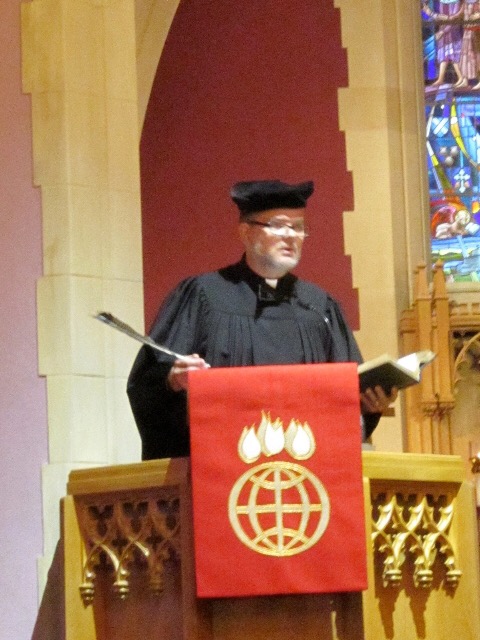
Annual Pastor’s Report

Effective Partnerships

The most significant event in the life of Faith Lutheran Church in 2016, was the decision to complete an extensive renovation of our worship space and narthex hallway. To complete this major modernization project, we partnered with the capable and esteemed contracting company from Stittsville, “Amsted”.

This decision precipitated what may in the long run prove to be just as significant, if not more so: The decision to join with the local Anglican parish on Sunday mornings during the time of the renovation (which lasted into 2017).

Even should nothing enduring come of the relationship between Faith Lutheran Church and Julian of Norwich Anglican Church, the mere exercise of gathering as a hybrid congregation for the last ten consecutive Sundays in 2016 plus two Christmas Eve services caught the attention of the Christian community in Ottawa and across our Eastern Synod.

Meeting to worship with local Anglicans affirmed both the existing Full Communion relationship between the Evangelical Lutheran Church in Canada (ELCIC) and the Anglican Church of Canada (ACC), an agreement existing since 2001. As such, given the other options during our vacancy from 43 Meadowlands Drive West, meeting with an Anglican congregation was attractive, since doing so facilitated many logistics of worship between our similar liturgies, as well as kept a certain momentum alive for meeting at all, during the renovation/vacancy period.

On Lutheran liturgy Sundays (every other Sunday) at Julian of Norwich, we expressed our unique identity within the union of two distinct congregations. For example, each congregation has different histories, as well as contrasting governance structures (i.e. Anglicans are governed episcopally, while Lutherans are governed in a congregational structure).

While comparing congregations is fruitful, challenging and enjoyable, the fact that we began this relationship knowing we were returning home at some point allows us to pose critical questions of review of our ‘way of doing things’ freely, both around sacramental practice and mission.

During the Eastern Synod Assembly in June, your lay delegate (Julia Wirth) and the pastor heard again the four main, missional themes of the Eastern Synod (Effective Partnerships, Healthy Church, Spirited Discipleship, Compassionate Justice). No doubt, our congregation participated in a way no other Eastern Synod congregation has, in affirming the value of seeking “Effective Partnerships” in fulfilling God’s mission, especially during times of need and change.

Loss and Transition

A basic assumption of committing to the renovation project was that we had to take leave of our current building, and specifically our place of prayer. Doing so was an act of courage. Leaving a place that has symbolized a constant certainty in the lives of Faith members for over fifty years was not easy. Our sense of stability in faith was disrupted, as we were challenged to distinguish between the form (‘our’ building) and function (the purpose) of faith.

This leave-taking coincided with other endings. June 2016 marked the last time the Faith Lutheran Women (FLW), structured the way they had been for the last few decades, met in typical fashion (see report). For some time prior to this they had been talking about closing their account and ceasing to meet ‘as is’. In the latter part of 2016, that talk became reality.

Also, the Confirmation program that for several years had been a successful experience for leaders and participants alike, did not in the Fall of 2016 achieve the critical mass of students to warrant a class structured in the same way. As a result, no program started up at the start of the school year.

These events, I believe, constitute ground for growth and maturity of our community as we practice the spiritual gifts of detachment and trust. The prophet Isaiah spoke the word of God to the exiled people in Babylon in the 6th century B.C.:

“Do not remember the former things, or consider the things of old. I am about to do a new thing; now it springs forth, do you not perceive it? I will make a way in the wilderness and rivers in the desert.” (Isaiah 43:18-19)

Before the new thing arrives, we need to stop the old thing. These endings are not failures as such; rather, they provide the space for the new thing God will have for us. What we are called to in disruptive times of loss and transition, I believe, is to be patient, have presence of mind and openness of heart, and be willing to take a risk together when something presents itself in our hearts as possibility and passion.

Poised for renewal

Moving into the new year, Faith Lutheran Church is poised to embrace a season of discernment, reflection and new beginnings.

Not only will we return to enjoy the gift of a refreshed, safe and healthy environment for meeting in our newly renovated building, we will be encouraged to reflect on what this space, created for at least another decade of ministry, worship, and mission, will be used for.

Late in 2016, the congregational council unanimously endorsed a proposal for a 3-month sabbatical for the pastor in 2017. The sabbatical covenant, based on the Eastern Synod Guidelines for Sabbatical, addresses the need for leaders to take periodic and extensive ‘pauses’ in vocational life, for renewal, reflection and discernment.

The benefits for the congregation mirror those for the pastor. From the perspective of providing some distance, a sabbatical gives freedom for everyone to step back, assess the structure of ministry and mission in the congregation, and contemplate new ways of supporting one another in our lives of faith.

For example, healthy congregations in general have several highly functioning lay leaders who engage proactively not only in managing a church, but in leading the mission of the church. The health benefits to the congregation, as for the pastor, following the sabbatical give opportunity for renewal of the mutuality of the relationship between pastor and congregation in God’s mission. The ‘reset button’ is pressed, and energy flows again.

Adaptive Change: Put away the mallets and start asking “Why?”

“There is a wonderful story of a group of American car executives who went to Japan to see a Japanese assembly line. At the end of the line, the doors were put on the hinges, the same as in America. But something was missing.

“In the United States, a line worker would take a rubber mallet and tap the edges of the door to ensure that it fit perfectly. In Japan, that job didn’t seem to exist.

“Confused, the American auto executives asked at what point they made sure the door fit perfectly. Their Japanese guide looked at them and smiled sheepishly. ‘We make sure it fits when we design it.’

“In the Japanese auto plant, they didn’t examine the problem and accumulate data to figure out the best solution — they engineered the outcome they wanted from the beginning. If they didn’t achieve their desired outcome, they understood it was because of a decision they made at the start of the process.

“At the end of the day, the doors on the American-made and Japanese-made cars appeared to fit when each rolled off the assembly line. Except the Japanese didn’t need to employ someone to hammer doors, nor did they need to buy any mallets. More importantly, the Japanese doors are likely to last longer and maybe even more structurally sound in an accident. All this for no other reason than they ensured the pieces fit from the start.

“What the American automakers did with their rubber mallets is a metaphor for how so many people and organizations lead … a series of perfectly effective short-term tactics are used until the desired outcome is achieved. But how structurally sound are those solutions?

“ … Long-term success [is] more predictable for only one. The one that understands why the doors need to fit by design and not by default.

“Going back to the original purpose, cause of belief will help … [churches] adapt. Instead of asking, “WHAT should we do …? the questions must be asked, “WHY did we start doing WHAT we’re doing in the first place, and WHAT can we do to bring our cause to life considering all the technologies and …[other] opportunities available today?” (1)

Being poised for renewal means we need to understand the nature of change in institutions such as the church. Some definitions, outlined in a report generated by the Eastern Synod Mission Committee late in 2016, draw the distinction between Technical Change and Adaptive Change:

Technical Change is about fixing problems while essentially keeping the system the same. In other words, where’s the mallet?
Adaptive Change, on the other hand, is about addressing fundamental changes in values that demand innovation, learning and changes to the system itself. Start with ‘Why?’ And then lead from there, by design not default.

During this coming year, which will give all of us permission to pause and reflect, please resist the temptation to rush into doing something either because ‘we’ve always done it that way’ or because we are too anxious not to remain awhile in the uneasy ‘in-between’ time of loss and transition. Be patient, take deep breath, pray, and reflect on the following questions:

Our adaptive challenge questions for 2017:
1. How do we communicate? To whom is each of us accountable?
2. How well do we listen and seek to understand the other? Give concrete examples.
3. Will we create a list of those who are not in church (technical strategy); or, will we identify the needs in the community surrounding 43 Meadowlands Dr West, in Ottawa (adaptive strategy)?
4. How will prayer be our starting point?
5. What are other ways besides worship that serve as entry points for the public to engage the church? This is important.
6. How do we see worship as a launching pad, not a destination, for following Jesus? This is very important.
7. What are the gifts we have as a church? (personnel, space, talents, passions, etc.)
8. How well do you know your fellow congregants’ jobs, professions, contacts, interests, hobbies, talents, passions?
9. Why do we initiate a ministry or mission outreach activity in the first place? Who is the target group? What is the purpose of doing it? Does everyone know the purpose? Why or why not? Is there general agreement about the purpose? Why or why not?

Thank you again for the privilege of another year doing this work with you. Blessings and Grace, on our journeys moving forward,
Pastor Martin

(1) Simon Sinek, “Start With Why”, Penguin Books, New York, 2009, p.14-15, p.51

Why? To melt hearts of stone

In a typical Canadian winter at this time of year, salt and light (Matthew 5:13-20), of course, serve a particular purpose.

It doesn’t matter how cold it can still get in February, if the sun is shining then the snow and ice will melt under the strengthening, radiant beams of warm light. And, with the occasional freezing rain still in the offing, that bag of salt sitting on the porch or in the garage can come in handy, to sprinkle on the walkways and driveways — to melt the ice.

Salt and light, in any given context, serves a specific purpose. I can remember when the kids were younger, one of ours had the habit of picking anything and everything up off the ground and putting it in her mouth.

I can remember needing to intervene when she was in her exploratory mode, walking down the sidewalk in the middle of winter. “Don’t eat it! That is road salt, dear. Not table salt.”

We are called to be like salt and light in the world. But that gift will serve a specific purpose, according to the context and circumstance of our lives.

How can we know what that gift is, and for what purpose it serves? It can be challenging to claim that gift for our lives, and then have the courage to use it. This can be difficult because the world and the dominant powers of culture may not support it. The gift and purpose may seem small in comparison to the dominant climate of coldness, hatred and violence so prevalent in the culture today.

Julian of Norwich in her first of Divine Revelations writes about the small hazelnut. She writes, that God “showed me a little thing, the quantity of a hazel nut, lying in the palm of my hand …. I marvelled how it might last, for I thought it might suddenly have fallen to nothing for littleness. And I was answered in my understanding: It lasts and ever shall, for God loves it. And so have all things their beginning by the love of God.”

It may seem pallid at first, even pointless. But there is power in small. Ezekiel writes, “A new heart I will give you, and a new spirit I will put within you; and I will remove from your body the heart of stone and give you a heart of flesh. I will put my spirit within you …” (Ezekiel 11:19;36:26-27).

In words that may make better sense in our Canadian winter, God is promising us that God will melt our hearts of stone-cold bitterness, resentment, fear and hatred. And put the warmth of God’s light in Christ and the loving power of the Spirit to change our lives, and the world around us.

Salt and light are gifts that are subtle and small, yes, similar to the smallness of the hazelnut. And yet, these are gifts you cannot easily hide. Nor will they go away. They are public gifts, not private, in scope. They affect the whole experience of living.

You cannot add salt to soup, and not notice a difference. You cannot throw ice-melter on the driveway, and not notice some change on the ground. You cannot stop the sun from shining, and not stop the smile that comes on a sunny day after weeks of dark, grey, cloudy existence.

Faith Lutheran has a renovated gift, the gift of a safe and modernized building — a gift, yes. But why will it be used? How will our (Faith Lutheran’s) soon return to that site on 43 Meadowlands Drive restore something that was missing in the neighbourhood while we were here (at Julian)? Or, does it? What difference does that gift make to the world around us?

Our gift has a purpose. And that purpose is meant to catch the attention of a world that is shrouded in cloudy days and numbed to the slippery vices of distraction, delusion and fear.

Why is this important? How is it worthwhile? In an age when the church in North America is facing challenge and change, perhaps it is time again to focus on the WHY. It has been argued that people don’t buy-in to the WHAT we do but the WHY we do it. (1)

We need to be clear about that. The only way we can know WHAT do do with our faith, the church and our buildings is first to claim, embrace and communicate clearly the WHY of our faith. The WHY.

In the aftermath of the tragic violence in Quebec last weekend, the premier challenged his province, indeed our whole society, to reflect and consider again how we treat one another in a culturally diverse community. How we treat one another through the changes and stresses of life that can be disruptive. How we treat one another who are different and come from different walks of life, religious experience and ethnic diversity.

Observing how we do what we do may also give us a clue to the WHY. I believe the church has a lot to offer this world of ours, as salt and light. St. Paul encourages the fledgling, conflict-ridden Corinthian church to claim their identity they already have, in Jesus: “We have the mind of Christ,” he concludes (1 Corinthians 2:16). And Jesus, in short, came to show the love and grace of God to a world so hung up on achieving, earning, competing, judging, proving themselves, excluding others and fighting.

I believe the church has a lot to offer this world. To reflect Christ, the light of the world: to receive the love of God, to accept the love of God, and then demonstrate that compassion and love to the world. It is behind everything we do in the church. Everything. Let’s not forget that.

To melt hearts of stone.
(1) Simon Sinek, “Start With Why” (New York: Penguin, 2009), p.58

Dialogue sermon – Epiphany 3A

The people who sat in darkness have seen a great light, and for those who sat in the region and shadow of death light has dawned (Matthew 4:16)

The people who walked in darkness have seen a great light; those who lived in a land of deep darkness — on them light has shined (Isaiah 9:2b)

Voice 1: We confess that we sit in darkness (Matthew 4).
Voice 2: We confess that we even have the gall to walk around in the darkness (Isaiah 9).

Voice 1: Whether we are moving, or staying put, the darkness of sin clouds our vision, purpose and value in the world. We stumble and fall —
When we exclude, and draw lines of division between the haves and have-nots;
When we ignore, avoid and despise those different from us who press into our private places, disturbing the darkness and isolation.

Voice 2: We confess our longing to sit and walk in the light.
A place to be, free from our stuck-in-the-rut-ness,
free from what holds us back — our prejudices and fears.
A place to affirm and re-affirm our call.

Voice 3 (from balcony):
Bethlehem.
Egypt.
Nazareth.
Jordan River.
Wilderness.
Capernaum by the Sea of Galilee.

Voice 4 (from balcony):
The places where Jesus had his beginnings —
moving,
interrupting,
disturbing,
challenging,
calling.

Voice 1: Where are we now? What place inhabits our vision?
We long to return soon to our home, at 43 Meadowlands (Faith Lutheran Church).

Voice 2: We long to identify our place in the mission of God to the inadequately-housed (Julian of Norwich Anglican Church).

PLACE IS IMPORTANT.

Voice 5:
Our place in this world.
Our purpose.
Where we pray, sing, do mission together.
Where we affirm week after week who we are in Christ,
the light of the world.

In relationships, where we act boldly, and immediately, as did Christ’s disciples of old.

Jesus comes into the places of our lives to change us, challenge us.
No longer complacent,
but urgent following.
No longer passive,
but active response —

Voice 1: to the God who has, does and will continue to shine
God’s light and love in Jesus Christ
upon all who sit and walk in the darkness of the world.

Checking our Image of God

Do you know “Good Old Uncle George”? (1)

Listen to this description of what happens when a family makes a visit to Uncle George who lives in, and never really leaves, his formidable mansion.

At the end of the brief visit in which the children describe Uncle George as bearded, gruff and threatening, he leans closely, and says in a severe tone of voice, “Now listen, dear. I want to see you here once a week. And if you fail to come, let me just show you what will happen to you.”

He then leads the family down to the mansion’s basement. It is dark, becomes hotter and hotter as they descend, and they begin to hear unearthly screams. In the basement there are steel doors. Uncle George opens one.

“Now look in there, dear,” he says. They see a nightmare vision, an array of blazing furnaces with little demons in attendance, who hurl into the blaze those men, women and children who failed to visit Uncle George or act in a way he approved. “And if you don’t visit me, dear, that is where you will most certainly go,” says Uncle George.

Do you know “Good Old Uncle George?” Sound familiar?

From the bible readings assigned for this season after Epiphany, we are asked to consider again who is this God we are called to follow. Of course, no one image of God is complete. Our perspective is limited, no matter how well we know the bible or how many degrees we may have behind our name. And God is greater and bigger than anything anyone can imagine or say.

Nevertheless, it is fruitful to examine what we think about God. Our image of God influences our own behaviour and what we do “in the name of God”, who is revealed in history, in our experience and in the Scriptures as God the Father, God the Son and God the Holy Spirit. Eventually, our actions mirror the God to whom we pray, to whom we relate, whom we imagine. (2)

I would like to highlight briefly three aspects of the character of God, in Jesus, that we can see in the story of Epiphany for today — the baptism of our Lord (Matthew 3:13-17).

First, Jesus moves. He does not sit still for too long. Jesus is baptized ‘on the side of the road’ so to speak. He is baptized nowhere special, not in some officially consecrated, designated holy place — but in the wilderness where John preaches ‘on the edge’ of civilization where crowds have to follow to be there.

In fact, the Jordan River is some 35 kilometres from Jerusalem. For people who walked, this would likely mean at least a two-day journey from the city. So, most of the people who witnessed this divine event and encounter between Jesus and John on the banks of the Jordan River had to travel to get there. Even the high priests and Pharisees, those in power and who held influence in the religious establishment of Jerusalem had to get there.

Who is God? God is more a verb than a noun; God is not static; God is always on the move; we can in this story of Jesus’ baptism appreciate the moving parts of faith. It is important to note to where God goes, and is revealed.

Mobility is a kingdom value. Going some place else away from what is familiar and comfortable is part of exercising a healthy faith. Conversely, staying in one place too long is not healthy for the soul.

Second, in this mobility God relates to us in vulnerability. In worship and praise of God we are accustomed to calling God Almighty. But, at the same time, if we are ‘getting’ Jesus, we ought to be calling God Al-vulnerable.

Jesus relates to us. The divine becomes one of us in moments of vulnerability, especially. The primary symbol of Christianity, the Cross, points to the ultimate, earthly destination of Jesus, and reveals our most vulnerable God. The Cross is a sign that says: God understands us even in death and dying.

What is unique about Matthew’s version of the baptism of our Lord is that it is meant for public witness. Unlike the other Gospel accounts who make this event more of an inward, spiritual experience of Jesus, Matthew portrays the baptism of Jesus as an external event, available to all present.

Also, Jesus submits to baptism not because he needs his sins washed away. Through this act, Jesus was indicating his willingness to yield his life, to surrender his life, in obedience to his Father. Jesus requests baptism by John so that he could completely identify with those he came to save.

Therefore, relationships described by mutual vulnerability is another kingdom value. Being with others in this way, in community, is vital for faith. Prolonged isolation and emotional detachment from others is not healthy for the soul.

Finally, not only is God in motion and in vulnerable relationship with us, God is reaching out to us, immanent and present to our common lives.

Jesus’ father in heaven calls to him, validates and affirms his path. Then, too, Jesus calls his disciples. Jesus does not do it alone. He includes his disciples in his travels, walks in their shoes, involves himself in the common, daily activities, gets his hands dirty — so to speak.

Jesus is the son of a carpenter from Nazareth, he fishes with his disciples, he goes to weddings and drinks wine, he hangs out with all people not just the ‘good ones’.

Jesus does not leave us alone, some distant, transcendent God who does not care about what happens on earth. Jesus will not stop reaching out to us, and will beckon us to follow where he goes. Jesus continues to engage our lives, touching our hearts, our hands and our minds, in the very course of our lives on earth. God will intervene, and pierce our perception, inviting us into a new way of being and doing.

Today, followers of Jesus can consider anew this God who is revealed to us in Jesus. Jesus is the divine-man, who walked everywhere and moved around a lot; Jesus is the God who seeks relationships and models vulnerability and self-surrender; Jesus is the God who will not leave us alone and continues to call out to us to follow in his way.

May God bless the path we journey. Amen.
(1) cited in Dennis Linn, Sheila Fabricant Linn & Matthew Linn, “Good Goats: Healing our Image of God” (Paulist Press, New York, 1994), p.3
(2) ibid., p. 7ff

Christmas in July


This past summer my family visited friends in Italy. We spent three weeks touring around mostly the southern half of mainland Italy — Naples and the Amalfi Coast especially. In this region in summer, the weather is tropical. Palm trees, humid air, full sun and temperatures soaring. We wore shorts and sandals, t-shirts and hats the entire time.

One of our highlights was visiting the Green, or Emerald, grotto near Positano on the Amalfi Coast. We had to take an elevator down from the snaking roadway to the water line. Then, we entered small boats for a tour around the cave.


The grotto was named “Emerald” for the incredible colours that filter from an underground opening and fill the cave with intense nuances of green. The inside of the cavern is filled with stalagmites, stalactites and beautiful works of art created by time and nature.

Near the end of the tour when the boat was paddled close to a wall of the cave, our tour guide asked us to look down into the sparkling, luminescent water on the one side of the boat. “What do you see?” he prompted us. For the longest time, I could see nothing, just the rippling waters.

Then, as the light continued to play on the currents swirling some ten feet underneath us, I saw it:

The grotto is home to an underwater nativity scene, made by a ceramics artisan from nearby Vietri in 1956. Since that time, divers from all over Italy come to pay a visit to the Holy Family at Christmas. But it wasn’t Christmas.

For me, the traditional nativity set felt out of place – a kitsch decoration in a natural, marine setting in a tropical paradise. From my Canadian perspective, it felt all wrong. This didn’t belong here.

It was the least-expected time and place to be reminded of Christmas. Christmas in July, where temperatures were well into the 30 degree celsius range, far away from home on the Amalfi Coast in Italy. On vacation. Christmas was the farthest thing from my mind!

In the Christmas children’s book by Eve Bunting, entitled, “We Were There: A Nativity Story”, she illustrates how the least expected animals very likely also attended the birth of Jesus: a snake, a frog, a scorpion, a cockroach, a bat, a spider and a rat.

It is written from the perspective of these least likely characters who are thankful for the more popular donkeys, sheep and cows who are “so generous to share their place” by the side of the manger. She concludes:

No one will look beyond the light to darkness
and the corner where we watch, unwatched.
They will not know or care.
But we were there. (1)

This children’s book makes a deep, theological point! The problem: We don’t see that God is there. We only expect to see God in certain places, at certain times:
Only at Christmas once a year in a crowded, decorated church;
Only in warm, comfortable stables where clean sheets and cutesy animals surround a quiet baby lying in the arms of a domicile Mary;
Only when good times roll with egg nog at the hearth of a roaring fire sitting in your favourite chair;
Only when choristers sing your favourite carols;
Or, only when everything is perfect.

We’ve locked God into the proverbial box.

The good news: God blows all our contrived and constricted expectations. God comes to us in all times and places, especially when we least expect it, even when we are not thinking about it, or planning for it.

While the dominant Christmas culture depends on our planning and organizing and ‘setting it up’, God comes to us despite all our fussing and fretting.

In truth, God is already there, just beneath the surface, out of the reach of the light, in the shadows where no one is looking or even caring.

Our job is not to make God happen by all our toiling and efforts to create the best Christmas ever. We don’t achieve God’s presence. Our job is simply to recognize where God is already present. Our job, simple though not easy, is to surrender to God who is already there. And this takes practice and intention.

So, this Christmas holiday, take a walk downtown where street people continue to ask for money. This Christmas holiday, search out an old friend with whom you haven’t spoken for a long time. This Christmas holiday, do something that you normally would not do, for the common good. This Christmas holiday, recognize the gifts you already have, not just in those presents packed under the tree.

Give thanks for the gifts you enjoy every day of the year — friends, family, love, community — the blessings that come from learning to want what you have instead of having what you want. Exercise the skill of seeing where and what many will not.

The joy of Christmas be with you. The gift of life and love in Jesus is born anew in our very lives. Today. And no matter where you are and whatever the circumstance of your life. God is already with you, waiting to be seen.

(1) – Eve Bunting, “We Were There: A Nativity Story” (Clarion Books, New York, 2001)

No easy way up those stairs


Perhaps you know someone like Sue.

Sue had Multiple Sclerosis (MS). As the disease progressed in her relatively young life, she nevertheless wanted to stay at home as long as possible. Her house, unfortunately, was not outfitted appropriately for someone in her debilitating condition.

And yet, she battled. For example, it took her twenty minutes to crawl upstairs to her bedroom. Sue called the stairs “Mount Sinai”. Because it was by struggling on those stairs, moving limb for limb through each laboured breath through gritted teeth; it was through determination for each step gained, that she learned so much (1).

The prophet Isaiah does this to us again — gives us an ideal vision of a world where no one suffers any longer, a utopia where everyone is joyful. What is perhaps even more astounding is that this vision of hope and promise is proclaimed in the midst of everything that was not:

These verses speak to Babylonian exiles (2). They are the captives of war, and as such have been wounded maimed, even intentionally blinded as was King Zedekiah (2 Kings 25:7). It is to this failed community now subjugated and marginalized in an oppressive regime far away from Jerusalem that Isaiah paints this picture of a highway leading back home through the desert (Isaiah 35:1-10).

The cynic in us alights, as it must have in many of the exiles in the sixth century B.C.E. For, when do we see the eyes of the blind opened, the ears of the deaf unstopped, the disabled leaping like a deer, the tongues of the speechless sing for joy? (vs.5-6). Words that Jesus later repeats almost verbatim (Matthew 11:5; Luke 4:18) surprise because he seems to validate the promise of a vision, hundreds of years after Isaiah, that has yet to be fulfilled.

The vision, the promise, operates like a bouncing ball through history. Indeed, our world to this day — two thousand years later — is still rife with human brokenness, both visible and hidden from sight. Many have given up on God precisely because they can’t see how a God of love can be represented in a world of suffering, disease, violence and disability.

What if this promise is given, is meant, for us today? Can we believe it? Yet, perhaps human beings will always struggle with the God who came, and is coming again and again, in Jesus. We have to be careful with Isaiah’s vision, for it can pander to our perfectionism, which denies the reality of a life lived in the graces of God: That what is of God is exclusively the purview of the rich and famous, successful, beautiful and handsome — only for the perfect ones.

Perfectionism pretends that we have to achieve that vision of wholeness and restoration by our own herculean efforts and responsibilities. A denial of the suffering in life leads us to attempt a path around all that is difficult, challenging and transformative.

“A highway shall be there, and it shall be called the Holy Way, and the unclean shall not pass it by, but it shall be for them.” (Isaiah 35:8)

When John the Baptist shouts that the coming Jesus will make a way through the aridity and desolation of the desert (Matthew 3:3), it bears reason to pause and reflect on the place of John’s prophetic work. Not in the public square in downtown Jerusalem nor on the steps of the Temple.

He stands on the banks of the Jordan River — which separated two worlds. On the one side, the desert which represents the long journey, the pilgrimage, that the people of God made from slavery in Egypt. On the other side of the Jordan lies the Promised Land, the place of arrival, destination, highlighted by the holy city of Jerusalem.

John the Baptist stands preaching words of challenge and hope in the in-between place — the River Jordan. Baptismal in its imagery, this in-between space is the place where something happens. A change occurs in our lives. The space in-between is often a place of disruption as the mental furniture of long-held beliefs, assumptions and values are re-arranged. In this in-between place of discomfort and turbulence we experience, nevertheless, a transformation to be people ‘on the way’ to our destination with God.

We must be willing to go there. And not deny this path through the wilderness. A holy highway does not circumvent the desert places of our lives. What ails us, what disturbs us, what challenges us — these are often valuable clues, yes even invitations, to a deeper engagement with our lives and with God. The disruption is actually God calling us into a transformative experience of life.

Do we accept this? Advent is a time to be honest. Advent is a time of reckoning. Will we stay the same, stuck in our inhibitions and motivated by fear? Or, are we willing to take the risk and go through this in-between place that does not deny our suffering and discomfort, but which actually holds redemptive power?

It is no accident that God chose to be revealed in a broken body. A bloody and pierced body hanging on a Cross. God showed us the way, in Jesus’ death and resurrection. God opened to us the way of salvation.

We know God saves. The names of Isaiah, and Joshua — important in the Hebrew Scriptures — echo the same meaning of Jesus’ name: God saves. No dispute there. But what is the way, the how, of God’s saving? How does God save?

The path through the desert. Before there is a re-ordering of our lives, there must first be a dis-order or sorts. There is no direct-flight from ‘order to re-order’ as much as we might wish there were. In God’s realm, according to the way of Jesus, we must go from ‘order to dis-order before arriving at re-order’ (3).

Julian of Norwich wrote: “First the fall, and then the recovery from the fall. And both are the mercy of God” (4).

We can’t have Easter without Good Friday. Both are held in tandem. Even today in popular Christianity, people avoid worshiping on Good Friday; most experience the ‘hosananas’ of Palm Sunday only to return the following Easter Sunday to sing ‘halleluia’. No wonder we get seduced by culture’s ‘glory’ theology that pretends we can somehow deny suffering in order to validate our faith.

But without somehow acknowledging the Passion and suffering of Holy Week culminating in death on the Cross of Good Friday, we miss the point of Easter. We miss the point of Christianity:

The body of Christ is broken in love for us. God loves us not despite our brokenness as human beings but precisely because we are broken.

Lutherans talk a lot about grace, and unconditional love of God for us ‘while we were yet sinners’ (Romans 5:6-8). This is good talk. But — being a diehard, lifelong Lutheran myself and so I can say this — it is not easy living, behaving and inter-relating according to that unconditional-love-‘way’ with others. It may be a simple concept for the mind to turn over and accept, but it certainly is not easy for our egos to put into practice.

Climbing the steps of “Mount Sinai” as Sue was want to do was a feat of incredible endurance. Whether it took her twenty minutes or two hours is not the point, really. It’s the journey: Learning to love, forgive and accept our lives not because everything is ‘just right’ but precisely because God is there in the ‘not alright’ — is a discipline that may indeed take a lifetime to learn.

Enduring whatever suffering comes your way. Grieving whatever loss or mourning a loved one. Carrying on in the midst of the in-between places of our lives. Being present to all the feelings and thoughts and sensations of life — good and bad. Accepting our own imperfection and disability — and still enjoying moments of grace with one another on the way.

So as we learn on the way, may our journeys be inspired by moments when we do experience the presence of a God who understands and walks with us, when the vision appears no longer a mirage on the horizon of reality. But is truth incarnate. An inexplicable gift of joyous wonder.

When, “everlasting joy shall be upon their heads; they shall obtain joy and gladness, and sorrow and sighing shall flee away” (Isaiah 35:10).


(1) Charles Foster, “The Sacred Journey” (Thomas Nelson, Nashville, 2010), p. xxiii
(2) Bruce C. Birch in David L. Bartlett & Barbara Brown Taylor, eds. “Preaching the Revised Common Lectionary; Feasting on the Word, Year A, Volume 1” (WJK Press, Kentucky, 2010), p.51-55
(3) Richard Rohr, “Daily Meditation”, Tuesday, December 6, 2016 (Center for Action and Contemplation), http://www.cac.org
(4) Julian of Norwich, “Revelations of Divine Love”, 61, ed. Grace Warrack, R.Rohr paraphrase (London: Methuen & Company, 1901), p.153

A Poem from Rainer Maria Rilke

“My eyes already touch the sunny hill

Going far ahead of the road I have begun.

So we are grasped by what we cannot grasp;

It has its inner light, even from a distance —

And changes us, even if we do not reach it,

Into something else, which, hardly sensing it, we already are.”


Rainer Maria Rilke, “A Walk,” quoted by Robert Bly, Iron Man (Cambridge, MA: DaCapo Press, 2004), p.49

Martin Luther visit


Guten Tag. Allo. Ich heiss Martin. My name is Martin. Liebe Gott! I can speak English! Something incredible happened to me on my way to this time and place. And I cannot explain it! So, “Here I stand.” With you. In this place. Today.
You know, truth be told, I don’t know what to make of this “Lutheran Church”.

Yes, it’s been a long time — 500 years — since I hung the 95 Theses on the door of the Wittenberg Church. So much in the world has changed. Travel, electricity, automation, information systems. And yes, I did write a lot with my hand. I suppose I would do things differently today, as well. Who knows?

But I noticed that some of my words have taken on an iconic status in your discourse through the centuries. And so, I’ll start there and tell you what I observe about your “Lutheran” church today — I feel awkward even saying that word: “Lutheran”! Who the hell do you think I am? “It’s true, we are all beggars!” Even me!

So, let me set the record straight. First off, I never intended there to be a separate church, divided from the Catholic church. Oh yes, a toilet-flushing theology underpinned some religious practices at the time, beliefs that needed reformation. I was excommunicated. And that meant death. But the Lord had a purpose for me still to fulfill, and I was spared. Thanks to Frederick, who let me live in his Wartburg castle for a time being.

Obviously, I still have a purpose or else I wouldn’t be standing here today. I am amazed to see how many different churches exist — and some even taking on my name! In a letter I once sent to my colleague Philip Melanchthon, you know, I encouraged him to “sin boldly, but believe and rejoice in Christ even more boldly.” He must have taken my words seriously — the “sin boldly” part, anyway — since he pushed my reforms to brink of dividing the “one, holy, catholic church.” Dumbkopf!

Which, it seems, has happened here in Ottawa as well. I take it that Lutherans from my Heimat, Germany, arrived quite late in Ottawa — later than in other parts of Turtle Island — is that not what the first nations of this land call it, this Canada?

I have secret to tell you — the Germans have long since stopped getting off the boats and settling this land in large waves of immigration. You are all settlers! And, the first Lutheran Church was St Paul’s Lutheran Church near the University of Ottawa, established in 1874. For the most part of your history since then there have been some 15 Lutheran congregations, no?, divided basically into three different Synods — the Evangelical Lutheran Church in Canada, the Lutheran Church Canada-Missouri Synod, and the Wisconsin Evangelical Lutheran Synod.

“What does this mean?”. You who have endured Confirmation classes decades ago, yes I’m speaking to you now: When you memorized parts of my Small Catechism, you will remember I sectioned parts of the Creed, the Lord’s Prayer, and the Ten Commandments, for example, I offered my interpretation of those sections preceded by the question: “What does this mean?”

I did that on purpose. Don’t you know that asking the question itself reflects an important stance towards learning? “What does this mean” is a question that first seeks to understand. It doesn’t presume you already have the answer.

I certainly didn’t at first. I struggled mightily with my own stuff, and spent a whole lot of time on that blessed toilet seat! I had doubt and prayed: “Lord, I believe, help my unbelief!” (Mark 9:24).

The purpose of your Lutheran Council, for example, which functioned between 1968 and 1992 (I learned in your history books), was “to foster greater understanding between Lutherans in Ottawa” (1) — this amid conflicts over biblical interpretation, Communion practice and ordination of women to suggest a few enduring divisions. Good for the Lutheran Council! They were onto something, there, you know!

Learn from the first nations of this land. Among the diversity of Indigenous Peoples of Canada comes the wise advice: Seek first to understand, then to be understood. First, however, to understand the other. Not to persuade, to defend, to self-justify, to impose one’s opinion. Which appears to be the dominant characteristic of relationships in the church and the public today. You believe you first have to defend yourselves.

“What does this mean?” can be a call sign for you “Lutherans” today, indeed for all of mature faith, on how to learn, how to grow, how to move forward to embrace God’s future. You do so first by seeking to understand the other. Ask questions. Try to feel into from where the other is coming in their approach. Listen for smidgens of truth, of potential points of agreement, of overlap between what you hear and where your own heart resonates.

There’s another phrase some have said I wrote. But I didn’t. One of your modern theologians, Karl Barth, actually wrote it, based on something Saint Augustine of blessed memory wrote: “Semper Reformanda” — Always reforming. It’s still good and wise counsel! The Evangelical Lutheran Church in Germany (Evangelische Kirche Deutschland) has as the theme logo for the 500th Anniversary of the Reformation: “500 Years of Reformation”, suggesting that these past 500 years represent a continually reforming church. I like that. Sehr gut!

I know you like “A Mighty Fortress is our God”, ok? But I wrote that hymn in order to bring the popular music of my day into the church. I confess I spent much time in bars during my travels across Germany enjoying the local ales. And I sung along to the bar tunes, and wondered: “Wouldn’t this sound great in church!” And so, I took some of those tunes and transformed them into hymnody.

Why are you still singing “A Mighty Fortress” to celebrate the Reformation? The very idea of 21st century “Lutherans” celebrating the Reformation by clinging to the events of the 16th century doesn’t make sense, if you believe you are truly Semper Reformanda. I travelled all this way through space and time; I want to hear some of your new songs! 

We should be singing this century’s music rather than smugly resting on the laurels of the past, you would say. You should be plotting where the reformation goes from here. Perhaps in this the 21st century, when so many of your traditions have seen the institution fall into the malaise of irrelevancy, you need to echo the cry: “Semper Reformanda” — “Always Reforming”. Indeed, the church in every age stands in need of reformation (2).

In my Disputation in Heidelberg, a year before I hung those famous Theses on the doors of the Wittenberg Church, I stated that, “The Law says ‘do this’ and it’s never done; Grace says, ‘believe in this’ and everything is already done.”

The quality and practice of faith today is on trial. What do you believe about God, and your life with God, others and this world? Reformation starts with those questions.

I’m glad to see you still say, at least, that we are justified by grace through faith.

And when I read the Jeremiah (31:31-34) text for today, I must confess we are often our own worst enemy. When we try so hard and work so hard but underneath all that work is a niggling belief that it’s all up to us. We are most ready to hear those words of grace, forgiveness and mercy, I will confess, when our own efforts are exhausted. When we are weary of our inner turmoil we are ready to hear the Gospel of Jesus Christ. And believe. And trust.

Because by my own understanding or strength I cannot believe in Jesus Christ, in God, or anything good!

Do the work of God, yes. But allow God, in the end, to reap God’s own harvest. Believe in that which cannot be seen, towards that which can be seen (Hebrews 11:1). It won’t be our accomplishment when it finally happens. Because all is grace. All is love.

“This is most certainly true.”

I’ll tell you what else is true. There are some new words circulating among Lutherans in Ottawa these days. I’ve heard them. Who are you? You are “many communities and one church”. And you are “better together.” The fragmentation of the church which has been the unfortunate legacy of the Reformation needs reformation.

How can you see it? This is a matter of faith and belief? Do you believe that though you are many communities you are still one church? Do you believe you are better together?

This is not a figment of someone’s imagination that has mere mythic, allegorical status, invisible and irrelevant.

After all, when in the last year you gathered together at a Peace pole and prayer garden; when you gathered together to recall the history of the relationship between Indigenous and setter peoples in the blanket exercise; when you gathered together on Ash Wednesday and during Advent to worship; when you support a city-wide youth group by gathering together to have fun at summer fest; and when you serve together to do refugee sponsorship — it is real. It is tangible. It is visible.

And it is happening in a Lutheran community near you!

This is most certainly true!

(1) Barton Beglo & Jo Nordley Beglo, eds., “By Faith; Lutherans in Ottawa and the Valleys” (Ottawa: St Peter’s Press, 1995), p.66

(2) Dawn Hutchings, pastordawn.com “Enough with ‘A Might Fortress’ Already! Sing a New Song”

Funeral sermon – Thanksgiving

Isaiah 25:6-10 —

On this mountain the Lord of hosts will make for all peoples a feast of rich food, a feast of well-matured wines, of rich food filled with marrow, of well-matured wines strained clear. 

And he will destroy on this mountain the shroud that is cast over all peoples, the sheet that is spread over all nations; he will swallow up death for ever.

Then the Lord God will wipe away the tears from all 

faces, and the disgrace of his people he will take away from all the earth, 

for the Lord has spoken. It will be said on that day,

   Lo, this is our God; we have waited for him, so that he might save us.

   This is the Lord for whom we have waited; let us be glad and rejoice in his salvation. For the hand of the Lord will rest on this mountain. 

It is not insignificant, I believe, that Peter died on Thanksgiving. It’s a paradox of the utmost to grapple with this most grievous reality — on a day when we are supposed to be thankful for all good things, someone beloved is taken away from us. The pain of loss digs sharply into our hearts to have to face death when this loss occurs on Thanksgiving weekend, of all times.

How can we be thankful in such circumstances? Is this possible?

We say that a funeral service is about a “celebration of life”. When we name it such, we choose to focus on life. Then, perhaps we can begin to approach the notion of giving thanks even amidst the turmoil of grief.

Because “death does not end our relationship with those who have died. Relationships at their deepest level are not of the body, but of the spirit. And in that sense, they are never over. The crux of a relationship lies not in its form, but in its content.” (1) Living into heaven, but starting on earth.

It is our work on earth, especially now that Peter has died, to tap the gift of faith in us and deepen our understanding of the eternal nature of relationships, and the eternal nature of love. This understanding, I believe, can bring peace to even a tormented heart.

We need to use our imaginations, and examine our beliefs honestly. The gift of faith grants those who wish to exercise it a rich imagination that is filled with God’s good promises, and the blessing of love lived out.

The image the prophet Isaiah paints is rich indeed! A feast on the mountain where there is more than enough good food and wine for all people! What a beautiful image of heaven, a promise to those who can imagine such a thing. And to all people, not just to those whose faith seems impressive on the outside, not just to those who appear spiritual. But to all.

Since Peter, I hear, was quite a cook, he would appreciate the attention to detail required to put on such a scrumptious and generous gift of food for all. I can imagine him today, one of the cooks in God’s kitchen!

Thanksgiving, as I’ve said before, is not a feeling that presumes all is well all of the time. In truth, thanksgiving is an action that stems from a belief in the never-ending power and unconditional nature of God’s love, forgiveness and presence — especially in the darkest and most trying of times.

“Faith, hope and love remain. And the greatest of these is love,” writes Saint Paul to the Corinthian Church. “Your anger, O God, lasts for but a moment; your love and mercy endureth forever,” sings the Psalmist. Again, Saint Paul to the Romans: “Nothing can separate us from the love of God, through Jesus Christ our Lord — not even death, nor principalities, nor things to come.”

These promises of God’s enduring love can be an anchor for you in a tumultuous, stormy sea of life. Such visions of God’s generosity are like salve to the troubled soul.

As you grieve the death of a dear husband, son, brother, brother-in-law and friend, I pray your thanksgiving for his life leaves a legacy of God’s love amongst yourselves, and in the world, for the days ahead.

Peace be with you,

Amen.

(1) Marianne Williamson, “Tears to Triumph; The Spiritual Journey from Suffering to Enlightenment” (HarperOne, New York, 2016), p.123-127

Blueberries where the forest was

A congregational treasurer once asked God how long a million years was to Him. God replied, “A million years to me is just like a single second in your time.”  

Then the treasurer asked God what a million dollars was to Him. God replied, “A million dollars to me is just like a single penny to you.” Congregational finances being what they were, the treasurer got her courage up and asked: “God, could I have one of your pennies?”  

God smiled and replied, “Certainly, just a second.”

I think it’s more often the case in our spiritual journeys that we do not simply get what we ask for, or want. The faith life just doesn’t work like that. Even though in popular religion we often joke about it.

When people banter with me about having a special connection to God when we want better weather, I like to remind them that I’m in sales, not management. Indeed, in the popular mindset we live with this idea that somehow we ought to manage what really is the purview, the domain, of God.

And in tough times we struggle with it. Why doesn’t God do what WE think is the solution to our problem: Cure our illness, give us money to make ends meet, solve our problems, etc.? Of course we hear stories that are exceptions to this. But even then, the answers to the prayer request don’t come in precisely the way we expected they would.

It reminds me of a Valentine’s day card that I’ve seen. On the outside of the card is the catchy phrase “You’re the answer to all of my prayers.” On the inside of the card are the words “You’re not what I prayed for, but you’re the answer to all of my prayers. You’re what I got!” 

It is true: everything we have in life is ‘what we got’ whether we like it, want it, or not. We run into spiritual and emotional trouble whenever we feel like we must control the outcome of all that we do and are. How much do we miss what’s there because we are expecting to see what’s not there? What we don’t have? What we’ve lost? What isn’t any longer?

At the ‘generous giving’ practicum I attended this past week in Orillia with other clergy from the Eastern Synod, several speakers spoke to us about the nature of giving. The general secretary of the Anglican Church of Canada, the Ven. Dr. Michael Thompson, told of the time when he and his wife hiked a challenging trail in Lake Superior National Park last summer.

Coming over a rise they descended into a valley devastated by a forest fire a couple years back. The contrast from the lush pine and spruce forest they had just left was stark. Now, they walked gingerly among the burnt out stumps in a moonscape land. The birdsong had disappeared into an eerie silence. The rustle of underbrush caused by scampering chipmunks yielded to wind gusts sweeping across the vast, exposed earth.

Where were the tall trees? Would they ever return? How long would it take? Michael and his wife began to despair as they hurried to leave the depressing scene and return into the cover of mature forest once again.

Then by their feet a blueberry caught their eye. As they lifted their vision, they saw not just one blueberry but a bush, and not just one blueberry bush but actually the whole place was teeming with blueberry bushes surrounding the base of the tree stumps and fallen timber.

They stopped to consider the gift of abundance that lay at their feet in the blueberries: the sweet taste, the healthy nutrition, the food for many creatures of land and air. And then the possibilities of scrumptious blueberry pies and jams. All of a sudden their mood shifted, and they began to see and talk not about what was missing anymore. But the new thing that was appearing out of the ruins of fire and loss.

Indeed, especially on Thanksgiving weekend, it can be hard to feel thankful, especially when we focus either in the direction of deficit and scarcity, or in the delusion that we are the reason of all that we have. When we lean either way we may have trouble understanding what it means to live by Paul’s words in his letter to the Philippians: “Rejoice always, again I will say rejoice!” (4:4). 

How can we rejoice always, when we focus on scarcity on the one hand, or pretend it’s all up to us on the other? Either way, we remain depressed or stressed to the hilt and cannot, in the words of the Deuteronomist, “celebrate with all the bounty that the Lord your God has given to you and to your house” (26:11).

The Lord instructs the people, when they enter the Promised Land, to bring their basket of offerings to the priest at the altar. The giving doesn’t stop there, however. They need to be reminded again and again that it was God who listened to their prayer and brought them out of slavery in Egypt to freedom in the Promised Land (Deuteronomy 26:1-11). In the Gospel for Thanksgiving Day, we read Jesus’ words reminding his listeners again, that it is his “Father in heaven” who is the source of the bread we need (John 6:33).

Perhaps the secret to thanksgiving is in seeing what is actually there, what God has actually given, and not fixate on what is “missing” all the time? Perhaps Thanksgiving is not only about giving, but also about receiving. What if the secret to thanksgiving is noticing the blueberries where a forest should of /could of/ would of been, if not for the fire?

It is our nature to give and to receive with joy. As Christians we have a choice. It is a matter of belief, and intention. We can submit to our ego cravings to keep ‘what we got’ for ourselves, pretending we are the source of all the good in our lives. Or, we can give ‘what we got’ for the benefit of the world which God so loved (John 3:16). And rejoice!

Thanksgiving is not a feeling. It is an action. It is intention, and practice, and discipline. Why do people give, today? There are some cultural changes we need to recognize. If you are of a certain age, born before the latter part of the last century, you likely give because of duty, responsibility and commitment. That’s not the case in recent decades, if you haven’t already noticed, among younger people. Only 29% of Canadian donors in 2013 reported donating to fulfill religious obligations. (1)

The reality, today, is that younger generations will give of their time, talent and treasures when they feel compassion in the community and hope towards their giving. They need to be inspired, not guilted. In other words, people today give when they believe in the mission of whatever group or activity — including the church’s work and programs — if they are inspired and compelled by a belief that their engagement with the church will make a positive difference in the world.

Statistics Canada reports that the vast majority of Canadian donors today (91%) said that the reason they donate is that they feel compassion towards people in need (2013 General Social Survey released in Dec 2015); other reasons for donating often cited include the idea of a helping cause in which they personally believe (88%) and wanting to make a contribution to their community (82%).

There is much for us to be thankful. Giving levels in Canada between 1984 and 2010 have steadily grown, contrary to what you might think; charitable giving peaked in 2010 (the last year this was tracked) with a gross amount of $15 billion. In other words, over the last couple decades people are giving more, not less. And what is good news for us in the church, is that 60% of this $15 billion was faith-based.

This community of faith has given generously to the refugee sponsorship, to Lutherlyn Camp and Conference Centre, to our youth initiatives. This community of faith has given of its time, talents and treasures for the last quarter century to the Carlington Community Chaplaincy. This community of faith has always been generous, giving at least 10 percent to the work of the wider church in benevolence offerings. And, I’ve just scratched the surface.

You people are very generous in your giving. And this culture of generosity, of compassion and commitment, is the heart of what we are all about as Christians, as followers of Jesus who gave his all, for us.

And so, on this Thanksgiving Sunday in Canada, on behalf of all the people in Ottawa, in Canada and in the world who have benefited in small and big ways over the years from your generous giving — I want to say a heartfelt “Thank you!”

Let’s pray together “The Prayer of Thanksgiving” written by Walter Rauschhenbusch:

For the wide sky and the blessed sun,

For the salt sea and the running water,

For the everlasting hills

And never-resting winds,

For trees and the common grass underfoot.

We thank you for our senses

By which we hear the songs of birds,

And see the splendor of the summer fields,

And taste of the autumn fruits,

And rejoice in the feel of the snow,

And smell the breath of the spring.

Grant us a heart wide open

To all this beauty;

And save our souls from being so blind

That we pass unseeing

When even the common thornbush

Is aflame with your glory,

O God our creator,

For ever and ever.

Amen.
(1) Kerilyn Voigt, “Generosity – What Moves Us to Give?” Canada Lutheran Vol 31 No 5 July/August 2015, p.10-14; also, from the Eastern Synod ‘Generous Giving Practicum’ October 2016