A wedding sermon: To expand and include

In a moment, we will share candlelight in this circle of friends and family. Sharing the light is a symbol of the meaning of marriage. Just as one candle shines its light in the darkness and with other candles expands the field of vision, so the nature of the rose bud is to open and expand into the world. Each of you receives a rose from the bridal couple.

Like the rose bud, the human soul defines itself in the same way. The soul’s nature and purpose is to expand and include, by offering a courageous ‘yes’ to life.[1]The soul, in all human goodness, always says ‘yes’. Wherever and whenever ‘no’ must be said, it will follow the initial ‘yes’. ‘No’ never leads in a life of faith, and love. ‘No’ will find clarity and effectiveness only after the gracious lead of ‘yes’ – to any and all of life’s circumstances and situations, marriage included.

The primary words in a wedding service, traditionally and effectively, are spoken by the bride to the groom, and the groom to the bride: “I do.” In other words, “Yes! I will.” You cannot come to a wedding service without the energy of the “yes” defining this very moment. Thanks be to God!

In the time I have journeyed with the bridal couple in preparation for this day, I have witnessed in them a celebration of who they are as a couple. I have witnessed an emerging and resilient joy at their union. And the gift within them.

Each of us has a gift inherent and living within us. I invite you to participate now in a brief guided meditation to experience and touch that gift within your life. You may close your eyes or focus on the rose in front of you:

‘Imagine, for a moment, a rose bud. At first, the rosebud is closed and enveloped by its green sepals. Now, imagine that the sepals start to open, turn back, and reveal the petals inside – tender, delicate, still closed.

‘Now, the petals themselves slowly begin to open. [Such is the process of growth in us.] As you imagine the petals slowly begin to open, perhaps you can become aware of a blossoming also occurring in the depths of your being. You may feel that something in you is opening and coming to light.

‘As you keep visualizing the rose, you feel that its rhythm is your rhythm, its opening is your opening. You keep watching the rose as it opens up to the light and the air, as it reveals itself in all its beauty. You smell its perfume and absorb it into your being.

‘Now gaze into the very center of the rose, where its life is most intense. Let an image emerge from there. This image will represent what is most beautiful, most meaningful, most creative that wants to come to light in your life right now. It can be an image of absolutely anything. Just let it emerge spontaneously, without forcing or thinking.

‘Now stay with this image form some time and absorb its quality. The image may have a message for you – a verbal or a non-verbal message. Be receptive to it.’[2]This is the gift of the rose for you today, on this joyous occasion of the your union.

There is something beautiful emerging out of this expanding and inclusive circle. From the union of two, comes the growth of an emerging new family, including more and more people, an expansion born out of the ‘yes’ of love, life, and light.

In your opening notes about the service, dear couple, you quoted from the bible a verse from Proverbs (17:17). “A friend loves at all times.” The verse goes on to say that these relationships bear together not just the good times but the challenges of life, too. Despite the dissonance inherent in all relationships, someone stands by you. This, too, is an important image for the journey of marriage.

When I bought the same Sony receiver that you have in your home, I connected them to some old Sony tower speakers that I’ve used for years. You’d think that the same brand would create a perfect compatibility. But, I neglected to consider what connected these two parts. To connect the speakers to the receiver, I used the same, old speaker wires whose ends were frayed to put it mildly.

As a result, whenever the receiver is plugged into the electricity, I can hear this faint but persistent humming sound. For some reason, the wires inhibit a perfect compatibility between speaker and receiver. For a perfectionist such as myself, it drives me crazy. Needless to say, I’m on the hunt for some new wire that will, hopefully, more adequately convey and balance the connective energy between speaker and receiver.

In other words, the connection will not always be perfect. In truth, conflict is part of healthy life. “A life without conflicts is by necessity only half a life,” I read recently. “A certain degree of stress is good and necessary; and shows you inside of the true Mystery”[3]of all relationships, even good ones.

The healthiest of relationships will carry some subtle dissonances. But, when the marriage focuses intentionally on its fundamental purpose and nature to ‘make music’ – staying with the analogy – then the grace of God is experienced in all beauty and wonder and goodness. Because when I crank that receiver, the whole neighbourhood can hear what I’m playing! And it’s a sweet, clear sound.

When light does what it is meant to be – despite the darkness all around …

When the rose bud does what it is designed to do – expand and include …

When the human soul, before anything else, says, “Yes!” to love and life …

When, in the midst of the hard realities of life, the music of love and gentleness and compassion sound to all the world around …

Then, we know that we do and are, what we were meant for.  Then, your marriage communicates to yourselves and to those around all that is good in this life we are given.

[1]Richard Rohr, “Dancing Standing Still: Healing the World from a Place of Prayer” (New Jersey: Paulist Press, 2014), p.23-24.

[2]Jacqueline Syrup Bergan and Marie Schwan, CSJ, “Love, A Guide for Prayer” (Maryland: The Word Among Us Press, 2004), p.78-79.

[3]Richard Rohr, ibid., p.19.

Fresh air

I am glad to be back to breathe the air in the Ottawa Valley. That is why I live here, truth be told. Even before the plane landed at Ottawa airport last evening, I could feel it in the air.

IMG_7127

There’s nothing in the world like catching the sweet breeze blowing down over James Bay, through the budding pine and spruce trees of the Laurentian’s and over the pristine waters of the Ottawa River.

Not only was the hotel room where my brother and I stayed sealed off to the outside, the air in Washington DC was heavy, stale and full of particle contaminants that caused us some coughing, wheezing and rubbing our itching eyes. You don’t have to be an environmentalist to know the Potomac River basin is ….well, not the Ottawa River and Valley.

Ottawa and Washington DC are both the capital cities of their respective nations. Each reflects by its monuments, memorials and geography the character of the nation it represents. One of the purposes of nationalism, like the rivers that surround the two capital cities, is to separate one from the other. Indeed, the work of creating divisions continues in earnest to this day.

In fact, walls are being built not only in the United States, but all over the world as the USA Today front page reported a couple of days ago.[1]Protectionism and isolationism fueled by fear are on the rise.

IMG_7120

So, the voices of a different vision need to be heard, once again.

One of the most recently constructed memorials in Washington is on the shores of the Potomac River — the Martin Luther King Memorial.

IMG_6993

“No one is free,” said Martin Luther King, “until we are all free.” In other words:

What I want for myself can’t happen, until it can be so for everyone. If there is anyone who suffers in whatever way,

If there is anyone who is not free, in whatever way,

If there are people who are bound, captive to whatever vice, to whatever imprisonment of the soul or in prison because something they have done…

I am going to be healed of whatever ails me, only when I seek the healing of the other, the freeing of the other, the liberation of the other. The church holds up a different vision from that of the divisive, individualistic and exclusive nature of white nationalism in the world today.

You can see, I hope, why the consciousness of the church not only at Faith Lutheran, not only in Ottawa, or in the Eastern Synod or the Evangelical Lutheran Church in Canada, but in the United States of America and worldwide is moving to see not a division between things, not building walls between two perceived opposites, but building unity between them.

Not a division between politics and pastoral care,

Not a division between care for the soul and social justice,

Not a division between reaching out and reaching in,

Not a division between speaking out against injustice of whatever kind and speaking to the choir,

Not a division between contemplation and action.

Not an either-or, but a both-and.

Last week when Ken stood here and told you about the different ways we can support the financial health of the congregation, he introduced his well-delivered announcement by saying — “you’ve heard we in the church were never to talk about money, politics and sex (well, he didn’t actually say the last word, but I know you all were thinking it!).

And then a couple weeks before that, Mark stood here and told you about his upcoming trip to Ecuador to build homes in a community destroyed by an earthquake some years ago. And in his well-worded speech he said (I paraphrase): “In this mission trip the group he was going with was not doing mere charity, dollars sent to a far-off location, but directly helping them on the ground and making a real difference in the lives of those who suffer.” Check it out. He said it. I believe he has it all on a piece of paper.

I alone am not telling you all this. Your own members are. Your own church family is slowly but surely breaking down the walls that have divided, distanced and incubated our conversations in the church.

Limited our conversation. Limited our imagination. Limited the ways of God. NOT talking about these things, well, how has that worked out for the church in recent times?

NOT talking about the things that really matter in our daily life, NOT being open and honest, sharing the deepest secrets and burdens of our lives, NOT feeling safe in a community of faith to be who we humanly are, warts and all, imperfect, suffering, in need of God’s love. NOT being like that — how has that worked for the church? How has that worked for you?

It is not easy in the church (although everyone else in our real lives are talking about them!) to talk about money, politics and sex. It is not easy to talk about the real things that matter in this life. And so, the church for many decades has avoided having these conversations. Why? Because we were afraid? Because talking about sex, politics and money would put a mirror in front of us, exposing areas of our life that needed even a bit of God’s light shining upon it?

It’s not easy to talk about these things. I know. I feel it too. But I always thought that that’s what faith was supposed to be about — to confess, be honest, be real, and just do the work of God. How can we do the work of God when we can’t even be honest, and real, and confess ourselves to one another?

We can echo the prophet Isaiah’s complaint to the Lord: “Woe is me! I am lost, for I am a man of unclean lips …”[2]

But he doesn’t stop there. His confession is not just about himself. Faithfulness is not merely individualistic. We don’t come to church to make an individual contract with the Lord.

Isaiah continues in his confession: “Woe is me! I am lost, for I am a man of unclean lips, and I live among a people of unclean lips.”

Faithfulness drives towards the communal, the community, the well-being of the world. “No one is free, until we are all free.” Not just me, but we!

When we don’t include, welcome and affirm people who are different from us, we are a people of unclean lips.

When we refuse to include conversations about sexuality, money and political action, we are a people of unclean lips.

When we remain quiet in the face of injustice, we are a people of unclean lips.

In other words, this confession of Isaiah implies that he feels he should just ‘shut up and sit down.’ Not say anything. Because he is bad. And Israel is bad.

Maybe you feel this too. Not unlike Isaiah when confronted with a vision of God, you feel, deep down, the church is bad, and has nothing worthwhile to say in the public sphere. Millennials believe that. Just ask your children or your friend’s children. In the past, we church-going Canadians have conveniently said, “That sort of stuff is the government’s job.” We effectively, therefore, excuse ourselves from any social action in the name of Jesus. And continue the dividing.

Martin Luther King also said that in the church it’s alright to talk about the New Jerusalem (pointing to heaven, the afterlife), yes, but one day we also have to talk about the New York or the new Ottawa, the new community in the here and now.

What did Isaiah see in his vision?

Two details in this vision I want to focus on:

First, “the house was filled with smoke.”[3]

Here’s Isaiah who sees God in all God’s glory. How can I understand this vision by analyzing: Why the six wings folded over on various parts of the seraphim? What’s with that?

But the smoke fills the space. Usually, the image of smoke — like the cloud — in the bible is codeword for, “Can’t get this.” I can’t explain what’s going on in the presence of God. I can’t bring all the statistics, analysis, data and information the world can offer, to explain this rationally. But that’s ok. Because that’s not the point.

In 2018, in the wake of the internet revolution, did you know that more than 7 billion humans use the internet; and, that’s 7 and a half percent more, over 2016. Google now processes more than 40 thousand searches EVERY second. And remember, that’s only Google. Include all the other search engines out there, worldwide there are 5 billion searches EVERY day.[4]

We don’t need any more information! The church’s solutions are not found in accruing more data to solve our problems!

Because things happen in life that we can’t understand. The truth about God cannot be conveyed in data streams and pie charts and three point sermons.

Smoke in the house. Mystery. Might it be, that Isaiah and the bible is trying to say: We don’t need to understand everything. We don’t need to know how it makes sense for people of different races, colour, ethnic background, different social economic status, expressing a different sexuality, different ages, different abilities can form one, unified community. We don’t need to know how that can be.

Today is Trinity Sunday. I am not going to stand here and try to explain to you how three different persons can constitute one God. Because I don’t know. All I know is that those different persons are in a unified relationship. Relationship.

The third person, especially, confounds our Lutheran sensibilities. We’ve figured God the Creator. We’ve figured out God the Son, well, as much as we can. But the Holy Spirit throws a wrench into any rationalizations. A mystery, to be sure!

How does it all fit together? How can we analyze this even more? Shouldn’t we first have a detailed plan? Shouldn’t we try to draw a diagram?

We don’t need to know! All we have are the visions. The dreams. The imagination that describes in poetry and colourful words flashes and fragments of God’s kingdom and truth. We don’t need to know. We don’t need to reconcile all the contradictions. We don’t need to make sense of it. We don’t need to provide all the answers. We don’t need to put God in a box, nor explain God to anyone. God doesn’t need that from us.

Why?

Because even though Isaiah is a man of unclean lips (God doesn’t deny it!), even though God’s people have unclean lips, even though we are imperfect individuals in an imperfect church, that isn’t going to stop God. In Section Five of a recent Confession of Faith in a Time of Crisis called “Reclaiming Jesus” church leaders from across the United States wrote: “We support democracy, not because we believe in human perfection, but because we do not.”[5]

The realm of politics is imperfect. Who would think? Yet, our imperfection is the very reason politics happens. It is not something to avoid, it is something to embrace.

What does God do? Despite Isaiah’s complaints and resistance (just like all the rest of the people in the bible!) …

Despite us!

God reaches down from God’s throne and touches Isaiah’s lips with God’s holiness. God doesn’t steer uncomfortably away from the place of Isaiah’s greatest embarrassment, sin, weakness, brokenness, uncleanliness. God doesn’t avoid the uncomfortable places of our lives. God doesn’t even say anything to that uncleanliness.

God touches it. In the place of our greatest fear, shame, guilt, when we present ourselves in God’s almighty, mysterious presence, honestly and openly — not denying nor avoiding — we place ourselves in a position to be touched by God in the very place of our greatest weakness, to be healed, to be transformed, to be made new.

Even in the vision, the temple and the seraphim cannot contain the ‘bigness of God’. “The train of God’s robe filled the temple.”[6]The image is not meant to convey facts, figures, numbers, measurements, information.. Only our post-enlightenment, rational minds want to go there. But we can’t explain the vision of God. God’s kingdom doesn’t sit comfortably in our rationally justified common-sense policies.

God’s presence enfolds and goes to the edges and bunches up in the corner feeling like it needs to be stretched even beyond the walls of temple.

Whom shall I send? God asks.

Isaiah, transformed by God’s touch, can then say, “Here I am, send me.”[7]

Will we?

The Holy Spirit blows where it will. The wind does not stop at the border. The wind does not end at any walls we build to divide. The Holy Spirit brings fresh air into the stagnant, recycled, stuffy air of our temples. The Holy Spirit blows, fresh air at last, sending us into the world with God’s love, grace and power to change.

I don’t know how the fresh air of the Ottawa Valley is cleaner and sweeter than the air I breathed south of the border, really. But I don’t need to know how. I just know.

And give thanks.

[1]USA Today, May 24, 2018

[2]Isaiah 6:5

[3]Isaiah 6:4

[4]Bernard Marr, Forbes.com, May 21, 2018

[5]ReclaimingJesus.org

[6]Isaiah 6:1

[7]Isaiah 6:8

The musical performance

“You are witnesses of these things,” Jesus tells his followers.[1]

What does it mean, ‘to be a witness’ to all that happened around Jesus over two thousand years ago? How can we be a witness to these things with which we haven’t had a direct experience, when we haven’t seen with our own eyes and met with our own bodies the living, Lord Jesus?

The weather this weekend is a joke. There’s no other way of putting it, to my mind. It is the season of baseball not snowball! But sometimes when things don’t go our way, humour can be a good antidote. So, here is a music joke.

Last week I gave an example of a double bass player to illustrate how we need to go from the head to the heart. But we don’t always trust that movement from head to heart because it feels like we are losing control.

Imagine a picture of several double bass players standing at the back of an orchestra playing Beethoven’s Ninth Symphony. The bass players are swaying to the majestic sounds and rhythms; their bodies are into it. It is nearing the end of the epic masterpiece, and the caption at the bottom of the comic strip says:

“It’s the bottom of the ninth, and the bassists are loaded.” Hmmm. Maybe too much heart?

How do we live a life of faith that is heart-centred? At same time, how do we deal with our performance anxiety, worried about how people will perceive us when we do our thing, as Christians? We do put a lot of pressure on ourselves to perform to perfection and make a good impression. Unfortunately, this kind of self-talk keeps us from being the best we can be. That’s why, unfortunately, too many musicians have too much to drink prior to a performance.

We need not be too hard on ourselves. Easily 50% of the population make decisions based on fear.[2]The annual “Back to Church” movement creator, Michael Harvey, claims that there is only one socially-accepted sin in the church today: fear.[3]

Yet, none of the Gospel accounts of the risen Jesus condemn the fear. It is to be expected. Jesus meets the disciples, and meets us, where we are even in our uncertainty. Jesus’ initial purpose, after all, is to bring peace. “Peace be with you,” are Jesus’ first words to his disciples after the resurrection.[4]

But Jesus calls us, as he called his disciples, to move beyond our fear, move beyond the fearfully locked doors of our hearts.

The ultimate purpose of the Gospel is not just to allay the fears of Jesus’ followers. It is not to convince us of the miracle of God. In other words, ultimately, who and what we’re about leads us beyond ourselves. The point of the bodily resurrection of Jesus is not the miracle per se, but that it becomes the engine of the proclamation of Jesus Christ to all nations.

Brother Curtis Almquist of the Society of Saint John the Evangelist noted recently that, “Jesus’ resurrection was indeed a miracle; however, Jesus’ resurrection needs to be more than a miracle. It needs to be normal, everyday, how we live and breathe: with resurrection power.”[5]

God’s grace finds expression in flesh and blood – in our bodies. First, as we experience it coming through the Eucharist, the presence of God is made manifest in humanity. And today, in the power of the Holy Spirit, that means, in us and all our brokenness and despite our imperfections.

How can we say this? Because in Jesus’ resurrected body, his scars were still visible. His humanity was still intact – in some mysterious way, in an mysteriously enhanced body to be sure. But the fact that Jesus bodily resurrection is so defended and argued by Paul and Luke and other early Apostles suggests, does it not, the crucial importance of the earthly, human manifestation, and receptivity, of God’s grace and presence.[6]

This is the power of the resurrection. That in the midst of our fear, Jesus comes to stand among us. In the midst of all that is wrong, broken, suffering in our lives, Jesus comes into the locked doors of our hearts and bodies. And then, calls us out.

How do we ‘proclaim’ Christ to all the nations? Again, nothing spectacular, here. Through our ordinary, simple selves, reaching out.

Leonard Bernstein, 20thcentury musician and famous conductor of renowned orchestras around the world – the Berlin Philharmonic, Los Angeles Philharmonic – once said: “The only way I have of knowing I’ve done a really remarkable performance is when I lose my ego completely and become the composer. I have the feeling that I’m creating the piece, writing the piece on stage … making it up as I go, along with those hundred people [in the orchestra] who are also making it up with me.”[7]

Working together, like in an orchestra, we are playing the music of the Gospel of Jesus Christ to the world, and in the world. Even though the music was first created a long time ago, we are making it alive and real for us and for the world, today.

We do so, using the gifts and grace and resources given to us from the Composer of the whole experience. We do so, through our own bodies, minds and spirits. At the same time, we let go of our ego, because it is not about us; it is about something much bigger than all of us.

Order of Canada recipient for his work in fostering Christian unity and inter-religious dialogue, Father Laurence Freeman said: “…grace works on nature. The grace of God that enters into human existence doesn’t come from out of space; it comes through nature. That’s why it is very dubious to talk about supernatural things. We are always interested in the supernatural, but what’s much more real and interesting is the real meaning of the natural. It is through nature, through the natural, through our own nature, our own psychology, our own physiology, our mind and body – through our human nature – that grace touches, emerges and transforms us …”[8]

So, it is our ordinary selves through which the grace and purpose of God works. What does this mean? First, it means we have to believe in ourselves. We have to trust that God has given us what we need to do God’s work, to be God’s instruments and vehicles through which God accomplishes God’s purposes.

Then, we need to perform the music, so to speak. And, it doesn’t need to be perfect, complicated or anything spectacular. Just simple, ordinary. We have to start somewhere.

One of our members asked recently a neighbor to describe what happens on and around our property on an average day in the Spring, Summer and Fall. And the neighbor reported that between 2:30 and 3:30pm every week day, about 30 kids on average, children of all ages, walk across our property from the bus stops along Meadowlands to their homes in the City View neighborhood. Thirty.

With presence of mind, our member asked the neighbor: What do they do when they walk across? Is there anything in particular that stands out in their behavior?

The neighbor said many of them like our benches outside the front doors. They like to sit and visit. They like to rest for a few minutes before continuing on their walk home.

When the member and I reflected on this, we realized there aren’t many, if any at all, public places in the neighborhood where people can sit awhile. Not only do we fill a need providing a place to sit, we encourage community-building, relationship-building right outside the doors to the church. How appropriate!

And for so many young people who are turned off the church, or at least afraid to enter into a church building these days, providing benches for children and young people to sit and visit sends a positive if subtle message about our identity and purpose as a church. It also sends a subtle yet real message of welcome.

This example is simple, ordinary, unspectacular. Yet, it is a first step in the right direction. As a community. Not as individuals doing our own thing. But, together, as a church, an orchestra playing together.

And isn’t that what the walk of faith is all about? We can only do what we are able to do, together. And then, when we take the first step, we watch as the Spirit of God can surprise and delight in us. All because we began by simply using what God has given us. Giving from ourselves, for the sake of others, for something larger than all of us.

That is, being faithful witnesses to these things.

[1]Luke 24:48, NRSV.

[2]Richard Rohr & Andreas Ebert, “The Enneagram: A Christian Perspective” (Crossroad, 2001).

[3]Michael Harvey, “Unlocking the Growth: You’ll Be Amazed at your Church’s Potential” (Oxford: Monarch Books, 2012), p.52.

[4]Luke 24:36; John 20:19-21, NRSV.

[5]Brother Curtis Almquist, Society of Saint John the Evangelist, “Brother, Give us a Word” on April 10, 2018.

[6]Paul’s first letter to the Corinthian church is a testimony both to Jesus’ bodily resurrection, and to our bodies being the imperfect vessels for the transmission of God’s grace and wisdom.

[7]Cited in Barry Green with W. Timothy Gallwey, “The Inner Game of Music: The Classic Guide to Reaching a New Level of Musical Performance” (New York: Doubleday & Company Inc., 1986), p.95.

[8]Laurence Freeman, OSB, “Finding Oneself 2” transcript (Singapore: Medio Media, 2017), p.29.

A wintery spirit

IMG_6730

The winter of 2018 has been record-setting, so far. And we are barely one week into the new year! Did you know it was Ottawa’s coldest New Year’s Day since records began in 1873? At 8am on January 1st, the mercury dipped to a frigid minus 30.2 degrees Celsius (-22 Fahrenheit); New Year’s Day also marked Ottawa’s sixth consecutive day with temperatures below -17 degrees Celsius (1 Fahrenheit), which made it the longest run in exactly one hundred years.[1]

IMG_0223

A full onslaught of winter can help us appreciate the meaning of Christianity. Though much of the bible’s stories and lessons were wrought out of the harsh desert climate surrounding the Mediterranean and Arabian seas, the winter realities we face in Canada are not that much different. I suggest, then, let’s take desert and winter as synonymous – meaning, essentially, the same things.

IMG_3529

American Lutheran theologian, Martin Marty, describes the importance of what he calls a “wintery spirituality”, defined by the shrill cry of absence, frost, and death. In contrast to a summer spirituality, winter is more given to being emptied than being filled. Winter is harsh and lean in imagery, beggarly in its gifts of grace and love.[2]

IMG_3524

Of course, Jesus goes into the Judean wilderness to be baptized in the Jordan River. And right after his baptism, he spends forty days and nights in the desert.[3] The desert is not a comfortable place to be. For one thing, it makes scarce and even denies the basic need for our survival – water. A desert is an arid region where annual rainfall remains miniscule. Some deserts average only one centimetre a year, with parts of the Sahara not receiving a drop of rain for more than twenty years.[4]

The word and image of water appears in each of the Hebrew readings assigned for this festival day in the church calendar, and is tied to baptism in the readings from the New Testament.[5] More to the point, water is given out of the chaotic void in the creation story, and in the arid wilderness as a gift and a grace. Water is thus a sign of God’s love amid the harsh winter or desert realities of our lives.

The prophets of old affirm that it is precisely in the desert where God expresses God’s love to the people. The grace of God cannot be received outside of winter. “Thus says the Lord: The people who found grace in the wilderness … I have loved you with an everlasting love …. I remember your love, how you followed me in the wilderness.”[6]

How, then, can we appreciate and even thrive, living out of this truth? How can we follow Jesus in his way? After all, the Baptism of our Lord is about Jesus beginning the journey to fulfill his God-given purpose in life. How he does it is of particular importance to us, if we are interested in following Jesus in our life-style.

Listen to a story first told by a nineteenth-century teacher, Awad Afifi the Tunisian, who drew his wisdom from the wide expanse of the North African desert:

A gentle rain fell on a high mountain in a distant land. The rain was at first hushed and quiet, trickling down granite slopes. Gradually it increased in strength, as rivulets of water rolled over rocks and down gnarled, twisted trees that grew there. The rain fell, as water must, without calculation. After all, water never has time to practice falling.

Soon, it was pouring, as swift currents of dark water flowed together into the beginnings of a stream. The brook made its way down the mountainside, through small stands of cypress trees and fields of lavender, and down cascading falls. It moved without effort, splashing over stones – learning that the stream interrupted by rocks is the one that sings most nobly. Finally, having left its heights in the distant mountain, the stream made its way to the edge of a great desert. Sand and rock stretched beyond seeing.

Having crossed every other barrier in its way, the stream fully expected to cross this as well. But as fast as its waves splashed into the desert, that fast did they disappear into the sand. Before long, the stream heard a voice whispering, as if coming from the desert itself, saying, “The wind crosses the desert, so can the stream.”

“Yes, but the wind can fly!” cried out the stream, still dashing itself into the desert sand.

“You’ll never get across that way,” the desert whispered. “You have to let the wind carry you.”

“But, how?” shouted the stream.

“You have to let the wind absorb you.”

The stream could not accept this, however. It didn’t want to lose its identity or abandon its own individuality. After all, if it gave itself to the winds, could it ever be sure of becoming a stream again?

The desert replied that the stream could continue its flowing, perhaps one day even producing a swamp there at the desert’s edge. But it would never cross the desert so long as it remained a stream.

The stream was silent for a long time, listening to distant echoes of memory, knowing parts of itself having been held before in the arms of the wind. From that long-forgotten place, it gradually recalled how water conquers only by yielding, by turning to steam in a natural cycle. From the depths of that silence, slowly the stream raised its vapours to the welcoming arms of the wind and was borne upward, carried easily on great white clouds over the wide desert waste.

Approaching distant mountains on the desert’s far side, the stream then began once again to fall as a light rain. At first it was hushed and quiet, trickling down granite slopes. Gradually it increased in strength, as rivulets rolled over the rocks and down the gnarled, twisted trees that grew there. The rain fell, as water must, without calculation. And soon it was pouring, as swift currents of dark water flowed together – yet again – into the headwaters of a new stream. [7]

Jesus instructs his followers to become the people they are called to be.[8] God is aware that our lives are like a journey through the desert. Or, as Canadians, we can say that our faith journey is not dissimilar from living through an Ottawa record-setting winter.

To thrive in this life is to see that this journey of becoming is not static. We are not called by Jesus to become mere swamp lands at the edge of the desert. Rather, the journey calls us to be vulnerable, to recognize what we may initially want to resist in us – like the stream that first struggled against yielding to the wind.

Our journey through life are journeys of vulnerability. Of taking little. Of trusting God. Of appreciating the value of small things. Of letting go into the Spirit wind of God. Then, we can, with the Psalmist see that, even in the wilderness, the Lord fulfills God’s promises and does indeed give strength to us and bless us with peace.[9]

IMG_3628

[1] Ottawa weather records, Twitter @YOW_Weather

[2] cited in Belden C. Lane, “The Solace of Fierce Landscapes: Exploring Desert and Mountain Spirituality” (New York: Oxford University Press, 1998), p.37

[3] Mark 1:12-13

[4] Belden C. Lane, ibid., p.38

[5] The Baptism of our Lord, Revised Common Lectionary Year B: Genesis 1:1-5, Psalm 29, Acts 19:1-7, Mark 1:4-11

[6] Jeremiah 31:3; 2:2

[7] as written by Belden C. Lane, ibid., p.20-21

[8] read the entire section from Matthew 10:5-42

[9] Psalm 29:11, NRSV

Christmas – God goes home

Were you home for Christmas?

It is customary to be at home, or go home, for Christmas. For some, Christmas wouldn’t be Christmas without being home. And, in this meaning, ‘home’ refers to a specific, geographic location, a space usually defined by a building: the homestead back on the farm, the house you grew up in and is still in the family, the house you lived in for many years, etc.

Bing Crosby’s “I’ll be home for Christmas” echoes in the back of our mind, providing a mantra for constructing our idea of what Christmas must be like. Being home brings comfort and a feeling of stability. To do or say otherwise might threaten our very notion of what Christmas means. In discussing whether it is time to celebrate Christmas somewhere new and somewhere different, someone will always say: How could we do Christmas anywhere else than here — at home?

I heard over the holiday the story of a childhood memory of Christmas. When this person was a young child, her parents took her and her siblings to travel from Ottawa to the Eastern Townships to be with an aging and infirm family member. Friends criticized them: “How could you spend Christmas in a motel room and nursing home far away,” they judged. “You’re spoiling Christmas. Especially for the children.”

Contrary to our nostalgic sentiments, the first Christmas story points another way: Mary and Joseph make a home where there is no home – a stable behind a packed inn in a town far away from hometown Nazareth. The recluse shepherds have to leave the familiar abodes of the fields surrounding Bethlehem and go with haste to visit strangers in town. And the magi travel great distances, following a star, from the East and arrive to visit the Christ child after some time has passed since that Holy Night.

The Christmas story is more about traveling away from home, away from the familiar and towards the unknown, the new, the unfamiliar. If we assume that being away from home at Christmas would be unsettling, then we might be surprised that the dislocation of the main characters in the Christmas story does not appear to destabilize them.[1]

Brian McLaren argues that what matters most in religion “is not our status but our trajectory, not where we are but where we’re going, not where we stand but where we’re headed. Religion is at its best when it leads us forward, when it guides us on our spiritual growth.”[2] This is the meaning of the magi’s journey:

Religion is at its best when we, with the wise men, follow the star shining upon the place of Jesus’ presence in the world today. Like Jesus’ disciples who were to “go into all the world”[3], we are called from time to time to leave places of comfort and familiarity, in order to discover the new things God is revealing to us and participate in the mission of God.

Our comfort and stability come when, no matter where we find ourselves at Christmas time, we find our home in Christ. There is something true about a nostalgic portrayal of the nativity: the happy family and visitors huddle around the manger made of straw, a soft light shedding its warmth on the pastoral scene; what is right about this is that there is a home – a home whose hearth is Jesus Christ himself.[4]

As I pondered the idea of being home at Christmas, I found this wonderful definition of home: “Home is the abiding place of the affections.”[5] Home speaks of a shared intimacy, vulnerability, truth-telling and love. The abiding place of the affections is not limited to any one physical space, but is more a function of healthy relationships. Jesus said, “Wherever two or three are gathered in my name, there I am among them.”[6] Whenever deep speaks to deep,[7] heart speaks to heart, that is home. And that is where God is.

In this coming season of Epiphany, we indeed discover God anew. We discover the revelation of Jesus in the world today. We discover with joy that God is at home in us and in this world.

“See, the home of God is among mortals; He will dwell with them; they will be his peoples and God himself will be with them.”[8]

Christmas means that the game for us has changed. For, no longer do we need to wait until the end of our life to go to heaven and be with God. For that matter, we don’t need to go anywhere at all.

Rather, Christmas means that God came home; that God and heaven have come to us. To where we are. And no matter where we are. For now, and forevermore. Amen.


[1] Cynthia L. Rigby in David L. Bartlett & Barbara Brown Taylor, eds. “Feasting on the Word: Preaching the Revised Common Lectionary Year B, Volume 1 (Kentucky: WJK Press, 2008) p.118.

[2] Brian McLaren, “The Great Spiritual Migration: How the World’s Largest Religion is Seeking a Better Way to Be Christian” (Convergent, 2006), p.xi-xii, 12-13.

[3] Mark 16:15

[4] Cynthia L. Rigby, ibid.

[5] David Marine, cited in Diana Butler Bass, “Grounded: Finding God in the World, A Spiritual Revolution (New York: HarperCollins Publishers, 2015) p.172.

[6] Matthew 18:20

[7] Psalm 42:7

[8] Revelation 21:3

Cape Disappointment

How do we learn to deal with disappointment?

When health concerns mount? When there are cutbacks in the company you work for? When a relationship breaks down? When someone betrays you? When you fail to meet your goal? When you lose something precious?

How, as people of faith, do we learn to deal with disappointment? When what has happened does not make sense, when we can’t understand ‘why’?

In 1788 Captain John Meares named the spot of land overlooking the confluence of the Columbia River and the Pacific Ocean, Cape Disappointment. He was disappointed that the Columbia River was simply thus, a river, instead of the fabled Northwest Passage which he was intending to find.

IMG_6125.JPG

Mr. Meares was obviously well off-course to his goal. We know today that the Columbia River begins its journey at Columbia Lake in central British Columbia, Canada, and winds itself south hundreds of kilometres into the states of Washington and Oregon before spilling into the Pacific.

IMG_6201

In keeping with the rather downer of name, the lighthouse on Cape Disappointment overlooks the hundreds of shipwreck sites off the coast. The United States Coast Guard recognizes this large area of water as the most dangerous among all the river outlets along the continental shores of the United States.

IMG_6123

Both the strong outflow of the broad and mighty Columbia competes with the powerful tides and winds generated by the largest ocean on earth. Crisscrossing currents of water create constantly shifting sand bars and opposite flow wave action that can confuse, disorient and ultimately undo any mariner navigating this passage.

IMG_5932

IMG_6320

IMG_6322

Add to this mayhem the fog which has an uncanny knack of coming in unexpectedly on the north breeze, disappearing under the burning sunshine as quickly as it appears. I stood bewildered in such a fog jam on the beach one day, unable to comprehend how a perfectly cloudless sky in beautiful sunshine can change so quickly. Signs are staked at entrances to the shores along the thirty-eight mile stretch of contiguous sand beach north of the Cape warning unsuspecting swimmers of rip currents and unstable sand conditions above and below the surf.

In short, while ascetically beautiful to the eyes, this small part of the world contains hidden, life-threatening dangers beneath the surface of things. Disappointing is an understatement when considering the potentially dire consequences of a mariner’s failed attempt at moving around the Cape, let alone dealing with the failure of not arriving at one’s goal.

IMG_6204

In the first reading for today[1], God responds to Jonah by asking questions, rhetorical though they are. Jonah expresses his anger at God for sparing the “great” city of Nineveh. God’s actions did not make sense to Jonah, even though Jonah confesses his belief in a gracious God who is “merciful, slow to anger, and abounding in steadfast love, and ready to relent from punishing.”[2] He obviously did not think much about the people of Nineveh regardless of God’s mercy. Yet he is internally divided, unable to reconcile his belief with his feelings. He can’t figure it out. He is depressed. And wants to die.

If God says anything toward Jonah’s healing, it starts with a question: “Is it right for you to be angry?” And when God provides a bush to protect and save Jonah’s life, a bush that then dies, Jonah is angry again. What does God say to Jonah’s outburst? Another question. “Is it right for you to be angry about the bush?” And to top it off, the entire book of Jonah ends rather abruptly, again with a question from God.[3] Questions. Not pat, cut-and-dry answers. Questions.

I wonder if we have tended to make God and religion into something and someone to give us quick and final answers. We demand ‘what’ from God when all along Jesus, in the wisdom tradition, is primarily teaching ‘how’. Out of the total of the one hundred and eighty-three questions that are asked of him in the Gospel, Jesus only directly answers three of them.[4] In the New Testament, Jesus’ very first words spoken to his disciples was a question: “What are you looking for?”[5]

Jesus turns the tables on the disciples, as he does time and time again. Rather than give them what they are looking for in a neat and tidy package of an easy answer, he throws it back at them. What do you want?

The first call of Jesus in our lives is a call to be honest with ourselves. Before we can do anything, we need to be true to ourselves. And commit to that lifelong struggle to move beyond our intellect and its insatiable compulsions for answers, towards actions that reflect a trusting heart. Because following Jesus in this world does not, most of the time, make a whole lot of intellectual sense. If we are being faithful.

It is not our job to know everything. God knows all. We don’t have to. Ours is a call to hold, not rid ourselves of, all the messy contradictions of our lives. Abraham, Jacob, Rebekah, Moses, David, Job, Esther, Jonah, Elijah, the disciples, Paul – they were not people who had all the easy answers to life’s complex questions. But they were trusting, obedient, and they acted. Sure, they objected to God at times. Yes, they made mistakes. If anything, the story of Jonah ought to reinforce the importance of a real, personal, topsy-turvy relationship with God. That is the stand-out characteristic of all the faithful.

During the years following the Council of Nicea in the fourth century, a common heresy re-emerged under the leadership of Eunomius, a bishop in Cappadocia (in modern day Turkey). Eunomius argued that we can understand the nature of God simply and clearly. Reflecting on what was the mystery of the Trinity, he implied that God was perfectly accessible to human intelligence.[6]

The Cappadocian Fathers, as they are called, reacted to Eunomius. Basil the Great, his brother Gregory of Nyssa along with John Chrysostom insisted on the incomprehensibility of God to the human mind, and the necessary limits of theological discourse. Their position became the orthodox, Christian stance, ever since.

I wonder, ever since the Reformation, the industrial, scientific revolutions and enlightenment era of the last few centuries in especially the western world, haven’t we slipped back into this heresy once again? Pretending, even though we may not be aware of it, that we should have answers to all of life’s important questions.

It is our natural humanity to strive to know everything. But if we are honest, our minds certainly cannot grasp fully such incomprehensible realities as the mysteries of love, suffering, death and God. Here, we must trust and let go of all our pretenses. “For,” in the words of the prophet Isaiah, “my thoughts are not your thoughts, nor are your ways my ways, says the Lord.”[7]

Disappointment in life is a doorway to a deeper awareness of God’s truth and presence in our lives. Our varied expressions of worship, of living out God’s call, our prayer lives – all these are not so much, then, a matter of petition, of doctrine, of rule-setting-and-following, of solving the discrepancies and inconsistencies of the bible and theological discourse.

Rather, our complex lives with all the joys and disappointments become the tableau, the canvas, upon which we discover we are not alone. And that God is ever present and faithful, regardless of what we do or think. You can’t make God love you one ounce more – by all your right thinking and having all the right answers – than God already loves you right now.

Often, the disappointments of our lives bring us to this realization more than all of our accomplishments and successes. Because if we are going to get anywhere in our lives, we need to hope and believe, despite the disappointing circumstances of our lives.

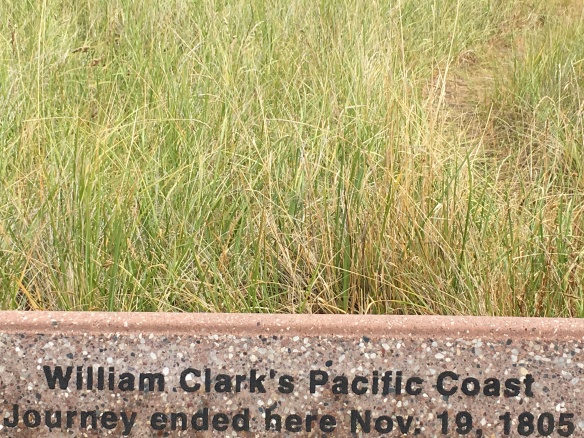
Cape Disappointment marks another very important place in the history of North America. It is not just a place that signifies disappointment, tragedy and danger. It is also the very spot where the famous Lewis and Clark expedition reached the Pacific Ocean in November of 1805. Yes, Lewis & Clark met with many a disappointment and setback along the 3700-mile route up the Missouri River, across the American Midwest, over the Rocky and Cascade mountains and down the Columbia River Gorge that took them a year-and-a-half to accomplish.

IMG_6400

On the journey, were they ever absolutely certain they would make it? As it was, they must have taken their disappointments in stride. For on an uncharacteristically calm day in a stormy November, they made their final push around the western Cape and finally met the limitless horizon.

Significantly, the Lewis and Clark Expedition was called the Corps of Discovery. Today, a 10-mile-long, well-groomed paved path winds through the dunes of Long Beach Peninsula and up into the forest of the Cape. It is called the “Path of Discovery”.

IMG_5994

Cape Disappointment is intricately tied to the Corps of Discovery, where both failure and success are entwined in a rich and diverse history of exploration. The spirit of questing celebrated on these shores includes and transcends both the unique events of human tragedy and human achievement. You cannot have one without the other. In one place. In one human being. Each of us is invited to the journey that includes, embraces and transcends disappointment and failure.

At some point along the journey, you need to have hope in order to continue. Even in the midst of all our unknowing, we can believe and trust in the solution, before it happens.

It’s called faith.

IMG_5922.JPG


[1] Jonah 3:10—4:11, NRSV, Proper 20A/Ordinary 25A/Pentecost+16

[2] Jonah 4:2

[3] Jonah 4:4,9,11, NRSV

[4] Richard Rohr, “Adam’s Return: The Five Promises of Male Initiation” (New York: The Crossroad Publishing Company, 2004), p.112

[5] John 1:38, NRSV

[6] Belden C. Lane, “The Solace of Fierce Landscapes: Exploring Desert and Mountain Spirituality” (New York: Oxford University Press, 1998), p.105

[7] Isaiah 55:8, NRSV

photos by Martin Malina IMG_5940

Talking about toast

“I want butter on my toast, but not too much.””You’ve spread it on too thinly. I want a whole wad of it.”

“You’re being wasteful. You’ll use up the tub in a couple of days.”

“If you didn’t burn the toast to a crisp all the time …”

“I don’t like my toast slightly warm.”

” … the butter would melt into the bread.”

“Toast is toast. A slice of bread is a slice of bread. There’s a difference.”

“Lighten up. Just slather it on.”

Of course, the words alone in this dialogue do not tell the whole story. There are other ways that we communicate, that animate the message. They say seventy percent of communication is non-verbal. What does the tone of our voice communicate? What are our eyes looking at when we speak? And, most significantly, what are our bodies doing? What is our body language?

I was attuned more to this truth in Italy during our family vacation. Every culture presents uniquely in the manner of body language during a conversation, to the point of caricature and over-generalization. Of course, not every English person speaks with a stiff upper lip; not every Italian gestures wildly with their hands; not every Canadian looks downward and apologizes. The exercise, nevertheless, of paying attention to a cultural tendency is helpful in bringing awareness to the way we communicate.

We played a little humorous game, somewhat irreverent, whenever we drove by or saw in a distance a couple of Italians speaking to each other — their bodies close, hands waving on either side of their partner’s ears as if guiding a plane on the tarmac to its docking at the gate, eyes piercing the other with intensity, even spittle flying from their mouths. We couldn’t hear what they were talking about. But we made up a dialogue about something the opposite in nature to their serious, even combative, style. We would try to convince ourselves that they were talking about toast.

Communication is essential to any relationship. And it’s not just the words we speak. It’s our behaviour. What we do. How we act. What our bodies are telling ourselves, and the other who is in our presence.

In other words, communication is real. It is not just reserved to the realm of ideas and theory and abstraction. Communication involves our whole lives, our whole selves. We are not by ourselves in the ideas we express and the words we use. 

When we speak about God, and our relationship with God, we dare not relegate our relationship with God to the realm of words alone — whether those words are printed on a page, or spoken during worship in a detached manner as if those words hold power on their own without context or embodiment.

Our God is real. Our God wants relationship with us. And, in the Isaiah text today, we read that invitation: “Come, let us argue it out!” says the Lord (1:18). God is having an argument with the people of Judah and Jerusalem during the reigns of kings Uzziah, Jotham, Ahaz and Hezekiah.

It is not a dialogue that is calm and reserved. It is not a cool, collected, disassociated manual of instruction. It is not a legal text. It is throwing down the gauntlet! Come on! You are messing up! But I make an offer. Let’s have it out! says the Lord! You have something to say? Then say it! The Lord can take it. Let’s negotiate. Let’s hear each other out. Let’s be real.

I wonder about our image of God when we shy away from such boldness. Is it because we imagine a God who is passive? Who only does our bidding, or should? Or a God whose job it is only to direct us, judge us and basically order us around?

But what about a God who is more vulnerable than that? There is no more direct and clear message of this vulnerable God than Jesus hanging crucified and dying on the Cross. So, what about a God who seeks our attention by being vulnerable? Who wants us to engage with God in an honest, self-disclosing way? Because the message of Scripture suggests time and time again: 

Not only is God’s company available and deeply important to us, but our company might very well be important to God. Could it be that God seeks our companionship? Could it be that God desires to have us as friends, and that the God who so patiently works with us in every moment rejoices upon occasion to have our undivided attention — even when our attentions are directed to the many particular concerns of our lives? (1) 

God is, indeed, the “great companion” (2). God is present with us, interested in us, and trustworthy. God’s love is receptive and responsive. In other words, we do not pray to an impassive, unmoved mover.

God is in relationship with us. God invites us, when we have a bone to pick about life, about whatever is happening in the world, to “Come, let us argue it out.”

It’s not that God always wants a fight. I will define a “fight” in this context as a bold yet non-combative, mutually-respecting exchange of unique perspectives. What this kind of arguing or fighting reveals is passion, real feelings, and the truth about ourselves. 

And this is a sign of any healthy relationship whether we talk about relationships in marriage, or work, church, community or play. Honesty. Truth. And in the exchange of honest discourse, we bring all that we are, not just our words. Our hearts. Our minds. Our bodies. 

We may not change God’s mind about whatever. But that is not the point. God wants to hear what we have to say. God wants to feel our passion, hear our cries, sense the beating of our strained hearts. God wants to understand us. This is what Jesus was all about. 

God sent Jesus in our flesh so that God could begin to truly understand what it means to be human. And in that humanity, in seeking us, God can bring an outpouring of love, grace and mercy — time and time again.

So, any subject is on the table. Thanks be to God! Anything is on the table, in all honesty. Including talking about toast.
Amen.

1 – Nancy Campbell & Marti Steussy, “Process Theology and Contemplative Prayer: Seeking the Presence of God”, p.87

2 – Clark Williamson, “Learning How to Pray,” in Adventures of the Spirit: A Guide to Worship from the Perspective of Process Theology with Ronald Allen (Lanham: University Press of America, 1997), p.162

Seeing Jesus

Jesus says, “the person who sees me and believes will be raised up” (John 6:40).

If I polled the assembly gathered here this morning and asked you to raise your hand if you ‘believed in Jesus (or God)’, my guess is I would get a decent showing.

But if I asked you to put up your hand if you recently saw Jesus, I’m not sure I’d get the same kind of response. If you did raise your hand to that question I might look at you with some degree of skepticism. I might not take your statement at face value. I would want to ask you more questions.

Seeing Jesus sounds like a conversation for the mystics and contemplatives. If our faith is limited merely to a conversation about the historical, biblical Jesus, we will be challenged at this point of acknowledging the living, immanent Jesus who is also always more — an unfolding Presence in the course of all history.

Where do we see Jesus? This is an important question. How can we see the living, resurrected Lord in the world and in our lives today? How can we account for the presence of Jesus?

There is the problem of sight. Here, Jesus obviously is not talking about physical vision. Otherwise why would he even say, “the person who sees me …”? Of course the people to whom he originally spoke these words standing on the sandy, rocky ground in first-century Palestine saw him. Jesus is talking more about a perception of the heart, mind and soul — an internal dynamic.

If you follow any of my social media sites online, you might have noticed there recently some sunset photos over Lake Huron where my family vacationed over the past couple of weeks. Aside from the inspiring sunsets, this is not what I remember the water to look like:


Normally, as I recall from my childhood summers spent on these shores, Lake Huron is fairly active. More days than not you would see a lot of wave action, and white caps carving up the horizon and rolling in over the surf. You would feel the constant high winds buffeting the tree-lined shore.

For the fourteen days we lived by the shore last month, however, the Lake was mostly calm. The water was placid, where there would be no more than a ripple on the surface and a splash on the shore line. In fact I would be hard pressed to say there was more than two days of wave action that came close to my childhood recollections. Needless to say, the quiet, peaceful waters made for much stress-free sea-kayaking and swimming along the coast.


At sunset most evenings we sat around the fire pit a stone’s throw from the shore, enjoying the very soft breezes and the relatively flat surface of the water.

And, if you watched the water, once in awhile you would see a large white fish breach the surface and flap it’s broad tail. The slapping sound often caught my attention if I wasn’t looking at the exact spot on the water.

This sudden sound, amidst the relative quiet of the expansive scene of resting water, air and land before us, also caught the attention of the other members of my family (I would add, they were preoccupied by their hand held devices, swatting the bugs, and chatting incessantly with one another!).

“What was that?” they looked up.

“Oh, a fish, jumping out of the water,” I responded.

“Cool! Where? Where? I wanna see!”

“Well, you need to be watching the water. Keep scanning the water up and down the shore line close to the edge.”

“I don’t see anything!”, one says, scratching another mosquito bite.

“You need to keep watching the water. There,” I point over the water toward the island, “there was another one!”

“Where?”

“Were you watching the water?”

“Uh, no.”

And on and on it went. I had a restful holiday. No, I did. Really!

The problem is not so much an incapacity to see. It is first to confess how distracted we are as a people in a culture that is impatient, anxious, that does not want to slow down, that keeps us from seeing what is already there. Perhaps Jesus is there for us to see. And we, like the Pharisees with whom Jesus often sparred, are “blind” to this truth. Jesus gives us precisely what we need to live, fully (Matthew 23; John 10:10). Do we not see it?

Before the cross became the central symbol of Christianity, the sign of the fish identified the early Christian movement. In fact, the cross was for centuries rejected by Christian who naturally recoiled at the thought of having an instrument of torture and capital punishment the central symbol of the faith.

The fish was a symbol for Jesus Christ. Food. Like bread, fish gave faithful people ongoing strength, sustenance and nourishment for life. No wonder the miracle of multiplication of bread and fish became a popular Gospel story about Jesus feeding the multitude on a hillside in Galilee (Matthew 14, Mark 6, Luke 9, John 6).

The new logo of the Eastern Synod reflects this original, early Christian identification with fish:


In the sixth chapter of the Gospel of John especially, Jesus compares himself to bread — bread that sustains us and feeds us everything we need. Everything. Not more. Not less. In the Old Testament, it was manna that God provided to the people in their desert wanderings.

The desert was the place where the people had to learn to give up control, which is mostly what ‘making plans’ is all about. “Like us, the Hebrews weren’t initially too excited about all this vague mystery. The people didn’t just complain that they were out of food, they also began to romanticize about the good old days back in Egypt where they ate their fill of bread …

“God responded to the people’s anxiety about food in a very tangible way. He provided the daily blessing of bread from heaven called manna. It was a fine, flaky substance which appeared every morning. And it came with some instructions (Exodus 16:1-8). Every family had to gather their own. You couldn’t store it up or hoard it, or the worms would eat it. So you had to gather it every day, except on the sixth day of the week when you could gather an extra portion for the Sabbath. It wasn’t much — just enough to keep you going on the journey.

“All of these descriptions [like bread and fish] are wonderful metaphors for how God cares for us along the way in the desert journey: daily, tangibly, personally, and sufficiently, although never enough to remove our anxiety about tomorrow. We have to trust there will be more manna when we need it [emphasis mine].

“This is what Jesus had in mind in teaching us to pray, ‘Give us this day our daily bread’. To pray those words is as if to say, ‘No matter how hard I try to secure my life with money, exercise, relationships, or work, I know that only you can give it to me. And you will do it one day at a time.

“The best reason for seeing the manna as a blessing [of Jesus’ presence, I might add] comes from its name. The literal translation of manna is ‘What is it?’ This means that every morning the people would go out and gather the ‘What is it?’ The mothers would prepare it as creatively as they could, which was tough because there was no ‘What is it?’ -helper. The family would sit at the table to eat. The kids would ask, ‘What is it?’ The mother would sigh and say, ‘Yes.’ They’d bow their heads and pray, ‘Thank you God for What is it?'” (Craig Barnes, Insights from the Desert, “Nurtured in Mystery” Shadyside Presbyterian Church, 2010)

What if we lived out of gratitude for what God has already given us? What if we made decisions — even small ones, each and every day — based on trust in Jesus being there for us, just beneath the surface of our lives? They’re for the watching. They’re for the catching and gathering. Grace and Gift, available to us. Before we even lift a finger to eat.

A light-gift contemplation

The distant sun

finding purchase through cracks in the clouds,

Light filtered through earth-bound trees

streaming across the plane

onto my space. Our space.

  
This distant, constant, sun gives peace

and stillness so all that is uncertain,

in anguish and turmoil

has now permission to rest, and be quiet.

Not to cry out like the noisy child all the time

incessant as the wind.

Now all is still, a nothingness that is everything.

Then other desires and wants can find verdant voice,

after a long winter of hibernation and subjugation

by the crying, lascivious adolescent.

A desire grows to explore the vast regions of imagination

not held captive by the child’s wanton treachery,

A peaceful meditation, a welcome relief, a restful sleep —

invitation to the true self, a final satisfaction.

Maybe a re-visit from time to time,

lurking near the door of restlessness and

lustful distraction;

Maybe the occasional forray 

into the windy regions of consciousness.

But today, if only for a moment it is

a quiet repose in the light’s blissful shine

warming the soul of gratitude and divine worship.

Light creates spaces in the heart,

a simple acceptance and

re-cognition of what is,

not a judgement of it.

God is action: a grammar lesson

God is an action Word. The English language, sometimes, does not do it justice. “The Word became flesh” is the theme of the Christmas-Epiphany cycle in the church year. Sermons, prayers, liturgies are all based on this message.

But the French language conveys the truth about God in a much better way. In John 1:1 — “Au commencement etait le Verbe, et le Verbe etait tourne vers Dieu, et le Verbe etait Dieu.” God, in other words, is equated with a verb — an action word. And, later in verse 14 the English normally reads: The Word became flesh. In French, again, “le Verbe s’est fait chair …” translated, the Action-Word made himself!

Thank God for the French language! Here we receive the truth about God and Jesus, flowing in continual action, movement. The status-quo does not belong in the vocabulary nor the kingdom of God!

The God-human relationship is clarified: God’s first job is to act; our’s is to just be a human (-being!). Jesus’ first words identified by the Gospeler Mark in the Capernaum synagogue (Mark 1:25) was not what Jesus was reading from the lectern; rather, it was his words to the man with the evil spirit: “Be silent!” Be … !

Stop talking! Stop doing what you are doing! When we can first be as we are, not as we think we ought, then perhaps we will discover the actions that correspond and are aligned truly with God’s action in our lives.

Someone recently joked that they say English is the language of heaven. Why? Because it takes an eternity to learn it!

In this case, better in the French.