There’s a hole, PART 2: For a purpose

I am a hole in a flute / that the Christ’s breath moves through – / listen to this /music.            -Hafiz

If you comprehend it, it is not God. -St. Augustine

Unlike the pounding of the surf a stone’s toss away, the ponding on the nearby creek made the surface of its water look pristine. A narrow creek made its lazy, winding way down the escarpment from Highway 21 and aimed to run into Lake Huron after finally crossing the stretch of sand on the beach at Point Clarke.

One of our favourite pastimes on those lazy summer days was to play around the area where the creek and lake met. As children, my brother and I would build castles, dig trenches and re-direct the flow of the creek’s water.

For a real challenge, we would try to dam up the creek’s flow, which took some planning, and extra material like drift wood and larger stones to block any outflow attempts. Once we contained it, the creek turned slowly into a large pond, comfortably remaining – for the time being – behind its fortress sand walls.

I’ve already talked about how in God’s creation, it is meant to be that each of us has a hole in our heart (see “There’s a hole, PART 1: Meant to be”). Moreover, it is God’s good intention that this hole is there for a purpose.

Paul writes in his second letter to the Corinthian church a confession that in all his accomplishments for the expansion of the Gospel across the Mediterranean, he was given a thorn in his side.[1]The proverbial ‘hole’. It is not important, although many have tried, to figure out what this thorn actually was.

We don’t know. Maybe that’s the point. It’s not important that we know, only that this thorn was given him in order to keep him humble. The text says that the thorn was given Paul to keep him from being ‘elated’ – to keep his ego in check, perhaps because he tended toward being too full of himself, over confident in his own ability.

How does the ego get the better of yourself? What is your compulsion? What drives you to achieve some illusion of perfection in your life? So, you don’t need to trust what is beyond your life, what is ineffable, what cannot be fully understood that is the Great Mystery (a.k.a. God)?

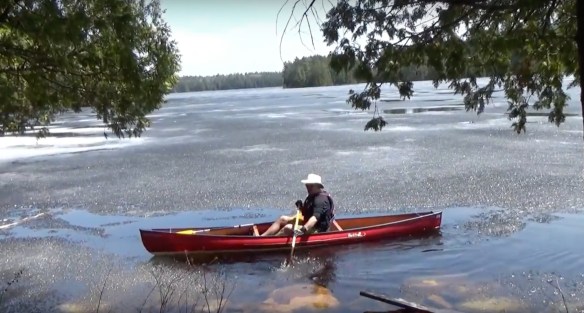
Let me show you an example of compulsion to achieve that which is beyond our capacity: On my fishing trip with colleagues last May to Algonquin Park, we tried everything to beat the ice on the lake. Despite the predominance of the ice-covered lake, we tried desperately to fight the odds against us catching some fish even to the point of risking our safety to break up the ice ourselves in our canoes.
Screen Shot 2018-07-07 at 2.29.00 PM

Yup, that’s me. And, yup, you guessed it: We caught no fish. The irony is that on the last day of our camp out, the wind and the sun did its job. When we woke that last day, we looked over a lake completely free of the ice.

IMG_6940.JPG

Was God sending us a message? Weren’t we the butt end of some divine humour?

The hole in our heart has a divine purpose: To keep us from being too sure of ourselves, over-confident in our ability and our capacity to have it all figured out. If we didn’t have this hole, might we put all our trust in our own autonomy, our independence, to lead our life without any need at all to trust anyone else let alone God.

Beyond Paul in the New Testament, the stories in the bible are about God lessening, even stopping, the compulsive drive of main characters, so the wind of God’s Spirit could draw them more gently and more effectively (Gideon and Moses in the Hebrew Scriptures are good examples).[2]

In the Gospel reading for today, Jesus instructs his disciples in going into the world to do God’s mission, “to take nothing for their journey … no bread, no bag, no money in their belts; but to wear sandals and not to put on two tunics.”[3]

God’s consolation is simple yet profound: “My grace is sufficient for you, for power is made perfect in weakness,” God tells Paul.[4]The making perfect here is not about getting rid of that vulnerability. Rather, whatever weakness we bear stays with us in order for us to complete our purpose as human beings. We are made complete in God’s love because of our hole, thorn, weakness – not without it.

In one of Martin Luther’s famous works entitled, “The Bondage of the Will”, he emphatically declared that we, as humans, can never work out our own salvation for ourselves. We will continually fail, even when, or especially when, we believe we are doing good in the world.

While some might find this realization depressing – and it would be helpful to know why that is, for yourself – perhaps the “bondage of the will” can be freeing. Because we don’t need to be driven to inaction because we are afraid of making a mistake. We don’t need to get stuck in the mud under the fear of imperfection. As Christians, we can be free to do good work in the world, imperfectly, knowing that what we do is for the benefit of others and not for ourselves.[5]

Author Brian McLaren in his recent book: “The Great Spiritual Migration”, describes this time in history as a transition in the church from “organized religion” to “organizing religion.”[6]

A Church in the flow of God’s Spirit pertains not only to wind and water over the earth, but also to spiritual movement. To purpose and mission. To going where we need to go as a people. To re-focus again on loving God, self and others as the primal energy of the church. To bring to life once again the old verse: “They will know we are Christians by our love …” … and not by our buildings, property, and concern for security, certainty and self-preservation.

Can we let go of these things for the sake of God’s mission, for the sake of the Gospel of life and love in Christ? As the prophet Amos so well put it, using the water imagery: “Let justice role down like waters, and righteousness like an ever-flowing stream … “[7]

By the time we had finally engineered the dam on the tiny creek aiming towards Lake Huron, the sun was setting and we had to go home. Inevitably, the next morning one of three things would have happened in our absence:

Either the creek would have found the weak spot in the sandy fortress wall we built, and escape through a tiny crack; or, increasing wind conditions over Lake Huron overnight would have created larger waves whose surf reached and destroyed the walls of our dam; or, someone would have been walking along the beach and, for the fun of it, just poked a tiny hole to watch as a slow trickle quickly turned into a strong, flowing stream.

In each case, a small hole was required in order for the creek to fulfill its mission and reach its destination – despite all the efforts of playful human beings to keep it contained.

After all, nothing was going to stop the flow. God’s Spirit and purpose will flow on because and through the holes in our lives.

[1]2 Corinthians 12:7-10

[2]Richard Rohr, “Dancing Standing Still; Healing the World from a Place of Prayer” (New Jersey: Paulist Press, 2014), p.18.

[3]Mark 6:8-9

[4]2 Corinthians 12:9

[5]Ross Murray, Senior Director, GLAAD Media Institute, LinkedIn July 2018.

[6]Brian McLaren, “The Great Spiritual Migration: How the World’s largest Religion is Seeking a Better Way to be Christian” (Massachusetts: Convergent Books, 2017)

[7]Amos 5:24
A wedding sermon: To expand and include

In a moment, we will share candlelight in this circle of friends and family. Sharing the light is a symbol of the meaning of marriage. Just as one candle shines its light in the darkness and with other candles expands the field of vision, so the nature of the rose bud is to open and expand into the world. Each of you receives a rose from the bridal couple.

Like the rose bud, the human soul defines itself in the same way. The soul’s nature and purpose is to expand and include, by offering a courageous ‘yes’ to life.[1]The soul, in all human goodness, always says ‘yes’. Wherever and whenever ‘no’ must be said, it will follow the initial ‘yes’. ‘No’ never leads in a life of faith, and love. ‘No’ will find clarity and effectiveness only after the gracious lead of ‘yes’ – to any and all of life’s circumstances and situations, marriage included.

The primary words in a wedding service, traditionally and effectively, are spoken by the bride to the groom, and the groom to the bride: “I do.” In other words, “Yes! I will.” You cannot come to a wedding service without the energy of the “yes” defining this very moment. Thanks be to God!

In the time I have journeyed with the bridal couple in preparation for this day, I have witnessed in them a celebration of who they are as a couple. I have witnessed an emerging and resilient joy at their union. And the gift within them.

Each of us has a gift inherent and living within us. I invite you to participate now in a brief guided meditation to experience and touch that gift within your life. You may close your eyes or focus on the rose in front of you:

‘Imagine, for a moment, a rose bud. At first, the rosebud is closed and enveloped by its green sepals. Now, imagine that the sepals start to open, turn back, and reveal the petals inside – tender, delicate, still closed.

‘Now, the petals themselves slowly begin to open. [Such is the process of growth in us.] As you imagine the petals slowly begin to open, perhaps you can become aware of a blossoming also occurring in the depths of your being. You may feel that something in you is opening and coming to light.

‘As you keep visualizing the rose, you feel that its rhythm is your rhythm, its opening is your opening. You keep watching the rose as it opens up to the light and the air, as it reveals itself in all its beauty. You smell its perfume and absorb it into your being.

‘Now gaze into the very center of the rose, where its life is most intense. Let an image emerge from there. This image will represent what is most beautiful, most meaningful, most creative that wants to come to light in your life right now. It can be an image of absolutely anything. Just let it emerge spontaneously, without forcing or thinking.

‘Now stay with this image form some time and absorb its quality. The image may have a message for you – a verbal or a non-verbal message. Be receptive to it.’[2]This is the gift of the rose for you today, on this joyous occasion of the your union.

There is something beautiful emerging out of this expanding and inclusive circle. From the union of two, comes the growth of an emerging new family, including more and more people, an expansion born out of the ‘yes’ of love, life, and light.

In your opening notes about the service, dear couple, you quoted from the bible a verse from Proverbs (17:17). “A friend loves at all times.” The verse goes on to say that these relationships bear together not just the good times but the challenges of life, too. Despite the dissonance inherent in all relationships, someone stands by you. This, too, is an important image for the journey of marriage.

When I bought the same Sony receiver that you have in your home, I connected them to some old Sony tower speakers that I’ve used for years. You’d think that the same brand would create a perfect compatibility. But, I neglected to consider what connected these two parts. To connect the speakers to the receiver, I used the same, old speaker wires whose ends were frayed to put it mildly.

As a result, whenever the receiver is plugged into the electricity, I can hear this faint but persistent humming sound. For some reason, the wires inhibit a perfect compatibility between speaker and receiver. For a perfectionist such as myself, it drives me crazy. Needless to say, I’m on the hunt for some new wire that will, hopefully, more adequately convey and balance the connective energy between speaker and receiver.

In other words, the connection will not always be perfect. In truth, conflict is part of healthy life. “A life without conflicts is by necessity only half a life,” I read recently. “A certain degree of stress is good and necessary; and shows you inside of the true Mystery”[3]of all relationships, even good ones.

The healthiest of relationships will carry some subtle dissonances. But, when the marriage focuses intentionally on its fundamental purpose and nature to ‘make music’ – staying with the analogy – then the grace of God is experienced in all beauty and wonder and goodness. Because when I crank that receiver, the whole neighbourhood can hear what I’m playing! And it’s a sweet, clear sound.

When light does what it is meant to be – despite the darkness all around …

When the rose bud does what it is designed to do – expand and include …

When the human soul, before anything else, says, “Yes!” to love and life …

When, in the midst of the hard realities of life, the music of love and gentleness and compassion sound to all the world around …

Then, we know that we do and are, what we were meant for.  Then, your marriage communicates to yourselves and to those around all that is good in this life we are given.

[1]Richard Rohr, “Dancing Standing Still: Healing the World from a Place of Prayer” (New Jersey: Paulist Press, 2014), p.23-24.

[2]Jacqueline Syrup Bergan and Marie Schwan, CSJ, “Love, A Guide for Prayer” (Maryland: The Word Among Us Press, 2004), p.78-79.

[3]Richard Rohr, ibid., p.19.

Conversations – Children’s Ministry

In recent years and with increasing awareness, it’s evident that a fresh, creative approach to children’s ministry is needed. We stand, really, at a crossroads with how we do this work. An opportunity stands before us. And an important question is: Will we embrace it?

What is this opportunity, you ask?

As part of the process of growing our ministry at Faith, the leadership of the church — comprising of members of the council as well as members at large of the congregation — we felt one important step in discernment was to bring the questions to the whole assembly on a Sunday morning.

There isn’t likely a better way introducing this conversation to the congregation than by having a baptism.

First, scheduling this baptism had been a bit of journey itself. Originally we were aiming for a July date. But in the last ten days, the opportunity in the family’s lives to be together this weekend came up. And so, here we are, on the Sunday we had planned for the better part of a month to bring the children’s ministry issue up for conversation. It’s a wonderful convergence that happened beyond anyone’s planning.

Then, there is the meaning of the baptism itself. What does this occasion mean to you — as parents, sponsors, cousins and church community of Elise? It can mean belonging. It can mean togetherness in faith. It can mean life. New life. New beginnings. It can mean the start of a life-long journey of continual growth, learning and expanding the soul in God’s love.

I hope you can with me begin to see some connecting points with the question I asked at the top — about the opportunity we have at this moment in the history of Faith to embrace something new, something fresh in our growth as a community of faith. Let me further prime the pump!

In the relatively short Gospel of Mark, the phrase, “Kingdom of God’, is mentioned at least fourteen times. Clearly, Jesus’ message and ministry on earth is about communicating in word and deed what this reign of God means — to the original listeners in their world, and to us in our day and age.

We come up against some challenges in reading the Gospel for today (Mark 4:26-34). That is, challenges to our way of thinking. Jesus, quite clearly in the story of the growing seed, makes it a point to emphasize the farmer has very little to do with making the seed grow. He “would sleep … and the seed would sprout and grow … [and] he does not know how. The earth produces of itself …” (v.27-28). This is how the kingdom of God operates.

As products of the Enlightenment and Scientific Eras where we demand proof, evidence and rational methods prior to justifying any kind of belief and action — this imagery and story-telling which by the way is how Jesus communicated probably drives us nuts.

But a baby cannot speak for herself what she believes. A baby cannot stand up and confess by memory the Apostles’ Creed (I’m not sure most of us who have likely said a few times in the course of our lives can!). A baby cannot make rational choices nor communicate them effectively. We can’t prove that she can demonstrate in a any clear, indisputable way that she has faith. That she deserves the gift.

A baby is dependent, vulnerable, and relies on others to make this baptism happen. It is truly a community event, not an individualistic enterprise. It does ‘take a village’ in the kingdom of God.

Could that be a sign that the kingdom of God is here? When those values and qualities described in the above couple of paragraphs characterize a situation or a decision? (Yes!) (And Yes!)

A friend who lives in Cantley near the Gatineau Park north of Ottawa told me that his municipality recently replaced aged and diseased trees along the roadway in front of his house. After cutting down several trees, the municipality gave him a few oak tree seedlings to plant in their place.

What surprised him the most after receiving these tiny seedlings, was the actual size of the whole tree that he held in his hand. The part above the ground that would remain visible was only a mere few inches. But the part that would be buried under the ground, the part that wasn’t seen, was the root system. Especially the tap root — the main one — was at least double the length of what was seen above ground.

Now we are also getting at the nature and definition of faith, “for we walk by faith, not by sight” writes Saint Paul (2 Corinthians 5:7). Often, the truth of the matter lies beyond what is visible, what we can calculate, measure and determine rationally.

That doesn’t mean we don’t have a job to do. We will water and nurture growth. We will make the space available, and put whatever resources we have to helping the growth along.

The stories Jesus told ask us not to close our imagination and creative juices, ever. Because there is a dynamic, vital power at work beyond our comprehension and grasp, always. Indeed, our imagination must be stirred by these stories as we seek to connect our individual and historical stories within the larger story of God’s movement in our lives and in the life of the world. (See Nibs Stroupe in David L. Bartlett & Barbara Brown Taylor, eds. “Feasting on the Word: Preaching the Revised Common Lectionary” Year B Vol 3, Kentucky: WJK Press, 2009, p.143)

This moment in the life of Faith Lutheran Church is ours to embrace and be bold in the creative process. It’s our job to do this. It’s not outlined in a neat and tidy manual. The answers are not clear-cut. And that’s ok.

Remember, “Jesus and the Gospel writers were not lacking in verbal skills. Had they wished to define the Kingdom of God in specific terms, they were capable of doing so. They chose not to. What the Kingdom of God is to be, has been left to us. It has been left to us to envision, to dream, to imagine and to build.” (Br. Mark Brown, Society of Saint John the Evangelist, “Brother Give us a Word” 12 June 2018).

Children’s Ministry by, with and for the church — as with infant baptism — is about small things. At least, about the beginning of a journey that starts out small. Yet, these stories of Jesus describing the kingdom of God are about small things, like seeds, that eventually yield great outcomes.

Out of the most insignificant beginnings, “God creates a mighty wind that will blow throughout the entire world. In these stories, Jesus invites seekers in every age and every place to consider joining in this kind of life-long journey” whose ending is anything but small. (Nibs Stroupe, ibid. p.145). Let it be so! Amen.

Children’s Ministry Review – Faith Lutheran Church

The Church Council has considered the reality that dedicating resources to maintain the current Sunday School program is no longer feasible nor sustainable.

Over the last several years there has been a noticeable trend in decreasing Sunday morning attendance that does not justify nor attract volunteers to lead a ministry for children in that traditional model.

Here follow some observations about the learning process for younger generation Christians today, that learning is more:

1. Intergenerational – it happens when young and older Christians mix to share their faith and work together in service-projects and initiatives in the community

2. In-the-home – it happens effectively in the church only when there is, however small, some faith-based discipline, activity or conversation in the household/home of that child/youth

3. Spanning-a-whole-life – it happens effectively in the church when a whole-life approach is adopted for Christian learning. Milestones such as Confirmation are markers along journey of faith that continues into adulthood and beyond

4. Worship-integration – Each worship service, rich in ritual, liturgy, symbol, art and sacrament are valuable occasions and opportunities for ongoing Christian learning

5. Inter-denominational – Because of the growing reality of multi-faith marriages, families are more open to seeking children’s ministries from other churches and faith groups, not just their own parish where they hold membership

These observations reflect the changing realities, socially, and for the church as we respond in ministry. Our response needs to respect and adjust to these changing realities.

These challenges may be summarized by the following questions for the church to consider:

1. At this time, does Faith Lutheran consider itself a children’s Christian education center, as a reflection of our unique character and mission? If not, what about the couples and families who do come with their children to worship? To which congregations can we refer them /partner with for a viable children’s learning ministry?

2. If we do, what is the focus, scope and intent of the program?

3. Who is the intended ‘audience’? Only those who have been baptized here in the last few years (e.g., cradle roll)? Or, is there a more public ‘interface’, providing a service to the wider community?

4. What resources (skills, passionate volunteer leaders, property space, budget lines) do we have already, and are we willing to make available for this purpose?

5. In what specific way(s) can you support a children’s ministry led by Faith Lutheran Church at this time in your life? Please check all that apply:

_____ organize and lead a traditional cradle-roll for all that have recently been baptized at Faith;

_____ organize and lead children’s programming on a Sunday morning;

_____ organize and lead children’s programming on a weekday afternoon/evening;

_____ pray regularly for the children and youth who attend Faith;

_____ increase your financial donations to the church in order to support a viable program; ministry starting in the Fall.

Please make time this week to reflect on these questions. Submit any written notes you provide, into the offering plate on Sunday, June 17, 2018, email your comments about Children’s Ministry to pastormartin@faithottawa.ca, or submit to the church office by June 29.

We will make time in the service on the 17th to honour and celebrate the Sunday School ministry in our history at Faith, recall favourite memories together about Sunday School at Faith, and address some of the questions above. Thank you for your time and input.

Ordinary faithfulness

“Those who love their life lose it, and those who hate their life in this world will keep it for eternal life. Whoever serves me must follow me, and where I am, there will my servant be also.” (John 12:25-26, NRSV)

One reason the Stars Wars saga in the movies and on television has endured successfully over the years is because the themes in the story-telling resonate with ordinary life.

For example, the epic struggle between the dark side and the good side of the Force gets played out in entertaining fashion between the Sith lords and the Jedi masters. This war of fiction nevertheless resembles so much of how we perceive the struggles in our own lives, how we do battle with bad in our hearts and the evil in the world around us. It just goes on and on, already for some forty years, and never seems to end!

In the spin off TV series, “Star Wars: The Clone Wars”, a story is told of how Jedi younglings are trained in the Force in a ritual called “The Gathering”. In order to become full Jedi, they must build their own light sabres. Their light sabres are unique to the individual. Each one is built around a crystal which they have to retrieve on an inhospitable, cold planet.

A group of younglings is dispatched into an ice cave to harvest their crystal. In order to succeed, they must meet and overcome their deepest individual fear and greatest weakness. Fear of heights. Fear of monsters. Impatience. Being left behind. Their crystal becomes available to them once they endure this personal challenge, each to their own.

What is more, they must find their crystal and exit the cave in a few short hours before the entrance to it freezes over. Otherwise, they would have to wait a couple of weeks trapped inside without help until the next rotation of the sun would allow the ice entrance to melt open again. The clock is ticking.

Individual challenges. But a group effort. Before sending the younglings into the cave, Jedi master Yoda gives them their final instructions: “Trust yourself and trust each other you must.”

For some, this is the biggest problem. Most of the younglings run into the cave and work together in smaller groups, at least in pairs. One helps the other, and vice versa.

But for Petro, the young upstart, know-it-all youngling boy, he rushes in at breakneck speed and abandons the group immediately. He forges ahead giving the others the impression, again, that he doesn’t need anyone’s help.

Before you know it, he finds his crystal, or so he thinks. And, so he is the first one back outside the cave. But when Yoda inspects the crystal, it melts in his hand. It wasn’t a crystal he found on the tip of the cave’s stalactite, just some frozen water.

Petro needs to go back in and do it all over again. But now, time is against him. While he runs back through the main entrance of the cave, others are already returning from their search. He is worried and anxious now that he won’t have enough time.

Feverishly sprinting down tunnels and turning corners Petro doesn’t know what to do. Until he comes across one of his class mates, Ketuni, trapped behind a glass wall. Ketuni had been rushing herself to get to the entrance after finding her crystal. She had followed what she thought was a short cut from one of the larger caverns where her return passage was blocked. Just as she had recognized the main tunnel near the exit, she realized she was trapped. There was no way she had enough physical strength herself to break the glass wall. Neither did she have enough time to find another way around.

Ketuni is just about to give up, getting used to the idea of spending days alone in the cave when she notices Petro rush by. Ketuni calls, “Help! Get me out! Help!”. Petro faces her through the glass wall. “But I haven’t yet found my crystal. I can’t help you. I have to get going.” And so, preoccupied with his own agenda and needs, he darts off.

But seconds later, perhaps with a change of heart remembering Yoda’s initial instructions to work together, Petro comes back to the trapped Ketuni. Still without a crystal himself, Petro takes a sharp rock and breaks a hole through the glass wall big enough to let her out. “Thank you! I’ll help you find yours, now quick!” Ketuni says.

“No, No, you go. There isn’t enough time. Please, get yourself out!” Petro cries. Reluctantly, yet realizing the truth of what he says, Ketuni runs to the exit. At that moment Petro notices a crystal glimmering in the ice of the wall he just broke down to help his friend. In his willing sacrifice for her sake, he finds what he is looking for himself. By the end of the story, of course, Petro makes it out just in the nick of time.

One of the lessons learned from the story is the mutual blessing that comes from serving first the needs of the other as the way of finding your own true needs met. Our little friend needed to learn the value of trust in working together.

Star Wars, like many popular stories, are grandiose in order to get our attention and entertain us. Yet, the spiritual life, our pilgrimage of faith on earth, is anything but grandiose. Neither, by the way, is it entertainment. Because of the influence of our hyper-stimulated culture, we may be tempted to believe our faith, if it has any value, has to show itself in spectacular fashion.

We may be tempted to believe that if we have any faith at all, it has to be mass media worthy, go viral on the internet and make millions: a grand spectacle of sacrifice, of laying down one’s life, of doing what no one else could do. These extraordinary spectacles, unfortunately, can serve to keep us stuck in the rut of unbelief. “Well, we can’t do that,” we convince ourselves. And we give up. And don’t do anything for the sake of the common good.

But true faithfulness begins with the first, small, ordinary step. It begins with something we can do.

Twentieth-century Jesuit theologian Walter Burghardt defined prayer, simply yet profoundly, as: “a long, loving look at the real.”[1] Long, because it is unhurried and quiet. Loving, because our connection with God, however we do it, is done in the context of love. Prayer is a look, because we do it being aware; we pay attention, simply. We don’t analyze, define or describe; we simply observe and acknowledge. Finally, prayer is real because it focuses on our daily life and what is ordinary.

So, what do we do to follow Jesus? How do we ‘lose’ our life? How can we find what we are looking for by looking to the needs of others? How can we move beyond being solely interested in our own individualistic well-being to those outside our families, friends, and immediate community?[2]

Reflecting on Burghardt’s definition of prayer, we can ‘look’ at what we already have. This requires us to slow down and pay attention, and quieting our compulsive, driven nature. Breathe. Because God is out there. God is present, even here. Even there.

One of our members asked recently a neighbor to describe what happens on and around our property on an average day. This, by the way, is prayer that is ‘real’ by focusing on what is ordinary. And the neighbor reported that between 2:30 and 3:30 every week day, about 30 kids on average, children of all ages, walk across our property from the bus stops along Meadowlands to their homes in the City View neighborhood. Thirty.

With presence of mind, our member asked the neighbor: What do they do when they walk across? Is there anything in particular that stands out in their behavior?

The neighbor said many of them like our benches outside the front doors. They like to sit and visit. They like to rest for a few minutes before continuing on their walk home.

When the member and I reflected on this, we realized there aren’t many, if any at all, public places in the neighborhood where people can sit awhile. Not only do we fill a need providing a place to sit, we encourage community-building, relationship-building right outside the doors to the church. How appropriate!

And for so many young people who are turned off the church, or at least afraid to enter into a church building these days, providing benches for young people to sit and visit sends a positive if subtle message about our identity and purpose as a church. It also sends a subtle yet real message of welcome.

This example is simple, ordinary, unspectacular. Yet, it is a first step in the right direction. As a community. Not as individuals doing our own thing. But, together, as a church.

And isn’t that what the walk of faith is all about? We can only do what we are able to do, together. And then, when we take the first step, we watch as the Spirit of God can surprise us and meet our own needs. All because we began by simply responding to the needs of others. Giving from ourselves, for the sake of others. That is, following Jesus.

We become “children of the light”[3], the Light who shines through us.

[1] Cited in James Martin, SJ, “The Jesuit Guide to Almost Everything: A Spirituality for Real Life” (New York: HarperCollins Publishers, 2012), p.114.

[2] James Martin, SJ, ibid., p.183-184

[3] John 12:36

Leaning in

The man with the unclean spirit is ordered by Jesus to “Be silent!”[1] After Jesus speaks to him, the unclean spirit obeys, and leaves the man. The man is thus transformed, healed, made whole in this dramatic Gospel encounter with Jesus.

We need to note, before going on, that Jesus speaks in the synagogue in Capernaum. He is at the beginning of his ministry. And what better place to start his preaching than on home turf, on familiar ground, in the rural community with people he likely knows, and who know him?

If you’ve ever lived in the country, or farther up the Ottawa Valley, you know that in small towns, people know each other. And when it comes to annual fairs, big events or musical shows, everyone attends. So, when in the lake side village, a home-boy comes to preach in the local synagogue, well, who wouldn’t show up? The synagogue is crammed full. Standing room only.

The point here is that the evil spirit resides and comes out within this rather homogenous community. The evil is not out there, somewhere – in Jerusalem the big city, or out there across the lake among the heathen Gentiles, or expressed within other groups with different belief systems and faiths. The evil is right there in the middle of the common, familiar, comforts of home.

The man with the evil spirit is a person like us. We know him. He is our neighbour. He, or she, is our friend, co-worker. She is the person who comes to church and sits beside us, Sunday after Sunday. The person with the evil spirit is not a stranger to us. That person is us. Each of us.

The Gospel of Mark – indeed the entire New Testament – is a primarily message to and for the church. Not to Islam. Not to Wicca. Not to some Voodoo occult. Not to the so-called Axis of Evil. The finger of judgement is pointed directly at us, at our sin, our evil, the brokenness within us.

When we deny. When we exclude. When we overstep our bounds. When we self-justify. And if you think you don’t have any of these and other problems – to quote what my Dad used to say and preach – you do have a problem!

It’s to this community, in awareness of the sin in our hearts, individually and collectively, that Jesus’ first words, spoken with authority, are: “Be silent!”

How do we change by being silent? I thought we were supposed to do something about our sin! Being silent sounds too much like being passive, lazy, self-indulgent and unproductive. How is it that we are changed when we are quiet?

The silence of which I speak, is first not the silence of denial. It is not a silence that happens when we remain quiet in the face of a great injustice. When a problem is not named, silence enables the problem to continue unattested. When there is something wrong, but no one dares to name the elephant in the room. This is not the silence of which I speak.

Neither is it the silence of combative conflict between people. When someone gives the other ‘the silent treatment’, silence serves as a weapon between people who need help to speak to one another about things that need saying in a safe way. This, too, is not the silence of which I speak.

Jesus is not scolding the man with the unclean spirit when he says, “Be silent!” He is not like the frustrated parent who has reached the boiling point with a disobedient child and just wants them to just shut up and go to their room.

When Jesus says, “Be silent!” he is inviting the disturbed and ill man to open his heart to being changed. Jesus first words are an invitation to be healed. And the first step in that direction is to put to rest, for the moment, the rampant flailing of a seemingly unstoppable ego.

This is a scary thing to do. How can we let go of our reactions, compulsions, need to be right? How can we be so vulnerable and leave ourselves wide open? How can we take this risk, let alone be healed by doing so?

One of my greatest fears as a child was to play on the round-a-bout. At the centre of the playground at kindergarten, stood the scary carousel-like structure. The round-a-bout used rotary motion, spinning around in a circle either clockwise or counter-clockwise. It was painted red.

A bunch of us kids would start by grabbing the four railings which fanned out from the centre like spokes on a wheel. We then started running, really fast, around and around pushing the carousel to dizzying speeds. And then at the moment when we couldn’t run any faster, we threw ourselves onto the spinning platform.

My instinct, at first, was to hang on for dear life at the edge of the round-a-bout as it spun ridiculously fast. It seemed to me the closer I could be to the edge, the more control I had over when I wanted to get off. Doing this, however, I didn’t step off when I wanted. I flew off when I couldn’t hold on any more. So much for control. When all I wanted when I played on the round-a-bout was an evacuation plan.

In order to best stay on the round-a-bout, and not fall off, I had to lean in towards the centre. I had to do the counter-intuitive thing. I had to grab hold of the centre wheel – the hub, the heart of this fearful reality. This way, not only did I last longer, I actually had some fun.

We overcome the evil within not by denying it. Not by turning away from it. Because denying and turning away already exposes another negative disposition. Actual repentance is served best by turning toward that which frightens us. Transformation is realized by moving to our fear not away from it.

And surprise, we are not alone there. We find our strength and our victory in turning toward and leaning into … a very loving, very much present Christ. Jesus is even there, yes.

Like a pine tree on the Canadian Shield rocky coast of Georgian Bay leans into the gale force winds to survive and thrive in that environment, so, too, we turn towards that which assails us in life. As you know, I love the White Pine – native to this part of the world. And one of my favourite Group of Seven pieces of art is A.J. Casson’s “White Pine”.

This painting, in particular, depicts the rugged, often inhospitable places where the white pine flourishes. Spreading its roots just beneath the surface of the ground, the white pine can find foothold in rocky, sandy earth. What is more, along waterlines, the pine will grow sometimes leaning, like the Tower of Pisa, into the gale force winds, not away from them. By doing so, even with its shallow root system, it will not fall. At least, not for a long time.

Naturally, we resist this counter-intuition. Many say that when they meditate, the first half of the period of meditation is hell. When the flood gates are opened. That is when all the thoughts, distractions, and emotions scream to the surface. That is when we fight our greatest battle in prayer. Not against the thoughts and feelings themselves, but against the experience of being still and silent. Because all that has been hidden and suppressed in the dark recesses of our lives finally can come to the surface and is exposed even burned in the Son-light.

It is too easy to give into the ego at this point, which wants to have control, which drives compulsively towards having more, making more, producing more, taking more, defending more. Un-relentless is the ego, driving impulses we struggle with in those first minutes of quiet, still, sitting and praying. It is too easy to give up on the experience and declare, “This is not for me.” And return to the hurly-burly of life in the fast lane.

Should we, however, lean into the internal fray – not suppressing the maelstrom of thoughts, not doing violence against our ego – when we just let the thoughts and feelings come at us and go through us, we will find the rock of our salvation who will hold us up even if we are leaning a bit.

Our lives thus become a prayer of healing when, before all else, we heed Jesus’ call: “Be silent!”, when we seek to quiet our busy thoughts. Saint Isaak of Syria wrote of a way of becoming silent and experiencing our hearts as the temple of the Holy Spirit[2], the holy still centre, and the hub of our lives:

“Enter eagerly into the treasure house that is within you,” he wrote, “and you will see the things that are in heaven – for there is but one single entry to them both. The ladder that leads to the kingdom is hidden within your soul.  Dive into yourself, into your soul, and there you will find the ladder by which to ascend”, and by which God descends into our lives.[3]

Just the turning, the leaning in, is everything on the journey to transformation. “Be still before the Lord,” the Psalmist sings.[4] “In quietness and in trust shall be your strength,” the Prophet advises.[5] “Be silent!” Jesus invites.

[1] Mark 1:21-28, NRSV

[2] 1 Corinthians 6:19

[3] cited in Greg Pennoyer & Gregory Wolfe, eds. “God For Us: Rediscovering the Meaning of Lent and Easter” (Massachusetts: Paraclete Press, 2015), p.91.

[4] Psalm 37:7; 46

[5] Isaiah 30:15

Traveling stones: a pilgrimage lesson in letting go

In the sixth century Saint Benedict said, “A monk should have death always before his eyes.”[1] ‘Death’ doesn’t need to refer only to our physical demise at the end of life but to any loss experienced in life. There are many deaths we experience in life: the death of a cherished pet, the loss of friendship, the loss of a job, divorce, death of a loved one, moving into another home. Any significant change, even positive ones, involve something lost.

In the second reading for today written in the first century, Saint Paul admonishes the Corinthians to live in this world “as though not.”[2] He is advocating a certain disengagement from the attachments and claims of our lives, including some of our most cherished relationships. The likes of Paul and Benedict reflect, as well, the wisdom of the prophets and poets of ancient Israel: “The grass withers, the flower fades, but the word of God stands forever.”[3]

Our earth-bound attachments come under scrutiny here, no doubt. The question remains for each of us on our own journeys of faith and life – what are those things of which we need to let go in order to move on? After all, in the Lord’s Prayer the words, “Thy Kingdom come”, mean little unless we can also say: “My kingdom go.”[4]

Following Jesus means leaving things behind — as the first disciples did, in our Gospel reading for today (Mark 1:14:20).

You heard about the man who was hiking in the mountains when he slipped, and started to slide over the edge. Just as he was about to fall into the abyss, he grabbed a tree branch growing out of the rock ledge. He hung on perilously dangling in the air.

He didn’t know what to do. It was impossible to pull himself up since the branch stem was slippery and wet. He swung in the silence of the breeze contemplating his fate with growing terror. Finally he looked up to the sky and prayed: “If there is a God anywhere up there, I could do with some help, please.”

To his surprise and shock, he heard God’s voice respond instantly: “I will help you. But you first have to let go.”

The man was silent for a minute. He dared not look down. It was a long way to the jagged rocks of the canyon below. Again he looked up to the sky, and said: “Is there anyone else up there?”

A long-standing tradition in doing a pilgrimage is to bring a stone from home and lay it somewhere along the path. This home-stone represents a part of myself that I lose, and leave behind, where I have walked.

Last Spring when I walked a part of the Camino de Santiago, I wanted to leave my stone in the waters off the western coast of Spain, either in Fisterra or Muxia – both coastal towns are some one hundred kilometres west of Santiago.

I imagined this place a fitting resting place for my stone since I love walking by water and coastlines. Once, long ago, people believed the coastal town of Fisterra (French, for ‘the end of the earth’) was the physical limit of land – the farthest one could go. In my imagination, I saw myself facing the setting sun, having completed the 800-kilometer, two-month trek, looking west to the horizon line beyond which lies the land of my home in North America.

I imagined feeling satisfied at the end of a long journey, having reached my goal, grateful for the challenge and all the things the Camino taught me. In that moment of gratitude and joy, I would toss my stone as far as I could into the spume and depths of the Atlantic Ocean. That was the vision, anyway.

I found the perfect sized stone while wandering around my house one afternoon a week before leaving for Spain. Because I was running about making the last-minute preparations for the journey, I placed it temporarily on the landing railing in the garage, certain I would soon tuck it away in my backpack.

Two weeks later I was scrambling up a steep incline outside the town of Irun on the first day of my pilgrimage. As I expected that first day was incredibly tough going. The temperatures soared to above 25 degrees C and the sun shone brightly. Sweat pouring down my neck and back I struggled up that cliff wondering why on earth I chose to do this on my sabbatical. I dug my walking poles into the hard-caked sandy ground to make the next ledge and wondered sarcastically if I should have rather taken rappelling lessons in preparation for coming to Spain.

In that moment of physical and growing mental exhaustion, I realized I had forgotten to pack my stone. It was still sitting on the railing in the garage back home! I stopped in my tracks and exhaled deeply.

“What’s the matter?” my Dutch pilgrim friend asked me, huffing and puffing as I was.

“I forgot to bring my stone,” I confessed my failure.

“Don’t despair,” my co-pilgrim wanted to advise. “The Camino will give you an answer.”

IMG_5248

Several days later two significant things happened. The first was while I was walking down a slope towards the northern Basque town of Guernica, I thought I should take with me a couple stones from this path, as a keepsake from walking the Camino. So, I selected two small pebbles from under my feet where I stood beholding the town and valley below.

IMG_5299

That same day, my knee seized up, and I walked the remainder of my Camino in pain. Three days later, coughing and feeling very sick, I was on a plane homebound. Diagnosed with pneumonia back in Ottawa, I had to come to terms with my failure of not having reached my goal.

Not only had I not reached Santiago and Fisterra, I had done nothing with my stone which I had forgotten anyway. By forgetting the stone, had I already destined myself not to finish the pilgrimage? These dark thoughts swirled in my mind.

After having recovered a few weeks later, my wife and I flew to Lisbon for a week of vacation to celebrate our wedding anniversary. Originally, the plan had been for her to join me at the end of my pilgrimage, where I would meet her in Lisbon. Nevertheless, this time, I did bring my stone from home, renamed my ‘glory’ stone.

My glory stone represented all my aspirations, desires, longings which I knew deep down the Camino had taught me to let go of. I had to surrender even my human yearning and goals to God.

IMG_5853

And so, at Cabo Da Roca near Lisbon, Portugal – the farthest most western point of land on continental Europe – I threw my glory stone into the Atlantic Ocean facing the setting sun. I had to practice letting glory go.

IMG_5812

It seems I was still bound to finish some kind of pilgrimage during my sabbatical. I didn’t have enough time to go back to Spain and finish the Camino de Santiago. But I did have enough time to walk the entire length of the longest contiguous sand beach in North America – fifty kilometres on Long Beach Peninsula in Washington State. There, my journey of letting go continued.

IMG_6200

There, on “Cape Disappointment” – fittingly named – I brought the two pebbles that I picked up in Spain on the last day I walked on the Camino. One glorious afternoon, I scrambled down into Dead Man’s Cove – also fittingly named – on Cape Disappointment. After reflecting on my disappointments of late, I realized on my journey of life not only did I need to yield all my dreams but also all my regrets and suffering. And so, I threw those stones of disappointment into the Pacific Ocean. I let these go.


I realized life is not lived well when we obsessively hold on to all those things that cause us grief. I had to offer these to God as well. Later, while I sat on a park bench near the lighthouse on Cape Disappointment looking over the Pacific, I met a couple of Americans visiting from Portland. In our conversation, we were able to affirm that “all great spirituality is about learning to let go.”[5]

IMG_6217

But I didn’t leave my pilgrimage empty handed. When I climbed out of Dead Man’s Cove that day, I picked up from the sand a smooth, round stone. Now, any rocks on the Peninsula are rare. Most of the fifty-kilometre stretch is sand, land created from the outflow of the mighty Columbia River as it spills into the Pacific Ocean. Most rocks you see on the Peninsula have been trucked in. So, I was delighted to take with me back home, a rare thing.

And hope is a rare commodity in this world of pessimism, denial, and despair. This is my “stone of hope”, that I hold forever, amidst all the human aspirations swirling in my life and all the disappointments and failures which I regularly need to practice letting go of.

IMG_6752

We hold not only that which we need to let go of, but we also hold hope throughout our lives. “We do not simply resign ourselves to the give-ness of the world, for we have planted within us a great hope that God’s kingdom will come on earth, as in heaven. This means we are a people who look to the future with trust and hope, confident that God is working God’s purposes out and that God’s realm is even now breaking into our world.”[6]

At this point in your journey of life, which stones are you holding — of dreams, of disappointments, of hope? Which ones do you need to let go of? Which do you need to hold on to? I suspect it is true when the likes of Saint Paul, and all the wise teachers over the ages, writes: “Hope does not disappoint us.” [7]

[1] cited in Ruthanna B. Hooke in David L. Bartlett & Barbara Brown Taylor, eds., “Feasting on the Word: Preaching the Revised Common Lectionary Year B Volume 1” (Kentucky: WJK Press, 2008), p.280

[2] 1 Corinthians 7:29-31

[3] Isaiah 40:8

[4] Richard Rohr, Daily Meditation, Thursday, January 18, 2018.

[5] Richard Rohr, Center for Action and Contemplation, cac.org

[6] Ruthanna B. Hooke, ibid.

7 – Romans 5:5

Repeat performances

Once again during the Christmas season, I experienced this strange cultural phenomenon:

How many decades has it been that every December, movies like “It’s a Wonderful Life”, “Elf”, “How the Grinch Stole Christmas”, “A Charlie Brown Christmas”, “National Lampoon’s Christmas Vacation” and “The Bishop’s Wife” get replayed and replayed over and over again, year after year? And only at this time of year? You can probably add several more of your favourites to this list.

That is why I was a tad apprehensive last month when we received tickets to attend the National Art Centre (NAC) Theatre production of Charles Dickens “A Christmas Carol.” I know the story. I’ve read it several times. I’ve watched television renditions of the story over the years. What could the NAC Theatre do to bring it to life, once again, for me? Same old, same old, right?

On the other hand, I believe there is a good reason why we turn to these stories every year. There’s a reason for our culture’s yearning for their repeat-performances. A higher reason, I might add. Perhaps there’s something in those stories that we need to take to heart, and make positive changes to our lives. Perhaps, we need to see the story-telling as more than a mere syrupy, sentimental “Isn’t that nice” tradition.

So, I was surprised and intrigued by what the NAC Theatre troop did with the story. It was introduced by two actors who came on stage — one was blind and one was deaf. In the introduction they invited the audience to participate in a simple activity with our hands, both to show that the two actors needed each other in accomplishing their jobs; and, what is more, near the end of the story everyone in the audience was needed to give the sign with their hands in order to encourage Scrooge finally to embrace a more compassionate approach to life.

Without taking anything away from the traditional story-line plot, the meaning of Dickens’ famous “A Christmas Carol” was conveyed to me in a fresh way.

We encounter in young Samuel and the elder Eli one such repeat performance story in today’s text from the Hebrew scripture.(1) It is a story many of us know — of the boy Samuel in the temple who is called upon by God. It gets told many times in the life of the church over and over again — every three years at least. It is true: it is a nice, little story, isn’t it?

At first, Samuel doesn’t recognize God’s voice, believing instead that it is his old mentor, the priest Eli, who is calling him. Finally, with Eli’s help, Samuel responds to God’s call by saying, “Here I am. Speak, Lord, for your servant is listening.”(2)

Well, as I said, many of us are familiar with these very words. We even like to sing a popular hymn (3) reflecting the words of one responding positively to God’s call — a call that changes the life of the recipient. How does this familiar story speak to our lives today? How is it more than just ‘a nice, little story’ from the Bible? How can this story change our lives?

In this story, an old man and a young man collaborated to hear God’s vision for a new Israel. For God was about to do a new thing: Soon to emerge in the life of God’s people was a new lineage of kings, beginning with the inauguration of King Saul.(4) What was passing, was the rule of Judges along with the sinful house of Eli. What was emerging was the likes of King Saul, King David, King Solomon, and so forth.

In God’s message to Samuel, God condemns Eli’s lack of restraining his sons’ immorality. Eli’s sin was his aversion to do something even though he recognized what was happening. Even though Eli knew the ongoing problems in his household, Eli turned a blind eye and ignored it all.

He did not act. And no matter what Eli would do now to try to redeem himself by making various sacrifices to the Lord, God was intent to establish a new order of leadership over God’s people starting with the demise of Eli’s household.

Doing nothing was the problem. For us, today, doing nothing about a problem we know exists is the problem. How do we begin to move out of the prison of this self-inflicted inertia?

We need to recognize that growth and healing is a process. The birth of the new thing God was doing began as a cooperative affair. It took the attentiveness of the young Samuel’s ears and the wisdom of the old priest’s heart and mind to bring about God’s purpose. It took both the authority of the failing, feeble priest and the obedience of his youthful protégé to bring about God’s purpose. In other words, it takes a community to bear such a task.(5)

Responding to God’s actions and call in the world and in our lives today is not a solo effort. Religion is not a solitary practice. Indeed, it takes a village. It takes the various gifts of people in our lives. What one has and the other does not, what the other is good at that the first is not — it takes everyone’s attentiveness and participation.

How do we live into this collaborative way, especially challenged by our society’s emphasis on individualism, privacy and self-reliance? We are, indeed, up against a culture that is at odds with the Christian vision. How do we live the way of God’s reign? Where we value mutuality, diversity, common purpose in the mission of God for the good of all people?

In contrast to the way in which God spoke to the likes of Isaiah, Jeremiah and the later prophets of Israel, God does something unique with Samuel. You will notice that God does not enjoin Samuel to deliver God’s message to Eli. God does not charge Samuel to tell Eli what God is telling Samuel with words like: “Thus says the Lord, tell the people Israel”, etc., etc. No.

Rather, God wants simply to confide in Samuel. Basically, God expects Samuel, first, to listen. Just listen. It seems, Samuel first needs to learn how to do this. And it will take some time and some practice, evidently.

Can we have the courage, and the patience, to learn how first to listen to God and the other — without jumping in too soon with the energy of our own bravado, our own opinion, our own self-justifications, our own visions of what must be? The simple act of listening, can change our lives. Because listening first means we believe that the other has something of value to offer that we don’t have.

God works at a slower pace, it seems, compared to the hypersonic rhythms of life in 2018. Not only does God give Samuel and Eli one chance to figure it out, but two and even three opportunities to get on the same wavelength as God.

The story-telling is both appealing and intentionally slow early on. Dialogue is repeated. The action of Samuel getting up from sleep and going to Eli are repeated. We have to slow down with the narration and feel the build-up to the great reveal of God’s message.

Even though both Samuel and Eli are slow in finally getting it, even though they are encumbered by sleep, drowsiness, denial and avoidance, even though their response to God is compromised by vision and hearing impairment, by youthful pretence and the attrition of old age …. God still finds them. God still speaks. God still acts in the way God will act.

Despite human arrogance and self-delusion, despite all our toiling and pride, despite all our ego compulsions, God keeps at it to tell us, guide us, and instruct us.

We may not like the answer. We may not like what God has to say. We may be challenged to the core of our being by what God is telling us. Regardless of our hesitation, denial or self-delusion, God finds a way. God doesn’t give up on us. God gives us people, and stories, and experiences — even the same ones, over and over again — to help us finally get it.

God doesn’t give us just one chance. God is not just a God of second chances, as we often say. God gives us many chances, as many we need. May we, like Eli, finally come to accept what God has to say to us, with his words: “It is the Lord; let him do what seems good to him.”(6)


(1) 1 Samuel 3:1-20, the first reading for the Second Sunday after the Epiphany, Ordinary time, Year B in the Revised Common Lectionary.

(2) 1 Samuel 3:4-10.

(3) “Here I am, Lord”, Hymn #574, Evangelical Lutheran Worship (Augsburg Fortress, 2006); also, for the Christmas cycle, this hymn is also appropriate in singing Mary’s response to the angel Gabriel’s visit to her, announcing Mary’s role in the birth of Jesus (Luke 1:38).

(4) 1 Samuel 8-10.

(5) Richard Boyce in David L. Bartlett & Barbara Brown Taylor, eds., “Feasting on the Word: Preaching the Revised Common Lectionary, Year B, Volume 1 (Kentucky: WJK Press, 2008), p.245-247.

(6) 1 Samuel 3:18

A wintery spirit

IMG_6730

The winter of 2018 has been record-setting, so far. And we are barely one week into the new year! Did you know it was Ottawa’s coldest New Year’s Day since records began in 1873? At 8am on January 1st, the mercury dipped to a frigid minus 30.2 degrees Celsius (-22 Fahrenheit); New Year’s Day also marked Ottawa’s sixth consecutive day with temperatures below -17 degrees Celsius (1 Fahrenheit), which made it the longest run in exactly one hundred years.[1]

IMG_0223

A full onslaught of winter can help us appreciate the meaning of Christianity. Though much of the bible’s stories and lessons were wrought out of the harsh desert climate surrounding the Mediterranean and Arabian seas, the winter realities we face in Canada are not that much different. I suggest, then, let’s take desert and winter as synonymous – meaning, essentially, the same things.

IMG_3529

American Lutheran theologian, Martin Marty, describes the importance of what he calls a “wintery spirituality”, defined by the shrill cry of absence, frost, and death. In contrast to a summer spirituality, winter is more given to being emptied than being filled. Winter is harsh and lean in imagery, beggarly in its gifts of grace and love.[2]

IMG_3524

Of course, Jesus goes into the Judean wilderness to be baptized in the Jordan River. And right after his baptism, he spends forty days and nights in the desert.[3] The desert is not a comfortable place to be. For one thing, it makes scarce and even denies the basic need for our survival – water. A desert is an arid region where annual rainfall remains miniscule. Some deserts average only one centimetre a year, with parts of the Sahara not receiving a drop of rain for more than twenty years.[4]

The word and image of water appears in each of the Hebrew readings assigned for this festival day in the church calendar, and is tied to baptism in the readings from the New Testament.[5] More to the point, water is given out of the chaotic void in the creation story, and in the arid wilderness as a gift and a grace. Water is thus a sign of God’s love amid the harsh winter or desert realities of our lives.

The prophets of old affirm that it is precisely in the desert where God expresses God’s love to the people. The grace of God cannot be received outside of winter. “Thus says the Lord: The people who found grace in the wilderness … I have loved you with an everlasting love …. I remember your love, how you followed me in the wilderness.”[6]

How, then, can we appreciate and even thrive, living out of this truth? How can we follow Jesus in his way? After all, the Baptism of our Lord is about Jesus beginning the journey to fulfill his God-given purpose in life. How he does it is of particular importance to us, if we are interested in following Jesus in our life-style.

Listen to a story first told by a nineteenth-century teacher, Awad Afifi the Tunisian, who drew his wisdom from the wide expanse of the North African desert:

A gentle rain fell on a high mountain in a distant land. The rain was at first hushed and quiet, trickling down granite slopes. Gradually it increased in strength, as rivulets of water rolled over rocks and down gnarled, twisted trees that grew there. The rain fell, as water must, without calculation. After all, water never has time to practice falling.

Soon, it was pouring, as swift currents of dark water flowed together into the beginnings of a stream. The brook made its way down the mountainside, through small stands of cypress trees and fields of lavender, and down cascading falls. It moved without effort, splashing over stones – learning that the stream interrupted by rocks is the one that sings most nobly. Finally, having left its heights in the distant mountain, the stream made its way to the edge of a great desert. Sand and rock stretched beyond seeing.

Having crossed every other barrier in its way, the stream fully expected to cross this as well. But as fast as its waves splashed into the desert, that fast did they disappear into the sand. Before long, the stream heard a voice whispering, as if coming from the desert itself, saying, “The wind crosses the desert, so can the stream.”

“Yes, but the wind can fly!” cried out the stream, still dashing itself into the desert sand.

“You’ll never get across that way,” the desert whispered. “You have to let the wind carry you.”

“But, how?” shouted the stream.

“You have to let the wind absorb you.”

The stream could not accept this, however. It didn’t want to lose its identity or abandon its own individuality. After all, if it gave itself to the winds, could it ever be sure of becoming a stream again?

The desert replied that the stream could continue its flowing, perhaps one day even producing a swamp there at the desert’s edge. But it would never cross the desert so long as it remained a stream.

The stream was silent for a long time, listening to distant echoes of memory, knowing parts of itself having been held before in the arms of the wind. From that long-forgotten place, it gradually recalled how water conquers only by yielding, by turning to steam in a natural cycle. From the depths of that silence, slowly the stream raised its vapours to the welcoming arms of the wind and was borne upward, carried easily on great white clouds over the wide desert waste.

Approaching distant mountains on the desert’s far side, the stream then began once again to fall as a light rain. At first it was hushed and quiet, trickling down granite slopes. Gradually it increased in strength, as rivulets rolled over the rocks and down the gnarled, twisted trees that grew there. The rain fell, as water must, without calculation. And soon it was pouring, as swift currents of dark water flowed together – yet again – into the headwaters of a new stream. [7]

Jesus instructs his followers to become the people they are called to be.[8] God is aware that our lives are like a journey through the desert. Or, as Canadians, we can say that our faith journey is not dissimilar from living through an Ottawa record-setting winter.

To thrive in this life is to see that this journey of becoming is not static. We are not called by Jesus to become mere swamp lands at the edge of the desert. Rather, the journey calls us to be vulnerable, to recognize what we may initially want to resist in us – like the stream that first struggled against yielding to the wind.

Our journey through life are journeys of vulnerability. Of taking little. Of trusting God. Of appreciating the value of small things. Of letting go into the Spirit wind of God. Then, we can, with the Psalmist see that, even in the wilderness, the Lord fulfills God’s promises and does indeed give strength to us and bless us with peace.[9]

IMG_3628

[1] Ottawa weather records, Twitter @YOW_Weather

[2] cited in Belden C. Lane, “The Solace of Fierce Landscapes: Exploring Desert and Mountain Spirituality” (New York: Oxford University Press, 1998), p.37

[3] Mark 1:12-13

[4] Belden C. Lane, ibid., p.38

[5] The Baptism of our Lord, Revised Common Lectionary Year B: Genesis 1:1-5, Psalm 29, Acts 19:1-7, Mark 1:4-11

[6] Jeremiah 31:3; 2:2

[7] as written by Belden C. Lane, ibid., p.20-21

[8] read the entire section from Matthew 10:5-42

[9] Psalm 29:11, NRSV

Christmas – God goes home

Were you home for Christmas?

It is customary to be at home, or go home, for Christmas. For some, Christmas wouldn’t be Christmas without being home. And, in this meaning, ‘home’ refers to a specific, geographic location, a space usually defined by a building: the homestead back on the farm, the house you grew up in and is still in the family, the house you lived in for many years, etc.

Bing Crosby’s “I’ll be home for Christmas” echoes in the back of our mind, providing a mantra for constructing our idea of what Christmas must be like. Being home brings comfort and a feeling of stability. To do or say otherwise might threaten our very notion of what Christmas means. In discussing whether it is time to celebrate Christmas somewhere new and somewhere different, someone will always say: How could we do Christmas anywhere else than here — at home?

I heard over the holiday the story of a childhood memory of Christmas. When this person was a young child, her parents took her and her siblings to travel from Ottawa to the Eastern Townships to be with an aging and infirm family member. Friends criticized them: “How could you spend Christmas in a motel room and nursing home far away,” they judged. “You’re spoiling Christmas. Especially for the children.”

Contrary to our nostalgic sentiments, the first Christmas story points another way: Mary and Joseph make a home where there is no home – a stable behind a packed inn in a town far away from hometown Nazareth. The recluse shepherds have to leave the familiar abodes of the fields surrounding Bethlehem and go with haste to visit strangers in town. And the magi travel great distances, following a star, from the East and arrive to visit the Christ child after some time has passed since that Holy Night.

The Christmas story is more about traveling away from home, away from the familiar and towards the unknown, the new, the unfamiliar. If we assume that being away from home at Christmas would be unsettling, then we might be surprised that the dislocation of the main characters in the Christmas story does not appear to destabilize them.[1]

Brian McLaren argues that what matters most in religion “is not our status but our trajectory, not where we are but where we’re going, not where we stand but where we’re headed. Religion is at its best when it leads us forward, when it guides us on our spiritual growth.”[2] This is the meaning of the magi’s journey:

Religion is at its best when we, with the wise men, follow the star shining upon the place of Jesus’ presence in the world today. Like Jesus’ disciples who were to “go into all the world”[3], we are called from time to time to leave places of comfort and familiarity, in order to discover the new things God is revealing to us and participate in the mission of God.

Our comfort and stability come when, no matter where we find ourselves at Christmas time, we find our home in Christ. There is something true about a nostalgic portrayal of the nativity: the happy family and visitors huddle around the manger made of straw, a soft light shedding its warmth on the pastoral scene; what is right about this is that there is a home – a home whose hearth is Jesus Christ himself.[4]

As I pondered the idea of being home at Christmas, I found this wonderful definition of home: “Home is the abiding place of the affections.”[5] Home speaks of a shared intimacy, vulnerability, truth-telling and love. The abiding place of the affections is not limited to any one physical space, but is more a function of healthy relationships. Jesus said, “Wherever two or three are gathered in my name, there I am among them.”[6] Whenever deep speaks to deep,[7] heart speaks to heart, that is home. And that is where God is.

In this coming season of Epiphany, we indeed discover God anew. We discover the revelation of Jesus in the world today. We discover with joy that God is at home in us and in this world.

“See, the home of God is among mortals; He will dwell with them; they will be his peoples and God himself will be with them.”[8]

Christmas means that the game for us has changed. For, no longer do we need to wait until the end of our life to go to heaven and be with God. For that matter, we don’t need to go anywhere at all.

Rather, Christmas means that God came home; that God and heaven have come to us. To where we are. And no matter where we are. For now, and forevermore. Amen.


[1] Cynthia L. Rigby in David L. Bartlett & Barbara Brown Taylor, eds. “Feasting on the Word: Preaching the Revised Common Lectionary Year B, Volume 1 (Kentucky: WJK Press, 2008) p.118.

[2] Brian McLaren, “The Great Spiritual Migration: How the World’s Largest Religion is Seeking a Better Way to Be Christian” (Convergent, 2006), p.xi-xii, 12-13.

[3] Mark 16:15

[4] Cynthia L. Rigby, ibid.

[5] David Marine, cited in Diana Butler Bass, “Grounded: Finding God in the World, A Spiritual Revolution (New York: HarperCollins Publishers, 2015) p.172.

[6] Matthew 18:20

[7] Psalm 42:7

[8] Revelation 21:3

Christmas – God comes anyway

Do you remember ‘grumpy old uncle Stan’?

Eleven-year-old Nadia couldn’t believe that her recluse uncle fell asleep under the Christmas tree during the family gift exchange. He snored louder than any squeals of joy from other family opening presents.

Nadia complained to her Mom that she didn’t want to sit beside him at the Christmas dinner table any more. His burps and other inappropriate sounds coming from him embarrassed her to no end.

“I just don’t get it,” Nadia said. “Even though we make his favourite mash potatoes every year and wrap up all sorts of yarn for his knitting projects – he still acts all weird-like.”

“We only see him once a year, dear,” said her Mom. “We need to be patient.”

Nadia took a bite from left-over ginger bread. “Yeah. I don’t remember a Christmas without him.”

“You’re right,” Mom said. “He comes every year. He has a present for each of us. He listens to us more than he talks. I think he is just happy to be invited.”

“And sometimes he will ask me questions that make me really think.” Nadia continued eating her cookie. “I missed my cousins this year.”

“Yeah,” Mom sighed. “Other family members will sometimes find reasons for not coming. Uncle Stan comes anyway. Regardless of the weather. Regardless of who does or doesn’t have colds. Even when it would be better not to come. He comes anyway.”

“Christmas wouldn’t be Christmas without Grumpy Uncle Stan.”

Christmas teaches us how God is present to us. I believe that everything that Jesus says, everything that Jesus does, and everything that happens to Jesus reveals to us how God is present in our life. And the way Jesus responds to the situations and people in his life reveals to us how we are to respond to God’s presence in our life.

It is in that spirit then, that I read and hear again this holy night the Gospel story of Jesus birth: When Mary and Joseph arrived in Bethlehem the time came for Mary to give birth. And probably because of all the people in Bethlehem because of the census, there was no room in the inn. And so, they had to go to a small stable where Jesus was born. Mary wrapped him in swaddling clothes and put him in a manger. And he was born there out in the dark in the stable with the animals.

What does this story teach us about how God is present in our life? To me, it seems that a lesson is that there was no room in the inn, but God came anyway. The fact there was no room in the inn did not stop God from being born into this world, and that’s the lesson because that’s always true:

That sometimes in today’s world, whether it be through mass media or just the things that are going on internationally, and the way we as human beings treat each other, or sometimes just in our daily life, the hectic pace that we have to keep to just stay ahead of the day’s demands, along with the complexities of it all, it seems that there’s no room in the inn. That there is no hiatus from it all.

It’s true sometimes, not just in the world but in our own families, or sometimes just what we’re going through ourselves and all the ragged unfinished business of things. It seems that there’s no room in the inn. That it’s just all like closed up or too filled up with too much complexity and maybe things that shouldn’t even be there in the first place.

And as true as that might be we can take reassurance that God comes anyway. That God is being inexplicably born in our hearts moment by moment, breath by breath, as the interior richness of every little thing that happens to us and everyone around us.

As much as we may think it is all up to us – the good work we do, the important, business of our lives, striving after all that we believe is important – then come times and circumstances in our lives that confound and disrupt our self-inflated, self-constructed, neatly-tidied world –

A sudden death, a broken relationship, health problems, some failure, job loss, bad news, an unsolvable problem – and our neatly-packaged lives unravel.

And so, the Christmas message is really for those who seek more comfort than joy at this time of year. Some mercy. Some grace.

The Christmas message is for you who have tried oh-so hard to make things right but do not reap nor see the benefits of your toil; to you who by no fault of your own find yourselves in the middle of heart-ache; to you who continue to flounder in fields of despair when it seems there is no end in sight, no light at the end of the tunnel; to you who carry on, lifting head high despite the significant impairments of your lives. The Christmas message is for you. So, hear this: God comes anyway.

Christmas is not an escape from those hard realities, an escape we must engineer somehow by all the numbing stimulations of holiday ‘cheer’. But that God comes right into the midst of the darkness of our lives.

But here’s the thing: In order to discover the presence of God, we have to leave the hurly-burly of the inn, the superficiality and the chatter of it all, and find our way in the dark, back to the stable. That is, we have to enter into the humility and the simplicity and the patience and the delicate nature of what’s unfolding in our heart to discover where God is being born in our life.

And in this kind of prayerful attentiveness we are then asked to bring that delicate simplicity back out into the hurly-burly of the world. “It would be so much easier if we were asked to live a simple life in a simple world. But we’re asked to live a simple life in a complicated world.”[1] And I think this is how God is born in our hearts: In simplicity of heart we do our best to live with integrity in a complicated world.

James Finley relates one of his earliest memories of Christmas: His mother would take him to mass on Sunday and they always sat right up in the first couple of rows, off to the side altar. He was maybe three years old. He knew it was Christmas time because there were Christmas trees up in the sanctuary and there was a nativity scene.

He remembers the church was very crowded and a little baby started to cry near the back. And he remembers whispering in his mother’s ear: “Is that the baby Jesus crying?” His Mom leaned down and whispered in his ear, “Yes, it is.” And little James believed her. And today at 74 years old he still believes her. Not in the naïve way that a small child would believe it. But knowing that in Christ it is revealed to us that every child is worth all that God is worth.

And the truth is, for all the complexities and things of which that simplicity has been buried under, these so many things, there is in our heart this childlike purity, this childlike God-given Godly nature of who we simply are because God loves us.

And so, for us Christmas is us being awakened to this birthing of God in the simplicity of our hearts, in the depths of our life; and, into the awareness that despite the complexities of whatever each day might bring, we can take reassurance that God comes anyway.[2]

[1] Katagiri Roshi, Contemporary Zen master.

[2] I’ve adapted his words to my preaching context and am ever grateful to James Finley, “An Advent Meditation” (New Mexico: Center for Action and Contemplation, 2017), for sharing and emphasizing the Christmas Gospel message, that God comes anyway.