Ordinary faithfulness

“Those who love their life lose it, and those who hate their life in this world will keep it for eternal life. Whoever serves me must follow me, and where I am, there will my servant be also.” (John 12:25-26, NRSV)

One reason the Stars Wars saga in the movies and on television has endured successfully over the years is because the themes in the story-telling resonate with ordinary life.

For example, the epic struggle between the dark side and the good side of the Force gets played out in entertaining fashion between the Sith lords and the Jedi masters. This war of fiction nevertheless resembles so much of how we perceive the struggles in our own lives, how we do battle with bad in our hearts and the evil in the world around us. It just goes on and on, already for some forty years, and never seems to end!

In the spin off TV series, “Star Wars: The Clone Wars”, a story is told of how Jedi younglings are trained in the Force in a ritual called “The Gathering”. In order to become full Jedi, they must build their own light sabres. Their light sabres are unique to the individual. Each one is built around a crystal which they have to retrieve on an inhospitable, cold planet.

A group of younglings is dispatched into an ice cave to harvest their crystal. In order to succeed, they must meet and overcome their deepest individual fear and greatest weakness. Fear of heights. Fear of monsters. Impatience. Being left behind. Their crystal becomes available to them once they endure this personal challenge, each to their own.

What is more, they must find their crystal and exit the cave in a few short hours before the entrance to it freezes over. Otherwise, they would have to wait a couple of weeks trapped inside without help until the next rotation of the sun would allow the ice entrance to melt open again. The clock is ticking.

Individual challenges. But a group effort. Before sending the younglings into the cave, Jedi master Yoda gives them their final instructions: “Trust yourself and trust each other you must.”

For some, this is the biggest problem. Most of the younglings run into the cave and work together in smaller groups, at least in pairs. One helps the other, and vice versa.

But for Petro, the young upstart, know-it-all youngling boy, he rushes in at breakneck speed and abandons the group immediately. He forges ahead giving the others the impression, again, that he doesn’t need anyone’s help.

Before you know it, he finds his crystal, or so he thinks. And, so he is the first one back outside the cave. But when Yoda inspects the crystal, it melts in his hand. It wasn’t a crystal he found on the tip of the cave’s stalactite, just some frozen water.

Petro needs to go back in and do it all over again. But now, time is against him. While he runs back through the main entrance of the cave, others are already returning from their search. He is worried and anxious now that he won’t have enough time.

Feverishly sprinting down tunnels and turning corners Petro doesn’t know what to do. Until he comes across one of his class mates, Ketuni, trapped behind a glass wall. Ketuni had been rushing herself to get to the entrance after finding her crystal. She had followed what she thought was a short cut from one of the larger caverns where her return passage was blocked. Just as she had recognized the main tunnel near the exit, she realized she was trapped. There was no way she had enough physical strength herself to break the glass wall. Neither did she have enough time to find another way around.

Ketuni is just about to give up, getting used to the idea of spending days alone in the cave when she notices Petro rush by. Ketuni calls, “Help! Get me out! Help!”. Petro faces her through the glass wall. “But I haven’t yet found my crystal. I can’t help you. I have to get going.” And so, preoccupied with his own agenda and needs, he darts off.

But seconds later, perhaps with a change of heart remembering Yoda’s initial instructions to work together, Petro comes back to the trapped Ketuni. Still without a crystal himself, Petro takes a sharp rock and breaks a hole through the glass wall big enough to let her out. “Thank you! I’ll help you find yours, now quick!” Ketuni says.

“No, No, you go. There isn’t enough time. Please, get yourself out!” Petro cries. Reluctantly, yet realizing the truth of what he says, Ketuni runs to the exit. At that moment Petro notices a crystal glimmering in the ice of the wall he just broke down to help his friend. In his willing sacrifice for her sake, he finds what he is looking for himself. By the end of the story, of course, Petro makes it out just in the nick of time.

One of the lessons learned from the story is the mutual blessing that comes from serving first the needs of the other as the way of finding your own true needs met. Our little friend needed to learn the value of trust in working together.

Star Wars, like many popular stories, are grandiose in order to get our attention and entertain us. Yet, the spiritual life, our pilgrimage of faith on earth, is anything but grandiose. Neither, by the way, is it entertainment. Because of the influence of our hyper-stimulated culture, we may be tempted to believe our faith, if it has any value, has to show itself in spectacular fashion.

We may be tempted to believe that if we have any faith at all, it has to be mass media worthy, go viral on the internet and make millions: a grand spectacle of sacrifice, of laying down one’s life, of doing what no one else could do. These extraordinary spectacles, unfortunately, can serve to keep us stuck in the rut of unbelief. “Well, we can’t do that,” we convince ourselves. And we give up. And don’t do anything for the sake of the common good.

But true faithfulness begins with the first, small, ordinary step. It begins with something we can do.

Twentieth-century Jesuit theologian Walter Burghardt defined prayer, simply yet profoundly, as: “a long, loving look at the real.”[1] Long, because it is unhurried and quiet. Loving, because our connection with God, however we do it, is done in the context of love. Prayer is a look, because we do it being aware; we pay attention, simply. We don’t analyze, define or describe; we simply observe and acknowledge. Finally, prayer is real because it focuses on our daily life and what is ordinary.

So, what do we do to follow Jesus? How do we ‘lose’ our life? How can we find what we are looking for by looking to the needs of others? How can we move beyond being solely interested in our own individualistic well-being to those outside our families, friends, and immediate community?[2]

Reflecting on Burghardt’s definition of prayer, we can ‘look’ at what we already have. This requires us to slow down and pay attention, and quieting our compulsive, driven nature. Breathe. Because God is out there. God is present, even here. Even there.

One of our members asked recently a neighbor to describe what happens on and around our property on an average day. This, by the way, is prayer that is ‘real’ by focusing on what is ordinary. And the neighbor reported that between 2:30 and 3:30 every week day, about 30 kids on average, children of all ages, walk across our property from the bus stops along Meadowlands to their homes in the City View neighborhood. Thirty.

With presence of mind, our member asked the neighbor: What do they do when they walk across? Is there anything in particular that stands out in their behavior?

The neighbor said many of them like our benches outside the front doors. They like to sit and visit. They like to rest for a few minutes before continuing on their walk home.

When the member and I reflected on this, we realized there aren’t many, if any at all, public places in the neighborhood where people can sit awhile. Not only do we fill a need providing a place to sit, we encourage community-building, relationship-building right outside the doors to the church. How appropriate!

And for so many young people who are turned off the church, or at least afraid to enter into a church building these days, providing benches for young people to sit and visit sends a positive if subtle message about our identity and purpose as a church. It also sends a subtle yet real message of welcome.

This example is simple, ordinary, unspectacular. Yet, it is a first step in the right direction. As a community. Not as individuals doing our own thing. But, together, as a church.

And isn’t that what the walk of faith is all about? We can only do what we are able to do, together. And then, when we take the first step, we watch as the Spirit of God can surprise us and meet our own needs. All because we began by simply responding to the needs of others. Giving from ourselves, for the sake of others. That is, following Jesus.

We become “children of the light”[3], the Light who shines through us.

[1] Cited in James Martin, SJ, “The Jesuit Guide to Almost Everything: A Spirituality for Real Life” (New York: HarperCollins Publishers, 2012), p.114.

[2] James Martin, SJ, ibid., p.183-184

[3] John 12:36

Lent

IMG_6780

All we need to do during this season of Lent, is just slow down a bit.

Displaying a delightful play on words, this photo of Dorchester Ave in Ottawa suggests in the French language what drivers must do in the bilingual city of Ottawa when navigating narrow streets: “Slow down!”

A meaning of the word Lent, is slow. It is a season when we slow down to aerate the lawn of our lives, so to speak. In so doing, we create bigger and longer spaces amidst the hurly-burly of living. We take stock of our lives, reflect on the purpose of our living and contemplate our lives as part of a bigger picture.

During Lent, we (re) connect and correct. We connect with others in an organized fashion to focus on others in meeting their needs And, we connect with the Other that is the destination and goal of life — the living Christ.

In community and in relation to the other, we also experience a correction. We say the market makes occasional corrections to re-establish a sustainable pattern for growth in the value of stocks over the long term. So, our lives must experience regularly a season of correction, for the long term.

We make this Lenten pilgrimage both for connection and correction, in the hope that by the time Easter arrives we can experience renewed balance and a pattern for sustainable growth and joy in living.

But, it starts by slowing down the pace. Evening stopping, pausing, for a moment or two. Take a deep breath.

Lentement, s’il vous plait.

Langsam, bitte.

Slowly, please.

There’s a wild-ness to God’s mercy

“Show me your ways, O Lord, and teach me your paths …

All your paths, O Lord, are steadfast, love and faithfulness

To those who hold on to your promise …”

(Psalm 25:4,10)

When I walked fifty kilometers on the sand last summer on Long Beach Peninsula on the coast of the Pacific Ocean in Washington State, I was obviously forging my own path.

IMG_5894

Even though the beach was not busy any time I walked it, it was also obvious to me that many had travelled this route – by foot and vehicle, since cars are allowed to drive portions on this way.

IMG_6237IMG_5889

I couldn’t trust these other paths, however, since I was by myself I had no idea how long the footprints or car tracks had been there. And with the dramatic shift of tides on the beach every twelve-or-so-hours, I could easily lose a path someone else made.

And, you might presume that my 130-kilometer hike on the Camino in Spain  a month earlier would have been harder on my feet. While I did not get one blister in Spain – no problems there whatsoever with my feet – walking on Long Beach Peninsula was brutal by comparison.

52238986157__0BB32B7D-A218-49B0-A0AB-CE5783F87119

Often, we make assumptions about our faith journeys. We presume things about following the way of Jesus that are, simply, untrue. And only experience can verify. The first myth is that this path is easy – a walk along the Rideau Canal among the tulips on a sunny, quiet Sunday in May.

I’m watching  Mark Burnett’s TV production of “The Bible” this Lent. And I was impressed by the actor playing Moses, who when he parts the Red Sea with water spraying all around in the tumult, mayhem and stress of the moment – when the Egyptian army is bearing down on the Israelites – he calls to them, “Follow Me!”

It’s like an invitation to a roller coaster ride. Or worse! A part of me wants to say, “Thank you. But, no thank you. I’ll take that walk by the canal.”

These short verses from Mark’s Gospel focus on Jesus’ personal experience of change, leading to a simple message to his listeners to follow in his way. And his way leads through disruptive changes in one’s life. True growth is a wild journey, to say the least, to follow the path of Jesus by making our own through the desert of our lives.

Jesus’ baptism by John is something which Jesus experiences by himself. Mark gives no indication whatsoever that Jesus’ baptism is some public event witnessed by many. It is intended for Jesus alone. Jesus is set apart to experience a deeply personal, largely private, and divine event in his life.

“And just as he was coming up out of the water, he saw the heavens torn apart and the Spirit descending like a dove on him.”[1]

This personally divine experience is not a pleasant, comforting event for Jesus. The word “torn apart” in Greek is used only at one other time in Mark’s short Gospel – at the moment of Jesus’ death on the cross, when the curtain in the temple was “torn apart.”[2] When Jesus experiences the blessing and call of his life, it’s not about gentle doves cooing from heaven. God does the ripping apart in both cases.

There’s a wild-ness and a danger in God’s grace. This is a disrupting affair. This is life and death stuff. You can only wonder whether Jesus didn’t see in a moment of churning clouds his own death – the end of the journey he was about to begin.

After Jesus’ baptism, the text takes a rapid shift, as Jesus is “immediately” driven into the desert. Mark does not go into the details of Jesus’ forty days in the wilderness. He does not reveal what it meant for Jesus to be with the “wild beasts”. His temptations are not described in detail, only that he was tempted by Satan. And, by the end of the time in the desert, the angels waited on him.

IMG_6315

Mark preserves these truths about anyone’s wilderness journeys: It is wild, for sure; and, no one else can make that human journey for us.

As Jesus was privy to his own struggle with the wild beasts, so is it with our journeys in the wilderness. Whenever we go through challenging times and transitions in our lives, whenever we experience the severity of life’s choices and consequences of our misdeeds, whenever we receive the blunt end of life’s punches in the death of loved ones, in the loss of any security, the pain of ill health – these are intensely personal demons we struggle with.

IMG_6236

No one else, really, can fully presume to understand this journey of ours. They are unique to us alone. Our temptations are unique to us as spiritual individuals on a human journey. We need, as individuals, to take ownership of our own wilderness journey.

IMG_6244

Some of you may have been surprised in the Ash Wednesday liturgy this year when I asked you to impose the ashes on your own forehead as I said the words: “Remember that you are dust, and to dust you shall return. Repent, and believe in the Gospel.”

For those of you who were here last Wednesday, I hope you reflected on the subtle change’s significance. If you are entering this forty-day journey, embracing the path of Jesus in some way, through the desert of your life – however you define your wilderness journey – then you need to own it yourself. No one else can do for you. At the start of this interior and life-changing journey, you will own your own ‘ash’, you will enter the desert of your own heart.

This journey is a journey of repentance. Repentance means, “a change of mind.” This is the original, basic meaning of the word – more than a renewing of the mind as Paul puts it,[3] repentance entails a radical turn around in thinking. This is largely an interior journey, in your mind and heart. “Rend not your garments,” the prophet Joel preached, “Rend your hearts.”[4] Will you go there, this Lent?

Martin Luther defined repentance as a returning to your baptismal waters. Returning to God’s grace, God’s love, God’s unconditional forgiveness and mercy upon your heart.

The Lenten journey can be taken by holding on to the promise of your baptism.  The path we make is only possible by the waters of faith. In the end, the waters of grace, of eternal presence of God, will wash away our delusions and give us sustenance for the journey. If we must forge our own path, we are not alone nonetheless. For, another has gone before us. One who loves us.

In his description of the journey of the Lenten season, American theologian Frederick Buechner wrote, “After being baptized by John in the river Jordan, Jesus went off alone into the wilderness where he spent forty days asking himself the question what it meant to be Jesus. During Lent, Christians are supposed to ask one way or another what it means to be themselves.”

He, then, outlines several questions for Christians to ponder during Lent. Among them:

  1. When you look at your face in the mirror, what do you see in it that you most like and what do you see in it that you most deplore?
  2. If you had only one last message to leave to the handful of people who are most important to you, what would it be – in twenty-five words or less?
  3. Of all the things you have done in your life, which is the one you would most like to undo?
  4. Which is the one that makes you happiest to remember?
  5. If you had to bet everything you have on whether there is a God or whether there isn’t, which side would get your money and why?
  6. Is there any person in the world, or any cause, that, if circumstances called for it, you would be willing to die for?
  7. If this were the last day of your life, what would you do with it?

“To hear yourself try to answer questions like these,” Buechner goes on, “is to begin to hear something not only of who you are but of both what you are becoming and what you are failing to become. It can be a pretty depressing business all in all. But if sackcloth and ashes are at the start of it, something like Easter may be at the end.”[5]

[1] Mark 1:10

[2] Mark 15:38; Stanley P. Saunders in David L. Bartlett and Barbara Brown Taylor, eds., “Feasting on the Word: Preaching the Revised Common Lectionary Year B Volume 2 (Kentucky: WJK Press, 2008), p.47.

[3] Romans 12:2

[4] Joel 2:13

[5] Frederick Buechner, “Wishful Thinking” (New York: HarperCollins, 1993).

Repeat performances

Once again during the Christmas season, I experienced this strange cultural phenomenon:

How many decades has it been that every December, movies like “It’s a Wonderful Life”, “Elf”, “How the Grinch Stole Christmas”, “A Charlie Brown Christmas”, “National Lampoon’s Christmas Vacation” and “The Bishop’s Wife” get replayed and replayed over and over again, year after year? And only at this time of year? You can probably add several more of your favourites to this list.

That is why I was a tad apprehensive last month when we received tickets to attend the National Art Centre (NAC) Theatre production of Charles Dickens “A Christmas Carol.” I know the story. I’ve read it several times. I’ve watched television renditions of the story over the years. What could the NAC Theatre do to bring it to life, once again, for me? Same old, same old, right?

On the other hand, I believe there is a good reason why we turn to these stories every year. There’s a reason for our culture’s yearning for their repeat-performances. A higher reason, I might add. Perhaps there’s something in those stories that we need to take to heart, and make positive changes to our lives. Perhaps, we need to see the story-telling as more than a mere syrupy, sentimental “Isn’t that nice” tradition.

So, I was surprised and intrigued by what the NAC Theatre troop did with the story. It was introduced by two actors who came on stage — one was blind and one was deaf. In the introduction they invited the audience to participate in a simple activity with our hands, both to show that the two actors needed each other in accomplishing their jobs; and, what is more, near the end of the story everyone in the audience was needed to give the sign with their hands in order to encourage Scrooge finally to embrace a more compassionate approach to life.

Without taking anything away from the traditional story-line plot, the meaning of Dickens’ famous “A Christmas Carol” was conveyed to me in a fresh way.

We encounter in young Samuel and the elder Eli one such repeat performance story in today’s text from the Hebrew scripture.(1) It is a story many of us know — of the boy Samuel in the temple who is called upon by God. It gets told many times in the life of the church over and over again — every three years at least. It is true: it is a nice, little story, isn’t it?

At first, Samuel doesn’t recognize God’s voice, believing instead that it is his old mentor, the priest Eli, who is calling him. Finally, with Eli’s help, Samuel responds to God’s call by saying, “Here I am. Speak, Lord, for your servant is listening.”(2)

Well, as I said, many of us are familiar with these very words. We even like to sing a popular hymn (3) reflecting the words of one responding positively to God’s call — a call that changes the life of the recipient. How does this familiar story speak to our lives today? How is it more than just ‘a nice, little story’ from the Bible? How can this story change our lives?

In this story, an old man and a young man collaborated to hear God’s vision for a new Israel. For God was about to do a new thing: Soon to emerge in the life of God’s people was a new lineage of kings, beginning with the inauguration of King Saul.(4) What was passing, was the rule of Judges along with the sinful house of Eli. What was emerging was the likes of King Saul, King David, King Solomon, and so forth.

In God’s message to Samuel, God condemns Eli’s lack of restraining his sons’ immorality. Eli’s sin was his aversion to do something even though he recognized what was happening. Even though Eli knew the ongoing problems in his household, Eli turned a blind eye and ignored it all.

He did not act. And no matter what Eli would do now to try to redeem himself by making various sacrifices to the Lord, God was intent to establish a new order of leadership over God’s people starting with the demise of Eli’s household.

Doing nothing was the problem. For us, today, doing nothing about a problem we know exists is the problem. How do we begin to move out of the prison of this self-inflicted inertia?

We need to recognize that growth and healing is a process. The birth of the new thing God was doing began as a cooperative affair. It took the attentiveness of the young Samuel’s ears and the wisdom of the old priest’s heart and mind to bring about God’s purpose. It took both the authority of the failing, feeble priest and the obedience of his youthful protégé to bring about God’s purpose. In other words, it takes a community to bear such a task.(5)

Responding to God’s actions and call in the world and in our lives today is not a solo effort. Religion is not a solitary practice. Indeed, it takes a village. It takes the various gifts of people in our lives. What one has and the other does not, what the other is good at that the first is not — it takes everyone’s attentiveness and participation.

How do we live into this collaborative way, especially challenged by our society’s emphasis on individualism, privacy and self-reliance? We are, indeed, up against a culture that is at odds with the Christian vision. How do we live the way of God’s reign? Where we value mutuality, diversity, common purpose in the mission of God for the good of all people?

In contrast to the way in which God spoke to the likes of Isaiah, Jeremiah and the later prophets of Israel, God does something unique with Samuel. You will notice that God does not enjoin Samuel to deliver God’s message to Eli. God does not charge Samuel to tell Eli what God is telling Samuel with words like: “Thus says the Lord, tell the people Israel”, etc., etc. No.

Rather, God wants simply to confide in Samuel. Basically, God expects Samuel, first, to listen. Just listen. It seems, Samuel first needs to learn how to do this. And it will take some time and some practice, evidently.

Can we have the courage, and the patience, to learn how first to listen to God and the other — without jumping in too soon with the energy of our own bravado, our own opinion, our own self-justifications, our own visions of what must be? The simple act of listening, can change our lives. Because listening first means we believe that the other has something of value to offer that we don’t have.

God works at a slower pace, it seems, compared to the hypersonic rhythms of life in 2018. Not only does God give Samuel and Eli one chance to figure it out, but two and even three opportunities to get on the same wavelength as God.

The story-telling is both appealing and intentionally slow early on. Dialogue is repeated. The action of Samuel getting up from sleep and going to Eli are repeated. We have to slow down with the narration and feel the build-up to the great reveal of God’s message.

Even though both Samuel and Eli are slow in finally getting it, even though they are encumbered by sleep, drowsiness, denial and avoidance, even though their response to God is compromised by vision and hearing impairment, by youthful pretence and the attrition of old age …. God still finds them. God still speaks. God still acts in the way God will act.

Despite human arrogance and self-delusion, despite all our toiling and pride, despite all our ego compulsions, God keeps at it to tell us, guide us, and instruct us.

We may not like the answer. We may not like what God has to say. We may be challenged to the core of our being by what God is telling us. Regardless of our hesitation, denial or self-delusion, God finds a way. God doesn’t give up on us. God gives us people, and stories, and experiences — even the same ones, over and over again — to help us finally get it.

God doesn’t give us just one chance. God is not just a God of second chances, as we often say. God gives us many chances, as many we need. May we, like Eli, finally come to accept what God has to say to us, with his words: “It is the Lord; let him do what seems good to him.”(6)


(1) 1 Samuel 3:1-20, the first reading for the Second Sunday after the Epiphany, Ordinary time, Year B in the Revised Common Lectionary.

(2) 1 Samuel 3:4-10.

(3) “Here I am, Lord”, Hymn #574, Evangelical Lutheran Worship (Augsburg Fortress, 2006); also, for the Christmas cycle, this hymn is also appropriate in singing Mary’s response to the angel Gabriel’s visit to her, announcing Mary’s role in the birth of Jesus (Luke 1:38).

(4) 1 Samuel 8-10.

(5) Richard Boyce in David L. Bartlett & Barbara Brown Taylor, eds., “Feasting on the Word: Preaching the Revised Common Lectionary, Year B, Volume 1 (Kentucky: WJK Press, 2008), p.245-247.

(6) 1 Samuel 3:18

Cape Disappointment

How do we learn to deal with disappointment?

When health concerns mount? When there are cutbacks in the company you work for? When a relationship breaks down? When someone betrays you? When you fail to meet your goal? When you lose something precious?

How, as people of faith, do we learn to deal with disappointment? When what has happened does not make sense, when we can’t understand ‘why’?

In 1788 Captain John Meares named the spot of land overlooking the confluence of the Columbia River and the Pacific Ocean, Cape Disappointment. He was disappointed that the Columbia River was simply thus, a river, instead of the fabled Northwest Passage which he was intending to find.

IMG_6125.JPG

Mr. Meares was obviously well off-course to his goal. We know today that the Columbia River begins its journey at Columbia Lake in central British Columbia, Canada, and winds itself south hundreds of kilometres into the states of Washington and Oregon before spilling into the Pacific.

IMG_6201

In keeping with the rather downer of name, the lighthouse on Cape Disappointment overlooks the hundreds of shipwreck sites off the coast. The United States Coast Guard recognizes this large area of water as the most dangerous among all the river outlets along the continental shores of the United States.

IMG_6123

Both the strong outflow of the broad and mighty Columbia competes with the powerful tides and winds generated by the largest ocean on earth. Crisscrossing currents of water create constantly shifting sand bars and opposite flow wave action that can confuse, disorient and ultimately undo any mariner navigating this passage.

IMG_5932

IMG_6320

IMG_6322

Add to this mayhem the fog which has an uncanny knack of coming in unexpectedly on the north breeze, disappearing under the burning sunshine as quickly as it appears. I stood bewildered in such a fog jam on the beach one day, unable to comprehend how a perfectly cloudless sky in beautiful sunshine can change so quickly. Signs are staked at entrances to the shores along the thirty-eight mile stretch of contiguous sand beach north of the Cape warning unsuspecting swimmers of rip currents and unstable sand conditions above and below the surf.

In short, while ascetically beautiful to the eyes, this small part of the world contains hidden, life-threatening dangers beneath the surface of things. Disappointing is an understatement when considering the potentially dire consequences of a mariner’s failed attempt at moving around the Cape, let alone dealing with the failure of not arriving at one’s goal.

IMG_6204

In the first reading for today[1], God responds to Jonah by asking questions, rhetorical though they are. Jonah expresses his anger at God for sparing the “great” city of Nineveh. God’s actions did not make sense to Jonah, even though Jonah confesses his belief in a gracious God who is “merciful, slow to anger, and abounding in steadfast love, and ready to relent from punishing.”[2] He obviously did not think much about the people of Nineveh regardless of God’s mercy. Yet he is internally divided, unable to reconcile his belief with his feelings. He can’t figure it out. He is depressed. And wants to die.

If God says anything toward Jonah’s healing, it starts with a question: “Is it right for you to be angry?” And when God provides a bush to protect and save Jonah’s life, a bush that then dies, Jonah is angry again. What does God say to Jonah’s outburst? Another question. “Is it right for you to be angry about the bush?” And to top it off, the entire book of Jonah ends rather abruptly, again with a question from God.[3] Questions. Not pat, cut-and-dry answers. Questions.

I wonder if we have tended to make God and religion into something and someone to give us quick and final answers. We demand ‘what’ from God when all along Jesus, in the wisdom tradition, is primarily teaching ‘how’. Out of the total of the one hundred and eighty-three questions that are asked of him in the Gospel, Jesus only directly answers three of them.[4] In the New Testament, Jesus’ very first words spoken to his disciples was a question: “What are you looking for?”[5]

Jesus turns the tables on the disciples, as he does time and time again. Rather than give them what they are looking for in a neat and tidy package of an easy answer, he throws it back at them. What do you want?

The first call of Jesus in our lives is a call to be honest with ourselves. Before we can do anything, we need to be true to ourselves. And commit to that lifelong struggle to move beyond our intellect and its insatiable compulsions for answers, towards actions that reflect a trusting heart. Because following Jesus in this world does not, most of the time, make a whole lot of intellectual sense. If we are being faithful.

It is not our job to know everything. God knows all. We don’t have to. Ours is a call to hold, not rid ourselves of, all the messy contradictions of our lives. Abraham, Jacob, Rebekah, Moses, David, Job, Esther, Jonah, Elijah, the disciples, Paul – they were not people who had all the easy answers to life’s complex questions. But they were trusting, obedient, and they acted. Sure, they objected to God at times. Yes, they made mistakes. If anything, the story of Jonah ought to reinforce the importance of a real, personal, topsy-turvy relationship with God. That is the stand-out characteristic of all the faithful.

During the years following the Council of Nicea in the fourth century, a common heresy re-emerged under the leadership of Eunomius, a bishop in Cappadocia (in modern day Turkey). Eunomius argued that we can understand the nature of God simply and clearly. Reflecting on what was the mystery of the Trinity, he implied that God was perfectly accessible to human intelligence.[6]

The Cappadocian Fathers, as they are called, reacted to Eunomius. Basil the Great, his brother Gregory of Nyssa along with John Chrysostom insisted on the incomprehensibility of God to the human mind, and the necessary limits of theological discourse. Their position became the orthodox, Christian stance, ever since.

I wonder, ever since the Reformation, the industrial, scientific revolutions and enlightenment era of the last few centuries in especially the western world, haven’t we slipped back into this heresy once again? Pretending, even though we may not be aware of it, that we should have answers to all of life’s important questions.

It is our natural humanity to strive to know everything. But if we are honest, our minds certainly cannot grasp fully such incomprehensible realities as the mysteries of love, suffering, death and God. Here, we must trust and let go of all our pretenses. “For,” in the words of the prophet Isaiah, “my thoughts are not your thoughts, nor are your ways my ways, says the Lord.”[7]

Disappointment in life is a doorway to a deeper awareness of God’s truth and presence in our lives. Our varied expressions of worship, of living out God’s call, our prayer lives – all these are not so much, then, a matter of petition, of doctrine, of rule-setting-and-following, of solving the discrepancies and inconsistencies of the bible and theological discourse.

Rather, our complex lives with all the joys and disappointments become the tableau, the canvas, upon which we discover we are not alone. And that God is ever present and faithful, regardless of what we do or think. You can’t make God love you one ounce more – by all your right thinking and having all the right answers – than God already loves you right now.

Often, the disappointments of our lives bring us to this realization more than all of our accomplishments and successes. Because if we are going to get anywhere in our lives, we need to hope and believe, despite the disappointing circumstances of our lives.

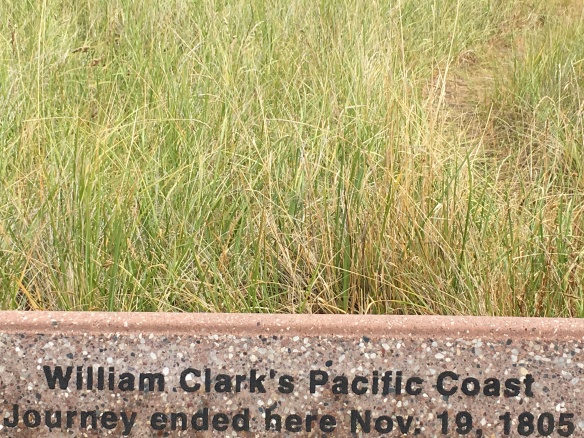
Cape Disappointment marks another very important place in the history of North America. It is not just a place that signifies disappointment, tragedy and danger. It is also the very spot where the famous Lewis and Clark expedition reached the Pacific Ocean in November of 1805. Yes, Lewis & Clark met with many a disappointment and setback along the 3700-mile route up the Missouri River, across the American Midwest, over the Rocky and Cascade mountains and down the Columbia River Gorge that took them a year-and-a-half to accomplish.

IMG_6400

On the journey, were they ever absolutely certain they would make it? As it was, they must have taken their disappointments in stride. For on an uncharacteristically calm day in a stormy November, they made their final push around the western Cape and finally met the limitless horizon.

Significantly, the Lewis and Clark Expedition was called the Corps of Discovery. Today, a 10-mile-long, well-groomed paved path winds through the dunes of Long Beach Peninsula and up into the forest of the Cape. It is called the “Path of Discovery”.

IMG_5994

Cape Disappointment is intricately tied to the Corps of Discovery, where both failure and success are entwined in a rich and diverse history of exploration. The spirit of questing celebrated on these shores includes and transcends both the unique events of human tragedy and human achievement. You cannot have one without the other. In one place. In one human being. Each of us is invited to the journey that includes, embraces and transcends disappointment and failure.

At some point along the journey, you need to have hope in order to continue. Even in the midst of all our unknowing, we can believe and trust in the solution, before it happens.

It’s called faith.

IMG_5922.JPG


[1] Jonah 3:10—4:11, NRSV, Proper 20A/Ordinary 25A/Pentecost+16

[2] Jonah 4:2

[3] Jonah 4:4,9,11, NRSV

[4] Richard Rohr, “Adam’s Return: The Five Promises of Male Initiation” (New York: The Crossroad Publishing Company, 2004), p.112

[5] John 1:38, NRSV

[6] Belden C. Lane, “The Solace of Fierce Landscapes: Exploring Desert and Mountain Spirituality” (New York: Oxford University Press, 1998), p.105

[7] Isaiah 55:8, NRSV

photos by Martin Malina IMG_5940

Cornered?

Have you ever wondered why this building was designed to be more-or-less round? Well, don’t you know, “The devil can’t corner you in here!” we say.

Like in the boxing ring, the combatants in the corner are at either end of the victory-defeat spectrum: In the corner they either have the upper hand, literally. Or, they are on the verge of collapsing in a heap.

Being in the corner is an undesired position. Cornering someone is to put them at a disadvantage. The one being cornered is vulnerable. Being cornered is to admit there are no options left.

We also use the phrase to mock contractors and builders worried only about the bottom line when they ‘cut corners’. Cutting corners may serve the bottom line, but in the long run cutting corners is a prescription for guaranteed repair and reconstruction work sooner than later.

At the same time, the latest fashion in contemporary urban design values right angles and sharp lines. The new buildings are rather square and boxy, aren’t they? Meaning, lots of straight lines. But a straight line can’t go on forever. Therefore, lots of corners.

People in many non-Western cultures don’t build as many corners as we do. The Zulus in southern Africa, for example, live in a less-carpentered world. They live in a history and culture where straight lines and right angles are scarce, if not entirely absent. (1)

What would it be like to live in a non-linear world? Where our material culture presents more rounded, softer, curved constructions such as our building!

And yet, there is a gift in the message of a corner. Not only can corners get us stuck. But they also are an indisputable sign that there’s always a corner to be turned. In truth, this is what we say, don’t we, when things are just starting to get better: “We’ve turned the corner on this.” When things are not yet better, we wonder: “When will I turn the corner on my illness, my fear, my problem, my troubled feelings, my strained relationships?”

Turning the corner means, nevertheless, there’s no turning back. Once you’ve crossed the line, there’s no going back to the way it used to be. That could be good. It can also be scary. Corners are necessary to find a way through a predicament, such as in a maze. Corners define clearly where one eventually needs to go, like it or not.

The story of Jesus’ resurrection is a huge corner turned in the cosmos of all that was, and is, and is to come. History is forever changed by the empty tomb. The ether of our very existence is transformed into the triumph of good that can be, for all time, for all people, and in every place. All the evil forces that led to Jesus’s crucifixion no longer need to triumph in the world today.

They say any lead in playoff hockey is a dangerous lead, as the first few games of the NHL playoffs have shown. More often than not the lead does not stand. If a team does have the lead however small, they are coached to employ the killer instinct:

Don’t let up. Don’t get too comfortable. Don’t sit back. Finish off your opponent with indiscriminating, ruthless power. Once they’re down, make sure they stay down. Hate your opponent. Don’t give them a chance to come back. Don’t be merciful, kind, generous, compassionate. Above all, don’t feel sorry for your opponent’s misgivings.

This is the philosophy of competitive play in professional sports. Why professional athletes and teams are so popular and generate billions of dollars in our economy is precisely because we humans are really good at believing this philosophy if not doing it from time to time.

Easter is God’s come-from-behind victory. The way of non-violence, of loving self-giving, and of trust in God is a victory against all the odds. It is, frankly, an unbelievable, unexpected move from our human perspective. Jesus’ demonstration of non-violence, of loving self-giving, and of trust in God is validated and redeemed by his resurrection. The surprising, brilliant victory of Easter morning is a poignant witness to what God is really all about.

The way of violence of our will/my will over yours, of greedy acquisition for more, of cynical mistrust of others — this is the way of the world that crashes in a heap of defeat in the light of Jesus’ resurrection. Now, the way of God is before us.

Resurrection says a lot about the nature of God’s purposes. Because Jesus lives. And Jesus is Lord. We therefore gather today to affirm that God’s purposes are good. And, in the end, it is not all doom and gloom. In the end, God comes through.

One thing I like about the re-modelled communion rail around the chancel, is that we have those corners at both sides. Some have said they don’t like it at the corner, because they feel squeezed out. Well, we can help each other with that. What the corners force us to do is pay more attention to who is standing beside us; and make room for them. And that’s not a bad thing!

What these corners force us to do, is to face and look at each other when we are standing or kneeling at the altar. We are not just individuals coming to face the Lord God one-on-one in a straight line, not seeing nor even respective of who comes along beside us. Now, it’s no longer just about ‘me and sweet Jesus’.

It’s about ‘us’ and sweet Jesus. And Jesus is not always sweet. We are a community gathered around one table, a people who embody the living Body of Christ in the world today. We are also the broken body of Jesus, whose power is shown through human weakness (1 Corinthians 1:18-29). What better place than to see our sisters and brothers in Christ, eye-to-eye, and practice right here what it means to pray for others, to encourage them, to recognize our unity in the living God.

And then take in word and deed that awareness and message from this place, into the world out there: Christ is risen! Christ is risen indeed! Alleluia!

1 — Wayne Weiten & Doug McCann, “Psychology: Themes and Variations” 3rd Edition (Toronto: Nelson Education, 2013), p.168

An installation sermon for a twin pastor

I wrestled this week with whether I should have my hair cut. Normally I wear my hair much shorter, especially during the winter months when ‘hat head’ poses fashion challenges. The reason I didn’t was I looked forward to playing up the twin thing once again; I know that my twin brother usually wears his hair much longer than I do.

And I’ve eagerly anticipated standing before you today, and asking: Are you sure you have the right twin as your new pastor? How do you know that your pastor is actually David, and not Martin? How do you know which one you are installing? After all, you’ve only had your new pastor a couple of months — do you really know him that well already?


Just one word of advice: If you believe you see Pastor David in Conestoga Mall or walking in Stanley Park in Kitchener or skiing at Chicopee, please, please don’t right away presume it’s Pastor David you are meeting.

One of my all-time favourite, yet awkward, twin-pastor experiences, almost always goes like this: I’m in town (Kitchener-Waterloo) either visiting David, Patricia, Sarah & Susie, or at some Synod meeting and going out by myself to the mall or restaurant when — it never fails — someone I do not know or maybe even know a little bit comes up to me and launches into quite a personal conversation; the person before me reveals information of a confidential nature.

I am caught in a conundrum: Do I carry on listening empathetically, nodding my head with pastoral attention and care? How soon do I break in with the news: “Ahh, excuse me, I am Martin, Pastor David’s twin brother; did you think I was Pastor David?”

At which point, the person’s jaw usually drops, the blush factor intensifies, and eyes pop. “Noooo! Really!?!”
“Yes. Really!”
“Pastor David, you are pulling my leg!”
Then, I have my passport and other photo ID handy, just to prove my identity.

Most non-identical-twins in leadership, I have come to covet, have lived relatively scrutiny-free of their public persona without ever having to ‘prove’ who they are. And here’s a twin secret: Both David and I know who we are. And we believe that there are differences between us; I don’t confuse my own identity with David’s. In fact, it has often surprised us why people can’t notice the distinct differences between us.

But we Malinas won’t make it simple. Add to that, we both end up being pastors in the same church. So not only do we look alike, we wear the same clothes on the job.

In the walls of the church, we may know who we are all about. We have our own social fortresses to hide behind; we gather with our own kind, in familiar places and spaces. We have our own rules and norms of behaviour in our brand of a more progressive, Lutheran church. Yes, we may know who we are.

But does the world know who we are? And perhaps this is the challenge for the church today.

Installations of pastors, or as the Anglicans call them, ‘Inductions’, are tricky events for us. Yes, we celebrate a new relationship between pastor and people, here at Christ Lutheran Church in Waterloo. That celebration tends to focus on the pastor; and, I’ve played into that in the first part of my sermon today!

I suspect that the traditional culture of the church has tended towards seeing ‘ministry’ as the sole purview of the pastor — and that Installation services tended to be viewed somewhat like launching pad for the pastor’s dazzling display of skill, leadership prowess and charisma.

In contrast, the relationship between pastor and people, which an Installation service signifies, is really about acknowledging the true meaning of the word, ‘liturgy’ — the work of the people. The pastor doesn’t ‘own’ the ministry of the church; it belongs to the people to which the pastor joins in supporting and enlivening it with his or her particular gifts, interests and passions.

Yes, leaders must be given permission to lead. Yes, you have elected Pastor David to be your leader. Yes, good leaders need to give themselves permission to lead. And yes, good leaders also need good followers. So, role clarity is vital. Setting and maintaining personal and professional boundaries are important.

It is also important to live collectively in this work. In the words of Martin Luther, we all comprise the ‘priesthood of all believers’ in the exercise of our vocations as Christians, ordained or not.

It’s not just about the pastor. It’s not just about the people. It’s not about pastor or people. It’s about pastor and people. We are not lone-rangers; we are not entrepreneurs or independent consultants in the business of selling faith to the world.

Because it’s about doing it together somehow. Praying together. Being responsible together. Not spectating the practice of faith, but participating in it. Figuring it out in the doing it — in the mystery, ambiguity and paradox that are central to the character of our faith.

I appreciate the Gospel text offered in this service today (Mark 4:3-9). I am drawn towards conversations about this text that focus on the identity of the sower, in Jesus’ parable. Who is the sower? Is it Jesus? Or, does this role fall exclusively on the ordained, set-apart, folks of our church — the pastor? Or, someone else? You, perhaps? We know only of the work the sower does.

I’ve also been looking at the Gospel text for this Second Sunday after the Epiphany (A), where Jesus calls his first disciples (John 1:29-42). There are two people accompanying John the Baptist when he identifies Jesus as the “Lamb of God”. Only Andrew is named. But the other one remains anonymous to us (v.40).

Perhaps both Jesus, who does not name the sower in his parable, and the writer of John’s Gospel who does not identify the second disciple, do so intentionally. Perhaps the anonymity we encounter in these stories is meant to engage us, the reader / the listener, in order to invite each of us / all of us into those roles — as follower of Jesus and sower of the Word.

Pastor David told me the little, liturgical scare you had here prior to the first Christmas services: Of course, it is appropriate not to have the baby Jesus in the manger during Advent and the weeks leading up to Christmas; after all, Jesus has not yet been born.

But it was just before the Christmas Eve service, I believe it was, when Pastor David expressed some anxiety about the missing infant. Where is Jesus? We’ll have to put him in the nativity sooner than later. Or, have we lost Jesus? Has Jesus already left the building? How can you celebrate the Word made flesh with no baby Jesus in the creche? This was not looking good.

Much to Pastor David’s delight, and surprise — I might add, not only did one baby Jesus appear in the little manger on Christmas morning, but two, identical baby Jesuses!!!!


I’m not going to suggest that Jesus had an identical twin brother, otherwise Dan Brown might have another best-selling fiction on the shelves in no time.

Nevertheless, the image is significant. Because, Christianity starts not with a one-person-show but a three-person Trinity (God the Father, God the Son, God the Holy Spirit). Christianity is inherently relational, and so is the work of God.

Following Jesus and sowing the Word is not exclusively the work of the Pastor. Can we envision this work collectively? Not just for one individual to do or be responsible for, but as the Body of Christ in the world today. Perhaps we can get at the identity of the sower or the disciple by observing and starting with what the sower and the disciple do. And how it is done:

When the work of compassion and justice expands beyond the walls of this space, we plant seeds. When the work of loving and forgiving involves the young and the mature doing it together, we plant seeds. When the risky following leads us out there and no one doing it stands alone, we plant seeds. When the work of the church is done together, as diverse and multi-faceted our individual identities in the Body of Christ are, we plant seeds.

And then the world will know who we are.

Checking our Image of God

Do you know “Good Old Uncle George”? (1)

Listen to this description of what happens when a family makes a visit to Uncle George who lives in, and never really leaves, his formidable mansion.

At the end of the brief visit in which the children describe Uncle George as bearded, gruff and threatening, he leans closely, and says in a severe tone of voice, “Now listen, dear. I want to see you here once a week. And if you fail to come, let me just show you what will happen to you.”

He then leads the family down to the mansion’s basement. It is dark, becomes hotter and hotter as they descend, and they begin to hear unearthly screams. In the basement there are steel doors. Uncle George opens one.

“Now look in there, dear,” he says. They see a nightmare vision, an array of blazing furnaces with little demons in attendance, who hurl into the blaze those men, women and children who failed to visit Uncle George or act in a way he approved. “And if you don’t visit me, dear, that is where you will most certainly go,” says Uncle George.

Do you know “Good Old Uncle George?” Sound familiar?

From the bible readings assigned for this season after Epiphany, we are asked to consider again who is this God we are called to follow. Of course, no one image of God is complete. Our perspective is limited, no matter how well we know the bible or how many degrees we may have behind our name. And God is greater and bigger than anything anyone can imagine or say.

Nevertheless, it is fruitful to examine what we think about God. Our image of God influences our own behaviour and what we do “in the name of God”, who is revealed in history, in our experience and in the Scriptures as God the Father, God the Son and God the Holy Spirit. Eventually, our actions mirror the God to whom we pray, to whom we relate, whom we imagine. (2)

I would like to highlight briefly three aspects of the character of God, in Jesus, that we can see in the story of Epiphany for today — the baptism of our Lord (Matthew 3:13-17).

First, Jesus moves. He does not sit still for too long. Jesus is baptized ‘on the side of the road’ so to speak. He is baptized nowhere special, not in some officially consecrated, designated holy place — but in the wilderness where John preaches ‘on the edge’ of civilization where crowds have to follow to be there.

In fact, the Jordan River is some 35 kilometres from Jerusalem. For people who walked, this would likely mean at least a two-day journey from the city. So, most of the people who witnessed this divine event and encounter between Jesus and John on the banks of the Jordan River had to travel to get there. Even the high priests and Pharisees, those in power and who held influence in the religious establishment of Jerusalem had to get there.

Who is God? God is more a verb than a noun; God is not static; God is always on the move; we can in this story of Jesus’ baptism appreciate the moving parts of faith. It is important to note to where God goes, and is revealed.

Mobility is a kingdom value. Going some place else away from what is familiar and comfortable is part of exercising a healthy faith. Conversely, staying in one place too long is not healthy for the soul.

Second, in this mobility God relates to us in vulnerability. In worship and praise of God we are accustomed to calling God Almighty. But, at the same time, if we are ‘getting’ Jesus, we ought to be calling God Al-vulnerable.

Jesus relates to us. The divine becomes one of us in moments of vulnerability, especially. The primary symbol of Christianity, the Cross, points to the ultimate, earthly destination of Jesus, and reveals our most vulnerable God. The Cross is a sign that says: God understands us even in death and dying.

What is unique about Matthew’s version of the baptism of our Lord is that it is meant for public witness. Unlike the other Gospel accounts who make this event more of an inward, spiritual experience of Jesus, Matthew portrays the baptism of Jesus as an external event, available to all present.

Also, Jesus submits to baptism not because he needs his sins washed away. Through this act, Jesus was indicating his willingness to yield his life, to surrender his life, in obedience to his Father. Jesus requests baptism by John so that he could completely identify with those he came to save.

Therefore, relationships described by mutual vulnerability is another kingdom value. Being with others in this way, in community, is vital for faith. Prolonged isolation and emotional detachment from others is not healthy for the soul.

Finally, not only is God in motion and in vulnerable relationship with us, God is reaching out to us, immanent and present to our common lives.

Jesus’ father in heaven calls to him, validates and affirms his path. Then, too, Jesus calls his disciples. Jesus does not do it alone. He includes his disciples in his travels, walks in their shoes, involves himself in the common, daily activities, gets his hands dirty — so to speak.

Jesus is the son of a carpenter from Nazareth, he fishes with his disciples, he goes to weddings and drinks wine, he hangs out with all people not just the ‘good ones’.

Jesus does not leave us alone, some distant, transcendent God who does not care about what happens on earth. Jesus will not stop reaching out to us, and will beckon us to follow where he goes. Jesus continues to engage our lives, touching our hearts, our hands and our minds, in the very course of our lives on earth. God will intervene, and pierce our perception, inviting us into a new way of being and doing.

Today, followers of Jesus can consider anew this God who is revealed to us in Jesus. Jesus is the divine-man, who walked everywhere and moved around a lot; Jesus is the God who seeks relationships and models vulnerability and self-surrender; Jesus is the God who will not leave us alone and continues to call out to us to follow in his way.

May God bless the path we journey. Amen.
(1) cited in Dennis Linn, Sheila Fabricant Linn & Matthew Linn, “Good Goats: Healing our Image of God” (Paulist Press, New York, 1994), p.3
(2) ibid., p. 7ff

Talking about toast

“I want butter on my toast, but not too much.””You’ve spread it on too thinly. I want a whole wad of it.”

“You’re being wasteful. You’ll use up the tub in a couple of days.”

“If you didn’t burn the toast to a crisp all the time …”

“I don’t like my toast slightly warm.”

” … the butter would melt into the bread.”

“Toast is toast. A slice of bread is a slice of bread. There’s a difference.”

“Lighten up. Just slather it on.”

Of course, the words alone in this dialogue do not tell the whole story. There are other ways that we communicate, that animate the message. They say seventy percent of communication is non-verbal. What does the tone of our voice communicate? What are our eyes looking at when we speak? And, most significantly, what are our bodies doing? What is our body language?

I was attuned more to this truth in Italy during our family vacation. Every culture presents uniquely in the manner of body language during a conversation, to the point of caricature and over-generalization. Of course, not every English person speaks with a stiff upper lip; not every Italian gestures wildly with their hands; not every Canadian looks downward and apologizes. The exercise, nevertheless, of paying attention to a cultural tendency is helpful in bringing awareness to the way we communicate.

We played a little humorous game, somewhat irreverent, whenever we drove by or saw in a distance a couple of Italians speaking to each other — their bodies close, hands waving on either side of their partner’s ears as if guiding a plane on the tarmac to its docking at the gate, eyes piercing the other with intensity, even spittle flying from their mouths. We couldn’t hear what they were talking about. But we made up a dialogue about something the opposite in nature to their serious, even combative, style. We would try to convince ourselves that they were talking about toast.

Communication is essential to any relationship. And it’s not just the words we speak. It’s our behaviour. What we do. How we act. What our bodies are telling ourselves, and the other who is in our presence.

In other words, communication is real. It is not just reserved to the realm of ideas and theory and abstraction. Communication involves our whole lives, our whole selves. We are not by ourselves in the ideas we express and the words we use. 

When we speak about God, and our relationship with God, we dare not relegate our relationship with God to the realm of words alone — whether those words are printed on a page, or spoken during worship in a detached manner as if those words hold power on their own without context or embodiment.

Our God is real. Our God wants relationship with us. And, in the Isaiah text today, we read that invitation: “Come, let us argue it out!” says the Lord (1:18). God is having an argument with the people of Judah and Jerusalem during the reigns of kings Uzziah, Jotham, Ahaz and Hezekiah.

It is not a dialogue that is calm and reserved. It is not a cool, collected, disassociated manual of instruction. It is not a legal text. It is throwing down the gauntlet! Come on! You are messing up! But I make an offer. Let’s have it out! says the Lord! You have something to say? Then say it! The Lord can take it. Let’s negotiate. Let’s hear each other out. Let’s be real.

I wonder about our image of God when we shy away from such boldness. Is it because we imagine a God who is passive? Who only does our bidding, or should? Or a God whose job it is only to direct us, judge us and basically order us around?

But what about a God who is more vulnerable than that? There is no more direct and clear message of this vulnerable God than Jesus hanging crucified and dying on the Cross. So, what about a God who seeks our attention by being vulnerable? Who wants us to engage with God in an honest, self-disclosing way? Because the message of Scripture suggests time and time again: 

Not only is God’s company available and deeply important to us, but our company might very well be important to God. Could it be that God seeks our companionship? Could it be that God desires to have us as friends, and that the God who so patiently works with us in every moment rejoices upon occasion to have our undivided attention — even when our attentions are directed to the many particular concerns of our lives? (1) 

God is, indeed, the “great companion” (2). God is present with us, interested in us, and trustworthy. God’s love is receptive and responsive. In other words, we do not pray to an impassive, unmoved mover.

God is in relationship with us. God invites us, when we have a bone to pick about life, about whatever is happening in the world, to “Come, let us argue it out.”

It’s not that God always wants a fight. I will define a “fight” in this context as a bold yet non-combative, mutually-respecting exchange of unique perspectives. What this kind of arguing or fighting reveals is passion, real feelings, and the truth about ourselves. 

And this is a sign of any healthy relationship whether we talk about relationships in marriage, or work, church, community or play. Honesty. Truth. And in the exchange of honest discourse, we bring all that we are, not just our words. Our hearts. Our minds. Our bodies. 

We may not change God’s mind about whatever. But that is not the point. God wants to hear what we have to say. God wants to feel our passion, hear our cries, sense the beating of our strained hearts. God wants to understand us. This is what Jesus was all about. 

God sent Jesus in our flesh so that God could begin to truly understand what it means to be human. And in that humanity, in seeking us, God can bring an outpouring of love, grace and mercy — time and time again.

So, any subject is on the table. Thanks be to God! Anything is on the table, in all honesty. Including talking about toast.
Amen.

1 – Nancy Campbell & Marti Steussy, “Process Theology and Contemplative Prayer: Seeking the Presence of God”, p.87

2 – Clark Williamson, “Learning How to Pray,” in Adventures of the Spirit: A Guide to Worship from the Perspective of Process Theology with Ronald Allen (Lanham: University Press of America, 1997), p.162

No life insurance

It’s like the spirited game parents play with their young children.

I remember years ago when the kids were still in diapers tossing our little ones up into the air, and then catching them on their way down. What makes this game so delightful is to watch the expression on the face of the child. If you slow-motioned the activity and zoomed in on the facial reactions of the child at each stage of the ‘throw and catch’ game, you would see a contrast of emotions:

From the catch to the upward toss, a smile and squeal of joy; from the falling motion to moment of catch, a growing sense of alarm as the eyes widen in concern and fear begins to creep into the picture. But, then, again the catch. And the grin returns. And the game resumes.

Can you imagine being the widow in the Gospel story (Luke 7:11-17) who has just lost her only son? Having lost her husband is one thing. You think it cannot get any worse. Yet, as is often the case in life, it does. Now her son. She feels the sharp edge of grief once again. Perhaps more deeply for the child she gave birth to, and raised with all her mother’s love.

Not only a personal grief, but the prospect of living in extreme need. Being a widow in 1st century Palestine was usually a ticket to poverty and low social status. A woman’s economic worth was almost always tied up in the men of her household — her husband or eldest son. This was much more than personal, emotional grief. This was a complete life-style change, from top to bottom, in a heart beat.

After meeting Jesus, however, things change so rapidly. From a season of mourning and grief, to the astonishment and wonder of joy: Her son is no longer dead, but alive! No longer is she alone, vulnerable, a burden on society, worthless in the economy and social structures of the day. Now, she has her son back. She has family. And that means the world to her!

Although something has changed. This new thing is also scary. All who witnessed the miracle were filled with fear (v.16). What does this second chance at life mean? Things will be different now. No longer like the good old days.

The rapid and extreme change of emotions could make her feel like a yo-yo. Maybe life sometimes feels like that for you. From moments of exquisite satisfaction, pleasure and joy, to the dark caverns of grief, depression, loss, suffering, fear and pain. Life. Death. Life. Death. Life. Death. Life. 

In my first parish, which was in rural southern Ontario, burials were conducted (except during winter months) immediately following the funeral service in the cemetery right beside the church building. The recessional with casket proceeded to the grave side where the words of committal, prayers and scripture readings were offered. 

But then, the family stood by as the grave-diggers and funeral attendants lowered the casket, suspended up until that point on winches and ropes, down into the hole. In some cases, I had to assist by moving the casket into place as it slowly lowered. Once resting on the ground inside the hole, a family member used a spade to throw the first shovel-full of earth onto the casket — a symbol of the family participating in burying their loved one.

Today, especially in urban centres where funeral services are highly managed by market-driven professionals, most often the family leaves the grave-side before the casket is lowered and actually buried. I wonder about how the smallest of acts reflects our attitudes towards death and loss. 

Perhaps we can’t ‘go there’ emotionally so soon after losing a loved one and have to insulate ourselves in order to cope. The funeral rite therefore serves more as an anesthetic against the harsh reality of death and loss. I wonder: Does the experience and ritual of funerals only end up buffering the hard, emotional impact of loss?

Perhaps we are not used to ‘losing’, letting go, failing, surrendering, being powerless, vulnerable, at ground zero. We have little in life to practice this letting go before the final experience of losing a loved one. And perhaps healthy religion, as Richard Rohr claims, is about showing us what to do with our pain.

Is this too difficult an expectation of our faith? Because in making religion only about ‘feel good’ ‘warm fuzzies’ we might maintain our denial of life’s realities and only distract ourselves from truth. And that’s not what Christian faith is about — distracting us and keeping us from the rhythms of life, death, life, death, life.

Because in avoiding death, we also ironically, avoid life. And Jesus is about life. When we say this Gospel story is first and foremost about a miracle, we may be missing the point. It’s understandable that we do, because it is sensational. It captivates our imagination.

Focusing only on the miracle may just play into our fear and avoidance of death. As if to say Jesus performing this miracle was done for the boy’s sake. The enemy, death, was conquered! Therefore we can go on denying death. As if the boy will never eventually die an earthly death. As if to say Jesus performed this miracle solely to convince us to ‘believe’ in him — because no one else could do so (even though there were magicians/soothsayers and other miracle workers who performed incredible acts in Jesus’ day).

But the miracle, per se, is not the point of the story. Jesus raised the son from death not merely to show his divine power but to express his love and concern for the widow. He had compassion on her (v.13). And he couldn’t stand the thought that she would have to go it alone in a culture that marginalized the widow. Jesus brought the son back to restore a relationship, for living in the world.

God tosses us into the air. God throws us into the thick of life with all its challenges, disappointments, failures, weaknesses, joys, hurts, loves, pleasures and pain, satisfactions and accomplishments. God throws us into the air to experience fully this life we have been given. Life, death, life, death, life, death …

Then, to our happy amazement, God catches us again at just the right moment. God cares about what happens to us in our lives. God is interested in every minute detail and event in our lives — even those things we would rather cover up and hide in the darkest recesses of our hearts. God’s light exposes those secrets, even. We may feel vulnerable, challenged, unsettled for a time. And we may even wonder if we won’t just crash and burn on our way down.

Have faith in the One who’s tossing you. Because it’s part of life, for one thing. But most importantly, because God loves you and will quite unexpectedly be the One to catch you, at just the right moment.