Turning into the wind

We were just down the street from Pearson International Airport in Toronto. Late in the evening after the first day’s sessions at the Synod Assembly last week, I walked along Dixon Road which goes right to the airport. 

At one point on a bridge you can stand directly underneath the path and roar of landing planes. You look west in the direction of the landing, and you see the long runway lighted brilliantly for the descending jets touching down. You look in the opposite direction towards the east, and you can see a long line of planes taking their turn in the landing rotation, the dots of their lights extending in a straight line far into the distant sky.

It was a windy day, the gusts reaching over 50 km/h from the south. What impressed me was how each plane’s nose was turned slightly to the left, towards the south, as they made their final approach. The planes were coming in on a straight line, yes, but turned towards the wind in order to keep their landing true. At the last second before touching down, the jet would straighten out.

Wind, like currents in the water, is a significant if not main factor in affecting the flight or sail of the airborne or water craft. In order to land safely and soundly, the planes had to face the challenging issue head on. In the words of Paul in his letter to the Galatians, the problem must be “detected” (Galatians 6:1) and exposed. 

You will get nowhere in a plane or boat unless you ‘dance with the devil’ so to speak. Unless you look your problem square on, face it and name it, and change your position accordingly. If the landing planes insisted on keeping their plane aligned straight on their approach, they would not have made their landing on the runway, but somewhere to the north of it!

Our guest at the Synod Assembly, Bishop Munib Younan (president of the Lutheran World Federation) spoke of Lutheranism. He warned us, that in these Reformation Anniversary years, we do not celebrate ourselves. We do not pretend that God couldn’t have done anything good without us. We are not the perfect church, but always reforming.

Being Lutheran, he said, is a call to humility, not a spirit of triumphalism. We dare not make an idol out of Martin Luther or his legacy in us.

Paul strongly exhorts the Galatian church to proceed with one another in humility and gentleness, not lording it over others who are ‘sinners’. Because we ourselves are no better. We must learn to face our own demons. This is what is meant by his words: “All must test their own work … for all must carry their own loads (v.4-5).” We dare not point fingers without first acknowledging our own stuff.

This is then, how we bear one another’s burdens. Amidst the conflict wreaking havoc in the early church in Galatia, Paul encourages the people to persist in not losing heart, to have courage and not give up.

As the Gospel text for today describes (Luke 10:1-11), the work of the church doing God’s mission in the world will result in friction and struggle. You cannot follow Christ and not encounter conflict and adversity in your life. 

The famous Psalm 23 so often associated with bringing comfort and evoking peaceful, calming images includes this disturbing verse: “You prepare a table before me in the presence of mine enemies” (Psalm 23:5). It feels like this verse doesn’t belong beside still waters and green pastures along paths of righteousness. But it does belong! It means that God gives us the gift of grace in the presence of all that challenges us, all our demons internal and external, everything that we may not like in our lives — not apart from it.

Paul concludes his letter to the Galatians by focusing our attention on the cross of Christ (6:12,14) — the symbol of death and suffering of a God who goes the distance to love us. This is the only reality about which to “boast”. Why?

There is a treasure in the midst of the suffering. We may not see it right away. Yet, our struggle does yield something good, something meaningful, something liberating. Yes, we are liberated by God’s grace. 

Liberated however not by ‘nicey-nicey, goody-goody’ — a phrase our Bishop Michael Pryse used at Synod to describe an approach to church life that just keeps us stuck. Liberated not pretending to live a charmed life. Not by everything working out perfectly. But liberated through what may be a terrible suffering, a loss, the very pain that would otherwise destroy a person altogether. There is a treasure therein.

That is why we boast of the cross, and nothing else. How can God be found in the painful letting go that marks the various stages of life? How can we even sense or feel God’s presence in the midst of a grief too heavy to bear? How can we move on through the turbulence of change and transformation?

In his short book, “Rules for a Knight”, actor-writer Ethan Hawke recounts the last words of instruction by a renowned knight, Thomas, to his children:

“There is a memory that won’t let me go,” Thomas begins. “Last summer all you children were playing by the ocean. We were with your mother and her sister’s family, do you remember? The weather was sublime, streaks of sun and a deep blue sky. You four and all your cousins were building castles with the warm, muddy sand. Each of you kept your castle separate, announcing, ‘This one is mine!’ ‘That’s yours!’ ‘Stay away from mine!’

“When all the castles were finished, your cousin Wallace playfully stepped on Cven’s. Lemuel, you flew into a protective rage. You were only looking out for your sister, I know. Mary-Rose, you thought Lemuel was over-reacting, and you threw him to the ground. Next, everyone was fighting, throwing sand, howling with tears, and pushing one another. Young Wally had to be taken home, sobbing in your aunt’s arms.

“When he was gone, you all went back to playing with your castles for a little while but quickly moved on to swimming. It grew cloudy, and soon it was time for us to begin the journey home. No one cared at all about their castle anymore. Idamay, you stamped on yours. Cven, you toppled yours with both hands. We all went home. And the gentle rain washed all the castles back into the surf.

“Please be kind to one another,” Thomas concludes. (1)

What are the castles in your life? Things or issues that in five to ten years won’t really matter anymore? Things for which you might lay your life down now in heated, compulsive reaction, but really won’t endure — material possessions, opinions that merely shore up a vulnerable ego, beliefs that have outlasted their use? A spirit of judgement and condescension towards people who do not experience life like you do? A reputation to defend at all costs? etc. etc. What are your castles in the sand?

“My friends,” writes Saint Paul, “if anyone is detected in a transgression, you who have received the Spirit should restore such a one in a spirit of gentleness.” Around the same time Philo of Alexandria wrote: “Be kind: Everyone you meet is fighting a hard battle.”

Turning into the wind may be a basic operation for landing a plane. When I face the wind and continue paddling or cycling into it, tears will come to my uncovered eyes. There are tears that come in the face of God’s Spirit, a Spirt that will blow down castles built in the sand.

This wind also has the power, like the Spirit of God, to build endurance, strengthen my inner life and take me where I need to go. If I stay with it, often more rapidly than I would on my own!

May God’s wind blow surely and true in your life this summer. May you receive grace in turning to the wind.

(1) – Ethan Hawke, “Rules for a Knight”, Alfred A Knopf, New York, 2015, p.148-149

Bread for all

After the old doctor died, his sons emptied the house in order to sell it. In the living room on the shelf above the fireplace they found a box with a slice of bread in it.

It was dried up hard and obviously had sat in the box a long time.

“He really kept every thing!” said one of the sons amazed. The doctor’s assistant who worked for the doctor for many years stood beside the sons silently. And then said: “Let me tell you the story of the slice of bread:

“You know that after the war your dad became very ill. He was weak, and near death. A friend, who had visited him told him, ‘If you don’t eat enough to regain your strength, it looks very bad for you.’ But where was one to get enough to eat? Everyone was starving. Many simply cooked potato peels and considered it a rich soup.

“The friend returned after some hours and brought some bread. Where he found it, he didn’t say. Surely he must have paid a fortune for it.

“But your dad did not eat it,” continued the assistant. “Your dad told me to take it to the neighbour; their daughter had been ill for a long time too. ‘I am an old man already who does not need the bread as much!’ your Dad said. ‘Take it to the neighbours!’

“As it later turned out, the neighbours did not eat it either, but passed it on to a family of refugees with three little children that lived in a small shack in the backyard of the neighbours’ house. They were overjoyed for they had not seen bread for more than three months. 

“But as they were about to eat, they remembered that the doctor, who had helped their children at no charge when they had been struck by a dangerous fever, was ill and weak and really needed something that would make him stronger.

“So when the bread came back after a day,” said the assistant, “we recognized it at once. Your dad was in tears, as they found out about the wandering piece of bread and where it had been.

Your Dad had said, “as long as there is love between us – I am not afraid about anything, not even dying”. So he divided it evenly and sent me out again. His share he kept; he put it in this box to always remember what had happened.”

The three children took the old bread, broke in in three pieces and decided to keep it in order to remember the story, to tell it to the next generation, and to teach them about the power of love and the wonder of sharing.

Something like this can only happen when there is a communal consciousness — more than one person that participates in a community of love and trust. That all will have enough. That all will benefit. That the needs of the whole outweigh the needs of the one.

This is the Gospel call. The kingdom call. Not for individual enlightenment or edification. Not for our sake alone. Dear Confirmands, your baptism as a baby was not valid on account of your own individual strength or decision. It was the community — your parents, sponsors and everyone in the church long ago — whose faith surrounded you at your baptism. Even your confirmation is not done for your own sake — but for the sake of others around you.

And that’s why you participate in leading and assisting in your own confirmation service: To practice this truth, that affirming your baptism is a call to deeper commitment in the life of the church. You may doubt the strength of your faith. That’s ok. In fact, I would be worried if you didn’t. God can work with just a tiny bit.

I must admit when we planted that tiny four-inch tall spruce on church grounds last Fall, I didn’t have a lot of hope that it would survive the winter. This was our first tree planted in response to the Reformation challenge for our national church to plant 500,000 trees by the end of 2017 — the 500th anniversary of the Reformation. It was a small tree. A humble start. Could it live, and even bear fruit? I had my doubts.

For one thing it was exposed, and not easily visible, to the many pedestrians that use this property to cross through and the many children who play in this space. For another thing, since receiving the sapling, I had not seen signs of new life on it. So I wasn’t sure it there was anything new to come out of it.

I was in for a pleasant surprise. Throughout the coming months, our neighbours put a tall chicken-wire type fence around it and staked it. We watered it. People walked around it. God took care of it over the cold winter. And voila, look at the new shoots of life sprouting now! There is hope.


It does take a community committed to sharing, committed to kingdom values, and the Gospel of Jesus Christ. Today is just as much about celebrating the church of all times and places as it is about our part in the kingdom of God on earth. We are not loners on this path. We don’t walk by ourselves. It’s not all up to us, individually. 

It’s amazing to see the fans of “We the North” cheer on the Toronto Raptors as they advance through the NBA playoffs this post-season. They are true fans who gather in “Jurassic Park” outside the ACC in downtown Toronto, even during away-games in the pouring rain. You might say, they are ‘fan-atics’ of their team. 

Yes, fans can be fanatics — exuberant, dedicated, passionate, sometimes even over-the-top. Imagine the fans in heaven — the faithful gathered as the grand host of heaven, cheering you on this day. These may be your loved ones, long gone now, or recently died. These may be the saints throughout the ages. These may be other Christians not here today yet praying for you nonetheless. These are your fans of faith. Fans. Fanatics. Fantastic!

You are not alone, making this decision today. Pentecost, and Confirmation Sunday, is also about trusting in God’s initiative, God’s work, God’s love and mercy. Through the Holy Spirit God comes to us in so many ways we sometimes don’t even recognize. 

In a few minutes, God comes to us in bread. This bread, the body of Jesus, is broken bread. It is broken from the One, so that all may eat. There is always enough for all, for the sake of our broken lives in this broken world that God so loves.

The gift of the White-breasted Nuthatch

I walk quickly. In the first hour of walking I can manage 6 kilometres. Pretty impressive, eh? Well, I was zipping through the treed park near our house the other day when I heard birds rustling and chirping in the branches above me. 

I stopped when I noticed a small bird scampering down the trunk of the tree head-first. This tiny bird caught my attention. It had a disproportionately long beak, a black cap and a white breast. I memorized the details of what I saw, and scurried home to consult my three, different bird books.

It was a White-breasted Nuthatch. I was so thrilled to have made that identification. I love birds, and I enjoy the challenge. Most of the time.

I’m by no means an experienced, knowledgeable birder. Because most often I forget the names of the birds I identify or mis-identify. Because I don’t carry around with me my bird books and note pads wherever I go, I have to hone my skills of observation and memory. There are times even when my bird books don’t display sketches or photos of what I think I saw. That’s really frustrating!

When Paul and Silas were thrown into prison after being flogged for disrupting the peace, their future was uncertain at best, an absolute failure at worse (Acts 16:16-34). They were done, or so it seemed. The prospects of continuing their missionary journeys looked bleak no matter how you looked at it. What could they do?

I bet no one expected that earthquake to come when it did. A natural disaster always comes unexpectedly. The severity and life-changing magnitude of an earthquake, for example, cannot be predicted. It’s only after-the-fact when assessments and conclusions of what happened can be made. 

No one could see it coming the way it did: The fires in northern Alberta around Fort McMurray, despite the dry hot Spring, could not be predicted. Who could forsee precisely how it’s actually played out, and continues to play out? It just happens. And people have to react to the moment, when it does.

Despite the life-changing magnitude of events unfolding around Paul, he still seems to find stride in his faith, and yes, even joy. He shows resilience in faith. Despite all the losses, earthquakes, imprisonments, floggings, shipwrecks, rejections, threats on his life, thorn in his side — he still demonstrates an incredible passion for, dedication to, and joy in his life in Christ.

They are in the Roman colonial city of Philippi when Paul and Silas are arrested. Paul’s famous letter to the Philippians was written, later, when Paul sat in a Roman prison cell. And it is in this letter where we find some of the most joyous and aspirational words from Paul’s hand: 

“Rejoice in the Lord always; again I will say: Rejoice! Let your gentleness be known to everyone. The Lord is near. Do not worry about anything, but in everything by prayer and supplication let your requests be made known to God. And the peace of God, which surpasses all understanding, will guard your hearts and your minds in Christ Jesus.” (4:4-7)

Paul is instructing his good friends in Philippi, and followers of Christ in all times and places, to rejoice — not when everything is perfect, not when your problems have been resolved, not when certain conditions have been met, not when we are prepared for rejoicing, not even when the stars are aligned.

But, to rejoice, precisely when things are chaotic and messy. Rejoice, precisely when things are not going well, nor planned, nor pre-conceived, nor forseen. How is this even possible?

When installing our new dishwasher recently, I screwed clamps into the cabinetry on both sides. Tightly.

When I ran a cycle for the first time, water started streaming out the side of the door. It’s as if the door wasn’t even sealed! I discovered later that because I had fastened the clamps too tightly, the whole unit twisted and warped the door in an unnatural way and therefore could not seal properly and do its job. 

As soon as I loosened the screws a bit so that the dishwasher could rest naturally, evenly and squarely on the floor, everything worked fine.

Indeed, to be faithful is to know how to celebrate, even in difficult, unpredictable times. Trying too hard without a break can actually damage our commitment in faith. 

When things don’t go well, is it that we are trying too hard? Or believe the solution is simply to work harder? And then do we get all tense, anxious, impatient and frustrated when nothing in our power seems to work or when things don’t always go the way we planned? And we don’t ask for help. Or recognize or confess openly our limitations. Who do we think we are?

Especially during the long journey of a dark night of the soul, it is vital for our health to pause from time to time, loosen the screws, and lighten up a bit. Doing so will improve our endurance, open our hearts, deepen our trust in the good Lord who comes to us, who is alive and lives in us.

It is the freedom of God who comes to us, quite unexpectedly. Like the gift of the White-breasted Nuthatch. All I needed to do, was to stop my rushed march through the woods. Stop my over-thinking, incessant mental machinations. 

Just stop, and look up.

Better is not what you think

What happens when doors close and we don’t see other doors open? Life is full of closed doors: unemployment, failure to graduate, illness, tragedy, lost friendships, divorce — the list goes on. What happens when you are stuck in the middle of that transition and can’t see a way through? For whatever reason, doors close. The fact we sometimes don’t know why may make it harder to take.

Paul wanted and “attempted” to go to Asia. The lectionary doesn’t include the verses (6-9) immediately prior to the first text today (Acts 16:9-15). For some inexplicable reason, the Holy Spirit “did not allow” Paul and his cohort to travel there. A door is closed. 

But you’ve heard the cliche: When God closes a door, another one opens. Which is, presumably, a better deal.

After the door to Asia, and Paul’s ‘wants’, closes, he then goes to Macedonia after a convincing vision and on to Philippi where he meets Lydia. The result of their encounter is that “she and her household were baptized”. Good things happen. This open door was a successful mission. Even though, originally, this mission-field was not for-seen, planned, even desired.

The church finds itself in an uncomfortable situation these days. The glory days of ethnically-defined church planting and building are long gone. We still yearn for those good-old-days, the hey day of the kind of church we still try to maintain when Lutherans from Germany were streaming off the boats, church budgets were growing and pews were filled. For the institutional reality, it feels like a door is closing. And we don’t see a clear picture of what it is changing into.

It’s not a comfortable place to be, when doors close. Where’s the open door?

Earlier this year a couple members of a Lutheran church in Southern Ontario, decided to partner with a neighbouring church to organize a refugee sponsorship initiative. They complied with all the regulations, began a fundraising appeal, and the word got out.

Before long they had attracted fourteen people from the community to work alongside them. They found unprecedented success at mobilizing resources and motivating people to help. Tens of thousands of dollars was raised in no time. An apartment was secured and furnished without problem. A Syrian family was on the way.

The Lutherans on the committee made sure their own congregation was brought up to speed with regular reports, appeals for help and updates. To their surprise, and dismay, all but a couple on that growing committee were members of their church.

The gentleman who had initiated this refugee work lamented to one of the Synod staff who was close to the community, “What’s the point of doing all this work, when the people working on the committee don’t come to church on Sundays and put offerings in the plate?”

“Are others aware you are a Christian from a local congregation?”

“Are people being helped?”

“Is good coming out of all your efforts?”

“Are you doing this from your conscience as a Christian?”

“Do you feel God is calling you to do this work?”

All these questions were answered in the affirmative. So, what’s the problem? Maybe a door is closing, and maybe another has opened? It just isn’t what we may expect or think we want. The Holy Spirit is active in the world and among people. The question is, are we willing to walk through that open door? Congratulations to that Lutheran who took the initiative to do something when there was a need.

When a door closes, it can feel like you are unprepared for whatever may be. In life transitions, especially, the in-between ‘close door / open door’ time can be unnerving. When a baby is born, for example, no manual comes out with the baby. Being a parent is feeling your way to make decisions with each passing moment. Preparation — you can throw that out the door!

Of the top three major festivals of the church year, the Day of Pentecost comes up almost unexpectedly. Did you know it’s two weeks from today? Unlike Christmas and Easter which have long weeks of preparation (Advent and Lent, respectively) leading up to these high, holy days, Pentecost does not.

We only have Jesus’ words in the Gospel of John (14:23-29) to his disciples, these days, preparing them for his departure. And giving the promise of the Holy Spirit.

Occasions like this should be sad, unnerving, disquieting, too sudden. And, on some level, it is. It cannot be denied. After all, the disciples will no longer have Jesus physically present with them any more. In a way, they are losing something precious and dear to them: their leader, their confidant, their friend. The common reaction to a loved one’s leaving is sorrow and despair. We can understand. Sympathize.

And yet, Jesus tells them to “rejoice” that Jesus is going back to the Father. Be glad, that Jesus is leaving them? It doesn’t make sense. Be glad, that you are going? – You can probably hear the disciples murmur under their breath, trying to figure it out.

In coping with his absence, Jesus nevertheless gives them something even better. The door of his physical presence is closing. But another, better door, is opening. This is unexpected, never-before-seen, and unplanned (from the disciples’ point of view):

After he leaves, Jesus’ presence will be within them: Earlier in this chapter (v.20), Jesus says: “I am in my Father, and you in me, and I in you.” Through the gift of the Holy Spirit, they will have the power and the grace to do great things in the name of Jesus. “Very truly, I tell you, the one who believes in me will also do the works that I do and, in fact, will do greater works than these, because I am going to the Father” (14:12).

In order for the new door to open, the old door must close. The only way the disciples of Jesus can receive the Holy Spirit and do and be all that they are meant to be and do, is only after Jesus leaves them and returns to his Father in heaven.

The promises of God are rich. We may not see the outcome or how it will all turn out, in the end. Yet, it is true: Once a door closes, another will open. And it will not be what we think. It will be better!

Prayer: “Help”

When I heard this prayer I thought it related well and in a humorous way to how well we follow the ‘rules’ of our faith:

“Dear Lord, I am happy to report, so far this day has gone well: I haven’t coveted anyone their belongings; I haven’t harboured ill-will to my neighbours; I haven’t spoken hateful words or done anything out of spite to harm anyone; I want to help out in the church food-bank this week; I’m even praying to you now! I am thankful that this day has been going so well, Lord. But I think I’m going to need some help, once I get out of bed. Amen.”

Indeed, how well do we follow the commandments of God? The very act of getting out of bed almost guarantees we will make mistakes no matter our good intentions. It is our common humanity.

One of the functions of the Law, from a Lutheran point of view, is to make us realize that we totally depend on the grace of God. Let’s be honest. We need help, and we can’t do it on our own. No matter how hard we try, we will always miss the mark and mess up in some way. If there is anything good that comes out of our work, it is a gift and a grace.

This morning’s Gospel (John 13:31-35) was also read at the Maundy Thursday liturgy last month. Maundy means the commandment to love. It is fair to say that these words of Jesus capture the essence of who we are called to be and what we are called to do: In all we are called to be and do, is to personify love.

In this love, we see the glory of God. Glory. A statement attributed to Saint Ireneus of the early church comes to mind: “The glory of God is a human fully realized”. 

I take that to mean that God’s glory is not something other-worldly so much as something discovered in the ordinary, real, weak, broken life of a person who is able to receive with open heart the gifts of another, the gifts of grace and love. That is the glory of God. So intertwined with Jesus’ suffering as a human on the night of his betrayal (v.31-32), when Jesus needed to depend on his Father.

Faith is not just about believing and thinking doctrines and dogma, it’s more than that; it’s not just about believing, it’s about behaving. We have to pay attention to the behaving part. We must remember something I have heard our bishops say for many years now: Those who claim the greatest truth must demonstrate the greatest love.

Peter Steinke, who has given much thought, books and workshops about healthy churches and leadership today, told the true story of mega-church pastor whose congregation in the southern U.S. was doing really well. By all counts, Pastor Chase was enjoying unprecedented success in his vocation. 

And yet, he had confessed to Steinke, he was suffering from a malaise of the spirit. You could call it, a crisis of faith. Chase was losing a sense of personal direction in his work. 

Hearing about his struggle, a brother-in-law who was a member of a Franciscan order invited Chase to visit him in Italy. And so, Chase took his leave and spent that time resting, reading and visiting his extended family. 

Nearing the end of his time away, the brother-in-law invited him to come for a day to the AIDS hospice which the Franciscans managed and served the several men who were terminally ill. After working in the kitchen a couple of hours, a care-giver invited Chase upstairs to help with one of the residents. The man he looked upon was emaciated. His skin looked like it would fall off the bone. He couldn’t have been more than 90 pounds.

The care-giver greeted the man with a kiss on the forehead, and then looked at Chase: “Could you please lift him into the bath for me?” Chase carried the man and laid him into the bath water. The care-giver then asked, “Would you please wash him?” At first hesitant, Chase understood that this man needed a thorough wash. And so he did.

When they were finished and walking down the stairs the care-giver thanked Chase for his help. She indicated they were short-staffed that day and Chase had provided a real service to the hospice. “I can tell you have a Christian background,” she said. Chase responded: “It is I who need to thank you, Sister, because today I became a Christian.” (1)

“They will know we are Christians by our love,” goes the song. We have a choice to make. We need to be intentional as Christians. We cannot afford not to be, in this day and age. We can choose whether or not to love. 

We can’t save ourselves, or do anything to garner points for heaven, for we will always fall short no matter how heroic, self-giving or impressive our good deeds of faith appear. This is not about doing these things in order to make ourselves right with God. It is not about not doing anything at all. It is, however, about choosing actions that demonstrate care, compassion and love for the sake of others, and so, for God. 

It won’t ever be perfect. But that’s not the point. It is about behaviour that flows genuinely from a heart of love. And understands that all is a gift: The gift of faith, the gift of each other, the gift of community, the gift of Jesus Christ who is alive and lives in the Body of Christ, the church, and in the world he so loves.

(1) – adpated from a video entitled, “To Make a Difference”, presented in an upcoming workshop called “Apple Tree” by the Eastern Synod-ELCIC. Apple Tree is a workshop to help stimulate conversations about purpose and mission

There’s no place on earth

People of faith, since the beginning, have been on the move. Even when they settled down for a while, they created ways of practising the journey — of moving from Point A to Point B.

Rome, central to the story and expansion of early Christianity, is full of famous steps. The most famous of these are the 135 Spanish steps which visitors traverse daily en masse.

Millions of Christians have walked the Camino el Santiago which spans almost 800 kms from the foothills of the Pyrenees in France all the way to Galicia on the northwest coast of Spain.

The trails to the castle at Lindisfarne in the United Kingdom attract Christians worldwide every Holy Week to walk nearly 200 kilometres.

People of faith have valued movement as integral to their spiritual growth. Because we are not the same at the end of a journey than we were when we started. This innate desire to be better, to change, to grow and mature — is part and parcel of the life of faith.

The culture of Journeying, so important to the Lenten season we now begin, has its roots in the original pilgrimages to Holy Lands. For centuries, Christians sought a deeper connection with Jesus who walked and lived and died in and around Jerusalem and the Judean wilderness. 

When the Crusades prevented pilgrims from traveling to the Holy Lands, Christians ‘back home’ developed prayer walks in Labyrinths — the most famous and oldest in the Chartres Cathedral in France — which symbolized the long journey to meet Jesus.

Indeed, settlers to this country moved here, many of them to exercise and practice their faith in freedom. Mobility, migration, pilgrimage — this is our story, as people of faith.

How we journey is the question. The journey is not only physical, it also describes our understanding of the way things work.

Over the last month, the Ottawa Senators (NHL hockey team) were looking to score more goals. They had lost more games than won. Their star players were not producing. 

One of their younger players, Curtis Lazar, decided to give $50 to a homeless person after dining out one evening. The next night, he scored two goals in a routing of the Toronto Maple Leafs — the Senators won that game 6-1. The following game, the Senators won again, 5-1, against the Tampa Bay Lightning.

In an interview afterwards, Lazar confessed that perhaps there was “karma” working here. Meaning, because he had done a good deed, there was a ‘return’ on his righteous investment and he was rewarded with those goals and wins.

I like Lazar and I appreciate his hockey skills and character. At the same time, he reflects a dominant way of thinking. It is really what some have a called a mechanical type of spirituality, with inputs (from us) and outputs (from God). The sequence goes something like:

1. We sin

2. We are punished

3. We confess our sins

4. We change our lives, and do something good

5. Then, we receive forgiveness and grace

Such is the description of a journey towards goodness that hinges entirely on us, and our doing, our initiative. This spiritual journey then cycles back to the beginning and round and round it goes. Essentially, we force God’s hand. Karma is not a belief alien even to Christians, it seems!

The problem with karma is that because it ultimately relies on our good works, we will never achieve the goal. After winning two lop-sided games, the Senators have now lost three in a row. Where does that leave Lazar? Does he have to give $100 next time to poor people he meets?

In recalling the great acts of God in bringing the Israelites to the Promised Land, Moses confesses it is God’s mighty arm that started the ball rolling towards freedom; verses 8-9 of Deuteronomy 26:

8The Lord brought us out of Egypt with a mighty hand and an outstretched arm, with a terrifying display of power, and with signs and wonders; 9and he brought us into this place and gave us this land, a land flowing with milk and honey.

Like the Israelites wandering in the desert for 40 years, Jesus walks with us in a completely opposite direction from karma. His is not the spirituality of addition, but of subtraction. He goes into the desert.

Try to imagine Jesus’ first moments, entering into the wilderness he would occupy for forty days: The sound of any footsteps is absorbed by sand and rock, lost in the wind or in silence. It is in this barren place that Jesus chooses to retreat, far from what he knows.

Christ chose to retrace the path of his ancestors — in the desert: Abraham. Moses. Ruth. Some of them were responding to God’s call. Some were fleeing persecution. Some were simply looking for a place to call home.

There may very well be value, to our growth as Christians, in embarking on spiritual journeys and earth-bound pilgrimages with some expectations at the destination in mind.

At the same time, we can be assured that Jesus not only waits for us at the ‘end of the line’. Jesus is right there with us, each step of the way. His journey into the desert of testing and suffering shows that there is no place of suffering, pain and loss on earth, to which Jesus is unaccustomed. No place of want that Jesus doesn’t know, intimately. This is more the point.

I like one of the sayings, attributed to Albert Camus, on a Valentine’s Day card I saw: It’s a message of love from one to another: “Don’t walk in front of me, I may not follow; don’t walk behind me, I may not lead. Just walk beside me, and be my friend.”

The message of Christianity is that God is not out there, or back there. God is ‘in our skin’, with us. And goes where we go in our journeys of faith and life, through the good and the bad. Jesus is not only the God of our eternal salvation, Jesus is our friend for life, and no matter what.

Jesus resides in the deepest places of our heart and activates our truest most authentic selves no matter where we are at.

Long before Jesus came, the Psalmist knew this gracious truth in his heart: There is no place on earth where God’s presence of grace, love and mercy cannot reach. In Psalm 139 —

7 Where can I go from your spirit? Or where can I flee from your presence? 
8 If I ascend to heaven, you are there; if I make my bed in Sheol, you are there. 
9 If I take the wings of the morning and settle at the farthest limits of the sea, 10 even there your hand shall lead me, and your right hand shall hold me fast. 

Contrary to karma, this journey of faith begins with God’s grace and forgiveness, as it always does. It is in the desert of our lives where we experience this grace because life happens regardless of how hard we try. And because we are already forgiven, already blessed, we can live confident, transformed lives, even in the desert of our lives. As we live out of our freedom in Christ, we can then confess, “Jesus is Lord!”

As God is with us in our deepest darkness and light, we look to those on the move today. Refugees. Migrants. More than the places of the journey, it is the people we must engage. 

While the desert wilderness was a time of solitary retreat for Jesus, migrants and refugees live in communities: their solace is in the comfort of companionship and common history and identity with those whom they live alongside. In the Lenten days to come, in our own solitary places, let us pray for those for whom solitude is a luxury. And welcome them into our hearts and minds. (1)

(1) Lutherans Connect, “Welcoming the Stranger” blogpost Lenten devotions, Day 1 (lc2016lentdevotional.blogspot.ca)

Lift, and open the gates!

I reacted with sadness and sympathy looking at the photo of my friend’s dog whose entire face, chest and front legs were pierced with dozens — maybe even hundreds — of the sharp quills of a porcupine.
The photo was taken of the dog in the back of the car on the way to the vet, and she seemed stable enough — like the look of someone who knows they’ve been stung and know they just need to hold it together for a bit longer.

I felt sorry for that dog because it was simply being true to its nature — maybe motivated by a natural impulse to be friendly and play with another creature. Unfortunately, good intentions don’t always yield the desired results in relationships. Often, expressions of love and care are misunderstood. And the response can sting — just like this poor dog! I wonder if this dog will ever approach another porcupine again with such exuberance. 

On All Saints Sunday, Christians remember not only those who have gone before us who now taste and see the glory of God in eternity. We also reflect on the “communion of saints” on earth. And, like we did last Sunday during the celebration of the Reformation, we ask the good question: Who are we? Who are the saints? What qualifies a Christian for sainthood, beginning in this life?

Psalm 24 may suggest that no one living can belong to this glorious, virtuous group of people. Only those with clean hands and pure hearts who do not swear deceitfully (v.4) can qualify. A sharp tone of exclusivity rings throughout our tradition. Since I am not good enough, and will never be good enough, I have nothing good to offer. And so I will grovel in the dirt, turned in on myself and my sins.

Such negativity dominates our way of life. We don’t see abundance, we see scarcity. We don’t see forgiveness of sins as much as we love to talk about and dwell on our sinfulness. We don’t see the good, we see the bad. It’s a dangerous world out there, after all, and so we need to build closed, protective fortresses around us. And therefore, we get stuck in a self-centred, self-inhibiting style of life. Who am I to be able to offer anything of value? Let alone be counted among the saints?!

The bible’s poetry, today from the Psalms, offers insight into this problem. The Scriptures reveal a way of emphasizing what is important. Really important. We see this method most in the Hebrew scriptures — the Old Testament Psalms and prophets: Repetition.

Repetition of words and phrases underscores a sense of urgency or jubilation. In the Psalm for today — 24 — certain phrases are repeated. The context is a massive procession coming up the road to Jerusalem; God is returning to the temple being restored in the city of God. 

And as the people ascend to the walls, the cry goes out not once (v.7-10), but several times: “Lift up your heads, O gates! and be lifted up, O ancient doors! that the King of glory may come in.” (x2) The general image of ‘lifting up’, in fact appears almost half a dozen times in this short Psalm. What emphasis is being sought by the Psalmist, here?

The insistence of lifting up the gates mounts beyond the request to raise the gate just high enough, or the doors just wide enough, for the King of glory to enter and then to be slammed shut in the face of the others in the procession. Rather, the intent is for the gates to be raised so high above the walls that they will never need to be shut again. The intent is for the doors to be flung off their hinges, in order that the seekers and followers of the Lamb may follow him, redeemed and welcomed, into the courts of God. (1)

“The barriers to paradise, like the stone rolled away from the empty tomb in the garden, have been pushed aside to give us unfettered access to behold the smiling face of a gracious and accepting God, whose mercy, rather than our own merits, enables us to pass through the open door.”

We need to remember and appreciate who our King of glory is: A man, named Jesus, who encountered in his short life on earth all that we must endure and suffer. Our God is a God who became one of us in order to fully appreciate our own station in life. God understands our human weaknesses, suffers and endures with us on the road up to Jerusalem, and longs to welcome us into the divine presence. 

Ours is a God who bears the scars and wounds of crucifixion, even in his resurrected form. God is one who identifies with us seekers and wanderers who bear the scars of life, the woundedness of sin — and yet who long for something more: a deeper communion with God and the saintly procession going to Jerusalem together.

If we want to know God, we must know and accept ourselves; if we want to accept ourselves, we must know and accept God. Who are we? Well, perhaps we first need to ask: Who is God? Clean hands, a pure heart, a humble spirit, integrity and honesty — these are infinitely more difficult and subtle a list of characteristics suggested by this Psalm than the mandates against theft and adultery and the taking of another life (as in the Ten Commandments).

The qualifiers for sainthood are not a cut and dry check list easily accomplished like completing a shopping list. Rather, the qualifiers for sainthood are worked out in a life-long journey and sometimes seesaw struggle with the One who despite bearing the scars of suffering is the only One with clean hands and a pure heart.

Who are we? Well, then, Who is God? In Jesus, God is the One who welcomes us all into the holy city, whose cry goes out to lift up those gates — I mean, really lift up those gates — forever — in order to let in that whole procession of rag-tag, diverse, wounded, broken followers!

Knowing who we are, appreciating fully the grace and acceptance of us by a God who knows us, what do we have to lose? We can offer what little and what much we have to help others. We can use the gifts we have been given for the sake of the other, and with others, on this journey. We don’t have to be afraid. We can take the risk to reach out — not worried about the results but only convinced of the value of what we do.

Whether we have been stung by the quills of disappointment; whether we have been hurt by the failures of our lives; whether we have been weighted down by the pressures of performance in work and play; whether we endure the pain of physical, mental, emotional illness; whether we grieve through the losses of life — we are still on the way! And will always be!

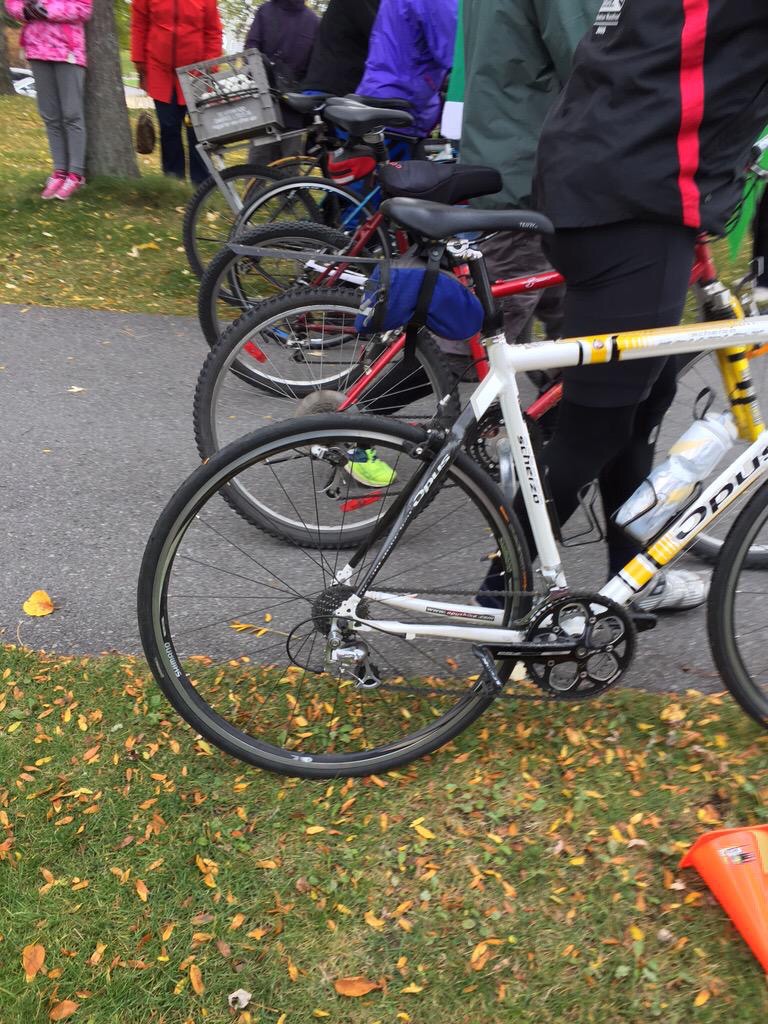
The highlight for me during the clerics cycling challenge (clericchallenge.com) was the finish line, when we all crossed together. This experience symbolized for me what the culture of Christian community ought to feel like and be like.

   
 We are part of a holy procession led by the King of Glory whose destination is sure. We have nothing to lose. If God’s grace is extended even to the generation of seekers (v.6), then we have nothing to lose. If what we are about is not a competition, then we have nothing to lose. If we don’t need to find fault in the other to prove our own self-worth, then we have nothing to lose. If it’s not about one-up-man-ship, then we can go for broke and not worry about it. If we don’t need to question who our Saviour is — who already accomplished for us our salvation — we don’t need to doubt our final destination. Then, why not share now what we have with others on this road?

All the saints on earth, despite the scars of life we bear, have gifts to share with other seekers on that journey. What gifts and blessings of God reflect in your life? In discerning this, remember: It’s not up to you alone! We don’t need to be perfect. We gain the gates not by our own merit or even hard work. Ours is the victory only because of the One for whose reason the gates are lifted in the first place.

Thanks be to God!
(1) — Michael Morgan in David L. Bartlett & Barbara Brown Taylor, eds. of “Feasting on the Word Year B, Volume 4” Fortress Press, 2009, p.228

Prayer for Reformation Sunday

We give you thanks, loving God, for  your unconditional love and grace to us and all people. Help us be moved to your heart, Christ Jesus, as our motivation, our desire, our passion for the decisions we make in our congregations. By your Holy Spirit, keep us steadfast in your Word, and continue to bless us in mission for and with others, so all may have dignity and all may live in hope. Amen

Reformation Themes 2017

The Day of Reformation (October 31) for Protestants, and especially Lutherans, calls us back to basic questions about who we are, as people of faith. Celebrating this day gives us the opportunity to ask again, “Who are we in the variety of religious expression on a diverse, social landscape?” And what do we have to offer?

For Protestants, the word itself may give us a clue. Protestants have often identified themselves as protesting against something. Many of us know the history: In 1517 Martin Luther nailed those 95 arguments on the doors of the Wittenberg Church. “Theses”, we’ve called them, were statements against certain religious practices and beliefs in the 16 century church. “Here I stand” has become a popular Martin Luther quote as he stood his ground and accounted for his beliefs before the Pope and Emperor at the famous meeting in Worms, Germany, shortly thereafter.
Many of us remember the Lutheran legacy as substantially a theological assertion: that you cannot ‘buy’ your way into heaven (by purchasing indulgences); rather, we are justified by grace through faith. Faith and salvation are fundamentally gifts from God.
And this is why the Lutheran World Federation (LWF) — a worldwide communion of 144 national churches — has come up with the theme of “Liberated by God’s Grace” for the 500th anniversary in 2017, commemorating Luther’s first protestant act in Wittenberg. Its sub-themes resonate with the indulgence debate: “Salvation not for sale; Humans not for sale; Creation not for sale.” 
In the pronouncement of these themes Lutherans worldwide and in Canada are claiming that we are not only celebrating something that happened in history. We are also asserting that we are a continually reforming church; that century-old themes can be relevant even today.
“Salvation – not for sale; Humans – not for sale; Creation – not for sale”. When something is not for sale, it is not on the market. We can not procure it by our means — any material means for that matter. When something is not for sale, it is a gift. We cannot possess it, in the same way we can never really possess God, salvation, anyone else, nor can we possess the earth.
The world today wants us to think and believe we can. We therefore delude ourselves into thinking and believing that we can buy salvation, that by our own hands, efforts and hard work we can earn God’s favour, God’s forgiveness. Do we go to church because we feel we need to manage our spirituality more as an insurance policy against hell, even though we are not sure about living out the mission of Jesus today? But God’s love in Jesus is unconditional. It is free. We have nothing to lose in positively living out our faith. Really! “Salvation — not for sale!”
Second, humans: It’s incredible that in the 21st century, there is still slavery practiced in the world; according to a 2013 study, there are still some 30 million slaves in the world today. Even in Canada, young people are gone missing and forced into the sex trade. Many Aboriginal women have disappeared, some murdered and some no doubt exploited in some despicable way. But, we claim: “Humans — not for sale!” What are we doing about this?
Finally, creation: As I said, our culture wants us to believe we can buy it. In fact, a recent survey measuring happiness revealed that our happiness is often dependent on ‘owning’ property. While the exchange of goods is in many ways an important building block of our economy, how differently would we look on our lives if creation (the environment, the land, the water and the resources therein) was not only something we must buy, possess and exploit for profit — but simply given as a gift from God that we share with all people? “Creation — not for sale!” Is finding meaning and purpose in life not the real sources of happiness? (“Money Really Can Buy Happiness, Study Shows”, thecanadianencylopedia.ca, 2013)
The confirmation class last week planted a tree in our church yard. Not only did we do this to respond to one of the Reformation challenges of our church (Evangelical Lutheran Church in Canada) to plant 500,000 trees by 2017, we performed a loving and caring act towards God’s beautiful creation which we share with all living creatures.
  
When it comes down to it, and we are honest, we must confess that it is often very difficult to be loving. It is challenging, even though we say we believe in a God who loves us unconditionally, loves the world unconditionally, loves creation unconditionally. 

So, how can we learn to love better?

Wise speech is a prayer

My parents, now retired pastors, have been ordained many years in the Evangelical Lutheran Church in Canada and the Polish Lutheran Church. My mother told me that not once in her long years of work did she choose to preach on the second lesson for this Sunday in Ordinary Time — the 18th Sunday after Pentecost — James 5:13-20. 

So, curious, I went back in my online archive of sermons to see if had. And to my surprise, I discovered that I now have preached two sermons in a row based on this text. The last time in the lectionary these texts appeared was three years ago in September 2012; and here we are three years later focusing on it again!

Why so? I asked myself. Many possible reasons likely. Not to mention the lectionary group here at Faith chose to reflect on James — yet again! Could it be, underlying this desire to look at James is the church’s need today for some practical advice about how to live the Christian life? Could it be, that the church today needs basic guidance about how to live as a Christian would in today’s world?

When we think of all that we say, all the airtime we populate with our words, how much of it would we consider ‘wise’? It is important to ask this, since one of the major concerns in the Book of James is our speech (Mark Douglas, Feasting on the Word Year B Vol 4, eds. Barbara Brown Taylor & David L Bartlett, WJK Press, 2009, p.112). And, it’s not so much what we say but how we say it — in the context of the relationships involved. This, indeed, requires great wisdom. So, I ask again, how much of what we say would we consider wise?

My guess is, not much. When we think of all that we say that is hypocrisy — that doesn’t really coincide with the choices we make, the lifestyles we lead. When we think of all that we say that only ends up hurting others …

When wise speech happens, it is truly a holy event. This is speech that communicates truth and honesty. This is speech that reveals vulnerability, expresses compassion, tenderness and authenticity. This is speech that is wise. And wise speech is then a prayer in God, with God, to God.

And, it is not only spoken to the ceiling. Because prayer is fundamentally a public act, not a private affair. One of the unfortunate victims of the Reformation period  — which launched the Enlightenment and Industrial and Scientific Revolutions of the modern era — was that Confession was relegated to a lower place in the value systems of religion. As a result of these modernizing developments which heightened the importance of the individual in religion, prayer was reduced and confined to words spoken to the air in our private lives.

In contrast, Confession is about speaking honestly the truth of our lives to another and with another. Confession is wise speech which brings healing and wholeness, when another ‘in the flesh’ can hear the truth and respond with guidance and in love, mercy and forgiveness.

And what we do every time we gather to worship, is pray. We pray in all the parts of the liturgy. Whether we are celebrating the sacrament of the table, whether we are listening to the sermon, whether we are singing a hymn or ‘saying’ a prayer — we are praying! Including the Confession of sins, and the pronouncement of forgiveness.

It is true — the church needs basic guidance about how to live as a Christian would in today’s world. I emphasize in today’s world because sometimes I don’t think we realize how decidedly unChristian this culture of ours is. And I don’t just mean the fact that we live in a multicultural, ethnically and religiously diverse society. But also, even in the institutional church, in our own lives, our lifestyles, our common sense assumptions about how to live our lives and the values we espouse: our attitudes towards competition, financial security, self-defence, self-righteousness, financial-material selfish gain, etc.

Perhaps it is time for the Reformation church (including Lutherans) to let go of the split we have created between grace and ‘works righteousness’. It is not all ‘cheap’ grace on the one hand; nor is it all work, on the other. In truth, it is a lot of work and practice to remain fully open to underserved and unmerited grace (Philippians 2:12-13). Because we will rush, if unawares, to make it all about our hard work. Just work harder!

At the same time, as Cynthia Bourgeault writes (in The Wisdom Way of Knowing: Reclaiming an Ancient Tradition to Awaken the Heart, Jossey Bass Publishing, 2003, p.10), “those willing to bear the wounds of intimacy, the knowledge of that underlying coherence – in which all things hold together – is possible.” To let go of the compulsions that keep us captive and stuck in patterns of life that are ungracious, untrue, unhealthy. To commit to the work and sacrifice of being true to self, true to neighbour and true to God. To practice confession and honesty with another. To accept the forgiveness, mercy and love of God and to receive it fully and know peace.

Could it be deep down we know it but are afraid to address and embrace it: the values of God in Christ Jesus are meaningful — they make for great, wordy and pious statements in church groups — yet clash with what we do and what we actually say to one another?

The Furious 7 movie which was Paul Walker’s last before he died shortly after filming the movie, ironically, in a car crash, highlighted for me this hypocrisy. In the extended version which I assume was edited after his death, there is a beautiful scene on the beach where Paul Walker’s character and family are gathered. His friends watch on as he plays with his young child and pregnant wife at the water’s edge. One of them remarks how what is truly important in life is not the thrill-seeking, high-octane, ego-satisfying selfish pursuits, but his relational world of love and family which endures forever. In contrast to the explosive, sensational content of the film up to that point, this affirmation of family living in love is rich in meaning and truth.

I commented in my slightly cynical mood after the movie that I didn’t think the Fast & the Furious franchise would have grossed the hundreds of millions it did if it made movies solely about family and love. It seems we want to acknowledge what is true and right, but only after we first can serve our own fixations and compulsions ‘for the thrill’.

Another TV example: Did you notice how the Amazing Race Canada presented the final words of the father and daughter from Africa — newly arrived immigrants, when they were eliminated before the final round? They were the victims of unfair play in that second-to-last leg of the race; other teams cheated on them by stealing their taxi not once but twice, if I remember correctly. 

And then, as the host John invited them for some closing remarks on the elimination mat, all of them spoke beautiful tear-wrenching words about the fair, generous nature of Canadians. It seems only the losers have something meaningful to say. Only when we suffer loss do we discover the truth of our lives. Now, we are getting uncomfortably closer to the whole point of our Christian faith and what it means to follow Jesus.

As I wrote three years ago, in James’ concluding chapter we encounter vivid images of prayer involving the laying on of hands and the anointing with oil. Prayer is a public act that invades the space of individuals and pulls us to be in the space of one another. Prayer is inherently relational. It gets down and dirty in the bodily reality of our lives, one with another. It is about touch and sensation as much as about the mere words we speak. Prayer is not my time, it is our time for the sake of the other.

Maybe I chose to preach on James 5 two times in a row because the Gospel associated with this text is about Jesus instructing us to cut out our eyes or chop off our hands if they caused us to sin (Mark 9:38-50). And I just didn’t want to go there! These are difficult words to ponder. Jesus concludes by using the image of salt to define the Christian life: something with an edge, that adds flavour. God forbid you lose your edge, your flavour! Jesus counsels us to have saltiness in our lives as a way to “be at peace with one another” (v.50).

Perhaps the way of Jesus will be tough and difficult building bridges of reconciliation. And yet, his last word to us today is a blessing of peace. The Book of James began with an address to those who are “dispersed” (1:1). James continues his letter to address the divisive consequences of an “unbridled tongue” (3:6ff) and considers the reasons for the “conflicts and disputes” among the people of God (3:4). James’ letter acknowledges the inherent splintering of our lives.

His letter in chapter 5, however, ends rather abruptly. Perhaps to indicate that there is no easy answer to the disconnections of our lives. Perhaps also to remind us that though wise speech is indeed a gift from God in the world so full of sin and death, we will still pray. And through prayer that is public, we will continue to engage the world in hope for a time when what has splintered can be reunited.