Divine fireworks

July 1, 2019 (photo by Martin Malina)

For Father’s Day, I received an upgrade on our backyard fire pit. This set includes stone bricks, a metal insert and a three-foot diameter pit. A couple weekend ago Mika and I spent the afternoon laying down patio stones on which we assembled the bricks and poured in the river stones for the base. This new fire pit will be a central feature in our backyard, hopefully for years to come.

In the memorial service for Byron last week, his brothers wrote about special memories. They highlighted a particular memory outside, around a fire pit. This time together served to strengthen their brotherly bond.

They wrote, “One time when the whole family was up at the farm, we had a great campfire … The jokes never ended. Pretty sure the rest of the family [who had already gone inside] was laughing at us staying by the campfire [so late] but we were having a great time under the stars.”

Their words support what studies have shown, that family relationships are forged outdoors when camping together, whenever families gather around the fire (Jirasek et al., 2017). Summer-time campfires will make memories for friends, families and all who pull up a camp chair or picnic table to sit around the fire.

I love watching a campfire, watching the sparks rise upwards, towards the heavens, “under the stars”. The brothers quoted above had to have looked up at some point during the campfire.

Looking up at the stars.

We don’t look up anymore. Especially at night. We don’t look up anymore, when times are tough and we become lost in the darkness. We don’t look up anymore, when we can’t directly see the sun shining.

We don’t look up anymore because we are distracted, because we are in pain or we have suffered some loss and are hurting inside. We don’t look up when we’ve lost a job, failed in a relationship, make a huge mistake and are weighed down by shame, guilt.

We look down. We spend most of our time not looking up towards the sky.

1 O Lord our Lord, how majestic is your name in all the earth! —
2 you whose glory is chanted above the heavens …                           

3 When I consider your heavens, the work of your fingers,
  the moon and the stars you have set in their courses … (Psalm 8)

We need to look up more. Fathers need to look up more, to see that the world is much more than their failures and shortcomings. Men need to look up more, to see a reality beyond the world of their own creation.

All of us need to look up more, and beyond to the great mystery the stars represent, the great mystery of God. We need to appreciate God’s limitless, expansive universe. Just because we can’t see the sun shining when we find ourselves in the dark, doesn’t mean it isn’t, somewhere on the earth. Doesn’t mean there aren’t trillions of other suns shining in the universe.

Admittedly Holy Trinity Sunday has often got us stuck in the quagmire of analysis. We try to dissect God into different autonomous parts, like disassembling a machine. “How can God be one person in three parts?”

But we lose our way going down that reductionist rabbit hole.  Ours is not the purpose to comprehend the fullness of God. That’s an exercise in futility if there ever was one.

The purpose of Holy Trinity Sunday, rather, is to encourage followers of Jesus with the knowledge and awareness that God’s Spirit has been poured into our hearts (Romans 5:5). That Jesus and the Father are one. And that Jesus lives in us through the Holy Spirit (John 14-16) who will “guide us in all truth” (16:12-15).

God’s Spirit didn’t just come to us at one time in one historical event. God’s Spirit conveying the real presence of Jesus continues to come, to fall, to be poured into our lives.

Consider star light. Every minute on each square mile of earth one ten-thousandth of an ounce of starlight drizzles like gentle rain (Mahany, 2023). Stardust sprinkles down upon us. And not only on us.

We are made of actual stardust. All the atoms and elements in us come from generations of stars burning to dust and filtering down literally from the heavens. We have a small part of the divine in us. Just like the stars.

Origen of Alexandria, the third century theologian and truth seeker, argued there was a star-like quality in each and every human being. He wrote, “You must understand that … there is in you sun and moon and stars … You to whom it is said that you are ‘the light of the world’” (Mahany, 2023, p. 132; Matthew 5:14). Indeed, we should reach for the stars!

We belong to God. We belong in relationship with God. We belong in relationship with God’s people, united in Christ, and in the love of God for all. A contemporary scholar who writes extensively about God revealed in nature, wrote: “Love alone is what shows you the face of God. It’s what makes the stars shine” (Lane, 2019).

Maybe the very reason the stars were shining so brightly on the night the brothers were having so much fun around that campfire, creating memories that will endure forever, the reason they noticed the bright stars above them, is because of the deep, great love they had for each other.

May the light of stars shine brightly in our hearts, O God. May this world be transformed by the power of your love, O God – in, through and around us – in the name of God the Creator/Father, the Redeemer/Son, and the Holy Spirit. Amen.

References:

Jirasek, I., Roberson, D.N., Jirásková, M., (2017). The impact of families camping together: Opportunities for personal and social development. Leisure Sciences, 39(1), 79-93. http://dx.doi.org/10.1080/01490400.2015.1136251

Lane, B. C. (2019). The great conversation: Nature and the care of the soul. Oxford University Press.

Mahany, B. (2023). The book of nature: The astonishing beauty of God’s first sacred text. Broadleaf Books.

Seeking kin-doms: a funeral sermon

Byron was born at the beginning of the Easter season in 1974, on Easter weekend in fact. Byron died on the last weekend of the Easter season in 2025. His life, from beginning to end was held and embraced in the life of the resurrected Jesus. 

At the beginning of the Easter season, the beginning of Byron’s life, it is about the promise fulfilled. After months of waiting and expecting, your baby is born. New life has arrived, upturning regular routines, upsetting comfortable sleep patterns and shocking the family into a new, delightful part of life.

But at the end of the Easter season, at this unbidden moment, when the one we’ve grown to love and know and see in the flesh, leaves us. This is the difficult time for the disciples of Jesus, who now that Jesus is resurrected will leave them. They will no longer see him in the flesh. What will they do without him? This crisis of faith hits them like a gut punch.

Byron’s sudden and unexpected loss hits us like a gut punch. And we may very well still be trying to get our breath back from the shock of it.

The Easter season frames Byron’s life both in the promise of life and in the loss of it. Every funeral service, arising from the pain of death, is an Easter service no matter what time of year.

Loss is part of life. In his lifetime, Byron’s favourite team, the Indianapolis Colts only one the Super Bowl once, in 2007 under Payten Manning’s quarterbacking. For all the years that Byron was faithful to his beloved team, he endured all those losses, year after year – except for that one.

Losses and death can dominate even in the season of Easter, except for that one Win. Hope and faith stay alive despite the losses. The hope of life still to come, against all the odds. The colour of Easter is white, the colour signifying life ongoing, life eternal.

Hockey and football, two of Byron’s passions, are seasonal sports. For the most part, they happen during a defined season of every year. But I think there is something deeper going on here.

Notice in both cases we are talking about team play, with others. Football, like hockey, is a team sport. In few other sports do the players need to connect intuitively with everyone else. The better a team connects that way, the greater chance they have to win. Football players will often talk about their team-mates as family.

Byron, at heart, valued kinship. He was dedicated to family and to the network of people that made up his life. He never missed a family gathering, at Christmas and at Easter. In fact, this past Easter weekend was the last time some of you saw Byron face-to-face.

When Jesus counselled his disciples, prepared them, for his departure, he promised them he would always be with them, in them, through the Holy Spirit. He promised them that they would not be alone, and that they would always have access to him in their hearts, and in the world (John 14).

How so?

“It is God’s pleasure,” Jesus says, “to give you the kingdom” (Luke 12:32). The phrase, “kingdom of God” is mentioned some eighty times in the New Testament. It is what Jesus says is the goal, purpose and aim of the Gospel – the good news. “Seek ye first the kingdom of God” (Matthew 6:33).

But kingdom doesn’t mean empire-building, evoking images of might-makes-right, power-seeking kings that we have witnessed throughout human history. To help us get the true gist of the word, biblical scholars are now suggesting the word kingdom should drop the ‘g’. In other words, wherever we see the word ‘kingdom’ in the New Testament what we should be reading is ‘kin-dom’ (Butler Bass, 2022).

The reign of Christ is really about our kinship with God, with creation, with one another and with ourselves. The reign of Christ is really about valuing relationships over things. For wherever your treasure is, there your heart is also. Whatever you value, your treasure, what is most important to you, your heart will follow suit.

Put another way, whatever you value, you pay more attention to. Whatever you pay attention to, you love.

Jesus says, “Seek ye first the kingdom of God” (Matthew 6:33). Which means, pay attention, draw your attention, to what is already in front of your eyes, to what you have in your relationships. There you will find love. And there, you will find Jesus.

Because it’s not that we don’t already have access to the kin(g)dom. It’s not that we don’t have it and we have to somehow acquire it, possess it. It’s God’s good pleasure to give us the kingdom. We already have it. It is God’s good pleasure to raise up before us the value of our relationships.

For Byron, despite the challenges he met, or maybe better yet through the challenges he faced he remained true to his values of supporting his children and valuing those relationships more than material things. He didn’t live to amass wealth and prestige. He didn’t live to accumulate material resources and build investment portfolios.

He lived for his family. It wasn’t a perfect kinship all round. Like for all of us, relationships aren’t easy. And sometimes we fail. Yet, in all his humility, simplicity, and yes even in his passion where he found his juice and motivation, underlying all of that was his commitment and dedication to his kin.

God will not stop expressing pleasure in giving us the kingdom, despite and perhaps more because of our tendency to slip up and fail. God takes pleasure in giving us the kin-dom, offering us relationships where love and grace abound.

Connecting to the life of Christ, we all live in relationship. May the kinship of God, as it did and does for Byron, surround us with grace and fill our lives with love, forever.

Reference:

Butler Bass, D. (2022). Freeing Jesus: Rediscovering Jesus as friend, teacher, savior, lord, way, and presence.Harper One.

Can you catch it?

When I was younger I enjoyed playing catch using a softball or baseball. My catch partner and I would stand at a distance from each other, and we would toss, whip, lob, sidearm, underhand, windmill or basically throw the ball in various combinations of the above.

That simple, and for me rather therapeutic, repetitive motion – back-and-forth—impressed upon me the truth that whether the ball is successfully caught doesn’t just depend on the catcher. Whether the ball is successfully caught depends to a large degree how accurately the ball is thrown. Assuming you want your ball partner to catch the ball!

You need to throw the ball in such a way to match the catcher’s ability, attention in the moment, stance and glove position. The one throwing the ball needs to pay attention to and know the catcher. Throwing and catching the ball is a relationship in which both parties have to do their part for the exercise to work.

Which then reminds me of a popular saying in the church I have heard over the years: That faith is not taught as much as it is caught. The ball of faith, if it is to be successfully passed on, needs to be thrown in a way that the catcher can catch it. Because every individual is unique and has different abilities, personality, and capacity, the gift of faith—if it is to stick and not be dropped—needs to come at them in a way they can handle it.

No one size fits all. The ball of faith has wings to fly in a manner in which each of us can perceive it, appreciate it, and let it enter into our life. On our part, to throw the ball of faith, we need to reach people through their point of view, not our own. In other words, we need a relationship with them to seek to understand their tendency, their perspective, and then speak their language (Rubin, 2017).

One of the most significant scientific facts in existence is something we cannot directly see, touch, taste, or even smell. But we can feel it on our skin. Planet Earth is wrapped in 5,600 million million tons of air, and most of the time most of the air is moving (Mahany, 2023, p. 93). While wind is elusive, hard to define, one thing it is for sure: Wind is impossible to ignore.

photo by Martin Malina (Long Beach WA, July 21, 2017)

The winds have been particularly noticeable of late. They have been strong enough to send us the smoke caused by wildfires in Western Canada. Over the past few years, we have witnessed the effects of powerful windstorms here in Ottawa – toppling ancient trees, downing lines, throwing damaging debris.

A couple of weeks ago, a Chinese paraglider was caught in a powerful updraft sending him some nine kilometres straight upward until he was piercing the edge of the atmosphere with air temperatures near -40 degrees Celsius. Most para-gliders caught in this unfortunate circumstance don’t survive. Miraculously, he did (TWN, 2025).

Indeed, wind is elusive, dangerous. We cannot contain it, control it, nor even predict its behaviour. No wonder for people of faith the world over and since the beginning of time have made the wind, air, breath synonymous with the divine (Mahany, 2023).

There is movement in the scriptures assigned for this season after the resurrection of Jesus leading into this Pentecost Sunday. There is movement with the Spirit. The Spirit descends on the disciples gathering in Jerusalem with “the sound like the rush of a violent wind” (Acts 2:1-21). Elsewhere in the bible, Jesus breathes the Spirit into the disciples (John 20:22). God’s breath moves over creation (Genesis 1:2). “Even the winds and waves obey” the the disciples notice after Jesus stills the storm on Lake Galilee (Matthew 8:27).

The question of faith confronting the disciples after Easter was, what happens now when Jesus, the founder of the community, is no longer around? Is the community left on its own, with no access to Jesus’ presence or transformative power (Bay, 2010)? Has the wind, the breath of God, stopped blowing?

Has Jesus dropped the ball? Have the disciples? The disciples, essentially, are anticipating their grief at losing access – physical access – to their loved one in Jesus. And they don’t know what to do without him.

The question of faith is how to live amidst the perceived absence. Pentecost answers the question of grief. Because one important aspect of healing is that we are no longer defined by our losses. While the pain of grief stays with us our whole life long, who we are now is not defined by what happened then. Not because we’ve forgotten. Healing is not forgetting.

But we are now defined by what the connection to our lost loved one means to us today, now. They live in us. They live in some way in the world today. Who we are and who they are, are no longer defined by what caused our painful grieving in the first place. Instead, we are defined today by those around us who hold us, accept us, and give us encouragement on the way.

“Show us the Father,” demands Philip (John 14:8). Jesus rebukes Philip. Philip wants to see, touch, taste, control, contain, put a lock on his apprehension of faith. No, no, Jesus says to Philip and to you and to me. You know God already. You don’t need to put God in a box in order to believe. God is already with you, in you. “You know [God],” Jesus responds, “because God abides with you, and God will be in you” (John 14:17).

God is already with you, in you. The life of Jesus, through the coming Spirit of God, lives in you, through you, around you! So, act like it!

We take a breath some 20-30 thousand times a day. Yet, are we aware when we even just take one? If you do anything on this Pentecost Sunday that is spiritual and life giving, just breathe with awareness that you do. Breathe in God’s love, God’s presence. Breathe out – return the gift of God’s life and love into the world by your loving actions for your neighbour.

Jesus throws the ball of faith towards us. And it’s not that we have to catch it one way. We don’t need to be afraid of dropping it. When we are aware of the presence of Jesus, when we face him and lift our hands to catch the ball, Jesus throws it at us in a way we can receive it. Because Jesus knows us. Jesus is in a relationship of love with us. God created us. And the Spirit lifts the ball and carries it into our hearts so that we can catch it.

Thanks be to God.

References:

Bay, E. C. (2010). Pastoral perspective: John 14:8-27. In D. L. Bartlett & B. B. Taylor (Eds.). Feasting on the Word: Preaching the Revised Common Lectionary Year C, Volume 3 (pp. 20-24). Westminster John Knox Press.

Mahany, B. (2023). The book of nature: The astonishing beauty of God’s first sacred text. Broadleaf Books.

Rubin, G. (2017). The four tendencies: The indispensable personality profiles that reveal how to make your life better (and other people’s lives better, too). Harmony Books.

The Weather Network (2025). Paraglider sucked nearly 9 km up into the frigid atmosphere [Video]. Newsflare/Reuters. https://www.theweathernetwork.com/en/video/Ke6uK9sn?playlist=JRE9lq9q

Closer to the light

Card crafting by Jasmine Hawley; Image from ‘Creative Stamping Magazine’ (Issue 147, p. 16, 2025)

As the days lengthen and the sun shines higher in the sky, so much more is exposed to the light, and for longer. The journey of the seasons can reflect our own personal, spiritual journeys with God. And one truth becomes clearer at this glorious time of year:

The closer we get to the sun, to the light source, the more of our shadow we see. We get closer to God, or God gets closer to us. And one of the first experiences of this nearing, is exposure to what we’ve wanted to hide, what has embarrassed us, what we’ve kept hidden from view. Nearer my God to Thee, and more of myself I and others see.

It’s like two opposite movements in tension. On the one hand, towards the bright glorious presence of God. And, on the other, towards the revelation of our own truth good and bad.

This can discourage us, and we might rather turn away from getting closer to the light.

Another natural reaction is to blame others. At every level of human interaction – from geo-political affairs to national debates, to community groups, families and inter-personally – it’s easier to locate the source of the problem outside us. It’s much, much harder, to admit the problem at home, in us.

Russian writer Aleksandr Solzhenitsyn put it beautifully: “If only there were evil people somewhere insidiously committing evil deeds, and it were necessary only to separate them from the rest of us and destroy them.

“But the line dividing good and evil cuts through the heart of every human being. And who is willing to destroy a piece of [their] own heart?” (Solzhenitsyn, 1974, p. 168). Jesus himself says that good and evil come from within us, from the heart (Mark 7:20-23; Matthew 12:34; Luke 6:43-45).

So, what does this mean? First, as Solzhenitsyn implies, it is impossible to purge that evil side of us. Jesus in the parable of the weeds, implies the same. “Don’t pull up the weeds because you might uproot the good wheat as well. Let the weeds and the wheat grow together …” (Matthew 13:24-30).

And, in truth, there is more to this than mere tolerating it, or putting up with the less-than-perfect ideal. Because, in truth, therein lies a key, working with both sides in your life, a key to growing and becoming stronger.

Holy is this tension between good and bad within us, not to be spurned. So, spiritual wisdom from the ages has taught: “Pray in the moments light and darkness touch” (Mahany, 2023, p. 125). Pray in the moments when the nearness of God’s light exposes the tender vulnerabilities in you.

The problem, really, are the untruths we believe – the ideals fuelled by perfectionist, purist expectations. When we set up those expectations, it is our vision we seek, rather than God’s. The problem starts when we dream up a vision of the church, for example, as an ideal we have to realize, rather than a reality created by God.

Because when it doesn’t go our way, when reality bursts our bubble, we think we are a failure. When our idealized image is shattered, we see the church falling to pieces. And then we blame others in the church, then we blame God, we blame culture, and finally we blame ourselves (Barnhill, 2005).

But Jesus doesn’t ask us to conform to some perfect ideal. When Jesus says, “Be perfect as your Father in heaven is perfect” (Matthew 5:48) he is not talking about someone who has magically become faultless by their own efforts. Our belonging in Christ is not a race we have to run or some competition to see who conforms to Christ faster or better. Our unity in Christ is not about uniformity based on some ideal to be striven after.

As Bonhoeffer claims, “the church doesn’t need brilliant personalities but faithful servants of Jesus and of one another. It does not lack the former, but the latter” (Barnhill, 2005, p. 140).

Instead, the Gospel is about Jesus who seeks to be formed in us (Galatians 4:19). What we have trouble believing is, what may appear weak and insignificant to us – the long shadow appearing the closer we get to the light – what may appear weak and vulnerable and shameful to us, may be useful to God. May even be great and glorious to God.

How so?

Every year towards the end of the season of Easter, we receive this prayer of Christ from John 17. This morning, we heard again the words of Jesus praying that his followers for all time “may be one” (John 17:20-26). The passage concludes with Jesus’ statement about how the world will know God. They will know God by the love in them and for each other.

When Jesus says, “Be perfect as your Father in heaven is perfect” he is talking about the Father’s love. Love others as your God loves you. What binds us together in unity, how we become one in Christ in the end, is the forgiveness of sins we all receive from God. Why what appears weak in us may be great to God, is that our perceived failures open the door to being aware we are loved despite our failure. We are forgiven.

And not just me. But everyone else I want to blame for the ills of church and society and the world we live in. Our forgiveness for what appears to be a long and scary shadow behind us as we near the light of Christ’s presence is what unites us in Christian community. And that reality, that truth, is great!

We don’t need to strive for perfection, or some ideal vision of what it ought to be like. We only need to receive one another, our leaders, our volunteers, our families in the way Christ also receives us – bathed in the light of God’s loving forgiveness, always and forever.

This forgiveness releases us to be who we are, including all our limitations and failures. God’s forgiveness releases us to take the next step, and follow where Christ leads.

Indeed, they will know we are Christians by our love.

References:

Barnhill, C. (Ed.). (2005). A year with Dietrich Bonhoeffer: Daily meditations from his letters, writings, and sermons. Harper One.

Mahany, B. (2023). The book of nature: The astonishing beauty of God’s first sacred text. Broadleaf Books.

Solzhenitsyn, A. I. (1974). The gulag archipelago, 1918–1956: An experiment in literary investigation (Vols. 1-2). Harper and Row.

Healing for everyone

Each and every one of them in the crowd wanted to be healed (John 5:1-9). That’s why they were there, surrounding the pool. Jesus asks the man a rhetorical question, “Do you want to be made well?” Because based on how the man responds, what Jesus may really have been asking was, “If so, why haven’t you already been into the pool?”

Everyone seeks healing, and that’s why they are there. The question really gets at the barriers to our healing, everyone’s healing.

The story ends well, for the man. In this Gospel, Jesus leads the man to new life. How does he get there? The text reads like all Jesus did was snap his fingers and the story is over. But let’s break it down.

To set him on the path to new life, Jesus provides the necessary support that man needed but never got from anyone else, for 38 long years.

Recall, for context, many more people than usual were in Jerusalem for the festival and passed by the pool on their way to the temple to offer a sacrifice.

This is how Sue Monk Kidd describes the scene at a healing pool in her creative telling of the Gospel. This scene is told from the perspective of someone close to Jesus:

“We crossed the valley with the little lamb on Jesus’ shoulders and entered Jerusalem through the Fountain Gate near the Pool […]. We planned to cleanse ourselves there before entering the Temple, but we found the pool glutted with people. A score of cripples lay on the terraces waiting for some sympathetic soul to lower them into the water.

“’We can purify ourselves at one of the mikvahs near the Temple,’ I said, feeling repulsed by all the infirmities and foul bodies.

“Ignoring me, Jesus thrust the lamb into my arms. He lifted a paralytic boy from his litter; his legs were twisted like tree roots.

“’What are you doing?’ I said, trailing after him.

“’Only what I’d want if I were the boy,’ he replied, carrying him down into the water. I clutched the squirming lamb and watched as Jesus kept the child afloat while he splashed and bathed.

Naturally, his deed set off shouts and pleas from the other cripples, and I knew we would be here a while. [Jesus] bore every one of them into the pool” (Kidd, 2020, pp. 169-170). This is Jesus. This is the beloved character of Jesus.

During the Easter season, we celebrate the resurrection of Jesus. And we see how it is in Jesus’ nature and purpose, exampled by this Gospel text, to lead us to life, beginning in this life. The one you have now, however imperfect, broken, hurting, sinful. Jesus beckons us to new life.

But the path to new life isn’t a solo journey. We understand that everyone is not the same. But that means everyone has different needs. And so, everyone needs everyone else to do their part to help. Interdependence. As the body of Christ in the world today, the church is about following together in Jesus’ way by helping each other.

Jesus models how it’s done in a simple yet vivid way: He acts to remove the barriers that keep others from their path to growth, healing, and new life. Jesus levels the playing field, so everyone at least has an opportunity, like everyone else, to grow and be renewed.

Doing this is not easy and it means taking a risk. Jesus healed the man on the Sabbath. He broke convention and the rules for the sake of the wellbeing of another. Jesus got in trouble with the law for his acts of compassion and healing.

There’s a meme that’s gone around my social media page. It’s an animated picture of the front of a church during a snowstorm. There’s a crowd of people waiting to climb the steps to get into the building. But they are waiting for the lone caretaker to shovel off the pile of snow making entrance impassable for anyone. Amid the crowd is one person in a wheelchair.

The caretaker, before attacking the snow blocking the stairs, begins his work by shovelling the long, switchback ramp leading up to the main doors.

The crowd complains – “Hey, do the stairs first. There’s more of us!”

The caretaker responds – “If I shovel the ramp first, then all of us can enter right away.”

Jesus leads us into new life by removing the barriers. It’s a new life given to us all, not just those in the majority.

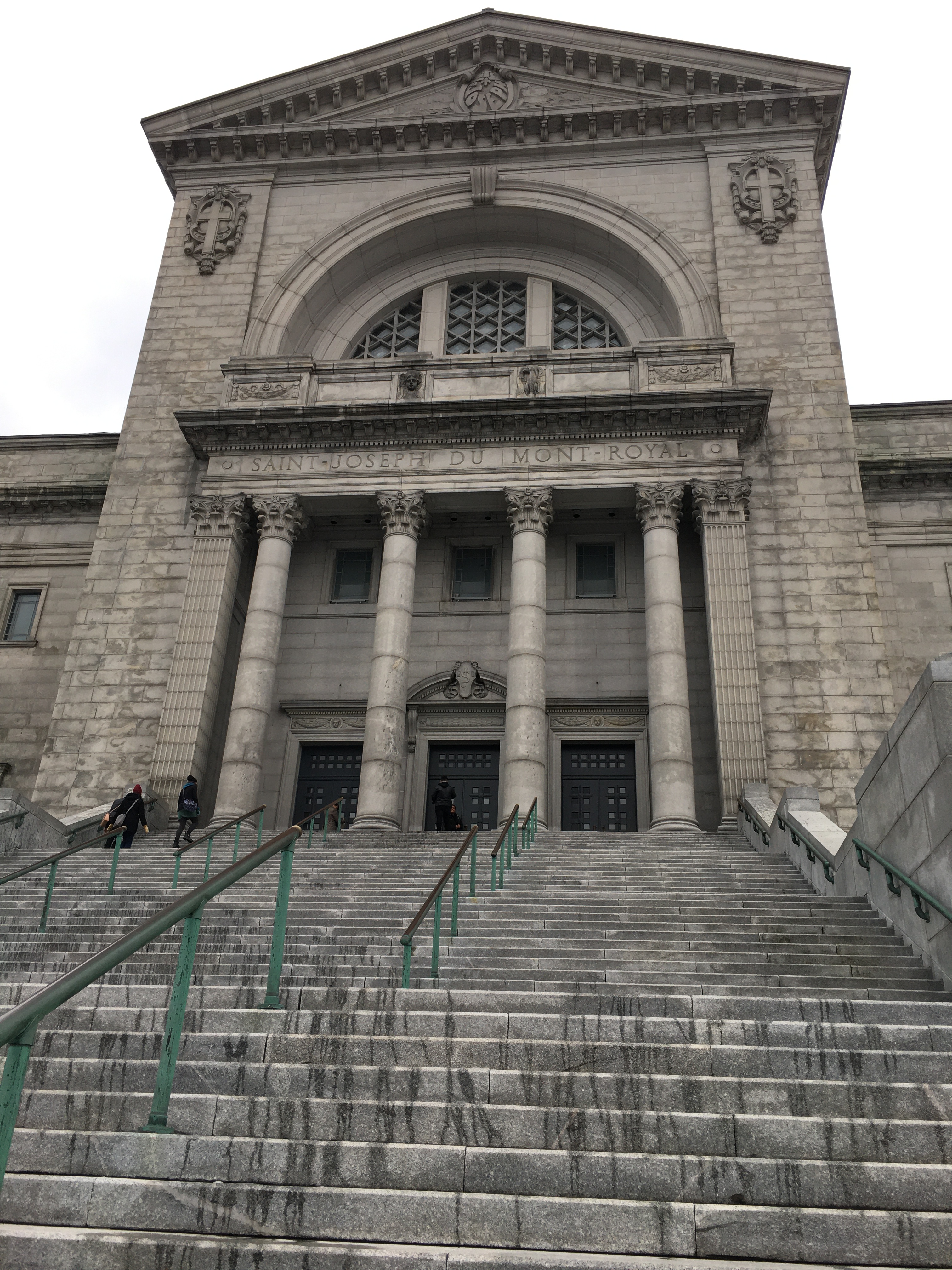
Climbing the stairs at St Joseph’s Oratory in Montreal (Nov 2019, photo by Martin Malina)

Dietrich Bonhoeffer said we don’t find truth and freedom by focusing exclusively on our own needs and wants. We find God’s truth and freedom by focusing our attention on another’s needs and wants. In doing that, we free ourselves from whatever blocks us on the journey to new life.

He says it best. Bonhoeffer writes in one of his sermons: “God’s truth alone allows me to see others. It directs my attention, bent in on myself, to what is beyond and shows me the other person. And, as it does this, I experience the love and grace of God … God’s truth is God’s love, and God’s love frees us from ourselves to be free for others” (Barnhill, 2005, p. 151).

There’s a beautiful Taizé song we are chanting before meditation these Easter weeks. It announces and celebrates the living Lord who leads us all into life.

Bless the Lord my soul, and bless God’s holy name. Bless the Lord my soul, who leads me into life. (Berthier, 1981).

What are the barriers you face? What are the barriers others face? And how does God invite you to help level the playing field so that all may come to know new life?

References:

Barnhill, C. (Ed.). (2005). A year with Dietrich Bonhoeffer: Daily meditations from his letters, writings, and sermons. Harper One.

Berthier, J. (1981). Bless the Lord, my soul [Taizé Community]. Les Presses de Taizé, France.

Kidd, S. M. (2020). The book of longings. Penguin.

Gifts from above

I often joke that I’ll let God wash my car. After a long winter when the salt-infused grime cakes on the outside panels, I wait until the pure rains in Spring give the car a good rinse.

Indeed, the rains fall from heaven, often unbidden, to cleanse the earth, to cleanse us. Notice the direction of God’s grace, God’s new thing, God’s vision of our future in the text from Revelation today. The holy city, the new Jerusalem, comes down from heaven to earth (Revelation 21:2). Direction, downward.

Just as in the Inuit language there are about 50 different words to describe various forms of snow (The Canadian Encyclopedia, 2015), the British boast several words and phrases to describe rain’s multiple personalities:

There’s a basking – which is a drenching in a heavy shower; a drisk – which is a misty drizzle; a fox’s wedding – sudden drops out of a clear blue sky; a hurly-burly – thunder and lightning; a slotting – which is rain so hard it bounces up off the ground; and a thunner-pash – which is a heavy shower with thunder (Mahany, 2023). Have you heard of these terms? Most of these, I haven’t. There are different ways the rain comes down.

No matter the form it takes, rain has a way of catching my attention. “One minute it’s barely pebbling the windows, the next it’s making a joke of the downspouts” (Mahany, 2023, p. 90). On the one hand, we pray for it. On the other hand, we roll out tarps to stop it.

No matter the form rain takes, we feel the water-drop touch our skin. It is invasive and so often our first instinct is to get out of it, to find shelter or cover. Rain seeks to grab our attention not just by touch alone, but by smell as well.

There is that unforgettable, indescribable just-after-the-rain earthy smell. There’s a name for that scent – petrichor. It’s caused when rainwater mixes with certain plant oils in dry soil – compounds to which the human nose is highly sensitive. Add to this cocktail of smell ozone which is released if lightning is in the mix. All of this wafts into the air, and we “smell rain” (Mahany, 2023, p. 91).

Like I said, rain has a way of catching our attention in more ways than one. Likewise, there are different ways we experience God’s grace, and not always is it what we want nor expect. But it always catches our attention. Somehow, God’s presence and life touches us, our hearts, our intuition, our perceptions – even subtly.

I joked that I let God wash my car. We also joke, “We’re not made of sugar,” implying that we won’t melt in the rain. Earth and all that is in it is not destroyed, obliterated nor eradicated by rainfall.

When the author of Revelation speaks of “the first earth passing away, and sea was no more” (21:1), it is not the extinction of the earth at the end that we’re talking about. God’s grace, God’s promise of resurrection does not cancel earth, our humanity, our senses – what we see, hear, touch, taste and smell.

Instead, new life is embodied and transformed on earth, from the earth. The direction of grace may be downward. But the reason the promise and vision come down to earth is because God will use the stuff of earth, and embody it. The goal of resurrection is earth’s transformation (Carey, 2009).

Rain, yes, is invasive. But it renews, refreshes and generates growth and life. Out of the old emerges the new.

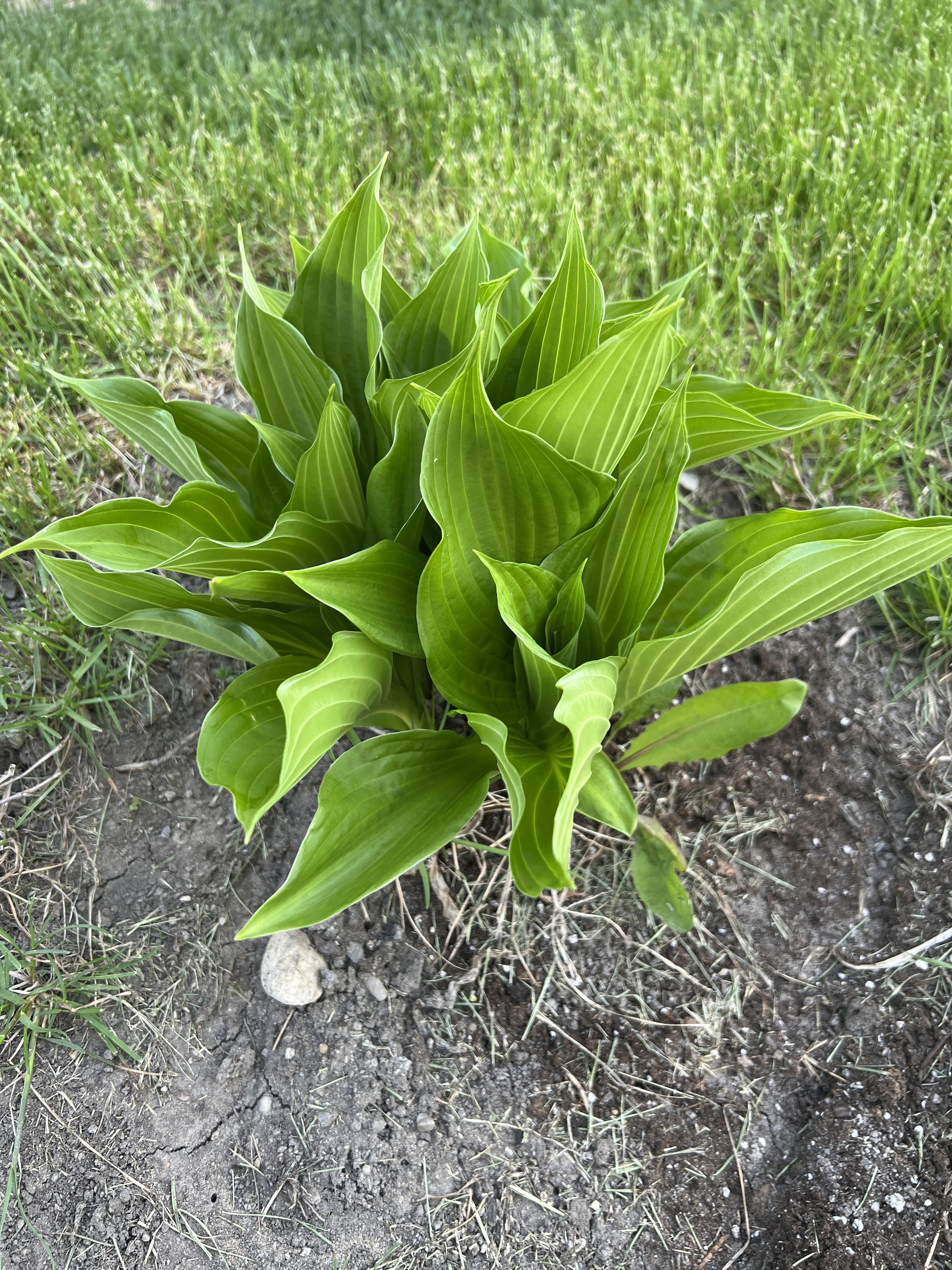
I was given two Hosta plants last year which I planted on the side of our house that receives a lot of sunshine. But these Hosta plants were designed to thrive in more shade than sun. They didn’t look so good by the Fall time. They were sporting large brown spots which covered their large, limping leaves. Honestly, I didn’t expect them to come back up this Spring.

But out they came a week ago, bursting through the less-than-ideal soil and location for these particular plants. The young shoots already showcased their green, lustrous leaves reaching upward to receive the gifts of rain and sun. Coming from above. Downward.

There’s a path on that side of the house, a ravine at the bottom of which the deer will follow. Deer love to munch on Hosta plants. But the Hosta plants will live, I do believe, despite the deer. Despite the hail. Despite thunner-pash, slotting, hurly-burly and basking rain falls those plants will surely endure this summer. I believe!

New life, new beginnings, the promise of resurrection, is not without its difficulties, challenges and little deaths. We may not understand yet its deepest mysteries and paradoxes, death and life, life and death.

But those raindrops will continue to descend from above. Even if we can’t understand it, or when we come up against our own limitations. Despite hearth’s and humanity’s imperfections, God’s work of reviving, renewing and enlivening the earth will not stop. Easter is a forever-promise.

Those raindrops will always be awakening us to the wonderful mystery of God. Those raindrops will remind us that even though we may suffer disruption, and painful transitions in life, the rain of God’s love will continue to nourish us and enliven us to reach forward into the unknown future with trust and assurance.

References:

Carey, G. (2009). Exegetical perspective: Revelation 21:1-6. In D. L. Bartlett & B. B. Taylor (Eds.). Feasting on the Word: Preaching the Revised Common Lectionary Year C, Volume 2 (pp. 463-467). Westminster John Knox Press.

Mahany, B. (2023). The book of nature: The astonishing beauty of God’s first sacred text. Broadleaf Books.

The Canadian Encyclopedia. (2015). Inuktitut words for snow and ice. The Canadian Encyclopedia [Website]. Retrieved from https://www.thecanadianencyclopedia.ca/en/article/inuktitut-words-for-snow-and-ice

Nearer, my God

Jesus says, “My sheep hear my voice” (John 10:27). He doesn’t say, “My sheep see me.” In this Gospel, belief is equated with hearing and listening, not seeing.

At this time of year, the birds are finally returning to our feeder. And when I go for my walks around the neighbourhood I know where the cardinals live – in a stand of old growth trees near the Algonquin Trail in Arnprior. Almost every time I walk through there, I first hear the cardinal’s distinct song.

photo by Martin Malina (Aug 6, 2023)

The point is, I know the cardinal is there. I will scan the trees, fence lines and roof tops from whence the song comes. Rarely will I first observe the bird nestled deep in the foliage, despite its catchy red coat. But because I can’t see the bird doesn’t mean it’s not true, doesn’t mean it’s not there. I know it is nearby. I believe, not because I have seen it with my own eyes but because I hear it close by.

When I was in public school, at Halloween teachers handed to us students those orange UNICEF boxes. We strung those boxes around our necks and carried them with us trick-or-treating. Some of you may remember those boxes. So, when we went to each house for candy, neighbours would also have the option of dropping some coin into those iconic boxes. All the proceeds were then donated to the United Nations Children’s Fund, originally labelled the United Nations International Children’s Emergency Fund (https://www.unicef.ca/en).

I value that experience of learning. I learned that what I did for myself was not enough to be a good human being. I also had to do something for other children, especially those who were suffering hunger and persecution in faraway lands. Just because I couldn’t see these children with my own eyes, just because these were not my personal friends, didn’t mean I wasn’t called by God’s voice to do something to care for them in their suffering, their hunger, their pain.

Today it’s unfortunately fashionable to openly admit that if some situation that others suffer doesn’t impact me directly, I don’t care and I don’t want anything to do with it. We shy away from taking on the responsibility, collectively, to teach by example younger generations the vital importance of working together to care for those who are not our own, so to speak. If the problem is far away, far removed from my or our reality, then forget it.

My wife Jessica talks about a cherished memory of family friends whose parents created a home environment in Ottawa where neighbourhood kids felt comfortable dropping by at any time of day or night. Not only did those parents care for their own children with fierce love, but their home also became grand central for all the kids in the neighbourhood to hang out and even eat meals together.

Jessica has often remarked how influential that early childhood experience was in forming the desires of her own heart in wanting to be open to others and engage those outside the family with caring acts of compassion, generosity and respect. In response to a need.

God’s voice, God’s call – the root of the word vocation – doesn’t come from far away. God doesn’t come to us from some celestial, otherworldly heaven removed from our day to day. God’s presence is near to us, in fact born in the nitty-gritty of our lives. The call is to live out from our Christian values of compassion and love.

Jesus assures his disciples of two things in the Gospel text for today. First, that he and God “are one” (John 10:30). So, if Jesus will never allow anything or anyone to snatch us away from his care and protection for eternity, neither does God. For Jesus and God are one. In other words, we are never, ever out of the scope, the field of belonging to God’s loving care and attention. Ever.

The second assurance flows from the first. God and Jesus are not only faithful and loyal to us – as a shepherd is to their flock of sheep, using a biblical metaphor. God’s loyalty and faithfulness means that God perseveres. God does not give up. Even if for just one out of the hundred in the flock (Luke 15:1-7). No matter how awful and terrible the human circumstances can get for anyone. No matter how lost one can get. God keeps at it, keeps loving us, finding us, embracing us, forgiving us, protecting us.

That ‘snatch’ verb repeats twice in the conclusion of this Gospel’s short eight verses (in verses 27 and 28). That should draw our attention to the persevering God we worship. Nothing will snatch us away from God’s perseverance.

Dietrich Bonhoeffer translated the word perseverance to mean, literally: “remaining underneath, not throwing off the load, but bearing it” (Barnhill, 2005, p. 72). Bearing it.

How do we recognize God’s voice, today? God’s voice emerges from human suffering and loss.

Bearing the load. God bears the human load. The cross of Jesus indicates the kind of God we worship. We worship a suffering God who knows our pain, our hunger. We worship a God who is revealed to us most poignantly in the lives of those who persevere in their suffering. Bearing the load.

From the UNICEF website (https://www.unicef.ca/en/blog/seven-inspirational-stories-about-mothers-around-world), I read about a brave Mom, named Neveen Barakat, who kept her family strong in the midst of war. Neveen’s husband died in a blast that hit a UN-run school in Gaza. The blast wounded three of her children and left Neveen with a permanent disability. A photo from the webpage cited above shows Neveen comforting her six-year-old daughter, Rosol.

The mothering love of Neveen is bearing a huge load. And that is why we must care with the mothering love God reveals to us in Jesus. Because while God’s revelation comes to us daily in our human suffering and pain, God’s grace calls us to care for others in the way of Christ who bears their suffering, too.

We can care for others close and far because God is never far away. God doesn’t care from a distance. God will hear our voice when we call out, just as we know and listen to the voice of our loving God who will never give up on us. Even if it’s just a whisper under our breath, God is near and hears us. God is close and will help us persevere.

References:

Barnhill, C. (Ed.). (2005). A year with Dietrich Bonhoeffer: Daily meditations from his letters, writings, and sermons. Harper One.

UNICEF. (2025). Seven inspirational stories about mothers around the world [website]. https://www.unicef.ca/en/blog/seven-inspirational-stories-about-mothers-around-world.

Live in the light of the resurrection

Dietrich Bonhoeffer defined Easter this way: “To live in the light of the resurrection – that is what Easter means” (Barnhill, 2005, p. 114). Live in the light of the resurrection.

In one of those contemporary movies about the life, death and resurrection of Jesus, one scene sticks in my mind. It is when the women who discover the empty tomb early that first Easter encounter there the “two men in dazzling clothes” (Luke 24:4).

But instead of actually meeting two men standing there, all we see over the empty shroud in the tomb is an eye-shielding brilliant light from which the divine voice speaks, “Why do you seek the living among the dead? He is not here, but has risen” (Luke 24:5). Surprise!

We are so fortunate in Canada to celebrate Easter each year during the Springtime in the Northern Hemisphere. Early 20th century New England writer, Henry Beston, called Spring, the “trumpet call of the return of light” (cited in Mahany, 2023, p. 62). In Spring the days grow longer, we get our first basking in the sunlight’s warmth, and new life starts emerging from the sleepy, cold earth.  We know, at least in Spring, that truly we live in the light. We need the light, to live.

Sometimes, as on that first Easter morning, the light actually changes people. Listen to the testimony of Rosemarie Feeney Harding (cited in Rohr, 2025, March 27) who describes her experience of how the Light impacted her life:

“I can’t say exactly where the Light entered,” she writes, “where it started from. Suddenly, it was just there with me. A white light, bright enough that it should have hurt to look. But it didn’t hurt. In fact, as the Light grew and enveloped everything in the room, I felt the most astonishing sense of protection, of peace. It surrounded me and I was in it, so joyfully…. 

“The Light became a kind of touchstone in my life. It was so much love. Like an infinite compassion. At the same time it was something very precious and intimate. It awed me, really. And when I walked out of the room, everything looked different. Clear. Even later, outside the house, in my classes and at my job, everything looked sharper. It was like a heightened sense of presence. Almost a shine.  

“I do believe that whole experience put me on a path. And the Light stayed with me a long time. It gave me a sense of security and deep internal connectedness to God, I would say …

“As I moved away from my family and struggled for years … I needed the grounding and shelter and strength of that Light. There is something in there, in that profoundly embracing energy, that allows you to come out with a kind of forgiveness, an absence of animosity … Help. Encouragement. A deep, deep encouragement in this life …” (Harding & Harding, 2015, pp. 1-3).

Living in the light. I wonder what it would be like to always live in that light. What would change in your life? What good things you already have and are would come to the surface? What would you see in others?

One icebreaker question I’ve always enjoyed answering is: “If you could be one animal, what would it be and why?”


Image by Airwolfhound

If I were answering that question today, I think I’d like to be an Arctic Tern. You see, these terns “spend the summer in the Arctic when the sun is available for almost 24 hours. Then they fly south during the Northern Hemisphere winter to join the summer season of the Antarctic regions, where the sun is also visible almost 24 hours a day.

“Scientists believe they follow the sun because the sun illuminates the water allowing them to find fish during their travel. As a result, Arctic Terns are believed to experience more daylight in their lifetime than any other creature. Right now is the time of the Arctic Tern’s return migration to the Arctic” (Coman, 2025, March 27).

Birders at Point Pelee and other bird sanctuaries on the migration routes over Ontario are actively lifting their heads to the heavens these days! And they are excited for what they might see. Surprise!

A large part of why Easter joy surprises us is that it is unexpected. The joy comes as a surprise because of the tough road that preceded Easter joy. Living in the light is so special because this joy grew out from the ashes of loss, of death. What seemed certain and final. It’s the contrast. It’s the surprising, unexpected answer to what was an impossible possibility.

The Christian narrative is essentially a rising-from-the-dead story that plays out in the wake of history’s darkest hours. Therefore, Easter brings a message of hope.

One of the most famous of these stories of emerging from history’s darkest hours is the miracle of the seed birthed in the inferno. It is the story of the seeds of Hiroshima, “when in the aftermath of the atomic fireball in August of 1945, the city staggered through never-before-witnessed devastation.

“As survivors scrounged for unburned rubble to try to patch together homes, word came from a prominent physician that nothing would grow there for seventy years, with all flora and fauna incinerated across a [near 10-kilometre] swath.

“[But] barely a month after the bombing, though, rising from the charred bits [about a kilometre] from the explosion’s radioactive center, red canna lilies and delicate wildflowers began to sprout and bloom amid the wasteland …

“What had happened, in part, was that the bricks of Hiroshima had been formed of clay from the mountains, where wildflowers grew. Walls throughout the city secretly had been harbouring long dormant seeds. And in the cataclysm of the bomb, the explosive power split open the seeds, and the mountain flowers sprouted [under the sun’s light].

“Out of horror, erupted beauty. [Out of darkness, blossomed new life exposed finally to the light.] Ever since, the survivor seeds of Hiroshima have been revered in Japan as ‘the faith that grew out of the ashes’” (Mahany, 2023, p. 39).

This message of new life is for us. Because now that Jesus is alive, every message about Jesus is a message about all of us (Rohr, 2025, April 20). All creatures on earth – including the birds and the seeds and the animals and us – all of creation – shout for joy when out of the tomb of suffering and death we can sprout, we can grow, we can fly.

Spread your wings. Follow the Sun. Live in the light.

For Christ is risen! Alleluia! Christ is risen indeed!

References:

Barnhill, C. (Ed.). (2005). A year with Dietrich Bonhoeffer: Daily meditations from his letters, writings, and sermons. Harper One.

Coman, S. (2025, March 27). Streams of Living Justice [Blog]. Lutherans Connect. https://streamsoflivingjustice.blogspot.com/2025/03/day-20.html

Harding, R. F. & Harding R. E. (2015). Remnants: A memoir of spirit, activism, and mothering. Duke University Press.

Mahany, B. (2023). The book of nature: The astonishing beauty of God’s first sacred text. Broadleaf Books.

Rohr, R. (2025, April 20). A universal message: Celebrating resurrection. [Website]. Daily Meditations, Center for Action and Contemplation. https://cac.org/daily-meditations/a-universal-message/

Rohr, R. (2025, March 27). A light that sustains: Centering, silence, and stillness [Website]. Daily Meditations, Center for Action and Contemplation. https://cac.org/daily-meditations/a-light-that-sustains/

A gateway at the edge

Photo by Martin Malina (Kalaloch Beach, WA, August 16, 2022)

Today, we stand with the women and disciples at the foot of the cross. We have arrived at the end of our Lenten pilgrimage. Or so we may feel.

We have come now to the base of the hilltop of Golgotha. We have come to the edge. We’ve made it.

We may have been carrying a heavy burden—our own cross. What do you bring? What have you carried? Maybe at this point you realize you can carry it no longer? Because the weight of it is just too much. Because, while at the start of this journey you thought perhaps you could carry it all, you now realize your own limits, your own complicity, your own misguided perceptions, your own sin.

“We come to the edge, when what we hold cannot be contained” (Mahany, 2023, p. 52), when we have to finally lay it down.

Golgotha stood at the edge of the city of Jerusalem. In order to leave the city, or enter it, you had to pass through the place crucifixion, of death. There is no bypass where truth is concerned. Pilate sought refuge in argument and exercising power — that was his bypass. “What is truth?” (John 18:38) he quipped, retreating into abstraction and perceived safety of his privilege and power.

“What is truth?” Jesus’ answer to Pilate? Watch me. Watch what I do. Watch the power of God’s love in the actions of Simon who will carry my cross (Luke 23:26), in the centurion’s cross-side confession (Matthew 27:54). Watch the power of God’s love in those who wait at the edge of the hilltop and witness the day turn to night (Mark 15:33), the curtain in the temple being torn in two (Luke 23:45). Watch the power of God’s love in the grace shown by Joseph to provide a tomb for my body (Luke 23:50-53). Watch what God does, then …

Jesus knew his path. Jesus’ path led through the challenge, the suffering, the cost – not around it. Dietrich Bonhoeffer, the famous Lutheran pastor who was executed by the Nazis 80 years ago this year for opposing Hitler, noted in one of his books, how Jesus fulfilled his call on earth.

But in this short reading, Bonhoeffer extended the example of Jesus into our own lives, as his followers, should we seek peace for our souls at edge of our journeys.

He writes, “Our hearts make sure that we only keep the company of friends, of the righteous and the respectable. But Jesus was to be found right in the midst of his enemies. That is precisely where he wanted to be. We should be there too. It is that which distinguishes us from all other … religions. In them, the pious want to be with one another. But Christ wants us to be in the midst of our enemies, as he was; it was in the midst of his enemies that he dies the death of God’s love and prayed: Father, forgive them for they know not what they do. Christ wants to win his victory among his enemies. Therefore, do not withdraw, do not seclude yourselves; rather seek to do good unto all. Make peace, as far as it depends on you, with all” (Bonhoeffer cited in Barnhill, 2005, p. 31).

This was Jesus’ path, to be in the middle of the tension, the conflict among his enemies. This had always been his way.

For example, Jesus could have avoided Samaria on his way to Galilee. Samarians were in tension and at odds with Jews. Jesus could have gone around. But instead, he travelled through the region, some 150 kilometres on foot. No wonder the Gospel writer reports Jesus as “weary” (John 4:6) when he stops at the well to talk with the Samarian woman. Many others would have gone around. But for Jesus, it is always important to go through even though it cost him. The path is hard.

We have a famous path in Canada. And it isn’t easy to follow. The Path of the Paddle is a series of portages between lakes and rivers from the western edge of Lake Superior into the bush of Northwestern Ontario. The path is part of the Trans Canada Trail. In one of its hardest sections, where in order to travel when the water is not frozen, the trail must be negotiated at the height of bug season, soon upon us. Portaging is not for the faint of heart: each portage means traveling twice – once to carry the canoe, and the other time to carry the gear from one lake’s edge to the next.

This path was first charted by Indigenous people as the Anishinaabe Trail, before it became a major route for Europeans interested in the fur trade. Today, this path is being restored in the hope of re-establishing the original route as it once was.

The 1200-kilometre journey was made by Carrie and John Nolan ten years ago. It involved 120 portages, and it took them 58 days. It was certainly a test of their fitness, endurance and physical and mental stamina (Coman, 2025, April 11).

When we come to the edge, when what we hold can no longer be contained, tears will often fall. Is it any wonder that God turned to water when making our tears? We can go to the water’s edge, when what we hold can no longer be contained. The water’s edge, like at the foot of the cross, is the place to let it all out, to lay it all down, to let it go. The baptismal waters, our place of identity forming in Christ, is sacred, this holy edge. Where we can be honest, vulnerable, and let the tears roll.

I walked only a small portion of the Camino de Santiago in Spain – some 800 kilometres long. It is one of the oldest trails on the planet, dating back over a thousand years to the 9th century. Last year, in 2024, the Camino attracted almost half a million pilgrims.

If you are walking, it could take months to cross the Iberian Peninsula in northern Spain towards the destination. The destination? Pilgrims will say, it is the city of Santiago de Compostella, in the shrine of Saint James.

But increasingly over the years, more and more pilgrims go through Santiago and travel an extra 100 kilometres to a town called Fisterra, whose name literally means, “the end of the world.” This town lies on the coast along the Atlantic Ocean which at one point in history was deemed to be situated literally at the edge of the known world.

Santiago becomes a way point on a journey to a more significant edge where the horizon is limitless and points our vision upward. This extended journey does not end at the Cross but continues beyond the original destination to a more expansive vision beyond the hardship of the trail.

The Cross is not really the end point. That is why Good Friday is good. Because the Cross, while necessary to go through, is merely a gateway to the edge of a new world coming.

References:

Barnhill, C. (Ed.). (2005). A year with Dietrich Bonhoeffer: Daily meditations from his letters, writings, and sermons. Harper One.

Coman, S. (2025, April 11). Streams of living justice [Blog]. Lutherans Connect. https://streamsoflivingjustice.blogspot.com/2025/04/day-33.html

Mahany, B. (2023). The book of nature: The astonishing beauty of God’s first sacred text. Broadleaf Books.

Stripping away

Photo by Martin Malina (Kalaloch Beach, WA, August 15, 2022)

At the end of the service tonight, we engage a ritual that has become a tradition in many churches on Maundy Thursday. We strip the altar.

We take away all the symbols, the candles, the silverware, the embroidery and fabric that are associated with our faith.

We do this in Holy Week – in the context of Jesus’ suffering and dying when everything he had was stripped away, not only his clothing, but his dignity as a human being. Maundy Thursday sets the stage in the grand narrative of Jesus’ Passion for Good Friday when he was nailed to the tree.

Theologian and American writer Brian McLaren writes about how one tree survives the hurricanes that seasonally batter his home state of Florida. “Many of our trees in Florida survive hurricanes by being flexible. They’re able to bend an amazing amount and spring back into shape. [But] One of my favourite trees,” he writes, “has a slightly different strategy.

“It’s called a ‘gumbo-limbo’ tree, and the way it survives a hurricane is that when the wind starts to blow, it just lets branches break off. It knows that if you can keep the trunk solid and stable, and you don’t get overturned by the wind, you can bounce back after the storm. And that’s what the gumbo-limbo tree does. It travels light through the storm. It lets go of everything that’s not essential to focus on for life” (McLaren, 2023).

If you keep the trunk solid and stable, you will find new life after the storm. What is that proverbial trunk in our lives? What was it, in Jesus’ life? What was that power that allowed him to let go of everything and be stripped of all his humanity?

The mandate to love sets the stage for this proverbial stripping. The mandate to love is the command of Jesus we hear on Maundy Thursday – the night he washed the feet of his disciples, shared the meal with them and led them to the garden to pray. This mandate to “love one another just as I have loved you” (John 13:34-35) is the fuel. It is the trunk of the tree: God’s eternal, unconditional, loving presence for all people. But it comes at a cost.

A quote I came across this past week has stuck, the wise saying of a desert mother from early Christianity. She said, “the hardest world you have leave behind is the one you carry right inside your heart” (Lane, 2024). What you carry inside your heart, it would seem to me, is precious. Whatever you hold in your heart is integral to what you perceive to be an important part of your identity. It defines who you are in the world.

This is important stuff. And it struck me that on Maundy Thursday as we strip away the paraments and silverware from the altar, we’re not talking about the knick-knacks, dusty boxes in basements and stuff we keep in storage rental units.

We’re talking about what we would consider the important, life-altering, life-defining stuff. But these are still the branches, not the trunk. You might say what the gumbo-limbo tree does in a hurricane is counter-intuitive, even unreasonable, impossible for us to do. Why would we let go of what we feel most attached to?

It’s significant that the Garden of Gethsemane was the last place to which Jesus led his disciples before he was arrested, before the dominos began to fall in the Passion narrative, a story that then escalates towards Jesus’ arrest, prosecution, persecution and execution.

Jesus led his disciples to the garden to pray. There is a form of prayer whose aim is finding inner peace and contentment in the storm.

Yet this peace cannot be experienced without a painful letting go. It’s a practice, you could say, of stripping away the non-essentials. Prayer is becoming aware of God’s grace and life of Christ with us and for us. And this prayer needs no words from us.

For the desert mothers and fathers, prayer was understood as practising a way of taming the ego’s desires for being front-row-and-centre in all things, including our conversation with God.

So, instead of doing all the talking in this relationship of prayer, we practice doing all the listening. Instead of trying to change God’s mind, prayer is about allowing God to transform the mind and heart of the one doing the praying. In this practice of letting go we allow God to change our mind about what is truly going on around us. We let God change our mind about the reality right in front of us, a reality which we usually dismiss, avoid or even distort.

In our prayer tonight and throughout these coming three holy days, may we practice letting go. In the way of Jesus, may we learn to be like the gumbo-limbo tree, especially during the storms of our lives. Because as long as the trunk remains stable and firmly planted in the ground, new life will surely find a way again.

“And now, faith, hope, and love remain … and the greatest of these is love” (1 Corinthians 13:13).

References:

Lane, B. (2024). “The Desert Tradition,” The Living School: Essentials of Engaged Contemplation. Center for Action and Contemplation. www.cac.org.

McLaren, B. (2024). 2024 Daily meditations: Radical resilience [Video]. Center for Action and Contemplation.  https://cac.org/daily-meditations/2024-daily-meditations-theme-radical-resilience/

Wagamese, R. (2021). Richard Wagamese selected: What comes from spirit.