The great un-doing

This past week I heard from someone how they overcame their addiction to smoking. A middle-aged man, he said he had been a smoker for many years until he started feeling the ill-effects of the habit. He had tried many gimmicks and treatments to quit, to no avail.

It wasn’t until he let go of his need to control the outcome of his efforts, that he succeeded. In other words, when he was able to tell himself: “I can’t do this on my own,” he finally found the capacity within himself to quit. He was able to stop smoking only when he accepted his own limitations, when he released the false notion that he was the master of his own destiny. Even to do something healthy, good.

He didn’t need to accomplish this on his own. What he wanted (to quit smoking), he needed to let go of. What he sought, he needed to release control over.

Whatever you want, you first need to let go of. Counter-intuitive, isn’t it? Usually when you want something, you go for it. And you don’t let up until you have it, eh?

So, what’s going on here?

What did the rich young man in the Gospel story want (Mark 10:17-31)? He wanted to prove that he was a righteous, good man. He wanted to show Jesus and others that he had fulfilled all the rules of his religion and therefore he was worth his religious beans. And who could compare?

The rich man approached Jesus thinking he had it in the bag. His question—”What must I do to inherit eternal life?” (Mark 10:17)—sounds disingenuous, inauthentic. In a manipulative, self-congratulatory way, he thus approached Jesus, even kneeling before him.

He had self-righteously fooled himself into believing he already knew the answer. The gospel writer doesn’t even assign the rich man a name, underscoring the fake, artificial nature of the man’s attitude.

But Jesus cuts through the crap, skims the fat off the top, and goes to the jugular! Indeed, “the word of God is living and active, sharper than any two-edged sword” (Hebrews 4:12). Jesus sees through the rich man’s pretense, and uncovers the real, authentic person beneath the surface. There he finds an enslaved heart, and brings to light the truth:

In order for the man to be liberated and set free, he has to surrender what owns him, what captivates and grips his soul: For him — it’s material possessions. For someone else, it might be different. But he has to learn, if he wants to grow, to let go and not hold on to those things that keep him stuck in false beliefs about himself, God, and the world around him.

What he wasn’t expecting, was an answer from Jesus that undid him. The one thing that he wanted to get—an unscrupulous, beyond reproach reputation as a religious superman—he would now have to let go of. He would have to let go of everything that made him, that put him in a position of power and wealth in his community and that gave him the grounds to boast.

He would now have to sell his reputation, literally, and become poor. And what do the poor have to show for their religious prowess? Wasn’t (and isn’t) being impoverished a sign of God’s dis-favour?[1]

All the texts assigned for today reflect the nature of relationship with God. Relationship with God is at the root of our spirituality, our church lives, our purpose in life and the meaning of our lives. Relationship. Relationship. Relationship.

And what the lectionary offerings are inviting us to consider today, is the nature of our relationship with God. They ask us to be honest, first, about who this God is we are supposed to relate to.

Let’s say, we want God. Well, detach from what we want. That is the key. Let go of our false conceptions about God. For example, an underlying assumption we will make about God is a transactional, mechanized God. Such assumptions were criticized by reformers like Martin Luther in the 16thcentury but also those before him like Meister Eckhart in the 14thcentury. This image they condemned, was God the “reward machine”.[2]It goes something like this:

God is the great rewarder-in-the-sky. And, if you put enough quarters in the slot, God will send down the candy-bar. In Martin Luther’s world, the criticism focused on the sale of indulgences—the more money you paid to the church, the more spiritual benefits you accrued.

These false beliefs about God then generated attitudes and actions that placed the onus all on us and our capacities and resources as individuals. That it was up to us to garner favour with God and so we would earn, and deserve, our salvation and even prosperity on earth.

I believe this is what is behind the rich, young man’s presumption and approach to Jesus. Certainly, he of all people deserves God’s favour.

And Jesus’ response is, essentially: If that’s what you want, you need to let go of it. And, it’s going to hurt before it gets better again.

Whether it’s a bad habit or false understanding of God or anything else that puts you in the driver’s seat of your life, God is looking you in the eye and challenges you to let go of that pretense. Whatever it is you want, first let go of it, and feel the pain of it. Detach yourself from your attachments if you truly want to be healed. It ain’t easy.

And the image is apt: Putting a camel through the eye of a needle is meant to communicate impossibility. And we say that in our own way every day. “Bah, I can’t change; people can’t change.” “We don’t change.” “People stay the same.” And so, we continue to get mired in unhealthy and self-destructive life-journeys. Transformation is inconceivable, we believe.

Maybe, before anything, our image of God needs transformation. If God is not a reward machine high in the sky, who and what is God all about?

It’s hard to believe with all the rain we’ve had in the past month that earlier this summer the lawns were brown, and the ground was bone dry. We’ve seen a lot of rain, lately. I’ve noticed local creeks are flowing again, and the grass on our yard is thicker and a dark, rich green.

I was reminded this week when I read that waterdrops in the atmosphere are created when water vapour condenses. That part I knew. But what popped out at me was the following sentence: water vapour condenses on tiny particles of dust. At the very centre of every raindrop is a particle.[3]

Our relationship with God is not between entities, to begin with. We don’t relate to being, a God among various God-beings out there in a religious marketplace.

We relate to God as the ground of our very being. Our connection to God already exists. Before we do, say, or think anything. Whether we know it or not. God is already connected to us, in our innermost being.

Saint Paul writes: “Do you not know that you are a temple of God and that the Spirit of God dwells in you?” (1 Cor 3:16); and, “I pray that, according to the riches of his glory, he may grant that you may be strengthened in your inner being with power through his Spirit, and that Christ may dwell in your hearts through faith, as you are being rooted and grounded in love (Eph 3:16-17).

We don’t add God to our lives, like filling a shopping cart in the grocery store. We don’t need to relate to a transactional God-the-rewarder-in-the-sky with our consumer mindset. The Reformation should have put that mechanistic view of our relationship with the Lord to rest. We still need the Reformation!

We don’t add God to our lives. We add our lives to God. Who is already there, at the very centre of our lives.

Imagine rain, falling. The raindrops have a way to go before reaching the ground. It may feel like a free-fall. Unnerving, dis-orienting, it is to let go of our deepest attachments. We experience like Jesus did a painful, momentary ‘forsaken-ness’ (Psalm 22:1). I wonder if the rich, young man had the courage to sell all he had to give it to the poor.

I would love to meet him, especially if had gone through with it. I have many questions to ask him. I suspect, however, that if he did it, if he did what Jesus called him to do — that in the letting go he opened his heart, confronted his greatest fear and experienced a free fall … right into the love of God at the very centre of his life. What a joyous surprise, to find the presence that will always be there, and has always been there!

It may seem impossible to do—this letting go—but in Christ all things are possible. And we discover in the journey: there really isn’t anything to lose that is of any enduring, lasting value.

[1]Today’s so-called ‘prosperity gospel’ implies that when you have it right with God, you will be blessed with material riches; the converse is true, too: according to the prosperity gospel, when you sin, God will withdraw blessing and you will be impoverished.

[2]Bernard McGinn, Praying with the Masters Today, Volume 2 (Meditatio Talks Series CD B, Track 5), 2018.

[3]Richard Rohr, “The God Particle” Daily Meditation 10 Oct 2018 (cac.org /Center for Action and Contemplation)


There’s a wild-ness to God’s mercy

“Show me your ways, O Lord, and teach me your paths …

All your paths, O Lord, are steadfast, love and faithfulness

To those who hold on to your promise …”

(Psalm 25:4,10)

When I walked fifty kilometers on the sand last summer on Long Beach Peninsula on the coast of the Pacific Ocean in Washington State, I was obviously forging my own path.

IMG_5894

Even though the beach was not busy any time I walked it, it was also obvious to me that many had travelled this route – by foot and vehicle, since cars are allowed to drive portions on this way.

IMG_6237IMG_5889

I couldn’t trust these other paths, however, since I was by myself I had no idea how long the footprints or car tracks had been there. And with the dramatic shift of tides on the beach every twelve-or-so-hours, I could easily lose a path someone else made.

And, you might presume that my 130-kilometer hike on the Camino in Spain  a month earlier would have been harder on my feet. While I did not get one blister in Spain – no problems there whatsoever with my feet – walking on Long Beach Peninsula was brutal by comparison.

52238986157__0BB32B7D-A218-49B0-A0AB-CE5783F87119

Often, we make assumptions about our faith journeys. We presume things about following the way of Jesus that are, simply, untrue. And only experience can verify. The first myth is that this path is easy – a walk along the Rideau Canal among the tulips on a sunny, quiet Sunday in May.

I’m watching  Mark Burnett’s TV production of “The Bible” this Lent. And I was impressed by the actor playing Moses, who when he parts the Red Sea with water spraying all around in the tumult, mayhem and stress of the moment – when the Egyptian army is bearing down on the Israelites – he calls to them, “Follow Me!”

It’s like an invitation to a roller coaster ride. Or worse! A part of me wants to say, “Thank you. But, no thank you. I’ll take that walk by the canal.”

These short verses from Mark’s Gospel focus on Jesus’ personal experience of change, leading to a simple message to his listeners to follow in his way. And his way leads through disruptive changes in one’s life. True growth is a wild journey, to say the least, to follow the path of Jesus by making our own through the desert of our lives.

Jesus’ baptism by John is something which Jesus experiences by himself. Mark gives no indication whatsoever that Jesus’ baptism is some public event witnessed by many. It is intended for Jesus alone. Jesus is set apart to experience a deeply personal, largely private, and divine event in his life.

“And just as he was coming up out of the water, he saw the heavens torn apart and the Spirit descending like a dove on him.”[1]

This personally divine experience is not a pleasant, comforting event for Jesus. The word “torn apart” in Greek is used only at one other time in Mark’s short Gospel – at the moment of Jesus’ death on the cross, when the curtain in the temple was “torn apart.”[2] When Jesus experiences the blessing and call of his life, it’s not about gentle doves cooing from heaven. God does the ripping apart in both cases.

There’s a wild-ness and a danger in God’s grace. This is a disrupting affair. This is life and death stuff. You can only wonder whether Jesus didn’t see in a moment of churning clouds his own death – the end of the journey he was about to begin.

After Jesus’ baptism, the text takes a rapid shift, as Jesus is “immediately” driven into the desert. Mark does not go into the details of Jesus’ forty days in the wilderness. He does not reveal what it meant for Jesus to be with the “wild beasts”. His temptations are not described in detail, only that he was tempted by Satan. And, by the end of the time in the desert, the angels waited on him.

IMG_6315

Mark preserves these truths about anyone’s wilderness journeys: It is wild, for sure; and, no one else can make that human journey for us.

As Jesus was privy to his own struggle with the wild beasts, so is it with our journeys in the wilderness. Whenever we go through challenging times and transitions in our lives, whenever we experience the severity of life’s choices and consequences of our misdeeds, whenever we receive the blunt end of life’s punches in the death of loved ones, in the loss of any security, the pain of ill health – these are intensely personal demons we struggle with.

IMG_6236

No one else, really, can fully presume to understand this journey of ours. They are unique to us alone. Our temptations are unique to us as spiritual individuals on a human journey. We need, as individuals, to take ownership of our own wilderness journey.

IMG_6244

Some of you may have been surprised in the Ash Wednesday liturgy this year when I asked you to impose the ashes on your own forehead as I said the words: “Remember that you are dust, and to dust you shall return. Repent, and believe in the Gospel.”

For those of you who were here last Wednesday, I hope you reflected on the subtle change’s significance. If you are entering this forty-day journey, embracing the path of Jesus in some way, through the desert of your life – however you define your wilderness journey – then you need to own it yourself. No one else can do for you. At the start of this interior and life-changing journey, you will own your own ‘ash’, you will enter the desert of your own heart.

This journey is a journey of repentance. Repentance means, “a change of mind.” This is the original, basic meaning of the word – more than a renewing of the mind as Paul puts it,[3] repentance entails a radical turn around in thinking. This is largely an interior journey, in your mind and heart. “Rend not your garments,” the prophet Joel preached, “Rend your hearts.”[4] Will you go there, this Lent?

Martin Luther defined repentance as a returning to your baptismal waters. Returning to God’s grace, God’s love, God’s unconditional forgiveness and mercy upon your heart.

The Lenten journey can be taken by holding on to the promise of your baptism.  The path we make is only possible by the waters of faith. In the end, the waters of grace, of eternal presence of God, will wash away our delusions and give us sustenance for the journey. If we must forge our own path, we are not alone nonetheless. For, another has gone before us. One who loves us.

In his description of the journey of the Lenten season, American theologian Frederick Buechner wrote, “After being baptized by John in the river Jordan, Jesus went off alone into the wilderness where he spent forty days asking himself the question what it meant to be Jesus. During Lent, Christians are supposed to ask one way or another what it means to be themselves.”

He, then, outlines several questions for Christians to ponder during Lent. Among them:

  1. When you look at your face in the mirror, what do you see in it that you most like and what do you see in it that you most deplore?
  2. If you had only one last message to leave to the handful of people who are most important to you, what would it be – in twenty-five words or less?
  3. Of all the things you have done in your life, which is the one you would most like to undo?
  4. Which is the one that makes you happiest to remember?
  5. If you had to bet everything you have on whether there is a God or whether there isn’t, which side would get your money and why?
  6. Is there any person in the world, or any cause, that, if circumstances called for it, you would be willing to die for?
  7. If this were the last day of your life, what would you do with it?

“To hear yourself try to answer questions like these,” Buechner goes on, “is to begin to hear something not only of who you are but of both what you are becoming and what you are failing to become. It can be a pretty depressing business all in all. But if sackcloth and ashes are at the start of it, something like Easter may be at the end.”[5]

[1] Mark 1:10

[2] Mark 15:38; Stanley P. Saunders in David L. Bartlett and Barbara Brown Taylor, eds., “Feasting on the Word: Preaching the Revised Common Lectionary Year B Volume 2 (Kentucky: WJK Press, 2008), p.47.

[3] Romans 12:2

[4] Joel 2:13

[5] Frederick Buechner, “Wishful Thinking” (New York: HarperCollins, 1993).

Love got down and dirty

I am not a pet person. In the sense that we don’t own a pet and we don’t have any animals currently living in our home.

However, we do enjoy visiting with the pets of others. And, if we did have a dog at home, I would probably consider a terrier. The word, terrier, is derived from the Latin word terra, meaning, earth.

And, I’ve heard, a terrier will eat dirt. And dig holes in the dirt. It is a solid dog with short legs. It is scruffy and tough. A terrier is, indeed, an ‘earth dog’, living very close to the ground.

Today, Ash Wednesday, marks the beginning of Lent. This long season of the church year, some forty days’ pilgrimage, leads us somewhere. It is not an aimless wandering. Though it may sometimes feel like it.

The forty days is largely symbolic, let’s be honest. Though the Lenten season is an ancient Christian tradition going back in its variations to at least the fourth century after Christ, our observance of it today is slight, for the most part.

How can we re-discover its meaning?

At the beginning of any journey – I prefer to see the progress of life and faith as a journey – I want to see in my mind’s eye at least, the destination – the finish line so to speak.

Before I set out on the Camino pilgrimage in Spain last Spring – some 800 kilometres long – I needed to know my destination, which was the city of Santiago. Not only did knowing the destination help me navigate the trail, it motivated me on the way.

What is the finish line of the Lenten journey? Easter, of course.

I said the observance of the faith journey is marked by symbol or ritual. These rituals in the church take the form of sacraments, such as baptism and Holy Communion. At Easter – the celebration of Jesus’ resurrection – we not only receive the promise of our ongoing transformation and new life in Christ, we have arrived at the destination of the Lenten journey of our healing, our forgiveness, our change.

Because of Easter, we can do Lent. The disciplines of Lent would be groundless without the Easter promise guiding our way. The joy of Easter is the destination – the very point – of the long Lenten discipline.

That is why baptisms and confirmations happen during Easter. This so-called first sacrament of the church, baptism, involves using water to make the sign of the cross on baptized forehead.  In some churches, the congregation gathers literally by the river to participate in a baptismal celebration.

Diana Butler Bass grew up as an evangelical Christian. She remembers that more often than not, “The water would be murky, seemingly impure rather than sanctified … The pastor would dunk the newcomer anyway, a drenching testimony of sin washed away and new birth in Christ.” But she wondered “how one could be washed of sin when the water itself was not safe to drink.”[1]

It seems, we cannot avoid getting dirty on the road to Easter and new life. In truth, is there not something good about dirt?

Some years ago, Diana Butler Bass spent the forty days of Lent focusing her discipline on priming her vegetable and flower garden in Spring. Obviously, she lived farther south than where we are. During Lent, she readied the garden, worked the soil, coaxed dirt to life. And, she concluded,

“Dirt was not dirty – it was beautiful. God made it. I was tending it. Caring for soil is hard work. The last thing I wanted to imagine was it being washed away. I was fighting for the dirt. I wanted more dirt, better dirt, richer dirt. I was adding stuff to it to make it mealier. I wanted dirtier dirt.”[2]

Yet, I would agree with Butler Bass, the symbols of the church have become sterile over the centuries. We have become germ-a-phobic, averse to dirt. And this, to our spiritual peril.

“In many dictionaries, the definition of ‘soil’ as a noun is typically scientific” – a particular kind of earth, a portion of the earth’s surface, the ground, etc.”

But the second definition, as a verb, turns sinister: ‘to soil: to make unclean, dirty or filthy; to smirch, smudge, or stain; to sully or tarnish, as with disgrace; defile morally. Its synonyms are ‘blacken, taint, debase, pollute.’ The term ‘dirt’ is perhaps even worse than ‘soil’. ‘Dirt’ comes from Middle English … meaning ‘mud, dung, or excrement’; or related ‘smutty or morally unclean.”

It’s easy to understand the theological leap from dirt and soil to sin and evil.[3] This is why we need Ash Wednesday in our faith journey. We need to feel the dirt on our foreheads in the sign of the cross as much as we make the sign of the cross with baptismal water, impure as it sometimes is.

This may seem like “a tempest in a linguistic teapot”[4] except for the fact that the bible points in another direction:

“Biblical creation stories abound with praise for the soil: God creates the ground and calls it good. Then the land brings forth life, and God calls it good. Humankind is made from the dust; God breathes life into the soil and Adam is born, this ‘soil creature’, and God sees that as very good.[5]

Humans beings are, literally, made from the humus, the ground. We are, simply, animated dirt.

In the famous Gospel story of the sower and the seed – where some seed falls on rocky ground, other seed on fertile, deep soil, other seed on the path, and other seed on shallow soil – Jesus explains that the seed is God’s love and the soil is us. The moral of the story?

“We are not soil-y enough! Spiritually, we would be better off more soiled rather than less. Being soiled is actually the point. You could say: ‘God loves dirt more than plants, soil more than what it yields. God is a dirt farmer, not a vegetable gardener.’ Soil is not sin. Soil is sacred, holy, and good. When we care for it, we are doing God’s work. Soil is life. And it is time for us — Ash Wednesday is a good time, symbolically at least — to reclaim the dirt.”[6] Why?

God became humus. God’s love got down and dirty. In the person of Jesus, God’s love was shown – in a human being. God is, according to Paul Tillich, not apart from us “but who is the very core and ground of all that is.”[7]

God is part of us, because of Christ Jesus and the incarnation. I read that every day more than sixty tons of cosmic dust fall to the earth. These are microscopic elements we can’t see, travelling in space from the farthest reaches of the universe. This cosmic dust enters our atmosphere where it mixes with existing soil on earth and enters the food chain.

Imagine, this cosmic dust is a source of ongoing creation. We eat and breathe it. Quite literally, human beings are made and being made of ‘stardust’. As the biblical story reflects: the divine and the soil, the Creator and created, are part of the same, theological ecosystem.

The Easter baptismal celebration is the end goal. We see it now, from the perspective of the starting line: Ash Wednesday. Tonight, we also make the sign of the cross on our foreheads, not with water – pure or murky. But with ash. We start by embracing the soil in and of our own lives.

Earth to Earth, Ashes to Ashes, Dust to Dust. The traditional words spoken at the start of Lent, and significantly, when our bodies return to the ground. A reminder, viscerally by the imposition of ash on our foreheads, that we are not only mortal, but that we belong to the earth. A reminder of our own need for repentance and new life.

At very least, we have to say it starts with dirt. We are dirt. Really. We therefore have to care for the dirt that is us, and in the earth, on this journey.

“We are not tourists here,” writes philosopher Mary Midgly, “We are at home in the world, because we were made for it,”[8] a world God so loved.

[1] Diana Butler Bass, “Grounded: Finding God in the World; A Spiritual Revolution” (New York: HarperCollins Publishers, 2015), p.53.

[2] Ibid., p.53-54.

[3] Ibid., p.54.

[4] Ibid., p.54.

[5] Ibid., p.57.

[6] Ibid., p.58.

[7] Cited in ibid., p.31

[8] Cited in ibid., p.64

Re-purpose the building: a sermon for Transfiguration

In the Gospel stories of the Transfiguration of Jesus, it is the disciples’ response to Jesus’ glory that captures my attention and imagination.

In response to seeing the incredible transformation of their friend and master before them, Peter says he wants to build three “dwelling places”, or “tents” from the Greek. The Gospel of Mark suggests that Peter wants to build these shelters because they are “terrified”.[1]

It is a natural reaction when we are afraid for us to go to that which gives us security. For Peter, that means building a house. Or two. Or three. He must have been really scared. Not just a tent for Jesus, but also for Moses and Elijah who have mystically and supernaturally appeared alongside Jesus.

This is a glorious moment. Jesus’ divinity bursts upon their vision. And, we humans naturally want to contain this mountaintop experience. Put God, literally, in the proverbial box. Saint Augustine said in the fourth century, “If you can comprehend it, it is not God.”

The Gospel of Matthew goes further when he writes that it was “while Peter was speaking”[2] this, that a voice from heaven spoke: “This [Jesus] is my beloved Son.” The narrative feels like God interrupted Peter, cut him off.

It’s as if God is saying: “Don’t.” Don’t try to own such divine moments of God’s self-revelation. Don’t try to manage your spirituality. Don’t try to control the experience of gift, of unconditional love. We may want to build something and thus put God in a box. But we can’t. Because, really, there is no box.

In our religiosity, we may instinctively try to capture any glorious, God moments we experience in life. By repeating the experience, invoking certain feelings and the mood. We build buildings and keep them the same.

As with the disciples of old, we would rather escape the humdrum, ordinary realities of living in the valley of our daily, imperfect lives, and just stay on the mountaintop, containing God while we are at it. We don’t want it to change. We don’t want to change. We, like the disciples of old, just want to remain in this state of euphoric ‘mountaintop’ feelings and stay put, there.

Today marks the one-year anniversary that we have worshipped in this transfigured space. A year ago, on Transfiguration Sunday, we returned from an extended absence during which we worshipped every Sunday for eighteen straight weeks with our neighbours at Julian of Norwich Anglican Church. Coming back to this renewed space was a joy and a blessing. We were back in our own tent, so to speak.

IMG_6546

I say, ‘tent’, intentionally. Because the contractors who modernized this building emphasized the strap-over accenting on the exterior – to make it look like when you put a large fly over your tent. In fact, those of us on the ‘liturgical arts’ committee who consulted with the contract designer heard him say on occasion early on in the project, that the idea behind the contrasting colour choices was to make it look like a tent.

Which was by design. And very appropriate for the church, as a symbol. Not only was the natural element emphasized in the tent-like strappings on the outside, the blue colour on our ceiling inside was meant to image the night sky – looking up, in faith.

Indeed, the structure of our church, and its recent ‘transformation’, is not new. It is to emphasize an original idea when it was first built over fifty years ago: as a temporary house worship space. The tent image for our structure underscores an enduring truth about the church: The church is a movement. It is always on the move. It doesn’t stay put in one place for long.

A church ever changing, a church adapting its form yet reflecting its original mission.

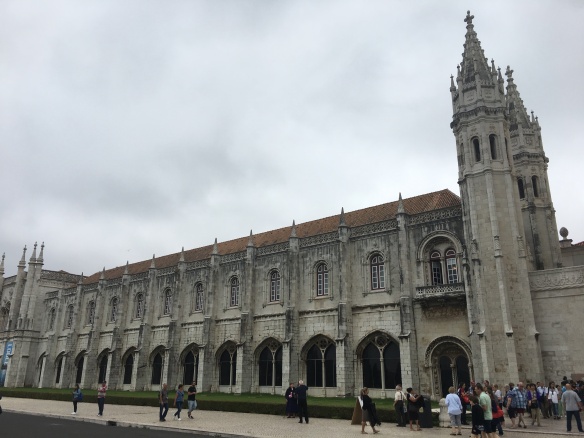
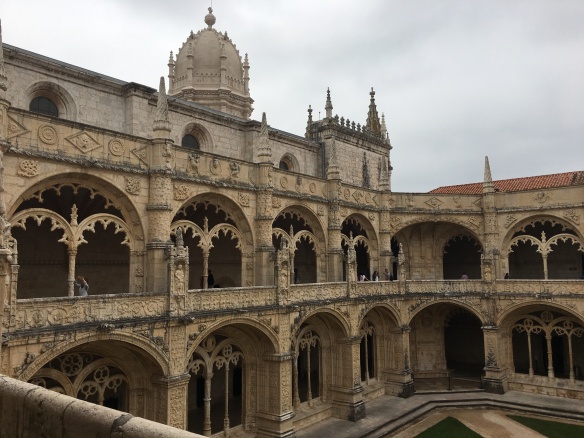
The Jeróminos Monastery in Lisbon, Portugal, is a UNESCO world heritage site. When my wife and I toured the massive complex last summer, including the impressive cloister and the ‘chapel’ – which views more like a colossal cathedral in typical European grandeur, I understood why. These photos don’t do it justice.

IMG_5608

In 1833, over three hundred years after the site and property was inaugurated as a religious Order of Saint Jerome, a state edict transferred the property and all its assets to Real Casa Pia de Lisboa, a philanthropic institution that took in, raised and educated orphan children.

IMG_5573

It was hard for me to imagine that a three-hundred-year-old religious institution of this magnitude would relinquish its assets. And doing this, located on prime waterfront in Portugal’s growing commercial city during the sea-faring Age of Discovery.

IMG_5588

IMG_5595

IMG_5605

IMG_5581

Without delving into the complex history and context of the Secularization Act of 1833, the fact remains: During a robust period of historical expansion, the church made a big change. I would argue, however, the church did not lose. Sure, it no longer could boast financial ownership of the property. But, by handing over its assets and combining them with the resources of the state, it bolstered its core purpose in mission – the care of vulnerable children. The space and property, as of 1833 moving forward, would now serve the needs of needy children.

Jesus says: “Unless you change and become like children …”[3] Without doubt, the religious of 1833 Lisbon were being true to the mission of Jesus.

In our lifetimes, we are witnessing here in North America – indeed in Ottawa – many growing examples of a church re-purposing its properties to build senior’s complexes and other social enterprise. We may believe this is a sign of the times – a negative, unfortunate, disappointing, mournful reality of the church. But, in truth, in many cases, such a re-purposing of a building is consistent with the Christian mission – to care for the weak, the vulnerable and needy in our society.

I can remember driving through rural country in south-western Ontario, and more in Saskatchewan, where you would see, stuck in the middle of a wheat field, a run-down, dilapidated old church building no longer in use, just left abandoned. It is sad to see this. It’s easy to jump to the negative conclusion that the church is dying by simply looking at its physical assets. When it’s not tied to a living purpose, the building will surely die.

But two hundred years after the so-called secularization of the Jeróminos Monastery’s assets, hundreds of thousands of visitors to the site every year continue to pour in and be inspired by the legacy of that bold, courageous move of those 19th century Christians in Lisbon. Good for them.

Re-purposing church property is not just a recent, contemporary phenomenon borne out of the institution’s modern demise. Re-purposing assets is not a sign of Christian defeat in a secular society. First of all, it has evidently been done throughout history when the need and opportunity arose.

Moreover, changing a physical structure doesn’t mean Christians are being decimated by an oppressively secular, contemporary, multi-cultural, diverse society in Canada. The physical transfiguration of Christian property may in truth be a positive sign of healthy, missional spirit, consistent with our Christian identity. A sign that the church and its original purpose in their properties will endure for centuries longer.

The disciples of Jesus accompany him to and from the mountaintop. Moses and Elijah appear with the transfigured Jesus, linking the present moment with the great tradition spanning all times and places. The community, the people, the saints on earth and the saints of heaven, accompany us on this journey.

The journey is a movement, not to remain stuck – even in moments of glory and victory. Rather, we are called to embrace the hardship as well, the challenges, the disappointments and opportunities of the daily grind of living, down in the valley of our lives. Ours is not a denial religion. Ours is not an escapist religion, one that ignores the plight of those who suffer, avoiding the normal difficulties of life, pretending that somehow we can with God only experience the highs without the lows. That is false religion.

Jesus interrupts our striving and tells us, “Don’t”. Don’t build those false expectations of a prosperity gospel. Don’t pretend you can stay on the mountaintop with Jesus forever while you live on earth. Because, Jesus, the divine Son of God, also embraced his humanity, and leads us down into the very human valley of life on earth.

Positive change and transfiguration in this light don’t come by way of escaping the world. The cathedrals of our hearts are meant to house people – all people, in their needs and for the sake of the other.

We are not alone, in this enterprise. As Jesus accompanied the first disciples up and down the mountain, God goes with us, up and down. Jesus leads the way. And, we walk shoulder to shoulder with our co-pilgrims who go with us.

[1] Mark 9:6, NRSV

[2] Matthew 17:5, NRSV

[3] Matthew 18:1-5

Repeat performances

Once again during the Christmas season, I experienced this strange cultural phenomenon:

How many decades has it been that every December, movies like “It’s a Wonderful Life”, “Elf”, “How the Grinch Stole Christmas”, “A Charlie Brown Christmas”, “National Lampoon’s Christmas Vacation” and “The Bishop’s Wife” get replayed and replayed over and over again, year after year? And only at this time of year? You can probably add several more of your favourites to this list.

That is why I was a tad apprehensive last month when we received tickets to attend the National Art Centre (NAC) Theatre production of Charles Dickens “A Christmas Carol.” I know the story. I’ve read it several times. I’ve watched television renditions of the story over the years. What could the NAC Theatre do to bring it to life, once again, for me? Same old, same old, right?

On the other hand, I believe there is a good reason why we turn to these stories every year. There’s a reason for our culture’s yearning for their repeat-performances. A higher reason, I might add. Perhaps there’s something in those stories that we need to take to heart, and make positive changes to our lives. Perhaps, we need to see the story-telling as more than a mere syrupy, sentimental “Isn’t that nice” tradition.

So, I was surprised and intrigued by what the NAC Theatre troop did with the story. It was introduced by two actors who came on stage — one was blind and one was deaf. In the introduction they invited the audience to participate in a simple activity with our hands, both to show that the two actors needed each other in accomplishing their jobs; and, what is more, near the end of the story everyone in the audience was needed to give the sign with their hands in order to encourage Scrooge finally to embrace a more compassionate approach to life.

Without taking anything away from the traditional story-line plot, the meaning of Dickens’ famous “A Christmas Carol” was conveyed to me in a fresh way.

We encounter in young Samuel and the elder Eli one such repeat performance story in today’s text from the Hebrew scripture.(1) It is a story many of us know — of the boy Samuel in the temple who is called upon by God. It gets told many times in the life of the church over and over again — every three years at least. It is true: it is a nice, little story, isn’t it?

At first, Samuel doesn’t recognize God’s voice, believing instead that it is his old mentor, the priest Eli, who is calling him. Finally, with Eli’s help, Samuel responds to God’s call by saying, “Here I am. Speak, Lord, for your servant is listening.”(2)

Well, as I said, many of us are familiar with these very words. We even like to sing a popular hymn (3) reflecting the words of one responding positively to God’s call — a call that changes the life of the recipient. How does this familiar story speak to our lives today? How is it more than just ‘a nice, little story’ from the Bible? How can this story change our lives?

In this story, an old man and a young man collaborated to hear God’s vision for a new Israel. For God was about to do a new thing: Soon to emerge in the life of God’s people was a new lineage of kings, beginning with the inauguration of King Saul.(4) What was passing, was the rule of Judges along with the sinful house of Eli. What was emerging was the likes of King Saul, King David, King Solomon, and so forth.

In God’s message to Samuel, God condemns Eli’s lack of restraining his sons’ immorality. Eli’s sin was his aversion to do something even though he recognized what was happening. Even though Eli knew the ongoing problems in his household, Eli turned a blind eye and ignored it all.

He did not act. And no matter what Eli would do now to try to redeem himself by making various sacrifices to the Lord, God was intent to establish a new order of leadership over God’s people starting with the demise of Eli’s household.

Doing nothing was the problem. For us, today, doing nothing about a problem we know exists is the problem. How do we begin to move out of the prison of this self-inflicted inertia?

We need to recognize that growth and healing is a process. The birth of the new thing God was doing began as a cooperative affair. It took the attentiveness of the young Samuel’s ears and the wisdom of the old priest’s heart and mind to bring about God’s purpose. It took both the authority of the failing, feeble priest and the obedience of his youthful protégé to bring about God’s purpose. In other words, it takes a community to bear such a task.(5)

Responding to God’s actions and call in the world and in our lives today is not a solo effort. Religion is not a solitary practice. Indeed, it takes a village. It takes the various gifts of people in our lives. What one has and the other does not, what the other is good at that the first is not — it takes everyone’s attentiveness and participation.

How do we live into this collaborative way, especially challenged by our society’s emphasis on individualism, privacy and self-reliance? We are, indeed, up against a culture that is at odds with the Christian vision. How do we live the way of God’s reign? Where we value mutuality, diversity, common purpose in the mission of God for the good of all people?

In contrast to the way in which God spoke to the likes of Isaiah, Jeremiah and the later prophets of Israel, God does something unique with Samuel. You will notice that God does not enjoin Samuel to deliver God’s message to Eli. God does not charge Samuel to tell Eli what God is telling Samuel with words like: “Thus says the Lord, tell the people Israel”, etc., etc. No.

Rather, God wants simply to confide in Samuel. Basically, God expects Samuel, first, to listen. Just listen. It seems, Samuel first needs to learn how to do this. And it will take some time and some practice, evidently.

Can we have the courage, and the patience, to learn how first to listen to God and the other — without jumping in too soon with the energy of our own bravado, our own opinion, our own self-justifications, our own visions of what must be? The simple act of listening, can change our lives. Because listening first means we believe that the other has something of value to offer that we don’t have.

God works at a slower pace, it seems, compared to the hypersonic rhythms of life in 2018. Not only does God give Samuel and Eli one chance to figure it out, but two and even three opportunities to get on the same wavelength as God.

The story-telling is both appealing and intentionally slow early on. Dialogue is repeated. The action of Samuel getting up from sleep and going to Eli are repeated. We have to slow down with the narration and feel the build-up to the great reveal of God’s message.

Even though both Samuel and Eli are slow in finally getting it, even though they are encumbered by sleep, drowsiness, denial and avoidance, even though their response to God is compromised by vision and hearing impairment, by youthful pretence and the attrition of old age …. God still finds them. God still speaks. God still acts in the way God will act.

Despite human arrogance and self-delusion, despite all our toiling and pride, despite all our ego compulsions, God keeps at it to tell us, guide us, and instruct us.

We may not like the answer. We may not like what God has to say. We may be challenged to the core of our being by what God is telling us. Regardless of our hesitation, denial or self-delusion, God finds a way. God doesn’t give up on us. God gives us people, and stories, and experiences — even the same ones, over and over again — to help us finally get it.

God doesn’t give us just one chance. God is not just a God of second chances, as we often say. God gives us many chances, as many we need. May we, like Eli, finally come to accept what God has to say to us, with his words: “It is the Lord; let him do what seems good to him.”(6)


(1) 1 Samuel 3:1-20, the first reading for the Second Sunday after the Epiphany, Ordinary time, Year B in the Revised Common Lectionary.

(2) 1 Samuel 3:4-10.

(3) “Here I am, Lord”, Hymn #574, Evangelical Lutheran Worship (Augsburg Fortress, 2006); also, for the Christmas cycle, this hymn is also appropriate in singing Mary’s response to the angel Gabriel’s visit to her, announcing Mary’s role in the birth of Jesus (Luke 1:38).

(4) 1 Samuel 8-10.

(5) Richard Boyce in David L. Bartlett & Barbara Brown Taylor, eds., “Feasting on the Word: Preaching the Revised Common Lectionary, Year B, Volume 1 (Kentucky: WJK Press, 2008), p.245-247.

(6) 1 Samuel 3:18

Even there your hand shall lead me

Later this summer I will be going on a 10-day canoe-camping trip on the French River. Last summer my friend and I did three nights and four days on a smaller portion of the French; this summer we want to challenge ourselves to do the whole, or at least most, of the river all the way from Lake Nipissing to Georgian Bay.

Because the challenge is greater, I felt I needed to take a First Aid Course in preparation, so I could be of some use to the company with whom I travel.

I learned some interesting facts about providing First Aid. Did you know that in all of Canada, except Quebec, you and I are not legally obligated to provide First Aid to anyone experiencing a medical emergency? In Quebec, however, we are legally bound to help someone who is in distress. It is, from Quebec’s point of view, a basic human right for any person to receive first aid in an emergency.

In class we discussed reasons why we may choose not to give First Aid: For fear of hurting them more, for fear of harming oneself, and of course for fear of legal repercussions. Our instructor countered this latter objection by reminding us of the “Good Samaritan Act” which governs any attempt in good faith to help someone in an emergency. So, legally, we were off the hook.

But we may still hesitate to take the risk and commit ourselves to helping someone. It would be easier to pretend we didn’t see it, get on with our busy day and avoid the added stress and responsibility.

Every time I read the wonderful story of the so-called “Walk to Emmaus” (Luke 24:13-35), something else piques my interest and causes me to reflect. I believe there is so much depth to this story while it provides a summary of what we believe as Christians. Particularly, this time, I wondered what Cleopas and his friend had to do with this incredible encounter with Jesus.

It seems they really had nothing to do with making this encounter happen, when Jesus appeared to them on the road that first Easter day. As far as we can tell, they weren’t expecting to meet Jesus let alone praying for it. And, ironically, when they do finally recognize the living Lord Jesus at the breaking of the bread, Jesus disappears from their sight! Truly, this event happened to them.

But were they merely passive recipients of this encounter? There is one turning point in the story, where things could have gone one of two opposite directions. Up until that point, they had not yet consciously recognized the man walking with them as Jesus himself. After that point, the table was set — literally — for their full recognition of Jesus.

Had they not invited Jesus to stay with them, for the evening was nigh, they would have missed out on a wonderful conclusion to their day. “Abide with us, for it is evening,” they invited this still stranger to them into their home. They could have chosen to let the man on his way. They could have chosen not to pay attention to their burning hearts. They could have ignored the subtle yet real ‘promptings of the Spirit’ we may call it today, within them.

I learned some thought-provoking statistics on my First Aid course this week. There we were, some twenty-five of us stuffed into a tiny room above a car repair shop in Renfrew. We were from all walks of life. Local businesses paid for their employees to take this course; therefore, my class mates were prompt and motivated to learn their First Aid techniques, principles and procedures. Certificates were issued upon successful completion of two exam periods and practice with bandages, splints and manikins.

Then, our instructor posted these statistics after asking us: Presuming it was done properly, what was the success rate of providing only chest compressions (sets of thirty thrusts downward over the chest) to someone who was unconscious and not breathing? What was the success rate of doing just that? 1.2%.

Without the aid of an Automated External Defibrillator (AED), adding ventilation to the chest compressions (pinching the nose and breathing in sets of two into the casualty’s mouth) raises the chance of recovery to only 5%.

I thought to myself: There is hope to humanity! Because it would be easy to just not bother! No wonder we may feel unwilling to commit to providing First Aid to an unconscious stranger on the street! What’s the point of doing that, let alone learning how to do it?! The chances of success are so slim!

And yet, there we were. These classes, I am told, are usually full. Businesses and organizations require their employees who engage with the public to know First Aid. They employ resources to make sure their employees have this training. All this effort for at best a 5% success rate.

But the ethics of it would argue: It is worth trying. Better to do something, than do nothing at all.

Sometimes I wonder whether being the church feels a bit like that. We expect the church to function at a 100% success rate; and when we fail the odd time, well — the church is no good, don’t bother. What is the worth of it all?

People are still bad. Failures in humans abound and seem to persist against all good intentions and efforts to be good. The message of the Gospel doesn’t always seem to make any positive difference in our lives. So, what’s the point?

Driving on Clyde Ave the other day, I noticed the sign outside the Reformed Church that reads: “Growth doesn’t come without change. Change doesn’t come without some risk.”

Following the example of Cleopas and his friend on the road to Emmaus, the only thing we can do, it seems, is learn to pay attention to those rare moments whenever our hearts are burning with love. And then, practice making the invitation in response to that nudging of our hearts and open our lives to those moments when we sense something shift within us. We may not be able to put our finger on it just yet, but respond nonetheless.

And then the rest is up to God. God is free. God enters our lives and walks with us whether we know it or not. God then ‘disappears’ from our awareness whenever God wants. But whether we feel God near or far, God is there. “Am I a God nearby and not a God far off? Who can hide in secret places so that I cannot see them?” says the Lord. “Do I not fill heaven and earth?” (Jeremiah 23:23-24).

The God of Easter is alive and present with us no matter where on earth we go. This is the good news of the resurrection. God is alive, and so we are called to rise up in renewal and joy. “If I take the wings of the morning and settle at the farthest limits of the sea, even there your hand shall lead me and your right hand shall hold me fast” (Psalm 139:9-10).

It is worth it. Even though we fail time and time again. There is the hope. There is the promise. There is the opportunity. There is the constant presence of God.

Transfiguration – a launching pad, not a destination

Last Fall, a member of council framed a few pieces of the original cork that lined our walls prior to the renovation. I now show you a piece of this cork as another reminder of what used to be a unique certainty every time worshippers gathered in this space, for over fifty years. Certainty no longer!

You notice, obviously, that this space is fundamentally the same. And yet what we see and what is invisible has changed. No longer cork, but drywall and insulation. No longer narrow windows placed as a trinity, but wider ones that let in more light! The reredos, the pulpit and the ceiling — all retain fundamental elements of the old, but are definitely and without a doubt new at the same time!

These are mysterious, hard to grasp perceptions that can help our understanding of the Transfiguration of Jesus — the same person, the same general shape and size, but different: not only fully human, but also fully divine!

The Transfiguration points to a truth in our lives we often, because of our sin, want to resist: Change happens; it is part and parcel of the process of life.

Before the transfiguration of this space that occurred over the last four months, did you know that this space experienced a previous transfiguration? Perhaps it was more a transfiguration of purpose, than actual bricks and mortar:

In 1965, the sanctuary was originally intended and designed to be the fellowship hall for the ‘new’ church to be built at some future date. The Annual Design Award for 1965 was given to the Schoeler Markham and Hector architectural firm by the Ontario Association of Architects, Ottawa Chapter, for the design of the “Faith Lutheran Fellowship Hall”, as it was originally named. (1)

Change in the church is the norm, not the exception. As we sit, stand and move in this space today, we know there is still work to be done. The narthex hallway is still under construction, and needs some time for its transfiguration to be completed.

Life is a process of change, of coming and going. The last four months were not a vacuum in our existence. Whether we are aware of it or not, we have changed in the time we were not here. Whether you worshipped with us at Julian, whether you worshipped elsewhere, whether you didn’t worship at all, we changed. And that is part of the reason that during midweek Lent gatherings, we will give ourselves time to process our learnings.

Much has been said and written about the extraordinary, supernatural experience of Jesus being transformed in the presence of a few of his disciples. Not only does Jesus’ countenance change, he appears with Moses and Elijah — a couple of Israel’s greats.

The relationship between these characters — Jesus, Moses, Elijah, Peter, James and John — is fascinating to ponder. What compels me in this reading is what happens shortly before they climb the Mount of Transfiguration, and what happens shortly after Jesus’ entourage heads back down the mountain. The movement up and down speaks of a rhythm not only evident in the bible, but in life: a rhythm of coming and going, of ups and downs, of death and resurrection.

Jesus took with him Peter, James and John up the mountain. Special treatment? After all, didn’t have twelve disciples? Were these Jesus’ favourites? I wonder. Well, Peter, in the verses prior to the text for today, gets a scolding from Jesus after Peter suggests Jesus ought not suffer and die; Jesus calls Peter “Satan” (Matthew 16:23) for expressing that opinion. So, Peter is not in Jesus’ good books. Or at least, that’s what James and John probably thought, hiking up that mountain.

And so, after the spectacular event atop the mountain, when they return with Jesus down into the valley of their regular lives, they want to keep and guard their special status among the other disciples. A few verses after the end of this text, they ask Jesus: “Who is the greatest in the kingdom of heaven?” (Matthew 18:1). The Gospeler Mark portrays James and John in a more aggressive manner, when he records James’ and John’s request more as an order, or demand of Jesus: “Teacher, we want you to do for us whatever we ask of you … Grant us to sit, one at your right hand and one at your left, in your glory” (Mark 10:35-37).

The disciples are fighting amongst themselves, and competing over who is the greatest. Of course, they use the world’s standards of greatness. Jesus brings to them children and the Cross, to show them who and what is truly great in God’s eyes.

“‘BANG!’ The gun fires and the race is on. The runners take off across the field. It rained the day before and the ground is still damp. The temperature is cool. It is a perfect day for running. The line of runners quickly forms a pack. Like a school of fish they come together as one. They move as one … As with any race, in a short period of time the stronger ones will start to pull ahead and the weaker ones will start to to fall behind.

“But not Ben Comen. Ben was left behind as soon as the starter gun sounded. Ben’s not the fastest runner on the team. In fact, he’s the slowest. He has never won a single race the entire time he’s been on the … High School cross-country track team. Ben, you see, has cerebral palsy.

“Cerebral palsy, a condition often caused by complications at birth, affects someone’s movement and balance. The physical problems endure a lifetime. Misshapen spines create a twisted posture. Muscles are often withered and motor reflexes slow. Tightness in the muscles and joints also affect balance. Those with cerebral palsy often have an unsteady gait, their knees knock and their feet drag. To an outsider, they may seem clumsy. Or even broken.

“The pack pulls farther and farther ahead while Ben falls farther and farther behind. He slips on the wet grass and falls forward into the soft earth. He slowly picks himself up and keeps going. Down he goes again. This time it hurts. He gets back up and keeps running. Ben won’t quit. The pack is now out of sight and Ben is running alone. It is quiet. He can hear his own laboured breathing. He feels lonely. He trips over his own feet again, and down he goes yet another time.

“No matter his mental strength, there is no hiding the pain and frustration on his face. He grimaces as he uses all his energy to pull himself back to his feet to continue running. For Ben, this is part of the routine. Everyone else finishes the race in about twenty-five minutes. It usually takes Ben more than forty-five minutes.

“When Ben Comen eventually crosses the finish line he is in pain and he is exhausted. It took every ounce of strength he had to make it. His body is bruised and bloodied. He is covered in mud. Ben inspires us, indeed.

“But this is not a story of ‘when the going gets tough, the tough get going.’ This is not a story of ‘when you fall down, pick yourself up.’ Those are great lessons to learn, without a doubt. But we don’t need Ben Comen to teach us those lessons. There are dozens of others we can look to for that … Ben’s lesson is deeper.

“…. What Ben teaches us is special … Ben starts every race with a very clear sense of why he’s running. [It’s not about how Ben relates to his ‘competitors’.] He’s not there to beat anyone but himself. Ben never loses sight of that. His sense of why he’s running gives him the strength to keep going. To keep pushing. To keep getting up. To keep going. And to do it again and again and again. And every day he runs, the only time Ben sets out to beat is his own.” (2)

Change is the norm, not the resisted exception. When we face changes in our lives, the only competitor we face is ourselves — individually, or as a group. When we face the changes of life, we misfire our energies if we find someone else to blame, some other entity out there that is the cause of all our problems. When we play that kind of game, we become part of the problem rather then part of the solution. The greatest and most significant competitor we face, is ourselves.

From the mountaintop experience, one must return to the valley, where the real work begins. We need to ponder, now that we have this beautiful space to gather, why indeed we gather here. We need to articulate for a new day in new language and different forms what is our purpose, our mission. What is the purpose of the building?

There is no recording of James, John and Peter ever running back to the place of worship atop the Mount of Transfiguration when things got tough. They didn’t go back there every Sunday, again and again. That’s because the purpose of worship is not a destination, but a launching pad to the world around.

The purpose of this space on Sunday morning is not a destination of our faith, but a launching pad, to go out there and live out our faith in our daily, Monday-Saturday lives. Ekklesia, the Greek word for ‘church’ means literally, ‘a people called out’. We keep going, moving forward, doing what we are called to be and do.

And we don’t give up. We keep in mind that when the stress of change seems overwhelming, there is no one or circumstance ‘out there’ to blame. We are our own greatest enemy, they say; it is true. We, also, are our greatest asset. We only have ourselves to challenge, to change, and to grow.

And Jesus goes with us, and before us, through all the ups and down. Thanks be to God. Ours is the task, now, to follow.

1 – from Church Anniversary 2011, Faith Evangelical Lutheran Church Ottawa, “Some Interesting Facts”.

2 – Simon Sinek, “Start With Why”, New York: Penguin, 2009, pages 222-224.

Better is not what you think

What happens when doors close and we don’t see other doors open? Life is full of closed doors: unemployment, failure to graduate, illness, tragedy, lost friendships, divorce — the list goes on. What happens when you are stuck in the middle of that transition and can’t see a way through? For whatever reason, doors close. The fact we sometimes don’t know why may make it harder to take.

Paul wanted and “attempted” to go to Asia. The lectionary doesn’t include the verses (6-9) immediately prior to the first text today (Acts 16:9-15). For some inexplicable reason, the Holy Spirit “did not allow” Paul and his cohort to travel there. A door is closed. 

But you’ve heard the cliche: When God closes a door, another one opens. Which is, presumably, a better deal.

After the door to Asia, and Paul’s ‘wants’, closes, he then goes to Macedonia after a convincing vision and on to Philippi where he meets Lydia. The result of their encounter is that “she and her household were baptized”. Good things happen. This open door was a successful mission. Even though, originally, this mission-field was not for-seen, planned, even desired.

The church finds itself in an uncomfortable situation these days. The glory days of ethnically-defined church planting and building are long gone. We still yearn for those good-old-days, the hey day of the kind of church we still try to maintain when Lutherans from Germany were streaming off the boats, church budgets were growing and pews were filled. For the institutional reality, it feels like a door is closing. And we don’t see a clear picture of what it is changing into.

It’s not a comfortable place to be, when doors close. Where’s the open door?

Earlier this year a couple members of a Lutheran church in Southern Ontario, decided to partner with a neighbouring church to organize a refugee sponsorship initiative. They complied with all the regulations, began a fundraising appeal, and the word got out.

Before long they had attracted fourteen people from the community to work alongside them. They found unprecedented success at mobilizing resources and motivating people to help. Tens of thousands of dollars was raised in no time. An apartment was secured and furnished without problem. A Syrian family was on the way.

The Lutherans on the committee made sure their own congregation was brought up to speed with regular reports, appeals for help and updates. To their surprise, and dismay, all but a couple on that growing committee were members of their church.

The gentleman who had initiated this refugee work lamented to one of the Synod staff who was close to the community, “What’s the point of doing all this work, when the people working on the committee don’t come to church on Sundays and put offerings in the plate?”

“Are others aware you are a Christian from a local congregation?”

“Are people being helped?”

“Is good coming out of all your efforts?”

“Are you doing this from your conscience as a Christian?”

“Do you feel God is calling you to do this work?”

All these questions were answered in the affirmative. So, what’s the problem? Maybe a door is closing, and maybe another has opened? It just isn’t what we may expect or think we want. The Holy Spirit is active in the world and among people. The question is, are we willing to walk through that open door? Congratulations to that Lutheran who took the initiative to do something when there was a need.

When a door closes, it can feel like you are unprepared for whatever may be. In life transitions, especially, the in-between ‘close door / open door’ time can be unnerving. When a baby is born, for example, no manual comes out with the baby. Being a parent is feeling your way to make decisions with each passing moment. Preparation — you can throw that out the door!

Of the top three major festivals of the church year, the Day of Pentecost comes up almost unexpectedly. Did you know it’s two weeks from today? Unlike Christmas and Easter which have long weeks of preparation (Advent and Lent, respectively) leading up to these high, holy days, Pentecost does not.

We only have Jesus’ words in the Gospel of John (14:23-29) to his disciples, these days, preparing them for his departure. And giving the promise of the Holy Spirit.

Occasions like this should be sad, unnerving, disquieting, too sudden. And, on some level, it is. It cannot be denied. After all, the disciples will no longer have Jesus physically present with them any more. In a way, they are losing something precious and dear to them: their leader, their confidant, their friend. The common reaction to a loved one’s leaving is sorrow and despair. We can understand. Sympathize.

And yet, Jesus tells them to “rejoice” that Jesus is going back to the Father. Be glad, that Jesus is leaving them? It doesn’t make sense. Be glad, that you are going? – You can probably hear the disciples murmur under their breath, trying to figure it out.

In coping with his absence, Jesus nevertheless gives them something even better. The door of his physical presence is closing. But another, better door, is opening. This is unexpected, never-before-seen, and unplanned (from the disciples’ point of view):

After he leaves, Jesus’ presence will be within them: Earlier in this chapter (v.20), Jesus says: “I am in my Father, and you in me, and I in you.” Through the gift of the Holy Spirit, they will have the power and the grace to do great things in the name of Jesus. “Very truly, I tell you, the one who believes in me will also do the works that I do and, in fact, will do greater works than these, because I am going to the Father” (14:12).

In order for the new door to open, the old door must close. The only way the disciples of Jesus can receive the Holy Spirit and do and be all that they are meant to be and do, is only after Jesus leaves them and returns to his Father in heaven.

The promises of God are rich. We may not see the outcome or how it will all turn out, in the end. Yet, it is true: Once a door closes, another will open. And it will not be what we think. It will be better!

Easter: Jesus on the loose, now!

A mother was putting her young, eight-year-old girl to bed one night. The girl, accustomed to saying her prayers as part of her bedtime ritual, said to her Mom:

“I want to die so I can see Jesus.”

Taken aback, the mother realized in that moment that everything her daughter had heard to that point about Jesus was about eternal life — how Jesus came to earth to save us from our sins so that after we die we will go to heaven. 

No wonder the girl, who had faith, thought that the only way to see Jesus was to die first.

Quick thinking, the mother put her hand in her child’s, looked her in the eye and said, “Jesus is alive. Jesus lives in you and in me. If you want to see Jesus, look for him in the people you meet in the church, in your school and wherever we go. If you want to see Jesus, sweet child, just open your eyes. And live your life!”

Jesus is alive, today. Right now. That is the message of Easter. And the foundation of our faith as Christians.
A few weeks ago the Jewish Rabbi who met with our confirmation class answered a question about who he thought Jesus was. His answer made me think. He said, “Jesus was and is a very important and significant person for Christians.”

I wondered if someone asked me, “Who is Jesus?”, what would I say? I think my first response would be: “Jesus is alive.” Not dead. Not just a great teacher who walked the earth over two thousand years ago and died a criminal on a cross outside Jerusalem. Not just a healer of the sick and prophet who spoke God’s good news to the people of his time. All those things, yes. But more. So much more.

You notice the traditional Easter acclamation is NOT: “Alleluia! Christ was risen! He was risen indeed! Allelulia!” He IS risen!

When we come to worship God, we are not just praising a man from the past, studying an important historical figure, or reading a great story from history. We are not just about being a bunch of ‘talking heads’ who like to debate religion, theology and doctrine, but go on living as if nothing really needs to change in our lives in this world, today. 

We cannot turn this great story of Jesus’ death and resurrection into a platitude that just makes us feel good on a holiday long weekend in Spring. There’s too much at stake. The Easter proclamation means something for our lives today. Our job is no different from the first disciples who met the risen Jesus.

Jesus, outside the garden tomb, had to shift Mary’s focus away from the past to the future. After calling Mary’s name, Jesus rebuffs Mary’s attempt to ‘hold on’ to Jesus as if he were the same as before he died (John 20:17). In that encounter with Jesus, Mary learns from her Teacher that she is being caught up into a larger drama that includes not only Jesus’ death and resurrection, but also his ascension — and beyond!

In other words, Mary learns that this is not merely a story about the re-union of friends with tears and hugs all around, case solved. It is about ultimate destinies: (1) Jesus’ and Mary’s — and the disciples’ destinies too. The story has not concluded; it is still unfolding. She must relate that to the rest of the disciples. Her story, and Jesus’ story, his experience and hers, cannot be anchored in the past. The story of Jesus, then and now, must move on.

That’s where our sights are focused on Easter morning. Where are we going? Where are you going, in your faith? The promise of new life in Christ Jesus means something special for you, now. It means something very special for the church, today. To live out of the Easter message, we must look forward, to where the risen Jesus awaits our following.

It seems so many people these days are reading Rumi, the great 13th century Sufi poet. Sufi described an image of a mirror in the hands of God. It fell, and broke into billions of pieces of glass strewn all across the face of the earth. Everybody took a piece of it, and thought at first they had the Truth — the whole Truth, and nothing but the Truth.

Let’s imagine that each shard represents a unique reflection of God’s being, God’s will, God’s presence. Let’s imagine that each piece of glass represents one who has faith. Each piece of glass reflects the beauty and light of God’s creation, manifest in the individual person or congregation — however you want to look at it.

God is, over time, restoring all the pieces back into wholeness, into the original mirror. God also seeks our cooperation in mending what has been divided. 

We are like that little girl who wants to see the face of Jesus. And is learning that we don’t have to wait until we die, to experience a fullness of the Lord’s presence. Using the words of the Apostle Paul, We may see as in a mirror dimly while we live on earth (1 Cor 13:12), for sure. But slowly, surely, God is also already at work reflecting the love, the light and presence of the living Christ in each and everyone one of us. Who in gospels was not changed after encountering the Lord?

We are, as Paul also describes, the “Body of Christ” (1 Cor 12:27), on earth. The tradition of Christianity since the Resurrection of the Lord has claimed that the church together is the Body of the Living Jesus. We are the living representation of Jesus on earth. As Martin Luther stated, in our baptism we are “little Christs”. 

Jesus is on the loose! Jesus can show up as a cashier in the grocery store, the young man who changes the oil in our car, a coworker in the office, our doctor, a good friend or even our spouse, child or grandchild. You may even find him looking back at you in your bathroom mirror! (2)

Paul concludes, “All of us … are being transformed” (2 Cor 3:18). God is already at work, in the power of the resurrection, healing what has been broken, bringing together what has been divided, restoring to completion a glorious transformation of our very lives. This is our hope. This is our Easter joy.

Alleluia! Christ is risen! He is risen indeed! Alleluia!


(1) Gregory A. Robbins & Nancy Claire Pittman in David L. Bartlett & Barbara Brown Taylor, eds., “Preaching the Revised Common Lectionary: Feasting on the Word” WJK Press, Kentucky, 2009, p.377

(2) Sr Bernadette Gautreau, “Jesus is Loose!” in Holy Week Reflections 2016 published by On Eagle’s Wings, p.9

The return journey of Transfiguration

When I first watched Danny Macaskill’s video, “The Ridge”, I assumed the incredible journey on his mountain bike would culminate at the pinnacle. When he lifts his bicycle over his head through the streaming rays of glorious sunshine on top of the Scottish highland, I anticipated the credits to role. His journey done. The glory achieved. Mission accomplished.

But we were only half done! After relishing the moment, he puts his wheels on the uneven, rocky, dangerous path and accelerates downward on the return journey — jumping across gaping crevices, twisting across boulder tops and flipping over barbed wire fences. The pilgrimage began at the water’s edge below. And there, it will end.

The journey of Transfiguration, described by Luke in the lectionary for today, does not end on the mountaintop (Luke 9:28-43). After the majesty, mystery and glory of the spectacular vision on the top of the mountain, Jesus and the disciples “come down from the mountain” (v.37) into an anxious scene where Jesus heals a man shrieking, convulsing and foaming at the mouth in the grips of demon possession. Not exactly a moment of pristine glory. 

Though the story ends well for all concerned, the Gospel writer reminds us that the journey of change and transformation and healing must include a descent, a going down, a letting go, a releasing. You may call it a reality check in life, or in the case of the video, literally — the rubber hitting the road.

These mountaintop experiences of our lives, according to the Gospel, find meaning and validity in the valleys of our lives. Jesus’ majesty is legitimized in his mission to the people living in the valley. These mountaintop experiences are mere stopping points on the journey, not the destination. While we live on earth, the journey must embrace both mountain and valley, must recognize the meaning and value in both. Our spiritual charade is exposed if we pretend faith is validated only in those ecstatic mountaintop moments.

In your life, which mountains have you ascended? These can be times when you experience joy, love, peace and hope; they can be times when you experience a deep sense of satisfaction and accomplishment.

And into which valleys did you descend? These can be times when you experience failure, setback, disappointment, loss; they can be times when you felt profound fear, shame, anger, guilt and anxiety. 

Joyce Rupp reflects on legends common to many lands “about a person who has an enticing dream of where treasure is located. Of course, the valuable cache in the dream hides far beyond where the person lives. If the dreamer does not leave home to seek the treasure, the dream is repeated until the person finally sets out for the extensive journey. In each legend, the seeker travels long, arduous years, filled with both dangerous and enthralling adventure, never being sure if that which is sought will be found.

“The story ends with the traveler coming to the place where the treasure is supposedly hidden. Instead of finding it there, the seeker meets a stranger at that site who tells about a dream he or she had in which the long-sought treasure is located back at the place where the dreamer originally started out. Of course, the person who has been seeking all those years now hurries as quickly as possible to get home. Arriving back at the place of the dream, sure enough, there is the treasure. What the person sought on the arduous journey had been there all along.

“This legend teaches that life’s journey, with its flow of ups and downs, has to be made. Although it leads full circle back to the home of one’s own heart, the journey itself contains the necessary teachings for growth and change.” (1)

When we return to the starting point of our own existence, we will find our true nature. Again, the story of Jesus’ Transfiguration is helpful. Because the message from the biblical record is that Jesus’ true essence was revealed on the mountaintop. He is the divine Son of God.

Yet, the Transfiguration of our Lord didn’t negate his humanity. From that point forward, he would still go down into the valley, heal the sick, preach good news to the poor and die a human man on the Cross of Calvary. The Transfiguration only uncovered his true nature in that moment of time.

In the same way, we are transformed and changed — yes. But our Christian growth does not dismiss, discard, and deny all that we are and have been — good and bad. As Martin Luther argued, we are simultaneously saints and sinners. Our transformation is not a movement from sinner to saint, as if we can only be Christian if we don’t sin anymore, as if no more sin infects our lives, as if we can somehow abolish altogether our sinful baggage on the journey. The greatest saints on earth still sinned to their dying day.

Rather, our transformation reveals to us and those around us who we truly are, in Christ Jesus: We are beloved children of God. In this life, we will always be saints and sinner. Yet, we will know and experience more and more the transforming power of God’s love for us, in us, and through us. This is our true nature. And our greatest treasure. Thanks be to God!

Where in your life do you see the love of Jesus, working in and through you despite the sin in your life?


(1) Joyce Rupp, “Open the Door – A Journey to the True Self” Sorin Books, Notre Dame Indiana, 2009, digital copy in Week 2, p.8