Easter: what is life-giving

When Sherlock Holmes and John Watson go tent camping for the first time, the two detectives unexpectedly encounter a ‘mystery.’

They hike deep into the woods all day until they find the ideal place to pitch their tent. They start a roaring campfire, roast marshmallows, tell favorite stories, sing some tunes and as the last embers flicker in the fire pit they pack it in for the night.

In the wee hours before dawn, Watson wakes the snoring Sherlock. “Look, Holmes, look at the billions of stars in the sky! What a glorious sight! Praise to the Creator!” Watson’s eyes remain transfixed on the expanse above them. “What would you say about this wonder, my friend?”

“I would like to know,” Sherlock mumbles, looking around their campsite, “who stole our tent.”

Were Sherlock Holmes and Dr. Watson victims of a prank, an April Fool’s Day practical joke?

Nevertheless, consistent with their personalities, each chose to notice a different aspect of their reality: Watson immediately taken in by the glorious night sky – probably something both sleuths weren’t accustomed to seeing in their busy, urban lives.

Sherlock, on the other hand, ever the deducing genius, notices what is amiss, and automatically goes into ‘fix it’ mode, seeking solutions to the trickiest, mind-stumping riddles of life.

In their shared situation one beholds life, joy and beauty; the other, the problem, and its attendant logical, calculated explanation. One looks up, the other, down.

What do you notice? And dwell on? Are you looking up? Or, still down?

The joyous, life-giving message of Easter does not deny nor avoid the harsh realities of living. The Christian’s journey on the road of life does not float over the potholes, ignore the accidents, nor glibly get a free pass over the traffic jams.

Yet, Easter declares something greater than all the suffering, pain and death has happened, and continues to happen every moment we dare to notice.

Jesus is alive! Amidst the hardships. Despite the necessary suffering. Jesus is alive! Right in the middle of the mess. Even in our complicated, self-contradicting lives. Despite our mistakes and our failures. The life of God in Christ resides within and all around us. Martin Luther famously said, the sun shines even on all the manure piles in our lives. Sherlock Holmes AND John Watson. Both/And.

The question is, do we now, as Easter people, notice the Life? Do we see, as Watson does – the victim of obvious theft – the stars in the glorious sky? Do we pause amidst the hectic, hurly-burly of life to, actually, smell the roses and give thanks? Can we believe that the Light that has come into the world now shines in the darkness? A darkness that can never overcome the Light?(1)

Can we assert that our hurt has become home for our greatest hope?

The good news of resurrection hope is that we don’t see this alone. The life and light of Christ shines in the Body of the living Christ — the church today. We are here for each other and for the world in order to discover and celebrate the presence of God in and around us.

We are not alone in discovering the gift of Life in us. In truth, the life of Christ resides in each and every one of us, despite the imperfection of the church and this community. When one of us falls, the other lifts up. We don’t have to suffer alone in the misery of alienation, feeling useless, or being crushed by failure. As if we must carry this burden alone, and heroically solve all by ourselves.

Easter means that now, “Faith does not occur in isolation. Despite the rugged individualism of our culture, faith is not just something private between God and me. Rather, faith is, by its very definition, communal.”(2)

God gives life. That’s God’s job. Where is God’s in yours? In the world? Where do you see it? Because, it’s there!

A woman asked her local Lutheran pastor for advice. “Pastor”, she says, “I have a boy who is six months old. And I’m curious to know what he will be when he grows up.”

The Lutheran pastor says, “Place before him three things: A bottle of beer, a looney, and a Bible. If he picks the beer, he’ll be a bartender. If he picks the looney, a business man. And if he picks the Bible, a pastor.” So, the mother thanked him and went home.

The next week she returned. “Well,” said the pastor, “which one did he pick: the beer, the looney, or the Bible?”

She said, “He picked all three!”
“Ah,” said the pastor, “a Lutheran!”(3)

Of course, we can substitute any Christian, here, not just Lutherans. The point is, living in the resurrection of Jesus means our lives reflect, resonate and echo the life of the living God. We rejoice and sing Alleluias for the beauty in life, despite the difficulties, through our human desires, and amidst the realities of life.

Now, we can see the life in the world – its beauty and glory – without denying the real. Even though someone may very well have stolen our proverbial tent, this cannot stop or take away the Life that is in us and all around us. Forever.

May our lives reflect a sense of wonder, trust in one another and in ourselves, and hope for God’s glorious future. Good news, indeed!


1 — John 1:5

2 — Stephen R. Montgomery in David L. Bartlett & Barbara Brown Taylor, eds., “Feasting on the Word: Preaching the Revised Common Lectionary” Year B Volume 2 (Kentucky: WJK Press, 2008), p.166.

3 — Adapted from James Martin , SJ, “The Jesuit Guide To Almost Everything: A Spirituality for Real Life” (New York: HarperCollins, 2010), p.317.

The Passion of Christ – a Good Friday sermon

The heaviness of it all weighs on our souls. Good Friday is a sombre day. The tormented images of the torture and death of anyone, let alone Jesus Son of God, flash across our minds-eye in the hearing of the texts describing the Passion of Christ.

We hear the lament from Isaiah’s poetry known as the Suffering Servant poems. If we let it, Good Friday pierces our denial of suffering and death. And we face squarely the reality of the situation. The very word, “Passion”, is from the Latin, one meaning of which is suffering.

If you, like me, have watched some contemporary video portrayals of Jesus’ Passion, probably the foremost image is the bloodiness of it all. Not only do we see the violence of the Jewish rebellion heating up during the Passover in Jerusalem, but we are intimately involved in the trial and torture of Jesus – beginning with the bloody cutting off of the servant’s ear in the Garden, to the whipping, flaying, kicking, slapping and piercing in Jesus’ torture while being held in Roman custody.

If that is not enough, we shiver at the pounding of the nails into his hands and feet, see the blood and water gush out of his side when the sword strikes him. Watch as blood trickles over his bruised face from the crown of thorns. Blood all over.

Blood all over. The blood of Christ given for you.

Suffering, Passion, is a great letting go. And acceptance of Christ suffering, even for us, is a great letting go. We cannot possess the gift of life. We cannot own or control this gift for us.

“For three days, the child bled profusely from the nose. She was six years old, and doctors had no idea what was causing the bleeding. What’s more, they understood that if the bleeding didn’t stop, her life was in grave danger.

“The year was 1913. The doctors knew little about transfusion, but they understood the importance of somehow getting good new blood back into the little girl’s system, so they asked her father, a preacher, to give his daughter some of his. He did, one of the first blood transfusions in the state of Michigan.

“The yellowed newspaper story is titled ‘Minister Saves the Life of Daughter By Giving Blood’, and ends by explaining how the father ‘was considerably improved and was able to dress.’ Then it adds, ‘The child was also considerably better and hopes are entertained for her recovery.’

“Two weeks later she was dead. Little Agnes Gertrude … succumbed once the hemorrhaging returned. For a time her father’s blood had brightened her face and her possibilities, but his gift – as unusual and strange to the newspaper readers as it must have been to him – wasn’t enough to save her life.

“Doctors knew very little, back then, about blood-typing. Her father … was as good as choice as the doctors could have made, but what coursed in his veins was not a match. Agnes Gertrude … died two weeks after that strange new procedure the doctors called ‘a transfusion.’

“Her father, a man of God, lay face down on the rug of the living room for almost a week after Agnes’ death, unable to move. Who could blame him – for an entire afternoon, he lay there beside his little girl, his blood flowing into her veins. He was lost in profound grief, was lethargic, depressed, his whole countenance darkened by the death of his child.

“Nothing changed … until he accepted a call to another congregation, a small country church up north. He and his family rode in a horse-drawn wagon up to that country church, their possessions packed up behind them. And there being greeted by the entire congregation there on the lawn, all of them waiting for the new preacher and his family.”[1]

The blood of Christ shed for you. Still, a mystery. Source of life. Beyond comprehension. The blood of Christ shed for you.

We hear these words during the Eucharist, Holy Communion. The word, Eucharist, from Greek, means “Thanksgiving”. Martin Luther, the great reformer, insisted that this sacrament is centrally about the gift of God, in Christ Jesus. The Holy Communion is God’s gift in Christ to us.

This, in contrast, to his contemporaries many of whom insisted that the sacrament of the table was more about what we humans must do to make sacrifice in order to appease God. Instead of making Holy Communion about what we must do for God, Luther preached that the Eucharist was what God does for us. It is a gift.

And a gift we cannot control, manipulate, engineer, manage. Only receive in thanksgiving.

On Good Friday, significantly, we abstain from the Holy Communion. It is one of the only days in the church year that calls for us to withhold collectively this gift. It, in our tradition, is the climax of the Lenten fast, the discipline to ‘do without’ and ‘let go’ and ‘surrender’ our claim on the gift. After all, we do not control God. God is free. And God gives what God will. When God wills. We are not in the driver’s seat of life and death.

Part of our lament, and suffering prayer, is to recognize that we are finite human beings, that we cannot do it alone. And can’t ever get it right. On this heavy day, the low point you might say of the Lenten journey, we put our ultimate trust and hope in God’s promise. As Jesus trusted his Father to the bitter end, we follow in his way, trusting that death has not the last word.

The blood of Christ shed for you.

Christ bled in his suffering, death and burial for three days. But God has other plans. The other meaning of the word “Passion” of course is love. Great suffering and great love. The Passion of Christ is ultimately about God’s great love for Jesus and for us. That is why God gives the gift of life to us. Love.

We will once again feast on the gift of life in Christ’s blood coursing through our veins. We will be transfused again with the life-giving spirit of God. It will be a perfect match! And our lament can become a song of praise and hope, bringing us home at last, as to a lawn on a bright day full of smiling people who open their loving arms.


[1] James Schaap, in Greg Pennoyer & Gregory Wolfe, eds., “God For Us: Rediscovering the Meaning of Lent and Easter” (Massachusetts: Paraclete Press, 2015), p.119-121.

The human face of a vulnerable God

Jean-Paul Sartre once wrote a play entitled: ‘The Living Dead”. The climactic scene is set in the attic of a house in France during World War II, where a half dozen captured members of the Resistance are being kept. The prisoners anxiously await the morning, when they will be executed.

An unexpected thing happens, however. The attic door opens, and the Nazi soldiers throw in the leader of the Resistance. The Nazis don’t know who he is. As far as they are concerned, they simply caught a man out after curfew.

The prisoners’ anxiety turns to courage. They tell their leader, “Don’t worry. We will hold our tongues.” The leader responds, “I thank you, for myself, for the Resistance, for France. Your courage and your sacrifice will not be forgotten.”

Suddenly, one of the prisoners says, “Oh, shut up. Nothing you have to say could possible mean anything to us. I am not blaming you … the fact is that you are a living man and I am a dead woman after tomorrow morning. The living and the dead have nothing to say to each other …and that fact puts an impenetrable barrier between us.”[1]

The Leader of the Resistance is an example of who God is NOT. Until Jesus, there indeed stood an impenetrable barrier between the divine and the rest of us. This is precisely why God became human. If God couldn’t bridge that divine-human divide, how could we love God? How could God love us?

When we look at the world today, we may just the same want to get angry at our human leaders if they lack authenticity. Scenes of African poverty, the chaos of Middle Eastern refugee camps, the evil of human trafficking, the growing divide between rich and poor, the scandals and fake posturing in politics – these all make us angry.

Indeed, in life we sometimes feel like shouting at God: “Shut up!” And working through that anger is good, I believe, because we will realize that many of our gods are not God: The god of domination. The god of violence. The god of consumerism. The gods of competition and combat. The gods of politics and superiority. Which lead us in the opposite direction when it comes to the God of the cross, and God’s relationship with us and the world.

We arrive soon at the climax of Jesus’ earthly, very human story. And this man who reflects the face of God says something very different from the gods of this world.

German Reformed theologian, Juergen Moltmann, tweeted this week: “We discover his glory in his humbleness, his greatness in his poverty, his power in his self-surrender, from the wretched manger in Bethlehem to the desolate cross on Golgotha.”[2]

In today’s Gospel reading[3], Jesus says, “…My soul is troubled.” Jesus can say this. He is fully human and authentically relatable to us, as a human being. “Jesus had the full spectrum of emotion and experience. He was sad and had compassion for those who suffered. He wept with a broken heart including upon the death of his friend Lazarus. He got mad at injustice and hypocrisy (“you brood of vipers!”) and got frustrated at his disciples who were continually arguing and not getting his point. Jesus changed his way of thinking as with the surprising confrontation with a Syrophoenician woman. Jesus learned and developed. Jesus was human!”[4]

God does not bypass the humanity and death we too must endure. God is now capable, because God became fully human, of removing the inseparable barriers between God and the world. Our Leader is one of us!

“…My soul is troubled,” says Jesus. Thank God for these words! These are the kind of things Jesus said that reveals the truth of the Christian God. Jesus says this in response to the inquiry of Gentiles during the Passover Festival in Jerusalem, just days before Jesus dies on the cross. Everything has been accomplished in his ministry and mission, even now to all the nations represented by the seeking Greeks.

Nothing is left now for Jesus to do other than his final surrender to death. Jesus is now ready to succumb to the evil gods of the world which will condemn and crucify the upstart prophet from Galilee.

When Pilate, the regional governor of Palestine, later confronts Jesus during his trial, Jesus says that his kingdom is not of this world. If it were, his followers would be fighting to protect, defend and save Jesus.[5] Obviously, the method of God is not violence however justified. The way of God, is vulnerability and surrender. Not combat, not force-on-force, not physical strength, not invincibility nor violent justice.

Yes, we hear the human Jesus in that honest, vulnerable statement: “My soul is troubled.” In these words, Jesus crosses the divide between divine and human. He identifies with all our troubled souls however afflicted. He knows what is coming.

In Jesus, God was given a face and a heart. God became someone we could love. We don’t and we can’t fall in love with abstractions. So, God became a person “that we could hear, see with our eyes, look at, and touch with our hands”.[6] The brilliant Jewish philosopher Emmanuel Levinas (1905-1995) said the only thing that really converts people is “an encounter with the face of the other.”[7]

This is why to this day Christians have sought God among the faces of the poor, the destitute, the refugee, the homeless – and have tried to do their part in alleviating the plight of the disadvantaged and vulnerable. Because that is where God is discovered.

“Just giving people commandments on tablets of stone doesn’t change the heart. It may steel the will, but it doesn’t soften the heart like an I-Thou encounter can. We are mirrored into life, not by concepts, but by faces delighting in us, giving us the beloved self-image we can’t give to ourselves. Love is the gaze that does us in! How blessed are those who get it early and receive it deeply.”[8]

The prophet Jeremiah says it best: “I will put my law within them, and I will write it on their hearts; and I will be their God, and they shall be my people. No longer shall they teach one another, or say to each other, ‘Know the Lord’, for they shall all know me, from the least to the greatest, says the Lord; for I will forgive their iniquity, and remember their sin no more.”[9]

The good news is that the vulnerable God we worship and follow suffers with us. This vulnerable God in Christ Jesus lived in poverty and died in shame and torment. This God embraced our humanity. And has earned the right to ask us to hold on a little longer until morning comes … until resurrection.[10]

[1] Cited by Michael Battle in David Bartlett & Barbara Brown Taylor, eds., “Feasting on the Word: Preaching the Revised Common Lectionary Year B Volume 2 (Kentucky: WJK Press, 2008), p.141-142.

[2] @moltmannjuergen, March 15, 2018

[3] John 12:20-33, Lent 5B.

[4] Brother Luke Ditewig, “Brother Give us a Word”, daily meditations from the Society of Saint John the Evangelist (SSJE), 20 January 2018.

[5] John 18:36

[6] 1 John 1:1

[7] Cited in Richard Rohr, “Daily Meditations”, 15 January 2018.

[8] Ibid.

[9] Jeremiah 31:33-34

[10] Michael Battle, ibid., p.144.

Lutherlyn skit: Listen to God’s voice

Narrator (N)

Camp Counselor (CC) – Serena

Camper 1 (C1) – Jordan

Camper 2 (C2) – Mikayla

N – It is a stormy night at Camp Lutherlyn. The sleep-out is cancelled due to the storm. Hurricane-force winds pound the old-growth pine forest surrounding the cabins, rubbing the tree branches against the windows and outside walls. The wind howls through the grove. The rain pelts the windows and forms pools of water in the walkways joining the cabins. Inside cabin “Faith”, the girls huddle in the semi-darkness. The only light comes from the glow of Mikayla’s iPhone. The Bluetooth speakers vibrate to the beat of K-Pop.

C1 – Really???!!! (She rolls over in her bunk, facing the wall. She tucks a pillow around her head)

C2 – At least the music is drowning out the storm outside. (She stands in the middle of the cabin, dancing to the music)

CC – It’s ok to be afraid of the storm.

C2 – I’d rather listen to music than the wind howling outside.

N – At that moment, a lightning bolt flashes. Thunder cracks.

C1 – I’d rather listen to the storm.

C2 – We all love the music, don’t we, girlfriends!

CC – We are kinda like the people in the bible.

C2 – Huh?

C1 – Turn the music down!

CC – When the young prophet Samuel was sleeping in the temple. (read 1 Samuel 3:1-20)

C1 – Well, we’re not sleeping. And I’m pretty sure he wasn’t listening to K-Pop.

C2 – What did they listen to back then?

CC – I’m not sure. The bible does mention harps and lutes and stringed instruments.

C2 – Bo-ring! Probably like the music my parents like.

C1 – What were prophets?

CC – Prophets were people who listened to God’s voice. They told the people what God had to say to them.

C1 – I can’t hear myself think in all this racket! Can’t we listen to some Daya?

C2 – You’re kidding, right? (She rolls her eyes. Music is still blasting. She still dances)

 CC – While Samuel was trying to sleep, God was trying to get his attention. But Samuel thought the interruption was the old priest, Eli, sleeping in the room next door. And this went on for half the night.

C1 – Did Samuel finally get that God was trying to talk to him?

CC – Samuel didn’t know it was God at first. He needed help.

N – A large branch crashes against the building.

ALL – Aaahhhh! (screaming)

C2 – Do you think God is trying to tell us something? Ha-Ha! (laughing)

CC – The old priest, Eli, told Samuel the next time he heard the voice of God …

C1 – What did God sound like?

CC – I don’t know.

C1 – Can we change the music, PLEASE!

C2 – Next song.

C1 – Wait! Do you hear that?

ALL – What? (C2 turns off the music)

C1 – Ssshhhh! The rain stopped!

C2 – It’s not windy anymore!

C1 – I think the storm is over!

C2 – Why is it so bright outside? (looking out the window)

 C1 – Let’s go see! (jumps out of her bunk)

 CC – Put on your rubber boots and raincoats, girls. And don’t forget your flashlights! Remember the buddy system!

N – Mikayla opens the door and the girls walk outside into the open.

C2 – Look! The moon!

C1 – It’s a full moon, tonight.

C2 – The stars are so bright!

CC – It’s beautiful to be in God’s creation. God is good. God has protected us through the storm. And we are not alone. We have each other.

C1 – Do you hear that?

C2 – What?

C1 – Listen!

There’s a wild-ness to God’s mercy

“Show me your ways, O Lord, and teach me your paths …

All your paths, O Lord, are steadfast, love and faithfulness

To those who hold on to your promise …”

(Psalm 25:4,10)

When I walked fifty kilometers on the sand last summer on Long Beach Peninsula on the coast of the Pacific Ocean in Washington State, I was obviously forging my own path.

IMG_5894

Even though the beach was not busy any time I walked it, it was also obvious to me that many had travelled this route – by foot and vehicle, since cars are allowed to drive portions on this way.

IMG_6237IMG_5889

I couldn’t trust these other paths, however, since I was by myself I had no idea how long the footprints or car tracks had been there. And with the dramatic shift of tides on the beach every twelve-or-so-hours, I could easily lose a path someone else made.

And, you might presume that my 130-kilometer hike on the Camino in Spain  a month earlier would have been harder on my feet. While I did not get one blister in Spain – no problems there whatsoever with my feet – walking on Long Beach Peninsula was brutal by comparison.

52238986157__0BB32B7D-A218-49B0-A0AB-CE5783F87119

Often, we make assumptions about our faith journeys. We presume things about following the way of Jesus that are, simply, untrue. And only experience can verify. The first myth is that this path is easy – a walk along the Rideau Canal among the tulips on a sunny, quiet Sunday in May.

I’m watching  Mark Burnett’s TV production of “The Bible” this Lent. And I was impressed by the actor playing Moses, who when he parts the Red Sea with water spraying all around in the tumult, mayhem and stress of the moment – when the Egyptian army is bearing down on the Israelites – he calls to them, “Follow Me!”

It’s like an invitation to a roller coaster ride. Or worse! A part of me wants to say, “Thank you. But, no thank you. I’ll take that walk by the canal.”

These short verses from Mark’s Gospel focus on Jesus’ personal experience of change, leading to a simple message to his listeners to follow in his way. And his way leads through disruptive changes in one’s life. True growth is a wild journey, to say the least, to follow the path of Jesus by making our own through the desert of our lives.

Jesus’ baptism by John is something which Jesus experiences by himself. Mark gives no indication whatsoever that Jesus’ baptism is some public event witnessed by many. It is intended for Jesus alone. Jesus is set apart to experience a deeply personal, largely private, and divine event in his life.

“And just as he was coming up out of the water, he saw the heavens torn apart and the Spirit descending like a dove on him.”[1]

This personally divine experience is not a pleasant, comforting event for Jesus. The word “torn apart” in Greek is used only at one other time in Mark’s short Gospel – at the moment of Jesus’ death on the cross, when the curtain in the temple was “torn apart.”[2] When Jesus experiences the blessing and call of his life, it’s not about gentle doves cooing from heaven. God does the ripping apart in both cases.

There’s a wild-ness and a danger in God’s grace. This is a disrupting affair. This is life and death stuff. You can only wonder whether Jesus didn’t see in a moment of churning clouds his own death – the end of the journey he was about to begin.

After Jesus’ baptism, the text takes a rapid shift, as Jesus is “immediately” driven into the desert. Mark does not go into the details of Jesus’ forty days in the wilderness. He does not reveal what it meant for Jesus to be with the “wild beasts”. His temptations are not described in detail, only that he was tempted by Satan. And, by the end of the time in the desert, the angels waited on him.

IMG_6315

Mark preserves these truths about anyone’s wilderness journeys: It is wild, for sure; and, no one else can make that human journey for us.

As Jesus was privy to his own struggle with the wild beasts, so is it with our journeys in the wilderness. Whenever we go through challenging times and transitions in our lives, whenever we experience the severity of life’s choices and consequences of our misdeeds, whenever we receive the blunt end of life’s punches in the death of loved ones, in the loss of any security, the pain of ill health – these are intensely personal demons we struggle with.

IMG_6236

No one else, really, can fully presume to understand this journey of ours. They are unique to us alone. Our temptations are unique to us as spiritual individuals on a human journey. We need, as individuals, to take ownership of our own wilderness journey.

IMG_6244

Some of you may have been surprised in the Ash Wednesday liturgy this year when I asked you to impose the ashes on your own forehead as I said the words: “Remember that you are dust, and to dust you shall return. Repent, and believe in the Gospel.”

For those of you who were here last Wednesday, I hope you reflected on the subtle change’s significance. If you are entering this forty-day journey, embracing the path of Jesus in some way, through the desert of your life – however you define your wilderness journey – then you need to own it yourself. No one else can do for you. At the start of this interior and life-changing journey, you will own your own ‘ash’, you will enter the desert of your own heart.

This journey is a journey of repentance. Repentance means, “a change of mind.” This is the original, basic meaning of the word – more than a renewing of the mind as Paul puts it,[3] repentance entails a radical turn around in thinking. This is largely an interior journey, in your mind and heart. “Rend not your garments,” the prophet Joel preached, “Rend your hearts.”[4] Will you go there, this Lent?

Martin Luther defined repentance as a returning to your baptismal waters. Returning to God’s grace, God’s love, God’s unconditional forgiveness and mercy upon your heart.

The Lenten journey can be taken by holding on to the promise of your baptism.  The path we make is only possible by the waters of faith. In the end, the waters of grace, of eternal presence of God, will wash away our delusions and give us sustenance for the journey. If we must forge our own path, we are not alone nonetheless. For, another has gone before us. One who loves us.

In his description of the journey of the Lenten season, American theologian Frederick Buechner wrote, “After being baptized by John in the river Jordan, Jesus went off alone into the wilderness where he spent forty days asking himself the question what it meant to be Jesus. During Lent, Christians are supposed to ask one way or another what it means to be themselves.”

He, then, outlines several questions for Christians to ponder during Lent. Among them:

  1. When you look at your face in the mirror, what do you see in it that you most like and what do you see in it that you most deplore?
  2. If you had only one last message to leave to the handful of people who are most important to you, what would it be – in twenty-five words or less?
  3. Of all the things you have done in your life, which is the one you would most like to undo?
  4. Which is the one that makes you happiest to remember?
  5. If you had to bet everything you have on whether there is a God or whether there isn’t, which side would get your money and why?
  6. Is there any person in the world, or any cause, that, if circumstances called for it, you would be willing to die for?
  7. If this were the last day of your life, what would you do with it?

“To hear yourself try to answer questions like these,” Buechner goes on, “is to begin to hear something not only of who you are but of both what you are becoming and what you are failing to become. It can be a pretty depressing business all in all. But if sackcloth and ashes are at the start of it, something like Easter may be at the end.”[5]

[1] Mark 1:10

[2] Mark 15:38; Stanley P. Saunders in David L. Bartlett and Barbara Brown Taylor, eds., “Feasting on the Word: Preaching the Revised Common Lectionary Year B Volume 2 (Kentucky: WJK Press, 2008), p.47.

[3] Romans 12:2

[4] Joel 2:13

[5] Frederick Buechner, “Wishful Thinking” (New York: HarperCollins, 1993).

Re-purpose the building: a sermon for Transfiguration

In the Gospel stories of the Transfiguration of Jesus, it is the disciples’ response to Jesus’ glory that captures my attention and imagination.

In response to seeing the incredible transformation of their friend and master before them, Peter says he wants to build three “dwelling places”, or “tents” from the Greek. The Gospel of Mark suggests that Peter wants to build these shelters because they are “terrified”.[1]

It is a natural reaction when we are afraid for us to go to that which gives us security. For Peter, that means building a house. Or two. Or three. He must have been really scared. Not just a tent for Jesus, but also for Moses and Elijah who have mystically and supernaturally appeared alongside Jesus.

This is a glorious moment. Jesus’ divinity bursts upon their vision. And, we humans naturally want to contain this mountaintop experience. Put God, literally, in the proverbial box. Saint Augustine said in the fourth century, “If you can comprehend it, it is not God.”

The Gospel of Matthew goes further when he writes that it was “while Peter was speaking”[2] this, that a voice from heaven spoke: “This [Jesus] is my beloved Son.” The narrative feels like God interrupted Peter, cut him off.

It’s as if God is saying: “Don’t.” Don’t try to own such divine moments of God’s self-revelation. Don’t try to manage your spirituality. Don’t try to control the experience of gift, of unconditional love. We may want to build something and thus put God in a box. But we can’t. Because, really, there is no box.

In our religiosity, we may instinctively try to capture any glorious, God moments we experience in life. By repeating the experience, invoking certain feelings and the mood. We build buildings and keep them the same.

As with the disciples of old, we would rather escape the humdrum, ordinary realities of living in the valley of our daily, imperfect lives, and just stay on the mountaintop, containing God while we are at it. We don’t want it to change. We don’t want to change. We, like the disciples of old, just want to remain in this state of euphoric ‘mountaintop’ feelings and stay put, there.

Today marks the one-year anniversary that we have worshipped in this transfigured space. A year ago, on Transfiguration Sunday, we returned from an extended absence during which we worshipped every Sunday for eighteen straight weeks with our neighbours at Julian of Norwich Anglican Church. Coming back to this renewed space was a joy and a blessing. We were back in our own tent, so to speak.

IMG_6546

I say, ‘tent’, intentionally. Because the contractors who modernized this building emphasized the strap-over accenting on the exterior – to make it look like when you put a large fly over your tent. In fact, those of us on the ‘liturgical arts’ committee who consulted with the contract designer heard him say on occasion early on in the project, that the idea behind the contrasting colour choices was to make it look like a tent.

Which was by design. And very appropriate for the church, as a symbol. Not only was the natural element emphasized in the tent-like strappings on the outside, the blue colour on our ceiling inside was meant to image the night sky – looking up, in faith.

Indeed, the structure of our church, and its recent ‘transformation’, is not new. It is to emphasize an original idea when it was first built over fifty years ago: as a temporary house worship space. The tent image for our structure underscores an enduring truth about the church: The church is a movement. It is always on the move. It doesn’t stay put in one place for long.

A church ever changing, a church adapting its form yet reflecting its original mission.

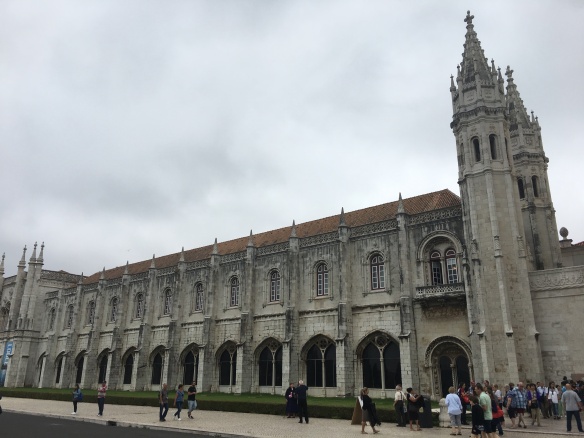
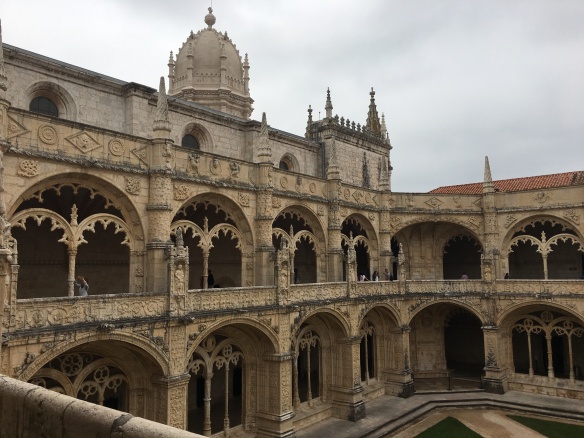
The Jeróminos Monastery in Lisbon, Portugal, is a UNESCO world heritage site. When my wife and I toured the massive complex last summer, including the impressive cloister and the ‘chapel’ – which views more like a colossal cathedral in typical European grandeur, I understood why. These photos don’t do it justice.

IMG_5608

In 1833, over three hundred years after the site and property was inaugurated as a religious Order of Saint Jerome, a state edict transferred the property and all its assets to Real Casa Pia de Lisboa, a philanthropic institution that took in, raised and educated orphan children.

IMG_5573

It was hard for me to imagine that a three-hundred-year-old religious institution of this magnitude would relinquish its assets. And doing this, located on prime waterfront in Portugal’s growing commercial city during the sea-faring Age of Discovery.

IMG_5588

IMG_5595

IMG_5605

IMG_5581

Without delving into the complex history and context of the Secularization Act of 1833, the fact remains: During a robust period of historical expansion, the church made a big change. I would argue, however, the church did not lose. Sure, it no longer could boast financial ownership of the property. But, by handing over its assets and combining them with the resources of the state, it bolstered its core purpose in mission – the care of vulnerable children. The space and property, as of 1833 moving forward, would now serve the needs of needy children.

Jesus says: “Unless you change and become like children …”[3] Without doubt, the religious of 1833 Lisbon were being true to the mission of Jesus.

In our lifetimes, we are witnessing here in North America – indeed in Ottawa – many growing examples of a church re-purposing its properties to build senior’s complexes and other social enterprise. We may believe this is a sign of the times – a negative, unfortunate, disappointing, mournful reality of the church. But, in truth, in many cases, such a re-purposing of a building is consistent with the Christian mission – to care for the weak, the vulnerable and needy in our society.

I can remember driving through rural country in south-western Ontario, and more in Saskatchewan, where you would see, stuck in the middle of a wheat field, a run-down, dilapidated old church building no longer in use, just left abandoned. It is sad to see this. It’s easy to jump to the negative conclusion that the church is dying by simply looking at its physical assets. When it’s not tied to a living purpose, the building will surely die.

But two hundred years after the so-called secularization of the Jeróminos Monastery’s assets, hundreds of thousands of visitors to the site every year continue to pour in and be inspired by the legacy of that bold, courageous move of those 19th century Christians in Lisbon. Good for them.

Re-purposing church property is not just a recent, contemporary phenomenon borne out of the institution’s modern demise. Re-purposing assets is not a sign of Christian defeat in a secular society. First of all, it has evidently been done throughout history when the need and opportunity arose.

Moreover, changing a physical structure doesn’t mean Christians are being decimated by an oppressively secular, contemporary, multi-cultural, diverse society in Canada. The physical transfiguration of Christian property may in truth be a positive sign of healthy, missional spirit, consistent with our Christian identity. A sign that the church and its original purpose in their properties will endure for centuries longer.

The disciples of Jesus accompany him to and from the mountaintop. Moses and Elijah appear with the transfigured Jesus, linking the present moment with the great tradition spanning all times and places. The community, the people, the saints on earth and the saints of heaven, accompany us on this journey.

The journey is a movement, not to remain stuck – even in moments of glory and victory. Rather, we are called to embrace the hardship as well, the challenges, the disappointments and opportunities of the daily grind of living, down in the valley of our lives. Ours is not a denial religion. Ours is not an escapist religion, one that ignores the plight of those who suffer, avoiding the normal difficulties of life, pretending that somehow we can with God only experience the highs without the lows. That is false religion.

Jesus interrupts our striving and tells us, “Don’t”. Don’t build those false expectations of a prosperity gospel. Don’t pretend you can stay on the mountaintop with Jesus forever while you live on earth. Because, Jesus, the divine Son of God, also embraced his humanity, and leads us down into the very human valley of life on earth.

Positive change and transfiguration in this light don’t come by way of escaping the world. The cathedrals of our hearts are meant to house people – all people, in their needs and for the sake of the other.

We are not alone, in this enterprise. As Jesus accompanied the first disciples up and down the mountain, God goes with us, up and down. Jesus leads the way. And, we walk shoulder to shoulder with our co-pilgrims who go with us.

[1] Mark 9:6, NRSV

[2] Matthew 17:5, NRSV

[3] Matthew 18:1-5

Lifting up

Imagine the path slick with rainfall and mud. I took this photo at the end of a beautiful, clear day, on the Camino de Santiago (del Norte). But just as often as there were dry, sunny days on the way, I encountered trails that were treacherous in rain.

IMG_5303

It was at the end of my longest hiking day in northern Spain that I met with such a descent – almost a full kilometre straight down on uneven cobblestone into the coastal town of Deba. The rain had started moments before. And I had just walked thirty-three kilometres in the hilly Basque country, all the way from Orio, near Zarautz.

I was exhausted. My mind was obsessed with getting to the pilgrims’ hostel as soon as possible. I was ready to collapse in a heap on my bed. Negotiating a tricky, slippery path was the last thing on my mind.

I had read and heard from fellow pilgrims these horror stories of unsuspecting pilgrims breaking their ankles on these kinds of descents. It was all too easy to cut short a pilgrimage after such an unfortunate accident. The practiced and seasoned hikers would know that one had to be very mindful of each step made. Even when they were tired. Even when being mindful of placing one foot in front of the other was the last thing they wanted to do.

On the last couple of Sundays we’ve encountered stories from the Gospel of Mark about Jesus’ healing ministry.[1] Indeed, during Ordinary (“green”) time in the church – both during the relatively shorter season after Epiphany in January and early February, and during the longer summer months in the season after Pentecost – the Gospel focus is the ministry of Jesus which includes healing.

In Lutheran circles we tend to look only at his proclamation; that is, we focus on what he said and taught the disciples about the kingdom of God. From this, we emphasize that Christian ministry is primarily about the proclamation of the good news. Mission, then, becomes more about ‘telling’ others about God, thus spreading the Word.

We miss an essential aspect of work-in-the-name-of-Christ with this limited vision of mission. Because, as elsewhere in the Gospels, we find that healing has equal prominence in Jesus’ ministry. Not only do we read about the miracles of Jesus curing disease, but more an inner healing for people battling their demons, so to speak. Healing has just as much to do about a renewed mind, a refreshed heart, a changed spirit. A reconstituted identity.

Healing is emphasized in the Gospel story today. Not just through words. But changed lives. Jesus came not only so that we might ‘believe’ with our minds in the good news, but that we might be healed in our earthen bodies and spirits.

How does this happen? What does Jesus do? From the text given to us today, Jesus’ took the hand of Simon’s mother-in-law, and “lifted her up.”[2] Jesus touches the person, physically. Taking someone by their hand is a sign of accompaniment. God is not remote from our human struggles. God is with us, Emanuel, in the person of Jesus. God takes our hand, and then lifts us up.

Faith can be described as movement. Last week we looked at the movement of ‘leaning into’ what we are afraid of, as a step in the direction of our healing – and finding Jesus is there. This week, the focus on the movement of ‘lifting up’, being ‘lifted up’, by God. As Jesus took the woman by the hand and lifted her up to be healed.

The Psalmist knew intimately this uplifting aspect of faith. “I lift my eyes to the hills, from where will my help come? My help comes from the Lord, who made heaven and earth.”[3] Many of the Psalm writer’s verses are called “psalms of ascent” because they were sung on the way ‘up’ to Jerusalem. The ancient pilgrim faithful needed to ‘look up’ as they made their way up the mount to the gates of the holy city. You know the hymn: “My Faith Looks Up to Thee.”

Faith is a ‘look beyond and upwards’ movement. In other words, the life of faith is not characterized by remaining stuck in the valley of our own suffering and misery. A faithful life, of course, does not deny our suffering nor is it pretending or distracting ourselves away from accepting its harsh reality.

Despite life’s imperfections, and struggles, however, to be faithful is to remain focused on others, on the promise of God, and on the hope we have. God takes our hand and is with us, and God sees it all. As Paul wrote, “we only see dimly now”.[4] Because we cannot understand all of life’s complexities, we need to trust in life, trust in good, trust in God’s time, in God’s way, that “all things work together for good for those who love and trust in God.”[5]

We are not just lifted up for our sake alone. We are called to lift others up, especially the downtrodden. Ours is the calling to lift others up – physically, emotionally, spiritually and materially.

We all know people who are ‘the lifters’. In their presence you feel lighter, lifted up. Whether it be their life story, their non-judgemental presence, their desire to show mercy and compassion, their interest in listening to you – they are an inspiration to us. They inspire us by their discipline, their focus in life.

The Gospel message is: We don’t need to be continually burdened by our suffering and narrow focus. We can be lifted up and transformed to be a reflection of God’s light to the world. In being truly ourselves, we can be ‘lifters’ too.

Remember: Resurrection is the end game of our faith. I mean not only of Jesus’ resurrection over two thousand years ago. I mean not only of our resurrection after we die our physical, earthly death. Because of Jesus’ healing ministry, we know that God also wants us to experience ‘resurrections’ in our own lives – on our earthly pilgrimage of living.

We can change, yes. It won’t be easy. It will take work. It will challenge us. We will need to move outside of our comfort zones. We will need to endure our momentary afflictions. On this journey of transformation, it will get harder before it gets easier. The truth will set us free, but it will first make us miserable. This is Christian truth. There is a cost. It is first the Cross of Christ; it is then the empty tomb of Easter.

There’s a woman from Tennessee whose name is Margaret Stevenson. She was in her nineties when I first read about her passion for hiking. You see, Margaret Stevenson used to hike ten or fifteen miles every day. She was a legend in the Smoky Mountains. She knew every trail and every plant and tree by its Latin and colloquial name.

Bill was much younger than Margaret when he hiked with her one day up Mt. LeConte. Now, Mt. LeConte is the third highest mountain in the Great Smoky Mountains National Park peaking at just over 6500 feet.

pexels-photo-414171.jpeg

Bill’s first trip up Mt. LeConte was Margaret’s seventy-fifth. When she finally stopped hiking she had climbed Mt. LeConte more than 700 times. Her husband rarely went, even before he got cancer.

When Bill and Margaret set out, they came upon what Margaret described as the most unrelenting two-mile ridge in the whole area – two miles up with no break. And this after a hard six miles on a very hot day.

Bill liked to hike in spurts, so he said, “See you later, Margaret,” and took off in his usual fashion and got way ahead of her. At some point, he found himself lying flat on his back in half delirium. A blurred Margaret passed him by at her steady pace. Bill can still hear the click-click of her cane and with no pity at all in her voice, she said, “One more mile to go, Bill. I’ll see you at the top!” And so, she did, arriving well ahead of Bill without stopping once.

Not long after that, Margaret’s husband finally died of cancer. But because of her daily walk with God, their last few hours were spent not in sadness or remorse, but in joy and celebration. For when Margaret says, “I’ll see you at the top!” she means it. For her face is fixed on Christ. Her step is steady and sure. And she knows the meaning of Isaiah’s words:

Even youth’s will faint and be weary,

And the young will fall exhausted;

But those who wait for the Lord shall renew their strength,

They shall mount up with wings as eagles,

They shall run and not be weary,

They shall walk and not faint.[6]

[1] Mark 1:21-28, Mark 1:29-39

[2] Mark 1:31

[3] Psalm 121:1-2, NRSV

[4] 1 Corinthians 13:12

[5] Romans 8:28

[6] William J. Carl III in David L. Bartlett & Barbara Brown Taylor, eds. “Feasting on the Word: Preaching the Revised Common Lectionary” Year B, Volume 1 (Kentucky: WJK Press, 2008), p.318-319.

Leaning in

The man with the unclean spirit is ordered by Jesus to “Be silent!”[1] After Jesus speaks to him, the unclean spirit obeys, and leaves the man. The man is thus transformed, healed, made whole in this dramatic Gospel encounter with Jesus.

We need to note, before going on, that Jesus speaks in the synagogue in Capernaum. He is at the beginning of his ministry. And what better place to start his preaching than on home turf, on familiar ground, in the rural community with people he likely knows, and who know him?

If you’ve ever lived in the country, or farther up the Ottawa Valley, you know that in small towns, people know each other. And when it comes to annual fairs, big events or musical shows, everyone attends. So, when in the lake side village, a home-boy comes to preach in the local synagogue, well, who wouldn’t show up? The synagogue is crammed full. Standing room only.

The point here is that the evil spirit resides and comes out within this rather homogenous community. The evil is not out there, somewhere – in Jerusalem the big city, or out there across the lake among the heathen Gentiles, or expressed within other groups with different belief systems and faiths. The evil is right there in the middle of the common, familiar, comforts of home.

The man with the evil spirit is a person like us. We know him. He is our neighbour. He, or she, is our friend, co-worker. She is the person who comes to church and sits beside us, Sunday after Sunday. The person with the evil spirit is not a stranger to us. That person is us. Each of us.

The Gospel of Mark – indeed the entire New Testament – is a primarily message to and for the church. Not to Islam. Not to Wicca. Not to some Voodoo occult. Not to the so-called Axis of Evil. The finger of judgement is pointed directly at us, at our sin, our evil, the brokenness within us.

When we deny. When we exclude. When we overstep our bounds. When we self-justify. And if you think you don’t have any of these and other problems – to quote what my Dad used to say and preach – you do have a problem!

It’s to this community, in awareness of the sin in our hearts, individually and collectively, that Jesus’ first words, spoken with authority, are: “Be silent!”

How do we change by being silent? I thought we were supposed to do something about our sin! Being silent sounds too much like being passive, lazy, self-indulgent and unproductive. How is it that we are changed when we are quiet?

The silence of which I speak, is first not the silence of denial. It is not a silence that happens when we remain quiet in the face of a great injustice. When a problem is not named, silence enables the problem to continue unattested. When there is something wrong, but no one dares to name the elephant in the room. This is not the silence of which I speak.

Neither is it the silence of combative conflict between people. When someone gives the other ‘the silent treatment’, silence serves as a weapon between people who need help to speak to one another about things that need saying in a safe way. This, too, is not the silence of which I speak.

Jesus is not scolding the man with the unclean spirit when he says, “Be silent!” He is not like the frustrated parent who has reached the boiling point with a disobedient child and just wants them to just shut up and go to their room.

When Jesus says, “Be silent!” he is inviting the disturbed and ill man to open his heart to being changed. Jesus first words are an invitation to be healed. And the first step in that direction is to put to rest, for the moment, the rampant flailing of a seemingly unstoppable ego.

This is a scary thing to do. How can we let go of our reactions, compulsions, need to be right? How can we be so vulnerable and leave ourselves wide open? How can we take this risk, let alone be healed by doing so?

One of my greatest fears as a child was to play on the round-a-bout. At the centre of the playground at kindergarten, stood the scary carousel-like structure. The round-a-bout used rotary motion, spinning around in a circle either clockwise or counter-clockwise. It was painted red.

A bunch of us kids would start by grabbing the four railings which fanned out from the centre like spokes on a wheel. We then started running, really fast, around and around pushing the carousel to dizzying speeds. And then at the moment when we couldn’t run any faster, we threw ourselves onto the spinning platform.

My instinct, at first, was to hang on for dear life at the edge of the round-a-bout as it spun ridiculously fast. It seemed to me the closer I could be to the edge, the more control I had over when I wanted to get off. Doing this, however, I didn’t step off when I wanted. I flew off when I couldn’t hold on any more. So much for control. When all I wanted when I played on the round-a-bout was an evacuation plan.

In order to best stay on the round-a-bout, and not fall off, I had to lean in towards the centre. I had to do the counter-intuitive thing. I had to grab hold of the centre wheel – the hub, the heart of this fearful reality. This way, not only did I last longer, I actually had some fun.

We overcome the evil within not by denying it. Not by turning away from it. Because denying and turning away already exposes another negative disposition. Actual repentance is served best by turning toward that which frightens us. Transformation is realized by moving to our fear not away from it.

And surprise, we are not alone there. We find our strength and our victory in turning toward and leaning into … a very loving, very much present Christ. Jesus is even there, yes.

Like a pine tree on the Canadian Shield rocky coast of Georgian Bay leans into the gale force winds to survive and thrive in that environment, so, too, we turn towards that which assails us in life. As you know, I love the White Pine – native to this part of the world. And one of my favourite Group of Seven pieces of art is A.J. Casson’s “White Pine”.

This painting, in particular, depicts the rugged, often inhospitable places where the white pine flourishes. Spreading its roots just beneath the surface of the ground, the white pine can find foothold in rocky, sandy earth. What is more, along waterlines, the pine will grow sometimes leaning, like the Tower of Pisa, into the gale force winds, not away from them. By doing so, even with its shallow root system, it will not fall. At least, not for a long time.

Naturally, we resist this counter-intuition. Many say that when they meditate, the first half of the period of meditation is hell. When the flood gates are opened. That is when all the thoughts, distractions, and emotions scream to the surface. That is when we fight our greatest battle in prayer. Not against the thoughts and feelings themselves, but against the experience of being still and silent. Because all that has been hidden and suppressed in the dark recesses of our lives finally can come to the surface and is exposed even burned in the Son-light.

It is too easy to give into the ego at this point, which wants to have control, which drives compulsively towards having more, making more, producing more, taking more, defending more. Un-relentless is the ego, driving impulses we struggle with in those first minutes of quiet, still, sitting and praying. It is too easy to give up on the experience and declare, “This is not for me.” And return to the hurly-burly of life in the fast lane.

Should we, however, lean into the internal fray – not suppressing the maelstrom of thoughts, not doing violence against our ego – when we just let the thoughts and feelings come at us and go through us, we will find the rock of our salvation who will hold us up even if we are leaning a bit.

Our lives thus become a prayer of healing when, before all else, we heed Jesus’ call: “Be silent!”, when we seek to quiet our busy thoughts. Saint Isaak of Syria wrote of a way of becoming silent and experiencing our hearts as the temple of the Holy Spirit[2], the holy still centre, and the hub of our lives:

“Enter eagerly into the treasure house that is within you,” he wrote, “and you will see the things that are in heaven – for there is but one single entry to them both. The ladder that leads to the kingdom is hidden within your soul.  Dive into yourself, into your soul, and there you will find the ladder by which to ascend”, and by which God descends into our lives.[3]

Just the turning, the leaning in, is everything on the journey to transformation. “Be still before the Lord,” the Psalmist sings.[4] “In quietness and in trust shall be your strength,” the Prophet advises.[5] “Be silent!” Jesus invites.

[1] Mark 1:21-28, NRSV

[2] 1 Corinthians 6:19

[3] cited in Greg Pennoyer & Gregory Wolfe, eds. “God For Us: Rediscovering the Meaning of Lent and Easter” (Massachusetts: Paraclete Press, 2015), p.91.

[4] Psalm 37:7; 46

[5] Isaiah 30:15

Traveling stones: a pilgrimage lesson in letting go

In the sixth century Saint Benedict said, “A monk should have death always before his eyes.”[1] ‘Death’ doesn’t need to refer only to our physical demise at the end of life but to any loss experienced in life. There are many deaths we experience in life: the death of a cherished pet, the loss of friendship, the loss of a job, divorce, death of a loved one, moving into another home. Any significant change, even positive ones, involve something lost.

In the second reading for today written in the first century, Saint Paul admonishes the Corinthians to live in this world “as though not.”[2] He is advocating a certain disengagement from the attachments and claims of our lives, including some of our most cherished relationships. The likes of Paul and Benedict reflect, as well, the wisdom of the prophets and poets of ancient Israel: “The grass withers, the flower fades, but the word of God stands forever.”[3]

Our earth-bound attachments come under scrutiny here, no doubt. The question remains for each of us on our own journeys of faith and life – what are those things of which we need to let go in order to move on? After all, in the Lord’s Prayer the words, “Thy Kingdom come”, mean little unless we can also say: “My kingdom go.”[4]

Following Jesus means leaving things behind — as the first disciples did, in our Gospel reading for today (Mark 1:14:20).

You heard about the man who was hiking in the mountains when he slipped, and started to slide over the edge. Just as he was about to fall into the abyss, he grabbed a tree branch growing out of the rock ledge. He hung on perilously dangling in the air.

He didn’t know what to do. It was impossible to pull himself up since the branch stem was slippery and wet. He swung in the silence of the breeze contemplating his fate with growing terror. Finally he looked up to the sky and prayed: “If there is a God anywhere up there, I could do with some help, please.”

To his surprise and shock, he heard God’s voice respond instantly: “I will help you. But you first have to let go.”

The man was silent for a minute. He dared not look down. It was a long way to the jagged rocks of the canyon below. Again he looked up to the sky, and said: “Is there anyone else up there?”

A long-standing tradition in doing a pilgrimage is to bring a stone from home and lay it somewhere along the path. This home-stone represents a part of myself that I lose, and leave behind, where I have walked.

Last Spring when I walked a part of the Camino de Santiago, I wanted to leave my stone in the waters off the western coast of Spain, either in Fisterra or Muxia – both coastal towns are some one hundred kilometres west of Santiago.

I imagined this place a fitting resting place for my stone since I love walking by water and coastlines. Once, long ago, people believed the coastal town of Fisterra (French, for ‘the end of the earth’) was the physical limit of land – the farthest one could go. In my imagination, I saw myself facing the setting sun, having completed the 800-kilometer, two-month trek, looking west to the horizon line beyond which lies the land of my home in North America.

I imagined feeling satisfied at the end of a long journey, having reached my goal, grateful for the challenge and all the things the Camino taught me. In that moment of gratitude and joy, I would toss my stone as far as I could into the spume and depths of the Atlantic Ocean. That was the vision, anyway.

I found the perfect sized stone while wandering around my house one afternoon a week before leaving for Spain. Because I was running about making the last-minute preparations for the journey, I placed it temporarily on the landing railing in the garage, certain I would soon tuck it away in my backpack.

Two weeks later I was scrambling up a steep incline outside the town of Irun on the first day of my pilgrimage. As I expected that first day was incredibly tough going. The temperatures soared to above 25 degrees C and the sun shone brightly. Sweat pouring down my neck and back I struggled up that cliff wondering why on earth I chose to do this on my sabbatical. I dug my walking poles into the hard-caked sandy ground to make the next ledge and wondered sarcastically if I should have rather taken rappelling lessons in preparation for coming to Spain.

In that moment of physical and growing mental exhaustion, I realized I had forgotten to pack my stone. It was still sitting on the railing in the garage back home! I stopped in my tracks and exhaled deeply.

“What’s the matter?” my Dutch pilgrim friend asked me, huffing and puffing as I was.

“I forgot to bring my stone,” I confessed my failure.

“Don’t despair,” my co-pilgrim wanted to advise. “The Camino will give you an answer.”

IMG_5248

Several days later two significant things happened. The first was while I was walking down a slope towards the northern Basque town of Guernica, I thought I should take with me a couple stones from this path, as a keepsake from walking the Camino. So, I selected two small pebbles from under my feet where I stood beholding the town and valley below.

IMG_5299

That same day, my knee seized up, and I walked the remainder of my Camino in pain. Three days later, coughing and feeling very sick, I was on a plane homebound. Diagnosed with pneumonia back in Ottawa, I had to come to terms with my failure of not having reached my goal.

Not only had I not reached Santiago and Fisterra, I had done nothing with my stone which I had forgotten anyway. By forgetting the stone, had I already destined myself not to finish the pilgrimage? These dark thoughts swirled in my mind.

After having recovered a few weeks later, my wife and I flew to Lisbon for a week of vacation to celebrate our wedding anniversary. Originally, the plan had been for her to join me at the end of my pilgrimage, where I would meet her in Lisbon. Nevertheless, this time, I did bring my stone from home, renamed my ‘glory’ stone.

My glory stone represented all my aspirations, desires, longings which I knew deep down the Camino had taught me to let go of. I had to surrender even my human yearning and goals to God.

IMG_5853

And so, at Cabo Da Roca near Lisbon, Portugal – the farthest most western point of land on continental Europe – I threw my glory stone into the Atlantic Ocean facing the setting sun. I had to practice letting glory go.

IMG_5812

It seems I was still bound to finish some kind of pilgrimage during my sabbatical. I didn’t have enough time to go back to Spain and finish the Camino de Santiago. But I did have enough time to walk the entire length of the longest contiguous sand beach in North America – fifty kilometres on Long Beach Peninsula in Washington State. There, my journey of letting go continued.

IMG_6200

There, on “Cape Disappointment” – fittingly named – I brought the two pebbles that I picked up in Spain on the last day I walked on the Camino. One glorious afternoon, I scrambled down into Dead Man’s Cove – also fittingly named – on Cape Disappointment. After reflecting on my disappointments of late, I realized on my journey of life not only did I need to yield all my dreams but also all my regrets and suffering. And so, I threw those stones of disappointment into the Pacific Ocean. I let these go.


I realized life is not lived well when we obsessively hold on to all those things that cause us grief. I had to offer these to God as well. Later, while I sat on a park bench near the lighthouse on Cape Disappointment looking over the Pacific, I met a couple of Americans visiting from Portland. In our conversation, we were able to affirm that “all great spirituality is about learning to let go.”[5]

IMG_6217

But I didn’t leave my pilgrimage empty handed. When I climbed out of Dead Man’s Cove that day, I picked up from the sand a smooth, round stone. Now, any rocks on the Peninsula are rare. Most of the fifty-kilometre stretch is sand, land created from the outflow of the mighty Columbia River as it spills into the Pacific Ocean. Most rocks you see on the Peninsula have been trucked in. So, I was delighted to take with me back home, a rare thing.

And hope is a rare commodity in this world of pessimism, denial, and despair. This is my “stone of hope”, that I hold forever, amidst all the human aspirations swirling in my life and all the disappointments and failures which I regularly need to practice letting go of.

IMG_6752

We hold not only that which we need to let go of, but we also hold hope throughout our lives. “We do not simply resign ourselves to the give-ness of the world, for we have planted within us a great hope that God’s kingdom will come on earth, as in heaven. This means we are a people who look to the future with trust and hope, confident that God is working God’s purposes out and that God’s realm is even now breaking into our world.”[6]

At this point in your journey of life, which stones are you holding — of dreams, of disappointments, of hope? Which ones do you need to let go of? Which do you need to hold on to? I suspect it is true when the likes of Saint Paul, and all the wise teachers over the ages, writes: “Hope does not disappoint us.” [7]

[1] cited in Ruthanna B. Hooke in David L. Bartlett & Barbara Brown Taylor, eds., “Feasting on the Word: Preaching the Revised Common Lectionary Year B Volume 1” (Kentucky: WJK Press, 2008), p.280

[2] 1 Corinthians 7:29-31

[3] Isaiah 40:8

[4] Richard Rohr, Daily Meditation, Thursday, January 18, 2018.

[5] Richard Rohr, Center for Action and Contemplation, cac.org

[6] Ruthanna B. Hooke, ibid.

7 – Romans 5:5

Repeat performances

Once again during the Christmas season, I experienced this strange cultural phenomenon:

How many decades has it been that every December, movies like “It’s a Wonderful Life”, “Elf”, “How the Grinch Stole Christmas”, “A Charlie Brown Christmas”, “National Lampoon’s Christmas Vacation” and “The Bishop’s Wife” get replayed and replayed over and over again, year after year? And only at this time of year? You can probably add several more of your favourites to this list.

That is why I was a tad apprehensive last month when we received tickets to attend the National Art Centre (NAC) Theatre production of Charles Dickens “A Christmas Carol.” I know the story. I’ve read it several times. I’ve watched television renditions of the story over the years. What could the NAC Theatre do to bring it to life, once again, for me? Same old, same old, right?

On the other hand, I believe there is a good reason why we turn to these stories every year. There’s a reason for our culture’s yearning for their repeat-performances. A higher reason, I might add. Perhaps there’s something in those stories that we need to take to heart, and make positive changes to our lives. Perhaps, we need to see the story-telling as more than a mere syrupy, sentimental “Isn’t that nice” tradition.

So, I was surprised and intrigued by what the NAC Theatre troop did with the story. It was introduced by two actors who came on stage — one was blind and one was deaf. In the introduction they invited the audience to participate in a simple activity with our hands, both to show that the two actors needed each other in accomplishing their jobs; and, what is more, near the end of the story everyone in the audience was needed to give the sign with their hands in order to encourage Scrooge finally to embrace a more compassionate approach to life.

Without taking anything away from the traditional story-line plot, the meaning of Dickens’ famous “A Christmas Carol” was conveyed to me in a fresh way.

We encounter in young Samuel and the elder Eli one such repeat performance story in today’s text from the Hebrew scripture.(1) It is a story many of us know — of the boy Samuel in the temple who is called upon by God. It gets told many times in the life of the church over and over again — every three years at least. It is true: it is a nice, little story, isn’t it?

At first, Samuel doesn’t recognize God’s voice, believing instead that it is his old mentor, the priest Eli, who is calling him. Finally, with Eli’s help, Samuel responds to God’s call by saying, “Here I am. Speak, Lord, for your servant is listening.”(2)

Well, as I said, many of us are familiar with these very words. We even like to sing a popular hymn (3) reflecting the words of one responding positively to God’s call — a call that changes the life of the recipient. How does this familiar story speak to our lives today? How is it more than just ‘a nice, little story’ from the Bible? How can this story change our lives?

In this story, an old man and a young man collaborated to hear God’s vision for a new Israel. For God was about to do a new thing: Soon to emerge in the life of God’s people was a new lineage of kings, beginning with the inauguration of King Saul.(4) What was passing, was the rule of Judges along with the sinful house of Eli. What was emerging was the likes of King Saul, King David, King Solomon, and so forth.

In God’s message to Samuel, God condemns Eli’s lack of restraining his sons’ immorality. Eli’s sin was his aversion to do something even though he recognized what was happening. Even though Eli knew the ongoing problems in his household, Eli turned a blind eye and ignored it all.

He did not act. And no matter what Eli would do now to try to redeem himself by making various sacrifices to the Lord, God was intent to establish a new order of leadership over God’s people starting with the demise of Eli’s household.

Doing nothing was the problem. For us, today, doing nothing about a problem we know exists is the problem. How do we begin to move out of the prison of this self-inflicted inertia?

We need to recognize that growth and healing is a process. The birth of the new thing God was doing began as a cooperative affair. It took the attentiveness of the young Samuel’s ears and the wisdom of the old priest’s heart and mind to bring about God’s purpose. It took both the authority of the failing, feeble priest and the obedience of his youthful protégé to bring about God’s purpose. In other words, it takes a community to bear such a task.(5)

Responding to God’s actions and call in the world and in our lives today is not a solo effort. Religion is not a solitary practice. Indeed, it takes a village. It takes the various gifts of people in our lives. What one has and the other does not, what the other is good at that the first is not — it takes everyone’s attentiveness and participation.

How do we live into this collaborative way, especially challenged by our society’s emphasis on individualism, privacy and self-reliance? We are, indeed, up against a culture that is at odds with the Christian vision. How do we live the way of God’s reign? Where we value mutuality, diversity, common purpose in the mission of God for the good of all people?

In contrast to the way in which God spoke to the likes of Isaiah, Jeremiah and the later prophets of Israel, God does something unique with Samuel. You will notice that God does not enjoin Samuel to deliver God’s message to Eli. God does not charge Samuel to tell Eli what God is telling Samuel with words like: “Thus says the Lord, tell the people Israel”, etc., etc. No.

Rather, God wants simply to confide in Samuel. Basically, God expects Samuel, first, to listen. Just listen. It seems, Samuel first needs to learn how to do this. And it will take some time and some practice, evidently.

Can we have the courage, and the patience, to learn how first to listen to God and the other — without jumping in too soon with the energy of our own bravado, our own opinion, our own self-justifications, our own visions of what must be? The simple act of listening, can change our lives. Because listening first means we believe that the other has something of value to offer that we don’t have.

God works at a slower pace, it seems, compared to the hypersonic rhythms of life in 2018. Not only does God give Samuel and Eli one chance to figure it out, but two and even three opportunities to get on the same wavelength as God.

The story-telling is both appealing and intentionally slow early on. Dialogue is repeated. The action of Samuel getting up from sleep and going to Eli are repeated. We have to slow down with the narration and feel the build-up to the great reveal of God’s message.

Even though both Samuel and Eli are slow in finally getting it, even though they are encumbered by sleep, drowsiness, denial and avoidance, even though their response to God is compromised by vision and hearing impairment, by youthful pretence and the attrition of old age …. God still finds them. God still speaks. God still acts in the way God will act.

Despite human arrogance and self-delusion, despite all our toiling and pride, despite all our ego compulsions, God keeps at it to tell us, guide us, and instruct us.

We may not like the answer. We may not like what God has to say. We may be challenged to the core of our being by what God is telling us. Regardless of our hesitation, denial or self-delusion, God finds a way. God doesn’t give up on us. God gives us people, and stories, and experiences — even the same ones, over and over again — to help us finally get it.

God doesn’t give us just one chance. God is not just a God of second chances, as we often say. God gives us many chances, as many we need. May we, like Eli, finally come to accept what God has to say to us, with his words: “It is the Lord; let him do what seems good to him.”(6)


(1) 1 Samuel 3:1-20, the first reading for the Second Sunday after the Epiphany, Ordinary time, Year B in the Revised Common Lectionary.

(2) 1 Samuel 3:4-10.

(3) “Here I am, Lord”, Hymn #574, Evangelical Lutheran Worship (Augsburg Fortress, 2006); also, for the Christmas cycle, this hymn is also appropriate in singing Mary’s response to the angel Gabriel’s visit to her, announcing Mary’s role in the birth of Jesus (Luke 1:38).

(4) 1 Samuel 8-10.

(5) Richard Boyce in David L. Bartlett & Barbara Brown Taylor, eds., “Feasting on the Word: Preaching the Revised Common Lectionary, Year B, Volume 1 (Kentucky: WJK Press, 2008), p.245-247.

(6) 1 Samuel 3:18