
Driving me crazy

IMG_7227

There are times in life that come our way to remind us that something is ending. And even though at some deeper level we know it to be true, we hesitate to face that ending, whatever it is — the end of an era, the end of the life of a loved one, the end of a relationship, the end of a career, the end of youthful health and energy, etc.

How do we face these movements in life?

In planning our family vacation to Italy a couple summers ago, we decided to rent a car. Our host family lived in Naples. So, right off the plane, we jumped in our small Fiat, yours truly engaged the manual shift, and we immersed ourselves in the mayhem of driving in Naples.

What added to the heightened anxiety of driving in the sprawling metropolis, was that I had to follow our friends from downtown to the suburbs – no short jaunt ‘round the corner.

Not only did I have to deal with the speedy and crazy driving conditions, I had to slice through the haze of jetlag in my mind, and pay attention. I had to keep up to our host family already long acclimatized to the riotous driving culture there.

What is more, shortly after recovering from the stress and thrill of that first-day drive from the airport, the next day, in our separate cars we took to the winding and narrow road along the Amalfi Coast. To get there, we had to cross Naples first. Been there done that. No small feat.
IMG_5192

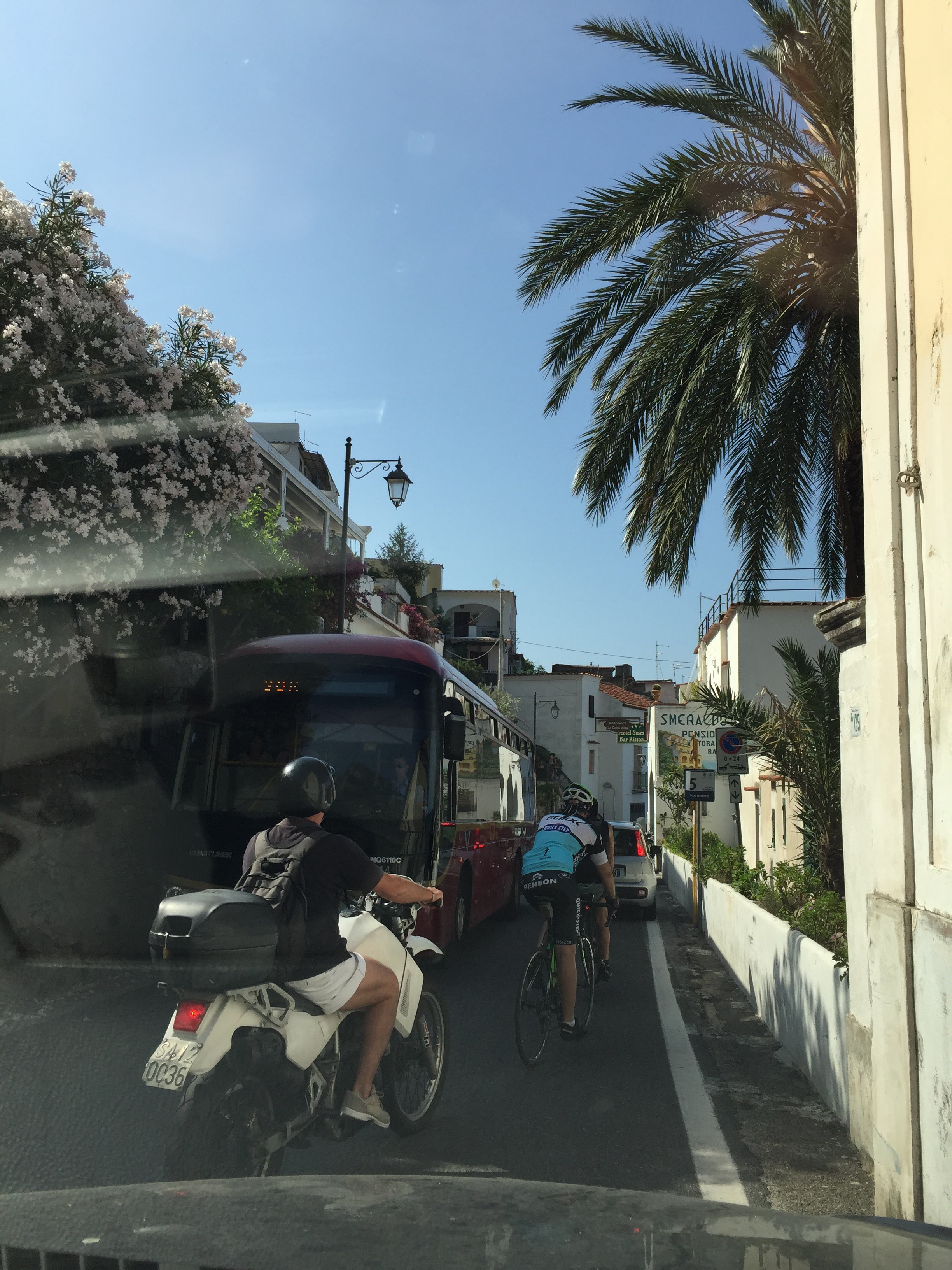
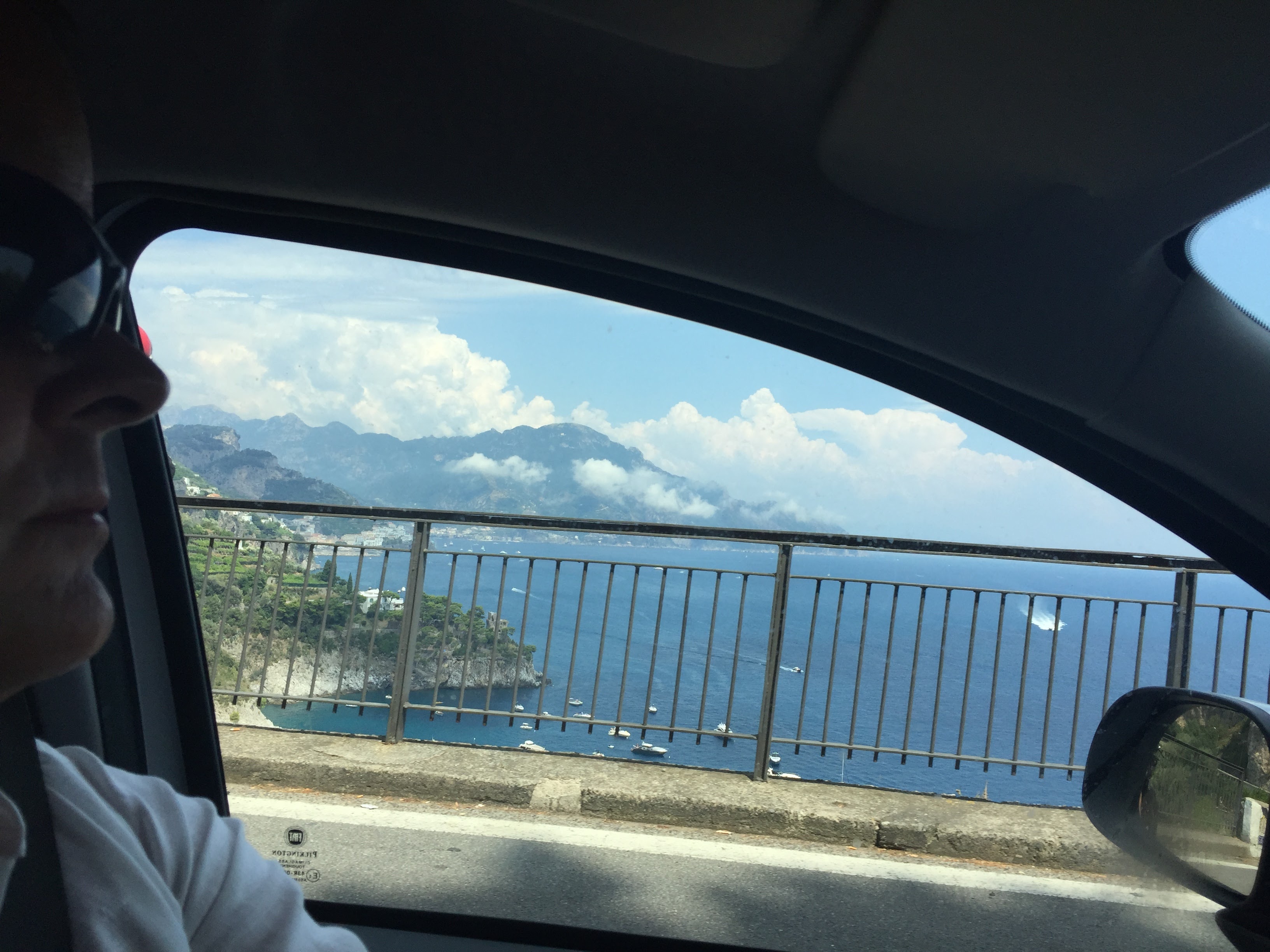
Then, once on the rocky Amalfi coastline, my face was practically pasted on the front windshield. I had to make constant reflexive maneuvers rounding blind, hairpin bends. At relatively high speeds I squeezed our little Fiat between oncoming Vespa scooters, ginormous tour buses and sleek, racing, tinted-windowed Audi sedans. All the while wiping the spittle from the glass in front of my mouth emitting profanity after profanity.


Caution thrown to the wind, I threw myself into it without thinking too much. Reactive, assertive and confident driving skills required! Since I didn’t exactly know the route we would take, I had to focus on what was directly in front of me. I had to pay attention and respond not only to the immediate conditions I found myself in. I also had to keep an eye on the dark blue Hyundai some car lengths in front, leading the way.

IMG_7315

Following someone in another car, requires certain skills best developed in the context of faith. Let me explain.

First, you have to trust. You must trust that the One you are following knows what they are doing and where they are going. You have to believe that following them faithfully will take you to where you want to go. At some gut level, you have to relinquish your claim to knowing better. And trust the other. And believe that they believe in you and your skill, too.

Second, you have to pay attention. You have to stay aware of your surroundings, even though the distractions and obstacles are frightening. As with driving in general, you can’t be looking inside the car or admiring the scenery to the side or behind you. Rather, you have to remain focused on the road ahead. Better yet, for as smooth a ride as possible, you have to envision yourself already being a certain distance down the road.
IMG_6661

Third, you need to act on in-the-moment decisions. Following another car is a whole different way of driving then when you are on your own. On your own, you can stop whenever you want, you can go however fast or slow you want to go, and you are not accountable in any way to another vehicle on the road.

IMG_7356

All that changes as soon as you say, “I will follow you.” If you don’t want to get lost, you have to keep up. You have to do it. You have to match the velocity of the lead car, whether they speed up or slow down. You have to drive in a way that will keep you within eyesight of the lead, which will affect how you negotiate traffic signals, lane changes, roundabouts, traffic jams, and toll gates.

IMG_4632

Finally, in order to follow another successfully, you have to take the primary focus off yourself. And fix it on whom you are following. There is no time to dwell on your past mistakes – the guy you cut off coming onto the expressway, your cursing a fellow driver weaving across multi lanes going 130 kilometres an hour, or the slight yet growing pressure you feel on your bladder from all the espresso you drank earlier in the day.

There is no time for self-indulgence of this kind. There is no time for regret, guilt or self-absorbed mental gymnastics. There is no time to stop to lick the wounds of obsessive introspection.

Because your energy is required now for the task at hand: trust, focus, action.

Jesus describes at least two opposing lifestyles in the Gospel reading for today.[1] The sheep are on Christ’s right hand – they are the good guys. The goats are on Jesus’ left hand – they are the bad guys. I suspect we can relate to being both a goat and a sheep at different times and conditions of our lives.

Either way, both groups are surprised to hear Jesus’ answer to their question: “When did we see you …?”[2] Both groups failed to see Jesus in the faces of the stranger, sick, hungry, thirsty, naked, and imprisoned.

The only difference is that the sheep already happened to be serving those in need, before they heard this news, before they had a chance to think about it too much, strategize and create impressive mission plans. That group was visiting the sick and tending to the needs of others as a matter of course, moved by a simple compassion for the needy. Doing so was part of their regular routine of life.

On the other hand, the goats apparently never thought nor believed that their very salvation depended on helping others, going to the poor, attending to the weak and vulnerable in society. Instead, they must have made life predominantly a game of ‘who can get the most stuff and be most comfortable and take care of their own first.’ Their faith must have been assigned to a God who existed only in their minds, in abstraction, a matter reserved only for intellectual discourse,polite company, and board room strategy sessions.

At this turning point in the calendar year, we shift gears and look ahead. We leave behind the relative calm and ease of the long summer season after Pentecost, and enter the fray of the holiday season. How we drive through and around the many distractions, noise, pace and twisting corners of our lives in the coming months will reveal a lot about who we follow or whether we are following anyone at all, let alone Jesus.

So, let’s not forget where Jesus goes. Let’s not forget what he was all about, whom he visited, whom he cared for and where he spent his time. This is our focus. Let’s trust that Jesus knows what he is talking about and the path he takes, even though God’s reign feels countercultural and unpopular in a season of getting more stuff and self-indulgent sentimentality.

Perhaps we will need to practice looking for Jesus on the streets, in the hospices, the safe-injection sites, the social housing units, the shelters, the refugee lines and immigrant ghettos in our city.

Let’s trust that Jesus’ way will lead to our resurrection and transformation in this life as much as in the next. Let’s pay attention to our surroundings and the various ways God encourages us on the way. Let’s not remain idle, nor get stuck in self-centred living. Let’s not coast nor ride the clutch too much. Because we’ll stall the car. And stopping is not good on the highway of life. In fact, it’s dangerous.
IMG_4253

Instead, let’s act faithfully in small, concrete ways that make a difference for the better in the lives of others in need.  Let’s do so assertively and confidently, knowing that we don’t travel alone; there are others in the car with us and on the highway around us. Because despite our many failings, and the mistakes we will make along the way, God continues to have faith in us.

There is too much at stake. And no time to lose. Still today, in our country – Canada – and in our nation’s capital, Ottawa, there are still over 10,000 households needing adequate, safe and affordable housing.[3] And, 15% of the population in the whole province of Ontario still lives in some kind of housing need.

Where is Jesus? The bible makes it very clear. The better question is: Will you follow?

Recently I came across this anonymous quote about the merits of volunteering in ways that can reflect the reign of Christ in our lives and in our world:

Volunteering is the ultimate exercise in democracy. You vote in elections … [once every four years], but when you volunteer, you vote every day about the kind of community you want to live in.

When you volunteer for good causes you add value to the vision of God in earth. The Reign of Christ is about the kind of world God wants us to live in. Where is Jesus? Will you follow?

We end today a church season. This annual observance can remind us that endings only herald a new beginning just around the corner.

[1] Matthew 25:31-46

[2] verses 37 and 44

[3] check out http://www.multifaithhousing.ca
Prayer: “Help”

When I heard this prayer I thought it related well and in a humorous way to how well we follow the ‘rules’ of our faith:

“Dear Lord, I am happy to report, so far this day has gone well: I haven’t coveted anyone their belongings; I haven’t harboured ill-will to my neighbours; I haven’t spoken hateful words or done anything out of spite to harm anyone; I want to help out in the church food-bank this week; I’m even praying to you now! I am thankful that this day has been going so well, Lord. But I think I’m going to need some help, once I get out of bed. Amen.”

Indeed, how well do we follow the commandments of God? The very act of getting out of bed almost guarantees we will make mistakes no matter our good intentions. It is our common humanity.

One of the functions of the Law, from a Lutheran point of view, is to make us realize that we totally depend on the grace of God. Let’s be honest. We need help, and we can’t do it on our own. No matter how hard we try, we will always miss the mark and mess up in some way. If there is anything good that comes out of our work, it is a gift and a grace.

This morning’s Gospel (John 13:31-35) was also read at the Maundy Thursday liturgy last month. Maundy means the commandment to love. It is fair to say that these words of Jesus capture the essence of who we are called to be and what we are called to do: In all we are called to be and do, is to personify love.

In this love, we see the glory of God. Glory. A statement attributed to Saint Ireneus of the early church comes to mind: “The glory of God is a human fully realized”. 

I take that to mean that God’s glory is not something other-worldly so much as something discovered in the ordinary, real, weak, broken life of a person who is able to receive with open heart the gifts of another, the gifts of grace and love. That is the glory of God. So intertwined with Jesus’ suffering as a human on the night of his betrayal (v.31-32), when Jesus needed to depend on his Father.

Faith is not just about believing and thinking doctrines and dogma, it’s more than that; it’s not just about believing, it’s about behaving. We have to pay attention to the behaving part. We must remember something I have heard our bishops say for many years now: Those who claim the greatest truth must demonstrate the greatest love.

Peter Steinke, who has given much thought, books and workshops about healthy churches and leadership today, told the true story of mega-church pastor whose congregation in the southern U.S. was doing really well. By all counts, Pastor Chase was enjoying unprecedented success in his vocation. 

And yet, he had confessed to Steinke, he was suffering from a malaise of the spirit. You could call it, a crisis of faith. Chase was losing a sense of personal direction in his work. 

Hearing about his struggle, a brother-in-law who was a member of a Franciscan order invited Chase to visit him in Italy. And so, Chase took his leave and spent that time resting, reading and visiting his extended family. 

Nearing the end of his time away, the brother-in-law invited him to come for a day to the AIDS hospice which the Franciscans managed and served the several men who were terminally ill. After working in the kitchen a couple of hours, a care-giver invited Chase upstairs to help with one of the residents. The man he looked upon was emaciated. His skin looked like it would fall off the bone. He couldn’t have been more than 90 pounds.

The care-giver greeted the man with a kiss on the forehead, and then looked at Chase: “Could you please lift him into the bath for me?” Chase carried the man and laid him into the bath water. The care-giver then asked, “Would you please wash him?” At first hesitant, Chase understood that this man needed a thorough wash. And so he did.

When they were finished and walking down the stairs the care-giver thanked Chase for his help. She indicated they were short-staffed that day and Chase had provided a real service to the hospice. “I can tell you have a Christian background,” she said. Chase responded: “It is I who need to thank you, Sister, because today I became a Christian.” (1)

“They will know we are Christians by our love,” goes the song. We have a choice to make. We need to be intentional as Christians. We cannot afford not to be, in this day and age. We can choose whether or not to love. 

We can’t save ourselves, or do anything to garner points for heaven, for we will always fall short no matter how heroic, self-giving or impressive our good deeds of faith appear. This is not about doing these things in order to make ourselves right with God. It is not about not doing anything at all. It is, however, about choosing actions that demonstrate care, compassion and love for the sake of others, and so, for God. 

It won’t ever be perfect. But that’s not the point. It is about behaviour that flows genuinely from a heart of love. And understands that all is a gift: The gift of faith, the gift of each other, the gift of community, the gift of Jesus Christ who is alive and lives in the Body of Christ, the church, and in the world he so loves.

(1) – adpated from a video entitled, “To Make a Difference”, presented in an upcoming workshop called “Apple Tree” by the Eastern Synod-ELCIC. Apple Tree is a workshop to help stimulate conversations about purpose and mission

Today

In Andy Weir’s book and movie entitled, “The Martian”, the character played by actor Matt Damon – Mark Watney – is stranded on Mars. And he decides to survive using whatever scientific means possible and using whatever resources are at his disposal until a rescue mission is mounted. 

The book and movie differ in some ways — although the deviations in the movie aren’t as pronounced as in other script to screen adaptations. The most significant difference is, perhaps, the last scene. In the movie, the rescued and now teacher, Mark Watney, gives advice to a classroom full of students in astronaut school.

He counsels that in the face of almost certain death, the way forward is to focus all your energy on solving the next problem, and then the next, and then the next. After all, he survived almost two years alone on the red planet on account of his determination, and despite the odds to remain focused on the immediate task at hand. And not get lost in imagining future outcomes, or wallow in past mistakes.

His advice points to the importance of being present to the current moment of existence, paying attention to what is (not what might be or what was), and acting in confidence for all his efforts.

In the Gospel story, Jesus uses the words of the prophet Isaiah to announce his mission, his purpose (Luke 4:14-21). Jesus will bind up the brokenhearted, proclaim liberty to the captives, release to the prisoners and good news to the oppressed. In summary, he declares his mission to bring compassion and healing to people. And significantly, he closes his public reading in the Nazarene synagogue in 28 C.E. by announcing that “today” this scripture has been fulfilled.

For all who wonder about who this Jesus is, this season after Epiphany ought to give us some clues. Epiphany means ‘revelation’, as Jesus is revealed to us. And, in this text his purpose is made clear. In fact, the writer Luke throughout his book de-emphasizes moral correctness, and rather underscores acts of compassion (1). The underlying question in Luke is not so much: “What does God demand?”; Rather, “Who needs attention and compassion?” This line of questioning can re-focus the purpose of any follower of Jesus.

If someone asked you today, “What is your purpose in life?”, what would you say? Could you describe your mission, specifically and in concrete terms? And, how does your life today reflect the values of your mission statement?

These questions cannot be directed solely at individuals, but the church as well. In the reading today from 1 Corinthians 12, our ministry and purpose finds purchase in the context of the collective. Saint Paul describes the church as a body with many members. The church is the Body of Christ, today. Do you know what your faith community’s mission is, to which you belong?

In coming to terms with his own ministry, Jesus had to make some decisions. He omits a phrase from the Isaiah scroll handed to him. While Jesus cites Isaiah 61:1-3 word for word, he excludes the second part of verse 2 — “… and the day of vengeance of our God.” In order to be true to his purpose, Jesus also needs to be clear about what he will not do. He needs to leave something out of his life altogether in order to remain on the path of healing and compassion. How can he reconcile divisions and heal the brokenhearted by bringing punishment and vengeance upon the people? Impossible.

In pursuing your mission, what do you need to omit? What do you need to stop doing? What are things you need to let go of, in order to make room for the new life which is calling you to grow in the Body?

And we can’t put it off or rationalize it away. There is a sense of urgency in the life of faith. Almost a dozen times in his Gospel, we find the word “today.” The writer Luke emphasizes the importance of the present time. Jesus says, “Today” the scriptures have been fulfilled (Luke 4:21). To Zacchaeus, Jesus announces that “today” salvation has come to his household (Luke 19:9). Hanging on the cross moments before he dies, Jesus turns to the criminal hanging beside him and says, “Today, you will be with me in paradise” (Luke 23:43).

Today, not yesterday. Not when I was young. Not in the heyday of church planting and growth. Not in some glorious vision of the past to which we hang on, pretending it was perfect, wishing to turn the clock back.

Today, not tomorrow. Not at some future date when things will be better. When we will have enough money. When I will have more time. When the kids are old enough. When I retire. When I die. When the church will be full again. When I/we find healing or deliverance from whatever hinders me/us from pursing my/our mission.

God gives us no other day than today to do what we must, what we need to do.

What in my life is it too soon for, too late for, just the right time for? (2)

The Holy Spirit gives us something to do for God. And God doesn’t leave us bereft of resources. The solution may very well be under our eyes, very near to us. Everyone seems to want to know these days: “How are we doing as a church?” and “How are you doing as an individual?” Perhaps the questions need to change. The real questions may be: “As a church, what are we doing for God?” and “What are you doing for God, today?”
This is the day that the Lord has made! Let us rejoice and be glad in it! – Psalm 118:24


(1) Carol Lakey Hess in Barbara Brown Taylor & David L Bartlett, eds. “Feasting on the Word” Year C Vol 1, WJK Press Kentucky, 2009, p.286

(2) Dawna Markova, “I Will Not Die an Unlived Life” in Joyce Rupp, “Open Door: Journey to the True Self”, Kindle version, 2008, p.18 of 36 in Week 1

The trouble tree

I borrow much of the first part of this sermon from Nancy Lynne Westfield’s thoughtful reflection — please refer to note (1) below …

Thomas Dorsey, born in 1889 in rural Georgia, was a prolific songwriter and an excellent gospel and blues musician. While a young man, Dorsey moved to Chicago and found work as a piano player in the churches as well as in clubs and playing in theatres. Struggling to support his family, Dorsey divided his time between playing in the clubs and playing in the church. After some time of turbulence, Dorsey devoted his artistry exclusively to the church.

In August of 1932, Dorsey left his pregnant wife in Chicago and traveled to be the feature soloist at a large revival meeting in St Louis. After the first night of the revival, Dorsey received a telegram that simply said, “Your wife just died.” Dorsey raced home and learned that his wife had given birth to a son before dying in childbirth.

The next day his son died as well. Dorsey buried his wife and son in the same caske. He then withdrew in sorrow and agony from his family and friends. He refused to compose or play any music for quite some time.

While still in the midst of despair, Dorsey said that as he sat in front of a piano, a feeling of peace washed through him. He heard a melody in his head that he had never heard before and began to play it on the piano. That night, Dorsey recorded this testimony while in the midst of suffering:
Precious Lord, take my hand,
Lead me on, let me stand;
I am tired, I am weak, I am worn;

Through the storm, through the night,

Lead me on to the light;

Take my hand, precious Lord,

Lead me home.

Testimony is usually reserved for the stories that declare how God brought the faithful out of slavery into freedom, how God made a way when there was no way; how God acted to save a distressed people. We are accustomed, I think, to hearing a testimony from someone whose ‘bad times are over now’.

The peculiar words of Jesus in the Gospel text today (Luke 21:9-36), however, tell us that when we experience destruction, betrayal, and loss, we are to see these times as opportunities to testify (v.13). What kind of testimony does one give in the face of great suffering and great hatred? Not after it’s passed, but in the midst of it?

The opportunity to testify during times of destruction is, in part, the daring to muster courage in the face of fear, the boldness to speak in the face of suffering. Great suffering changes some people and defeats others. What distinguishes a Christian from others is not the difficult and sometimes tragic circumstances we must all face in this life. It is the nature of how we respond to that suffering. For those who endure with hope and not despair — their very souls are gained.

Suffering provides an opportunity for those who have been changed to tell of their hope. Howard Thurman, brilliant African American theologian, has seen suffering change people. He writes, “Into their faces come a subtle radiance and a settled serenity; into their relationships a vital generosity that opens the sealed down doors of the heart in all who are encountered along the way.” (1)

The tragic events in Thomas Dorsey’s life put him down, for sure. But not out. How one responds to adversity is what marks a person’s character and resilience. I read recently that employers today are not interested in whether or not a candidate has experienced failure in a particular line of work. But how that candidate responded to that failure. (2)

Hope is not born out of some escape or distraction into flights of fancy. Hope is not something we feel after good things happen in life or after we get more and more stuff. Rather, hope is expressed amidst personal loss and failure and suffering. In Jesus’ vision of the ‘end time’ in Luke, dramatic and tragic events in life are simply a required stage-setting for the great drama of speaking God’s truth.

How do we “speak” God’s truth? How do express that hope and faith? “Testifying” is not only a verbal act. Bearing witness and testifying to hope and truth is also something we do. When Martin Luther was confronted with the prospect of the final judgement and the end of time, how did he respond? With an action — that he would still go out and plant a tree. In our hope-filled actions, we live into the reality of God’s kingdom, which God promises.

In the 21st chapter, Luke makes clear that war is not the way the world will end. Fear and uncertainty are not the end either. The world will not end with truth’s impersonators. Yes, peace will be disrupted and we will feel like our security has been shaken. But these ‘signs’ are not the end. (3) These are just means to an end, so to speak.

What is at the ‘end’ is our testimony, our witness in the world, our lives of action in faith, hope and love in relationships with others. Our testimony will come out of turbulence, destruction and suffering. God’s kingdom is born from the testimony of the faithful. What we do and what we say out there in our daily lives matter. Especially in the midst of difficult times.

I received an email this week about our need for trees. Yes, trees. You may receive this as a plug for one of the 2017/500th anniversary Reformation challenges to plant 500,000 trees. This story does, nevertheless, point to the desperate need, I think we all share, for doing things for the sake of faith, hope and love into a better future in the Kingdom of God:

A plumber was helping restore an old farmhouse for a friend. He had just finished a rough first day on the job: a flat tire made him lose an hour of work, his electric drill quit and his ancient one tonne truck refused to start.

While his friend drove him home, he sat in stony silence. On arriving, the plumber invited his friend in to meet his family. As they walked toward the front door, the plumber paused briefly at a small tree, touching the tips of the branches with both hands.

 When opening the door he underwent an amazing transformation. His face was wreathed in smiles and he hugged his two small children and gave his wife a kiss.

 Afterward he walked his friend to the car. They passed the tree and the friend’s curiosity got the better of him. And so he asked the plumber about what he had seen him do earlier.

 ‘Oh, that’s my trouble tree,’ he replied ‘I know I can’t help having troubles on the job. But one thing’s for sure: those troubles don’t belong in the house with my wife and the children. So I just hang them up on the tree every night when I come home and ask God to take care of them. Then in the morning I pick them up again.

‘Funny thing is,’ he smiled,’ when I come out in the morning to pick ’em up, there aren’t nearly as many as I remember hanging up the night before.’

It starts in our lives and in our closest relationships — with ourselves, with God, and with others. Hope then moves outwards in acts of creativity, acts of kindness, generosity and forgiveness. May this Advent season lead us to a hope-filled celebration for all, at the coming of our Lord.

(1) in Nancy Lynne Westfield in David Bartlett, Barbara Brown Taylor & Kimberly Bracken Long, eds. “Feasting on the Word: Advent Companion” WJK Press, 2014, p.17-19

(2)  Barbara Moses, “What Next” 2nd edition, DK Canada, 2009, p.241

(3) Patrick J. Wilson, “Feasting on the Word: Advent Companion”, ibid., p.22-24

Questioning for the truth

Jesus answered, “Do you ask this on your own, or did others tell you about me?” (John 18:34)

Well over a hundred times in the Gospels (Matthew, Mark, Luke, John) Jesus asks a question. Jesus, the Teacher, does not give answers as much as he asks the right question.

And the question aims to reveal the truth. Good teachers will ask questions. And those who learn, who follow, will appreciate the importance of understanding the question.

Laurence Freeman tells of a time in his youth when he struggled with math in school. Finally he and some of his friends went to a bookstore in London, England, and found a copy of the math textbook they were using in class. The teacher’s edition had all the answers in the back.

Overnight, his marks shot up. Succeeding in math was no longer a problem. But the problem was that even though he had all the right answers, he still didn’t understand the questions. He was no better off in learning anything.

As people of faith living in this time of history, are we not so preoccupied with finding the right answers? We want answers to questions about ordinary life as much as the biggies — life after death, the nature of God, the final judgement, the end times, who will go to heaven and who will go to hell. We want answers. And, we will be satisfied only with right answers.

And yet, the point of the Christian life is to understand what is behind the question. Jesus uncovers the truth by helping others understand what the questions mean. We ought to appreciate this, since Jesus often “answered” a question by asking another question, as is the case in this trail scene with Pilate.

What is Jesus getting at with Pilate? In truth, as many have indicated, this scene might better be called “Pilate on trial”. Pilate, though supposedly in control, is completely trapped in fear. Pilate’s line of questioning betrays his his true goals. And his captivity.

These days it is common to speak of defining one’s values and clarifying one’s goals in life. Othersie we drift, rudderless. Without setting goals we become guilty of living LBWA (Life By Wandering Around). Or, without taking the effort and time to articulate values and goals, we become subject to “the tyranny of the immediate” and react to events rather than doing that which is most meaningful to us. Being honest and open with our values and deepest desires is not an easy task. Yet honestly living out of our deepest held values makes us more authentic and real. (1)

Pilate’s true goals? Being honest could not be the true goal of Pilate. Rather, staying in power had to be his aim. Authenticity would have to be thrown out the window. He questioned Jesus to find a technicality on which to condemn Jesus — in order to appease the crowd and religious leaders. “So, you are a king?” is a question designed to catch Jesus in a capital offense.

“Do you ask this on your own, or did others tell you about me?” Jesus asks. Is Pilate not bound in his effort to stay in control? Is that not Pilate’s real goal, regardless of the cost — to stay in control of his life ‘as is’? Pilate is trapped. I have the feeling Pilate has to hide his true convictions, his honest questions, and his haunting fears. Jesus sees right through the smoke and mirrors.

There, before Pilate, Jesus seeks to encounter the real Pilate, the one who in truth is utterly trapped in his desperate effort to stay in control. There, Jesus gives himself to be with the true person who is Pilate. There, Jesus invites Pilate to be vulnerable, transparent, to share how it is with him, to utter the truth of his own life. (2)

My uncle living in Poland tells of a time at the end of the Second World War when the Soviets established control over Eastern Europe. My uncle, a German by origin, felt trapped. Caring for his wife and two young girls in an economically depressed part of Europe, he faced a significant decision to ‘prove’ himself: He could either reject the offer to become a card-holding member of the Communist party — which would be consistent with his beliefs — but face the potentially dire consequences. Or, as it turned out to be, he ‘paid his dues’ and became officially a Communist.

I remember he spoke to me years ago about how difficult that was. On Sundays he would sneak in and out of church through a back door to avoid scrutiny by the authorities. He and his family enjoyed the security and material benefits of his decision. Yet, on a deeper level he never felt entirely at ease with his decision, living a double life.

I share this not to condemn my uncle. In the same breath I sympathize with Pilate. I would struggle with and probably make similar decisions if I were in their shoes. My point is that living the truth is not an easy, simplistic reality in our world.

In our encounter with the living Lord and King, Jesus Christ, we are invited nevertheless to strive for the truth. We are invited to be authentic, transparent, vulnerable. We are invited to share the utter truth of our lives with one another in the church — the Body of Christ. We are called to face the truth about our lives, the truth Jesus holds up before us. We must look at what is right and what is wrong in our actions and attitudes towards others and within ourselves. As Emilie Townes puts it, we must “look deeply into who we are and what we have become, to try to live into what we can and should be.” (3)

I agree with those who say that people are leaving the church today not because they reject the teaching of Jesus. They are leaving the church because of the actions of those in the church. The problem is not what we say we believe. Truth is not simply born out of an intellectual discourse and debate. The problem is the actions — or lack thereof — that are supposed to flow from what we say we believe, into every dark corner of our lives.

Is not the truth Jesus wants us to see, what we are doing with our lives? Our behaviour? What we say to others? Our decisions? Is it possible to speak of truth as something that is done, rather than something that is merely believed or thought of?

We therefore challenge ourselves to look beyond what we think, to the truth found in God, as represented by Jesus. Jesus encounters us daily to help uncover the deeper truth of our lives, and invites us to speak and act authentically out of that truth which is larger than any of us individually. Our encounter with Jesus pulls us out of our self-centredness into that expansive, eternal realm that is the kingdom of God. And we act, beginning in our lives on earth according to the values of the Reign of Christ.

“Everyone who belongs to truth listens to my voice,” says Jesus to Pilate. Even to Pilate Jesus offers to be the good shepherd – the good shepherding king – who, when his sheep listen to his voice, are led into abundant life. (John 10)

God the creator is love and grace. The truth of God comes from beyond our hypocrisy and failures. The truth of God comes from outside of our sordid and mis-guided attempts to act accordingly. The truth of God comes from a divine heart that is willing to put Jesus’ life on the line, for us. Jesus giving of his whole life for our sake speaks of an ultimate action, despite ours, that is all love, forgiveness and grace.

This truth can help us sort through all that competes in life for our attention and energy. We may encounter truth as a challenge from God. But it is also a gift God gives to us through infinite love and grace.

(1) Paul R. Trimm, “Successful Self-Management; Increasing Your Personal Effectiveness” Revised Edition, Logical Operations, 2015, p.14-19

(2) Pete Peery in David Bartlett & Barbara Brown Taylor, eds. “Feasting on the Word” Year B Volume 4, WJK Press, 2009, p.333-337

(3) ibid., p.336

Part B

I don’t have many bad memories from my youth. But recurring is one from exam time in highschool. This memory brings back desperate feelings of failure, despair, and shame. The exam was for a history or English course. And it was only a one-pager!

I recall sitting down in the large gymnasium at the start of the exam period looking down at the simple Part A question, and thinking to myself: ‘I got this one in the bag!’ Instead of writing my answer down on that page underneath the question, I wrote down about five pages on extra sheets I asked from the exam moderator. Usually, I took the entire allotted time to write my exams. I remember, however, with this one I finished much earlier.

After checking over my in-depth and complete answer, feeling satisfied and even smug with my work, I signed off on it and left the room with a hop in my step. I felt confident that I had performed to my usual high level of competency in a subject matter that I liked.

You might imagine the horror I felt shortly thereafter when I learned from others why it was that I happened to finish so early.

“Martin,” a friend asked me, “What did you write for the Part B question?”

“Part B?!!”

“Yeah, on the second page.” 

Alas! The one-pager was double-sided. I didn’t think to turn the question sheet over to do Part B. I had only completed the first half — Part A — of the exam. I didn’t finish the entire test. I. Was. Doomed.

In the Gospel for today (John 6:51-58), Jesus uses carnal language that borders on the cannabalistic. “Eat my flesh. Drink my blood.” What are we to make of this arresting, vivid, corporeal language?

Well, the Pharisees have an answer. But theirs is the usual mind-tripping, logical finagling. They take everything literally! “How can this man give us his flesh to eat?” they ask. This style of intellectual, rational mind-gaming is reminiscent of when earlier Jesus spoke of being born again — and again the Pharisee Nicodemus gets trapped in his head: “How can a man go back a second time into his mother’s womb and be born again?” (John 3:1-4).

The Gospel of John and especially this text (6:51-58) evokes images of ingesting, chewing, and gulping — and relates this to our relationship in Christ Jesus. Language like this pervades the Gospel, right from its inaugural, tone setting words: “The Word became flesh” (John 1:14).

The Word is not just a doctrine or idea. The Word is not just a mental picture that we frame with rational explanations, logical arguments and eloquent words about Jesus. That is only Part A.

There’s a Part B that needs to be completed in order to get at the fullness of truth of Jesus relating to us and the world God creates. When we talk of Christian theology and even Christian discipleship, we must go beyond saying: “Let’s follow Jesus” or merely have conversations about Jesus, or think about Jesus, or construct nice ideas about Jesus. 

We must learn to confess that Jesus not only wants our thoughts, Jesus wants all of me/us — every aspect of our lives including our bodies, our exercise, our diets, our play, our work, our relationships. Jesus wants more than our Sunday mornings. He wants Friday night and Wednesday morning as well. A local church had this message on their front-lawn sign last week: “Jesus doesn’t want weekend visits; he wants full custody.” 

Worship is only Part A. Part B is when we walk out that door when worship is over. If our prayers and songs and statements of faith during worship on Sunday morning — as glorious and uplifting and inspiring as they may be — do not translate into meaningful, concrete action consistent with our faith Monday through Saturday, then our worship is really, in the words of Saint Paul, “a noisy gong or clanging cymbal” (1 Corinthian 13:1). The Psalmist confesses to God: For you have no delight in sacrifice; if I were to give a burnt offering, you would not be pleased. The sacrifice acceptable to God is a broken spirit; a broken and contrite heart, O God, you will not despise. (Psalm 51:16-17)

“People often daydream, and even share their fantasies, about what they would do if they won the lottery. Still, most people choose to keep their money in their wallet. In response, lotteries south of the border run commercials reminding us, ‘You can’t win if you don’t play.’ In a sense, Jesus is saying something very similar: ‘Unless you eat the flesh of the Son of Man and drink his blood, you have no life in you’ (v.56). In these verses, Jesus demands more than intellectual assent, more than fantasies of eternal life. Jesus asks for high-stakes, all-in participation, here and now.” (Sundays and Seasons, Augsburg Fortress, 2014, p.261) Jesus wants all of me. Part A and Part B.

I still passed the course, both because I did well during the term on assignments and such; and, because I passed the exam with a 50% score. Even though I messed up and had my blinders on, even though I did not complete the expectations of the exam, I could count on the grace of the instructor.

You see, I did not get a perfect score on Part A. Close, but not perfect. I should have therefore failed the exam. But the instructor knew me. Knew me well. And she knew I deserved to pass the grade. Despite my mistake, I still got credit for the course.

Where there is suffering in the real world. Where there is blood spilled and bodies broken. Perhaps it did take the Christian movement some centuries to work through their natural repulsion against the unadorned cross — an instrument of torture and death — to finally embrace the Cross as the central symbol of our faith. Because there is an important point to it.

That is where Christ is, in our lives and in the world. And it is there that we must go to find Jesus in the faces of those bloodied by war, by displacement, by injustice and violence — in whatever kind. It is there that we must go to witness by our giving and our own brokeness the truth and hope of the Gospel. It is there that we must go. The life stronger than death that God gives to the world in Jesus Christ always comes to us “in the flesh” and blood sufferings of the present time. It is there we must turn the page, and go.

Part B.
Lord, you have searched me out; O Lord, you have known me. You know my sitting down and my rising up; you discern my thoughts from afar. You trace my journeys and my resting places, and are acquainted with all my ways. Indeed, there is not a word on my lips but, O Lord, know it altogether. You encompass me, behind and before, and lay your hand upon me. Such knowledge is too wonderful for me; it is so high that I cannot attain to it. Where can I go from your Spirit? Where can I flee from your presence? If I climb up to heaven, you are there; if I make the grave my bed, you are there also. If I take the wings of the morning and dwell in the uttermost parts of the sea, even there your hand will lead me and your right hand hold me fast. (Psalm 139:1-10)


Amen.

Planting chestnut seeds

“Once upon a time a king was strolling through the forest and he saw an old man, a poor man, bent over a furrow. He walked up to him and saw that he was planting seeds for chestnut trees. He asked the old man why he was doing it and the old man replied, ‘I love the taste of chestnuts.’

“The king responded, ‘Old man, stop punishing your back bent over a hole in the ground. Do you really not know that by the time even one of these trees has grown tall enough to bear nuts, you may not be around to gather them?’

“And the old man answered, “Your Majesty, if my ancestors had thought the way you do, I would never have tasted chestnuts.'” (Juan Gomez-Jurado, God’s Spy, Orion Books, Great Britain, 2007, p.164-165)

Questions for reflection:

1. Who are your ancestors — in work and family, community and nation, church and neighborhood — who planted the seeds of privilege and success you can enjoy today? Name them. Thank them.

2. a) What have your predecessors done to make life a blessing for you today? Financially? Socially? Vocationally? Be specific.

    b) How did they themselves benefit from their sacrifice of resources, time and energy?

3. To what extent do you live your life today for the benefit of future generations, and not primarily your own? What areas of your life reflect this future-orientation of your work, time, and leisure activities?

4. Why do you think it may be a challenge to consider how you live now as extending beyond the scope of your own personal interests? What are the obstacles to living life ‘for the sake of others’?

5. What is one thing you can do today that represents:

a) a thanksgiving for the sacrifice of previous generations? and/or

b) a prayer, a gift to others or a specific action whose purpose is primarily for the benefit of future generations and not your own?

Getting drenched

Nine, good people praying and studying in the church were brutally murdered this past week in Charleston, South Carolina. What tragedy. What loss. What a deep wound inflicted on our society. What awful pain the Christian community has suffered for the loss of those individuals, and for the loss of feeling secure, in church and in public.
In reaction to such horror, our ‘fear-meter’ may very well continue to rise. The storm clouds are thickening. We fear for others lives’ in a culture still troubled by racism. We fear for our own. Why would anyone ever want to enter the public square anymore to study the bible, pray and engage in social interaction? In reaction to the increasing anxiety in us, we may bolt our gates shut, close our borders completely, and cower to any anticipated conflict with others on account of our identity as Christians, as white people, as black people. This, too, would be tragic.
What the gift of faith does not do, however, is dis-spell fear. Having faith does not get rid of the reasons for being afraid. Rather, faith helps us cope with the fear and insecurity we must live with. Notice in the Gospel text for today, Jesus does not say, “Have no fear”; instead he says, “Why do you fear?” (Mark 4:35-41). Jesus does not deny there very well may be good reason to be afraid in life; at the same time, he suggests that faith gives us reason to embrace our fear with hope. And then act boldly, despite that fear.
Faith gives us reason to see beyond the fearful circumstance. The purpose of faith is to live with the hope that the present circumstance, fraught with anxiety and fear, has not the last word on our lives. Only by going through it, risking vulnerability in that circumstance, is the way to that hope, on the way to that new day.
I can imagine when Jesus calmed the storm and the wind ceased, the clouds above them broke open and they saw the sun shine again. Faith is about painting the sun-shine picture in our hearts, minds and souls, while in the middle of the storm. Faith is singing with confidence while the rain is falling (modifying slightly the words of an old song): “Someday when our crying is done, we’re gonna walk with a smile in the sun.” (A-Ha, “Crying in the Rain”)
When we are tempted in our fear not to do anything.

When we are tempted in our anxiety to turn a blind eye to the racism that continues – evidently – to be a blight on our culture.

When we are tempted in our fear to build fortress walls around us instead of welcoming the stranger …
The disciples were afraid, not awed, by Jesus’ calming the tempest. A better English translation of the Greek (phobos megas) in verse 41 is “being filled with a great fear”. Why? Probably because they knew deep down in their hearts, that living in the presence of Jesus will change them, will challenge them and cause them to behave differently in the future: boldly — no longer according to their fears, but taking risks of reaching out based on the faith — the vision — of the kingdom of God where all people are welcome.
Don’t forget that the journey across the lake was more than simply a change in venue. When Jesus said, “Let’s go to the other side”, he had in mind the actual geography of the place. He wanted to go to Gentile territory, the “country of the Garasenes” (5:1) — this is the context of the story that follows the Gospel for today. And, this represents Jesus’ first visit to what would likely have been considered a dangerous, risky mission field. Coming from his Jewish background, this would even be considered an inappropriate destination.

All this is to say, following Christ means, reaching out to others despite our fears and amidst of the storms of life. And doing so, never letting go of the vision and promise of Christ-with-us.
On my way home from Kitchener-Waterloo last week I chose to go the longer route north through Algonquin Park — and yes, I stopped at Gravenhurst to fill up with gas! I was looking forward to ‘try before I buy’ a canoe I had researched. They had a demo for sale at a reduced price, and I wanted to take this canoe for a test-paddle. I wasn’t making a commitment either way. I wanted to be open to not buying, or even finding another boat there that may have been more suitable. So, I had packed all my gear and was ready for a morning paddle in Oxtongue Lake near Dwight.
It was raining. And it wasn’t just a passing shower. It was a steady downpour. When I mentioned to the sales person that I really would like to paddle this canoe, he looked at me and smiled — “That depends”, he said, “on whether you are ok getting drenched.”
Earlier that morning when I had got up and looked at the weather forecast, I was a bit discouraged. It was cool and wet and dreary outside. And the forecast had promised a day-long rain. I hummed and hawed for a while. “Is it worth it?” “I could wait until the end of summer for the end-of-season sales.” “I don’t have to buy now”. 
Then I brought an image — a vision — to my mind. I imagined paddling this canoe on a sunny, calm-water day in some of my favourite places. I imagined the joy this would bring me, the adventure and the peace of mind and heart. Holding this vision before me, I decided it would definitely be worth the test paddle in the pouring rain.
I realize how easily discouraged I could be if the present circumstances are less than ideal. I realize how so much of life is led from the perspective of the stormy seas — as if that is the only reality we know. I also realize that if I were not able to hold firmly the vision of hope and faith and goodness before me, how life can be a negative and rather sad existence. Imagine the joy I would be missing out on had I listened to the voice of fear rather than the voice of hope.   
Another lesson I learned from my new solo canoe, is the vital importance of relaxing, of trusting, into the insecurity and uncertainty. You see, for the first time I have a canoe with a tumblehome design with no keel underneath. In other words, it is a flat-bottom boat with sides that bubble out before coming in to the gunnels on the sides. 
What this does, is make the boat extremely tippy. Unless you are sitting with your weight centred in the exact middle of the craft, you will start rocking back and forth. Unless you ‘settle down’, you will get wet quickly!
This boat is like a horse. I am told horses can read, intuitively the anxiety level of the rider. If the rider is nervous and anxious, the horse will respond in kind. The result can be an unpleasant experience for all concerned. The key, is to relax into and trust the experience. And when I do, this canoe can track with speed and is very good to manoeuvre in tight.
The Gospel for today opens to us the possibility of living through the storms of life holding onto the vision of Jesus. The only ‘condition’ of faith, is the presence of Jesus, quietly and faithfully resting in the back of our minds, in the bottom of our hearts, at the core of our being — always there, always pointing to the sun shining even above the storm clouds.
Thank you, Jesus. Help us act out of hope and faith knowing you are always there for us, always bidding us to reach out, to take the risk, and from time to time, getting drenched in the process. Amen.

The outing begins within us

“If a kingdom is divided against itself, that kingdom cannot stand … No one can enter a strong man’s house and plunder his property without first tying up the strong man; then indeed the house can be plundered … Whoever does the will of God is [my family]” – Mark 3:24,27,35 

I wonder, in an action-oriented culture, whether we have considered the curious notion of where the kingdom of God – the reign of God – resides. In the the Gospel of Luke (17:21), Jesus says that “The kingdom of God is within you.” The great reformer, Martin Luther, preferred this rendering to the sometimes translated, “among” you. In his famous German translation he writes: “Das Reich Gottes ist inwendig in euch.”

Our house-dividedness and our divisions are not only externally out there in the big, bad world; they embody an internal reality, among and within us, that we often fail to acknowledge.

I think it was Canadian mystery writer, Louise Penny, in one of her recent novels described the internal conflict between two wolves: On the one hand, there is the wolf that lives on fear, anxiety and negativity; the other wolf warring for supremacy inside of us lives on joy, optimism and hope. The main characters in the newly-released home video entitled “Tomorrowland” starring George Clooney use this image of two parts of ourselves in conflict: the wolf of fear versus the wolf of hope. Which one wins? Which one will be victorious?

The answer: The one you feed.

We don’t often recognize the darkness within each one of us. We are all divided – in our nation, in our city, our communities, our churches and in our own lives. Whether we are ‘saved’ or not. Whether we are believers or not. Whether we belong to the right church, or not. Whether we have the right interpretation and doctrine, or not. Whether we speak the right language, or not.

It is curious how Jesus rebuffs the religious leaders’ serious accusation that Jesus had the devil inside him. In denouncing their claim by a logical argument – how can the devil purge the devil? – he acknowledges Satan’s existence and influence. Jesus doesn’t deny the power of evil.

We are all divided. The power of sin extends into the ways we have organized our lives, our prejudices, our racism, our bigotry, our ‘common sense’ ways of looking at the world and people, our economy. We are divided. Our identity is fractured. We will say one thing about God’s love, and behave the opposite way when it comes down to it.

It can be very easy to detect which wolf we end up feeding, most of the time.

Thankfully, there is this levelling affect that Jesus has in his words from the Gospel today. This is not an exclusive venture we are on, as followers of Jesus. In verse 28 a more accurate translation of the word “people” evokes a universal meaning, such as “all children of humanity” – everyone will be forgiven their sins! This is good news! This is the hope. Because, even though we live in imperfect, flawed and divided communities – there is still the good, therein.

But how can the two wolves get along inside of us? How can the warring internal battles, in the end, be resolved?

“Das Reich Gottes ist inwendig in EUCH”. That last word, “you”, is not singular. In German, it is the plural form. Of course, in the original Greek, Jesus addressed his disciples. But in English we don’t have this distinction in the second-person between individual or plural; so we easily and naturally assume, I think, the individual. But this is a mistake.

In this Gospel text, the one verse that I think get’s us distracted more than any other is the ‘one sin against the Holy Spirit that is unforgivable’ (v.29). And immediately we, individually, start getting upset and fearful and very nervous: What if I have sinned against the Holy Spirit? Will I go to hell? People on their death beds will often become anxious about their faith, whether they, individually, have done enough to ‘earn’ salvation on their own, by themselves. This fear goes deep.

But the weight of glory and the burden of sin is carried by the whole, mystical body of Christ. I don’t have to be privately perfect in order to go to heaven, because the perfection is in the whole body of Christ. We are merely members of it: some of you are a foot, some of you are an eye, some of you are an ear – today, I am the mouth! “I” am not the whole body; you (singular) are not the whole body.

You, individually, don’t have to take the burden of universal sin upon yourself, in which you are complicit, I agree. And so am I. But neither can you, individually, take on the weight of glory upon yourself. If you are good – and obviously you are by coming to church today and sticking with us the whole hour long – your goodness is not your own: It’s your Mom in you; it’s your Dad in you; it’s your grandfather and your grandmother in you; it’s your neighbour in you; it’s your pastor that pastored you years ago in you; it’s your friends in you. They are your goodness.

This rampant individualism that is the unfortunate consequence of the Reformation has probably undone Christianity more than anything else, to keep us – ‘tie us up’ – from understanding the communal aspect of God’s kingdom and the church. This is the level from which Jesus, Paul and Martin Luther for that matter proclaimed it. (Richard Rohr, Center for Action and Contemplation, The Rohr Institute, Disc 4, New Mexico, 2012).

So, despite the tug of war inside of inside of us, obey the good. Whatever is strong and good in us together, let that lead. Whatever good nudges us at the core of our being – forgiveness, compassion, grace, good intention – let’s not ‘tie that strength up within us.’ Let’s not hesitate. Let’s not rationalize it to death. Let’s not succumb to the temptation of paralysis-by-analysis. Let it out. Let that goodness lead us. Because each of us has this shared, good strength within – even people against whom we hold prejudice and discriminate.

Decorated Canadian Olympian and mental health advocate, Clara Hughes, said at the Closing Ceremonies of the Truth and Reconciliation Commission in Ottawa this past week that “The only way you can be good and strong and fast is if you want it for everyone.”

Jesus said, “Only those who do the will of God is my brother and sister and mother” (v.35). We say the words every week in our prayers – praying for peace among waring religious groups in far away places. We pray for peace in Syria and Iraq where ISIL continues its reign of terror against religious minorities. We pray for reconciliation between Aboriginal and Settler peoples – that is, immigrants like us.

Why don’t we also consider living that prayer out, in our own backyard? Why don’t we also consider actually doing something in the name of Jesus to the purpose of peace and reconciliation between different religious and ethnic groups in our own city? To be a faithful witness of what peace can look like, to the world?

To feed the wolf of hope.

God is action: a grammar lesson

God is an action Word. The English language, sometimes, does not do it justice. “The Word became flesh” is the theme of the Christmas-Epiphany cycle in the church year. Sermons, prayers, liturgies are all based on this message.

But the French language conveys the truth about God in a much better way. In John 1:1 — “Au commencement etait le Verbe, et le Verbe etait tourne vers Dieu, et le Verbe etait Dieu.” God, in other words, is equated with a verb — an action word. And, later in verse 14 the English normally reads: The Word became flesh. In French, again, “le Verbe s’est fait chair …” translated, the Action-Word made himself!

Thank God for the French language! Here we receive the truth about God and Jesus, flowing in continual action, movement. The status-quo does not belong in the vocabulary nor the kingdom of God!

The God-human relationship is clarified: God’s first job is to act; our’s is to just be a human (-being!). Jesus’ first words identified by the Gospeler Mark in the Capernaum synagogue (Mark 1:25) was not what Jesus was reading from the lectern; rather, it was his words to the man with the evil spirit: “Be silent!” Be … !

Stop talking! Stop doing what you are doing! When we can first be as we are, not as we think we ought, then perhaps we will discover the actions that correspond and are aligned truly with God’s action in our lives.

Someone recently joked that they say English is the language of heaven. Why? Because it takes an eternity to learn it!

In this case, better in the French.