Christmas – God goes home

Were you home for Christmas?

It is customary to be at home, or go home, for Christmas. For some, Christmas wouldn’t be Christmas without being home. And, in this meaning, ‘home’ refers to a specific, geographic location, a space usually defined by a building: the homestead back on the farm, the house you grew up in and is still in the family, the house you lived in for many years, etc.

Bing Crosby’s “I’ll be home for Christmas” echoes in the back of our mind, providing a mantra for constructing our idea of what Christmas must be like. Being home brings comfort and a feeling of stability. To do or say otherwise might threaten our very notion of what Christmas means. In discussing whether it is time to celebrate Christmas somewhere new and somewhere different, someone will always say: How could we do Christmas anywhere else than here — at home?

I heard over the holiday the story of a childhood memory of Christmas. When this person was a young child, her parents took her and her siblings to travel from Ottawa to the Eastern Townships to be with an aging and infirm family member. Friends criticized them: “How could you spend Christmas in a motel room and nursing home far away,” they judged. “You’re spoiling Christmas. Especially for the children.”

Contrary to our nostalgic sentiments, the first Christmas story points another way: Mary and Joseph make a home where there is no home – a stable behind a packed inn in a town far away from hometown Nazareth. The recluse shepherds have to leave the familiar abodes of the fields surrounding Bethlehem and go with haste to visit strangers in town. And the magi travel great distances, following a star, from the East and arrive to visit the Christ child after some time has passed since that Holy Night.

The Christmas story is more about traveling away from home, away from the familiar and towards the unknown, the new, the unfamiliar. If we assume that being away from home at Christmas would be unsettling, then we might be surprised that the dislocation of the main characters in the Christmas story does not appear to destabilize them.[1]

Brian McLaren argues that what matters most in religion “is not our status but our trajectory, not where we are but where we’re going, not where we stand but where we’re headed. Religion is at its best when it leads us forward, when it guides us on our spiritual growth.”[2] This is the meaning of the magi’s journey:

Religion is at its best when we, with the wise men, follow the star shining upon the place of Jesus’ presence in the world today. Like Jesus’ disciples who were to “go into all the world”[3], we are called from time to time to leave places of comfort and familiarity, in order to discover the new things God is revealing to us and participate in the mission of God.

Our comfort and stability come when, no matter where we find ourselves at Christmas time, we find our home in Christ. There is something true about a nostalgic portrayal of the nativity: the happy family and visitors huddle around the manger made of straw, a soft light shedding its warmth on the pastoral scene; what is right about this is that there is a home – a home whose hearth is Jesus Christ himself.[4]

As I pondered the idea of being home at Christmas, I found this wonderful definition of home: “Home is the abiding place of the affections.”[5] Home speaks of a shared intimacy, vulnerability, truth-telling and love. The abiding place of the affections is not limited to any one physical space, but is more a function of healthy relationships. Jesus said, “Wherever two or three are gathered in my name, there I am among them.”[6] Whenever deep speaks to deep,[7] heart speaks to heart, that is home. And that is where God is.

In this coming season of Epiphany, we indeed discover God anew. We discover the revelation of Jesus in the world today. We discover with joy that God is at home in us and in this world.

“See, the home of God is among mortals; He will dwell with them; they will be his peoples and God himself will be with them.”[8]

Christmas means that the game for us has changed. For, no longer do we need to wait until the end of our life to go to heaven and be with God. For that matter, we don’t need to go anywhere at all.

Rather, Christmas means that God came home; that God and heaven have come to us. To where we are. And no matter where we are. For now, and forevermore. Amen.


[1] Cynthia L. Rigby in David L. Bartlett & Barbara Brown Taylor, eds. “Feasting on the Word: Preaching the Revised Common Lectionary Year B, Volume 1 (Kentucky: WJK Press, 2008) p.118.

[2] Brian McLaren, “The Great Spiritual Migration: How the World’s Largest Religion is Seeking a Better Way to Be Christian” (Convergent, 2006), p.xi-xii, 12-13.

[3] Mark 16:15

[4] Cynthia L. Rigby, ibid.

[5] David Marine, cited in Diana Butler Bass, “Grounded: Finding God in the World, A Spiritual Revolution (New York: HarperCollins Publishers, 2015) p.172.

[6] Matthew 18:20

[7] Psalm 42:7

[8] Revelation 21:3

Christmas – God comes anyway

Do you remember ‘grumpy old uncle Stan’?

Eleven-year-old Nadia couldn’t believe that her recluse uncle fell asleep under the Christmas tree during the family gift exchange. He snored louder than any squeals of joy from other family opening presents.

Nadia complained to her Mom that she didn’t want to sit beside him at the Christmas dinner table any more. His burps and other inappropriate sounds coming from him embarrassed her to no end.

“I just don’t get it,” Nadia said. “Even though we make his favourite mash potatoes every year and wrap up all sorts of yarn for his knitting projects – he still acts all weird-like.”

“We only see him once a year, dear,” said her Mom. “We need to be patient.”

Nadia took a bite from left-over ginger bread. “Yeah. I don’t remember a Christmas without him.”

“You’re right,” Mom said. “He comes every year. He has a present for each of us. He listens to us more than he talks. I think he is just happy to be invited.”

“And sometimes he will ask me questions that make me really think.” Nadia continued eating her cookie. “I missed my cousins this year.”

“Yeah,” Mom sighed. “Other family members will sometimes find reasons for not coming. Uncle Stan comes anyway. Regardless of the weather. Regardless of who does or doesn’t have colds. Even when it would be better not to come. He comes anyway.”

“Christmas wouldn’t be Christmas without Grumpy Uncle Stan.”

Christmas teaches us how God is present to us. I believe that everything that Jesus says, everything that Jesus does, and everything that happens to Jesus reveals to us how God is present in our life. And the way Jesus responds to the situations and people in his life reveals to us how we are to respond to God’s presence in our life.

It is in that spirit then, that I read and hear again this holy night the Gospel story of Jesus birth: When Mary and Joseph arrived in Bethlehem the time came for Mary to give birth. And probably because of all the people in Bethlehem because of the census, there was no room in the inn. And so, they had to go to a small stable where Jesus was born. Mary wrapped him in swaddling clothes and put him in a manger. And he was born there out in the dark in the stable with the animals.

What does this story teach us about how God is present in our life? To me, it seems that a lesson is that there was no room in the inn, but God came anyway. The fact there was no room in the inn did not stop God from being born into this world, and that’s the lesson because that’s always true:

That sometimes in today’s world, whether it be through mass media or just the things that are going on internationally, and the way we as human beings treat each other, or sometimes just in our daily life, the hectic pace that we have to keep to just stay ahead of the day’s demands, along with the complexities of it all, it seems that there’s no room in the inn. That there is no hiatus from it all.

It’s true sometimes, not just in the world but in our own families, or sometimes just what we’re going through ourselves and all the ragged unfinished business of things. It seems that there’s no room in the inn. That it’s just all like closed up or too filled up with too much complexity and maybe things that shouldn’t even be there in the first place.

And as true as that might be we can take reassurance that God comes anyway. That God is being inexplicably born in our hearts moment by moment, breath by breath, as the interior richness of every little thing that happens to us and everyone around us.

As much as we may think it is all up to us – the good work we do, the important, business of our lives, striving after all that we believe is important – then come times and circumstances in our lives that confound and disrupt our self-inflated, self-constructed, neatly-tidied world –

A sudden death, a broken relationship, health problems, some failure, job loss, bad news, an unsolvable problem – and our neatly-packaged lives unravel.

And so, the Christmas message is really for those who seek more comfort than joy at this time of year. Some mercy. Some grace.

The Christmas message is for you who have tried oh-so hard to make things right but do not reap nor see the benefits of your toil; to you who by no fault of your own find yourselves in the middle of heart-ache; to you who continue to flounder in fields of despair when it seems there is no end in sight, no light at the end of the tunnel; to you who carry on, lifting head high despite the significant impairments of your lives. The Christmas message is for you. So, hear this: God comes anyway.

Christmas is not an escape from those hard realities, an escape we must engineer somehow by all the numbing stimulations of holiday ‘cheer’. But that God comes right into the midst of the darkness of our lives.

But here’s the thing: In order to discover the presence of God, we have to leave the hurly-burly of the inn, the superficiality and the chatter of it all, and find our way in the dark, back to the stable. That is, we have to enter into the humility and the simplicity and the patience and the delicate nature of what’s unfolding in our heart to discover where God is being born in our life.

And in this kind of prayerful attentiveness we are then asked to bring that delicate simplicity back out into the hurly-burly of the world. “It would be so much easier if we were asked to live a simple life in a simple world. But we’re asked to live a simple life in a complicated world.”[1] And I think this is how God is born in our hearts: In simplicity of heart we do our best to live with integrity in a complicated world.

James Finley relates one of his earliest memories of Christmas: His mother would take him to mass on Sunday and they always sat right up in the first couple of rows, off to the side altar. He was maybe three years old. He knew it was Christmas time because there were Christmas trees up in the sanctuary and there was a nativity scene.

He remembers the church was very crowded and a little baby started to cry near the back. And he remembers whispering in his mother’s ear: “Is that the baby Jesus crying?” His Mom leaned down and whispered in his ear, “Yes, it is.” And little James believed her. And today at 74 years old he still believes her. Not in the naïve way that a small child would believe it. But knowing that in Christ it is revealed to us that every child is worth all that God is worth.

And the truth is, for all the complexities and things of which that simplicity has been buried under, these so many things, there is in our heart this childlike purity, this childlike God-given Godly nature of who we simply are because God loves us.

And so, for us Christmas is us being awakened to this birthing of God in the simplicity of our hearts, in the depths of our life; and, into the awareness that despite the complexities of whatever each day might bring, we can take reassurance that God comes anyway.[2]

[1] Katagiri Roshi, Contemporary Zen master.

[2] I’ve adapted his words to my preaching context and am ever grateful to James Finley, “An Advent Meditation” (New Mexico: Center for Action and Contemplation, 2017), for sharing and emphasizing the Christmas Gospel message, that God comes anyway.

The unknown journal of Ebenezer Scrooge

After attending the National Arts Centre (Ottawa) theatre performance of Charles Dickens’ classic tale “A Christmas Carol” last week, I wondered: What if Scrooge kept a daily journal? So, in my journal this week, I wrote this imaginative piece entitled, The Unknown Journal of Ebenezer Scrooge:

“It started out as a good idea. Keeping a daily journal was easy for a man who kept meticulous financial records. His ledgers were perfectly lined, his pen craft impeccable.

“Ebenezer Scrooge was on a mission to clean up all of life’s messiness. He wanted to resolve all his problems. He wanted to tie up all the loose ends and complete any unfinished business:

“The brackets on his library shelves downstairs needed reinforcing. The kitchen silverware needed polishing. The large knocker on his apartment door needed sanding and some fresh paint.

The door’s deteriorating condition had recently created spectral images on his imagination in the fading light of day. Like on this Christmas Eve when coming home from work, he saw the face of his long-deceased partner, Mr. Morley, embedded in the decorative door knocker.

“Then, there was the unresolved issue of his assistant Bob Cratchit’s pay in the New Year. Scrooge waffled between giving him a decrease, or keeping it at the same level. The money was tight. And, Scrooge was still beset by disturbing dreams about Tiny Tim – Cratchit’s youngest boy. He wanted to understand what to do with the feelings of despair swirling about these nocturnal predations of the mind.

“All these he would diligently record. These matters, after all, needed his scrupulous and perfectionist ministrations once he would have the time, or by unsuspecting fortune he was granted insight and resource to solve.

“Scrooge lifted his journal onto his lap, feeling the rough leather-bound book. He was surprised by how heavy it felt. Curious about the turn of his thoughts, he flipped to previous days in the month. Then quickly he turned to the first half of his nearly-finished tome, recording events in the last year. Finally, he opened to the first few pages when he started the journal several years ago now.

“Back then, the door knob still needed fixing, the shelf brackets still needed reinforcing. The silverware was never polished enough. And worry about money figured into most of his notations throughout. Nothing changed.

“What is more, a persistent, dark pessimism shrouded his lists of unfinished, unresolved, ‘problems.’ His writing reflected a clear, negative tendency. Something was always missing, incomplete, imperfect. There was never enough. Scarcity, he realized with startling awareness, was a constant undercurrent in his approach to life. And had been, for a long, long time.

“Scrooge pulled on his night shirt and climbed onto his giant canopy bed. As he pulled the covers tight around his chin, he wondered if he should bother keeping a journal at all. The lights dimmed. And he thought he heard the rattle of chains ….”

Charles Dicken’s epic story survives the ages and continues to inspire people at Christmastime because there is something in all of us that can relate to it. The light of Christ coming into the world exposes the darker contours of our souls. In the weeks, and now days, leading to the Christmas celebration, we may feel and struggle with the tensions in our own hearts: Between generosity and self-preservation, between a joyous liberation of spirit and the confining constriction of fear.

Into these tensions, the Lord’s message is clear. The Gospel pushes us into the realm of light – under the spotlight of God’s vision. All is revealed.  We have nothing to hide, and nothing for which we have to strive and toil and protect. “The true light, which enlightens everyone, was coming into the world.”[1]

During Advent, we hear again the story of Elizabeth’s meeting with her cousin Mary. Both are pregnant, expecting the birth of babies. Even the babies feel the excitement of their mothers, “leaping with joy” in the womb.[2] The Magnificat, which we read responsively this morning, is Mary’s song of joy in response to the message of the Lord’s promise to her. Joy is a central theme both in the four weeks of preparation leading to Christmas, and also an important characteristic of faith.

It is God’s will for us to enjoy the good things in life. Without denying nor avoiding the hard, challenging and often disappointing events of life, we are called to see the good, and rest in the joy of living. Jesus came, after all, that we might have life “abundantly”.[3] The dominant disposition of faith is joy.

Paul writes in our second lesson some of the earliest script in the New Testament.[4] Written around 50 C.E. the Christians in Thessalonica are merely a generation removed from Jesus life, death, resurrection and ascension. They are waiting for the immanent return of Jesus. And this letter is written to a people with a growing anxiety. The proverbial elephant in the room is growing larger with each passing year: Why hasn’t Jesus yet returned in glory?

So, in essence, Paul is addressing a relevant question of faith – even to us some two thousand years later: What do we do in the tension of living between the promise of Jesus’ coming again, and the harsh reality of ‘not yet’?

Paul’s answer revolves around the inner attitudes of thanksgiving and joy. “Give thanks in all circumstances,” he admonishes the faithful.[5] Even when things don’t seem just right. Even when there doesn’t seem to be enough. Even when there are still things to be done, problems to solve, imperfections to address.

The true message of Christmas does a frontal attack on our inherent pessimism. This wake-up call can be disarming. The inaugural Prayer of the Day for Advent calls us to be pure and blameless at the coming of the Lord.[6] Even our liturgies can make us feel worse. For, how can we give thanks in all circumstances when we are hurting so much, are so fearful or angry?

By the end of the story, Ebenezer Scrooge has a conversion of heart. He becomes generous, joyful, free, helping others. How does it happen? A man steeped in his own negativity makes an almost incredible U-turn by the end because of the intervention of the ghosts of Christmas past, present and future. An intervention of divine proportions breaks into and breaks apart the shroud of pessimism encasing his heart.

Even when we find ourselves stuck in the mire of circumstance, we can begin by appreciating that all of life, especially the good things, are a pure gift of God. Even amidst the direst of circumstances, are there not pinpricks of light, nuggets of grace, whispers of love that pierce our field of vision?

We can, in this appreciation, learn to let go, and release our claim on our lives which are not our own. They are gift. With open hearts, we learn to walk lightly in faith, trusting that God will indeed complete the good work begun in each of our hearts “by the day of Jesus Christ.”[7] All our days are God’s. Our very breath is a gift of life from the Creator.

And what is more, Paul’s earliest message to the Christian church, a message that will endure until the day of Jesus Christ, is one of grace. “The one who calls you is faithful,” Paul tells us, “and God will do this.”[8] On our own strength, and by our own will, we may very well not be able to engineer our own perfection, or the perfection of our lives.

By ourselves, we cannot make the world a better place. By ourselves, we cannot solve all the world’s problems.

But together, God can through us. God did; God does; And God will.

[1] John 1:9

[2] Luke 1:41

[3] John 10:10

[4] 1 Thessalonians 5:16-24

[5] 1 Thessalonians 5:18

[6] First Sunday of Advent, Year B in “Evangelical Lutheran Worship” (Augsburg Fortress, 2006), p.18

[7] Philippians 1:6

[8] 1 Thessalonians 5:24

Surprise ending

The Arnprior Rapids were destined to lose. If you asked me, midseason, to write the history of the 2017 Fall season of the Lanark-Renfrew Highschool Football League, it would sound completely different than it actually turned out in the end.

After playing five games, the Rapid’s opponent, the Almonte Thunderbolts, was undefeated. What is more, in all their games they did not have one single point scored against them. They were that good. By all counts, they were destined to be the League’s champion.

When a couple of weeks ago Almonte faced its arch rival and 2nd place Arnprior Rapids in the final championship game, many – even the players themselves deep down – felt this was a pointless exercise. Why bother even playing the game? Because the last time these two teams clashed Almonte thrashed Arnprior 40-0. And the time before that, 24-0.

So, you tell me. What will the history books have said about the outcome?

IMG_6618

These kids are learning an important life skill. Because as is often the case throughout life when things happen, it is easy to focus on what is wrong, what seems impossible, what appears a waste of time and energy. And give up.

Over the past several weeks, we have been reading some parables of Jesus recorded in the latter chapters of the Gospel of Matthew.[1]

These apocalyptic[2] parables sound somewhat harsh towards the human project: It seems human beings cannot help but eventually get it all wrong, whether it be the wicked tenants, the foolish bridesmaids or, as in today’s parable, the fearful investor.[3]

What is more, you get the feeling that the line between doing the right thing and the wrong thing is awfully thin. Even those that do get it right in Jesus’ telling are not that much different from those who get it all wrong – those who are doomed to the hell fires “where there will be weeping and gnashing of teeth.”[4] In short, there is a heavy, dark pall of negativity hanging over these stories.

It’s hard to remain enthusiastic about a life of faith when presented with these doom-and-gloom scenarios. It’s easier to become more fearful than hopeful.

When reading from this section in Matthew, I think we need to be mindful of the context of Jesus’ storytelling. We need to remember that Jesus told these stories while he was heading right into the middle of his own personal, high-risk venture, which led to arrest, torture, suffering and horrible death.

That is, he had decided to leave the relative safety of rural Galilee and head to Jerusalem, the capital city, where the authorities would regard Jesus as “a threat to the status quo and their own power.” The Romans would regard him as a “disturber of the peace” and condemn him to capital punishment on the Cross.[5]

We have the benefit of hindsight to help us better interpret these challenging parables. That is, because of the new life given to Jesus on Easter morning, we can now believe in resurrection, which is the end game of all of history. The benefit of Christ-faith is the hope and promise we discover on the other side of risk-taking, of losing, of failing and of taking responsibility. All the things that make us human.

Despite what may look impossible, a sure failure, a likely defeat and a waste of time and energy, this parable today encourages us to take heart and simply put our gifts, our talents on the line.

The sin described here is the sin of not risking anything, of not caring, not investing, of playing it safe and being overly cautious with what we have been given.

Whatever we have, “each according to their ability”[6], even if it’s only one, measly, tiny “talent” – when we risk giving it away to the world, allowing it to engage the world with positive intent, only then can good things happen. There are no guarantees good things will happen. But then again, we wouldn’t know unless we try. And take the risk.

But it’s well worth it! Because one talent is neither measly, neither is it tiny. One talent, according to some interpreters, was worth fifteen years wages or $1.25 million in today’s valuation. Just imagine the wealth of the entire property of the master who was placing it all in the care of his stewards.

Let’s take that to be God and us. When we can first appreciate all that wealth and riches that God has given us, and can begin to acknowledge the great faithfulness of God to entrust all that is God’s to us … now that’s something special about the God we worship. What a great joy! What a great responsibility!

In the end, this parable is not about money, essentially. Because even if the first two stewards who invested the little that was given them lost all that they invested on the market, Jesus would still have applauded them for trying. The attitude of risk-taking and putting it all on the line is the important thing, not the results of their monetary investment.

And then, when you try despite the odds stacked against you, you never know. How resurrection happens, and when, in the context of our own lives, will be a surprise.

When the Arnprior Rapids faced off against their arch rivals, the Almonte Thunderbolts in the Lanark-Renfrew Highschool Football League championship game, it was truly a David and Goliath show-down. The end looked bleak for Arnprior.

By all counts, Almonte should have won that game.

But, life is full of surprises. God is full of surprises. We can never know for sure what unexpected things await us when we put ourselves out there and invest our gifts on the playing field of life.

Not only did Arnprior score two touchdowns in the game – thus breaking Almonte’s bid for a clean sheet season – Arnprior did not allow a single point scored against them.

History is being written anew.

[1] Matthew 25:1-13, Matthew 22:1-14, Matthew 21:33-46; a parable is simply a fictional story Jesus tells to reflect some truth

[2] when the ‘end time’ promises of God are fulfilled

[3] Matthew 25:14-30

[4] Matthew 25:30

[5] John M. Buchanan in David L. Bartlett and Barbara Brown Taylor, eds., “Feasting on the Word: Preaching the Revised Common Lectionary Year A Volume 4” (Kentucky: WJK Press, 2011), p.308

[6] Matthew 25:15

Reforming Remembrance

In the last couple weeks, we have worn our poppies and have been challenged to remember.

There is little to question about what actually happened in the First, Great War, the Korean War, The Second World War and all the military conflicts in the last century including Afghanistan. We have the numbers, the maps, the results, the casualties. We honour the soldiers and veterans who made sacrifices in service to their country. We recall the horrors of war and pledge to be agents for peace in the world.

Remembering is important to do. How we remember and what we remember is another question worth pondering.

In recent years whenever my twin brother and I have gotten together we are intentional to remember times especially with my Father, growing up, travelling, spending ordinary days doing ordinary things. As with any life, there are lots of stories to remember.

And what is almost always the case, is that David remembers one aspect of the same event that I don’t; and, I remember a completely different part of that event – which David doesn’t. For example, David remembers the imaginative story Dad told us when we were about ten years old about Mr. Black fighting Mr. White. While he remembers more the content of the story, I remember that when Dad told us that story we were sitting on the back porch after having gone for a bike ride together.

We spend these times reminiscing by ‘filling in’ each other’s gaps in memory. Same event. Just different things remembered. And different things forgotten or overlooked.

In this 500th anniversary year of the Reformation, the Lutheran and Roman Catholic churches have attempted a different tact from the way we have ‘celebrated’ Reformation anniversaries in the past. Listen to what the Lutheran World Federation scholars and Roman Catholic leadership wrote together recently about the task of how we remember the Reformation events of the sixteenth century:

“What happened in the past cannot be changed, but what is remembered of the past and how it is remembered can, with the passage of time, indeed change. Remembrance makes the past present. While the past itself is unalterable, the presence of the past in the present is alterable. In view of 2017 [the 500th anniversary of the start of the Reformation] the point is not to tell a different history, but to tell that history differently.”[1]

That same history, you will know, was used for centuries to incite conflict and division between our churches. Reformation was traditionally a time to celebrate how good we are and how bad they are. Today, in a changed context reflecting globalization, ecumenism and a pile of new research and study about Martin Luther, his times and his theology — these have yielded fresh approaches that emphasize unity rather than division.

Perspectives have changed. And continue to change.

This year in Canada we are also celebrating our 150 years of history with more of a critical eye. We acknowledge publicly, perhaps in a new way, the fact that Canada was already occupied by people long before the first Europeans settled here. This understanding may be challenging for us settlers because for so long we have reaped the vast material benefits of settling and working here.

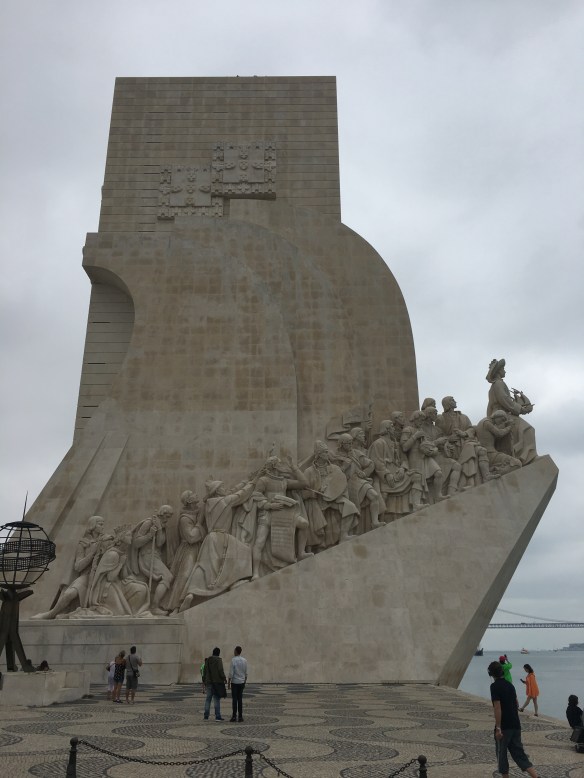
Part of my sabbatical journey took me to Lisbon, Portugal. On the far westernmost coast of continental Europe, Lisbon was a natural launching point for the various expeditions and voyages made by Europeans during the “Age of Discovery”.

IMG_6630

On Lisbon’s extensive waterfront at least a couple of impressive monuments stand in celebration of the achievements of European explorers and aviators. There is the looming Monument of Discovery which depicts the personalities of various explorers making their way across the ocean.

IMG_6632

IMG_6633

IMG_6631

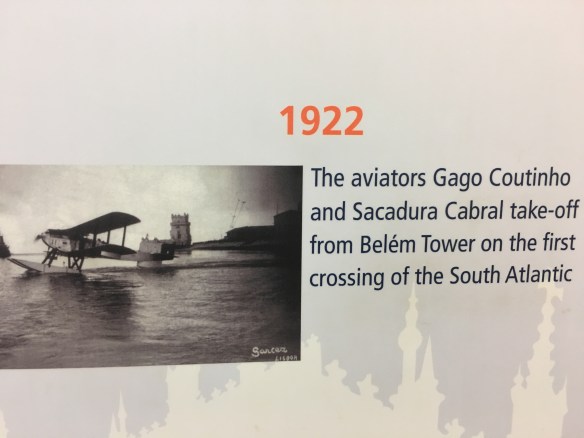
And there is an airplane monument commemorating the historic first south Atlantic crossing in 1922 flown by Gago Coutinho and Sacadura Cabral.

IMG_6628

IMG_6629

IMG_6634

In the decade following Coutinho’s and Cabral’s inaugural south Atlantic flight, another adventuring aviator, Antoine de Saint-Exupéry who is perhaps most well-known for writing the children’s book “The Little Prince”, reflected on what flying did to our understanding of the land upon which we live:

The airplane, he writes, “has revealed to us the true face of the earth. Through all the centuries, in truth, the roads have deceived us … They avoid barren lands, great rocks and sands, they are wedded to the needs of men and go from spring to spring …But our perspective has sharpened, and we have taken a cruel step forward. Flight has brought us knowledge of the straight line. The moment we are airborne we leave behind those [winding] roads …  It is only then, from high on our rectilinear course, that we discover the essential bedrock, the stratum of stone and sand and salt…

“Thus do we now assess man on a cosmic scale, observing him through our cabin windows as if through scientific instruments. Thus we are reading our history anew.”[2]

As we retell our history, as we seek understanding of what and how it happened, do we take the winding road, or do we take to the skies?

Amos the reformer was a prophet in ancient Israel. He challenged especially the northern kingdom in the eighth century B.C.E. to accept a new way of worshipping God. No longer where they to worship at the old shrines established by earlier prophets Samuel, Elijah, and Elisha at Beer-sheba, Bethel and Gilgal. Now, they would have to learn to worship God in a central location, at the temple in Jerusalem.[3]

In order to persuade them, he railed against the rituals and heartless pomp often associated with worship in that day.[4] The Israelites’ understanding of their own history needed changing. Without denying or changing the history itself, Amos helped them grow into an appreciation of the centralized worship which was not inconsistent with the Hebrew faith, a faith that had always emphasized care for the poor, the widow, the destitute. As such, Amos was “an agent of reformation”[5].

Whether we speak of ancient Israel, or the Reformation, or the Age of Discovery, or World War Two, or present day Canada, our remembrance is being reformed.

This first week of November is Treaties Recognition Week in Ontario. Listen to what perspective is offered in the writing of our history. Again, this perspective is not untrue. It simply offers a fuller understanding of what happened when Europeans ‘discovered’ this land:

“This native land was the home of many peoples, who have lived here for centuries and millennia. There is extensive archaeological evidence to confirm this statement. North America was occupied long before European strangers from across the ocean ‘got lost’ on their way to India and ignorantly named the inhabitants ‘Indians’.

“The residents of this new land had a deep regard for the practice of hospitality. So they welcomed the strangers to come ashore and opened their lives to these ‘lost’ explorers. This invitation to step out onto the land conveyed a message that did not make sense to the newly-arrived who had their own primary interests; wealth and resources.

“These alien visitors were nominally Christian. They were supported by ‘Christian’ interests intermingled with commercial and imperial motives. The biblical foundations and the practice of hospitality had been lost or buried under the exercise of abusive power that appears to be the inevitable companion of empires seeking to expand their influence and control. Equally forgotten or ignored was the fundamental biblical concept of covenant whose goal is establishing and nurturing respectful relationships that honour the Creator.

“These European strangers had been told by their highest authorities that any people unlike themselves actually were nobodies. The Doctrine of Discovery … reminded the newly-arriving aliens that they were superior to the ‘nobodies’ greeting them in hospitality. The rest is history and now we are trying to ‘get it right’ so that we can discover what it means to live in peace and mutual respect. It is time to set aside suspicion and abuse so that we can again become hospitable to one another as well as to contemporary visitors.”[6]

This anniversary year we sing “O Canada” and this Remembrance Day we’ve worn our poppies. It is important that we remember. It is important that we commemorate our history, good and bad.

How we remember is important, too. What aspects of our remembrance we emphasize speak loudly about the kind of people we are and aspire to be.

Amos presented a pretty bleak picture of Israel’s plight in the eighth century B.C.E.  The tone of his message is harsh, doom-and-gloom. It seems the Israelites can do nothing to avoid the inevitable calamity that awaits. It’s easy to lose hope and despair in the present circumstances. It doesn’t look good, what with all that’s going on in the world today.

From the perspective of history, though, we know how the story ends for them. We know the people of God are headed to the trials of Babylonian exile a couple of centuries later. We also know that one day, they do return to Jerusalem to restore the temple worship and re-build their lives at home.

Antoine Saint-Exupéry tells the story of when he and his friends from northern Europe invited some north Africans from the Sahara to visit with them in France.[7] These Bedouin, up until this point in their lives, never left the desert; they only knew the scarcity of water that defined so much of their lives and perspective.

When they climbed in the foothills of the French Alps they came across a thunderous waterfall. The French explained to their astounded friends that this water was enhanced by the Spring run-off of melting snows high above them. After minutes of silence during which the Africans stood transfixed before the bounteous and gorged scene before them, the Europeans turned to continue on their mountain path.

But the Africans didn’t move.

“What are you waiting for?” Saint- Exupéry called back.

“The end. We are waiting for the water to stop running. A stream of water always runs out. We are just curious to see how long it takes.”

They would be waiting there a long time. The prophet Amos concludes his diatribe by doing what so many other prophets of Israel do: They call on the people to have faith in God’s action in the world, God’s righteousness and justice. “Let justice roll down like waters, and righteousness like an ever-flowing stream.”[8]

God’s justice never runs out. The waters of God’s grace, mercy and truth never cease flowing. Our perspectives, our experience, our opinions are limited and sometimes scarce, if we rely on these alone.

But God’s work continues to gush forth in and all around us. Let us trust and have faith in the never-ending flow of God’s love and presence in the world today. So we may grow into the fullness of God’s vision for us all.


[1]  “From Conflict to Communion: Lutheran-Catholic Common Commemoration of the Reformation in 2017” (Leipzig: Evangelische Verlagsanstalt/Paderborn: Bonifatius, 2013), p.16

[2] Antoine Saint-Exupéry, “Wind, Sand and Stars” trans. by William Rees (New York: Penguin Classics, 2000), p.33-34.

[3] Wil Gafney in David L. Bartlett & Barbara Brown Taylor, eds., “Feasting on the Word: Preaching the Revised Common Lectionary Year A Volume 4” (Kentucky: WJK Press, 2011), p.266-270

[4] Amos 5:18-24

[5] Wil Gafney, ibid., p.268

[6] Reconciling Circle: reconcilingcircle@execulink.com, Daily Readings for Treaties Recognition Week: 5-11 November 2017, Day 1 “Have You Ever”

[7] I summarize and paraphrase his telling from “Wind, Sand and Stars”, ibid., p.54-55

[8] Amos 5:24

Sabbatical reading list

I enjoyed reading during my sabbatical. Here is a list and brief commentary on seven of the books that I particularly liked:

1. Saroo Brierly, “Lion” (previously published as “A Long Way Home: A Memoir”), Toronto: Penquin Books, 2013.

This memoir was also made into a motion picture under the title, “Lion”. The author documents his traumatic story of becoming separated from his family and lost as a child in India. Miraculously he finds help at the right time and the resources he needs to escape an impoverished and dangerous life on the street in Calcutta, and start his life over in Australia. Under the care of loving foster parents, he responds to an inner longing. His journey home is about finding the roots of his life in India. The story is about death and resurrection, relationships, and journeys of longing, searching, and finding.

2. Charles Foster, “Wired for God? The Biology of Spiritual Experience”, London: Hodder & Stoughton, 2010.

I find Charles Foster to be both delightful and humorous, as well as serious and respectful of the Christian faith. This is not an easy balancing act to perform in one book. He nevertheless provides a thorough academic and scholarly background to his arguments. He suggests that both belief and experience are essential to the journey of faith. But he does not give glib and easy answers to complicated questions and paradoxes of life and truth. Particularly, I enjoyed learning more about the biology of our brains and how the mechanisms of neurotransmitters and other functions of the cortex relate to near-death, out-of-body, mystic and intensive care experiences. Pointing to historical and current examples, Foster weaves a rich and (shall I say) entertaining read. I first encountered Richard Foster reading his “Sacred Journeys” published around the same time.

3. Adam Shoalts, “Alone Against the North: An Expedition into the Unknown“, Toronto: Penquin, 2015.

A Fellow of the Royal Canadian Geographic Society, Adam Shoalts writes about his recent wilderness expeditions to the Hudson Bay Lowlands. In his gripping true tale of adventure, he tells the story of persistence, human resolve, success and failure. Relating his personal experience Shoalts comments on the nature and passion of exploration. He exemplifies the survivalist par excellence who depends on the land, water and air and with simple means survives life-threatening dangers in unsuspecting waterfalls and killer polar bears. Despite all the obstacles, he is pulled forward by an unrelenting motivation to complete the journey.

4. Phil Cousineau, “The Art of Pilgrimage: The Seeker’s Guide to Making Travel Sacred”, San Francisco: Conari Press, 1998.

A classic tome on pilgrimage, Cousineau’s book gives a comprehensive summary of what pilgrimage means. He suggests the idea of pilgrimage is more than just going to a traditional site. Pilgrimage could land someone anywhere on the planet — not just Jerusalem, Rome and Santiago (for Christians). Cousineau supplies in two hundred pages all the well-known quotes and citations about pilgrimage. So, I regard this book as a go-to resource for finding anything ever written on the theme of going somewhere to find meaning. I particularly liked how he helped the reader define for themselves what kind of pilgrimage to make, based on the reader’s own passion, longing and need to go somewhere. He makes the reflection both personal and historically sound, and suggests practical ways of making travel something more than just being a tourist.

5. Eca de Queiroz, “The Relic”, London: Dedalus, 2003.

Originally published in Portugese in 1887, this fiction is a European classic. It tells the story of a young university student who pretends at being pious and devoted to his Christian practice, motivated only by impressing his rich aunt so he would inherit the family fortune upon her death. Set in Lisbon, “The Relic” is about the journey of a man who crosses boundaries of moral behaviour in his secret/true life but shows off in order to please and meet the expectations of others. After a fantastical trip to Jerusalem to find a relic to bring home to his aunt, our hero experiences the folly of his hypocrisy. And, through the pain of defeat and untold embarrassment, he learns in the end to hold both the good and bad in his life.

6. Richard Rohr, “Adam’s Return: The Five Promises of Male Initiation”, New York: The Crossroad Publishing Co., 2016.

My favourite author/mentor, Richard Rohr continues in this book to make the case for authentic, real, and healing experiences for men in Western society. Drawing from cross-cultural and historical examples, Rohr describes what happens in male initiation rites, and what is hoped for through these transformational rites. It should be no secret that men suffer emotionally in our culture that give little space for men to be real, vulnerable and honest. Rohr reflects on Scripture and describes what is, in my reading, a summary of the Gospel: Only by accepting what is real, painful and honest about one’s life, only by entering the Paschal Mystery of Christ crucified and risen in one’s own life, can men rise into the resurrection of new life and hope.

7. Beldon C. Lane, “The Solace of Fierce Landscapes: Exploring Desert and Mountain Spirituality”, New York: Oxford University Press, 1998.

This was my favourite book on my sabbatical. A dense read (I had to re-read sections), Lane offers a historical overview of mystic/contemplative tradition, citing the likes of Gregory of Nyssa, Evagrius, Cassion, Julian of Norwich and other desert mothers and fathers. He also emphasizes the importance of geography in expressing one’s journey of faith, comparing for example the experiences of hiking up Mount Sinai compared to Mount Tabor. He makes the case for a healthy spirituality that includes both apophatic (no words, letting go, release, loss, mystery, disorder, contemplation, silence, solitude, stillness) and kataphatic (language, community, structure, order, images, action) modes of relating with God. You can’t have one without the other. Observing regular contemplative forms of prayer leads to a renewed engagement with community. Essentially, nevertheless, this is a book describing the process of grief. Lane writes about this stage in his midlife dealing with the loss and deaths of his parents, and how the experience of the nursing home and caring for his dying mother contributed to his inner and outer journeys. And his healing.

You may follow me on Goodreads.com for a listing of all the books I have read.

The good crowd

I was ten years old when my parents shuffled me and my brother into one of the front rows of the main, outdoor theatre in the small, Bavarian town. The crowd pushed and shoved for privileged seating to watch the story of Jesus’s last days acted out daily by the town’s folk every ten years.

In fact, the crowd on the large stage did not appear any different than the tourists who got up very early in the morning for tickets to the Oberammergau Passion play.  

This coming Holy Week is rich with story. And when we read the stories about the last days of Jesus — full of drama, plot, and character — we will naturally identify with elements of the story-telling. Our worship is designed to help us identify, for example, with the crowds.

This morning, we sing “Hosanna” and wave our palm branches identifying with the enthusiastic crowd that first day when Jesus entered the city. “A very large crowd spread their cloaks on the road, and others cut branches from the trees …” (Matthew 21:8). Some years in Holy Week we dramatized and therefore simplify the trial scenes. We have individuals and groups speaking the various parts of the story. So, for example, ‘the crowd’ is played by the whole congregation who chants those lines together, such as “Crucify Him! Crucify Him!” (Matthew 27:23) and “He deserves death!” (Matthew 26:66).

Undergoing some mysterious metamorphosis sometime between Palm Sunday and Maundy Thursday, the crowd turns to the dark side. In a tradition that goes back centuries, Christians have most often portrayed the Jewish crowd around Jesus during his last days as rabidly and violently against him. We see it in Passion plays, the most famous of which is at Oberammergau in Bavaria. The evil crowd is also central to Mel Gibson’s film, “The Passion of the Christ.”

This over-interpretation has unfortunately led to harmful, anti-semitic justification against the Jewish people throughout the dark side of Christian history.

It may be easy to identify with these ‘bad’ crowds more than anyone else in the stories. Through the journey of Lent, we have struggled with the shadow self of our own lives, carrying our own cross so to speak, alongside Jesus. We have confessed our sin. Indeed, at the climax of Christ’s Passion, we pound nails into the cross on Good Friday. We so readily identify with the crowds, even saying that ‘we’ have crucified Jesus by our sin. It is little wonder why we come to these rather negative views, from Scripture.

What these portrayals fail to address, however, is this: Why, if the Jewish crowd was so against Jesus, was it necessary to arrest him in the darkness of night with the help of a traitor from among Jesus’s followers? Why not arrest him in broad daylight? And why do they need Judas?

What we discover is a positive, more balanced approach to the identity of the crowd. First we need to understand why the high-priestly authorities wanted to do away with Jesus.

“[The chief priests and Pharisees] wanted to arrest him …” (Matthew 21:46).

If the chief priests and Pharisees let him go on like this, everyone would believe in him, and the Romans would then intervene and execute them (John 11:48). Moreover, the authorities were not just afraid of the Roman Emperor, who was the recipient of Judean tax money and demanded political allegiance from those put in a position of power by the Emperor to keep the Pax Romana in the region. Insurrection in Judea would not be tolerated by Rome.

“… but they feared the crowds …”

Pilate and the high-priests also felt threatened by the whole crowd of people who, if they didn’t do something about Jesus, would eventually turn on them, which in 70AD (around the time most of the Gospels were written), did in fact happen. (1)

The Gospels reveal a clear disconnect between the high-priestly authorities who wish to execute Jesus, and the “whole crowd” who are “spellbound by his teachings” (Mark 11:18) and who “regarded him as a prophet” (Matthew 21:46).

This favourable support of Jesus by the predominantly Jewish crowd does not stop after the “Hosannas” of Palm Sunday. It continues throughout the days leading to the Passover Festival in Jerusalem.

The crowds aren’t perfect, to be sure. Their motivations for supporting Jesus may very well have missed the mark, especially those who still sought in Jesus a violent solution to the end of Roman rule in Judea.

Yet, they are captivated by his teachings. There is some good, therein. The ‘whole crowd’ can be personified by each of us. Which part of ourselves identifies with the crowd that is for the most part good and supportive of Jesus, even during his last days on earth?

I ask this question, especially in the midst of the most penitential season of the church year. I ask this question, and make this point as a spiritual antidote to what can easily, and so often does, slide into self-hatred on account of all our sinfulness.

We must remember we live in Christ Jesus, and the living Christ lives in us through the Holy Spirit. There is some good therein. We don’t need to be so hard on ourselves.

“The secret of life,” say the American Indigenous people, “is in the shadows and not in the open sun; to see anything at all, you must look deeply into the shadow of a living thing.” (2)

We may begin Lent and Holy Week — indeed our Christian pilgrimage on earth — by confronting our shadow self. It’s important to do so. But by the end of Holy Week we cannot avoid the open sun and see the empty tomb. The ending is always as it was in the beginning when God created everything and everyone, and said that it was good. “It was very good” (Genesis 1:31).

 
1 — Marcus J. Borg & John Dominic Crossan, “The Last Week: What the Gospels Really Teach About Jesus’s Final Days in Jerusalem” (New York: HarperCollins, 2006), esp. p.87-91

2 — cited in Joyce Rupp, “Walk In A Relaxed Manner: Life Lessons from the Camino” (New York: Orbis Books, 2005), p.161

Lent begins again: Why?

We begin a journey of some forty days, which mirrors Jesus’ forty days in the wilderness (Matthew 4:1-11). We continue to observe the season of Lent, year after year, as we approach the most holy of Christian days — Easter, the resurrection of our Lord.

But why do we do this? Why do we continue to do this, it seems, against the flow of society and the dominant culture today? As a child, I remember when it was more popular to ‘give up’ something for Lent; people actually did give something up, like dessert or TV. Some still do, I know.

And yet, it seems from the perspective of our economy and lifestyle today, that planning for March break, and sun-shine, escapist getaways get more attention and energy than any spiritual discipline might.

So, let’s begin our Lenten journey with a close look at why we need to go on this trip in the first place. Speaking of journeys, then, here’s a fascinating one from the history books:

“Early in the twentieth century, the English adventurer Ernest Shackleton set out to explore the Antarctic …. The land part of the expedition would start at the frigid Weddell Sea, below New Zealand …

“‘The crossing of the south polar continent will be the biggest polar journey ever attempted,’ Shackleton told a reporter for the New York Times on December 29, 1913.’

“On December 5, 1914, Shackleton and a crew of twenty-seven men set out for the Weddell Sea on the Endurance, a 350-ton ship that had been constructed with funds from private donors, the British government and the Royal Geographical Society. By then, World War 1 was raging in Europe, and money was growing more scarce. Donations from English schoolchildren paid for the dog teams.

“But the crew of the Endurance would never reach the continent of Antarctica.

“Just a few days out of South Georgia Island in the southern Atlantic, the ship encountered mile after mile of pack ice, and was soon trapped as winter moved in early and with fury. Ice closed in around the ship ‘like an almond in a piece of toffee,’ a crew member wrote.

“Shackleton and his crew were stranded in the Antarctic for ten months as the Endurance drifted slowly north, until the pressure of the ice floes finally crushed the ship. On November 21, 1915, the crew watched as she sank in the frigid waters of the Weddell Sea.

“Stranded on the ice, the crew of the Endurance boarded their three lifeboats and landed on Elephant Island. There Shackleton left behind all but five of his men and embarked on a hazardous journey across 800 miles of rough seas to find help. Which, eventually, they did.

“What makes the story of the Endurance so remarkable, however, is not the expedition. It’s that throughout the whole ordeal no one died. There were no stories of people eating others and no mutiny [to speak of …. Some have argued that ] “This was not luck. This was because Shackleton hired good fits. He found the right men for the job ….

“Shackleton’s ad for crew members was different [from the norm]. His did not say WHAT he was looking for. His did not say: ‘Men needed for expedition. Minimum five year’s experience. Must know how to hoist mainsail. Come work for a fantastic captain.’ Rather, Shackleton was looking for those with something more. He was looking for a crew that belonged on such an expedition. His actual ad ran like this:

“‘Men wanted for Hazardous journey. Small wages, bitter cold, long months of complete darkness, constant danger, safe return doubtful. Honour and recognition in case of success.’

“The only people who applied for the job were those who read the ad and thought it sounded great. They loved insurmountable odds. The only people who applied for the job were survivors. Shackleton hired only people who believed what he believed. Their ability to survive was guaranteed.” (1)

Year after year, the Gospel text from Matthew 6 is read on Ash Wednesday which marks the beginning of the Lenten journey. It is a journey, a pilgrimage, you might say. For those willing to embark on the sometimes harrowing yet intentional path, Jesus points to the authentic quality and honesty of community life.

Being the church in the world is not to give a false impression, to show how exceptional we are in the religious marketplace. Being the church to the world is to be authentic and true to what we believe and who we are, whether or not we measure up to some cultural standards of behaviour.

Maybe that explains why Lent is no longer popular in our day. Society has already been for a while losing ourselves in distractions. In 1985 Neil Postman claimed that we were “Amusing Ourselves to Death.” (2) Over a decade earlier, Ernest Becker wrote a book I read in seminary, entitled, “The Denial of Death” (3) which is a theological reflection on how we live in ‘modern’ North America.

Indeed, we in the West continue on a course of distracting ourselves to death — with stimulating toys, technological advance and even more addictive ways to keep the truth at bay. This strategy, with often tragic consequences, only serves to drive a deeper wedge and division from our true selves.

The symbolic destination of the Lenten journey is the Cross, on Good Friday. And so, right off the start, we know this can’t be an easy journey, when we have to face and bear our own cross. But this is what life is about, is it not? Whenever hardship comes our way in whatever form it does — illness, loss, tragedy, disappointment, conflict and confrontation, failure, guilt, pain. We don’t have to seek it out; Suffering comes to us all. This is a reality we are called to accept.

We are called not to deny that our message is for people who are honest about their brokenness, who in their vulnerability do not want to pretend their weaknesses away. Our suffering can be a great teacher, an opportunity for growth and wholeness.

Suffering, in the words of Canadian theologian Douglas John Hall, “belongs to an order of creation insofar as struggle … is necessary to evoke the human potential for nobility, for love, for wisdom, and for depth of authenticity of being. A pain-free life would be a life-less life.” (4)

Lent is not a path to ultimate self-annihilation. Ultimately, Lent is not a downer. Because suffering can point to a new beginning. Followers of Jesus are not a people who suffer the pains of life without faith and hope. We can face what life brings, with a conviction that together, we can do more than merely survive.

On this journey we can experience that the whole is greater than the sum of its individual parts. In accompanying each other through the difficult times, we can experience something greater than ourselves. Together we will realize more than we could ever have imagined on our own; transformation, resurection, a new beginning. Together, because God in Jesus goes with us. We are not alone on this journey.

God blesses this journey.

1 – Simon Sinek, “Start With Why” (New York: Penguin, 2009), p.90-93
2 – Neil Postman, “Amusing Ourselves to Death” (New York: Viking Penguin, 1985)
3 – Ernest Becker, “The Denial of Death” (New York: Free Press, 1973)
2 – Douglas John Hall, “God and Human Suffering: An exercise in the Theology of the Cross” (Minneapolis: Augsburg Publishing House, 1986), p.62-63

Annual Pastor’s Report

Effective Partnerships

The most significant event in the life of Faith Lutheran Church in 2016, was the decision to complete an extensive renovation of our worship space and narthex hallway. To complete this major modernization project, we partnered with the capable and esteemed contracting company from Stittsville, “Amsted”.

This decision precipitated what may in the long run prove to be just as significant, if not more so: The decision to join with the local Anglican parish on Sunday mornings during the time of the renovation (which lasted into 2017).

Even should nothing enduring come of the relationship between Faith Lutheran Church and Julian of Norwich Anglican Church, the mere exercise of gathering as a hybrid congregation for the last ten consecutive Sundays in 2016 plus two Christmas Eve services caught the attention of the Christian community in Ottawa and across our Eastern Synod.

Meeting to worship with local Anglicans affirmed both the existing Full Communion relationship between the Evangelical Lutheran Church in Canada (ELCIC) and the Anglican Church of Canada (ACC), an agreement existing since 2001. As such, given the other options during our vacancy from 43 Meadowlands Drive West, meeting with an Anglican congregation was attractive, since doing so facilitated many logistics of worship between our similar liturgies, as well as kept a certain momentum alive for meeting at all, during the renovation/vacancy period.

On Lutheran liturgy Sundays (every other Sunday) at Julian of Norwich, we expressed our unique identity within the union of two distinct congregations. For example, each congregation has different histories, as well as contrasting governance structures (i.e. Anglicans are governed episcopally, while Lutherans are governed in a congregational structure).

While comparing congregations is fruitful, challenging and enjoyable, the fact that we began this relationship knowing we were returning home at some point allows us to pose critical questions of review of our ‘way of doing things’ freely, both around sacramental practice and mission.

During the Eastern Synod Assembly in June, your lay delegate (Julia Wirth) and the pastor heard again the four main, missional themes of the Eastern Synod (Effective Partnerships, Healthy Church, Spirited Discipleship, Compassionate Justice). No doubt, our congregation participated in a way no other Eastern Synod congregation has, in affirming the value of seeking “Effective Partnerships” in fulfilling God’s mission, especially during times of need and change.

Loss and Transition

A basic assumption of committing to the renovation project was that we had to take leave of our current building, and specifically our place of prayer. Doing so was an act of courage. Leaving a place that has symbolized a constant certainty in the lives of Faith members for over fifty years was not easy. Our sense of stability in faith was disrupted, as we were challenged to distinguish between the form (‘our’ building) and function (the purpose) of faith.

This leave-taking coincided with other endings. June 2016 marked the last time the Faith Lutheran Women (FLW), structured the way they had been for the last few decades, met in typical fashion (see report). For some time prior to this they had been talking about closing their account and ceasing to meet ‘as is’. In the latter part of 2016, that talk became reality.

Also, the Confirmation program that for several years had been a successful experience for leaders and participants alike, did not in the Fall of 2016 achieve the critical mass of students to warrant a class structured in the same way. As a result, no program started up at the start of the school year.

These events, I believe, constitute ground for growth and maturity of our community as we practice the spiritual gifts of detachment and trust. The prophet Isaiah spoke the word of God to the exiled people in Babylon in the 6th century B.C.:

“Do not remember the former things, or consider the things of old. I am about to do a new thing; now it springs forth, do you not perceive it? I will make a way in the wilderness and rivers in the desert.” (Isaiah 43:18-19)

Before the new thing arrives, we need to stop the old thing. These endings are not failures as such; rather, they provide the space for the new thing God will have for us. What we are called to in disruptive times of loss and transition, I believe, is to be patient, have presence of mind and openness of heart, and be willing to take a risk together when something presents itself in our hearts as possibility and passion.

Poised for renewal

Moving into the new year, Faith Lutheran Church is poised to embrace a season of discernment, reflection and new beginnings.

Not only will we return to enjoy the gift of a refreshed, safe and healthy environment for meeting in our newly renovated building, we will be encouraged to reflect on what this space, created for at least another decade of ministry, worship, and mission, will be used for.

Late in 2016, the congregational council unanimously endorsed a proposal for a 3-month sabbatical for the pastor in 2017. The sabbatical covenant, based on the Eastern Synod Guidelines for Sabbatical, addresses the need for leaders to take periodic and extensive ‘pauses’ in vocational life, for renewal, reflection and discernment.

The benefits for the congregation mirror those for the pastor. From the perspective of providing some distance, a sabbatical gives freedom for everyone to step back, assess the structure of ministry and mission in the congregation, and contemplate new ways of supporting one another in our lives of faith.

For example, healthy congregations in general have several highly functioning lay leaders who engage proactively not only in managing a church, but in leading the mission of the church. The health benefits to the congregation, as for the pastor, following the sabbatical give opportunity for renewal of the mutuality of the relationship between pastor and congregation in God’s mission. The ‘reset button’ is pressed, and energy flows again.

Adaptive Change: Put away the mallets and start asking “Why?”

“There is a wonderful story of a group of American car executives who went to Japan to see a Japanese assembly line. At the end of the line, the doors were put on the hinges, the same as in America. But something was missing.

“In the United States, a line worker would take a rubber mallet and tap the edges of the door to ensure that it fit perfectly. In Japan, that job didn’t seem to exist.

“Confused, the American auto executives asked at what point they made sure the door fit perfectly. Their Japanese guide looked at them and smiled sheepishly. ‘We make sure it fits when we design it.’

“In the Japanese auto plant, they didn’t examine the problem and accumulate data to figure out the best solution — they engineered the outcome they wanted from the beginning. If they didn’t achieve their desired outcome, they understood it was because of a decision they made at the start of the process.

“At the end of the day, the doors on the American-made and Japanese-made cars appeared to fit when each rolled off the assembly line. Except the Japanese didn’t need to employ someone to hammer doors, nor did they need to buy any mallets. More importantly, the Japanese doors are likely to last longer and maybe even more structurally sound in an accident. All this for no other reason than they ensured the pieces fit from the start.

“What the American automakers did with their rubber mallets is a metaphor for how so many people and organizations lead … a series of perfectly effective short-term tactics are used until the desired outcome is achieved. But how structurally sound are those solutions?

“ … Long-term success [is] more predictable for only one. The one that understands why the doors need to fit by design and not by default.

“Going back to the original purpose, cause of belief will help … [churches] adapt. Instead of asking, “WHAT should we do …? the questions must be asked, “WHY did we start doing WHAT we’re doing in the first place, and WHAT can we do to bring our cause to life considering all the technologies and …[other] opportunities available today?” (1)

Being poised for renewal means we need to understand the nature of change in institutions such as the church. Some definitions, outlined in a report generated by the Eastern Synod Mission Committee late in 2016, draw the distinction between Technical Change and Adaptive Change:

Technical Change is about fixing problems while essentially keeping the system the same. In other words, where’s the mallet?
Adaptive Change, on the other hand, is about addressing fundamental changes in values that demand innovation, learning and changes to the system itself. Start with ‘Why?’ And then lead from there, by design not default.

During this coming year, which will give all of us permission to pause and reflect, please resist the temptation to rush into doing something either because ‘we’ve always done it that way’ or because we are too anxious not to remain awhile in the uneasy ‘in-between’ time of loss and transition. Be patient, take deep breath, pray, and reflect on the following questions:

Our adaptive challenge questions for 2017:
1. How do we communicate? To whom is each of us accountable?
2. How well do we listen and seek to understand the other? Give concrete examples.
3. Will we create a list of those who are not in church (technical strategy); or, will we identify the needs in the community surrounding 43 Meadowlands Dr West, in Ottawa (adaptive strategy)?
4. How will prayer be our starting point?
5. What are other ways besides worship that serve as entry points for the public to engage the church? This is important.
6. How do we see worship as a launching pad, not a destination, for following Jesus? This is very important.
7. What are the gifts we have as a church? (personnel, space, talents, passions, etc.)
8. How well do you know your fellow congregants’ jobs, professions, contacts, interests, hobbies, talents, passions?
9. Why do we initiate a ministry or mission outreach activity in the first place? Who is the target group? What is the purpose of doing it? Does everyone know the purpose? Why or why not? Is there general agreement about the purpose? Why or why not?

Thank you again for the privilege of another year doing this work with you. Blessings and Grace, on our journeys moving forward,
Pastor Martin

(1) Simon Sinek, “Start With Why”, Penguin Books, New York, 2009, p.14-15, p.51

Relationships over Resources

A member of this congregation sent me an email including a list of short phrases called paraprosdokians.

A paraprosdokian, according to my online dictionary, is a derivative of a Greek word which means, ‘beyond expectation’. It is a wordplay, a figure of speech in which the latter part of a sentence is unexpected. Here’s a smattering:

 · A neighbour knocked on my door and asked for a small donation towards the local swimming pool, so I gave him a glass of water.

 · Take my advice — I’m not using it.

 · Ever stop to think, and forget to start again?

 · He who laughs last, thinks slowest.

 · I was going to give him a nasty look, but he already had one.

 · Change is inevitable, except from a vending machine.

 · I was going to wear my camouflage shirt today, but I couldn’t find it.

 · If at first you don’t succeed, skydiving is not for you.

 · No matter how much you push the envelope, it’ll still be stationery.

 · Money is the root of all … wealth.

Indeed, the Gospel today (Luke 16:1-13) has at least one major, unexpected twist. And unlike most of these paraprosdokians, this twist is not humorous. 

A manager has been wasteful of his boss’ riches, and consequently will lose his job. So, the manager figures on a scheme to look out for his own interests in his impending unemployment. The ‘dishonest manager’ — as some bibles entitle this parable — puts himself first at the seeming expense of his boss: he will go to his boss’ debtors and demand only half of what they owe. He shrewdly seeks to curry favour with them, and anticipates to be in their good books, once he is unemployed.

Smart move, you might say, eh? But what will Jesus say? Especially keeping in mind that this passage comes to us on the heels of the ‘golden’ chapter of the bible, Luke 15. Therein we read the familiar and heart-warming stories of the lost being found, of celebration and belonging, of unimaginable grace and mercy shown to the poor, the wayward, those who are not easily counted in the economy of the day. 

In Luke 15, we get the strong impression that the values of God’s kingdom — mercy, inclusion of others, unconditional love — stand in sharp contrast to the values of the world — competition, self-centredness, individualism. And, now, in Luke 16, the set up leads me to anticipate Jesus will come down hard on the ‘dishonest’ manager. I expect Jesus to say how unjust, unethical, and selfish the manager was. Don’t be as self-centred as he is!

In verse eight, the rug is pulled out from underneath me: “And his master commended the dishonest manager because he had acted shrewdly.” What ?!! Commended?

And yet, I should expect that the bible does that to us from time to time. The bible does not present a tightly knit, unequivocally clear and coherent storyline. You can justify anything from the bible, if you want — even murder. But that is not what we are about, when we approach the bible. 

After all, there is an important reason why the New Testament includes four, different, renditions of the life and times of Jesus. If uniformity was the goal in the inspiration behind putting together the bible, then we would have only had one Gospel, not four. Matthew, Mark, Luke and John — the first four books of the New Testament — basically follow a similar plot line about Jesus’ birth, baptism, calling, choosing disciples, healing, teaching, passion, death and resurrection stories.

And yet, each presents variations, slightly different orders, and yes, sometimes even these unexpected twists and turns in what needs to be emphasized. There are, after all, different people listening in — the religious leaders of the day, his disciples — people like you and me who live different lives and face different challenges. Each of us needs to hear something unique to what our needs are, apart from our neighbour. And each faith community needs to hear a unique word spoken to them.

So, while the story of the dishonest manager twists and puts our expectations on their head, perhaps there is something here worth paying attention to. “You cannot serve God and wealth” concludes the passage. And yet, the manager was looking out for his own material well-being in his shrewd and commendable actions.

Well, what is the wealth that is talked about here? For what treasure do we Christians — called the “children of the light” in this text (v.8) — search? What is the golden nugget that we seek, above all else? Again, perhaps the broader context can help us, again.

As I said, the previous stories of the lost sheep, lost coin and lost sons suggest that what is valuable in the economy of God, stands in sharp contrast to what is valuable in the economy of the world. These are treasures that are worth uprooting what is hidden, putting in the light what is shrouded in darkness, lifting up what is normally considered not worth the effort, forgiving what is unforgivable.

What does the shrewd manager value, even more than making money? He values relationships. He values keeping connected with others even though he loses what the world values — jobs, financial security and material wealth:

He reduces the amount of debt owed by the amount of his commission — as some biblical commentators suggest. He reduces the amount of interest owed, according to the Torah Law in Deuteronomy 23:19-20 — as other commentators suggest. Regardless of how we interpret the manager’s actions, we can see how much the manager values being in relationship, above all else.

The wealth described here is the treasure of being inter-related in a season of loss and disruptive change. Relationships over Resources, you could say (1).

And this truth hits us unexpectedly in the telling of the Gospel. Another classic reversal. I started this sermon with a Greek word to describe a form of speech that ends unexpectedly. Of course, the New Testament was written in Greek and influenced by Greek culture.

Greek culture often reflects this image of having a feast in the midst of famine. Another contrast of expectations, when during a famine you would not expect people to throw a large feast, and celebrate. Remember, after finding the lost sheep, the lost coin and when the Prodigal returns home, there is much rejoicing. And a feast is prepared for the whole community.

This does not make sense. To have a feast in the midst of famine. And yet, this is what we are called to do. To be children of the light, in the midst of darkness. Not to be a slave to our circumstances and meagre resources, as we may see them to be. But to release them, distribute them, relinquish our seeming control over them, all for the purpose of maintaining and strengthening our relationships.

Celebrating the gift of each other and those we meet. Relationships first, then resources. The horse before the cart, not the other way around.

We may by lying in the gutter of our lives, but we keep our gazed fixed upon the stars. We may be wallowing in an ocean of despair, regret, fear or pain — but we begin with a spoonful of water. In other words, there is always hope. There is always room to grow, to change, to something — anything — in order to make things better. This is the quality of faith.

We are never lost, abandoned and left for dead in the economy of God’s grace. After all, the rich man gives his irresponsible manager a second chance. Normally when charges are brought against an employee, charges that incriminate and prove wrong-doing to the degree of ‘squandering’ the owner’s property, the person in question is fired immediately, without question.

But something odd happens here: The rich man allows his soon-to-be-fired worker to continue doing his job for a while. The rich man gives his delinquent employee some ground, some space, to do something — anything — in order to make things better. The rich man demonstrates some grace in a relationship that has gone awry. 

Not only are the relationships in life our priority over everything else including our material resources, the quality of those relationships — according to the New Testament — are defined by grace, compassion, and love. 

An unexpected twist of the stories of our lives in the world, perhaps. Yet, these are the hallmarks of the children of light following Christ in the world.

Thanks be to God!

(1) David L. Bartlett & Barbara Brown Taylor, eds., Preaching the Revised Common Lectionary; Feasting on the Word, Year C Vol 4, WJK Press; Louisville Kentucky, 2010, p.92-97