Community of the broken and blessed

This Sunday I will use the words of David Lose, in his fine reflection on the Gospel assigned for this 19th Sunday after Pentecost in the Revised Common Lectionary (Mark 10:2-16).

He suggests that Jesus’ difficult words here are not so much addressed to individuals as they are to a community that is broken and blessed. These words are not about divorce per se but about the law and under what circumstances it was applied.

Finally, these Gospel words are not so much about matters of the law, but about relationships of mutual dependence and health. He welcomes children, thereby painting a vivid picture of this kindgom community. This is a community comprising of relationships whose purpose is to be honest about our vulnerability, and whose mission is to protect the vulnerable.

Please visit his blog for the full text: In the Meantime

Part B

I don’t have many bad memories from my youth. But recurring is one from exam time in highschool. This memory brings back desperate feelings of failure, despair, and shame. The exam was for a history or English course. And it was only a one-pager!

I recall sitting down in the large gymnasium at the start of the exam period looking down at the simple Part A question, and thinking to myself: ‘I got this one in the bag!’ Instead of writing my answer down on that page underneath the question, I wrote down about five pages on extra sheets I asked from the exam moderator. Usually, I took the entire allotted time to write my exams. I remember, however, with this one I finished much earlier.

After checking over my in-depth and complete answer, feeling satisfied and even smug with my work, I signed off on it and left the room with a hop in my step. I felt confident that I had performed to my usual high level of competency in a subject matter that I liked.

You might imagine the horror I felt shortly thereafter when I learned from others why it was that I happened to finish so early.

“Martin,” a friend asked me, “What did you write for the Part B question?”

“Part B?!!”

“Yeah, on the second page.” 

Alas! The one-pager was double-sided. I didn’t think to turn the question sheet over to do Part B. I had only completed the first half — Part A — of the exam. I didn’t finish the entire test. I. Was. Doomed.

In the Gospel for today (John 6:51-58), Jesus uses carnal language that borders on the cannabalistic. “Eat my flesh. Drink my blood.” What are we to make of this arresting, vivid, corporeal language?

Well, the Pharisees have an answer. But theirs is the usual mind-tripping, logical finagling. They take everything literally! “How can this man give us his flesh to eat?” they ask. This style of intellectual, rational mind-gaming is reminiscent of when earlier Jesus spoke of being born again — and again the Pharisee Nicodemus gets trapped in his head: “How can a man go back a second time into his mother’s womb and be born again?” (John 3:1-4).

The Gospel of John and especially this text (6:51-58) evokes images of ingesting, chewing, and gulping — and relates this to our relationship in Christ Jesus. Language like this pervades the Gospel, right from its inaugural, tone setting words: “The Word became flesh” (John 1:14).

The Word is not just a doctrine or idea. The Word is not just a mental picture that we frame with rational explanations, logical arguments and eloquent words about Jesus. That is only Part A.

There’s a Part B that needs to be completed in order to get at the fullness of truth of Jesus relating to us and the world God creates. When we talk of Christian theology and even Christian discipleship, we must go beyond saying: “Let’s follow Jesus” or merely have conversations about Jesus, or think about Jesus, or construct nice ideas about Jesus. 

We must learn to confess that Jesus not only wants our thoughts, Jesus wants all of me/us — every aspect of our lives including our bodies, our exercise, our diets, our play, our work, our relationships. Jesus wants more than our Sunday mornings. He wants Friday night and Wednesday morning as well. A local church had this message on their front-lawn sign last week: “Jesus doesn’t want weekend visits; he wants full custody.” 

Worship is only Part A. Part B is when we walk out that door when worship is over. If our prayers and songs and statements of faith during worship on Sunday morning — as glorious and uplifting and inspiring as they may be — do not translate into meaningful, concrete action consistent with our faith Monday through Saturday, then our worship is really, in the words of Saint Paul, “a noisy gong or clanging cymbal” (1 Corinthian 13:1). The Psalmist confesses to God: For you have no delight in sacrifice; if I were to give a burnt offering, you would not be pleased. The sacrifice acceptable to God is a broken spirit; a broken and contrite heart, O God, you will not despise. (Psalm 51:16-17)

“People often daydream, and even share their fantasies, about what they would do if they won the lottery. Still, most people choose to keep their money in their wallet. In response, lotteries south of the border run commercials reminding us, ‘You can’t win if you don’t play.’ In a sense, Jesus is saying something very similar: ‘Unless you eat the flesh of the Son of Man and drink his blood, you have no life in you’ (v.56). In these verses, Jesus demands more than intellectual assent, more than fantasies of eternal life. Jesus asks for high-stakes, all-in participation, here and now.” (Sundays and Seasons, Augsburg Fortress, 2014, p.261) Jesus wants all of me. Part A and Part B.

I still passed the course, both because I did well during the term on assignments and such; and, because I passed the exam with a 50% score. Even though I messed up and had my blinders on, even though I did not complete the expectations of the exam, I could count on the grace of the instructor.

You see, I did not get a perfect score on Part A. Close, but not perfect. I should have therefore failed the exam. But the instructor knew me. Knew me well. And she knew I deserved to pass the grade. Despite my mistake, I still got credit for the course.

Where there is suffering in the real world. Where there is blood spilled and bodies broken. Perhaps it did take the Christian movement some centuries to work through their natural repulsion against the unadorned cross — an instrument of torture and death — to finally embrace the Cross as the central symbol of our faith. Because there is an important point to it.

That is where Christ is, in our lives and in the world. And it is there that we must go to find Jesus in the faces of those bloodied by war, by displacement, by injustice and violence — in whatever kind. It is there that we must go to witness by our giving and our own brokeness the truth and hope of the Gospel. It is there that we must go. The life stronger than death that God gives to the world in Jesus Christ always comes to us “in the flesh” and blood sufferings of the present time. It is there we must turn the page, and go.

Part B.
Lord, you have searched me out; O Lord, you have known me. You know my sitting down and my rising up; you discern my thoughts from afar. You trace my journeys and my resting places, and are acquainted with all my ways. Indeed, there is not a word on my lips but, O Lord, know it altogether. You encompass me, behind and before, and lay your hand upon me. Such knowledge is too wonderful for me; it is so high that I cannot attain to it. Where can I go from your Spirit? Where can I flee from your presence? If I climb up to heaven, you are there; if I make the grave my bed, you are there also. If I take the wings of the morning and dwell in the uttermost parts of the sea, even there your hand will lead me and your right hand hold me fast. (Psalm 139:1-10)


Amen.

Seeing Jesus

Jesus says, “the person who sees me and believes will be raised up” (John 6:40).

If I polled the assembly gathered here this morning and asked you to raise your hand if you ‘believed in Jesus (or God)’, my guess is I would get a decent showing.

But if I asked you to put up your hand if you recently saw Jesus, I’m not sure I’d get the same kind of response. If you did raise your hand to that question I might look at you with some degree of skepticism. I might not take your statement at face value. I would want to ask you more questions.

Seeing Jesus sounds like a conversation for the mystics and contemplatives. If our faith is limited merely to a conversation about the historical, biblical Jesus, we will be challenged at this point of acknowledging the living, immanent Jesus who is also always more — an unfolding Presence in the course of all history.

Where do we see Jesus? This is an important question. How can we see the living, resurrected Lord in the world and in our lives today? How can we account for the presence of Jesus?

There is the problem of sight. Here, Jesus obviously is not talking about physical vision. Otherwise why would he even say, “the person who sees me …”? Of course the people to whom he originally spoke these words standing on the sandy, rocky ground in first-century Palestine saw him. Jesus is talking more about a perception of the heart, mind and soul — an internal dynamic.

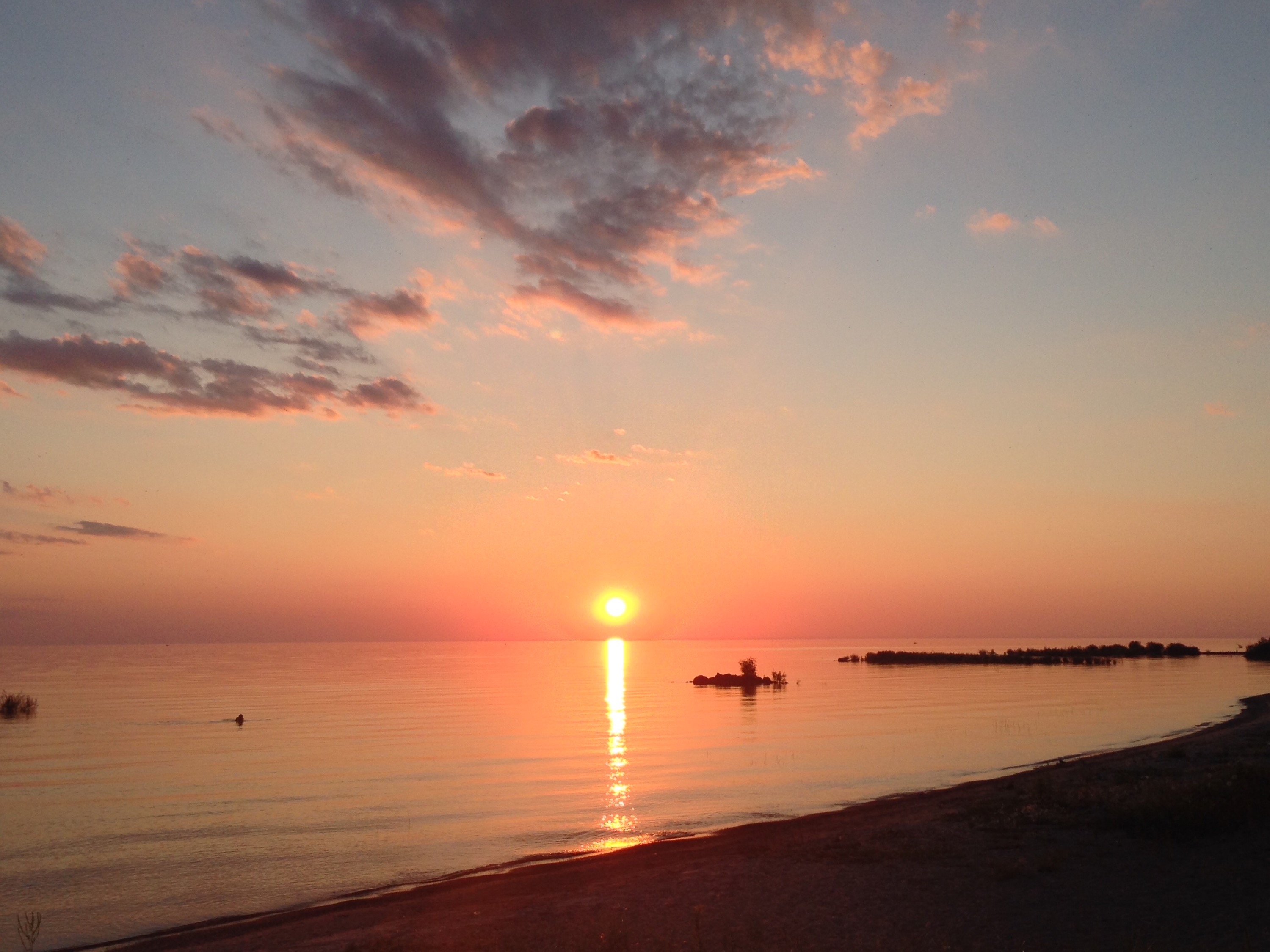
If you follow any of my social media sites online, you might have noticed there recently some sunset photos over Lake Huron where my family vacationed over the past couple of weeks. Aside from the inspiring sunsets, this is not what I remember the water to look like:

Normally, as I recall from my childhood summers spent on these shores, Lake Huron is fairly active. More days than not you would see a lot of wave action, and white caps carving up the horizon and rolling in over the surf. You would feel the constant high winds buffeting the tree-lined shore.

For the fourteen days we lived by the shore last month, however, the Lake was mostly calm. The water was placid, where there would be no more than a ripple on the surface and a splash on the shore line. In fact I would be hard pressed to say there was more than two days of wave action that came close to my childhood recollections. Needless to say, the quiet, peaceful waters made for much stress-free sea-kayaking and swimming along the coast.


At sunset most evenings we sat around the fire pit a stone’s throw from the shore, enjoying the very soft breezes and the relatively flat surface of the water.

And, if you watched the water, once in awhile you would see a large white fish breach the surface and flap it’s broad tail. The slapping sound often caught my attention if I wasn’t looking at the exact spot on the water.

This sudden sound, amidst the relative quiet of the expansive scene of resting water, air and land before us, also caught the attention of the other members of my family (I would add, they were preoccupied by their hand held devices, swatting the bugs, and chatting incessantly with one another!).

“What was that?” they looked up.

“Oh, a fish, jumping out of the water,” I responded.

“Cool! Where? Where? I wanna see!”

“Well, you need to be watching the water. Keep scanning the water up and down the shore line close to the edge.”

“I don’t see anything!”, one says, scratching another mosquito bite.

“You need to keep watching the water. There,” I point over the water toward the island, “there was another one!”

“Where?”

“Were you watching the water?”

“Uh, no.”

And on and on it went. I had a restful holiday. No, I did. Really!

The problem is not so much an incapacity to see. It is first to confess how distracted we are as a people in a culture that is impatient, anxious, that does not want to slow down, that keeps us from seeing what is already there. Perhaps Jesus is there for us to see. And we, like the Pharisees with whom Jesus often sparred, are “blind” to this truth. Jesus gives us precisely what we need to live, fully (Matthew 23; John 10:10). Do we not see it?

Before the cross became the central symbol of Christianity, the sign of the fish identified the early Christian movement. In fact, the cross was for centuries rejected by Christian who naturally recoiled at the thought of having an instrument of torture and capital punishment the central symbol of the faith.

The fish was a symbol for Jesus Christ. Food. Like bread, fish gave faithful people ongoing strength, sustenance and nourishment for life. No wonder the miracle of multiplication of bread and fish became a popular Gospel story about Jesus feeding the multitude on a hillside in Galilee (Matthew 14, Mark 6, Luke 9, John 6).

The new logo of the Eastern Synod reflects this original, early Christian identification with fish:

In the sixth chapter of the Gospel of John especially, Jesus compares himself to bread — bread that sustains us and feeds us everything we need. Everything. Not more. Not less. In the Old Testament, it was manna that God provided to the people in their desert wanderings.

The desert was the place where the people had to learn to give up control, which is mostly what ‘making plans’ is all about. “Like us, the Hebrews weren’t initially too excited about all this vague mystery. The people didn’t just complain that they were out of food, they also began to romanticize about the good old days back in Egypt where they ate their fill of bread …

“God responded to the people’s anxiety about food in a very tangible way. He provided the daily blessing of bread from heaven called manna. It was a fine, flaky substance which appeared every morning. And it came with some instructions (Exodus 16:1-8). Every family had to gather their own. You couldn’t store it up or hoard it, or the worms would eat it. So you had to gather it every day, except on the sixth day of the week when you could gather an extra portion for the Sabbath. It wasn’t much — just enough to keep you going on the journey.

“All of these descriptions [like bread and fish] are wonderful metaphors for how God cares for us along the way in the desert journey: daily, tangibly, personally, and sufficiently, although never enough to remove our anxiety about tomorrow. We have to trust there will be more manna when we need it [emphasis mine].

“This is what Jesus had in mind in teaching us to pray, ‘Give us this day our daily bread’. To pray those words is as if to say, ‘No matter how hard I try to secure my life with money, exercise, relationships, or work, I know that only you can give it to me. And you will do it one day at a time.

“The best reason for seeing the manna as a blessing [of Jesus’ presence, I might add] comes from its name. The literal translation of manna is ‘What is it?’ This means that every morning the people would go out and gather the ‘What is it?’ The mothers would prepare it as creatively as they could, which was tough because there was no ‘What is it?’ -helper. The family would sit at the table to eat. The kids would ask, ‘What is it?’ The mother would sigh and say, ‘Yes.’ They’d bow their heads and pray, ‘Thank you God for What is it?'” (Craig Barnes, Insights from the Desert, “Nurtured in Mystery” Shadyside Presbyterian Church, 2010)

What if we lived out of gratitude for what God has already given us? What if we made decisions — even small ones, each and every day — based on trust in Jesus being there for us, just beneath the surface of our lives? They’re for the watching. They’re for the catching and gathering. Grace and Gift, available to us. Before we even lift a finger to eat.

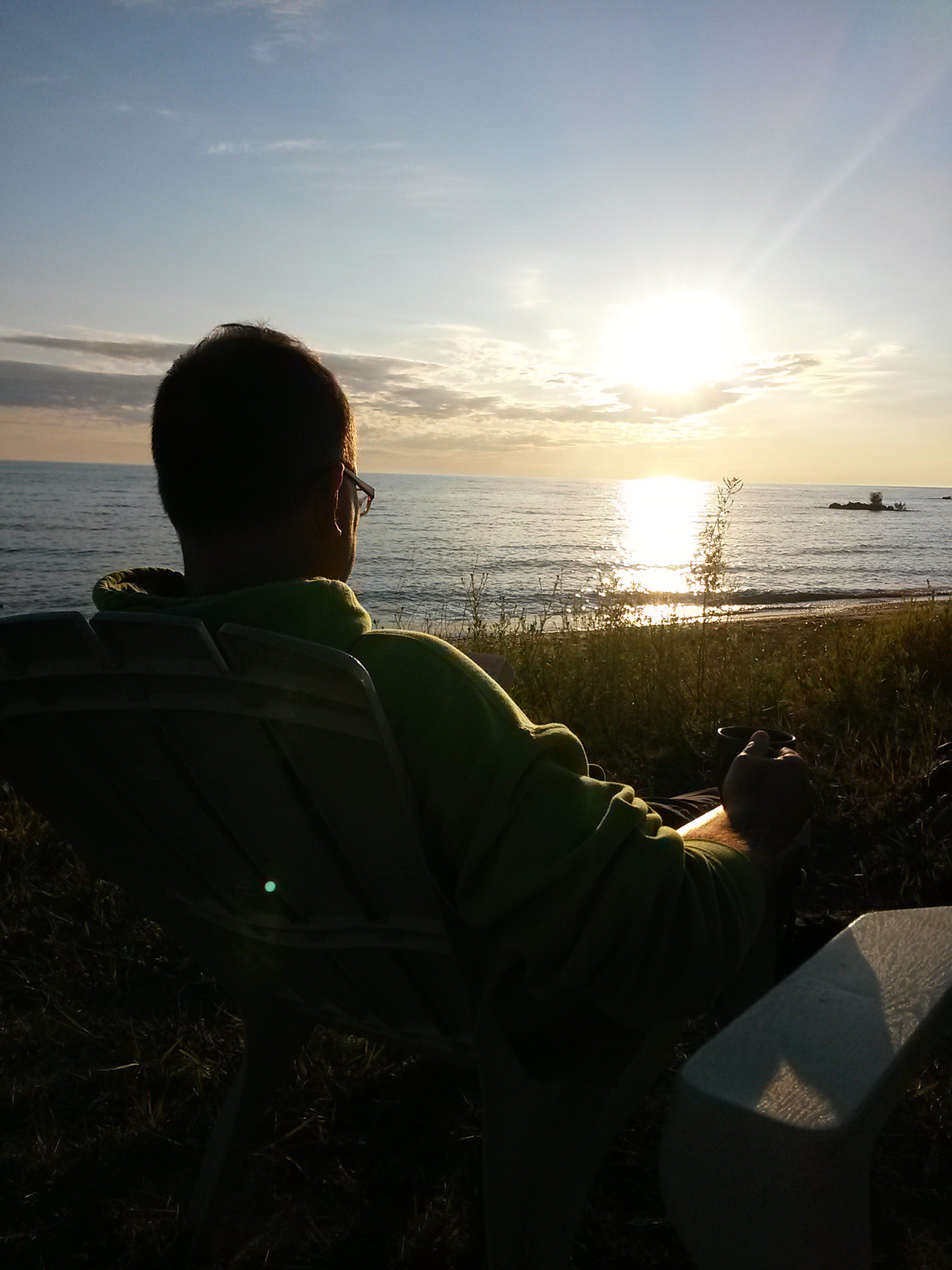
A light-gift contemplation

The distant sun

finding purchase through cracks in the clouds,

Light filtered through earth-bound trees

streaming across the plane

onto my space. Our space.

  
This distant, constant, sun gives peace

and stillness so all that is uncertain,

in anguish and turmoil

has now permission to rest, and be quiet.

Not to cry out like the noisy child all the time

incessant as the wind.

Now all is still, a nothingness that is everything.

Then other desires and wants can find verdant voice,

after a long winter of hibernation and subjugation

by the crying, lascivious adolescent.

A desire grows to explore the vast regions of imagination

not held captive by the child’s wanton treachery,

A peaceful meditation, a welcome relief, a restful sleep —

invitation to the true self, a final satisfaction.

Maybe a re-visit from time to time,

lurking near the door of restlessness and

lustful distraction;

Maybe the occasional forray 

into the windy regions of consciousness.

But today, if only for a moment it is

a quiet repose in the light’s blissful shine

warming the soul of gratitude and divine worship.

Light creates spaces in the heart,

a simple acceptance and

re-cognition of what is,

not a judgement of it.

Planting chestnut seeds

“Once upon a time a king was strolling through the forest and he saw an old man, a poor man, bent over a furrow. He walked up to him and saw that he was planting seeds for chestnut trees. He asked the old man why he was doing it and the old man replied, ‘I love the taste of chestnuts.’

“The king responded, ‘Old man, stop punishing your back bent over a hole in the ground. Do you really not know that by the time even one of these trees has grown tall enough to bear nuts, you may not be around to gather them?’

“And the old man answered, “Your Majesty, if my ancestors had thought the way you do, I would never have tasted chestnuts.'” (Juan Gomez-Jurado, God’s Spy, Orion Books, Great Britain, 2007, p.164-165)

Questions for reflection:

1. Who are your ancestors — in work and family, community and nation, church and neighborhood — who planted the seeds of privilege and success you can enjoy today? Name them. Thank them.

2. a) What have your predecessors done to make life a blessing for you today? Financially? Socially? Vocationally? Be specific.

    b) How did they themselves benefit from their sacrifice of resources, time and energy?

3. To what extent do you live your life today for the benefit of future generations, and not primarily your own? What areas of your life reflect this future-orientation of your work, time, and leisure activities?

4. Why do you think it may be a challenge to consider how you live now as extending beyond the scope of your own personal interests? What are the obstacles to living life ‘for the sake of others’?

5. What is one thing you can do today that represents:

a) a thanksgiving for the sacrifice of previous generations? and/or

b) a prayer, a gift to others or a specific action whose purpose is primarily for the benefit of future generations and not your own?

Marriage: for the heavy-haul

“For if they fall, one will lift up the other” (Ecclesiastes 4:10)
On the journey of life, how well we do depends on with whom we travel. And how well we travel together. I like the name of your business — the brand of your trucking company: “JNB Heavy Haul”. You are not hauling the light stuff. You’re challenging yourself to haul the heaviest stuff that can be pulled by a tractor-trailer on the highways and byways of this continent.
On the road of life, how well we travel together depends, furthermore, on the degree of touch in the relationship. Yes, touch. In our touch-averse culture, the institution of marriage offers couples the benefit and freedom to exercise that public and private right with the fullness, health and joy with which touching another was meant to be.
The popular reading, “The Blessing of the Hands”, brings to our minds this image of holding the hand of your beloved. What is powerful about this poem is that it not only describes those delightful and joyous occasions when hands are held in the sweetness of love. It also brings to mind the larger picture of youth AND ageing, happy AND sad — and even hints at the prospect of death. This perspective includes the heavy-haul of life.
In the blissful exchange of wedding vows you make in the prime of the first half of your life, it is important to sound this deeper note. Because even in the most challenging moments of marriage, life and love, those hands that hold one another can mean everything. The sense of touch with the beloved can get us through times when disappointment, failure, loss, grief, fear and the need for forgiveness press close — as will happen in everyone’s life.
The image of holding hands in those times are equally important to bring to light. Such a bond, forged in the anvil of struggle and conflict, is nearly indestructible. When two people join their hearts, minds and bodies, a third element is brought into the relationship — you can call it ‘the relationship’. And when this happens, you feel it — and everyone else knows it and must respect it: “A threefold cord is not quickly broken” (Ecclesiastes 4:12). If you ever take ballroom dancing and learn the standard, international steps of, let’s say, a waltz, you soon recognize this ‘third partner’ that is the energy linking two individuals. Both partners step in time with one another and respond in kind to this field of energy between and surrounding them. Call it God.
God, who created you both, makes an eternal promise that will never be broken: “I am continually with you; you hold my right hand” (Psalm 73:23). Originally this promise was made to a people desperate in life’s challenging circumstances and struggles, travelling through the wilderness of life. This promise is made for the long-haul and the heavy-haul of life.
I recently read the story of a woman who had walked seven hundred miles as a refugee to escape a violent war. She was finally able to cross a national boundary out of the war zone. She walked all that way and brought with her an eight-year-old girl, who walked beside her. For seven hundred miles, the child held her hand tightly. When they reached safety, the girl loosened her grip, and the woman looked at her hand: It was raw and bloody with an open wound, because the little girl had held tightly in her fearfulness. This is no casual hand-holding. This is a life-or-death grip that does not let go. (Walter Brueggemann, “Sabbath as Resistance: Saying No to the Culture of Now”, WJK Kentucky, 2014, p.88-89)
Upon arriving at their destination, can you imagine the joy, relief and gratitude expressed by both the woman and her eight-year-old travel companion? Their relationship is sealed for life, no matter what!
Earlier this year, a colleague of mine from Toronto was celebrating her 25th silver anniversary. In fact it was Valentine’s Day when she and her husband were driving by one of the biggest cemeteries in Toronto. At that moment they were discussing what they should do, to celebrate this joyous occasion. They wondered if they ought spend some money on themselves, treat themselves, to mark such an auspicious point in their lives.
At that moment they passed by the entrance-way to the sprawling cemetery grounds. And hanging over the ornate gate was a great canvass banner with the words printed in Valentine’s Day red: “One-day sale only: 10% off burial plots!”. The couple looked at each other with wide eyes. A few hours later, they drove out of the cemetery chuckling about how they had just dropped $8000 for themselves on their silver anniversary …. to buy two burial plots side by side!
This puts a different slant on those traditional wedding vows, “till death do us part!” And yet, they do so in life with confidence and faith that marital love can stand the test of time, thanks be to God, for the long-haul and the heavy-haul!

Getting drenched

Nine, good people praying and studying in the church were brutally murdered this past week in Charleston, South Carolina. What tragedy. What loss. What a deep wound inflicted on our society. What awful pain the Christian community has suffered for the loss of those individuals, and for the loss of feeling secure, in church and in public.
In reaction to such horror, our ‘fear-meter’ may very well continue to rise. The storm clouds are thickening. We fear for others lives’ in a culture still troubled by racism. We fear for our own. Why would anyone ever want to enter the public square anymore to study the bible, pray and engage in social interaction? In reaction to the increasing anxiety in us, we may bolt our gates shut, close our borders completely, and cower to any anticipated conflict with others on account of our identity as Christians, as white people, as black people. This, too, would be tragic.
What the gift of faith does not do, however, is dis-spell fear. Having faith does not get rid of the reasons for being afraid. Rather, faith helps us cope with the fear and insecurity we must live with. Notice in the Gospel text for today, Jesus does not say, “Have no fear”; instead he says, “Why do you fear?” (Mark 4:35-41). Jesus does not deny there very well may be good reason to be afraid in life; at the same time, he suggests that faith gives us reason to embrace our fear with hope. And then act boldly, despite that fear.
Faith gives us reason to see beyond the fearful circumstance. The purpose of faith is to live with the hope that the present circumstance, fraught with anxiety and fear, has not the last word on our lives. Only by going through it, risking vulnerability in that circumstance, is the way to that hope, on the way to that new day.
I can imagine when Jesus calmed the storm and the wind ceased, the clouds above them broke open and they saw the sun shine again. Faith is about painting the sun-shine picture in our hearts, minds and souls, while in the middle of the storm. Faith is singing with confidence while the rain is falling (modifying slightly the words of an old song): “Someday when our crying is done, we’re gonna walk with a smile in the sun.” (A-Ha, “Crying in the Rain”)
When we are tempted in our fear not to do anything.

When we are tempted in our anxiety to turn a blind eye to the racism that continues – evidently – to be a blight on our culture.

When we are tempted in our fear to build fortress walls around us instead of welcoming the stranger …
The disciples were afraid, not awed, by Jesus’ calming the tempest. A better English translation of the Greek (phobos megas) in verse 41 is “being filled with a great fear”. Why? Probably because they knew deep down in their hearts, that living in the presence of Jesus will change them, will challenge them and cause them to behave differently in the future: boldly — no longer according to their fears, but taking risks of reaching out based on the faith — the vision — of the kingdom of God where all people are welcome.
Don’t forget that the journey across the lake was more than simply a change in venue. When Jesus said, “Let’s go to the other side”, he had in mind the actual geography of the place. He wanted to go to Gentile territory, the “country of the Garasenes” (5:1) — this is the context of the story that follows the Gospel for today. And, this represents Jesus’ first visit to what would likely have been considered a dangerous, risky mission field. Coming from his Jewish background, this would even be considered an inappropriate destination.

All this is to say, following Christ means, reaching out to others despite our fears and amidst of the storms of life. And doing so, never letting go of the vision and promise of Christ-with-us.
On my way home from Kitchener-Waterloo last week I chose to go the longer route north through Algonquin Park — and yes, I stopped at Gravenhurst to fill up with gas! I was looking forward to ‘try before I buy’ a canoe I had researched. They had a demo for sale at a reduced price, and I wanted to take this canoe for a test-paddle. I wasn’t making a commitment either way. I wanted to be open to not buying, or even finding another boat there that may have been more suitable. So, I had packed all my gear and was ready for a morning paddle in Oxtongue Lake near Dwight.
It was raining. And it wasn’t just a passing shower. It was a steady downpour. When I mentioned to the sales person that I really would like to paddle this canoe, he looked at me and smiled — “That depends”, he said, “on whether you are ok getting drenched.”
Earlier that morning when I had got up and looked at the weather forecast, I was a bit discouraged. It was cool and wet and dreary outside. And the forecast had promised a day-long rain. I hummed and hawed for a while. “Is it worth it?” “I could wait until the end of summer for the end-of-season sales.” “I don’t have to buy now”. 
Then I brought an image — a vision — to my mind. I imagined paddling this canoe on a sunny, calm-water day in some of my favourite places. I imagined the joy this would bring me, the adventure and the peace of mind and heart. Holding this vision before me, I decided it would definitely be worth the test paddle in the pouring rain.
I realize how easily discouraged I could be if the present circumstances are less than ideal. I realize how so much of life is led from the perspective of the stormy seas — as if that is the only reality we know. I also realize that if I were not able to hold firmly the vision of hope and faith and goodness before me, how life can be a negative and rather sad existence. Imagine the joy I would be missing out on had I listened to the voice of fear rather than the voice of hope.   
Another lesson I learned from my new solo canoe, is the vital importance of relaxing, of trusting, into the insecurity and uncertainty. You see, for the first time I have a canoe with a tumblehome design with no keel underneath. In other words, it is a flat-bottom boat with sides that bubble out before coming in to the gunnels on the sides. 
What this does, is make the boat extremely tippy. Unless you are sitting with your weight centred in the exact middle of the craft, you will start rocking back and forth. Unless you ‘settle down’, you will get wet quickly!
This boat is like a horse. I am told horses can read, intuitively the anxiety level of the rider. If the rider is nervous and anxious, the horse will respond in kind. The result can be an unpleasant experience for all concerned. The key, is to relax into and trust the experience. And when I do, this canoe can track with speed and is very good to manoeuvre in tight.
The Gospel for today opens to us the possibility of living through the storms of life holding onto the vision of Jesus. The only ‘condition’ of faith, is the presence of Jesus, quietly and faithfully resting in the back of our minds, in the bottom of our hearts, at the core of our being — always there, always pointing to the sun shining even above the storm clouds.
Thank you, Jesus. Help us act out of hope and faith knowing you are always there for us, always bidding us to reach out, to take the risk, and from time to time, getting drenched in the process. Amen.

Becoming the new

I spend a lot of time in the car. With over 30 years of driving experience, I pride myself in being a good driver who is well-prepared and always thinking ahead. 
Especially when it comes to fuelling the car. In fact, I have rarely ever let the gas gauge go much less than half full. Whenever I’ve noticed others pushing their car to the gas pump, I would secretly harbour disdain for them: “Stupid! Why would you even let yourself run out of fuel when you know you are running out of gas?!!! Plan ahead, idiot!” 
Others have loved to road trip with me because I am the one always thinking ahead, anticipating and watching out for where we could stop for cheap gas along the journey — I am the responsible car operator! 
Until this past week.
There are at least two ways to tell how much fuel you have: First, there is the traditional gauge with the little red needle that fluctuates between F for full and E for empty. In the new cars you can also toggle a button on your dash displaying how many kilometres you can still travel on the amount of gas you have. And it was this latter feature — this guidance system — that I chose to depend on in planning my road trip to Waterloo.
I filled up at Costco Monday morning and flipped the switch to show that I could travel 570 kilometres before I needed to refuel. According to Google Maps, the distance between Ottawa and where I was going in Kitchener was 528 kilometres. So, I concluded, I could make that trip on one tank of gas, especially since the gas station I was aiming for in Kitchener had the cheapest gas in the region. Sounds like a good plan, right? I wouldn’t have to stop. I could make better time. I wouldn’t have to pay the exorbitant gas prices along the 401.
As I travelled throughout the day I noticed the red needle make its slow but steady plunge towards the E. By the time I arrived in Cambridge (between Toronto and Kitchener) the trip counter showed I could still go 30 kilometres before I would run out of gas. Okay. But I was embroiled in one of those famous car parks along the 401. Happy to say, it didn’t take too long, even though by now the red needle was sitting on E. As I was flying along Highway 8 in Kitchener a handful of kilometres from the cheap gas station, the indicator still had me for 19 kilometres. My other eye kept looking at the red needle, which hadn’t moved at all still resting on empty.
I stopped at a red light very close to that gas station. I was still good for 19 kilometres. I looked around me and the other cars in the intersection waiting for the light to turn, feeling smug that everything was going smoothly according to my plan. Then, I looked down at the trip-counter, and to my horror it read: “0” kilometres left. How did it go suddenly from 19 to 0? I figured, I still had a few hundred metres to go. I would be running on fumes. And I just made it, without having to push my car to the pump. It was close!

It is vital to know which way of thinking, which guidance system, is informing our behaviour and the decisions we make. My decision to trust the trip counter instead of the fuel gauge made a difference in the way I experienced my journey.
What beliefs, what values, which guidance systems are informing the decisions you are making now in your life — especially in the midst of stress, loss, and increased anxiety? It’s important to step back and uncover this stuff.
What we do is based on beliefs that go deep. Often, like an iceberg, those beliefs are hidden, unacknowledged, under-the-surface — even though they constitute the main part, the main reason, for what we do. For the most part, we deal with what’s above the water line. This is where we operate most of the time. Without going underneath the surface, we end up leading shallow lives, simply reacting to what happens and going in circles.
I’ve quoted Albert Einstein before: “you can’t solve a problem with the same way of thinking that caused the problem in the first place.” 
Admittedly, this is how we normally have done things: we react, we knee-jerk, into similar, surface kinds of responses based on assumptions closer to the surface. We respond to a stupid remark by giving an equally stupid remark. When there is a disagreement, we jump into a relational food-fight to see who can yell louder — as if this is supposed somehow solve the problem. 
When I took history in public school, it was still during the Cold War; my teachers described the problem that the super-powers were caught in by calling it: “Mutually-Assured-Destruction” — the slippery slope to an unsustainable reality. How would it stop, when both sides stockpiled more and more nuclear weapons to show their enemy who was stronger? The anacronym for mutually-assured-destruction is true: It is MAD! It doesn’t lead us anywhere constructive. In fact, it is the path towards the demise of all that is.
Are we aware of the ordinary patterns of our thinking? If so, to begin with, we can give thanks. To a degree, those ways of thinking may have served us well throughout our lives, to a point. Without ditching them altogether, are we at the same time aware of deeper currents and other ways of approaching life’s challenges? I would hope so, because when life happens and we run low on gas, we have decisions to make. The question is: According to which way of thinking?
Paul concludes in the passage we read from his second letter to the Corinthian church: “We regard no one from a human [read, ‘ordinary’] point of view … So, if anyone is in Christ, there is a new creation: everything old has passed away; see, everything has become new!” (2 Corinthians 5:16-17)
How do we get to the ‘new’? I don’t believe we have to wait until we die, to get to the new. Someone wise once said, “The truth will set you free. But first it will make you miserable.” Whatever good, whatever new life we receive is necessarily preceded by some pain and what some have called: “necessary suffering.”
We resist this, quite naturally, in our personal lives and in the life of the church. And yet, the truth stares us in the face: No pain, no gain. You cannot circumnavigate grief, for example. You cannot trick life by avoiding conflict, another example. You cannot grow and mature without first letting go of something that is holding you back. All this causes some pain, yes. And on the other side of that suffering is the new creation.
This takes courage, resolve and determination to behave according to a different mind-set. “Be transformed by the renewing of your mind,” Paul writes to the Roman church (12:2). Renewing the mind involves taking some risk, responding differently from your usual pattern, stepping out of our comfort zones into places of discomfort. It may even feel like a momentary affliction. I had to experience the unexpected anxiety of trying another way of planning my road trips in order to learn something new, so that I am better equipped to plan for fuel stops along the way, next time I drive to Waterloo.
Talking about the new thing, wanting it will not make it happen. We first need to face the harder truth. Neale Donald Walsch writes: “Yearning for a new way will not produce it. Only ending the old way can do that. You cannot hold onto the old while declaring that you want something new. The old will defy the new; the old will deny the new; the old will decry the new. There is only one way to bring in the new. You must make room for it.” (nealedonaldwalsch.com) 
Making room will not guarantee anything. Making room will not make it happen. An yet, making room creates the space in our lives for grace. I think in the parable today (Mark 4:26-34), we can place ourselves in the role of the ‘someone’ who scatters the seed — the seed being the work we do and the hopes and dreams of our lives. You can call it, our work to surrender ourselves. 
We scatter the seed — our prayer for letting go for the good to come. We have to give it away. The results, the sprouting and growing, are beyond our doing. And then, the miracle happens. Then, the smallest seeds of our hearts become, with God’s work, something wonderful and great where even “the birds of the air can make nests in its shade.”

That’s what we can look forward to.

The outing begins within us

“If a kingdom is divided against itself, that kingdom cannot stand … No one can enter a strong man’s house and plunder his property without first tying up the strong man; then indeed the house can be plundered … Whoever does the will of God is [my family]” – Mark 3:24,27,35 

I wonder, in an action-oriented culture, whether we have considered the curious notion of where the kingdom of God – the reign of God – resides. In the the Gospel of Luke (17:21), Jesus says that “The kingdom of God is within you.” The great reformer, Martin Luther, preferred this rendering to the sometimes translated, “among” you. In his famous German translation he writes: “Das Reich Gottes ist inwendig in euch.”

Our house-dividedness and our divisions are not only externally out there in the big, bad world; they embody an internal reality, among and within us, that we often fail to acknowledge.

I think it was Canadian mystery writer, Louise Penny, in one of her recent novels described the internal conflict between two wolves: On the one hand, there is the wolf that lives on fear, anxiety and negativity; the other wolf warring for supremacy inside of us lives on joy, optimism and hope. The main characters in the newly-released home video entitled “Tomorrowland” starring George Clooney use this image of two parts of ourselves in conflict: the wolf of fear versus the wolf of hope. Which one wins? Which one will be victorious?

The answer: The one you feed.

We don’t often recognize the darkness within each one of us. We are all divided – in our nation, in our city, our communities, our churches and in our own lives. Whether we are ‘saved’ or not. Whether we are believers or not. Whether we belong to the right church, or not. Whether we have the right interpretation and doctrine, or not. Whether we speak the right language, or not.

It is curious how Jesus rebuffs the religious leaders’ serious accusation that Jesus had the devil inside him. In denouncing their claim by a logical argument – how can the devil purge the devil? – he acknowledges Satan’s existence and influence. Jesus doesn’t deny the power of evil.

We are all divided. The power of sin extends into the ways we have organized our lives, our prejudices, our racism, our bigotry, our ‘common sense’ ways of looking at the world and people, our economy. We are divided. Our identity is fractured. We will say one thing about God’s love, and behave the opposite way when it comes down to it.

It can be very easy to detect which wolf we end up feeding, most of the time.

Thankfully, there is this levelling affect that Jesus has in his words from the Gospel today. This is not an exclusive venture we are on, as followers of Jesus. In verse 28 a more accurate translation of the word “people” evokes a universal meaning, such as “all children of humanity” – everyone will be forgiven their sins! This is good news! This is the hope. Because, even though we live in imperfect, flawed and divided communities – there is still the good, therein.

But how can the two wolves get along inside of us? How can the warring internal battles, in the end, be resolved?

“Das Reich Gottes ist inwendig in EUCH”. That last word, “you”, is not singular. In German, it is the plural form. Of course, in the original Greek, Jesus addressed his disciples. But in English we don’t have this distinction in the second-person between individual or plural; so we easily and naturally assume, I think, the individual. But this is a mistake.

In this Gospel text, the one verse that I think get’s us distracted more than any other is the ‘one sin against the Holy Spirit that is unforgivable’ (v.29). And immediately we, individually, start getting upset and fearful and very nervous: What if I have sinned against the Holy Spirit? Will I go to hell? People on their death beds will often become anxious about their faith, whether they, individually, have done enough to ‘earn’ salvation on their own, by themselves. This fear goes deep.

But the weight of glory and the burden of sin is carried by the whole, mystical body of Christ. I don’t have to be privately perfect in order to go to heaven, because the perfection is in the whole body of Christ. We are merely members of it: some of you are a foot, some of you are an eye, some of you are an ear – today, I am the mouth! “I” am not the whole body; you (singular) are not the whole body.

You, individually, don’t have to take the burden of universal sin upon yourself, in which you are complicit, I agree. And so am I. But neither can you, individually, take on the weight of glory upon yourself. If you are good – and obviously you are by coming to church today and sticking with us the whole hour long – your goodness is not your own: It’s your Mom in you; it’s your Dad in you; it’s your grandfather and your grandmother in you; it’s your neighbour in you; it’s your pastor that pastored you years ago in you; it’s your friends in you. They are your goodness.

This rampant individualism that is the unfortunate consequence of the Reformation has probably undone Christianity more than anything else, to keep us – ‘tie us up’ – from understanding the communal aspect of God’s kingdom and the church. This is the level from which Jesus, Paul and Martin Luther for that matter proclaimed it. (Richard Rohr, Center for Action and Contemplation, The Rohr Institute, Disc 4, New Mexico, 2012).

So, despite the tug of war inside of inside of us, obey the good. Whatever is strong and good in us together, let that lead. Whatever good nudges us at the core of our being – forgiveness, compassion, grace, good intention – let’s not ‘tie that strength up within us.’ Let’s not hesitate. Let’s not rationalize it to death. Let’s not succumb to the temptation of paralysis-by-analysis. Let it out. Let that goodness lead us. Because each of us has this shared, good strength within – even people against whom we hold prejudice and discriminate.

Decorated Canadian Olympian and mental health advocate, Clara Hughes, said at the Closing Ceremonies of the Truth and Reconciliation Commission in Ottawa this past week that “The only way you can be good and strong and fast is if you want it for everyone.”

Jesus said, “Only those who do the will of God is my brother and sister and mother” (v.35). We say the words every week in our prayers – praying for peace among waring religious groups in far away places. We pray for peace in Syria and Iraq where ISIL continues its reign of terror against religious minorities. We pray for reconciliation between Aboriginal and Settler peoples – that is, immigrants like us.

Why don’t we also consider living that prayer out, in our own backyard? Why don’t we also consider actually doing something in the name of Jesus to the purpose of peace and reconciliation between different religious and ethnic groups in our own city? To be a faithful witness of what peace can look like, to the world?

To feed the wolf of hope.

Pentecost: A tangled mess

The tangled mess that is this long, electric cord takes me time whenever I cut the grass. I stand there pulling the ends through loops and ties, slowly unravelling the serpent-like wire until it stretches straight. Each time I cut the grass. Sometimes I am impatient and frustrated. But I do it time and time again. How can I resolve this problem of a tangled cord?
Sometimes our lives may feel tangled. In truth, our youth and those teenage years often may feel quite tangled, as you sort out sometimes messy contradictions and conflicts in your life — figuring out your sexuality, clarifying your vocation, discerning what you want to do “when you grow up”, finding your place in this world, and navigating the often bumpy road of relationships and friendships.
Dear confirmands, you are entering a most complicated, challenging and exciting period of your life. And through it all, your life may sometimes feel, frankly, a tangled mess. How to even begin un-tangling it?
Today, the colours in the church are passionate, powerful, fiery red, because it is Pentecost Sunday — the birthday of the church. It is the day we commemorate the coming of the Holy Spirit upon the disciples gathered in Jerusalem, in dramatic fashion I might add: Tongues of fire alighting upon peoples’ heads, and a sound like the “rush of a violent wind” crashing around them (Acts 2:2-3). Then, when the disciples address the diverse crowd in their native languages, Peter quotes from the prophet Joel describing what is happening in these “last days” — when God will show “signs on the earth below: blood, and fire, and smoky mist. The sun shall be turned to darkness and the moon to blood, before the coming of the Lord’s great and glorious day” (v.19-20). Indeed, we are seeing red!
Living amidst all this drama could feel kinda tangled, messy, chaotic. But, I thought being a Christian was supposed to be all neat and tidy, ordered and predictable, comfortable and nice. The coming of the Holy Spirit into our lives suggests something altogether different! Birthdays are supposed to recall who we are, our identity. How do we even begin un-tangling meaning and purpose of our existence as a church, from this crazy picture?
I purposely did not iron my red chasuble for today’s service to remind myself that following Jesus sometimes feels ‘dis-ordered’. And, I purposely left alone two small holes in this old, Pentecost garment to remind myself of something Saint Paul gets at in the second reading for Pentecost Sunday: “the Spirit helps us in our weakness”; and, that the whole creation, including you and me “groan inwardly while we wait for adoption, the redemption of our bodies. For in hope we were saved. Now hope that is seen is not hope. For who hopes for what is seen? But if we hope for what we do not see, we wait for it with patience” (Romans 8:22-27). 
What I often ‘see’ in my life are a lot of holes — many weaknesses. What I often see in other peoples’ lives are their weaknesses. What I often see is me trying so hard to keep my life untangled, compared to others. What I see is all my toiling and fretting and striving to make things right and straight. But, hope that is seen is not hope. If I pretend how good everything is — or ought to be — all of the time, that’s not hope. That’s just me toiling in vain pretending I will be saved by my own efforts.
You might have heard illustrations of some old cathedrals in Europe especially built with holes in the ceiling. They were built purposely so, in order to provide an ‘imperfect’ entry point for the Spirit of God to descend into the lives of the Body of Christ on earth — the church. The entry point of the Spirit of God is precisely through the imperfections, the tangled messes, of our lives — not through our vainglorious, self-righteous, pull-myself-up-by-the-bootstraps efforts. Remember, the Spirit of God helps us in our weaknesses. At ground zero. When on our knees we fall and confess, “I need help and I cannot do it on my own.”
We don’t find God by doing it right. God finds us by our doing it wrong. That’s not to say we ought to go out and try to sin. It is to say that when we find ourselves — as we all will — in moments of our greatest weakness, that’s when Grace happens, when we provide entry points through the ‘holes’ of our ego, our bravado, our pretences of ‘being right when everyone else is wrong’.
You would think that after fifteen years of home ownership and being the person who cuts the lawn in our household; and after ten years of cutting the lawn with an electric, corded, lawn-mower, I would have already figured this out and just purchased one of those roller-thingies for the cord. The strange thing is, I haven’t and after I am finished cutting, I still just crumple the cord and throw it into the garage on top of the mower.
Maybe that says something about the reality and truth of our lives. No matter how much we may grow, and mature — I would hope — over life, we are still stuck in some ways, and will still get into messes from time to time. Youth is just the beginning!
The scriptures for Pentecost are very clear that the disciples of Jesus did not ‘invoke’ the Spirit or earn God’s coming by saying and doing the right things. The Spirit came to them, freely, surprisingly and despite their weaknesses. And what is more, Saint Paul further specifies how that Spirit comes — when we do not know how to pray as we ought (v.26). Not a very impressive picture of humanity. And yet, God still has faith in us, and comes to us!
On the cross, as Jesus hung dying, he said, “It is accomplished” (John 19:30). The victory is won. In Jesus’ human suffering and death, he says this. Not on Easter Sunday, when we celebrate his resurrection. But the victory is won in the moment of God’s fullest identification with human humility, shame, vulnerability, weaknesses — at the moment of what signifies and is in reality our greatest defeat: death. There, “It is accomplished.”
Jesus, God, identifies with us in our tangled messes. In some ways — although this may not be comforting — being a teenager is the best time of our lives to know God, precisely because it is a time in our lives when we have permission to be most honest about the struggles of our identity and purpose in life. 
Even when you feel most distant from God. Even when you feel your faith is not ‘all there’, and you wonder if you have any faith in God at all. Even when you make a mistake, which you will. Being confirmed today is not a perfect ‘affirmation’ of baptism and faith you are making. And it never will!
These are the ‘holes’ so important that we acknowledge — not deny! — and we see as the entry points of the Spirit of the living God into our hearts. It is exactly at those moments of greatest vulnerability and honest weakness that Jesus walks closest to us: That was the purpose of the Cross, the accomplishment of the Cross. That in human suffering and entanglement, God’s grace and power abound. It is God who saves us. Not our work at being ‘good’ or ‘perfect’.
Traditionally during the liturgy of Pentecost, and specifically right after the reading of the Holy Gospel, the “Paschal” light is extinguished. You will recall that this candle was first lighted at the Great Vigil of Easter fifty days ago. And for each of the subsequent Sundays of Easter it has remained lighted — a sign of Christ’s living, resurrected and eternal presence.
Now it is extinguished. Would anyone suggest, why? Isn’t Jesus still alive? Where is he now? With the coming of the Holy Spirit into the church, and with Jesus ascended into heaven, the presence of God and Christ Jesus through the Holy Spirit alights in our own hearts. Through the ‘holes’ of our ego, in the imperfection of our lives, the flame of God’s Spirit washes over us in patience and in gentleness. The Spirit purifies and clarifies our hearts upon which God’s stamp still rests from our baptism. The Spirit encourages and reminds us of who we are and whose we are, forever, and no matter what.