Love got down and dirty

I am not a pet person. In the sense that we don’t own a pet and we don’t have any animals currently living in our home.

However, we do enjoy visiting with the pets of others. And, if we did have a dog at home, I would probably consider a terrier. The word, terrier, is derived from the Latin word terra, meaning, earth.

And, I’ve heard, a terrier will eat dirt. And dig holes in the dirt. It is a solid dog with short legs. It is scruffy and tough. A terrier is, indeed, an ‘earth dog’, living very close to the ground.

Today, Ash Wednesday, marks the beginning of Lent. This long season of the church year, some forty days’ pilgrimage, leads us somewhere. It is not an aimless wandering. Though it may sometimes feel like it.

The forty days is largely symbolic, let’s be honest. Though the Lenten season is an ancient Christian tradition going back in its variations to at least the fourth century after Christ, our observance of it today is slight, for the most part.

How can we re-discover its meaning?

At the beginning of any journey – I prefer to see the progress of life and faith as a journey – I want to see in my mind’s eye at least, the destination – the finish line so to speak.

Before I set out on the Camino pilgrimage in Spain last Spring – some 800 kilometres long – I needed to know my destination, which was the city of Santiago. Not only did knowing the destination help me navigate the trail, it motivated me on the way.

What is the finish line of the Lenten journey? Easter, of course.

I said the observance of the faith journey is marked by symbol or ritual. These rituals in the church take the form of sacraments, such as baptism and Holy Communion. At Easter – the celebration of Jesus’ resurrection – we not only receive the promise of our ongoing transformation and new life in Christ, we have arrived at the destination of the Lenten journey of our healing, our forgiveness, our change.

Because of Easter, we can do Lent. The disciplines of Lent would be groundless without the Easter promise guiding our way. The joy of Easter is the destination – the very point – of the long Lenten discipline.

That is why baptisms and confirmations happen during Easter. This so-called first sacrament of the church, baptism, involves using water to make the sign of the cross on baptized forehead.  In some churches, the congregation gathers literally by the river to participate in a baptismal celebration.

Diana Butler Bass grew up as an evangelical Christian. She remembers that more often than not, “The water would be murky, seemingly impure rather than sanctified … The pastor would dunk the newcomer anyway, a drenching testimony of sin washed away and new birth in Christ.” But she wondered “how one could be washed of sin when the water itself was not safe to drink.”[1]

It seems, we cannot avoid getting dirty on the road to Easter and new life. In truth, is there not something good about dirt?

Some years ago, Diana Butler Bass spent the forty days of Lent focusing her discipline on priming her vegetable and flower garden in Spring. Obviously, she lived farther south than where we are. During Lent, she readied the garden, worked the soil, coaxed dirt to life. And, she concluded,

“Dirt was not dirty – it was beautiful. God made it. I was tending it. Caring for soil is hard work. The last thing I wanted to imagine was it being washed away. I was fighting for the dirt. I wanted more dirt, better dirt, richer dirt. I was adding stuff to it to make it mealier. I wanted dirtier dirt.”[2]

Yet, I would agree with Butler Bass, the symbols of the church have become sterile over the centuries. We have become germ-a-phobic, averse to dirt. And this, to our spiritual peril.

“In many dictionaries, the definition of ‘soil’ as a noun is typically scientific” – a particular kind of earth, a portion of the earth’s surface, the ground, etc.”

But the second definition, as a verb, turns sinister: ‘to soil: to make unclean, dirty or filthy; to smirch, smudge, or stain; to sully or tarnish, as with disgrace; defile morally. Its synonyms are ‘blacken, taint, debase, pollute.’ The term ‘dirt’ is perhaps even worse than ‘soil’. ‘Dirt’ comes from Middle English … meaning ‘mud, dung, or excrement’; or related ‘smutty or morally unclean.”

It’s easy to understand the theological leap from dirt and soil to sin and evil.[3] This is why we need Ash Wednesday in our faith journey. We need to feel the dirt on our foreheads in the sign of the cross as much as we make the sign of the cross with baptismal water, impure as it sometimes is.

This may seem like “a tempest in a linguistic teapot”[4] except for the fact that the bible points in another direction:

“Biblical creation stories abound with praise for the soil: God creates the ground and calls it good. Then the land brings forth life, and God calls it good. Humankind is made from the dust; God breathes life into the soil and Adam is born, this ‘soil creature’, and God sees that as very good.[5]

Humans beings are, literally, made from the humus, the ground. We are, simply, animated dirt.

In the famous Gospel story of the sower and the seed – where some seed falls on rocky ground, other seed on fertile, deep soil, other seed on the path, and other seed on shallow soil – Jesus explains that the seed is God’s love and the soil is us. The moral of the story?

“We are not soil-y enough! Spiritually, we would be better off more soiled rather than less. Being soiled is actually the point. You could say: ‘God loves dirt more than plants, soil more than what it yields. God is a dirt farmer, not a vegetable gardener.’ Soil is not sin. Soil is sacred, holy, and good. When we care for it, we are doing God’s work. Soil is life. And it is time for us — Ash Wednesday is a good time, symbolically at least — to reclaim the dirt.”[6] Why?

God became humus. God’s love got down and dirty. In the person of Jesus, God’s love was shown – in a human being. God is, according to Paul Tillich, not apart from us “but who is the very core and ground of all that is.”[7]

God is part of us, because of Christ Jesus and the incarnation. I read that every day more than sixty tons of cosmic dust fall to the earth. These are microscopic elements we can’t see, travelling in space from the farthest reaches of the universe. This cosmic dust enters our atmosphere where it mixes with existing soil on earth and enters the food chain.

Imagine, this cosmic dust is a source of ongoing creation. We eat and breathe it. Quite literally, human beings are made and being made of ‘stardust’. As the biblical story reflects: the divine and the soil, the Creator and created, are part of the same, theological ecosystem.

The Easter baptismal celebration is the end goal. We see it now, from the perspective of the starting line: Ash Wednesday. Tonight, we also make the sign of the cross on our foreheads, not with water – pure or murky. But with ash. We start by embracing the soil in and of our own lives.

Earth to Earth, Ashes to Ashes, Dust to Dust. The traditional words spoken at the start of Lent, and significantly, when our bodies return to the ground. A reminder, viscerally by the imposition of ash on our foreheads, that we are not only mortal, but that we belong to the earth. A reminder of our own need for repentance and new life.

At very least, we have to say it starts with dirt. We are dirt. Really. We therefore have to care for the dirt that is us, and in the earth, on this journey.

“We are not tourists here,” writes philosopher Mary Midgly, “We are at home in the world, because we were made for it,”[8] a world God so loved.

[1] Diana Butler Bass, “Grounded: Finding God in the World; A Spiritual Revolution” (New York: HarperCollins Publishers, 2015), p.53.

[2] Ibid., p.53-54.

[3] Ibid., p.54.

[4] Ibid., p.54.

[5] Ibid., p.57.

[6] Ibid., p.58.

[7] Cited in ibid., p.31

[8] Cited in ibid., p.64
Lifting up

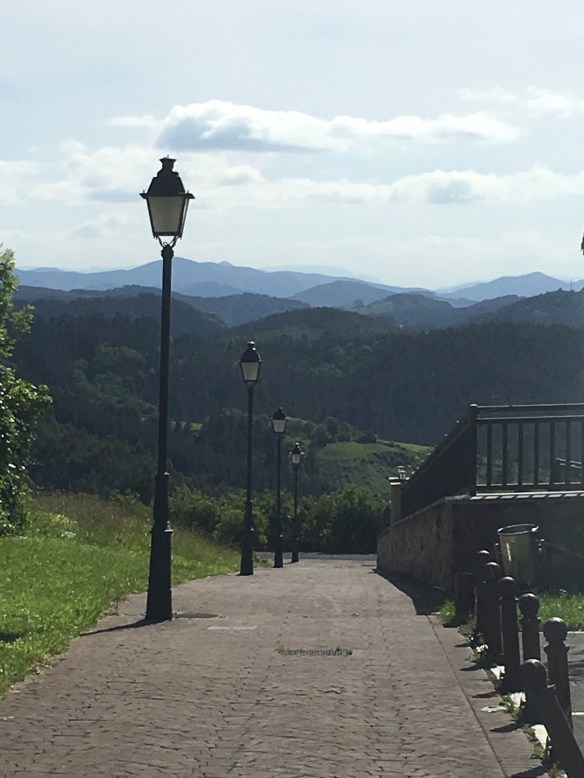
Imagine the path slick with rainfall and mud. I took this photo at the end of a beautiful, clear day, on the Camino de Santiago (del Norte). But just as often as there were dry, sunny days on the way, I encountered trails that were treacherous in rain.

IMG_5303

It was at the end of my longest hiking day in northern Spain that I met with such a descent – almost a full kilometre straight down on uneven cobblestone into the coastal town of Deba. The rain had started moments before. And I had just walked thirty-three kilometres in the hilly Basque country, all the way from Orio, near Zarautz.

I was exhausted. My mind was obsessed with getting to the pilgrims’ hostel as soon as possible. I was ready to collapse in a heap on my bed. Negotiating a tricky, slippery path was the last thing on my mind.

I had read and heard from fellow pilgrims these horror stories of unsuspecting pilgrims breaking their ankles on these kinds of descents. It was all too easy to cut short a pilgrimage after such an unfortunate accident. The practiced and seasoned hikers would know that one had to be very mindful of each step made. Even when they were tired. Even when being mindful of placing one foot in front of the other was the last thing they wanted to do.

On the last couple of Sundays we’ve encountered stories from the Gospel of Mark about Jesus’ healing ministry.[1] Indeed, during Ordinary (“green”) time in the church – both during the relatively shorter season after Epiphany in January and early February, and during the longer summer months in the season after Pentecost – the Gospel focus is the ministry of Jesus which includes healing.

In Lutheran circles we tend to look only at his proclamation; that is, we focus on what he said and taught the disciples about the kingdom of God. From this, we emphasize that Christian ministry is primarily about the proclamation of the good news. Mission, then, becomes more about ‘telling’ others about God, thus spreading the Word.

We miss an essential aspect of work-in-the-name-of-Christ with this limited vision of mission. Because, as elsewhere in the Gospels, we find that healing has equal prominence in Jesus’ ministry. Not only do we read about the miracles of Jesus curing disease, but more an inner healing for people battling their demons, so to speak. Healing has just as much to do about a renewed mind, a refreshed heart, a changed spirit. A reconstituted identity.

Healing is emphasized in the Gospel story today. Not just through words. But changed lives. Jesus came not only so that we might ‘believe’ with our minds in the good news, but that we might be healed in our earthen bodies and spirits.

How does this happen? What does Jesus do? From the text given to us today, Jesus’ took the hand of Simon’s mother-in-law, and “lifted her up.”[2] Jesus touches the person, physically. Taking someone by their hand is a sign of accompaniment. God is not remote from our human struggles. God is with us, Emanuel, in the person of Jesus. God takes our hand, and then lifts us up.

Faith can be described as movement. Last week we looked at the movement of ‘leaning into’ what we are afraid of, as a step in the direction of our healing – and finding Jesus is there. This week, the focus on the movement of ‘lifting up’, being ‘lifted up’, by God. As Jesus took the woman by the hand and lifted her up to be healed.

The Psalmist knew intimately this uplifting aspect of faith. “I lift my eyes to the hills, from where will my help come? My help comes from the Lord, who made heaven and earth.”[3] Many of the Psalm writer’s verses are called “psalms of ascent” because they were sung on the way ‘up’ to Jerusalem. The ancient pilgrim faithful needed to ‘look up’ as they made their way up the mount to the gates of the holy city. You know the hymn: “My Faith Looks Up to Thee.”

Faith is a ‘look beyond and upwards’ movement. In other words, the life of faith is not characterized by remaining stuck in the valley of our own suffering and misery. A faithful life, of course, does not deny our suffering nor is it pretending or distracting ourselves away from accepting its harsh reality.

Despite life’s imperfections, and struggles, however, to be faithful is to remain focused on others, on the promise of God, and on the hope we have. God takes our hand and is with us, and God sees it all. As Paul wrote, “we only see dimly now”.[4] Because we cannot understand all of life’s complexities, we need to trust in life, trust in good, trust in God’s time, in God’s way, that “all things work together for good for those who love and trust in God.”[5]

We are not just lifted up for our sake alone. We are called to lift others up, especially the downtrodden. Ours is the calling to lift others up – physically, emotionally, spiritually and materially.

We all know people who are ‘the lifters’. In their presence you feel lighter, lifted up. Whether it be their life story, their non-judgemental presence, their desire to show mercy and compassion, their interest in listening to you – they are an inspiration to us. They inspire us by their discipline, their focus in life.

The Gospel message is: We don’t need to be continually burdened by our suffering and narrow focus. We can be lifted up and transformed to be a reflection of God’s light to the world. In being truly ourselves, we can be ‘lifters’ too.

Remember: Resurrection is the end game of our faith. I mean not only of Jesus’ resurrection over two thousand years ago. I mean not only of our resurrection after we die our physical, earthly death. Because of Jesus’ healing ministry, we know that God also wants us to experience ‘resurrections’ in our own lives – on our earthly pilgrimage of living.

We can change, yes. It won’t be easy. It will take work. It will challenge us. We will need to move outside of our comfort zones. We will need to endure our momentary afflictions. On this journey of transformation, it will get harder before it gets easier. The truth will set us free, but it will first make us miserable. This is Christian truth. There is a cost. It is first the Cross of Christ; it is then the empty tomb of Easter.

There’s a woman from Tennessee whose name is Margaret Stevenson. She was in her nineties when I first read about her passion for hiking. You see, Margaret Stevenson used to hike ten or fifteen miles every day. She was a legend in the Smoky Mountains. She knew every trail and every plant and tree by its Latin and colloquial name.

Bill was much younger than Margaret when he hiked with her one day up Mt. LeConte. Now, Mt. LeConte is the third highest mountain in the Great Smoky Mountains National Park peaking at just over 6500 feet.

pexels-photo-414171.jpeg

Bill’s first trip up Mt. LeConte was Margaret’s seventy-fifth. When she finally stopped hiking she had climbed Mt. LeConte more than 700 times. Her husband rarely went, even before he got cancer.

When Bill and Margaret set out, they came upon what Margaret described as the most unrelenting two-mile ridge in the whole area – two miles up with no break. And this after a hard six miles on a very hot day.

Bill liked to hike in spurts, so he said, “See you later, Margaret,” and took off in his usual fashion and got way ahead of her. At some point, he found himself lying flat on his back in half delirium. A blurred Margaret passed him by at her steady pace. Bill can still hear the click-click of her cane and with no pity at all in her voice, she said, “One more mile to go, Bill. I’ll see you at the top!” And so, she did, arriving well ahead of Bill without stopping once.

Not long after that, Margaret’s husband finally died of cancer. But because of her daily walk with God, their last few hours were spent not in sadness or remorse, but in joy and celebration. For when Margaret says, “I’ll see you at the top!” she means it. For her face is fixed on Christ. Her step is steady and sure. And she knows the meaning of Isaiah’s words:

Even youth’s will faint and be weary,

And the young will fall exhausted;

But those who wait for the Lord shall renew their strength,

They shall mount up with wings as eagles,

They shall run and not be weary,

They shall walk and not faint.[6]

[1] Mark 1:21-28, Mark 1:29-39

[2] Mark 1:31

[3] Psalm 121:1-2, NRSV

[4] 1 Corinthians 13:12

[5] Romans 8:28

[6] William J. Carl III in David L. Bartlett & Barbara Brown Taylor, eds. “Feasting on the Word: Preaching the Revised Common Lectionary” Year B, Volume 1 (Kentucky: WJK Press, 2008), p.318-319.

Surprise ending

The Arnprior Rapids were destined to lose. If you asked me, midseason, to write the history of the 2017 Fall season of the Lanark-Renfrew Highschool Football League, it would sound completely different than it actually turned out in the end.

After playing five games, the Rapid’s opponent, the Almonte Thunderbolts, was undefeated. What is more, in all their games they did not have one single point scored against them. They were that good. By all counts, they were destined to be the League’s champion.

When a couple of weeks ago Almonte faced its arch rival and 2nd place Arnprior Rapids in the final championship game, many – even the players themselves deep down – felt this was a pointless exercise. Why bother even playing the game? Because the last time these two teams clashed Almonte thrashed Arnprior 40-0. And the time before that, 24-0.

So, you tell me. What will the history books have said about the outcome?

IMG_6618

These kids are learning an important life skill. Because as is often the case throughout life when things happen, it is easy to focus on what is wrong, what seems impossible, what appears a waste of time and energy. And give up.

Over the past several weeks, we have been reading some parables of Jesus recorded in the latter chapters of the Gospel of Matthew.[1]

These apocalyptic[2] parables sound somewhat harsh towards the human project: It seems human beings cannot help but eventually get it all wrong, whether it be the wicked tenants, the foolish bridesmaids or, as in today’s parable, the fearful investor.[3]

What is more, you get the feeling that the line between doing the right thing and the wrong thing is awfully thin. Even those that do get it right in Jesus’ telling are not that much different from those who get it all wrong – those who are doomed to the hell fires “where there will be weeping and gnashing of teeth.”[4] In short, there is a heavy, dark pall of negativity hanging over these stories.

It’s hard to remain enthusiastic about a life of faith when presented with these doom-and-gloom scenarios. It’s easier to become more fearful than hopeful.

When reading from this section in Matthew, I think we need to be mindful of the context of Jesus’ storytelling. We need to remember that Jesus told these stories while he was heading right into the middle of his own personal, high-risk venture, which led to arrest, torture, suffering and horrible death.

That is, he had decided to leave the relative safety of rural Galilee and head to Jerusalem, the capital city, where the authorities would regard Jesus as “a threat to the status quo and their own power.” The Romans would regard him as a “disturber of the peace” and condemn him to capital punishment on the Cross.[5]

We have the benefit of hindsight to help us better interpret these challenging parables. That is, because of the new life given to Jesus on Easter morning, we can now believe in resurrection, which is the end game of all of history. The benefit of Christ-faith is the hope and promise we discover on the other side of risk-taking, of losing, of failing and of taking responsibility. All the things that make us human.

Despite what may look impossible, a sure failure, a likely defeat and a waste of time and energy, this parable today encourages us to take heart and simply put our gifts, our talents on the line.

The sin described here is the sin of not risking anything, of not caring, not investing, of playing it safe and being overly cautious with what we have been given.

Whatever we have, “each according to their ability”[6], even if it’s only one, measly, tiny “talent” – when we risk giving it away to the world, allowing it to engage the world with positive intent, only then can good things happen. There are no guarantees good things will happen. But then again, we wouldn’t know unless we try. And take the risk.

But it’s well worth it! Because one talent is neither measly, neither is it tiny. One talent, according to some interpreters, was worth fifteen years wages or $1.25 million in today’s valuation. Just imagine the wealth of the entire property of the master who was placing it all in the care of his stewards.

Let’s take that to be God and us. When we can first appreciate all that wealth and riches that God has given us, and can begin to acknowledge the great faithfulness of God to entrust all that is God’s to us … now that’s something special about the God we worship. What a great joy! What a great responsibility!

In the end, this parable is not about money, essentially. Because even if the first two stewards who invested the little that was given them lost all that they invested on the market, Jesus would still have applauded them for trying. The attitude of risk-taking and putting it all on the line is the important thing, not the results of their monetary investment.

And then, when you try despite the odds stacked against you, you never know. How resurrection happens, and when, in the context of our own lives, will be a surprise.

When the Arnprior Rapids faced off against their arch rivals, the Almonte Thunderbolts in the Lanark-Renfrew Highschool Football League championship game, it was truly a David and Goliath show-down. The end looked bleak for Arnprior.

By all counts, Almonte should have won that game.

But, life is full of surprises. God is full of surprises. We can never know for sure what unexpected things await us when we put ourselves out there and invest our gifts on the playing field of life.

Not only did Arnprior score two touchdowns in the game – thus breaking Almonte’s bid for a clean sheet season – Arnprior did not allow a single point scored against them.

History is being written anew.

[1] Matthew 25:1-13, Matthew 22:1-14, Matthew 21:33-46; a parable is simply a fictional story Jesus tells to reflect some truth

[2] when the ‘end time’ promises of God are fulfilled

[3] Matthew 25:14-30

[4] Matthew 25:30

[5] John M. Buchanan in David L. Bartlett and Barbara Brown Taylor, eds., “Feasting on the Word: Preaching the Revised Common Lectionary Year A Volume 4” (Kentucky: WJK Press, 2011), p.308

[6] Matthew 25:15

From Loss to Life

“I have learned to be content with whatever I have. I know what it is to have little … and of being in need. I can do all things through him who strengthens me.”

 -Paul, to the Philippians 4:11-13

One of the basic truisms of pilgrimage walking is that first-timers usually pack more than they need for the journey. The general rule is ten percent of your body weight. For most people, that means no more than fifteen to twenty pounds in your backpack.

IMG_5303

I read in one of the Camino de Santiago guidebooks, in preparation for my walk last summer, that for most first-time pilgrims five pounds in their pack is unnecessary; these items amount to five pounds of fear: that extra sweatshirt, pajama onesie, that tub of moisturizing cream or the proverbial electric hairdryer. It is not long on the journey before at least five pounds are left behind or mailed home.

IMG_5285

If we use the pilgrimage as a metaphor for life, then the pilgrim on the journey of life, to be true to the journey, needs to learn how to let go.

IMG_5243

When I began I thought I had it down to the bare minimum. Nevertheless, I was still anxious. Those first few days I worried about where I was going to sleep that night. Not knowing how far I would walk, and not wanting to put the stress of expectation by booking ahead, I had to go with the flow and improvise in the moment. Even though I found a place every night, I was still preoccupied, distracted and fretting. Perhaps I had put too much faith in what I carried.

IMG_6116

Before I knew it, I lost some of my belongings those first days on the path. The first night I left behind my head lamp. The second or third night – I don’t know which – I lost my very expensive self-inflating bed roll for underneath my sleeping bag.

If the story ended there, you might say I was in an unwanted, growing state of crisis. If the story ended there you might say my pilgrimage was headed towards disaster, defeat, loss and failure. If the story ended there, you might say that everything was falling apart in my journey, collapsing into the rubble heap of destruction.

But the story didn’t end there. And it doesn’t end there.

The truth is, as Richard Rohr explains it best, that “through loss, through crisis, through stress, limitation, we move to a better place in our lives.

“Physicists today would say that loss is not real. There is only transformation. The metaphor of the liquid world is that this element simply moves from liquid to solid to vapor and back again.

“It looks like a death, a loss, in each case. But, in fact, it’s a becoming. Now we recognize that Jesus was saying this all along. In Christianity, it was called the ‘Paschal Mystery’. It was a phrase used by Saint Augustine that in fact dying leads to resurrection. Jesus became the icon, the living image, of that mystery – that his crucified body transformed into the risen Christ. That they are both the same person.

“Creativity, newness of life, has a cost. And the cost is what always looks like death. But really isn’t. The cost is loss. Which is perceived as an enemy, or affliction, which always looks like what we don’t want. Somehow to embrace loss, spiritually speaking, is to achieve eternity. Death allows us to be united with what is real. But, of course, it only looks like death from our side. Apparently from the other side – we call it heaven, or eternal life – is in fact the really real.

“The really real is already beginning now. And that’s what we need to trust. That’s what we need to allow. Fourteenth century Italian theologian Catherine of Siena once said: ‘It’s heaven all the way to heaven; and, it’s hell all the way to hell.’ And the way to heaven begins in this world, all the way to heaven.

“To avoid all loss, to avoid all letting go, is to avoid transformation into union with God. If you spend your entire life avoiding ‘dying’, Jesus would say you never get there. It’s hell all the way to hell.

“‘Unless the grain of wheat dies, it remains just a grain of wheat. But if it dies, it bears much fruit.’[i] We now know that this phrase was used in the initiation rites of Asia Minor. Perhaps one of Jesus’ most enigmatic lines is: ‘You must lose your life in order to find your life; you must lose your life in order to gain your life.’[ii] And if you don’t let it go, you will never find it.”[iii]

This is what Paul is talking about when he says he can do all things in Christ who strengthens him. That is, he can also ‘let go’. Not only does he know what it is to have plenty. He can also lose.

Philippians 4:13 is a popular well-loved verse in the New Testament: “I can do all things through him who strengthens me.” It is often used to bolster self-confidence in accomplishing heroic goals and aspirations. It is often quoted on posters, billboards and bumper stickers to indicate a glory, success and prosperity gospel message of human achievement more reflective of current self-help pop psychology. It is also used to undergird impressive mission goals in the church.

Moreover, the first nine verses of this chapter – the famous “Rejoice always!” text – are read on their own, as unfortunately prescribed in the Revised Common Lectionary, without including verses 10-13 for context. And the context is Paul’s suffering and need and persecution.

He is rejoicing and expressing his confidence in living precisely because he has travelled through the valley of the shadow of death. Precisely because he has learned to let go. You can’t have resurrection without death. You can’t experience the joy of transformation without first feeling the pain of loss. You can’t do mission unless you have let go, done without, lost — in some fundamental, real way.

Later this month on Reformation Sunday when all ELCIC Lutherans in Ottawa will gather to worship together, we will sing together Martin Luther’s well-known hymn: “A Mighty Fortress is our God.” Frederick Hedge’s English translation is closer to the original German when in the last verse we sing: “Let goods and kindred go, this mortal life also.”[iv]

Here, we get a peek into an under-emphasized aspect of Luther’s theology which included the practice of letting go. Not only is salvation realized at the moment of our mortal death, it is something that begins in the midst of living. That is, during our life we the practice the art of dying – of letting go, of losing – as an essential experience in the way of salvation, of transformation.

When I realized I had lost my head lamp and bed roll several days later, a couple of things were happening within me:

First, it took a while for me to notice these losses. I didn’t notice my loss right away perhaps because I really didn’t need those things. Second, and maybe more significantly, I was less stressed the farther I journeyed along the Camino. I was relaxing more into the pilgrimage, even without what I had deemed essential kit when I began.

Some Christians in the West today make the mistake, I believe, of confusing loss of privilege with persecution. Wealthy, financially advantaged Christians say they are being persecuted by a politically correct movement to recognize other religions and different people in a growing multi-cultural and pluralistic society, something Luther could never have envisioned in his day.[v]

We are not being persecuted. Rather, we are being confronted with the prospect of losing our privileged place in society, a status that we have admittedly enjoyed for centuries in our country. What the real issue is, is whether we will resist and avoid this loss, or whether we will accept it.

What is ending in your life? What are you facing that deep down you know is a loss? What are the failures and defeats and suffering in your life? Where is there suffering in the lives of the vulnerable, the underprivileged, the poor?

Pay attention, and wake up. These may, in truth, be invitations. Invitations to enter the gate of loss and letting go. Invitations to let go and trust that through dying, it is heaven all the way to heaven.


[i] John 12:24

[ii] Matthew 16:25, Mark 8:35, Luke 9:24, John 12:25

[iii] Richard Rohr, “The Art of Letting Go: Living the Wisdom of Saint Francis” (Boulder Colorado: Sounds True Audio CD Learning Course, 2010), Session Three.

[iv] Evangelical Lutheran Worship (Minneapolis: Augsburg Fortress 2006), Hymn 505

[v] The Rev. Dr. Gordon Jensen, “Luther’s Legacy” in Canada Lutheran (Volume 32, Number 6, September 2017), p.10-14

Even there your hand shall lead me

Later this summer I will be going on a 10-day canoe-camping trip on the French River. Last summer my friend and I did three nights and four days on a smaller portion of the French; this summer we want to challenge ourselves to do the whole, or at least most, of the river all the way from Lake Nipissing to Georgian Bay.

Because the challenge is greater, I felt I needed to take a First Aid Course in preparation, so I could be of some use to the company with whom I travel.

I learned some interesting facts about providing First Aid. Did you know that in all of Canada, except Quebec, you and I are not legally obligated to provide First Aid to anyone experiencing a medical emergency? In Quebec, however, we are legally bound to help someone who is in distress. It is, from Quebec’s point of view, a basic human right for any person to receive first aid in an emergency.

In class we discussed reasons why we may choose not to give First Aid: For fear of hurting them more, for fear of harming oneself, and of course for fear of legal repercussions. Our instructor countered this latter objection by reminding us of the “Good Samaritan Act” which governs any attempt in good faith to help someone in an emergency. So, legally, we were off the hook.

But we may still hesitate to take the risk and commit ourselves to helping someone. It would be easier to pretend we didn’t see it, get on with our busy day and avoid the added stress and responsibility.

Every time I read the wonderful story of the so-called “Walk to Emmaus” (Luke 24:13-35), something else piques my interest and causes me to reflect. I believe there is so much depth to this story while it provides a summary of what we believe as Christians. Particularly, this time, I wondered what Cleopas and his friend had to do with this incredible encounter with Jesus.

It seems they really had nothing to do with making this encounter happen, when Jesus appeared to them on the road that first Easter day. As far as we can tell, they weren’t expecting to meet Jesus let alone praying for it. And, ironically, when they do finally recognize the living Lord Jesus at the breaking of the bread, Jesus disappears from their sight! Truly, this event happened to them.

But were they merely passive recipients of this encounter? There is one turning point in the story, where things could have gone one of two opposite directions. Up until that point, they had not yet consciously recognized the man walking with them as Jesus himself. After that point, the table was set — literally — for their full recognition of Jesus.

Had they not invited Jesus to stay with them, for the evening was nigh, they would have missed out on a wonderful conclusion to their day. “Abide with us, for it is evening,” they invited this still stranger to them into their home. They could have chosen to let the man on his way. They could have chosen not to pay attention to their burning hearts. They could have ignored the subtle yet real ‘promptings of the Spirit’ we may call it today, within them.

I learned some thought-provoking statistics on my First Aid course this week. There we were, some twenty-five of us stuffed into a tiny room above a car repair shop in Renfrew. We were from all walks of life. Local businesses paid for their employees to take this course; therefore, my class mates were prompt and motivated to learn their First Aid techniques, principles and procedures. Certificates were issued upon successful completion of two exam periods and practice with bandages, splints and manikins.

Then, our instructor posted these statistics after asking us: Presuming it was done properly, what was the success rate of providing only chest compressions (sets of thirty thrusts downward over the chest) to someone who was unconscious and not breathing? What was the success rate of doing just that? 1.2%.

Without the aid of an Automated External Defibrillator (AED), adding ventilation to the chest compressions (pinching the nose and breathing in sets of two into the casualty’s mouth) raises the chance of recovery to only 5%.

I thought to myself: There is hope to humanity! Because it would be easy to just not bother! No wonder we may feel unwilling to commit to providing First Aid to an unconscious stranger on the street! What’s the point of doing that, let alone learning how to do it?! The chances of success are so slim!

And yet, there we were. These classes, I am told, are usually full. Businesses and organizations require their employees who engage with the public to know First Aid. They employ resources to make sure their employees have this training. All this effort for at best a 5% success rate.

But the ethics of it would argue: It is worth trying. Better to do something, than do nothing at all.

Sometimes I wonder whether being the church feels a bit like that. We expect the church to function at a 100% success rate; and when we fail the odd time, well — the church is no good, don’t bother. What is the worth of it all?

People are still bad. Failures in humans abound and seem to persist against all good intentions and efforts to be good. The message of the Gospel doesn’t always seem to make any positive difference in our lives. So, what’s the point?

Driving on Clyde Ave the other day, I noticed the sign outside the Reformed Church that reads: “Growth doesn’t come without change. Change doesn’t come without some risk.”

Following the example of Cleopas and his friend on the road to Emmaus, the only thing we can do, it seems, is learn to pay attention to those rare moments whenever our hearts are burning with love. And then, practice making the invitation in response to that nudging of our hearts and open our lives to those moments when we sense something shift within us. We may not be able to put our finger on it just yet, but respond nonetheless.

And then the rest is up to God. God is free. God enters our lives and walks with us whether we know it or not. God then ‘disappears’ from our awareness whenever God wants. But whether we feel God near or far, God is there. “Am I a God nearby and not a God far off? Who can hide in secret places so that I cannot see them?” says the Lord. “Do I not fill heaven and earth?” (Jeremiah 23:23-24).

The God of Easter is alive and present with us no matter where on earth we go. This is the good news of the resurrection. God is alive, and so we are called to rise up in renewal and joy. “If I take the wings of the morning and settle at the farthest limits of the sea, even there your hand shall lead me and your right hand shall hold me fast” (Psalm 139:9-10).

It is worth it. Even though we fail time and time again. There is the hope. There is the promise. There is the opportunity. There is the constant presence of God.

Buen Camino!

When in Sunday School decades ago we played the roles of well-known bible characters, I remember the only thing worse than being a “Judas” was to be a “doubting Thomas”.

We wanted to be Abraham, Moses, Kind David, Samson, Queen Esther, Rachel, Ruth, The Magi, Peter, Paul, John. We wanted to be Joseph or Mary, or even Jesus himself!

But Judas the Betrayer, or Thomas the Doubter? No. Indeed Thomas has been treated quite negatively in much of Christian preaching and teaching. He is often held up as a negative role model.

Let’s take a closer look at the text about Jesus’s resurrection appearance to his disciples (John 20: 19-31). Because there is no condemnation of Thomas. Recall the disciples are hiding behind locked doors in Jerusalem fearful of the authorities. Unless Jesus’ words to Thomas are inflected in an accusing way, they do not need to be read as a condemnation: “Have you believed because you have seen me? Blessed are those who have not seen and yet have come to believe” (John 20:29). They simply affirm that those who believe without first-hand experience of the risen Jesus are also blessed. (1)

But can we blame Thomas? Thomas only desires his own firsthand experience of the risen Jesus. He is unwilling to accept the secondhand testimony of others. And, his desire is granted: Jesus appears to him. Prayer answered!

I wonder if Thomas today doesn’t really represent so many of us who deeply yearn and seek for a first-hand experience of God, and are simply and naturally unsatisfied with hearing it ‘second-hand’. Hearing someone else’s first-hand experience of God is inspiring and instructional to be sure. We learn about someone else’s experience of God’s presence, healing, grace and wonder — whether that person is from the bible or our grandparents or the person sitting next to us in worship. But someone else’s experience of God can never be a substitute for our own.

What we may be looking for, is to be more like Thomas: Honest in our desire for a first-hand experience of the living God. Yearning to taste and feel more of the goodness of God in our own lives and in the world. Striving ourselves to make the world a better place for everyone. We may be unsatisfied with basing our commitment to a life of faith on someone else’s testimony. We may, like many people today, be seeking our own experience of God and suffer from what I would call the ‘second-hand syndrome’. Perhaps Thomas needs to be our role-model more than anyone else in the bible today!

Of course, the benefit of the Reformation was to teach us an important distinction in all our striving: Our motivation is important to be aware of, because if we strive to do good all in order to make ourselves right before God we will most certainly miss the mark. “We confess that we are captive to sin and cannot free ourselves,” we say in our Confession. God initiates the saving relationship. God moves; we only second the motion.

And yet, our striving, our trying, our good work as response to God can help create the space and the climate in which God’s grace is made clear to us, is given to us, and in which we are most ready, then, to receive God’s forgiveness, love and mercy. Being pro-active, doing things with one another in the church, yearning and striving for God — these are antidotes to the ‘second-hand syndrome’ and a prescription for a healthy life of faith.

Last week on the first Sunday of Easter, I emphasized the words from Matthew’s account of the Resurrection of Jesus outside the empty tomb that first morning. Jesus instructs the women: “Do not be afraid; go and tell my brothers to go to Galilee; there they will see me” (Matthew 28:9-10).

When resurrection happens today, as it always has beginning with that first day, there is movement forward. Not backward. As I said last week, there is no turning back once resurrection happens. The disciples are not instructed to meet Jesus in the empty tomb where the miracle happened. No. The instruction is quite clear: Get moving! Get out of here! Go to Galilee. Go to where I wait for you. In other words, don’t stay where you are! Do something!

In 2017 the Lutheran Church worldwide celebrates the 500th anniversary of the Reformation. We call it Reformation 500. ‘Five hundred’ is an important number in all the dialogue surrounding this momentous occasion. The national church has even set up the Reformation Challenges for the church across Canada to meet. And each of those goals are pegged at some variant of 500:

Five hundred refugee sponsorships (which already has been exceeded), five hundred scholarships for school children in the Holy Land, five hundred thousand trees planted in Canada, and five hundred thousand dollars raised for the Lutheran World Federation endowment. You can visit elcic.ca for the most recent update on where we are at in meeting all those goals. And please consider making a personal contribution towards any one of those worthwhile causes.

I’d like to up the ante. Let me call it the ‘Reformation 800 Challenge’. Eight hundred is the new Five hundred. Not only are we celebrating 500 years of Reformation this year; we turn to the future and pray not just for 500 more years but … 800. Why not?

Let that number, eight hundred, symbolize a confidence and hope-filled trust that God has more good than we can ever imagine in store for us in the church far into the future. And this is what I propose in this year’s Reformation 800 Challenge:

Next month, I begin walking the 800 kilometres from Irun, Spain to Santiago de Compostela in Galicia. The route I follow skirts the northern coast of Spain from East to West. This is my Reformation 800 Challenge.

I walk a pilgrimage route, one of the most ancient on the planet. This Camino (which means the “way”) has been an important spiritual discipline for almost a thousand years for millions of Christians.

A pilgrimage means that what happens on the outside of us in our physical reality mirrors the change and challenge that happens on the inside of us. In other words, outer and inner realities find some kind of resonance on a pilgrimage experience. It’s on a pilgrimage where many discover or re-discover their ‘walk’ with God in life, are renewed on their ‘path’ and/or are ‘re-directed’ to new ways of living.

I would like you to do this with me. Yes. I invite you to consider doing a Reformation 800 Challenge with me, in your own way, with your own resources and plan.

For example: In order to reach the goal of 800 kilometres in under two months I plan to walk at least 20 kilometres a day. So, while I’m gone would you consider a physical discipline whereby you, for 20 minutes a day, do something intentional for your own health and well-being: walking, cycling, lifting a small weight, stretching, doing yoga, etc.? It doesn’t have to be ‘extreme’; something simple even if you are confined to a chair or bed — for 20 minutes a day, do something that involves your body in ways you have not normally been accustomed. Be creative.

A piece of wisdom for pilgrims that has guided my preparation and planning is: Walk Your Way. Walk your own Camino. This is nobody else’s walk but yours. Do what you want and need to do, in your own way, according to your own pace.

You can interpret this challenge in many ways. For example, if you are very active and move about a lot in your daily life already, perhaps sitting still and quietly for twenty minutes a day in silent meditation and prayer is your way. Or, take twenty steps a day. Do twenty reps of a particular exercise or stretch. But whatever you do, the important thing is that you are challenged to attempt and remain faithful to a daily, body-involving discipline. Do it your own way.

Keep a journal or write your notes on a piece of paper that you stick to the fridge door. Write the date, and the accomplished task, so that over time, you can track your progress.

Your goal: 800 of something before the end of this year — whether eight hundred minutes, steps, kilometres. And here’s the good news. You already have a head start on me. I don’t begin until mid-May. You can start this afternoon, on your Reformation 800 Challenge! And, you have until the end of the year; I need to be finished my walk by early July.

After I return from my sabbatical, I would very much be interested in having a conversation with you about our experiences on our pilgrimage. They say that for pilgrims close to reaching their destination in Santiago, many confess that by the end it was no longer them walking the Camino, but the Camino was walking them. In other words, the experience of doing it created deeper trust in the way of God, of faith and peace within them. The physical reality converged with their inner life in positive ways.

As you contemplate what your discipline will be, as you think about what you will do, as you plan your own ‘pilgrimage’ — here are some questions for your own reflection and which can provide a basis for our own conversation when I return. Ask yourself:

In Preparation

What will you do to reach ‘800’ by the end of the year? In time? Kilometres? Steps? Reps? And how will you do it on a daily basis? (for example, 20 minutes/kms/reps/steps, etc. per day)

What are your intentions for this experience? What do you hope for by the end? The first recorded words of Jesus to his disciples in John’s Gospel are: “What are you looking for?” (John 1:38). How do you know you will find it if you don’t know what you are looking for in the first place?

What do you think you will discover about yourself? Saint Augustine once said that knowing yourself is a stepping stone to knowing God.

How will you record your journey?

On the Journey

Where did God find you? What experiences along the way brought you close to God?

What was the best part of the experience so far? What has been the greatest challenge?

Who did you meet along the way? Or, describe your relationships with others during the experience.

What were you grateful for?

Nearing the end / Getting close to the goal

What does it mean ‘to arrive’?

How does it feel to be reaching a destination after great effort and clear motivation for the journey?

What sacrifices did you make in order to get this far on the journey?

How will you celebrate and honour the ending of the journey?

After the Journey

What was the most memorable part of the whole experience?

How did you deal with disappointments and/or failure during the journey?

How do you now view God?

How will you keep what you learned alive in your regular life now that the journey is over?

Has anything shifted within you as a result of the experience? If so, how would you describe this change within yourself?

How will you share your journey and what you have learned with the important people in your life?

As we soon begin our pilgrimages, may God bless us on the way. And to all we meet along the path, may we wish them, “Buen Camino!”
1 — Marcus Borg & John Crossan, “The Last Week: What the Gospels Really Teach About Jesus’ Final Days in Jerusalem” (New York: Harper One, 2006), p.202-204.

Trust the down

I hate roller-coasters. It’s about the fear of letting go of control on the way down, that’s the problem. The couple times I’ve had the guts to go on a roller-coaster, I didn’t enjoy the experience because I couldn’t let go on the way down. Someone took a photo of me and my friend in the middle of one of those rapid descents: My friend who loves roller-coaster — his arms were up in the air and a big smile beamed across his face.

Sitting beside him, I was the opposite: My hands were glued to the bar in front of us, and my lips were pursed tightly and my eyes looked like they were going to pop out of their sockets. It looked as if I were staring death in the face, going down that roller coaster.

I read this week: “Humans are the only creatures who have knowledge of their own death. Its awareness creeps on us as we get older. All other animals, plants, and the cycles of nature themselves seem to live out and surrender to the pattern of mortality.

This places humans in a state of anxiety and insecurity from our early years. We know on some level that whatever this is that we are living will not last. This changes everything, probably more than we realize consciously. So our little bit of consciousness makes us choose to be unconscious. It hurts too much to think about it.” (1)

We humans find ingenious ways to avoid this journey, especially through Holy Week, that invites us to contemplate not only human death but the death of God in Christ Jesus. No wonder, especially among Protestants, attending services through Holy Week is not popular. This is not easy work, to face Jesus’s and our own mortality. No fun in that.

One way we avoid and deny this awareness of our own mortality is to find a scapegoat — by focusing all our negative energy on something or someone else. Our scapegoat is that which deludes us into believing that its destruction will somehow solve all our problems and make everything better again. Our scapegoat also shields us from taking responsibility for and dealing with our own problems.

Today, the scapegoats are easy to identify: The immigrants, the newcomers to Canada, the Muslims, the gays, the corrupt politicians, the government, the media, the church hierarchy — you name it. The blame game is alive and well, even in the church.

And then what happens is what many wise teachers through the ages have said: When we deny our own suffering we make others around us suffer. Which is unfair and unjust. Because the Gospel was given first and foremost to the followers of Jesus. 

“The time is fulfilled and the kingdom of God has come near,” The Gospel Mark thus records Jesus’s first words to his own people in Galilee. And to them he said, “Repent and believe in the Gospel” (Mark 1:15). We are the ones addressed by the Gospel — those who are already in the church, in the family of God. Not those so-called ‘bad’ people out there.

Jesus was the scapegoat whose destruction would solve the high-priestly authorities’ problems. By having Jesus put to death, the religious authorities could maintain their power and privileged position in Jerusalem, the Roman Emperor’s fears of insurrection would be temporarily alleviated, and the Pax Romana (the Roman rule) would continue in the land.

As unjust as killing Jesus was — for many even in authority including Pilate saw that Jesus was innocent — Jesus was the convenient scapegoat whose death on a cross would make it easy on those in power. And maintain the unjust status quo in the land.

After hearing of Jesus’ raising of Lazarus from the dead, the high priest, Caiaphas, advised the rest of the leadership in Jerusalem: “It is better for you to have one man die for the people than to have the whole nation destroyed” (John 11:50). Rather than do the right thing in the moment, the end — a false peace — justifies the unjust means. Classic scapegoat -ism: Jesus became the convenient victim in the human power play of first century Judean politics.

It’s ironic that our fear, denial and avoidance of death is actually that which keeps us stuck in scapegoating, in blaming others, in all the motivations for war and violence in the world. You could argue that all of what is bad in the world today stems from humanity’s continued ambivalence and denial of death.

What’s amazing is that Jesus, knowing all along this human condition, chose to become a victim to it. From his privileged unity with God the Creator, he chose to connect with humanity. The reading on Palm Sunday from Philippians 2:5-11 describes this downward movement of God in Christ into the “enfleshment of creation” (2), and then into humanity’s depths and sadness, and final identification with those at the very bottom, “taking the form of a slave” (Philippians 2:7), to death on the Cross.

Jesus represents God’s total solidarity with, and love of, the human situation. It’s as if God is saying: “Nothing human, now, is abhorrent to me.” This is incredible.

The Cross represents the divine choice to descend. It’s almost total counterpoint with our humanity that is always trying to climb, achieve, perform, justify and prove itself. The witness of the Cross is the divine invitation to each of us to reverse the usual process.

Christians worldwide have a great gift and witness in the Gospel of Christ crucified. The divine union with humanity suggests that everything human — including death, losing and letting go that is so much a reality in all our lives — is embraced by God’s love. The reason God loves even our shadow sides, is because God experienced the fullness of its brutal and unjust consequences, in the death of Jesus.

Jesus is like the human blueprint for our own transformation. Because who would have presumed that the way up could be the way down? It is, as Saint Paul writes, “the secret Mystery” (Romans 16:25).

Trust the down, and God will take care of the up. The hymn in Philippians 2:5-11 says that Jesus leaves the ascent to God, in God’s way, and in God’s time. Because Jesus went to the bottom of all that is human, “God lifted him up, and gave him the name above all other names” (Philippians 2:9-11).

Of course, they say the joy of a roller coaster’s twists, turns and rapid descents is knowing and trusting that the ride eventually and surprisingly goes up. What an incredible rush! Carl Jung wrote: “Not wanting to live is identical with not wanting to die.” (3) The roller coaster analogy suggests that when we refuse to descend, when we avoid facing our own mortality, and avoid taking responsibility for our own suffering, we also don’t really live.

Conversely, we can only truly live when we have faced and come to terms with the reality of our own mortal, imperfect human lives. Being fully human is being fully spiritual, faithful and alive. Saint Irenaeus was first to say in the second century that the glory of God is human being fully alive.

Trust the down, and God will take care of the up. When challenges, disappointments, defeats and failures come your way, don’t rush into avoidance techniques, distractions, denial of the problem or blaming others for the circumstance you find yourself in. What do these events have to teach you? Where is God in the midst of your suffering? What are the signs of grace therein? Christian faith asserts that God is revealed precisely in those lowest moments. Jesus believed this. It was trust in his Father that got Jesus through his passion, suffering and death.

Trust the down, and God will take care of the up. Resurrection was just around the corner.


1 — Richard Rohr, “Wondrous Encounters: Scripture for Lent” (Cincinnati Ohio: Franciscan Media, 2011), p.100.
2 — Rohr, ibid., p.123
3 — cited in Rohr, ibid., p.123.

Lent begins again: Why?

We begin a journey of some forty days, which mirrors Jesus’ forty days in the wilderness (Matthew 4:1-11). We continue to observe the season of Lent, year after year, as we approach the most holy of Christian days — Easter, the resurrection of our Lord.

But why do we do this? Why do we continue to do this, it seems, against the flow of society and the dominant culture today? As a child, I remember when it was more popular to ‘give up’ something for Lent; people actually did give something up, like dessert or TV. Some still do, I know.

And yet, it seems from the perspective of our economy and lifestyle today, that planning for March break, and sun-shine, escapist getaways get more attention and energy than any spiritual discipline might.

So, let’s begin our Lenten journey with a close look at why we need to go on this trip in the first place. Speaking of journeys, then, here’s a fascinating one from the history books:

“Early in the twentieth century, the English adventurer Ernest Shackleton set out to explore the Antarctic …. The land part of the expedition would start at the frigid Weddell Sea, below New Zealand …

“‘The crossing of the south polar continent will be the biggest polar journey ever attempted,’ Shackleton told a reporter for the New York Times on December 29, 1913.’

“On December 5, 1914, Shackleton and a crew of twenty-seven men set out for the Weddell Sea on the Endurance, a 350-ton ship that had been constructed with funds from private donors, the British government and the Royal Geographical Society. By then, World War 1 was raging in Europe, and money was growing more scarce. Donations from English schoolchildren paid for the dog teams.

“But the crew of the Endurance would never reach the continent of Antarctica.

“Just a few days out of South Georgia Island in the southern Atlantic, the ship encountered mile after mile of pack ice, and was soon trapped as winter moved in early and with fury. Ice closed in around the ship ‘like an almond in a piece of toffee,’ a crew member wrote.

“Shackleton and his crew were stranded in the Antarctic for ten months as the Endurance drifted slowly north, until the pressure of the ice floes finally crushed the ship. On November 21, 1915, the crew watched as she sank in the frigid waters of the Weddell Sea.

“Stranded on the ice, the crew of the Endurance boarded their three lifeboats and landed on Elephant Island. There Shackleton left behind all but five of his men and embarked on a hazardous journey across 800 miles of rough seas to find help. Which, eventually, they did.

“What makes the story of the Endurance so remarkable, however, is not the expedition. It’s that throughout the whole ordeal no one died. There were no stories of people eating others and no mutiny [to speak of …. Some have argued that ] “This was not luck. This was because Shackleton hired good fits. He found the right men for the job ….

“Shackleton’s ad for crew members was different [from the norm]. His did not say WHAT he was looking for. His did not say: ‘Men needed for expedition. Minimum five year’s experience. Must know how to hoist mainsail. Come work for a fantastic captain.’ Rather, Shackleton was looking for those with something more. He was looking for a crew that belonged on such an expedition. His actual ad ran like this:

“‘Men wanted for Hazardous journey. Small wages, bitter cold, long months of complete darkness, constant danger, safe return doubtful. Honour and recognition in case of success.’

“The only people who applied for the job were those who read the ad and thought it sounded great. They loved insurmountable odds. The only people who applied for the job were survivors. Shackleton hired only people who believed what he believed. Their ability to survive was guaranteed.” (1)

Year after year, the Gospel text from Matthew 6 is read on Ash Wednesday which marks the beginning of the Lenten journey. It is a journey, a pilgrimage, you might say. For those willing to embark on the sometimes harrowing yet intentional path, Jesus points to the authentic quality and honesty of community life.

Being the church in the world is not to give a false impression, to show how exceptional we are in the religious marketplace. Being the church to the world is to be authentic and true to what we believe and who we are, whether or not we measure up to some cultural standards of behaviour.

Maybe that explains why Lent is no longer popular in our day. Society has already been for a while losing ourselves in distractions. In 1985 Neil Postman claimed that we were “Amusing Ourselves to Death.” (2) Over a decade earlier, Ernest Becker wrote a book I read in seminary, entitled, “The Denial of Death” (3) which is a theological reflection on how we live in ‘modern’ North America.

Indeed, we in the West continue on a course of distracting ourselves to death — with stimulating toys, technological advance and even more addictive ways to keep the truth at bay. This strategy, with often tragic consequences, only serves to drive a deeper wedge and division from our true selves.

The symbolic destination of the Lenten journey is the Cross, on Good Friday. And so, right off the start, we know this can’t be an easy journey, when we have to face and bear our own cross. But this is what life is about, is it not? Whenever hardship comes our way in whatever form it does — illness, loss, tragedy, disappointment, conflict and confrontation, failure, guilt, pain. We don’t have to seek it out; Suffering comes to us all. This is a reality we are called to accept.

We are called not to deny that our message is for people who are honest about their brokenness, who in their vulnerability do not want to pretend their weaknesses away. Our suffering can be a great teacher, an opportunity for growth and wholeness.

Suffering, in the words of Canadian theologian Douglas John Hall, “belongs to an order of creation insofar as struggle … is necessary to evoke the human potential for nobility, for love, for wisdom, and for depth of authenticity of being. A pain-free life would be a life-less life.” (4)

Lent is not a path to ultimate self-annihilation. Ultimately, Lent is not a downer. Because suffering can point to a new beginning. Followers of Jesus are not a people who suffer the pains of life without faith and hope. We can face what life brings, with a conviction that together, we can do more than merely survive.

On this journey we can experience that the whole is greater than the sum of its individual parts. In accompanying each other through the difficult times, we can experience something greater than ourselves. Together we will realize more than we could ever have imagined on our own; transformation, resurection, a new beginning. Together, because God in Jesus goes with us. We are not alone on this journey.

God blesses this journey.

1 – Simon Sinek, “Start With Why” (New York: Penguin, 2009), p.90-93
2 – Neil Postman, “Amusing Ourselves to Death” (New York: Viking Penguin, 1985)
3 – Ernest Becker, “The Denial of Death” (New York: Free Press, 1973)
2 – Douglas John Hall, “God and Human Suffering: An exercise in the Theology of the Cross” (Minneapolis: Augsburg Publishing House, 1986), p.62-63

The other side

In a Brazilian folk tale called, “The Little Cow”, a master of Wisdom was walking through the countryside with his apprentice. They came to a small disheveled hovel on a meagre piece of farmland. “See this poor family,” said the Master. “Go see if they will share with us their food.”

“But we have plenty,” said the apprentice.

“Do as I say.”

The obedient apprentice went to the home. The good farmer and his wife, surrounded by their seven children, came to the door. Their clothes were dirty and in tatters.
“Fair greetings,” said the apprentice. “My Master and I are sojourners and want for food. I’ve come to see if you have any to share.”
The farmer said, “We have little, but what we have we will share.” He walked away, then returned with a small piece of cheese and a crust of bread. “I am sorry, but we don’t have much.”

The apprentice did not want to take their food but did as he had been instructed. “Thank you. Your sacrifice is great.”
“Life is difficult,” the farmer said, “but we get by. And in spite of our poverty, we do have one great blessing.”

“What blessing is that?” asked the apprentice.

“We have a little cow. She provides us milk and cheese, which we eat or sell in the marketplace. It is not much but she provides enough for us to live on.”

The apprentice went back to the Master with the meagre rations and reported what he had learned about the farmer’s plight. The Master of Wisdom said, “I am pleased to hear of their generosity, but I am greatly sorrowed by their circumstance. Before we leave this place, I have one more task for you.”
“Speak, Master.”

“Return to the hovel and bring back their cow.”

The apprentice did not know why, but he knew his Master to be merciful and wise and so he did as he was told. When he returned with the cow, he said to his Master, “I have done as you commanded. Now what is it that you would do with this cow?”
“See yonder cliffs? Take the cow to the highest crest and push her over.”
The apprentice was stunned. “But, Master …”

“Do as I say.”

The apprentice sorrowfully obeyed. When he had completed his task, the Master and his apprentice went on their way.

Over the next years, the apprentice grew in mercy and wisdom. But every time he thought back on the visit to the poor farmer’s family, he felt a pang of guilt. One day he decided to go back to the farmer and apologize for what he had done. But when he arrived at the farm, the small hovel was gone. Instead there was a large, fenced villa.

“Oh, no,” he cried. “The poor family who was here was driven out by my evil deed.” Determined to learn what had become of the family, he went to the villa and pounded on its great door. The door was answered by a servant. “I would like to speak to the master of the house,” he said.

“As you wish,” said the servant. A moment later the apprentice was greeted by a smiling, well-dressed man.
“How may I serve you?” the wealthy man asked.

“Pardon me, sir, but could you tell me what has become of the family who once lived on this land but is no more?”

“I do not know what you speak of,” the man replied. “My family has lived on this land for three generations.”

The apprentice looked at him quizzically. “Many years ago I walked through this valley, where I met a farmer and his seven children. But they were very poor and lived in a small hovel.”
“Oh,” the man said smiling, “that was my family. But my children have all grown now and have their own estates.”

The apprentice was astonished. “But you are no longer poor. What happened?”

“God works in mysterious ways,” the man said, smiling. “We had this little cow who provided us with the slimmest of necessities, enough to survive but little more. We suffered but expected no more from life. Then, one day, our little cow wandered off and fell over a cliff. We knew that we would be ruined without her, so we did everything we could to survive. Only then did we discover that we had greater power and abilities than we possibly imagined and never would have found as long as we relied on that cow. What a blessing from Heaven to have lost our little cow.” (1)

This story is not a prescription for how the church or society should treat economically disadvantaged, underprivileged people — by ignoring their plight and expecting them to pull themselves up by their own bootstraps. 

Instead, I offer this story as an allegory, a parable, of whatever it is in our lives that keeps us bound, that keeps us stuck. 

The cow, in the story, represents that which the farmer believed would help them survive in the big, bad world. And without it, they would be lost.

What is ‘the cow’ in your life? Whatever you believe you cannot live without. What keeps you bound, shackled in a sense? It may not appear or even be a bad thing. It can be the ‘best’ thing in your life, you will say! And that’s point of the fable.

The cow was the only thing, the best thing, the poor family had going. In our lives, it can be the relationship we have with our work. It can be a person. It can be some activity of our lives that we think we want and need. What is the ‘cow’ in your life — things to “let go ” of, either in church life or your personal lives, that would enable the freedom of God to operate?

Letting go of over-attachment to building? Property? Material riches? Some significant aspect of your financial portfolio?Clutching on to church programs and processes that have had their day, making room for something new?

It could even be your reputation, your status, or social position. Whatever it is …

If we should lose that, why would God want that for us? And when we do lose it, we may be angry at God for taking it away from us. We may shake our fists at God, walk away in disgust and anger, never to darken the door of a church again. We may be blind to the possibilities on the other side.

In the Gospel text today (Luke 8:26-39), Jesus travels to opposite side of Lake Galilee. He goes to what I will call ‘the other side’, where the people in the Gentile territory there respond to the miracle of exorcism with fear. The man they knew to be living on the outskirts of town, out of his mind, full of demons — now sat at the feet of Jesus “in his right mind” (v.35).             

Odd as it may sound, we often prefer the devil we know to the freedom we do not. We can take a false sense of security from the patterns of our lives we learned to cope with over the years. 

And we may fear what change — even change for health — may bring. Because that would mean losing that which we have grown accustomed, even cherished, for a long time. We keep ourselves from seeing the possibilities on the other side.

The truth of the Gospel of Jesus Christ reverses the fortunes of those in low estate. The “good news to the poor” which Jesus announces in his inaugural speech (4:18) becomes a reality in the healings and exorcisms that follow in Luke’s Gospel.

But this freedom and health does not come without major disruption in people’s lives. This is the part we like to dismiss in our “feel good”, “prosperity-gospel” driven culture of church in North America. 

Because to the people whose living depended on the pigs — those pigs who ran off the edge of a cliff to their deaths — their loss is catastrophic. The swineherds in the Gospel story are understandably afraid, too, even angry at Jesus. And despite the healing, they want Jesus to leave them (v.37).

The story demonstrates that the the Gospel brings upheaval and sets in motion powerful forces that will disrupt our lives. 

At first, the good news of Jesus will not seem good to everyone. At first, our economic and social lives are put on their heads. At first, we will experience pain and suffering. We will need to surrender that which has given us a sense of security in life. 

We cannot have Easter without “Good” Friday. The cross precedes the empty tomb. The way of salvation goes through suffering, not around it. We cannot avoid pain in our journey towards liberation, healing and salvation.

The good news is the promise that there is no darkness, no loss, no pit too deep that God will not go into, in order to carry us through to the other side.

(1) cited in Richard Paul Evans, “The Walk” Toronto: Simon & Schuster, 2010, p.285-288

Happy Birthday! (funeral sermon)

“Jesus said to her, ‘I am the resurrection and the life. Those who believe in me, even though they die, will live, and everyone who lives and believes in me will never die. Do you believe this?’” (John 11:25-26)

It may seem strange to say this, today: On a day we mourn at the death and loss of a loved one. A loved one, nonetheless who lived to a 103! A loved one whose 104th birthday is today! “Happy birthday Wilma!”

When we say a funeral service is a ‘celebration of life’ we affirm this with mixed feelings, to be sure.

Kind of like the other paradoxes in our lives: Because, for example, we know that we are better fulfilled in giving rather than receiving. Because, as people of faith, we know that it is in dying that we live — on many levels.

That is why a funeral service is like an Easter service when we celebrate the resurrection of Jesus. That is why, the day Jesus died on the cross is called “Good” Friday. Talk about paradox.

So, with confidence, we gather today to have a birthday party. Because Wilma, a person of deep faith in the living Lord, lives today in heavenly glory! 

Happy birthday Wilma!

At birthday parties we often tell stories about the person’s life, to date. There is one story from early on in Wilma’s life that I wish to highlight: When she was five years old, the windows of the Halifax house she and her family were living in blew inward, planting shards of glass deep in the layers of the skin on her head. She and her family survived the famous Halifax explosion.

Until Wilma was well into her 40s she was pulling little pieces of glass from her skin. For a large chunk of her life, especially in her formative years, she had to live with this reminder of her near death experience at such a young age. She was, in the first part of her life, regularly made aware of the fragility of her life and the reality of her mortality. That with each step we take in life, death walks along close by. Maybe that’s why she lived so long.

We try to avoid death. We deny it at every turn. We don’t want to see it. And yet, in avoiding death we also avoid living. Living to the upmost. The key to a rich life is to be aware that our death is only one breath away. 

It is common knowledge that the most effective, greatest and skilled soldiers in history were men and women who were willing to die in giving themselves to engage each combat situation. When you accept your own death at any given moment, then you can truly live.

An incredible paradox, isn’t it? How can we live in the ambiguity, uncertainty and mystery of this reality?

Wilma, as I said, was a woman of deep and enduring faith — through it all. It’s amazing when you think about the history she lived through: the rise of the automobile; the radical advance of technology from wires to the digital age; the many wars and two world wars of the last century, the Depression and economic ups and downs, the social revolutions. Through it all, she nurtured, and was nurtured in, a life of faith in the God who died in order to live.

Perhaps a deep knowing of this leads one to bless others. Indeed, this is how I got to know Wilma in these last four years of her life. Mostly through touch. In the tradition of the church, a blessing of healing and grace was given primarily by the ‘laying of hands’. It was a challenge to communicate with her, and yet, experts affirm that 70% of communication is non-verbal.

Wilma’s image of God was of a gracious, giving, loving God. She bristled at me early in our relating when I said the version of the Lord’s Prayer that has the line: “Lead us not to temptation …” She stopped me right in the tracks of that prayer, right there: “Stop,” she said. “God does not lead us to be tempted!” she objected. So, we changed the words. And that is why you read a slight variation in that sentence in the liturgy today.

God is a God of compassion and caring. God loves. Even when we can’t. Even when our love is imperfect and fraught with our own sin and misgivings. God comes to us first with a word of compassion, healing and mercy. This is the God Wilma believed in.

Her mission in life, in the last few years, was to bless others who cared for her. I learned this when she was at Fairfield Manor in Kanata, that she would routinely bless the nurses that attended to her. 

And after our many visits there, she would lean close to me and kiss me on my forehead. She said: “That’s the kiss of Jesus, saying that he loves you. And I do too.”

I responded: “I love you too, Wilma.”

Then, ever true to her belief, Wilma said: “That makes the Holy Trinity — three loves!”

Perhaps, then, Wilma leaves us with the legacy of faith that doesn’t pretend life is meant to be perfect. Because she wasn’t. But life is meant to be lived as long as we are given breath, in order to be a blessing of love to one another, as best we can.

Because God does.

Amen.