Courage and Joy

Last night, the hustle and bustle of getting ready, and anticipating the birth. Last night, the noise, the anxiety, the smelly stable, the animals, the shepherds, the chorus of heaven singing in the starry, silent night. “Joy to the world” indeed!

Today, however, the child is born. A little more breathing room, perhaps. A little more time for realizing what just has happened. Time, amidst the burping, squawking infant feeding for quiet reflection, to ponder this miraculous birth, this wondrous event that will change everything! “What child is this?” indeed!

As things begin to sink in, to settle, one may ponder the last several months as I am sure Mary and Joseph did — how it all began to take shape. It all started, of course, when the Angel Gabriel visited Mary to tell her the news of God’s intention (Luke 1). 

Looking back, this was the critical moment. In the reverie it almost feels like the Mission Impossible theme song should start up: “Should you choose to accept your mission ….” Da-Da, Da-Da-Da, Da-Da. 

Everything depended on that moment of decision on Mary’s part. The course of history hung in the balance. So much at stake. What does she do? How will she respond?

During Christmas, Mary mother of Jesus figures prominently in the story-telling. Traditionally, Mary has been imagined by Christians as a passive, placid, sweet and quiet girl. Certainly she is portrayed like this in many a Sunday School Christmas pageant.

But the biblical record suggests something more. Listen to the famous poem, the “Annunciation” by Denise Levertov who captures the immensity of the moment:

“We know the scene: the room, variously furnished, 

almost always a lectern, a book; always

the tall lily.


Arrived on solemn grandeur of great wings,

the angelic ambassador, standing or hovering,

whom she acknowledges, a guest.

But we are told of meek obedience. No one mentions

courage.


The engendering Spirit

did not enter her without consent.

God waited.

She was free

to accept or to refuse, choice

integral to humanness.

Aren’t there annunciations

of one sort or another

in most lives?


Some unwillingly

undertake great destinies,

enact them in sullen pride,

uncomprehending.

More often

those moments

when roads of light and storm

open from darkness in a man or woman,

are turned away from

in dread, in a wave of weakness, in despair

and with relief.

Ordinary lives continue.

God does not smite them.

But the gates close, the pathway vanishes.

She had been a child who played, ate, slept

like any other child–but unlike others,

wept only for pity, laughed

in joy not triumph.

Compassion and intelligence

fused in her, indivisible.

Called to a destiny more momentous

than any in all of Time,

she did not quail,

only asked

a simple, ‘How can this be?’

and gravely, courteously,

took to heart the angel’s reply,

the astounding ministry she was offered:

to bear in her womb

Infinite weight and lightness; to carry

in hidden, finite inwardness,

nine months of Eternity; to contain

in slender vase of being,

the sum of power–

in narrow flesh,

the sum of light.


Then bring to birth,

push out into air, a Man-child

needing, like any other,

milk and love–

but who was God.

This was the moment no one speaks of,

when she could still refuse.

A breath unbreathed, Spirit suspended, waiting.

She did not cry, ‘I cannot. I am not worthy,’

Nor, ‘I have not the strength.’

She did not submit with gritted teeth,

raging, coerced.

Bravest of all humans,

consent illumined her.

The room filled with its light,

the lily glowed in it,

and the iridescent wings.

Consent,

courage unparalleled,

opened her utterly.”

How did she handle the moment of decision before the Angel Gabriel? I must conclude, with both courage AND joy. Often we don’t consider the two together. Either someone has a whole lot of courage, determination, and serious intent about their business. Or, someone tends towards the frivolous, uncontained in their happiness and joyful demeanour — even being silly, unfettered from the cares of the world.

During the memorial service for the late Dorothy Mueller last week, we recalled a moment in Dorothy’s early life in Montreal with her husband Henry. One night all dressed up for going out dancing on the town, she and Henry came across a street fight where a couple boys were beating up another. Without missing a beat she crossed the street, strode right up to the offending boys and demanded that they stop their violence. Which they did.

Not many of us would demonstrate that level of courage in the public arena. And take the risk to stand up out of passionate concern for the underdog, the downtrodden, the suffering, the poor.

What else is impressive is that she showed that courage while out on the night, dancing. Along with any kind of bold, courageous deed on behalf of the poor, we must also be filled with joy, of letting go, of honest and playful engagement with ourselves and our loved ones — all of which good dancing demands and embodies.

Theologian Gustavo Gutierrez, and others, have suggested that the most appropriate contemporary equivalent to “The Word became flesh” (John 1:14) may be “The Word became poor.” (1) Like Mary, like Dorothy, we too need to express joy in our lives even as we are called to do the right things on behalf of the poor and the needy.

Dancing is a relational/relationship-building activity. And this is what we ultimately celebrate at Christmas. When Mary, with courage and joy, accepted the mission presented by the Angel Gabriel, the God-human relationship was now restored in the incarnation — the birth of Jesus. Indeed, “The Word became flesh.” Because of that first Christmas the divine could finally, truly and intimately relate to all humanity. To us.

God was now human in the person of Jesus. At Christmas, we celebrate the divine-human dance. At Christmas we ponder the love of God that seeks to fully understand each one of us. We ponder this great love which brings God’s comfort, mercy and encouragement no matter the depth of our grief, the extent of our suffering, the measure of our pain and loss. Jesus came into the darkness of the 1st century world. And, Jesus continues to come into the darkness of our lives.

At Christmas-time, this year, the dance continues. Yes, the world, our lives, still have problems. At the same time we can express the grace of God that comes to us in different ways, and to each according to our needs.

Perhaps, on this Christmas Day, we can start by giving thanks to God for Mary — her courage and joy at being the first to receive Christ.

(1) cited in “Feasting on the Word: Advent Companion”, WJK Press Kentucky, 2014, p.138

You shall see the light

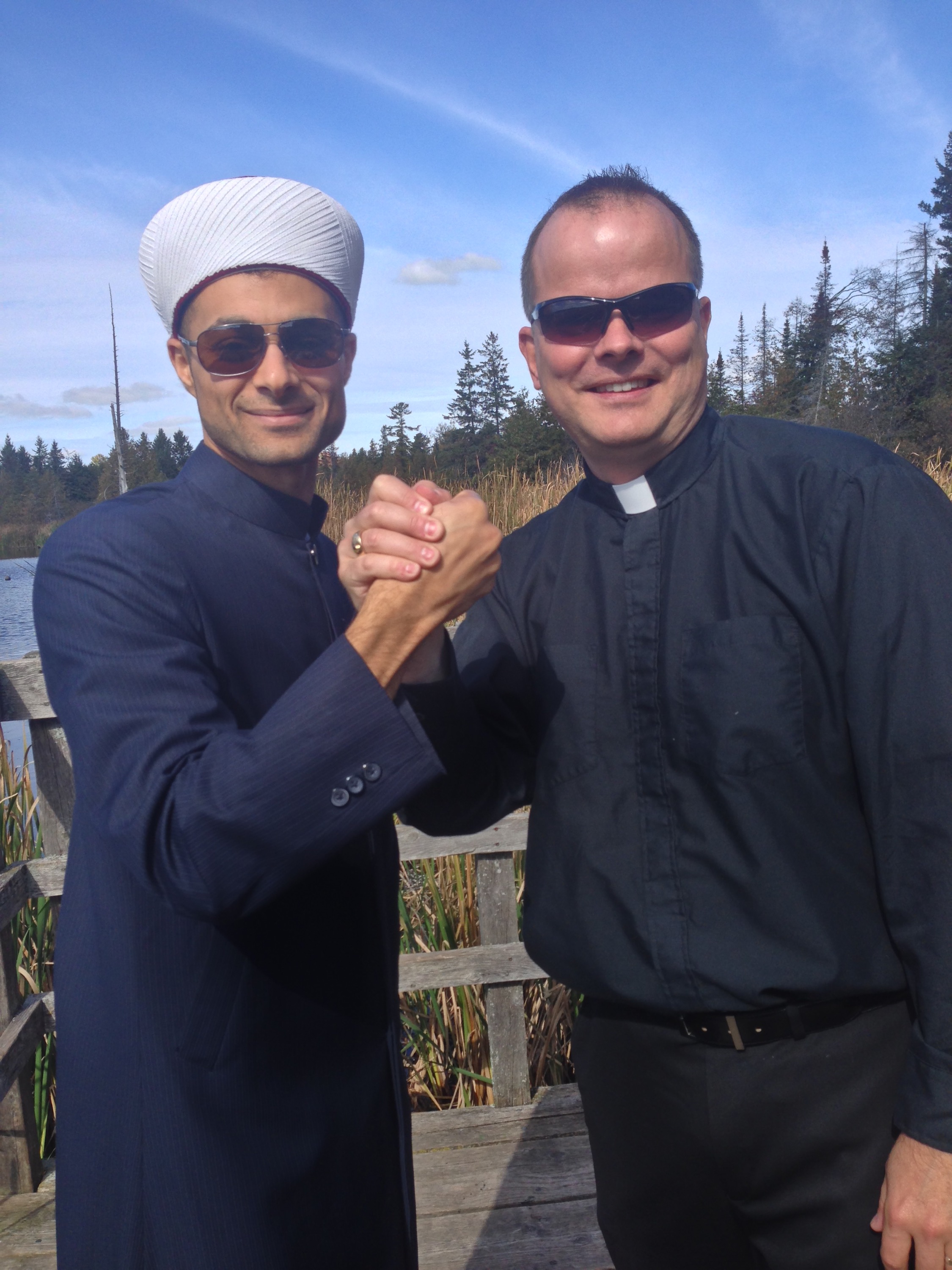
Jesus commanded that we shall love our neighbour as ourselves (Matthew 22:36-40). This commandment motivates me to participate this afternoon in the clerics’ cycling challenge (www.clericchallenge.com), initiated by Imam Mohamad Jebara.

  
Practically, then, what Jesus’ commandment means is that if you love someone, you want to know something about her or him. You want to know who she is, what he values, and how they orient their life. If you love someone, you take the time to talk to him, get to know her, and in so doing, you share yourself as well. 

  
Love shows itself in attention to another, in accepting another on their own terms — yes, and in a willingness to learn something new, to think about things in a new way, and to grow together in friendship and harmony. 

  
When I say Christians are called to love their Jewish or Muslim neighbours, for example, I mean we are called to develop relationships of mutual affection, understanding, and appreciation (Kristin Johnston Largen, “Interreligious Learning and Teaching” Fortress Press, 2014, p.59). Then, we love our neighbour as ourselves, thus fulfilling Jesus’ commandment.

  
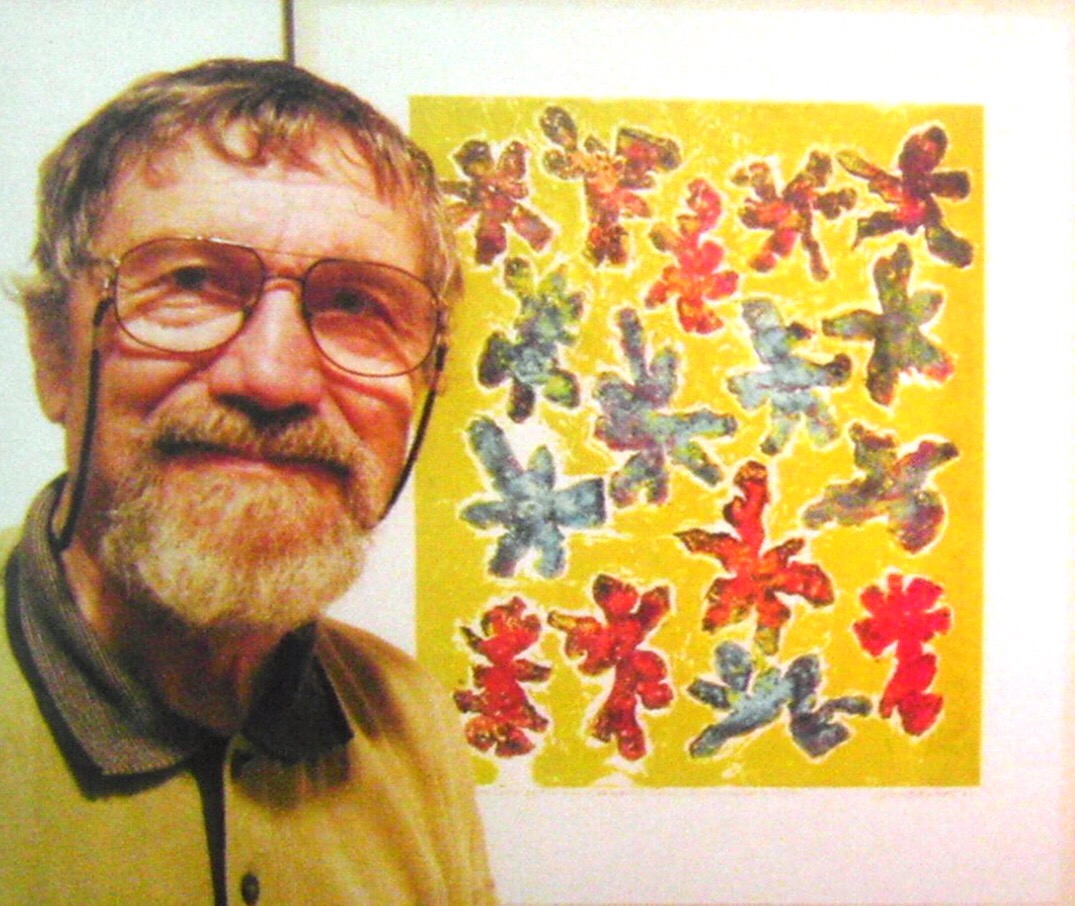
I had the pleasure of viewing some artwork this past week at the Rothwell Gallery on Montreal Road in Ottawa. The Gallery is presenting until October 24th the work of the late Leonard Gerbrandt (1942-2010) who travelled the world and created beautiful impressionistic watercolours and prints especially about the structures of various land and waterscapes. I was given a personal tour by Ute, his spouse, of the hundred pieces or so displayed in the gallery.

  
When we began the tour, she asked me to guess what colour appears and is prevalent in the vast majority of his art. With a twinkle in her eye, she confessed that this particular colour also happened to be his favourite. And so I went to work. At first, I suggested it was the earth tone greens, even maybe the rust, terracotta and orange/reds. No. No. And no.

As we reflected on one specific piece of art I marvelled how Leonard mixed the blues to distinguish sky and sea. Ute smiled, then said, it was blue indeed. I quickly travelled through the gallery looking anew at the paintings. And you know what? It was true! Now, I could see it — blue indeed found its way into almost all his paintings. Why didn’t I see that at first?

Blue, after all, is my favourite colour too (No political association, though!). And then I pondered further why I couldn’t see what had always been my favourite colour. Had I been distracted by the flashiness of other ‘colours’? Did I take ‘my colour’ for granted? What were ‘the blocks’ inside of me preventing me from seeing what was most important to me? Pride? Anger? Fear? Shame? Greed? Why couldn’t I appreciate fully the beauty that was staring me in the face, for me?

Of course, colours would not exist without the presence of light. In fact, it is how the light is represented in a work of art that brings out the textures and hues created by the paint brush. I also believe that art, like music, serves to reflect back to us an inner state — and that is why art and music can be so powerful conveyors of meaning and truth about ourselves and the world at any given moment in time.

The living Jesus is with us, and in our hearts through the Holy Spirit. The love of God propels the Spirit to move us in the the way of Jesus. And yet, we block our sight. We can’t see the light. What are those blocks that keep us from living out of our nature that is being renewed day by day? What keeps us from loving our neighbour? Is it fear of the unknown? Is it a shame that is deeply imbedded? Is it the fire of anger, the pain of regret, the poison of hatred, the paralysis of mistrust?

“Out of his anguish he shall see light” (Isaiah 53:11)

This phrase comes from a larger so-called suffering servant poem from the prophet Isaiah. Christians have read Jesus Christ into the role of the servant even though the text was originally heard among the people of Israel hundreds of years before Christ. The ‘servant’ could refer to the people as a whole suffering in Babylonian exile, or to a specific individual (i.e. Persian King Cyrus /Isaiah 45) who liberated the Israelites and led them home to Jerusalem.

This exegesis is important and we need to tread carefully in working with sacred texts that we share with our Jewish neighbours. We Christians know the sacrifice of Jesus on the Cross for our liberation, indeed for the whole world. Jesus fits the suffering servant-narrative from Isaiah. Let’s work with this.

The anguish Jesus experiences in his suffering and death reflects a God who is fundamentally relational. And God the Father, the Son and the Holy Spirit relates to us in our very own humanity. Thanks to Jesus who showed us the way not just in his divinity but especially in his very own humanity. ‘Anguish’ after all, is a human emotion grounded in love. That is, “to anguish over the loss of a loved one” (online dictionary definition).

Not only does Jesus know our suffering in a shared humanity, he feels for us because of God’s intense love for us. The author of Hebrews is therefore able to describe Jesus as the ultimate high priest, who “is able to deal gently with the ignorant and wayward, since he himself is subject to [this] weakness” (5:2). In short, Jesus helps us “see the light” because of God’s deep anguish-filled love for us. God grieves losing us to our sin, and will not stop short in going the distance — even sacrificing his own life — so that we too will see things as they truly are, in the brilliance of God.

In prayer, 14th century Christian mystic Julian of Norwich reflected the divine stance: “I am light and grace which is all blessed love.” May our words and deeds reflect the light of Christ to our neighbours, in all grace and love.


Marriage: valuing difference

I am an identical twin. Whenever people see my brother and me together, usually the first reaction is to express how similar we look and act. People, it seems, naturally start with what appears to unite us and make us ‘the same’.

When two people celebrate a marriage, again what seems to be the focus is on what they must share in common, what makes them ‘one’. In various marriage traditions the unity of the couple is, obviously, presumed. In Christianity we read the scriptures about ‘two becoming one’; leave in order to cleave (Matthew 19:5; Ephesians 5:31).

We may therefore read into such a coming together a complete blending of the individuals, almost as if the two people in marriage must dissolve their separateness into one kind of amorphous blob. Somehow, it feels like individuality needs to be ‘erased’, we feel, in a proper marriage.

As a twin, I am continually intrigued by what challenges not only my twin relationship but other kinds of relationships as well: It is more difficult to consider our differences, what is dissimilar, between people as something to celebrate and lift up.

I am impressed by your differences that stand in sharp relief this weekend as you exchange wedding vows. Because, the very foundation of the way you are getting married is based on your differences. Not on something you share as the same.

Each of you come into the marriage union with a different and distinct set of religious beliefs. One is baptized Christian and the other is Hindu. In order to celebrate the marriage, you participated in a Hindu ceremony on Saturday, and then a Christian worship service on Sunday.

Using this experience as an important marker on your journey of life, I want to encourage you to continue celebrating the differences between you. Stand on your own two feet, albeit side by side. A healthy marriage will reflect two, distinct points of view. Don’t deny the individual journeys and identities of each person that brought you together in the first place, lest not those identities be diminished, ignored, suppressed or repressed in the course of your marriage. A healthy marriage will reflect an activity and character that results in two sets of feet moving in tension as in a dance, albeit in the same direction.

Kahlil Gibran, born in northern Lebanon, was an early twentieth century philosophical essayist, novelist, poet and artist whose 1923 book, “The Prophet”, is considered a classic in Arab literature. It is in this book that his poetry on marriage highlights the paradoxical nature of a true coming together, and a true unity of separate souls:

You were born together, and together you shall be forevermore.

You shall be together when the white wings of death scatter your days.

Ay, you shall be together even in the silent memory of God.

But let there be spaces in your togetherness,

And let the winds of the heavens dance between you.

Love one another, but make not a …[smothering] of love;

Let it rather be a moving sea between the shores of your souls.

Fill each other’s cup but drink not from one cup.

Give one another of your bread but eat not from the same loaf

Sing and dance together and be joyous, but let each one of you be alone,

Even as the strings of a lute are alone though they quiver with the same music.

Give your hearts, but not into each other’s keeping.

For only the hand of Life [God] can contain your hearts.

And stand together yet not too near together:

For the pillars of the temple stand apart, 

And the oak tree and the cypress grow not in each other’s shadow.[emphasis mine]

“Let their be spaces in our togetherness.”

What you are showing us is that we need not be afraid of what is different in the world today. We need not be afraid of what we don’t understand, just because it is a ‘mystery’. A mystery is not something we can’t understand; a mystery is infinitely understandable. Always unfolding. Always yielding and revealing new insights. Always inviting us to learn more, appreciate more, and love more. This is the true adventure and ongoing discovery of marriage and love.

You see, there is really only one reason, one motivation, one activity that gives charge, energy and purpose to your differentiated union. It is love. It is the passion and pure first love, born in the human heart, despite all the differences of our lives. Not denying them. Simply placing those differences in the perspective of love. The movement of love in your heart brings you into conversation and dialogue in the first place. And then, this love leads you both into deeper expressions of joy and intimacy.

Without needing to control the other, or force the other to change into our likeness. Love does not demand subservience. Love does not force another into submission. Love is not controlling of the other. Instead, love respects another who is different, seeks to understand the other. Love forgives the other and listens to them.

God is love. And that is why we are here today. As Lutheran pastor and teacher, Dr. Kristen Johnston Largen, writes, there is “inherent value in difference – even religious difference” (Interreligious Learning & Teaching, Fortress Press Minneapolis, 2014, p.79). Religious difference, in truth, is “part of God’s plan, rather than an obstacle to it.”

Love calls us out of our comfort zones, into the sometimes challenging and messy realities of being with another and participating in another’s field of life. On the one hand respecting one’s own integrity in doing so; at the same time, boldly entering another’s life. Marriage, in this way, is one of the best schools of love.

Raimon Panikkar, who was one of the most creative voices working in the area of interreligious dialogue encouraged people of different faiths to remember that “We belong together, even if our notions and codes are incompatible” (quoted in Largen, ibid., p.81). We belong together, in relationships of love. The scriptures you chose for your Christian wedding reflect this central tenet of Christianity (1 John 4:9-12, 1 Corinthians 13:4-13).

In the Christian faith, God is understood in a relationship. We call it, “The Holy Trinity” – three persons as one God. The truth of our lives is demonstrated most clearly in relation to one another. Because each of us has gifts and strengths to offer the other. In marriage, you individually have something the other needs, and the other can teach you a thing or two – I am sure! Each can learn from another, each from our own areas of strength.

For God bringing us together today.

For God bringing you both together in love.

Amidst the diversity, difference and distinctions of our common lives.
We give thanks. And praise be to God.

Amen.

Marriage: for the heavy-haul

“For if they fall, one will lift up the other” (Ecclesiastes 4:10)
On the journey of life, how well we do depends on with whom we travel. And how well we travel together. I like the name of your business — the brand of your trucking company: “JNB Heavy Haul”. You are not hauling the light stuff. You’re challenging yourself to haul the heaviest stuff that can be pulled by a tractor-trailer on the highways and byways of this continent.
On the road of life, how well we travel together depends, furthermore, on the degree of touch in the relationship. Yes, touch. In our touch-averse culture, the institution of marriage offers couples the benefit and freedom to exercise that public and private right with the fullness, health and joy with which touching another was meant to be.
The popular reading, “The Blessing of the Hands”, brings to our minds this image of holding the hand of your beloved. What is powerful about this poem is that it not only describes those delightful and joyous occasions when hands are held in the sweetness of love. It also brings to mind the larger picture of youth AND ageing, happy AND sad — and even hints at the prospect of death. This perspective includes the heavy-haul of life.
In the blissful exchange of wedding vows you make in the prime of the first half of your life, it is important to sound this deeper note. Because even in the most challenging moments of marriage, life and love, those hands that hold one another can mean everything. The sense of touch with the beloved can get us through times when disappointment, failure, loss, grief, fear and the need for forgiveness press close — as will happen in everyone’s life.
The image of holding hands in those times are equally important to bring to light. Such a bond, forged in the anvil of struggle and conflict, is nearly indestructible. When two people join their hearts, minds and bodies, a third element is brought into the relationship — you can call it ‘the relationship’. And when this happens, you feel it — and everyone else knows it and must respect it: “A threefold cord is not quickly broken” (Ecclesiastes 4:12). If you ever take ballroom dancing and learn the standard, international steps of, let’s say, a waltz, you soon recognize this ‘third partner’ that is the energy linking two individuals. Both partners step in time with one another and respond in kind to this field of energy between and surrounding them. Call it God.
God, who created you both, makes an eternal promise that will never be broken: “I am continually with you; you hold my right hand” (Psalm 73:23). Originally this promise was made to a people desperate in life’s challenging circumstances and struggles, travelling through the wilderness of life. This promise is made for the long-haul and the heavy-haul of life.
I recently read the story of a woman who had walked seven hundred miles as a refugee to escape a violent war. She was finally able to cross a national boundary out of the war zone. She walked all that way and brought with her an eight-year-old girl, who walked beside her. For seven hundred miles, the child held her hand tightly. When they reached safety, the girl loosened her grip, and the woman looked at her hand: It was raw and bloody with an open wound, because the little girl had held tightly in her fearfulness. This is no casual hand-holding. This is a life-or-death grip that does not let go. (Walter Brueggemann, “Sabbath as Resistance: Saying No to the Culture of Now”, WJK Kentucky, 2014, p.88-89)
Upon arriving at their destination, can you imagine the joy, relief and gratitude expressed by both the woman and her eight-year-old travel companion? Their relationship is sealed for life, no matter what!
Earlier this year, a colleague of mine from Toronto was celebrating her 25th silver anniversary. In fact it was Valentine’s Day when she and her husband were driving by one of the biggest cemeteries in Toronto. At that moment they were discussing what they should do, to celebrate this joyous occasion. They wondered if they ought spend some money on themselves, treat themselves, to mark such an auspicious point in their lives.
At that moment they passed by the entrance-way to the sprawling cemetery grounds. And hanging over the ornate gate was a great canvass banner with the words printed in Valentine’s Day red: “One-day sale only: 10% off burial plots!”. The couple looked at each other with wide eyes. A few hours later, they drove out of the cemetery chuckling about how they had just dropped $8000 for themselves on their silver anniversary …. to buy two burial plots side by side!
This puts a different slant on those traditional wedding vows, “till death do us part!” And yet, they do so in life with confidence and faith that marital love can stand the test of time, thanks be to God, for the long-haul and the heavy-haul!

God is action: a grammar lesson

God is an action Word. The English language, sometimes, does not do it justice. “The Word became flesh” is the theme of the Christmas-Epiphany cycle in the church year. Sermons, prayers, liturgies are all based on this message.

But the French language conveys the truth about God in a much better way. In John 1:1 — “Au commencement etait le Verbe, et le Verbe etait tourne vers Dieu, et le Verbe etait Dieu.” God, in other words, is equated with a verb — an action word. And, later in verse 14 the English normally reads: The Word became flesh. In French, again, “le Verbe s’est fait chair …” translated, the Action-Word made himself!

Thank God for the French language! Here we receive the truth about God and Jesus, flowing in continual action, movement. The status-quo does not belong in the vocabulary nor the kingdom of God!

The God-human relationship is clarified: God’s first job is to act; our’s is to just be a human (-being!). Jesus’ first words identified by the Gospeler Mark in the Capernaum synagogue (Mark 1:25) was not what Jesus was reading from the lectern; rather, it was his words to the man with the evil spirit: “Be silent!” Be … !

Stop talking! Stop doing what you are doing! When we can first be as we are, not as we think we ought, then perhaps we will discover the actions that correspond and are aligned truly with God’s action in our lives.

Someone recently joked that they say English is the language of heaven. Why? Because it takes an eternity to learn it!

In this case, better in the French.

“Who’s voice is it?”

I’ve used this exercise with children during worship a couple of times with success, although it does take some preparation: Before worship, you will need to ask a couple of parents/guardians of children attending the worship service to participate; they will need to stand in the vestry or a room right beside the chancel area where they won’t be seen, but they can be heard. They will also need to listen to your cue, so they can call the name of their child at the appointed time. This children’s sermon can be used effectively when the theme of the day centres on ‘hearing the voice of God’ — when Jesus talks about being the shepherd of the sheep who recognize his voice (John 10:16); or, when Samuel first confuses God’s voice for the prophet Eli (1 Samuel 3:1-20). An appropriate hymn, “Hear I Am, Lord” (WOV #574) can follow

Good morning! The Lord be with you!!
When you can’t see someone, can you still tell who is calling you? Let’s say the person is in another room and they call your name — can you tell who it is?
Let’s see if you can tell, okay? Let’s hear someone’s voice …..
Who’s voice is that? …. Your parent! Good! Let’s hear another ….
Who’s voice is that? …. And that’s your grandmother! Wow! You’re really good!
How can you tell who’s voice it is when you can’t see them with your own eyes? …..
You know them, already. Right? You’ve spent enough time with them so that even when you can’t see them, you can still recognize their voice.
Our relationship with Jesus is a little bit like that. Because we don’t always see Jesus, we can still learn to recognize/to know his voice. How do you suppose we can learn to know the voice of God? What are the kinds of things we can do to get good at hearing Jesus’ voice? ….
We can spend time in prayer. We can sing the songs of worship. We can be with other friends from church. We can read and hear the stories in the bible. We can learn about God in Sunday School. We can help others in need. We can practice looking for God whenever we feed the hungry and help the poor. Etc. Etc.
There are all sorts of ways we can get good at knowing God, so that when Jesus call us, we’ll be ready to hear him, and do what is asked of us.
Let’s pray: Dear Jesus, thank you for knowing and loving us like a good friend. Help us to get to know you, so that we can tell it’s you, when you call us. Amen.

Making a way where there is no way

Year after year I ponder how “Remembrance Day” carries with it so much staying power — especially for older generations of people. While on the surface our observances acknowledge the sacrifice made by many young service men and women in the wars of the last century, a deeper vein is struck.

It is important ‘to remember’, because so many lives were lost in war. Death separates loved ones. Death means, for many, that relationships are severed and hopes are dashed. Similar to attending funerals of loved ones, Remembrance Day observances expose one of our deepest, human fears — being abandoned by our loved ones. Being abandoned by our loved ones is a horror too deep to even want to go there.

In Paul’s letter to the Thessalonian church, he addressed a pastoral need. The early Christians living in those immediate decades after Jesus ascended to heaven believed that Christ was coming back in their lifetime. They believed his second coming was immanent. They looked forward to it.

The problem was, when their friends and family members began to die, they wondered if their loved ones would share in the glory of the resurrected Jesus at his second coming. Paul assures the church that not only are the dead included in resurrection at the end time, but that they will be “first” (1 Thessalonians 4:16) to join Christ at his return.

This passage forms a reading for one of the last Sundays before Advent. The season of Advent is about the ‘coming of Jesus’. We normally attribute this season to anticipating the coming of baby Jesus to Bethlehem — the incarnation of God — and we recall this history with much joyous tradition and emphasis.

But the ‘coming of Jesus’ theme is more than just the Christmas story. The Advent of Christ is attributed as well to the “Second Coming” when Jesus will come in at the ‘eschaton’ — the end time. We read in the Nicene Creed: “And he will come again in glory to judge the living and the dead, and his kingdom will have no end.”

Finally, the ‘coming of Jesus’ is meant to pique our attention to the ways in which the Holy Spirit comes to us daily, in the ordinary people and happenings of life, as well as in Word and Sacrament; in other words, the coming of Jesus is not only an event of history nor of future expectation, but something that happens now — all the time, in every moment. Especially at times of grief and loss when we fear abandonment, the assurance of a coming divine presence — or anyone’s presence for that matter — can bring comfort and hope into the moment.

How, then, do we experience a re-connection with those we love, especially because for whatever reason, we have been divided from them? There are many reasons why loved ones may be separated from each other, besides death: the friction of personality, vast geographical distance, emotional wounds, hurtful memories of a ‘water-under-the-bridge’ variety. Many reasons exist for why that division remains. And even though we may desire a better relationship with a loved one, we time and time again come up against those blocks. So, how do we even begin to make things better — amidst the grief, when facing hard times, when you can really use a friend to lean on?

An answer from the tradition of our Christian faith is, I’m afraid, not an easy one. First, in the words of Jesus from the Gospel for today: “Keep awake therefore, for you know neither the day nor the hour” (Matthew 25:13), there is this element of not being in total control of the outcome. And this is disruptive, especially for those of us who feel they need to be in some semblance of control over not only our relationships, but our lives in general. We can try. But the trying ought not be motivated by the result we envision.

Moreover, there are these dramatic and vivid images in Paul’s description of Jesus’ coming (1 Thessalonians 4: 16-17) that are, frankly, unbelievable and unrealistic: being drawn into the sky, trumpets sounding, the archangel calling, clouds whipping across the panorama — seems more like some filmmaker’s fantasy than anything that is real. The coming of Jesus into our lives is thus underscored with disruption, incredibleness and an unravelling of what we believe is possible.

Then again, this is a prevalent theme in the Scriptures. Two things: First, in our hope to re-establish relationships marred by whatever divides those relationships, can we be open to going to where it feels uncomfortable, unravelling of us, vulnerable — and being lovingly honest about it? If Jesus will bring his healing power to the relationship, the “refiner’s fire” (Malachi 3:2-3) will sting and singe, momentarily. The new thing that Jesus comes to establish in your life, in our lives, does bring judgement of sorts to what has been. We really cannot move forward unless we can lovingly and honourably discharge the past, and confess our own failing.

And it’s not just about healing the other’s issues — like pointing the finger at what you perceive to be ‘their’ problem. More importantly it is addressing your own issues that have contributed to the problem. And this is never easy. To even bother going there. Some would say impossible: to go inside yourself and let go of past hurts, to forgive others, to live in grace not anger and resentment. Impossible, you say?

But, and this is the second point from the testimony of scripture: God does come to make a way where there didn’t seem to be a way through: After all, God turns a rock into a pool of water (Psalm 114:8) and makes a path through the wilderness where none exists (Isaiah 43:19). Christ comes to disrupt the current, messy, state of affairs, yes.

But, to work a total transformation of our lives for the better. This turbulent coming creates a way to reconciliation, resurrection, a new life. As one theologian wrote: The kingdom of God “breaks into, disturbs, disorders, and troubles the waters of our fallen reality” (Jennifer McBride, “Feasting on the Word” Year A Volume 4, Westminster John Knox Press, 2011, p.282).

God comes, in Christ, to make a way where there is no way. In the fallen reality of death, abandonment, and separation — God comes to reunite and reconcile in acts of forgiveness, generosity and mercy.

In the fallen reality of dying church institutions and perceived dwindling of resources — God comes, in Christ to stir things up and create new ways of being the church in today’s world.

In the fallen reality of clashing religions and cultures where extremism threatens to escalate violent acts — God comes, in Christ to disarm and disable ideologies of hatred and make swords into plowshares and spears into pruning hooks (Isaiah 2:4).

And so we can have hope in the new thing that God promises. This hope is not in what is possible, but precisely in what seems impossible to us. What we can never on our own merit or strength, God will. Get ready! God is on the move!

Are you an honest sinner?

A Christian leader (Laurence Freeman) commented on the 25th anniversary edition of “Rolling Stones” magazine. It contained interviews with pop music icons over that time period, starting with John Lenin all the way to Madonna.

He was wondering why young people especially were drawn to these, their idols. Of course, many pop stars are not exemplary people. They are not saints.

But they are, what he calls, ‘honest sinners’. Which reminds me of what Martin Luther said about us: That we are at the same time: Saints AND Sinners.

In the church, I think we get the ‘Saint’ part. But how do we validate the ‘Sinner’ part of ourselves?

In the Gospel text for Ordinary Time on this last Sunday in September 2014, we continue to work through the parables given by Jesus, in the latter part of the Gospel of Matthew.

In the assigned pericope, the authority of Jesus is questioned by the Pharisees (Matthew 21:23-32). In response, Jesus tells a story of a Father who asks both his sons to work in his vineyard. The first son says he wont do it, but does. The second son says he will do it but doesn’t.

What do we make of the first son who does his Father’s bidding? He does not want to obey. And he is honest about it.

The verb in the original Greek in this text (v.29) for “changed”, as in, “he changed his mind” (or as many English translations have it — “he repented”), is not the common one usually associated with the idea of a total transformation of character (as is implied in, for example, Matthew 3:2 “Repent, for the kingdom of God is at hand”).

In fact, the only other place in the Gospel of Matthew where the exact same form appears is in Matthew 27:3, when Judas experiences a regretful change of purpose that ends in despair, remorse and his demise (see Ellicott’s Commentary for English Readers).

Perhaps a better translation would have it as “a caring change of heart”; or, “a change of heart burdened with care.”

This form suggests that a heart nurtured in the love of God leads to action that not only obeys the call of God, but does it willingly. Even though the first son’s mind and his words at first are contrary to the will of the Father, his follow-through redeems him in the end. An imperfect confession it is, to be sure. But, ultimately, words are not enough.

Although in the case of both sons words do not match the deeds, “the repentance of the former is preferable to the hypocrisy of the latter;” Kathryn Blanchard says it best: “True righteousness is in the doing, rather than in the confessing” (in “Feasting on the Word” Year A Volume 4, WJK 2011, p.118).

I see a possible link here with the alternate first testament text assigned for this Sunday, from Exodus 17:1-7 (We also encounter this text on the Third Sunday in Lent, Year A). The Israelites are on the journey to the promised land, and yet again (for the fourth time in the sequence of these texts from Exodus) they complain to Moses about their lack of food; and in this, case, water.

They are thirsty. They are without a basic need for human survival. We are not talking here about typical ‘first-world problems’ — complaining about the weather, or unable to sync online calendars among family members with different smart phones, or dealing with a dilemma of how to invest money in competing markets, or having to cancel a credit card that was stolen, etc. These are things we complain about, and may even pray about.

But the Israelites’ complaints to Moses are about a basic, human need that they lack. I cannot blame them for being upset! They will die without water. They are being ‘honest sinners’, aren’t they?

Scientists, medical professionals, and child care workers will agree today that love is such a basic human need. If a person, especially at a young age, lacks love in their life, this absence of love will even stunt their physical development. They will be underdeveloped, physically, because of love being absent. The giving and receiving of love is a fundamental, human need.

Jesus tells the Pharisees that the prostitutes and tax collectors will enter heaven before they will. Maybe because these ‘lowest rung’ folk in the religious hierarchy of the day certainly don’t present themselves in a religiously acceptable way. There is no pretence, performance, pious evasion. There is no making appearances, no self-denial nor self-repression. There is no saying-the-right-things, no artifice, no self-consciousness to their being and behaving. They are truly ‘honest sinners’.

Both of Moses and of Jesus, the people demanded ‘signs’ of God’s presence. The Exodus text ends with those ominous and faithless words: “Is God with us, or not?” Even after the visible and tangible sign of water was given to quench their thirst, the Israelites still doubted. Even though Jesus performed miracles; even though the resurrected, bodily form of Jesus appeared to the disciples in Galilee following Easter morning, they did not ‘believe’ (Matthew 28:17).

The ‘signs’ are not the point of the Gospel — God’s love IS. Acts of love demonstrate our Christianity more than dogmas and creeds.

And when we participate in loving, caring action …

We are truly free. Free to be ourselves. And free to do the right thing. Perhaps whatever good things honest sinners do, they do it then from the heart. Their giving of love, however unnoticeable and seemingly irrelevant acts of love, is authentic and real — something the Pharisees so stuck in their heads and dogmas could not grasp.

You might notice that the Father — who in this parable may represent the attitude of God — does not condemn the first son for saying the wrong thing. The Father does not ‘correct’ the son’s imperfect words. The Father accepts him just as he is. And in the freedom of God’s love, the son then experiences a change of heart.

God accepts you as you are. God has faith in you. Because of God’s steadfast love and unwavering faithfulness in you, what will you do?

Listen! Do you hear?

So much in the wisdom of the ages is wrapped up in the basic task of listening.

Whether stemming from the prologue to his famous Rule in which Saint Benedict writes to listen and attend with the ear of your heart, or in current media from popular spiritual leaders advising us to listen (not talk) to God in prayer — the message is clear: the skill of listening is foundational to the health and well-being of any relationship.

The spiritual basis of listening to God extends to our relationships on earth. How shall we listen to others?

In listening to others, I am challenged to try not thinking about how I would say something, only how they are saying it; I am challenged to try not thinking about what an experience would mean to me, only what that experience meant to them (Brene Brown, The Gifts of Imperfection, p.129).

How would this approach to listening affect our bible study when we are tempted to proof-text in order to argue a point? In seminary I was taught that good exegesis aims first to understand what Scripture meant to the original hearers of the text.

How would deep listening affect the way we relate to those who differ from us, politically? Would we show the courage to seek understanding of why someone may believe certain things with which we may take issue?

When we may more easily rush to condemnation and judgement, have we first truly understood from where the other comes, and why?

We would do well to listen.

Window panes

A retired pastor gave a group I was with last week some sage advice from a professor telling seminary graduates how to be ‘out there’ in parish land. Afterward I thought this may be helpful food-for-thought not only for public church leaders, but for anyone on the path to wholeness and health in their lives.

He said, “Be like a window. But not just any window; there are three basic windows you can be like.

“First, you can be like a stained glass window. People can first notice your beauty. What people see is the intricacy, the colour, the ‘picture’ you show — and the glass is perfectly constructed, wonderfully arranged; folks admire and gaze upon your image for hours at a time.

“Or, you can be like a cracked, dirty window pane. What people see and what you show are your wounds, your brokenness, your pain. When people see you they want either to ignore you and pretend you are not there. Or they might instinctively want to ‘fix’ you.

“Finally, you can be a clear window — transparent. You have nothing, really, to hide. You are who you are. In all your humanity you are not ashamed to reflect the truth in you that is Christ Jesus. The divine presence who created you to be who you are shines through you and illumines the world.”

What kind of ‘window’ describes you in your life now?

Thank you to Rev Orlan Lapp who is currently serving St Johns Lutheran Church, Germanicus in the Upper Ottawa Valley, Ontario, for this illuminating illustration.