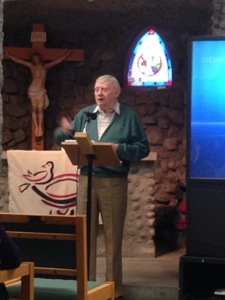
Paul Harris is a long-time leader of the Ottawa Christian Meditation Community and author. Today he leads a workshop to encourage and equip small group leaders of weekly meetings of meditators. There are over 44 groups in the Ottawa area, spanning many church denominations and meeting in all manner of locations. A useful resource, written by Order of Canada recipient, Laurence Freeman, is: “A Pearl of Great Price; Sharing the Gift of Meditation”
Tag Archives: prayer
On the path of hardship tempered with grace
I suspect that some of you really like John the Baptist, while others would feel intimidated and back off from his forceful energy. Similar to the way two very different recruits into the Canadian Armed Forces reacted during the first days of regular duty.
A friend from Petawawa who is a sergeant and has put many years in the Forces told me last week how very differently some personalities react to his dissing of discipline. When boots aren’t polished, collars not ironed, and back-packs not kitted properly, he would lean in on the rookies and set them straight.
The one young recruit began to well up in tears when my friend started criticizing him for not being prepared. The other, being disciplined for the same problem, smiled, and was energized by the confrontation: “Wow, this is just like the movies, when the sergeant major yells at the recruits, spitting inches from the other’s face, turning the air blue!” Just loving it! The first recruit didn’t last long in the army. The other, was spurred on and challenged through his mistakes, to have a successful career.
John the Baptist is the ultimate reality check for Christianity. In the best of the prophetic tradition, he epitomizes the no-nonsense, truth-telling, going-for-the-jugular style not often associated with a more sanitized approach to religion.
C.S. Lewis wrote, “If you want religion to make you feel really comfortable, I certainly don’t recommend Christianity.” Is this how you feel about belonging to the church today? Many stand in the line of John the Baptist tradition. Stanley Hauerwas and William Willimon — influential theologians of the last century wrote: “There is not much wrong with the church that could not be cured by God calling about a hundred really insensitive, uncaring, and offensive people into ministry” (p.45 Feasting on the Word Year A Vol 1). What do you think about that? Would you like that?
John the Baptist’s hard words to the religious leaders of the day call them to repentance. Judgment underscores the tenor of this text assigned for Advent. And that’s why some of us would rather read scriptures and sing songs about sheep softly grazing in fields during these weeks leading to Christmas. Because you may know people in your life who have been hurt by the judgment of others — many of those doing the judging from the church. Even as we in the church have been warned NOT to judge others (Romans 14).
God calls ALL of us to fall on our knees, confess and repent — especially those of in the church.
The original Greek word for repentance, metanoia, literally means — “moving beyond the mind.” We need to have a change of mind as much as a change of our heart. “Do not be conformed to this world, but be transformed by the renewing of your minds,” argues Saint Paul (Romans 12:2). He goes on to say that this change of our mind would happen, “so that you may discern what is the will of God — what is good and acceptable …” Our changed minds, our renewed way of thinking about things, will then affect how we behave.
“Moving beyond the mind” means that we need, at first, to have our fundamental assumptions questioned. Fundamental assumptions about God and the ways of God in the world. Is it true that we don’t have to do anything more in the church because we were baptized and confirmed here and our grandparents and great-grandparents were Lutheran? Is it true that God hates us and is only out there to catch us breaking a rule in order to punish us?
John the Baptist might have a field day in the Christian church today. John the Baptist is here to remind and recall us to a faith that only makes sense when embraced in the desert, in the wilderness of our lives. John the Baptist is here to remind and recall us to a faith that makes sense only when we have learned to weep at our faults and let go. John the Baptist is here to remind and recall us to a faith that makes sense only when we are called out of our complacency, selfishness, and self-righteousness to a greater cause, a greater good.
Barbara Marshall wrote this prayer poem cited in an Advent devotional for the season (Lutherans Connect); in it she describes the times of her life when she was truly invigorated, motivated and inspired in faith:
“… It was never the turbulent waters that raged and tore through my life that left me floundering, helpless adrift in the surging tide. But rather the lulling beauty and lure of familiar shores that fashioned my days with indifferent thought and compelled me to stay where I was. So, Father, give me a yearning for the valleys shadowed and steep, for deserts that breathe their fire and dust, for waves that crash at my feet. And surely then I’ll accomplish much …when inspiration is fueled on the path of hardship tempered with grace.”
So you can see why I suggest that nostalgia may be a great enemy of Christianity. For it keeps us stuck in apathy and inaction. But, ironically, looking to the past is an essential ingredient in faithful living. John the Baptist himself quotes directly from Isaiah when preaching his sermon: “The voice of one crying out in the wilderness: Prepare the way of the Lord; make his paths straight …” (40:3). In writing about John the Baptist, the Gospel writer Matthew uses descriptive words right out of the Hebrew Scriptures originally describing the prophet Elijah who was “a hairy man with a leather belt around his waist” (2 Kings 1:8). John the Baptist may breathe fire into a soppy nostalgic faith — but he certainly doesn’t dismiss the past.
Remembering the past is important. But there’s a difference between nostalgia and remembering. Biblical commentator David Bartlett writes that “nostalgia is memory filtered through disproportionate emotion. Faith is memory filtered through appropriate gratitude” (p.48, Feasting on the Word, Year A Vol 1). In Advent we re-member, we reconnect. The word “religion” literally means to re-unite, re-align, ourselves out of isolation and into a holy union. In Advent when we remember, we embrace the good God has been and done for us in our past. In Advent we remember, together, as a family, as a church, as a community — what God has done for us in Jesus. We do this remembering at the Table — we remember that in the night in which he was betrayed …. We do this remembering singing out loud together our seasonal songs so precious to us.
We pray. We sing. We remember. Doing this, NOT to a disproportionate emotional longing for a time gone by. No. But rather, to embrace an occasion for re-affirming the good God has done for you in the history of your life, and to affirm our on-going hope and belief that God does care about us and our behavior this season, and beyond.
This Advent, know that we are cherished by God not only for who we are, but that we are responsible for what we do. This is good news, because if God does not care about what I do, I may begin to question whether God actually cares about me. If God loves me enough to welcome me into the family, then God loves me enough to expect something of me.
“One December afternoon … a group of parents stood in the lobby of a nursery school waiting to claim their children after the last pre-Christmas class session. As the youngsters ran from their lockers, each one carried in his hands the ‘surprise’, the brightly wrapped package on which he had been working diligently for weeks. One small boy, trying to run, put on his coat, and wave to his parents, all at the same time, slipped and fell. The ‘surprise’ flew from his grasp, landed on the floor and broke with an obvious ceramic crash. The child … began to cry inconsolably. His father, trying to minimize the incident and comfort the boy, patted his head and murmured, ‘Now, that’s all right, son. It doesn’t matter. It really doesn’t matter at all.’ But the child’s mother, somewhat wiser in such situations, swept the boy into her arms and said, ‘Oh, but it does matter. It matters a great deal.’ And she wept with her son.”
It does matter to God. God is that mother who embraces us when we weep after making a big mistake and mess up. God doesn’t punish us, but rather holds us, and cries with us.
Perhaps the church can give up on judgment, but we cannot give up on responsibility. We can continue remembering and being faithful to our calling in Christ, especially in the desert, because we know God does care for each of us.
So, let’s sing on and re-member!
Returning to the Lord your God
It was a joyous yet emotionally intense day that Mom and Dad finally decided to tell their rather rambunctious four-year-old son the good news of the coming birth of another child into their family. After all, little Joshua liked being the centre of attention, and was quite the social spark at school, church and family gatherings.
The birth of a baby girl came soon enough to the active family. Their lives changed forever. No longer were they three. Another human being was ushered into their home, and a nursery room already prepared at the end of the hallway.
Mom and Dad were a little concerned about how Joshua would react to having a baby sister — someone else in the family who would vie for parental attention. But the first few days after Mom and Daughter returned home from the hospital proved a relatively easy transition for Joshua, who welcomed his sister with endless requests to hold her and play with her.
“Be careful,” Mom’s mantra of advice to Joshua, “she’s just a few days old and we can’t be rough with her.” She repeated this instruction over and over again those first days.
Late one night Mom and Dad heard footsteps down the hallway and into the nursery. Dad was on duty, so he quickly got out of bed and followed Joshua into his sister’s room. When he poked his head to see what Joshua was up to, Dad was a little startled:
Joshua was practically inside the crib with little baby sister, his body hanging over the railing and his legs dangling over the top.
“Joshua! What are you doing?!” whispered Dad as loudly as a whisper can be. “Don’t wake up your sister!”
“Shhhh!” Joshua replied, “I am listening to what my baby sister remembers about God.”
The season of Advent gives us an opportunity to return to an awareness that God is coming to us, always. Jesus’ birth represents a truth about our lives: before we were born, we were united with God; when we were born we began a life journey that will eventually reunite us with God after our death. Honour the babies! For they have just come from seeing God face to face! They may just have something to tell us about God. This Advent may be a good time to practice simply listening in our prayer with God and to each other.
Prayer power; moving from dilemma to choice
It may seem strange to hear this Gospel (Luke 23:33-43) for the Festival of Christ the King. At first glance, this traditional Good Friday text at the end of November seems as odd to me as Christmas in July.
So, right off the bat, we are faced with a paradox on at least a couple of levels. First, the demonstration of the kind of God we follow flies in the face of everything the world values as powerful; a king who suffers for us and becomes vulnerable in a self-giving sacrifice?! He was an object of sport and scorn. No wonder the people around the cross laughed at him: A naked, nailed-down Jesus was scarcely a powerful king.
He was, instead, a sign of failure, weakness and incompetence. This is just not the way the game is played today in the echelons of power, right?
And yet, we Christians believe that the crucifixion of Jesus is actually his moment of greatest power. To lend weight to this truth, the placement of this text a month before Christmas invites us – indeed, prods us – to reflect again on the meaning of our discipleship.
Perhaps those who devised the lectionary were wise. Because the crucifixion of Jesus is not only a record of history to be read and remembered during Holy Week when we recall Jesus last, tortured days on earth. The crucifixion of Jesus demonstrates the whole point of our identity and mission as followers of Christ. In other words, Jesus’ reign reveals values of a kingdom relevant to us today. Jesus preached, “The kingdom of God is near!” (Luke 21:31); and, “The kingdom of God is among you” (Luke 17:21). This is a recognition that dramatically turns our reality upside down, if we choose to live it so.
Ultimately, should we follow this king we say we worship, this paradox must be resolved. But how do we resolve this strange juxtaposition of heavenly value of power reflecting vulnerability, surrender and mercy on the one hand; and on the other, the earthly value of power reflecting competition, judgment and comparisons? I believe this paradox must resolve itself not merely in a dilemma to be thought and talked about, but a choice that leads to behavior and action.
I remember a story my mom told me once when I was younger that helped me when I had questions about how to follow Jesus in this world: “There once was a great king,” she said, “that decided to share his wealth with his subjects. The king had a spacious compound right in front of his castle and marked it off with a large stone wall. In the compound he placed all his treasures and at its centre he positioned his throne.
“Then he sat down, called his subjects together and announced, ‘I am about to share all of my treasures with you. Choose whatever you wish in this compound — and it is yours. Choose wisely, and do not leave the area until I have dismissed you.’
“So his subjects began to scramble over his possessions, taking whatever they wished. In the hubbub, an elderly woman, small in stature and great in years, approached the king to ask, ‘ Your majesty, have I understood you correctly? If I choose anything in this compound, it will be mine?’ ‘Yes,’ the king assured her that she had understood correctly and he invited her, again, to choose wisely.
“The woman paused for a moment deep in thought. Then she looked hard at the king and said, ‘Your majesty, I choose you!‘ The crowd grew silent at her words, waiting to hear the king’s response. The king smiled at the woman and said, ‘You have chosen most wisely. And because you chose me, all my kingdom will be yours as well.’ There was abundant joy in the land that day, because the woman was much loved, and everyone shared in the king’s treasure.”
Not only are we invited this Christ the King Sunday to reflect on what kind of king and reign Jesus is and represents, we have a choice to make. Will we be the hands and feet of Jesus today in a world that suffers? Will we go to the highways and byways of our city, our country and our neighborhood to see the face of Christ in those we serve and those in need? Is this Jesus – the one who hangs on the cross – the God we follow, the Lord of our time, the Lord of our use of material wealth and our talents? Is Jesus the king in whose service we daily engage and rejoice? We know who rules the heavens. But does Christ rule our hearts?
We can choose: to play the game according to the world’s rules — competition, aggression, judgment and comparison; or, we can make choices based in compassionate justice, generosity, confidence, intentionality and trust. How do we do that?
Prayer. Prayer will move us from dilemma to choice.
I have the proud distinction this year to be the first in my extended family to produce my Christmas wish list. In fact, I had it ready last weekend, and copies to give to my rather shocked family.
Prayer at its best is not about presenting our wish list to God. Because prayer doesn’t start with us; it starts with God. Origen from the second century wrote that prayer is not about trying to get benefits from God; rather, it is about becoming united with God; about reflecting God’s gaze upon us.
We are told today that in the first few years of life, infants see themselves entirely mirrored in their parents’ eyes, especially the mother’s (p.67, Richard Rohr, Everything Belongs); “What her eyes tell about ourselves, we believe and we become … Prayer is much the same: we receive and return the divine gaze.” In other words, we know ourselves and our purpose in life in the security of the living God in Christ who holds us and continues to gaze upon our lives.
All forms of prayer are good and right and true. But without also giving time in prayer to be simply silent and still, to contemplate this knowing that is neither a mental activity nor a mere ‘good work’ on our part, is necessary. I invite each and every one of you to join our group on Wednesday evenings to learn more about this form of prayer called “Christian Meditation.” It is a form of prayer that propels us to reflect and engage the nature and mission of God in us and in the world.
But a warning: Christian Meditation is a way of prayer that exercises a surrendering, a letting go, a powerlessness that echoes the values of the Cross of Christ. It is seemingly unproductive use of time, so contrary to the values of the world of glamour, achievement and progress. But, in its very form, contemplative prayer is thus fundamentally Christian.
Because, in the end, it’s not about us, it’s about the kingdom of God – a topic Jesus spent more time talking about in the Gospels than any other topic or issue, values that continue to challenge us to the core of our being. We are more like the thieves who hung next to Jesus than we are like Jesus: it is hard for us to believe in the gracious God, in the forgiving God, in the God who would love us even when we disappoint and sin. Yet, Jesus last words to another human being before his death and resurrection were words of forgiveness, words consistent with the ministry of Jesus’ short life.
Thank God our salvation is not dependent on us, but on a loving, grace-giving, self-giving, merciful God. We may not be able to do things rightly. We may not be able. But God is. That’s why we are who we are and do what we do: Christ crucified; Christ risen.
What ought we do?
In the Gospel text from Luke 17:5-10, the disciples are likened in the parable to “worthless slaves”. Yet, this is a misleading translation, since a servant who will work all day ploughing or tending sheep in the field, and then make supper, don an apron and serve the meal – is hardly worthless! Better those translations that render the word to mean “unprofitable”.
Because in our relationship with God, we can toil and do good works – for God and for the church. We may expect reward or at least recognition for our good works. Yet, Jesus reminds the disciples this kind of approach is like a servant doing what is expected of a servant – and then the servant feeling they deserve a profit, an extra bonus.
“Teach us simply to do what we ought, Lord” – a relevant prayer today. When facing a crisis or stress, either personal or institutional, our impulse may be to do something – anything! Last week someone at the Christian Meditation seminar in Arnprior told me that their father taught him as a young person: “When you don’t know what to do, do something, anything!” This impulse to action is so inbred in our cultural and economic psyche. NOT to do anything is foreign territory. NOT to buy something new. NOT to jump into the newest, latest fad. To refrain from activity is at very least, counter-intuitive.
Admittedly, it would take some self-discipline to hold back. And be silent. Be still. And wait upon God.
Paul’s words to young, active Timothy in our second reading today (2 Timothy 1:1-14) may help us in understanding this complex Gospel text: “For God …[gave] us a spirit of power, of love and of self-discipline… [so] join with me … relying on the power of God, who saved us and called us with a holy calling, not according to our works but according to his own purpose and grace.”
We so easily get wrapped up in what we need to do in our lives of faith – to make it better, to save ourselves, to save the church, to save the world, to save our friends and family. I suspect that is what has been so challenging – for me, anyway – in inviting someone to church. Because we so naturally think that if they do come, it’s our success. Conversely, if they don’t come, we have failed.
But haven’t we crossed the line there – falsely taking on more than is our calling? Our job is simply to issue the invitation – and not just for “Back to Church Sunday” – but for every successive Sunday after that. Those first-timers who came last week – how many of them were invited to come back again? We certainly do have a job to do; are we focusing on the right thing?
The response of those whom we invite, however, is God’s job – not according to our works but according to God’s own purpose and grace.
“Teach us, Lord, what we ought to do.” It’s not a question of not ever doing anything. It’s not about staying stuck in a rut. Being still, waiting on God, is not passive complacency. Rather, it’s about growing a discernment about when to act, and when not to. When to wait, and when to move.
I suspect God is ready to show us something beautiful and what we need, should we simply get out of the way for a moment, stop, and be still – just for a moment.
“Teach us, Lord, what we ought to do.” Amen.
Not a prize to win but a gift to celebrate
When the lost sheep is found, and the lost coin is recovered, there is much rejoicing in heaven (Luke 15:1-10). God celebrates. God is pleased. God is honoured. And all are invited to the party.
The shepherd’s friends and neighbours are invited to the celebration. The woman calls her friends over to rejoice together. For what has been found is so precious to the one who finds.
A couple of months after I was married, my wife and I raced to the beach in Goderich Ontario at the end of the workday. Because the bluffs overlooking Lake Huron there are high, you can watch the sunset twice. First at the beach level; then, as soon as the sun sets you run up the stairs some fifty feet to the top of the bluff, turn around and see the sun go down again.
That evening, we arrived too late to watch it twice. The sun was setting from atop the bluff when we got there. But we didn’t drive all the way there not take a short walk along the beach. So, after the sun set, we descended the steps and walked onto the sand as the day’s light quickly dissipated.
Because it was getting dark, we decided not to walk far, but just to sit down on the sand and watch the amazing array of yellows, blues, reds, and orange in the sky. Not only was it getting dark, but the late summer temperatures quickly plummeted. And it was getting cold.
And when our hands get cold, the blood vessels restrict and our fingers narrow somewhat. After about 10 minutes of sky-gazing, we went to get up to go, and with shock and horror I realized my wedding band was no longer on my finger. It had slipped off.
At first we froze in indecision. What do we do? Give up? Accept the loss? After all, to find a ring in a 25 square foot area buried in soft sand full of pebbles and wood chips in the waning light of day seemed impossible. Despair began to creep into my heart.
We said to each other that rather than just give up, we should at least try. So with a stick we drew a square in the sand, and on our hands and knees raked with our fingers every square inch of that boxed area.
It was nearing pitch black as we approached the last corner of our ‘fenced’ area. Suddenly the tips of my fingers felt something cold and metallic. I scooped up my ring and we darted up those steps feeling giddy and light on our feet. The joy, the relief! All was not lost!
In Luke 15, Jesus responds to the Pharisees with stories whose climax is a party, a rejoicing, a celebration. The upshot of the these parables is an invitation to all people, including the sinners and the tax collectors to join together in the celebration of God’s kingdom.
But what about the Pharisees? Are they included, too? I wonder about the 99 sheep left behind.
I wonder what the 99 sheep must have felt, when the shepherd leaves them alone to go after the one who has broken all the rules? What is the shepherd thinking? A crazy risk, wouldn’t you say? 99% of the shepherd’s assets are left unprotected, vulnerable. And, for what? One, lost, misguided, rebellious lamb?
I see a similar dynamic here to the elder son in the story of the Prodigal Son which immediately follows these ones in Luke 15. The elder son who has faithfully remained and worked on his father’s land resents his brother who is shown so much love and attention. And, for what? For running away, squandering his father’s inheritance, shaming the family only to return to the biggest party ever thrown? For him? How fair is that?
We see here that God’s economy is not based on merit, but on mercy. God’s economy is upside down. While our culture is built on merit, God’s kingdom is built on grace. For, God is merciful, gracious, slow to anger and abounding in steadfast love (Psalm 103:8).
What Jesus is saying to the Pharisees is that the sheepfold – the family of God – exists primarily for those who are not yet members of it – especially those we would consider ‘lost’.
Here we see some values that emerge from a focus on God’s character, values that we would do well to consider in the church.
Let’s say we are the sheepfold, the flock whose Savior is Jesus, the great Shepherd. Where do you think Jesus will be found? Based on this scripture, I’m thinking the attention of our Lord is focused, relentlessly, on those who are not yet here.
By implication then, whatever we decide to do in the church, we would do well to ask this question: Whose purposes does a certain action serve? Ourselves? Whom are we serving, in all our work in the church? Do we make decisions on programs and worship practices that serve our needs? Or, do we see things from the perspective of those who are not here every Sunday? — who are on the fringes of the community, who are somehow distant? What would benefit them?
Because that’s where Jesus is. He’s out there. Looking. Searching. And we know the end of the story: He invites everyone to the table for a celebration. Even the religious types.
When Jesus leaves the 99 in order to search out the one, when you think about it, the shepherd must be putting a whole lot of trust and faith in those 99. He wouldn’t leave them for a while without believing in his flock, believing they had the ability and the resources to do what they had to do during his absence.
God has faith in us all. God believes in each one of us. And God will have faith in anyone who returns home to live in loving relationship with Jesus – whether the sinners, the tax collectors, the Pharisees …. [complete the list]
Because it is a gathering for everyone to celebrate not a prize won, but a gift given by an all-inclusive God whose sights are set beyond the pen, beyond the borders of safety, beyond the walls of any church.
Listen! Do you hear?
So much in the wisdom of the ages is wrapped up in the basic task of listening.
Whether stemming from the prologue to his famous Rule in which Saint Benedict writes to listen and attend with the ear of your heart, or in current media from popular spiritual leaders advising us to listen (not talk) to God in prayer — the message is clear: the skill of listening is foundational to the health and well-being of any relationship.
The spiritual basis of listening to God extends to our relationships on earth. How shall we listen to others?
In listening to others, I am challenged to try not thinking about how I would say something, only how they are saying it; I am challenged to try not thinking about what an experience would mean to me, only what that experience meant to them (Brene Brown, The Gifts of Imperfection, p.129).
How would this approach to listening affect our bible study when we are tempted to proof-text in order to argue a point? In seminary I was taught that good exegesis aims first to understand what Scripture meant to the original hearers of the text.
How would deep listening affect the way we relate to those who differ from us, politically? Would we show the courage to seek understanding of why someone may believe certain things with which we may take issue?
When we may more easily rush to condemnation and judgement, have we first truly understood from where the other comes, and why?
We would do well to listen.
Impossible demands Incredible love
Mark Wahlberg is known for his acting prowess in films like “The Perfect Storm”, “Italian Job”, “The Fighter” and will star in next year’s “Transformers” sequel. He recently gave an interview with CNN’s Piers Morgan about the transformation in his life – from being a brawler and coke addict as a teenager to being a faithful Christian who now starts each day going into a church to pray.
Piers asks Mark Wahlberg, “What do you pray for?” He basically answers by saying he wants to be the best person he can be – responsible, a good neighbor, father, son, and servant to God.
On one level, I appreciate very much when popular, culture icons like Mark Wahlberg give public testimony to the Christian faith. His example gives a positive impression to the power of prayer, especially among younger people. “What do you pray for?” seems to strike a chord, since it is fashionable for skeptics who question God’s loving existence to point to unanswered prayer. Have they considered the very goal of prayer?
In the Gospel of John, one of the first words recorded out of the mouth of Jesus when he meets up with a couple of his disciples are: “What are you looking for?” (John 1:38). Apparently Jesus, too, recognizes the significance of, first off, identifying what it is we want, or expect, from God.
We may feel like the early disciples of Jesus did, then, when they asked Jesus: “Teach us to pray” (Luke 11:1). Jesus responds by instructing them to say what has become known as the “Our Father” or “The Lord’s Prayer” – the paramount prayer of Christianity.
So, what does Jesus tell us to ask for? In Luke’s version of the Lord’s Prayer (Luke 11:1-4), the first thing we ask for is “Thy Kingdom Come”. Perhaps this can give us a clue to the aim and nature of our Christian prayer.
In the interview, Mark Wahlberg says that he would rather give favours than receive favours. It is natural, is it not, to want to believe that our redemption and transformation will happen as a result of our good efforts? Even prayer becomes about telling God what we want and desire, about actualizing our dreams for a better world and life by our energy and efforts and eloquence.
There is much in this Gospel text to suggest that our growth and maturity rests with our initiative: “Ask, and it will be given to you; search, and you will find; knock, and the door will be opened to you. For everyone who asks receives, and for everyone who knocks, the door will be opened” (v.9-10). We resonate with those words, don’t we? They roll off our tongues easily enough! And we tell ourselves to buck up!
Yet, how many times have we given up on prayer because what we asked for so diligently hasn’t come to pass? We may have prayed and prayed and prayed for release from some kind of bondage or for someone else’s well being. And whatever it is continues to burden our lives. The issue remains unresolved.
This conundrum might be best described with forgiveness. In the Lord’s Prayer we ask God for forgiveness. But this forgiveness, it seems, is conditional upon our ability to forgive ‘everyone’ indebted to us! “Forgive us our sins as we forgive those who sin against us.”
That’s a tall order! Yikes! Have I forgiven – truly forgiven – others who have hurt me? And not only the one person that first comes to mind – but everyone who has ever hurt me? If not, will God forgive me?
Right after the Lord’s Prayer Jesus tells a rather weird story about going to a friend in the middle of the night to ask for three loaves of bread. Notwithstanding the awkward position in which you would be putting your friend in the middle of the night, why on earth wouldn’t you have something as basic as bread in your house at any given time?
Why would you be all out of bread in the first place? In a culture devoid of corner stores and open-all-night Seven-Elevens, you would think folks in Jesus’ day would plan ahead and have food stored up. Obviously a subtext of Jesus’ story here is the irresponsibility, laziness, short-sightedness, and sinfulness causing you to go to your friend in the first place.
How many times have I withheld grace or forgiveness from someone because I have felt they haven’t done their part enough to deserve my help?
On one hand I admire the person going shamelessly and boldly to the friend. It takes guts to interrupt someone, especially at night. Perhaps we can learn from this the trust and confidence you have in your friend to help you. Similar to the trust and confidence we are called upon to place in God.
Elsewhere in the New Testament the writer John expresses it this way: “I write the truth to you because you already know the truth” (1 John 2:21). We receive these words of Scripture and the word of God in Jesus Christ not because we don’t know it or don’t have it. We receive the words telling the truth of Jesus today because the truth and presence of Jesus already resides within us – at that deep level, in our hearts. The bible’s message is given to us to remind us, to help us re-member, what is already living within us.
And so with confidence, boldness, and shamelessness, we approach the “throne of grace” (Hebrews 4:13) with our pleas for help – even when those requests are misguided, selfish and born from our own weaknesses.
And this is the point, I believe, of the Gospel. Ultimately it is not about our efforts to make something of prayer and our relationship with God. Rather, it is about a God who will help us, no matter what. Jesus reminds us that God is always willing to offer us the help we need in order to live out the truth of Christ within us for the sake of the world which God so loved (John 3:16). Such is the incredible love of God even in the face of impossible demands.
While God receives all our prayers, however tainted with our ego compulsions, fears and neediness, the power of prayer resides in ‘thy kingdom come’ – which some ancient transcripts translated as “Your Holy Spirit come upon us and cleanse us.” Such a rendition is worth considering, because it is consistent with the last verse (13) of the text: “If you then, who are evil, know how to give good gifts to your children, how much more will the heavenly Father give the Holy Spirit to those who ask him!”
I wonder about the positive changes we desire for our lives. I wonder about how we shall pray for the good things we seek for ourselves, those we love, the church, and the world around us. What do you pray for? – the Holy Spirit? – the deep yearning for an experience of God’s love and grace and forgiveness? – that our lives be transformed according to love of God for us and for the world?
Will we pray for, and in, God’s will?
When we pray, “Thy kingdom come” are we willing to let ‘my kingdom’ go? (Richard Rohr).
What do you expect from God?
Good things! Good things, for the sake and love of the world, in Christ Jesus.
Food with Focus
Very few other texts from the Bible generate such passionate discourse in my family and extended family as this one (Luke 10:38-42). So, out of awareness, love and respect for especially the women in my life, I must confess I approach this sermon with a little trepidation. Because this story about Jesus is fraught with some interpretive pitfalls.
To begin, I think it must be said that Jesus is not against being busy and active when helping others, regardless of gender. After all, in the Gospel of Luke, Jesus self-describes as a “servant” (Luke 22:26-27; 12:37). So it hardly makes sense to suggest he is admonishing Martha – one of his best friends – for being busy, serving. The first verse of the Gospel text today announces that Martha “welcomed” Jesus into her home; she “opened the door” as some translations have it, to let Jesus in.
Thank God for Martha! She initiated this encounter and made possible, by her invitation, Jesus’ presence and teaching. This story is not about either service or prayer; it’s not choosing one over the other. Both characterize the people of God; both are necessary, holy, and good.
What is more the point, here, is acknowledging and re-connecting – in all our contemplation AND action – with the centre and source of our faith: God, in Christ Jesus.
When serving others in your home, the focus, while mediated through the gift of a shared meal together, is not about the food. It’s about presence of mind and heart. What’s important is being with and connecting with your guest, not fretting and fuming over the food preparation and setting – nor your guest’s reaction to your food.
I know, for some, this might seem a no-brainer, self-evident. But especially for those who can easily get caught up in perfectionist expectations and compulsive people-pleasing ways of being – this is particularly difficult.
The most important thing is the very reason we are making the effort to prepare the food in the first place – the relationship you have and the blessing of the other’s presence with you in your home, your space. First things first.
We don’t know what happened after Jesus spoke. Again, the Gospel leaves it up to us. How did Martha react to Jesus’ admonition? Did she continue fluttering about in her anxiety, cursing under her breath? What did Mary do? For all we know, Mary could have gotten up and started helping Martha. We can only speculate, of course. But would Mary engage the act of service better grounded in purpose and aware of the presence of Jesus in all her busy-ness?
The Gospel story doesn’t tie it up neatly. We may wish the Gospel writer concluded Jesus’ teaching here with a nice, satisfying ending where both Mary and Martha are seen behaving in ways reflecting the teaching of Jesus. But it’s not so, because the transformation – the change – is meant for our lives. How do we act? How will we respond to this scenario? How does this story affect and change our lives?
First, may I suggest that we can apply Mary’s approach to our whole life – not just those prescribed ‘holy’ moments in formal worship on Sunday mornings. But more importantly – as the setting of the Gospel story implies – in our very homes and among our regular, daily relationships with those closest to us. We need to simply observe what is going on. And, in our simple and honest observation, as people of faith, we must first confess that – for one thing, we are distracted.
Some years ago now, Tom Friedman had a column in the New York Times (Nov 1, 2006) entitled “The Taxi Driver”. He told of being driven by cab from Charles de Gaulle Airport to Paris. During the one-hour trip, he and the driver had done six things: the driver had driven the cab, talked on his cell phone, and watched a video (which was a little nerve-racking!), whereas he had been riding, working on a column on his laptop, and listening to his iPod. “There was only one thing we never did: talk to each other.”
Friedman went on to quote Linda Stone, a technologist, who had written that the disease of the Internet Age is “continuous partial attention.” Perhaps it is not only the disease of the Internet age; perhaps it has always been with us, and just the causes of our inattention have altered (cited from James Wallace in Feasting on the Word, Year C, Proper 11, page 267). That is why today, one of the most confounding verses in the Bible is Paul’s instruction to “pray without ceasing” (1 Thessalonians 5:17) because how can we pray always when we are plagued with “continuous partial attention”. Antidote – we need to pray more, and focus our mind and heart.
Laurence Freeman, leader in the World Community for Christian Meditation, suggests that the problem we find today among even good Christian people is this division between heart and mind. The heart wants to do, and the mind is distracted. Once the mind is focused and aligned with the heart, a person can discover the peace of Christ. And then, all activity is done mindful of the presence of Jesus – in all situations and circumstances of life.
A posture of listening before speaking. An approach to another that communicates – “I first seek to understand you” before spouting YOUR opinion. An attitude of inner stillness that is focused and undivided on the intent and purpose of whatever it is that you do.
In many ways the history of this congregation, from the early days in the 1950s when this space we sit in today was built, through the 1990s when the addition was built and then early in the last decade the parsonage was sold – in many ways our history has revolved around bricks and mortar. Has this been the ‘food’ of our ministry?
There is little doubt in my mind now that I’ve been with you over a year that the issue of ‘building’ has been not only front and foremost in your minds in recent years. But, also, the energy for this project is gathering momentum again.
The question is – and perhaps this text can serve for us some guidance – is it going to be just about the ‘food’? Or, will the ‘food’ be guided by the ‘focus’? Will any plans to build or renovate be fueled by a mission focus? I hope so. With the understanding that first and foremost Jesus is found both in here and out there? That the Jesus in me sees the Jesus in you? That any building be grounded in purpose and function and Christian vision.
You heard the famous Japanese proverb? That vision without action is daydreaming; but action without vision is a nightmare.
How do we change the mind? “Be transformed by the renewing of your mind …” (Romans 12:2) Paul writes in his letter to the Romans. In contemplating a changed life offered by Jesus, I think we need to appreciate the very possibility and health around changing the way we think; that is, changing our attitudes, our beliefs, that underpin all that we do. Especially those beliefs and attitudes that serve only to keep us stuck in unhealthy ways of being.
Michael Harvey, in his book, Unlocking the Growth; You’ll be Amazed at your Church’s Potential (Monarch Books, Grand Rapids Michigan, 2012, p.18), writes about neuroplasticity, which looks at how our brains work. Scientists have discovered the brain is ‘plastic’ and ‘malleable’. In other words, our brains are not simply ‘hard-wired’ from childhood. Life experiences beyond those critical early years can change the brain.
When they study stroke victims, they discovered that each time someone repeats a movement or action, a neuro-pathway in the brain is formed initially as a scratch. But each time it is repeated it becomes deeper and deeper until it becomes automatic, a habit. You may have heard the advice that if you want to start a new, healthy discipline – like exercise or some diet – you need to do it on each of 21 consecutive days before it’s a habit.
The concept of neuroplasticity suggests to me that should we focus our attention – our minds – on what we want to change, and then repeat it frequently enough the thought or belief will take root, and then affect our behaviour. That’s the power of the mind.
How do we change the heart? Those like Martha usually start with action. So, simply start behaving in better ways. Start acting “as if” you are healed. As if we are thriving. As if we are transformed people of God inheritors of the kingdom. As if we are children of God – loved, redeemed, forgiven, saved. Start acting it! That’s the power of the heart.
And when the mind and heart are aligned in the awareness of the steadfast, constant, unconditional presence of Jesus, peace reigns in our lives and our action and contemplation are grounded, clear, and focused.
In Saint Paul’s words, “It is no longer I who live, but it is Christ who lives in me. And the life I now live in the flesh I live by faith in the Son of God who loved me and gave himself for me” (Galatians 2:20).

Who are you gonna call?
The induction, or installation, of a new pastor is a day to celebrate not only leadership in the church, but an occasion to review the role and function of the relationship between pastor, people and God.
Recently I was elected as “Dean” of the Ottawa/St Lawrence Conference. I have spent some time reviewing and reflecting on leadership, as a result. The jokes in comparison to ‘Dean Martin’ are interesting. I may be too young to appreciate the entertainment of ‘King Cool’ — member of the infamous ‘rat pack’. But I am old enough to remember watching the original, iconic Bill Murray and Dan Aykroyd film ‘Ghostbusters’.
A nerdy tween in the early 1980s, I easily got hooked on the catchy theme song whose repetitive mantra was: “Who are you gonna call? — Ghostbusters!” The team would respond to complaints and investigate paranormal activity. Then, they would eliminate any potential threats. If ghosts appeared in someone’s house, “Who are you gonna call? — Ghostbusters!”
Every individual, every family, every community, every nation, every church — has ‘ghosts’ in the closet. And I think the ghostbuster culture has influenced the culture of church leadership today. For example, when there’s a change in pastoral leadership often people expect the new guy or gal to exterminate any proverbial ghosts in the church closet. The new pastor will swoop in, identify all the problems and miraculously make things better. “Who are you gonna call? –A new pastor!”
He or she will use the tools of their trade — their exceptional skill sets at conflict resolution, their managerial and organizational abilities around the council table, their charisma and eloquence in the pulpit, their compassion and listening skills by the hospital bed. When congregations — as they all do — bear the emotional weight of past failures, unrealized dreams or struggle with scars of past conflicts or fears about the future … “Who are you gonna call? — A new pastor!”
Here comes Pastor (fill in the blank) in his flowing robes and swagger! Glorious! “Who are you gonna call? — A new pastor!” Save us!
Well, I hate to break it to you… but I think you know: YOU, and anyone else in this room, are not gonna do it. Because alongside our unrealistic expectations and pressures we place on ourselves to be successful and perfect, is the Word of God which states in no uncertain terms that it is God who will bring to completion the good work begun in us (Philippians 1:6). Alongside our fervor and toil is the Sacrament of the Table whose host is Jesus, reminding us that this thing we do in church is not about us but about God, God’s mission and God’s work in us.
The job of pastor and people working in mutual ministry is to pay attention to what God is doing, and respond honestly and with love to God’s call. We are in this together. Who are we gonna call? Let’s call on God!