The unknown journal of Ebenezer Scrooge

After attending the National Arts Centre (Ottawa) theatre performance of Charles Dickens’ classic tale “A Christmas Carol” last week, I wondered: What if Scrooge kept a daily journal? So, in my journal this week, I wrote this imaginative piece entitled, The Unknown Journal of Ebenezer Scrooge:

“It started out as a good idea. Keeping a daily journal was easy for a man who kept meticulous financial records. His ledgers were perfectly lined, his pen craft impeccable.

“Ebenezer Scrooge was on a mission to clean up all of life’s messiness. He wanted to resolve all his problems. He wanted to tie up all the loose ends and complete any unfinished business:

“The brackets on his library shelves downstairs needed reinforcing. The kitchen silverware needed polishing. The large knocker on his apartment door needed sanding and some fresh paint.

The door’s deteriorating condition had recently created spectral images on his imagination in the fading light of day. Like on this Christmas Eve when coming home from work, he saw the face of his long-deceased partner, Mr. Morley, embedded in the decorative door knocker.

“Then, there was the unresolved issue of his assistant Bob Cratchit’s pay in the New Year. Scrooge waffled between giving him a decrease, or keeping it at the same level. The money was tight. And, Scrooge was still beset by disturbing dreams about Tiny Tim – Cratchit’s youngest boy. He wanted to understand what to do with the feelings of despair swirling about these nocturnal predations of the mind.

“All these he would diligently record. These matters, after all, needed his scrupulous and perfectionist ministrations once he would have the time, or by unsuspecting fortune he was granted insight and resource to solve.

“Scrooge lifted his journal onto his lap, feeling the rough leather-bound book. He was surprised by how heavy it felt. Curious about the turn of his thoughts, he flipped to previous days in the month. Then quickly he turned to the first half of his nearly-finished tome, recording events in the last year. Finally, he opened to the first few pages when he started the journal several years ago now.

“Back then, the door knob still needed fixing, the shelf brackets still needed reinforcing. The silverware was never polished enough. And worry about money figured into most of his notations throughout. Nothing changed.

“What is more, a persistent, dark pessimism shrouded his lists of unfinished, unresolved, ‘problems.’ His writing reflected a clear, negative tendency. Something was always missing, incomplete, imperfect. There was never enough. Scarcity, he realized with startling awareness, was a constant undercurrent in his approach to life. And had been, for a long, long time.

“Scrooge pulled on his night shirt and climbed onto his giant canopy bed. As he pulled the covers tight around his chin, he wondered if he should bother keeping a journal at all. The lights dimmed. And he thought he heard the rattle of chains ….”

Charles Dicken’s epic story survives the ages and continues to inspire people at Christmastime because there is something in all of us that can relate to it. The light of Christ coming into the world exposes the darker contours of our souls. In the weeks, and now days, leading to the Christmas celebration, we may feel and struggle with the tensions in our own hearts: Between generosity and self-preservation, between a joyous liberation of spirit and the confining constriction of fear.

Into these tensions, the Lord’s message is clear. The Gospel pushes us into the realm of light – under the spotlight of God’s vision. All is revealed.  We have nothing to hide, and nothing for which we have to strive and toil and protect. “The true light, which enlightens everyone, was coming into the world.”[1]

During Advent, we hear again the story of Elizabeth’s meeting with her cousin Mary. Both are pregnant, expecting the birth of babies. Even the babies feel the excitement of their mothers, “leaping with joy” in the womb.[2] The Magnificat, which we read responsively this morning, is Mary’s song of joy in response to the message of the Lord’s promise to her. Joy is a central theme both in the four weeks of preparation leading to Christmas, and also an important characteristic of faith.

It is God’s will for us to enjoy the good things in life. Without denying nor avoiding the hard, challenging and often disappointing events of life, we are called to see the good, and rest in the joy of living. Jesus came, after all, that we might have life “abundantly”.[3] The dominant disposition of faith is joy.

Paul writes in our second lesson some of the earliest script in the New Testament.[4] Written around 50 C.E. the Christians in Thessalonica are merely a generation removed from Jesus life, death, resurrection and ascension. They are waiting for the immanent return of Jesus. And this letter is written to a people with a growing anxiety. The proverbial elephant in the room is growing larger with each passing year: Why hasn’t Jesus yet returned in glory?

So, in essence, Paul is addressing a relevant question of faith – even to us some two thousand years later: What do we do in the tension of living between the promise of Jesus’ coming again, and the harsh reality of ‘not yet’?

Paul’s answer revolves around the inner attitudes of thanksgiving and joy. “Give thanks in all circumstances,” he admonishes the faithful.[5] Even when things don’t seem just right. Even when there doesn’t seem to be enough. Even when there are still things to be done, problems to solve, imperfections to address.

The true message of Christmas does a frontal attack on our inherent pessimism. This wake-up call can be disarming. The inaugural Prayer of the Day for Advent calls us to be pure and blameless at the coming of the Lord.[6] Even our liturgies can make us feel worse. For, how can we give thanks in all circumstances when we are hurting so much, are so fearful or angry?

By the end of the story, Ebenezer Scrooge has a conversion of heart. He becomes generous, joyful, free, helping others. How does it happen? A man steeped in his own negativity makes an almost incredible U-turn by the end because of the intervention of the ghosts of Christmas past, present and future. An intervention of divine proportions breaks into and breaks apart the shroud of pessimism encasing his heart.

Even when we find ourselves stuck in the mire of circumstance, we can begin by appreciating that all of life, especially the good things, are a pure gift of God. Even amidst the direst of circumstances, are there not pinpricks of light, nuggets of grace, whispers of love that pierce our field of vision?

We can, in this appreciation, learn to let go, and release our claim on our lives which are not our own. They are gift. With open hearts, we learn to walk lightly in faith, trusting that God will indeed complete the good work begun in each of our hearts “by the day of Jesus Christ.”[7] All our days are God’s. Our very breath is a gift of life from the Creator.

And what is more, Paul’s earliest message to the Christian church, a message that will endure until the day of Jesus Christ, is one of grace. “The one who calls you is faithful,” Paul tells us, “and God will do this.”[8] On our own strength, and by our own will, we may very well not be able to engineer our own perfection, or the perfection of our lives.

By ourselves, we cannot make the world a better place. By ourselves, we cannot solve all the world’s problems.

But together, God can through us. God did; God does; And God will.

[1] John 1:9

[2] Luke 1:41

[3] John 10:10

[4] 1 Thessalonians 5:16-24

[5] 1 Thessalonians 5:18

[6] First Sunday of Advent, Year B in “Evangelical Lutheran Worship” (Augsburg Fortress, 2006), p.18

[7] Philippians 1:6

[8] 1 Thessalonians 5:24

Cape Disappointment

How do we learn to deal with disappointment?

When health concerns mount? When there are cutbacks in the company you work for? When a relationship breaks down? When someone betrays you? When you fail to meet your goal? When you lose something precious?

How, as people of faith, do we learn to deal with disappointment? When what has happened does not make sense, when we can’t understand ‘why’?

In 1788 Captain John Meares named the spot of land overlooking the confluence of the Columbia River and the Pacific Ocean, Cape Disappointment. He was disappointed that the Columbia River was simply thus, a river, instead of the fabled Northwest Passage which he was intending to find.

IMG_6125.JPG

Mr. Meares was obviously well off-course to his goal. We know today that the Columbia River begins its journey at Columbia Lake in central British Columbia, Canada, and winds itself south hundreds of kilometres into the states of Washington and Oregon before spilling into the Pacific.

IMG_6201

In keeping with the rather downer of name, the lighthouse on Cape Disappointment overlooks the hundreds of shipwreck sites off the coast. The United States Coast Guard recognizes this large area of water as the most dangerous among all the river outlets along the continental shores of the United States.

IMG_6123

Both the strong outflow of the broad and mighty Columbia competes with the powerful tides and winds generated by the largest ocean on earth. Crisscrossing currents of water create constantly shifting sand bars and opposite flow wave action that can confuse, disorient and ultimately undo any mariner navigating this passage.

IMG_5932

IMG_6320

IMG_6322

Add to this mayhem the fog which has an uncanny knack of coming in unexpectedly on the north breeze, disappearing under the burning sunshine as quickly as it appears. I stood bewildered in such a fog jam on the beach one day, unable to comprehend how a perfectly cloudless sky in beautiful sunshine can change so quickly. Signs are staked at entrances to the shores along the thirty-eight mile stretch of contiguous sand beach north of the Cape warning unsuspecting swimmers of rip currents and unstable sand conditions above and below the surf.

In short, while ascetically beautiful to the eyes, this small part of the world contains hidden, life-threatening dangers beneath the surface of things. Disappointing is an understatement when considering the potentially dire consequences of a mariner’s failed attempt at moving around the Cape, let alone dealing with the failure of not arriving at one’s goal.

IMG_6204

In the first reading for today[1], God responds to Jonah by asking questions, rhetorical though they are. Jonah expresses his anger at God for sparing the “great” city of Nineveh. God’s actions did not make sense to Jonah, even though Jonah confesses his belief in a gracious God who is “merciful, slow to anger, and abounding in steadfast love, and ready to relent from punishing.”[2] He obviously did not think much about the people of Nineveh regardless of God’s mercy. Yet he is internally divided, unable to reconcile his belief with his feelings. He can’t figure it out. He is depressed. And wants to die.

If God says anything toward Jonah’s healing, it starts with a question: “Is it right for you to be angry?” And when God provides a bush to protect and save Jonah’s life, a bush that then dies, Jonah is angry again. What does God say to Jonah’s outburst? Another question. “Is it right for you to be angry about the bush?” And to top it off, the entire book of Jonah ends rather abruptly, again with a question from God.[3] Questions. Not pat, cut-and-dry answers. Questions.

I wonder if we have tended to make God and religion into something and someone to give us quick and final answers. We demand ‘what’ from God when all along Jesus, in the wisdom tradition, is primarily teaching ‘how’. Out of the total of the one hundred and eighty-three questions that are asked of him in the Gospel, Jesus only directly answers three of them.[4] In the New Testament, Jesus’ very first words spoken to his disciples was a question: “What are you looking for?”[5]

Jesus turns the tables on the disciples, as he does time and time again. Rather than give them what they are looking for in a neat and tidy package of an easy answer, he throws it back at them. What do you want?

The first call of Jesus in our lives is a call to be honest with ourselves. Before we can do anything, we need to be true to ourselves. And commit to that lifelong struggle to move beyond our intellect and its insatiable compulsions for answers, towards actions that reflect a trusting heart. Because following Jesus in this world does not, most of the time, make a whole lot of intellectual sense. If we are being faithful.

It is not our job to know everything. God knows all. We don’t have to. Ours is a call to hold, not rid ourselves of, all the messy contradictions of our lives. Abraham, Jacob, Rebekah, Moses, David, Job, Esther, Jonah, Elijah, the disciples, Paul – they were not people who had all the easy answers to life’s complex questions. But they were trusting, obedient, and they acted. Sure, they objected to God at times. Yes, they made mistakes. If anything, the story of Jonah ought to reinforce the importance of a real, personal, topsy-turvy relationship with God. That is the stand-out characteristic of all the faithful.

During the years following the Council of Nicea in the fourth century, a common heresy re-emerged under the leadership of Eunomius, a bishop in Cappadocia (in modern day Turkey). Eunomius argued that we can understand the nature of God simply and clearly. Reflecting on what was the mystery of the Trinity, he implied that God was perfectly accessible to human intelligence.[6]

The Cappadocian Fathers, as they are called, reacted to Eunomius. Basil the Great, his brother Gregory of Nyssa along with John Chrysostom insisted on the incomprehensibility of God to the human mind, and the necessary limits of theological discourse. Their position became the orthodox, Christian stance, ever since.

I wonder, ever since the Reformation, the industrial, scientific revolutions and enlightenment era of the last few centuries in especially the western world, haven’t we slipped back into this heresy once again? Pretending, even though we may not be aware of it, that we should have answers to all of life’s important questions.

It is our natural humanity to strive to know everything. But if we are honest, our minds certainly cannot grasp fully such incomprehensible realities as the mysteries of love, suffering, death and God. Here, we must trust and let go of all our pretenses. “For,” in the words of the prophet Isaiah, “my thoughts are not your thoughts, nor are your ways my ways, says the Lord.”[7]

Disappointment in life is a doorway to a deeper awareness of God’s truth and presence in our lives. Our varied expressions of worship, of living out God’s call, our prayer lives – all these are not so much, then, a matter of petition, of doctrine, of rule-setting-and-following, of solving the discrepancies and inconsistencies of the bible and theological discourse.

Rather, our complex lives with all the joys and disappointments become the tableau, the canvas, upon which we discover we are not alone. And that God is ever present and faithful, regardless of what we do or think. You can’t make God love you one ounce more – by all your right thinking and having all the right answers – than God already loves you right now.

Often, the disappointments of our lives bring us to this realization more than all of our accomplishments and successes. Because if we are going to get anywhere in our lives, we need to hope and believe, despite the disappointing circumstances of our lives.

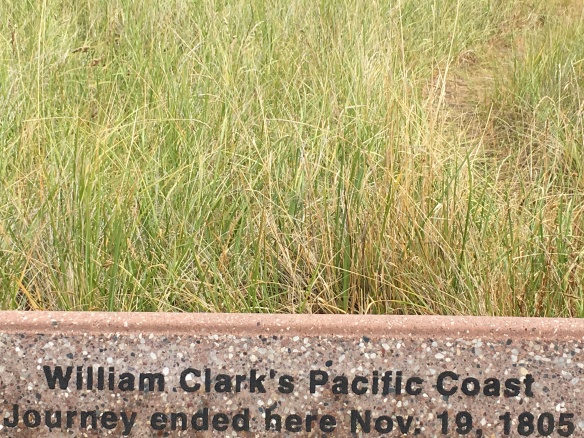
Cape Disappointment marks another very important place in the history of North America. It is not just a place that signifies disappointment, tragedy and danger. It is also the very spot where the famous Lewis and Clark expedition reached the Pacific Ocean in November of 1805. Yes, Lewis & Clark met with many a disappointment and setback along the 3700-mile route up the Missouri River, across the American Midwest, over the Rocky and Cascade mountains and down the Columbia River Gorge that took them a year-and-a-half to accomplish.

IMG_6400

On the journey, were they ever absolutely certain they would make it? As it was, they must have taken their disappointments in stride. For on an uncharacteristically calm day in a stormy November, they made their final push around the western Cape and finally met the limitless horizon.

Significantly, the Lewis and Clark Expedition was called the Corps of Discovery. Today, a 10-mile-long, well-groomed paved path winds through the dunes of Long Beach Peninsula and up into the forest of the Cape. It is called the “Path of Discovery”.

IMG_5994

Cape Disappointment is intricately tied to the Corps of Discovery, where both failure and success are entwined in a rich and diverse history of exploration. The spirit of questing celebrated on these shores includes and transcends both the unique events of human tragedy and human achievement. You cannot have one without the other. In one place. In one human being. Each of us is invited to the journey that includes, embraces and transcends disappointment and failure.

At some point along the journey, you need to have hope in order to continue. Even in the midst of all our unknowing, we can believe and trust in the solution, before it happens.

It’s called faith.

IMG_5922.JPG


[1] Jonah 3:10—4:11, NRSV, Proper 20A/Ordinary 25A/Pentecost+16

[2] Jonah 4:2

[3] Jonah 4:4,9,11, NRSV

[4] Richard Rohr, “Adam’s Return: The Five Promises of Male Initiation” (New York: The Crossroad Publishing Company, 2004), p.112

[5] John 1:38, NRSV

[6] Belden C. Lane, “The Solace of Fierce Landscapes: Exploring Desert and Mountain Spirituality” (New York: Oxford University Press, 1998), p.105

[7] Isaiah 55:8, NRSV

photos by Martin Malina IMG_5940

Buen Camino!

When in Sunday School decades ago we played the roles of well-known bible characters, I remember the only thing worse than being a “Judas” was to be a “doubting Thomas”.

We wanted to be Abraham, Moses, Kind David, Samson, Queen Esther, Rachel, Ruth, The Magi, Peter, Paul, John. We wanted to be Joseph or Mary, or even Jesus himself!

But Judas the Betrayer, or Thomas the Doubter? No. Indeed Thomas has been treated quite negatively in much of Christian preaching and teaching. He is often held up as a negative role model.

Let’s take a closer look at the text about Jesus’s resurrection appearance to his disciples (John 20: 19-31). Because there is no condemnation of Thomas. Recall the disciples are hiding behind locked doors in Jerusalem fearful of the authorities. Unless Jesus’ words to Thomas are inflected in an accusing way, they do not need to be read as a condemnation: “Have you believed because you have seen me? Blessed are those who have not seen and yet have come to believe” (John 20:29). They simply affirm that those who believe without first-hand experience of the risen Jesus are also blessed. (1)

But can we blame Thomas? Thomas only desires his own firsthand experience of the risen Jesus. He is unwilling to accept the secondhand testimony of others. And, his desire is granted: Jesus appears to him. Prayer answered!

I wonder if Thomas today doesn’t really represent so many of us who deeply yearn and seek for a first-hand experience of God, and are simply and naturally unsatisfied with hearing it ‘second-hand’. Hearing someone else’s first-hand experience of God is inspiring and instructional to be sure. We learn about someone else’s experience of God’s presence, healing, grace and wonder — whether that person is from the bible or our grandparents or the person sitting next to us in worship. But someone else’s experience of God can never be a substitute for our own.

What we may be looking for, is to be more like Thomas: Honest in our desire for a first-hand experience of the living God. Yearning to taste and feel more of the goodness of God in our own lives and in the world. Striving ourselves to make the world a better place for everyone. We may be unsatisfied with basing our commitment to a life of faith on someone else’s testimony. We may, like many people today, be seeking our own experience of God and suffer from what I would call the ‘second-hand syndrome’. Perhaps Thomas needs to be our role-model more than anyone else in the bible today!

Of course, the benefit of the Reformation was to teach us an important distinction in all our striving: Our motivation is important to be aware of, because if we strive to do good all in order to make ourselves right before God we will most certainly miss the mark. “We confess that we are captive to sin and cannot free ourselves,” we say in our Confession. God initiates the saving relationship. God moves; we only second the motion.

And yet, our striving, our trying, our good work as response to God can help create the space and the climate in which God’s grace is made clear to us, is given to us, and in which we are most ready, then, to receive God’s forgiveness, love and mercy. Being pro-active, doing things with one another in the church, yearning and striving for God — these are antidotes to the ‘second-hand syndrome’ and a prescription for a healthy life of faith.

Last week on the first Sunday of Easter, I emphasized the words from Matthew’s account of the Resurrection of Jesus outside the empty tomb that first morning. Jesus instructs the women: “Do not be afraid; go and tell my brothers to go to Galilee; there they will see me” (Matthew 28:9-10).

When resurrection happens today, as it always has beginning with that first day, there is movement forward. Not backward. As I said last week, there is no turning back once resurrection happens. The disciples are not instructed to meet Jesus in the empty tomb where the miracle happened. No. The instruction is quite clear: Get moving! Get out of here! Go to Galilee. Go to where I wait for you. In other words, don’t stay where you are! Do something!

In 2017 the Lutheran Church worldwide celebrates the 500th anniversary of the Reformation. We call it Reformation 500. ‘Five hundred’ is an important number in all the dialogue surrounding this momentous occasion. The national church has even set up the Reformation Challenges for the church across Canada to meet. And each of those goals are pegged at some variant of 500:

Five hundred refugee sponsorships (which already has been exceeded), five hundred scholarships for school children in the Holy Land, five hundred thousand trees planted in Canada, and five hundred thousand dollars raised for the Lutheran World Federation endowment. You can visit elcic.ca for the most recent update on where we are at in meeting all those goals. And please consider making a personal contribution towards any one of those worthwhile causes.

I’d like to up the ante. Let me call it the ‘Reformation 800 Challenge’. Eight hundred is the new Five hundred. Not only are we celebrating 500 years of Reformation this year; we turn to the future and pray not just for 500 more years but … 800. Why not?

Let that number, eight hundred, symbolize a confidence and hope-filled trust that God has more good than we can ever imagine in store for us in the church far into the future. And this is what I propose in this year’s Reformation 800 Challenge:

Next month, I begin walking the 800 kilometres from Irun, Spain to Santiago de Compostela in Galicia. The route I follow skirts the northern coast of Spain from East to West. This is my Reformation 800 Challenge.

I walk a pilgrimage route, one of the most ancient on the planet. This Camino (which means the “way”) has been an important spiritual discipline for almost a thousand years for millions of Christians.

A pilgrimage means that what happens on the outside of us in our physical reality mirrors the change and challenge that happens on the inside of us. In other words, outer and inner realities find some kind of resonance on a pilgrimage experience. It’s on a pilgrimage where many discover or re-discover their ‘walk’ with God in life, are renewed on their ‘path’ and/or are ‘re-directed’ to new ways of living.

I would like you to do this with me. Yes. I invite you to consider doing a Reformation 800 Challenge with me, in your own way, with your own resources and plan.

For example: In order to reach the goal of 800 kilometres in under two months I plan to walk at least 20 kilometres a day. So, while I’m gone would you consider a physical discipline whereby you, for 20 minutes a day, do something intentional for your own health and well-being: walking, cycling, lifting a small weight, stretching, doing yoga, etc.? It doesn’t have to be ‘extreme’; something simple even if you are confined to a chair or bed — for 20 minutes a day, do something that involves your body in ways you have not normally been accustomed. Be creative.

A piece of wisdom for pilgrims that has guided my preparation and planning is: Walk Your Way. Walk your own Camino. This is nobody else’s walk but yours. Do what you want and need to do, in your own way, according to your own pace.

You can interpret this challenge in many ways. For example, if you are very active and move about a lot in your daily life already, perhaps sitting still and quietly for twenty minutes a day in silent meditation and prayer is your way. Or, take twenty steps a day. Do twenty reps of a particular exercise or stretch. But whatever you do, the important thing is that you are challenged to attempt and remain faithful to a daily, body-involving discipline. Do it your own way.

Keep a journal or write your notes on a piece of paper that you stick to the fridge door. Write the date, and the accomplished task, so that over time, you can track your progress.

Your goal: 800 of something before the end of this year — whether eight hundred minutes, steps, kilometres. And here’s the good news. You already have a head start on me. I don’t begin until mid-May. You can start this afternoon, on your Reformation 800 Challenge! And, you have until the end of the year; I need to be finished my walk by early July.

After I return from my sabbatical, I would very much be interested in having a conversation with you about our experiences on our pilgrimage. They say that for pilgrims close to reaching their destination in Santiago, many confess that by the end it was no longer them walking the Camino, but the Camino was walking them. In other words, the experience of doing it created deeper trust in the way of God, of faith and peace within them. The physical reality converged with their inner life in positive ways.

As you contemplate what your discipline will be, as you think about what you will do, as you plan your own ‘pilgrimage’ — here are some questions for your own reflection and which can provide a basis for our own conversation when I return. Ask yourself:

In Preparation

What will you do to reach ‘800’ by the end of the year? In time? Kilometres? Steps? Reps? And how will you do it on a daily basis? (for example, 20 minutes/kms/reps/steps, etc. per day)

What are your intentions for this experience? What do you hope for by the end? The first recorded words of Jesus to his disciples in John’s Gospel are: “What are you looking for?” (John 1:38). How do you know you will find it if you don’t know what you are looking for in the first place?

What do you think you will discover about yourself? Saint Augustine once said that knowing yourself is a stepping stone to knowing God.

How will you record your journey?

On the Journey

Where did God find you? What experiences along the way brought you close to God?

What was the best part of the experience so far? What has been the greatest challenge?

Who did you meet along the way? Or, describe your relationships with others during the experience.

What were you grateful for?

Nearing the end / Getting close to the goal

What does it mean ‘to arrive’?

How does it feel to be reaching a destination after great effort and clear motivation for the journey?

What sacrifices did you make in order to get this far on the journey?

How will you celebrate and honour the ending of the journey?

After the Journey

What was the most memorable part of the whole experience?

How did you deal with disappointments and/or failure during the journey?

How do you now view God?

How will you keep what you learned alive in your regular life now that the journey is over?

Has anything shifted within you as a result of the experience? If so, how would you describe this change within yourself?

How will you share your journey and what you have learned with the important people in your life?

As we soon begin our pilgrimages, may God bless us on the way. And to all we meet along the path, may we wish them, “Buen Camino!”
1 — Marcus Borg & John Crossan, “The Last Week: What the Gospels Really Teach About Jesus’ Final Days in Jerusalem” (New York: Harper One, 2006), p.202-204.

Lent begins again: Why?

We begin a journey of some forty days, which mirrors Jesus’ forty days in the wilderness (Matthew 4:1-11). We continue to observe the season of Lent, year after year, as we approach the most holy of Christian days — Easter, the resurrection of our Lord.

But why do we do this? Why do we continue to do this, it seems, against the flow of society and the dominant culture today? As a child, I remember when it was more popular to ‘give up’ something for Lent; people actually did give something up, like dessert or TV. Some still do, I know.

And yet, it seems from the perspective of our economy and lifestyle today, that planning for March break, and sun-shine, escapist getaways get more attention and energy than any spiritual discipline might.

So, let’s begin our Lenten journey with a close look at why we need to go on this trip in the first place. Speaking of journeys, then, here’s a fascinating one from the history books:

“Early in the twentieth century, the English adventurer Ernest Shackleton set out to explore the Antarctic …. The land part of the expedition would start at the frigid Weddell Sea, below New Zealand …

“‘The crossing of the south polar continent will be the biggest polar journey ever attempted,’ Shackleton told a reporter for the New York Times on December 29, 1913.’

“On December 5, 1914, Shackleton and a crew of twenty-seven men set out for the Weddell Sea on the Endurance, a 350-ton ship that had been constructed with funds from private donors, the British government and the Royal Geographical Society. By then, World War 1 was raging in Europe, and money was growing more scarce. Donations from English schoolchildren paid for the dog teams.

“But the crew of the Endurance would never reach the continent of Antarctica.

“Just a few days out of South Georgia Island in the southern Atlantic, the ship encountered mile after mile of pack ice, and was soon trapped as winter moved in early and with fury. Ice closed in around the ship ‘like an almond in a piece of toffee,’ a crew member wrote.

“Shackleton and his crew were stranded in the Antarctic for ten months as the Endurance drifted slowly north, until the pressure of the ice floes finally crushed the ship. On November 21, 1915, the crew watched as she sank in the frigid waters of the Weddell Sea.

“Stranded on the ice, the crew of the Endurance boarded their three lifeboats and landed on Elephant Island. There Shackleton left behind all but five of his men and embarked on a hazardous journey across 800 miles of rough seas to find help. Which, eventually, they did.

“What makes the story of the Endurance so remarkable, however, is not the expedition. It’s that throughout the whole ordeal no one died. There were no stories of people eating others and no mutiny [to speak of …. Some have argued that ] “This was not luck. This was because Shackleton hired good fits. He found the right men for the job ….

“Shackleton’s ad for crew members was different [from the norm]. His did not say WHAT he was looking for. His did not say: ‘Men needed for expedition. Minimum five year’s experience. Must know how to hoist mainsail. Come work for a fantastic captain.’ Rather, Shackleton was looking for those with something more. He was looking for a crew that belonged on such an expedition. His actual ad ran like this:

“‘Men wanted for Hazardous journey. Small wages, bitter cold, long months of complete darkness, constant danger, safe return doubtful. Honour and recognition in case of success.’

“The only people who applied for the job were those who read the ad and thought it sounded great. They loved insurmountable odds. The only people who applied for the job were survivors. Shackleton hired only people who believed what he believed. Their ability to survive was guaranteed.” (1)

Year after year, the Gospel text from Matthew 6 is read on Ash Wednesday which marks the beginning of the Lenten journey. It is a journey, a pilgrimage, you might say. For those willing to embark on the sometimes harrowing yet intentional path, Jesus points to the authentic quality and honesty of community life.

Being the church in the world is not to give a false impression, to show how exceptional we are in the religious marketplace. Being the church to the world is to be authentic and true to what we believe and who we are, whether or not we measure up to some cultural standards of behaviour.

Maybe that explains why Lent is no longer popular in our day. Society has already been for a while losing ourselves in distractions. In 1985 Neil Postman claimed that we were “Amusing Ourselves to Death.” (2) Over a decade earlier, Ernest Becker wrote a book I read in seminary, entitled, “The Denial of Death” (3) which is a theological reflection on how we live in ‘modern’ North America.

Indeed, we in the West continue on a course of distracting ourselves to death — with stimulating toys, technological advance and even more addictive ways to keep the truth at bay. This strategy, with often tragic consequences, only serves to drive a deeper wedge and division from our true selves.

The symbolic destination of the Lenten journey is the Cross, on Good Friday. And so, right off the start, we know this can’t be an easy journey, when we have to face and bear our own cross. But this is what life is about, is it not? Whenever hardship comes our way in whatever form it does — illness, loss, tragedy, disappointment, conflict and confrontation, failure, guilt, pain. We don’t have to seek it out; Suffering comes to us all. This is a reality we are called to accept.

We are called not to deny that our message is for people who are honest about their brokenness, who in their vulnerability do not want to pretend their weaknesses away. Our suffering can be a great teacher, an opportunity for growth and wholeness.

Suffering, in the words of Canadian theologian Douglas John Hall, “belongs to an order of creation insofar as struggle … is necessary to evoke the human potential for nobility, for love, for wisdom, and for depth of authenticity of being. A pain-free life would be a life-less life.” (4)

Lent is not a path to ultimate self-annihilation. Ultimately, Lent is not a downer. Because suffering can point to a new beginning. Followers of Jesus are not a people who suffer the pains of life without faith and hope. We can face what life brings, with a conviction that together, we can do more than merely survive.

On this journey we can experience that the whole is greater than the sum of its individual parts. In accompanying each other through the difficult times, we can experience something greater than ourselves. Together we will realize more than we could ever have imagined on our own; transformation, resurection, a new beginning. Together, because God in Jesus goes with us. We are not alone on this journey.

God blesses this journey.

1 – Simon Sinek, “Start With Why” (New York: Penguin, 2009), p.90-93
2 – Neil Postman, “Amusing Ourselves to Death” (New York: Viking Penguin, 1985)
3 – Ernest Becker, “The Denial of Death” (New York: Free Press, 1973)
2 – Douglas John Hall, “God and Human Suffering: An exercise in the Theology of the Cross” (Minneapolis: Augsburg Publishing House, 1986), p.62-63

Annual Pastor’s Report

Effective Partnerships

The most significant event in the life of Faith Lutheran Church in 2016, was the decision to complete an extensive renovation of our worship space and narthex hallway. To complete this major modernization project, we partnered with the capable and esteemed contracting company from Stittsville, “Amsted”.

This decision precipitated what may in the long run prove to be just as significant, if not more so: The decision to join with the local Anglican parish on Sunday mornings during the time of the renovation (which lasted into 2017).

Even should nothing enduring come of the relationship between Faith Lutheran Church and Julian of Norwich Anglican Church, the mere exercise of gathering as a hybrid congregation for the last ten consecutive Sundays in 2016 plus two Christmas Eve services caught the attention of the Christian community in Ottawa and across our Eastern Synod.

Meeting to worship with local Anglicans affirmed both the existing Full Communion relationship between the Evangelical Lutheran Church in Canada (ELCIC) and the Anglican Church of Canada (ACC), an agreement existing since 2001. As such, given the other options during our vacancy from 43 Meadowlands Drive West, meeting with an Anglican congregation was attractive, since doing so facilitated many logistics of worship between our similar liturgies, as well as kept a certain momentum alive for meeting at all, during the renovation/vacancy period.

On Lutheran liturgy Sundays (every other Sunday) at Julian of Norwich, we expressed our unique identity within the union of two distinct congregations. For example, each congregation has different histories, as well as contrasting governance structures (i.e. Anglicans are governed episcopally, while Lutherans are governed in a congregational structure).

While comparing congregations is fruitful, challenging and enjoyable, the fact that we began this relationship knowing we were returning home at some point allows us to pose critical questions of review of our ‘way of doing things’ freely, both around sacramental practice and mission.

During the Eastern Synod Assembly in June, your lay delegate (Julia Wirth) and the pastor heard again the four main, missional themes of the Eastern Synod (Effective Partnerships, Healthy Church, Spirited Discipleship, Compassionate Justice). No doubt, our congregation participated in a way no other Eastern Synod congregation has, in affirming the value of seeking “Effective Partnerships” in fulfilling God’s mission, especially during times of need and change.

Loss and Transition

A basic assumption of committing to the renovation project was that we had to take leave of our current building, and specifically our place of prayer. Doing so was an act of courage. Leaving a place that has symbolized a constant certainty in the lives of Faith members for over fifty years was not easy. Our sense of stability in faith was disrupted, as we were challenged to distinguish between the form (‘our’ building) and function (the purpose) of faith.

This leave-taking coincided with other endings. June 2016 marked the last time the Faith Lutheran Women (FLW), structured the way they had been for the last few decades, met in typical fashion (see report). For some time prior to this they had been talking about closing their account and ceasing to meet ‘as is’. In the latter part of 2016, that talk became reality.

Also, the Confirmation program that for several years had been a successful experience for leaders and participants alike, did not in the Fall of 2016 achieve the critical mass of students to warrant a class structured in the same way. As a result, no program started up at the start of the school year.

These events, I believe, constitute ground for growth and maturity of our community as we practice the spiritual gifts of detachment and trust. The prophet Isaiah spoke the word of God to the exiled people in Babylon in the 6th century B.C.:

“Do not remember the former things, or consider the things of old. I am about to do a new thing; now it springs forth, do you not perceive it? I will make a way in the wilderness and rivers in the desert.” (Isaiah 43:18-19)

Before the new thing arrives, we need to stop the old thing. These endings are not failures as such; rather, they provide the space for the new thing God will have for us. What we are called to in disruptive times of loss and transition, I believe, is to be patient, have presence of mind and openness of heart, and be willing to take a risk together when something presents itself in our hearts as possibility and passion.

Poised for renewal

Moving into the new year, Faith Lutheran Church is poised to embrace a season of discernment, reflection and new beginnings.

Not only will we return to enjoy the gift of a refreshed, safe and healthy environment for meeting in our newly renovated building, we will be encouraged to reflect on what this space, created for at least another decade of ministry, worship, and mission, will be used for.

Late in 2016, the congregational council unanimously endorsed a proposal for a 3-month sabbatical for the pastor in 2017. The sabbatical covenant, based on the Eastern Synod Guidelines for Sabbatical, addresses the need for leaders to take periodic and extensive ‘pauses’ in vocational life, for renewal, reflection and discernment.

The benefits for the congregation mirror those for the pastor. From the perspective of providing some distance, a sabbatical gives freedom for everyone to step back, assess the structure of ministry and mission in the congregation, and contemplate new ways of supporting one another in our lives of faith.

For example, healthy congregations in general have several highly functioning lay leaders who engage proactively not only in managing a church, but in leading the mission of the church. The health benefits to the congregation, as for the pastor, following the sabbatical give opportunity for renewal of the mutuality of the relationship between pastor and congregation in God’s mission. The ‘reset button’ is pressed, and energy flows again.

Adaptive Change: Put away the mallets and start asking “Why?”

“There is a wonderful story of a group of American car executives who went to Japan to see a Japanese assembly line. At the end of the line, the doors were put on the hinges, the same as in America. But something was missing.

“In the United States, a line worker would take a rubber mallet and tap the edges of the door to ensure that it fit perfectly. In Japan, that job didn’t seem to exist.

“Confused, the American auto executives asked at what point they made sure the door fit perfectly. Their Japanese guide looked at them and smiled sheepishly. ‘We make sure it fits when we design it.’

“In the Japanese auto plant, they didn’t examine the problem and accumulate data to figure out the best solution — they engineered the outcome they wanted from the beginning. If they didn’t achieve their desired outcome, they understood it was because of a decision they made at the start of the process.

“At the end of the day, the doors on the American-made and Japanese-made cars appeared to fit when each rolled off the assembly line. Except the Japanese didn’t need to employ someone to hammer doors, nor did they need to buy any mallets. More importantly, the Japanese doors are likely to last longer and maybe even more structurally sound in an accident. All this for no other reason than they ensured the pieces fit from the start.

“What the American automakers did with their rubber mallets is a metaphor for how so many people and organizations lead … a series of perfectly effective short-term tactics are used until the desired outcome is achieved. But how structurally sound are those solutions?

“ … Long-term success [is] more predictable for only one. The one that understands why the doors need to fit by design and not by default.

“Going back to the original purpose, cause of belief will help … [churches] adapt. Instead of asking, “WHAT should we do …? the questions must be asked, “WHY did we start doing WHAT we’re doing in the first place, and WHAT can we do to bring our cause to life considering all the technologies and …[other] opportunities available today?” (1)

Being poised for renewal means we need to understand the nature of change in institutions such as the church. Some definitions, outlined in a report generated by the Eastern Synod Mission Committee late in 2016, draw the distinction between Technical Change and Adaptive Change:

Technical Change is about fixing problems while essentially keeping the system the same. In other words, where’s the mallet?
Adaptive Change, on the other hand, is about addressing fundamental changes in values that demand innovation, learning and changes to the system itself. Start with ‘Why?’ And then lead from there, by design not default.

During this coming year, which will give all of us permission to pause and reflect, please resist the temptation to rush into doing something either because ‘we’ve always done it that way’ or because we are too anxious not to remain awhile in the uneasy ‘in-between’ time of loss and transition. Be patient, take deep breath, pray, and reflect on the following questions:

Our adaptive challenge questions for 2017:
1. How do we communicate? To whom is each of us accountable?
2. How well do we listen and seek to understand the other? Give concrete examples.
3. Will we create a list of those who are not in church (technical strategy); or, will we identify the needs in the community surrounding 43 Meadowlands Dr West, in Ottawa (adaptive strategy)?
4. How will prayer be our starting point?
5. What are other ways besides worship that serve as entry points for the public to engage the church? This is important.
6. How do we see worship as a launching pad, not a destination, for following Jesus? This is very important.
7. What are the gifts we have as a church? (personnel, space, talents, passions, etc.)
8. How well do you know your fellow congregants’ jobs, professions, contacts, interests, hobbies, talents, passions?
9. Why do we initiate a ministry or mission outreach activity in the first place? Who is the target group? What is the purpose of doing it? Does everyone know the purpose? Why or why not? Is there general agreement about the purpose? Why or why not?

Thank you again for the privilege of another year doing this work with you. Blessings and Grace, on our journeys moving forward,
Pastor Martin

(1) Simon Sinek, “Start With Why”, Penguin Books, New York, 2009, p.14-15, p.51

The case of the missing pulpit

As we worship this morning, the sanctuary at Faith Lutheran Church building is gutted — empty, a shell. Not only is the cork on the walls now removed and the old carpet disposed. The light fixtures, most of the furniture, liturgical items and holy hardware is stowed away for the time being to be recovered, restored and positioned again in their proper place once the renovations are completed.

I know some of you who have been at the site in the last day or so helping to get it ready for the workers, have been asking the question: “Where is the pulpit?” I can see the title of the next best-selling mystery novel: “The Case of the Missing Pulpit.” Where is it?

What a mystery! Well, this is what happened …

Last Sunday afternoon as I was helping members of our altar care committee removing certain items, we ran into a little problem. Our pulpit is mobile; it sits on wheels. So, depending on the needs of the day, we move it around. 

Well, we moved it alright — all the way to the door of the sacristy where we were hoping to store it. Without doing serious alterations (and damage!) to the door frame, there was no way that pulpit would get through. And the cloakroom, where we normally store the pulpit at Christmas, was going to be filled with stacks of chairs. Where on an already compact floor space would we store a rather heavy and cumbersome piece of teak-wood furniture?

It was the spur of the moment when I offered to put the pulpit in my car. I had the back seats down anyway at the time, and the rear hatch opened just wide enough to allow the pulpit to slide in fairly easily. And I drove away with church’s pulpit in the back seat of my car! Truth be told!

During the 45 minute drive home to Arnprior, my mind raced: What would I say to someone who would behold this mystery! I was also wondering where on earth I would put it. I had no clue. There was room in our garage, but most of that space was already tagged for bikes, tires, canoes and garden implements for the winter season.

My wife and I sat in the living room that evening scratching our chins and trying to come up with solutions. But to no avail. I guess I would drive around with a pulpit in the back seat of my car for three months! A mobile preacher who comes with his own pulpit! What a deal!

Barbecuing on the back deck that evening, I looked above the tree line and my eyes rested on the steeple of a church, just around the corner from our place. After making a phone call, and depending on the good will of their pastor and the muscle of a couple of their men from that community — and our pulpit now has a resting place. 

So, if anyone asks: Our pulpit is in the safe-keeping in the building of the good people of St John Lutheran Church in Arnprior. Let it be heard! “The case of the missing pulpit” … mystery solved!

I’m usually the kind of person who wants to have a plan, to know how things ought to go and what the end result should be, before doing anything. This is also usually a good thing. Driving away with the pulpit without any clue as to where it should go, was a little unnerving for me. It was, nevertheless, a good exercise for letting go and trusting that a solution would present itself. And it did, in a most gracious, natural and expedient way.

Some of you know that I am planning to go on a sabbatical next year. The theme of my sabbatical is ‘pilgrimage’. And part of the experience is to walk an ancient path, some eight hundred kilometres long, on the north coast of Spain on the famous Camino de Santiago de Compostela. I’ve read that a majority of people who start the pilgrimage — hundreds of thousands every year — don’t finish it. Many pilgrims give up, some even just 25 kilometres into it. 

What many successful pilgrims learn is that all that is required is to remain committed to the journey itself. What is needed, is to unlearn deep-seeded attitudes about what justifies us, as human beings. To persevere in that un-learning process over six-weeks, even against all the challenges of the trail. To learn that all that is required is simply to put the next foot forward. To not give up, to not lose heart. And to pray always.

To dial it down to accepting that it’s all about taking the next step faithfully — nothing more, nothing less. Although simple, it is not easy for most of us to comprehend let alone do: Just walk. Eight hundred kilometres. Because it’s not about our ability and resourcefulness in the end. It’s not about rushing to the next distraction, checking off the next thing on our list in a busy, hectic lifestyle. It’s about something much bigger than us and our ‘stuff.’ A pilgrimage can teach us that.

That was the message from last week’s Gospel from Luke 18:1-8, to pray always. The most important thing is to remain focused on staying the course, to do the prayer. The solution — the answer, the benefit — will present itself as long as we remain committed to the journey, the adventure. 

Last week, we learned to persevere in prayer. This week in the story that follows we learn how to pray. And I want to reflect David Lose’s perspective here (1), to watch for the trap that Luke sets for us readers. Remember, the Gospel of Luke is full of reversals — the song of Mary, the beatitudes in the sermon on the mount, Jesus’ conversation with the thief hanging beside him on a cross, etc. Luke, it seems, delights in setting up his readers with presumed expectations, and then pulling the rug from under our feet.

It’s too easy merely to paint the bad guy as the Pharisee. Because don’t forget, the Pharisee is law abiding, has fulfilled all the demands of his religion, lives a pure and righteous life. Isn’t this what faithful living looks like? After all, we shall know others by their fruits, no? The Pharisee does a lot of things right. Except for one thing:

The Pharisee, while living the right life, has forgotten the source of his life and all the good in it. Otherwise, he would not despise another whom God loves. He falsely believes it’s all about him and his efforts alone. He falsely believes others who are not like him, need to be, in order for them to be good people.

And, it’s too easy to side with the ‘humble’ tax collector. Let’s not let him off the hook too easily. The tax collector only recognizes that all he is about is depending on the mercy and forgiveness of God. That’s in good contrast to the Pharisee, yes. And that’s the challenging starting place, to be sure.

But nowhere do we see a sign of his repenting. Does he desire to have his life turned around? He may very well be as self-engrossed as the Pharisee. Just the other side of the same coin. The tax collector strikes me as one who might remain stuck in cycles of self-pity, negative self-talk and depression. 

He might be one who goes back every Sunday to remind himself how bad he really is. A false humility, we may call it, where it feels good, actually, to put yourself down before others. “I’m not good enough.” “I don’t have a strong faith.” “I can’t do this or that.” 
Will he not hear that God’s forgiveness can lift him out of what may appear a chronic negativity? Will he not hear that he is not all of the time all worms and dirt and badness within? Will he not hear that God has given him a great gift within himself, in himself?

No matter with whom we relate, or cheer for, in this text — the Pharisee or the tax collector — we run into a wall with both of them. And I believe this wall is meant to test to what degree we focus too much on ourselves in the practice of our faith and in our prayer, and not on God.

The trap is to call us out whenever what we do or what we decide as communities of faith is more about our own stuff, than about the bigger picture, the holy and wonderful mystery that is God.

At least one item from our worship practice is not in storage, but stands in this place alongside yours — the Paschal Candle. It is called, ‘paschal’, because it describes the ‘mystery’ of Jesus life, death, resurrection and ascension. We call it, ‘the Paschal Mystery’. 

We are not talking here about a mystery like ‘the case of the missing pulpit’, where it is simply a question of information about something that is already known, just not to everyone. “Mystery isn’t something that you cannot understand”; A mystery, in the holy sense, is as Richard Rohr puts it: something you can “endlessly understand” (2). We never ‘arrive’ at a complete knowing, this side of eternity, of what God is all about. We never completely ‘get it’. We are always growing, changing, discovering, adventuring.

It is natural to seek signs. The Pharisees and disciples demanded Jesus: Give us a sign! And the only ‘sign’ that Jesus was willing to give them, was the “sign of Jonah” (Luke 11:29). Many of us know that story from the Old Testament, where Jonah fights against God’s will, refuses to follow where God calls, doesn’t want to do it! 

Only by spending time in the belly of a whale for a few days, where he can do nothing, does Jonah become aware and accept that it’s not about him, or his mission, but about God’s purpose, God’s call, God’s mission. Doing God’s mission will call us beyond our own agendas, preferences, and even personalities. Not that those things are bad. But this is about something a lot bigger than our resumes, list of accomplishments, or even our baggage and painful histories.

We are on a journey moving forward, a pilgrimage, to discover what God is about in this holy space and in the world around us, now. We already received signs of God grace — your authentic and heartfelt welcome and accommodating us, for starters. This beautiful space and hospitality we can share. This is God’s good work among us and through you. Thank you!

We might not know what this will look like at the end of the journey together as Faith Lutheran Church worships alongside Julian of Norwich Anglican Church over the next few months. “I’ve got this pulpit in the back seat of my car, and I have no idea where it’s going!”
We might not know where this adventure leads.

But we don’t go alone. We travel this uncertain road together, side by side. We may suffer through some moments together as we figure things out, as we feel our way into this journey, as we learn and perhaps go through some growing pains together on these first few steps.

But let us be encouraged by the Paschal Mystery, which points to the way of Christ, the self-emptying and giving that leads to a marvellous and wonderful resurrection from all that is passing away, transforming us into the new thing that God is doing. The light of Christ shines ever and ever, even in the darkness and through our most challenging journeys. 

Thanks be to God! Amen.


(1) David Lose, “The Pharisee, the Tax Collector, and the Reformation”; Monday, October 21, 2013; http://www.workingpreacher.org 

(2) Richard Rohr, “The Divine Dance: The Trinity and Your Transformation” (Whitaker House Publishing, Pennsylvania, 2016)

Sanctuary

For a year and a half my wife and I took dance lessons. We learned Latin dances such as the Salsa, Rumba, Samba, Triple-Step, Merengue, and the Cha-Cha. 

I was motivated, at the start, by a beautiful vision in my imagination: I could see my wife and I swinging to the music, sweeping across the dance floor, effortlessly. I had a vision of us moving in complete sync with one another, twirling and swaying together in perfect rhythm and harmony. What a vision!

When I first proposed we take these lessons together, she was all game. So, every week we dutifully went to our lesson and met with our dance instructor who showed us the steps and taught us the moves. We were doing this together!

After a few lessons, however, I was becoming a little bit disappointed. My vision was not panning out. We weren’t always in sync with each other. Indeed, more often than not, we were stepping on each other toes! Oh yes, we giggled about our missteps, but it seemed we were not getting anywhere.

Our instructor calmly yet persistently reminded us that we needed to practice. Before the fun would come, she said, we had to master the steps. And for me, the lead, I had to memorize the patterns and in my mind always be one step ahead, knowing where we were going with each and every move. And this took work! And persistence. And time. The fun would come later, I held on to the promise.

It wasn’t as easy as I imagined it would be, working towards that vision. In fact, it was my wife who grew into the love of the dance and often had to cajole and encourage me to keep up with the program.

The Gospel text (Luke 18:1-8) today describes a woman who is persistent in her pursuit of justice. Jesus tells this parable to illustrate what it means not to lose heart. In the story, persistence is not just about building up the courage to do something beyond one’s comfort zone just once, and then give up because it doesn’t turn out. 

How often, isn’t that how we operate when trying something new for the first time? Something doesn’t please us the way we expected or wanted the first time we try, and so we just give up on it. No, in the story, she goes back “continually”. The vision of justice never wavers in her commitment to do the hard work.

This relentless pestering is accomplished in adversity, and really against all odds. Why the woman would even consider trying, up against someone in power who has no fear of God and no respect for anyone, is remarkable. At the onset, we would say she is hardly setting herself up for success!

Setting up a contrast of visions to describe God, is what Jesus is up to in telling this story. The place where we meet God is a place of mercy, of sanctuary. People, in the course of history, could enter a church and find respite from the condemnation of the law. The police, the authorities, the powers that be, even the force of the law could not touch you in the holy space. Here, you found immediate relief and mercy, just by entering the space.

The place where we exercise our prayer is a place where we receive forgiveness, despite the imperfection and sordid realities of our lives in the world. That is why Jesus tells of a woman receiving justice, not because she goes to the temple per se, but a court of law in the secular world: Even there, you can find justice, despite the unjust and sinful people involved. God’s love is greater even then the most powerful, unjust judge.

Indeed, this is our challenge today. God is not just in one, holy place that we have cherished for the past fifty-five years. God is out there, too! In the imperfection of our Monday-to-Saturday lives. In the imperfection of our secular world. In the seat of government. In the marketplace. And, would you believe it, also in other churches. The truth of the Gospel resides in a worshipping community that is far from perfect. That, in fact, has weakness and brokenness imbedded in our very being together.

When Jacob wrestled with God on the banks of the River Jabbok (Genesis 32:22-31), he didn’t hold back any punches, so to speak. He let God have it, and prevailed! His encounter with God, nevertheless, left him with a physical reminder of relationship with God: A bad hip. He would live the rest of his days, “limping because of his hip.” 

To be in communion with the Holy One is to bear the physical, real mark of sacrifice, of weakness, of imperfection. Followers of Christ, if you want to know them, are not perfect people. And if you meet Christians who appear to be perfect — or you want them to be — you are missing the truth of it I am certain. In fact, we would throw our lot in with the unjust judge, more than anyone else in these stories I would guess.

I read recently a story told by Marianne Williamson in her most recent book: “Tears to Triumph”. It’s “about a chimpanzee troop in which a portion of the population displayed depressed behaviour. They didn’t eat with the rest of the chimps, play with the rest of the chimps, or sleep with the rest of the chimps.

“A group of anthropologists wondered what effect the absence of these depressed chimps would have on the rest of the troop and removed them for six months. When they returned, they found that all of the other chimps, those who remained in the troop, had died! Why?

“According to one analysis, the chimps perished because the so-called depressed chimps among them had been their early warning system. The depressed chimps had been depressed for a reason; they registered that a storm was coming or snakes, or elephants, or disease. The presence of the depressed chimps had been an aid to the survival of the entire population … ” (1)

We need each other. We need our faults, you could say, just as much as we need our strengths. To remind us of what it’s all about. To point us to the Cross and the Empty Tomb. To help us remember that the church is not about our mission, but about God’s mission. To emphasize the grace of God under which all of us stand. To encourage us to work together with others that appear different from us. Going to, and persisting with, people that do things differently from us — in some ways better, in other ways not so much — is vital for the health and survival of the whole church.

So, after today we begin an adventure. Worship and faith and life-in-our-community does not stop now because this particular space becomes a construction zone for a couple months. We will continue to worship as a community, as Faith Lutheran Church. Yes we will! 

Our prayer will continue, and we will persist with others who are different from us (and I suspect we will soon discover they are not that much different from us!) at Julian of Norwich Anglican Church. Being outside our comfort zone is a critical, healthy, spiritual exercise. Should we persist together in this adventure, I believe we will grow in ways that are both vital and healthy to the future of Faith Lutheran Church; persisting together in this adventure will also deepen our walk with God.

I want to encourage you over the next two months to embrace this challenge, not shy away form it, maintain the vision, not lose heart, and pray always! Because God is already and always merciful and just.

(1) Marianne Williamson, “Tears to Triumph; The Spiritual Journey from Suffering to Enlightenment”, HarperOne, New York, 2016, p.84-85

Funeral sermon for an astronomer

Read Psalms 136:1-9 & 19:1-8

Rolf worked at many things. My impression is that he accomplished so much. Rolf was always on a project, whether clearing large rocks off his land, growing grapes, gardening, building structures, star-watching and -tracking.

His scientific mind, inductive reasoning and clarity of thought all translated into a degree of productivity not many of us will ever achieve. His gentle, methodical approach to his work reflects a state of mind that mirrors the great, spiritual giants of history.

Yes, spiritual.

Often science and religion have been pitted against each other in the philosophical and doctrinal wars of the contemporary age. And yet, in the lives of common people, we can begin to see that the two are not opposites in the seesaw battle for truth. Science and religion, in all truth, go hand in hand.

Some argue that besides the bible, no other book has likely influenced the course of western history more than the Rule of Benedict from the sixth century of the Common Era. Only some 13,000 words long, The Rule outlines instructions for the monastic tradition including prayer and work. In The Rule, Saint Benedict ordered the monks not only how to pray the Psalms, but how to work.

This work involved primarily manual, physical labour — fixing things, gardening, building. This work also evolved, happily, into artisan endeavours — wine-making, beer-producing, food preparing, and the such. Finally, the intellectual work of scribing and reading.

With singular attention focused on one task at a time, work becomes a contemplation. Even, you could say, a prayer. When it is done with joy and thanksgiving in each given moment. When we are present to our work, it is an offering of the natural rhythms of life, unfettered by distraction and self-consuming narcissism, which is often characterized by the demands and expectations of a hurried, anxious immediacy.

We remember and celebrate a precious life today. We recall moments that reveal a story of a person who reflects some of the best of what life and work is all about. Creation is indeed beautiful. God did good! And it will take eternity for us humans to begin to even scratch the surface of the brilliance and wonder of all that is.

The spirit of expansion, I would say, characterized Rolf’s life — a moving outward to include all, to embrace all, to reach to the farthest limits of all that we can know in God’s creation.

When Rolf was baptized at St James Anglican Church in Gatineau a few months after his birth, he was not only baptized into that particular faith community. His baptism signified his connection to the vast communion of saints. This community of faith spans the globe in all times and in all places. His baptism connected him to what Christians often call the ‘Body of Christ’ which has many members and includes all the baptized around the world: Starting here in the Ottawa region, and expanding outward.

In the funeral liturgy, one of the traditional prayers acknowledges the ‘mystical communion’ we all share in the Body of Christ. It speaks to the connectivity among all creatures.

Rolf’s passion for astronomy demonstrates this expansive spirit beautifully. The stars, of course, symbolize the mystery of heaven and God, and our human yearning for the unknown to become known. To connect to this great mystery, Rolf built his own observatory in the backyard of his house. 

And in 2005 he took a superb photo of Mars, his favourite planet. This image, which you see displayed here today, was possible because in 2005 Mars was in a close approach to earth at a high elevation — which means the angle at which viewing the red planet from the earth’s surface was exceptional.

Apparently Mars doesn’t behave like this every year. But in 2016, this year of Rolf’s death, Mars has again dipped close to the earth. Almost as if it was coming in to scoop Rolf up and connect his spirit once again to the vast universe, where now Rolf can see with his own eyes the expansive realm of God, whose love, mercy, and grace knows no limits.

Although we grieve a particular connection we have known with Rolf on earth these past six-plus decades, we touch today on the truth of the eternal connection we share with Rolf, all people, with all of creation and with God, forever.

Thanks be to God.

Bread for all

After the old doctor died, his sons emptied the house in order to sell it. In the living room on the shelf above the fireplace they found a box with a slice of bread in it.

It was dried up hard and obviously had sat in the box a long time.

“He really kept every thing!” said one of the sons amazed. The doctor’s assistant who worked for the doctor for many years stood beside the sons silently. And then said: “Let me tell you the story of the slice of bread:

“You know that after the war your dad became very ill. He was weak, and near death. A friend, who had visited him told him, ‘If you don’t eat enough to regain your strength, it looks very bad for you.’ But where was one to get enough to eat? Everyone was starving. Many simply cooked potato peels and considered it a rich soup.

“The friend returned after some hours and brought some bread. Where he found it, he didn’t say. Surely he must have paid a fortune for it.

“But your dad did not eat it,” continued the assistant. “Your dad told me to take it to the neighbour; their daughter had been ill for a long time too. ‘I am an old man already who does not need the bread as much!’ your Dad said. ‘Take it to the neighbours!’

“As it later turned out, the neighbours did not eat it either, but passed it on to a family of refugees with three little children that lived in a small shack in the backyard of the neighbours’ house. They were overjoyed for they had not seen bread for more than three months. 

“But as they were about to eat, they remembered that the doctor, who had helped their children at no charge when they had been struck by a dangerous fever, was ill and weak and really needed something that would make him stronger.

“So when the bread came back after a day,” said the assistant, “we recognized it at once. Your dad was in tears, as they found out about the wandering piece of bread and where it had been.

Your Dad had said, “as long as there is love between us – I am not afraid about anything, not even dying”. So he divided it evenly and sent me out again. His share he kept; he put it in this box to always remember what had happened.”

The three children took the old bread, broke in in three pieces and decided to keep it in order to remember the story, to tell it to the next generation, and to teach them about the power of love and the wonder of sharing.

Something like this can only happen when there is a communal consciousness — more than one person that participates in a community of love and trust. That all will have enough. That all will benefit. That the needs of the whole outweigh the needs of the one.

This is the Gospel call. The kingdom call. Not for individual enlightenment or edification. Not for our sake alone. Dear Confirmands, your baptism as a baby was not valid on account of your own individual strength or decision. It was the community — your parents, sponsors and everyone in the church long ago — whose faith surrounded you at your baptism. Even your confirmation is not done for your own sake — but for the sake of others around you.

And that’s why you participate in leading and assisting in your own confirmation service: To practice this truth, that affirming your baptism is a call to deeper commitment in the life of the church. You may doubt the strength of your faith. That’s ok. In fact, I would be worried if you didn’t. God can work with just a tiny bit.

I must admit when we planted that tiny four-inch tall spruce on church grounds last Fall, I didn’t have a lot of hope that it would survive the winter. This was our first tree planted in response to the Reformation challenge for our national church to plant 500,000 trees by the end of 2017 — the 500th anniversary of the Reformation. It was a small tree. A humble start. Could it live, and even bear fruit? I had my doubts.

For one thing it was exposed, and not easily visible, to the many pedestrians that use this property to cross through and the many children who play in this space. For another thing, since receiving the sapling, I had not seen signs of new life on it. So I wasn’t sure it there was anything new to come out of it.

I was in for a pleasant surprise. Throughout the coming months, our neighbours put a tall chicken-wire type fence around it and staked it. We watered it. People walked around it. God took care of it over the cold winter. And voila, look at the new shoots of life sprouting now! There is hope.


It does take a community committed to sharing, committed to kingdom values, and the Gospel of Jesus Christ. Today is just as much about celebrating the church of all times and places as it is about our part in the kingdom of God on earth. We are not loners on this path. We don’t walk by ourselves. It’s not all up to us, individually. 

It’s amazing to see the fans of “We the North” cheer on the Toronto Raptors as they advance through the NBA playoffs this post-season. They are true fans who gather in “Jurassic Park” outside the ACC in downtown Toronto, even during away-games in the pouring rain. You might say, they are ‘fan-atics’ of their team. 

Yes, fans can be fanatics — exuberant, dedicated, passionate, sometimes even over-the-top. Imagine the fans in heaven — the faithful gathered as the grand host of heaven, cheering you on this day. These may be your loved ones, long gone now, or recently died. These may be the saints throughout the ages. These may be other Christians not here today yet praying for you nonetheless. These are your fans of faith. Fans. Fanatics. Fantastic!

You are not alone, making this decision today. Pentecost, and Confirmation Sunday, is also about trusting in God’s initiative, God’s work, God’s love and mercy. Through the Holy Spirit God comes to us in so many ways we sometimes don’t even recognize. 

In a few minutes, God comes to us in bread. This bread, the body of Jesus, is broken bread. It is broken from the One, so that all may eat. There is always enough for all, for the sake of our broken lives in this broken world that God so loves.

Prayer: “Help”

When I heard this prayer I thought it related well and in a humorous way to how well we follow the ‘rules’ of our faith:

“Dear Lord, I am happy to report, so far this day has gone well: I haven’t coveted anyone their belongings; I haven’t harboured ill-will to my neighbours; I haven’t spoken hateful words or done anything out of spite to harm anyone; I want to help out in the church food-bank this week; I’m even praying to you now! I am thankful that this day has been going so well, Lord. But I think I’m going to need some help, once I get out of bed. Amen.”

Indeed, how well do we follow the commandments of God? The very act of getting out of bed almost guarantees we will make mistakes no matter our good intentions. It is our common humanity.

One of the functions of the Law, from a Lutheran point of view, is to make us realize that we totally depend on the grace of God. Let’s be honest. We need help, and we can’t do it on our own. No matter how hard we try, we will always miss the mark and mess up in some way. If there is anything good that comes out of our work, it is a gift and a grace.

This morning’s Gospel (John 13:31-35) was also read at the Maundy Thursday liturgy last month. Maundy means the commandment to love. It is fair to say that these words of Jesus capture the essence of who we are called to be and what we are called to do: In all we are called to be and do, is to personify love.

In this love, we see the glory of God. Glory. A statement attributed to Saint Ireneus of the early church comes to mind: “The glory of God is a human fully realized”. 

I take that to mean that God’s glory is not something other-worldly so much as something discovered in the ordinary, real, weak, broken life of a person who is able to receive with open heart the gifts of another, the gifts of grace and love. That is the glory of God. So intertwined with Jesus’ suffering as a human on the night of his betrayal (v.31-32), when Jesus needed to depend on his Father.

Faith is not just about believing and thinking doctrines and dogma, it’s more than that; it’s not just about believing, it’s about behaving. We have to pay attention to the behaving part. We must remember something I have heard our bishops say for many years now: Those who claim the greatest truth must demonstrate the greatest love.

Peter Steinke, who has given much thought, books and workshops about healthy churches and leadership today, told the true story of mega-church pastor whose congregation in the southern U.S. was doing really well. By all counts, Pastor Chase was enjoying unprecedented success in his vocation. 

And yet, he had confessed to Steinke, he was suffering from a malaise of the spirit. You could call it, a crisis of faith. Chase was losing a sense of personal direction in his work. 

Hearing about his struggle, a brother-in-law who was a member of a Franciscan order invited Chase to visit him in Italy. And so, Chase took his leave and spent that time resting, reading and visiting his extended family. 

Nearing the end of his time away, the brother-in-law invited him to come for a day to the AIDS hospice which the Franciscans managed and served the several men who were terminally ill. After working in the kitchen a couple of hours, a care-giver invited Chase upstairs to help with one of the residents. The man he looked upon was emaciated. His skin looked like it would fall off the bone. He couldn’t have been more than 90 pounds.

The care-giver greeted the man with a kiss on the forehead, and then looked at Chase: “Could you please lift him into the bath for me?” Chase carried the man and laid him into the bath water. The care-giver then asked, “Would you please wash him?” At first hesitant, Chase understood that this man needed a thorough wash. And so he did.

When they were finished and walking down the stairs the care-giver thanked Chase for his help. She indicated they were short-staffed that day and Chase had provided a real service to the hospice. “I can tell you have a Christian background,” she said. Chase responded: “It is I who need to thank you, Sister, because today I became a Christian.” (1)

“They will know we are Christians by our love,” goes the song. We have a choice to make. We need to be intentional as Christians. We cannot afford not to be, in this day and age. We can choose whether or not to love. 

We can’t save ourselves, or do anything to garner points for heaven, for we will always fall short no matter how heroic, self-giving or impressive our good deeds of faith appear. This is not about doing these things in order to make ourselves right with God. It is not about not doing anything at all. It is, however, about choosing actions that demonstrate care, compassion and love for the sake of others, and so, for God. 

It won’t ever be perfect. But that’s not the point. It is about behaviour that flows genuinely from a heart of love. And understands that all is a gift: The gift of faith, the gift of each other, the gift of community, the gift of Jesus Christ who is alive and lives in the Body of Christ, the church, and in the world he so loves.

(1) – adpated from a video entitled, “To Make a Difference”, presented in an upcoming workshop called “Apple Tree” by the Eastern Synod-ELCIC. Apple Tree is a workshop to help stimulate conversations about purpose and mission