Traveling stones: a pilgrimage lesson in letting go

In the sixth century Saint Benedict said, “A monk should have death always before his eyes.”[1] ‘Death’ doesn’t need to refer only to our physical demise at the end of life but to any loss experienced in life. There are many deaths we experience in life: the death of a cherished pet, the loss of friendship, the loss of a job, divorce, death of a loved one, moving into another home. Any significant change, even positive ones, involve something lost.

In the second reading for today written in the first century, Saint Paul admonishes the Corinthians to live in this world “as though not.”[2] He is advocating a certain disengagement from the attachments and claims of our lives, including some of our most cherished relationships. The likes of Paul and Benedict reflect, as well, the wisdom of the prophets and poets of ancient Israel: “The grass withers, the flower fades, but the word of God stands forever.”[3]

Our earth-bound attachments come under scrutiny here, no doubt. The question remains for each of us on our own journeys of faith and life – what are those things of which we need to let go in order to move on? After all, in the Lord’s Prayer the words, “Thy Kingdom come”, mean little unless we can also say: “My kingdom go.”[4]

Following Jesus means leaving things behind — as the first disciples did, in our Gospel reading for today (Mark 1:14:20).

You heard about the man who was hiking in the mountains when he slipped, and started to slide over the edge. Just as he was about to fall into the abyss, he grabbed a tree branch growing out of the rock ledge. He hung on perilously dangling in the air.

He didn’t know what to do. It was impossible to pull himself up since the branch stem was slippery and wet. He swung in the silence of the breeze contemplating his fate with growing terror. Finally he looked up to the sky and prayed: “If there is a God anywhere up there, I could do with some help, please.”

To his surprise and shock, he heard God’s voice respond instantly: “I will help you. But you first have to let go.”

The man was silent for a minute. He dared not look down. It was a long way to the jagged rocks of the canyon below. Again he looked up to the sky, and said: “Is there anyone else up there?”

A long-standing tradition in doing a pilgrimage is to bring a stone from home and lay it somewhere along the path. This home-stone represents a part of myself that I lose, and leave behind, where I have walked.

Last Spring when I walked a part of the Camino de Santiago, I wanted to leave my stone in the waters off the western coast of Spain, either in Fisterra or Muxia – both coastal towns are some one hundred kilometres west of Santiago.

I imagined this place a fitting resting place for my stone since I love walking by water and coastlines. Once, long ago, people believed the coastal town of Fisterra (French, for ‘the end of the earth’) was the physical limit of land – the farthest one could go. In my imagination, I saw myself facing the setting sun, having completed the 800-kilometer, two-month trek, looking west to the horizon line beyond which lies the land of my home in North America.

I imagined feeling satisfied at the end of a long journey, having reached my goal, grateful for the challenge and all the things the Camino taught me. In that moment of gratitude and joy, I would toss my stone as far as I could into the spume and depths of the Atlantic Ocean. That was the vision, anyway.

I found the perfect sized stone while wandering around my house one afternoon a week before leaving for Spain. Because I was running about making the last-minute preparations for the journey, I placed it temporarily on the landing railing in the garage, certain I would soon tuck it away in my backpack.

Two weeks later I was scrambling up a steep incline outside the town of Irun on the first day of my pilgrimage. As I expected that first day was incredibly tough going. The temperatures soared to above 25 degrees C and the sun shone brightly. Sweat pouring down my neck and back I struggled up that cliff wondering why on earth I chose to do this on my sabbatical. I dug my walking poles into the hard-caked sandy ground to make the next ledge and wondered sarcastically if I should have rather taken rappelling lessons in preparation for coming to Spain.

In that moment of physical and growing mental exhaustion, I realized I had forgotten to pack my stone. It was still sitting on the railing in the garage back home! I stopped in my tracks and exhaled deeply.

“What’s the matter?” my Dutch pilgrim friend asked me, huffing and puffing as I was.

“I forgot to bring my stone,” I confessed my failure.

“Don’t despair,” my co-pilgrim wanted to advise. “The Camino will give you an answer.”
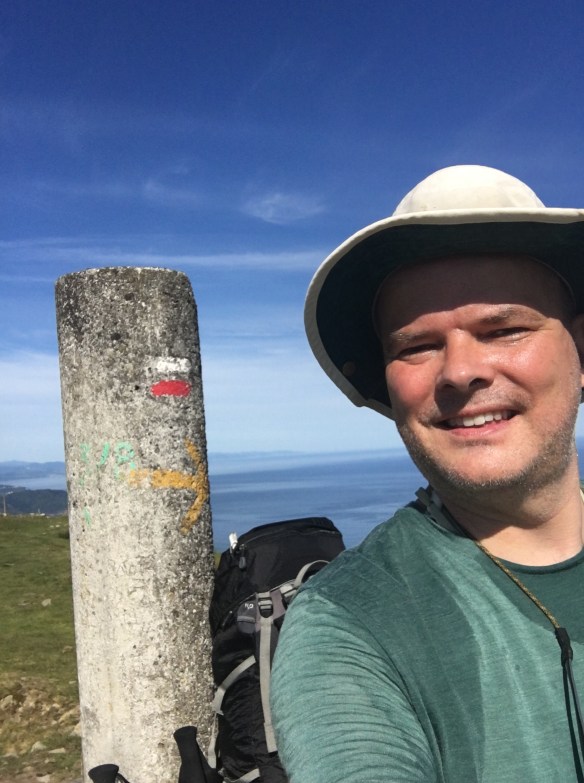
IMG_5248

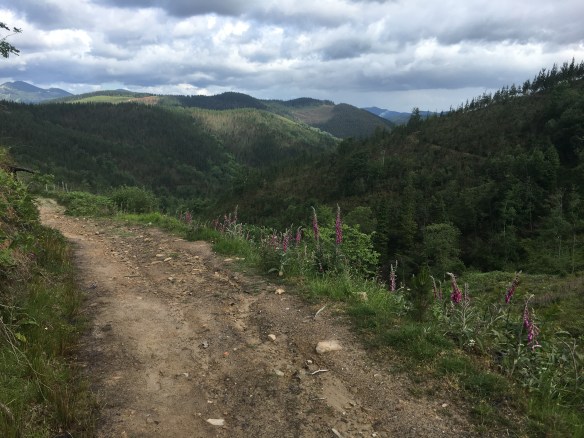
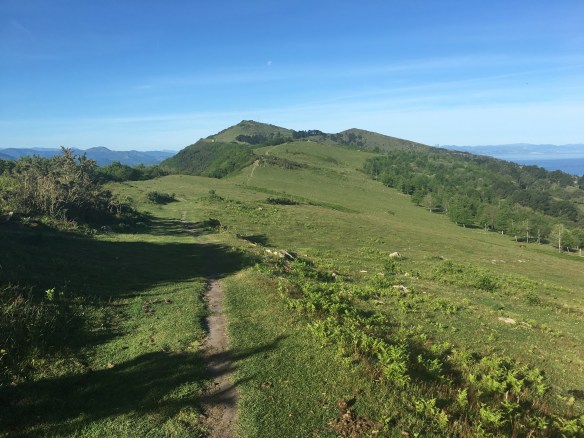
Several days later two significant things happened. The first was while I was walking down a slope towards the northern Basque town of Guernica, I thought I should take with me a couple stones from this path, as a keepsake from walking the Camino. So, I selected two small pebbles from under my feet where I stood beholding the town and valley below.
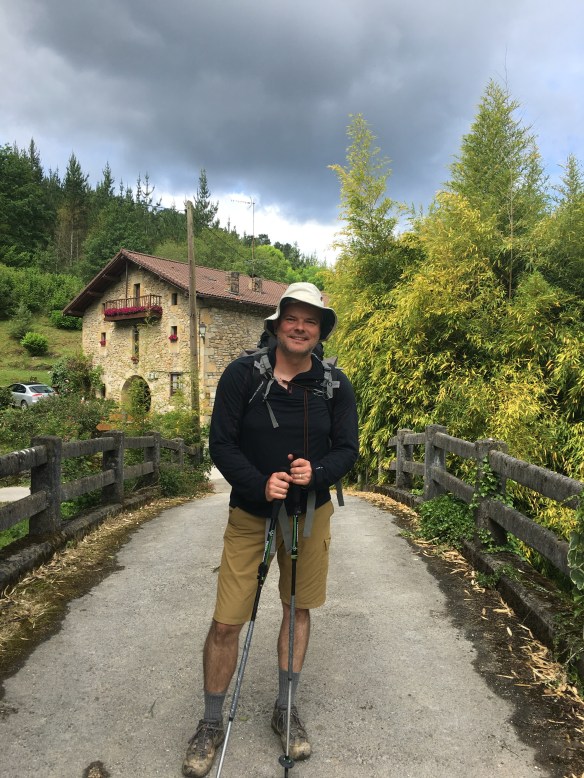
IMG_5299

That same day, my knee seized up, and I walked the remainder of my Camino in pain. Three days later, coughing and feeling very sick, I was on a plane homebound. Diagnosed with pneumonia back in Ottawa, I had to come to terms with my failure of not having reached my goal.

Not only had I not reached Santiago and Fisterra, I had done nothing with my stone which I had forgotten anyway. By forgetting the stone, had I already destined myself not to finish the pilgrimage? These dark thoughts swirled in my mind.

After having recovered a few weeks later, my wife and I flew to Lisbon for a week of vacation to celebrate our wedding anniversary. Originally, the plan had been for her to join me at the end of my pilgrimage, where I would meet her in Lisbon. Nevertheless, this time, I did bring my stone from home, renamed my ‘glory’ stone.

My glory stone represented all my aspirations, desires, longings which I knew deep down the Camino had taught me to let go of. I had to surrender even my human yearning and goals to God.
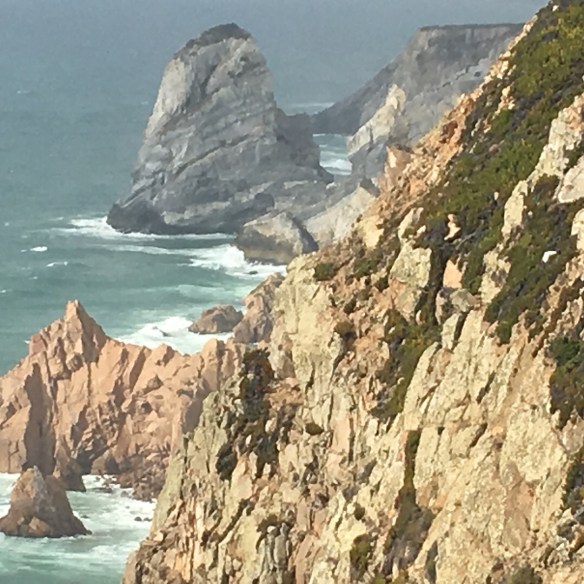
IMG_5853

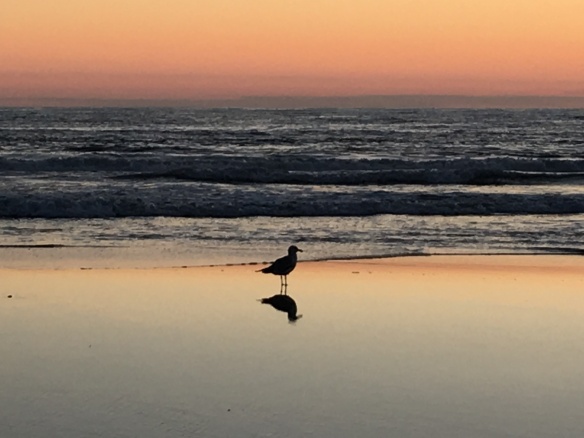
And so, at Cabo Da Roca near Lisbon, Portugal – the farthest most western point of land on continental Europe – I threw my glory stone into the Atlantic Ocean facing the setting sun. I had to practice letting glory go.
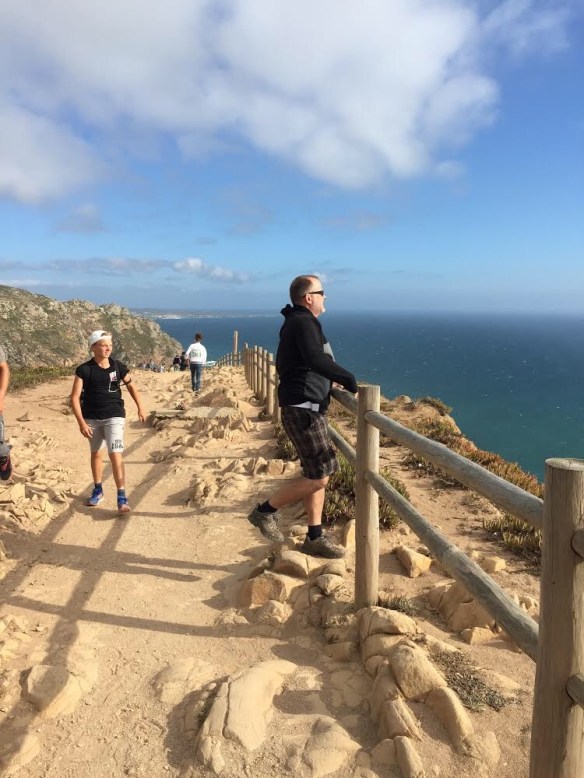
IMG_5812

It seems I was still bound to finish some kind of pilgrimage during my sabbatical. I didn’t have enough time to go back to Spain and finish the Camino de Santiago. But I did have enough time to walk the entire length of the longest contiguous sand beach in North America – fifty kilometres on Long Beach Peninsula in Washington State. There, my journey of letting go continued.

IMG_6200

There, on “Cape Disappointment” – fittingly named – I brought the two pebbles that I picked up in Spain on the last day I walked on the Camino. One glorious afternoon, I scrambled down into Dead Man’s Cove – also fittingly named – on Cape Disappointment. After reflecting on my disappointments of late, I realized on my journey of life not only did I need to yield all my dreams but also all my regrets and suffering. And so, I threw those stones of disappointment into the Pacific Ocean. I let these go.


I realized life is not lived well when we obsessively hold on to all those things that cause us grief. I had to offer these to God as well. Later, while I sat on a park bench near the lighthouse on Cape Disappointment looking over the Pacific, I met a couple of Americans visiting from Portland. In our conversation, we were able to affirm that “all great spirituality is about learning to let go.”[5]
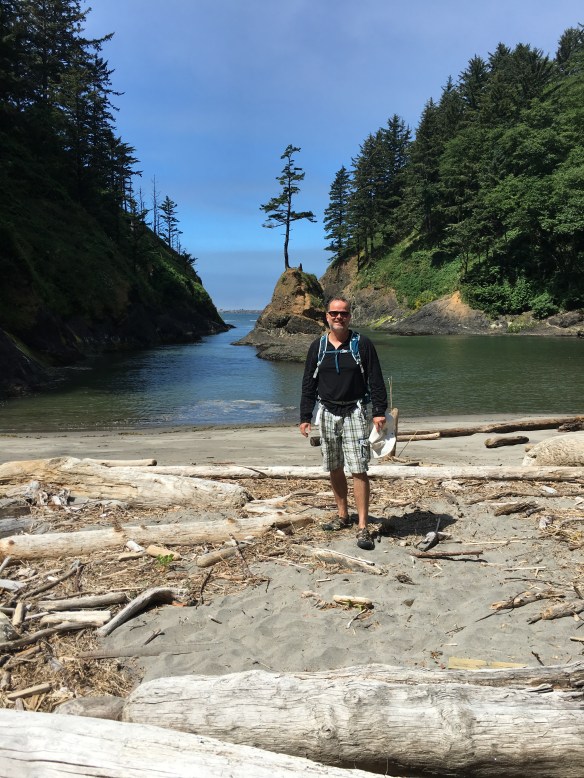
IMG_6217

But I didn’t leave my pilgrimage empty handed. When I climbed out of Dead Man’s Cove that day, I picked up from the sand a smooth, round stone. Now, any rocks on the Peninsula are rare. Most of the fifty-kilometre stretch is sand, land created from the outflow of the mighty Columbia River as it spills into the Pacific Ocean. Most rocks you see on the Peninsula have been trucked in. So, I was delighted to take with me back home, a rare thing.

And hope is a rare commodity in this world of pessimism, denial, and despair. This is my “stone of hope”, that I hold forever, amidst all the human aspirations swirling in my life and all the disappointments and failures which I regularly need to practice letting go of.
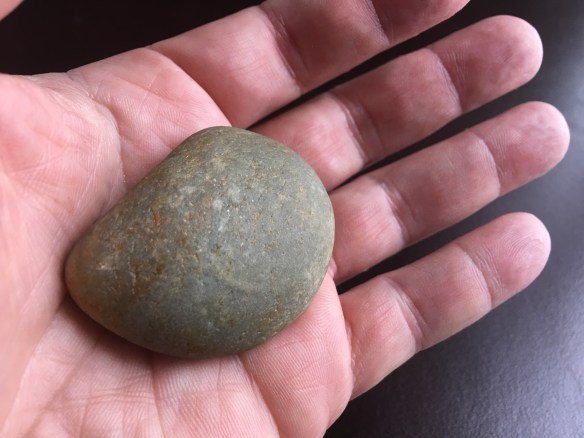
IMG_6752

We hold not only that which we need to let go of, but we also hold hope throughout our lives. “We do not simply resign ourselves to the give-ness of the world, for we have planted within us a great hope that God’s kingdom will come on earth, as in heaven. This means we are a people who look to the future with trust and hope, confident that God is working God’s purposes out and that God’s realm is even now breaking into our world.”[6]

At this point in your journey of life, which stones are you holding — of dreams, of disappointments, of hope? Which ones do you need to let go of? Which do you need to hold on to? I suspect it is true when the likes of Saint Paul, and all the wise teachers over the ages, writes: “Hope does not disappoint us.” [7]

[1] cited in Ruthanna B. Hooke in David L. Bartlett & Barbara Brown Taylor, eds., “Feasting on the Word: Preaching the Revised Common Lectionary Year B Volume 1” (Kentucky: WJK Press, 2008), p.280

[2] 1 Corinthians 7:29-31

[3] Isaiah 40:8

[4] Richard Rohr, Daily Meditation, Thursday, January 18, 2018.

[5] Richard Rohr, Center for Action and Contemplation, cac.org

[6] Ruthanna B. Hooke, ibid.

7 – Romans 5:5
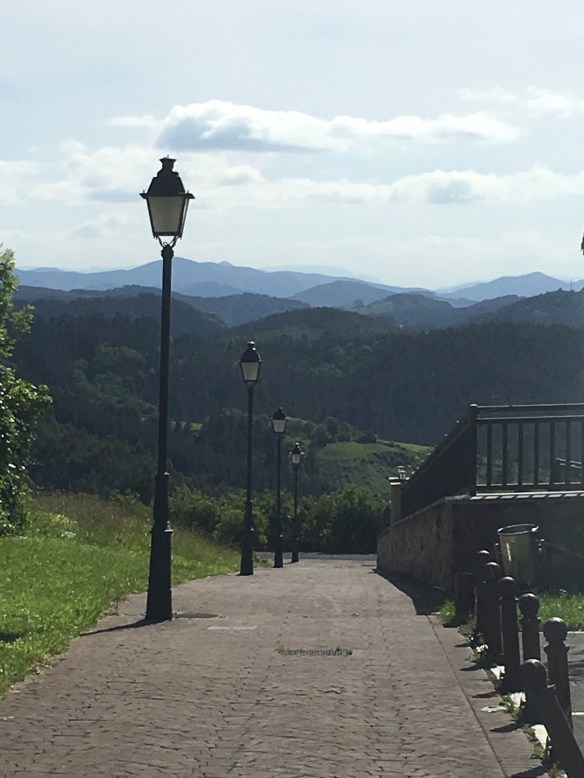
God-talk

Last week in the Canadian Football League (CFL), Ottawa RedBlacks receiver Diontae Spencer set a CFL record in a game against the Hamilton Ticats for most overall yardage gained — just under 500 — in one game. His incredible feat was truly remarkable in a game where his team didn’t score any points in the first quarter.

When asked afterwards about his record-setting accomplishment, Spencer mentioned God several times. He emphasized that the praise was ultimately for God. He couldn’t have succeeded along with his team in that game without God. God was the reason and source of his victory.

Such a witness gets a lot of mileage, especially on national TV covering a professional sports league in Canada. It is true: the public, general impression of Christians is their often-exuberant witness to an all-powerful, almighty God who authors and reflects anything and everything that is glorious, successful, impressive and spectacular. This is the dominant belief and main flavour of the kind of God-talk in the public arena when it comes to Christian witness.

Years ago, a parishioner in a former parish declined my invitation to her to give a testimony of faith during a mid-week Lenten program. I knew she was struggling with some personal challenges at the time. When I asked her why she said no, especially as I recognized in her the strong gift of faith, she said she wanted to wait until things were going better in her life before sharing her faith.

While I understood her reasoning, and was mindful of the delicate situation in her life, I wondered to myself if her attitude didn’t reflect a more general disposition among Christians today. As if you could only give public testimony of faith when you could talk about how good your life was. As if you could only give public testimony of faith when you could point to external circumstances that were favourable, impressive, even enviable.

After all, how could you get up in front of people and talk about God when all was not well in your life? How could you talk about God if you had nothing impressive to show for it? More to the point, would you be giving faithful testimony to God if everything in your life was broken, damaged, failed?

Is God only mentioned when humans achieve something great? Is God only a God who wins contests on the football field and battlefield of life? Can God be talked about only among folks who have succeeded and are healthy and rich? Only when things are going super well?

Or, could God also be present and real to us when we fail, when we are down, when we lose our earthly battles? It seems to me Christians call themselves Christian because we follow the way of Christ. And so, don’t we believe in the God of the Cross? God, by all human standards, failed — being branded public enemy number one and condemned to death. Jesus’ broken body is the iconic symbol for Christians. It is precisely in the suffering of life where God finds us.

On this All Saints Sunday, we understandably focus on what human beings have accomplished: the saints on earth and the saints in heaven. Blessed are those who demonstrate the qualities we read in the Beatitudes[1] — the Gospel text for this festival in the church calendar.

“Blessed” is not the word we might associate with being poor, persecuted peacemakers especially if we use the often-translated English word, “Happy”. I prefer the translation of the first word in the Psalms[2] also often translated to “Happy are they …”:

The Hebrew word here is ‘ashar, which means, literally, “to find the right road.” So, in providing the first beatitude, Jesus is saying: “You are on the right road when you are poor in spirit.”[3] I prefer this translation because it implies a direction rather than a moral state.

Should we take these beatitudes as moral rules for living, as with the Law, we can never fulfill it perfectly. And therefore, we can easily despair and give up. Being on the way, however, gives the long view and big picture. It implies the need for trusting that we are headed in the right direction even if the present circumstances in our lives suggest otherwise.

What is more, as much as we want to make the Beatitudes into the Ten (or rather, Nine) Commandments of the New Testament, this speech from Jesus — given at the beginning of his Sermon on the Mount in Matthew’s Gospel — is not primarily about ‘rules for moral behaviour’ as it is facts about God. These Beatitudes really and fundamentally describe God.

Matthew’s narrative builds towards this awareness, if you can appreciate the classic reversal that Matthew sets up in the first five chapters of his Gospel:

In the first chapter, Matthew’ genealogy firmly plants Jesus “the Messiah” in the lineage of the great Israelite King David. In the second chapter, exotic magi from the East come to pay homage to the newborn king. In the third chapter, King Herod takes seriously this threat to his power and tries to eliminate a contestant to his throne by killing innocent, Hebrew two-year-old boys in Bethlehem. Then, John the Baptist comes on the scene, announcing that he was making way for one who was greater than he. Finally, Matthew has Jesus ascend a mountain where he, like his predecessor Moses, would dispense the Word of God and give his inaugural address.[4]

You can see the build-up, I hope, of an expectation that Jesus would come to bring justice to the wicked and set things right. He, the Messiah, would turn back Roman oppression and occupation of Palestine. But, these words from Jesus’ mouth announcing who is “blessed” pull the rug from under our expectations of who God is. “The one who was supposed to lead revolutionary armies or bring down heavenly fire shows up in Galilee building hospitals and telling people not to hit back.”[5]

Can you imagine the surprise and shock among his disciples! Even the imprisoned John the Baptist does a double-take on his faith and later questions Jesus: “Are you the one who is to come, or shall we keep looking?”[6] It is no wonder, then, that Peter later rebukes Jesus when he talks of his impending death: “God forbid it, Lord! This must never happen to you!”[7]

These beatitudes must have seriously disappointed his listeners and most ardent followers who had such ‘high’ expectations of their would-be Messiah King. How could they now continue following this man?

Is the reason why we may have trouble conforming our lives to the way described in the beatitudes is that we really don’t believe in these words as giving an accurate and trustworthy understanding of God? This is, after all, Jesus, who we know was persecuted and reviled as the prophets were before him.[8]

Do we believe in a God who chooses to be revealed in human flesh, born a vulnerable baby to a teenage couple? Do we believe in a God who chooses to be revealed dying a grotesque and brutal death on a cross showing the world a bruised, beaten, broken and bloody body?

If we did, perhaps we would hear more from the losers in our society. Perhaps TSN would hear the faithful witness of locker room players talking of a God who knows how it is to lose a big game and still keep faith. Perhaps we would hear more from street people, addicts and the impoverished, vulnerable people talk of their simple yet honest faith in a God who walks with them. Perhaps we would hear more from children declare their love of a playful God who carries our burdens for us, freeing us to be who and how we are without judgement and punishment.

Perhaps we would listen more to the murmurs of our own hearts whisper the love of God for us especially when we suffer the turmoil of life. Then, I gather, the world will open its eyes to the God of grace and love.

Because they will see people who live in hope. They will see people who know they have found the right road where they find God most present in helping people who suffer loss and pain, a road on which Jesus has walked himself, a road upon which God will always first find us.


[1] Matthew 5:1-12, NRSV

[2] Psalm 1:1, NRSV

[3] Earl F. Palmer in David L. Bartlett and Barbara Brown Taylor, eds., “Feasting on the Word: Preaching the Revised Common Lectionary Year A, Volume 4 (Kentucky: WJK Press, 2011), p.238

[4] Allen Hilton in ibid., p.239

[5] ibid., p.239

[6] Matthew 11:3

[7] Matthew 16:22

[8] Matthew 5:11-12

From Loss to Life

“I have learned to be content with whatever I have. I know what it is to have little … and of being in need. I can do all things through him who strengthens me.”

 -Paul, to the Philippians 4:11-13

One of the basic truisms of pilgrimage walking is that first-timers usually pack more than they need for the journey. The general rule is ten percent of your body weight. For most people, that means no more than fifteen to twenty pounds in your backpack.

IMG_5303

I read in one of the Camino de Santiago guidebooks, in preparation for my walk last summer, that for most first-time pilgrims five pounds in their pack is unnecessary; these items amount to five pounds of fear: that extra sweatshirt, pajama onesie, that tub of moisturizing cream or the proverbial electric hairdryer. It is not long on the journey before at least five pounds are left behind or mailed home.

IMG_5285

If we use the pilgrimage as a metaphor for life, then the pilgrim on the journey of life, to be true to the journey, needs to learn how to let go.

IMG_5243

When I began I thought I had it down to the bare minimum. Nevertheless, I was still anxious. Those first few days I worried about where I was going to sleep that night. Not knowing how far I would walk, and not wanting to put the stress of expectation by booking ahead, I had to go with the flow and improvise in the moment. Even though I found a place every night, I was still preoccupied, distracted and fretting. Perhaps I had put too much faith in what I carried.

IMG_6116

Before I knew it, I lost some of my belongings those first days on the path. The first night I left behind my head lamp. The second or third night – I don’t know which – I lost my very expensive self-inflating bed roll for underneath my sleeping bag.

If the story ended there, you might say I was in an unwanted, growing state of crisis. If the story ended there you might say my pilgrimage was headed towards disaster, defeat, loss and failure. If the story ended there, you might say that everything was falling apart in my journey, collapsing into the rubble heap of destruction.

But the story didn’t end there. And it doesn’t end there.

The truth is, as Richard Rohr explains it best, that “through loss, through crisis, through stress, limitation, we move to a better place in our lives.

“Physicists today would say that loss is not real. There is only transformation. The metaphor of the liquid world is that this element simply moves from liquid to solid to vapor and back again.

“It looks like a death, a loss, in each case. But, in fact, it’s a becoming. Now we recognize that Jesus was saying this all along. In Christianity, it was called the ‘Paschal Mystery’. It was a phrase used by Saint Augustine that in fact dying leads to resurrection. Jesus became the icon, the living image, of that mystery – that his crucified body transformed into the risen Christ. That they are both the same person.

“Creativity, newness of life, has a cost. And the cost is what always looks like death. But really isn’t. The cost is loss. Which is perceived as an enemy, or affliction, which always looks like what we don’t want. Somehow to embrace loss, spiritually speaking, is to achieve eternity. Death allows us to be united with what is real. But, of course, it only looks like death from our side. Apparently from the other side – we call it heaven, or eternal life – is in fact the really real.

“The really real is already beginning now. And that’s what we need to trust. That’s what we need to allow. Fourteenth century Italian theologian Catherine of Siena once said: ‘It’s heaven all the way to heaven; and, it’s hell all the way to hell.’ And the way to heaven begins in this world, all the way to heaven.

“To avoid all loss, to avoid all letting go, is to avoid transformation into union with God. If you spend your entire life avoiding ‘dying’, Jesus would say you never get there. It’s hell all the way to hell.

“‘Unless the grain of wheat dies, it remains just a grain of wheat. But if it dies, it bears much fruit.’[i] We now know that this phrase was used in the initiation rites of Asia Minor. Perhaps one of Jesus’ most enigmatic lines is: ‘You must lose your life in order to find your life; you must lose your life in order to gain your life.’[ii] And if you don’t let it go, you will never find it.”[iii]

This is what Paul is talking about when he says he can do all things in Christ who strengthens him. That is, he can also ‘let go’. Not only does he know what it is to have plenty. He can also lose.

Philippians 4:13 is a popular well-loved verse in the New Testament: “I can do all things through him who strengthens me.” It is often used to bolster self-confidence in accomplishing heroic goals and aspirations. It is often quoted on posters, billboards and bumper stickers to indicate a glory, success and prosperity gospel message of human achievement more reflective of current self-help pop psychology. It is also used to undergird impressive mission goals in the church.

Moreover, the first nine verses of this chapter – the famous “Rejoice always!” text – are read on their own, as unfortunately prescribed in the Revised Common Lectionary, without including verses 10-13 for context. And the context is Paul’s suffering and need and persecution.

He is rejoicing and expressing his confidence in living precisely because he has travelled through the valley of the shadow of death. Precisely because he has learned to let go. You can’t have resurrection without death. You can’t experience the joy of transformation without first feeling the pain of loss. You can’t do mission unless you have let go, done without, lost — in some fundamental, real way.

Later this month on Reformation Sunday when all ELCIC Lutherans in Ottawa will gather to worship together, we will sing together Martin Luther’s well-known hymn: “A Mighty Fortress is our God.” Frederick Hedge’s English translation is closer to the original German when in the last verse we sing: “Let goods and kindred go, this mortal life also.”[iv]

Here, we get a peek into an under-emphasized aspect of Luther’s theology which included the practice of letting go. Not only is salvation realized at the moment of our mortal death, it is something that begins in the midst of living. That is, during our life we the practice the art of dying – of letting go, of losing – as an essential experience in the way of salvation, of transformation.

When I realized I had lost my head lamp and bed roll several days later, a couple of things were happening within me:

First, it took a while for me to notice these losses. I didn’t notice my loss right away perhaps because I really didn’t need those things. Second, and maybe more significantly, I was less stressed the farther I journeyed along the Camino. I was relaxing more into the pilgrimage, even without what I had deemed essential kit when I began.

Some Christians in the West today make the mistake, I believe, of confusing loss of privilege with persecution. Wealthy, financially advantaged Christians say they are being persecuted by a politically correct movement to recognize other religions and different people in a growing multi-cultural and pluralistic society, something Luther could never have envisioned in his day.[v]

We are not being persecuted. Rather, we are being confronted with the prospect of losing our privileged place in society, a status that we have admittedly enjoyed for centuries in our country. What the real issue is, is whether we will resist and avoid this loss, or whether we will accept it.

What is ending in your life? What are you facing that deep down you know is a loss? What are the failures and defeats and suffering in your life? Where is there suffering in the lives of the vulnerable, the underprivileged, the poor?

Pay attention, and wake up. These may, in truth, be invitations. Invitations to enter the gate of loss and letting go. Invitations to let go and trust that through dying, it is heaven all the way to heaven.


[i] John 12:24

[ii] Matthew 16:25, Mark 8:35, Luke 9:24, John 12:25

[iii] Richard Rohr, “The Art of Letting Go: Living the Wisdom of Saint Francis” (Boulder Colorado: Sounds True Audio CD Learning Course, 2010), Session Three.

[iv] Evangelical Lutheran Worship (Minneapolis: Augsburg Fortress 2006), Hymn 505

[v] The Rev. Dr. Gordon Jensen, “Luther’s Legacy” in Canada Lutheran (Volume 32, Number 6, September 2017), p.10-14

Cape Disappointment

How do we learn to deal with disappointment?

When health concerns mount? When there are cutbacks in the company you work for? When a relationship breaks down? When someone betrays you? When you fail to meet your goal? When you lose something precious?

How, as people of faith, do we learn to deal with disappointment? When what has happened does not make sense, when we can’t understand ‘why’?

In 1788 Captain John Meares named the spot of land overlooking the confluence of the Columbia River and the Pacific Ocean, Cape Disappointment. He was disappointed that the Columbia River was simply thus, a river, instead of the fabled Northwest Passage which he was intending to find.

IMG_6125.JPG

Mr. Meares was obviously well off-course to his goal. We know today that the Columbia River begins its journey at Columbia Lake in central British Columbia, Canada, and winds itself south hundreds of kilometres into the states of Washington and Oregon before spilling into the Pacific.

IMG_6201

In keeping with the rather downer of name, the lighthouse on Cape Disappointment overlooks the hundreds of shipwreck sites off the coast. The United States Coast Guard recognizes this large area of water as the most dangerous among all the river outlets along the continental shores of the United States.

IMG_6123

Both the strong outflow of the broad and mighty Columbia competes with the powerful tides and winds generated by the largest ocean on earth. Crisscrossing currents of water create constantly shifting sand bars and opposite flow wave action that can confuse, disorient and ultimately undo any mariner navigating this passage.

IMG_5932

IMG_6320

IMG_6322

Add to this mayhem the fog which has an uncanny knack of coming in unexpectedly on the north breeze, disappearing under the burning sunshine as quickly as it appears. I stood bewildered in such a fog jam on the beach one day, unable to comprehend how a perfectly cloudless sky in beautiful sunshine can change so quickly. Signs are staked at entrances to the shores along the thirty-eight mile stretch of contiguous sand beach north of the Cape warning unsuspecting swimmers of rip currents and unstable sand conditions above and below the surf.

In short, while ascetically beautiful to the eyes, this small part of the world contains hidden, life-threatening dangers beneath the surface of things. Disappointing is an understatement when considering the potentially dire consequences of a mariner’s failed attempt at moving around the Cape, let alone dealing with the failure of not arriving at one’s goal.

IMG_6204

In the first reading for today[1], God responds to Jonah by asking questions, rhetorical though they are. Jonah expresses his anger at God for sparing the “great” city of Nineveh. God’s actions did not make sense to Jonah, even though Jonah confesses his belief in a gracious God who is “merciful, slow to anger, and abounding in steadfast love, and ready to relent from punishing.”[2] He obviously did not think much about the people of Nineveh regardless of God’s mercy. Yet he is internally divided, unable to reconcile his belief with his feelings. He can’t figure it out. He is depressed. And wants to die.

If God says anything toward Jonah’s healing, it starts with a question: “Is it right for you to be angry?” And when God provides a bush to protect and save Jonah’s life, a bush that then dies, Jonah is angry again. What does God say to Jonah’s outburst? Another question. “Is it right for you to be angry about the bush?” And to top it off, the entire book of Jonah ends rather abruptly, again with a question from God.[3] Questions. Not pat, cut-and-dry answers. Questions.

I wonder if we have tended to make God and religion into something and someone to give us quick and final answers. We demand ‘what’ from God when all along Jesus, in the wisdom tradition, is primarily teaching ‘how’. Out of the total of the one hundred and eighty-three questions that are asked of him in the Gospel, Jesus only directly answers three of them.[4] In the New Testament, Jesus’ very first words spoken to his disciples was a question: “What are you looking for?”[5]

Jesus turns the tables on the disciples, as he does time and time again. Rather than give them what they are looking for in a neat and tidy package of an easy answer, he throws it back at them. What do you want?

The first call of Jesus in our lives is a call to be honest with ourselves. Before we can do anything, we need to be true to ourselves. And commit to that lifelong struggle to move beyond our intellect and its insatiable compulsions for answers, towards actions that reflect a trusting heart. Because following Jesus in this world does not, most of the time, make a whole lot of intellectual sense. If we are being faithful.

It is not our job to know everything. God knows all. We don’t have to. Ours is a call to hold, not rid ourselves of, all the messy contradictions of our lives. Abraham, Jacob, Rebekah, Moses, David, Job, Esther, Jonah, Elijah, the disciples, Paul – they were not people who had all the easy answers to life’s complex questions. But they were trusting, obedient, and they acted. Sure, they objected to God at times. Yes, they made mistakes. If anything, the story of Jonah ought to reinforce the importance of a real, personal, topsy-turvy relationship with God. That is the stand-out characteristic of all the faithful.

During the years following the Council of Nicea in the fourth century, a common heresy re-emerged under the leadership of Eunomius, a bishop in Cappadocia (in modern day Turkey). Eunomius argued that we can understand the nature of God simply and clearly. Reflecting on what was the mystery of the Trinity, he implied that God was perfectly accessible to human intelligence.[6]

The Cappadocian Fathers, as they are called, reacted to Eunomius. Basil the Great, his brother Gregory of Nyssa along with John Chrysostom insisted on the incomprehensibility of God to the human mind, and the necessary limits of theological discourse. Their position became the orthodox, Christian stance, ever since.

I wonder, ever since the Reformation, the industrial, scientific revolutions and enlightenment era of the last few centuries in especially the western world, haven’t we slipped back into this heresy once again? Pretending, even though we may not be aware of it, that we should have answers to all of life’s important questions.

It is our natural humanity to strive to know everything. But if we are honest, our minds certainly cannot grasp fully such incomprehensible realities as the mysteries of love, suffering, death and God. Here, we must trust and let go of all our pretenses. “For,” in the words of the prophet Isaiah, “my thoughts are not your thoughts, nor are your ways my ways, says the Lord.”[7]

Disappointment in life is a doorway to a deeper awareness of God’s truth and presence in our lives. Our varied expressions of worship, of living out God’s call, our prayer lives – all these are not so much, then, a matter of petition, of doctrine, of rule-setting-and-following, of solving the discrepancies and inconsistencies of the bible and theological discourse.

Rather, our complex lives with all the joys and disappointments become the tableau, the canvas, upon which we discover we are not alone. And that God is ever present and faithful, regardless of what we do or think. You can’t make God love you one ounce more – by all your right thinking and having all the right answers – than God already loves you right now.

Often, the disappointments of our lives bring us to this realization more than all of our accomplishments and successes. Because if we are going to get anywhere in our lives, we need to hope and believe, despite the disappointing circumstances of our lives.

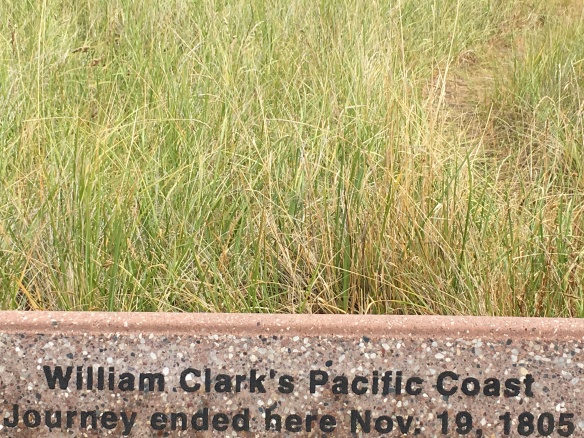
Cape Disappointment marks another very important place in the history of North America. It is not just a place that signifies disappointment, tragedy and danger. It is also the very spot where the famous Lewis and Clark expedition reached the Pacific Ocean in November of 1805. Yes, Lewis & Clark met with many a disappointment and setback along the 3700-mile route up the Missouri River, across the American Midwest, over the Rocky and Cascade mountains and down the Columbia River Gorge that took them a year-and-a-half to accomplish.

IMG_6400

On the journey, were they ever absolutely certain they would make it? As it was, they must have taken their disappointments in stride. For on an uncharacteristically calm day in a stormy November, they made their final push around the western Cape and finally met the limitless horizon.

Significantly, the Lewis and Clark Expedition was called the Corps of Discovery. Today, a 10-mile-long, well-groomed paved path winds through the dunes of Long Beach Peninsula and up into the forest of the Cape. It is called the “Path of Discovery”.

IMG_5994

Cape Disappointment is intricately tied to the Corps of Discovery, where both failure and success are entwined in a rich and diverse history of exploration. The spirit of questing celebrated on these shores includes and transcends both the unique events of human tragedy and human achievement. You cannot have one without the other. In one place. In one human being. Each of us is invited to the journey that includes, embraces and transcends disappointment and failure.

At some point along the journey, you need to have hope in order to continue. Even in the midst of all our unknowing, we can believe and trust in the solution, before it happens.

It’s called faith.

IMG_5922.JPG


[1] Jonah 3:10—4:11, NRSV, Proper 20A/Ordinary 25A/Pentecost+16

[2] Jonah 4:2

[3] Jonah 4:4,9,11, NRSV

[4] Richard Rohr, “Adam’s Return: The Five Promises of Male Initiation” (New York: The Crossroad Publishing Company, 2004), p.112

[5] John 1:38, NRSV

[6] Belden C. Lane, “The Solace of Fierce Landscapes: Exploring Desert and Mountain Spirituality” (New York: Oxford University Press, 1998), p.105

[7] Isaiah 55:8, NRSV

photos by Martin Malina IMG_5940

Love: The Body speaks

I jumped out of bed Labour Day Monday ready for action: I had my traditional ‘to do’ list around the house, tasks reserved only for that most auspicious of holidays: Labour Day. Neatly positioned at the beginning of a new school year, Labour Day promises the beginning of a new season of programs, commitments, work, setting goals, ideals and visions of our aspiring.

I only did certain jobs on this day of the year. You know, like Spring cleaning, these were things that needed to be done once in a while, but aren’t really activities that are particularly pleasurable, to say the least. So, I put it off to Labour Day. I need that annual calendar day to help me stay disciplined. And that is good.

One of those jobs was cleaning the HRV – the Heat Recovery Ventilator. This is the contraption attached to the furnace that recycles the air in your house. On the sticker inside the ventilator, it suggests that the filter should be cleaned once every three months. Yeah, right. Who has time for that?

So, on Labour Day every year, I dutifully remove the heavy box containing the filter, and hose it down. I wash the spongy fabric and hang to dry. I meticulously wipe out the interior of the ventilator with a damp cloth. I vacuum out all the cobwebs, dead wasps, flies and dust mites. I use pipe cleaners to clean the plastic, transparent drain tubes. And when everything is done I put it all back together. Usually it takes me a couple of hours. And then it’s on to the next item on my Labour Day ‘to do’ list. You get the idea.

I knew I had a full day’s agenda of those odds and sods sort of jobs.  Jess and I had just pulled the stove away from the wall to clean the floor underneath (yuck!) when all-of-a-sudden the doorbell rang.

With beads of sweat trickling from my forehead stinking of sweat in dirty clothes, I looked up with ‘surprise’ at who was smiling and waving through the front door pane: my parents-in-law! They were inviting us out for lunch at the local truck stop.

With herculean effort to switch gears and rush into ‘receive-and-respond-to-guest’ mode, I quietly complained to Jess in the bathroom as we quickly washed up that I didn’t appreciate this interruption to the day’s agenda of hard work. Likely all the work wouldn’t get done. And how long were they going to stay at our place after lunch? Throughout the lunch hour I fought the impulse to be resentful and angry at this unplanned, unwelcomed intrusion to the important Labour Day work.

Nevertheless, have to say I enjoyed lunch out. It was a treat. And the conversation helped take my mind off other pressing matters. After only about an hour, we came home, and my parents were off to complete errands. I was surprised by how just one hour of gift, of grace, of unscheduled act of love actually gave me the energy to finish all my Labour Day tasks in a shorter amount of time than I had originally anticipated.

Love has a way of doing that. Love does not steer clear of the structures, agendas, immediacies of our lives. Love does not exist on some surreal, other-worldly plane, dis-associated from ordinary life. Love is not a fantasy trip. Love operates right in the middle of the messy, honest reality of our lives.

We call it other things, which leave us empty:

Whenever we project our wants onto something or someone we don’t have. We delude ourselves in believing we will experience love when we yield to this mirage of desire. This is the ego’s impulse. But if we are honest, getting what we want only sets the ground for wanting more and more. This strategy for life is a prescription for perpetual unhappiness bereft of true joy, because pursuing this frantic desiring is predicated on the assumption that it is never good enough. We are always wanting what we don’t have. Wanting and desiring do not fulfill love.

Neither does the law. We skim the surface of love when we try to please God by merely following the rigor of the law. This is the ego’s attempt to prove one’s self-worth by measuring it up against some ideal. But if we are honest, this effort at loving God and others is really self-centred and only exposes our failure to live up to that ideal. This strategy for life can lead to a stifling legalism, judgmental attitudes towards others and self-hate. Our success at following all the rules is not love. Paying attention to another person is. “Love is the fulfilling of the law,” Paul writes.[1]

Love is free. It is not bound by our ability to control outcomes. Love happens when we are not in charge. Love is a gift, given and received freely. There is no guarantee, from our human perspective, that all our good efforts and good works will make things right. Author and teacher Belden Lane writes: “We love and are loved by God in the act of relinquishing every guarantee of love.”[2] In truth, when we stop our striving if only for a moment, when we release our need to be in control, then we are in the position to experience God’s grace and love. Through others. In ourselves. And from the least expected of places and people. Indeed, as C.S. Lewis expressed, we are surprised by joy.[3]

The ego doesn’t like this because the ego wants to get in the way.  But, love is expressed to another without preconceived expectations of what the other person needs. Love is expressed without giving what we imagine to be best in the situation for them. True love is not striving for what particular results we want to engineer in a relationship. True love, as Belden Lane describes so well, is “a love finally purged of the ego’s calculating desires, a love without strings.”[4] We simply be with the other, and listen to them. And go from there.

Love starts here. It is hard work to love. It is a labour of love – for self, others, creation and God. And it is a work in progress – a journey – that can last a life-time and beyond.

Paul continues in the Epistle text for today, that we are to “make no provision for the flesh, to gratify its desires.”[5] Here, it is helpful to substitute the word, ‘ego’ for flesh. Christianity is an incarnational religion. God is, for Christians, a human being in Christ. The divine entered humanity. God knows the human body intimately. We do our faith a dis-service when we neglect, shame or deny our physical bodies as well as the human dignity of others. Our flesh is not bad. Your physical body is, according to Paul, “a temple of the Holy Spirit.”[6]

We exercise the love of God by paying attention and listening to our own bodies and paying attention and listening to the suffering of humanity all around us. “The glory of God,” Saint Irenaeus said in the 2nd century, “is the human being fully alive.” We celebrate human beauty and strength, yes, but also not ignore its pains.

I sat alone in the Bilbao hotel room looking at my body. On the surface, everything looked fine. Even great. In eight days I had walked one hundred and thirty kilometres through the Basque hills along the coast of the Bay of Biscay in northern Spain. I had even lost several pounds and buffed up a bit.

My feet were fine. So many pilgrims on the Camino de Santiago develop serious problems with blisters and tendonitis. Not I. Now, I did give regular attention to my feet: I made periodic breaks during my hiking, taking my shoes and socks off and gently, lovingly, applying moisturizing cream around my toes, under the ball of my foot and around the heels. They say foot care is paramount to the successful completion of any Camino pilgrimage. I was the poster boy for that piece of advice.

Yet, these superficial indicators did not reveal the truth of the matter. You see, even before I had left Canada to fly to Barcelona, I was coughing.

Besides the cough, I was feeling fine when I headed out of Irun at the start of the Camino del Norte, near the French-Spanish border. But eight days later, a few kilometres outside of Guernica, my right knee blew out. And, in that moment, I realized that I was in trouble. The systematic repetition of hefting my 200-pound body weight and additional 20 pound pack, leading with my right knee finally screamed protest. At first, my pilgrim friends suggested what I was thinking: A few rest days in Bilbao would renew me enough to continue my pilgrimage across northern Spain.

But after three days of rest in Bilbao, I was feeling worse. Not only did I continue to cough, all my muscles were aching not just my knee. I didn’t even feel like travelling to visit with my extended family in Germany.

My body hath spoken. And I was going to listen to it. When I saw my doctor in Ottawa a few days later, she ordered an x-ray and ultrasound which confirmed the diagnosis of pneumonia. I had, literally, ‘walking’ pneumonia on the Camino. All the medical staff, my family and friends complemented me in being able to ‘listen to my body’. And even though I didn’t realize and know how sick I really was at the time, I didn’t push it for the sake of some higher, abstract goals or principles. I came home to heal. My body was telling me something I needed listening to: Stop. Stop the frantic desiring. Stop the restless striving. Just stop. And be still, for a while.

They say the body never lies. We can deceive ourselves in our heads, play all kinds of mind games with ourselves, providing ceaseless self-justifications and employing conniving self-defense mechanisms that would confound any therapist. But what the body presents – the physical manifestation of who we are – is the truth indicator. What the body proclaims is truer than what anyone says.

Any journey towards health and love begins by paying attention to what your body is saying. And go from there. We may slow down. We may pray. We may embark on a journey to search out meaning in our lives, to explore the multi-layered regions of our hearts and souls. We may seek medical help, and rely on the gifts of medical science. We may even make major changes in our lives. In other words, we learn the truth about ourselves. Beginning with what the body says.

Someone asked me what I learned about myself during the sabbatical. You could say, I had the chance to just be myself. I experienced my humanity without the usual trappings of roles, titles and responsibilities. I met with and explored myself as a human being. I am human. Not just a talking head. I don’t just live out of my head. I live out of my body, too.

And, to be honest, I didn’t always like everything I saw, there, in my human nature. Yet, I will confess that in that mess of my humanity I re-discovered Jesus. It wasn’t so much in the usual places but in those other pilgrims I met, the help I received along the way, and in my own, ordinary self – stripped away from all the usual distractions, comforts and busy-ness of life – that grounded me in a love that endures.

Out of this awareness has grown a deep thankfulness for all the gifts of life. Gifts over which I don’t have ultimate control in having received: The gift of physical health and ability; The gift of this sabbatical – about which I express heartfelt thanks to the congregation; The gift of colleagues who take up the torch so to speak — thank you to Pastors Diane and Ted and musician, David: The gift of capable lay leaders who show remarkable abilities administratively and creatively when given a chance – Beth, Julia and Megan, especially; The gift of lay preachers who in their diverse expression reflect something beautiful about God and God’s ways – Jessica, Beth, Christa and Jann; The gift of a spouse and children who model the love of God by ‘letting me go’ for a while.

In Christianity, the word, ‘body’, takes on a broader meaning: The Body of Christ is the church, the community, the network of relationships. I am ever so grateful and encouraged. I learned another thing out of this sabbatical experience: There is love in the Body of Christ, to be sure.


[1] Romans 13:10

[2] Belden C. Lane, “The Solace of Fierce Landscapes: Exploring Desert and Mountain Spirituality”, New York: Oxford University Press, 2007, p.201.

[3] C.S. Lewis, “Surprised By Joy”, New York: Harper Collins, 1966

[4] Belden C. Lane, ibid.

[5] Romans 13:14

[6] 1 Corinthians 6:19

Buen Camino!

When in Sunday School decades ago we played the roles of well-known bible characters, I remember the only thing worse than being a “Judas” was to be a “doubting Thomas”.

We wanted to be Abraham, Moses, Kind David, Samson, Queen Esther, Rachel, Ruth, The Magi, Peter, Paul, John. We wanted to be Joseph or Mary, or even Jesus himself!

But Judas the Betrayer, or Thomas the Doubter? No. Indeed Thomas has been treated quite negatively in much of Christian preaching and teaching. He is often held up as a negative role model.

Let’s take a closer look at the text about Jesus’s resurrection appearance to his disciples (John 20: 19-31). Because there is no condemnation of Thomas. Recall the disciples are hiding behind locked doors in Jerusalem fearful of the authorities. Unless Jesus’ words to Thomas are inflected in an accusing way, they do not need to be read as a condemnation: “Have you believed because you have seen me? Blessed are those who have not seen and yet have come to believe” (John 20:29). They simply affirm that those who believe without first-hand experience of the risen Jesus are also blessed. (1)

But can we blame Thomas? Thomas only desires his own firsthand experience of the risen Jesus. He is unwilling to accept the secondhand testimony of others. And, his desire is granted: Jesus appears to him. Prayer answered!

I wonder if Thomas today doesn’t really represent so many of us who deeply yearn and seek for a first-hand experience of God, and are simply and naturally unsatisfied with hearing it ‘second-hand’. Hearing someone else’s first-hand experience of God is inspiring and instructional to be sure. We learn about someone else’s experience of God’s presence, healing, grace and wonder — whether that person is from the bible or our grandparents or the person sitting next to us in worship. But someone else’s experience of God can never be a substitute for our own.

What we may be looking for, is to be more like Thomas: Honest in our desire for a first-hand experience of the living God. Yearning to taste and feel more of the goodness of God in our own lives and in the world. Striving ourselves to make the world a better place for everyone. We may be unsatisfied with basing our commitment to a life of faith on someone else’s testimony. We may, like many people today, be seeking our own experience of God and suffer from what I would call the ‘second-hand syndrome’. Perhaps Thomas needs to be our role-model more than anyone else in the bible today!

Of course, the benefit of the Reformation was to teach us an important distinction in all our striving: Our motivation is important to be aware of, because if we strive to do good all in order to make ourselves right before God we will most certainly miss the mark. “We confess that we are captive to sin and cannot free ourselves,” we say in our Confession. God initiates the saving relationship. God moves; we only second the motion.

And yet, our striving, our trying, our good work as response to God can help create the space and the climate in which God’s grace is made clear to us, is given to us, and in which we are most ready, then, to receive God’s forgiveness, love and mercy. Being pro-active, doing things with one another in the church, yearning and striving for God — these are antidotes to the ‘second-hand syndrome’ and a prescription for a healthy life of faith.

Last week on the first Sunday of Easter, I emphasized the words from Matthew’s account of the Resurrection of Jesus outside the empty tomb that first morning. Jesus instructs the women: “Do not be afraid; go and tell my brothers to go to Galilee; there they will see me” (Matthew 28:9-10).

When resurrection happens today, as it always has beginning with that first day, there is movement forward. Not backward. As I said last week, there is no turning back once resurrection happens. The disciples are not instructed to meet Jesus in the empty tomb where the miracle happened. No. The instruction is quite clear: Get moving! Get out of here! Go to Galilee. Go to where I wait for you. In other words, don’t stay where you are! Do something!

In 2017 the Lutheran Church worldwide celebrates the 500th anniversary of the Reformation. We call it Reformation 500. ‘Five hundred’ is an important number in all the dialogue surrounding this momentous occasion. The national church has even set up the Reformation Challenges for the church across Canada to meet. And each of those goals are pegged at some variant of 500:

Five hundred refugee sponsorships (which already has been exceeded), five hundred scholarships for school children in the Holy Land, five hundred thousand trees planted in Canada, and five hundred thousand dollars raised for the Lutheran World Federation endowment. You can visit elcic.ca for the most recent update on where we are at in meeting all those goals. And please consider making a personal contribution towards any one of those worthwhile causes.

I’d like to up the ante. Let me call it the ‘Reformation 800 Challenge’. Eight hundred is the new Five hundred. Not only are we celebrating 500 years of Reformation this year; we turn to the future and pray not just for 500 more years but … 800. Why not?

Let that number, eight hundred, symbolize a confidence and hope-filled trust that God has more good than we can ever imagine in store for us in the church far into the future. And this is what I propose in this year’s Reformation 800 Challenge:

Next month, I begin walking the 800 kilometres from Irun, Spain to Santiago de Compostela in Galicia. The route I follow skirts the northern coast of Spain from East to West. This is my Reformation 800 Challenge.

I walk a pilgrimage route, one of the most ancient on the planet. This Camino (which means the “way”) has been an important spiritual discipline for almost a thousand years for millions of Christians.

A pilgrimage means that what happens on the outside of us in our physical reality mirrors the change and challenge that happens on the inside of us. In other words, outer and inner realities find some kind of resonance on a pilgrimage experience. It’s on a pilgrimage where many discover or re-discover their ‘walk’ with God in life, are renewed on their ‘path’ and/or are ‘re-directed’ to new ways of living.

I would like you to do this with me. Yes. I invite you to consider doing a Reformation 800 Challenge with me, in your own way, with your own resources and plan.

For example: In order to reach the goal of 800 kilometres in under two months I plan to walk at least 20 kilometres a day. So, while I’m gone would you consider a physical discipline whereby you, for 20 minutes a day, do something intentional for your own health and well-being: walking, cycling, lifting a small weight, stretching, doing yoga, etc.? It doesn’t have to be ‘extreme’; something simple even if you are confined to a chair or bed — for 20 minutes a day, do something that involves your body in ways you have not normally been accustomed. Be creative.

A piece of wisdom for pilgrims that has guided my preparation and planning is: Walk Your Way. Walk your own Camino. This is nobody else’s walk but yours. Do what you want and need to do, in your own way, according to your own pace.

You can interpret this challenge in many ways. For example, if you are very active and move about a lot in your daily life already, perhaps sitting still and quietly for twenty minutes a day in silent meditation and prayer is your way. Or, take twenty steps a day. Do twenty reps of a particular exercise or stretch. But whatever you do, the important thing is that you are challenged to attempt and remain faithful to a daily, body-involving discipline. Do it your own way.

Keep a journal or write your notes on a piece of paper that you stick to the fridge door. Write the date, and the accomplished task, so that over time, you can track your progress.

Your goal: 800 of something before the end of this year — whether eight hundred minutes, steps, kilometres. And here’s the good news. You already have a head start on me. I don’t begin until mid-May. You can start this afternoon, on your Reformation 800 Challenge! And, you have until the end of the year; I need to be finished my walk by early July.

After I return from my sabbatical, I would very much be interested in having a conversation with you about our experiences on our pilgrimage. They say that for pilgrims close to reaching their destination in Santiago, many confess that by the end it was no longer them walking the Camino, but the Camino was walking them. In other words, the experience of doing it created deeper trust in the way of God, of faith and peace within them. The physical reality converged with their inner life in positive ways.

As you contemplate what your discipline will be, as you think about what you will do, as you plan your own ‘pilgrimage’ — here are some questions for your own reflection and which can provide a basis for our own conversation when I return. Ask yourself:

In Preparation

What will you do to reach ‘800’ by the end of the year? In time? Kilometres? Steps? Reps? And how will you do it on a daily basis? (for example, 20 minutes/kms/reps/steps, etc. per day)

What are your intentions for this experience? What do you hope for by the end? The first recorded words of Jesus to his disciples in John’s Gospel are: “What are you looking for?” (John 1:38). How do you know you will find it if you don’t know what you are looking for in the first place?

What do you think you will discover about yourself? Saint Augustine once said that knowing yourself is a stepping stone to knowing God.

How will you record your journey?

On the Journey

Where did God find you? What experiences along the way brought you close to God?

What was the best part of the experience so far? What has been the greatest challenge?

Who did you meet along the way? Or, describe your relationships with others during the experience.

What were you grateful for?

Nearing the end / Getting close to the goal

What does it mean ‘to arrive’?

How does it feel to be reaching a destination after great effort and clear motivation for the journey?

What sacrifices did you make in order to get this far on the journey?

How will you celebrate and honour the ending of the journey?

After the Journey

What was the most memorable part of the whole experience?

How did you deal with disappointments and/or failure during the journey?

How do you now view God?

How will you keep what you learned alive in your regular life now that the journey is over?

Has anything shifted within you as a result of the experience? If so, how would you describe this change within yourself?

How will you share your journey and what you have learned with the important people in your life?

As we soon begin our pilgrimages, may God bless us on the way. And to all we meet along the path, may we wish them, “Buen Camino!”
1 — Marcus Borg & John Crossan, “The Last Week: What the Gospels Really Teach About Jesus’ Final Days in Jerusalem” (New York: Harper One, 2006), p.202-204.

Place for all – a funeral sermon

“Lord, when the shadows lengthen and night has come, I know that you will strengthen my steps toward home, then nothing can impede me, O blessed Friend! So, take my hand and lead me unto the end.” (1)

I wonder if in her last days in the hospital, May if she weren’t singing the words she certainly meant them when she declared a few times to those attending to her, “I’m soon going home.”

In saying this, did she mean her home in Osgoode — the homestead and first family home? Or in Bel Air Heights on Cannon Drive, where she and her family lived for 52 years? Or, was a more nuanced meaning of ‘home’ coming to mind? For example, when home wasn’t so much a specific place, as it was being with family in any place — such as the campground at Silver Lake, which I hear you frequented quite often and created so many cherished memories together.

“I’m soon going home.” Or, as I suspect, didn’t she already know that she soon was going home to be with all her loved ones gone before her — in her heavenly home?

A prayer on her lips and a well-known hymn’s words: So, take my hand and lead me, Lord, strengthen me in my steps toward home.

Indeed, home life was so important to May. You have told me, dear family, how your home — however imagined — was always a place of welcome to all your friends. It was a place of unconditional acceptance of each of you and your friends. Your home became a destination place for the community. A basement brimming with energy and sounding of laughter was a common occurrence. A tone of inclusiveness and openness surrounded home life.

Today as we gather to celebrate May’s life, we can affirm that God’s house is now home for May (John 14:1-3). This is a dwelling place which has a room for her, and all her loved ones in the heavenly host. 

May feels at home, I am sure, because her homes on earth seemed very much like what Jesus described in the kingdom of God: A place of inclusion, where all feel welcome. Food for everyone! An acre of vegetables that had to be tended, comes to mind, as you shared precious memories of treasured places like the large garden in the back yard.

In the Gospel reading, when Jesus says: In my Father’s house there are many rooms, read “a room for you” as “a place for you.” It goes beyond a mere belonging. It means “you can be yourself fully, here”. It means “you can come just as you are and be as you are.” “You can participate fully in everything this family is about.”

This participation is not isolated individualism. Because a house has shared space. A house has many rooms, yes. But a house means you are in a community of a certain kind. There are spaces in a house that must be shared — a living room, family room, dining room, kitchen, hallways, bathrooms.

Your parents were leaders in this shared space. They valued certain things in the family. They taught you what you know about being in relationship with one another: respecting the other, being responsible for your actions, being accountable to one another. Each of you had ‘room’ in this family to participate fully in your own unique way, and still be mindful of the other. 

The journey which continues today for May in her heavenly home begins on earth. However we find our way from this day onward — different for each of us — the same God who walked with May on earth walks with us. The God who blessed May with the joy of family relationships leads us toward bright horizons — the dawn of a new day.

Lord, take my hand and lead me upon life’s way; Direct, protect, and feed me from day to day. Without your grace and favour I go astray; So take my hand, O Saviour, and lead the way. (2)

Amen.

(1) – Julie von Hausmann, “Lord Take My Hand and Lead Me” in #767 Evangelical Lutheran Worship, Augsburg Fortress, MN, 2006

(2) – Ibid.

Lent begins again: Why?

We begin a journey of some forty days, which mirrors Jesus’ forty days in the wilderness (Matthew 4:1-11). We continue to observe the season of Lent, year after year, as we approach the most holy of Christian days — Easter, the resurrection of our Lord.

But why do we do this? Why do we continue to do this, it seems, against the flow of society and the dominant culture today? As a child, I remember when it was more popular to ‘give up’ something for Lent; people actually did give something up, like dessert or TV. Some still do, I know.

And yet, it seems from the perspective of our economy and lifestyle today, that planning for March break, and sun-shine, escapist getaways get more attention and energy than any spiritual discipline might.

So, let’s begin our Lenten journey with a close look at why we need to go on this trip in the first place. Speaking of journeys, then, here’s a fascinating one from the history books:

“Early in the twentieth century, the English adventurer Ernest Shackleton set out to explore the Antarctic …. The land part of the expedition would start at the frigid Weddell Sea, below New Zealand …

“‘The crossing of the south polar continent will be the biggest polar journey ever attempted,’ Shackleton told a reporter for the New York Times on December 29, 1913.’

“On December 5, 1914, Shackleton and a crew of twenty-seven men set out for the Weddell Sea on the Endurance, a 350-ton ship that had been constructed with funds from private donors, the British government and the Royal Geographical Society. By then, World War 1 was raging in Europe, and money was growing more scarce. Donations from English schoolchildren paid for the dog teams.

“But the crew of the Endurance would never reach the continent of Antarctica.

“Just a few days out of South Georgia Island in the southern Atlantic, the ship encountered mile after mile of pack ice, and was soon trapped as winter moved in early and with fury. Ice closed in around the ship ‘like an almond in a piece of toffee,’ a crew member wrote.

“Shackleton and his crew were stranded in the Antarctic for ten months as the Endurance drifted slowly north, until the pressure of the ice floes finally crushed the ship. On November 21, 1915, the crew watched as she sank in the frigid waters of the Weddell Sea.

“Stranded on the ice, the crew of the Endurance boarded their three lifeboats and landed on Elephant Island. There Shackleton left behind all but five of his men and embarked on a hazardous journey across 800 miles of rough seas to find help. Which, eventually, they did.

“What makes the story of the Endurance so remarkable, however, is not the expedition. It’s that throughout the whole ordeal no one died. There were no stories of people eating others and no mutiny [to speak of …. Some have argued that ] “This was not luck. This was because Shackleton hired good fits. He found the right men for the job ….

“Shackleton’s ad for crew members was different [from the norm]. His did not say WHAT he was looking for. His did not say: ‘Men needed for expedition. Minimum five year’s experience. Must know how to hoist mainsail. Come work for a fantastic captain.’ Rather, Shackleton was looking for those with something more. He was looking for a crew that belonged on such an expedition. His actual ad ran like this:

“‘Men wanted for Hazardous journey. Small wages, bitter cold, long months of complete darkness, constant danger, safe return doubtful. Honour and recognition in case of success.’

“The only people who applied for the job were those who read the ad and thought it sounded great. They loved insurmountable odds. The only people who applied for the job were survivors. Shackleton hired only people who believed what he believed. Their ability to survive was guaranteed.” (1)

Year after year, the Gospel text from Matthew 6 is read on Ash Wednesday which marks the beginning of the Lenten journey. It is a journey, a pilgrimage, you might say. For those willing to embark on the sometimes harrowing yet intentional path, Jesus points to the authentic quality and honesty of community life.

Being the church in the world is not to give a false impression, to show how exceptional we are in the religious marketplace. Being the church to the world is to be authentic and true to what we believe and who we are, whether or not we measure up to some cultural standards of behaviour.

Maybe that explains why Lent is no longer popular in our day. Society has already been for a while losing ourselves in distractions. In 1985 Neil Postman claimed that we were “Amusing Ourselves to Death.” (2) Over a decade earlier, Ernest Becker wrote a book I read in seminary, entitled, “The Denial of Death” (3) which is a theological reflection on how we live in ‘modern’ North America.

Indeed, we in the West continue on a course of distracting ourselves to death — with stimulating toys, technological advance and even more addictive ways to keep the truth at bay. This strategy, with often tragic consequences, only serves to drive a deeper wedge and division from our true selves.

The symbolic destination of the Lenten journey is the Cross, on Good Friday. And so, right off the start, we know this can’t be an easy journey, when we have to face and bear our own cross. But this is what life is about, is it not? Whenever hardship comes our way in whatever form it does — illness, loss, tragedy, disappointment, conflict and confrontation, failure, guilt, pain. We don’t have to seek it out; Suffering comes to us all. This is a reality we are called to accept.

We are called not to deny that our message is for people who are honest about their brokenness, who in their vulnerability do not want to pretend their weaknesses away. Our suffering can be a great teacher, an opportunity for growth and wholeness.

Suffering, in the words of Canadian theologian Douglas John Hall, “belongs to an order of creation insofar as struggle … is necessary to evoke the human potential for nobility, for love, for wisdom, and for depth of authenticity of being. A pain-free life would be a life-less life.” (4)

Lent is not a path to ultimate self-annihilation. Ultimately, Lent is not a downer. Because suffering can point to a new beginning. Followers of Jesus are not a people who suffer the pains of life without faith and hope. We can face what life brings, with a conviction that together, we can do more than merely survive.

On this journey we can experience that the whole is greater than the sum of its individual parts. In accompanying each other through the difficult times, we can experience something greater than ourselves. Together we will realize more than we could ever have imagined on our own; transformation, resurection, a new beginning. Together, because God in Jesus goes with us. We are not alone on this journey.

God blesses this journey.

1 – Simon Sinek, “Start With Why” (New York: Penguin, 2009), p.90-93
2 – Neil Postman, “Amusing Ourselves to Death” (New York: Viking Penguin, 1985)
3 – Ernest Becker, “The Denial of Death” (New York: Free Press, 1973)
2 – Douglas John Hall, “God and Human Suffering: An exercise in the Theology of the Cross” (Minneapolis: Augsburg Publishing House, 1986), p.62-63

The case of the missing pulpit

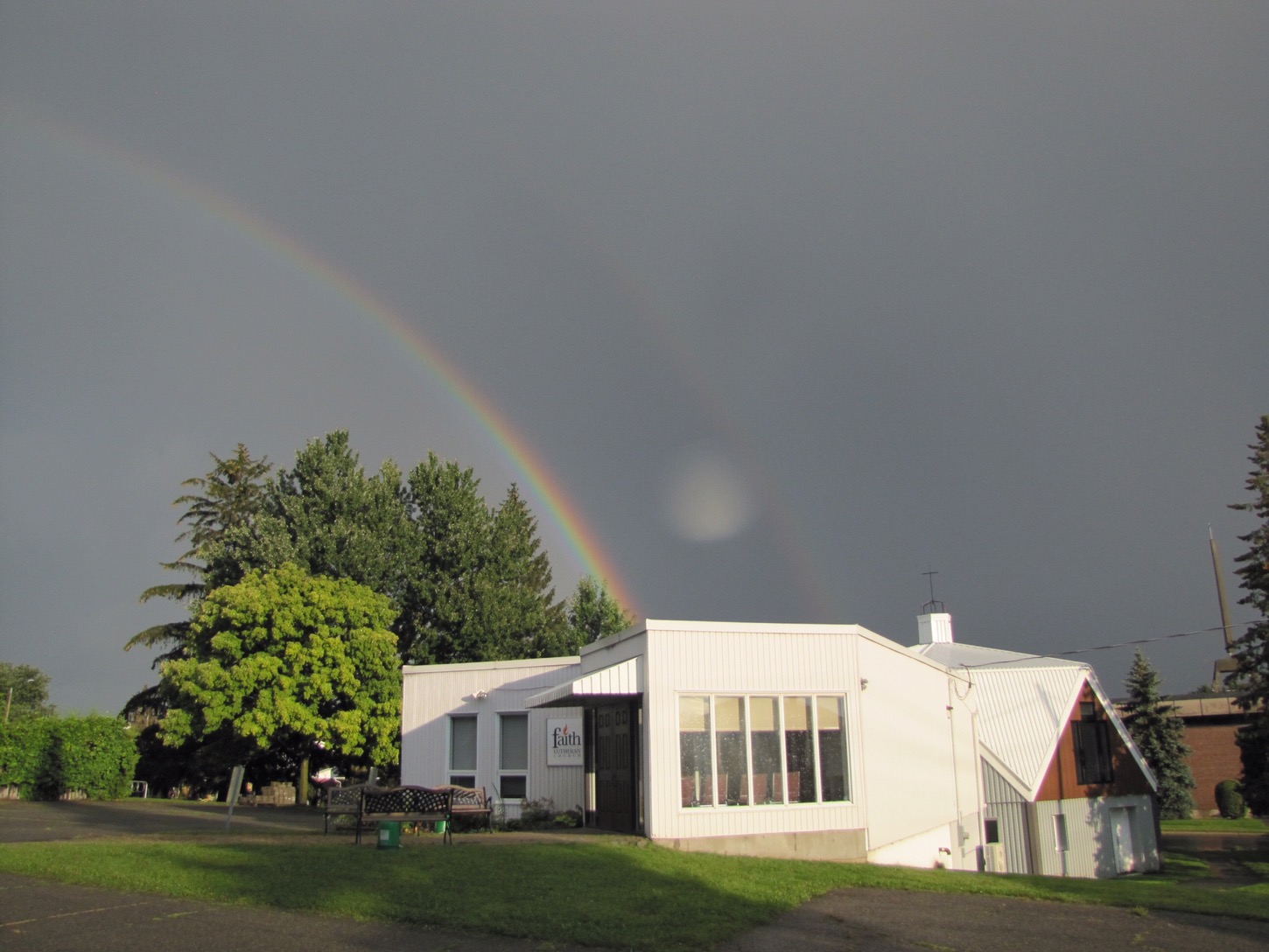
As we worship this morning, the sanctuary at Faith Lutheran Church building is gutted — empty, a shell. Not only is the cork on the walls now removed and the old carpet disposed. The light fixtures, most of the furniture, liturgical items and holy hardware is stowed away for the time being to be recovered, restored and positioned again in their proper place once the renovations are completed.

I know some of you who have been at the site in the last day or so helping to get it ready for the workers, have been asking the question: “Where is the pulpit?” I can see the title of the next best-selling mystery novel: “The Case of the Missing Pulpit.” Where is it?

What a mystery! Well, this is what happened …

Last Sunday afternoon as I was helping members of our altar care committee removing certain items, we ran into a little problem. Our pulpit is mobile; it sits on wheels. So, depending on the needs of the day, we move it around. 

Well, we moved it alright — all the way to the door of the sacristy where we were hoping to store it. Without doing serious alterations (and damage!) to the door frame, there was no way that pulpit would get through. And the cloakroom, where we normally store the pulpit at Christmas, was going to be filled with stacks of chairs. Where on an already compact floor space would we store a rather heavy and cumbersome piece of teak-wood furniture?

It was the spur of the moment when I offered to put the pulpit in my car. I had the back seats down anyway at the time, and the rear hatch opened just wide enough to allow the pulpit to slide in fairly easily. And I drove away with church’s pulpit in the back seat of my car! Truth be told!

During the 45 minute drive home to Arnprior, my mind raced: What would I say to someone who would behold this mystery! I was also wondering where on earth I would put it. I had no clue. There was room in our garage, but most of that space was already tagged for bikes, tires, canoes and garden implements for the winter season.

My wife and I sat in the living room that evening scratching our chins and trying to come up with solutions. But to no avail. I guess I would drive around with a pulpit in the back seat of my car for three months! A mobile preacher who comes with his own pulpit! What a deal!

Barbecuing on the back deck that evening, I looked above the tree line and my eyes rested on the steeple of a church, just around the corner from our place. After making a phone call, and depending on the good will of their pastor and the muscle of a couple of their men from that community — and our pulpit now has a resting place. 

So, if anyone asks: Our pulpit is in the safe-keeping in the building of the good people of St John Lutheran Church in Arnprior. Let it be heard! “The case of the missing pulpit” … mystery solved!

I’m usually the kind of person who wants to have a plan, to know how things ought to go and what the end result should be, before doing anything. This is also usually a good thing. Driving away with the pulpit without any clue as to where it should go, was a little unnerving for me. It was, nevertheless, a good exercise for letting go and trusting that a solution would present itself. And it did, in a most gracious, natural and expedient way.

Some of you know that I am planning to go on a sabbatical next year. The theme of my sabbatical is ‘pilgrimage’. And part of the experience is to walk an ancient path, some eight hundred kilometres long, on the north coast of Spain on the famous Camino de Santiago de Compostela. I’ve read that a majority of people who start the pilgrimage — hundreds of thousands every year — don’t finish it. Many pilgrims give up, some even just 25 kilometres into it. 

What many successful pilgrims learn is that all that is required is to remain committed to the journey itself. What is needed, is to unlearn deep-seeded attitudes about what justifies us, as human beings. To persevere in that un-learning process over six-weeks, even against all the challenges of the trail. To learn that all that is required is simply to put the next foot forward. To not give up, to not lose heart. And to pray always.

To dial it down to accepting that it’s all about taking the next step faithfully — nothing more, nothing less. Although simple, it is not easy for most of us to comprehend let alone do: Just walk. Eight hundred kilometres. Because it’s not about our ability and resourcefulness in the end. It’s not about rushing to the next distraction, checking off the next thing on our list in a busy, hectic lifestyle. It’s about something much bigger than us and our ‘stuff.’ A pilgrimage can teach us that.

That was the message from last week’s Gospel from Luke 18:1-8, to pray always. The most important thing is to remain focused on staying the course, to do the prayer. The solution — the answer, the benefit — will present itself as long as we remain committed to the journey, the adventure. 

Last week, we learned to persevere in prayer. This week in the story that follows we learn how to pray. And I want to reflect David Lose’s perspective here (1), to watch for the trap that Luke sets for us readers. Remember, the Gospel of Luke is full of reversals — the song of Mary, the beatitudes in the sermon on the mount, Jesus’ conversation with the thief hanging beside him on a cross, etc. Luke, it seems, delights in setting up his readers with presumed expectations, and then pulling the rug from under our feet.

It’s too easy merely to paint the bad guy as the Pharisee. Because don’t forget, the Pharisee is law abiding, has fulfilled all the demands of his religion, lives a pure and righteous life. Isn’t this what faithful living looks like? After all, we shall know others by their fruits, no? The Pharisee does a lot of things right. Except for one thing:

The Pharisee, while living the right life, has forgotten the source of his life and all the good in it. Otherwise, he would not despise another whom God loves. He falsely believes it’s all about him and his efforts alone. He falsely believes others who are not like him, need to be, in order for them to be good people.

And, it’s too easy to side with the ‘humble’ tax collector. Let’s not let him off the hook too easily. The tax collector only recognizes that all he is about is depending on the mercy and forgiveness of God. That’s in good contrast to the Pharisee, yes. And that’s the challenging starting place, to be sure.

But nowhere do we see a sign of his repenting. Does he desire to have his life turned around? He may very well be as self-engrossed as the Pharisee. Just the other side of the same coin. The tax collector strikes me as one who might remain stuck in cycles of self-pity, negative self-talk and depression. 

He might be one who goes back every Sunday to remind himself how bad he really is. A false humility, we may call it, where it feels good, actually, to put yourself down before others. “I’m not good enough.” “I don’t have a strong faith.” “I can’t do this or that.” 
Will he not hear that God’s forgiveness can lift him out of what may appear a chronic negativity? Will he not hear that he is not all of the time all worms and dirt and badness within? Will he not hear that God has given him a great gift within himself, in himself?

No matter with whom we relate, or cheer for, in this text — the Pharisee or the tax collector — we run into a wall with both of them. And I believe this wall is meant to test to what degree we focus too much on ourselves in the practice of our faith and in our prayer, and not on God.

The trap is to call us out whenever what we do or what we decide as communities of faith is more about our own stuff, than about the bigger picture, the holy and wonderful mystery that is God.

At least one item from our worship practice is not in storage, but stands in this place alongside yours — the Paschal Candle. It is called, ‘paschal’, because it describes the ‘mystery’ of Jesus life, death, resurrection and ascension. We call it, ‘the Paschal Mystery’. 

We are not talking here about a mystery like ‘the case of the missing pulpit’, where it is simply a question of information about something that is already known, just not to everyone. “Mystery isn’t something that you cannot understand”; A mystery, in the holy sense, is as Richard Rohr puts it: something you can “endlessly understand” (2). We never ‘arrive’ at a complete knowing, this side of eternity, of what God is all about. We never completely ‘get it’. We are always growing, changing, discovering, adventuring.

It is natural to seek signs. The Pharisees and disciples demanded Jesus: Give us a sign! And the only ‘sign’ that Jesus was willing to give them, was the “sign of Jonah” (Luke 11:29). Many of us know that story from the Old Testament, where Jonah fights against God’s will, refuses to follow where God calls, doesn’t want to do it! 

Only by spending time in the belly of a whale for a few days, where he can do nothing, does Jonah become aware and accept that it’s not about him, or his mission, but about God’s purpose, God’s call, God’s mission. Doing God’s mission will call us beyond our own agendas, preferences, and even personalities. Not that those things are bad. But this is about something a lot bigger than our resumes, list of accomplishments, or even our baggage and painful histories.

We are on a journey moving forward, a pilgrimage, to discover what God is about in this holy space and in the world around us, now. We already received signs of God grace — your authentic and heartfelt welcome and accommodating us, for starters. This beautiful space and hospitality we can share. This is God’s good work among us and through you. Thank you!

We might not know what this will look like at the end of the journey together as Faith Lutheran Church worships alongside Julian of Norwich Anglican Church over the next few months. “I’ve got this pulpit in the back seat of my car, and I have no idea where it’s going!”
We might not know where this adventure leads.

But we don’t go alone. We travel this uncertain road together, side by side. We may suffer through some moments together as we figure things out, as we feel our way into this journey, as we learn and perhaps go through some growing pains together on these first few steps.

But let us be encouraged by the Paschal Mystery, which points to the way of Christ, the self-emptying and giving that leads to a marvellous and wonderful resurrection from all that is passing away, transforming us into the new thing that God is doing. The light of Christ shines ever and ever, even in the darkness and through our most challenging journeys. 

Thanks be to God! Amen.


(1) David Lose, “The Pharisee, the Tax Collector, and the Reformation”; Monday, October 21, 2013; http://www.workingpreacher.org 

(2) Richard Rohr, “The Divine Dance: The Trinity and Your Transformation” (Whitaker House Publishing, Pennsylvania, 2016)

Rooted in the earth, rising to the sun

Recently I have been reading about people’s experiences on the Camino de Santiago — the eight hundred kilometre walking pilgrimage through northern Spain. This walk has become more and more popular among Christians of all stripes over the past couple of decades. It seems Christians around the globe are finding the pilgrimage a good place to work through personal issues, find focus in life again and seek re-connection with God, the world and themselves.

This past week I met with one such pilgrim from Ottawa who goes at least once a year to walk some part of the Camino; in fact he is leaving today for Barcelona. I sought his experienced advice for some practical considerations for the trek. His first rule of thumb: Pack only ten percent of your body weight. For me, that would mean no more that 20 pounds in my back pack — of all that I would need for the thirty to forty day hike. Twenty pounds is not a lot!

His second rule of thumb: What you wear on your back, put only one in your pack. That’s all. For example, if you are wearing a t-shirt, pack only one other t-shirt in your back-pack. If you are wearing a pair of shorts, pack only one other pair of shorts. And so on.

He laughed when he told me that about four days in — some one hundred kilometres into the journey — you find bins and bins full of personal items people left behind. These pilgrims had realized, thankfully sooner than later, that they were simply carrying too much — stuff they didn’t really need (extra shirts, pants, sweaters, books, jackets, bed mats, blankets, etc.). A final rule of thumb from my friend: If you do take something extra, then you need to have a good reason for it besides, “I might need it.”

This discipline reflects the quality of being able to let go. It can be described as a total self-surrendering, a giving up. The term “Kenosis” has been used among Christians throughout the ages to connote this sense of releasing that which we normally feel we need to hold onto tightly.

Fourteenth century German theologian Meister Eckhart said, “God is not found in the soul by adding anything, but by a process of subtraction.” (1) In our consumer culture, religion and spirituality have very often become a matter of addition: earning points with God, attaining enlightenment, producing moral behaviour. In the ‘prosperity gospel’ so popular in North America, we often hear the message that Jesus approves of you when your material and financial wealth increases; the more you have, the more in favour you are in God’s eyes.

Yet authentic, Christian faith is not about getting, attaining, achieving, performing or succeeding. The solution is not just “work harder” or “get more” of something. Our culture and economy, indeed, is based on more and more. Whereas true faith suggests: less is more. Martin Luther’s theology of Justification by Grace through Faith suggests the very same: We cannot by our own efforts achieve anything worthy of God.

So, stop trying. In fact, start doing the opposite: Let go of your pretence to manage your life according to the creed: Bigger and More is Better. Let go of a paralyzing negative body image. Let go of the inner talk that is putting yourself down, that tells you you are no good. Let go of attitudes of hatred against people who are different from you. Let go of those material aspirations that tease you into a false sense of security. Let go of being paralyzed by fear.

Instead, focus on what is essential. Appreciate that you already have enough, all that you need. When Jesus gives instruction in the Gospel text for today (Luke 14:25-33) he is travelling out on a public road, on his pilgrimage to the Cross. Remember, ever since Luke 9:51, he is already on the way to Jerusalem, his final destination. When Jesus is walking towards his death and resurrection in Jerusalem, he offers what sounds rather harsh to our ears. What is called-for here is a ‘single-mindedness’ that is needed when you travel with Jesus.

Discipleship is about being single-minded about the purpose, the goal and the mission of Jesus in the world. It is about prioritizing what is important to life in the public realm where culture, consumerism and a whole host of other distractions can keep us from this focus.

This single-mindedness demands that we think ahead, and anticipate the cost of our journey. Setting out on the road to follow Jesus requires at least a little forethought and reflection. This journey is not a light matter. Sit down and think about it a bit. Reflect.

There is not only the blessing of the assets promised, but there are the liabilities, too. Discipleship is not just one more hobby or extra-curricular activity to add to a well-rounded, prosperous life. It is not merely “a matter of pure passion and abandon” (2).

Followers of Jesus should count the cost, but also realize this is not just about counting the cost of a church building renovation or a church fund-raising project. The cost of discipleship, as Dietrich Bonhoeffer first coined the term, is about prioritizing our whole lives, not just our “church” or “Sunday morning” lives.

If someone told me a year ago that I would spend four days cut off from civilization, in the bush without cell-phone service, hauling all my food and everything I need to survive in a canoe that I would have to navigate through rapids and rocky, snake-infested portage routes — I would say they were dreaming … or talking about someone else.

Well, that’s precisely what I did last week, along the French River Provincial Park between North Bay and Sudbury. Fortunately I was not alone; I journeyed with a more experienced wilderness survivalist. 

We ended up taking more than we needed. We could have packed less food, and less clothing. The exercise, nevertheless, was confident-building for me in realizing I really don’t need that much stuff.

Jesus says, “None of you can become my disciple if you do not give up all your possessions.”

To live life well, and faithfully, is to recognize one’s place in the world, and not to over-reach, over-extend, to be someone you are not — all on the basis of wanting more and more, bigger and better. To live faithfully, we are called to examine our dependencies, count the cost of it all, focus on what is important, and then make room in our lives for what is important by letting go.

A sojourn into the wilderness may indeed by the antidote to visions of self-aggrandizement embedded in the prosperity gospel message. Try doing without, for some time, what you may have taken for granted for too long. Try doing without what you always have believed you needed in order to live. Try Letting go. Releasing. Forgiving. 

This is not about doing away with personal boundaries. Letting go is not about condoning injustice or cruelty. Kenosis/letting go is not about being blind optimists, repressing or denying or not caring, or ‘giving up’ in frustration.

Forgiveness is a good example of letting go of the misery caused by holding on to the pain of resentment or holding a grudge. This kind of letting go brings a positivity that is based in honest struggle and prayer born out of compassion and love for self, the other, and God. The end result is a freedom and peace that cannot ever be realized through a program of simply working harder or getting more.

The German poet, Rainer Maria Rilke, wrote about the contrast between the law of gravity and the rising of the trees. He writes about the gift of letting go into a place of trust: Trusting that the gift in you is enough. So that you can rise up, rooted like trees: 

How surely gravity’s law,

strong as an ocean current,

takes hold of even the smallest thing

and pulls it toward the heart of the world.


Each thing —

each stone, blossom, child —

is held in place.

Only we, in our arrogance,

push out beyond what we each belong to

for some empty freedom.

If we surrendered

to earth’s intelligence

we could rise up rooted, like trees


Instead we entangle ourselves

in knots of our own making

and struggle, lonely and confused.

So, like children, we begin again

to learn from the things,

because they are in God’s heart;

they have never left God.

This is what the things can teach us:

to fall,

patiently to trust our heaviness.

Even a bird has to do that

before he can fly. (3)

In the poetry of scripture, the Psalmist describes beautifully the blessing we are, created in the image of God — so “wonderfully made” (Psalm 139:14). God would know intimately each part of our lives only if we were valuable to God and to the rest of creation. Otherwise, why would God care?

In other words, we are and have everything we need to enjoy and live to our fullest potential. We are beautiful. We don’t have to strive and strive to become someone we are not. We don’t have to ‘add’ anything to our lives to be well. In fact, when we have the courage to risk letting go, and “fall”, as Rilke poetically expresses, trusting in our “heaviness”, we will find a freedom and peace that will be the joy of all creation, and the glory of God.

We will live our lives at the same time rooted in the earth, and rising to the sun.

(1) Translated by J. Clark & J. Skinner, “Meister Eckhart: Selected Treatises & Sermons Translated from Latin and German with an Introduction and Notes”, Faber & Faber: 1958, p.194

(2) David Schnasa Jacobsen, Commentary on Luke 14:25-33 in “WorkingPreacher.org”, 2016

(3) Rainer Maria Rilke, “Rilke’s Book of Hours: Love Poems to God” translated by Anita Barrows and Joanna Macy, Riverhead Books: 1996, p.116-117; cited with permission in Richard Rohr’s Daily Meditation for August 28, 2016