Thanksgiving not a 1-day event

Thanksgiving is not a one-day event.

Canadian Thanksgiving weekend is upon us. Even so, we know that for many of us in Ottawa feeling thankful is not easy at this time. Especially in the aftermath of the tornadoes, what about the folks in Dunrobin?

Indeed, difficult circumstances in life can challenge our attitudes and beliefs. Bad news can dampen any uplifting feelings. We may even react angrily to those who tell us to be happy and thankful.

Perhaps if we understand thanksgiving more as something we do over time rather than a one-shot deal, we can get through those tough times. Perhaps if we see thanksgiving as something that grows slowly in our hearts rather than an artificial nostalgia imposed during one Fall weekend in October, we can find a way through all the topsy-turvy feelings in our lives. True, thanksgiving is an attitude and corresponding action of ‘giving’ more than a self-serving emotional exercise.

The restoration efforts in Dunrobin, Gatineau and parts of Nepean continue. And they will, for some time to come. The needs of those rebuilding their lives didn’t stop in the week following the devastating tornadoes.

Below is a list compiled last weekend by a neighbor living in the Cityview community. Please consider the various opportunities to help those in need, locally. And, in so doing, giving thanks despite all that’s not perfect in the world.

May God grow the seed of thanksgiving in our hearts at this time of year.

What you can do:

1. Donate to the Red Cross, which is helping both Ottawa and Gatineau residents.

Ottawa: http://www.redcross.ca or by calling 1-800-418-1111.

Gatineau: http://www.gatineau.ca/croix-rouge

2. A financial donation to the Ottawa Senators’ fundraiser on GoFundMe.com. Ottawa-Gatineau supporters have donated $187,798 and the Ottawa Senators Foundation is going to match the total amount raised.

Visit their page at: https://www.gofundme.com/ottawa-senats-amp-fans-tornado-relief

3. Donate clothing, furniture or other household items to St. Vincent de Paul. To locations in Ottawa: Merivale Rd and Wellington

4. In Gatineau, donations of “clean clothing in good condition, personal hygiene products and non-perishable foods” can be dropped off at the former Sears location at the Galeries de Hull on Boul. Saint-Joseph.

5. The food banks are in need of donations. It is best to call them to find out what is needed most. Here are just a couple. There are others too in Gatineau.

The Kanata Food Cupboard – http://www.kanatafoodcupboard.ca/ – it is open for donations on Monday from 9 a.m. to 4:30 p.m., and will coordinate delivery to the locations “most in need.”

The Ottawa Food Bank – http://www.ottawafoodbank.ca/ – you can hold a food drive, volunteer, and/or make a donation through their website.

6. CBC has set-up The “Ottawa-Gatineau Tornado Community Connector” Facebook group is a place for anyone to share their ideas to help people without power or looking for shelter and supplies.

Doers of positive change

If you’ve followed the Ottawa Senators’ Hockey Club over the last year you will have endured a roller coaster ride. From the high, you will have tasted the sweet drippings of a near-berth in the Stanley Cup Championship Series sixteenth months ago …

To the low, feeling the despairing collapse of the team, not just to being out of the playoffs but crashing all the way to second last place in the NHL standings by the end of this past season.

What happened?

In the last several months, the nightmare season was enflamed by revelations of all the off-ice drama that was happening:

  • Allegations of sexual abuse by then assistant manager Randy Lee;
  • The politicking of owner Eugene Melnick to shame/scare the fan base that he was either going to move the team away from Ottawa, and/or that the downtown arena project may not happen motivating concerned fans to initiate an #MelnykOut ad campaign across the city;
  • Star player Erik Karlsson’s wife applying for a peace bond (restraining order) against the girlfriend of another star player, Mike Hoffman, who allegedly used social media and other means to send discriminatory, abusive messages to the Karlssons even during the loss of their unborn son in March;
  • And the continuing speculation around and probable trade of Erik Karlsson in the final season of his current contract.

General Manager Pierre Dorion was right when he told the media last Spring that his locker room was “broken.” Inter-personal relationships, team chemistry – the essential ingredients in a winning team – were damaged maybe even beyond repair.

While ‘on paper’ the team had skilled players and was comprised of the same core from the year previous when they had that successful run to the Conference Final, something significant had changed for the worse. And this subtle yet very real aspect of failed team-work was at the root cause of the team’s on-ice collapse last season. It wasn’t that they weren’t good players; it was their unhealthy, damaging ways of relating with each other that was the problem.

Funny we are talking here in the church about a hockey team that many of us follow in Ottawa. And yet, we can, I think, attend in a similar way to most areas of our social, political, religious, family and personal lives. Are their areas in your work, your volunteer efforts in the church and in the community, in your personal health, in any aspect of your quality of life let’s say, that are lagging, that yearn for renewal, new life, positive change?

For some time, Ottawa Senator players have been saying that there needs to be a culture change in the locker room and among team relationships. Goaltender Craig Anderson said this week he is looking forward to the changed culture in the coming season but he is “too old for all the drama.”

Teammate and hometown defenseman Mark Borowiecki who is considered a leader in the group called out his goalie and others on the team by suggesting they need to do more than just say they need a culture change. Each player and the players themselves as a team, has to do the work of changing the culture. It wasn’t going to happen by itself. No divine intervention. No single-player trade, no matter how newsworthy, was going to change their culture. They, the players, had to take on the responsibility to work at it.

Be doers of the word. A theme in the scriptures assigned for this day. In the Book of James we get the message that while words are important, actions reveal the truth, authentic self and purpose of what we’re about (1:22) more than anything else. What we do with ourselves, with each other – our actions – are the best teacher and communicator of what is most important to our common life, our team, you could say – whether that team is the church, the family, a marriage, a community group, a political movement, or a sports team.

And this action is not only about our performance on the ice, so to speak. This work of doing is not merely about the mission, out there. It is not about whether we succeed or fail on the mission field in getting the job done – the work of ministry in the world. Perhaps our failure at getting that job done out there may at least in part relate to our failure to do anything on the inside of our personal and corporate lives. And lacking the awareness and the belief of positive change within.

It is no wonder Bishop Susan Johnson and the leadership of the Evangelical Lutheran Church in Canada (ELCIC) has identified being a “healthy church” as one of the four vision priorities, moving forward in community. Being a healthy church means, to “develop and promote a culture of mutual trust and accountability.”[1]

That is, we relate with one another and the world around us in ways that reflect genuine listening, respect, humility and patience. In short, we offer safe spaces for personal interaction and growth. We can’t achieve the other vision priorities of the church, such as compassionate justice, spirited discipleship or effective partnerships, unless we are first a healthy group of people relating to one another.

And no one will make this culture change in our relational lives unless we are doers of the word, unless we take action that promotes growth, faith and positive change in our common lives.

In the mid-point of Mark’s short Gospel, Jesus spends a lot of time around the Sea of Galilee. When I visited Israel during my seminary years, our bus ride was only a couple of hours from Jerusalem to the Sea of Galilee. In Jesus’ day, it meant walking at least six days. Word of Jesus had certainly spread, and his actions of healing and eating with sinners and picking grain on the Sabbath made the Pharisees – the keepers of the Law – extremely nervous. So much so, that the powers that be from Jerusalem invested the better part of a month checking up on Jesus’ ministry (7:1).

It is sometimes amazing the lengths people will go in order to keep things the way they have always been. A radio sports commentator mentioned after the Anderson and Borowiecki interviews that Mark Borowiecki was right: talk of culture change has been swirling around the same group of players for most of last season with little, actual change in their performance. It seems we haven’t really been taught how to work at bringing positive change, starting with us.

Change is frightening, to be sure. Institutions often seek to preserve the status quo. That was true in Jesus’ day. And it is true in congregations as much as in team locker rooms these days. Yet change, as we must surely know living in this time and place in history, is the norm, not an exception.

I was pleased to hear Pastor Mei Sum Lai, leading her last worship service at Resurrection Lutheran Church in Orleans[2]last Sunday, thank the congregation for allowing change to happen during her tenure there. I then reflected on all the changes that have happened here at Faith[3]in the last six years or so:

  • The bold decision to bring significant upgrades and modernization to the building and sanctuary;
  • The gutsy decision to worshipping for four months with our local Anglican parish while the sanctuary was off-limits in its renovation;
  • The move to weekly Communion;
  • The involvement of lay readers and worship assistants;
  • The completion of the work of the Evangelical Lutheran Women as a formal entity
  • The introduction of Christian Meditation as a weekly prayer group;
  • The evolution of bible study to a prayerful encounter with the Word;
  • The ongoing evolution of meals at the church in all its fits and starts – to name a few changes.

These changes, good or bad in your view, are nevertheless good practice for us. Making these changes are good exercise for us, for the positive changes that God is bringing about in our world and church. Because we won’t do it perfectly. We will make mistakes. We will even fail at times. But avoiding failure is not the point of Christian identity and mission. The point is, we are following Christ – or trying to – on a rocky and uncertain road in the post-modern world. Trying amidst the noise and chaos to discern and listen to Jesus’ voice.

What is at stake, is what we believe. What do we believe about change? I think this makes a huge difference in how that rocky road will go for us.

Despite the negative scrutiny and criticism heaped upon Jesus by the Pharisees, what does Jesus do in response? Does he cave into the pressure to play by the religious rules of the day? Does he try to please the authorities and adhere to the tradition for tradition’s sake? Does he shift into self-preservation mode and quietly step into the shadows as not to garner any more attention? What does he do?

Jesus keeps on healing. If you read on in chapter 7, he goes on from Lake Galilee southward on the road into the non-religious Gentile region first to heal the daughter of the Syrophoenician woman[4], and then he opens the ears of the deaf man in the Decapolis.[5]

In fact, I don’t know of anyone in the New Testament who doesn’t change after encountering Jesus, whether by a healing or in a shift of attitude and approach to life. The most dramatic example, probably, is Saul of Tarsus who on the road to Damascus encounters the living Lord and experiences a profound conversion.[6]

When you meet Jesus, your life changes for the better not because you don’t do anything about it. But because you’ve placed yourself, for better or worse, in a position to receive the grace, healing and change of God. Historian Diana Butler Bass writes, “For all the complexity of primitive Christianity, a startling idea runs through early records of faith: Christianity seems to have succeeded because it transformed the lives of people in a chaotic world.”[7]During this time, Christianity was primarily about how to live a better, more faithful life, here and now within the kingdom of God.

Team play is as much an inner game as it is an outer game. And the inner game takes work, not just words. This inner work is not easy to do.

Perhaps you might have a hard time believing positive change is possible in your own life. If so, is it because we refuse to see the positive changes happening in those around us – in the life of the church, in our own families and friendship groups? Because when we refuse to accept that others have changed, we strike the death knoll and close the doors of our own hearts to see the change there.

So perhaps a first step would be to regard others, especially those closest to us, as on a journey that is changing and growing them in ways beyond our control. And then wait for Jesus’ call on your own life to follow him, to encounter him, to meet him on the road of life. In most of the people who meet Jesus, they present their own need. They approach Jesus in their vulnerability. Where they are hurting.

Because whatever the case may be with your own heart, whether or not you believe change in your own life and in the life of others around you is possible, God waits for you. God is patient, ready and willing to heal. God believes in you.


[1]http://www.elcic.ca

[2]http://www.rlchurch.ca

[3]http://www.faithottawa.ca

[4]Mark 7:24-30

[5]Mark 7:31-37

[6]Acts 9:1-31

[7]Diana Butler Bass, “A People’s History of Christianity: The Other Side of the Story” (HarperOne, 2009), p.26.

Geometric power: The circle church

The architecture of church buildings, despite Christianity’s institutional decline in the Western world today, continues to draw our attention. For the most part, these are beautiful buildings, appealing to the eye whose symbols etched in paint, glass and images conveyed through colour and the play of light and shadow serve as magnets to the curious and searching among us all.

In one reading assigned for this Sunday from the prophet Amos, God’s judgement on Israel is measured by a plumb line.[1]Construction workers measured the stone blocks to make sure they were squared so the walls of the temple could be built straight up. It was used to make sure the construction of buildings was done properly. The plumb line image conveys the proverbial ‘standard’ to determine how righteous God’s people are. Needless to say, Israel fails miserably, time and time again.

It seems, for folks in the bible, there is always good and bad in the mix. God’s people will never, no matter how hard they try, be pure and perfect in their doing and being. From ancient days to this day, people of faith always miss the mark. Just read Paul.[2]Our vision is often clouded, and we cannot help but make mistakes on the journey.

The stories from the bible assigned for this day reveal characters mired in the shackles of their humanity, good and bad. David rejoices in bringing the ark of the covenant into the holy place of the temple in Jerusalem while others look on with hatred, despising him.[3]Of course, King David was no angel himself, committing murder and adultery while he was king.[4]

Herod Antipas, in the Gospel reading, respected the rogue John the Baptist and liked to hear him speak yet condemned him to a gruesome death in order to protect his own reputation.[5]Wherever you read in the bible, you cannot avoid the sinfulness of even the so-called heroes of the faith.

What we build to the glory of God, the fruits of our labours and expressions of our faith, will also reflect this good/bad reality. The Dean of the now re-named Martin Luther University College [formerly Waterloo Lutheran Seminary], Rev. Dr. Mark Harris, once told me, when he visited me at my former parish at Zion Lutheran Church in Pembroke, that no matter all the changes that happen in the church today — good and bad — architecture always wins out.

What does the architecture of a place of prayer, therefore, communicate? What truths do they reveal about what we value, what is important to the church? How does the architecture ‘win out’?

Recently, I’ve visited other congregations that are housed in beautiful, old church buildings. The first is Merrickville United Church where last month I did a pulpit exchange, you might remember. The second was two months ago when I visited Luther Place Memorial Church in Washington D.C., which hosted some seminars at the Festival of Homiletics.

What is similar about the floors in these churches, keeping in mind [hint!] our discussion of the plumb line? What would Amos say about their construction using his plumb line?

Why did the original construction include a sloped floor? Perhaps its architects wanted to create an easier sight-line for the person in the pew to see clearly the primary furniture of worship located in the chancel — the font, altar and pulpit. The font, where the first sacrament of baptism — of entering the family of God; the altar, where the sacrament of the meal invites us regularly for nourishment on the journey of faith; the pulpit from where we hear God’s word in scripture and voice.

That’s the good from the construction, that we are drawn and can see clearly what is central to our faith: Word and Sacrament. That we can come easily; we don’t have to work hard to earn our way to God. I don’t know how many times in worships services and lectures during my time in and visits to these spaces, we had to stop whatever was going on to wait for a rolling water bottle to make its easy yet loud, clattering roll down to the front.

So, the good: We can pool down into the arms of God’s grace. We are drawn to the love of God’s welcome and forgiveness. And we really don’t need to work hard to be there. We just need to ride the current flowing to God. It is gift. It is grace. It is free. Neither ought we place any barriers to God’s grace being accessible to all, to come forward. To let all, including ourselves, come to God. Amen? All are welcome!

You may have noticed, however, that King David brings the ark of the covenant “up” into the city. Indeed, this is the geography and architecture of the city of David built upon a hill.[6]And the holy of holies is not down below in the valley, but up high by the altar.

The people have to exert some physical energy to get to the place of God’s presence. Even David, in all his rejoicing in bringing the ark to Jerusalem, “danced before the Lord with all his might.”[7]He was working hard! He was putting his all – heart, soul and body – into the effort.

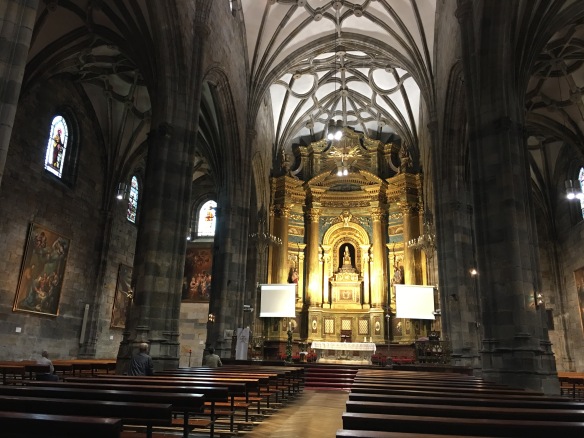
At the unplanned end to my Camino de Santiago pilgrimage last year, I sat in the large nave of the cathedral in Bilbao, Spain, reflecting on the disappointing turn of events. It is a spectacular fifteenth century build.

IMG_5352.jpg

As I looked around me in the silent, cavernous space, for a split second I experienced vertigo, not unlike you would in the old slanted room in the Ottawa Science Centre. Something was off.

Then I realized, I’d never before been in a church building whose floor was not sloped downward toward the altar, but upward!

IMG_5355.jpg

And what goes up must come down. The floor was slanting outward and downward toward the front doors and down into the city!

The story of David’s extravagant, energy-filled entrance up into the holy city didn’t finish at the holy of holies. Going up was completed by turning around at the apex to come back down. The story ends by David distributing food and gifts to not only his family and friends in the city, but “the whole multitude of Israel.”[8]Everyone is fed!

Worship and centering in God is followed by a necessary, gracious giving and going out into the world. I quote again the prophet Amos, where we started: “Let justice roll down like waters, and righteousness like an ever-flowing stream.”[9]

We don’t have slanted floors here. It’s more or less flat. Amos with his plumb line might be satisfied with the level of the floors. But what else could the architecture of our place of worship tell us about ourselves, our identity and God’s call for us?

IMG_6546

Could it be, sitting in room that is basically round that the obvious measure and geometric symbol is not the straight line, but the circle? And now, with larger windows surrounding us, windows which let more light in, also improve our imagination and connection with the world out there? Could it be, given the architecture of our faith here at Faith, we are now called not only to be drawn into the centre, the hub, of the circle who is Christ, but also be sent out in the centrifugal force of God’s Spirit?

In the last pages of the bible, the Book of Revelation, we read a vision of God’s magnificent future:

God’s future comes as an experience of God’s love, “flowing like a river from God’s throne, nourishing trees with leaves for the healing of the nations.”[10]This vision “pictures a world made whole, with people living in a beloved community, where no one is despised or forgotten, peace reigns, and the goodness of God’s creation is treasured and protected as a gift. Our faith is not a privatized expression of belief which keeps faith in Jesus contained in an individualized bubble and protects us from the world.

“Rather, we are on a spiritual journey in which we remain connected to the centre of the presence of God but whose love yearns to save and transform the world. We are called to be ‘in Christ’, which means we share – always imperfectly, and always in community with others – the call to be the embodiment of God’s love in the world.”[11]

In loving others by including them in the circle, we discover how much we are loved by God. We are the circle church. A porous, ever-expanding circle.


[1]Amos 7:7-9

[2]Romans 3:23; Romans 7:15-21

[3]2 Samuel 6:16

[4]2 Samuel 11

[5]Mark 6:14-29

[6]2 Samuel 6:12b

[7]2 Samuel 6:14

[8]2 Samuel 6:18-19

[9]Amos 5:24

[10]Revelation 22:1-2

[11]Richard Rohr’s Daily Meditation, Friday, July 13, 2018 (www.cac.org)

God in Acts

In Mark Burnett’s recent visual adaptation of the entire Bible, some scenes from Jesus’ passion still stand out for me. Weeks have passed since the dramatic events of Holy Week and Easter. So, I ask you, to rewind the tape for just a minute. And recall with me when news of the upstart prophet from Galilee first came to ears of the high priest in Jerusalem:

The scene in the temple is dark, illuminated only by the flickering flame of candlelight sending fleeting shadows throughout the cavernous room. The religious leaders draped in their flowing robes shuffle about.

An anxious member of the religious elite makes his way to the high priest, catching his attention: “There are reports of a man performing miracles, and some five thousand followed him to Galilee.” At first, news about Jesus does not worry the high priest. He turns away without saying a word. But the messenger persists, pulling at the high priest’s shoulder. “He calls himself the Son of God!”

The high priest’s mouth stretches in a cold smile, “They all do.”

Then, the night before Jesus’ death, Pilate consoles his wife who is disturbed by news of Jesus’ arrest and trial. Pilate’s wife tries to convince Pilate to have nothing to do with Jesus and let him go.

But Pilate, feeling caught between a stone and a hard place, is playing a delicate political game in order to keep control. He says to his wife, trying to justify his own actions to have Jesus condemned to death: “Don’t worry, in a week this man will be forgotten.”

Both the high priest and Pilate, struggling for political control, convince themselves Jesus is a no one, or at best, a pretender. And will be forgotten, like all the rest of them.

We fast forward now, to life in Jerusalem after Jesus’ death and resurrection. Now, in the Book of Acts, the focus shifts to the disciples. A man who is disabled, sitting by the gate near the temple in Jerusalem, finds healing. Peter and John meet him on their way into the temple. “In the name of Jesus Christ”, Peter touches the man, and he is able to walk again.[1]

“By what power or by what name did you do this?” the religious leaders in Jerusalem ask Peter and John when they are arrested. The Sadducees, who were a powerful religious group in Jerusalem, did not believe in the resurrection of the dead.

Strike one, against Peter and John who did not stop preaching the resurrection of Jesus and all who believe.

It is said that five thousand people converted to Christianity after hearing and seeing what miracles and words Peter and John performed.[2]

Strike two, against them. Five thousand people is a huge threat to the religious establishment. And to social stability. Rome held Jerusalem’s religious leaders responsible for keeping the pax romana – Caesar’s idea of political control over each region in the vast Mediterranean empire. There was no way the Sanhedrin were going to allow Peter and John to continue their disruptive work.

So, they were arrested and brought before the religious council called the Sanhedrin. Did Peter and John know that a few weeks prior, Jesus stood in the same place before the religious leaders?

Strange, I find, that something obviously positive – the healing of a person – turns into something negative so easily where human nature is concerned. Questions of resurrection, the mercy of God and healing turn into a question of power: “By what power or by what name did you do this?”

It is also clear, as the author of Acts present, that the religious leaders were “jealously protective”[3]of their franchise on religion. They wanted the masses to be prayerful and faithful. But they wanted people to do so under the exclusive banner of the temple.

Yet, from the beginning, the Christian movement was an outbreak of the Holy Spirit, spreading like wildfire. It cannot be contained in any one, exclusive denomination, group or church claiming to be the only, right way. That is not the nature of the Christian movement, from day one to the present. Exclusivity is not the preferred style of Christian life.

“By what power or by what name did you do this?” Peter and John have an answer: There is no other name by which we all are healed. Jesus Christ stands for all.[4]For God shows no partiality, for there are people in every nation who are acceptable to God.[5]

There is no other name. Other gods will give up on you:

The god of war and violence will give up on you when you turn the other cheek.

The god of consumerism will give up on you when you give what you have to those in need.

The god of power and control will give up on you when you let go of any pretence of being in control of others, forcing them to be like you.

The god of competition and hatred will give up on you when you welcome, affirm and show mercy to those who are different from you and your kind.

All these false gods of the world will forget you. They will be forgotten. The high priest of Jerusalem and Pilate were right because there were so many claiming to be the Messiah who were just that: fakes. These are the false gods who will be forgotten.

But not Jesus. Even after his resurrection and ascension, Jesus will not be forgotten.

Peter and John may have had a couple of strikes against them standing as prisoners before the religious leaders in the temple’s portico. But they, and the Christian movement, would never strike out. God was about to blast a grand slam out of the park of history.

The God of resurrection and new life will continue to inspire, to push us forward, to pinch our consciences, even challenge us to move forward. There is no hiding from this God who will not give up on you and on us.

The God who created you, who loved you,

Who, even in your sin forgives you and shows you mercy,

The God who gives you a second chance, always,

The God who is your loving shepherd, compassionate friend,

This God will never, ever give up on you, nor forget you. Nor any lost, hurting person or creature in all of creation.

Whether it is Peter or John, or the voice of God speaking this through the church and in the world today …

There is no other name under heaven by whose power all can be saved.

Amen.

[1]Acts 3:1-10

[2]Acts 4:4

[3]Thomas C. Long cited in David L Bartlett & Barbara Brown Taylor, “Feasting on the Word: Preaching the Revised Common Lectionary” Year B Volume 2 (Kentucky: WJK Press, 2008) p.432

[4]Acts 4:10-12

[5]Acts 10:34

The Shepherd, and Creation

In the midst of this season of Easter, the extreme winter weather that has plagued this part of the world recently has been the topic of conversation. Perhaps, then, it is appropriate that April 22 is Earth Day. The public, as well as Christians, are invited to pause and reflect on our relationship with all of creation.

Earth Day coincides with the Fourth Sunday of Easter, which is traditionally called “Good Shepherd Sunday”. Familiar readings from the bible populate the liturgies of this day.

The imagery from the Psalms, particularly Psalm 23, calls forth in me a context of creation that is stable, healthy. The Psalmist walks beside still waters, green pastures, verdant valleys. And if we expand the Psalmist’s repertoire we can include the hills and mountains (Psalm 121), the moon and the stars (Psalm 8), breaking waves (Psalm 42,89), expansive seas (Psalm 139) and sky-reaching trees (Psalms 1,148).

In scripture, grace is mediated through creation, not apart from it. The message of the Gospel cannot be communicated in spite of creation but in and with it. All of creation, like the Sacrament, is a beloved conveyor of God’s grace and purpose.

When in the Gospel Jesus says to his disciples that he is the “good shepherd” (John 10:11), we are invited to consider what it means to care for creation. The Greek word for ‘good’ in this text, kalos, means ‘model’. In other words, Jesus is the model shepherd. Jesus models for us, in his life-giving love, how it looks to be a follower of Jesus.

Jesus will stop at no cost to care for us and for the world that God created and so loved. What does it mean for us? What are we called to do, as followers of Jesus?

This weekend, as the weather finally warms up and feels more like Spring, please reflect and act on what it means to follows Jesus in today’s world. Start by reading the Earth Day statement prepared together by the ELCIC Bishop, the Rev. Susan Johnson, Anglican National Indigenous Bishop, the Rt. Rev. Mark MacDonald, and the Anglican Church of Canada Bishop, the Most Rev. Fred Hiltz:

Earth Day statement by church leaders

Easter: what is life-giving

When Sherlock Holmes and John Watson go tent camping for the first time, the two detectives unexpectedly encounter a ‘mystery.’

They hike deep into the woods all day until they find the ideal place to pitch their tent. They start a roaring campfire, roast marshmallows, tell favorite stories, sing some tunes and as the last embers flicker in the fire pit they pack it in for the night.

In the wee hours before dawn, Watson wakes the snoring Sherlock. “Look, Holmes, look at the billions of stars in the sky! What a glorious sight! Praise to the Creator!” Watson’s eyes remain transfixed on the expanse above them. “What would you say about this wonder, my friend?”

“I would like to know,” Sherlock mumbles, looking around their campsite, “who stole our tent.”

Were Sherlock Holmes and Dr. Watson victims of a prank, an April Fool’s Day practical joke?

Nevertheless, consistent with their personalities, each chose to notice a different aspect of their reality: Watson immediately taken in by the glorious night sky – probably something both sleuths weren’t accustomed to seeing in their busy, urban lives.

Sherlock, on the other hand, ever the deducing genius, notices what is amiss, and automatically goes into ‘fix it’ mode, seeking solutions to the trickiest, mind-stumping riddles of life.

In their shared situation one beholds life, joy and beauty; the other, the problem, and its attendant logical, calculated explanation. One looks up, the other, down.

What do you notice? And dwell on? Are you looking up? Or, still down?

The joyous, life-giving message of Easter does not deny nor avoid the harsh realities of living. The Christian’s journey on the road of life does not float over the potholes, ignore the accidents, nor glibly get a free pass over the traffic jams.

Yet, Easter declares something greater than all the suffering, pain and death has happened, and continues to happen every moment we dare to notice.

Jesus is alive! Amidst the hardships. Despite the necessary suffering. Jesus is alive! Right in the middle of the mess. Even in our complicated, self-contradicting lives. Despite our mistakes and our failures. The life of God in Christ resides within and all around us. Martin Luther famously said, the sun shines even on all the manure piles in our lives. Sherlock Holmes AND John Watson. Both/And.

The question is, do we now, as Easter people, notice the Life? Do we see, as Watson does – the victim of obvious theft – the stars in the glorious sky? Do we pause amidst the hectic, hurly-burly of life to, actually, smell the roses and give thanks? Can we believe that the Light that has come into the world now shines in the darkness? A darkness that can never overcome the Light?(1)

Can we assert that our hurt has become home for our greatest hope?

The good news of resurrection hope is that we don’t see this alone. The life and light of Christ shines in the Body of the living Christ — the church today. We are here for each other and for the world in order to discover and celebrate the presence of God in and around us.

We are not alone in discovering the gift of Life in us. In truth, the life of Christ resides in each and every one of us, despite the imperfection of the church and this community. When one of us falls, the other lifts up. We don’t have to suffer alone in the misery of alienation, feeling useless, or being crushed by failure. As if we must carry this burden alone, and heroically solve all by ourselves.

Easter means that now, “Faith does not occur in isolation. Despite the rugged individualism of our culture, faith is not just something private between God and me. Rather, faith is, by its very definition, communal.”(2)

God gives life. That’s God’s job. Where is God’s in yours? In the world? Where do you see it? Because, it’s there!

A woman asked her local Lutheran pastor for advice. “Pastor”, she says, “I have a boy who is six months old. And I’m curious to know what he will be when he grows up.”

The Lutheran pastor says, “Place before him three things: A bottle of beer, a looney, and a Bible. If he picks the beer, he’ll be a bartender. If he picks the looney, a business man. And if he picks the Bible, a pastor.” So, the mother thanked him and went home.

The next week she returned. “Well,” said the pastor, “which one did he pick: the beer, the looney, or the Bible?”

She said, “He picked all three!”
“Ah,” said the pastor, “a Lutheran!”(3)

Of course, we can substitute any Christian, here, not just Lutherans. The point is, living in the resurrection of Jesus means our lives reflect, resonate and echo the life of the living God. We rejoice and sing Alleluias for the beauty in life, despite the difficulties, through our human desires, and amidst the realities of life.

Now, we can see the life in the world – its beauty and glory – without denying the real. Even though someone may very well have stolen our proverbial tent, this cannot stop or take away the Life that is in us and all around us. Forever.

May our lives reflect a sense of wonder, trust in one another and in ourselves, and hope for God’s glorious future. Good news, indeed!


1 — John 1:5

2 — Stephen R. Montgomery in David L. Bartlett & Barbara Brown Taylor, eds., “Feasting on the Word: Preaching the Revised Common Lectionary” Year B Volume 2 (Kentucky: WJK Press, 2008), p.166.

3 — Adapted from James Martin , SJ, “The Jesuit Guide To Almost Everything: A Spirituality for Real Life” (New York: HarperCollins, 2010), p.317.

The will of God – creation,incarnation,passion – March 25

In both Mel Gibson’s ‘The Passion of the Christ’ and, more recently, Mark Burnett’s ‘The Bible’, the devil stands by watching Jesus’ moments of agony.

Contemporary Jesuit writer, James Martin, SJ, describes three temptations facing Jesus during his Passion: The temptation of accommodation; the temptation of annihilation, and the temptation of abandonment.[1]

Jesus could have accommodated his opposition by not offending his listeners and telling them what they wanted to hear thereby avoiding his fate. When the Pharisees tested him time after time, Jesus could have appeased them.[2] But he didn’t.

Jesus could also have simply wiped out/annihilated his opponents by rallying the rebellious Jews against the Roman oppressors. Moreover, he could have called on divine power to protect him through force and violence.[3] But he didn’t.

Finally, Jesus could have left his ministry behind and the life God chose for him – abandoned it – in favor of a more conventional life. He could have settled down in the quiet sea-side town of Capernaum and taken on his earthly father’s carpentry business. But he didn’t.

Instead of doing all these things, he chose the path of surrendering to what came before him. He remained true to himself and his path.

Jesus chose the path of love and obedience. Jesus understood that the only way for God to fully embrace the human life and therefore the only way for God to love us, was the path of suffering and death. How did he come to align his will with God’s will? In the garden of Gethsemane, he prayed, “Not my will, but thy will be done.”[4] He prayed this as an affirmation that his deepest desires aligned with God’s purposes. “With you, all things are possible,” he prayed in his hour of anguish.

Indeed, what is God’s will? How do we discern God’s will for our lives? And when we are faced with the right path to follow, are we not also tempted to accommodate, to annihilate or to abandon? Early Christians, even before they were identified as such, were called, “Followers of the Way”, or “People of the Way”.[5] Jesus said, “I am the Way, the truth and the life…”[6]

This is the path of Jesus that we follow – a path that does not accommodate, annihilate nor avoid the reality of situation on the way to new life and resurrection. Life and death, light and dark, suffering and healing – the opposites are not excluded nor denied in the life of discipleship. It’s more both/and, than either/or.

March 25th is a significant date in Christian tradition, did you know? What we realize on the Sunday of the Passion / Palm Sunday is a liturgical convergence, an integration of meaning in the events of Holy Week, rather than a dissection and deconstruction into separate parts.

Some Christian denominations on March 25 celebrate the Annunciation – the day the angel Gabriel announced to Mary that she was pregnant with the Holy Spirit – nine months before Christmas Day. It is also the day ancient Christian believed Jesus was crucified. Finally, while now the calendar puts it on March 21, this time was associated with the creation of the world, on the Spring Equinox, the day when the day is divided equally between light and dark.

Creation, Incarnation (Christmas) and Passion (Crucifixion) – all collapse and converge on this day in Christian tradition.[7] The larger purpose of God come together to offer significant meaning on this one day: We recall the separation of day and night in Genesis during creation; the entering of God into the world in the person of Jesus; and, finally, the passion of Jesus brings to concrete and vivid reality the cross as the way to resurrection.

We live as we worship, and worship as we live.

Amidst the collisions of light and dark, hope and despair, love and suffering in our own lives, how do we discern God’s will for our lives? What are we supposed to do? Often when we ask these questions we assume that we have to figure it out. As if God’s will exists somewhere out there, detached or opposed to us, like clues we have to solve and decipher – a problem or mystery.

And yet, Christians have for centuries believed that God’s will was discerned within their  very own lives. Our own desires help reveal God’s desires for us. We look for signs of those desires in our own lives.[8] From ancient days, the Psalmist prayed: “May God grant you your heart’s desire and fulfill your plans.”[9]

Here are some pointers:

  1. Sometimes an obligation is an obligation, and you need to do it in order to be a good and moral person. But be careful your life is not simply one in which you only respond to shoulds or pushes that may not be coming from God. “When you feel pushed to do something – I should do this, I should do that – out of a sense of crushing and lifeless obligation or a desire to please everyone, it may not be coming from God.”[10] God’s ‘pulls’ are gentle invitations that beckon in love – that do not accommodate, annihilate nor abandon the reality you face.
  2. The desires of our heart are not the surface pushes and pulls of wishes and wants, neither are they tied to our compulsive, impulsive selves. The desires of our hearts are discovered deep within us. When getting water from the lake or river into a jar, we need to let all the sediment – twigs, leaves, sand – settle to the bottom. We can’t examine or use it right away. Even just waiting for a few minutes is really not good enough. We have to wait a good day, leaving it alone, still. Then, the water is at its best. Truly, it is the best of ourselves that will reveal our truest and deepest desires.
  3. Finally, the desires of our hearts as the way to discerning God’s will for us, are realized in the most ordinary tasks of the day. What God wills for us is presented in the problems, situations, people and events of our daily lives. God’s will for us is not found in any abstract principle disconnected from the reality of our simple, ordinary lives. If you want to find God’s will and God’s path for your life, start with the realities of your day-to-day, and discover the path of love and attention within the specifics of every moment you face.

Pray for what you desire, as the way of discovering God’s will for your life. Your will and God’s will may very well be closer than you imagined. When we follow in the Way of Christ, we discover that God is Immanuel – God is with us.


[1] James Martin, SJ, “The Jesuit Guide to Almost Everything; A Spirituality for Real Life” (New York: HarperCollins, 2010) p.299.

[2] Matthew 22:15-22; John 2:13-22

[3] John 18:36; Luke 23:39

[4] Mark 14:36

[5] Acts 24:14.

[6] John 14:6

[7] Beth Bevis in Greg Pennoyer & Gregory Wolfe, eds., “God For Us: Rediscovering the Meaning of Lent and Easter” (Massachusetts: Paraclete Press, 2015), p.155-157.

[8] James Martin, SJ, ibid., p.279-283.

[9] Psalms 20:4

[10] James Martin SJ, ibid., p.329.

The Passion of Christ – a Good Friday sermon

The heaviness of it all weighs on our souls. Good Friday is a sombre day. The tormented images of the torture and death of anyone, let alone Jesus Son of God, flash across our minds-eye in the hearing of the texts describing the Passion of Christ.

We hear the lament from Isaiah’s poetry known as the Suffering Servant poems. If we let it, Good Friday pierces our denial of suffering and death. And we face squarely the reality of the situation. The very word, “Passion”, is from the Latin, one meaning of which is suffering.

If you, like me, have watched some contemporary video portrayals of Jesus’ Passion, probably the foremost image is the bloodiness of it all. Not only do we see the violence of the Jewish rebellion heating up during the Passover in Jerusalem, but we are intimately involved in the trial and torture of Jesus – beginning with the bloody cutting off of the servant’s ear in the Garden, to the whipping, flaying, kicking, slapping and piercing in Jesus’ torture while being held in Roman custody.

If that is not enough, we shiver at the pounding of the nails into his hands and feet, see the blood and water gush out of his side when the sword strikes him. Watch as blood trickles over his bruised face from the crown of thorns. Blood all over.

Blood all over. The blood of Christ given for you.

Suffering, Passion, is a great letting go. And acceptance of Christ suffering, even for us, is a great letting go. We cannot possess the gift of life. We cannot own or control this gift for us.

“For three days, the child bled profusely from the nose. She was six years old, and doctors had no idea what was causing the bleeding. What’s more, they understood that if the bleeding didn’t stop, her life was in grave danger.

“The year was 1913. The doctors knew little about transfusion, but they understood the importance of somehow getting good new blood back into the little girl’s system, so they asked her father, a preacher, to give his daughter some of his. He did, one of the first blood transfusions in the state of Michigan.

“The yellowed newspaper story is titled ‘Minister Saves the Life of Daughter By Giving Blood’, and ends by explaining how the father ‘was considerably improved and was able to dress.’ Then it adds, ‘The child was also considerably better and hopes are entertained for her recovery.’

“Two weeks later she was dead. Little Agnes Gertrude … succumbed once the hemorrhaging returned. For a time her father’s blood had brightened her face and her possibilities, but his gift – as unusual and strange to the newspaper readers as it must have been to him – wasn’t enough to save her life.

“Doctors knew very little, back then, about blood-typing. Her father … was as good as choice as the doctors could have made, but what coursed in his veins was not a match. Agnes Gertrude … died two weeks after that strange new procedure the doctors called ‘a transfusion.’

“Her father, a man of God, lay face down on the rug of the living room for almost a week after Agnes’ death, unable to move. Who could blame him – for an entire afternoon, he lay there beside his little girl, his blood flowing into her veins. He was lost in profound grief, was lethargic, depressed, his whole countenance darkened by the death of his child.

“Nothing changed … until he accepted a call to another congregation, a small country church up north. He and his family rode in a horse-drawn wagon up to that country church, their possessions packed up behind them. And there being greeted by the entire congregation there on the lawn, all of them waiting for the new preacher and his family.”[1]

The blood of Christ shed for you. Still, a mystery. Source of life. Beyond comprehension. The blood of Christ shed for you.

We hear these words during the Eucharist, Holy Communion. The word, Eucharist, from Greek, means “Thanksgiving”. Martin Luther, the great reformer, insisted that this sacrament is centrally about the gift of God, in Christ Jesus. The Holy Communion is God’s gift in Christ to us.

This, in contrast, to his contemporaries many of whom insisted that the sacrament of the table was more about what we humans must do to make sacrifice in order to appease God. Instead of making Holy Communion about what we must do for God, Luther preached that the Eucharist was what God does for us. It is a gift.

And a gift we cannot control, manipulate, engineer, manage. Only receive in thanksgiving.

On Good Friday, significantly, we abstain from the Holy Communion. It is one of the only days in the church year that calls for us to withhold collectively this gift. It, in our tradition, is the climax of the Lenten fast, the discipline to ‘do without’ and ‘let go’ and ‘surrender’ our claim on the gift. After all, we do not control God. God is free. And God gives what God will. When God wills. We are not in the driver’s seat of life and death.

Part of our lament, and suffering prayer, is to recognize that we are finite human beings, that we cannot do it alone. And can’t ever get it right. On this heavy day, the low point you might say of the Lenten journey, we put our ultimate trust and hope in God’s promise. As Jesus trusted his Father to the bitter end, we follow in his way, trusting that death has not the last word.

The blood of Christ shed for you.

Christ bled in his suffering, death and burial for three days. But God has other plans. The other meaning of the word “Passion” of course is love. Great suffering and great love. The Passion of Christ is ultimately about God’s great love for Jesus and for us. That is why God gives the gift of life to us. Love.

We will once again feast on the gift of life in Christ’s blood coursing through our veins. We will be transfused again with the life-giving spirit of God. It will be a perfect match! And our lament can become a song of praise and hope, bringing us home at last, as to a lawn on a bright day full of smiling people who open their loving arms.


[1] James Schaap, in Greg Pennoyer & Gregory Wolfe, eds., “God For Us: Rediscovering the Meaning of Lent and Easter” (Massachusetts: Paraclete Press, 2015), p.119-121.

The human face of a vulnerable God

Jean-Paul Sartre once wrote a play entitled: ‘The Living Dead”. The climactic scene is set in the attic of a house in France during World War II, where a half dozen captured members of the Resistance are being kept. The prisoners anxiously await the morning, when they will be executed.

An unexpected thing happens, however. The attic door opens, and the Nazi soldiers throw in the leader of the Resistance. The Nazis don’t know who he is. As far as they are concerned, they simply caught a man out after curfew.

The prisoners’ anxiety turns to courage. They tell their leader, “Don’t worry. We will hold our tongues.” The leader responds, “I thank you, for myself, for the Resistance, for France. Your courage and your sacrifice will not be forgotten.”

Suddenly, one of the prisoners says, “Oh, shut up. Nothing you have to say could possible mean anything to us. I am not blaming you … the fact is that you are a living man and I am a dead woman after tomorrow morning. The living and the dead have nothing to say to each other …and that fact puts an impenetrable barrier between us.”[1]

The Leader of the Resistance is an example of who God is NOT. Until Jesus, there indeed stood an impenetrable barrier between the divine and the rest of us. This is precisely why God became human. If God couldn’t bridge that divine-human divide, how could we love God? How could God love us?

When we look at the world today, we may just the same want to get angry at our human leaders if they lack authenticity. Scenes of African poverty, the chaos of Middle Eastern refugee camps, the evil of human trafficking, the growing divide between rich and poor, the scandals and fake posturing in politics – these all make us angry.

Indeed, in life we sometimes feel like shouting at God: “Shut up!” And working through that anger is good, I believe, because we will realize that many of our gods are not God: The god of domination. The god of violence. The god of consumerism. The gods of competition and combat. The gods of politics and superiority. Which lead us in the opposite direction when it comes to the God of the cross, and God’s relationship with us and the world.

We arrive soon at the climax of Jesus’ earthly, very human story. And this man who reflects the face of God says something very different from the gods of this world.

German Reformed theologian, Juergen Moltmann, tweeted this week: “We discover his glory in his humbleness, his greatness in his poverty, his power in his self-surrender, from the wretched manger in Bethlehem to the desolate cross on Golgotha.”[2]

In today’s Gospel reading[3], Jesus says, “…My soul is troubled.” Jesus can say this. He is fully human and authentically relatable to us, as a human being. “Jesus had the full spectrum of emotion and experience. He was sad and had compassion for those who suffered. He wept with a broken heart including upon the death of his friend Lazarus. He got mad at injustice and hypocrisy (“you brood of vipers!”) and got frustrated at his disciples who were continually arguing and not getting his point. Jesus changed his way of thinking as with the surprising confrontation with a Syrophoenician woman. Jesus learned and developed. Jesus was human!”[4]

God does not bypass the humanity and death we too must endure. God is now capable, because God became fully human, of removing the inseparable barriers between God and the world. Our Leader is one of us!

“…My soul is troubled,” says Jesus. Thank God for these words! These are the kind of things Jesus said that reveals the truth of the Christian God. Jesus says this in response to the inquiry of Gentiles during the Passover Festival in Jerusalem, just days before Jesus dies on the cross. Everything has been accomplished in his ministry and mission, even now to all the nations represented by the seeking Greeks.

Nothing is left now for Jesus to do other than his final surrender to death. Jesus is now ready to succumb to the evil gods of the world which will condemn and crucify the upstart prophet from Galilee.

When Pilate, the regional governor of Palestine, later confronts Jesus during his trial, Jesus says that his kingdom is not of this world. If it were, his followers would be fighting to protect, defend and save Jesus.[5] Obviously, the method of God is not violence however justified. The way of God, is vulnerability and surrender. Not combat, not force-on-force, not physical strength, not invincibility nor violent justice.

Yes, we hear the human Jesus in that honest, vulnerable statement: “My soul is troubled.” In these words, Jesus crosses the divide between divine and human. He identifies with all our troubled souls however afflicted. He knows what is coming.

In Jesus, God was given a face and a heart. God became someone we could love. We don’t and we can’t fall in love with abstractions. So, God became a person “that we could hear, see with our eyes, look at, and touch with our hands”.[6] The brilliant Jewish philosopher Emmanuel Levinas (1905-1995) said the only thing that really converts people is “an encounter with the face of the other.”[7]

This is why to this day Christians have sought God among the faces of the poor, the destitute, the refugee, the homeless – and have tried to do their part in alleviating the plight of the disadvantaged and vulnerable. Because that is where God is discovered.

“Just giving people commandments on tablets of stone doesn’t change the heart. It may steel the will, but it doesn’t soften the heart like an I-Thou encounter can. We are mirrored into life, not by concepts, but by faces delighting in us, giving us the beloved self-image we can’t give to ourselves. Love is the gaze that does us in! How blessed are those who get it early and receive it deeply.”[8]

The prophet Jeremiah says it best: “I will put my law within them, and I will write it on their hearts; and I will be their God, and they shall be my people. No longer shall they teach one another, or say to each other, ‘Know the Lord’, for they shall all know me, from the least to the greatest, says the Lord; for I will forgive their iniquity, and remember their sin no more.”[9]

The good news is that the vulnerable God we worship and follow suffers with us. This vulnerable God in Christ Jesus lived in poverty and died in shame and torment. This God embraced our humanity. And has earned the right to ask us to hold on a little longer until morning comes … until resurrection.[10]

[1] Cited by Michael Battle in David Bartlett & Barbara Brown Taylor, eds., “Feasting on the Word: Preaching the Revised Common Lectionary Year B Volume 2 (Kentucky: WJK Press, 2008), p.141-142.

[2] @moltmannjuergen, March 15, 2018

[3] John 12:20-33, Lent 5B.

[4] Brother Luke Ditewig, “Brother Give us a Word”, daily meditations from the Society of Saint John the Evangelist (SSJE), 20 January 2018.

[5] John 18:36

[6] 1 John 1:1

[7] Cited in Richard Rohr, “Daily Meditations”, 15 January 2018.

[8] Ibid.

[9] Jeremiah 31:33-34

[10] Michael Battle, ibid., p.144.

Annual Pastor’s Report 2017

Anniversary Year

2017 marked a significant year in the life of the Lutheran church, from the global expression of the church all the way to the local.

Some 74 million Lutherans associated with the Lutheran World Federation (LWF) commemorated the 500th anniversary of Reformation with the theme, and theological claim: “Liberated by God’s Grace: salvation, human beings, creation – not for sale!”

The Evangelical Lutheran Church in Canada (ELCIC) presented several Reformation goals based on the number 500. Congregations in the ELCIC were challenged to commit to 500 refugee sponsorships, fund 500 scholarships for students in the Evangelical Lutheran Church in the Jordan and the Holy Land, plant 500,000 trees, and raise $500,000 for the LWF endowment fund.

In the Ottawa Ministry Area, a five-week study in the Fall included lay and ordained members from both Lutheran and Roman Catholic congregations to reflect together on the theme and resource, “From Conflict to Communion”. The documents were developed by the ELCIC and the Canadian Conference of Catholic Bishops (CCCB) for local groups across the country to acknowledge the significant strides to greater visible unity between Lutherans and Catholics over the last fifty years.

Thus, the Reformation was not merely ‘celebrated’ as a competitive – even combative – victory over the other but rather ‘commemorated’ as a movement whose trajectory invites greater understanding of a complex history. In this mutual sharing and conversation, deeper ties and unity is realized.

In this spirit of growing ecumenism as an appropriate expression of Reformation, two significant worship experiences happened in the Fall of 2017. The first was held at St Peter’s Lutheran Church and Christ Church Cathedral in downtown Ottawa.

This service, on Reformation Sunday, October 29, welcomed over 600 Lutherans and visitors from Ottawa congregations who by closing their individual congregation’s doors that Sunday morning opened doors of greater unity and relationship-building. It was a festive worship led by Eastern Synod Bishop Michael Pryse and National ELCIC Bishop Susan Johnson. The service was organized by lay and ordained leaders of the Ottawa Lutherans organization, and by many of our members from Faith.

The second service occurred on the last liturgical weekend of the church calendar in 2017 – at Notre Dame Cathedral. Ottawa Roman Catholic Archbishop Terrence Prendergast and Lutheran Bishop Michael Pryse led a Service of the Word to an assembly of Lutherans, Catholics and visitors – again to enact a Reformation 500 principle of first focusing on all that unites us rather than emphasizing our differences.

At Faith, this Lutheran Anniversary year also capped an extensive modernization of our worship space and narthex. At the beginning of 2017 we were still worshipping at Julian of Norwich Anglican Church while renovations were being completed at 43 Meadowlands Drive.

During our absence from Faith building, we were able to continue worshipping at the same time on Sunday morning with our neighbouring Anglican sisters and brothers, seamlessly, because of the Full Communion relationship the ELCIC shares with the Anglican Church of Canada (ACC).

Finally, on a personal note, 2017 marked the 20th anniversary of my ordination to the Ministry of Word and Sacrament (June 6, 1997). And therefore, it was significant that in my 20th year of ordination, I took a three-month sabbatical leave for renewal and rest. My wife, Jessica, and I celebrated in 2017 our 20th wedding anniversary as well.

In conclusion, anniversaries are opportunities to not only look back, but look to the future with hope. In all the planning and events surrounding the 500th anniversary of Reformation, I heard often the sentiment that we do this for the sake of the next 500 years. I’ve quoted before the Eastern Synod motto for its 150th celebration in 2011: “Remembering for the future.” Indeed, life must be lived forward even as we look to the past.

“Hope does not disappoint us, because God’s love has been poured into our hearts through the Holy Spirit that has been given to us.” (Saint Paul, Romans 5:5)