Life and love? Not just here

Why do you look for the living among the dead?

He is not here, but has arisen!

Where is Jesus now?

Around 13 million visitors a year flock to Notre Dame Cathedral in Paris. And that number has been growing in recent years, and will likely continue to grow now. After the fire there this past week, so many worldwide grieved at the seeming passing of this iconic and historical site.

Over a billion people in the last century alone have made a physical contact with that one particular site on the banks of the Seine River in France. Think of it. A significant portion of the world’s human population in modern history.

We are a people attached to certain places. And, then, we associate our identity, our families, our faith, our memories with those places—becoming attached to them. Losing them is akin to losing the meaning associated with that place. Losing them is losing ourselves.

Where is Jesus now? Where do we look for Christ today? In one place, only?

In the ashes of a burned-out sanctuary? At the homestead farm long ago abandoned? At the graveside tomb of a loved one? Only at the seaside, or only in gardens of splendour and glory? In the pages of the bible alone?

Can we even pin it down to one place, now? Can we experience Jesus only under certain conditions, when and where the stars are aligned in perfect order, where we feel God? And only there and then?

It was hard to believe that I would ever get the manger scene—our front-yard Christmas tableau—freed from the frozen ice last January. I joked that Jesus was snowed in with us. It felt like forever. And that it would probably be Easter by the time I would be able to free baby Jesus from the bonds of his snowy tomb.

Well, finally this past week, it was done! Baby Jesus’ resting place for the past half year now shows signs of new life in the ground even as the snow recedes.

IMG_8094

Jesus is no longer bound to a certain place and time in history. Easter has unfurled Christ to the whole world. The power of God’s love has unbound Jesus from a particular point in history and place; and, released the power of that love for all people, in every time and every place.

And, for all of creation.

Christmas and Easter are thus connected through the incarnation, the indwelling, the integration of the divine and material. While Christmas injected the divine into the DNA of humanity, announcing: “God is with us!”; Easter proclaims the universal imprint of God’s purpose through the Spirit of the living Jesus everywhere and in all things! Now, “God is for us!” Easter drives home and expands Christmas’ initial point.

Jesus isn’t in one place: 1stcentury Bethlehem, Nazareth, Galilee, Jerusalem, Golgotha.  Jesus is in every place, in all times:  2019 Canada. 1789 France. 1519 Wittenberg. 1348 Spain. 1215 England. 476 Rome. And that’s just looking backward … The future, too!

When French president Macron addressed the nation following the burning of Notre Dame, he talked about how the cathedral survived two world wars, about how the cathedral was looted and badly damaged in the French Revolution. And how it always survives. And how it will survive again, and be reconstructed.

Even through suffering, loss and death, the Spirit of hope, love and generosity prevails—throughout history! And sometimes unexpectedly. The love and life will come as a surprise. That is the nature of life.

In the winters of our lives, life will lie hidden and buried under banks of snow and ice. But under and in and within, life is literally waiting to erupt at just the right time, at just the right moment. Now it does. Because that is God’s desire for creation. Life and love.

That is God’s desire for Jacqueline who is this day baptized. That is God’s desire for each one of us. That is God’s desire, now, for everyone. The Easter message encourages each of us to release the loving Christ living in our hearts. The Easter message challenges us to act in ways that show that we aren’t saved until the whole world is saved. Because the wind of Christ’s presence now blows across the whole earth and over every creature, rock, tree and wave without inhibition, without boundary, without limitation. For all.

Today, Jesus is freed from the chains of death. Jesus is alive! Alleluia!

Amen!

The loved migrant: a ‘washing feet’ analogy

The disciples need to have their feet washed.

It was not only customary in ancient times to wash the feet of guests into your home, but necessary. Calloused and muddy feet were the norm in an age of open-toed sandals and pedestrian highways. Providing this service was a kind and appreciated gesture offered to the weary pilgrim.

But no one else had volunteered to do it. The disciples had followed all the Lord’s instructions to prepare for a meal in the upper room. They had bought what they needed in preparation for the Passover. They had gathered the bread and wine. Check. Check. Check.

So, what made them miss this important act of hospitality, friendship and welcome? What blinders did they have on?

Perhaps, we can’t underestimate the state of affairs among the disciples. Recall, they were arguing about which one of them was the greatest.[1]And for any one of them to volunteer to wash feet would be to lose the argument. Because only servants and slaves washed the feet of their superiors.

So Jesus got up to do it—shocking them all by his disregard for social and cultural convention.[2]

And then, as if that wasn’t shock enough to the system, Jesus looks up at the disciples, looks them square in the eyes and says:

“If I, your Lord and Teacher, have washed your feet, you also ought to wash one another’s feet.” (v.14)

How good are we at ‘washing one another’s feet’? We’re not doing it in worship tonight on Maundy Thursday. I don’t believe we’ve ever done it here at Faith. But maybe we need the practice.

Since my father’s death earlier this year, I’ve been reviewing his life story, going over certain details. Especially in his formative days when he migrated from Poland to London, England, in the mid-1960s, I see a pattern emerge.

The small town in southern Poland where he was born and raised was and has been the largest concentration of Lutherans in a predominantly Roman Catholic nation. They called themselves the Lutheran Church of the Augsburg Confession. And, the church whose bishop he assisted later in London was the Lutheran church ‘in exile’ from Poland. This church was taken care of by the Missouri Synod Lutheran church.

Even though commissioned to serve ELCIC congregations when he and my mother immigrated to Canada in 1967, Dad was still called upon to serve Polish-speaking Lutherans once a month in an independent Lutheran Church in Toronto during the 1980s. This congregation has since become part of the Missouri Synod.

When our long-time family friend from Toronto visited us here in Ottawa a couple weeks ago, I was reminded again of this pattern: My father had been, in the first part of his life certainly, born and bred in the culture and beliefs of the Missouri Synod/Confessional Lutheran Church, worldwide, you could say.

The question I’ve pondered is: What made him change his allegiance? Why not continue to remain serving the denomination and church culture of his childhood and youth—even in North America? Why did he change? What made the difference?

It wasn’t doctrinal, by and large. I remember several debates we had around the kitchen table over the hot button issues in the church during the past few decades. And he usually tended towards the more conservative stance. It wasn’t doctrinal. It wasn’t about beliefs and confessions of faith. It was something else.

When he was serving the Missouri Synod church in London, he met someone over lunch after worship one day. This man, William Dase, had been a pilot in the war. A Canadian flying with the British Airforce, he had made many runs over London. And, after the war, decided to make London his home.

He was also a major benefactor of Waterloo Lutheran Seminary. In conversation over lunch, my Dad expressed a desire to learn English, and not anywhere people knew him. Somewhere far away from any Polish-speaking Lutherans, he felt he could master the English language. Following the Soviet invasion of Czechoslovakia in 1968, he also didn’t believe he could ever return to Poland a free person.

And so Dase posed a simple question, with significant consequence: Why not spend a study year at Waterloo Lutheran Seminary in Canada? Dase would sponsor my Dad’s study and booked passage for both my parents on the ocean liner, Maasdam, to set sail from Southampton to Quebec.

Before my parents landed in Waterloo, the Dean of the Seminary at the time, Professor Dr. Hauser, had already arranged an apartment in student housing and a job in the cafeteria kitchen for my mother which paid $75 a month. This was just enough to cover the rent for the apartment.

After completing his master’s degree at Waterloo, my Dad was appointed to serve a small rural parish north of Stratford, Ontario. He needed a car. So, Assistant to the Bishop, Dr. Berner, of the Eastern Canada Synod, went with my Dad to the bank to arrange a loan to buy a VW Beetle. Dr. Berner used his standing with the bank as collateral for the loan.

However, after the year was up, my parents’ temporary student and visitor VISAs were expiring. And so, the Dean of the Seminary, Dr. Hauser, promptly took my parents to the immigration office in Kitchener to vouch for an upgrade to landed immigrant status— ‘my parents would make excellent citizens in Canada’, he told the immigration officer without hesitation. They received their immigrant status on the spot.

When my brother and I came along a couple of years later—twin boys—thus creating an instant family that doubled in size literally overnight, my parents experienced a sudden strain on the household budget.

The bishop of the Eastern Canada Synod, then Bishop Lotz, immediately arranged for a changed call to the three-point parish in Maynooth, Raglan and Denbigh—because these parishes were able to offer a higher wage.

That was then, this is now. I understand. Nevertheless, I am impressed in reviewing this history how church people who were in a position to do so could make such a positive difference in the lives of those in need. No just once. But consistently. Over time. And in response to various needs.

I can say with certainty that it was the love shown in practical, simple, ordinary ways to my parents when they immigrated and settled into Canada, that made all the difference.

The disciples needed their feet washed, after all. Despite all their debating and power struggles and determining who was right and who was wrong. Jesus showed his disciples, and shows us, that to help another is to put oneself on the same level as the other. Not to ‘lord it over’ in a condescending manner, but to recognize the common humanity we all share.

Jesus shows us what it means to fulfill the ‘new commandment’ of love.[3]If the world will know that ‘you are my disciples’, it has nothing to do with agreeing on doctrine, creedal statements, confessions of faith. In fact, arguing about these things, as the disciples tended to do, hinder this expression of true discipleship.

In the Gospel of John, the disciples do not and cannot understand the significance of Jesus’ actions until after Easter.[4]Even then, their faith still falters.[5]In John, “the disciples’ divine election and sustenance do not depend on how much they understand. Their faith is perfected, not in knowledge, but in how much they love their fellow lambs (21:15-19; cf. 1 Cor 13:12-13).”[6]

Jesus tells his disciples after washing their feet, “If you know these things, blessed are you if you do them.”[7]

It’s about loving action, not knowledge/understanding.

St John of the Cross wrote: “In the evening of life, we will be judged on love alone.” I concur. When all is said and done, at the end of the road, we will be asked: “How have you loved your neighbor?” not “Did you believe the right things?”

Just like washing one’s feet is messy, and uncomfortable, so at first it may feel out-of-sorts to be so vulnerable to one another. There are boundary issues when it comes to feet, to be sure.

We are not used to small and ordinary acts of self-giving for another. We need to practice. In an age when congregations and denominations are significantly divided over doctrinal, social, and other issues, and sometimes have difficulty even gathering at the same table for a meal with one another—what do we need? What do we really need?

More debate? More information? More knowledge? More convincing arguments? Really?

The disciples just needed their feet washed.


[1]Luke 22:24-27

[2]Jim Green Somerville in David L. Bartlett & Barbara Brown Taylor, eds., Feasting on the Word: Preaching the Revised Common Lectionary Year C Volume 2 (Kentucky: WJK Press, 2008), p.276

[3]John 13:1-17,31-35, the Gospel text for Maundy Thursday, according to the Revised Common Lectionary (RCL).

[4]2:22; 7:39; 12:16; 14:26

[5]20:19-29; 21:20-23

[6]C. Clifton Black, Feasting on the Word., ibid., p.279

[7]John 13:17, emphasis mine.

Super-hero busted

With Marvel and DC the biggest box office attractions in recent years, the popular culture exposes our desires and fantasies. These super-heroes are really just projections of our own wants and longings. We put ourselves in these roles, vicariously living out the super-hero life.

What from the super-hero culture inform and influence our real lives, you ask? What does it mean to be a hero, living day-to-day?

Last week, we concluded our Lent book study about our medical culture. When the stakes are high and decisions have to be made about treatment of serious illness, what do we want? How do we respond? In the book aptly entitled, “Being Mortal”, author Atul Gawande writes:

“The pressure remains all in one direction, toward doing more, because the only mistake clinicians seem to fear is doing too little. Most have no appreciation that equally terrible mistakes are possible in the other direction—that doing too much could be no less devastating to a person’s life.”[1]

Being heroic means doing more, not less. More power. More strength. Super-human capacity. Fighting evil means counter punch for punch—just harder, faster. Solving problems means finding more resources, generating more capacity to meet the demands. Doing things better. This is the culture of heroism in our day. We want to be heroes.

Peter, one of Jesus’ disciples, is our biblical hero. We like him. We get him. He always wanted to be Jesus’ hero, protecting him from the suffering of which he spoke, jumping into the water not once but twice to be the first of the disciples to get to Jesus.[2]Jesus, at one point, even had to say to Peter: “Get behind me Satan” when Peter said he would not allow the suffering and death of Jesus.[3]

Even in the Passion narrative Peter is still delusional, believing he will follow Jesus, heroically, to the end. “Lord, I am ready to go with you to prison and to death!”[4]Peter is the consummate hero.

The part from the Passion narrative where he then ‘denies the Lord three times when the rooster crows’ is a turning point for him.[5]And for us.

In the Passion of our Lord, the Cross is the central image and destination. And against the Cross our truth is exposed, and we are caught in the headlights. Our true motivations are squared against the values of the kingdom of God to which Jesus bore witness in his last days and trial.

Normally, I have understood Peter’s denial of Jesus merely as self-preservation. He doesn’t want to expose his vulnerability in that situation. He doesn’t want to be considered a threat, and be arrested himself. He wants to conserve and protect himself. And so he is caught off-guard, and quickly denies his involvement with Jesus.

But what if we saw Peter’s words of denial more as a confession rather than self-seeking, self-preservation? Peter confesses, at the end of the road, that he does not ‘know’ the kingdom of which Jesus speaks. Peter confesses that he is not a true disciple of Jesus.

Even at this end, nevertheless, Jesus knows Peter better than he knows himself. “Today, you will deny me”. Hours later, Peter stares into the flames of the firepit in the courtyard of the high priest’s house, and warms his hands by the fire. Finally, Peter comes to himself in all honesty and vulnerability. “No, I don’t know him. No, I don’t know this Jesus. No, I don’t know what you’re talking about.”

He is finally telling the truth, in his ‘denial’. Facing this truth is hard, and that is why he goes out and weeps bitterly at the end. Peter’s ideal image of himself—a heroic disciple of the Lord, a super-hero Jesus freak—has come crashing down. He is not the hero he thought he was. He does not have the courage to follow in the way of Jesus to the cross.

When, in the solitude of our confession, we confront ourselves in all honesty—we find ourselves at ground zero, that turning point, that event-horizon towards transformation and healing. Because further down that path of hero worship we cannot go. And, we wonder, seriously question whether we have what it takes to let go, and follow Jesus to the cross of our lives.

It is unknown territory, on the bottom. We do not know it well, if at all. We shy away from it, understandably. We are uncomfortable, here. “In solitude, we encounter our own poverty, incompleteness and brokenness. We see how petty we can be; how possessive and judgmental; how angry, resentful, and mean-spirited; how self-centered in our thoughts and actions. No wonder we are tempted to flee solitude and to lose ourselves in busyness and distractions. It takes courage to plumb the depths of our soul.”[6]

Peter in the high priest’s courtyard finds his bottom in honest confession, not unlike the Prodigal Son wallowing in the mud of the pig pen when he has his moment of reckoning.

It takes courage to come close to Jesus near the Cross. It takes courage to let go of our heroism and our compulsion to do more, to do better. It takes courage to let go being incessantly active and working harder as a way of avoiding ‘plumbing the depths of our soul’.

Are you willing to give up being a hero for Jesus? Are you still a disciple when Jesus leads you this close to the cross?[7]

Perhaps another story from the Passion narratives of the Gospels usually assigned for Holy Week can be helpful. It’s the Gospel text from last week, actually, when Mary lavishly anoints Jesus’ feet.

How does Mary respond to the reality of human limitation and vulnerability? How does she respond to the ‘ground zero’ reality surrounding her and Jesus? Remember, Mary knows what is going on with Jesus. Anointing was reserved for coronations and burials. Jesus qualifies for both. And his end was nigh. How does she deal with that?

In Luke’s version of the anointing story, Jesus tells Mary: “Your sins are forgiven.”[8]Why were her sins forgiven after anointing Jesus’ feet with costly perfume?

Not only because of her great sorrow, nor because she remembered all her sins, nor even because of any contrition she might have felt for her human weakness. Why then?

Because she loved, and loved much.[9]So, instead of sorrowing over her sinfulness, she gave abundantly and without reservation of her affection and love for Jesus.

Confronting our truth, as scary as that is, is not license to wallow in passive, self-preoccupation. Rather, this degree of self-honesty and confession leads to extravagant acts of mercy and love towards another. At ground zero, we realize that our lives are not ours, but God’s. At ground zero, we realize that we live for something and someone much greater than our individual problems and shortcomings.

The description of what God does, relating to the suffering servant in Isaiah 50:4-9 is important:

The Lord God has given me the tongue of a teacher, that I may know how to sustain the weary with a word …

The Lord God has opened my ear …

The Lord God helps me …

The Lord God helps me.[10]

When truth-telling can lead to acts of profound love for the sake of ‘the weary’, the Lord God helps us.

When our actions, tarnished even by our humanity, focus on love for the vulnerable and weak, the Lord God helps us.

When our limitations are offered to God in acts of love for others, the Lord God helps us.

And we are still the Lord’s disciples. Even Peter, beyond his moment not of denial, but acceptance. Jesus pronounced him ‘the rock’ upon which God builds the church.

And, we know what lies beyond this momentary tribulation. We have Jesus to thank for that. This is the promise of our journeys, rough though they may be.

And, through it all, we are still the Lord’s disciples.


[1]Atul Gawande, Being Mortal: Medicine and What Matters at the End(Toronto: Penguin, 2017), p.220

[2]Matthew 14:28-31; John 21:7-19

[3]Matthew 16:23; Mark 8:33

[4]Luke 22:33

[5]Luke 22:24-34,54-62; John 18:15-27

[6]Br. David Vryhof
Society of Saint John the Evangelist, “Brother, Give us a Word” 8 April 2019


[7]M. Craig Barnes, The Pastor As Minor Poet: Texts and Subtexts in the Ministerial Life  (Michigan: Eerdmans, 2009),  p.79.

[8]Luke 7:44-48

[9]The Cloud of Unknowing, ed. Ira Progoff (Delta Books: 1957), 100-102.

[10]Isaiah 50:4-9 NRSV, reading assigned by the Revised Common Lectionary (RCL) for Passion Sunday.

The Prodigal story: Three in One

Most of this sermon today is the work of the Rev. Monika Wiesner who first preached it. A lay member of our congregation, Sharon Wirth, then also preached Monika’s sermon at Faith Ottawa last year. A heart-felt ‘thank you’ to both for this contemplative and grace-filled approach to a popular parable of Jesus.

 Many will regard the turning point of the story as the call to repentance[1], when the rebellious, prodigal son comes to his senses in the sloppy mud of a pig pen.[2]And therefore, according to this interpretation, repentance must be preached and communicated to others who have or are falling away.

You will notice with me, however, that it is not because someone in town or the farmer on whose land he was working told him to repent. When the rebellious younger son comes to the end of his rope and realizes his folly, it’s not because someone guilted him, pressured him, preached him into repentance. The message of changing the Prodigal’s moral direction did not come from outside of him. But from within.

Repentance does not precede grace and mercy. Rather, the other way around: First and foremost, compassion and love changes lives. The experience of the younger son at the end of himself was an inner experience. His changed reality resulted from something that happened within himself. The state of his inner life shifted somehow.

Within himself, the younger brother heard the voice of self-love and acceptance. Not once. But twice in the story. First, in the pig pen he came to self-love within himself. Enough love to stop hurting himself. Then, later, from the father, this Love was reinforced.

Since we see the turning point of this story as primarily a movement of the inner life, imagine then, that this family of three actually lives together within each of us, within our souls.

Within our soul we first have a younger son or daughter that is severely wounded. We might call this our “wounded inner child”.  This is the part of our soul that experiences shame. It is the part of us that feels there is something intrinsically wrong with us.

Within our soul, we also have a critical older sibling. We might call this our superego or our “inner critic”. This is the part of us that actually triggers our shame, telling us where we’ve done wrong, wagging their finger at us in judgement whenever we step out of line.

Finally, there is also within our soul a compassionate parent, the compassionate parent that can heal our shame. We might call this our True Self. We Christians, knowing that God lives within each one of us, might call this our God-Self or even our Sacred Self.

It is the message of Jesus’ Priestly Prayer to his “Father” for his disciples: “As you are in me and I am in you, may they also be in us… I in them and you in me, that they may become completely one…”[3]And again, Jesus said to his followers, “I am the vine, you are the branches. Those who abide in me and I in them bear much fruit …”[4]

I invite you to imagine that this family lives within your own soul: the wounded child in you, your inner critic and your compassionate divine parent. All live within you.

In the rest of this sermon, heads up, I will intentionally switch to both male and female pronouns, so that each one of us may connect more personally with the experiences of these three different persons in the story.

How do these three persons relate within us?

When we are born, our soul and God are one. As an infant, we smile when we’re happy and we cry when we’re unhappy.

Then something happens to this unity within our souls. We experience events that we interpret as painful or as trauma. Our primary caregivers may be limited in their ability to parent or they may over-worked and overtired. And they hurt us.

Or maybe we simply need to leave the security of mommy and daddy for the first time and we discover that the world does not revolve around us. We experience hurt and rejection and intense anxiety and fear. Have you ever watched a young child who is being taken away from his/her mother? Do you ever wonder what is happening within that child’s psyche? These separation experiences may be necessary. But they are experienced as wounding.

What’s important for us to note is that these first experiences of woundedness follow us a lifetime. They might be called “holes within our souls”. We experience those first feelings of not being lovable or not being safe or not being of worth. Because our souls and God are one, this is where we feel our first disconnect from God.

Over the years, more holes are created. Our intense feelings of anxiety, powerlessness, depression, anger or jealousy or shame all have their roots in these holes. Whenever you feel these feelings, you are in touch with one of these holes in your soul.

So what do we do? We try to fill these holes by looking outside ourselves. As young children, we learned to please people by doing things that would make them happy and then we felt lovable and safe.  As we grew in years, we became the responsible one, the wise one, the funny one, or the caregiver. We became beautiful or educated or rich. We did whatever the outside world said would make us feel valued.

We did whatever was needed to fill those holes in our soul that were wounded and crying out in pain. We believed the outside world held the answers.

That is exactly what the younger brother did in this parable. He took his inheritance and he spent it on everything the world suggested would soothe his wounded soul. But in the end, nothing worked. One day, he simply came to the end of himself … and he was drowning in shame.

So the prodigal child remembers her home and her parents. However, her shame went so deep that she believed all love was gone from her life. Her parents would never take her back, so she decided she would do whatever it took to earn her place in the household. She needed to earn their love.

But to her amazement, the prodigal child found loving parents waiting for her. When they saw her, they were filled with compassion and ran out to her, put their arms around her and hugged and kissed her. The wounded child began to confess what a failure she was, no longer worthy to be called their child. But her parents would hear none of it.

Instead, this prodigal child found herself in a beautiful robe … with the family ring on her finger … and a huge “Welcome home” banner hanging over the dining room table. A celebration was being prepared in her honour.

This is the compassion for oneself … this is where all healing takes place. This is where we experience the compassionate God … because God and our soul are one.

But there is one other character in the story, namely the older critical brother, our inner critic. Our super-ego. This is the inner critic who can’t accept the “easy” homecoming of the wounded child.

This older sibling doesn’t believe in compassion, does not believe in grace. And so she becomes critical and angry and refuses to participate in the homecoming. She’s the one who says to the wounded inner child, “You don’t deserve this!”

This is the inner voice that holds us back from experiencing the compassion of God within and for ourselves. This is the inner voice that uses those feelings of shame to stop the healing of those holes in our soul. This is the older sibling who sits on the doorstep and sulks, refusing to go to the party.

Oftentimes, Christians confuse that critical inner voice as the voice of God. It is not! It is not. If anything, it is the voice of our primary caregivers at their worst.

One thing is for sure – when we decide to return home, to find healing for all those holes in our soul, our inner critic will become very active and tell us we don’t deserve compassion, acceptance or love and we don’t deserve the healing we so desperately want. The inner critic will pull out all the stops to keep us feeling shame. But just remember, if it isn’t the voice of compassion, it isn’t the voice of God.

And so the wounded child no longer needs to listen to the voice of the inner critic because our soul and God are one and God has already embraced us in love. We need only listen to the compassionate, holy and sacred that lives deep within each one of us. And that sacred God-Self is saying, “I’m preparing a banquet in your honour! Come to the party!”

In this parable do you hear the voice of God embracing you in love? Welcoming you home? Herein lies the nugget of truth that is at the root of all emotional or spiritual healing.

So let the party begin! We’ve all been invited!


[1]Meaning: metanoia –a change of mind.

[2]Luke 15:1-3,11b-32, the Gospel for the 4thSunday in Lent, Year C, Revised Common Lectionary (RCL)

[3]John 17:21,23 NRSV

[4]John 15:5

The fig tree calls out

Hear today some wisdom from Thich Nhat Hanh:

“When you plant lettuce, if it does not grow well, you don’t blame the lettuce. You look for reasons it is not doing well. It may need fertilizer, or more water, or less sun. You never blame the lettuce. Yet, if we have problems with our friends or family, we blame the other person. But if we know how to take care of them, they will grow well, like the lettuce. 

“Blaming has no positive effect at all, nor does trying to persuade using reason and argument. This is my experience. No blame, no reasoning, no argument, just understanding. If you understand, and you show that you understand, you can love, and the situation will change.”

When 21-year-old Sharif Said was gunned down near the Trainyards in Ottawa four years ago, his uncle spoke to the media on behalf of the family.[1]What surprised me in his testimony was how he defended not only his nephew, around whom rumours swirled that he was involved in a gang.

But then he defended those arrested for his nephew’s murder. He said that they were also victims. Khalid Mohammad and Abdulaziz Abdullah, both in their twenties and arrested for Said’s murder, were victims themselves of a “senseless violence”, the uncle said. As a result they could not value life as “precious”.

A subtle twist in the tone of the message changes the direction of the conversation about these things. Making sense of any criminal act, to begin with, can leave us confused and hopeless. And we desperately seek to be on the right side of ‘right and wrong’. We do that most effectively by assigning blame.

Then, you throw into the mix a statement coming from ‘the victim’ that offers sympathy to the perpetrators, a word that levels the moral playing field, we don’t know what to do with that.

Are we all, each and every one of us, part of a culture that creates these problems? Do we all participate on both sides—all sides—of the moral equation? Isn’t that too confusing and wishy-washy? Forgiveness, and mercy, wreak havoc on any common-sense pursuit for laying blame. An act of kindness and forbearance in the midst of senseless tragedy takes the wind out of retribution.

Admittedly, we may feel more at home with the way the ancient prophets used the image of a barren fig tree.[2]One way we tend to lean is towards despair. The prophet Micah feels lonely and depressed in the face of scarcity and evil:

‘Woe is me! For I have become like one who, after the summer fruit has been gathered,      after the vintage has been gleaned, finds no cluster to eat; there is no first-ripe fig for which I hunger.’

Or, we lean towards vengeance. You can hear it in Isaiah’s tone when he speaks of his ‘beloved’ vineyard. Despite all his hard work to create conditions for abundant growth it yielded only wild, undesirable, grapes:

‘And now I will tell you what I will do to my vineyard. I will remove its hedge, and it shall be devoured; I will break down its wall, and it shall be trampled down …’

Indeed aren’t these the usual go-to’s when bad things happen to good people—we either slip into despair or shake our fists in anger against someone or something we blame?

When an Ethiopian airliner filled with people crashes and all are killed including eighteen Canadians onboard. When Galileans are slaughtered in cold blood by the hand of Pilate and the Tower of Siloam falls and kills innocent pilgrims at the pool of healing.[3]When randomly, bad things happen, and we can’t really make sense of it. Well, we try.

Do you despair? Or do you get angry and try to find who or what to blame? The people in the Gospel text today tried to get Jesus in on their blame-game and despair-mongering ways.

And Jesus comes back to the ancient, scriptural image of the fig tree again. When he first mentions the fig tree, the crowd must have gotten really excited. Because they knew where this story was going, knowing their prophets Micah and Isaiah: Despair. Vengeance. The lead-up sounds good.

But Jesus pulls the rug out from underneath their expectations. The twist Jesus offers to the familiar image of the barren fig tree is his emphasis on forbearance and mercy. Staving off a swift impulse to cut the tree down after three years of neglect and barrenness, the vineyard’s stewards will give the fig tree yet another year’s chance to bear fruit. The fig tree is given yet another second chance. The hope is that the fig tree will be rehabilitated.

It is important to note, moreover, that in the parable it is the gardener who allows for the possibility of fruitfulness. Not the fig tree. It can’t do anything, by itself. It is stuck in a cycle of barrenness (aka poverty, violence). First, the gardener has to plead his case, be the tree’s advocate, to the owner of the field. Then, the gardener has to do the work. By constant care, digging around the roots and applying manure, the gardener employs all the gifts and resources at their disposal to allow for a positive outcome.[4]

The fig tree calls to us. Who or what does the fig tree represent in our lives? Now, parables are not meant to be taken literally, so we can rule out any divine gardening tips here. This parable won’t appear in a google search for ‘how to grow a fig tree’.

Who is the barren fig tree in your life?

When and where do you sense in your life or another’s, a feeling of being at wit’s end? When all resources have been explored and used up. When a group of people or individual cannot to do it on their own any longer. When someone is stuck in cycles of behaviour that they cannot see the way out, by themselves. When a call for help is evident by a lack of fruitfulness in their lives.

You will notice that this parable comes to a rather abrupt end. The narrative is not neatly tied up into a certain, ‘happy’ ending. We just don’t know whether the fig tree will produce after all this advocacy and gardening work is done. You could say, it’s up to us to write the ending to this story. Will it be judgement? Or, salvation?

Every time we worship together, though, we pray not ‘mykingdom come’, not ‘our kingdom come’, but ‘Thy kingdom come’. Jesus tells a parable about a gardener determined to tend a fruitless fig tree because he is open to a future possibility that he does not control.

Our task, as American Episcopalian Bishop Michael Curry says it best, “is to labor, without having all the answers, to acknowledge the deep mystery of it all. The task of the disciple is to witness and then wait, to take our best step and leave the rest to God. We labor now for a future we are not meant to control.”[5]

When forgiveness and mercy dictate public discourse in the media and in response to horrific, tragic and painful events around the world and in our lives, we may not be able to explain it easily. But maybe that’s not our job.

Maybe our job is to seek understanding in the other, and thereby show our love. Maybe our job in the church and as Christians is to speak and work for God’s values for the sake of others amidst pain and suffering.

And in hope and trust, let God write the end of the story.


[1]cbc.ca, posted May 7, 2015

[2]Micah 7:1; Isaiah 5:1-7

[3]Luke 13:1-9, Gospel for the Third Sunday in Lent, Year C, Revised Common Lectionary (RCL).

[4]Daniel G. Deffenbaugh in David L. Bartlett and Barbara Brown Taylor, eds., Feasting on the Word: Preaching the Revised Common Lectionary (Kentucky: WJK Press, 2009), p.96.

[5]Michael B. Curry in Feasting on the Word, ibid., p.95-97.

You can tell a pilgrim …

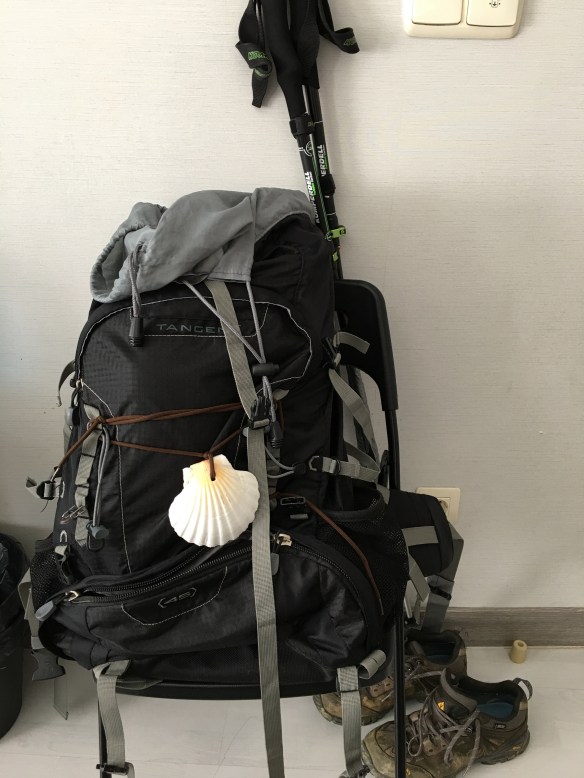
Before I took my first steps on the Camino de Santiago pilgrimage a couple of years ago, I first had to choose my shell—the symbol for St James the Apostle. Along the roadways and paths of the 800-kilometre trek across the Iberian Peninsula in northern Spain you can tell a pilgrim by the shell they have attached to their backpacks.

IMG_5341

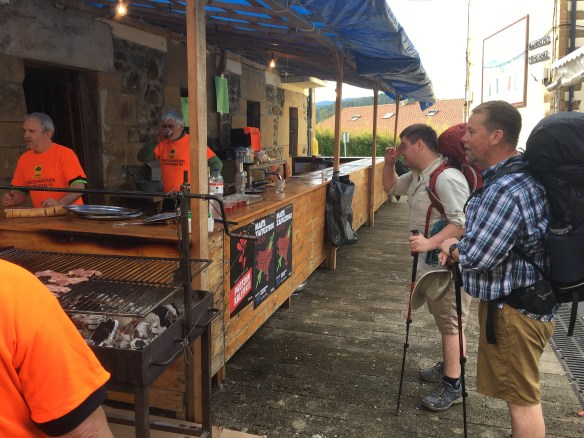
Wearing the shell attracted attention, often very positive. The group with whom I was walking came through a small suburb of the city of Guernica one Sunday morning. When we walked into the town square, we soon realized we were at the finish line of a marathon fundraiser for a local, special needs school.

There, some of the locals had set up large barbecues where they were grilling all sorts of meats for the marathon runners to enjoy after their race. We entered the square moments before the first runners crossed the finish line. But those preparing the barbecue called us over and without even asking our names or who we were offered us some of the delectable meats.

IMG_5308

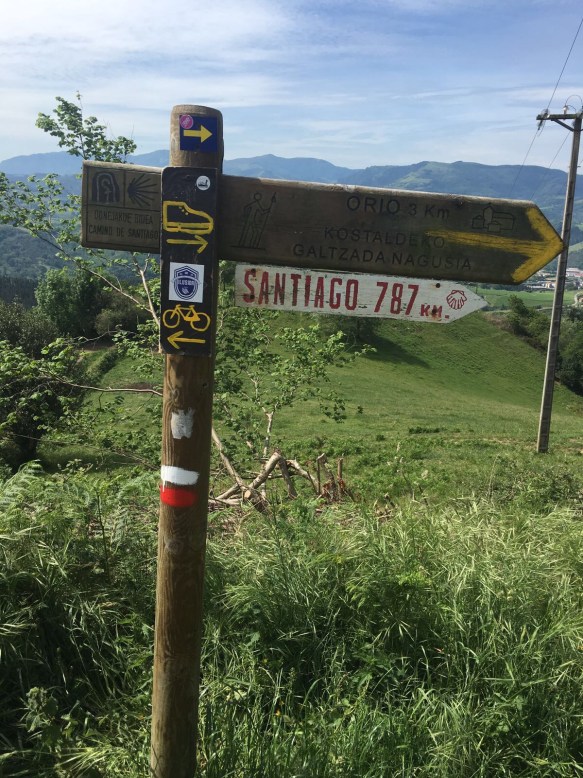
When we expressed our gratitude, they asked us to say a prayer for them at the destination of our pilgrimage: the shrine in the city of Santiago, Spain—still some 700 kilometres away. I promised them I would.

IMG_5385

As you know, I didn’t make it to Santiago, falling ill to pneumonia and coming home early after only a couple of weeks on the trail. I remember struggling with my ‘failure’ to achieve my spiritual and physical goals. For one thing, I wasn’t able to offer a prayer in Santiago for those good people from Guernica who asked me to.

Was it worth it? Did my truncated pilgrimage do any good? Or, was the love and generosity those locals showed us and our receiving their gifts graciously, enough?

On Ash Wednesday, we begin a journey. And at the beginning of this journey, we are given a mark—not a shell, but the sign of the cross on our foreheads. It is a public act, a public ‘coming out’ if you will. By this mark the world will know we are Christians.

I hope you will wear your mark home tonight, wherever you go and whatever you still have to do—keep it visible. And see what happens. You might be invited into some meaningful, enriching conversations along the way. Some might even ask you to pray for them.

Go into the closet where no one can see you, instructs Jesus.[1]And pray to your Father in heaven who hears you, and will reward you for your faithful act. But even when we think our faith fails us? Or only for its visible success? Or only if we achieve our goals?

Arnold Lobel, author of his children’s book called The Frog and Toad Treasury describes the relationship of two friends and how they pass time together, explore the world together and support one another.

In one chapter, the action takes place in October. The leaves are falling. Frog decides to go to Toad’s house, secretly, and rake his leaves for him. “I will rake all the leaves that have fallen on his lawn. Toad will be surprised,” Frog says.

Now, his friend Toad has the same idea. Both manage to arrive at the home of the other unseen, ascertain that no one is home, rake the leaves, and return to their own houses unnoticed. On their respective ways home, however, a wind comes.

The wind blows and blows. The piles of leaves do too, so that the leaves are scattered everywhere. At the end of the day, neither Frog nor Toad realizes what the other has done, because both return home to leaves strewn across their yards. Both pledge to rake their own leaves the next day. Nevertheless, that night Frog and Toad are both happy when they each turned out the light and went to bed.[2]

What is more important: Our good intentions and motivation? Or, the outcome of our actions. Being authentic matters more than the results of our actions. The Gospel is not about the consequences, good or bad, of our good or bad intentions. The Gospel is not about achieving results and being rewarded for our good work, even with righteous motivation. In the end, the Gospel does not leave us stuck (and perplexed!) in self-centred piety, it points to what God is all about.

Normally when we hear the words of Jesus: “the kingdom of heaven is like …”[3]when someone does so and so, we think of the job we must do to enter that kingdom. And so, we imagine and want to be like that religious person, attending to ritual and prayer and acts of charity and justice our whole life long; the more we can do, the better.

Not that we don’t do anything or don’t keep trying. But we cannot ignore from these words of Jesus what Godis all about. I consider those scriptures about the kingdom of heaven as describing the character of God: A God who treasures each of us. And will stop at nothing to find us. And give up God’s very life on the cross—give up everything—in order to be with us and love us.

God is the one who sells all in order buy the field with the treasure buried in it. God is the merchant who sells everything in order to obtain the pearl of great value. Where God’s treasure is (God’s life, God’s mercy, God’s presence—in us), there God’s heart is also.

This is a fundamental message of Christianity. A message of One who comes into our life even in the messiness and despair of being human. Born a vulnerable baby to poor, teenage parents in a backwater town of Bethlehem. Living the life of a simple man from Nazareth, hanging out with fishers, tax collectors and prostitutes. Dying, even, the very humiliating death of a criminal, for all to see.

The message of Christianity is about a God who ‘sells it all’ in order to be with us, live in us and work in us, for the good.

God does all of this in order to know us, really know us. To love us. To grieve with us. To enjoy with us. To walk with us this often difficult journey that we undertake again this day.

And despite the difficult journey for which Lent is a metaphor, may the world in each step we take on the pilgrimage know we are Christians by our love.

And that’s enough.


[1]Matthew 6:1-6,16-21

[2]Cited in Lori Brandt Hale, David L. Bartlett & Barbara Brown Taylor, eds. Feasting on the Word: Preaching the Revised Common Lectionary Year C Vol 2 (Kentucky: WJK Press, 2009), p.23-24.

[3]from his later parables (or stories) describing the reign of God, specifically Matthew 13:44-45.

The change within

When seventeen-year-old Hannah said she was drug free, her parents were skeptical. Having participated in a rehab program and given all the support she could expect from friends and family, Hannah was able to declare that she was finding success in weaning herself off a destructive opioid dependence.

But her father was not convinced. When pressed, he simply confessed, “I don’t believe people can change. Once a drug addict, always a drug addict.”

Though fictional, Hannah and her parents’ situation poses a common predicament for many today. Not just of the real struggle with addiction. But also the struggle with belief: Do we change? And if so, how? And maybe more to the point: Do we recognize the change that happens in our lives? Do we want to?

There’s the story of the Zen Monk who was visiting Time’s Square in New York. And he wanted to buy a hotdog. The vendor asked him, “What would you like on your hotdog?”

The monk replied with a smile, “Make me one with everything.” So the vendor made the hotdog with ketchup, onions and lettuce and mustard and all these other nice things. And he gave it to the monk, and the monk gave the vendor a twenty-dollar bill.

And the vendor didn’t give him anything back. So the monk said, “What about my change?” And the vendor said, “The change is all within.”[1]

An underlying belief in Christianity is that people do change. The resurrection of Christ presents the ultimate pattern for life. We die. We live. We grow. We evolve. We are given new beginnings, to live again. Death. Resurrection. Life is dynamic, not static.

On this Transfiguration of our Lord Sunday, we encounter people who change. First and foremost, Jesus. He is bathed in uncreated light and to the onlookers his face radiates a changed appearance. His countenance is transformed before their very eyes. Here the gospel writers want to emphasize Jesus’ divine nature, his unique revelation as God’s own. The witnesses to this holy and amazing encounter receive the most wonderful gift of experiencing God’s greatness in Christ.[2]

At the same time, the transfigured Lord encounters us. In the scriptures for this Sunday we witness change in the characters of the bible, specifically Moses, Elijah and Paul.[3]They, and others in the bible, are not static beings, one-dimensional characters. We witness in them, rather, incredible change over the course of their lives and throughout history.

In other words, Jesus is not the only one who shows a divine-like appearance. Throughout scripture, there are others who experience within themselves a transfiguration.

Jesus is the first and foremost. But God’s divinity, though fully expressed in Jesus, is not confined to Jesus. God’s true presence is not limited to Jesus for Jesus’ sake alone. God’s fullness in all of creation is not locked in one specific time of history, two thousand years ago.

Martin Luther called it, the great, wonderful, holy “exchange”[4]. On the cross God experienced the fullness of our human sin in all its humiliating nakedness and vulnerability in order that all for whom Christ loved and died may eventually experience and grow into the fullness of divine life and union with God. This divine-human holy exchange is exemplified and mediated through Jesus.

We may balk at the notion that in our very lives, in each one of us, God is present in the living consciousness of Jesus. How can we be that good, eh? We are so used to imagining a separation there—that God is ‘out there’ reserved exclusively to doctrinal debate alone or in some other person upon whom we project all our hopes and dreams. But within me? In my heart? So that I can live differently, better, a changed person?

St. Paul, elsewhere in his first century writings expresses this truth from the start: In his letter to the Galatians, he says, “God revealed his Son in me”[5]. On the road to Damascus the living, post-resurrected Christ encountered Paul. Over one hundred times in all of his New Testament writings he writes this phrase: en Christo meaning ‘in Christ’. And to the Colossians, he confesses: “There is only Christ. He is everything and he is in everything.”[6]

The vendor’s response to the monk carries metaphoric weight. The change is within. A holy encounter with Jesus first changes us within. The change for the better can happen because God is in us. God works on our hearts. God is relentless. Sometimes it hurts. God is the refiner’s fire, creating and re-creating us from the inside-out.

So that, eventually, the light of Christ’s love may shine forth from our lives, and our union with God will be complete, in this world and the next.

Thanks be to God!

[1]Laurence Freeman, “Change is part of the Journey, like it or not”; talk 1 in Mount Oliveto Retreat, Maggiore Siena, Italy, June 18-25, 2016: Change (wccm.org, audio resources, album)

[2]Luke 9:28-43

[3]Exodus 34:29-35; 2 Corinthians 3:12—4:2

[4]“That is the mystery which is rich in divine grace to sinners: wherein by a wonderful exchange our sins are no longer ours but Christ’s and the righteousness of Christ not Christ’s but ours. He has emptied Himself of His righteousness that He might clothe us with it, and fill us with it.

And He has taken our evils upon Himself that He might deliver us from them… in the same manner as He grieved and suffered in our sins, and was confounded, in the same manner we rejoice and glory in His righteousness.”

–Martin Luther, Werke (Weimar, 1883), 5: 608.

[5]Chapter one, verse sixteen, as translated by the NIV and JB.

[6]Chapter three, verse 11. In the NRSV, the Greek is translated, “He is all and in all.”

Even among the lost

I hear Simon’s despair, tainted with frustration and even anger, when he reacts to Jesus’ instruction to put the nets in deep water to catch the fish in Lake Galilee.[1]

“Master, we have worked all night long but have caught nothing.” He’s trying to make a point that there is no use to doing what Jesus asks of them. After all, they did all they could do. They employed all their resources, knowledge and effort into catching fish that night. But to no avail. Understandably frustrated, Simon scoffs at the futility of doing what Jesus asks. As if he knows better. There is not point to it all.

This is not the first time we hear Jesus say or do something that mystifies us. Earlier in this season after Epiphany, we witnessed Jesus being baptized. Jesus being baptized in the Jordan River often confounds our sensibility. Why does Jesus need to be baptized? Aren’t we the ones that need to be baptized? Not God!

So often we find salvation in what we do, and the meaning we attribute to what we do. In the church, we often do exactly what the crowds at the Jordan did: We come to worship, pray the printed confessions of sin, receive Communion and hope that these liturgical acts will wash away our sins. And make life right.

Then, we also have other programs for self-improvement, such as trying a new diet, cutting down on drinking and smoking, or finding someone who will love us just right. But these things are all futile for making real change in our lives, for making our lives right.

But Jesus walks into our lives just as he waded into the Jordan to be baptized by John. If Jesus was to walk into our lives today, he could just as well arrive at our job interviews, wedding receptions, or retirement parties. He could just as well stand in the long lines with us at the Tim Horton’s or sports venues. Jesus could just as well join us in all our driving around town to this and that – and the next futile thing we are trying to do in order to make life right.

Yes, I could feel the futility behind Simon’s statement—but we fished all night and caught nothing. Would Jesus step even into that despair?

When work seems futile. When other people frustrate us. When life seems pointless. When what we do appears to have little purpose, meaning or utility. When we fail. When despair sinks in.

Or, not far removed in the face of uncertainty, we clamber and clamor for the next shiny, new thing. We distract ourselves. We fall into mindless routine or stimulating addiction, to occupy our minds or numb them. And escape reality. Even just below the surface of seeming industry, there broils a fearsome anxiety.

Yes, I hear Simon’s despair. But I also see Jesus, right there.

What is Jesus up to here? Getting baptized. Going fishing with his friends. Going to weddings. Hanging out in the streets. What is Jesus up to here, living the life we all live?

For some reason, Jesus is taking on our lost condition. Jesus participates in our lives, doing what we do, engaging our routines, our work, our lifestyles. And, as we become more aware of Jesus closeness to us in our successes and our failures, we discover the Gospel truth: that salvation comes not because of our activity, our brains, our efforts. Salvation comes through a loving Savior who finds us and takes on our lost condition.

So maybe our job is not to explain the mystery, but simply to obey the seemingly pointless, futile instruction from Jesus. And act on it, as Simon did. “Yet, if you say so, I will let down the nets.”[2]

Visit the sick. Befriend the poor, the outcast, the refugee. Accompany the vulnerable, the weak, the dying.

After selling their large house where they called home for decades, Jack and Betty moved to a smaller two-bedroom apartment in town. Once settled in, they invited Craig, a church friend, to dinner in their new home. Craig was happy to oblige.

After all, on Sunday mornings they would sit together in worship. They didn’t say a lot. Betty might say something odd, but her countenance was so bright. Jack seemed always bothered by something, like he was scowling. But the couple was always together. And they liked each other.

Craig tells the story of his experience visiting Jack and Betty. He writes,

“Once I arrived at their apartment on the appointed evening, it didn’t take me long to realize that Betty had Alzheimer’s disease. It now seemed so obvious that I felt foolish for missing it earlier. Jack never let her out of his sight. It was then that I realized that he hadn’t been scowling for the last couple of years. He was just worried.

“Before I even had my coat off, Betty took me by the hand and led me to the painting above the sofa that depicted their stately old home. She became a bit more lucid as the stories of the old place tumbled out of her soul. I felt her squeeze my hand as she talked … [as if she were trying to say], ‘There is more to me than you see now.’ … Jack stood behind us and allowed his worry to ease a bit with a tender smile.

“Dinner was interesting. Betty couldn’t be allowed near the stove, and Jack wasn’t about to learn to cook. So he had asked their housekeeper to make them an extra-large omelet before she left that afternoon. When we were ready to eat, Jack put the egg dish in the microwave, then cut it into thirds and served it on Betty’s best china. For desert he brought out Klondike bars that we ate using the good silverware, which wasn’t easy. Several times during the meal, Betty got up and wandered around the apartment a bit. I was impressed by Jack’s ability to maintain our conversation, which was always of secondary importance to him, while always watching his wife.

“Throughout the evening I kept thinking that I needed to say something useful. After all … [isn’t that what we’re supposed to do with others?] But how profound could I be with Betty, whose mind was too clouded for conversation? What would I even say to Jack…? I could try, ‘Keep up the good work’ or ‘This must be really hard,’ but that would be so inane.

“After dinner, we left the old dining-room table and made our way back to the living room sofa, where I sat next to Betty. Jack took the chair across from us. I began to talk, trying to speak of …[relevant] things, but I wasn’t doing well. [As a Christian friend, from church] I knew that I was called there to be a blessing to them and … to witness to Christ’s presence among them. But how? I felt like a pilot circling above the clouds, looking for an opening to land. Soon Betty got up and wandered off again.

“When she returned, she stood behind the chair where Jack was seated and put her trembling hand on his shoulder. And as only old lovers know how to do, he reached up to take her hand as if it were the first and millionth time he had done it. I stopped talking as they both smiled at me.

“Well, there it was – the blessed presence of Christ. Then I knew that I wasn’t there to say a thing. My calling was to behold and be amazed. It was as if their mutual smile said, ‘Don’t you dare pity us. We are blessed.’ Beneath the gentle act of holding a trembling hand lies the mystery of … [love].

“In the end, this is as good as the calling to love can be. …There is just the holding of hands …”[3]

There is neither brow-wrinkled explanation nor fear-induced despair.

There is just the smile of God in the face of another.


[1]Luke 5:4-5

[2]Luke 5:5

[3]M. Craig Barnes, The Pastor As Minor Poet: Texts and Subtexts in the Ministerial Life (Grand Rapids: Eerdmans, 2009) p.97,103-105

funeral sermon – living with a Gospel bias

The last church activity in which Tony participated was the weekly bible study group. At that time I was asking the group to choose next week’s text for study. And the selection was one from either the Old Testament or the Psalms or from Paul’s letters in the New Testament or from a Gospel reading in Matthew, Mark, Luke or John—the first four books of the New Testament.

Tony always, always, always voted for the Gospel reading. The Gospel describes the story of Jesus—his life, death and resurrection. You could say Tony had a bias towards the Gospel. And especially the Gospel of John, for some reason.

The word, Gospel, means: Good News. Good news. Not bad news. Not about how we always fall short. Not about human folly. Not readings about our sinfulness, about what we should do to make it better. But about the grace of God. God’s forgiveness, mercy, love.

The example in today’s Gospel is typical: Jesus washes his disciples’ feet.[1]The Gospel, to recognize it, is always about what God does, as a gift to us. So, here’s the thing about the good news of God:

It’s about receiving more than it is about achieving. The grace of God must be received, not achieved. Normally at a funeral service we talk about what our loved one has achieved in life, as if somehow the more one has achieved the better.

And without second glance, Tony, on that measure, has achieved so much: publishing books in his retirement, building half a dozen houses, acquiring degrees in mathematics and engineering, qualifying himself in brick-laying and construction, even playing soccer into his 80thyear. He achieved a lot, if that’s how you want to look at it.

And certainly in our culture, it seems that’s what it’s all about.

But what a tribute to one who has learned to see, that in all that life has given him—good and bad—all that he received in life, there is grace. A gift of God’s love. To appreciate life as gift. This is right brain stuff. This is entering into the mystery that is God and life.

When he was young, he contracted Diphtheria which kept him isolated for some time, sequestered with the nuns in their abbey. Late in his life, Tony was able to confess that even having a disease was a gift, since it kept him from entering the war, a war that claimed the lives of his two brothers.

These traumatic events of life could have left him bitter. But, despite it all, he remained his true self—kind, loving and gracious.

The author bio on the back cover of both books he published in his retirement says the following about Tony: “Tony was always very interested in literature, history, religion, and cosmology.”

At the end of Act One in his book entitled About God, the World and People, the scene is set at an evening dinner party. Around the table sit different characters – a priest and a scientist among others. After covering such cerebral topics as ‘what is dark matter’, the origin of the universe and various forms of energy, the priest, Father Stengel, concludes with what I suspect is the author’s personal belief:

Father Stengel says, “I personally have no problem with what our diligent scientists discover. I clearly see in the development of our universe the guiding and loving spirit of our Father in heaven.”[2]

While working with numbers all his life and valuing their clarity and succinctness, Tony was also able to say, “They’re just numbers”, in light of God’s truth.

From the perspective of faith, analytics and left-brain thinking can obviously help with some things in life. But when it comes to the great mysteries of life, when we encounter great suffering or great love, when we experience death, or yearn for God, we need to access another ‘operating system’.

You can’t explain these realities adequately using the scientific method alone. It’s remarkable, for the mathematician and engineer that Tony was—that he was able to appreciate, discern and plumb those more intuitive and subtler depths of knowing as well.

It doesn’t make sense how grief works, really. I’ve told this to many grieving families over the years after a loved one died: That in a grieving process, it’s not just the pain of loss of that particular person that comes to the surface at that time. The death of a loved one triggers all the emotional baggage—if you will—of all previous losses you have experienced as well, all those unresolved issues in a family, everything. It can be quite overwhelming. I’ve recently experienced this truth myself. It’s not rational. But it’s very real.

And in those moments that can’t be explained, in the end, the only course of action is love. It’s the only way that does make sense in the turmoil of loss and pain. I think Tony knew that. Gospel bias towards love.

Tony’s teammates on the soccer team were well represented at the funeral home last evening. One of his teammates told me that Tony was the reason they kept playing together. He said that during a game teammates and the competition sometimes came to blows, emotionally if not physically. But Tony was always there trying to mend ways, trying to keep the group together, inspiring them to play on. Tony knew that. Gospel bias towards love.

Death changes some things. Death is final, in a way. And it hurts. Yes. But human death doesn’t mean the relationship is ended. Death merely changed the nature of our relationship with Tony.

Now, Tony is no longer physically present with us. But he lives on—in our hearts, in our minds, in our spirit, in our conscience, in our actions. He is still with us, albeit in a different way. Tony’s death leaves us a gift, an invitation to make what was important to him, important to us. Life as gift, a grace to do unto others as you would have done unto yourself. Gospel bias towards love.

“What we do for ourselves dies with us. What we do for others and the world remains and is immortal.”[3]Let what we do for others, be love.


[1]John 13:12-15,34-35

[2]Tony Bickle, About God, the World and People (Xlibris Corporation, 2008) p.48

[3]Most likely from Albert Pike, 19thcentury American attorney, soldier, writer, and Freemason. Sometimes this quote is attributed to 20thcentury American writer and biographer, Albert Paine.


‘Just beyond reach’ – a tribute to Jan

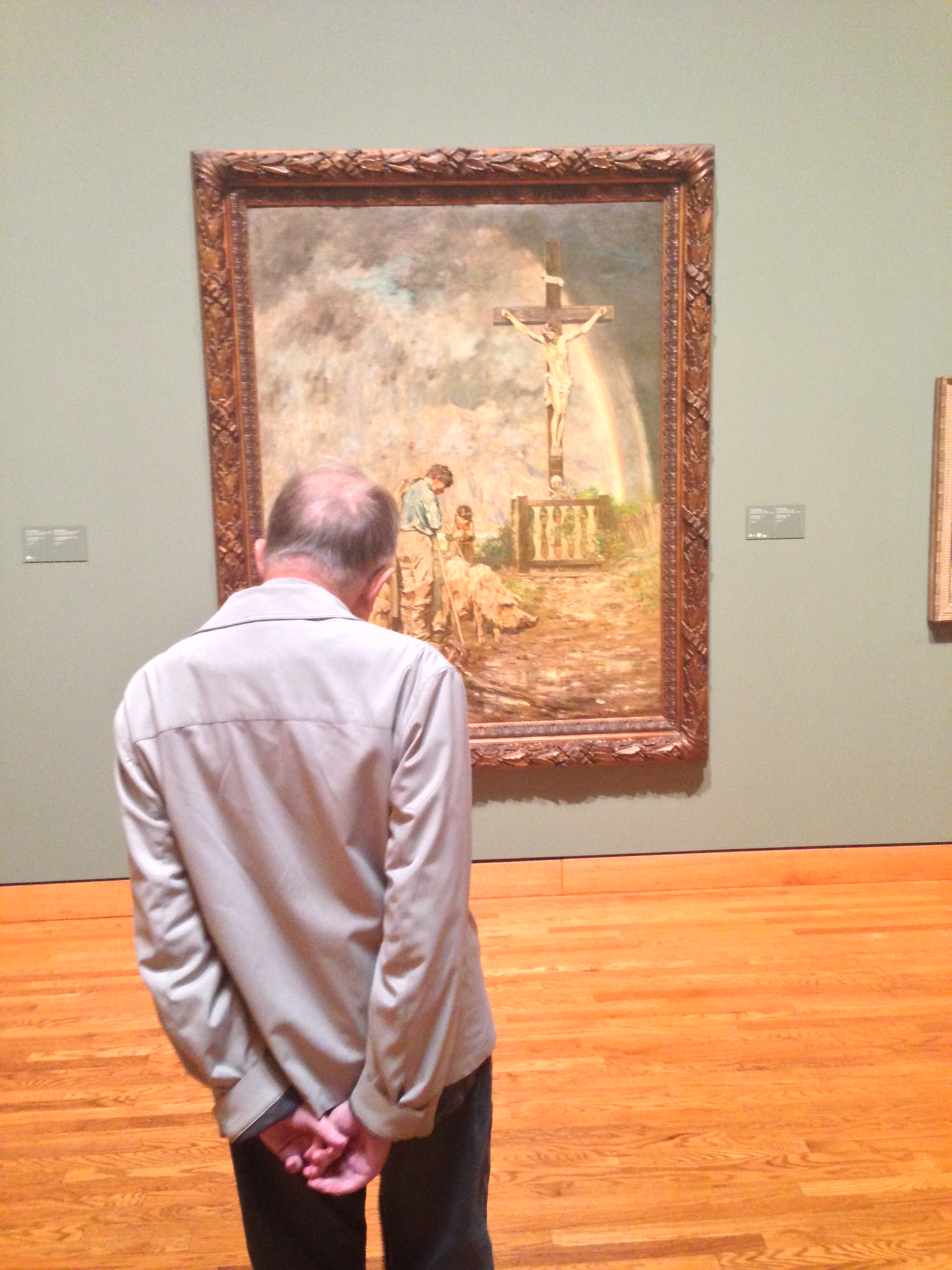
2015-10-04 15.23.20

In the Fall of 2015, we made a family visit to the National Art Gallery in Ottawa. Here is Jan, who was already struggling mightily with his dementia, pausing at a framed vision depicting images of his faith. Perhaps Jesus, the cross and other symbols in the painting awakened something deep within his soul, enough to make him stop and look. Perhaps it was an innate knowing that this painting described something of the final destination in his life.

Shortly after Dad died, we talked about how in his last decade of life, Dad’s ability to perceive the world around him had shrunk. Increasingly encumbered and limited by dementia, Dad’s vision slowly narrowed.

It’s curious that in the days after he died, we didn’t envision so many people would battle frigid, Ottawa temperatures to attend visitation and funeral services for him. How often our vision becomes encumbered. And we limit ourselves and for various reasons don’t see the wideness of possibility.

What a joy it is to be wrong! To see that there is more, that in life and reality therein hides something greater often just beyond the reach of our imagination.

I wish to share a few brief memories that speak to Dad’s/Opa’s rich imagination which kept him truly alive throughout his life. What we are dealing with here is sort of like Doctor Who’s Tardis: From the outside, it looks like a common, rather narrow, even flawed telephone booth. But once you risk going inside it, you enter a much larger world, a world that can easily be missed and overlooked.

I can still see the over two-dozen books written by adventure/sci-fi authors Karl May and Edgar Rice Burroughs lining the book shelves, along with the other ten thousand books stuffed on shelves against any free wall space in our home. Maybe Dad didn’t read every single one of those books, but he loved collecting them for what they symbolized to him: gateways to other worlds just beyond his reach.

In my youth, I came to believe that Dad’s hero was Lutheran Albert Schweitzer. Dad looked up to this gifted Nobel Peace Prize Laureate who did not specialize in any one thing, but was accomplished in various fields: an organist, a physician, a theologian, a writer, a humanitarian and philosopher. A virtual ‘renaissance man’, Schweitzer may have modelled for Dad the work and identity of a pastor. Dad was no Albert Schweitzer, but his expansive and creative spirit certainly resonated within him.

As a young child, I remember standing on the shores of Papineau Lake near Maynooth, listening to Dad tell us stories about good and evil battling it out on earth and throughout the universe.

Indeed, Dad’s imagination was expansive. He inspired in me a spirit of exploration, adventure, boundless in time and space. Perhaps motivated by a holy restlessness, Dad continued to seek ways to see more, envision more, experience the wideness of possibility, the wideness of God’s mercy. His desire to move, to change places and ‘go West young man’ fueled his passion for new things, new experiences. Dad was willing to take that risk.

I remember in Maynooth, in the front yard of the parsonage on Highway 62, we often played around the picnic table there. Chipmunks scampered on the ground and in the pine and spruce trees above us.

Once he let a chipmunk climb onto his hand, then up his arm all the way to his shoulders. I believe he wanted to show us how intuitively connected we can be to all the natural world. He showed us how to take the risk of trusting. He modeled for us, in a small way, how to receive a gift, how to surrender to the freedom of an unknown, unpredictable quantity in the chipmunk. And, in God?

His arms reached out to me the last time I saw him at St Patrick’s Home. He didn’t want me to go. That was a difficult leave-taking. That vision is stuck in my mind. Those arms stretched-out capture, for me, his stance of yearning for and living on the verge of loving possibility, just beyond his reach.

Today, I believe Dad finally experiences the fullness of what always flickered within his soul: For, he now flies with the angels, plays with the angels and rests in arms of a God who carries him to the farthest reaches of the universe.

Have fun, Dad. Enjoy! And some day, we will catch up to you.