Still snowed in – Lent 5

Even though it’s now less than two weeks till Easter Sunday, our Christmas tableau is still snowed into our front yard.

At least now — surprise! — we can see what’s there, what has been hidden deep under the snow for over three months.

The journey of Lent continues. More and more snow is melting. Much too slowly. The holy family and Christ child are now revealed, bit by bit.

Still not able to free Jesus from the frozen earth, I can recognize the gift hidden deep within a heart frozen in grief, in loss, in suffering.

And what a joy to discover that all along, Christ is there with me, even through the travail of a long winter’s journey in my life.

Invasion of abundant grace

The Toronto Maple Leafs are a playoff team. They have been for a while now. In fact, they’ve occupied the third seed in the Atlantic Division for months. And, lately, regardless of how many games they’d lose or win, it wouldn’t change their place in the standings for the playoffs, which begin this coming week.

The Leafs’ success has a lot to do with the stellar play of their number one goaltender, Frederik Andersen. At least how he played early in the season when he was sporting an impressive .923 goals against average (that’s very good). He was, some argue, the main reason the Leafs were able to climb in the standings and secure their playoff destiny. That is, until recently.

As some of you may know, he’s been kind of faltering a bit in the last month — letting in just a little too many goals, and losing just a bit too many games. As of last week, the Leafs had lost five of their last seven games—two of them here in Ottawa against the Sens. His lackluster performance has been enough to cause some to wonder whether Freddy will be able to hold up during the playoffs, especially against their arch rivals in the first round: the Boston Bruins.

An article in the Toronto Star recently caught my eye about this funk Andersen is in, and what he’s doing about it.[1]

Anderson speaks of dealing with all the downward-spiraling statistics — an embarrasing .890 goals against average (that’s bad) — all the anxiety-producing pressures to perform and succeed and chalk up more wins than losses — all the negative, worrisome scenarios that might play out for his whole team if he doesn’t stop more shots on net. Dashed playoff hopes. Disappointed fans. Negative publicity in the media. Downward career trajectories. Worry. Worry. Worry.

Indeed having success doesn’t mean being in a good head space. True, when the stakes are high, when it’s all on the line, when the vice grips of life’s important events tighten—it’s very difficult, maybe feels like it’s impossible, to keep calm, walk lightly, and breathe deeply through it all.

That’s the measure, that’s the key. Not when there’s nothing on the line. When you have little or no investment in the outcome. When it doesn’t matter and you don’t really care.

Rather, when what you are passionate about, what you care about, what you believe in, your most sacred values—when those things are on the line, when the stakes are high, how do you respond?

In the Lent book study, “Being Mortal” by Atul Gawande[2], we have been exploring many questions about the last chapter of one’s life. We’ve been talking about how to navigate the medical culture and what we want when time is short. You could say, the end of life conversations and thoughts are the ultimate ‘high stakes’ decisions:

How do you want the last ten years of your life to look like? What do you want for yourself? What trade-offs are you willing to make in order to achieve your final wishes? Whom do you need to include in conveying those decisions? Are those closest to you aware of your thoughts? Why or why not?

Most of us avoid having these conversations. We dread not only those situations but those conversations. We don’t want to think too far ahead. We don’t want to think about next year. ‘It’s too depressing’ we say. ‘I just want to think about next week, or just tomorrow, or just today.’

As Atul Gawande writes in his book, “It’s the route people the world over take, and that is understandable. But,” he continues, “it tends to backfire. Eventually, the crisis [you] dreaded arrives.”[3]And then what?

When the stakes are high, what does Mary do? Oh, and if you think the stakes aren’t high, let’s take another look: Why does Mary spill on Jesus’ feet a year’s worth of wages in perfume made from pure nard?[4]There are two uses in ancient Israel for pouring expensive oil on someone: First, in a coronation of a king; and, second, for the burial of that person.[5]

This was a costly oil with a sweet smell, imported from northern India. Scholars estimate that the “pound” referred to was nearly 12 ounces, or 324 grams. Many typical flasks of anointing oil would contain only a single ounce. So, Mary has a lot of this stuff, and pours it all out on Jesus’ feet!

“Money going down the drain!” eh?

Yet, Mary was anoints Jesus, the true King, and Jesus who will soon die. This extravagant act of love and adoration conveys Jesus’ purpose, publicly for all to see and read for all time to come. While everyone else around Jesus does not want to talk about it even though they might feel it, Mary does everything but avoid, deny and shove under the carpet what is obvious. What needed to be done.

It’s not a measly drop, offered in secret. It’s a whole flask, and the aroma fills the entire house!

Jesus and to an extent Mary know what is going to soon happen. The writing is on the wall, certainly since Jesus recently raised Mary’s brother Lazarus from the dead. From that point on, the religious leaders began plotting Jesus’ death.[6]The way to the cross is becoming clearer and clearer. There is no turning back. There is no avoiding this outcome if Jesus chooses to continue in his mission and divine purpose.

It is worth it, even though the stakes are high.

How do we find the courage to rise above our tendency to avoid and deny reality when the stakes are high? Can it have something to do with our purpose and mission? When you know what it is you are all about in life? Maybe, then, good things can happen.

In his book, Gawande mentions an experiment which compared two nursing homes. After the study, in one the number of prescriptions required per resident fell to half, psychotropic drugs for agitation decreased, total drug costs fells to just 38% of the comparison facility; and deaths fell by 15 %.[7]

What made the difference? In the test facility, residents began to “wake up and come to life” when animals and birds were brought into their environment. Not just one or two creatures. But a whole bunch of them. They experienced a “glorious chaos” at the beginning of the experiment.

Because no one knew what they were doing, everyone—staff and residents included—had to drop their guard and pitch in, to help. Residents forgot themselves and were immersed in an environment that gave them purpose and meaning. In the process they started having a little bit of fun. There was lots of laughter and frivolity reported in response to the invasion of all the animals and birds.[8]

This is just one small example of how connecting to a meaning and purpose in life, however trivial, and at whatever stage of life—can do miracles.

For goalie Frederik Andersen, it means no longer obsessing about the data and numbers, good and bad. He has to trust his teammates and play as part of a team rather than an individual obsessed with personal stats. He has to free himself from micro-managing his technique because he realizes his primary challenge is not his ability or capacity to do great things in the net, but the mental, emotional and yes, spiritual, part of his game.

In short, he simply needs to find joy in playing again. That’s spiritual!

As the playoffs begin, Fredrik Andersen is on a journey to reconnect with the purpose of what he was about on the ice. He is looking to discover ‘fun’ in his game, and enjoy every minute he has the privilege of playing it at that level.

We, too, are on a journey in Lent. Mary’s action in the Gospel reminds us that on this journey, there are times God calls us simply to be extravagant in our giving born of devotion and thanksgiving to God. Mary’s action reminds us that sometimes God calls us to breathe deeply and savor life’s good things.

As we ourselves work on the important question of the church’s mission and ministry, and how that again can take expression in the here and now, let’s remember in the midst of all that, to take the time, to give ourselves the permission, to lavish upon God our love, our attention, to rest in God’s presence.

And, in that holy act of devotion and love, be renewed for life and joy.


[1]
https://www.thestar.com/sports/leafs/opinion/2019/03/28/the-joy-of-hockey-could-save-andersen-and-the-leafs-season.html

[2]Atul Gawande, Being Mortal: Medicine and what matters in the End (Anchor Canada: Penguin Books, 2014/2017).

[3]Ibid., p.57

[4]John 12:1-8, Gospel text for the Fifth Sunday in Lent according to the Revised Common Lectionary, RCL, Year C

[5]Lindsey Trozzo comments on the Gospel reading (John 12:1-8) at http://www.workingpreacher.org

[6]John 11:45-53

[7]Gawande, ibid., p.123.

[8]Ibid., p.120-121.

Snowed in: Lent 4

IMG_8077

The snow still covers most of the story from our awareness. Buried deep within our hearts the fullness of all that makes us who we are is waiting to emerge. On the slow and steady movement on the Lenten journey to the springtime release and new life, we must embrace what is revealed, good and bad.

The first figure that I recognize is Joseph, praying. Joseph, the father of Jesus. Joseph, the father. What in my soul does ‘father’ mean to me? My father, Jan, died this winter. His memory resonates in my heart and I still feel the pang of grief. What is his legacy– as father, pastor, male– in my life? Faithfulness. Vulnerability. Physical strength. Passion. Feeling. Human-ness …

What does the revelation of the springtime structures within your heart tell you about you? About God? About your relationship with others, this earth, and Jesus still waiting to be released from what binds him on earth? Jesus, still waiting to be expressed and resurrected in your heart anew?

On the journey, even though the snow still covers so much (in Eastern Ontario anyway!), let us be buoyed by true signs, indeed, that the snow is surely melting away.

The Prodigal story: Three in One

Most of this sermon today is the work of the Rev. Monika Wiesner who first preached it. A lay member of our congregation, Sharon Wirth, then also preached Monika’s sermon at Faith Ottawa last year. A heart-felt ‘thank you’ to both for this contemplative and grace-filled approach to a popular parable of Jesus.

 Many will regard the turning point of the story as the call to repentance[1], when the rebellious, prodigal son comes to his senses in the sloppy mud of a pig pen.[2]And therefore, according to this interpretation, repentance must be preached and communicated to others who have or are falling away.

You will notice with me, however, that it is not because someone in town or the farmer on whose land he was working told him to repent. When the rebellious younger son comes to the end of his rope and realizes his folly, it’s not because someone guilted him, pressured him, preached him into repentance. The message of changing the Prodigal’s moral direction did not come from outside of him. But from within.

Repentance does not precede grace and mercy. Rather, the other way around: First and foremost, compassion and love changes lives. The experience of the younger son at the end of himself was an inner experience. His changed reality resulted from something that happened within himself. The state of his inner life shifted somehow.

Within himself, the younger brother heard the voice of self-love and acceptance. Not once. But twice in the story. First, in the pig pen he came to self-love within himself. Enough love to stop hurting himself. Then, later, from the father, this Love was reinforced.

Since we see the turning point of this story as primarily a movement of the inner life, imagine then, that this family of three actually lives together within each of us, within our souls.

Within our soul we first have a younger son or daughter that is severely wounded. We might call this our “wounded inner child”.  This is the part of our soul that experiences shame. It is the part of us that feels there is something intrinsically wrong with us.

Within our soul, we also have a critical older sibling. We might call this our superego or our “inner critic”. This is the part of us that actually triggers our shame, telling us where we’ve done wrong, wagging their finger at us in judgement whenever we step out of line.

Finally, there is also within our soul a compassionate parent, the compassionate parent that can heal our shame. We might call this our True Self. We Christians, knowing that God lives within each one of us, might call this our God-Self or even our Sacred Self.

It is the message of Jesus’ Priestly Prayer to his “Father” for his disciples: “As you are in me and I am in you, may they also be in us… I in them and you in me, that they may become completely one…”[3]And again, Jesus said to his followers, “I am the vine, you are the branches. Those who abide in me and I in them bear much fruit …”[4]

I invite you to imagine that this family lives within your own soul: the wounded child in you, your inner critic and your compassionate divine parent. All live within you.

In the rest of this sermon, heads up, I will intentionally switch to both male and female pronouns, so that each one of us may connect more personally with the experiences of these three different persons in the story.

How do these three persons relate within us?

When we are born, our soul and God are one. As an infant, we smile when we’re happy and we cry when we’re unhappy.

Then something happens to this unity within our souls. We experience events that we interpret as painful or as trauma. Our primary caregivers may be limited in their ability to parent or they may over-worked and overtired. And they hurt us.

Or maybe we simply need to leave the security of mommy and daddy for the first time and we discover that the world does not revolve around us. We experience hurt and rejection and intense anxiety and fear. Have you ever watched a young child who is being taken away from his/her mother? Do you ever wonder what is happening within that child’s psyche? These separation experiences may be necessary. But they are experienced as wounding.

What’s important for us to note is that these first experiences of woundedness follow us a lifetime. They might be called “holes within our souls”. We experience those first feelings of not being lovable or not being safe or not being of worth. Because our souls and God are one, this is where we feel our first disconnect from God.

Over the years, more holes are created. Our intense feelings of anxiety, powerlessness, depression, anger or jealousy or shame all have their roots in these holes. Whenever you feel these feelings, you are in touch with one of these holes in your soul.

So what do we do? We try to fill these holes by looking outside ourselves. As young children, we learned to please people by doing things that would make them happy and then we felt lovable and safe.  As we grew in years, we became the responsible one, the wise one, the funny one, or the caregiver. We became beautiful or educated or rich. We did whatever the outside world said would make us feel valued.

We did whatever was needed to fill those holes in our soul that were wounded and crying out in pain. We believed the outside world held the answers.

That is exactly what the younger brother did in this parable. He took his inheritance and he spent it on everything the world suggested would soothe his wounded soul. But in the end, nothing worked. One day, he simply came to the end of himself … and he was drowning in shame.

So the prodigal child remembers her home and her parents. However, her shame went so deep that she believed all love was gone from her life. Her parents would never take her back, so she decided she would do whatever it took to earn her place in the household. She needed to earn their love.

But to her amazement, the prodigal child found loving parents waiting for her. When they saw her, they were filled with compassion and ran out to her, put their arms around her and hugged and kissed her. The wounded child began to confess what a failure she was, no longer worthy to be called their child. But her parents would hear none of it.

Instead, this prodigal child found herself in a beautiful robe … with the family ring on her finger … and a huge “Welcome home” banner hanging over the dining room table. A celebration was being prepared in her honour.

This is the compassion for oneself … this is where all healing takes place. This is where we experience the compassionate God … because God and our soul are one.

But there is one other character in the story, namely the older critical brother, our inner critic. Our super-ego. This is the inner critic who can’t accept the “easy” homecoming of the wounded child.

This older sibling doesn’t believe in compassion, does not believe in grace. And so she becomes critical and angry and refuses to participate in the homecoming. She’s the one who says to the wounded inner child, “You don’t deserve this!”

This is the inner voice that holds us back from experiencing the compassion of God within and for ourselves. This is the inner voice that uses those feelings of shame to stop the healing of those holes in our soul. This is the older sibling who sits on the doorstep and sulks, refusing to go to the party.

Oftentimes, Christians confuse that critical inner voice as the voice of God. It is not! It is not. If anything, it is the voice of our primary caregivers at their worst.

One thing is for sure – when we decide to return home, to find healing for all those holes in our soul, our inner critic will become very active and tell us we don’t deserve compassion, acceptance or love and we don’t deserve the healing we so desperately want. The inner critic will pull out all the stops to keep us feeling shame. But just remember, if it isn’t the voice of compassion, it isn’t the voice of God.

And so the wounded child no longer needs to listen to the voice of the inner critic because our soul and God are one and God has already embraced us in love. We need only listen to the compassionate, holy and sacred that lives deep within each one of us. And that sacred God-Self is saying, “I’m preparing a banquet in your honour! Come to the party!”

In this parable do you hear the voice of God embracing you in love? Welcoming you home? Herein lies the nugget of truth that is at the root of all emotional or spiritual healing.

So let the party begin! We’ve all been invited!


[1]Meaning: metanoia –a change of mind.

[2]Luke 15:1-3,11b-32, the Gospel for the 4thSunday in Lent, Year C, Revised Common Lectionary (RCL)

[3]John 17:21,23 NRSV

[4]John 15:5

The fig tree calls out

Hear today some wisdom from Thich Nhat Hanh:

“When you plant lettuce, if it does not grow well, you don’t blame the lettuce. You look for reasons it is not doing well. It may need fertilizer, or more water, or less sun. You never blame the lettuce. Yet, if we have problems with our friends or family, we blame the other person. But if we know how to take care of them, they will grow well, like the lettuce. 

“Blaming has no positive effect at all, nor does trying to persuade using reason and argument. This is my experience. No blame, no reasoning, no argument, just understanding. If you understand, and you show that you understand, you can love, and the situation will change.”

When 21-year-old Sharif Said was gunned down near the Trainyards in Ottawa four years ago, his uncle spoke to the media on behalf of the family.[1]What surprised me in his testimony was how he defended not only his nephew, around whom rumours swirled that he was involved in a gang.

But then he defended those arrested for his nephew’s murder. He said that they were also victims. Khalid Mohammad and Abdulaziz Abdullah, both in their twenties and arrested for Said’s murder, were victims themselves of a “senseless violence”, the uncle said. As a result they could not value life as “precious”.

A subtle twist in the tone of the message changes the direction of the conversation about these things. Making sense of any criminal act, to begin with, can leave us confused and hopeless. And we desperately seek to be on the right side of ‘right and wrong’. We do that most effectively by assigning blame.

Then, you throw into the mix a statement coming from ‘the victim’ that offers sympathy to the perpetrators, a word that levels the moral playing field, we don’t know what to do with that.

Are we all, each and every one of us, part of a culture that creates these problems? Do we all participate on both sides—all sides—of the moral equation? Isn’t that too confusing and wishy-washy? Forgiveness, and mercy, wreak havoc on any common-sense pursuit for laying blame. An act of kindness and forbearance in the midst of senseless tragedy takes the wind out of retribution.

Admittedly, we may feel more at home with the way the ancient prophets used the image of a barren fig tree.[2]One way we tend to lean is towards despair. The prophet Micah feels lonely and depressed in the face of scarcity and evil:

‘Woe is me! For I have become like one who, after the summer fruit has been gathered,      after the vintage has been gleaned, finds no cluster to eat; there is no first-ripe fig for which I hunger.’

Or, we lean towards vengeance. You can hear it in Isaiah’s tone when he speaks of his ‘beloved’ vineyard. Despite all his hard work to create conditions for abundant growth it yielded only wild, undesirable, grapes:

‘And now I will tell you what I will do to my vineyard. I will remove its hedge, and it shall be devoured; I will break down its wall, and it shall be trampled down …’

Indeed aren’t these the usual go-to’s when bad things happen to good people—we either slip into despair or shake our fists in anger against someone or something we blame?

When an Ethiopian airliner filled with people crashes and all are killed including eighteen Canadians onboard. When Galileans are slaughtered in cold blood by the hand of Pilate and the Tower of Siloam falls and kills innocent pilgrims at the pool of healing.[3]When randomly, bad things happen, and we can’t really make sense of it. Well, we try.

Do you despair? Or do you get angry and try to find who or what to blame? The people in the Gospel text today tried to get Jesus in on their blame-game and despair-mongering ways.

And Jesus comes back to the ancient, scriptural image of the fig tree again. When he first mentions the fig tree, the crowd must have gotten really excited. Because they knew where this story was going, knowing their prophets Micah and Isaiah: Despair. Vengeance. The lead-up sounds good.

But Jesus pulls the rug out from underneath their expectations. The twist Jesus offers to the familiar image of the barren fig tree is his emphasis on forbearance and mercy. Staving off a swift impulse to cut the tree down after three years of neglect and barrenness, the vineyard’s stewards will give the fig tree yet another year’s chance to bear fruit. The fig tree is given yet another second chance. The hope is that the fig tree will be rehabilitated.

It is important to note, moreover, that in the parable it is the gardener who allows for the possibility of fruitfulness. Not the fig tree. It can’t do anything, by itself. It is stuck in a cycle of barrenness (aka poverty, violence). First, the gardener has to plead his case, be the tree’s advocate, to the owner of the field. Then, the gardener has to do the work. By constant care, digging around the roots and applying manure, the gardener employs all the gifts and resources at their disposal to allow for a positive outcome.[4]

The fig tree calls to us. Who or what does the fig tree represent in our lives? Now, parables are not meant to be taken literally, so we can rule out any divine gardening tips here. This parable won’t appear in a google search for ‘how to grow a fig tree’.

Who is the barren fig tree in your life?

When and where do you sense in your life or another’s, a feeling of being at wit’s end? When all resources have been explored and used up. When a group of people or individual cannot to do it on their own any longer. When someone is stuck in cycles of behaviour that they cannot see the way out, by themselves. When a call for help is evident by a lack of fruitfulness in their lives.

You will notice that this parable comes to a rather abrupt end. The narrative is not neatly tied up into a certain, ‘happy’ ending. We just don’t know whether the fig tree will produce after all this advocacy and gardening work is done. You could say, it’s up to us to write the ending to this story. Will it be judgement? Or, salvation?

Every time we worship together, though, we pray not ‘mykingdom come’, not ‘our kingdom come’, but ‘Thy kingdom come’. Jesus tells a parable about a gardener determined to tend a fruitless fig tree because he is open to a future possibility that he does not control.

Our task, as American Episcopalian Bishop Michael Curry says it best, “is to labor, without having all the answers, to acknowledge the deep mystery of it all. The task of the disciple is to witness and then wait, to take our best step and leave the rest to God. We labor now for a future we are not meant to control.”[5]

When forgiveness and mercy dictate public discourse in the media and in response to horrific, tragic and painful events around the world and in our lives, we may not be able to explain it easily. But maybe that’s not our job.

Maybe our job is to seek understanding in the other, and thereby show our love. Maybe our job in the church and as Christians is to speak and work for God’s values for the sake of others amidst pain and suffering.

And in hope and trust, let God write the end of the story.


[1]cbc.ca, posted May 7, 2015

[2]Micah 7:1; Isaiah 5:1-7

[3]Luke 13:1-9, Gospel for the Third Sunday in Lent, Year C, Revised Common Lectionary (RCL).

[4]Daniel G. Deffenbaugh in David L. Bartlett and Barbara Brown Taylor, eds., Feasting on the Word: Preaching the Revised Common Lectionary (Kentucky: WJK Press, 2009), p.96.

[5]Michael B. Curry in Feasting on the Word, ibid., p.95-97.

With us, snowed-in

I wasn’t able to remove the Christmas manger scene from our front yard in time, before the snowstorms left everything buried. As we’ve approached Lent, the joke in our household is that Jesus, like us, is snowed-in.

IMG_8042

It likely won’t be until late April now when I will be able to remove the tableau from the frozen earth and its snowy cover. When will Jesus be set free from the tomblike confines of winter’s grip?

When exactly, no one knows. Meteorologists are calling for a cooler-than-normal late April /early May. It might be a while.

The Jesus story, for us, begins in winter around the winter solstice on Christmas Day. We begin again our Lenten pilgrimage in the throes of winter, when snow and ice cover everything. When will the sky brighten and warmer temperatures heat the ground again? When does the journey end?

The poet, Mary Oliver, who died in January of this year, wrote primarily about winter. In several pieces she twins snow with wisdom, the capacity to live with questions in silence, surrendering to its beauty. “I love this world,” she wrote, “but not for its answers.”[1]

I’ve considered Christianity to be a winter faith. We, as people of faith, live with many questions that are largely unanswerable. Why do we still live in a world beset by injustice, intolerance, hatred—despite all good effort in the name of Jesus to the contrary? Why death and disease? When will we find the answers to our deepest questions? Why? Why? Why? Winter is a time for questions.

And so, we continue to search, wander, and wonder with Jesus snowed-in, by our side.

But, is Jesus in over his head?

The temptation of Jesus—as this story is famously called—happens near the beginning of his divine calling and ministry.[2]He goes into the wilderness, the desert, for forty days. He goes into a place of harsh simplicity, stripped of all creaturely comforts, to serve a holy purpose.

We wonder, will he survive the challenge?

Given his life purpose on earth, he meets with what could be his greatest vulnerability—the seduction of power and its forceful implications. The man who is the Son of God, King of Kings, Lord of Lords, Almighty and Everlasting, the man whom people would look to for guidance and leadership, the man who many would lift onto a pedestal—would Jesus succumb to everyone’s expectation?

Would Jesus yield to the temptation that he, the Messiah, will now lead the revolt to free the suppressed and oppressed Judeans out from Roman occupation? Would he be the political rallying point around which the crowds would mobilize and generate an effective, political movement?

And, in fact, the evil one touches on this potential weakness. Notice in different ways each of the three temptations seduce Jesus to grab hold of power that would make him this kind of King: One who satisfies his every appetite and hunger using whatever means at his disposal; one who creates God in one’s own image by forcing God’s hands, one who offers blind obedience to those still ‘above’ them while climbing the ladder of ‘success’.

But that’s not what Jesus was going to be about. We know that. In order to embrace his true identity, what happens?

Jesus is first led by the Spirit into this vulnerable place, not away from it. He was to first meet this human, shadow side.

The point of Lenten discipline, whatever it may be for you, is to be led into that shadow place in our own lives that we, on our own, don’t want and even can’t go. The Spirit leads us to face that which we normally distract ourselves from, where we normally deny, avoid. What is that vulnerability for you?

What does the light and Spirit reveal in the dark corners of your life? Is it a fear? Is it a conversation you know needs to happen? Is it confronting a situation you have been trying to avoid? Is it coming to terms with what is really going on deep down in your heart?

How does Jesus respond to his temptation? How does he return to his identity in God?

The scriptural quotations he cites are signs of his true identity—his ‘touchstone’, if you will. The scriptures point to his true self. By citing the scripture, he reminds himself, he aligns himself, he allies himself, with what grounds him in who he is. By citing scripture he relies not on his own humanity and resources of his own making, but rather on God.

This text provides rich support for our own journeys of Lent. As we wander into the wilderness of our lives and continue to trudge through the snow wary of still slipping on the ice, as we wonder with our questions, we meet our own shadow sides. And are called to stay rooted in who and whose we are.

And what is your touchstone for remembering your identity in Christ? Is it scripture? Is it the bread and cup of the sacrament? Is it a song? Is it an act of repeated service for another? Is it a prayer?

In her poems about winter Madeleine L’Engle writes a word of hope for the journey:

“Snow does not obscure the shape of things. It outlines them, like an icy highlighter, revealing the deep structure of the world. We walk through the woods, seeing differently, and, when we glimpse the hidden structure, we ask questions even as we experience its stark beauty.”[3]

Writer-theologian, Diana Butler Bass takes it further: “Strangely I have found in my own life that it is only through a wintery spirituality that I am able to affirm summer and sunshine. A friend wrote me recently, ‘Winter reveals structure’. Only as the structure is firmly there are we able to dress it with the lovely trappings of spring, budding leaves, rosy blossoms. Winter is the quiet, fallow time when earth prepares for the rebirth of spring.”

The word, Lent, means ‘springtime’. While the Lenten journey begins in the frozen winter, we can say in faith that the purpose of the journey is to bring us to Spring. Because by the end of the Lenten season, the snow will be gone revealing the soft, verdant earth underneath where new life is just budding to sprout.

In the end, the disciplines of Lent, the questions we now pose and with which we struggle on the journey, these are gifts from God. They point us to God’s presence in our lives and in our world. In the end, that is what faithful observance of Lent is—“a grace-filled return to the Lord our God.”[4]

Who begins with us, snowed-in and under.


[1]Cited in Diana Butler Bass, The Cottage: A Winter Faith (January 18, 2019)

[2]Luke 4:1-13

[3]Madeleine L’Engle cited in Diana Butler Bass, ibid.

[4]Kimberly M. Van Driel, in David L. Bartlett & Barbara Brown Taylor, eds. Feasting on the Word: Preaching the Revised Common Lectionary Year C, Vol 2 (Kentucky: WJK Press, 2009), p.25.

You can tell a pilgrim …

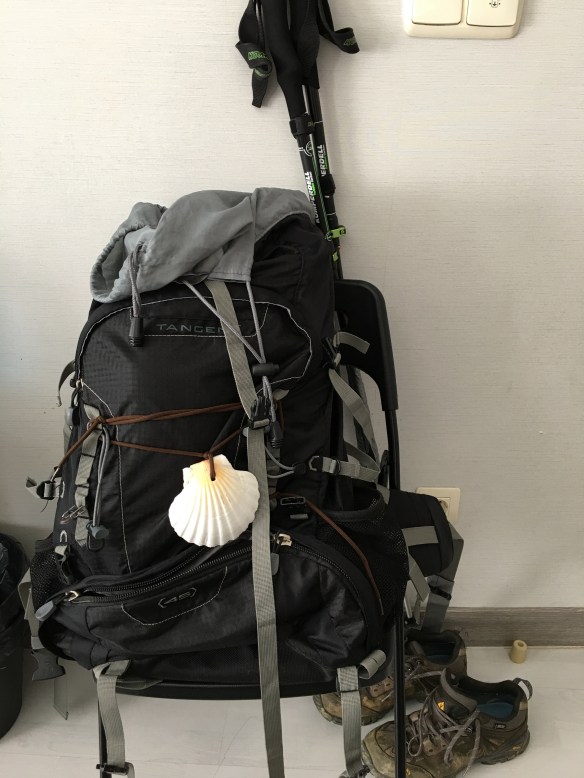
Before I took my first steps on the Camino de Santiago pilgrimage a couple of years ago, I first had to choose my shell—the symbol for St James the Apostle. Along the roadways and paths of the 800-kilometre trek across the Iberian Peninsula in northern Spain you can tell a pilgrim by the shell they have attached to their backpacks.

IMG_5341

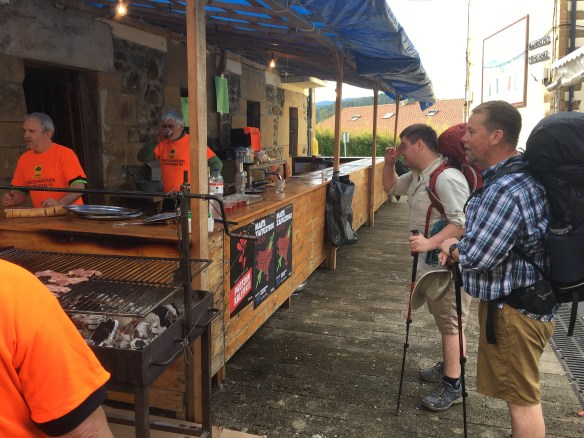
Wearing the shell attracted attention, often very positive. The group with whom I was walking came through a small suburb of the city of Guernica one Sunday morning. When we walked into the town square, we soon realized we were at the finish line of a marathon fundraiser for a local, special needs school.

There, some of the locals had set up large barbecues where they were grilling all sorts of meats for the marathon runners to enjoy after their race. We entered the square moments before the first runners crossed the finish line. But those preparing the barbecue called us over and without even asking our names or who we were offered us some of the delectable meats.

IMG_5308

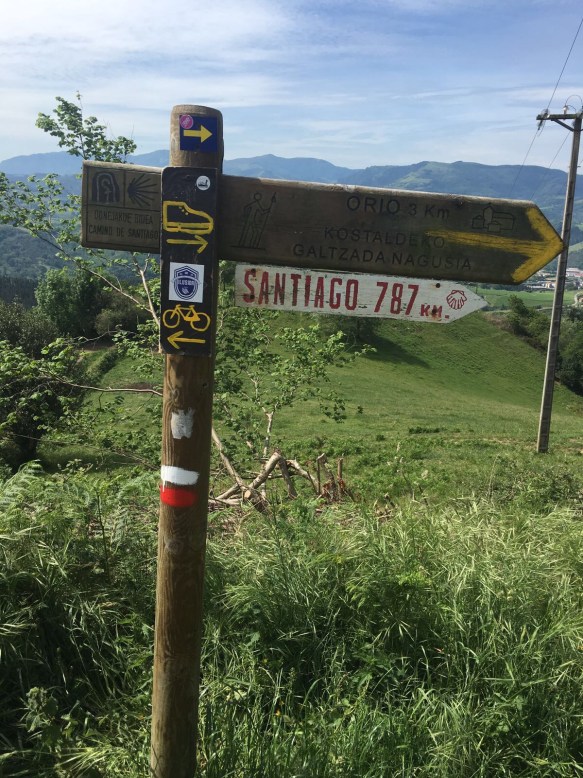
When we expressed our gratitude, they asked us to say a prayer for them at the destination of our pilgrimage: the shrine in the city of Santiago, Spain—still some 700 kilometres away. I promised them I would.

IMG_5385

As you know, I didn’t make it to Santiago, falling ill to pneumonia and coming home early after only a couple of weeks on the trail. I remember struggling with my ‘failure’ to achieve my spiritual and physical goals. For one thing, I wasn’t able to offer a prayer in Santiago for those good people from Guernica who asked me to.

Was it worth it? Did my truncated pilgrimage do any good? Or, was the love and generosity those locals showed us and our receiving their gifts graciously, enough?

On Ash Wednesday, we begin a journey. And at the beginning of this journey, we are given a mark—not a shell, but the sign of the cross on our foreheads. It is a public act, a public ‘coming out’ if you will. By this mark the world will know we are Christians.

I hope you will wear your mark home tonight, wherever you go and whatever you still have to do—keep it visible. And see what happens. You might be invited into some meaningful, enriching conversations along the way. Some might even ask you to pray for them.

Go into the closet where no one can see you, instructs Jesus.[1]And pray to your Father in heaven who hears you, and will reward you for your faithful act. But even when we think our faith fails us? Or only for its visible success? Or only if we achieve our goals?

Arnold Lobel, author of his children’s book called The Frog and Toad Treasury describes the relationship of two friends and how they pass time together, explore the world together and support one another.

In one chapter, the action takes place in October. The leaves are falling. Frog decides to go to Toad’s house, secretly, and rake his leaves for him. “I will rake all the leaves that have fallen on his lawn. Toad will be surprised,” Frog says.

Now, his friend Toad has the same idea. Both manage to arrive at the home of the other unseen, ascertain that no one is home, rake the leaves, and return to their own houses unnoticed. On their respective ways home, however, a wind comes.

The wind blows and blows. The piles of leaves do too, so that the leaves are scattered everywhere. At the end of the day, neither Frog nor Toad realizes what the other has done, because both return home to leaves strewn across their yards. Both pledge to rake their own leaves the next day. Nevertheless, that night Frog and Toad are both happy when they each turned out the light and went to bed.[2]

What is more important: Our good intentions and motivation? Or, the outcome of our actions. Being authentic matters more than the results of our actions. The Gospel is not about the consequences, good or bad, of our good or bad intentions. The Gospel is not about achieving results and being rewarded for our good work, even with righteous motivation. In the end, the Gospel does not leave us stuck (and perplexed!) in self-centred piety, it points to what God is all about.

Normally when we hear the words of Jesus: “the kingdom of heaven is like …”[3]when someone does so and so, we think of the job we must do to enter that kingdom. And so, we imagine and want to be like that religious person, attending to ritual and prayer and acts of charity and justice our whole life long; the more we can do, the better.

Not that we don’t do anything or don’t keep trying. But we cannot ignore from these words of Jesus what Godis all about. I consider those scriptures about the kingdom of heaven as describing the character of God: A God who treasures each of us. And will stop at nothing to find us. And give up God’s very life on the cross—give up everything—in order to be with us and love us.

God is the one who sells all in order buy the field with the treasure buried in it. God is the merchant who sells everything in order to obtain the pearl of great value. Where God’s treasure is (God’s life, God’s mercy, God’s presence—in us), there God’s heart is also.

This is a fundamental message of Christianity. A message of One who comes into our life even in the messiness and despair of being human. Born a vulnerable baby to poor, teenage parents in a backwater town of Bethlehem. Living the life of a simple man from Nazareth, hanging out with fishers, tax collectors and prostitutes. Dying, even, the very humiliating death of a criminal, for all to see.

The message of Christianity is about a God who ‘sells it all’ in order to be with us, live in us and work in us, for the good.

God does all of this in order to know us, really know us. To love us. To grieve with us. To enjoy with us. To walk with us this often difficult journey that we undertake again this day.

And despite the difficult journey for which Lent is a metaphor, may the world in each step we take on the pilgrimage know we are Christians by our love.

And that’s enough.


[1]Matthew 6:1-6,16-21

[2]Cited in Lori Brandt Hale, David L. Bartlett & Barbara Brown Taylor, eds. Feasting on the Word: Preaching the Revised Common Lectionary Year C Vol 2 (Kentucky: WJK Press, 2009), p.23-24.

[3]from his later parables (or stories) describing the reign of God, specifically Matthew 13:44-45.

The change within

When seventeen-year-old Hannah said she was drug free, her parents were skeptical. Having participated in a rehab program and given all the support she could expect from friends and family, Hannah was able to declare that she was finding success in weaning herself off a destructive opioid dependence.

But her father was not convinced. When pressed, he simply confessed, “I don’t believe people can change. Once a drug addict, always a drug addict.”

Though fictional, Hannah and her parents’ situation poses a common predicament for many today. Not just of the real struggle with addiction. But also the struggle with belief: Do we change? And if so, how? And maybe more to the point: Do we recognize the change that happens in our lives? Do we want to?

There’s the story of the Zen Monk who was visiting Time’s Square in New York. And he wanted to buy a hotdog. The vendor asked him, “What would you like on your hotdog?”

The monk replied with a smile, “Make me one with everything.” So the vendor made the hotdog with ketchup, onions and lettuce and mustard and all these other nice things. And he gave it to the monk, and the monk gave the vendor a twenty-dollar bill.

And the vendor didn’t give him anything back. So the monk said, “What about my change?” And the vendor said, “The change is all within.”[1]

An underlying belief in Christianity is that people do change. The resurrection of Christ presents the ultimate pattern for life. We die. We live. We grow. We evolve. We are given new beginnings, to live again. Death. Resurrection. Life is dynamic, not static.

On this Transfiguration of our Lord Sunday, we encounter people who change. First and foremost, Jesus. He is bathed in uncreated light and to the onlookers his face radiates a changed appearance. His countenance is transformed before their very eyes. Here the gospel writers want to emphasize Jesus’ divine nature, his unique revelation as God’s own. The witnesses to this holy and amazing encounter receive the most wonderful gift of experiencing God’s greatness in Christ.[2]

At the same time, the transfigured Lord encounters us. In the scriptures for this Sunday we witness change in the characters of the bible, specifically Moses, Elijah and Paul.[3]They, and others in the bible, are not static beings, one-dimensional characters. We witness in them, rather, incredible change over the course of their lives and throughout history.

In other words, Jesus is not the only one who shows a divine-like appearance. Throughout scripture, there are others who experience within themselves a transfiguration.

Jesus is the first and foremost. But God’s divinity, though fully expressed in Jesus, is not confined to Jesus. God’s true presence is not limited to Jesus for Jesus’ sake alone. God’s fullness in all of creation is not locked in one specific time of history, two thousand years ago.

Martin Luther called it, the great, wonderful, holy “exchange”[4]. On the cross God experienced the fullness of our human sin in all its humiliating nakedness and vulnerability in order that all for whom Christ loved and died may eventually experience and grow into the fullness of divine life and union with God. This divine-human holy exchange is exemplified and mediated through Jesus.

We may balk at the notion that in our very lives, in each one of us, God is present in the living consciousness of Jesus. How can we be that good, eh? We are so used to imagining a separation there—that God is ‘out there’ reserved exclusively to doctrinal debate alone or in some other person upon whom we project all our hopes and dreams. But within me? In my heart? So that I can live differently, better, a changed person?

St. Paul, elsewhere in his first century writings expresses this truth from the start: In his letter to the Galatians, he says, “God revealed his Son in me”[5]. On the road to Damascus the living, post-resurrected Christ encountered Paul. Over one hundred times in all of his New Testament writings he writes this phrase: en Christo meaning ‘in Christ’. And to the Colossians, he confesses: “There is only Christ. He is everything and he is in everything.”[6]

The vendor’s response to the monk carries metaphoric weight. The change is within. A holy encounter with Jesus first changes us within. The change for the better can happen because God is in us. God works on our hearts. God is relentless. Sometimes it hurts. God is the refiner’s fire, creating and re-creating us from the inside-out.

So that, eventually, the light of Christ’s love may shine forth from our lives, and our union with God will be complete, in this world and the next.

Thanks be to God!

[1]Laurence Freeman, “Change is part of the Journey, like it or not”; talk 1 in Mount Oliveto Retreat, Maggiore Siena, Italy, June 18-25, 2016: Change (wccm.org, audio resources, album)

[2]Luke 9:28-43

[3]Exodus 34:29-35; 2 Corinthians 3:12—4:2

[4]“That is the mystery which is rich in divine grace to sinners: wherein by a wonderful exchange our sins are no longer ours but Christ’s and the righteousness of Christ not Christ’s but ours. He has emptied Himself of His righteousness that He might clothe us with it, and fill us with it.

And He has taken our evils upon Himself that He might deliver us from them… in the same manner as He grieved and suffered in our sins, and was confounded, in the same manner we rejoice and glory in His righteousness.”

–Martin Luther, Werke (Weimar, 1883), 5: 608.

[5]Chapter one, verse sixteen, as translated by the NIV and JB.

[6]Chapter three, verse 11. In the NRSV, the Greek is translated, “He is all and in all.”

You are blessed

(We can better understand the beatitudes of Jesus[1] alongside the texts from the Hebrew scriptures assigned for today[2]. Read together in light of the imagery we find there, we begin to make sense of Jesus’ challenging words. Both the Psalmist and the Prophet paint the picture of a tree or shrub in a state of dryness, and in a state of blessedness, shall we say?)

6They shall be like a shrub in the desert, and shall not see when relief comes. They shall live in the parched places.[3]

Being in a “parched place” suggests the unfortunate state of our lives when misfortune and adversity come our way: when we fail at something, when we lose someone or something, or through circumstances beyond our control life hands us lemons.

But the problem is not so much that we are in the desert. It’s not the condition nor circumstance in which we find ourselves. When we are in a bad way, it’s not where we are.

When we are ‘dried out’, the problem is we don’t see the relief that comes our way. We have a vision problem:

We don’t perceive the grace, the gift, and the solutions that present themselves. We, for whatever reason, do not appreciate what we already have. We are blind to this grace.

The sight of which Jeremiah speaks is not merely physical, but of the heart—an attitude, an inner stance—that leans towards what is good within us and in the world around us. It is the intention of our minds and hearts to search for what is good, what is life-giving. And, we nurture this disposition despite what may appear to the contrary on the surface.

Of course, to search and yearn for something means there is something missing in our lives. It is to admit something is amiss. It is to be honest and open about our needs. The longing of the heart exposes our vulnerabilities. But also our hope.

7Blessed are those who trust in the Lord,
whose trust is the Lord.
8They shall be like a tree planted by water,
sending out its roots by the stream
.[4]

Our searching for what feels lost in our lives are like the roots of a tree that naturally expand, grow and spread out towards the source of life—in water, in light. It’s the search itself, the persistent, dedicated and committed journey towards the water that keeps the tree alive, even against the odds.

On the Washington State coast along the Pacific Ocean, you will find the famous Kalaloch Tree, otherwise known as the Tree of Life, or the Runaway Tree.Underneath the webbed roots of the Kalaloch Tree is the Tree Root Cave. Inside, a stream falls into the cave and flows out into the ocean.

69c053a6a3c63493189b8bdda3d7943d

(photo from pinterest.ca)

Many question how the tree continues to grow and the leaves continue to stay green. These questions have been asked so many times with no one really knowing how it keeps on going. So it became known to some as the Tree of Life. Because it continues to live by the stream and the ocean, even though where it finds itself is hardly the ideal spot for stability and longevity.

The Sitka Spruce tree, common along the lush, verdant Pacific coast under the constant influence of moist-laden trade winds, has lived a long time balanced precariously over these rocks. Even though it’s immediate circumstance is fragile, its roots are never far from the source of its very life.

There’s the story about a man searching for his keys under a street light. A friend comes by and asks, “What are you doing?” The response: “Looking for my keys.” The friend says, “Where did you drop them?” The man replies, “Around the corner but I’m looking here because the light is better.”[5]

It’s interesting that in order for the man to actually find his keys, he would eventually have to go around the corner into the dark to find them. But he starts under the light. He starts his search where the light is. Where his confidence rests. Where he can see. And he will go from there, on his journey.

Today, it is common for people to say, “I am blessed” when talking about good fortune. When expressing joy and thanksgiving about all the good in life, we say that “we are blessed.” And, on one level, it is true.

But when Jesus gives a list of characteristics describing those who are ‘blessed’, that’s hardly the case. We find it hard to attribute blessedness to the poor, to the downtrodden, to those who experience misfortune, bad luck, who are given life’s worst circumstances imaginable. We can’t easily make that connection when we associate blessedness with material prosperity, or excellent health, or good fortune.

In Jesus’ teaching, ‘blessedness’ is not absence of trouble. Blessedness, here, is not a reflection of good luck and prosperity. Blessedness, in Jesus’ sense, is not a result of peachy circumstances, fortune and material wealth in the way the word is used in common parlance today.

Rather, to be blessed is “to live through such opposition aware that the struggle is temporary”[6]and that in the end, God will stand by the faithful.

In Luke’s version of Jesus’ great sermon, Jesus stands not on the mountain (as is the case in Matthew 5-7), but on “a level place.” In the bible the word “level” often refers to places of disgrace, suffering, misery, hunger and mourning.[7]

Jesus does not ascend to some high place to give his teaching. Instead, he descends not only to where we stand, but he goes deeper. Jesus descends into the dark recesses of the most difficult, challenging corners of our hearts in order to teach, guide and lead us through. He comes down to that ‘level’.

To be blessed is to be that Kalaloch Tree on the precipice of destruction, and still yearn, search and reach for the water. To be blessed is to pursue the good despite all the bad that is evident all around you. To be blessed is to start that search wherever there is light, and go from there. To be blessed is to trust God to be there in the dark with you. To be blessed is to grow into God’s holy purposes despite adversity, setback and misfortune.

In short, to be blessed is to bear the scars of life proudly. It’s not the absence of difficulty, grief, pain, poverty and suffering that mark a Christian. It is following Christ in his way, despite the suffering that path brings. It is depending on God alone for life, because there is nothing else to rely on.

We thus journey on with hope, joy and trust, bearing witness to the goodness of God to sustain, to nourish and to grow us in the light of Christ.


[1]Luke 6:17-26

[2]Psalm 1; Jeremiah 17:5-10, according to the Revised Common Lectionary (RCL) for the Sixth Sunday after Epiphany, Year C

[3]Jeremiah 17:6 NRSV

[4]Jeremiah 17:7-8 NRSV

[5]Dr. Earl A. Grollman, “In Search of a Lost Faith”, Frontline (Winter 2019), p.4

[6]Ronald J. Allen, “Commentary on Luke 6:17-26” in http://www.workingpreacher.org

[7]Allen, ibid.

funeral sermon – living with a Gospel bias

The last church activity in which Tony participated was the weekly bible study group. At that time I was asking the group to choose next week’s text for study. And the selection was one from either the Old Testament or the Psalms or from Paul’s letters in the New Testament or from a Gospel reading in Matthew, Mark, Luke or John—the first four books of the New Testament.

Tony always, always, always voted for the Gospel reading. The Gospel describes the story of Jesus—his life, death and resurrection. You could say Tony had a bias towards the Gospel. And especially the Gospel of John, for some reason.

The word, Gospel, means: Good News. Good news. Not bad news. Not about how we always fall short. Not about human folly. Not readings about our sinfulness, about what we should do to make it better. But about the grace of God. God’s forgiveness, mercy, love.

The example in today’s Gospel is typical: Jesus washes his disciples’ feet.[1]The Gospel, to recognize it, is always about what God does, as a gift to us. So, here’s the thing about the good news of God:

It’s about receiving more than it is about achieving. The grace of God must be received, not achieved. Normally at a funeral service we talk about what our loved one has achieved in life, as if somehow the more one has achieved the better.

And without second glance, Tony, on that measure, has achieved so much: publishing books in his retirement, building half a dozen houses, acquiring degrees in mathematics and engineering, qualifying himself in brick-laying and construction, even playing soccer into his 80thyear. He achieved a lot, if that’s how you want to look at it.

And certainly in our culture, it seems that’s what it’s all about.

But what a tribute to one who has learned to see, that in all that life has given him—good and bad—all that he received in life, there is grace. A gift of God’s love. To appreciate life as gift. This is right brain stuff. This is entering into the mystery that is God and life.

When he was young, he contracted Diphtheria which kept him isolated for some time, sequestered with the nuns in their abbey. Late in his life, Tony was able to confess that even having a disease was a gift, since it kept him from entering the war, a war that claimed the lives of his two brothers.

These traumatic events of life could have left him bitter. But, despite it all, he remained his true self—kind, loving and gracious.

The author bio on the back cover of both books he published in his retirement says the following about Tony: “Tony was always very interested in literature, history, religion, and cosmology.”

At the end of Act One in his book entitled About God, the World and People, the scene is set at an evening dinner party. Around the table sit different characters – a priest and a scientist among others. After covering such cerebral topics as ‘what is dark matter’, the origin of the universe and various forms of energy, the priest, Father Stengel, concludes with what I suspect is the author’s personal belief:

Father Stengel says, “I personally have no problem with what our diligent scientists discover. I clearly see in the development of our universe the guiding and loving spirit of our Father in heaven.”[2]

While working with numbers all his life and valuing their clarity and succinctness, Tony was also able to say, “They’re just numbers”, in light of God’s truth.

From the perspective of faith, analytics and left-brain thinking can obviously help with some things in life. But when it comes to the great mysteries of life, when we encounter great suffering or great love, when we experience death, or yearn for God, we need to access another ‘operating system’.

You can’t explain these realities adequately using the scientific method alone. It’s remarkable, for the mathematician and engineer that Tony was—that he was able to appreciate, discern and plumb those more intuitive and subtler depths of knowing as well.

It doesn’t make sense how grief works, really. I’ve told this to many grieving families over the years after a loved one died: That in a grieving process, it’s not just the pain of loss of that particular person that comes to the surface at that time. The death of a loved one triggers all the emotional baggage—if you will—of all previous losses you have experienced as well, all those unresolved issues in a family, everything. It can be quite overwhelming. I’ve recently experienced this truth myself. It’s not rational. But it’s very real.

And in those moments that can’t be explained, in the end, the only course of action is love. It’s the only way that does make sense in the turmoil of loss and pain. I think Tony knew that. Gospel bias towards love.

Tony’s teammates on the soccer team were well represented at the funeral home last evening. One of his teammates told me that Tony was the reason they kept playing together. He said that during a game teammates and the competition sometimes came to blows, emotionally if not physically. But Tony was always there trying to mend ways, trying to keep the group together, inspiring them to play on. Tony knew that. Gospel bias towards love.

Death changes some things. Death is final, in a way. And it hurts. Yes. But human death doesn’t mean the relationship is ended. Death merely changed the nature of our relationship with Tony.

Now, Tony is no longer physically present with us. But he lives on—in our hearts, in our minds, in our spirit, in our conscience, in our actions. He is still with us, albeit in a different way. Tony’s death leaves us a gift, an invitation to make what was important to him, important to us. Life as gift, a grace to do unto others as you would have done unto yourself. Gospel bias towards love.

“What we do for ourselves dies with us. What we do for others and the world remains and is immortal.”[3]Let what we do for others, be love.


[1]John 13:12-15,34-35

[2]Tony Bickle, About God, the World and People (Xlibris Corporation, 2008) p.48

[3]Most likely from Albert Pike, 19thcentury American attorney, soldier, writer, and Freemason. Sometimes this quote is attributed to 20thcentury American writer and biographer, Albert Paine.