You can tell a pilgrim …

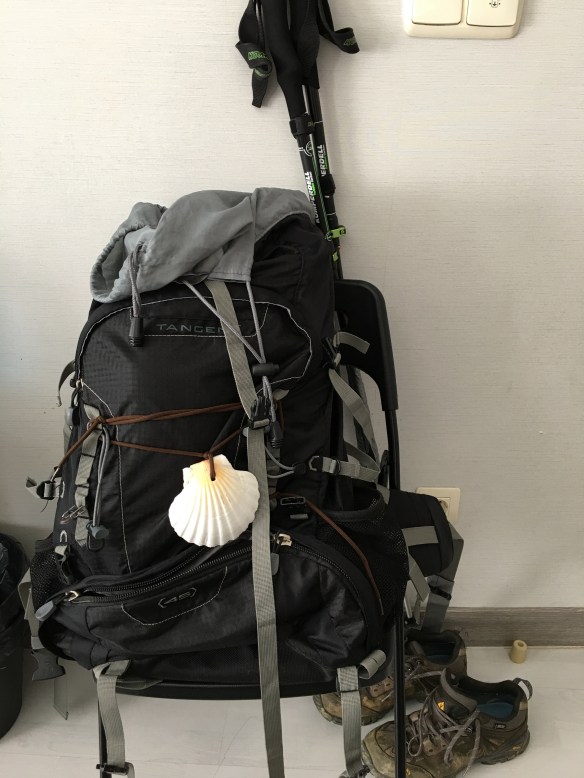
Before I took my first steps on the Camino de Santiago pilgrimage a couple of years ago, I first had to choose my shell—the symbol for St James the Apostle. Along the roadways and paths of the 800-kilometre trek across the Iberian Peninsula in northern Spain you can tell a pilgrim by the shell they have attached to their backpacks.

IMG_5341

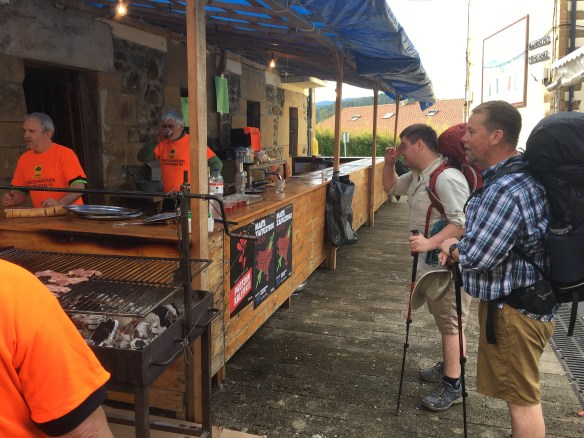
Wearing the shell attracted attention, often very positive. The group with whom I was walking came through a small suburb of the city of Guernica one Sunday morning. When we walked into the town square, we soon realized we were at the finish line of a marathon fundraiser for a local, special needs school.

There, some of the locals had set up large barbecues where they were grilling all sorts of meats for the marathon runners to enjoy after their race. We entered the square moments before the first runners crossed the finish line. But those preparing the barbecue called us over and without even asking our names or who we were offered us some of the delectable meats.

IMG_5308

When we expressed our gratitude, they asked us to say a prayer for them at the destination of our pilgrimage: the shrine in the city of Santiago, Spain—still some 700 kilometres away. I promised them I would.

IMG_5385

As you know, I didn’t make it to Santiago, falling ill to pneumonia and coming home early after only a couple of weeks on the trail. I remember struggling with my ‘failure’ to achieve my spiritual and physical goals. For one thing, I wasn’t able to offer a prayer in Santiago for those good people from Guernica who asked me to.

Was it worth it? Did my truncated pilgrimage do any good? Or, was the love and generosity those locals showed us and our receiving their gifts graciously, enough?

On Ash Wednesday, we begin a journey. And at the beginning of this journey, we are given a mark—not a shell, but the sign of the cross on our foreheads. It is a public act, a public ‘coming out’ if you will. By this mark the world will know we are Christians.

I hope you will wear your mark home tonight, wherever you go and whatever you still have to do—keep it visible. And see what happens. You might be invited into some meaningful, enriching conversations along the way. Some might even ask you to pray for them.

Go into the closet where no one can see you, instructs Jesus.[1]And pray to your Father in heaven who hears you, and will reward you for your faithful act. But even when we think our faith fails us? Or only for its visible success? Or only if we achieve our goals?

Arnold Lobel, author of his children’s book called The Frog and Toad Treasury describes the relationship of two friends and how they pass time together, explore the world together and support one another.

In one chapter, the action takes place in October. The leaves are falling. Frog decides to go to Toad’s house, secretly, and rake his leaves for him. “I will rake all the leaves that have fallen on his lawn. Toad will be surprised,” Frog says.

Now, his friend Toad has the same idea. Both manage to arrive at the home of the other unseen, ascertain that no one is home, rake the leaves, and return to their own houses unnoticed. On their respective ways home, however, a wind comes.

The wind blows and blows. The piles of leaves do too, so that the leaves are scattered everywhere. At the end of the day, neither Frog nor Toad realizes what the other has done, because both return home to leaves strewn across their yards. Both pledge to rake their own leaves the next day. Nevertheless, that night Frog and Toad are both happy when they each turned out the light and went to bed.[2]

What is more important: Our good intentions and motivation? Or, the outcome of our actions. Being authentic matters more than the results of our actions. The Gospel is not about the consequences, good or bad, of our good or bad intentions. The Gospel is not about achieving results and being rewarded for our good work, even with righteous motivation. In the end, the Gospel does not leave us stuck (and perplexed!) in self-centred piety, it points to what God is all about.

Normally when we hear the words of Jesus: “the kingdom of heaven is like …”[3]when someone does so and so, we think of the job we must do to enter that kingdom. And so, we imagine and want to be like that religious person, attending to ritual and prayer and acts of charity and justice our whole life long; the more we can do, the better.

Not that we don’t do anything or don’t keep trying. But we cannot ignore from these words of Jesus what Godis all about. I consider those scriptures about the kingdom of heaven as describing the character of God: A God who treasures each of us. And will stop at nothing to find us. And give up God’s very life on the cross—give up everything—in order to be with us and love us.

God is the one who sells all in order buy the field with the treasure buried in it. God is the merchant who sells everything in order to obtain the pearl of great value. Where God’s treasure is (God’s life, God’s mercy, God’s presence—in us), there God’s heart is also.

This is a fundamental message of Christianity. A message of One who comes into our life even in the messiness and despair of being human. Born a vulnerable baby to poor, teenage parents in a backwater town of Bethlehem. Living the life of a simple man from Nazareth, hanging out with fishers, tax collectors and prostitutes. Dying, even, the very humiliating death of a criminal, for all to see.

The message of Christianity is about a God who ‘sells it all’ in order to be with us, live in us and work in us, for the good.

God does all of this in order to know us, really know us. To love us. To grieve with us. To enjoy with us. To walk with us this often difficult journey that we undertake again this day.

And despite the difficult journey for which Lent is a metaphor, may the world in each step we take on the pilgrimage know we are Christians by our love.

And that’s enough.


[1]Matthew 6:1-6,16-21

[2]Cited in Lori Brandt Hale, David L. Bartlett & Barbara Brown Taylor, eds. Feasting on the Word: Preaching the Revised Common Lectionary Year C Vol 2 (Kentucky: WJK Press, 2009), p.23-24.

[3]from his later parables (or stories) describing the reign of God, specifically Matthew 13:44-45.

The change within

When seventeen-year-old Hannah said she was drug free, her parents were skeptical. Having participated in a rehab program and given all the support she could expect from friends and family, Hannah was able to declare that she was finding success in weaning herself off a destructive opioid dependence.

But her father was not convinced. When pressed, he simply confessed, “I don’t believe people can change. Once a drug addict, always a drug addict.”

Though fictional, Hannah and her parents’ situation poses a common predicament for many today. Not just of the real struggle with addiction. But also the struggle with belief: Do we change? And if so, how? And maybe more to the point: Do we recognize the change that happens in our lives? Do we want to?

There’s the story of the Zen Monk who was visiting Time’s Square in New York. And he wanted to buy a hotdog. The vendor asked him, “What would you like on your hotdog?”

The monk replied with a smile, “Make me one with everything.” So the vendor made the hotdog with ketchup, onions and lettuce and mustard and all these other nice things. And he gave it to the monk, and the monk gave the vendor a twenty-dollar bill.

And the vendor didn’t give him anything back. So the monk said, “What about my change?” And the vendor said, “The change is all within.”[1]

An underlying belief in Christianity is that people do change. The resurrection of Christ presents the ultimate pattern for life. We die. We live. We grow. We evolve. We are given new beginnings, to live again. Death. Resurrection. Life is dynamic, not static.

On this Transfiguration of our Lord Sunday, we encounter people who change. First and foremost, Jesus. He is bathed in uncreated light and to the onlookers his face radiates a changed appearance. His countenance is transformed before their very eyes. Here the gospel writers want to emphasize Jesus’ divine nature, his unique revelation as God’s own. The witnesses to this holy and amazing encounter receive the most wonderful gift of experiencing God’s greatness in Christ.[2]

At the same time, the transfigured Lord encounters us. In the scriptures for this Sunday we witness change in the characters of the bible, specifically Moses, Elijah and Paul.[3]They, and others in the bible, are not static beings, one-dimensional characters. We witness in them, rather, incredible change over the course of their lives and throughout history.

In other words, Jesus is not the only one who shows a divine-like appearance. Throughout scripture, there are others who experience within themselves a transfiguration.

Jesus is the first and foremost. But God’s divinity, though fully expressed in Jesus, is not confined to Jesus. God’s true presence is not limited to Jesus for Jesus’ sake alone. God’s fullness in all of creation is not locked in one specific time of history, two thousand years ago.

Martin Luther called it, the great, wonderful, holy “exchange”[4]. On the cross God experienced the fullness of our human sin in all its humiliating nakedness and vulnerability in order that all for whom Christ loved and died may eventually experience and grow into the fullness of divine life and union with God. This divine-human holy exchange is exemplified and mediated through Jesus.

We may balk at the notion that in our very lives, in each one of us, God is present in the living consciousness of Jesus. How can we be that good, eh? We are so used to imagining a separation there—that God is ‘out there’ reserved exclusively to doctrinal debate alone or in some other person upon whom we project all our hopes and dreams. But within me? In my heart? So that I can live differently, better, a changed person?

St. Paul, elsewhere in his first century writings expresses this truth from the start: In his letter to the Galatians, he says, “God revealed his Son in me”[5]. On the road to Damascus the living, post-resurrected Christ encountered Paul. Over one hundred times in all of his New Testament writings he writes this phrase: en Christo meaning ‘in Christ’. And to the Colossians, he confesses: “There is only Christ. He is everything and he is in everything.”[6]

The vendor’s response to the monk carries metaphoric weight. The change is within. A holy encounter with Jesus first changes us within. The change for the better can happen because God is in us. God works on our hearts. God is relentless. Sometimes it hurts. God is the refiner’s fire, creating and re-creating us from the inside-out.

So that, eventually, the light of Christ’s love may shine forth from our lives, and our union with God will be complete, in this world and the next.

Thanks be to God!

[1]Laurence Freeman, “Change is part of the Journey, like it or not”; talk 1 in Mount Oliveto Retreat, Maggiore Siena, Italy, June 18-25, 2016: Change (wccm.org, audio resources, album)

[2]Luke 9:28-43

[3]Exodus 34:29-35; 2 Corinthians 3:12—4:2

[4]“That is the mystery which is rich in divine grace to sinners: wherein by a wonderful exchange our sins are no longer ours but Christ’s and the righteousness of Christ not Christ’s but ours. He has emptied Himself of His righteousness that He might clothe us with it, and fill us with it.

And He has taken our evils upon Himself that He might deliver us from them… in the same manner as He grieved and suffered in our sins, and was confounded, in the same manner we rejoice and glory in His righteousness.”

–Martin Luther, Werke (Weimar, 1883), 5: 608.

[5]Chapter one, verse sixteen, as translated by the NIV and JB.

[6]Chapter three, verse 11. In the NRSV, the Greek is translated, “He is all and in all.”

You are blessed

(We can better understand the beatitudes of Jesus[1] alongside the texts from the Hebrew scriptures assigned for today[2]. Read together in light of the imagery we find there, we begin to make sense of Jesus’ challenging words. Both the Psalmist and the Prophet paint the picture of a tree or shrub in a state of dryness, and in a state of blessedness, shall we say?)

6They shall be like a shrub in the desert, and shall not see when relief comes. They shall live in the parched places.[3]

Being in a “parched place” suggests the unfortunate state of our lives when misfortune and adversity come our way: when we fail at something, when we lose someone or something, or through circumstances beyond our control life hands us lemons.

But the problem is not so much that we are in the desert. It’s not the condition nor circumstance in which we find ourselves. When we are in a bad way, it’s not where we are.

When we are ‘dried out’, the problem is we don’t see the relief that comes our way. We have a vision problem:

We don’t perceive the grace, the gift, and the solutions that present themselves. We, for whatever reason, do not appreciate what we already have. We are blind to this grace.

The sight of which Jeremiah speaks is not merely physical, but of the heart—an attitude, an inner stance—that leans towards what is good within us and in the world around us. It is the intention of our minds and hearts to search for what is good, what is life-giving. And, we nurture this disposition despite what may appear to the contrary on the surface.

Of course, to search and yearn for something means there is something missing in our lives. It is to admit something is amiss. It is to be honest and open about our needs. The longing of the heart exposes our vulnerabilities. But also our hope.

7Blessed are those who trust in the Lord,
whose trust is the Lord.
8They shall be like a tree planted by water,
sending out its roots by the stream
.[4]

Our searching for what feels lost in our lives are like the roots of a tree that naturally expand, grow and spread out towards the source of life—in water, in light. It’s the search itself, the persistent, dedicated and committed journey towards the water that keeps the tree alive, even against the odds.

On the Washington State coast along the Pacific Ocean, you will find the famous Kalaloch Tree, otherwise known as the Tree of Life, or the Runaway Tree.Underneath the webbed roots of the Kalaloch Tree is the Tree Root Cave. Inside, a stream falls into the cave and flows out into the ocean.

69c053a6a3c63493189b8bdda3d7943d

(photo from pinterest.ca)

Many question how the tree continues to grow and the leaves continue to stay green. These questions have been asked so many times with no one really knowing how it keeps on going. So it became known to some as the Tree of Life. Because it continues to live by the stream and the ocean, even though where it finds itself is hardly the ideal spot for stability and longevity.

The Sitka Spruce tree, common along the lush, verdant Pacific coast under the constant influence of moist-laden trade winds, has lived a long time balanced precariously over these rocks. Even though it’s immediate circumstance is fragile, its roots are never far from the source of its very life.

There’s the story about a man searching for his keys under a street light. A friend comes by and asks, “What are you doing?” The response: “Looking for my keys.” The friend says, “Where did you drop them?” The man replies, “Around the corner but I’m looking here because the light is better.”[5]

It’s interesting that in order for the man to actually find his keys, he would eventually have to go around the corner into the dark to find them. But he starts under the light. He starts his search where the light is. Where his confidence rests. Where he can see. And he will go from there, on his journey.

Today, it is common for people to say, “I am blessed” when talking about good fortune. When expressing joy and thanksgiving about all the good in life, we say that “we are blessed.” And, on one level, it is true.

But when Jesus gives a list of characteristics describing those who are ‘blessed’, that’s hardly the case. We find it hard to attribute blessedness to the poor, to the downtrodden, to those who experience misfortune, bad luck, who are given life’s worst circumstances imaginable. We can’t easily make that connection when we associate blessedness with material prosperity, or excellent health, or good fortune.

In Jesus’ teaching, ‘blessedness’ is not absence of trouble. Blessedness, here, is not a reflection of good luck and prosperity. Blessedness, in Jesus’ sense, is not a result of peachy circumstances, fortune and material wealth in the way the word is used in common parlance today.

Rather, to be blessed is “to live through such opposition aware that the struggle is temporary”[6]and that in the end, God will stand by the faithful.

In Luke’s version of Jesus’ great sermon, Jesus stands not on the mountain (as is the case in Matthew 5-7), but on “a level place.” In the bible the word “level” often refers to places of disgrace, suffering, misery, hunger and mourning.[7]

Jesus does not ascend to some high place to give his teaching. Instead, he descends not only to where we stand, but he goes deeper. Jesus descends into the dark recesses of the most difficult, challenging corners of our hearts in order to teach, guide and lead us through. He comes down to that ‘level’.

To be blessed is to be that Kalaloch Tree on the precipice of destruction, and still yearn, search and reach for the water. To be blessed is to pursue the good despite all the bad that is evident all around you. To be blessed is to start that search wherever there is light, and go from there. To be blessed is to trust God to be there in the dark with you. To be blessed is to grow into God’s holy purposes despite adversity, setback and misfortune.

In short, to be blessed is to bear the scars of life proudly. It’s not the absence of difficulty, grief, pain, poverty and suffering that mark a Christian. It is following Christ in his way, despite the suffering that path brings. It is depending on God alone for life, because there is nothing else to rely on.

We thus journey on with hope, joy and trust, bearing witness to the goodness of God to sustain, to nourish and to grow us in the light of Christ.


[1]Luke 6:17-26

[2]Psalm 1; Jeremiah 17:5-10, according to the Revised Common Lectionary (RCL) for the Sixth Sunday after Epiphany, Year C

[3]Jeremiah 17:6 NRSV

[4]Jeremiah 17:7-8 NRSV

[5]Dr. Earl A. Grollman, “In Search of a Lost Faith”, Frontline (Winter 2019), p.4

[6]Ronald J. Allen, “Commentary on Luke 6:17-26” in http://www.workingpreacher.org

[7]Allen, ibid.

funeral sermon – living with a Gospel bias

The last church activity in which Tony participated was the weekly bible study group. At that time I was asking the group to choose next week’s text for study. And the selection was one from either the Old Testament or the Psalms or from Paul’s letters in the New Testament or from a Gospel reading in Matthew, Mark, Luke or John—the first four books of the New Testament.

Tony always, always, always voted for the Gospel reading. The Gospel describes the story of Jesus—his life, death and resurrection. You could say Tony had a bias towards the Gospel. And especially the Gospel of John, for some reason.

The word, Gospel, means: Good News. Good news. Not bad news. Not about how we always fall short. Not about human folly. Not readings about our sinfulness, about what we should do to make it better. But about the grace of God. God’s forgiveness, mercy, love.

The example in today’s Gospel is typical: Jesus washes his disciples’ feet.[1]The Gospel, to recognize it, is always about what God does, as a gift to us. So, here’s the thing about the good news of God:

It’s about receiving more than it is about achieving. The grace of God must be received, not achieved. Normally at a funeral service we talk about what our loved one has achieved in life, as if somehow the more one has achieved the better.

And without second glance, Tony, on that measure, has achieved so much: publishing books in his retirement, building half a dozen houses, acquiring degrees in mathematics and engineering, qualifying himself in brick-laying and construction, even playing soccer into his 80thyear. He achieved a lot, if that’s how you want to look at it.

And certainly in our culture, it seems that’s what it’s all about.

But what a tribute to one who has learned to see, that in all that life has given him—good and bad—all that he received in life, there is grace. A gift of God’s love. To appreciate life as gift. This is right brain stuff. This is entering into the mystery that is God and life.

When he was young, he contracted Diphtheria which kept him isolated for some time, sequestered with the nuns in their abbey. Late in his life, Tony was able to confess that even having a disease was a gift, since it kept him from entering the war, a war that claimed the lives of his two brothers.

These traumatic events of life could have left him bitter. But, despite it all, he remained his true self—kind, loving and gracious.

The author bio on the back cover of both books he published in his retirement says the following about Tony: “Tony was always very interested in literature, history, religion, and cosmology.”

At the end of Act One in his book entitled About God, the World and People, the scene is set at an evening dinner party. Around the table sit different characters – a priest and a scientist among others. After covering such cerebral topics as ‘what is dark matter’, the origin of the universe and various forms of energy, the priest, Father Stengel, concludes with what I suspect is the author’s personal belief:

Father Stengel says, “I personally have no problem with what our diligent scientists discover. I clearly see in the development of our universe the guiding and loving spirit of our Father in heaven.”[2]

While working with numbers all his life and valuing their clarity and succinctness, Tony was also able to say, “They’re just numbers”, in light of God’s truth.

From the perspective of faith, analytics and left-brain thinking can obviously help with some things in life. But when it comes to the great mysteries of life, when we encounter great suffering or great love, when we experience death, or yearn for God, we need to access another ‘operating system’.

You can’t explain these realities adequately using the scientific method alone. It’s remarkable, for the mathematician and engineer that Tony was—that he was able to appreciate, discern and plumb those more intuitive and subtler depths of knowing as well.

It doesn’t make sense how grief works, really. I’ve told this to many grieving families over the years after a loved one died: That in a grieving process, it’s not just the pain of loss of that particular person that comes to the surface at that time. The death of a loved one triggers all the emotional baggage—if you will—of all previous losses you have experienced as well, all those unresolved issues in a family, everything. It can be quite overwhelming. I’ve recently experienced this truth myself. It’s not rational. But it’s very real.

And in those moments that can’t be explained, in the end, the only course of action is love. It’s the only way that does make sense in the turmoil of loss and pain. I think Tony knew that. Gospel bias towards love.

Tony’s teammates on the soccer team were well represented at the funeral home last evening. One of his teammates told me that Tony was the reason they kept playing together. He said that during a game teammates and the competition sometimes came to blows, emotionally if not physically. But Tony was always there trying to mend ways, trying to keep the group together, inspiring them to play on. Tony knew that. Gospel bias towards love.

Death changes some things. Death is final, in a way. And it hurts. Yes. But human death doesn’t mean the relationship is ended. Death merely changed the nature of our relationship with Tony.

Now, Tony is no longer physically present with us. But he lives on—in our hearts, in our minds, in our spirit, in our conscience, in our actions. He is still with us, albeit in a different way. Tony’s death leaves us a gift, an invitation to make what was important to him, important to us. Life as gift, a grace to do unto others as you would have done unto yourself. Gospel bias towards love.

“What we do for ourselves dies with us. What we do for others and the world remains and is immortal.”[3]Let what we do for others, be love.


[1]John 13:12-15,34-35

[2]Tony Bickle, About God, the World and People (Xlibris Corporation, 2008) p.48

[3]Most likely from Albert Pike, 19thcentury American attorney, soldier, writer, and Freemason. Sometimes this quote is attributed to 20thcentury American writer and biographer, Albert Paine.


Pluck up!

When our daughter received a pouch of seeds last Spring, we didn’t know initially what to do with them. They were Colorado Spruce Tree seeds. And we weren’t exactly planning on seeding a forest.

So we took a medium-sized flower pot and sprinkled the dozen-or-so seeds into the soil packed into the container which we left on the back deck outside. Let’s first see if the seeds in fact sprout, we thought. And go from there.

Three little buds popped through the top layer of soil a couple weeks later. One came up near the edge of the pot. But two of them came up in the centre, side-by-side. At first, I thought the two to be part of one sprig. But they weren’t.

At some point I would have to separate the two, distinct saplings. They were too close together. When to pull them up posed a bit of a challenge. If I waited too long, then the root systems would most certainly entwine and grow into one tree making it impossible to separate. If I plucked up the saplings too soon, I ran the risk of damaging the vulnerable shoots.

The task before me reminded me of the call of God to Jeremiah stated poetically: “to pluck up … and to plant.”[1]While Jeremiah’s plucking up and planting had to do with nations, social practice and religious faith, mine was more literal: As the tiny saplings were finding life and vitality to grow, I would first have to pluck them up from the soil before planting them into separate containers for the next stage of their growth.

And that plucking up would not be easy. It would hurt. It would put stress on the individual seedlings. I could very well be killing them in the transfer. Would they survive the ‘plucking up’?

Sometimes we don’t believe we can survive the ‘plucking up’ events of our lives. We don’t believe we have the strength to endure those difficult transitions in life, especially after experiencing loss, or when confronted with change or great disappointment and failure.

We object, like Jeremiah did—and Moses and Isaiah before him, to God’s call, finding all sorts of justifications: Can’t do that; I’m not qualified, I don’t have the skills, I don’t have the strength, I am too young or too old, I don’t have time. They make sense, common sense we might say. We find all sorts of excuses and even create a religion around all of that to keep us feeling good. Or at least not guilty. And stuck in a rut.

What is more, we make our faith into something that ought to make us comfortable. We ‘go to church’ expecting not the challenge to grow and change but instead to find the salve of warm fuzzies and emotional feel-goodies. We even believe Jesus was all about being ‘nice’. And if anyone is not nice, or challenges us, or doesn’t fit our mould—well, that’s not the way it’s supposed to be.

And yet, the biblical witness, if not our authentic lives of faith when we pay honest attention to them, suggest something entirely different:

  1. Jesus’ popularity suffers a severe blow after he says to his people in their synagogue that “today the scripture has been fulfilled in their hearing”.[2]What he means is that they—his people—would not be the vessels for the unfolding of God’s new narrative; outsiders would be. Stew on that. The audacity. They nearly succeed in throwing him off a cliff, they are so enraged.
  2. In the Jeremiah text, we read that God’s hand “touches” Jeremiah’s mouth. “I have put my words in your mouth,” God says.[3]Perhaps, at first, this sounds rather intimate, soft, gentle, nice.

But we need to be careful not to imagine it was a comforting touch. The same verb used here can also mean “strike” or “harm.” The one other biblical verse that uses this same verb to envision God’s hand touching is found in the prologue to the book of Job, where Satan challenges God to test Job’s faithfulness by taking away everything Job has.[4]There is nothing gentle about the wind that then “touches” the house where Job’s children are feasting, leaving every one of them dead beneath its roof.[5]

“When we picture the hand of God ‘touching’ Jeremiah’s mouth, we might do better to imagine a jolt or a shock. We would be justified in asking whether it hurt, whether it left a wound or scar, whether having God’s words in his mouth changed Jeremiah forever.”[6]

The message of Christ is the message of the cross. And then, resurrection. For our growth and life in Christ, we are called into places of disruption of our comfortable lives before anything new and life-giving happens. There’s no way around it, if we want to follow Jesus in this world.

It starts small, though. And that’s the grace and the hope. God does not call the qualified; God qualifies the called. The point of the Jeremiah story is that Jeremiah cannot depend on his own, developed capabilities and skill-set to justify his participation in God’s work. God called and equipped him even before he was born.

Every worldly role has purpose in Christ. No work is meaningless in God’s light. Martin Luther famously said about parenthood, when understood in Christian vocation: even changing dirty diapers is done for the glory of God! It is God’s invitation to us to invest God’s grace into whatever work God opens to us.[7]

All Jeremiah must do is trust God, and not make his decisions—yay or nay—based on fear. The most often repeated command in the bible—do you know it? “Fear not”. This does not mean we will never be afraid when we listen to and follow God. It means we do not lead our lives with fear in the driver’s seat. Instead, we find in the driver’s seat of our lives: Trust God. And hope in God. Fear can take a back seat, now.

I sat on the front porch with three separate, small pots for each of the seedlings. I did this in early November, believing they would do much better inside during their first winter.

My ‘plucking up’ was done swiftly, using the old adage of taking off a band-aid quickly is better than dragging it out. What surprised me the most in the process of ‘plucking up’ and then ‘planting’ again, was to see the roots.

Each of the tiny saplings had astoundingly long tap roots. One even had extended its main root all the way to the bottom of the original pot, and then some. More than tripling the length of the part of the sapling above ground, there was definitely more to the little sprout than what met the eye on the surface.

And so, there is much more to you and to me than what may first meet the eye—the eye of our self-regard. God calls us to break through the crust of the surface of our self-perception and to mine the depths of who we are, created uniquely each of us in God’s image. There’s so much good, there!

God is just waiting for you to uncover those depths, and then to bless and to empower who you are and what you do, into God’s holy purposes.

img_7991

[1]Jeremiah 1:10

[2]Luke 4:21-30

[3]Jeremiah 1:9

[4]Job 1:11, see Anathea Portier-Young in her commentary on Jeremiah 1:4-10 in workingpreacher.org

[5]Job 1:19

[6]Portier-Young, ibid.

[7]James Calvin Davis, in David L. Bartlett & Barbara Brown Taylor, eds., Feasting on the Word: Preaching the Revised Common Lectionary Year C Volume 1 (Kentucky: WJK Press, 2009) p.292

What is Jesus doing?

I have a small humidifier for my guitar. I combine special crystals with distilled water in a small tube that I insert between the strings. This helps prevent the hardwood casing of the guitar from cracking and splitting. I need to keep filling the small tube with water at least once a week during the dry months of winter to preserve the wood.

At this time of year in Canada, especially under the influence of a continental climate, the air is dry. Very. But we don’t even notice or think about it. The only way I know it’s really dry when it’s so cold is my skin is itchy and my hands get cracked and rough. Also, a device at home tells me the humidity levels are quite low around 20-30%. Not only does our skin pay the price in dry conditions, our organs internally need hydration. So, we have to drink more water.

It’s hard to imagine, but we can actually be dehydrated in the winter. And these conditions are not overtly noticeable, really. Unless we pay attention to our skin or check the humidistat, it’s not apparent.

When we consider faith, or spirituality, we enter into a level of awareness similar to our awareness of water around us, or lack thereof. It’s not immediately nor easily perceptible where the water is or goes.

When we approach a problem or a challenge in life with the good intention of bringing our faith to bear on it, we must first uncover our way of thinking about it. Because how we think about it influences the choices we make.

Here are a couple ways of thinking that we are usually not aware of, in the choices and decisions we make. These are ways of thinking that the Gospel for today exposes.[1]

First, underneath all our words and actions often lurks the virus of dualism. ‘Dual’ means, two: Either/Or, This or That; This belongs and That doesn’t belong. This mental strategy exists just below the level of consciousness, and is ingrained in our western thinking especially since the Enlightenment and Reformation. This way of thinking has dominated our approach to faith, even though it was not the way of thinking of those who first scribed the biblical stories.

For example, John the Baptist in the Gospel story today says that he baptizes with water but the one coming after him will baptize with Spirit and fire.[2]We may comprehend this dualistically, suggesting that Jesus was not going to use water in his baptismal ministry. We then interpret this is as: In Christian baptism, water is irrelevant, unnecessary. After all, if Jesus, Son of God, won’t baptize with water, why should we? … and so on and so on.

You see how dualism creeps into our encounter with Scripture? It doesn’t help, then, that nowhere in the New Testament do we see Jesus performing anybaptisms, let alone with water, Spirit or fire.

When we get up in-the-head with these Gospel texts, we easily can get ourselves into a twisted, confused state. We start fighting amongst ourselves over right-thinking, doctrine and the efficacy of baptism. The church divides and we see in the history, especially after the Reformation, a proliferation of denominations. And how well has dividing-over-doctrine worked for us?

But, what if the solution lies in another way of thinking? It’s interesting that in our thinking that can go astray in this Gospel text, we do get some helpful cues to help us out of the quagmire of dualism:

“Repent!” is John the Baptist’s primary message which we see clearly in the other Gospels,[3]and earlier in the Gospel of Luke.[4]The Greek word, metanoia, translated as “repent”, literally means ‘to change your mind’. Then Saint Paul comes along and instructs, “Be transformed by a renewal of your mind.”[5]So, repentance does not start by changing bad habits, or feeling guilty for bad behaviour. Repentance is not fundamentally moralistic.

First, repentance means changing our way of thinking about a problem. Repentance means looking at a challenge in a completely different way from the way you’ve always thought about it. The message of repentance is about nurturing a healthy self-critique about your thought-process, and changing it. Once the mind is changed, hopefully the heart will soon follow.

So, from this text, what if it’s not either/or but both/and? What if water, fire and Spirit were all important aspects of our experience and expression of baptism in Christ? And nothing was being excluded from the mix?

Because from the story of creation in the book of Genesis, the Spirit hovers over the water and God speaks to create. So, in Baptism the ‘word’ and ‘water’ are vehicles of God to create something new in you.[6]

We don’t often think about our need for water, especially in a country like Canada where fresh drinking water abounds. After all, over 60% of our bodies are made up of water and most of this planet is covered by water. How can we take it for granted? How can we not see it?

Water, in its various states—frozen, liquid, gas—is integral to all of creation. It is pervasive. We cannot get away from it, or remove ourselves somehow from its all-encompassing reality. We cannot divide it out, easily. It cannot exist, apart from anything else in the natural world. Water connects all things. And we can only participate in its existence within and all around us. We belong to it; it belongs to us.

Often when the Baptism of our Lord comes up in the church calendar, we immediately think this story must primarily be about our baptism. Here is another way of thinking that we don’t usually uncover: a lifestyle that places the ultimate onus on us, individually.

So, this story gives us license, we presume, to make it all about us: our faith, our work, our sin, our need to somehow earn God’s favour by seeking out baptism or proving the worthiness of our faith. The upshot of this story of Jesus’ baptism must, therefore, mean we need to imitate Jesus as best as we can.

But what about asking another question? Instead of the popular question, “What would Jesus do?”, what about asking, “What is Jesus doing?”[7]

The first question—What would Jesus do?— assumes that the Savior is on the sidelines of our lives and that the burden of life and work is on our shoulders. When we seek to imitate Jesus’ life, we presume the Savior is not really saving but is setting impossibly high standards that we attempt to imitate by doing what we assume he would do if he were in our situation.

But to be clear, we do not imitate the Savior’s life; we participate in it. In first century context, this Gospel story has less to do with the nature of Jesus and more with his purpose.[8]

“What is Jesus doing?” is built on the conviction that he is alive, reigning, and at work in our lives. In other words, he is in our situation. And that changes everything, first about our thinking then also our mission. Instead of believing that the work of Christ is done-and-over and that now it is our turn to try to imitate his life and work, we take on the identity of being witnesses who watch and testify to his continued work of salvation that is unfolding before our eyes.

Obviously, Jesus’ incarnation, ministry, cross, and resurrection make up the decisive turning point in the great drama of salvation. But the Kingdom is still coming. And it doesn’t come through ourefforts at doing Christ’s work. It comes through the ongoing ministry of the ascended and reigning Son of God, who completes his own work through the Holy Spirit so that we may participate in what Jesus is doing.[9]

Not, what would Jesus do. Rather, what is Jesus doing.

So, Baptism gives us a physical assurance that our final destiny is no longer determined by the brokenness of our world and lives and twisted ways of thinking. Baptism gives us a physical assurance that our final destiny is the realm of God already breaking in all around us. Baptism is an invisible mark initiating us into a community that anticipates the fullness of God’s kingdom.[10]Baptism calls us to pay attention to what Jesus is doing all around us, like water.

God’s voice from heaven identifies Jesus as God’s son, in whom God is well pleased. The Baptism of our Lord is not what we are about, but about what God is up to in Jesus. If anything, this text calls us to choose how we will align ourselves with the purposes of God in Christ, in the world around us today.

To that end, when we love others, when we have mercy on others, when we show compassion, and affirm all people and creation—these are worthy strategies to align ourselves with what God is doing to make everything belong.

May the grace of God, like water, wash us and surround us in hope and in thanksgiving for all that belongs to God.


[1]Luke 3:15-17,21-22; Baptism of our Lord, Year C, Revised Common Lectionary

[2]Luke 3:16

[3]For example, see Matthew 3:1-2 and Mark 1:4

[4]Luke 3:8

[5]Romans 12:2

[6]Donald W. Johnson, Praying the Catechism  (Augsburg Fortress, 2008)

[7]M.Craig Barnes, The Pastor as Minor Poet: Texts and Subtexts in the Ministerial Life (Grand Rapids Michigan: William B. Eerdmans Publishing Company, 2009), p.59.

[8]Ronald J. Allen, “Commentary on Luke 3:15-17,21-22” in workpreacher.org for January 13, 2019

[9]Barnes,ibid.

[10]Ibid.

Alone no more

Mary and Joseph mess up. Their only child, and they lose him. (read Luke 2:41-52) Aren’t parents supposed to know where their kids are, at all times?

Now, of course, this stuff happens all the time to the best of us—in large crowds, at amusement parks, sports stadiums, Disney World, the mall. Unintentionally we make mistakes. Each of us can likely relate to a time when we got lost and felt abandoned by our parents, and how that felt. Or, how as parents we lost track of our child. And how that felt. The fright. The embarrassment. The shame.

Maybe it’s a comfort to know that even Mary and Joseph parents of the Christ child didn’t get the parenting thing right, on occasion. Today, we would communicate that in social media as #parentingfail.

I’m reminded of the popular Christmas movie, Home Alone, when a family plans a European vacation for Christmas. The relatives all arrive for the big event. But in all the commotion the youngest son feels slighted. Expressing his frustration inappropriately, he is punished and sent to a room in the attic.

There, in a fit of anger, he wishes that his family would go away so he could be all alone. The next morning, in their rush to get ready and leave for the airport, the family overlooks the little boy in the attic. They get to the airport and board the plane, all the while believing he is with them. The boy gets his wish when the next morning he finds himself home alone.

The twelve-year-old boy Jesus experienced the feeling of abandonment by his parents. Perhaps this was a foretaste of the abandonment of the cross he would experience at the end of his life. It appears Jesus knew already from a young age what it felt like to be a human being. It appears he learned to accept the follies and misgivings of the human condition. For, he experienced it himself. At the end of the story, he felt the joy of being found and of not being alone anymore.

In the Judaeo-Christian tradition, the temple was a sign of God’s eternal presence. And so we have a clue as to why this story from Luke is read on the First Sunday of Christmas. Because, without the temple, how else would this story fit? After all, Christmas is about the birth of Jesus. And this story is about Jesus on the verge of adulthood, his ‘coming of age’ story from the bible.

Jesus was found in the temple, engaged with the learned in conversation about God. In his childhood experience of abandonment—in the midst of it—he was still in God’s presence. He was found in God’s presence.

Christmas is about the promise of God to be with us. It is about the grace and gift of God-with-Us, Immanuel. Immanuel is the name given to Jesus by the angel in the Christmas story. It is a name to give us hope.

God is with us, even in the darkness of grief. God is with us, even when we feel abandoned. God is with us, even when we are lost and forsaken. God is with us, even when we are confused and don’t know what to do. God is with us, in all our losses, pain and especially in our suffering. That is why this story, I believe, is included in the Christmas repertoire year after year: To remind us of this holy promise of hope at the darkest time of year: God is with us.

It feels like once we celebrate those first few days of Christmas, time seems to thrust forward in leaps and bounds. At one moment, we are cooing with the barn animals at the baby in the manger and singing hallelujahs with the angel chorus over the fields of Bethlehem.

And the next, we actually fast forward over a decade in the story of Jesus to this temple scene when he is almost a teenager. The Christmas message catapults us from the past, into the present and towards the future in a kaleidoscope of events that unite in the meaning of God-with-us.

A gift-giving tradition in our family is the exchange of books. I just finished reading a fiction which told its story by shifting forward and backward in time. In reading through the book from beginning to end, there were times when it felt a bit dis-jointed, where I asked myself especially early on: What does this detail or this person have anything to do with the story? Why is the author spending so much time and several pages describing this particular scene or detail? How does it all fit together?

This technique, of course, kept me hooked. I was committed to the journey. I had to trust that in the perplexing ‘set-up’ the author was providing, there would eventually be a satisfying ‘pay-off’. And I wanted to know, and feel, the resolution to the mystifying issues, sub-plot lines and character developments. I had to trust and hope that the longer I stayed with it, at some point, there would be some satisfaction to the bemusing chronology of the storytelling.

People will often say, there is a reason for everything. Even when bad things happen, they will say there was a divine purpose. I would sooner say, in everything that happens—good and bad—God is present, and there is reason to hope. Because we don’t know the mind of God.

As soon as we say ‘everything has a reason’ we presume our suffering is a consequence of our not knowing. But knowing ‘why’ is not our business. We cannot comprehend the fullness of the divine mystery and purpose. We can’t really pronounce on what God is up to in the evolution of reality and history. We can only make the next step. Our task is to become aware of God’s presence in all our circumstances.

In hope.

If we are not a people of hope, we are not human—just animals scavenging for survival and reacting to impulse. If we are not a people of hope, we are not the people of God who are called to see beyond the circumstances of the desert and darkness of this world with all its suffering.

In hope, time is really irrelevant. In hope, the past and future collapse into the present moment. That’s where we live, anyway. This time of year is not well-behaved, neat, and orderly. To be faithful in this time-tumbling season is to stick with it despite the disorderliness of our past, present and future, and not just give up.

We can appreciate the good in the past and can anticipate the good that is promised in the future. We can hope that no matter what lies before us or what happened behind us, there is good that still awaits. There is good that is here.

God is here. God is present. God is involved, now. That’s the meaning of Christmas—God is now with us, Immanuel. For now, and forevermore, God sheds tears and rejoices alongside us. God walks with us on this journey and will never abandon us in God’s love.

Hope is what keeps time. Hope is what connects the past and the future into the marvel of the moment. A moment in time infused with grace.

Where does hope reside in your life? In what activity? In which thoughts? What feelings are associated with hope, for you? How do your thoughts, your actions and your feelings reflect hope today?

May you be open to the blessing of God’s presence, in the New Year.

Christmas, now

Just a couple of years before he died, Martin Luther preached one of his last Christmas sermons. In it, he challenged his 16thcentury German congregation to bring the nativity into the present moment – the present reality.

Martin Luther described the squalor and desperation swirling around Mary and Joseph arriving late in Bethlehem and not finding room in the inn, leaving them to give birth to Jesus in a small barn out back. Then, he said:

 There are many of you in this congregation who think to yourselves: “If only I had been there! How quick I would have been to help the baby! I would have washed his linen!” … [Well] Why don’t you do it now? You have Christ in your neighbour. You ought to serve them, for what you do to your neighbour in need you do to the Lord Christ himself.[1] That was preached in 1543.

At Christmas 2018, we are not just called to hear the story again, but to be in it, part of it.[2]

Essentially, Martin Luther was getting at the meaning of Christmas for his contemporaries. And for us, today. How can we be inspired by the children, the music, the gifts we bring at Christmas to step out of the nativity ‘play’, and into the real story unfolding around us today?

We share in the communion tonight. In the chaos, noise and crowd, celebrating the sacrament might not fit our idea of a neat-and-tidy, perfect Christmas service. It’s hard to sentimentalize the Eucharist.

But it’s important to offer it tonight. Because the sacrament brings us to the present moment. The meal tells the story of Jesus being in our hearts—not decades ago when things were golden and sweet in our memories, not two thousand years ago, not in the Martin Luther’s day, not lost in words of scripture alone—but right here, right now, in the present day, in our own experience of life in this world.

Receiving the bread and cup doesn’t mean your life is perfect, doesn’t mean you are now ready for Christmas, doesn’t mean y our life is in order and worthy of God.

When you receive the Communion, you are affirming that God is somewhere in the mess and chaos of your life. Our life. Emmanuel–God with us.

Celebrating Christ’s birth does not bring us outof history, it involves us with it—in the present time.[3]The Christmas story gets lived out by our attention and care for the dark shadows in our own hearts, as well as reaching out to vulnerable people in our world.

I heard with dismay on the local radio station last week that the City of Ottawa is putting up 230 families in cheap hotels this Christmas, where they have to live for over a year before social housing spots open up. Talk about conditions of squalor entire families, all of them poor, need to live in at Christmas. And we’re not talking about a handful. Two Hundred and Thirty families, in Ottawa alone.

Have we considered that when we pray for and help in whatever way we can these people, we are serving Christ himself? After all, our Lord was a refugee himself right after his birth, fleeing to Egypt with his parents to get away from Herod’s violent and murderous intent.[4]

Popular TSN Hockey Insider Bob McKenzie just came out with a book this Fall entitled: “Everyday Hockey Heroes: Inspiring Stories on and off the Ice”[5]

In one chapter about an inspiring Ottawa story, Bob McKenzie relays the words of Karina Potvin, a minor hockey coach. She writes: “So much about Canada is welcoming. Well, except maybe our winters, but they’re a small price to pay in order to play hockey …”

As Karina watched on the news refugees being greeted at the airport, she writes: “I knew I wanted to help these new Canadians feel at home. I just wasn’t sure how.

“A few months later I was at practice when I saw one of my fellow coaches … coming towards the bench … [he had a] new idea for Reach Out. Reach Out is a program in our hockey association that helps low income families pay for equipment and registration fees so that their kids can join our league …

“‘You know how my wife and I have been working with some of the Syrian families who have settled here in Ottawa?’ He went on, ‘We took a family to …[a] game last week, and their sons absolutely loved it. They had never heard of hockey before, but they want to play.’

Karina ended up coaching three boys—Mohammed, Ahmad and Ismael—who quickly got the hang of skating. “They’re all over the ice!”

“The three boys breathed hockey all day, every day. As did their parents. By midseason, the parents were typical Canadian hockey moms and dads.

“One Arabic word I learned was hebbak which means “I love you.” Sometimes when we were on the bench, I would turn to Mohammed and say it. He always gave me a strange look.

“’Yeah, I just told you that I love you. Because you’re playing really well tonight and listening to us coaches.’

“He shook his head, ‘Coach Karina, you’re weird.’

“’If you ever make the NHL and they ask you who was your first and favourite coach, you have to say Coach Karina.’

“’Yes, of course.’ He laughed.

“’And if you ever play for the Senators, you have to get me tickets.’ Every time I said this, he would smile and reply, ‘Yes. Yes. Yes.’”

Just imagine: The year before, these kids had been in a refugee camp in Lebanon. Now, they were playing hockey just like so many other kids in Canada.[6]

May the first Christmas story become alive and real for you, as the Christ child is born anew in your hearts thisday.

Here are the words of American writer Madeleine L’Engle in a poem entitled “First Coming”:

He did not wait till the world was ready,
till men and nations were at peace.
He came when the Heavens were unsteady,
and prisoners cried out for release.

He did not wait for the perfect time.
He came when the need was deep and great.
He dined with sinners in all their grime,
turned water into wine.

He did not wait till hearts were pure.
In joy he came to a tarnished world of sin and doubt.
To a world like ours, of anguished shame
he came, and his Light would not go out.

He came to a world which did not mesh,
to heal its tangles, shield its scorn.
In the mystery of the Word made Flesh
the Maker of the stars was born.

We cannot wait till the world is sane
to raise our songs with joyful voice,
for to share our grief, to touch our pain,
He came with Love: Rejoice! Rejoice!

Merry Christmas!

[1]Martin Luther, Christmas Sermon, 1543; Matthew 25:45

[2]Lcfaithinthenight.blogspot.com, 19 Dec 2018, (Lutherans Connect, @LuTConnect).

[3]Gustavo Gutierrez, cited in LutheransConnect, ibid.

[4]Matthew 2:13-15

[5]With Jim Lang (Toronto: Simon & Schuster, 2018)

[6]The full story in ibid., p.45-56

Behold, your servant!

A few weeks before Christmas, little Benjamin was thinking about what he really wanted for Christmas. This year, it was a Star Wars Lego set. All his friends had this, and he really wanted one.

And Benjamin wanted to write a letter to Jesus for this gift. His mother said he should really be writing a letter to Santa, but no, Benjamin was serious. Better Jesus; he thought, better chance he’d get this gift by communicating directly to Jesus instead of Santa.

So, Benjamin starts writing: “Dear Jesus, I’ve been a very good kid, and …”

He stops. No, Jesus won’t believe that.

He crumples up the paper, throws it away, and starts again: “Dear Jesus, most of the time, I’ve been a good kid…” He stops again. No, Jesus isn’t going to buy this.

 He starts again: “Dear Jesus, I’ve thought about being good…” He thinks a bit, then decides he didn’t like that one either. Benjamin throws on his jacket and heads outside, frustrated and upset.

He walks to the church around the corner. In front of it is set up a large manger scene. And he has a brilliant idea: He grabs the wooden figurine of Mary in his arms and rushes home with it!

He wraps the sculpture in blankets and stuffs it under his bed, then heads over to his desk and starts writing a new letter: “Dear Jesus, if you ever want to see your mother again, send me that Lego set! Your friend, Benjamin.”

At least Benjamin was honest. Before God in all our vulnerability, as the light of God’s gaze rests on us, we may feel inadequate and not good enough. We, then, will stay stuck in negative self-talk and complacent in-action. “How could God use me?” “Not only a sinner but quite unexceptional. Doesn’t God see all the dirt in my life, all the dark corners that even I don’t want to look at?” “Not me!”

“Behold, your servant.”[1]Mary’s first words after hearing the angel’s call for her to bear God’s Son. The New Revised Standard Version replaced the older English “Behold” with the phrase, “Here I am”. Of course, “Here I am”, based on Mary’s initial response to the angel as a precursor to her Song of Praise[2], is now a popular song in our worship book. “Here I Am, Lord.[3]

Interesting that Mary begins her prayerful response to God simply by acknowledging God’s astonishing choice of her: a common, teenager with no pedigree, status or exceptionality to her name. “Behold, your servant.” Yes, God sees her. God favors her. God beholds whom God created, in Mary.

“Behold, your servant” is a statement of profound love. Mary’s very being is seen by God. The light of God’s love shines upon her common, fragile, vulnerable nature. Yes. But the dirt doesn’t matter to God. She is deemed a worthy recipient of God’s good intent and purpose.

As God first beholds Mary, we see in her what is true about God’s relationship to us. As God be-holds, Mary holds the Christ child within her. As God be-holds us with unconditional acceptance and love for who we are, so we hold the presence of the living Lord within us. Not only are we called to receive Jesus, we are called to conceive Jesus in our lives.

A truly remarkable message at Christmas, every year! We become Christ-bearers, to give birth to Jesus’ life and love for this world through how God has uniquely created each one of us–through our words, eyes, hands and heart.[4] We need to be reminded of this truth often.

A pre-Reformation era tradition in Germany has recently gained more popularity: It is a ritual that has been practiced mostly in small towns, villages, and rural areas. What happens before Christmas is that each family brings a small statue of Mary to a neighbouring family, where that statue remains in a central location in the household until Christmas day.[5]

This ritual reminds everyone who participates a few important truths: First, your neighbour gives you a statue; you don’t get one for yourself. This part of the ritual is meant to convey that before we say or do anything in response to God, we must acknowledge, as Mary did, that God’s gift first comes to us. Jesus himself later told his disciples a lesson in love: “You did not choose me, but I chose you.”[6]

And secondly, perhaps more importantly, the statue is a visual reminder that each of us is Mary, preparing a place in our own hearts for the presence of Jesus in the Holy Spirit.

You see, when Mary was pregnant with Jesus in that small place within her where the light of the world was gestating and growing – there was a pure heart. Yes, Mary was sinful as any human being. But within her, too, was a holy place where sin had no power, where she reflected the image of God.

Is that not so, with us, too? Each one of us holds the capacity, within ourselves, to carry the presence of the living God in Jesus. What difference would that conviction make in, not only appreciating the place in our own lives where God’s Spirit indwells, but in others?

The statue of Mary in these households reminds families, that despite all the conflict, stress, misunderstandings and sin so obvious in every kind of family, especially at this time of year, we can also look for a place of peace, stillness, and true joy amongst and within our very selves.

We are, at Christmas, reminded by this holy birth and through those familiar biblical characters like Mary, that we can see one another now with what Saint Paul calls the strength of our inner nature, or being.[7]

We can regard one another, though we are different and unique, with a knowledge and belief that each of us holds a space and a place within that is being renewed, transformed and united in God.

Someone once said that to be of help to anyone, you must first be able to see the good, however small, in that person.[8]  Then, and only then, can you be effective and genuine in your caregiving. Can we see, first, the good in others? Can we practice doing so this Christmas?

We can be strengthened in this course, nourished at the Table and emboldened in faith to know that God, before anything, “beholds” us in God’s loving gaze, just as we are. God sees the preciousness in each of our lives before dealing with the dirt, and loves us anyway.

So rather than right away assume the worst in us and others, and then like little Benjamin act out on that vision; rather than initially write off others who annoy us because they are different—those strangers and people we don’t understand and maybe even fear …

Perhaps we need Mary to remind us again of her response to God’s beholding of each of us. Perhaps we need to appreciate anew the gift in others that may not on the surface of things be always apparent.

Perhaps God is coming to us again this Christmas, in the guise of a stranger yet one who is truly a lover – one who comes because “God so loved the world”.[9]

Indeed, love is coming. Alleluia! Thanks be to God! Amen!


[1]Luke 1:38

[2]The Magnificat, Luke 1:46-55

[3]“Here I Am Lord”, Daniel L. Schutte (Fortress Press: Evangelical Lutheran Worship, 2006), #574.

[4] Curtis Almquist, Society of Saint John the Evangelist (SSJE) “Brother-Give Us A Word” (22 December 2018), http://www.ssje.org

[5]For more information about the tradition of ‘carrying Mary’ at Christmas, please read Anselm Gruen, “Weihnachten — Einen neuen Anfang” (Verlag Herder Freiburg, 1999), p.39-41

[6]John 15:12-17

[7]2 Corinthians 4:16-18; Ephesians 3:16-19

[8] Yuval Lapide: “Bis du nicht das Gute in einem Menschen siehst, bist du unfähig, ihm zu helfen.“

[9] John 3:16

Christmas funeral sermon: God-with-us love

Please read 1 Corinthians 13 (v.1-8,13); Romans 8 (v.35,37-39); Matthew 28:20

In a popular Christmas movie, Home Alone, a family plans a European vacation for Christmas. The relatives all arrive for the big event. But in all the commotion the youngest son feels slighted. Expressing his frustration inappropriately, he is punished and sent to a room in the attic.

There, in a fit of anger, he wishes that his family would go away so he could be all alone. The next morning, in their rush to get ready and leave for the airport, the family overlooks the little boy in the attic. They get to the airport and board the plane, all the while believing he is with them.

When the little boy wakes, he discovers that there is no one in the house and believes his wish has been granted. He is home alone.

And he is delighted, even delirious with joy. For the next few days, while his family tries frantically to return to him, the little boy has full run of the house. He eats all the junk food he wants, watches whatever movie he wants, sleeps wherever he wants, and doesn’t have to answer to anyone.

But then burglars try to break into the house, and he discovers that his aloneness has made him vulnerable. After the burglars have been foiled with his inventive array of booby traps, the boy realizes how lonely he is. Being alone, without his parents and the rest of his family, isn’t as wonderful as he thought it would be.[1]

I think about this funny yet poignant movie in light of what we do today. We remember and celebrate the life and love of a beloved son, father, brother, uncle, friend and colleague.

Your loved one was a funny guy. He appreciated good, practical humor. Even in his final moments, he expressed his love to you in a gently humorous way. I suspect your loved one might have praised the little boy’s ways of foiling the burglars in Home Alone.

There are, of course, various ways people show love. Gary Chapman in his bestseller, “The Five Love Languages”[2], identifies different strategies for expressing love: through acts of service, words of affirmation, physical touch, giving gifts, spending quality time.

It’s true: there isn’t exclusively and only one, valid way of expressing love between people. It’s important to know how you do it yourself, and then equally important to know what your loved one’s preferred strategy is. To that list, I would add humor. Although it is often misunderstood.

God’s way of showing love is often misunderstood. People ask: If God is all-powerful and all-benevolent, why does God allow suffering to happen? How is God being loving when tragedy strikes, and when bad things happen to good people?

 Yet, God minds the gap, so to speak. God blesses the space between us. Irish poet John O’Donohue wrote a book of blessings entitled: “To Bless the Space Between Us”.[3]The title alone captures the essence of his poetry—blessings for people at the edge of an experience or relationship where there is a space, a darkness, a longing, a want, a suffering.

If God loves us truly, God will give us the freedom to choose, and not force nor demand our love in return. In the Home Alone scenario, the boy had to experience the freedom of his ways before realizing what he truly wanted—desiring to be with his family again.

Because God loves us, God gives us the freedom, the space. God does not smother us or make us into robots. God is not a control-freak. God honors the space. God lets us figure it out. Make mistakes. Find our way. God is patient. God is free.

To be sure, in the darkness of night, in the being home alone, we struggle. In the darkness of grief and pain, sight is compromised, vision is blurred, fear and desperate feelings can suffocate. And yet, it is in the darkness of the gap between this world and the next where God is, and comes to us as God did to your loved one, in his moment of greatest need.

One of the most common words we hear each and every Christmas is: Immanuel. The word adorns Christmas cards, is sung in hymns and carols, is painted or sewn on banners. Yet the impact of this word is often lost on us. Immanuel is one of the names of God, one of the most beautiful and enlightening names of God. And it explains one of the great reasons for Christmas in the first place.

The Christ child is called, “Immanuel”, which means “God is with us.” Not just in the ‘peachy’[4]times when all is well. But especially in the night. In times like this.

Christmas celebrates the coming of God into the dark night. The angel chorus announcing the birth of Jesus to the shepherds brightens the night sky. The back drop of this heavenly scene is a very dark time—on every level: politically, socially, historically.

Passing through the night, it is now ‘peachy’ with your loved one, our faith will say. The promise of the dawn is there for us all. The night will not last forever. How can we move towards that new day while we still walk in the dark as yet by faith?

Because Christmas celebrations are often lonely affairs for many, many people; because even those who have many friends feel alone—especially now, we can live the promise and truth of ‘God with us, Immanuel’. We can extend the love of God-with-us by sharing our presence, our love—in whatever language of love we use—to those who may need that extra special attention: a shoulder to lean on, a listening ear, an understanding smile, an act of kindness.

Humour can only be understood in relationship: a relationship of trust, of readiness to forgive, of unconditional love. Humor opens the soul, the heart and the mind to accept reality and look at things in a fresh way.

That’s healthy. To continue to build and strengthen those relationships among family and friends even now that he is gone from us. Your loved one’s gift to us can be this posture of openness, and encouragement to express God-with-us love to others.


[1]As described by Dan Schaeffer in his Introduction to God With Us: Christmas Reflections from Our Daily Bread (Windsor: Our Daily Bread Ministries Canada, 2018) www.ourdailybread.ca

[2]Gary Chapman, The Five Love Languages (Chicago: Northfield Publishing, 2015)

[3]John O’Donohue, To Bless the Space Between Us: A Book of Blessings (Toronto: Doubleday, 2008)

[4]A favourite word of the deceased