Reformation Themes 2017

The Day of Reformation (October 31) for Protestants, and especially Lutherans, calls us back to basic questions about who we are, as people of faith. Celebrating this day gives us the opportunity to ask again, “Who are we in the variety of religious expression on a diverse, social landscape?” And what do we have to offer?

For Protestants, the word itself may give us a clue. Protestants have often identified themselves as protesting against something. Many of us know the history: In 1517 Martin Luther nailed those 95 arguments on the doors of the Wittenberg Church. “Theses”, we’ve called them, were statements against certain religious practices and beliefs in the 16 century church. “Here I stand” has become a popular Martin Luther quote as he stood his ground and accounted for his beliefs before the Pope and Emperor at the famous meeting in Worms, Germany, shortly thereafter.
Many of us remember the Lutheran legacy as substantially a theological assertion: that you cannot ‘buy’ your way into heaven (by purchasing indulgences); rather, we are justified by grace through faith. Faith and salvation are fundamentally gifts from God.
And this is why the Lutheran World Federation (LWF) — a worldwide communion of 144 national churches — has come up with the theme of “Liberated by God’s Grace” for the 500th anniversary in 2017, commemorating Luther’s first protestant act in Wittenberg. Its sub-themes resonate with the indulgence debate: “Salvation not for sale; Humans not for sale; Creation not for sale.” 
In the pronouncement of these themes Lutherans worldwide and in Canada are claiming that we are not only celebrating something that happened in history. We are also asserting that we are a continually reforming church; that century-old themes can be relevant even today.
“Salvation – not for sale; Humans – not for sale; Creation – not for sale”. When something is not for sale, it is not on the market. We can not procure it by our means — any material means for that matter. When something is not for sale, it is a gift. We cannot possess it, in the same way we can never really possess God, salvation, anyone else, nor can we possess the earth.
The world today wants us to think and believe we can. We therefore delude ourselves into thinking and believing that we can buy salvation, that by our own hands, efforts and hard work we can earn God’s favour, God’s forgiveness. Do we go to church because we feel we need to manage our spirituality more as an insurance policy against hell, even though we are not sure about living out the mission of Jesus today? But God’s love in Jesus is unconditional. It is free. We have nothing to lose in positively living out our faith. Really! “Salvation — not for sale!”
Second, humans: It’s incredible that in the 21st century, there is still slavery practiced in the world; according to a 2013 study, there are still some 30 million slaves in the world today. Even in Canada, young people are gone missing and forced into the sex trade. Many Aboriginal women have disappeared, some murdered and some no doubt exploited in some despicable way. But, we claim: “Humans — not for sale!” What are we doing about this?
Finally, creation: As I said, our culture wants us to believe we can buy it. In fact, a recent survey measuring happiness revealed that our happiness is often dependent on ‘owning’ property. While the exchange of goods is in many ways an important building block of our economy, how differently would we look on our lives if creation (the environment, the land, the water and the resources therein) was not only something we must buy, possess and exploit for profit — but simply given as a gift from God that we share with all people? “Creation — not for sale!” Is finding meaning and purpose in life not the real sources of happiness? (“Money Really Can Buy Happiness, Study Shows”, thecanadianencylopedia.ca, 2013)
The confirmation class last week planted a tree in our church yard. Not only did we do this to respond to one of the Reformation challenges of our church (Evangelical Lutheran Church in Canada) to plant 500,000 trees by 2017, we performed a loving and caring act towards God’s beautiful creation which we share with all living creatures.
  
When it comes down to it, and we are honest, we must confess that it is often very difficult to be loving. It is challenging, even though we say we believe in a God who loves us unconditionally, loves the world unconditionally, loves creation unconditionally. 

So, how can we learn to love better?

How to love a porcupine

The following story was shared at a Faith Lutheran Women’s meeting recently, and I am relating it to the themes generated by the Lutheran World Federation (LWF) and adopted in convention by the Evangelical Lutheran Church in Canada (ELCIC) this past summer, to celebrate the 500th anniversary of the Reformation in 2017: “Liberated by God’s Grace: Salvation-not for sale; Humans-not for sale; Creation-not for sale!”

I was walking through the woods one day, happy to be outside in the wild. I was thinking about Jesus’ command to love our neighbour (Matthew 22:39; Mark 12:31; Luke 10:27). How is this possible? How could I love people who are not like me, who are different than me, whose beliefs are ‘a stranger’ to me.

When I rounded a bend in the path through the forest, I suddenly came across a porcupine trundling across the way in front of me. Its prickling spine and shell were covered with a dense coat of sharp quills pointing outward towards me. I stopped short and wondered what to do.
I think the porcupine, startled by my sudden appearance in its world, did as well.

In the silence that separated me and the porcupine on that path, I grinned at the thought that God must also love the porcupine. As ugly and as funny a creature it is, the porcupine too is created and therefore beloved by God. But how could I love that porcupine?

The porcupine is a rodent that can be hunted in Ontario, open year round and no limit by the law. Moreover, the porcupine’s meat is apparently safe to eat — a low risk, uncontaminated option in the protein department. Help yourself!

Perhaps to love a porcupine could mean different things. Sometimes if I assume loving a porcupine could only mean one course of action, I may be pricked by the needles!

If you were in that forest, confronted by that porcupine, what would you do? Or not do? 
In whatever you do, are you aware of why the porcupine might be afraid of you? The porcupine, like many creatures in the wild, is not for sale; that is, you aren’t there to buy or sell the things you see in the forest. So, why are you in that forest in the first place? What are you doing there? What are some words you could use to describe your relationship with everything else that makes the forest their home — including the trees, the water, the birds, and creatures that inhabit the place? (For example, are you their ‘owner’, or do you ‘share’ the gifts of creation with other creatures? What do you make of the fact that you are stronger and smarter — probably, and hopefully! — than most other creatures? What do you make of this gift you have?)

How is the forest, the path, and the porcupine analogous to human community and how we relate in our society to one another? How can we love the stranger who is also our neighbour? And just because we may not understand fully other creatures — including other people who are different — how can we show love to them (For example, by listening to them? By being curious to learn more about them? By helping them with something they need in our shared humanity? etc.)

You shall see the light

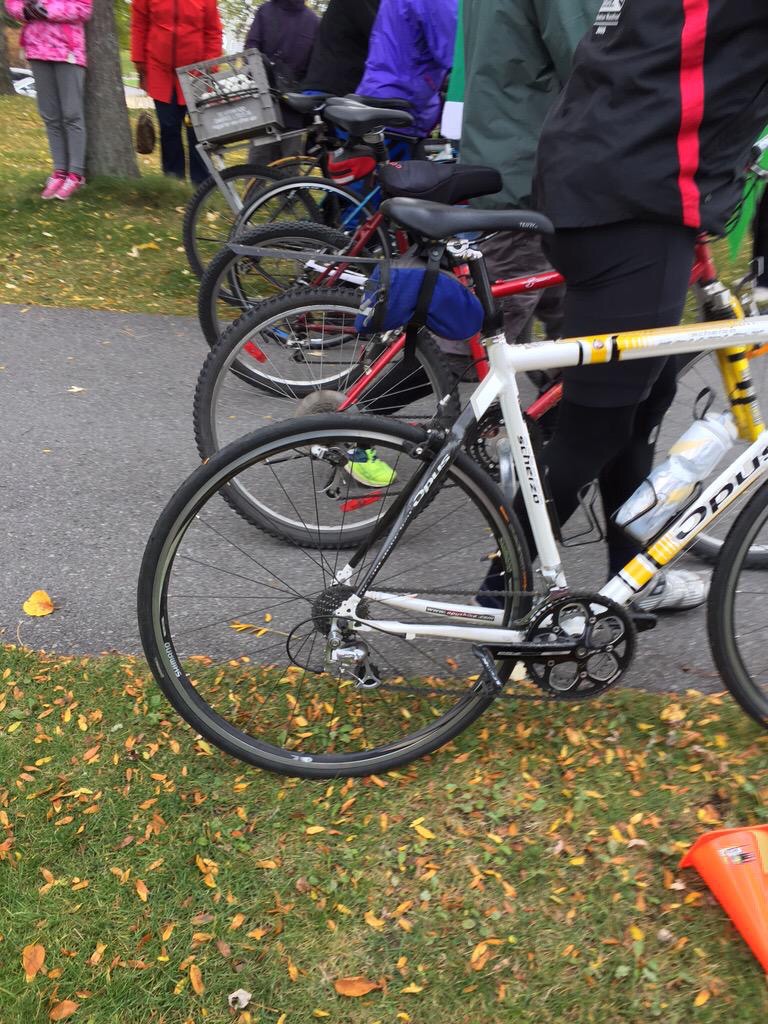
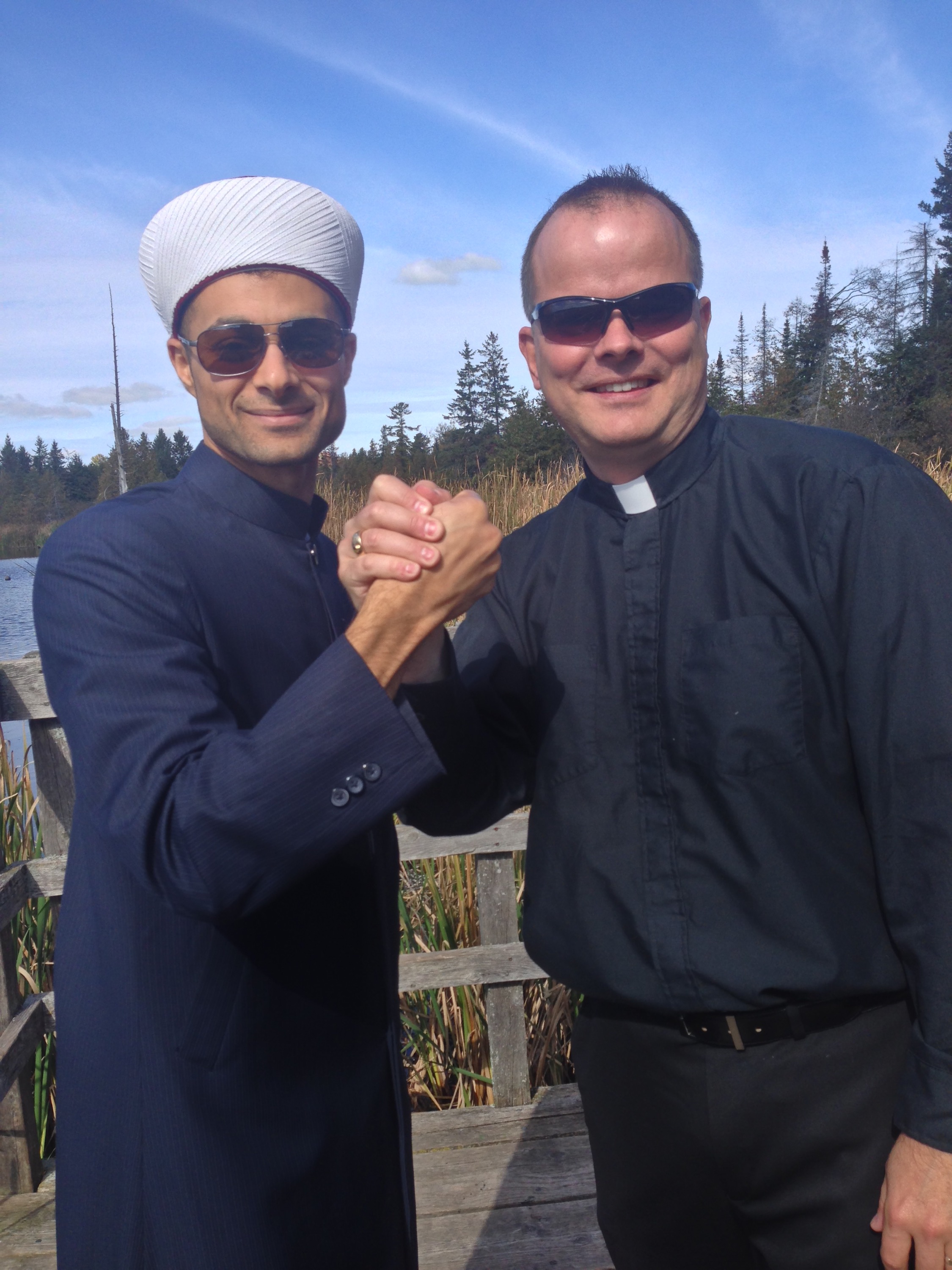
Jesus commanded that we shall love our neighbour as ourselves (Matthew 22:36-40). This commandment motivates me to participate this afternoon in the clerics’ cycling challenge (www.clericchallenge.com), initiated by Imam Mohamad Jebara.

  
Practically, then, what Jesus’ commandment means is that if you love someone, you want to know something about her or him. You want to know who she is, what he values, and how they orient their life. If you love someone, you take the time to talk to him, get to know her, and in so doing, you share yourself as well. 

  
Love shows itself in attention to another, in accepting another on their own terms — yes, and in a willingness to learn something new, to think about things in a new way, and to grow together in friendship and harmony. 

  
When I say Christians are called to love their Jewish or Muslim neighbours, for example, I mean we are called to develop relationships of mutual affection, understanding, and appreciation (Kristin Johnston Largen, “Interreligious Learning and Teaching” Fortress Press, 2014, p.59). Then, we love our neighbour as ourselves, thus fulfilling Jesus’ commandment.

  
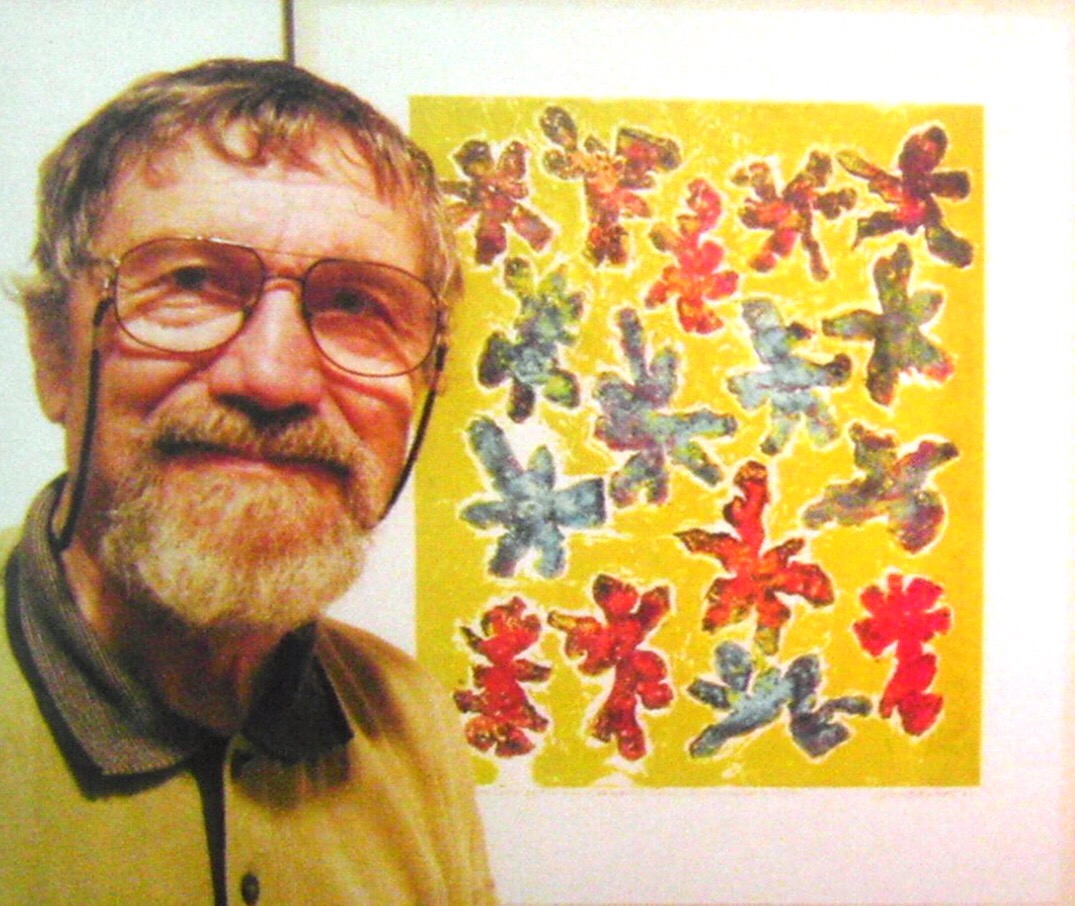
I had the pleasure of viewing some artwork this past week at the Rothwell Gallery on Montreal Road in Ottawa. The Gallery is presenting until October 24th the work of the late Leonard Gerbrandt (1942-2010) who travelled the world and created beautiful impressionistic watercolours and prints especially about the structures of various land and waterscapes. I was given a personal tour by Ute, his spouse, of the hundred pieces or so displayed in the gallery.

  
When we began the tour, she asked me to guess what colour appears and is prevalent in the vast majority of his art. With a twinkle in her eye, she confessed that this particular colour also happened to be his favourite. And so I went to work. At first, I suggested it was the earth tone greens, even maybe the rust, terracotta and orange/reds. No. No. And no.

As we reflected on one specific piece of art I marvelled how Leonard mixed the blues to distinguish sky and sea. Ute smiled, then said, it was blue indeed. I quickly travelled through the gallery looking anew at the paintings. And you know what? It was true! Now, I could see it — blue indeed found its way into almost all his paintings. Why didn’t I see that at first?

Blue, after all, is my favourite colour too (No political association, though!). And then I pondered further why I couldn’t see what had always been my favourite colour. Had I been distracted by the flashiness of other ‘colours’? Did I take ‘my colour’ for granted? What were ‘the blocks’ inside of me preventing me from seeing what was most important to me? Pride? Anger? Fear? Shame? Greed? Why couldn’t I appreciate fully the beauty that was staring me in the face, for me?

Of course, colours would not exist without the presence of light. In fact, it is how the light is represented in a work of art that brings out the textures and hues created by the paint brush. I also believe that art, like music, serves to reflect back to us an inner state — and that is why art and music can be so powerful conveyors of meaning and truth about ourselves and the world at any given moment in time.

The living Jesus is with us, and in our hearts through the Holy Spirit. The love of God propels the Spirit to move us in the the way of Jesus. And yet, we block our sight. We can’t see the light. What are those blocks that keep us from living out of our nature that is being renewed day by day? What keeps us from loving our neighbour? Is it fear of the unknown? Is it a shame that is deeply imbedded? Is it the fire of anger, the pain of regret, the poison of hatred, the paralysis of mistrust?

“Out of his anguish he shall see light” (Isaiah 53:11)

This phrase comes from a larger so-called suffering servant poem from the prophet Isaiah. Christians have read Jesus Christ into the role of the servant even though the text was originally heard among the people of Israel hundreds of years before Christ. The ‘servant’ could refer to the people as a whole suffering in Babylonian exile, or to a specific individual (i.e. Persian King Cyrus /Isaiah 45) who liberated the Israelites and led them home to Jerusalem.

This exegesis is important and we need to tread carefully in working with sacred texts that we share with our Jewish neighbours. We Christians know the sacrifice of Jesus on the Cross for our liberation, indeed for the whole world. Jesus fits the suffering servant-narrative from Isaiah. Let’s work with this.

The anguish Jesus experiences in his suffering and death reflects a God who is fundamentally relational. And God the Father, the Son and the Holy Spirit relates to us in our very own humanity. Thanks to Jesus who showed us the way not just in his divinity but especially in his very own humanity. ‘Anguish’ after all, is a human emotion grounded in love. That is, “to anguish over the loss of a loved one” (online dictionary definition).

Not only does Jesus know our suffering in a shared humanity, he feels for us because of God’s intense love for us. The author of Hebrews is therefore able to describe Jesus as the ultimate high priest, who “is able to deal gently with the ignorant and wayward, since he himself is subject to [this] weakness” (5:2). In short, Jesus helps us “see the light” because of God’s deep anguish-filled love for us. God grieves losing us to our sin, and will not stop short in going the distance — even sacrificing his own life — so that we too will see things as they truly are, in the brilliance of God.

In prayer, 14th century Christian mystic Julian of Norwich reflected the divine stance: “I am light and grace which is all blessed love.” May our words and deeds reflect the light of Christ to our neighbours, in all grace and love.


The happiness trap

In our traditional celebration of Thanksgiving this weekend (in Canada), you may be wondering how to feel thankful when things aren’t going well. When unpaid bills start piling up, when a health diagnosis pulls the rug from under your feet, you are in an accident, or a relationship sours, freezes and breaks off. How can I be thankful?

Not dissimilar from the social expectations of Christmastime, the season of Thanksgiving can bring stress to even those of us whose lives are going reasonably well. Because we presume, do we not, that to be thankful we need to be happy? And to be happy, we need to be living ‘the good life’ when all works out the way I want it. And when it doesn’t….

For example, “if I don’t get that job promotion, I’ll be depressed”; or, “if the house does not sell for the price I want, I won’t be happy”; or, “if I don’t get away to that sun destination this winter I’ll be in the dumps”. We find ourselves in a perpetual state of dissatisfaction.

We are caught in the happiness trap. The striving for which basically guarantees us discontentment and frustration. 

Now, if all we want is to be happy, we won’t grow because we will only attend to those things that we already appreciate and understand. If all we want is to be happy, we assume that we are already where we are supposed to be. If all we want is to be happy, we will stay stuck; we have left no room for growth and development that only comes from some intentional work that might in fact be meant to change us for the better.

If we only pursue happiness, we are constraining the movement of the Spirit of God. That Spirit may want to call us to, and discipline us for, some greater purpose. That greater purpose will not be achieved by just wanting to be happy all the time.

In contrast, I suggest a healthier, more realistic approach: to work toward faithfulness rather than happiness. (Gil Rendle, “The Illusion of Congregational Happiness” Congregational Resource Guide, http://www.congregationalresources.org, 2010, p.4)

Writer Lisa Bendall (lisabendall.com) uncovered a recent Florida State University study which advised not to confuse a happy life with a meaningful one. That is, “happiness is lower in people who have more stress and anxiety, but meaning is higher in these same people.” Which suggests something important about a healthy degree of anxiety and stress in one’s life. Through the lens of Christianity, we can say that ‘picking up our cross’ and following Jesus may not yield a happy lifestyle all the time. But it will result in transformative change in our life that will make a positive difference in the world. Bottom line: It won’t be easy.

The narrow search for happiness focuses only on making things easy. And that is why pursuing mere happiness is a sure-fire way of living a self-centred, narcissistic and meaningless life bereft of making a difference in the world for the better. Show me otherwise in the lives of people who have made an incredible contribution to their communities, nations, society and the world. Were they always happy? Did being unhappy at times deter them from pursuing their values and rich meaning for their life?

“Seek ye first the kingdom of God” (Matthew 6:33) suggests the same. Jesus is not promising us a distress-free lifestyle. Pursue the higher ideals. Take the high road. Don’t give up. If I only wanted to be happy, I’m not sure I’d want to follow Jesus on this earthly journey which must surely go through the Cross. Staying true to oneself, to others and to God means a bumpy ride from time to time.

Here are some tips for this life that is given to us — not just for the placid, calm waters of life. Our baptism means that from time to time the water will get rough. And we need to know how to navigate those waters and stay afloat!

Shortly after Bishop Michael Pryse (Eastern Synod – ELCIC) was elected some fifteen years ago, he made a trip up to the Ottawa Valley, and went white-water rafting on the Ottawa River. Here is what he learned, eight rules; and applied it to life, faith and church:

1. Don’t be surprised if the boat doesn’t go where you want it to go.

2. Rest in the calm places. There will be more white water soon.

3. Never stop paddling. Even when it seems hopeless.

4. If you get into trouble… DON’T panic.

5. If you go under, let go of everything. Eventually you will come back up.
6. Someone needs to call out the orders. It works better that way.
7. White water is what you came for. Enjoy it.

8. Everyone paddles furiously to get somewhere, but ultimately it’s the current that takes you downstream.

Ultimately, trusting in the grace of God will get us there. Which means, does it not, that even if we are limited in whatever way, even when life is not perfect and things don’t work out for us, we can still fulfill our purpose and find meaning in our faith? Keep paddling! Do what you can, because we really don’t have anything to lose.

Last week when I attended the meeting of Deans in our Synod, Bishop Pryse shared in his closing comments a word of inspiration from Thomas Merton — a quote he has displayed in his office:

You may have to face the fact that your work will apparently be worthless and achieve no results at all, if not perhaps results opposite to what you expect. As you get used to this idea you start more and more to concentrate, not on the results, but on the value, the rightness, the truth of the work itself.

And this, I believe, brings something more than mere happiness: enduring contentment, meaning and peace in one’s heart.

May your Thanksgiving celebrations encourage you in the value and meaning of the gift of  your life.

Community of the broken and blessed

This Sunday I will use the words of David Lose, in his fine reflection on the Gospel assigned for this 19th Sunday after Pentecost in the Revised Common Lectionary (Mark 10:2-16).

He suggests that Jesus’ difficult words here are not so much addressed to individuals as they are to a community that is broken and blessed. These words are not about divorce per se but about the law and under what circumstances it was applied.

Finally, these Gospel words are not so much about matters of the law, but about relationships of mutual dependence and health. He welcomes children, thereby painting a vivid picture of this kindgom community. This is a community comprising of relationships whose purpose is to be honest about our vulnerability, and whose mission is to protect the vulnerable.

Please visit his blog for the full text: In the Meantime

Wise speech is a prayer

My parents, now retired pastors, have been ordained many years in the Evangelical Lutheran Church in Canada and the Polish Lutheran Church. My mother told me that not once in her long years of work did she choose to preach on the second lesson for this Sunday in Ordinary Time — the 18th Sunday after Pentecost — James 5:13-20. 

So, curious, I went back in my online archive of sermons to see if had. And to my surprise, I discovered that I now have preached two sermons in a row based on this text. The last time in the lectionary these texts appeared was three years ago in September 2012; and here we are three years later focusing on it again!

Why so? I asked myself. Many possible reasons likely. Not to mention the lectionary group here at Faith chose to reflect on James — yet again! Could it be, underlying this desire to look at James is the church’s need today for some practical advice about how to live the Christian life? Could it be, that the church today needs basic guidance about how to live as a Christian would in today’s world?

When we think of all that we say, all the airtime we populate with our words, how much of it would we consider ‘wise’? It is important to ask this, since one of the major concerns in the Book of James is our speech (Mark Douglas, Feasting on the Word Year B Vol 4, eds. Barbara Brown Taylor & David L Bartlett, WJK Press, 2009, p.112). And, it’s not so much what we say but how we say it — in the context of the relationships involved. This, indeed, requires great wisdom. So, I ask again, how much of what we say would we consider wise?

My guess is, not much. When we think of all that we say that is hypocrisy — that doesn’t really coincide with the choices we make, the lifestyles we lead. When we think of all that we say that only ends up hurting others …

When wise speech happens, it is truly a holy event. This is speech that communicates truth and honesty. This is speech that reveals vulnerability, expresses compassion, tenderness and authenticity. This is speech that is wise. And wise speech is then a prayer in God, with God, to God.

And, it is not only spoken to the ceiling. Because prayer is fundamentally a public act, not a private affair. One of the unfortunate victims of the Reformation period  — which launched the Enlightenment and Industrial and Scientific Revolutions of the modern era — was that Confession was relegated to a lower place in the value systems of religion. As a result of these modernizing developments which heightened the importance of the individual in religion, prayer was reduced and confined to words spoken to the air in our private lives.

In contrast, Confession is about speaking honestly the truth of our lives to another and with another. Confession is wise speech which brings healing and wholeness, when another ‘in the flesh’ can hear the truth and respond with guidance and in love, mercy and forgiveness.

And what we do every time we gather to worship, is pray. We pray in all the parts of the liturgy. Whether we are celebrating the sacrament of the table, whether we are listening to the sermon, whether we are singing a hymn or ‘saying’ a prayer — we are praying! Including the Confession of sins, and the pronouncement of forgiveness.

It is true — the church needs basic guidance about how to live as a Christian would in today’s world. I emphasize in today’s world because sometimes I don’t think we realize how decidedly unChristian this culture of ours is. And I don’t just mean the fact that we live in a multicultural, ethnically and religiously diverse society. But also, even in the institutional church, in our own lives, our lifestyles, our common sense assumptions about how to live our lives and the values we espouse: our attitudes towards competition, financial security, self-defence, self-righteousness, financial-material selfish gain, etc.

Perhaps it is time for the Reformation church (including Lutherans) to let go of the split we have created between grace and ‘works righteousness’. It is not all ‘cheap’ grace on the one hand; nor is it all work, on the other. In truth, it is a lot of work and practice to remain fully open to underserved and unmerited grace (Philippians 2:12-13). Because we will rush, if unawares, to make it all about our hard work. Just work harder!

At the same time, as Cynthia Bourgeault writes (in The Wisdom Way of Knowing: Reclaiming an Ancient Tradition to Awaken the Heart, Jossey Bass Publishing, 2003, p.10), “those willing to bear the wounds of intimacy, the knowledge of that underlying coherence – in which all things hold together – is possible.” To let go of the compulsions that keep us captive and stuck in patterns of life that are ungracious, untrue, unhealthy. To commit to the work and sacrifice of being true to self, true to neighbour and true to God. To practice confession and honesty with another. To accept the forgiveness, mercy and love of God and to receive it fully and know peace.

Could it be deep down we know it but are afraid to address and embrace it: the values of God in Christ Jesus are meaningful — they make for great, wordy and pious statements in church groups — yet clash with what we do and what we actually say to one another?

The Furious 7 movie which was Paul Walker’s last before he died shortly after filming the movie, ironically, in a car crash, highlighted for me this hypocrisy. In the extended version which I assume was edited after his death, there is a beautiful scene on the beach where Paul Walker’s character and family are gathered. His friends watch on as he plays with his young child and pregnant wife at the water’s edge. One of them remarks how what is truly important in life is not the thrill-seeking, high-octane, ego-satisfying selfish pursuits, but his relational world of love and family which endures forever. In contrast to the explosive, sensational content of the film up to that point, this affirmation of family living in love is rich in meaning and truth.

I commented in my slightly cynical mood after the movie that I didn’t think the Fast & the Furious franchise would have grossed the hundreds of millions it did if it made movies solely about family and love. It seems we want to acknowledge what is true and right, but only after we first can serve our own fixations and compulsions ‘for the thrill’.

Another TV example: Did you notice how the Amazing Race Canada presented the final words of the father and daughter from Africa — newly arrived immigrants, when they were eliminated before the final round? They were the victims of unfair play in that second-to-last leg of the race; other teams cheated on them by stealing their taxi not once but twice, if I remember correctly. 

And then, as the host John invited them for some closing remarks on the elimination mat, all of them spoke beautiful tear-wrenching words about the fair, generous nature of Canadians. It seems only the losers have something meaningful to say. Only when we suffer loss do we discover the truth of our lives. Now, we are getting uncomfortably closer to the whole point of our Christian faith and what it means to follow Jesus.

As I wrote three years ago, in James’ concluding chapter we encounter vivid images of prayer involving the laying on of hands and the anointing with oil. Prayer is a public act that invades the space of individuals and pulls us to be in the space of one another. Prayer is inherently relational. It gets down and dirty in the bodily reality of our lives, one with another. It is about touch and sensation as much as about the mere words we speak. Prayer is not my time, it is our time for the sake of the other.

Maybe I chose to preach on James 5 two times in a row because the Gospel associated with this text is about Jesus instructing us to cut out our eyes or chop off our hands if they caused us to sin (Mark 9:38-50). And I just didn’t want to go there! These are difficult words to ponder. Jesus concludes by using the image of salt to define the Christian life: something with an edge, that adds flavour. God forbid you lose your edge, your flavour! Jesus counsels us to have saltiness in our lives as a way to “be at peace with one another” (v.50).

Perhaps the way of Jesus will be tough and difficult building bridges of reconciliation. And yet, his last word to us today is a blessing of peace. The Book of James began with an address to those who are “dispersed” (1:1). James continues his letter to address the divisive consequences of an “unbridled tongue” (3:6ff) and considers the reasons for the “conflicts and disputes” among the people of God (3:4). James’ letter acknowledges the inherent splintering of our lives.

His letter in chapter 5, however, ends rather abruptly. Perhaps to indicate that there is no easy answer to the disconnections of our lives. Perhaps also to remind us that though wise speech is indeed a gift from God in the world so full of sin and death, we will still pray. And through prayer that is public, we will continue to engage the world in hope for a time when what has splintered can be reunited.

Slave to none, servant to all

Especially at the beginning of a new school year, the gospel story of little children sitting on the lap of Jesus warms my heart. This saccharine image speaks to Jesus’ welcoming the children as we would welcome them to church and the start of a new year of Sunday School programming. 
We tell ourselves, “So should we be towards the children, like Jesus was.” Or, “We should be like the children.” Here perhaps lies the genesis of any motivation and focus of children’s ministry in the church. This act of Jesus witnessed by the bible’s words becomes our authority for action.
Indeed, the Gospel text for this Sunday (Mark 9:30-37) is about God’s view on power and authority. How does authority work, in the kingdom of God? What does it look like?
And it is here, admittedly, we Lutherans get into trouble. We say that authority for a congregation in the Roman Catholic Church is the Pope. We also say that authority for a congregation in the Protestant tradition is the Bible. For Lutherans, it is a former pastor! 🙂
This Gospel story is more about Jesus’ stance vis-a-vis the powers-that-be in society. This is revolutionary and counter-cultural. He makes irrelevant the political-economic-cultural pecking order, as far as the kingdom of God is concerned. The root of the Greek words “servant” and “child”, spoken in the same breath, is virtually the same (pais/paidon); on the basis of vocabulary alone, those who first received this story were principally hearers and not readers. Mark’s Greek-speaking audience would have made the close connection between servant and child. Neither had any real social value.
Therefore, this story describes more a stance towards people in general, an attitude and approach for relating to those who do not have power, who are of particularly low social status. Contrary to what the economic and political powers espouse, Jesus assigns worth and importance to every person (Sharon Ringe in Feasting on the Word Year B Vol 4 eds. David Bartlett & Barbara Brown Taylor, WJK Press 2009, p.97).
This is no longer a sweet, warm-fuzzy message as much as it is a direct stab at our social hierarchy of values. And the disciples know it, deep down in their hearts. But they are afraid. In their silence, they betray their weakness and fault in not ‘getting’ Jesus nor willing to ‘go there’.
Jesus didn’t come to pander to power. He didn’t come to play the game. He didn’t come to compete in the smorgasbord of religions in the first century Palestine. He didn’t come to prove that he is right and everyone who doesn’t agree with him is wrong. 
He came to show that God loves everyone, including the lowly servants and children.
Jesus came to turn on its head the regular way of thinking about power. He lifted up children and servants as those who receive the grace and love of God, not just those deserving it because they happen to be higher up on the social pecking order. 
We know how Jesus’ earthly story goes. Jesus was a victim of his ministry of unconditional love, compassion and healing. And how did that go, for Jesus? The Cross. To say he was misunderstood is an understatement. Even his closest friends didn’t understand, or were too afraid, to face the truth of their hearts.
Perhaps we may take from this some measure of comfort, in tough times. For example, if you are ‘thrown under the bus’ by your closest friends, when you are misunderstood, when you are derided and put down for trying to do right, maybe you are indeed on the right track?
On the other hand, when you become puffed up in your righteous defence of the status quo of your life, when you engage in defensive, combative and competitive stances against those who differ — then, well, how is this the way of Jesus? It is not. It is a way, to be sure, heralded by the prevailing culture of human achievement, reputation-defending self-righteousness, one-up-man-ship and glory, yes. But far be it from being the Christian way.
We are asked by the Gospel message to examine our relationships with those in society with little economic or social value. How is our relationship with the physically disabled, the mentally ill, the refugees and newcomers to Canada, young people without direction, those who live on the streets, the poor, the Indigenous people of this land? 
I listened recently to how a graduating university student was deciding which job to take. Upon graduation he was offered a high-paying job from two different well-respected companies at the same time, one in Chicago and one in New York. The student sought advice from his pastor.
“Which job should I take?” he asked. “Both offer similar compensation. But I’m torn as to where I should go — Chicago or New York. Both have pros and cons. What do you think, pastor?”
The pastor hesitated, for a moment. Then he said, “It’s wonderful you have been given the privilege of a job offer. Many young people today don’t have one, let alone two. You are very fortunate.”
“Yeah, right,” the student responded. And quickly added: “But where should I go?”
“I really don’t know,” the pastor mused. “Does it matter?” It’s usually at this point in the session that people realize why pastoral counselling is free. 🙂
I think we tend to lose energy, even waste it, on these kinds of first-world problems. After all, the truth is there is no place we can go, no decision we can make that is out of the reach of God’s grace, love and healing (read Psalm 139). Where there is a fork in the road … take it! 
In most, if not all, of our dilemmas do we acknowledge that no matter what we decide, even for less-than-stellar motivations or for high and righteous ones, God will not abandon us? Because God’s grace will not come up short, ever.
In the end, the Gospel story of Jesus welcoming little children comes to us not a word about how we should act. It’s not primarily about us serving others. Rather, the Gospel is about Jesus serving us.
Jesus asks each of us: How can I serve you? Jesus reflects God’s favour towards us, and all people. Jesus will not do what we so regretfully and naturally fall into — a tit for tat food fight with whatever first-world problems we wrestle, about which we complain, and over which we fight for ‘the advantage’. That’s not what Jesus is about. 
At the same time, Jesus will not stop at our human divisions. If you are at the bottom of the ladder, Jesus will come to you. If you are at the top of the world, Jesus will come to you. Jesus will make the ladders of our lives irrelevant. These ladders of success, upward-mobility and power are nonsense in the kingdom of God. Jesus comes to us all, and asks us — “I will welcome you and serve you. What do you need today, in order to follow me?”

The life-giving gap

Does a spring pour forth from the same opening both fresh and brackish water?” (James 3:11)

The writer, James, makes a case for integrity and authenticity in the Christian life. For us moderns, living in a day and age where how we look, our reputations, our social standings and our bank accounts seem to speak louder than anything else about who we truly are and what we truly want. Is our joy at living based on these ‘worldly’ values, when we are honest about it? 

It becomes particularly challenging for us Christians, whose value system is acutely counter-cultural. It becomes a real war, actually, to embrace the true source of our lives in a world of celebrity politicians and glory-seeking suburbanites. And I think, for the most part, we live a bifurcated existence. We say one thing — I believe in the God who asks us to bear our cross and follow him (Mark 8:34) — but so easily slip into a lifestyle that is really narcissistic, self-centred and selfish. The easy way.

It’s a rhetorical question. “Does a spring pour forth both fresh and brackish water?” In James’ mind, of course not. A spring will either bring forth, on balance, mostly fresh or mostly dirty water. The meter will lean one way or the other. 

Which way do you lean? In your work? In the way you invest? In how you spend your money? In how you spend your free time? With whom? In what and how you communicate?

In the Gospel for today (Mark 8:27-38), Jesus says some difficult, counter-cultural things about what kind of way Jesus — the Lord of Lords, the King of Kings, God incarnate, Almighty and Everlasting God — will travel the journey of life. And it is this God who beckons us to follow: in order “to undergo great suffering” (Mark 8:31). Really? That doesn’t sound right for a person claiming godly power!

In an upwardly mobile culture we are suddenly and shockingly presented with a downwardly mobile God. Naturally and understandably, through the lens of worldly value, we shudder. Peter rebukes Jesus. And it is in response to Peter’s communication that Jesus accuses Peter of being Satan.

The first lesson from Isaiah, the third chapter in the Epistle James and the Gospel reading for today are a call to discipline our speech — how we talk, and for what purpose. I would broaden this to say: How we communicate. The words we use. The body language we employ. They say that 70% of communication is non-verbal. I believe this truth is what prompted Francis of Assisi to say: “Preach the Gospel; Use words only when necessary!” It’s a cliche, but it’s true: Our actions speak louder than words.

We are called to pay attention not only to the words we use — important though they are, but our actions, our tone, our presence with another. We are called to pay attention to these details in assessing the quality of our relationships. Not to do so, to ignore and dismiss our attention to these aspects of relating, is evil. Not to hold ourselves accountable to what we say and how we say it to another is a satanic time-bomb waiting to happen.

The eighth commandment reads: Do not bear false witness against your neighbour (Exodus 20, Deuteronomy 5). This means, what we say about them. Of course, first we have to look around and ask: Who is our neighbour? On Meadowlands Drive West, in Nepean, Ottawa, and in Canada. Who are our neighbours today? Do we know their names? Who are they? And then, what do we say about them, to them?

In his explanation of all the Ten Commandments, Martin Luther makes clear these are not simply about ‘not-doing’ — not gossiping, not slandering — but even more important what positive behaviour we do for the sake of the neighbour. He writes that it is imperative that Christians should do all they can to protect the good name and social standing of their neighbours — and he lifts up particularly the “sins of the tongue” in this context. (Martin Luther, “The Large Catechism,” in the Book of Concord, ed. Robert Kolb & Timothy Wengert, Minneapolis: Fortress Press, 2000, p.420)

I can’t help here to think of the millions of refugees fleeing the violence in Syria. I can’t help here but think of the many ways Muslims are disparaged in the media in the West not only in the press, but also in those malicious forwarded emails that circulate “like a hydra with multiple heads: so pernicious and so difficult to stop” (Kristin Johnston Largen, “Inter-religious Learning and Teaching” Fortress Press, 2014, p.57).

James concedes to our human predicament. In the end, no matter how hard we try to do right by this, “no one can tame the tongue” (3:8). It’s as if the narrative of Scripture accepts the impossible capability of us, on our own, to get it all right all of the time. Even though Peter is in one moment ‘Satanic’ he is, in the next, the rock upon which the church will be built against whom “the gates of Hades will not prevail” (Matthew 16:18). Martin Luther’s well-known paradox can help us frame this apparent contradiction: We are simultaneously saints AND sinners (simul justus et pecator). 

This ‘word’ today may make us feel uncomfortable. It does, me. And, probably for good reason. Yet, there is good news. God speaks into this confused darkness of our lives. God speaks the Word of creation into this murky existence (Genesis 1). A Word of forgiveness, mercy and compassion. 

And the Word that God speaks sets up the endless harmonic of sounds in the world. And as we speak, and try to speak truthfully, perhaps what we are doing is far less hanging labels around the necks of the things of the world. And instead we try to find those divine harmonics and speak and act ‘in tune’ with that Word first spoken into silence and darkness.

The image I like of creation is that God first makes a great cave. And then breathes into it. Speaks into it. A Word. And from the cave the echoes come back. Differently pitched. Differently aimed. A world of Word. And we find our place in that world listening to those harmonics, trying to speak and act in tune with them. Not to speak and act from our will or our passion for control. But to speak because we want to join in what an earlier generation would have called the ‘music of the spheres’. (Rowan Williams, “The Spirit in the Desert” Meditatio Talk Series 2015 B Apr-June CD).

Those of us preachers and public speakers, especially need to think more about this. Paul says that the Body of Christ is made up of all parts, each important in their own right (1 Corinthians 12:12-27) — you are a hand, you a leg, you the eyes, you the foot. This morning, I am the mouth! And, like James, Paul also says that greater scrutiny and possible judgement will be brought upon those who speak (2 Peter 2:3;Colossians 2:20;1 Timothy 1:2-4). A timely word, perhaps, in a season of political campaign, mindless rhetoric and questionable election promises.

How do we speak in such a way that is authentic and true? Only by looking for the harmonics that that Word of God sets up. By refusing the mass pressures of culture. By becoming in our speaking as in our living a kind of invitation into the gracious harmonics of God’s world, into the resonances and echoes that are set up by that primordial utterance of God into the cave of creation.

Simone Weil used the concept of ‘hesitation’ to describe how to communicate in a healthy way For her, part of the essence of spiritual maturity was leaving the ‘life-giving gap’ between you, the act, and the other person (quoted in Rowan Williams, ibid.). Learning not so much to project straight away our ego compulsions into the other person; learning not so much to move right away into solving a problem on our own terms. But drawing away momentarily to listen for the sake of the other. And for the sake of the truth.

At the end of the day, we are called to check the compulsion to speak. And move back into a momentary stillness into which God’s draws us, and out of which God calls us to speak and to act with integrity and authenticity.

We would make James proud.

Changing your mind on faith

This past week I was finishing up on my monthly calls to shut-ins and those who are not easily able to attend worship services here. And it was in a couple of conversations where I felt particularly moved. Of course, I am not mentioning any names or specific circumstances.
“Sometimes I wonder if I have enough faith,” said one.
“When is it that you feel that you might not have enough faith?” I asked, prompting further: “What kinds of things are happening when you think you might not have enough faith?””Whenever things are not going well for me. When I’m suffering, or in pain. When it hurts. When I’m afraid that the worst will happen.”
Speaking Lutheran to Lutheran, I mentioned that the 16th century reformer was an anxious person. Martin Luther was terrified, for example, of dying. “I think that’s probably very normal,” I said. “Even people we consider giants of the faith, were afraid and scared especially when they thought they were going to die.”
Our conversation continued until we concluded that to have faith was not apart from all that scares us or causes us suffering and pain. Faith happens inspite of the difficulties of life. The challenging circumstances of life don’t define and determine our faith or lack thereof; Our faith or lack thereof is expressed amidst the realities of living.
“Faith is real only when we face and embrace the suffering of our lives.”
And it is here that we encounter what Jesus is getting at in the Gospel text today: We are not harmed by what comes from outside of us — including difficult circumstances — but by what is going on inside of us: what we think and say (Mark 7, James 1).
I like the more positive way the Deuteronomist expresses the same lesson — this to the Israelites entering the Promised Land: “Take care and watch yourselves closely, so as neither to forget the things that your eyes have seen [that is, the great acts of God to free the people from slavery in Egypt and sustain them through the desert wanderings] … nor to let them slip from your mind all the days of your life…” (Deuteronomy 4:9). Don’t forget! Don’t forget who and whose you are! Because what we do comes straight from what and how we think.
If we are honest, this life can take a toe-hold on our imagination — with values, goals, material aspirations and selfish projects that affect our way of thinking. I would add, cultural values that lead us to conclude that only if everything is perfect in my life — no pain, no tears, no suffering and lots and lots of money — then and only then can I have faith, believe in God and be active in my faith.
The Gospel message of Jesus Christ enduring throughout human history is all about a renewing of the mind — embracing a whole new way of thinking. Paul expresses this in one of his letters to the early church: “Be renewed in the way you think …” he counselled the Ephesians (2:23). Because often the way we think — our attitudes and opinions — are downright unhelpful and evil. “All these evil things come from within,” Jesus warns (Mark 7:23).
Sometimes we hold on to our opinions as if they were sacrosanct even though they may be unhelpful. But have we ever really examined our opinions? We often look down upon others (and ourselves), and dare I say politicians, who ‘change their mind’ about something or other. Waffling, we believe, or changing our mind about controversial subjects especially, is bad and suggests a weak personality. And yet God, even, changed his mind about bringing disaster upon the people when Moses and other prophets engaged God in passionate debate (eg. Exodus 32:14). If God is able to change directions, could we not too?
To change our way of thinking to be less self-centred and more other-centred.To change our way of thinking to find meaning more in serving others than serving self.To change our way of thinking about doing something good not out of fear or shame but more out of a heart filled with compassion.
“Once upon a time a king was strolling through the forest and he saw an old man, a poor man, bent over a furrow. He walked up to him and saw that he was planting seeds for chestnut trees. He asked the old man why he was doing it and the old man replied, ‘I love the taste of chestnuts.’
“The king responded, ‘Old man, stop punishing your back bent over a hole in the ground. Do you really not know that by the time even one of these trees has grown tall enough to bear nuts, you may not be around to gather them?’
“And the old man answered, “Your Majesty, if my ancestors had thought the way you do, I would never have tasted chestnuts.'” (Juan Gomez-Jurado, God’s Spy, Orion Books, Great Britain, 2007, p.164-165)
I had another inspiring conversation this week with someone who is caring for a loved one suffering with illness. She decided to invite some friends struggling with similar challenges over for a meal. These friends, especially, were down and depressed about their mutually-shared, tough circumstances.
And yet, over the tasty meal and dancing to music and laughter, something shifted in the climate of the meeting. The next day, the host received an email from one of the friends who visited: “Thank you for your generosity and love. I was so encouraged by the visit, that when I returned home, I changed into my gardening clothes, went outside to the front yard and trimmed the bush that had gotten way out of hand.” It was like the fearful, anxious, angst-ridden Martin Luther who said that if he knew the end of the world was going to happen tomorrow, he would still go out and plant an apple tree today. Now, that’s faith.
Here’s my confession today: Often I wonder whether it’s even possible. Whether we can change our minds towards God and God’s ways in Jesus Christ, no matter what circumstance of life in which we find ourselves. Sometimes I doubt that our minds can be renewed into the likeness of Jesus when we are sick, when we feel destitute and deprived, when things don’t go our way. When times are tough, we often knee-jerk into old, often destructive patterns of thinking. Will we, indeed, have enough faith, to see things differently and not despair?
It is here when, despite how I feel, I affirm a faith that says: No matter what you think, Martin, no matter what anyone else thinks, God will not forget you. Even if I have a lapse of memory and forget who I am and whose I am, even though our minds may go completely, this is the promise of the One who created us: “I will not forget you; I have inscribed you on the palms on my hands” (Isaiah 49:15-16). Because of who God is, I can therefore act boldly on a way of thinking that is based in trust. Trust this loving God who will not let go of us. Ever. And no matter what.
Thanks be to God!

Part B

I don’t have many bad memories from my youth. But recurring is one from exam time in highschool. This memory brings back desperate feelings of failure, despair, and shame. The exam was for a history or English course. And it was only a one-pager!

I recall sitting down in the large gymnasium at the start of the exam period looking down at the simple Part A question, and thinking to myself: ‘I got this one in the bag!’ Instead of writing my answer down on that page underneath the question, I wrote down about five pages on extra sheets I asked from the exam moderator. Usually, I took the entire allotted time to write my exams. I remember, however, with this one I finished much earlier.

After checking over my in-depth and complete answer, feeling satisfied and even smug with my work, I signed off on it and left the room with a hop in my step. I felt confident that I had performed to my usual high level of competency in a subject matter that I liked.

You might imagine the horror I felt shortly thereafter when I learned from others why it was that I happened to finish so early.

“Martin,” a friend asked me, “What did you write for the Part B question?”

“Part B?!!”

“Yeah, on the second page.” 

Alas! The one-pager was double-sided. I didn’t think to turn the question sheet over to do Part B. I had only completed the first half — Part A — of the exam. I didn’t finish the entire test. I. Was. Doomed.

In the Gospel for today (John 6:51-58), Jesus uses carnal language that borders on the cannabalistic. “Eat my flesh. Drink my blood.” What are we to make of this arresting, vivid, corporeal language?

Well, the Pharisees have an answer. But theirs is the usual mind-tripping, logical finagling. They take everything literally! “How can this man give us his flesh to eat?” they ask. This style of intellectual, rational mind-gaming is reminiscent of when earlier Jesus spoke of being born again — and again the Pharisee Nicodemus gets trapped in his head: “How can a man go back a second time into his mother’s womb and be born again?” (John 3:1-4).

The Gospel of John and especially this text (6:51-58) evokes images of ingesting, chewing, and gulping — and relates this to our relationship in Christ Jesus. Language like this pervades the Gospel, right from its inaugural, tone setting words: “The Word became flesh” (John 1:14).

The Word is not just a doctrine or idea. The Word is not just a mental picture that we frame with rational explanations, logical arguments and eloquent words about Jesus. That is only Part A.

There’s a Part B that needs to be completed in order to get at the fullness of truth of Jesus relating to us and the world God creates. When we talk of Christian theology and even Christian discipleship, we must go beyond saying: “Let’s follow Jesus” or merely have conversations about Jesus, or think about Jesus, or construct nice ideas about Jesus. 

We must learn to confess that Jesus not only wants our thoughts, Jesus wants all of me/us — every aspect of our lives including our bodies, our exercise, our diets, our play, our work, our relationships. Jesus wants more than our Sunday mornings. He wants Friday night and Wednesday morning as well. A local church had this message on their front-lawn sign last week: “Jesus doesn’t want weekend visits; he wants full custody.” 

Worship is only Part A. Part B is when we walk out that door when worship is over. If our prayers and songs and statements of faith during worship on Sunday morning — as glorious and uplifting and inspiring as they may be — do not translate into meaningful, concrete action consistent with our faith Monday through Saturday, then our worship is really, in the words of Saint Paul, “a noisy gong or clanging cymbal” (1 Corinthian 13:1). The Psalmist confesses to God: For you have no delight in sacrifice; if I were to give a burnt offering, you would not be pleased. The sacrifice acceptable to God is a broken spirit; a broken and contrite heart, O God, you will not despise. (Psalm 51:16-17)

“People often daydream, and even share their fantasies, about what they would do if they won the lottery. Still, most people choose to keep their money in their wallet. In response, lotteries south of the border run commercials reminding us, ‘You can’t win if you don’t play.’ In a sense, Jesus is saying something very similar: ‘Unless you eat the flesh of the Son of Man and drink his blood, you have no life in you’ (v.56). In these verses, Jesus demands more than intellectual assent, more than fantasies of eternal life. Jesus asks for high-stakes, all-in participation, here and now.” (Sundays and Seasons, Augsburg Fortress, 2014, p.261) Jesus wants all of me. Part A and Part B.

I still passed the course, both because I did well during the term on assignments and such; and, because I passed the exam with a 50% score. Even though I messed up and had my blinders on, even though I did not complete the expectations of the exam, I could count on the grace of the instructor.

You see, I did not get a perfect score on Part A. Close, but not perfect. I should have therefore failed the exam. But the instructor knew me. Knew me well. And she knew I deserved to pass the grade. Despite my mistake, I still got credit for the course.

Where there is suffering in the real world. Where there is blood spilled and bodies broken. Perhaps it did take the Christian movement some centuries to work through their natural repulsion against the unadorned cross — an instrument of torture and death — to finally embrace the Cross as the central symbol of our faith. Because there is an important point to it.

That is where Christ is, in our lives and in the world. And it is there that we must go to find Jesus in the faces of those bloodied by war, by displacement, by injustice and violence — in whatever kind. It is there that we must go to witness by our giving and our own brokeness the truth and hope of the Gospel. It is there that we must go. The life stronger than death that God gives to the world in Jesus Christ always comes to us “in the flesh” and blood sufferings of the present time. It is there we must turn the page, and go.

Part B.
Lord, you have searched me out; O Lord, you have known me. You know my sitting down and my rising up; you discern my thoughts from afar. You trace my journeys and my resting places, and are acquainted with all my ways. Indeed, there is not a word on my lips but, O Lord, know it altogether. You encompass me, behind and before, and lay your hand upon me. Such knowledge is too wonderful for me; it is so high that I cannot attain to it. Where can I go from your Spirit? Where can I flee from your presence? If I climb up to heaven, you are there; if I make the grave my bed, you are there also. If I take the wings of the morning and dwell in the uttermost parts of the sea, even there your hand will lead me and your right hand hold me fast. (Psalm 139:1-10)


Amen.