Turning into the wind

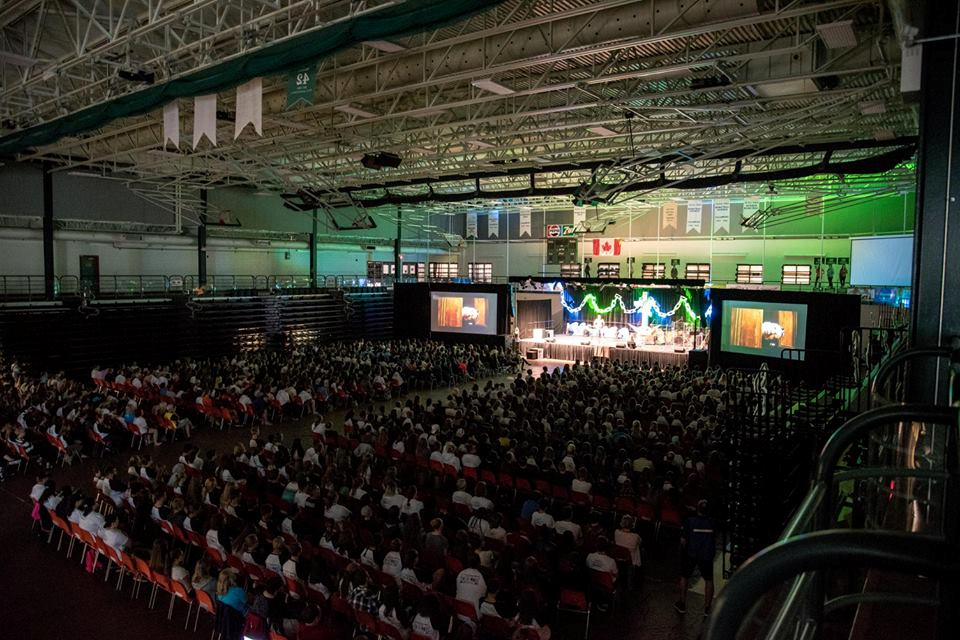
We were just down the street from Pearson International Airport in Toronto. Late in the evening after the first day’s sessions at the Synod Assembly last week, I walked along Dixon Road which goes right to the airport. 

At one point on a bridge you can stand directly underneath the path and roar of landing planes. You look west in the direction of the landing, and you see the long runway lighted brilliantly for the descending jets touching down. You look in the opposite direction towards the east, and you can see a long line of planes taking their turn in the landing rotation, the dots of their lights extending in a straight line far into the distant sky.

It was a windy day, the gusts reaching over 50 km/h from the south. What impressed me was how each plane’s nose was turned slightly to the left, towards the south, as they made their final approach. The planes were coming in on a straight line, yes, but turned towards the wind in order to keep their landing true. At the last second before touching down, the jet would straighten out.

Wind, like currents in the water, is a significant if not main factor in affecting the flight or sail of the airborne or water craft. In order to land safely and soundly, the planes had to face the challenging issue head on. In the words of Paul in his letter to the Galatians, the problem must be “detected” (Galatians 6:1) and exposed. 

You will get nowhere in a plane or boat unless you ‘dance with the devil’ so to speak. Unless you look your problem square on, face it and name it, and change your position accordingly. If the landing planes insisted on keeping their plane aligned straight on their approach, they would not have made their landing on the runway, but somewhere to the north of it!

Our guest at the Synod Assembly, Bishop Munib Younan (president of the Lutheran World Federation) spoke of Lutheranism. He warned us, that in these Reformation Anniversary years, we do not celebrate ourselves. We do not pretend that God couldn’t have done anything good without us. We are not the perfect church, but always reforming.

Being Lutheran, he said, is a call to humility, not a spirit of triumphalism. We dare not make an idol out of Martin Luther or his legacy in us.

Paul strongly exhorts the Galatian church to proceed with one another in humility and gentleness, not lording it over others who are ‘sinners’. Because we ourselves are no better. We must learn to face our own demons. This is what is meant by his words: “All must test their own work … for all must carry their own loads (v.4-5).” We dare not point fingers without first acknowledging our own stuff.

This is then, how we bear one another’s burdens. Amidst the conflict wreaking havoc in the early church in Galatia, Paul encourages the people to persist in not losing heart, to have courage and not give up.

As the Gospel text for today describes (Luke 10:1-11), the work of the church doing God’s mission in the world will result in friction and struggle. You cannot follow Christ and not encounter conflict and adversity in your life. 

The famous Psalm 23 so often associated with bringing comfort and evoking peaceful, calming images includes this disturbing verse: “You prepare a table before me in the presence of mine enemies” (Psalm 23:5). It feels like this verse doesn’t belong beside still waters and green pastures along paths of righteousness. But it does belong! It means that God gives us the gift of grace in the presence of all that challenges us, all our demons internal and external, everything that we may not like in our lives — not apart from it.

Paul concludes his letter to the Galatians by focusing our attention on the cross of Christ (6:12,14) — the symbol of death and suffering of a God who goes the distance to love us. This is the only reality about which to “boast”. Why?

There is a treasure in the midst of the suffering. We may not see it right away. Yet, our struggle does yield something good, something meaningful, something liberating. Yes, we are liberated by God’s grace. 

Liberated however not by ‘nicey-nicey, goody-goody’ — a phrase our Bishop Michael Pryse used at Synod to describe an approach to church life that just keeps us stuck. Liberated not pretending to live a charmed life. Not by everything working out perfectly. But liberated through what may be a terrible suffering, a loss, the very pain that would otherwise destroy a person altogether. There is a treasure therein.

That is why we boast of the cross, and nothing else. How can God be found in the painful letting go that marks the various stages of life? How can we even sense or feel God’s presence in the midst of a grief too heavy to bear? How can we move on through the turbulence of change and transformation?

In his short book, “Rules for a Knight”, actor-writer Ethan Hawke recounts the last words of instruction by a renowned knight, Thomas, to his children:

“There is a memory that won’t let me go,” Thomas begins. “Last summer all you children were playing by the ocean. We were with your mother and her sister’s family, do you remember? The weather was sublime, streaks of sun and a deep blue sky. You four and all your cousins were building castles with the warm, muddy sand. Each of you kept your castle separate, announcing, ‘This one is mine!’ ‘That’s yours!’ ‘Stay away from mine!’

“When all the castles were finished, your cousin Wallace playfully stepped on Cven’s. Lemuel, you flew into a protective rage. You were only looking out for your sister, I know. Mary-Rose, you thought Lemuel was over-reacting, and you threw him to the ground. Next, everyone was fighting, throwing sand, howling with tears, and pushing one another. Young Wally had to be taken home, sobbing in your aunt’s arms.

“When he was gone, you all went back to playing with your castles for a little while but quickly moved on to swimming. It grew cloudy, and soon it was time for us to begin the journey home. No one cared at all about their castle anymore. Idamay, you stamped on yours. Cven, you toppled yours with both hands. We all went home. And the gentle rain washed all the castles back into the surf.

“Please be kind to one another,” Thomas concludes. (1)

What are the castles in your life? Things or issues that in five to ten years won’t really matter anymore? Things for which you might lay your life down now in heated, compulsive reaction, but really won’t endure — material possessions, opinions that merely shore up a vulnerable ego, beliefs that have outlasted their use? A spirit of judgement and condescension towards people who do not experience life like you do? A reputation to defend at all costs? etc. etc. What are your castles in the sand?

“My friends,” writes Saint Paul, “if anyone is detected in a transgression, you who have received the Spirit should restore such a one in a spirit of gentleness.” Around the same time Philo of Alexandria wrote: “Be kind: Everyone you meet is fighting a hard battle.”

Turning into the wind may be a basic operation for landing a plane. When I face the wind and continue paddling or cycling into it, tears will come to my uncovered eyes. There are tears that come in the face of God’s Spirit, a Spirt that will blow down castles built in the sand.

This wind also has the power, like the Spirit of God, to build endurance, strengthen my inner life and take me where I need to go. If I stay with it, often more rapidly than I would on my own!

May God’s wind blow surely and true in your life this summer. May you receive grace in turning to the wind.

(1) – Ethan Hawke, “Rules for a Knight”, Alfred A Knopf, New York, 2015, p.148-149

Happy Birthday! (funeral sermon)

“Jesus said to her, ‘I am the resurrection and the life. Those who believe in me, even though they die, will live, and everyone who lives and believes in me will never die. Do you believe this?’” (John 11:25-26)

It may seem strange to say this, today: On a day we mourn at the death and loss of a loved one. A loved one, nonetheless who lived to a 103! A loved one whose 104th birthday is today! “Happy birthday Wilma!”

When we say a funeral service is a ‘celebration of life’ we affirm this with mixed feelings, to be sure.

Kind of like the other paradoxes in our lives: Because, for example, we know that we are better fulfilled in giving rather than receiving. Because, as people of faith, we know that it is in dying that we live — on many levels.

That is why a funeral service is like an Easter service when we celebrate the resurrection of Jesus. That is why, the day Jesus died on the cross is called “Good” Friday. Talk about paradox.

So, with confidence, we gather today to have a birthday party. Because Wilma, a person of deep faith in the living Lord, lives today in heavenly glory! 

Happy birthday Wilma!

At birthday parties we often tell stories about the person’s life, to date. There is one story from early on in Wilma’s life that I wish to highlight: When she was five years old, the windows of the Halifax house she and her family were living in blew inward, planting shards of glass deep in the layers of the skin on her head. She and her family survived the famous Halifax explosion.

Until Wilma was well into her 40s she was pulling little pieces of glass from her skin. For a large chunk of her life, especially in her formative years, she had to live with this reminder of her near death experience at such a young age. She was, in the first part of her life, regularly made aware of the fragility of her life and the reality of her mortality. That with each step we take in life, death walks along close by. Maybe that’s why she lived so long.

We try to avoid death. We deny it at every turn. We don’t want to see it. And yet, in avoiding death we also avoid living. Living to the upmost. The key to a rich life is to be aware that our death is only one breath away. 

It is common knowledge that the most effective, greatest and skilled soldiers in history were men and women who were willing to die in giving themselves to engage each combat situation. When you accept your own death at any given moment, then you can truly live.

An incredible paradox, isn’t it? How can we live in the ambiguity, uncertainty and mystery of this reality?

Wilma, as I said, was a woman of deep and enduring faith — through it all. It’s amazing when you think about the history she lived through: the rise of the automobile; the radical advance of technology from wires to the digital age; the many wars and two world wars of the last century, the Depression and economic ups and downs, the social revolutions. Through it all, she nurtured, and was nurtured in, a life of faith in the God who died in order to live.

Perhaps a deep knowing of this leads one to bless others. Indeed, this is how I got to know Wilma in these last four years of her life. Mostly through touch. In the tradition of the church, a blessing of healing and grace was given primarily by the ‘laying of hands’. It was a challenge to communicate with her, and yet, experts affirm that 70% of communication is non-verbal.

Wilma’s image of God was of a gracious, giving, loving God. She bristled at me early in our relating when I said the version of the Lord’s Prayer that has the line: “Lead us not to temptation …” She stopped me right in the tracks of that prayer, right there: “Stop,” she said. “God does not lead us to be tempted!” she objected. So, we changed the words. And that is why you read a slight variation in that sentence in the liturgy today.

God is a God of compassion and caring. God loves. Even when we can’t. Even when our love is imperfect and fraught with our own sin and misgivings. God comes to us first with a word of compassion, healing and mercy. This is the God Wilma believed in.

Her mission in life, in the last few years, was to bless others who cared for her. I learned this when she was at Fairfield Manor in Kanata, that she would routinely bless the nurses that attended to her. 

And after our many visits there, she would lean close to me and kiss me on my forehead. She said: “That’s the kiss of Jesus, saying that he loves you. And I do too.”

I responded: “I love you too, Wilma.”

Then, ever true to her belief, Wilma said: “That makes the Holy Trinity — three loves!”

Perhaps, then, Wilma leaves us with the legacy of faith that doesn’t pretend life is meant to be perfect. Because she wasn’t. But life is meant to be lived as long as we are given breath, in order to be a blessing of love to one another, as best we can.

Because God does.

Amen.

Grace precedes

Everyone was excited, but not sure what it was all about. In the centre of the room was a big box of balloons that had not been blown up yet.

The team leader asked each person to pick a balloon, blow it up and write their name on it. About 30 team members were able to get their name on a balloon without it popping. Those 30 were asked to leave their balloons and exit the room. They were told they had qualified for the second round.

Five minutes later the leader brought the team back into the room and announced that their next challenge was to find the balloon they had left behind with their name on it, among the hundreds of other balloons scattered in the large cafeteria. She warned them however to be very careful and not to pop any of the balloons. If they did, they would be disqualified.

While being very careful, but also trying to go as quickly as they could, each team member looked for the balloon with their name. After 15 minutes not one single person was able to find their balloon. 

They were not able to do it, because they were stuck looking only after their own interests as individuals. They couldn’t think collectively. They presumed they needed to do it all on their own, according to their interpretation of the rules of ‘the game’.

To me, the first two rounds of this game can be seen as a snap shot of the values of our culture and society. After all, there are ‘rules’ in our society. There are accepted ways of behaviour. There are the social norms and laws that bring at least a sense of order to our lives. One such norm, is the belief that we have to make it all on our own in this world.

We tell ourselves that competition and individualism are healthy and good, especially in the youth of our lives.

I grew up competing with my twin brother, David. Throughout our lives whether we were playing games, musical instruments and sports, doing our homework, achieving success at school, writing exams, making life choices — underlying our relationship was this competition. Always comparing and contrasting. While motivating and stimulating, ultimately it has become not always helpful, even a burden — as a foundation for our relationship.

When considering the doctrine of grace, based in the biblical witness of Paul’s letter to the Galatians, we often skim over and even neglect the original social context of Paul’s writing. We get excited debating the doctrine of Justification by Grace posited here — especially as Lutherans. Yet to do so without first examining what was going on in the early Christian community, we can miss its original meaning:

At the time of writing Galatians (2:15-21), Paul and Peter were in a bit of a conflict. They represented two, competing views of how the mission of Jesus should be carried out.

For Peter, the disciple chosen by Jesus to be “the rock” upon which the church would be built (Matthew 16:18), he was influenced by some Jewish-Christians in Jerusalem who insisted that true converts to Christianity should first follow all the rules of the Jewish tradition — since the first disciples and Jesus himself were Jews.

When Paul and Peter met in a town called Antioch in those early decades of the first century, they confronted each other on this point. Because, for Paul, the Gospel of Jesus Christ was on the line. He argued that Gentiles, who weren’t Jews, didn’t have first to be Jewish before becoming a follower of Jesus. If Christianity followed Peter’s bent, Gentiles could barely attain the status of second class citizens.

Later, Paul won the argument. Paul was a multi-culturalist far ahead of his time. Paul saw Jesus as the fulfillment of the long arc of God’s love and God’s inclusion, an arc bent toward making Gentiles full members of the family without preconditions. (1) Inclusion. Unconditional love. These words are signposts for the theology of grace, in Paul’s view, reflecting the way Jesus related to others.

If we begin with faith and grace, we can inhabit our traditions and rules more lightly. But it starts with God’s grace, for all people.

When I was in Clinical Pastoral Training at the Ottawa Hospital as part of my preparation for ordained ministry back in my seminary days, I was reminded of the truth of Christ’s presence and grace, which precedes mine.

I was advised, before entering the room of a patient, to stop for a moment. And bring to mind and heart this truth: Jesus is already in the room before I enter it. Jesus is already there, waiting for me. I do not bring Jesus with my charisma, eloquent words, magnetic personality, comforting presence. All these things may help, and may be true to some extent! 

But I don’t create Jesus. Jesus creates me. The patient I visit, along with me, are already in the presence of Christ. “It is no longer I who live, but Christ who lives in me,” Paul writes in his letter (2:20). Grace precedes everything I am and do.

When Jesus accepts the woman’s extravagant and outrageous offering of foot-washing with the gifts she has been given (her hair, her love, her touch, her tears), he is being inclusive and loving unconditionally. 

Jesus is not making the woman first follow a bunch of religious rules or follow accepted social norms before letting her come near and even touch him. (Luke 7:36 -8:3) Jesus is not requiring her to provide a government-issued I.D., proof of baptism certificate or a list of all the good deeds she accomplished and the churches she has attended.

The only requirement Jesus seems to accept is that she is honest, vulnerable and open about her sinfulness. Because only honest sinners can appreciate the gift of grace, it seems. The one who is forgiven the greater debt, shows the greater love (Luke 7:47).

What will we do when we see a homeless person, notice the addict, rub shoulders against a divorced person, or sense the struggling and pain in another? Will we ignore the other, suggesting “it’s none of my business”? (that statment reflects a major social norm in today’s society, you know!). 

Or, will we approach the person, confident that Jesus is already there? Will we approach the person, take a risk, and ask a question motivated by love and trust in God? Will we approach the person, aware and honest of our own sinfulness? Aware of the forgiveness we have been given?

We are not alone. We all stand on the same, level playing field in God’s kingdom. That is why we have the church. That is why we gather each week to feed at the Lord’s Table of grace and Divine Presence. We are not alone. We have each other, in the Body of Christ.

After the team who couldn’t find their balloons in the cafeteria was told that the second round of the game was over, they moved on to the third and final round:

In this last round the leader told the team members to find any balloon in the room with a name on it and give it to the person whose name was on it. Within a couple of minutes every member of the team had their balloon with their own name on it.

The team leader made the following point: “We are much more effective when we are willing to share with each other. And we are better problem solvers when we work together, helping each other.” We are able to do what we are called to do in Christ, when we work together for the sake of each other, in God’s mission on earth.

Because Jesus’ love, grace and presence await us in the room, at the table, in the world, beckoning us to come.
Amen.

(1) – Gregory H. Ledbetter, in David L. Bartlett & Barbara Brown Taylor, eds., “Feasting on the Word, Year C, Volume 3”, WJK Press, Kentucky, 2010, p.137

No life insurance

It’s like the spirited game parents play with their young children.

I remember years ago when the kids were still in diapers tossing our little ones up into the air, and then catching them on their way down. What makes this game so delightful is to watch the expression on the face of the child. If you slow-motioned the activity and zoomed in on the facial reactions of the child at each stage of the ‘throw and catch’ game, you would see a contrast of emotions:

From the catch to the upward toss, a smile and squeal of joy; from the falling motion to moment of catch, a growing sense of alarm as the eyes widen in concern and fear begins to creep into the picture. But, then, again the catch. And the grin returns. And the game resumes.

Can you imagine being the widow in the Gospel story (Luke 7:11-17) who has just lost her only son? Having lost her husband is one thing. You think it cannot get any worse. Yet, as is often the case in life, it does. Now her son. She feels the sharp edge of grief once again. Perhaps more deeply for the child she gave birth to, and raised with all her mother’s love.

Not only a personal grief, but the prospect of living in extreme need. Being a widow in 1st century Palestine was usually a ticket to poverty and low social status. A woman’s economic worth was almost always tied up in the men of her household — her husband or eldest son. This was much more than personal, emotional grief. This was a complete life-style change, from top to bottom, in a heart beat.

After meeting Jesus, however, things change so rapidly. From a season of mourning and grief, to the astonishment and wonder of joy: Her son is no longer dead, but alive! No longer is she alone, vulnerable, a burden on society, worthless in the economy and social structures of the day. Now, she has her son back. She has family. And that means the world to her!

Although something has changed. This new thing is also scary. All who witnessed the miracle were filled with fear (v.16). What does this second chance at life mean? Things will be different now. No longer like the good old days.

The rapid and extreme change of emotions could make her feel like a yo-yo. Maybe life sometimes feels like that for you. From moments of exquisite satisfaction, pleasure and joy, to the dark caverns of grief, depression, loss, suffering, fear and pain. Life. Death. Life. Death. Life. Death. Life. 

In my first parish, which was in rural southern Ontario, burials were conducted (except during winter months) immediately following the funeral service in the cemetery right beside the church building. The recessional with casket proceeded to the grave side where the words of committal, prayers and scripture readings were offered. 

But then, the family stood by as the grave-diggers and funeral attendants lowered the casket, suspended up until that point on winches and ropes, down into the hole. In some cases, I had to assist by moving the casket into place as it slowly lowered. Once resting on the ground inside the hole, a family member used a spade to throw the first shovel-full of earth onto the casket — a symbol of the family participating in burying their loved one.

Today, especially in urban centres where funeral services are highly managed by market-driven professionals, most often the family leaves the grave-side before the casket is lowered and actually buried. I wonder about how the smallest of acts reflects our attitudes towards death and loss. 

Perhaps we can’t ‘go there’ emotionally so soon after losing a loved one and have to insulate ourselves in order to cope. The funeral rite therefore serves more as an anesthetic against the harsh reality of death and loss. I wonder: Does the experience and ritual of funerals only end up buffering the hard, emotional impact of loss?

Perhaps we are not used to ‘losing’, letting go, failing, surrendering, being powerless, vulnerable, at ground zero. We have little in life to practice this letting go before the final experience of losing a loved one. And perhaps healthy religion, as Richard Rohr claims, is about showing us what to do with our pain.

Is this too difficult an expectation of our faith? Because in making religion only about ‘feel good’ ‘warm fuzzies’ we might maintain our denial of life’s realities and only distract ourselves from truth. And that’s not what Christian faith is about — distracting us and keeping us from the rhythms of life, death, life, death, life.

Because in avoiding death, we also ironically, avoid life. And Jesus is about life. When we say this Gospel story is first and foremost about a miracle, we may be missing the point. It’s understandable that we do, because it is sensational. It captivates our imagination.

Focusing only on the miracle may just play into our fear and avoidance of death. As if to say Jesus performing this miracle was done for the boy’s sake. The enemy, death, was conquered! Therefore we can go on denying death. As if the boy will never eventually die an earthly death. As if to say Jesus performed this miracle solely to convince us to ‘believe’ in him — because no one else could do so (even though there were magicians/soothsayers and other miracle workers who performed incredible acts in Jesus’ day).

But the miracle, per se, is not the point of the story. Jesus raised the son from death not merely to show his divine power but to express his love and concern for the widow. He had compassion on her (v.13). And he couldn’t stand the thought that she would have to go it alone in a culture that marginalized the widow. Jesus brought the son back to restore a relationship, for living in the world.

God tosses us into the air. God throws us into the thick of life with all its challenges, disappointments, failures, weaknesses, joys, hurts, loves, pleasures and pain, satisfactions and accomplishments. God throws us into the air to experience fully this life we have been given. Life, death, life, death, life, death …

Then, to our happy amazement, God catches us again at just the right moment. God cares about what happens to us in our lives. God is interested in every minute detail and event in our lives — even those things we would rather cover up and hide in the darkest recesses of our hearts. God’s light exposes those secrets, even. We may feel vulnerable, challenged, unsettled for a time. And we may even wonder if we won’t just crash and burn on our way down.

Have faith in the One who’s tossing you. Because it’s part of life, for one thing. But most importantly, because God loves you and will quite unexpectedly be the One to catch you, at just the right moment.

Bread for all

After the old doctor died, his sons emptied the house in order to sell it. In the living room on the shelf above the fireplace they found a box with a slice of bread in it.

It was dried up hard and obviously had sat in the box a long time.

“He really kept every thing!” said one of the sons amazed. The doctor’s assistant who worked for the doctor for many years stood beside the sons silently. And then said: “Let me tell you the story of the slice of bread:

“You know that after the war your dad became very ill. He was weak, and near death. A friend, who had visited him told him, ‘If you don’t eat enough to regain your strength, it looks very bad for you.’ But where was one to get enough to eat? Everyone was starving. Many simply cooked potato peels and considered it a rich soup.

“The friend returned after some hours and brought some bread. Where he found it, he didn’t say. Surely he must have paid a fortune for it.

“But your dad did not eat it,” continued the assistant. “Your dad told me to take it to the neighbour; their daughter had been ill for a long time too. ‘I am an old man already who does not need the bread as much!’ your Dad said. ‘Take it to the neighbours!’

“As it later turned out, the neighbours did not eat it either, but passed it on to a family of refugees with three little children that lived in a small shack in the backyard of the neighbours’ house. They were overjoyed for they had not seen bread for more than three months. 

“But as they were about to eat, they remembered that the doctor, who had helped their children at no charge when they had been struck by a dangerous fever, was ill and weak and really needed something that would make him stronger.

“So when the bread came back after a day,” said the assistant, “we recognized it at once. Your dad was in tears, as they found out about the wandering piece of bread and where it had been.

Your Dad had said, “as long as there is love between us – I am not afraid about anything, not even dying”. So he divided it evenly and sent me out again. His share he kept; he put it in this box to always remember what had happened.”

The three children took the old bread, broke in in three pieces and decided to keep it in order to remember the story, to tell it to the next generation, and to teach them about the power of love and the wonder of sharing.

Something like this can only happen when there is a communal consciousness — more than one person that participates in a community of love and trust. That all will have enough. That all will benefit. That the needs of the whole outweigh the needs of the one.

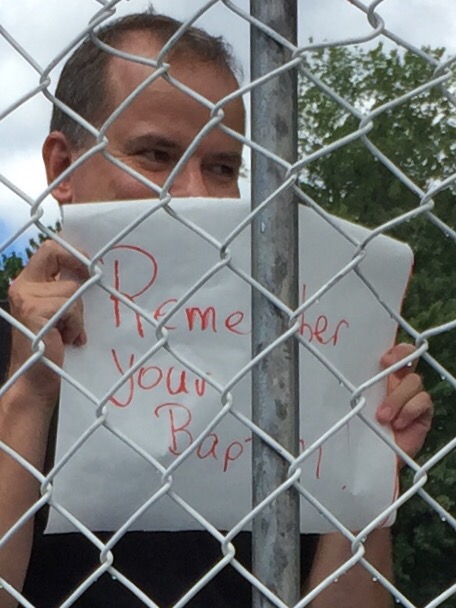
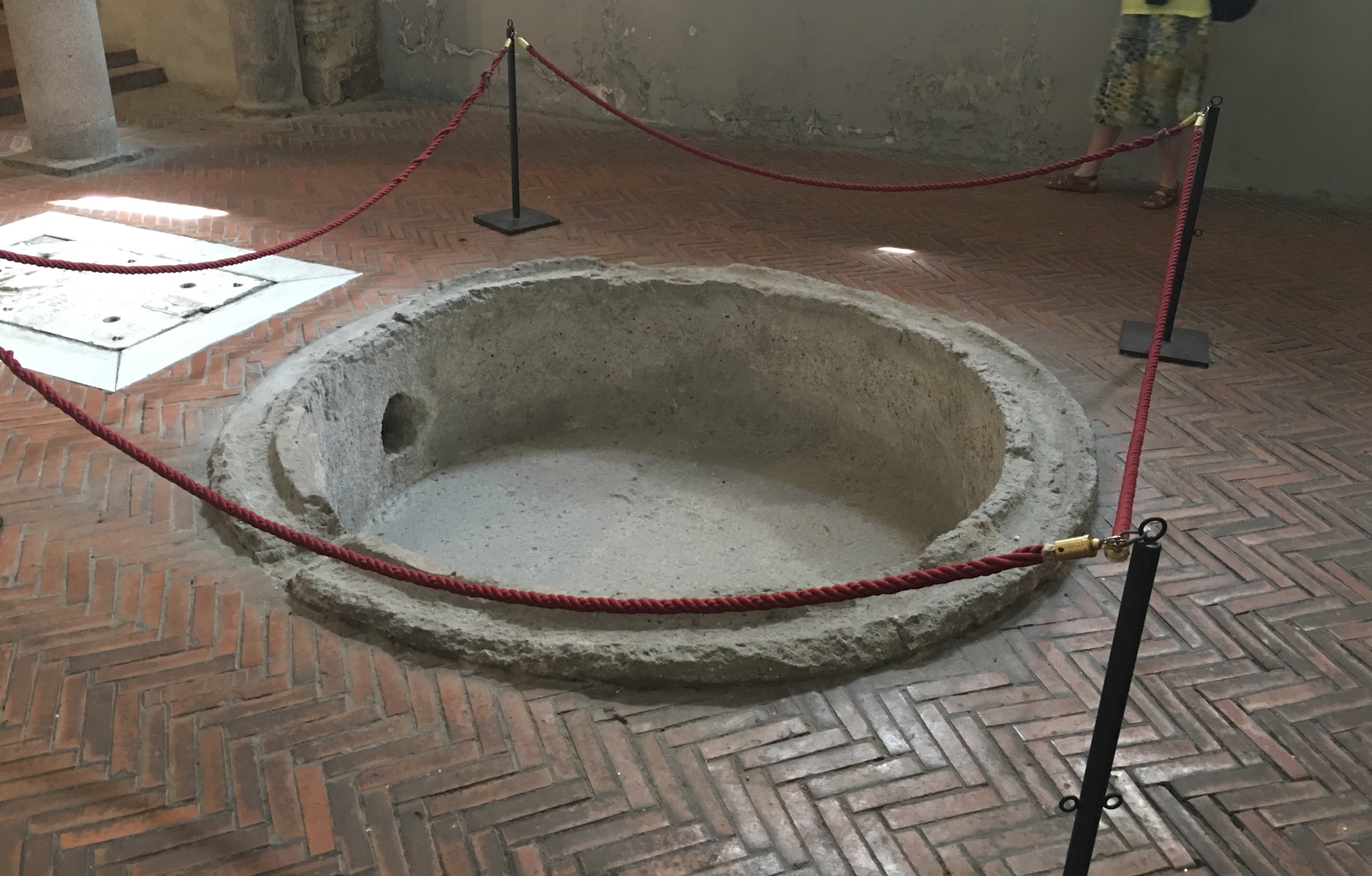
This is the Gospel call. The kingdom call. Not for individual enlightenment or edification. Not for our sake alone. Dear Confirmands, your baptism as a baby was not valid on account of your own individual strength or decision. It was the community — your parents, sponsors and everyone in the church long ago — whose faith surrounded you at your baptism. Even your confirmation is not done for your own sake — but for the sake of others around you.

And that’s why you participate in leading and assisting in your own confirmation service: To practice this truth, that affirming your baptism is a call to deeper commitment in the life of the church. You may doubt the strength of your faith. That’s ok. In fact, I would be worried if you didn’t. God can work with just a tiny bit.

I must admit when we planted that tiny four-inch tall spruce on church grounds last Fall, I didn’t have a lot of hope that it would survive the winter. This was our first tree planted in response to the Reformation challenge for our national church to plant 500,000 trees by the end of 2017 — the 500th anniversary of the Reformation. It was a small tree. A humble start. Could it live, and even bear fruit? I had my doubts.

For one thing it was exposed, and not easily visible, to the many pedestrians that use this property to cross through and the many children who play in this space. For another thing, since receiving the sapling, I had not seen signs of new life on it. So I wasn’t sure it there was anything new to come out of it.

I was in for a pleasant surprise. Throughout the coming months, our neighbours put a tall chicken-wire type fence around it and staked it. We watered it. People walked around it. God took care of it over the cold winter. And voila, look at the new shoots of life sprouting now! There is hope.


It does take a community committed to sharing, committed to kingdom values, and the Gospel of Jesus Christ. Today is just as much about celebrating the church of all times and places as it is about our part in the kingdom of God on earth. We are not loners on this path. We don’t walk by ourselves. It’s not all up to us, individually. 

It’s amazing to see the fans of “We the North” cheer on the Toronto Raptors as they advance through the NBA playoffs this post-season. They are true fans who gather in “Jurassic Park” outside the ACC in downtown Toronto, even during away-games in the pouring rain. You might say, they are ‘fan-atics’ of their team. 

Yes, fans can be fanatics — exuberant, dedicated, passionate, sometimes even over-the-top. Imagine the fans in heaven — the faithful gathered as the grand host of heaven, cheering you on this day. These may be your loved ones, long gone now, or recently died. These may be the saints throughout the ages. These may be other Christians not here today yet praying for you nonetheless. These are your fans of faith. Fans. Fanatics. Fantastic!

You are not alone, making this decision today. Pentecost, and Confirmation Sunday, is also about trusting in God’s initiative, God’s work, God’s love and mercy. Through the Holy Spirit God comes to us in so many ways we sometimes don’t even recognize. 

In a few minutes, God comes to us in bread. This bread, the body of Jesus, is broken bread. It is broken from the One, so that all may eat. There is always enough for all, for the sake of our broken lives in this broken world that God so loves.

Leading with love

When I saw the man pull up to the church doors, I was afraid. I am ashamed to confess that I was fearful when the man with olive-coloured skin, his neck wrapped in a scarf worn by Arab men, knocked at the door of the church. It is all the negative associations mainstream society has built up around people from the Middle East that went swirling through my brain in that moment.

What would I do? Act, based on my fear — and ignore, reject, send away this man? 

I therefore read the story of Saul’s conversion this past week through the eyes of Ananias, who is called by God to attend to Saul. Of course, Ananias at the point of his calling, does not know what dramatic change happened in Saul’s life on the road to Damascus (Acts 9). He objects. You might say, understandably: “Lord, I have heard how much evil this man has done to your saints in Jerusalem … he has authority to bind all who invoke your name” (Acts 9:13-14). Ananias was scared. How does he get past his fear?

We normally associate the beginning of Paul’s story with his dramatic conversion on the road to Damascus when light flashed around him and Jesus spoke to him. But the story of Paul, formerly Saul, begins earlier. 

In fact, the first time we read of Saul’s name is during the stoning of Stephen outside the gates of Jerusalem (Acts 7). More to the point, The first time Saul’s name is mentioned in the Bible is right before and after Stephen prays: “Lord, do not hold this sin against them” (Acts 7:58-60). In other words, Stephen prays for the forgiveness of his executioners, including Saul, at the moment of his death. Saul needs forgiveness, as he stands by “approving” (Acts 8:1) of the killing of one of Christ’s most passionate, ardent and faithful followers.

I have often wondered why God would later choose this Saul — the worst enemy of the early church — to become its greatest advocate. You cannot design a more effective and impressive strategy! In a war between good guys and bad guys you take out your primary enemy. But how is it that God would even have the heart to consider him? After all, Saul does not come with the right resume, to say the least.

I believe God answered the prayer of Stephen made at the moment of his death. The reason the drama on the Damascus road happens in the first place is because God listened to Stephen’s request to forgive Saul and the others who stoned him to death. I believe Saul was a forgiven man already before that “light from heaven flashed around him” (Acts 9:3). God honoured the prayer asking for the forgiveness of sins.

Peter, too, realizes forgiveness from the risen Lord. The Gospel text (John 21:15-17) is set up that way: Three times Jesus asks Peter: “Do you love me?” This three-times echoes the three times Peter had denied knowing Jesus in the courtyard of the high priest on the night of Jesus’ arrest (Luke 22:54-62).

Peter felt ashamed for this transgression against his friend and his Lord. Then, when Peter sees Jesus by the lake shore, he “puts on some clothes, for he was naked, and jumped into the water” (John 21:7). Normally, when we go swimming more clothes come off than on. Why does he put on clothes to get into the water? I would suggest this action echoes the Adam and Eve story from the first book of the bible, Genesis. 

When Adam and Eve realized their shame and guilt after disobeying God, they clothed themselves (Genesis 3:7,21). It seems that donning clothes in the presence of God is a penitential act — a confession of sin, and an expression of the guilt of sinning.

That is why we read this intentional dialogue between Jesus and Peter. The conversation has a liturgical feel to it, as if Peter needs the ritual of the speech to finally recognize and believe the truth of his forgiveness and being loved.

Here, there is an interesting wordplay on ‘love’. For example, ‘agapao’ is the the kind of self-giving, dedicated, total-commitment, unconditional type of love frequently associated with the Gospel of Jesus Christ. It is this love that Jesus asks of (Simon) Peter the first two times the question is asked: “Simon, son of John, do you love/agapao me?”

Peter, on account of his guilt, can only respond affirmatively to that question using another Greek variation of love — ‘phileo’ — which is a heartfelt and emotional type of love often expressed between good friends. He, in effect, answers by saying he can only love Jesus as a friend. He can do no more. He is stuck in his guilt. And that is why Jesus needs to continue pressing. When Peter answers again that he can only ‘phileo’ Jesus, we see an incredible shift on the part of Jesus:

The last time Jesus asks: “Simon, Son of John, to you love me?”, Jesus switches to ‘phileo’. He meets Peter where he is at. He validates Peter’s feelings. He allows Peter to be where he’s at. And that acceptance, then, releases the power for Peter to grow. This conversation, I believe, is the moment when Peter finally forgives himself. After Jesus loves Peter, Peter is able to love himself.

When we know we are loved by a God who initiates contact with us, who reaches out to us in our pain, and forgives us, then and only then can we do God’s work of loving others. Only when we know we are forgiven, and loved unconditionally by a God who can relate to us, then and only then can we ‘feed God’s sheep’ effectively and powerfully. Until that time we will live bound by and stuck in our guilt and our sin, and therefore in our fear.

The good news, is that our conversion and our salvation is not something we can do. In truth, there is nothing we can do to ‘save ourselves’. These heroes, giants, of the faith — Peter and Paul — do not gain their status in Christian tradition because of anything they did! Quite the contrary: the biblical witness shows in both cases that their conversions were all God’s doing, despite and especially because of their downfalls.

God saves. God calls. God empowers. All because of God’s forgiving love. Before we lift a finger to do anything for God, we are already forgiven. However we respond to that call, it’s already given. Given by a God who totally ‘gets us’ and already loves us.

Yes, I relate to Ananias. His first, and habitual reaction, is fear. And yet, praise be to God, he doesn’t lead with fear and judgement. He doesn’t deny his fear; he just puts fear in its proper place. He doesn’t stay put in his house. He doesn’t ignore, deny, or turn down the call of God which is to do something risky even reckless. 

Instead, He leads with love and trust of God. And therefore he experiences the great things God is already doing in the lives of the saints. He, along with Paul and Peter, can now ‘feed my sheep’.

I am grateful to have met that young man after opening the door of the church to him. He was, after all, a believer in the God of compassion and love. And he just wanted a quiet place to pray for a few minutes.

Praise be to God!

Waiting, still

Waiting for a response is not easy. After texting someone I’m usually impatient to get a response from them. Anything. And when they don’t, my blood starts to boil!

This whole notion of texting etiquette is a new one, of course. Back in the days when you had to actually pick up a telephone — one usually attached by a cord to a wall — to reach someone, it was pretty normal to wait an hour or two, or even more, to get a call back. And heaven forbid, you should actually send a letter — through the mail! You could wait weeks, even months, to hear back.

So, why do certain people wait hours to text back? One expert says the answer is pretty obvious: The person at the other end isn’t interested in communicating with you. A slow, or ignored altogether, text response is at root an expression of social rejection, usually excused by the socially acceptable reason: people are too busy. (http://www.inquisitr.com/1412393/text-me-back/)

I’m confronted by the need to learn how to wait. When you don’t have control over the timing of another’s response, your waiting is about letting go and being ok in the present unknowing.

Waiting and not-knowing are valuable, and legitimate, characteristics of leading a faithful, Christian life. Which, at first, might sound counter-intuitive. Like: How can you have faith and also doubt?

Jesus validated Thomas’ doubting the resurrection (John 20:19-31). Jesus did not chastise Thomas for his need for evidence. In fact, he acknowledged Thomas’ demands by inviting him to touch the holes in his hands and side.

The curious thing is that the Scripture does not indicate Thomas actually touching the scars of Jesus’ wounds. He simply confesses his now belief: “My Lord and my God”. Thomas does not need to follow through on his condition for believing, which was putting his finger in the mark of the nails and his hand in his side (v.25).

Jesus then underscores the point about having faith: Blessed are those who have not seen (i.e. have scientific proof) and yet have come to believe (v.29). Having faith is about not needing to have all the information, all the facts, all the evidence at one’s disposal. There’s a quality of faith that defies the rational, cognitive-centred, explanation-driven character of Christianity especially since the Reformation. It’s almost as if we have forgotten that faith is as the author of Hebrews puts it: “… the assurance of things hoped for, the conviction of things not seen” (11:1).

The quality of knowing (i.e.) faith that does not need to ‘know’ is reflected in a life of peace. Because as long as we feel we need to fix everything, as long as we believe we have to explain everything, as long as we feel we need have all the information before we can have faith — I am convinced we are not a people at peace with ourselves, with one another, with the world and even at peace with God. Peace is, as the Apostle Paul put it, that “which surpasses all understanding” (Philippians 4:7).

After Jesus was raised from the dead, you’d think he would want to shoot straight to heaven to be at the right side of his Father. Why would he even want to bother with humanity – this frail, broken, weak, sin-infested form he shared with us for thirty-three years? His temporary break from blissful eternity was hard enough. Why would he want to relate any more with human beings who, in their own delusion and compulsion, murdered him? Why would he want to re-connect with his ‘friends’ who betrayed, denied and deserted him in his hour of need? He is, after all, the divine Son of God whose rightful place should be at God’s right hand in heaven, no?

The disciples didn’t need to wait long for Jesus to return to them. You could say, he didn’t ignore or put off their message of fear, doubt, longing and sadness. He responded right away, even though he wasn’t in his usual ‘human’ form — after his resurrection he walked through locked doors, appeared and disappeared into thin air and the such. Re-connecting was more important, though. He wanted to re-assure them.

The book of Revelation reveals the expectations of the early church: That Jesus was coming back soon, and very soon. “Look! He is coming with the clouds! … who is and who was and who is to come, the Almighty” (Rev. 1:7-8).

Indeed, the early Christians lived with the expectation of the immanent return of Jesus at his second coming. Of course, after two thousand years of waiting, Christians have learned how to live in anticipation when we don’t know exactly when that time is. We may still need to wait for a long time to come.

Nevertheless we have the promise of scripture that Jesus does care for us, and will not hesitate to come to us. So, perhaps God is trying to tell us something here. 

Perhaps the value of our faith is not just about when that time comes, down the road. Perhaps the value of our faith is not just about eternal life in the far-off distant future. 

Perhaps there is value in the waiting, itself. And when we get impatient or perplexed, perhaps there’s something we are not seeing in the here and now.

Perhaps Christ is coming back to us all the time, and we just don’t see it. In the sacrament, in the Body of Christ — the collective unity of the Church, in the relationships we share, in the ordinary events of our lives. What are the glimmers of grace, the rays of hope, the good that you see in others and in the world? Where is Christ present for you, in life, today?

I saw a framed quote on the living room wall of someone I was visiting this past week; and it said: Not every day is a good day, but every day has some good in it.

We are a waiting people, yes. But people who wait have a choice to make: we can either ignore, deny, get down on ourselves and the world; or, we can learn to appreciate, be thankful for, exercise gratitude — all those moments and experiences where, in truth, Jesus comes through the doors of our hearts locked in fear: And tells us, “Peace be with you.”

Easter: Jesus on the loose, now!

A mother was putting her young, eight-year-old girl to bed one night. The girl, accustomed to saying her prayers as part of her bedtime ritual, said to her Mom:

“I want to die so I can see Jesus.”

Taken aback, the mother realized in that moment that everything her daughter had heard to that point about Jesus was about eternal life — how Jesus came to earth to save us from our sins so that after we die we will go to heaven. 

No wonder the girl, who had faith, thought that the only way to see Jesus was to die first.

Quick thinking, the mother put her hand in her child’s, looked her in the eye and said, “Jesus is alive. Jesus lives in you and in me. If you want to see Jesus, look for him in the people you meet in the church, in your school and wherever we go. If you want to see Jesus, sweet child, just open your eyes. And live your life!”

Jesus is alive, today. Right now. That is the message of Easter. And the foundation of our faith as Christians.
A few weeks ago the Jewish Rabbi who met with our confirmation class answered a question about who he thought Jesus was. His answer made me think. He said, “Jesus was and is a very important and significant person for Christians.”

I wondered if someone asked me, “Who is Jesus?”, what would I say? I think my first response would be: “Jesus is alive.” Not dead. Not just a great teacher who walked the earth over two thousand years ago and died a criminal on a cross outside Jerusalem. Not just a healer of the sick and prophet who spoke God’s good news to the people of his time. All those things, yes. But more. So much more.

You notice the traditional Easter acclamation is NOT: “Alleluia! Christ was risen! He was risen indeed! Allelulia!” He IS risen!

When we come to worship God, we are not just praising a man from the past, studying an important historical figure, or reading a great story from history. We are not just about being a bunch of ‘talking heads’ who like to debate religion, theology and doctrine, but go on living as if nothing really needs to change in our lives in this world, today. 

We cannot turn this great story of Jesus’ death and resurrection into a platitude that just makes us feel good on a holiday long weekend in Spring. There’s too much at stake. The Easter proclamation means something for our lives today. Our job is no different from the first disciples who met the risen Jesus.

Jesus, outside the garden tomb, had to shift Mary’s focus away from the past to the future. After calling Mary’s name, Jesus rebuffs Mary’s attempt to ‘hold on’ to Jesus as if he were the same as before he died (John 20:17). In that encounter with Jesus, Mary learns from her Teacher that she is being caught up into a larger drama that includes not only Jesus’ death and resurrection, but also his ascension — and beyond!

In other words, Mary learns that this is not merely a story about the re-union of friends with tears and hugs all around, case solved. It is about ultimate destinies: (1) Jesus’ and Mary’s — and the disciples’ destinies too. The story has not concluded; it is still unfolding. She must relate that to the rest of the disciples. Her story, and Jesus’ story, his experience and hers, cannot be anchored in the past. The story of Jesus, then and now, must move on.

That’s where our sights are focused on Easter morning. Where are we going? Where are you going, in your faith? The promise of new life in Christ Jesus means something special for you, now. It means something very special for the church, today. To live out of the Easter message, we must look forward, to where the risen Jesus awaits our following.

It seems so many people these days are reading Rumi, the great 13th century Sufi poet. Sufi described an image of a mirror in the hands of God. It fell, and broke into billions of pieces of glass strewn all across the face of the earth. Everybody took a piece of it, and thought at first they had the Truth — the whole Truth, and nothing but the Truth.

Let’s imagine that each shard represents a unique reflection of God’s being, God’s will, God’s presence. Let’s imagine that each piece of glass represents one who has faith. Each piece of glass reflects the beauty and light of God’s creation, manifest in the individual person or congregation — however you want to look at it.

God is, over time, restoring all the pieces back into wholeness, into the original mirror. God also seeks our cooperation in mending what has been divided. 

We are like that little girl who wants to see the face of Jesus. And is learning that we don’t have to wait until we die, to experience a fullness of the Lord’s presence. Using the words of the Apostle Paul, We may see as in a mirror dimly while we live on earth (1 Cor 13:12), for sure. But slowly, surely, God is also already at work reflecting the love, the light and presence of the living Christ in each and everyone one of us. Who in gospels was not changed after encountering the Lord?

We are, as Paul also describes, the “Body of Christ” (1 Cor 12:27), on earth. The tradition of Christianity since the Resurrection of the Lord has claimed that the church together is the Body of the Living Jesus. We are the living representation of Jesus on earth. As Martin Luther stated, in our baptism we are “little Christs”. 

Jesus is on the loose! Jesus can show up as a cashier in the grocery store, the young man who changes the oil in our car, a coworker in the office, our doctor, a good friend or even our spouse, child or grandchild. You may even find him looking back at you in your bathroom mirror! (2)

Paul concludes, “All of us … are being transformed” (2 Cor 3:18). God is already at work, in the power of the resurrection, healing what has been broken, bringing together what has been divided, restoring to completion a glorious transformation of our very lives. This is our hope. This is our Easter joy.

Alleluia! Christ is risen! He is risen indeed! Alleluia!


(1) Gregory A. Robbins & Nancy Claire Pittman in David L. Bartlett & Barbara Brown Taylor, eds., “Preaching the Revised Common Lectionary: Feasting on the Word” WJK Press, Kentucky, 2009, p.377

(2) Sr Bernadette Gautreau, “Jesus is Loose!” in Holy Week Reflections 2016 published by On Eagle’s Wings, p.9

Exposing the agenda of hate

A recent song by American singer-songwriter Soufjan Stevens is entitled: “There’s no shade in the shadow of the cross.” Today, on Good Friday, we all stand in the shadow of the Cross of Jesus. But there’s no shade in this shadow.

If you want a comfortable religion that just makes you feel good, then you dare not approach the Cross of Christ, and you dare not pray.

Encountering Jesus on the Cross is not pablum for the soul nor is it expressing mere platitude for an easy life. The cross is not an exercise of remembering something that happened long ago (and therefore doesn’t really mean anything for me today). We are not merely going through the motions, on Good Friday.

The cross, in all its bloody, bear and stark reality, exposes the darkness within each one of us, today. The cross exposes the human problem of hatred. You will not find relief here today. No shade. No comfort. Only sin. Only hate. In the world. And, within you.

The longer we live in this world, we are forced to asked the question: What makes many people so mean? What creates mean-spirited people? “I want to hurt you!” What is behind hate?

Hate – I just called it ‘mean-spiritedness’. Maybe that is what we see more often than overt hatred. Mean-spiritedness is, unfortunately, here to stay.

Hate is, for some reason, helpful. Hate works. In a lot of immediate and seemingly good ways. It unites a group very quickly. Far quicker than love, you must know that. Hate immediately and easily resolves the inner struggle between the little devil on one shoulder persuading you to do something other than what the little angel on the other shoulder is saying. 

Mean-spiritedness is formed by contraction, ‘against-ness’. Love, on the other hand, is formed by expansion. Love doesn’t come easily, because you have to let down your boundaries. And no one wants to do that.

Contraction — whereby you can eliminate another person, write them off, exclude them, torture them, expel them, ‘vote them off the island’, immediately gives one a sense of boundaried definition, boundaried superiority, even.

Hatred — mean-spiritedness — gives a person identity even if it is a negative one (“I am not that, I am not like them, I am against so-and-so, etc.”). And we’d sooner have a negative identity than feel vulnerable, like nothing, empty. Just who we are, in God.

Hatred takes away all doubt, and free-floating anxiety. Even if in a false way. It feels superior. And feels in control. Hate settles the dust, and the ambiguity that none of us likes. Hate is much more common and — I’m sad to have to say this as a pastor — it is much more immediately effective than love. Immediately.

Hate makes the world go round. Just read the front pages of morning paper this week, scroll through the news feeds on your tablet or flip the channels at 6 o’clock every day. It’s largely about who is hating whom.

You could say that Jesus came to resolve the central problem of hate — this problem that has defined humanity since the beginning of history. There’s really no other way: To save us from ourselves. To save us from one another. And to, therefore, save us.

Until and unless we are saved from our need to hate. 

That’s why people even made religion into a cover for their need to be hateful. I’m hating for Allah, and so it’s ok. And yes, I’m hating for Jesus. Christian history, too, is not free from violence (the Crusades, the witch-hunts, Protestant-Catholic European wars, the residential schools — the list goes on). “I’m hating for Christianity — so my hatred is good hatred.” It happens every day. It’s almost the name of the game.

The ultimate disguise, whereby you can remain a hateful, mean-spirited person is to do it to protect the church, or to protect the country. All those good excuses. So, you are relieved of all anxiety: “I am still a holy person.” Even though, underneath, in the deeper stream, you are a hateful person. But you don’t have to see that. That’s what Scott Peck called, years ago, “People of the Lie”.

We have done so much utopian talk about Jesus and love. But Jesus had a very hard time getting to the issue of love. First, he had to expose and destroy the phenomenon of hate. Which I think is the meaning of the Cross.

Once he exposed the lie and the illusion of hatred, love could show itself clearly. But until then, you can’t. The pattern is still the same. As Jesus shockingly put it, “Satan is the real prince of this world” (John 12:31, 14:30, 16:11).

Hate, it seems, is the daily, ordinary agenda. Love is the totally enlightened, entirely non-sensical way out of the ordinary agenda. The Gospel presents the dilemma in a personal and cathartic Passion narrative that grounds the whole issue in history, and in one man’s enlightened response to that history. 

One man, Jesus — fully divine and fully human, accepts the religious and social judgement of hate. We have both church and state, both Caiaphas and Pilate. Both power systems declaring Jesus unworthy, declaring him a sinner, wrong, the problem. The very one that you and I call the most perfect man who ever lived is judged by power at the highest levels to in fact be the problem. 

Jesus bears the consequences of hatred, publicly. But in an utterly new way that transforms the pattern. And therefore for us, transforms the possibilities. For two thousand years, Jesus has remained the most striking icon of a possible new agenda. His death exposed the lie and the problem like never before.

His risen life told people that life could have a different story line. Jesus did not just give us textbook answers from a distance. But he personally walked through the process of being rejected and then said, ‘follow me’. And there’s something you only know having been in that position.

What is behind hate? I believe fear is almost always behind hate. It’s not easy to get to that deeper river of fear. It’s not easy to recognize the subtle fears: Afraid of not looking good. Afraid of not being in control. Afraid of not having the right word. All those are fears. But they are subtle.

And the only way to see them is to go right into your own poverty of spirit — blessed are they who do so, Jesus said (Matthew 5:3).

Sometimes it looks like it’s control that’s behind hatred. But even control freaks like myself are usually afraid of losing something. Just go deeper, and you’ll see. It is almost always fear that justifies our knee-jerk hateful response. 

Fear is hardly ever recognized as such. As Paul says in Second Corinthians — ‘the angel of darkness must always be disguised as an angel of light’ (2 Corinthians 11:14). The best and most convincing disguise, of course, is virtue itself, or godliness. Then, it never looks like fear. 

For fear to survive, it has to look like reason, or reasonableness, prudence, common sense, intelligence, the need for social order, responsible stewardship, morality, religion, obedience, or even justice and spirituality. It always works. Just give it the nice cover, and you don’t have to face underneath it, what is craven fear.

What better way to veil vengeance, and a vengeful spirit than to call it justice. You hear it on the news every night, “I just want justice.” One wonders whether the inner need to punish the other, to hurt the other, has ever been recognized. Let’s be honest: It’s in everyone of us in this room. When someone has made you afraid, you want to hurt them back. To be trapped in our need for vengeance, is to always be afraid. It’s necessarily to be afraid. No wonder fear is the name of the game in almost all of the world. 

And that demon is not exorcised easily. Until you name the demon and admit the demon is there, you have no power of exorcising the demon. It’s clear, in Jesus’ exorcisms. You must name the demon correctly. When you pretend the demon isn’t there, you’ll never do any good exorcism. That’s largely what we do. It’s called, denial.

Only people who are honest and vulnerable about their own fear, and confess their need to control all outcomes, only those practiced in letting go, can go beyond the agenda of hate. Jesus himself prayed hanging on the cross: “Father, into your hands I commend my spirit” (Psalm 31:5). This is about letting go of our opinions, our need for getting back, our need to exclude, circle the wagons, and point the finger.  

Jesus prayed, too, from the cross: “Father, forgive them — they don’t know what they are doing!” (Luke 23:34). Only people practised in letting go will be taking the first step in the new agenda of love and forgiveness. This agenda of love, Jesus made possible for us. “Perfect love casts out fear,” scripture promises us (1 John 4:18).

The Cross, today on Good Friday, calls us to trust Jesus. To not have anyone that you can trust is necessarily to be afraid, to be vengeful. Christianity at its best aims to free individuals from their small, fragile, sinful selves, and points to a larger identity in Christ Jesus — the only true self — “hidden in Christ with God” (Colossians 3:3) .

Jesus is the only trustworthy lover, the only trustworthy self. Healthy Christianity, like Jesus himself, tells you that there IS someone you can trust. You do not have to create all the good. You do not have to fix all of the bad. You do not have to explain all the failures. You know you are simply in the stream we call the mystery of death and resurrection, the paschal mystery. 

What else would be the beginnings of peace? As long as you think you have to fix everything, control everything, explain everything, and understanding everything, I can promise you, you will never be a peaceful, loving person.

In the shadow of the cross, there is no shade. Indeed. But let’s stay awhile, and open our hearts to Jesus whose love makes us worthy and who is with us, even in the darkness.

Adapted and transcribed from Richard Rohr, “The Central Problem of Hate” track 8 on CD ‘Action & Contemplation’, Meditatio Talk Series 2015

Stick-to-it-ness of love

Terrorist bombs going off in Brussels during Holy Week should get our attention. Not only and primarily because of the sudden horror and tragic, senseless loss of life.

But also because Christians this week, the world over, are reflecting and imagining the path Jesus took to his own senseless, horrific death hanging on a cross.

Death is on the mind and heart of many these days. How can we approach this reality common to us all? How can we accept the truth of our own mortality, which will be realized some day in some unique way?

In a popular book about near-death experiences, people reported on how they saw a review of their life — the cliched ‘life flashing before your eyes’.

The people who had momentarily died detailed every single encounter they had had with another human being throughout their life. They not only re-lived it, they were able to feel what the other person had felt. In that life-review they knew what others felt because of the near-dead person’s words or actions in that particular encounter. (1)

You may be able to imagine how surprised some felt to know how their behaviour and words actually affected other people. To know what impact our lives have on others. We may not think that a simple action like a smile, or a scowling face, a gracious word, or an angry outburst, could affect someone else’s day — let alone their life.

A friend recently suggested that this is what they thought Judgement Day would be for us — to understand and feel fully what influence our lives had on people around us. And how much our lives mean, in relationship.

I attended my brother-in-law’s retirement reception last week. He was retiring from the military after about twenty-five years. In his speech to the gathered friends, family and colleagues he concluded by saying something that stuck with me: “There’s lots that I’ve done over the years that I’m not proud of — as I stand here today. But, I’ve always and will always be proud of who I did it with.”

On Maundy Thursday, the main theme behind the actions of Jesus with his disciples is love. The commandment to love one another infuses the ritual of washing his disciples feet, of eating with them and instituting the Holy Supper, of instructing them and praying for them that ‘they may be one’.

The motif of loving one another is strangely underneath the surface of the high-tension, escalating conflict surrounding Jesus as he nears the cross — the ultimate place of his suffering and death. You wouldn’t think this is a love story, at first glance.

Yet, Jesus does not seek retribution for the injustice he endures. As Simon Peter did by taking a sword and cutting off the ear of one of the high priest’s servants who came to arrest Jesus (John 18:10). Instead, Jesus is about a restorative type of judgement — one that through love seeks to make right what has been divided or tarnished by sin. Judgement is ultimately always about restoring us, not avenging us for all our mis-deeds. To whom are we restored?

Our religion is not one of individual moral performance and accomplishment for our glory alone. The judgement we individually meet at the end is not considered in a vacuum. Our religion is constituted in a community. Our religion, more to the point, is practised and validated in the context of human relationship. Christianity is a social religion. You can’t do Christianity apart from others.

On Maundy Thursday, the focus is on the disciples meeting together for the last time with Jesus. And they do so around a Meal. This is the context, the meal and the companionship, however flawed and fragile. Sharing food, here, is not an individual indulgence as it is a communal sharing.

For many, in our culture today, to simply sit and eat and talk and to remain together until the end of the meal seems a quaint custom, perhaps incomprehensible, even an empty game: There’s always something else to do in my room — download something, fix something, watch something, communicate in some other media. The community of the table seems far less interesting once you have eaten your fill.

Yet eating with others is what prayer is all about. It is the time — like meditating with others or celebrating a ritual as we do this evening at the Sacrament of the Table — when we are fed and nourished by the One who is the food itself. We need to stay and wait and allow ourselves to be waited upon. (2)

And so, we need to practice doing things together. Practice. Not perfectly. Not always the right way. And not just when all is smiles and joy. Sometimes, in practising our faith together we end up hurting others, and being hurt ourselves. This is nevertheless the nature of practice. 

Like in any endeavour, physical exercise, any discipline, anything that is of value to us. It sometimes hurts. We need to challenge ourselves. We need what coach Dave Cameron of the Ottawa Senators said once in an interview explaining what his team needs in order to be successful in the NHL: ‘stick-to-it-ness’. 

‘Stick-to-it-ness’ is the quality of staying with the game plan, playing with the team; not, individual heroics as they and we are want to do. Stick-to-it-ness, even in the face of adversity or failure, or disappointment. Not running out the back door when things get tough or uneasy or uncomfortable. Not giving up on others or on yourself, even when they disappoint you. Staying with the game plan. Being persistent. Even when things are less-than-perfect or ideal in your life, and life with others.

‘Stick-to-it-ness’ is a quality sadly lacking in Christian culture today. We are so individually-minded that we delude ourselves into thinking we can go it alone. That we don’t need others. That we can live our Christian lives without being faithful to the community — the hassle or complication of others who will only disappoint and annoy — 

That we can leave a group of people and join another church. That religion is like a smorgasbord; and “I” am the centre of the universe, determining my destiny, choosing what I want and leaving behind what I don’t want. And being in total control.

In the acclaimed film, “The Way”, starring Martin Sheen and his son Emilio Estevez, father and son together experience a walking pilgrimage on the Camino de Santiago. They begin their journey in conflict, estranged from one another. The son tells the father a truth that he learns by the end of the movie: “You don’t choose a life, you live a life.”

Practising our faith is not something we do by ourselves. Practising our faith is not motivated by trying to earn favour from God by all our good deeds. Practising our faith is not creating for ourselves the life we want. 

Practising our faith is first and foremost something we do together, for the sake of the other, and for love of the other. Even in the face of death.

We follow Jesus, who walked the way of life and death as we know it. We worship Jesus, these holy days, who showed us the motivation and stick-to-it-ness of love, of grace, of leading with a heart of mercy. For the sake of the other.

I will offer to you a thanksgiving sacrifice and call upon the name of the Lord.

I will pay my vows to the Lord in the presence of all his people, in the courts of the house of the Lord,

in your midst, O Jerusalem. Praise the Lord!

(Psalm 116:17-19)
(1) Raymond A. Moody, “Life After Life”, HarperCollins, New York, 2000, p.55-65

(2) Laurence Freeman, “Sensing God”, Novalis Press, Toronto, 2015, p.110