Funeral sermon for an infant at Christmas

Let us pray. Heavenly God, you formed us in our mother’s womb and, in Jesus, welcomed children to come to you. Today we grieve the untimely end to a life that delighted you and us. Our hearts are torn, and we are burdened by our grief. Be with us as we walk this shadowed valley. Receive our tears. Hold space within us for hope’s return. Amen (All Creation Sings, 2020).

No words I can say will take the pain away. Our actions now must speak louder than any words. And what you are doing today, dear family, is showing up. And more than that you do an act of love, and an act of courage amidst this horrible loss. We are grieved, deeply saddened, our hearts are torn, as we prayed. Yet, you have given each other space and permission to feel what you must.

In this collective effort and in our humble actions today, we honour the life given to Leyla. We stake our ground, together today, and affirm that Leyla’s life made a difference in the world, and in the universe. Her life was a precious gift.

Recently I read (Coman, 2024) about a giant sycamore gap tree that enjoyed enormous popularity among visitors to Northumberland Park in England. This tree was used in many films. Because of its location it was a beautiful beacon and focal point in the park.

But in September 2023, the tree was felled in an act of vandalism. The outpouring of grief and anger was unprecedented, and a testament to the beauty and meaning it had offered many.

Was it over? Was this tree, that had offered such joy and beauty in the lives of many, no more?

In the following year seeds were harvested from the downed tree. Now, the seeds have grown to become saplings and are thriving. In a project called “Trees of Hope”, these tiny saplings from the felled tree are being given to people in prison, and many charities. In this way, the Sycamore Gap Tree will not only have its own offspring, but whose seeds are now being used for good.

When the tree came down, it wasn’t the end of it. It wasn’t over. And whatever is not over, is not lost. Never lost.

Dear family, you’ve experienced a seismic shift in your life these past weeks. The earth underneath you has opened up. And grief can sometimes feel like free-falling into the unknown abyss. It is true, life will never be the same again.

But when the ground shakes as in an earthquake, the trees shake. The pinecones fall to the ground. And the seeds within come out and are planted in the earth.

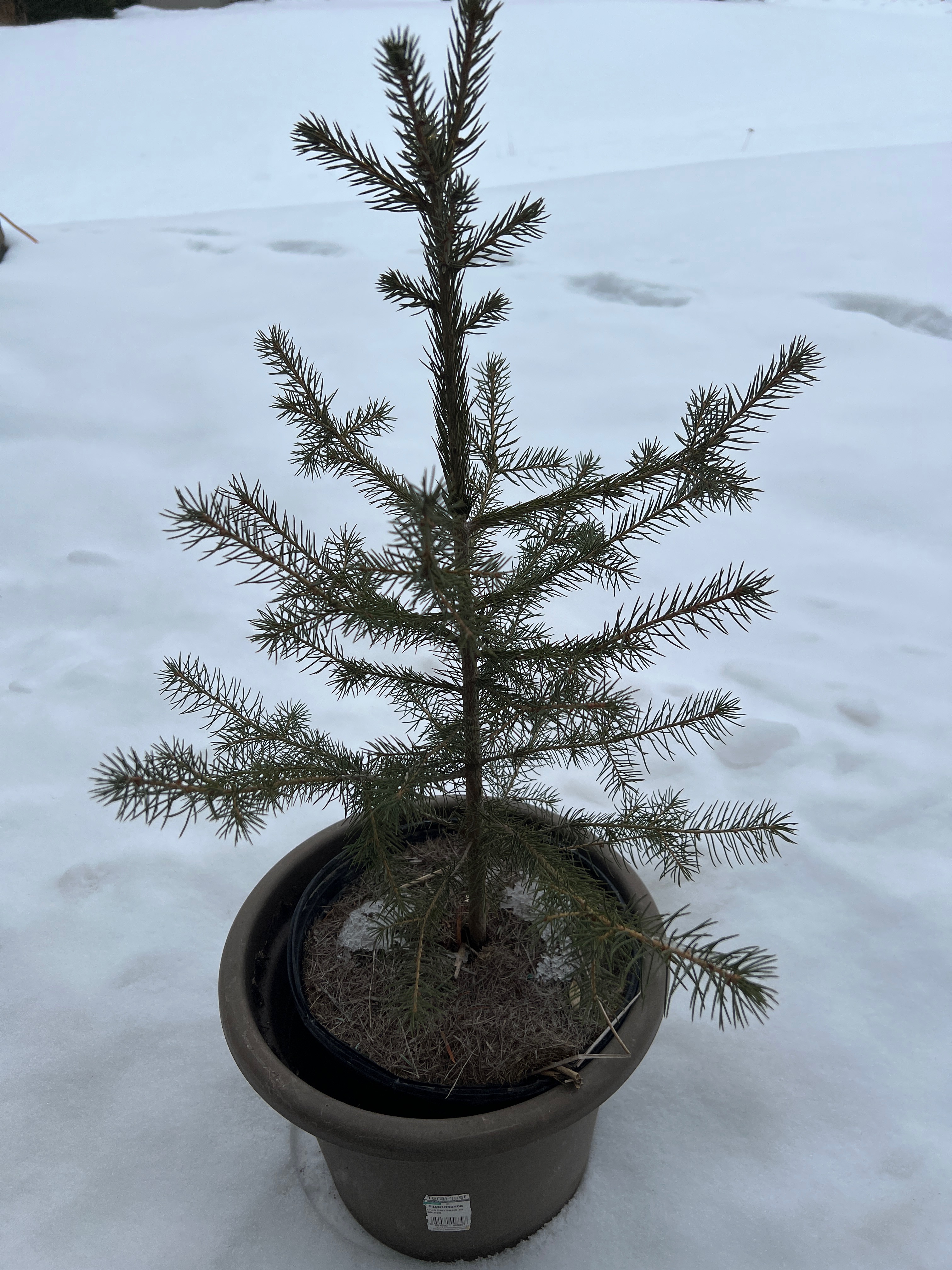
The Norway Spruce is common in Eastern Canada. One unique feature of this tree is its cones are the largest among all spruce varieties (Audubon, 2021). What does that mean? That means, lots and lots of seeds.

This sapling of Norway Spruce is now dormant for winter. It will need to be planted in the earth in the coming Spring. It needs lots of water, and it will grow. Perhaps during this wintertime, you can think of a place you’d like to plant it. In that simple act of planting a tree, there is this seed of hope that says maybe it’s not over; and because it’s not over, it’s not lost.

The cross of Christ, various legends have it, was made of varieties of wood ranging from dogwood to olive, to oak, to cypress. Whatever the blend or variety, the wood upon which Jesus died can be a sign and symbol of this close relationship between death and life. What dies finds a way to endure. What dies finds a way to live again. Our relationship with Leyla has changed, to be sure. But it isn’t over.

It is called the “tree of life”, both in the first book of the bible – Genesis (2:9) – and in the last book of the bible – Revelation (22:2). In the end, just as in the beginning, the tree of life promises that every ending marks a new beginning.

References:

All Creation Sings, Leaders Edition. (2020). Life passages and circumstances (p. 92) [adapted]. Augsburg Fortress.

Coman, S. (2024, December 9). Seeds of Hope: Day 8. Lutherans Connect. https://lcseedsofhope.blogspot.com/2024/12/day-8.html

National Audubon Society. (2021). Trees of North America. Knopf.

Healing

In the Gospel last week Jesus healed someone with an unclean Spirit.[1] This week, Jesus heals again, not only Simon’s mother-in-law but many others with all kinds of different problems.[2] What does it mean that Jesus heals us?

The language has changed in two thousand years. What healing was to people in the first century was expressed in language that has evolved over time. Today, the language we use to describe health, wholeness and healing assumes medical advances and understandings of how our bodies and brains work—something the authors of the letters, books, poetry and sermons of the bible didn’t yet know about.

It’s not to say there is no truth in the words of scriptures. It is to confess, however, that the means of conveying that truth—the language—has changed. Because our perspective has deepened. We have learned more, over time.

Listen to these predictions made almost a century ago, about computers. In 1949, a Popular Mechanics writer predicted, “Computers in the future may weigh more than one and a half tons.” And an IBM executive in 1943 observed, “I think there is a world market for maybe five computers.”[3] Despite their erroneous predictions, computers have since the 1940s changed in size, weight, speed, memory capacity, and market value. And they are an integral part of how we must effectively engage with others and the world today.

Technology is like language. Language is a tool. And while fulfilling an important purpose, tools change with changing needs.

Today, it’s Artificial Intelligence (AI). Maybe one thing we can learn from the mistakes the IBM executive and Popular Mechanics magazine made in the 40s is not to be too certain about our predictions about AI. You never know.

There are, nevertheless, some insightful comments made by those who work closely with AI development. They point to how the technology affects people and what we value. The development of AI presents a desperate need for compassionate, loving human interaction in this world, called “soft skills”.

Although technical skills will always help someone develop an expertise, the research suggests that in the age of AI, ethics skills are more valuable than ever.[4] People who develop and work with AI need to become ethicists to preserve authenticity and trust. Interpersonal communication is another in-demand skill in this field; that is, the ability to build real relationships.

So, what does this have to do with healing? Let’s look again at the Gospel. Jesus heals. That’s what Jesus does: he seeks the healing of all people. The emphasis in this text is on healing for the sake of a good and better life-on-earth, for us and for all people. Jesus came so that we might have “life abundantly”[5] because “God so loved the world.”[6]

God so loved the world, at the time when those words were first written two thousand years ago. But God so loved the world, in the 1940s. And, God so loved the world, today, in 2024.

Jesus’ healing today has to do with reconciling people within community, overcoming barriers and whatever separates people. Healing has to do with strengthening relationship and building community.

And, to this end, God has given us the tools we need. Much of our medicine today derives from plant-life, in other words, from God’s good creation. Our healing from God is found in the gifts God has already given to us in our natural environment.

Listen to this definition of medicine from an Indigenous writer: “Medicine is in every tree, plant, rock, animal, and person. It is in the light, the soil, the water, and the wind. Medicine is something that happened ten years ago that still makes you smile when you think about it. Medicine is that old friend who calls you up out of the blue because he or she was thinking about you. There is medicine in watching a small child play. Medicine is the reassuring smile of an elder. There is medicine in every event, memory, place, person and movement. There is even medicine in empty space if you know how to use it. And there can be powerful medicine in painful or hurtful experiences as well.”[7]

Let’s remember Jesus’ healing didn’t prevent people from dying eventually from something. Healing is not some magical cure for your problems. Healing is not the total eradication of disease from life on earth.

When Jesus healed he showed us, gave us a picture, of love-in-action, healing that happened in community, not in private. Notice the healing was always in the presence of another. That’s how we know these healings happened! There was always somebody around – if not in the crowded synagogue, in a crowded house and in the streets and byways.

Healing is what happens when there is loving connection with oneself, between oneself and others, between oneself and the natural world, between oneself and the Divine. There is balance in all those parts that make us who we are.

And God loves it all. God wants us to know and feel that love. Jesus couldn’t wait to get on to the next town and village to share the message of and demonstrate God’s love-in-action!

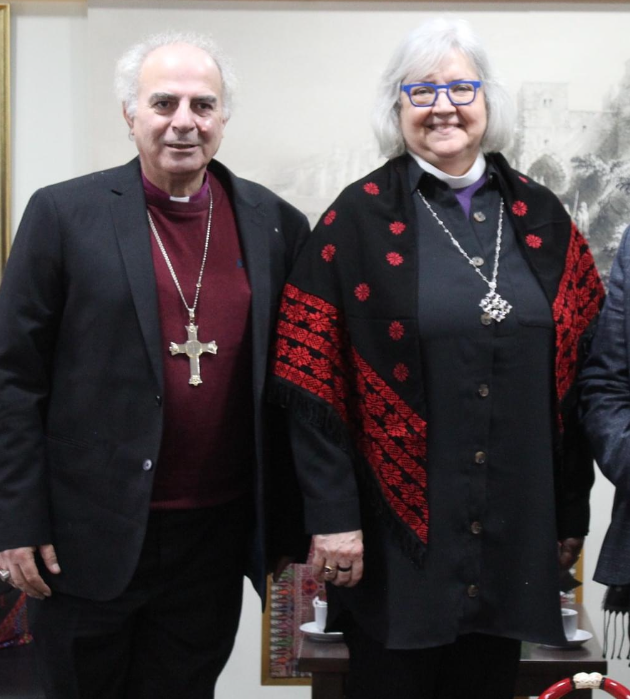
Today is Global Mission Sunday in the ELCIC. In Bishop Johnson’s sermon for today,[8] she reflects on our relationship with the Evangelical Lutheran Church in Jordan and the Holy Land (ELCJHL). In the midst of all their troubles, especially war, they continue to live in hope and faith.

Bishop Susan was actually in the Holy Lands last month, and talked with Bishop Ibrahim Azar about the very toned-down Christmas they had just experienced. She asked him how it had gone and he said to her how hard it was. “But,” Bishop Azar said, “Christ was born again in our hearts.” Christ was born again in our hearts.

If the ELCJHL can be faithful and continue ministry in their extremely difficult circumstances— keeping congregations and schools open and serving those in need, what about us?

Here’s a prediction that cannot be denied: We can certainly continue with faith and hope in the midst of the challenges we face!

Thanks be to the God, who continues to heal in Christ’s name, we pray. Amen.


[1] Mark 1:21-28

[2] Mark 1:29-39

[3] Ed Bowen. (2024, January 18). Hold Fast to the Truth. Eternity for Today.

[4] Peter Cardon. (2024, January 23). The Future of Work: New study finds AI makes employers value soft skills more. Fast Company. https://www.fastcompany.com/91012874/new-study-finds-ai-makes-employers-value-soft-skills-more

[5] John 10:10

[6] John 3:16

[7] Garrett, M. T., Garrett, J. T., & Brotherton, D. (2001). Inner circle/outer circle: A group technique based on Native American healing circles. Journal for Specialists in Group Work, 26(1), 17-30.

[8] Click here for Global Mission Sunday  resources (ELCIC, February 4, 2024).

Social distancing and religious gathering

Every Friday night I walk through the core of the small town close to where I live. And, every Friday night these restaurants—a popular Indian restaurant, a British-style pub and pizza parlor—are jammed full. Week after week, it never fails. It impresses upon me the common, human need for social interaction.

Here, far off the beaten track, the COVID-19 threat in early March is still far from reality. At the time of this writing there is not (yet) one confirmed case in the Ottawa area. And yet, last week when I walked my route by these restaurant windows and looked in, they were nearly empty. 

Clearly for my community the anticipation and fear of the pandemic has taken hold in our imagination. These fears are fueled by images in the media of empty planes and check-in lines at airports. St Mark’s Square in Venice, normally crowded with tourists, is empty. Classrooms in big name educational institutions are empty.

“Social distancing” is the catch-phrase. As a human community we are now becoming practiced in what it looks and what it feels like to be ‘distant’ from each other in the public sphere. But sports stadiums and convention venues are not the only places considered verboten during a pandemic. Places for religious gatherings are suffering the same scrutiny. Though, perhaps, religious people are used to seeing empty pews for some time now. 

In our social distancing during the COVID19 pandemic we are properly encouraged to inform ourselves of the risks and take the necessary precautions. Best practices in worship and community life together are emphasized especially for the most vulnerable to this disease.

People who like to meditate are generally drawn to spaces and places with others that embody some ‘distance’ and detachment. We close our eyes. We refrain from touching each other. We repeat the mantra not as a voiced, liturgical, chant but interiorly, individually. We who meditate and pray in silence and stillness are practiced somewhat in the art of non-interaction in contrast to the dominant extroversion of our culture. We say little and keep our distance as we sit in silence and stillness together.

Even in our solitude, however, we are reminded in the tradition of John Main not to neglect the coming together in faith even as we pray in silence. Yes, the twice daily meditation times to which we aspire belong normally to our private, individual work. Yet, the importance of the regular meditation group builds the community of love. 

We are not meant to be alone on this journey. In meeting with others we resist allowing our fear to overwhelm us. We trust in ‘God with us’ and in the revelation of God in Christ who speaks often in the Gospels the words of promise: ‘Do not be afraid’. We are called, on the contemplative path, to reassure others in the same promise. (See pastoral letter from bishops of the Evangelical Lutheran Church in Canada, link below)

During this time of social distancing we pray with all who are affected by this disease. God be with those who grieve, are ill, isolated and afraid, and the many people involved in medical and emergency care.

This may also be a good time to try an online meditation group. On the front page of the wccm.org website click on ‘Online Meditation’ to find a group suited for you. The first time I participated with an online group it felt strange to see on my computer screen the faces of several meditators praying in silence with me. It took some time and patience for me to adjust.

On the one hand, I was physically by myself. But I was not alone. I was still virtually connected with others far away from me. Talk about social distance. Yet, accountability and responsibility to each other are still felt values in the online meditation experience. There may times in our lives when a virtual group is the best option for remaining connected.

In this time of social distancing, I pray in the love of Christ Jesus who overcame the boundaries of fear and social stigma. I pray in the love of Christ who reached out to touch and heal the blind man, the leper, the diseased, and who placed himself, even to death on a cross, in the public sphere. I pray in the love of Christ whose life and love extends to our times and public places, into our hearts and into our very own relationships and communities.

The Peace of Christ be with you all,

Martin

canadacoordinator@wccm.org

When the lights go out: an Epiphany funeral sermon

It’s sounds strange talking about Marcella in the past tense. All of this happened so quickly. It was such a sudden loss. So unexpected. One moment she is participating and enjoying the holiday with family. And the next, she is gone. 

It’s like when there’s a power outage and the lights go out. We may have some heads up – like at this time of year when the weather network puts up freezing rain, wind or snow warnings. These storms will threaten the hydro lines, and we know we could lose power at any given time. 

But usually when the lights go out, no matter the condition, it still catches us by surprise. We are caught in the shock of it. 

And we are left in the dark. When we are without power even for a relatively short amount of time, that’s usually when we realize all the things we take for granted. These creature comforts we call them, things we appreciate, like – running water if we are on a well, the stove, the fridge, the furnace. Generally, when the lights go out, we think of all those things that normally give us a sense of security and help us survive, especially in the harsh winter time. And how life is now without them.

It’s scary. We find ourselves in unchartered territory. The first thing we will likely do is reach instinctively for any light. Like a candle. Or a flashlight. And appreciate its simple brilliance more. Also, if we share a living space with others, likely the situation will bring us physically closer together as we huddle around the light. And, usually, although it may not initially feel like it, we eventually get through the harrowing ordeal – through the dark night – in one piece and okay.

The sudden death of Marcella feels like the lights going out. And we’re not talking about a house or a subdivision, but a whole city or half the country! Marcella was a bright light in our lives. Her energy, her spunk, her drive. Her light going out affects a universe. It feels like now something huge in our lives is gone. We feel truly in the dark without Marcella. Will it ever be bright again in our lives?

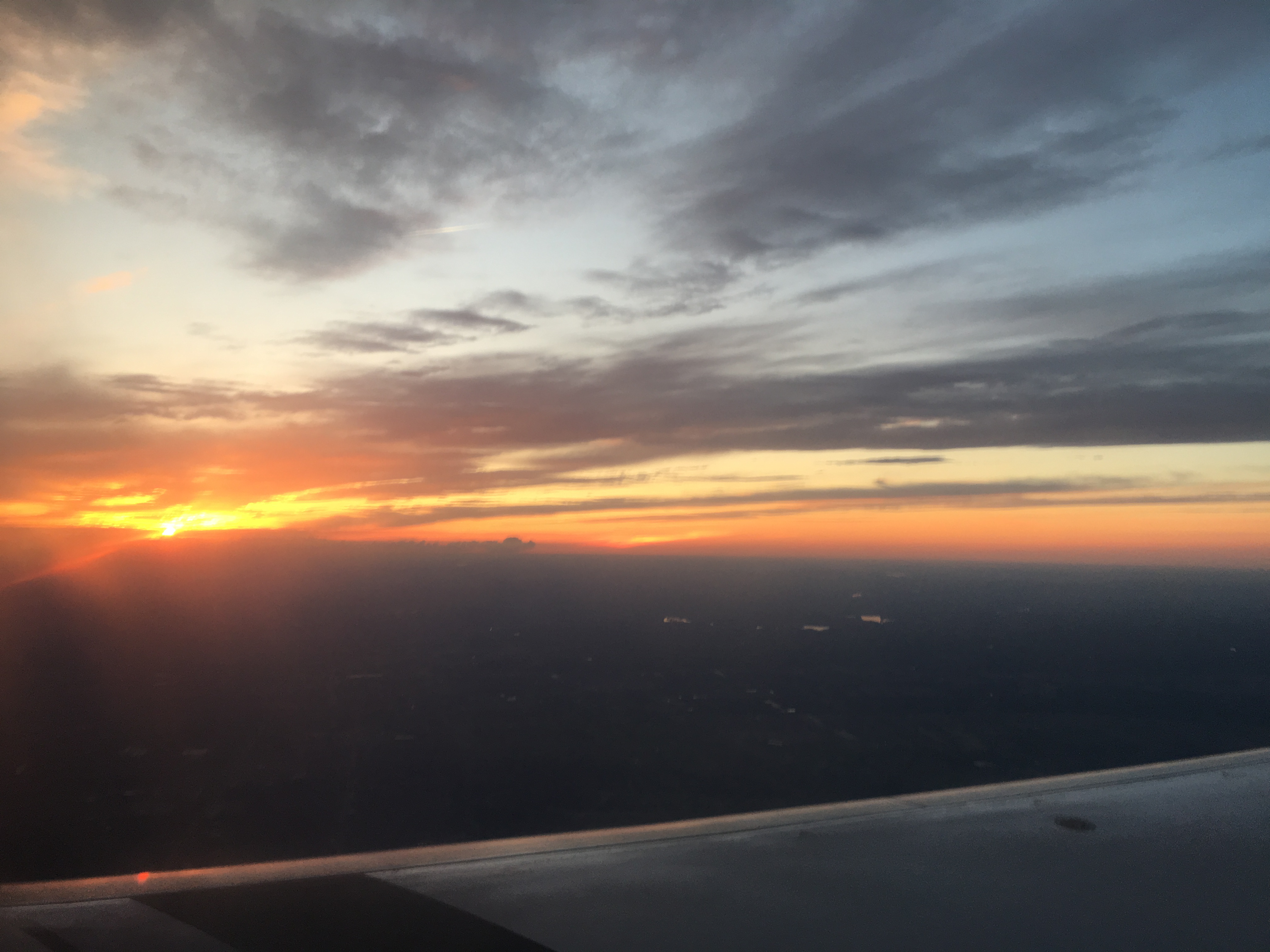
Marcella and David travelled a lot. So, you know that when flying from Ottawa to London or Frankfurt, the journey begins late in the evening. Almost immediately upon departure it is already night time. It is dark. And while most of the six-hour journey transpires in the dark of night, the flight over the Atlantic is heading eastward.

And that means that this journey we are on, dark as it stays for most of it, goes with the expectation—the promise—that we are heading into a new day. After five hours of complete darkness, a thin pinprick of light first lines the horizon ahead. It isn’t too long afterward that the journey is completed in the bright daylight.

You begin a journey these days. And it starts in the darkness of grief. This journey may take some time. It may feel like a very long time. This journey must acknowledge and embrace the darkness in which we walk and the time it takes. Because we can’t get to where we are going without moving through the night. We can’t avoid it. 

But you travel not alone. You are together, as family and friends, somewhere on the flight path. You may use the time you have to be reconciled to your losses and the suffering you bear.

Even though you carry the burden of grief and loss, you are nevertheless heading towards a new day. On this long journey in the dark you wait, as it were, for the sun to shine again. You look for the pale dawn’s light to begin brightening the day again. It may start small – a tiny candle flame, a moment of grace, a pinprick of starlight shining brightly in the dark sky.

May these moments give you hope and faith that Marcella’s light still shines. It still shines in the warmth, the light, the life and the love of God. Yes, we speak of her today in the past tense. But we can still use the present tense. Her light still shines. And your light will, one day, shine brightly again.

Prayer as Silence – Advent sermon series 4

In this concluding sermon in a series on prayer this Advent, I invite you to consider prayer as silence. In the first, we acknowledged prayer as growth – that there come times in our lives when God invites us into a deeper communion of prayer; and so, a different way of praying. In the second sermon, we considered that the fundamental work of prayer was to listen – listen to the other and listen to God. Last week, we reflected upon an important type of prayer that often is missed especially during times of the year we are called to be happy; the lament makes our relationship with God real and our ultimate joy authentic.

The eagle changes its flying posture depending on the state of the air around it.  When in flight it encounters noisy, turbulent air, the eagle folds its wings straight down and underneath, riding the agitated, unstable winds in as compact a body mass as possible.

But when the air is calm high above the earth, the eagle will spread its massive wingspan to its farthest limits. It will expand its body mass to its fullest potential as it coasts and glides on the silent, peaceful air.

Silence gets a bad rap in the Protestant church especially. Since the Reformation and Enlightenment, we are suspicious of anything that is interior or to do with experience. When we still our minds, we are afraid that we will let the devil in! 

And, we will straight away point to bad silence – like the violence percolating beneath the surface of giving someone ‘the silent treatment’. Or, we rightly condemn the complacent, fearful silence in face of injustice. In both cases, words must be spoken. And better loudly at that!

Yet, there is a silence that is healing, transformational. We find it in nature. We find it in the stillness of predawn dew resting on flowers and blades of grass. We experience it the first night in the bush after driving all day away from the loud, noisy city. 

We also find silence in the bold action born of convicted hearts, action that happens behind-the-scenes. Not in the spectacular, the sensational. Not in attention-grabbing largess of personality shock-and-awe. But in the quiet, dedicated, barely perceptible giving of those who know themselves and respond to the still, small voice speaking in their hearts.

This is Joseph. He appears, indeed, to be the strong, silent type. But not because he is afraid to say or do anything. But because he has the courage to respond. He begins his risky venture with Mary “after waking from sleep.” Even though he went to bed “considering in his mind” all the problematic aspects of his relationship with Mary, “resolving” to leave her, his course of action changed dramatically after he stopped the busy-ness of his mind, the activity of his consciousness – as good and righteous as it was – and went to sleep. And dreamt.[1]

There is a difference between the absence of noise and silence. Something is already happening in this holy silence. Something we’ve been too busy, too rushed, too loud, too distracted to notice. Where God already is, in between the words, in between the spaces defined by our cerebral, ego-driven impulses and imaginations.

This is good, Lutheran theology! The grace of God already exists in our lives. We don’t have to make it happen. Really, we don’t! God is in the world, already. It is given. God is present. God is waiting for us, in the silence of our hearts. God is waiting, already, in the circumstances and situations of the world. God is always listening to us. 

But are we always listening to God? Are we willing to step into the river of God’s action and Spirit? Will we immerse ourselves into the prayer already flowing in our lives, a prayer flowing into the ocean of God’s presence and love? The late Thomas Keating was known to have said, “Silence is God’s first language; everything else is a poor translation.”[2]

It is in silence where we can be fully and truly who we are. We don’t have to hide anything. We don’t have to meet anyone’s expectations, put on a good impression or please anyone. We can let go and let all that is there come to the surface in the confidence that all of it is held in God’s love – the good, the bad and the ugly. We can stretch to our fullest without judgement. We may be, in truth, letting the devil out, not in.

May we step into the spaciousness of God’s mercy, peace and joy just waiting for us in the silence of God’s ever-present love. May we learn to pray in the gift of silence, especially when we may so desperately need it.


[1]Matthew 1:18-25

[2]Cited in Theresa Blythe, Fifty Ways to Pray: Practices from Many Traditions and Times(Nashville: Abingdon Press, 2006) p.32

Advent blessing for the journey

When flying from Ottawa to London or Frankfurt, you leave late in the evening. Almost immediately after departure it is dark. And while most of the journey transpires in the dark of night, the flight over the Atlantic eastward nevertheless goes with the expectation—the promise—that you are heading into a new day. After four or five hours of darkness, a thin pinprick of light first lines the horizon ahead. It isn’t too long afterward that the journey is completed in the bright daylight.

The journey of Advent recognizes the darkness in which we walk and the time it takes. We can’t get where we are going without journeying through the night. Each of us are somewhere on the flight path, using the time we have to be reconciled to our losses and the suffering we bear.

Whether we carry the burden of grief and loss, of suffering and pain, of anxiety and fear, we are nevertheless heading towards a new day. On this long journey in the dark we wait, as it were, for the sun to shine again.

May this journey of Advent be hope-filled, that as you make your way towards the new dawn, the expectant joy of the coming of the light will give you strength and courage to keep going in the grace, peace and love of God.

Pastor Martin

IMG_7127

God in the lowlands

These last moments of Jesus’ life stand in stark contrast to what is valued in the world.

I find it ironic that we read today a text that is normally read on Good Friday – the day Christians worldwide pause to recall and remember the brutal death of Jesus on the cross. It is the day Christians confront the God who is deeply humiliated, a man who suffers injustice to the extent of his gruesome and painful suffering and torturous, drawn-out dying.

It’s ironic because a text that is normally read on Good Friday comes just days before what North Americans call Black Friday. Despite the various reasons why that day has come to be called Black Friday – it is commonly known to be the day the malls and commercial districts are crowded, busy and congested bustling with deal seekers and shoppers. It is the day the consumer in us is stoked. Big time.

Indeed, these last moments of Jesus’ earthly, humanity all seem to be in vivid contrast to what is valued as great in our world – this world presented to us in colourful, catalogue-thick inserts and pop-up internet ads promoting incredible sales and savings.

It is not poor, but a world of glamour and glitz.

It is not selfless, but a me-first world of acquisition and accumulation.

It is not vulnerable and generous, but a miserly, defensive and self-preservationist world.

Today is also what the church calls, “Christ the King”, on the last Sunday in the church year. At the end of time, we assert in faith that Jesus is King and his reign lasts forever. But, what kind of king are we talking about here? Certainly not a kind of king the world knows.

In response to Pilate’s question “Are you the King of the Jews?”[1], Jesus answers, “My kingdom is not from this world. If my kingdom were from this world, my followers would be fighting to keep me from being handed over to the Jews. But as it is, my kingdom is not from here.”

That Jesus’ kingdom is not of this world is proved in what this ruler wants to happen and makes happen that other powerful rulers are not willing or able to do.

Let’s face it: Part of our inability to believe and trust the forgiving power of God’s grace and mercy is our inability to believe that other people deserve mercy. We want to judge whom God lets into heaven. Many of us are more comfortable not knowing what happened to the thief who scoffed at Jesus than knowing that an undeserving thief was let into paradise.

Would we not rather have had Jesus say that  God loves the people we like that God does not love the people we do not like? Would we not prefer it if God did not love the crackheads, the homeless, the refugee and Muslim immigrant? Would we not prefer it if God did not love the addicts, the adulterers, the thieves, the gays, the prostitutes, the rebellious and the disgruntled? Would we not prefer it if paradise were exclusively for the nice people, the clean people, the polite people, the well-behaved people, the right people?

How different is Jesus? There was a very strange novel published in England in the late 19th century called Flatlands. It is a story about a world that is flat, everything is two-dimensional. The chief character in the novel is Mr. Square, who is, of course, only in two dimensions.

One day, Mr. Square is visited by a Mr. Sphere who is, of necessity, in three dimensions. Square regards Sphere quite apprehensively. Sphere speaks to Square about a world of three dimensions, a world that is not flat. But Square is unconvinced. Living in a two-dimensional world, it is impossible for him to imagine another dimension. Eventually, Sphere is persecuted and driven out by the outraged flatlanders.

I propose to you that that is how different Jesus is from us. We are flatlanders. We live in a world of two dimensions, unable to grasp the possibility of a reality beyond that which we have experienced. We have been unable to believe, for instance, that love and forgiveness is a better response to evil than brute force. God’s power of love is three-dimensional to our two-dimensional thinking.

Notice with the second thief hanging beside Jesus on his cross, the thief does not ask to be saved, to be rescued. He only asks once, “Jesus, remember me when you come into your kingdom.” Perhaps his plea is meant to echo these words from the Psalm: “Do not remember the sins of my youth or my transgressions; according to your steadfast love remember me, for your goodness’ sake, O Lord!”[2]– which is to say: Do not remember me according to my faults, but remember me according to your goodness.

We have faith not because we are weak but because God is strong and God is love. There is grace for us and for the people we do not like. Our salvation is dependent on a loving, grace-filled God.

So why can we hope in this goodness when we look around us at all the evil? Because Mr. Sphere did come among all of us Squares and we did persecute him and drive him out.

But he wouldn’t and couldn’t stay away. No, his three-dimensional existence couldn’t be flattened out by us. He is alive! And he comes to us again today in this meal we are about to share.

Again, it’s so hard for us to understand because he is like three-dimensions to our two. But he comes again with a word of love and forgiveness that promises the power that will finally take care of all that’s troubling in this world. It won’t be easy. He predicted that, too. But it is the only way. He comes to us again today to lead the way. “I have seen the future,” he says to us. “The future is not some cold grave, some hard, lifeless tomb. The future is the glorious triumph of God’s love.”

This man whom we follow is the king not of the flatlands, but in the lowlands. Spheres always roll to the bottom of things. Christ is king in the lowlands because God does not want us to die and suffer in that dark and sad region. Maybe you are today in a sort of darkness. The darkness of grief, loss, physical pain or emotional pain.

But the Holy One is with you today and for you today in that darkness. And, therefore, you will be with him today, and forevermore, in paradise. Thank God! Amen.[3]

[1]John 18:36

[2]Psalm 25:7

[3]Thank you to the writers for ‘Proper 29 (Reign of Christ) Luke 23:33-43’ in David L. Bartlett & Barbara Brown Taylor, eds. Feasting on the Word: Preaching the Revised Common Lectionary Year C Volume 4(Kentucky: WJK Press, 2010) p.332-337 for many of the words and ideas expressed here.

“¡Presente!”

Each of the four blessings is matched with a corresponding ‘woe’[1] First, Jesus says that blessed are they who are poor, who are hungry, who weep now and whom people hate. But, unlike Matthew’s version of the beatitudes[2], Luke doesn’t stop there. Luke doesn’t let us off easily.

Lest we become too enamoured with spiritualizing virtues or escape into some pie-in-the-sky notion of faith, Luke’s version of Jesus’ sermon only sets us up for being gobsmacked upside the head. In a stunning reversal to each blessing Jesus brings a ‘woe’—to those who are rich, who are full, who laugh now and about whom people speak well.

But wait—a secure financial future, a full stomach, a light heart, and a good reputation – aren’t these all values we want and seek? Aren’t these the things around which we structure our lives to obtain? Don’t these describe to a ‘t’ our five-year, ten-year and twenty-five-year goals?

A surface reading of this scripture can leave us picking sides. Am I on the ‘blessing’ side or the ‘woe’ side of the equation. Either / Or. Will we dare go deeper?

And, at the deeper currents of our awareness — when we are honest with ourselves — don’t we already know? Don’t we already know the truth of it—that, at best, wealth, a full stomach, a light heart and a good reputation are mixed blessings? They come at a great cost to health and relational well-being. They are temporary, fleeting. They can come and they can go.

Contrary to popular belief, rather than being evidence of God’s favour, prosperity can actually endanger our relationship with God, as was the case with the rich fool and Zacchaeus—both characters unique to Luke’s Gospel.[3]

What is common to both characters? Both came to Jesus rich men with full stomachs and their reputations intact. When they came to Jesus, both the rich fool and Zacchaeus were perfectly able to take care of themselves, to say the least.

The common trait they share as prosperous men of first century Palestine, is their self-sufficiency. This state is what separates them from God. And has them trapped. they are self-sufficient.

Elsewhere in Luke’s Gospel, we read that those who lay up treasures for themselves are not—and cannot be—rich toward God[4]because when we can take perfectly good care of ourselves, it is altogether too easy for us not to trust God. So, what jeopardizes the wealthy Christian’s relationship with God is the subtle temptation to think that we can go it alone and take care of ourselves.[5]

This underlying belief applies not only to our personal lives—and what we decide to do with our wealth, our investments, our properties our material blessing— but, also to the way we do church.

Will we be a community that lives only unto ourselves, or for the sake of others? Meeting the challenges of church today, how do we move forward? What decisions will we make with the resources we have? Will we abide by the code of self-sufficiency and go it alone? Or, will we seek out effective partners, neighbours and others on the journey of faith? Will we say God is only here inside thesewalls alone? Or, will we seek God’s work out there in the world?

What with all the competing values and programs for success beating down the doors of our hearts and minds, to follow the Christ of the cross is not easy. It’s not a technique or strategy that we can simply employ. In light of the beatitudes from Luke, the way of Christ cannot be an add-on. It cannot work that way, as another activity to add to the schedule of our already busy lives.

It comes to us as a complete package. It’s a call to transformation – a whole-life make-over. I understand the hesitation. Because life in the fast lane has its perks. Maybe we don’t want to give them up. Not easily, anyway. Seeking after self-sufficiency is too much of a lucrative deal for our egos.

Therefore the message of the Gospel can really be a downer! After all, how can we ever live faithfully when immersed in our world and its values?

But, perhaps, the message of All Saints provides an antidote to the despair and the grief. And give us hope for the journey. After all, the Gospel is not just about how to get into heaven after you die, but actually more about how to live in the kingdom of heaven on earth before you die. Not just the saints of heaven. But the saints on earth.

I want to close with a brief reflection on the meaning of a couple of words. First, ‘blessing’. “Blessed” is sometimes translated as “Happy”. I prefer the translation of the first word in the Psalms[6]which incidentally is also often translated to “Happy are they …”:

The Hebrew word here is ‘ashar, which means, literally, “to find the right road.” So, in offering the beatitudes, Jesus is saying: “You are on the right road when you are poor, when you hunger, when you weep, when you let go, when you don’t hold it all to yourself.” I prefer this translation because it implies a direction rather than a moral state. It acknowledges a journey of becoming. And any path of growth and transformation will include honest struggling and striving and letting go.

It is human to struggle with these things. On one hand, we do need to learn early in life how to take care of ourselves. Learning vital skills around self-care are important. Along the journey of maturity and growth, however, we must also learn how to balance this skill towards attention to others.

The second word is ‘presence’. This word doesn’t appear in the biblical texts for today, but it is implied in our ritual of All Saints. In Spanish, you hear the word said aloud: “¡Presente!”—which literally means “here” or “present”. There is a long tradition in Latin American movements for justice of invoking the memory of those who have lost their lives in the struggle.

At political gatherings their names were read out loud, one after another, not unlike we read the names of the saints earlier. After each name the crowd says together: “¡Presente!” as if to say: “You are not gone, you are here with us. You are not forgotten, and we continue the struggle in your name.”

It is human to struggle in the mission of God on earth. But we are not alone. Not only are the saints of heaven among us in spirit and in love, God is with us each step of the way. On the journey of life …

“Blessed are you who are poor – because you are not alone!”

“Blessed are you who hunger – because you are not alone!”

“Blessed are you who weep – because you are not alone!”

“Blessed are you who are despised – because you are not alone!”

“¡Presente!” “¡Presente!” “¡Presente!”


[1]Luke 6:20-31

[2]Matthew 5:1-12

[3]Luke 12:16-21; 19:1-10; E. Elizabeth Johnson in David L. Bartlett & Barbara Brown Taylor, eds., Feasting on the Word; Preaching the Revised Common Lectionary Year C Volume 4 (Kentucky: WJK Press, 2010), p.239-241.

[4]Luke 12:21

[5]E. Elizabeth Johnson, ibid., p.241

[6]Psalm 1:1

Give God a chance

A year ago last summer we bought a potted Hibiscus plant already in full, glorious bloom. The local nursery encouraged us to plant it right away and let it take root in our garden. When winter came, we snipped the stem down to a few inches above the ground.

Last Spring, the sprig showed no signs of life. At all. And it was late June already when I was tempted to pull up the seemingly lifeless root ball from the garden to make room for something else. Visiting the same nursery at the time I complained to them about the Hibiscus plant they sold to us, that obviously did not winter-well. To say the least.

“Don’t pull it up, yet!” they entreated me. “Wait a little longer, for it has been a late Spring. Give it a chance.”

At first, I didn’t believe them. But I left the dead thing alone trying not to think about my disappointment too much. Was I in for a surprise! In early July a tiny, green shoot pushed up the earth around the base. But then, not just one, but two, three and four shoots of new life erupted out of the ground. Seven weeks later, we were enjoying a multitude of magnificent blooms. The plant had more than doubled its growth from last year!

How critical it was for me to heed the gardener at the nursery when she told me “Don’t pull it up!” and “Wait a little longer” and “Give it a chance!”

“Then Jesus told them a parable about their need to pray always and not to lose heart”[1]

In Jesus’ story, the theme is ‘not giving up.’ Not giving up is what it looks like to pray always. Elsewhere in the bible, Paul, the writer to the early church, instructed the faithful “pray without ceasing”[2]. It’s about being persistent in waiting, in not reacting, in staying the course when it starts feeling like it’s no use any longer to keep going.

“If it seems to tarry, wait for it; it will surely come, it will not delay.”[3]

The prophet was waiting for a vision from God, a word that would give new life to those who were discouraged, defeated and ready to give up on God, on themselves and on the world.

For what do you wait? After what justice do you persist? What is it you seek after that seems elusive, just beyond your grasp? Whatever that is, the scriptures describe an inner quality of the heart that will not give up, that will wait for it, that is patient and true in enduring and persisting.

That sees the present moment as holding value in and of itself.

The goal, the destination, the vision – this may seem to tarry. Perhaps in those impatient moments it’s important again to look around at what is happening. Infant baptism, for one thing, is a visible sign of this challenge and truth.

For an infant does not express knowledge of God in the way we adults do. An infant cannot give us a rational accounting of their faith. They cannot, surely, deserve blessing by pointing to a long list of their good deeds and giving an impassioned testimony.

It confounds us sophisticated grown-ups crazy, as we are influenced so much by a success-mindset culture of instant gratification. The world we live in has little patience for this kind of long-view approach. We’d sooner just give up on someone or something for which we hope. When it seems we are in futility grasping at something not yet.

Here, we are asked to commit to quite the opposite. Infant baptism invites us all to dedicate ourselves to long journey. We are challenged to persist in our waiting for it, not to give up, to have faith and stay the course.

And, in the meantime, walk with the baptized as he grows over time into the person God has created him to be. The flowering will happen, yet quite beyond our claim to control it. The green shoots poking out of the ground are occasion to rejoice. Here is evidence enough for now, for this moment. Those tiny shoots hold the fullness of the gift of faith and life in him.

Dear family and friends of the baptized, and Faith community, I hope you stick with it. This journey of faith, together. Trust in the vision, the promise. And celebrate the wondrous gift of this moment.

IMG_3355


[1]Luke 18:1-8

[2]1 Thessalonians 5:17

[3]Habakkuk 2:3, the first reading from a couple of weeks ago, Pentecost 17C (RCL)

To see that we are seen

Because of the devastating flooding in the Ottawa region since Easter weekend, many conversations have turned toward the unprecedented levels of water in the Spring run-off. In 2017, we surpassed the 100-year levels. And just two short years later in 2019 we surpassed even 2017 levels. What’s going on?

When 16-year-old Greta Thunberg began demonstrating last year at the Swedish Parliament about climate change she rapidly gained worldwide attention. Among others, she inspired a whole generation of girls to be politically active.[1]

In Ottawa, the seat of the Canadian federal government, we are never short of political talk. We engage in daily debates over backyard fences, at the hockey rink and in coffee shops about the goings on in and around Parliament Hill.

We’ve heard the story before. This is not new, we say — the issues, the players, the opinions, the debates, the conflict. It’s par for the course.

Even as politics has taken a nasty turn in recent decades. It has become intensely personal. Conversations about politics now start with degrading remarks about the person and their character. Election campaigns have become platforms for disputing a candidate’s moral character. Scandals thrive on mudslinging and disparaging the ‘likeability’ factor of the major players. Never mind the views represented by these political players.

And you know we are sinking into a deeper moral hole when teenagers like Greta Thunberg are bullied by those who don’t share her political views—not with arguments about climate change but because she has autism. Neuro-typical people opposed to her politics have seized upon autistic traits Thunberg exhibits, “such as her ‘monotone voice’ and forthright manner, to liken her to a ‘cult member’ in an attempt to delegitimise her message.”[2]

Yet, we’ve heard the story before, we say. It gets replayed in different times and places by different characters and situations in history, no? Human beings will behave this way. In this day and age especially when information is shared immediately and globally.

It’s not a new story to us. We experience it on a daily basis. We can’t help ourselves. It’s either a joke. Or, we despair. And then we turn away.

For one thing, why can’t we distinguish the person from the issue? Maybe we don’t want to. Why do we so easily walk into the minefield of legitimizing the truth of something based on whether or not we like whomever represents the vision, the values, the policy, the idea? When the medium is the message?

We’ve heard this story before. It’s not new. People haven’t changed. We haven’t changed, we say.

When Jesus appears to his disciples after his resurrection, they don’t recognize him. Mary thinks she sees a gardener at the empty tomb.[3]The disciples at first don’t know it’s Jesus standing on the shoreline calling out to them.[4]Their vision is clouded, myopic.

We’ve heard this story before. I’m not the only one, I am sure, who has experienced not seeing someone while walking in a crowd. You know, you are in the mall going past so many people. Then I happen to be ‘looking’ at someone I know, but I don’t really see them. The only way I do is when they see me and call my name. And then I become aware that I am seen by them. That’s when it changes.

So, if that ever happens between you and me, you could always just say you thought I was my identical twin brother whom you don’t know!

The recognition happens when I see that I have been seen.[5]That’s when relationship starts. When you know you are seen by the other. When Mary, Peter, Thomas, John and all the other witnesses of the resurrection know that they are seen by the resurrected Jesus and recognized for who they are. Then they know and appreciate that they are part of the resurrection story, not distant from it but very much involved in the story we know.

The resurrection of Jesus means that not only have we heard this story before, not only armchair, arm-length critics of the story. But we are participants of it. Ourselves. We see that we have been seen.

We are Greta Thunberg. We are Doug Ford. We are Justin Trudeau. We are Jody Wilson-Raybould. We are Jane Philpott. We are all those people –whomever you first like to scrutinize, criticize, even demean and disparage. Because the person you first point a finger at is really about you, about your woundedness. When we judge another, we need to be aware that this judgement only exposes our own moral disparity. What we judge in the other reveals something in our shadow side, our weakness that we want to hide, suppress and deny for some reason. A part of ourselves that we have not been able to come to terms with and accept.

And yet, despite that dis-arming truth, the resurrected Jesus does not ignore us and walk by us in the crowd. Just as Jesus called out to Mary at the tomb and said her name, “Mary.” Just as Jesus called out to the disciples to let them know that they are seen and recognized by the loving, penetrating, all-knowing gaze of a gracious God – Jesus calls out to you and to me.

The resurrection story from the bible is not just a story we know, or think we know. The resurrection story is not really just a story about believing in the fact of the resurrection. It is believing that someone, starting with Jesus but not ending with Jesus, could be wounded and also resurrected at the same time.[6]

Resurrection is not merely about some perfected, other-worldly state that only few people achieve by their own strength or moral righteousness. That is the story the world believes. Resurrection is not some fanciful state of being, occupied only by Jesus, the Son of God. But because of Jesus’ resurrection, we all now can be seen for who we are. Like Christ we are all ‘little Christs’ (Martin Luther’s term) – wounded and resurrected at the same time. When we see that we are seen by loving eyes looking on us despite the woundedness therein. Despite the scars, the hurts, the ongoing struggles.

There is the hope.

“Put your finger here,” Jesus invites Thomas to touch the wound in his side on his resurrected body.[7]“Come and see,” Jesus invites the first disciples.[8]  “Come, and have breakfast,” Jesus invites his post-resurrected disciples for a meal he offers to them on the lakeshore. Jesus turns to us, in our ordinary, broken, common lives, and sees us. Whether or not we at first see him.

That’s the miracle of Easter — not just a resuscitated body, but that this resurrection body still bears the marks of woundedness at the same time and in the same place!

We are seen, and are invited to follow Jesus. As we are. We need not be intimidated nor held back by our imperfections. Those first disciples bore the woundedness of their own lives: tax collectors (not a good job), fishers (lowest class), even political agitators like Simon the Zealot.[9]These were people on the fringes of mainstream, privileged society. Not perfect by any stretch.

The miracle of the resurrection is not saying that life in Christ is perfect, or should be, or should be for some others. The miracle of the resurrection is saying that new life can be experienced right in the middle of all the dying, suffering, and pain of our own lives. Now, because of the resurrection, we don’t have to wait for ideal circumstances before we can really live. We, too, can discover the grace, the joy and the life of God in us, and in the world around us. Now. And no matter what.

In the coming week, try turning off your cell phone for an hour each day—you determine the time. If you don’t have a cell phone, unplug your landline or turn the ringer off each day for a certain amount of time. Practice not being available to the distractions and expectations of others. Practice this uncomfortable state of not being attached to the latest gossip, the latest market fluctuation, breaking news or a friend’s reaction. Practice not responding right away to a message or text or call.

And, in that discomfort, close your eyes and breath. And remember that God sees you. And that, in the silence and uncomfortable disconnection you are fundamentally and eternally connected.

Perhaps, in that moment, you can see that you are seen by the living Lord.


[1]‘The Greta effect? Meet the schoolgirl climate warriors’,  https://www.bbc.com/news/world-48114220

[2]https://www.theguardian.com/commentisfree/2019/apr/25/greta-thunberg-autism-spectrum-critics

[3]John 20:14-15

[4]John 21:4; forming part of the assigned Gospel text for the 3rdSunday of Easter, Year C, Revised Common Lectionary

[5]Laurence Freeman, “Discipleship” (Meditatio Talk Series 2019A, Jan-Mar), Track 1

[6]Richard Rohr, “Jesus’ Resurrection”, Daily Meditation 23 April 2019, http://www.cac.org

[7]John 20:27

[8]John 1:39

[9]Acts 1:13, Luke 6:15