The will of God – creation,incarnation,passion – March 25

In both Mel Gibson’s ‘The Passion of the Christ’ and, more recently, Mark Burnett’s ‘The Bible’, the devil stands by watching Jesus’ moments of agony.

Contemporary Jesuit writer, James Martin, SJ, describes three temptations facing Jesus during his Passion: The temptation of accommodation; the temptation of annihilation, and the temptation of abandonment.[1]

Jesus could have accommodated his opposition by not offending his listeners and telling them what they wanted to hear thereby avoiding his fate. When the Pharisees tested him time after time, Jesus could have appeased them.[2] But he didn’t.

Jesus could also have simply wiped out/annihilated his opponents by rallying the rebellious Jews against the Roman oppressors. Moreover, he could have called on divine power to protect him through force and violence.[3] But he didn’t.

Finally, Jesus could have left his ministry behind and the life God chose for him – abandoned it – in favor of a more conventional life. He could have settled down in the quiet sea-side town of Capernaum and taken on his earthly father’s carpentry business. But he didn’t.

Instead of doing all these things, he chose the path of surrendering to what came before him. He remained true to himself and his path.

Jesus chose the path of love and obedience. Jesus understood that the only way for God to fully embrace the human life and therefore the only way for God to love us, was the path of suffering and death. How did he come to align his will with God’s will? In the garden of Gethsemane, he prayed, “Not my will, but thy will be done.”[4] He prayed this as an affirmation that his deepest desires aligned with God’s purposes. “With you, all things are possible,” he prayed in his hour of anguish.

Indeed, what is God’s will? How do we discern God’s will for our lives? And when we are faced with the right path to follow, are we not also tempted to accommodate, to annihilate or to abandon? Early Christians, even before they were identified as such, were called, “Followers of the Way”, or “People of the Way”.[5] Jesus said, “I am the Way, the truth and the life…”[6]

This is the path of Jesus that we follow – a path that does not accommodate, annihilate nor avoid the reality of situation on the way to new life and resurrection. Life and death, light and dark, suffering and healing – the opposites are not excluded nor denied in the life of discipleship. It’s more both/and, than either/or.

March 25th is a significant date in Christian tradition, did you know? What we realize on the Sunday of the Passion / Palm Sunday is a liturgical convergence, an integration of meaning in the events of Holy Week, rather than a dissection and deconstruction into separate parts.

Some Christian denominations on March 25 celebrate the Annunciation – the day the angel Gabriel announced to Mary that she was pregnant with the Holy Spirit – nine months before Christmas Day. It is also the day ancient Christian believed Jesus was crucified. Finally, while now the calendar puts it on March 21, this time was associated with the creation of the world, on the Spring Equinox, the day when the day is divided equally between light and dark.

Creation, Incarnation (Christmas) and Passion (Crucifixion) – all collapse and converge on this day in Christian tradition.[7] The larger purpose of God come together to offer significant meaning on this one day: We recall the separation of day and night in Genesis during creation; the entering of God into the world in the person of Jesus; and, finally, the passion of Jesus brings to concrete and vivid reality the cross as the way to resurrection.

We live as we worship, and worship as we live.

Amidst the collisions of light and dark, hope and despair, love and suffering in our own lives, how do we discern God’s will for our lives? What are we supposed to do? Often when we ask these questions we assume that we have to figure it out. As if God’s will exists somewhere out there, detached or opposed to us, like clues we have to solve and decipher – a problem or mystery.

And yet, Christians have for centuries believed that God’s will was discerned within their  very own lives. Our own desires help reveal God’s desires for us. We look for signs of those desires in our own lives.[8] From ancient days, the Psalmist prayed: “May God grant you your heart’s desire and fulfill your plans.”[9]

Here are some pointers:

  1. Sometimes an obligation is an obligation, and you need to do it in order to be a good and moral person. But be careful your life is not simply one in which you only respond to shoulds or pushes that may not be coming from God. “When you feel pushed to do something – I should do this, I should do that – out of a sense of crushing and lifeless obligation or a desire to please everyone, it may not be coming from God.”[10] God’s ‘pulls’ are gentle invitations that beckon in love – that do not accommodate, annihilate nor abandon the reality you face.
  2. The desires of our heart are not the surface pushes and pulls of wishes and wants, neither are they tied to our compulsive, impulsive selves. The desires of our hearts are discovered deep within us. When getting water from the lake or river into a jar, we need to let all the sediment – twigs, leaves, sand – settle to the bottom. We can’t examine or use it right away. Even just waiting for a few minutes is really not good enough. We have to wait a good day, leaving it alone, still. Then, the water is at its best. Truly, it is the best of ourselves that will reveal our truest and deepest desires.
  3. Finally, the desires of our hearts as the way to discerning God’s will for us, are realized in the most ordinary tasks of the day. What God wills for us is presented in the problems, situations, people and events of our daily lives. God’s will for us is not found in any abstract principle disconnected from the reality of our simple, ordinary lives. If you want to find God’s will and God’s path for your life, start with the realities of your day-to-day, and discover the path of love and attention within the specifics of every moment you face.

Pray for what you desire, as the way of discovering God’s will for your life. Your will and God’s will may very well be closer than you imagined. When we follow in the Way of Christ, we discover that God is Immanuel – God is with us.


[1] James Martin, SJ, “The Jesuit Guide to Almost Everything; A Spirituality for Real Life” (New York: HarperCollins, 2010) p.299.

[2] Matthew 22:15-22; John 2:13-22

[3] John 18:36; Luke 23:39

[4] Mark 14:36

[5] Acts 24:14.

[6] John 14:6

[7] Beth Bevis in Greg Pennoyer & Gregory Wolfe, eds., “God For Us: Rediscovering the Meaning of Lent and Easter” (Massachusetts: Paraclete Press, 2015), p.155-157.

[8] James Martin, SJ, ibid., p.279-283.

[9] Psalms 20:4

[10] James Martin SJ, ibid., p.329.

The Passion of Christ – a Good Friday sermon

The heaviness of it all weighs on our souls. Good Friday is a sombre day. The tormented images of the torture and death of anyone, let alone Jesus Son of God, flash across our minds-eye in the hearing of the texts describing the Passion of Christ.

We hear the lament from Isaiah’s poetry known as the Suffering Servant poems. If we let it, Good Friday pierces our denial of suffering and death. And we face squarely the reality of the situation. The very word, “Passion”, is from the Latin, one meaning of which is suffering.

If you, like me, have watched some contemporary video portrayals of Jesus’ Passion, probably the foremost image is the bloodiness of it all. Not only do we see the violence of the Jewish rebellion heating up during the Passover in Jerusalem, but we are intimately involved in the trial and torture of Jesus – beginning with the bloody cutting off of the servant’s ear in the Garden, to the whipping, flaying, kicking, slapping and piercing in Jesus’ torture while being held in Roman custody.

If that is not enough, we shiver at the pounding of the nails into his hands and feet, see the blood and water gush out of his side when the sword strikes him. Watch as blood trickles over his bruised face from the crown of thorns. Blood all over.

Blood all over. The blood of Christ given for you.

Suffering, Passion, is a great letting go. And acceptance of Christ suffering, even for us, is a great letting go. We cannot possess the gift of life. We cannot own or control this gift for us.

“For three days, the child bled profusely from the nose. She was six years old, and doctors had no idea what was causing the bleeding. What’s more, they understood that if the bleeding didn’t stop, her life was in grave danger.

“The year was 1913. The doctors knew little about transfusion, but they understood the importance of somehow getting good new blood back into the little girl’s system, so they asked her father, a preacher, to give his daughter some of his. He did, one of the first blood transfusions in the state of Michigan.

“The yellowed newspaper story is titled ‘Minister Saves the Life of Daughter By Giving Blood’, and ends by explaining how the father ‘was considerably improved and was able to dress.’ Then it adds, ‘The child was also considerably better and hopes are entertained for her recovery.’

“Two weeks later she was dead. Little Agnes Gertrude … succumbed once the hemorrhaging returned. For a time her father’s blood had brightened her face and her possibilities, but his gift – as unusual and strange to the newspaper readers as it must have been to him – wasn’t enough to save her life.

“Doctors knew very little, back then, about blood-typing. Her father … was as good as choice as the doctors could have made, but what coursed in his veins was not a match. Agnes Gertrude … died two weeks after that strange new procedure the doctors called ‘a transfusion.’

“Her father, a man of God, lay face down on the rug of the living room for almost a week after Agnes’ death, unable to move. Who could blame him – for an entire afternoon, he lay there beside his little girl, his blood flowing into her veins. He was lost in profound grief, was lethargic, depressed, his whole countenance darkened by the death of his child.

“Nothing changed … until he accepted a call to another congregation, a small country church up north. He and his family rode in a horse-drawn wagon up to that country church, their possessions packed up behind them. And there being greeted by the entire congregation there on the lawn, all of them waiting for the new preacher and his family.”[1]

The blood of Christ shed for you. Still, a mystery. Source of life. Beyond comprehension. The blood of Christ shed for you.

We hear these words during the Eucharist, Holy Communion. The word, Eucharist, from Greek, means “Thanksgiving”. Martin Luther, the great reformer, insisted that this sacrament is centrally about the gift of God, in Christ Jesus. The Holy Communion is God’s gift in Christ to us.

This, in contrast, to his contemporaries many of whom insisted that the sacrament of the table was more about what we humans must do to make sacrifice in order to appease God. Instead of making Holy Communion about what we must do for God, Luther preached that the Eucharist was what God does for us. It is a gift.

And a gift we cannot control, manipulate, engineer, manage. Only receive in thanksgiving.

On Good Friday, significantly, we abstain from the Holy Communion. It is one of the only days in the church year that calls for us to withhold collectively this gift. It, in our tradition, is the climax of the Lenten fast, the discipline to ‘do without’ and ‘let go’ and ‘surrender’ our claim on the gift. After all, we do not control God. God is free. And God gives what God will. When God wills. We are not in the driver’s seat of life and death.

Part of our lament, and suffering prayer, is to recognize that we are finite human beings, that we cannot do it alone. And can’t ever get it right. On this heavy day, the low point you might say of the Lenten journey, we put our ultimate trust and hope in God’s promise. As Jesus trusted his Father to the bitter end, we follow in his way, trusting that death has not the last word.

The blood of Christ shed for you.

Christ bled in his suffering, death and burial for three days. But God has other plans. The other meaning of the word “Passion” of course is love. Great suffering and great love. The Passion of Christ is ultimately about God’s great love for Jesus and for us. That is why God gives the gift of life to us. Love.

We will once again feast on the gift of life in Christ’s blood coursing through our veins. We will be transfused again with the life-giving spirit of God. It will be a perfect match! And our lament can become a song of praise and hope, bringing us home at last, as to a lawn on a bright day full of smiling people who open their loving arms.


[1] James Schaap, in Greg Pennoyer & Gregory Wolfe, eds., “God For Us: Rediscovering the Meaning of Lent and Easter” (Massachusetts: Paraclete Press, 2015), p.119-121.

The human face of a vulnerable God

Jean-Paul Sartre once wrote a play entitled: ‘The Living Dead”. The climactic scene is set in the attic of a house in France during World War II, where a half dozen captured members of the Resistance are being kept. The prisoners anxiously await the morning, when they will be executed.

An unexpected thing happens, however. The attic door opens, and the Nazi soldiers throw in the leader of the Resistance. The Nazis don’t know who he is. As far as they are concerned, they simply caught a man out after curfew.

The prisoners’ anxiety turns to courage. They tell their leader, “Don’t worry. We will hold our tongues.” The leader responds, “I thank you, for myself, for the Resistance, for France. Your courage and your sacrifice will not be forgotten.”

Suddenly, one of the prisoners says, “Oh, shut up. Nothing you have to say could possible mean anything to us. I am not blaming you … the fact is that you are a living man and I am a dead woman after tomorrow morning. The living and the dead have nothing to say to each other …and that fact puts an impenetrable barrier between us.”[1]

The Leader of the Resistance is an example of who God is NOT. Until Jesus, there indeed stood an impenetrable barrier between the divine and the rest of us. This is precisely why God became human. If God couldn’t bridge that divine-human divide, how could we love God? How could God love us?

When we look at the world today, we may just the same want to get angry at our human leaders if they lack authenticity. Scenes of African poverty, the chaos of Middle Eastern refugee camps, the evil of human trafficking, the growing divide between rich and poor, the scandals and fake posturing in politics – these all make us angry.

Indeed, in life we sometimes feel like shouting at God: “Shut up!” And working through that anger is good, I believe, because we will realize that many of our gods are not God: The god of domination. The god of violence. The god of consumerism. The gods of competition and combat. The gods of politics and superiority. Which lead us in the opposite direction when it comes to the God of the cross, and God’s relationship with us and the world.

We arrive soon at the climax of Jesus’ earthly, very human story. And this man who reflects the face of God says something very different from the gods of this world.

German Reformed theologian, Juergen Moltmann, tweeted this week: “We discover his glory in his humbleness, his greatness in his poverty, his power in his self-surrender, from the wretched manger in Bethlehem to the desolate cross on Golgotha.”[2]

In today’s Gospel reading[3], Jesus says, “…My soul is troubled.” Jesus can say this. He is fully human and authentically relatable to us, as a human being. “Jesus had the full spectrum of emotion and experience. He was sad and had compassion for those who suffered. He wept with a broken heart including upon the death of his friend Lazarus. He got mad at injustice and hypocrisy (“you brood of vipers!”) and got frustrated at his disciples who were continually arguing and not getting his point. Jesus changed his way of thinking as with the surprising confrontation with a Syrophoenician woman. Jesus learned and developed. Jesus was human!”[4]

God does not bypass the humanity and death we too must endure. God is now capable, because God became fully human, of removing the inseparable barriers between God and the world. Our Leader is one of us!

“…My soul is troubled,” says Jesus. Thank God for these words! These are the kind of things Jesus said that reveals the truth of the Christian God. Jesus says this in response to the inquiry of Gentiles during the Passover Festival in Jerusalem, just days before Jesus dies on the cross. Everything has been accomplished in his ministry and mission, even now to all the nations represented by the seeking Greeks.

Nothing is left now for Jesus to do other than his final surrender to death. Jesus is now ready to succumb to the evil gods of the world which will condemn and crucify the upstart prophet from Galilee.

When Pilate, the regional governor of Palestine, later confronts Jesus during his trial, Jesus says that his kingdom is not of this world. If it were, his followers would be fighting to protect, defend and save Jesus.[5] Obviously, the method of God is not violence however justified. The way of God, is vulnerability and surrender. Not combat, not force-on-force, not physical strength, not invincibility nor violent justice.

Yes, we hear the human Jesus in that honest, vulnerable statement: “My soul is troubled.” In these words, Jesus crosses the divide between divine and human. He identifies with all our troubled souls however afflicted. He knows what is coming.

In Jesus, God was given a face and a heart. God became someone we could love. We don’t and we can’t fall in love with abstractions. So, God became a person “that we could hear, see with our eyes, look at, and touch with our hands”.[6] The brilliant Jewish philosopher Emmanuel Levinas (1905-1995) said the only thing that really converts people is “an encounter with the face of the other.”[7]

This is why to this day Christians have sought God among the faces of the poor, the destitute, the refugee, the homeless – and have tried to do their part in alleviating the plight of the disadvantaged and vulnerable. Because that is where God is discovered.

“Just giving people commandments on tablets of stone doesn’t change the heart. It may steel the will, but it doesn’t soften the heart like an I-Thou encounter can. We are mirrored into life, not by concepts, but by faces delighting in us, giving us the beloved self-image we can’t give to ourselves. Love is the gaze that does us in! How blessed are those who get it early and receive it deeply.”[8]

The prophet Jeremiah says it best: “I will put my law within them, and I will write it on their hearts; and I will be their God, and they shall be my people. No longer shall they teach one another, or say to each other, ‘Know the Lord’, for they shall all know me, from the least to the greatest, says the Lord; for I will forgive their iniquity, and remember their sin no more.”[9]

The good news is that the vulnerable God we worship and follow suffers with us. This vulnerable God in Christ Jesus lived in poverty and died in shame and torment. This God embraced our humanity. And has earned the right to ask us to hold on a little longer until morning comes … until resurrection.[10]

[1] Cited by Michael Battle in David Bartlett & Barbara Brown Taylor, eds., “Feasting on the Word: Preaching the Revised Common Lectionary Year B Volume 2 (Kentucky: WJK Press, 2008), p.141-142.

[2] @moltmannjuergen, March 15, 2018

[3] John 12:20-33, Lent 5B.

[4] Brother Luke Ditewig, “Brother Give us a Word”, daily meditations from the Society of Saint John the Evangelist (SSJE), 20 January 2018.

[5] John 18:36

[6] 1 John 1:1

[7] Cited in Richard Rohr, “Daily Meditations”, 15 January 2018.

[8] Ibid.

[9] Jeremiah 31:33-34

[10] Michael Battle, ibid., p.144.

Ordinary faithfulness

“Those who love their life lose it, and those who hate their life in this world will keep it for eternal life. Whoever serves me must follow me, and where I am, there will my servant be also.” (John 12:25-26, NRSV)

One reason the Stars Wars saga in the movies and on television has endured successfully over the years is because the themes in the story-telling resonate with ordinary life.

For example, the epic struggle between the dark side and the good side of the Force gets played out in entertaining fashion between the Sith lords and the Jedi masters. This war of fiction nevertheless resembles so much of how we perceive the struggles in our own lives, how we do battle with bad in our hearts and the evil in the world around us. It just goes on and on, already for some forty years, and never seems to end!

In the spin off TV series, “Star Wars: The Clone Wars”, a story is told of how Jedi younglings are trained in the Force in a ritual called “The Gathering”. In order to become full Jedi, they must build their own light sabres. Their light sabres are unique to the individual. Each one is built around a crystal which they have to retrieve on an inhospitable, cold planet.

A group of younglings is dispatched into an ice cave to harvest their crystal. In order to succeed, they must meet and overcome their deepest individual fear and greatest weakness. Fear of heights. Fear of monsters. Impatience. Being left behind. Their crystal becomes available to them once they endure this personal challenge, each to their own.

What is more, they must find their crystal and exit the cave in a few short hours before the entrance to it freezes over. Otherwise, they would have to wait a couple of weeks trapped inside without help until the next rotation of the sun would allow the ice entrance to melt open again. The clock is ticking.

Individual challenges. But a group effort. Before sending the younglings into the cave, Jedi master Yoda gives them their final instructions: “Trust yourself and trust each other you must.”

For some, this is the biggest problem. Most of the younglings run into the cave and work together in smaller groups, at least in pairs. One helps the other, and vice versa.

But for Petro, the young upstart, know-it-all youngling boy, he rushes in at breakneck speed and abandons the group immediately. He forges ahead giving the others the impression, again, that he doesn’t need anyone’s help.

Before you know it, he finds his crystal, or so he thinks. And, so he is the first one back outside the cave. But when Yoda inspects the crystal, it melts in his hand. It wasn’t a crystal he found on the tip of the cave’s stalactite, just some frozen water.

Petro needs to go back in and do it all over again. But now, time is against him. While he runs back through the main entrance of the cave, others are already returning from their search. He is worried and anxious now that he won’t have enough time.

Feverishly sprinting down tunnels and turning corners Petro doesn’t know what to do. Until he comes across one of his class mates, Ketuni, trapped behind a glass wall. Ketuni had been rushing herself to get to the entrance after finding her crystal. She had followed what she thought was a short cut from one of the larger caverns where her return passage was blocked. Just as she had recognized the main tunnel near the exit, she realized she was trapped. There was no way she had enough physical strength herself to break the glass wall. Neither did she have enough time to find another way around.

Ketuni is just about to give up, getting used to the idea of spending days alone in the cave when she notices Petro rush by. Ketuni calls, “Help! Get me out! Help!”. Petro faces her through the glass wall. “But I haven’t yet found my crystal. I can’t help you. I have to get going.” And so, preoccupied with his own agenda and needs, he darts off.

But seconds later, perhaps with a change of heart remembering Yoda’s initial instructions to work together, Petro comes back to the trapped Ketuni. Still without a crystal himself, Petro takes a sharp rock and breaks a hole through the glass wall big enough to let her out. “Thank you! I’ll help you find yours, now quick!” Ketuni says.

“No, No, you go. There isn’t enough time. Please, get yourself out!” Petro cries. Reluctantly, yet realizing the truth of what he says, Ketuni runs to the exit. At that moment Petro notices a crystal glimmering in the ice of the wall he just broke down to help his friend. In his willing sacrifice for her sake, he finds what he is looking for himself. By the end of the story, of course, Petro makes it out just in the nick of time.

One of the lessons learned from the story is the mutual blessing that comes from serving first the needs of the other as the way of finding your own true needs met. Our little friend needed to learn the value of trust in working together.

Star Wars, like many popular stories, are grandiose in order to get our attention and entertain us. Yet, the spiritual life, our pilgrimage of faith on earth, is anything but grandiose. Neither, by the way, is it entertainment. Because of the influence of our hyper-stimulated culture, we may be tempted to believe our faith, if it has any value, has to show itself in spectacular fashion.

We may be tempted to believe that if we have any faith at all, it has to be mass media worthy, go viral on the internet and make millions: a grand spectacle of sacrifice, of laying down one’s life, of doing what no one else could do. These extraordinary spectacles, unfortunately, can serve to keep us stuck in the rut of unbelief. “Well, we can’t do that,” we convince ourselves. And we give up. And don’t do anything for the sake of the common good.

But true faithfulness begins with the first, small, ordinary step. It begins with something we can do.

Twentieth-century Jesuit theologian Walter Burghardt defined prayer, simply yet profoundly, as: “a long, loving look at the real.”[1] Long, because it is unhurried and quiet. Loving, because our connection with God, however we do it, is done in the context of love. Prayer is a look, because we do it being aware; we pay attention, simply. We don’t analyze, define or describe; we simply observe and acknowledge. Finally, prayer is real because it focuses on our daily life and what is ordinary.

So, what do we do to follow Jesus? How do we ‘lose’ our life? How can we find what we are looking for by looking to the needs of others? How can we move beyond being solely interested in our own individualistic well-being to those outside our families, friends, and immediate community?[2]

Reflecting on Burghardt’s definition of prayer, we can ‘look’ at what we already have. This requires us to slow down and pay attention, and quieting our compulsive, driven nature. Breathe. Because God is out there. God is present, even here. Even there.

One of our members asked recently a neighbor to describe what happens on and around our property on an average day. This, by the way, is prayer that is ‘real’ by focusing on what is ordinary. And the neighbor reported that between 2:30 and 3:30 every week day, about 30 kids on average, children of all ages, walk across our property from the bus stops along Meadowlands to their homes in the City View neighborhood. Thirty.

With presence of mind, our member asked the neighbor: What do they do when they walk across? Is there anything in particular that stands out in their behavior?

The neighbor said many of them like our benches outside the front doors. They like to sit and visit. They like to rest for a few minutes before continuing on their walk home.

When the member and I reflected on this, we realized there aren’t many, if any at all, public places in the neighborhood where people can sit awhile. Not only do we fill a need providing a place to sit, we encourage community-building, relationship-building right outside the doors to the church. How appropriate!

And for so many young people who are turned off the church, or at least afraid to enter into a church building these days, providing benches for young people to sit and visit sends a positive if subtle message about our identity and purpose as a church. It also sends a subtle yet real message of welcome.

This example is simple, ordinary, unspectacular. Yet, it is a first step in the right direction. As a community. Not as individuals doing our own thing. But, together, as a church.

And isn’t that what the walk of faith is all about? We can only do what we are able to do, together. And then, when we take the first step, we watch as the Spirit of God can surprise us and meet our own needs. All because we began by simply responding to the needs of others. Giving from ourselves, for the sake of others. That is, following Jesus.

We become “children of the light”[3], the Light who shines through us.

[1] Cited in James Martin, SJ, “The Jesuit Guide to Almost Everything: A Spirituality for Real Life” (New York: HarperCollins Publishers, 2012), p.114.

[2] James Martin, SJ, ibid., p.183-184

[3] John 12:36

Lutherlyn skit: Listen to God’s voice

Narrator (N)

Camp Counselor (CC) – Serena

Camper 1 (C1) – Jordan

Camper 2 (C2) – Mikayla

N – It is a stormy night at Camp Lutherlyn. The sleep-out is cancelled due to the storm. Hurricane-force winds pound the old-growth pine forest surrounding the cabins, rubbing the tree branches against the windows and outside walls. The wind howls through the grove. The rain pelts the windows and forms pools of water in the walkways joining the cabins. Inside cabin “Faith”, the girls huddle in the semi-darkness. The only light comes from the glow of Mikayla’s iPhone. The Bluetooth speakers vibrate to the beat of K-Pop.

C1 – Really???!!! (She rolls over in her bunk, facing the wall. She tucks a pillow around her head)

C2 – At least the music is drowning out the storm outside. (She stands in the middle of the cabin, dancing to the music)

CC – It’s ok to be afraid of the storm.

C2 – I’d rather listen to music than the wind howling outside.

N – At that moment, a lightning bolt flashes. Thunder cracks.

C1 – I’d rather listen to the storm.

C2 – We all love the music, don’t we, girlfriends!

CC – We are kinda like the people in the bible.

C2 – Huh?

C1 – Turn the music down!

CC – When the young prophet Samuel was sleeping in the temple. (read 1 Samuel 3:1-20)

C1 – Well, we’re not sleeping. And I’m pretty sure he wasn’t listening to K-Pop.

C2 – What did they listen to back then?

CC – I’m not sure. The bible does mention harps and lutes and stringed instruments.

C2 – Bo-ring! Probably like the music my parents like.

C1 – What were prophets?

CC – Prophets were people who listened to God’s voice. They told the people what God had to say to them.

C1 – I can’t hear myself think in all this racket! Can’t we listen to some Daya?

C2 – You’re kidding, right? (She rolls her eyes. Music is still blasting. She still dances)

 CC – While Samuel was trying to sleep, God was trying to get his attention. But Samuel thought the interruption was the old priest, Eli, sleeping in the room next door. And this went on for half the night.

C1 – Did Samuel finally get that God was trying to talk to him?

CC – Samuel didn’t know it was God at first. He needed help.

N – A large branch crashes against the building.

ALL – Aaahhhh! (screaming)

C2 – Do you think God is trying to tell us something? Ha-Ha! (laughing)

CC – The old priest, Eli, told Samuel the next time he heard the voice of God …

C1 – What did God sound like?

CC – I don’t know.

C1 – Can we change the music, PLEASE!

C2 – Next song.

C1 – Wait! Do you hear that?

ALL – What? (C2 turns off the music)

C1 – Ssshhhh! The rain stopped!

C2 – It’s not windy anymore!

C1 – I think the storm is over!

C2 – Why is it so bright outside? (looking out the window)

 C1 – Let’s go see! (jumps out of her bunk)

 CC – Put on your rubber boots and raincoats, girls. And don’t forget your flashlights! Remember the buddy system!

N – Mikayla opens the door and the girls walk outside into the open.

C2 – Look! The moon!

C1 – It’s a full moon, tonight.

C2 – The stars are so bright!

CC – It’s beautiful to be in God’s creation. God is good. God has protected us through the storm. And we are not alone. We have each other.

C1 – Do you hear that?

C2 – What?

C1 – Listen!

Lent

IMG_6780

All we need to do during this season of Lent, is just slow down a bit.

Displaying a delightful play on words, this photo of Dorchester Ave in Ottawa suggests in the French language what drivers must do in the bilingual city of Ottawa when navigating narrow streets: “Slow down!”

A meaning of the word Lent, is slow. It is a season when we slow down to aerate the lawn of our lives, so to speak. In so doing, we create bigger and longer spaces amidst the hurly-burly of living. We take stock of our lives, reflect on the purpose of our living and contemplate our lives as part of a bigger picture.

During Lent, we (re) connect and correct. We connect with others in an organized fashion to focus on others in meeting their needs And, we connect with the Other that is the destination and goal of life — the living Christ.

In community and in relation to the other, we also experience a correction. We say the market makes occasional corrections to re-establish a sustainable pattern for growth in the value of stocks over the long term. So, our lives must experience regularly a season of correction, for the long term.

We make this Lenten pilgrimage both for connection and correction, in the hope that by the time Easter arrives we can experience renewed balance and a pattern for sustainable growth and joy in living.

But, it starts by slowing down the pace. Evening stopping, pausing, for a moment or two. Take a deep breath.

Lentement, s’il vous plait.

Langsam, bitte.

Slowly, please.

Love got down and dirty

I am not a pet person. In the sense that we don’t own a pet and we don’t have any animals currently living in our home.

However, we do enjoy visiting with the pets of others. And, if we did have a dog at home, I would probably consider a terrier. The word, terrier, is derived from the Latin word terra, meaning, earth.

And, I’ve heard, a terrier will eat dirt. And dig holes in the dirt. It is a solid dog with short legs. It is scruffy and tough. A terrier is, indeed, an ‘earth dog’, living very close to the ground.

Today, Ash Wednesday, marks the beginning of Lent. This long season of the church year, some forty days’ pilgrimage, leads us somewhere. It is not an aimless wandering. Though it may sometimes feel like it.

The forty days is largely symbolic, let’s be honest. Though the Lenten season is an ancient Christian tradition going back in its variations to at least the fourth century after Christ, our observance of it today is slight, for the most part.

How can we re-discover its meaning?

At the beginning of any journey – I prefer to see the progress of life and faith as a journey – I want to see in my mind’s eye at least, the destination – the finish line so to speak.

Before I set out on the Camino pilgrimage in Spain last Spring – some 800 kilometres long – I needed to know my destination, which was the city of Santiago. Not only did knowing the destination help me navigate the trail, it motivated me on the way.

What is the finish line of the Lenten journey? Easter, of course.

I said the observance of the faith journey is marked by symbol or ritual. These rituals in the church take the form of sacraments, such as baptism and Holy Communion. At Easter – the celebration of Jesus’ resurrection – we not only receive the promise of our ongoing transformation and new life in Christ, we have arrived at the destination of the Lenten journey of our healing, our forgiveness, our change.

Because of Easter, we can do Lent. The disciplines of Lent would be groundless without the Easter promise guiding our way. The joy of Easter is the destination – the very point – of the long Lenten discipline.

That is why baptisms and confirmations happen during Easter. This so-called first sacrament of the church, baptism, involves using water to make the sign of the cross on baptized forehead.  In some churches, the congregation gathers literally by the river to participate in a baptismal celebration.

Diana Butler Bass grew up as an evangelical Christian. She remembers that more often than not, “The water would be murky, seemingly impure rather than sanctified … The pastor would dunk the newcomer anyway, a drenching testimony of sin washed away and new birth in Christ.” But she wondered “how one could be washed of sin when the water itself was not safe to drink.”[1]

It seems, we cannot avoid getting dirty on the road to Easter and new life. In truth, is there not something good about dirt?

Some years ago, Diana Butler Bass spent the forty days of Lent focusing her discipline on priming her vegetable and flower garden in Spring. Obviously, she lived farther south than where we are. During Lent, she readied the garden, worked the soil, coaxed dirt to life. And, she concluded,

“Dirt was not dirty – it was beautiful. God made it. I was tending it. Caring for soil is hard work. The last thing I wanted to imagine was it being washed away. I was fighting for the dirt. I wanted more dirt, better dirt, richer dirt. I was adding stuff to it to make it mealier. I wanted dirtier dirt.”[2]

Yet, I would agree with Butler Bass, the symbols of the church have become sterile over the centuries. We have become germ-a-phobic, averse to dirt. And this, to our spiritual peril.

“In many dictionaries, the definition of ‘soil’ as a noun is typically scientific” – a particular kind of earth, a portion of the earth’s surface, the ground, etc.”

But the second definition, as a verb, turns sinister: ‘to soil: to make unclean, dirty or filthy; to smirch, smudge, or stain; to sully or tarnish, as with disgrace; defile morally. Its synonyms are ‘blacken, taint, debase, pollute.’ The term ‘dirt’ is perhaps even worse than ‘soil’. ‘Dirt’ comes from Middle English … meaning ‘mud, dung, or excrement’; or related ‘smutty or morally unclean.”

It’s easy to understand the theological leap from dirt and soil to sin and evil.[3] This is why we need Ash Wednesday in our faith journey. We need to feel the dirt on our foreheads in the sign of the cross as much as we make the sign of the cross with baptismal water, impure as it sometimes is.

This may seem like “a tempest in a linguistic teapot”[4] except for the fact that the bible points in another direction:

“Biblical creation stories abound with praise for the soil: God creates the ground and calls it good. Then the land brings forth life, and God calls it good. Humankind is made from the dust; God breathes life into the soil and Adam is born, this ‘soil creature’, and God sees that as very good.[5]

Humans beings are, literally, made from the humus, the ground. We are, simply, animated dirt.

In the famous Gospel story of the sower and the seed – where some seed falls on rocky ground, other seed on fertile, deep soil, other seed on the path, and other seed on shallow soil – Jesus explains that the seed is God’s love and the soil is us. The moral of the story?

“We are not soil-y enough! Spiritually, we would be better off more soiled rather than less. Being soiled is actually the point. You could say: ‘God loves dirt more than plants, soil more than what it yields. God is a dirt farmer, not a vegetable gardener.’ Soil is not sin. Soil is sacred, holy, and good. When we care for it, we are doing God’s work. Soil is life. And it is time for us — Ash Wednesday is a good time, symbolically at least — to reclaim the dirt.”[6] Why?

God became humus. God’s love got down and dirty. In the person of Jesus, God’s love was shown – in a human being. God is, according to Paul Tillich, not apart from us “but who is the very core and ground of all that is.”[7]

God is part of us, because of Christ Jesus and the incarnation. I read that every day more than sixty tons of cosmic dust fall to the earth. These are microscopic elements we can’t see, travelling in space from the farthest reaches of the universe. This cosmic dust enters our atmosphere where it mixes with existing soil on earth and enters the food chain.

Imagine, this cosmic dust is a source of ongoing creation. We eat and breathe it. Quite literally, human beings are made and being made of ‘stardust’. As the biblical story reflects: the divine and the soil, the Creator and created, are part of the same, theological ecosystem.

The Easter baptismal celebration is the end goal. We see it now, from the perspective of the starting line: Ash Wednesday. Tonight, we also make the sign of the cross on our foreheads, not with water – pure or murky. But with ash. We start by embracing the soil in and of our own lives.

Earth to Earth, Ashes to Ashes, Dust to Dust. The traditional words spoken at the start of Lent, and significantly, when our bodies return to the ground. A reminder, viscerally by the imposition of ash on our foreheads, that we are not only mortal, but that we belong to the earth. A reminder of our own need for repentance and new life.

At very least, we have to say it starts with dirt. We are dirt. Really. We therefore have to care for the dirt that is us, and in the earth, on this journey.

“We are not tourists here,” writes philosopher Mary Midgly, “We are at home in the world, because we were made for it,”[8] a world God so loved.

[1] Diana Butler Bass, “Grounded: Finding God in the World; A Spiritual Revolution” (New York: HarperCollins Publishers, 2015), p.53.

[2] Ibid., p.53-54.

[3] Ibid., p.54.

[4] Ibid., p.54.

[5] Ibid., p.57.

[6] Ibid., p.58.

[7] Cited in ibid., p.31

[8] Cited in ibid., p.64

Lifting up

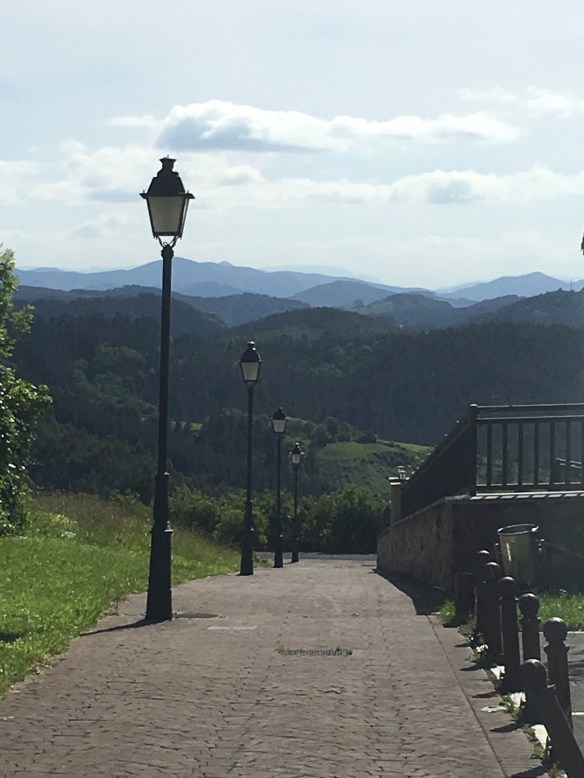
Imagine the path slick with rainfall and mud. I took this photo at the end of a beautiful, clear day, on the Camino de Santiago (del Norte). But just as often as there were dry, sunny days on the way, I encountered trails that were treacherous in rain.

IMG_5303

It was at the end of my longest hiking day in northern Spain that I met with such a descent – almost a full kilometre straight down on uneven cobblestone into the coastal town of Deba. The rain had started moments before. And I had just walked thirty-three kilometres in the hilly Basque country, all the way from Orio, near Zarautz.

I was exhausted. My mind was obsessed with getting to the pilgrims’ hostel as soon as possible. I was ready to collapse in a heap on my bed. Negotiating a tricky, slippery path was the last thing on my mind.

I had read and heard from fellow pilgrims these horror stories of unsuspecting pilgrims breaking their ankles on these kinds of descents. It was all too easy to cut short a pilgrimage after such an unfortunate accident. The practiced and seasoned hikers would know that one had to be very mindful of each step made. Even when they were tired. Even when being mindful of placing one foot in front of the other was the last thing they wanted to do.

On the last couple of Sundays we’ve encountered stories from the Gospel of Mark about Jesus’ healing ministry.[1] Indeed, during Ordinary (“green”) time in the church – both during the relatively shorter season after Epiphany in January and early February, and during the longer summer months in the season after Pentecost – the Gospel focus is the ministry of Jesus which includes healing.

In Lutheran circles we tend to look only at his proclamation; that is, we focus on what he said and taught the disciples about the kingdom of God. From this, we emphasize that Christian ministry is primarily about the proclamation of the good news. Mission, then, becomes more about ‘telling’ others about God, thus spreading the Word.

We miss an essential aspect of work-in-the-name-of-Christ with this limited vision of mission. Because, as elsewhere in the Gospels, we find that healing has equal prominence in Jesus’ ministry. Not only do we read about the miracles of Jesus curing disease, but more an inner healing for people battling their demons, so to speak. Healing has just as much to do about a renewed mind, a refreshed heart, a changed spirit. A reconstituted identity.

Healing is emphasized in the Gospel story today. Not just through words. But changed lives. Jesus came not only so that we might ‘believe’ with our minds in the good news, but that we might be healed in our earthen bodies and spirits.

How does this happen? What does Jesus do? From the text given to us today, Jesus’ took the hand of Simon’s mother-in-law, and “lifted her up.”[2] Jesus touches the person, physically. Taking someone by their hand is a sign of accompaniment. God is not remote from our human struggles. God is with us, Emanuel, in the person of Jesus. God takes our hand, and then lifts us up.

Faith can be described as movement. Last week we looked at the movement of ‘leaning into’ what we are afraid of, as a step in the direction of our healing – and finding Jesus is there. This week, the focus on the movement of ‘lifting up’, being ‘lifted up’, by God. As Jesus took the woman by the hand and lifted her up to be healed.

The Psalmist knew intimately this uplifting aspect of faith. “I lift my eyes to the hills, from where will my help come? My help comes from the Lord, who made heaven and earth.”[3] Many of the Psalm writer’s verses are called “psalms of ascent” because they were sung on the way ‘up’ to Jerusalem. The ancient pilgrim faithful needed to ‘look up’ as they made their way up the mount to the gates of the holy city. You know the hymn: “My Faith Looks Up to Thee.”

Faith is a ‘look beyond and upwards’ movement. In other words, the life of faith is not characterized by remaining stuck in the valley of our own suffering and misery. A faithful life, of course, does not deny our suffering nor is it pretending or distracting ourselves away from accepting its harsh reality.

Despite life’s imperfections, and struggles, however, to be faithful is to remain focused on others, on the promise of God, and on the hope we have. God takes our hand and is with us, and God sees it all. As Paul wrote, “we only see dimly now”.[4] Because we cannot understand all of life’s complexities, we need to trust in life, trust in good, trust in God’s time, in God’s way, that “all things work together for good for those who love and trust in God.”[5]

We are not just lifted up for our sake alone. We are called to lift others up, especially the downtrodden. Ours is the calling to lift others up – physically, emotionally, spiritually and materially.

We all know people who are ‘the lifters’. In their presence you feel lighter, lifted up. Whether it be their life story, their non-judgemental presence, their desire to show mercy and compassion, their interest in listening to you – they are an inspiration to us. They inspire us by their discipline, their focus in life.

The Gospel message is: We don’t need to be continually burdened by our suffering and narrow focus. We can be lifted up and transformed to be a reflection of God’s light to the world. In being truly ourselves, we can be ‘lifters’ too.

Remember: Resurrection is the end game of our faith. I mean not only of Jesus’ resurrection over two thousand years ago. I mean not only of our resurrection after we die our physical, earthly death. Because of Jesus’ healing ministry, we know that God also wants us to experience ‘resurrections’ in our own lives – on our earthly pilgrimage of living.

We can change, yes. It won’t be easy. It will take work. It will challenge us. We will need to move outside of our comfort zones. We will need to endure our momentary afflictions. On this journey of transformation, it will get harder before it gets easier. The truth will set us free, but it will first make us miserable. This is Christian truth. There is a cost. It is first the Cross of Christ; it is then the empty tomb of Easter.

There’s a woman from Tennessee whose name is Margaret Stevenson. She was in her nineties when I first read about her passion for hiking. You see, Margaret Stevenson used to hike ten or fifteen miles every day. She was a legend in the Smoky Mountains. She knew every trail and every plant and tree by its Latin and colloquial name.

Bill was much younger than Margaret when he hiked with her one day up Mt. LeConte. Now, Mt. LeConte is the third highest mountain in the Great Smoky Mountains National Park peaking at just over 6500 feet.

pexels-photo-414171.jpeg

Bill’s first trip up Mt. LeConte was Margaret’s seventy-fifth. When she finally stopped hiking she had climbed Mt. LeConte more than 700 times. Her husband rarely went, even before he got cancer.

When Bill and Margaret set out, they came upon what Margaret described as the most unrelenting two-mile ridge in the whole area – two miles up with no break. And this after a hard six miles on a very hot day.

Bill liked to hike in spurts, so he said, “See you later, Margaret,” and took off in his usual fashion and got way ahead of her. At some point, he found himself lying flat on his back in half delirium. A blurred Margaret passed him by at her steady pace. Bill can still hear the click-click of her cane and with no pity at all in her voice, she said, “One more mile to go, Bill. I’ll see you at the top!” And so, she did, arriving well ahead of Bill without stopping once.

Not long after that, Margaret’s husband finally died of cancer. But because of her daily walk with God, their last few hours were spent not in sadness or remorse, but in joy and celebration. For when Margaret says, “I’ll see you at the top!” she means it. For her face is fixed on Christ. Her step is steady and sure. And she knows the meaning of Isaiah’s words:

Even youth’s will faint and be weary,

And the young will fall exhausted;

But those who wait for the Lord shall renew their strength,

They shall mount up with wings as eagles,

They shall run and not be weary,

They shall walk and not faint.[6]

[1] Mark 1:21-28, Mark 1:29-39

[2] Mark 1:31

[3] Psalm 121:1-2, NRSV

[4] 1 Corinthians 13:12

[5] Romans 8:28

[6] William J. Carl III in David L. Bartlett & Barbara Brown Taylor, eds. “Feasting on the Word: Preaching the Revised Common Lectionary” Year B, Volume 1 (Kentucky: WJK Press, 2008), p.318-319.

Repeat performances

Once again during the Christmas season, I experienced this strange cultural phenomenon:

How many decades has it been that every December, movies like “It’s a Wonderful Life”, “Elf”, “How the Grinch Stole Christmas”, “A Charlie Brown Christmas”, “National Lampoon’s Christmas Vacation” and “The Bishop’s Wife” get replayed and replayed over and over again, year after year? And only at this time of year? You can probably add several more of your favourites to this list.

That is why I was a tad apprehensive last month when we received tickets to attend the National Art Centre (NAC) Theatre production of Charles Dickens “A Christmas Carol.” I know the story. I’ve read it several times. I’ve watched television renditions of the story over the years. What could the NAC Theatre do to bring it to life, once again, for me? Same old, same old, right?

On the other hand, I believe there is a good reason why we turn to these stories every year. There’s a reason for our culture’s yearning for their repeat-performances. A higher reason, I might add. Perhaps there’s something in those stories that we need to take to heart, and make positive changes to our lives. Perhaps, we need to see the story-telling as more than a mere syrupy, sentimental “Isn’t that nice” tradition.

So, I was surprised and intrigued by what the NAC Theatre troop did with the story. It was introduced by two actors who came on stage — one was blind and one was deaf. In the introduction they invited the audience to participate in a simple activity with our hands, both to show that the two actors needed each other in accomplishing their jobs; and, what is more, near the end of the story everyone in the audience was needed to give the sign with their hands in order to encourage Scrooge finally to embrace a more compassionate approach to life.

Without taking anything away from the traditional story-line plot, the meaning of Dickens’ famous “A Christmas Carol” was conveyed to me in a fresh way.

We encounter in young Samuel and the elder Eli one such repeat performance story in today’s text from the Hebrew scripture.(1) It is a story many of us know — of the boy Samuel in the temple who is called upon by God. It gets told many times in the life of the church over and over again — every three years at least. It is true: it is a nice, little story, isn’t it?

At first, Samuel doesn’t recognize God’s voice, believing instead that it is his old mentor, the priest Eli, who is calling him. Finally, with Eli’s help, Samuel responds to God’s call by saying, “Here I am. Speak, Lord, for your servant is listening.”(2)

Well, as I said, many of us are familiar with these very words. We even like to sing a popular hymn (3) reflecting the words of one responding positively to God’s call — a call that changes the life of the recipient. How does this familiar story speak to our lives today? How is it more than just ‘a nice, little story’ from the Bible? How can this story change our lives?

In this story, an old man and a young man collaborated to hear God’s vision for a new Israel. For God was about to do a new thing: Soon to emerge in the life of God’s people was a new lineage of kings, beginning with the inauguration of King Saul.(4) What was passing, was the rule of Judges along with the sinful house of Eli. What was emerging was the likes of King Saul, King David, King Solomon, and so forth.

In God’s message to Samuel, God condemns Eli’s lack of restraining his sons’ immorality. Eli’s sin was his aversion to do something even though he recognized what was happening. Even though Eli knew the ongoing problems in his household, Eli turned a blind eye and ignored it all.

He did not act. And no matter what Eli would do now to try to redeem himself by making various sacrifices to the Lord, God was intent to establish a new order of leadership over God’s people starting with the demise of Eli’s household.

Doing nothing was the problem. For us, today, doing nothing about a problem we know exists is the problem. How do we begin to move out of the prison of this self-inflicted inertia?

We need to recognize that growth and healing is a process. The birth of the new thing God was doing began as a cooperative affair. It took the attentiveness of the young Samuel’s ears and the wisdom of the old priest’s heart and mind to bring about God’s purpose. It took both the authority of the failing, feeble priest and the obedience of his youthful protégé to bring about God’s purpose. In other words, it takes a community to bear such a task.(5)

Responding to God’s actions and call in the world and in our lives today is not a solo effort. Religion is not a solitary practice. Indeed, it takes a village. It takes the various gifts of people in our lives. What one has and the other does not, what the other is good at that the first is not — it takes everyone’s attentiveness and participation.

How do we live into this collaborative way, especially challenged by our society’s emphasis on individualism, privacy and self-reliance? We are, indeed, up against a culture that is at odds with the Christian vision. How do we live the way of God’s reign? Where we value mutuality, diversity, common purpose in the mission of God for the good of all people?

In contrast to the way in which God spoke to the likes of Isaiah, Jeremiah and the later prophets of Israel, God does something unique with Samuel. You will notice that God does not enjoin Samuel to deliver God’s message to Eli. God does not charge Samuel to tell Eli what God is telling Samuel with words like: “Thus says the Lord, tell the people Israel”, etc., etc. No.

Rather, God wants simply to confide in Samuel. Basically, God expects Samuel, first, to listen. Just listen. It seems, Samuel first needs to learn how to do this. And it will take some time and some practice, evidently.

Can we have the courage, and the patience, to learn how first to listen to God and the other — without jumping in too soon with the energy of our own bravado, our own opinion, our own self-justifications, our own visions of what must be? The simple act of listening, can change our lives. Because listening first means we believe that the other has something of value to offer that we don’t have.

God works at a slower pace, it seems, compared to the hypersonic rhythms of life in 2018. Not only does God give Samuel and Eli one chance to figure it out, but two and even three opportunities to get on the same wavelength as God.

The story-telling is both appealing and intentionally slow early on. Dialogue is repeated. The action of Samuel getting up from sleep and going to Eli are repeated. We have to slow down with the narration and feel the build-up to the great reveal of God’s message.

Even though both Samuel and Eli are slow in finally getting it, even though they are encumbered by sleep, drowsiness, denial and avoidance, even though their response to God is compromised by vision and hearing impairment, by youthful pretence and the attrition of old age …. God still finds them. God still speaks. God still acts in the way God will act.

Despite human arrogance and self-delusion, despite all our toiling and pride, despite all our ego compulsions, God keeps at it to tell us, guide us, and instruct us.

We may not like the answer. We may not like what God has to say. We may be challenged to the core of our being by what God is telling us. Regardless of our hesitation, denial or self-delusion, God finds a way. God doesn’t give up on us. God gives us people, and stories, and experiences — even the same ones, over and over again — to help us finally get it.

God doesn’t give us just one chance. God is not just a God of second chances, as we often say. God gives us many chances, as many we need. May we, like Eli, finally come to accept what God has to say to us, with his words: “It is the Lord; let him do what seems good to him.”(6)


(1) 1 Samuel 3:1-20, the first reading for the Second Sunday after the Epiphany, Ordinary time, Year B in the Revised Common Lectionary.

(2) 1 Samuel 3:4-10.

(3) “Here I am, Lord”, Hymn #574, Evangelical Lutheran Worship (Augsburg Fortress, 2006); also, for the Christmas cycle, this hymn is also appropriate in singing Mary’s response to the angel Gabriel’s visit to her, announcing Mary’s role in the birth of Jesus (Luke 1:38).

(4) 1 Samuel 8-10.

(5) Richard Boyce in David L. Bartlett & Barbara Brown Taylor, eds., “Feasting on the Word: Preaching the Revised Common Lectionary, Year B, Volume 1 (Kentucky: WJK Press, 2008), p.245-247.

(6) 1 Samuel 3:18

A wintery spirit

IMG_6730

The winter of 2018 has been record-setting, so far. And we are barely one week into the new year! Did you know it was Ottawa’s coldest New Year’s Day since records began in 1873? At 8am on January 1st, the mercury dipped to a frigid minus 30.2 degrees Celsius (-22 Fahrenheit); New Year’s Day also marked Ottawa’s sixth consecutive day with temperatures below -17 degrees Celsius (1 Fahrenheit), which made it the longest run in exactly one hundred years.[1]

IMG_0223

A full onslaught of winter can help us appreciate the meaning of Christianity. Though much of the bible’s stories and lessons were wrought out of the harsh desert climate surrounding the Mediterranean and Arabian seas, the winter realities we face in Canada are not that much different. I suggest, then, let’s take desert and winter as synonymous – meaning, essentially, the same things.

IMG_3529

American Lutheran theologian, Martin Marty, describes the importance of what he calls a “wintery spirituality”, defined by the shrill cry of absence, frost, and death. In contrast to a summer spirituality, winter is more given to being emptied than being filled. Winter is harsh and lean in imagery, beggarly in its gifts of grace and love.[2]

IMG_3524

Of course, Jesus goes into the Judean wilderness to be baptized in the Jordan River. And right after his baptism, he spends forty days and nights in the desert.[3] The desert is not a comfortable place to be. For one thing, it makes scarce and even denies the basic need for our survival – water. A desert is an arid region where annual rainfall remains miniscule. Some deserts average only one centimetre a year, with parts of the Sahara not receiving a drop of rain for more than twenty years.[4]

The word and image of water appears in each of the Hebrew readings assigned for this festival day in the church calendar, and is tied to baptism in the readings from the New Testament.[5] More to the point, water is given out of the chaotic void in the creation story, and in the arid wilderness as a gift and a grace. Water is thus a sign of God’s love amid the harsh winter or desert realities of our lives.

The prophets of old affirm that it is precisely in the desert where God expresses God’s love to the people. The grace of God cannot be received outside of winter. “Thus says the Lord: The people who found grace in the wilderness … I have loved you with an everlasting love …. I remember your love, how you followed me in the wilderness.”[6]

How, then, can we appreciate and even thrive, living out of this truth? How can we follow Jesus in his way? After all, the Baptism of our Lord is about Jesus beginning the journey to fulfill his God-given purpose in life. How he does it is of particular importance to us, if we are interested in following Jesus in our life-style.

Listen to a story first told by a nineteenth-century teacher, Awad Afifi the Tunisian, who drew his wisdom from the wide expanse of the North African desert:

A gentle rain fell on a high mountain in a distant land. The rain was at first hushed and quiet, trickling down granite slopes. Gradually it increased in strength, as rivulets of water rolled over rocks and down gnarled, twisted trees that grew there. The rain fell, as water must, without calculation. After all, water never has time to practice falling.

Soon, it was pouring, as swift currents of dark water flowed together into the beginnings of a stream. The brook made its way down the mountainside, through small stands of cypress trees and fields of lavender, and down cascading falls. It moved without effort, splashing over stones – learning that the stream interrupted by rocks is the one that sings most nobly. Finally, having left its heights in the distant mountain, the stream made its way to the edge of a great desert. Sand and rock stretched beyond seeing.

Having crossed every other barrier in its way, the stream fully expected to cross this as well. But as fast as its waves splashed into the desert, that fast did they disappear into the sand. Before long, the stream heard a voice whispering, as if coming from the desert itself, saying, “The wind crosses the desert, so can the stream.”

“Yes, but the wind can fly!” cried out the stream, still dashing itself into the desert sand.

“You’ll never get across that way,” the desert whispered. “You have to let the wind carry you.”

“But, how?” shouted the stream.

“You have to let the wind absorb you.”

The stream could not accept this, however. It didn’t want to lose its identity or abandon its own individuality. After all, if it gave itself to the winds, could it ever be sure of becoming a stream again?

The desert replied that the stream could continue its flowing, perhaps one day even producing a swamp there at the desert’s edge. But it would never cross the desert so long as it remained a stream.

The stream was silent for a long time, listening to distant echoes of memory, knowing parts of itself having been held before in the arms of the wind. From that long-forgotten place, it gradually recalled how water conquers only by yielding, by turning to steam in a natural cycle. From the depths of that silence, slowly the stream raised its vapours to the welcoming arms of the wind and was borne upward, carried easily on great white clouds over the wide desert waste.

Approaching distant mountains on the desert’s far side, the stream then began once again to fall as a light rain. At first it was hushed and quiet, trickling down granite slopes. Gradually it increased in strength, as rivulets rolled over the rocks and down the gnarled, twisted trees that grew there. The rain fell, as water must, without calculation. And soon it was pouring, as swift currents of dark water flowed together – yet again – into the headwaters of a new stream. [7]

Jesus instructs his followers to become the people they are called to be.[8] God is aware that our lives are like a journey through the desert. Or, as Canadians, we can say that our faith journey is not dissimilar from living through an Ottawa record-setting winter.

To thrive in this life is to see that this journey of becoming is not static. We are not called by Jesus to become mere swamp lands at the edge of the desert. Rather, the journey calls us to be vulnerable, to recognize what we may initially want to resist in us – like the stream that first struggled against yielding to the wind.

Our journey through life are journeys of vulnerability. Of taking little. Of trusting God. Of appreciating the value of small things. Of letting go into the Spirit wind of God. Then, we can, with the Psalmist see that, even in the wilderness, the Lord fulfills God’s promises and does indeed give strength to us and bless us with peace.[9]

IMG_3628

[1] Ottawa weather records, Twitter @YOW_Weather

[2] cited in Belden C. Lane, “The Solace of Fierce Landscapes: Exploring Desert and Mountain Spirituality” (New York: Oxford University Press, 1998), p.37

[3] Mark 1:12-13

[4] Belden C. Lane, ibid., p.38

[5] The Baptism of our Lord, Revised Common Lectionary Year B: Genesis 1:1-5, Psalm 29, Acts 19:1-7, Mark 1:4-11

[6] Jeremiah 31:3; 2:2

[7] as written by Belden C. Lane, ibid., p.20-21

[8] read the entire section from Matthew 10:5-42

[9] Psalm 29:11, NRSV