
Gospel, Italian style

On the Sunday before I left for a family vacation to Italy, you encouraged me to — “know your history”. I think that message came to me mostly during the children’s chat when we talked about the Canadian flag on my backpack, and why Canadians had been so well appreciated and admired in western Europe, especially, over the past several decades.

The conversations then, as well as following the service over coffee, reinforced to me the value you place upon ‘history’ in general. 

Well, Italy is not exactly the hotbed of Reformation, Protestant Christian history as such. At the same time, the buildings there stand clearly as testimony to the dedication of Christians in certain times and places in history.

It was the first day we walked in the older section of Naples — a sprawling metropolis at the base of Mount Vesuvius on the Mediterranean coast — when I began to feel this history pressing in the air all around me.

I say sprawling because Naples is today the most densely populated urban centre in all of Europe; some 8,500 people inhabiting one square kilometre in a metropolis of nearly four million people — making it the third largest city in Italy, and the ninth most populous urban area in the entire European Union.


The noise was overwhelming: the hustle and bustle of pedestrians, car horns beeping, motorcycles and mopeds buzzing, shouting street vendors, impassioned conversations, two-toned emergency sirens, barking street dogs, screeching tires.

In conrast, the neo-Gothic styled ‘duomo’ in Naples offered a welcome break to this outside clamour. 

The expansive interior spaces of this main cathedral embraced silence and only hushed speech. You could occasionally hear the squeak of rubber-soled shoes and someone dropping a book on the stone and marbled flooring as people sat and wandered solemnly throughout the holy spaces.

Perhaps the most significant feature of this cathedral is the baptistery, which is the oldest baptistery in the world, built in the fifth century, C.E. It is remarkable to connect with such an ancient symbol in a material form. 
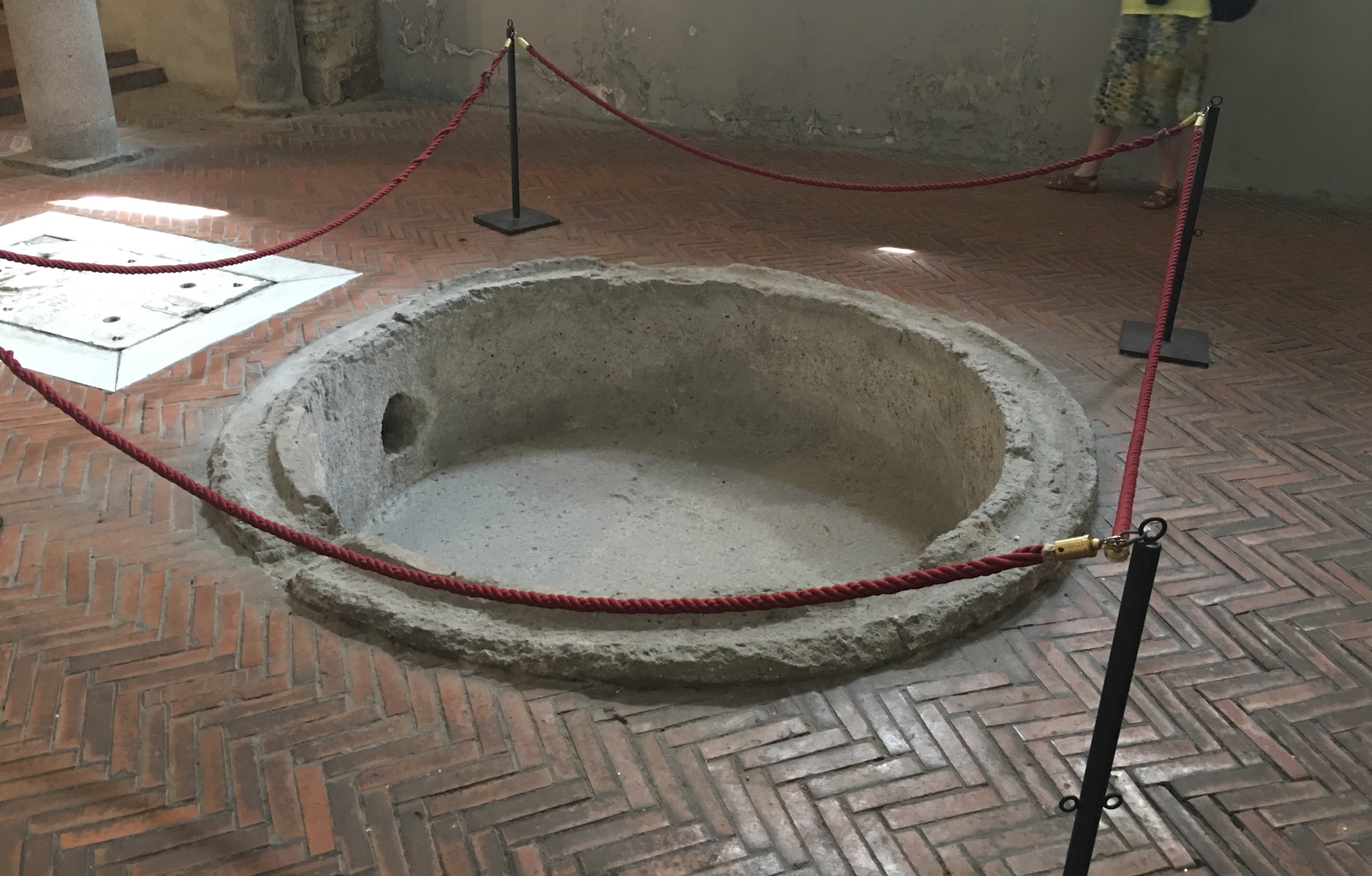
When the baptized emerged from the water, looking upward at the ceiling, they would be encouraged in their faith; the first images they saw after being baptized were scenes from the Gospel expressed in Byzantine, mosaic art: Jesus saving Peter from drowning, the women at the empty tomb, the miracles of the multiplied fish, an image of Saint Paul, the Apostle, etc.

Seeing with my own eyes and touching with my own hands this font that was built by human hands only a few hundred years after Jesus, affirmed my conviction in the longevity and validity of the sacrament which has endured as profoundly meaningful for Christians throughout the millennia. 

I felt that faith is not just about the good old days when I was young, but the good old days when the Christian faith was younger. We are part of something much larger than our immediate reality. And, when we connect with that broader history, we realize it wasn’t always peaches ‘n cream and rose-coloured a history.

If you are movie watcher, you might recognize another cathedral we visited — the Duomo in the Umbrian, medieval town of Orvieto. 


This cathedral was featured in the opening scenes of Under the Tuscan Sun. This cathedral’s highlight is the Chapel of San Brizio, featuring Luca Signorelli’s brilliantly lit frescoes of the Day of Judgment and Life after Death. 

Although the frescoes refer to themes of resurrection and salvation, they do so through images not from the bible (that is, stories from the Gospels or Old Testament) but from the turbulent political and religious atmosphere of Italy in the late 1400s. Signorelli told the story of faith through his contemporary human events, rather than the traditional symbols (such as Jesus, God, the Trinity, the Apostles, disciples and other biblical characters) that we see in most other places.

Those frescos in the Orvieto cathedral chapel were snapshots of an historical era particular to a specific time and geo-political reality (i.e. 15th century Italy). And the impression of faith put ‘on it.’ Historical to us. Yet current to those who built that Cathedral in the Midlle Ages.

Faith is more than merely appealing to our past. Coming to worship today is not just about being reminded of something or someone from a long time ago. What we do here today is not just an exercise in recalling historical facts. As if decisions we make today are really not about faith. When we talk about our building renovations, worship practice and art, musical choices, communion, budgets, outreach initiatives  — these issues are very mcuh about the Christian faith ‘in the real world’, so to speak. All of these real things do reveal what we believe in, our values, what is important to us, who we are. How do these ‘mundane’ decisions reflect the Christian Gospel, faith, kindgom values in this time and place?

Lutherans make a similar mistake, I believe, when we define ‘Lutheranism’ as a belief/doctrinal system that is limited to the words and conceptual formulations of sixteenth century Germans. When we say that to be Lutheran is merely to ‘turn the clock back’ to 1537 when the Book of Concord was finally assembled including Luther’s Small and Large Catechisms, the Augsburg Confession, and the Apology to the Augsburg Confession.

I prefer a view that is reflected in the Evangelische Kirche Deutschland’s (EKD) logo for 2017, “Celebrating 500 years of Reformation”. Five hundred years of Reformation. In other words, Reformation started happening — in our tradition — with Martin Luther, yes. 

But, Reformation continued through the 500 years following, and continues to this day and beyond. We are always reforming the forms and means by which we express our evangelical, Gospel-centred faith. Always finding new and creative ways to tell the story of God.

What can we say, then, about Christian history? If we can apply a macro view over the ages, we can say that the history of the Christian faith is about a God who loves us. Christian history is about a God whose compassion never fails, who “will not come in wrath” (Hosea 11:9) — even though the people of God continue to keep “sacrificing to the Baals and offering incense to idols” (v.2).

The history of the Christian faith is about our lives being “hidden with Christ in God”, being “revealed with Christ in glory” (Colossians 3:3-4), dying daily to ways of sin and being renewed daily in Christ who “is all and in all!” — even though we are imperfect and sin as long as we hold breath. Christ is all and in all — despite us!

The history of the Christian faith is about how each moment of history — including this one right now — reflected Jesus’ love in the fifth century, the fourteenth century, the 21st century in Palestine, Egypt, Italy, Canada, etc. God for all times and places!

We validate the Christian faith by our lives today, now. This is where the rubber hits the road. This in-the-moment approach fuelled the generosity of medieval Catholicism represented in the magnificent building projects for worship as much as it did the passion and commitment of European Christians during the Reformation era.

We do not leave the practice of faith for some distant, utopic and dreamy future. Neither do we rest on the laurels of the tremendous sacrifices made by our forebears in Canada. 

Now is the time. Now is the time to live out of the conviction of God’s grace and love, despite the many and various ways Christians have messed up in history, and continue to do so today. Now is the time to live out of the faith that is full of hope, that despite our waywardness and unfaithfulness, God is faithful. Now is the time to claim God loves us, not because we are good, but because God is good. God is so good!

You know Jesus’ familiar exhortation, most often translated as “be perfect as your heavenly Father is perfect” (Matthew 5:48). Christians have often interpreted this word ‘perfection’ as being made whole. 

A much better translation might be: “be merciful.” Because this verse comes right at the end of a passage calling Christians to “love your enemies” (v. 43-48). Only God is perfect. But we can participate in God’s perfect mercy, God’s all-inclusive and impartial love.

Echoing Saint Paul’s words from the Epistle today (Colossians 3:11 — “Christ is all and in all”) St. Bonaventure later said, “Christ is the one whose centre is everywhere and whose circumference is nowhere.” [1] 

Christ’s mercy is everywhere evident in history. This is the Wholeness, the forgiveness, the grace, that holds you forever and everywhere. You can’t figure this Wholeness out rationally, nor can you control it. All you can do is fall into this Wholeness that holds you when you stop excluding, even the dark parts of yourself. [2] And that, my friends, is the Gospel — good news — for all times and places.

Thanks be to God!

1- Alan of Lille, ‘Regulae Theologicae’, Reg. 7 as quoted by Bonaventure, translated by Ewert Cousins, “The Soul’s Journey into God”, Classics of Western Spirituality (Paulist Press: 1978), p.100

2- Richard Rohr, “Daily Meditation on the Spirituality of Imperfection” Week 2 – Perfection of Wholeness, Thursday, July 28, 2016

Exposing the agenda of hate

A recent song by American singer-songwriter Soufjan Stevens is entitled: “There’s no shade in the shadow of the cross.” Today, on Good Friday, we all stand in the shadow of the Cross of Jesus. But there’s no shade in this shadow.

If you want a comfortable religion that just makes you feel good, then you dare not approach the Cross of Christ, and you dare not pray.

Encountering Jesus on the Cross is not pablum for the soul nor is it expressing mere platitude for an easy life. The cross is not an exercise of remembering something that happened long ago (and therefore doesn’t really mean anything for me today). We are not merely going through the motions, on Good Friday.

The cross, in all its bloody, bear and stark reality, exposes the darkness within each one of us, today. The cross exposes the human problem of hatred. You will not find relief here today. No shade. No comfort. Only sin. Only hate. In the world. And, within you.

The longer we live in this world, we are forced to asked the question: What makes many people so mean? What creates mean-spirited people? “I want to hurt you!” What is behind hate?

Hate – I just called it ‘mean-spiritedness’. Maybe that is what we see more often than overt hatred. Mean-spiritedness is, unfortunately, here to stay.

Hate is, for some reason, helpful. Hate works. In a lot of immediate and seemingly good ways. It unites a group very quickly. Far quicker than love, you must know that. Hate immediately and easily resolves the inner struggle between the little devil on one shoulder persuading you to do something other than what the little angel on the other shoulder is saying. 

Mean-spiritedness is formed by contraction, ‘against-ness’. Love, on the other hand, is formed by expansion. Love doesn’t come easily, because you have to let down your boundaries. And no one wants to do that.

Contraction — whereby you can eliminate another person, write them off, exclude them, torture them, expel them, ‘vote them off the island’, immediately gives one a sense of boundaried definition, boundaried superiority, even.

Hatred — mean-spiritedness — gives a person identity even if it is a negative one (“I am not that, I am not like them, I am against so-and-so, etc.”). And we’d sooner have a negative identity than feel vulnerable, like nothing, empty. Just who we are, in God.

Hatred takes away all doubt, and free-floating anxiety. Even if in a false way. It feels superior. And feels in control. Hate settles the dust, and the ambiguity that none of us likes. Hate is much more common and — I’m sad to have to say this as a pastor — it is much more immediately effective than love. Immediately.

Hate makes the world go round. Just read the front pages of morning paper this week, scroll through the news feeds on your tablet or flip the channels at 6 o’clock every day. It’s largely about who is hating whom.

You could say that Jesus came to resolve the central problem of hate — this problem that has defined humanity since the beginning of history. There’s really no other way: To save us from ourselves. To save us from one another. And to, therefore, save us.

Until and unless we are saved from our need to hate. 

That’s why people even made religion into a cover for their need to be hateful. I’m hating for Allah, and so it’s ok. And yes, I’m hating for Jesus. Christian history, too, is not free from violence (the Crusades, the witch-hunts, Protestant-Catholic European wars, the residential schools — the list goes on). “I’m hating for Christianity — so my hatred is good hatred.” It happens every day. It’s almost the name of the game.

The ultimate disguise, whereby you can remain a hateful, mean-spirited person is to do it to protect the church, or to protect the country. All those good excuses. So, you are relieved of all anxiety: “I am still a holy person.” Even though, underneath, in the deeper stream, you are a hateful person. But you don’t have to see that. That’s what Scott Peck called, years ago, “People of the Lie”.

We have done so much utopian talk about Jesus and love. But Jesus had a very hard time getting to the issue of love. First, he had to expose and destroy the phenomenon of hate. Which I think is the meaning of the Cross.

Once he exposed the lie and the illusion of hatred, love could show itself clearly. But until then, you can’t. The pattern is still the same. As Jesus shockingly put it, “Satan is the real prince of this world” (John 12:31, 14:30, 16:11).

Hate, it seems, is the daily, ordinary agenda. Love is the totally enlightened, entirely non-sensical way out of the ordinary agenda. The Gospel presents the dilemma in a personal and cathartic Passion narrative that grounds the whole issue in history, and in one man’s enlightened response to that history. 

One man, Jesus — fully divine and fully human, accepts the religious and social judgement of hate. We have both church and state, both Caiaphas and Pilate. Both power systems declaring Jesus unworthy, declaring him a sinner, wrong, the problem. The very one that you and I call the most perfect man who ever lived is judged by power at the highest levels to in fact be the problem. 

Jesus bears the consequences of hatred, publicly. But in an utterly new way that transforms the pattern. And therefore for us, transforms the possibilities. For two thousand years, Jesus has remained the most striking icon of a possible new agenda. His death exposed the lie and the problem like never before.

His risen life told people that life could have a different story line. Jesus did not just give us textbook answers from a distance. But he personally walked through the process of being rejected and then said, ‘follow me’. And there’s something you only know having been in that position.

What is behind hate? I believe fear is almost always behind hate. It’s not easy to get to that deeper river of fear. It’s not easy to recognize the subtle fears: Afraid of not looking good. Afraid of not being in control. Afraid of not having the right word. All those are fears. But they are subtle.

And the only way to see them is to go right into your own poverty of spirit — blessed are they who do so, Jesus said (Matthew 5:3).

Sometimes it looks like it’s control that’s behind hatred. But even control freaks like myself are usually afraid of losing something. Just go deeper, and you’ll see. It is almost always fear that justifies our knee-jerk hateful response. 

Fear is hardly ever recognized as such. As Paul says in Second Corinthians — ‘the angel of darkness must always be disguised as an angel of light’ (2 Corinthians 11:14). The best and most convincing disguise, of course, is virtue itself, or godliness. Then, it never looks like fear. 

For fear to survive, it has to look like reason, or reasonableness, prudence, common sense, intelligence, the need for social order, responsible stewardship, morality, religion, obedience, or even justice and spirituality. It always works. Just give it the nice cover, and you don’t have to face underneath it, what is craven fear.

What better way to veil vengeance, and a vengeful spirit than to call it justice. You hear it on the news every night, “I just want justice.” One wonders whether the inner need to punish the other, to hurt the other, has ever been recognized. Let’s be honest: It’s in everyone of us in this room. When someone has made you afraid, you want to hurt them back. To be trapped in our need for vengeance, is to always be afraid. It’s necessarily to be afraid. No wonder fear is the name of the game in almost all of the world. 

And that demon is not exorcised easily. Until you name the demon and admit the demon is there, you have no power of exorcising the demon. It’s clear, in Jesus’ exorcisms. You must name the demon correctly. When you pretend the demon isn’t there, you’ll never do any good exorcism. That’s largely what we do. It’s called, denial.

Only people who are honest and vulnerable about their own fear, and confess their need to control all outcomes, only those practiced in letting go, can go beyond the agenda of hate. Jesus himself prayed hanging on the cross: “Father, into your hands I commend my spirit” (Psalm 31:5). This is about letting go of our opinions, our need for getting back, our need to exclude, circle the wagons, and point the finger.  

Jesus prayed, too, from the cross: “Father, forgive them — they don’t know what they are doing!” (Luke 23:34). Only people practised in letting go will be taking the first step in the new agenda of love and forgiveness. This agenda of love, Jesus made possible for us. “Perfect love casts out fear,” scripture promises us (1 John 4:18).

The Cross, today on Good Friday, calls us to trust Jesus. To not have anyone that you can trust is necessarily to be afraid, to be vengeful. Christianity at its best aims to free individuals from their small, fragile, sinful selves, and points to a larger identity in Christ Jesus — the only true self — “hidden in Christ with God” (Colossians 3:3) .

Jesus is the only trustworthy lover, the only trustworthy self. Healthy Christianity, like Jesus himself, tells you that there IS someone you can trust. You do not have to create all the good. You do not have to fix all of the bad. You do not have to explain all the failures. You know you are simply in the stream we call the mystery of death and resurrection, the paschal mystery. 

What else would be the beginnings of peace? As long as you think you have to fix everything, control everything, explain everything, and understanding everything, I can promise you, you will never be a peaceful, loving person.

In the shadow of the cross, there is no shade. Indeed. But let’s stay awhile, and open our hearts to Jesus whose love makes us worthy and who is with us, even in the darkness.

Adapted and transcribed from Richard Rohr, “The Central Problem of Hate” track 8 on CD ‘Action & Contemplation’, Meditatio Talk Series 2015

Slo-mo prayer

Everyone’s happy for the extra time off in March. For those in school, children and teachers can enjoy some leisure and vacation time. Then, at the end of the month, comes the extra long, four-day weekend at a time when Spring and warmer weather brightens our days.

Indeed, the holy days are upon us. But it’s not really just party time. It looks like that on the surface or at the start: The singing of hosannas, palm branches waving, praising the coming of the Messiah into Jerusalem riding a … wait. A pony? Is this a joke?

Palm Sunday starts the final leg, so to speak, on our Lenten journey. And what seems on the surface like the start of a holiday (that is, to relax and enjoy some well-earned leisure and play) is in truth an invitation to go deeper and reflect not only on the good life, but to go underneath and look at our suffering and pain. In Christian language, we call it the crosses we bear.

It is time now to look at the big picture of our life without ignoring the present sometimes difficult reality. How can we do that?

This Holy Week we are invited to slow down. And take a deep breath. And be honest, with ourselves and the truth of our lives. Not to grovel in a depressive, morbid mire of self-hate. But to lift to the light everything that has been hidden, kept secret, denied, overlooked, suppressed in the shadows and dark recesses of our hearts. In the end, it can be cause of a deeper joy and freedom; at first, though, it can be distressing and anxious-filled.

The path of Jesus shows us the way through it all. Where Jesus goes and how he does it offers us a way to forgiveness, release and true happiness. But first we must bear our cross. As we slow down, we pray.

Pray. As Jesus, on the night of his arrest, commanded his sleepy disciples in the Garden of Gethsemane not once but twice: “Get up and pray, that you may not come into the time of trail” (Luke 22:40,46). Jesus not only shows us what to pray, but also how to pray.

I follow the Ottawa Senators NHL team on Instagram. And before every game they post a short video montage, lasting no more than 15 seconds or so, of the players getting ready for the big game.

What’s attractive about the video to me, is to see how they splice together several brief clips of various moves the players make on and off the ice: back-slapping a team mate, practising a slap shot, the goalie making a glove save, skating towards the puck, a pre-game ritual.

But what keeps my attention is where the editors choose to speed up and slow down a few of the segments. Strategically done in an appealing way, the montage goes back and forth between periodic slow-motion action clips and real-time moves.

The whole presentation is enhanced because the real time rapid action shots are interspersed with slow motion shots. In fact, because they slow down some of the action, I can appreciate and enjoy a particular move even more — for all the skill and intention it entails.

In other words, it’s not boring. Slowing down, from time to time, actually gives energy. Slowing down, from time to time, gives clarity, focus and meaning to the activity and the whole picture. Slowing down, from time to time, allows me to get a good look at what is actually happening in all that I do.

And that’s what we do when we pray as Jesus did. Throughout his life of ministry, Jesus moved around a lot in the region of Galilee — healing people and teaching them about God. He covered great distances by foot. He didn’t even have a home base. 

But as was his custom, even before suffering betrayal, arrest and branded a criminal to die a horrific death on the cross, Jesus slowed things down. He went to quiet places on a hillside, by himself usually, to pray.

The feeling I have every Palm Sunday is like I’m seeing a video montage of Jesus’ life, ministry, and Passion. Just short segments highlighted with the larger flow of the story. Certain shots are in real time, sometimes even sped up because we also see the cross on Palm Sunday. But then there are the segments that slow right down.

Jesus was already practised in the art of slowing down to pray, so that from the cross came two prayers that can not be rushed, denied, suppressed, hidden: There’s a prayer for forgiveness (“Father, forgive them; for they do not know what they are doing” – Luke 23:34) and a prayer of relinquishment/release (“Father, into your hands I commend my spirit” – Luke 23:46). (1)

Whom was Jesus forgiving? The disciples who deserted him, the Roman soldiers who killed him, the ruling religious elite who condemned him to death, yes. Was he forgiving us all forever, for all our sins? This is the Gospel.

Did they “know what they were doing”? Only in part. None of us knows the full extent of our sinning or the full harm we do. God’s forgiveness covers all.

In his prayer of relinquishment, Jesus offers to his Father – Abba – what he has been offering all along: his life into the hands of God who is ever faithful. Jesus quotes Psalm 31, an evening prayer which may very well have been the bedtime prayer for Hebrew children and their parents. It is the prayer of “letting go”.

And Jesus asks his disciples to do the same. So, we can say, especially bearing our own crosses: “O God, take my sticky fingers off the controls, and place my life and life of my loved ones in better hands than mine. In your hands.”

It’s in our nature not to want to slow down. It’s in our nature to go-go-go. Slowing down, being silent and still, forgiving and letting go, is especially difficult in our day and age when we are so used to being stimulated by rapid-fire activity, lots of noise, and when we have total control.

The irony is that our lives of activity and go-go-go will have even more effect should we also intersperse that activity with regular times of slowing down to pray as Jesus did.

It has always been a tradition for Christians to pray silently, to just be, in the presence of God. We pray without having to do a whole lot. And this reminds us that God is already with us, Jesus already loves us and is already doing stuff in the world — even before we do anything. The practice of prayer has given Christians through the centuries great energy and peace for life, even more so had they not made the time for prayer.

If someone would do a video montage of your life to date — reviewing all the things you have done, places you’ve visited, people you’ve been with — would it also include shots of you being silent, still, praying by yourself and with others?

I think that would make a really cool video!

(1) – H. Stephen Shoemaker in David L. Bartlett & Barbara Brown Taylor, eds “Preaching the Revised Common Lectionary: Feasting on the Word” Year C, Volume 2, WJK Press, Kentucky, 2009, p.183

There’s no place on earth

People of faith, since the beginning, have been on the move. Even when they settled down for a while, they created ways of practising the journey — of moving from Point A to Point B.

Rome, central to the story and expansion of early Christianity, is full of famous steps. The most famous of these are the 135 Spanish steps which visitors traverse daily en masse.

Millions of Christians have walked the Camino el Santiago which spans almost 800 kms from the foothills of the Pyrenees in France all the way to Galicia on the northwest coast of Spain.

The trails to the castle at Lindisfarne in the United Kingdom attract Christians worldwide every Holy Week to walk nearly 200 kilometres.

People of faith have valued movement as integral to their spiritual growth. Because we are not the same at the end of a journey than we were when we started. This innate desire to be better, to change, to grow and mature — is part and parcel of the life of faith.

The culture of Journeying, so important to the Lenten season we now begin, has its roots in the original pilgrimages to Holy Lands. For centuries, Christians sought a deeper connection with Jesus who walked and lived and died in and around Jerusalem and the Judean wilderness. 

When the Crusades prevented pilgrims from traveling to the Holy Lands, Christians ‘back home’ developed prayer walks in Labyrinths — the most famous and oldest in the Chartres Cathedral in France — which symbolized the long journey to meet Jesus.

Indeed, settlers to this country moved here, many of them to exercise and practice their faith in freedom. Mobility, migration, pilgrimage — this is our story, as people of faith.

How we journey is the question. The journey is not only physical, it also describes our understanding of the way things work.

Over the last month, the Ottawa Senators (NHL hockey team) were looking to score more goals. They had lost more games than won. Their star players were not producing. 

One of their younger players, Curtis Lazar, decided to give $50 to a homeless person after dining out one evening. The next night, he scored two goals in a routing of the Toronto Maple Leafs — the Senators won that game 6-1. The following game, the Senators won again, 5-1, against the Tampa Bay Lightning.

In an interview afterwards, Lazar confessed that perhaps there was “karma” working here. Meaning, because he had done a good deed, there was a ‘return’ on his righteous investment and he was rewarded with those goals and wins.

I like Lazar and I appreciate his hockey skills and character. At the same time, he reflects a dominant way of thinking. It is really what some have a called a mechanical type of spirituality, with inputs (from us) and outputs (from God). The sequence goes something like:

1. We sin

2. We are punished

3. We confess our sins

4. We change our lives, and do something good

5. Then, we receive forgiveness and grace

Such is the description of a journey towards goodness that hinges entirely on us, and our doing, our initiative. This spiritual journey then cycles back to the beginning and round and round it goes. Essentially, we force God’s hand. Karma is not a belief alien even to Christians, it seems!

The problem with karma is that because it ultimately relies on our good works, we will never achieve the goal. After winning two lop-sided games, the Senators have now lost three in a row. Where does that leave Lazar? Does he have to give $100 next time to poor people he meets?

In recalling the great acts of God in bringing the Israelites to the Promised Land, Moses confesses it is God’s mighty arm that started the ball rolling towards freedom; verses 8-9 of Deuteronomy 26:

8The Lord brought us out of Egypt with a mighty hand and an outstretched arm, with a terrifying display of power, and with signs and wonders; 9and he brought us into this place and gave us this land, a land flowing with milk and honey.

Like the Israelites wandering in the desert for 40 years, Jesus walks with us in a completely opposite direction from karma. His is not the spirituality of addition, but of subtraction. He goes into the desert.

Try to imagine Jesus’ first moments, entering into the wilderness he would occupy for forty days: The sound of any footsteps is absorbed by sand and rock, lost in the wind or in silence. It is in this barren place that Jesus chooses to retreat, far from what he knows.

Christ chose to retrace the path of his ancestors — in the desert: Abraham. Moses. Ruth. Some of them were responding to God’s call. Some were fleeing persecution. Some were simply looking for a place to call home.

There may very well be value, to our growth as Christians, in embarking on spiritual journeys and earth-bound pilgrimages with some expectations at the destination in mind.

At the same time, we can be assured that Jesus not only waits for us at the ‘end of the line’. Jesus is right there with us, each step of the way. His journey into the desert of testing and suffering shows that there is no place of suffering, pain and loss on earth, to which Jesus is unaccustomed. No place of want that Jesus doesn’t know, intimately. This is more the point.

I like one of the sayings, attributed to Albert Camus, on a Valentine’s Day card I saw: It’s a message of love from one to another: “Don’t walk in front of me, I may not follow; don’t walk behind me, I may not lead. Just walk beside me, and be my friend.”

The message of Christianity is that God is not out there, or back there. God is ‘in our skin’, with us. And goes where we go in our journeys of faith and life, through the good and the bad. Jesus is not only the God of our eternal salvation, Jesus is our friend for life, and no matter what.

Jesus resides in the deepest places of our heart and activates our truest most authentic selves no matter where we are at.

Long before Jesus came, the Psalmist knew this gracious truth in his heart: There is no place on earth where God’s presence of grace, love and mercy cannot reach. In Psalm 139 —

7 Where can I go from your spirit? Or where can I flee from your presence? 
8 If I ascend to heaven, you are there; if I make my bed in Sheol, you are there. 
9 If I take the wings of the morning and settle at the farthest limits of the sea, 10 even there your hand shall lead me, and your right hand shall hold me fast. 

Contrary to karma, this journey of faith begins with God’s grace and forgiveness, as it always does. It is in the desert of our lives where we experience this grace because life happens regardless of how hard we try. And because we are already forgiven, already blessed, we can live confident, transformed lives, even in the desert of our lives. As we live out of our freedom in Christ, we can then confess, “Jesus is Lord!”

As God is with us in our deepest darkness and light, we look to those on the move today. Refugees. Migrants. More than the places of the journey, it is the people we must engage. 

While the desert wilderness was a time of solitary retreat for Jesus, migrants and refugees live in communities: their solace is in the comfort of companionship and common history and identity with those whom they live alongside. In the Lenten days to come, in our own solitary places, let us pray for those for whom solitude is a luxury. And welcome them into our hearts and minds. (1)

(1) Lutherans Connect, “Welcoming the Stranger” blogpost Lenten devotions, Day 1 (lc2016lentdevotional.blogspot.ca)

The life-giving gap

Does a spring pour forth from the same opening both fresh and brackish water?” (James 3:11)

The writer, James, makes a case for integrity and authenticity in the Christian life. For us moderns, living in a day and age where how we look, our reputations, our social standings and our bank accounts seem to speak louder than anything else about who we truly are and what we truly want. Is our joy at living based on these ‘worldly’ values, when we are honest about it? 

It becomes particularly challenging for us Christians, whose value system is acutely counter-cultural. It becomes a real war, actually, to embrace the true source of our lives in a world of celebrity politicians and glory-seeking suburbanites. And I think, for the most part, we live a bifurcated existence. We say one thing — I believe in the God who asks us to bear our cross and follow him (Mark 8:34) — but so easily slip into a lifestyle that is really narcissistic, self-centred and selfish. The easy way.

It’s a rhetorical question. “Does a spring pour forth both fresh and brackish water?” In James’ mind, of course not. A spring will either bring forth, on balance, mostly fresh or mostly dirty water. The meter will lean one way or the other. 

Which way do you lean? In your work? In the way you invest? In how you spend your money? In how you spend your free time? With whom? In what and how you communicate?

In the Gospel for today (Mark 8:27-38), Jesus says some difficult, counter-cultural things about what kind of way Jesus — the Lord of Lords, the King of Kings, God incarnate, Almighty and Everlasting God — will travel the journey of life. And it is this God who beckons us to follow: in order “to undergo great suffering” (Mark 8:31). Really? That doesn’t sound right for a person claiming godly power!

In an upwardly mobile culture we are suddenly and shockingly presented with a downwardly mobile God. Naturally and understandably, through the lens of worldly value, we shudder. Peter rebukes Jesus. And it is in response to Peter’s communication that Jesus accuses Peter of being Satan.

The first lesson from Isaiah, the third chapter in the Epistle James and the Gospel reading for today are a call to discipline our speech — how we talk, and for what purpose. I would broaden this to say: How we communicate. The words we use. The body language we employ. They say that 70% of communication is non-verbal. I believe this truth is what prompted Francis of Assisi to say: “Preach the Gospel; Use words only when necessary!” It’s a cliche, but it’s true: Our actions speak louder than words.

We are called to pay attention not only to the words we use — important though they are, but our actions, our tone, our presence with another. We are called to pay attention to these details in assessing the quality of our relationships. Not to do so, to ignore and dismiss our attention to these aspects of relating, is evil. Not to hold ourselves accountable to what we say and how we say it to another is a satanic time-bomb waiting to happen.

The eighth commandment reads: Do not bear false witness against your neighbour (Exodus 20, Deuteronomy 5). This means, what we say about them. Of course, first we have to look around and ask: Who is our neighbour? On Meadowlands Drive West, in Nepean, Ottawa, and in Canada. Who are our neighbours today? Do we know their names? Who are they? And then, what do we say about them, to them?

In his explanation of all the Ten Commandments, Martin Luther makes clear these are not simply about ‘not-doing’ — not gossiping, not slandering — but even more important what positive behaviour we do for the sake of the neighbour. He writes that it is imperative that Christians should do all they can to protect the good name and social standing of their neighbours — and he lifts up particularly the “sins of the tongue” in this context. (Martin Luther, “The Large Catechism,” in the Book of Concord, ed. Robert Kolb & Timothy Wengert, Minneapolis: Fortress Press, 2000, p.420)

I can’t help here to think of the millions of refugees fleeing the violence in Syria. I can’t help here but think of the many ways Muslims are disparaged in the media in the West not only in the press, but also in those malicious forwarded emails that circulate “like a hydra with multiple heads: so pernicious and so difficult to stop” (Kristin Johnston Largen, “Inter-religious Learning and Teaching” Fortress Press, 2014, p.57).

James concedes to our human predicament. In the end, no matter how hard we try to do right by this, “no one can tame the tongue” (3:8). It’s as if the narrative of Scripture accepts the impossible capability of us, on our own, to get it all right all of the time. Even though Peter is in one moment ‘Satanic’ he is, in the next, the rock upon which the church will be built against whom “the gates of Hades will not prevail” (Matthew 16:18). Martin Luther’s well-known paradox can help us frame this apparent contradiction: We are simultaneously saints AND sinners (simul justus et pecator). 

This ‘word’ today may make us feel uncomfortable. It does, me. And, probably for good reason. Yet, there is good news. God speaks into this confused darkness of our lives. God speaks the Word of creation into this murky existence (Genesis 1). A Word of forgiveness, mercy and compassion. 

And the Word that God speaks sets up the endless harmonic of sounds in the world. And as we speak, and try to speak truthfully, perhaps what we are doing is far less hanging labels around the necks of the things of the world. And instead we try to find those divine harmonics and speak and act ‘in tune’ with that Word first spoken into silence and darkness.

The image I like of creation is that God first makes a great cave. And then breathes into it. Speaks into it. A Word. And from the cave the echoes come back. Differently pitched. Differently aimed. A world of Word. And we find our place in that world listening to those harmonics, trying to speak and act in tune with them. Not to speak and act from our will or our passion for control. But to speak because we want to join in what an earlier generation would have called the ‘music of the spheres’. (Rowan Williams, “The Spirit in the Desert” Meditatio Talk Series 2015 B Apr-June CD).

Those of us preachers and public speakers, especially need to think more about this. Paul says that the Body of Christ is made up of all parts, each important in their own right (1 Corinthians 12:12-27) — you are a hand, you a leg, you the eyes, you the foot. This morning, I am the mouth! And, like James, Paul also says that greater scrutiny and possible judgement will be brought upon those who speak (2 Peter 2:3;Colossians 2:20;1 Timothy 1:2-4). A timely word, perhaps, in a season of political campaign, mindless rhetoric and questionable election promises.

How do we speak in such a way that is authentic and true? Only by looking for the harmonics that that Word of God sets up. By refusing the mass pressures of culture. By becoming in our speaking as in our living a kind of invitation into the gracious harmonics of God’s world, into the resonances and echoes that are set up by that primordial utterance of God into the cave of creation.

Simone Weil used the concept of ‘hesitation’ to describe how to communicate in a healthy way For her, part of the essence of spiritual maturity was leaving the ‘life-giving gap’ between you, the act, and the other person (quoted in Rowan Williams, ibid.). Learning not so much to project straight away our ego compulsions into the other person; learning not so much to move right away into solving a problem on our own terms. But drawing away momentarily to listen for the sake of the other. And for the sake of the truth.

At the end of the day, we are called to check the compulsion to speak. And move back into a momentary stillness into which God’s draws us, and out of which God calls us to speak and to act with integrity and authenticity.

We would make James proud.

‘One little word’

“Long ago your ancestors — Terah and his sons Abraham and Nahor — lived beyond the Euphrates and served other gods …. Now … choose this day whom you will serve, whether the gods your ancestors served in the region beyond the River or the gods of the Amorites in whose land you are living; but as for me and my household, we will serve the Lord.” (Joshua 24:2,15)

“Finally, be strong in the Lord and in the strength of his power. Put on the whole armour of God, so that you may be able to stand against the wiles of the devil. For our struggle is not against enemies of blood and flesh, but against the rulers, against the authorities, against the cosmic powers of this present darkness, against the spiritual forces of evil in the heavenly places … ” (Ephesians 6:10-12)

My mother told me the story of a dramatic stand made by Christians against Hitler on Easter Sunday 1942 in Norway: The Nazis had insisted that every Lutheran congregation praise God for Hitler’s rule over the Norwegians. The Lutheran Church considered this blasphemy, and refused. Every Norwegian Church closed that Easter Sunday morning. And instead they agreed to worship in the afternoon.

Later that day in one of the villages the people assembled in the market place. And because they were scared, they began singing what Lutherans have sung for over 400 years when they were afraid: “A Mighty Fortress is our God, a bulwark never failing …”

And they slowly began to walk to the steps of the village church — only to find the doors locked and guarded by a company of SS soldiers with submachine guns trained at them. When the Christians arrived at the front steps, having finished the first verse of Martin Luther’s famous hymn, an SS officer grabbed a woman holding a baby in her arms and said: “One more verse and she gets it first”, pointing the weapon at her head.

In the tense silence, the people, not knowing what to do, looked down at their feet.

And then, a single, soft, quivering voice began … 

“Though hordes of devils fill the land, all threatening to devour us, we tremble not, unmoved we stand, they cannot overpower us. Let this world’s tyrant rage … his might is doomed to fail. God’s judgement must prevail. One little word subdues him.”

It was the voice of the woman holding the baby. “One little word subdues him.” The soldiers were the ones in a moment of indecision who looked down at their boots. And then quietly they shuffled out of sight to let the worshippers enter the church.

One little word subdues him. Not a loud trumpet call. Not an explosion of spectacular proportions. Not an air strike obliterating the enemy. Not a bravado that denies human frailty and vulnerability. Not eloquent oration. Not a motivational speech rallying the crowd into a frenzy. One little word subdues him.

The themes of ‘standing up against evil’ and ‘taking a stand’ pervade the scriptures assigned for this Sunday. We must choose our god. We must stand up. Especially in the context of a multi-faith community. But how do we do this when all we want to do is stare down at our feet, immobilized with fear?

Because we are surrounded by diverse peoples. And that isn’t going to change. At least we can relate to the Ephesians. The Christians in Ephesus were probably taken to worship the emperor at the newly constructed temple of Domitian; Ephesus in the first century was also a thriving commercial city and the cultic centre of goddess Artemis. (Haruko Nawata  Ward, Feasting on the Word Year B Vol 3 Fortress Press, 2009, p.376). Christians were challenged to be confident in their faith amidst challenging times. Change some of the names, and it feels a bit like Canada in the 21st century!

And as simple as we sometimes may want to reduce the question of evil, the scriptures present a more subtle and systemic view of evil. In other words, evil is not just a little red man with a pitch fork sitting on your shoulder tempting you to do something bad. Evil is also, and more significantly, about forces beyond the immediately ‘individual’, into the realms of politics, world history, economics. 

More than against “flesh and blood” evil is also about certain patterns of thinking. Our attitudes and underlying beliefs and assumptions about people of other faiths and values.

Standing up against evil and taking a stand is just is as much to do with changing the way we think about ‘them’. Standing up against evil is about repudiating ways of thinking and unspoken assumptions that have only served to hurt and damage other people. Sometimes the way we think — the common sense assumptions of our culture — are downright evil and wrong. Let me give you an example:

This past summer at the national convention of the Evangelical Lutheran Church in Canada (ELCIC), the church voted to repudiate the “doctrine of discovery”. This doctrine is different from our normal understanding of a statement of faith. But it was a belief that resulted in untold damage to the aboriginal populations of North America. It was the reason aboriginal children were taken from their homes, families and communities to suffer — many of them — in the so-called Indian Residential Schools in the last century.

The doctrine of discovery was the underpinning belief that resulted in the first explorers labelling Aboriginal people as “beasts of the field and forest”, and prompted governments to justify “killing the Indian in the child.” The doctrine of discovery made the residential schools places where native children were not permitted to speak their own language, practice their own religion, nor attend with their own siblings or have any contact with their parents while they were at school. How evil is that!?

So what is this doctrine of discovery that the ELCIC repudiated? Basically, it was a system of belief based in the discovery of North America, as if nothing of inherent value existed here before ‘we’ arrived. When the explorers landed on the shores of Iceland and then Turtle Island (i.e. North America), the land appeared to be unoccupied in the ways of western Europe. The explorers therefore believed it was theirs to acquire and own. When the explorers encountered native bands, there was this immediate disconnected with their values and culture and relationship with the land, understandably. Still, the settlers felt superior in their relationship to the native culture, believing — “What we have is better for you.” And moving from that doctrine into practices and policies of assimilation and subjugation like the residential schools.

I can anticipate your objection: But what to make of the Great Commission in Matthew 28:19 — when Jesus instructs his disciples to “Go therefore and make disciples of all nations”? Isn’t this what we have been supposed to do? – make others, force others to be like us? Aren’t we supposed to impose our values on the world, using any means at our disposal? Another English translation of the word, disciples, changes the tone significantly. When we read, “Go therefore and make learners of all nations”, we can see our task as learning. Disciples are essentially ‘learners’. Learning involves challenging current patterns of thinking, and going out into the world to share our faith. (Kristin Johnston Largen, Interreligious Learning &  Teaching, Fortress Press, Minneapolis 2014, p.109)

When I visited Jerusalem years ago, I was surrounded by at least three different world religions day in and day out. Muslim minarets blared out regular calls to prayer; orthodox Jews bowed at the wailing wall. And I, with a small group of Christians found a little apartment in the old city to gather around bible, cup and bread, to pray  and sing together. Few other times in my life have I ever felt as confident and grateful for my Christian faith than in a context  where other faiths and cultures came and tried to live together, even clashed.

Sharing our faith is not about one-up-man-ship. Sharing our faith is not a competition. It is simply being confident to talk to others when appropriate about what is most important to you. And, giving the other the freedom to do likewise. I think we still need to work on that in the church because I think we still believe it’s about a competition. That we have to fight, even, if necessary, to defend God — or our ideas of God. Be the winner, not the loser, in a winner-takes-all kind of world. It was in Jerusalem when I first realized that if there was any evil in the world, it started in me and my selfish, materialistic, self-acquiring vision for life.

Paul’s armour-of-God metaphor, like all metaphors, has limits and can even be problematic. Such a text has been interpreted throughout two thousand years of church and world history often as justification for violence against others. It is challenging maybe even impossible for us today to engage this text without the lens of history and the development of society and human culture through the ages — particularly with respect to warfare.

And that is why, as Lutherans especially are taught to do, I would not want to interpret this text without placing it beside another text from Paul’s letters, in this case, to ‘let scripture interpret scripture’. Listen now to another clothing analogy, where Paul speaks of what we ‘put on’ in Christ:

“As God’s chosen ones, holy and beloved, clothe yourselves with compassion, kindness, humility, meekness, and patience. Bear with one another and, if anyone has a complaint against another, forgive each other; just as the Lord has forgiven you, so you also must forgive. Above all, clothe yourselves with love, which binds everything together in perfect harmony. And let the peace of Christ rule in your hearts to which indeed you were called in one body. And be thankful …. And whatever you do, in word and deed, do everything in the name of the Lord Jesus, giving thanks to God the Father through him.” (Colossians 3:12-15,17)

Indeed, in this light, the belt of truth is the Gospel. The helmut of salvation is God’s eternal promise of love for us. The breast-plate of righteousness is a heart of compassion. The boots are actions that bring peace and goodwill to the world. The shield of faith is trusting in God’s grace. The sword of the Spirit is proclaiming the word of forgiveness, mercy and love.

One little word subdues him. An act of humility, not military aggression nor forceful imposition.

One little word subdues him. A word of forgiveness rather than condemnation, racism and judgement.

One little word subdues him. Something unexpected, surprising and even looked down upon by the world’s winners — that changes history. One little word — not born of competition, comparison and control, but born of surrender, release and trust. One little word, “I love you”, changes everything.

One little word is Jesus. God becomes human. A baby. A prophet. A teacher. A lamb taken to slaughter. One little word is greater than anything the world lives by. One little word whispered in a storm. One little word sung softly into the barrel of a machine gun. One little word nudging gently our hearts, saying to you: I love you. I forgive you. You are free. You will forever more be a child of God.

Now, tell the nations of the world the same. And act like you believe it. Because it’s true. Thanks be to God.

Marriage on the Rock

What first comes to mind when you think about a rock? There is, for me, something about the stability, constancy and reliability of a rock that suitably describes the durability of a 60-year long marriage.

No doubt, some of that requires that both husband and wife can stand their own ground, from time to time.

A man and his wife were having some problems at home and were giving each other the silent treatment. Suddenly, the man realized that the next day, he would need his wife to wake him at 5:00 AM for an early morning business flight.

Not wanting to be the first to break the silence (and LOSE), he wrote on a piece of paper, “Please wake me at 5:00 AM.” He left it where he knew she would find it.

The next morning, the man woke up, only to discover it was 9:00 AM and he had missed his flight. Furious, he was about to go and see why his wife hadn’t wakened him, when he noticed a piece of paper by the bed.

The paper said, “It is 5:00 AM. Wake up.”

But ultimately that kind of inflexibility wont help the marriage succeed. A win-lose mentality will wreck any relationship over the long haul, I believe. Eventuality, for marriage to work, there is this subtle, instinctive but sure balance that is achieved between stability and flexibility, between constancy and fluidity — in various roles we take, in responding to crises over the years, in dealing with the ups and downs of life. In other words, what we want is a win-win mentality. Both of you are winners here today!

Clara and Ian, for sixty years you have danced this dance of maintaining your integrity, individually, but also of learning how to bend, compromise and yield. The rest of the world can learn so much from your witness as you stand here today.

Biblical images abound of this kind of paradox — rocks yielding water (Exodus 17), the foundations of the earth being shaken (Psalm 18:7), and hearts of stone melting (Isaiah 36:24-28).

To be a rock, in other words, is not synonymous with stubbornness, unyielding intransigence, digging your heals in. Of course, this dynamic is fluid — there are times together when one partner will get his or her way. But, you know, it can’t always be the one partner always getting his or her way.

God is a fortress and a rock for us (Deuteronomy 32:4, 2 Samuel 22:32, Psalm 18:31). This biblical image for God has been a comfort for those who seek protection, safety and comfort. It has also, unfortunately, led some to believe God is this cold, distant, impenetrable being. Not so.

We say, God is the third partner of a faithful couple relationship. God is the anchor, the corner stone in Christ (Matthew 21:42), upon which to lean in hard times, and upon which to build an enduring house. But Jesus is our friend who loves us. And who are our friends? Our friends are those who are true, who will take our venting, who will listen to our cries, who will sometimes sacrifice for our sake.

I believe today stands as a testimony to both the enduring, grounding and stabilizing values of relationships in a life of faith, as well as those tender aspects of divine love, grace and mercy which bends a listening year and yields much compassion, grace, forgiveness and mercy. And this, my friends, is a love and presence which lasts forever.

Making a way where there is no way

Year after year I ponder how “Remembrance Day” carries with it so much staying power — especially for older generations of people. While on the surface our observances acknowledge the sacrifice made by many young service men and women in the wars of the last century, a deeper vein is struck.

It is important ‘to remember’, because so many lives were lost in war. Death separates loved ones. Death means, for many, that relationships are severed and hopes are dashed. Similar to attending funerals of loved ones, Remembrance Day observances expose one of our deepest, human fears — being abandoned by our loved ones. Being abandoned by our loved ones is a horror too deep to even want to go there.

In Paul’s letter to the Thessalonian church, he addressed a pastoral need. The early Christians living in those immediate decades after Jesus ascended to heaven believed that Christ was coming back in their lifetime. They believed his second coming was immanent. They looked forward to it.

The problem was, when their friends and family members began to die, they wondered if their loved ones would share in the glory of the resurrected Jesus at his second coming. Paul assures the church that not only are the dead included in resurrection at the end time, but that they will be “first” (1 Thessalonians 4:16) to join Christ at his return.

This passage forms a reading for one of the last Sundays before Advent. The season of Advent is about the ‘coming of Jesus’. We normally attribute this season to anticipating the coming of baby Jesus to Bethlehem — the incarnation of God — and we recall this history with much joyous tradition and emphasis.

But the ‘coming of Jesus’ theme is more than just the Christmas story. The Advent of Christ is attributed as well to the “Second Coming” when Jesus will come in at the ‘eschaton’ — the end time. We read in the Nicene Creed: “And he will come again in glory to judge the living and the dead, and his kingdom will have no end.”

Finally, the ‘coming of Jesus’ is meant to pique our attention to the ways in which the Holy Spirit comes to us daily, in the ordinary people and happenings of life, as well as in Word and Sacrament; in other words, the coming of Jesus is not only an event of history nor of future expectation, but something that happens now — all the time, in every moment. Especially at times of grief and loss when we fear abandonment, the assurance of a coming divine presence — or anyone’s presence for that matter — can bring comfort and hope into the moment.

How, then, do we experience a re-connection with those we love, especially because for whatever reason, we have been divided from them? There are many reasons why loved ones may be separated from each other, besides death: the friction of personality, vast geographical distance, emotional wounds, hurtful memories of a ‘water-under-the-bridge’ variety. Many reasons exist for why that division remains. And even though we may desire a better relationship with a loved one, we time and time again come up against those blocks. So, how do we even begin to make things better — amidst the grief, when facing hard times, when you can really use a friend to lean on?

An answer from the tradition of our Christian faith is, I’m afraid, not an easy one. First, in the words of Jesus from the Gospel for today: “Keep awake therefore, for you know neither the day nor the hour” (Matthew 25:13), there is this element of not being in total control of the outcome. And this is disruptive, especially for those of us who feel they need to be in some semblance of control over not only our relationships, but our lives in general. We can try. But the trying ought not be motivated by the result we envision.

Moreover, there are these dramatic and vivid images in Paul’s description of Jesus’ coming (1 Thessalonians 4: 16-17) that are, frankly, unbelievable and unrealistic: being drawn into the sky, trumpets sounding, the archangel calling, clouds whipping across the panorama — seems more like some filmmaker’s fantasy than anything that is real. The coming of Jesus into our lives is thus underscored with disruption, incredibleness and an unravelling of what we believe is possible.

Then again, this is a prevalent theme in the Scriptures. Two things: First, in our hope to re-establish relationships marred by whatever divides those relationships, can we be open to going to where it feels uncomfortable, unravelling of us, vulnerable — and being lovingly honest about it? If Jesus will bring his healing power to the relationship, the “refiner’s fire” (Malachi 3:2-3) will sting and singe, momentarily. The new thing that Jesus comes to establish in your life, in our lives, does bring judgement of sorts to what has been. We really cannot move forward unless we can lovingly and honourably discharge the past, and confess our own failing.

And it’s not just about healing the other’s issues — like pointing the finger at what you perceive to be ‘their’ problem. More importantly it is addressing your own issues that have contributed to the problem. And this is never easy. To even bother going there. Some would say impossible: to go inside yourself and let go of past hurts, to forgive others, to live in grace not anger and resentment. Impossible, you say?

But, and this is the second point from the testimony of scripture: God does come to make a way where there didn’t seem to be a way through: After all, God turns a rock into a pool of water (Psalm 114:8) and makes a path through the wilderness where none exists (Isaiah 43:19). Christ comes to disrupt the current, messy, state of affairs, yes.

But, to work a total transformation of our lives for the better. This turbulent coming creates a way to reconciliation, resurrection, a new life. As one theologian wrote: The kingdom of God “breaks into, disturbs, disorders, and troubles the waters of our fallen reality” (Jennifer McBride, “Feasting on the Word” Year A Volume 4, Westminster John Knox Press, 2011, p.282).

God comes, in Christ, to make a way where there is no way. In the fallen reality of death, abandonment, and separation — God comes to reunite and reconcile in acts of forgiveness, generosity and mercy.

In the fallen reality of dying church institutions and perceived dwindling of resources — God comes, in Christ to stir things up and create new ways of being the church in today’s world.

In the fallen reality of clashing religions and cultures where extremism threatens to escalate violent acts — God comes, in Christ to disarm and disable ideologies of hatred and make swords into plowshares and spears into pruning hooks (Isaiah 2:4).

And so we can have hope in the new thing that God promises. This hope is not in what is possible, but precisely in what seems impossible to us. What we can never on our own merit or strength, God will. Get ready! God is on the move!

Hold the hot sauce

I heard about a recent episode of “Brain Games” on the National Geographic Channel, where a social experiment was conducted to measure compassion. The experiment was to be conducted three times with the same group of people. And participants were to be paid separately upon the successful completion of each stage of the experiment.

For the first round, the subjects were asked to sign in at a reception desk, then enter through a closed door into a small room and sit at a counter. In front of the counter was a window that they were told was a two-way mirror; anyone looking through from the other side couldn’t see them, but they could see who was on the other side.

On the counter in front of the subjects was a tray containing a small bowl of chilli, and three bottles of hot sauce, labelled from left to right: “Mild,” “Medium”, and “DEATH!!”

The three were instructed to season their bowl of chilli with their choice of hot sauce. The seasoned chilli would then be given to another subject sitting opposite them on the other side of the glass, who would then have to eat all three bowls of chilli. Because here’s the catch:

The person receiving the bowl of seasoned chilli would have to finish the bowls if he or she were to be paid for that stage of the experiment. If they couldn’t eat all the bowls, everyone would leave empty-handed for that stage.

As you can imagine, for the first time, the group came in and dropped a few drops of the mild sauce into the bowl, and proceeded to watch the other guy eat the chilli. Easy! These people were nice! Or probably just motivated by getting paid, right?

But for the second round, the experiment changed a bit: Between the time the test subjects registered and got to the counter with the choice of hot sauce, they were hassled. A big, strong man walked through the room, head buried in his phone, and practically walked through each one of them. Not only that, he then blamed them! “Watch it, buddy!” “Two lanes!!!” he said rudely.

The disturbed, disrupted, subjects entered the room and followed the instructions to heat the chilli. But not before looking through the glass and seeing ‘mr.big and rude’ sitting there! He was going to have to eat their seasoned chilli, or suffer the consequences – no paycheque!

No one chose “mild.” At least one grinned wickedly as he poured “DEATH” on the chilli. They were getting their revenge. None of them were showing any compassion whatsoever. They didn’t care about getting paid. No one did.

In the third and final round of the experiment, ‘mr.big and rude’ did his thing again. This time he upped the ante with personally offensive comments aimed individually at the subjects waiting in the reception room.

But between the offensive words and the hot sauce, the instructor welcomed kindly each subject with a smile and a compliment. Each was offered a glass of water. And the instructor asked if they were comfortable and ready to begin.

When ready, the man they might have wanted to burn entered the room before them. What sauce do you think they chose? Most chose the ‘medium’ hot sauce. It seems the main difference this time was accounted for by the instructor’s insertion of compassion into the experiment. This compassion tempered, if just a little, their desire for revenge.

A smile, a glass of water, and a compliment. Small and seemingly insignificant acts make a difference, either way. Like a contagion, our behaviour affects the lives of others with whom we come into contact. Even a random act of kindness can breed more compassion in the world.

I suspect when we read a text from the bible like Saint Paul’s in his letter to the Philippians, our first thoughts are heaven-bound. He writes, “For to me, living is Christ and dying is gain” (chapter 1, v.21). ‘Dying is gain’, in other words, means ‘heaven’.

We would be like the hungry Israelites wandering through the desert but motivated solely by the goal of the “Promised Land”. The Christian life, therefore, would have very little to do with the challenges of the world in which we live. Leave that for the politicians and social workers, right? “Ours is a heavenly kingdom!”

You’ve heard the argument, I am sure: When it comes to caring for suffering people, working for justice for all, tending to our fragile environment — these things are not a priority because we’re in the business of ‘saving souls’ for ‘heaven’ nothing more nothing less. The assurance of our salvation in Christ can lead us very easily into a mistaken disengagement with the world. This echoes the gnostic heresy from the early centuries, whereby ‘spiritual’ folk held a contempt and disregard for anything ‘in the flesh’.

“I am just going to hide in my corner, here, ignoring the plight of others. As long as I can eek out a comfortable existence for myself and people I want to love, then who cares about everyone else. I don’t want to bother because I am scared. And I am going to heaven, anyway. What’s the point of it all?”

Well, the point is that the Gospel of Jesus Christ is very much about living in the world, faithfully. While the Israelites lived in the hope of arriving at the Promised Land, God did not ignore their plight, and sent them food and water (Exodus 16:2-15).

The second half of the first chapter to the Philippian church is all about how to live with one another in this world, not the next. There’s no mention at all of heaven in the first chapter after Paul decides to “remain in the flesh … for you” (v.24). Rather, Paul emphasizes: “Only, live your life in a manner worthy of the Gospel of Christ” (v.27) and calls the church to live in harmony with one another, in order to bear faithful witness to the world.

Especially when I meet with people in the second half of their life, the subject of our conversation often revolves around the purpose of their lives. They may have come through a difficult time, survived a risky operation, experienced a miracle of healing, or simply lived a very long life — and they wonder why God still keeps them around despite their ill health or age or whatever limitations they face.

And then I think of Paul’s message that, even though he suffers, he doesn’t give up because this world and the people in it matter. I think of Moses and the Israelites in the desert, wandering, hungry, complaining — and they don’t give up, because this world and the people in it matter. I think of Jesus who while suffering death on the cross still prayed that God would forgive the world (Luke 23:34). He doesn’t give up, right to his tortured end, because this life on earth matters.

When, like in the ‘Brain Game’ experiment, a focus and unity of active love towards others — however small the action — can make a difference in world, then our life has a great purpose.

What’s the point of it all? The purpose of our lives is to show love to others, and our behaviour affects the world in ways we can’t always measure or see right away. But affect it, it does! Even in the midst of our suffering. Even though it isn’t easy.

When the 30-year-old rock group U2 partnered with Apple they did something never before done: A couple of weeks ago U2 released their new album free of charge, if you have an iTunes account. Whether or not you wanted this new album, it was automatically downloaded into your playlist.

At first, as you can imagine, the reaction was mildly positive. Fans say the album is ok to good. And, hey, it was free! But the backlash has escalated after the first week of its release. Why? The last time U2 released a new album a few years ago, five million people bought it. Now, there are some 500 million (half a billion) users of Apple’s iTunes. That means, assuming that approximately 5 million worldwide would have purchased this new album, that leaves some 450 million people who would very likely not really want it.

This action for most may very well be an imposition. It is an intrusion into someone’s personal collection of music, like an unwanted guest. And who likes that?

The Gospel of Jesus Christ can be disruptive to our lives. The Gospel of Jesus Christ may call us out of our comfort zones. Our baptism in Christ calls us out of our selfish kingdoms justified by a ‘heaven-centred’ theology that may minimize the importance of life on earth, in the flesh. The Gospel of Jesus Christ may intrude into our hearts, yes. God’s call may at first feel like an unwanted guest, and create an inconvenience for us.

But God places immeasurable value in this created world, including you. On that first Christmas when God entered this fleshly existence as a human being, God demonstrated just how much God loves what He creates. A perfect world? No. A sinful world, yes. But to a world where we are freed to love all, with small acts of kindness and generosity and grace, every day? —

This lovely intrusion makes life on earth a worthwhile adventure.

Thanks to Rev Margo Whittaker for the ‘Brain Games’ illustration

Forgiveness is absurd and excessive

Forgiveness is not what our world preaches nor practises. The problem in religious circles is that we may preach forgiveness but don’t often practise it.

When I listened to the speakers at the rally on Parliament Hill last week, I was impressed by the diversity of Christians represented in the crowd. There were placard-waving enthusiasts as well as mild-mannered conservatives. There were the politically right-wing as well as social justice progressives.

The diverse crowd of around one thousand responded with cheers, claps and arm-waving every time a speaker called on Canadians to stand up against the atrocities done in the name of religion against minorities in northern Iraq and Syria. Our sympathies were rallied for the cause of justice and human dignity for all.

Some speakers reminded us of the deplorable, evil acts of violence meted out by extremists, and the overwhelming social consequences: beheading, raping, exploitation of children, displacement of entire communities, refugee camps, even genocide.

Members of Parliament reviewed government actions in response to the crisis. Pastors, priests, bishops, Imams, and lay leaders called for the silent majority of Christians and Muslims to rise up against this evil.

And to all of this — loud cheering and fist pumping and whistling.

Then towards the end of the rally, a Syrian priest, I believe it was, stood up to give his speech. After commenting on the problem of evil as did many speakers before him, he said the most remarkable thing I heard all afternoon: “ISIS, we forgive you. We love you because God created you too, and loves you.”

I shook my head in stunned awareness. The crowd was silent. Not a popular things to say, I thought. True, yet hard to comprehend. So what does the theology of the Cross, the foundation of Christianity, say to this reality?

“Love your enemies,” Jesus commanded his disciples (Matthew 5:43-44). “For if you forgive others their trespasses, your Heavenly Father will also forgive you; but if you do not forgive others, neither will your Father forgive your trespasses” (Matthew 6:14-15).

Suddenly, and only for one, uncomfortable moment, the focus of the rally shifted away from northern Iraq to us — shouting, jeering, clapping crowds on a sunny day in Ottawa.

As I left the Hill, I could only reflect on how absurd forgiveness is, in Jesus’ name. Perhaps it is in the humble and honest struggle to practise this essential part of the Way that is redeeming. After all, it took Joseph from chapter 37 all the way to 50 in order to finally forgive his brothers the evil done to him (Genesis 50:15-21).

Lord, have mercy on us. Lord, have mercy.