Game of Thrones and the Throne of Grace

As I watched, thrones were set in place, and an Ancient One took his throne .. (Daniel 7:9)

There appears to be something different about the throne of the Ancient One. Among all the thrones, when the Ancient One sits down we are to take notice. What is it about God’s throne that stands out?

At this time of the year, we still ought to be saying: “Winter is coming.” Although it is obvious now that we can, with all “Game of Thrones” fans, be asserting those ominous words that indeed, “Winter has arrived”!

Fans of the epic TV series “Game of Thrones” need still to wait until the final season airs next year. In the symbolic centre of this miasma of twisting plot lines and characters constantly fighting for supremacy sits the imposing throne at the front of the grand hall of the capital city in George RR Martin’s fantasy world of ‘Westeros’.

Who will finally succeed in claiming the throne? Who IS the rightful heir? And how will each of the so-called ‘pretenders’ manage to usurp ultimate power in the Seven Kingdoms? These are the questions swirling around this throne, highlighted by spiked swords and jagged edges—a dark, cold symbol reflecting the heart, it seems, of what it takes to succeed in this place.

… and an Ancient One took his throne …

When Jesus stands before Pilate hours before Jesus dies a criminal of the state on a bloodied cross, he tells Pilate that his kingdom is not of this world.[1]The cross stands as a counterpoint to the world’s thrones. The cross stands as a symbol, not of cold-hearted power-plays and world domination where the end justifies any, bloodied means. No, the cross is a sign of the God who failed according to the world’s rules, who found defeat at the hands of the worldly mighty.

The throne that Jesus sits on is indeed very different from all the others. When Jesus said ‘my kingdom is not of this world’ he meant its values are at odds with how power is exercised among humans, in all its brutish ways. We may be alarmed, and despair; yet, we accept that the ‘Game of Thrones’ world is quite similar to our reality on earth, more so than the kingdom of God.

I find at least two ways we fail to see and realize God’s ways on earth:

First, I suspect, for Christians, the temptation is to go the other way: to deny God’s kingdom on earth. The problem is that, without even consciously, we may delegate God’s values to some fantasy world. To practice genuine humility, forgiveness, grace, mercy and unconditional love not just to family and friends but to people we don’t know—well, we say, that’s reserved for ‘heaven’ someday; it has no place in the ‘real world’, we way.

But God’s throne is not in a different world than ours. God’s throne is not ‘up there’ or ‘over there’ or in some fantasy world far removed from our own.

The truth, and our hope, is that God’s way can be realized on earth. Not only has Jesus enabled people of all time and place to face the truth about ourselves, our relationships, our faith, and the world in which we live, Jesus is saying that his kingdom is also present — in part — upon the earth, in all our relationships.[2] Wherever grace is given and received, wherever forgiveness is practiced, wherever mercy and love are shown. There, is God.

I’m finishing up this week teaching a course on Martin Luther, prayer and the legacy of the Reformation (at the Ottawa School of Theology and Spirituality). In teaching this course, the students and I have returned time and time again to the notion of movement. Semper Reformanda–the Latin phrase popularized by Karl Barth in the last century: Always reforming. The legacy of the Reformation is that we are a church that is continually changing, and moving, and becoming. And, in what ways?

Here, I want to bring in the Rev. Riitta Hepomaki, assistant to Bishop Pryse (Eastern Synod–Evangelical Lutheran Church in Canada). She said at the workshop the council attended last weekend that what we lack, today, as a church of the Reformation is this sense of movement. Our western church, and especially our generation, has adopted a “we have arrived” mindset.

This is the second way in which we fail to realize God’s ways, God’s reign on earth.

If we have arrived, we don’t need to move. If we don’t move, we are stuck. The feeling of being stuck often leads to hopelessness. And, we are not talking here about physical movement from one street address to another, per se. We can make little moves: from the church hall to the streets, from our own kitchen or garden to a community kitchen or garden—wherever God is sending you.

Giving up the ‘we have arrived’ mindset means also that we are willing to move from my little world to other people’s worlds. It is challenging. But we can do it because we have faith, even faith the size of a miniscule mustard seed. And we have each other. We have fellowship. We have a new way of life. And because we are confident that our God will guide and provide.

So, let’s try to change our mindset from ‘having arrived’ to ‘being sent’, and ‘being in movement’. After all, if we don’t move, we cannot follow. Aren’t we called “followers of Jesus?”[3]And, today, we proclaim, that Jesus is the Lord of our lives. And that we are followers not of the ways of the world, but of the Reign of Christ.

In another vision of God, this time from a major prophet[4]in the Hebrew scriptures, God sits on his throne, yet the primary image is of the hem of God’s robe filling the temple. God’s presence permeates and fills all.

The world will indeed separate and set a boundary between the most powerful ‘at the front on the throne’, and the rest of us on the floor down below. Not so with God. In Christ, that boundary has been severed. Moments after Jesus died on that symbol of death and defeat—the cross—the curtain in the temple was torn.[5]The dividing line between where God is and where the rest of us are was opened.

No longer are we divided, violent, fighting, them-and-us. No longer need we compare, compete and kill. These are the actions and behavior of those who bow to the world’s thrones.

Rather, we are all enfolded in the robes of God’s grace forever. There are no boundaries, no limits, to the love of God in Christ Jesus our Lord. And, as the writer to the Hebrews expresses, we can therefore approach the “throne of grace” will confidence.[6]No longer afraid that God will rebuke, punish and condemn us. No longer condemned by our faults, sins and weaknesses.

We can approach this throne with boldness, assured that God will embrace us in mercy, forgiveness, and love.


[1]John 18:33-37, Gospel for the Reign of Christ Sunday, Year B, Revised Common Lectionary (RCL).

[2]Robert A. Bryant in David L. Bartlett & Barbara Brown Taylor, eds., Feasting on the Word, Year C Vol.4 (Kentucky: WJK Press, 2009), p.337.

[3]Riitta Hepomaki, The Eastern Synod Lutheran Volume 44, Sept 25, 2015 (Kitchener: Eastern Synod of the Evangelical Lutheran Church in Canada), p.1

[4]Isaiah 6:1-8

[5]Matthew 27:51; Mark 15:38; Luke 23:45

[6]Hebrews 4:16
Surrender, to be free indeed: a sermon for Reformation Sunday

I am grateful that by some coincidence the choir sang today a piece whose title was, “I surrender to Jesus”. And, indeed, the thread that runs through the whole song is the act of of surrendering. This theme might, on the surface, appear incongruent and disconnected with Reformation Sunday.

As a child, I remember Reformation Sundays in the Lutheran Church were indeed ‘celebrations.’ As if we were remembering and celebrating a victory on the battlefield of religious truth. Against our opponents in the religious marketplace.

When we retold the stories of Martin Luther who five hundred years ago stood up to communicate his theological emphasis — that we are saved by grace alone through faith alone in Christ alone according to scripture alone — the upshot was that those who didn’t believe this were lost, even despised. Worthy of our judgement. Illumination translated into pressure to conform, need to compete and become embroiled in violent conflict.

Indeed the history of the Reformation in the decades and centuries following Martin Luther’s assertions reflects violence. Wars, based more on political and economical divisions, were fought in the name of Protestant or Catholic truth. Blood was shed. Common folk lost their livelihoods even their lives in the upheavals of the so-called religious wars across Europe. Marching into battle to defend truth became the vision and basis for ‘celebrating’ the Reformation.

Martin Luther’s unfortunate anti-semitism whose words the Evangelical Lutheran Church in Canada repudiated became grounds for hatred against Jewish people to this day, such as in Pittsburgh yesterday. Indeed hatred and violence are as much a legacy of the Reformation as anything else.

Surrendering is indeed counterpoint to the flavour of victory. The cross always stands in contrast to the wiles of glory-seeking fanatics. It is not an easy path: Waving a white flag in the wind may feel like we are ‘giving up’ on who we are, or not caring anymore, or losing our identity. And, here, it doesn’t matter whether we surrender spiritually to Jesus or surrender to anyone on earth. It is the act of surrender that offends our sense of being. And scares us.

That is why, perhaps, we react to this notion that surrender is a good thing. And so, we keep fighting, defending, being all self-righteous. And violent against others, in word and deed. When all along, the truth of it and the real problem is: We find it difficult to admit that in some things we were, and are, wrong.

Martin Luther didn’t want to create a new church. If he knew today that his actions resulted not only in the proliferation of some 30,000 Christian denominations and a plethora of Protestant churches across the globe, but that there was even a church named after him—he would be rolling around in his grave. And yet we trust that despite Luther’s good intentions to merely reform the Roman Catholic Church of which he wanted to remain a member, what has happened is part of something much larger than Luther himself.

The truth is, when we take the risk to do what we are called to do, we fall into a larger reality, a larger good, that is beyond our control. Do we do good, or even pray, in order to control the outcome? Do we do good, and pray, so that what we want to happen will turn out? And if it doesn’t, there’s something wrong with the prayer, or God? Is the religious life about an escape plan from this world into heaven? Because following Jesus is not management-by-objective. We don’t pray and do good to get an insurance policy for heaven.

Rather, we do what we must do because we are stepping into the flow of a greater good in which we participate. We move into active response to God’s love and grace because whatever we do is not for our sake alone. When we do good and pray, for example, it is not my prayer or our prayer. Following Jesus is like walking along a path on the banks of a fast-flowing river and frequently stepping into the water.

The current is strong. It is moving in one direction. We immerse ourselves into presence, the presence of Christ. It enlivens us with refreshment and purpose. We fall into the river of prayer that continues, the prayer of the living, resurrected Jesus, whose destination is the ocean of complete, loving union with God.

We can also learn from the example of Jesus. In the Gospel text for Reformation Day (John 8:31-36) , those who oppose Jesus try to draw him into an argument. Jesus suggests they are not free. They are slaves to sin. His opponents reply by saying they are descendants of Abraham and therefore have never been slaves to anyone.

They are blind to their own inner captivity. They can’t see how enslaved they actually are. Indeed they are not free to grow, in Christ. Because they are right. And everyone else is wrong. They are their own worst enemy.

When Jesus hangs on the cross, and prays to God, “Into your hands I commend my spirit,” (Luke 23:46) he expresses a profound and deep surrender, a letting go, into the immeasurable vastness that is God. From his moment of ‘forsakenness’ (Mark 15:34) that we all must one day experience we learn that faith is not about belief at all. It is about trust and love.

This is a surrendering that does not compromise in any way who we are. Letting go is not ‘giving up’, as if we don’t care anymore about whatever it is we’ve been so inclined to manage and control.

Surrendering to God is releasing our managerial faculties. It is like forgiveness, when we let go of the resentment that keeps us trapped in wanting revenge and retribution. Surrendering to God is an expression of complete trust in that which is wonderfully greater than anything we can imagine let alone accomplish on our own.

Over twenty years ago, Carl Sagan’s book, Contact, was made into a movie. This is basically a story of aliens who send the makings of an interstellar vehicle to earth. Engineers and scientists figure out how to complete this egg-shaped pod that would transport one person through gateways and wormholes to other worlds in the universe.

It is during the inaugural flight that the character played by Jodie Foster discovers a solution to a serious problem. She discovers that what humans think is a sensible, reasonable thing to do actually is the problem.

You see, in this orb that would be Jodie Foster’s mode of travel, there was at first no chair, or anything to keep her in place. And how could someone travel at untold speeds to unimaginable, unknown places without some way to secure her body? Otherwise she could seriously hurt herself tumbling about inside.

So the engineers and scientists construct an elaborate chair which they fasten to the inside of the capsule.

As expected, during the initial flight, Jodie Foster’s character experiences an excruciating degree of turbulence and vibration, to the point where she might expire from the stress of it.

At the height of the extreme shaking, a pendant that had been around her neck comes loose. And floats in front of her eyes. Surprisingly it isn’t subjected to the violent turbulence. It isn’t moving at all. Just floating, suspended in space. It is still. Peaceful.

An idea comes to her in a flash. Without hesitating she unbuckles her chest strap, and releases her body from the chair. From that moment on, her body is finally free from being confined to the chair. She could then fully appreciate, enjoy and embrace the wonder of her interstellar experience.

She understands now that the aliens knew what they were doing in sending a chair-less vessel to earth. They had indeed done their homework before coming to make contact with humans. In unbinding herself, she discovers she can trust them, the experience, and the greater good of what was happening to her.

Had she fixated on remaining bound in the chair, she would not have been able to discover the wonders of the universe to its fullest. Worse, she could have died.

She had to let go. She had to surrender any notion of security to survive. She had to take the risk to unbind herself. She had to trust, and have faith, that in the letting go, she would find peace. And be free.

We don’t have to be right. Only faithful. That when we surrender to Jesus we express in our praying and in our work a trust that we, and the whole universe, are held in the loving embrace of God.

From the scrap heap of metal, we find two pieces. These pieces are ready to be disposed of. The bare bones. The raw material. Broken pieces. These pieces represent our broken, common humanity.

We can do something with these pieces, to be sure. These scraps of metal can be used to brace structures of our own doing—reinforce supporting walls, strengthen sides in a piece of furniture, cover holes and be painted over in appealing colours.

But when these scraps are left alone, God makes something out of nothing. From the ‘scrap’ consciousness. You see, it is no good when these pieces are already made into something by our own hands. But in our dissembled lives, when either the world only sees just scraps and/or we only see the broken dissembled pieces of our lives.

It is only when we let go and let be ‘just as we are’ that God does something with us through the cross. We then become part of the greater flow of love running forever towards God.

God in Acts

In Mark Burnett’s recent visual adaptation of the entire Bible, some scenes from Jesus’ passion still stand out for me. Weeks have passed since the dramatic events of Holy Week and Easter. So, I ask you, to rewind the tape for just a minute. And recall with me when news of the upstart prophet from Galilee first came to ears of the high priest in Jerusalem:

The scene in the temple is dark, illuminated only by the flickering flame of candlelight sending fleeting shadows throughout the cavernous room. The religious leaders draped in their flowing robes shuffle about.

An anxious member of the religious elite makes his way to the high priest, catching his attention: “There are reports of a man performing miracles, and some five thousand followed him to Galilee.” At first, news about Jesus does not worry the high priest. He turns away without saying a word. But the messenger persists, pulling at the high priest’s shoulder. “He calls himself the Son of God!”

The high priest’s mouth stretches in a cold smile, “They all do.”

Then, the night before Jesus’ death, Pilate consoles his wife who is disturbed by news of Jesus’ arrest and trial. Pilate’s wife tries to convince Pilate to have nothing to do with Jesus and let him go.

But Pilate, feeling caught between a stone and a hard place, is playing a delicate political game in order to keep control. He says to his wife, trying to justify his own actions to have Jesus condemned to death: “Don’t worry, in a week this man will be forgotten.”

Both the high priest and Pilate, struggling for political control, convince themselves Jesus is a no one, or at best, a pretender. And will be forgotten, like all the rest of them.

We fast forward now, to life in Jerusalem after Jesus’ death and resurrection. Now, in the Book of Acts, the focus shifts to the disciples. A man who is disabled, sitting by the gate near the temple in Jerusalem, finds healing. Peter and John meet him on their way into the temple. “In the name of Jesus Christ”, Peter touches the man, and he is able to walk again.[1]

“By what power or by what name did you do this?” the religious leaders in Jerusalem ask Peter and John when they are arrested. The Sadducees, who were a powerful religious group in Jerusalem, did not believe in the resurrection of the dead.

Strike one, against Peter and John who did not stop preaching the resurrection of Jesus and all who believe.

It is said that five thousand people converted to Christianity after hearing and seeing what miracles and words Peter and John performed.[2]

Strike two, against them. Five thousand people is a huge threat to the religious establishment. And to social stability. Rome held Jerusalem’s religious leaders responsible for keeping the pax romana – Caesar’s idea of political control over each region in the vast Mediterranean empire. There was no way the Sanhedrin were going to allow Peter and John to continue their disruptive work.

So, they were arrested and brought before the religious council called the Sanhedrin. Did Peter and John know that a few weeks prior, Jesus stood in the same place before the religious leaders?

Strange, I find, that something obviously positive – the healing of a person – turns into something negative so easily where human nature is concerned. Questions of resurrection, the mercy of God and healing turn into a question of power: “By what power or by what name did you do this?”

It is also clear, as the author of Acts present, that the religious leaders were “jealously protective”[3]of their franchise on religion. They wanted the masses to be prayerful and faithful. But they wanted people to do so under the exclusive banner of the temple.

Yet, from the beginning, the Christian movement was an outbreak of the Holy Spirit, spreading like wildfire. It cannot be contained in any one, exclusive denomination, group or church claiming to be the only, right way. That is not the nature of the Christian movement, from day one to the present. Exclusivity is not the preferred style of Christian life.

“By what power or by what name did you do this?” Peter and John have an answer: There is no other name by which we all are healed. Jesus Christ stands for all.[4]For God shows no partiality, for there are people in every nation who are acceptable to God.[5]

There is no other name. Other gods will give up on you:

The god of war and violence will give up on you when you turn the other cheek.

The god of consumerism will give up on you when you give what you have to those in need.

The god of power and control will give up on you when you let go of any pretence of being in control of others, forcing them to be like you.

The god of competition and hatred will give up on you when you welcome, affirm and show mercy to those who are different from you and your kind.

All these false gods of the world will forget you. They will be forgotten. The high priest of Jerusalem and Pilate were right because there were so many claiming to be the Messiah who were just that: fakes. These are the false gods who will be forgotten.

But not Jesus. Even after his resurrection and ascension, Jesus will not be forgotten.

Peter and John may have had a couple of strikes against them standing as prisoners before the religious leaders in the temple’s portico. But they, and the Christian movement, would never strike out. God was about to blast a grand slam out of the park of history.

The God of resurrection and new life will continue to inspire, to push us forward, to pinch our consciences, even challenge us to move forward. There is no hiding from this God who will not give up on you and on us.

The God who created you, who loved you,

Who, even in your sin forgives you and shows you mercy,

The God who gives you a second chance, always,

The God who is your loving shepherd, compassionate friend,

This God will never, ever give up on you, nor forget you. Nor any lost, hurting person or creature in all of creation.

Whether it is Peter or John, or the voice of God speaking this through the church and in the world today …

There is no other name under heaven by whose power all can be saved.

Amen.

[1]Acts 3:1-10

[2]Acts 4:4

[3]Thomas C. Long cited in David L Bartlett & Barbara Brown Taylor, “Feasting on the Word: Preaching the Revised Common Lectionary” Year B Volume 2 (Kentucky: WJK Press, 2008) p.432

[4]Acts 4:10-12

[5]Acts 10:34

Love got down and dirty

I am not a pet person. In the sense that we don’t own a pet and we don’t have any animals currently living in our home.

However, we do enjoy visiting with the pets of others. And, if we did have a dog at home, I would probably consider a terrier. The word, terrier, is derived from the Latin word terra, meaning, earth.

And, I’ve heard, a terrier will eat dirt. And dig holes in the dirt. It is a solid dog with short legs. It is scruffy and tough. A terrier is, indeed, an ‘earth dog’, living very close to the ground.

Today, Ash Wednesday, marks the beginning of Lent. This long season of the church year, some forty days’ pilgrimage, leads us somewhere. It is not an aimless wandering. Though it may sometimes feel like it.

The forty days is largely symbolic, let’s be honest. Though the Lenten season is an ancient Christian tradition going back in its variations to at least the fourth century after Christ, our observance of it today is slight, for the most part.

How can we re-discover its meaning?

At the beginning of any journey – I prefer to see the progress of life and faith as a journey – I want to see in my mind’s eye at least, the destination – the finish line so to speak.

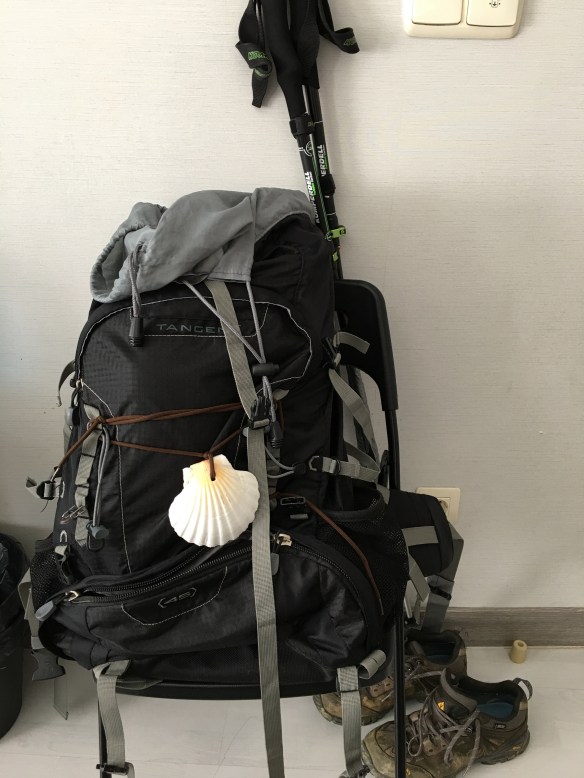
Before I set out on the Camino pilgrimage in Spain last Spring – some 800 kilometres long – I needed to know my destination, which was the city of Santiago. Not only did knowing the destination help me navigate the trail, it motivated me on the way.

What is the finish line of the Lenten journey? Easter, of course.

I said the observance of the faith journey is marked by symbol or ritual. These rituals in the church take the form of sacraments, such as baptism and Holy Communion. At Easter – the celebration of Jesus’ resurrection – we not only receive the promise of our ongoing transformation and new life in Christ, we have arrived at the destination of the Lenten journey of our healing, our forgiveness, our change.

Because of Easter, we can do Lent. The disciplines of Lent would be groundless without the Easter promise guiding our way. The joy of Easter is the destination – the very point – of the long Lenten discipline.

That is why baptisms and confirmations happen during Easter. This so-called first sacrament of the church, baptism, involves using water to make the sign of the cross on baptized forehead.  In some churches, the congregation gathers literally by the river to participate in a baptismal celebration.

Diana Butler Bass grew up as an evangelical Christian. She remembers that more often than not, “The water would be murky, seemingly impure rather than sanctified … The pastor would dunk the newcomer anyway, a drenching testimony of sin washed away and new birth in Christ.” But she wondered “how one could be washed of sin when the water itself was not safe to drink.”[1]

It seems, we cannot avoid getting dirty on the road to Easter and new life. In truth, is there not something good about dirt?

Some years ago, Diana Butler Bass spent the forty days of Lent focusing her discipline on priming her vegetable and flower garden in Spring. Obviously, she lived farther south than where we are. During Lent, she readied the garden, worked the soil, coaxed dirt to life. And, she concluded,

“Dirt was not dirty – it was beautiful. God made it. I was tending it. Caring for soil is hard work. The last thing I wanted to imagine was it being washed away. I was fighting for the dirt. I wanted more dirt, better dirt, richer dirt. I was adding stuff to it to make it mealier. I wanted dirtier dirt.”[2]

Yet, I would agree with Butler Bass, the symbols of the church have become sterile over the centuries. We have become germ-a-phobic, averse to dirt. And this, to our spiritual peril.

“In many dictionaries, the definition of ‘soil’ as a noun is typically scientific” – a particular kind of earth, a portion of the earth’s surface, the ground, etc.”

But the second definition, as a verb, turns sinister: ‘to soil: to make unclean, dirty or filthy; to smirch, smudge, or stain; to sully or tarnish, as with disgrace; defile morally. Its synonyms are ‘blacken, taint, debase, pollute.’ The term ‘dirt’ is perhaps even worse than ‘soil’. ‘Dirt’ comes from Middle English … meaning ‘mud, dung, or excrement’; or related ‘smutty or morally unclean.”

It’s easy to understand the theological leap from dirt and soil to sin and evil.[3] This is why we need Ash Wednesday in our faith journey. We need to feel the dirt on our foreheads in the sign of the cross as much as we make the sign of the cross with baptismal water, impure as it sometimes is.

This may seem like “a tempest in a linguistic teapot”[4] except for the fact that the bible points in another direction:

“Biblical creation stories abound with praise for the soil: God creates the ground and calls it good. Then the land brings forth life, and God calls it good. Humankind is made from the dust; God breathes life into the soil and Adam is born, this ‘soil creature’, and God sees that as very good.[5]

Humans beings are, literally, made from the humus, the ground. We are, simply, animated dirt.

In the famous Gospel story of the sower and the seed – where some seed falls on rocky ground, other seed on fertile, deep soil, other seed on the path, and other seed on shallow soil – Jesus explains that the seed is God’s love and the soil is us. The moral of the story?

“We are not soil-y enough! Spiritually, we would be better off more soiled rather than less. Being soiled is actually the point. You could say: ‘God loves dirt more than plants, soil more than what it yields. God is a dirt farmer, not a vegetable gardener.’ Soil is not sin. Soil is sacred, holy, and good. When we care for it, we are doing God’s work. Soil is life. And it is time for us — Ash Wednesday is a good time, symbolically at least — to reclaim the dirt.”[6] Why?

God became humus. God’s love got down and dirty. In the person of Jesus, God’s love was shown – in a human being. God is, according to Paul Tillich, not apart from us “but who is the very core and ground of all that is.”[7]

God is part of us, because of Christ Jesus and the incarnation. I read that every day more than sixty tons of cosmic dust fall to the earth. These are microscopic elements we can’t see, travelling in space from the farthest reaches of the universe. This cosmic dust enters our atmosphere where it mixes with existing soil on earth and enters the food chain.

Imagine, this cosmic dust is a source of ongoing creation. We eat and breathe it. Quite literally, human beings are made and being made of ‘stardust’. As the biblical story reflects: the divine and the soil, the Creator and created, are part of the same, theological ecosystem.

The Easter baptismal celebration is the end goal. We see it now, from the perspective of the starting line: Ash Wednesday. Tonight, we also make the sign of the cross on our foreheads, not with water – pure or murky. But with ash. We start by embracing the soil in and of our own lives.

Earth to Earth, Ashes to Ashes, Dust to Dust. The traditional words spoken at the start of Lent, and significantly, when our bodies return to the ground. A reminder, viscerally by the imposition of ash on our foreheads, that we are not only mortal, but that we belong to the earth. A reminder of our own need for repentance and new life.

At very least, we have to say it starts with dirt. We are dirt. Really. We therefore have to care for the dirt that is us, and in the earth, on this journey.

“We are not tourists here,” writes philosopher Mary Midgly, “We are at home in the world, because we were made for it,”[8] a world God so loved.

[1] Diana Butler Bass, “Grounded: Finding God in the World; A Spiritual Revolution” (New York: HarperCollins Publishers, 2015), p.53.

[2] Ibid., p.53-54.

[3] Ibid., p.54.

[4] Ibid., p.54.

[5] Ibid., p.57.

[6] Ibid., p.58.

[7] Cited in ibid., p.31

[8] Cited in ibid., p.64

Forgiveness: from transaction to wholeness

We ran all-out with back packs and walking poles to catch the bus. Yes, we were on a walking pilgrimage. But a few of us didn’t feel up to walking through one of northern Spain’s downtown city streets. After hiking a couple days already through the beautiful, peaceful hills along pristine trails with spectacular ocean views, the thought of breathing gas fumes and hitting the hard top sidewalks in an urban jungle just didn’t appeal. It was only three or four kilometres, and a city bus conveniently would take us to the other side where we could pick up the pilgrimage trail out in the open again.

As I clambered onto the bus behind my Dutch walking partners with all my gear, mindful of not clobbering someone with the swing of my bulky pack, I realized I did not have the correct change for the single fare ticket. Without any hesitation, my pilgrim friends dropped enough euros to cover my ticket. I expressed a deep-felt thanks to them, making a mental note to treat my friends later on. “I owe you coffee,” I said as the bus wove through San Sebastian’s downtown core.

IMG_5341

There’s a culture on the trail among pilgrims that doesn’t operate according to the normal etiquette of life back home. You see, early the next morning, my friends wanted to get going right away. I, on the other hand, wanted to stay at the hostel of my name’s sake (San Martin) a little longer to enjoy the view and the home made breakfast offered by the hosts. Off they went, and I never saw them again. I didn’t have a chance to ‘repay’ their good deed done unto me.

At the same time, there were other pilgrims to whom I’d catch up a few nights later at another hostel. Everyone walks at a different pace. Paths would cross, un-cross, and cross again. Sometimes I’d meet someone on the trail and never see them again. Other times I’d bump into the same group every other day, or so, somewhere along the way. Because of the nature of the pilgrimage community, I looked for opportunities, therefore, to treat another fellow pilgrim at a roadside café whenever the opportunity arose.

The economy of quid pro quo – paying back another individual and keeping the economic scales even on an individual basis – just couldn’t operate neatly on the Camino. It didn’t matter to whom you were being gracious. Only that you were gracious – that you offered help when help was needed, to whomever, regardless of whether or not they had earned your favour in some way earlier on.

The challenge was to receive the gift when it was offered, and give a gift when it was needed. Period. It was as if, on pilgrimage, we were all in the same boat. Which, of course, we know before God we are. It’s just in our daily lives we are not often able to appreciate that reality clearly.

Forgiveness is the theme in the Gospel text for today[1]. I’ve wondered why the servant who was forgiven his debt didn’t do likewise when given a chance. A more general question, is:  Why do we find it so difficult to forgive one who ‘owes you’ an apology for some wrong committed against you. I think it’s important to understand first some elements of the Gospel story. Because this story first tells us something very important about God and God’s ways.

To begin with, the servant owes the master ten thousand talents. ‘Ten thousand’ here signifies an absurd amount of money.[2] In that day and age, even if the servant lived three life-spans working full-time, there was no way he could ever repay that amount. The master has pity on him because the servant pretends that he can somehow work hard enough, in his plea for mercy, to repay the debt. The absurdity of the extra-ordinary amount should tip us off to something vital in our understanding of God forgiving us:

There is nothing we can do to make our lives right before God. And what is more, God has already forgiven us, and reminds us over and over again that we are forgiven before we do anything. Yes, we can say we ‘owe’ God. But no matter how hard we try, no matter all the things we can do to make it right, this effort will never, ever be able to erase what is stacked up against us – all our moral failing, our mistakes, our brokenness.

We puff ourselves us up in embarrassing, false piety when we pretend we can. As if forgiveness was simply a matter of paying our dues. But it isn’t. Like true love, forgiveness is a function of grace. And, oh, the Lord has compassion on us, even in all our futile toiling and striving.

I suspect one reason why the forgiven servant does not ‘pay it forward’ to his own slave, is because what the slave owes the forgiven servant was not as large an amount. In other words, the slave could technically repay his debt.

It’s so easy not to apply God’s economy of extraordinary grace to our ordinary lives. It’s so easy to slip into the transactional ways of our world, and apply the values of the culture to our life of faith. Meaning, we don’t really forgive others when they have to ‘earn’ our attention, our love, and our friendship. We will not really forgive others when they don’t behave in a way that meets our approval.

We live in a transactional economy – even in our spirituality – where people have to pay for their sins. We are to a large extent products of our culture. Our view of justice, therefore, is naturally retributive. Whereas God’s economy is about transformative justice. To move from one to another calls for a monumental shift in our thinking.

God’s grace, indeed, “surpasses all our understanding” (Philippians 4:7). God’s economy of grace does not make sense in our quid pro quo culture of transaction and merit. God’s love crosses all these boundaries and systems of our making. The gift is simply given. Will we receive it, freely? Will we pass it forward, freely, without any expectations nor strings attached?

In God’s economy of grace, we move from transaction to wholeness. Love and forgiveness – these functions of grace – expand outward. There are no losers in this economy. Only winners.

A transactional economy goes something like this: If I have twelve, gold coins and you take six, I will only have six left. I’ve lost. You’ve won. And so it goes with everything we do with others in life. Someone described our culture this way, sadly: We love things and we use people.

In an economy of grace, in contrast, we love people and use things. It’s as if I had planted twelve lily bulbs. I can divide my bulbs and give you twelve and I will still have twelve left. Then you can plant your bulbs and eventually you can give away twelve more. Grace multiplies. Everyone gets more. Grace is infinite, in truth. The win-lose economy changes into a win-win economy.[3]

Moreover, forgiveness is not just about evening the score between just two individuals. It’s not entirely a private act. Forgiveness is communal.[4] When, in the Gospel text, the others saw how unjustly the servant treated his own slave who owed him money, they didn’t simply wipe their hands in denial and avoidance of the injustice before them. They went back to the master and told him. The proverbial whistle-blowers, they were involved in the process of forgiveness.

This is necessary, because sometimes individuals are guilted into forgiving someone who is left unchallenged, unaffected, and unaccounted for their misdeed. Sometimes victims are not able to easily forgive the one who has hurt them. It took Joseph all the way to the last chapter in Genesis to finally forgive his brothers for throwing him into a well and selling him to slave-traders.[5] As they say, it takes a village. And sometimes time. Lots of it.

Forgiveness is validated in community. Because sin is something we all participate in. If we are human and live on this earth, we will sin. No matter the colour of our skin, no matter our creed, our ethnic background, no matter where we were born or what our political stripe. We will make mistakes. We will all contribute to the problems we face. As Paul wrote, “since all have sinned and fall short of the glory of God”.[6] No one is immune to the complicity and consequence of sin. It is woven into the fabric of our common existence.

And so is forgiveness. When forgiveness is offered and received, it becomes part of a wider field of responsibility and accountability. We are not alone. We need the community of faith. We need to be real. Forgiveness does not mean enabling sinful behavior to continue by excusing it, or letting it happen over and over again. Forgiveness means people of faith seek the justice of the matter. Forgiveness can only happen when people see their own lives as part of the human condition, just like everyone else.

People will not be changed in their hearts for God unless they are loved unconditionally, freely. Martin Luther believed that we would be so overcome by God’s unearned, unconditional love that we would be so moved to spontaneously and unconditionally love others in the same way.[7]

May our hearts be moved to forgiveness and justice for all.

Our Father in heaven …. forgive us our sins, as we forgive those who sin against us.

Amen.


[1] Matthew 18:21-35

[2] David L. Bartlett and Barbara Brown Taylor, eds., “Feasting on the Word: Preaching the Revised Common Lectionary”, Year A Volume 4 (Louisville Kentucky: WJK Press, 2011), p.71

[3] Janet Hagberg uses the gold coin versus lily bulb analogy to describe transitions in power, in “Real Power: Stages of Personal Power in Organizations”, 3rd Edition, Salem Wisconsin: Sheffield Publishing, 2003, p.77

[4] Susan E. Hylen, “Forgiveness and Life in Community,” Interpretation, Volume 54, Number 2 (April 2000), p.146-57.

[5] Genesis 50:15-26

[6] Romans 3:23

[7] cited in Bartlett & Brown Taylor, eds., ibid., p. 70

To see beyond, and go deep

“Suffering produces endurance, and endurance produces character, and character produces hope, and hope does not disappoint us, because God’s love has been poured into our hearts through the Holy Spirit that has been given to us.” (Romans 5:3-5)

We had a problem. In this perfectly finished renovation, something was not right. The microphone jack, on the floor in front of the pulpit here, was not working.

2_Power

How could this be? Everything was designed and installed as it should be. And yet, something had gone awry. The prognosis was not good. How could it be fixed, without tearing up the carpet, pulling off the baseboard and cutting into the drywall to find out exactly where the wire was shorting out?

For this problem to present months and years from now would be one thing. But to discover this problem in the first week or so back into our ‘new’ space. Uh-oh.

And yet, as you can see and hopefully hear today, it is working. And, as you can see, the carpet has not been ripped and there are no pieces of drywall cut and patched up. How was this problem solved? How were we saved from doom and destruction?

I will say this: For Brian who discovered the problem, it caused him some serious stress, at first. ‘Despair’ might be a word that comes close to describing his feeling, for someone who had already spent hours and hours of his time and energy and resources in the entire renovation project over the last several months.

All that you can see now is a tiny hole on the baseboard no larger than the size of a dime, just above the carpet line on the other side of the chancel. That’s all. A tiny hole, that doesn’t really reveal the depth and breadth of how the problem was solved.

4_TheCulprit

Apparently, a finishing nail had been shot into the wire from outside during the renovation. Unbeknownst to the worker strapping on the the siding, one of the nails embedded into the wire, thus shorting it out. It was, for Brian, a question of finding the proverbial needle in the haystack.

He employed the material resources at his disposal and years of experience in engineering and computer sciences. He brought in an oscilloscope to measure the current, and his infra-red camera, which he ran along the presumed route of the hidden wire. These instruments disclosed an abnormal, irregular heat signature which spiked at the spot of the short-out. From there, it was merely the task to go in with surgical precision, and remove the offending nail. And voila! The microphone now works!

This is definitely a feel-good story with a good ending. Especially because at first, it didn’t look good. It would have been easy to give up, to remain in despair and not do anything about it. And live with, and remain stuck in, some unhappy, dysfunctional space.

The Gospel story about Jesus meeting the Samaritan woman at Jacob’s well (John 4:5-42) has a feel-good ending, at least from the point of view of the woman. She starts by being defensive and confrontational — not seeing nor recognizing Jesus for who this man truly is. She leaves the encounter with Jesus, joyous, liberated, un-inhibited, free.

The story reveals God’s character in Jesus. To emphasize the point the Gospel writer John wishes to make about God’s character, John places this story immediately after Jesus’ encounter with Nicodemus in the previous chapter. Let’s compare briefly the two encounters:

For one thing, Nicodemus has a name. The woman is nameless. Nicodemus is a Pharisee and as such has status, authority and privilege in the social-religious culture of the day. The woman is a Samaritan with whom the Jewish authorities were in conflict. Nicodemus lived in a male-dominated society. The nameless, Samaritan woman is a nobody.

Jesus takes the initiative to cross the boundaries of geography, culture and prejudice to speak with the woman. And not only that, to draw from her the truth, and then empower her to be a missionary for the kingdom of God. The encounter with Jesus transforms her from a nobody to a somebody.

As the dialogue at the well comes to a close, the woman is filled with joy. She is so energized with passion and hope that she “left her water jar and went back into the city” (v.28). We now can see what is not immediately apparent. We can complete the sentence when the Samaritan woman exclaims: “Come and see a man who told me everything I have ever done” … and loved me anyway! She does not say these last four words at the end of verse 29, but they are implicit in her action and in the joy with which she runs.

“Everything she ever did” is a long list of sins. It is always before her, in the judgemental expressions of her neighbours and in her mind for the rest of her life; she has had many husbands, and the one she is living with now is not. For Jesus to have intimate knowledge of that list and for him to know her past, and still love and forgive her — well that’s unbelievably new and fresh as anything she has ever heard. The man who told her everything she ever did … and loved her anyway … is what saves her life. (1)

A caution: Her sin is not the main point in the story. (2) While Jesus’ offer of forgiveness is implied in the dialogue, the text itself says nothing of any sin she has committed (as we see elsewhere in the Gospel, for example, John 8:1-11); nor does Jesus ever actually say words of forgiveness to her.

The focus here is not sin. It is rather in the character of God, and the liberating result of a gracious, truth telling encounter with Jesus. In that moment, the woman sees God. She receives Christ — and leaps up to tell.

Would you? When Paul talks about suffering in his letter to the Romans (cited above) he is encouraging the faithful to see beyond their present, often difficult circumstances to the hope we have in Christ. Indeed our society’s values can make us feel, and keep us trapped in believing, we are nothing:

If we don’t have significant financial resources stored away in investments, bank accounts and property; if we don’t have that ‘perfect’ life, secure in our fortress worlds of private privilege and comfort; if we don’t have the perfect-looking body, the disease-free physiology, the magnetic, people-pleasing personality; if we don’t have the high-paying job, the investment-rich retirement plan; if we don’t measure up … the list goes on. The values of society make us feel like nobody.

And yet, Christ comes to remind us that we have everything we need to get through it, and more! We just need to see beyond what is immediately apparent. Jesus breaks all those boundaries of division and exclusion, casting aside our pretence and our cloudy vision. Jesus doesn’t pay attention to what society says is valuable or not valuable. Jesus comes to each and every one of us and says: “Look deeper. I know everything there is about you, and I love you anyway!”

So, what do you have to lose? Take the risk, and do something to make things better in your life, and those around you. Make the hole in that spot you may not be sure about because it’s not visible on the surface of things. And then trust what God has given to you already — the resources at your disposal, the unique gift of your very life, your talents, treasures and time — is worthy of using! And go for it!

Because God will love you anyway.


1 — Anna Carter Florence in David L. Bartlett and Barbara Brown Taylor, eds, “Feasting on the Word: Preaching the Revised Common Lectionary” Year A Volume 2 (Lousville Kentucky: WJK Press, 2010), p.97

2 — Karoline M. Lewis in ibid., p.95

The long journey – Lent 1A

We don’t often see the humour in the creation stories around Adam and Eve (Genesis 2-3). Perhaps because so many centuries of debate and dogma and doctrine-making put such a heavy burden on the sacred text.

But, if we can just lighten our approach a bit, a fresh perspective emerges. There are some funny aspects in the story of the Garden of Eden where the crafty serpent tempts Adam and Eve to eat the forbidden fruit, they disobey God, resulting in their rather undignified exit from Paradise.

Here’s a joke someone sent me this very week on the subject: Did you know the oldest computer can be traced back to Adam and Eve?
Surprise, surprise.
It was an Apple.
But with extremely limited memory.
Just one byte.
Then everything crashed.

That joke isn’t biblical in case you were wondering. But these story-lines are rather comedic: We have a talking snake (a la Harry Potter). If anyone is a parent or works with children, you will know that the surest way to get a child to do something, is to tell them not to do it (e.g. “You can eat anything you want from the fridge, but you dare not touch a cookie from that jar on top of the table”). It’s almost as if Adam and Eve were set up to fail. And then God warns them they will ‘die’ if they even touch the tree. They do touch the tree, but they don’t die.

Well, not for another several hundred years.

The scripture records Adam having lived a very long life (Genesis 5:5 suggests 930 years). The threat of death was therefore not a literal one tied to that one, particular transgression. In other words, there must have been a divine purpose in Adam living so long after their expulsion from the Garden of Eden.

We can assume, therefore, that when Adam and Eve left the Garden, they began a life of maturing and labouring under the weight of their broken humanity. The development and growth of any human being, we know, is bought by the price of pain and suffering. The wisdom writer from Ecclesiastes (1:18) expresses this truth: “For in much wisdom is vexation, and those who increase knowledge increase sorrow.” Suffering, then, must be part of God’s good, created order. Canadian theologian Douglas John Hall writes, “Life depends in some mysterious way on the struggle to be.” (1)

That God did not destroy them both immediately after their unfortunate decision, is an act of grace, of forgiveness. The writer of Genesis is emphasizing an important characteristic of God, here. Whether or not Adam lived, actually, 930 years is not the point; the point is it was a very, very long time. Perhaps the author is, at very least, emphatic in expressing the extent of God’s mercy: Adam and Eve have all the time in the world to practice making better decisions, and of experiencing more and more of God’s grace.

God is forgiving, even more so than we can be to ourselves. God is merciful, even more than we can be merciful to each other. God is gracious, even more than we can imagine being gracious to ourselves.

We begin today a journey of some forty days, which mirrors Jesus’ forty days in the wilderness (Matthew 4:1-11). In pursuit of various disciplines we observe the season of Lent, year after year, as we slowly and intentionally approach the most holy of Christian days — Easter, the resurrection of our Lord.

The only way to the Empty Tomb of resurrection is through the Cross of suffering. The symbolic destination of the Lenten journey is the Cross, on Good Friday. And so, right off the start, we know this can’t be an easy journey, when we have to face and bear our own cross. But this is what life is about, is it not?

Whenever hardship comes our way in whatever form it does — illness, loss, tragedy, disappointment, conflict and confrontation, failure, guilt, pain. We don’t have to seek it out; Suffering comes to us all. This is a reality we are called to accept.

When Adam and Eve failed God in the Garden, God gave them a chance to confess. As much as disobedience was the problem, so too was their impulse to try to ‘cover up’ their faults by blaming someone else; Adam blames Eve and then Eve blames the serpent (Genesis 3:12-13). 

Are we willing to embark on the sometimes harrowing yet intentional path of some kind self-discipline or challenge to change things for the better? Are we willing to take a long, hard look at our own lives? If so, Jesus’ vulnerability in the wilderness points to the authentic quality and honesty in all our relationships.

We are called to be honest about our brokenness. Being vulnerable is not a weakness, it is a strength. We do not need to pretend our weaknesses away. Our suffering can be a great teacher, an opportunity for growth and wholeness.

Suffering, in the words of Douglas John Hall, “is necessary to evoke the human potential for nobility, for love, for wisdom, and for depth of authenticity of being. A pain-free life would be a life-less life.” (2)

Lent is not a path to ultimate self-annihilation. Ultimately, Lent is not a downer. Because suffering can point to a new beginning. Followers of Jesus are not a people who suffer the pains of life without faith and hope.

This hope ought to give us endurance for the journey ahead. There will be temptations. There will be setbacks. There will be disappointments on the journey of becoming more authentic, more vulnerable, more open, more honest.

But God will not give up on us. Every moment we have is pregnant with the grace of God, even should we like Adam and Eve not always make the best decisions and then have to live with the consequences. But there is always hope. Always another chance. Always a new beginning coming up over the horizon of our lives.

We have every moment given to us — maybe not 930 years. But our faith can assure us that God will never, ever, give up on granting us mercy and forgiveness, no matter the many bad decisions we make over the course of our lives.

Our desert, Lenten journey, may seem long and arduous. But longer, still, is the span of time it takes for God to keep faith in us.


1 – cited in Terence E. Fretheim, “Is Genesis 3 a Fall Story?” in Word & World (Volume 14, Number 2, Luther Seminary, St Paul Minnesota, 1994), p.147
2 – Douglas John Hall, “God and Human Suffering: An exercise in the Theology of the Cross” (Minneapolis: Augsburg Publishing House, 1986), p.62-63

Sanctuary

For a year and a half my wife and I took dance lessons. We learned Latin dances such as the Salsa, Rumba, Samba, Triple-Step, Merengue, and the Cha-Cha. 

I was motivated, at the start, by a beautiful vision in my imagination: I could see my wife and I swinging to the music, sweeping across the dance floor, effortlessly. I had a vision of us moving in complete sync with one another, twirling and swaying together in perfect rhythm and harmony. What a vision!

When I first proposed we take these lessons together, she was all game. So, every week we dutifully went to our lesson and met with our dance instructor who showed us the steps and taught us the moves. We were doing this together!

After a few lessons, however, I was becoming a little bit disappointed. My vision was not panning out. We weren’t always in sync with each other. Indeed, more often than not, we were stepping on each other toes! Oh yes, we giggled about our missteps, but it seemed we were not getting anywhere.

Our instructor calmly yet persistently reminded us that we needed to practice. Before the fun would come, she said, we had to master the steps. And for me, the lead, I had to memorize the patterns and in my mind always be one step ahead, knowing where we were going with each and every move. And this took work! And persistence. And time. The fun would come later, I held on to the promise.

It wasn’t as easy as I imagined it would be, working towards that vision. In fact, it was my wife who grew into the love of the dance and often had to cajole and encourage me to keep up with the program.

The Gospel text (Luke 18:1-8) today describes a woman who is persistent in her pursuit of justice. Jesus tells this parable to illustrate what it means not to lose heart. In the story, persistence is not just about building up the courage to do something beyond one’s comfort zone just once, and then give up because it doesn’t turn out. 

How often, isn’t that how we operate when trying something new for the first time? Something doesn’t please us the way we expected or wanted the first time we try, and so we just give up on it. No, in the story, she goes back “continually”. The vision of justice never wavers in her commitment to do the hard work.

This relentless pestering is accomplished in adversity, and really against all odds. Why the woman would even consider trying, up against someone in power who has no fear of God and no respect for anyone, is remarkable. At the onset, we would say she is hardly setting herself up for success!

Setting up a contrast of visions to describe God, is what Jesus is up to in telling this story. The place where we meet God is a place of mercy, of sanctuary. People, in the course of history, could enter a church and find respite from the condemnation of the law. The police, the authorities, the powers that be, even the force of the law could not touch you in the holy space. Here, you found immediate relief and mercy, just by entering the space.

The place where we exercise our prayer is a place where we receive forgiveness, despite the imperfection and sordid realities of our lives in the world. That is why Jesus tells of a woman receiving justice, not because she goes to the temple per se, but a court of law in the secular world: Even there, you can find justice, despite the unjust and sinful people involved. God’s love is greater even then the most powerful, unjust judge.

Indeed, this is our challenge today. God is not just in one, holy place that we have cherished for the past fifty-five years. God is out there, too! In the imperfection of our Monday-to-Saturday lives. In the imperfection of our secular world. In the seat of government. In the marketplace. And, would you believe it, also in other churches. The truth of the Gospel resides in a worshipping community that is far from perfect. That, in fact, has weakness and brokenness imbedded in our very being together.

When Jacob wrestled with God on the banks of the River Jabbok (Genesis 32:22-31), he didn’t hold back any punches, so to speak. He let God have it, and prevailed! His encounter with God, nevertheless, left him with a physical reminder of relationship with God: A bad hip. He would live the rest of his days, “limping because of his hip.” 

To be in communion with the Holy One is to bear the physical, real mark of sacrifice, of weakness, of imperfection. Followers of Christ, if you want to know them, are not perfect people. And if you meet Christians who appear to be perfect — or you want them to be — you are missing the truth of it I am certain. In fact, we would throw our lot in with the unjust judge, more than anyone else in these stories I would guess.

I read recently a story told by Marianne Williamson in her most recent book: “Tears to Triumph”. It’s “about a chimpanzee troop in which a portion of the population displayed depressed behaviour. They didn’t eat with the rest of the chimps, play with the rest of the chimps, or sleep with the rest of the chimps.

“A group of anthropologists wondered what effect the absence of these depressed chimps would have on the rest of the troop and removed them for six months. When they returned, they found that all of the other chimps, those who remained in the troop, had died! Why?

“According to one analysis, the chimps perished because the so-called depressed chimps among them had been their early warning system. The depressed chimps had been depressed for a reason; they registered that a storm was coming or snakes, or elephants, or disease. The presence of the depressed chimps had been an aid to the survival of the entire population … ” (1)

We need each other. We need our faults, you could say, just as much as we need our strengths. To remind us of what it’s all about. To point us to the Cross and the Empty Tomb. To help us remember that the church is not about our mission, but about God’s mission. To emphasize the grace of God under which all of us stand. To encourage us to work together with others that appear different from us. Going to, and persisting with, people that do things differently from us — in some ways better, in other ways not so much — is vital for the health and survival of the whole church.

So, after today we begin an adventure. Worship and faith and life-in-our-community does not stop now because this particular space becomes a construction zone for a couple months. We will continue to worship as a community, as Faith Lutheran Church. Yes we will! 

Our prayer will continue, and we will persist with others who are different from us (and I suspect we will soon discover they are not that much different from us!) at Julian of Norwich Anglican Church. Being outside our comfort zone is a critical, healthy, spiritual exercise. Should we persist together in this adventure, I believe we will grow in ways that are both vital and healthy to the future of Faith Lutheran Church; persisting together in this adventure will also deepen our walk with God.

I want to encourage you over the next two months to embrace this challenge, not shy away form it, maintain the vision, not lose heart, and pray always! Because God is already and always merciful and just.

(1) Marianne Williamson, “Tears to Triumph; The Spiritual Journey from Suffering to Enlightenment”, HarperOne, New York, 2016, p.84-85

Relationships over Resources

A member of this congregation sent me an email including a list of short phrases called paraprosdokians.

A paraprosdokian, according to my online dictionary, is a derivative of a Greek word which means, ‘beyond expectation’. It is a wordplay, a figure of speech in which the latter part of a sentence is unexpected. Here’s a smattering:

 · A neighbour knocked on my door and asked for a small donation towards the local swimming pool, so I gave him a glass of water.

 · Take my advice — I’m not using it.

 · Ever stop to think, and forget to start again?

 · He who laughs last, thinks slowest.

 · I was going to give him a nasty look, but he already had one.

 · Change is inevitable, except from a vending machine.

 · I was going to wear my camouflage shirt today, but I couldn’t find it.

 · If at first you don’t succeed, skydiving is not for you.

 · No matter how much you push the envelope, it’ll still be stationery.

 · Money is the root of all … wealth.

Indeed, the Gospel today (Luke 16:1-13) has at least one major, unexpected twist. And unlike most of these paraprosdokians, this twist is not humorous. 

A manager has been wasteful of his boss’ riches, and consequently will lose his job. So, the manager figures on a scheme to look out for his own interests in his impending unemployment. The ‘dishonest manager’ — as some bibles entitle this parable — puts himself first at the seeming expense of his boss: he will go to his boss’ debtors and demand only half of what they owe. He shrewdly seeks to curry favour with them, and anticipates to be in their good books, once he is unemployed.

Smart move, you might say, eh? But what will Jesus say? Especially keeping in mind that this passage comes to us on the heels of the ‘golden’ chapter of the bible, Luke 15. Therein we read the familiar and heart-warming stories of the lost being found, of celebration and belonging, of unimaginable grace and mercy shown to the poor, the wayward, those who are not easily counted in the economy of the day. 

In Luke 15, we get the strong impression that the values of God’s kingdom — mercy, inclusion of others, unconditional love — stand in sharp contrast to the values of the world — competition, self-centredness, individualism. And, now, in Luke 16, the set up leads me to anticipate Jesus will come down hard on the ‘dishonest’ manager. I expect Jesus to say how unjust, unethical, and selfish the manager was. Don’t be as self-centred as he is!

In verse eight, the rug is pulled out from underneath me: “And his master commended the dishonest manager because he had acted shrewdly.” What ?!! Commended?

And yet, I should expect that the bible does that to us from time to time. The bible does not present a tightly knit, unequivocally clear and coherent storyline. You can justify anything from the bible, if you want — even murder. But that is not what we are about, when we approach the bible. 

After all, there is an important reason why the New Testament includes four, different, renditions of the life and times of Jesus. If uniformity was the goal in the inspiration behind putting together the bible, then we would have only had one Gospel, not four. Matthew, Mark, Luke and John — the first four books of the New Testament — basically follow a similar plot line about Jesus’ birth, baptism, calling, choosing disciples, healing, teaching, passion, death and resurrection stories.

And yet, each presents variations, slightly different orders, and yes, sometimes even these unexpected twists and turns in what needs to be emphasized. There are, after all, different people listening in — the religious leaders of the day, his disciples — people like you and me who live different lives and face different challenges. Each of us needs to hear something unique to what our needs are, apart from our neighbour. And each faith community needs to hear a unique word spoken to them.

So, while the story of the dishonest manager twists and puts our expectations on their head, perhaps there is something here worth paying attention to. “You cannot serve God and wealth” concludes the passage. And yet, the manager was looking out for his own material well-being in his shrewd and commendable actions.

Well, what is the wealth that is talked about here? For what treasure do we Christians — called the “children of the light” in this text (v.8) — search? What is the golden nugget that we seek, above all else? Again, perhaps the broader context can help us, again.

As I said, the previous stories of the lost sheep, lost coin and lost sons suggest that what is valuable in the economy of God, stands in sharp contrast to what is valuable in the economy of the world. These are treasures that are worth uprooting what is hidden, putting in the light what is shrouded in darkness, lifting up what is normally considered not worth the effort, forgiving what is unforgivable.

What does the shrewd manager value, even more than making money? He values relationships. He values keeping connected with others even though he loses what the world values — jobs, financial security and material wealth:

He reduces the amount of debt owed by the amount of his commission — as some biblical commentators suggest. He reduces the amount of interest owed, according to the Torah Law in Deuteronomy 23:19-20 — as other commentators suggest. Regardless of how we interpret the manager’s actions, we can see how much the manager values being in relationship, above all else.

The wealth described here is the treasure of being inter-related in a season of loss and disruptive change. Relationships over Resources, you could say (1).

And this truth hits us unexpectedly in the telling of the Gospel. Another classic reversal. I started this sermon with a Greek word to describe a form of speech that ends unexpectedly. Of course, the New Testament was written in Greek and influenced by Greek culture.

Greek culture often reflects this image of having a feast in the midst of famine. Another contrast of expectations, when during a famine you would not expect people to throw a large feast, and celebrate. Remember, after finding the lost sheep, the lost coin and when the Prodigal returns home, there is much rejoicing. And a feast is prepared for the whole community.

This does not make sense. To have a feast in the midst of famine. And yet, this is what we are called to do. To be children of the light, in the midst of darkness. Not to be a slave to our circumstances and meagre resources, as we may see them to be. But to release them, distribute them, relinquish our seeming control over them, all for the purpose of maintaining and strengthening our relationships.

Celebrating the gift of each other and those we meet. Relationships first, then resources. The horse before the cart, not the other way around.

We may by lying in the gutter of our lives, but we keep our gazed fixed upon the stars. We may be wallowing in an ocean of despair, regret, fear or pain — but we begin with a spoonful of water. In other words, there is always hope. There is always room to grow, to change, to something — anything — in order to make things better. This is the quality of faith.

We are never lost, abandoned and left for dead in the economy of God’s grace. After all, the rich man gives his irresponsible manager a second chance. Normally when charges are brought against an employee, charges that incriminate and prove wrong-doing to the degree of ‘squandering’ the owner’s property, the person in question is fired immediately, without question.

But something odd happens here: The rich man allows his soon-to-be-fired worker to continue doing his job for a while. The rich man gives his delinquent employee some ground, some space, to do something — anything — in order to make things better. The rich man demonstrates some grace in a relationship that has gone awry. 

Not only are the relationships in life our priority over everything else including our material resources, the quality of those relationships — according to the New Testament — are defined by grace, compassion, and love. 

An unexpected twist of the stories of our lives in the world, perhaps. Yet, these are the hallmarks of the children of light following Christ in the world.

Thanks be to God!

(1) David L. Bartlett & Barbara Brown Taylor, eds., Preaching the Revised Common Lectionary; Feasting on the Word, Year C Vol 4, WJK Press; Louisville Kentucky, 2010, p.92-97

Rooted in the earth, rising to the sun

Recently I have been reading about people’s experiences on the Camino de Santiago — the eight hundred kilometre walking pilgrimage through northern Spain. This walk has become more and more popular among Christians of all stripes over the past couple of decades. It seems Christians around the globe are finding the pilgrimage a good place to work through personal issues, find focus in life again and seek re-connection with God, the world and themselves.

This past week I met with one such pilgrim from Ottawa who goes at least once a year to walk some part of the Camino; in fact he is leaving today for Barcelona. I sought his experienced advice for some practical considerations for the trek. His first rule of thumb: Pack only ten percent of your body weight. For me, that would mean no more that 20 pounds in my back pack — of all that I would need for the thirty to forty day hike. Twenty pounds is not a lot!

His second rule of thumb: What you wear on your back, put only one in your pack. That’s all. For example, if you are wearing a t-shirt, pack only one other t-shirt in your back-pack. If you are wearing a pair of shorts, pack only one other pair of shorts. And so on.

He laughed when he told me that about four days in — some one hundred kilometres into the journey — you find bins and bins full of personal items people left behind. These pilgrims had realized, thankfully sooner than later, that they were simply carrying too much — stuff they didn’t really need (extra shirts, pants, sweaters, books, jackets, bed mats, blankets, etc.). A final rule of thumb from my friend: If you do take something extra, then you need to have a good reason for it besides, “I might need it.”

This discipline reflects the quality of being able to let go. It can be described as a total self-surrendering, a giving up. The term “Kenosis” has been used among Christians throughout the ages to connote this sense of releasing that which we normally feel we need to hold onto tightly.

Fourteenth century German theologian Meister Eckhart said, “God is not found in the soul by adding anything, but by a process of subtraction.” (1) In our consumer culture, religion and spirituality have very often become a matter of addition: earning points with God, attaining enlightenment, producing moral behaviour. In the ‘prosperity gospel’ so popular in North America, we often hear the message that Jesus approves of you when your material and financial wealth increases; the more you have, the more in favour you are in God’s eyes.

Yet authentic, Christian faith is not about getting, attaining, achieving, performing or succeeding. The solution is not just “work harder” or “get more” of something. Our culture and economy, indeed, is based on more and more. Whereas true faith suggests: less is more. Martin Luther’s theology of Justification by Grace through Faith suggests the very same: We cannot by our own efforts achieve anything worthy of God.

So, stop trying. In fact, start doing the opposite: Let go of your pretence to manage your life according to the creed: Bigger and More is Better. Let go of a paralyzing negative body image. Let go of the inner talk that is putting yourself down, that tells you you are no good. Let go of attitudes of hatred against people who are different from you. Let go of those material aspirations that tease you into a false sense of security. Let go of being paralyzed by fear.

Instead, focus on what is essential. Appreciate that you already have enough, all that you need. When Jesus gives instruction in the Gospel text for today (Luke 14:25-33) he is travelling out on a public road, on his pilgrimage to the Cross. Remember, ever since Luke 9:51, he is already on the way to Jerusalem, his final destination. When Jesus is walking towards his death and resurrection in Jerusalem, he offers what sounds rather harsh to our ears. What is called-for here is a ‘single-mindedness’ that is needed when you travel with Jesus.

Discipleship is about being single-minded about the purpose, the goal and the mission of Jesus in the world. It is about prioritizing what is important to life in the public realm where culture, consumerism and a whole host of other distractions can keep us from this focus.

This single-mindedness demands that we think ahead, and anticipate the cost of our journey. Setting out on the road to follow Jesus requires at least a little forethought and reflection. This journey is not a light matter. Sit down and think about it a bit. Reflect.

There is not only the blessing of the assets promised, but there are the liabilities, too. Discipleship is not just one more hobby or extra-curricular activity to add to a well-rounded, prosperous life. It is not merely “a matter of pure passion and abandon” (2).

Followers of Jesus should count the cost, but also realize this is not just about counting the cost of a church building renovation or a church fund-raising project. The cost of discipleship, as Dietrich Bonhoeffer first coined the term, is about prioritizing our whole lives, not just our “church” or “Sunday morning” lives.

If someone told me a year ago that I would spend four days cut off from civilization, in the bush without cell-phone service, hauling all my food and everything I need to survive in a canoe that I would have to navigate through rapids and rocky, snake-infested portage routes — I would say they were dreaming … or talking about someone else.

Well, that’s precisely what I did last week, along the French River Provincial Park between North Bay and Sudbury. Fortunately I was not alone; I journeyed with a more experienced wilderness survivalist. 

We ended up taking more than we needed. We could have packed less food, and less clothing. The exercise, nevertheless, was confident-building for me in realizing I really don’t need that much stuff.

Jesus says, “None of you can become my disciple if you do not give up all your possessions.”

To live life well, and faithfully, is to recognize one’s place in the world, and not to over-reach, over-extend, to be someone you are not — all on the basis of wanting more and more, bigger and better. To live faithfully, we are called to examine our dependencies, count the cost of it all, focus on what is important, and then make room in our lives for what is important by letting go.

A sojourn into the wilderness may indeed by the antidote to visions of self-aggrandizement embedded in the prosperity gospel message. Try doing without, for some time, what you may have taken for granted for too long. Try doing without what you always have believed you needed in order to live. Try Letting go. Releasing. Forgiving. 

This is not about doing away with personal boundaries. Letting go is not about condoning injustice or cruelty. Kenosis/letting go is not about being blind optimists, repressing or denying or not caring, or ‘giving up’ in frustration.

Forgiveness is a good example of letting go of the misery caused by holding on to the pain of resentment or holding a grudge. This kind of letting go brings a positivity that is based in honest struggle and prayer born out of compassion and love for self, the other, and God. The end result is a freedom and peace that cannot ever be realized through a program of simply working harder or getting more.

The German poet, Rainer Maria Rilke, wrote about the contrast between the law of gravity and the rising of the trees. He writes about the gift of letting go into a place of trust: Trusting that the gift in you is enough. So that you can rise up, rooted like trees: 

How surely gravity’s law,

strong as an ocean current,

takes hold of even the smallest thing

and pulls it toward the heart of the world.


Each thing —

each stone, blossom, child —

is held in place.

Only we, in our arrogance,

push out beyond what we each belong to

for some empty freedom.

If we surrendered

to earth’s intelligence

we could rise up rooted, like trees


Instead we entangle ourselves

in knots of our own making

and struggle, lonely and confused.

So, like children, we begin again

to learn from the things,

because they are in God’s heart;

they have never left God.

This is what the things can teach us:

to fall,

patiently to trust our heaviness.

Even a bird has to do that

before he can fly. (3)

In the poetry of scripture, the Psalmist describes beautifully the blessing we are, created in the image of God — so “wonderfully made” (Psalm 139:14). God would know intimately each part of our lives only if we were valuable to God and to the rest of creation. Otherwise, why would God care?

In other words, we are and have everything we need to enjoy and live to our fullest potential. We are beautiful. We don’t have to strive and strive to become someone we are not. We don’t have to ‘add’ anything to our lives to be well. In fact, when we have the courage to risk letting go, and “fall”, as Rilke poetically expresses, trusting in our “heaviness”, we will find a freedom and peace that will be the joy of all creation, and the glory of God.

We will live our lives at the same time rooted in the earth, and rising to the sun.

(1) Translated by J. Clark & J. Skinner, “Meister Eckhart: Selected Treatises & Sermons Translated from Latin and German with an Introduction and Notes”, Faber & Faber: 1958, p.194

(2) David Schnasa Jacobsen, Commentary on Luke 14:25-33 in “WorkingPreacher.org”, 2016

(3) Rainer Maria Rilke, “Rilke’s Book of Hours: Love Poems to God” translated by Anita Barrows and Joanna Macy, Riverhead Books: 1996, p.116-117; cited with permission in Richard Rohr’s Daily Meditation for August 28, 2016