‘Just beyond reach’ – a tribute to Jan

2015-10-04 15.23.20

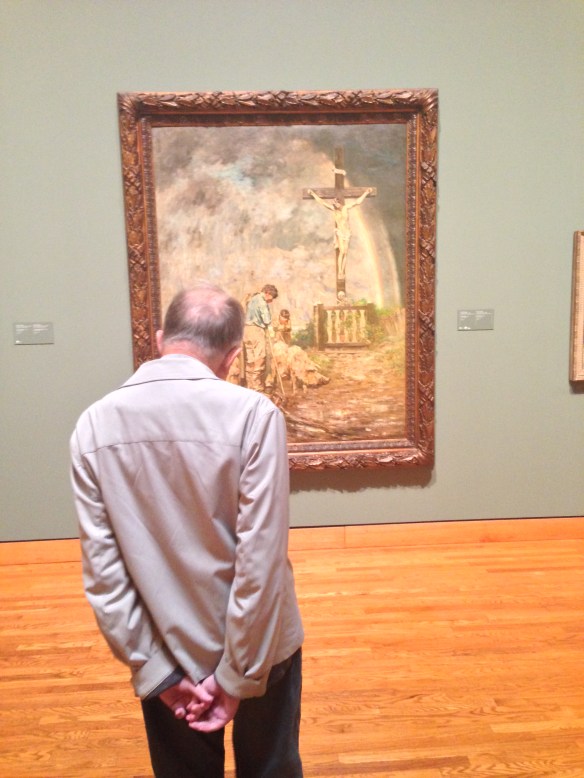
In the Fall of 2015, we made a family visit to the National Art Gallery in Ottawa. Here is Jan, who was already struggling mightily with his dementia, pausing at a framed vision depicting images of his faith. Perhaps Jesus, the cross and other symbols in the painting awakened something deep within his soul, enough to make him stop and look. Perhaps it was an innate knowing that this painting described something of the final destination in his life.

Shortly after Dad died, we talked about how in his last decade of life, Dad’s ability to perceive the world around him had shrunk. Increasingly encumbered and limited by dementia, Dad’s vision slowly narrowed.

It’s curious that in the days after he died, we didn’t envision so many people would battle frigid, Ottawa temperatures to attend visitation and funeral services for him. How often our vision becomes encumbered. And we limit ourselves and for various reasons don’t see the wideness of possibility.

What a joy it is to be wrong! To see that there is more, that in life and reality therein hides something greater often just beyond the reach of our imagination.

I wish to share a few brief memories that speak to Dad’s/Opa’s rich imagination which kept him truly alive throughout his life. What we are dealing with here is sort of like Doctor Who’s Tardis: From the outside, it looks like a common, rather narrow, even flawed telephone booth. But once you risk going inside it, you enter a much larger world, a world that can easily be missed and overlooked.

I can still see the over two-dozen books written by adventure/sci-fi authors Karl May and Edgar Rice Burroughs lining the book shelves, along with the other ten thousand books stuffed on shelves against any free wall space in our home. Maybe Dad didn’t read every single one of those books, but he loved collecting them for what they symbolized to him: gateways to other worlds just beyond his reach.

In my youth, I came to believe that Dad’s hero was Lutheran Albert Schweitzer. Dad looked up to this gifted Nobel Peace Prize Laureate who did not specialize in any one thing, but was accomplished in various fields: an organist, a physician, a theologian, a writer, a humanitarian and philosopher. A virtual ‘renaissance man’, Schweitzer may have modelled for Dad the work and identity of a pastor. Dad was no Albert Schweitzer, but his expansive and creative spirit certainly resonated within him.

As a young child, I remember standing on the shores of Papineau Lake near Maynooth, listening to Dad tell us stories about good and evil battling it out on earth and throughout the universe.

Indeed, Dad’s imagination was expansive. He inspired in me a spirit of exploration, adventure, boundless in time and space. Perhaps motivated by a holy restlessness, Dad continued to seek ways to see more, envision more, experience the wideness of possibility, the wideness of God’s mercy. His desire to move, to change places and ‘go West young man’ fueled his passion for new things, new experiences. Dad was willing to take that risk.

I remember in Maynooth, in the front yard of the parsonage on Highway 62, we often played around the picnic table there. Chipmunks scampered on the ground and in the pine and spruce trees above us.

Once he let a chipmunk climb onto his hand, then up his arm all the way to his shoulders. I believe he wanted to show us how intuitively connected we can be to all the natural world. He showed us how to take the risk of trusting. He modeled for us, in a small way, how to receive a gift, how to surrender to the freedom of an unknown, unpredictable quantity in the chipmunk. And, in God?

His arms reached out to me the last time I saw him at St Patrick’s Home. He didn’t want me to go. That was a difficult leave-taking. That vision is stuck in my mind. Those arms stretched-out capture, for me, his stance of yearning for and living on the verge of loving possibility, just beyond his reach.

Today, I believe Dad finally experiences the fullness of what always flickered within his soul: For, he now flies with the angels, plays with the angels and rests in arms of a God who carries him to the farthest reaches of the universe.

Have fun, Dad. Enjoy! And some day, we will catch up to you.

What is Jesus doing?

I have a small humidifier for my guitar. I combine special crystals with distilled water in a small tube that I insert between the strings. This helps prevent the hardwood casing of the guitar from cracking and splitting. I need to keep filling the small tube with water at least once a week during the dry months of winter to preserve the wood.

At this time of year in Canada, especially under the influence of a continental climate, the air is dry. Very. But we don’t even notice or think about it. The only way I know it’s really dry when it’s so cold is my skin is itchy and my hands get cracked and rough. Also, a device at home tells me the humidity levels are quite low around 20-30%. Not only does our skin pay the price in dry conditions, our organs internally need hydration. So, we have to drink more water.

It’s hard to imagine, but we can actually be dehydrated in the winter. And these conditions are not overtly noticeable, really. Unless we pay attention to our skin or check the humidistat, it’s not apparent.

When we consider faith, or spirituality, we enter into a level of awareness similar to our awareness of water around us, or lack thereof. It’s not immediately nor easily perceptible where the water is or goes.

When we approach a problem or a challenge in life with the good intention of bringing our faith to bear on it, we must first uncover our way of thinking about it. Because how we think about it influences the choices we make.

Here are a couple ways of thinking that we are usually not aware of, in the choices and decisions we make. These are ways of thinking that the Gospel for today exposes.[1]

First, underneath all our words and actions often lurks the virus of dualism. ‘Dual’ means, two: Either/Or, This or That; This belongs and That doesn’t belong. This mental strategy exists just below the level of consciousness, and is ingrained in our western thinking especially since the Enlightenment and Reformation. This way of thinking has dominated our approach to faith, even though it was not the way of thinking of those who first scribed the biblical stories.

For example, John the Baptist in the Gospel story today says that he baptizes with water but the one coming after him will baptize with Spirit and fire.[2]We may comprehend this dualistically, suggesting that Jesus was not going to use water in his baptismal ministry. We then interpret this is as: In Christian baptism, water is irrelevant, unnecessary. After all, if Jesus, Son of God, won’t baptize with water, why should we? … and so on and so on.

You see how dualism creeps into our encounter with Scripture? It doesn’t help, then, that nowhere in the New Testament do we see Jesus performing anybaptisms, let alone with water, Spirit or fire.

When we get up in-the-head with these Gospel texts, we easily can get ourselves into a twisted, confused state. We start fighting amongst ourselves over right-thinking, doctrine and the efficacy of baptism. The church divides and we see in the history, especially after the Reformation, a proliferation of denominations. And how well has dividing-over-doctrine worked for us?

But, what if the solution lies in another way of thinking? It’s interesting that in our thinking that can go astray in this Gospel text, we do get some helpful cues to help us out of the quagmire of dualism:

“Repent!” is John the Baptist’s primary message which we see clearly in the other Gospels,[3]and earlier in the Gospel of Luke.[4]The Greek word, metanoia, translated as “repent”, literally means ‘to change your mind’. Then Saint Paul comes along and instructs, “Be transformed by a renewal of your mind.”[5]So, repentance does not start by changing bad habits, or feeling guilty for bad behaviour. Repentance is not fundamentally moralistic.

First, repentance means changing our way of thinking about a problem. Repentance means looking at a challenge in a completely different way from the way you’ve always thought about it. The message of repentance is about nurturing a healthy self-critique about your thought-process, and changing it. Once the mind is changed, hopefully the heart will soon follow.

So, from this text, what if it’s not either/or but both/and? What if water, fire and Spirit were all important aspects of our experience and expression of baptism in Christ? And nothing was being excluded from the mix?

Because from the story of creation in the book of Genesis, the Spirit hovers over the water and God speaks to create. So, in Baptism the ‘word’ and ‘water’ are vehicles of God to create something new in you.[6]

We don’t often think about our need for water, especially in a country like Canada where fresh drinking water abounds. After all, over 60% of our bodies are made up of water and most of this planet is covered by water. How can we take it for granted? How can we not see it?

Water, in its various states—frozen, liquid, gas—is integral to all of creation. It is pervasive. We cannot get away from it, or remove ourselves somehow from its all-encompassing reality. We cannot divide it out, easily. It cannot exist, apart from anything else in the natural world. Water connects all things. And we can only participate in its existence within and all around us. We belong to it; it belongs to us.

Often when the Baptism of our Lord comes up in the church calendar, we immediately think this story must primarily be about our baptism. Here is another way of thinking that we don’t usually uncover: a lifestyle that places the ultimate onus on us, individually.

So, this story gives us license, we presume, to make it all about us: our faith, our work, our sin, our need to somehow earn God’s favour by seeking out baptism or proving the worthiness of our faith. The upshot of this story of Jesus’ baptism must, therefore, mean we need to imitate Jesus as best as we can.

But what about asking another question? Instead of the popular question, “What would Jesus do?”, what about asking, “What is Jesus doing?”[7]

The first question—What would Jesus do?— assumes that the Savior is on the sidelines of our lives and that the burden of life and work is on our shoulders. When we seek to imitate Jesus’ life, we presume the Savior is not really saving but is setting impossibly high standards that we attempt to imitate by doing what we assume he would do if he were in our situation.

But to be clear, we do not imitate the Savior’s life; we participate in it. In first century context, this Gospel story has less to do with the nature of Jesus and more with his purpose.[8]

“What is Jesus doing?” is built on the conviction that he is alive, reigning, and at work in our lives. In other words, he is in our situation. And that changes everything, first about our thinking then also our mission. Instead of believing that the work of Christ is done-and-over and that now it is our turn to try to imitate his life and work, we take on the identity of being witnesses who watch and testify to his continued work of salvation that is unfolding before our eyes.

Obviously, Jesus’ incarnation, ministry, cross, and resurrection make up the decisive turning point in the great drama of salvation. But the Kingdom is still coming. And it doesn’t come through ourefforts at doing Christ’s work. It comes through the ongoing ministry of the ascended and reigning Son of God, who completes his own work through the Holy Spirit so that we may participate in what Jesus is doing.[9]

Not, what would Jesus do. Rather, what is Jesus doing.

So, Baptism gives us a physical assurance that our final destiny is no longer determined by the brokenness of our world and lives and twisted ways of thinking. Baptism gives us a physical assurance that our final destiny is the realm of God already breaking in all around us. Baptism is an invisible mark initiating us into a community that anticipates the fullness of God’s kingdom.[10]Baptism calls us to pay attention to what Jesus is doing all around us, like water.

God’s voice from heaven identifies Jesus as God’s son, in whom God is well pleased. The Baptism of our Lord is not what we are about, but about what God is up to in Jesus. If anything, this text calls us to choose how we will align ourselves with the purposes of God in Christ, in the world around us today.

To that end, when we love others, when we have mercy on others, when we show compassion, and affirm all people and creation—these are worthy strategies to align ourselves with what God is doing to make everything belong.

May the grace of God, like water, wash us and surround us in hope and in thanksgiving for all that belongs to God.


[1]Luke 3:15-17,21-22; Baptism of our Lord, Year C, Revised Common Lectionary

[2]Luke 3:16

[3]For example, see Matthew 3:1-2 and Mark 1:4

[4]Luke 3:8

[5]Romans 12:2

[6]Donald W. Johnson, Praying the Catechism  (Augsburg Fortress, 2008)

[7]M.Craig Barnes, The Pastor as Minor Poet: Texts and Subtexts in the Ministerial Life (Grand Rapids Michigan: William B. Eerdmans Publishing Company, 2009), p.59.

[8]Ronald J. Allen, “Commentary on Luke 3:15-17,21-22” in workpreacher.org for January 13, 2019

[9]Barnes,ibid.

[10]Ibid.

Christmas funeral sermon: God-with-us love

Please read 1 Corinthians 13 (v.1-8,13); Romans 8 (v.35,37-39); Matthew 28:20

In a popular Christmas movie, Home Alone, a family plans a European vacation for Christmas. The relatives all arrive for the big event. But in all the commotion the youngest son feels slighted. Expressing his frustration inappropriately, he is punished and sent to a room in the attic.

There, in a fit of anger, he wishes that his family would go away so he could be all alone. The next morning, in their rush to get ready and leave for the airport, the family overlooks the little boy in the attic. They get to the airport and board the plane, all the while believing he is with them.

When the little boy wakes, he discovers that there is no one in the house and believes his wish has been granted. He is home alone.

And he is delighted, even delirious with joy. For the next few days, while his family tries frantically to return to him, the little boy has full run of the house. He eats all the junk food he wants, watches whatever movie he wants, sleeps wherever he wants, and doesn’t have to answer to anyone.

But then burglars try to break into the house, and he discovers that his aloneness has made him vulnerable. After the burglars have been foiled with his inventive array of booby traps, the boy realizes how lonely he is. Being alone, without his parents and the rest of his family, isn’t as wonderful as he thought it would be.[1]

I think about this funny yet poignant movie in light of what we do today. We remember and celebrate the life and love of a beloved son, father, brother, uncle, friend and colleague.

Your loved one was a funny guy. He appreciated good, practical humor. Even in his final moments, he expressed his love to you in a gently humorous way. I suspect your loved one might have praised the little boy’s ways of foiling the burglars in Home Alone.

There are, of course, various ways people show love. Gary Chapman in his bestseller, “The Five Love Languages”[2], identifies different strategies for expressing love: through acts of service, words of affirmation, physical touch, giving gifts, spending quality time.

It’s true: there isn’t exclusively and only one, valid way of expressing love between people. It’s important to know how you do it yourself, and then equally important to know what your loved one’s preferred strategy is. To that list, I would add humor. Although it is often misunderstood.

God’s way of showing love is often misunderstood. People ask: If God is all-powerful and all-benevolent, why does God allow suffering to happen? How is God being loving when tragedy strikes, and when bad things happen to good people?

 Yet, God minds the gap, so to speak. God blesses the space between us. Irish poet John O’Donohue wrote a book of blessings entitled: “To Bless the Space Between Us”.[3]The title alone captures the essence of his poetry—blessings for people at the edge of an experience or relationship where there is a space, a darkness, a longing, a want, a suffering.

If God loves us truly, God will give us the freedom to choose, and not force nor demand our love in return. In the Home Alone scenario, the boy had to experience the freedom of his ways before realizing what he truly wanted—desiring to be with his family again.

Because God loves us, God gives us the freedom, the space. God does not smother us or make us into robots. God is not a control-freak. God honors the space. God lets us figure it out. Make mistakes. Find our way. God is patient. God is free.

To be sure, in the darkness of night, in the being home alone, we struggle. In the darkness of grief and pain, sight is compromised, vision is blurred, fear and desperate feelings can suffocate. And yet, it is in the darkness of the gap between this world and the next where God is, and comes to us as God did to your loved one, in his moment of greatest need.

One of the most common words we hear each and every Christmas is: Immanuel. The word adorns Christmas cards, is sung in hymns and carols, is painted or sewn on banners. Yet the impact of this word is often lost on us. Immanuel is one of the names of God, one of the most beautiful and enlightening names of God. And it explains one of the great reasons for Christmas in the first place.

The Christ child is called, “Immanuel”, which means “God is with us.” Not just in the ‘peachy’[4]times when all is well. But especially in the night. In times like this.

Christmas celebrates the coming of God into the dark night. The angel chorus announcing the birth of Jesus to the shepherds brightens the night sky. The back drop of this heavenly scene is a very dark time—on every level: politically, socially, historically.

Passing through the night, it is now ‘peachy’ with your loved one, our faith will say. The promise of the dawn is there for us all. The night will not last forever. How can we move towards that new day while we still walk in the dark as yet by faith?

Because Christmas celebrations are often lonely affairs for many, many people; because even those who have many friends feel alone—especially now, we can live the promise and truth of ‘God with us, Immanuel’. We can extend the love of God-with-us by sharing our presence, our love—in whatever language of love we use—to those who may need that extra special attention: a shoulder to lean on, a listening ear, an understanding smile, an act of kindness.

Humour can only be understood in relationship: a relationship of trust, of readiness to forgive, of unconditional love. Humor opens the soul, the heart and the mind to accept reality and look at things in a fresh way.

That’s healthy. To continue to build and strengthen those relationships among family and friends even now that he is gone from us. Your loved one’s gift to us can be this posture of openness, and encouragement to express God-with-us love to others.


[1]As described by Dan Schaeffer in his Introduction to God With Us: Christmas Reflections from Our Daily Bread (Windsor: Our Daily Bread Ministries Canada, 2018) www.ourdailybread.ca

[2]Gary Chapman, The Five Love Languages (Chicago: Northfield Publishing, 2015)

[3]John O’Donohue, To Bless the Space Between Us: A Book of Blessings (Toronto: Doubleday, 2008)

[4]A favourite word of the deceased

Surrender, to be free indeed: a sermon for Reformation Sunday

I am grateful that by some coincidence the choir sang today a piece whose title was, “I surrender to Jesus”. And, indeed, the thread that runs through the whole song is the act of of surrendering. This theme might, on the surface, appear incongruent and disconnected with Reformation Sunday.

As a child, I remember Reformation Sundays in the Lutheran Church were indeed ‘celebrations.’ As if we were remembering and celebrating a victory on the battlefield of religious truth. Against our opponents in the religious marketplace.

When we retold the stories of Martin Luther who five hundred years ago stood up to communicate his theological emphasis — that we are saved by grace alone through faith alone in Christ alone according to scripture alone — the upshot was that those who didn’t believe this were lost, even despised. Worthy of our judgement. Illumination translated into pressure to conform, need to compete and become embroiled in violent conflict.

Indeed the history of the Reformation in the decades and centuries following Martin Luther’s assertions reflects violence. Wars, based more on political and economical divisions, were fought in the name of Protestant or Catholic truth. Blood was shed. Common folk lost their livelihoods even their lives in the upheavals of the so-called religious wars across Europe. Marching into battle to defend truth became the vision and basis for ‘celebrating’ the Reformation.

Martin Luther’s unfortunate anti-semitism whose words the Evangelical Lutheran Church in Canada repudiated became grounds for hatred against Jewish people to this day, such as in Pittsburgh yesterday. Indeed hatred and violence are as much a legacy of the Reformation as anything else.

Surrendering is indeed counterpoint to the flavour of victory. The cross always stands in contrast to the wiles of glory-seeking fanatics. It is not an easy path: Waving a white flag in the wind may feel like we are ‘giving up’ on who we are, or not caring anymore, or losing our identity. And, here, it doesn’t matter whether we surrender spiritually to Jesus or surrender to anyone on earth. It is the act of surrender that offends our sense of being. And scares us.

That is why, perhaps, we react to this notion that surrender is a good thing. And so, we keep fighting, defending, being all self-righteous. And violent against others, in word and deed. When all along, the truth of it and the real problem is: We find it difficult to admit that in some things we were, and are, wrong.

Martin Luther didn’t want to create a new church. If he knew today that his actions resulted not only in the proliferation of some 30,000 Christian denominations and a plethora of Protestant churches across the globe, but that there was even a church named after him—he would be rolling around in his grave. And yet we trust that despite Luther’s good intentions to merely reform the Roman Catholic Church of which he wanted to remain a member, what has happened is part of something much larger than Luther himself.

The truth is, when we take the risk to do what we are called to do, we fall into a larger reality, a larger good, that is beyond our control. Do we do good, or even pray, in order to control the outcome? Do we do good, and pray, so that what we want to happen will turn out? And if it doesn’t, there’s something wrong with the prayer, or God? Is the religious life about an escape plan from this world into heaven? Because following Jesus is not management-by-objective. We don’t pray and do good to get an insurance policy for heaven.

Rather, we do what we must do because we are stepping into the flow of a greater good in which we participate. We move into active response to God’s love and grace because whatever we do is not for our sake alone. When we do good and pray, for example, it is not my prayer or our prayer. Following Jesus is like walking along a path on the banks of a fast-flowing river and frequently stepping into the water.

The current is strong. It is moving in one direction. We immerse ourselves into presence, the presence of Christ. It enlivens us with refreshment and purpose. We fall into the river of prayer that continues, the prayer of the living, resurrected Jesus, whose destination is the ocean of complete, loving union with God.

We can also learn from the example of Jesus. In the Gospel text for Reformation Day (John 8:31-36) , those who oppose Jesus try to draw him into an argument. Jesus suggests they are not free. They are slaves to sin. His opponents reply by saying they are descendants of Abraham and therefore have never been slaves to anyone.

They are blind to their own inner captivity. They can’t see how enslaved they actually are. Indeed they are not free to grow, in Christ. Because they are right. And everyone else is wrong. They are their own worst enemy.

When Jesus hangs on the cross, and prays to God, “Into your hands I commend my spirit,” (Luke 23:46) he expresses a profound and deep surrender, a letting go, into the immeasurable vastness that is God. From his moment of ‘forsakenness’ (Mark 15:34) that we all must one day experience we learn that faith is not about belief at all. It is about trust and love.

This is a surrendering that does not compromise in any way who we are. Letting go is not ‘giving up’, as if we don’t care anymore about whatever it is we’ve been so inclined to manage and control.

Surrendering to God is releasing our managerial faculties. It is like forgiveness, when we let go of the resentment that keeps us trapped in wanting revenge and retribution. Surrendering to God is an expression of complete trust in that which is wonderfully greater than anything we can imagine let alone accomplish on our own.

Over twenty years ago, Carl Sagan’s book, Contact, was made into a movie. This is basically a story of aliens who send the makings of an interstellar vehicle to earth. Engineers and scientists figure out how to complete this egg-shaped pod that would transport one person through gateways and wormholes to other worlds in the universe.

It is during the inaugural flight that the character played by Jodie Foster discovers a solution to a serious problem. She discovers that what humans think is a sensible, reasonable thing to do actually is the problem.

You see, in this orb that would be Jodie Foster’s mode of travel, there was at first no chair, or anything to keep her in place. And how could someone travel at untold speeds to unimaginable, unknown places without some way to secure her body? Otherwise she could seriously hurt herself tumbling about inside.

So the engineers and scientists construct an elaborate chair which they fasten to the inside of the capsule.

As expected, during the initial flight, Jodie Foster’s character experiences an excruciating degree of turbulence and vibration, to the point where she might expire from the stress of it.

At the height of the extreme shaking, a pendant that had been around her neck comes loose. And floats in front of her eyes. Surprisingly it isn’t subjected to the violent turbulence. It isn’t moving at all. Just floating, suspended in space. It is still. Peaceful.

An idea comes to her in a flash. Without hesitating she unbuckles her chest strap, and releases her body from the chair. From that moment on, her body is finally free from being confined to the chair. She could then fully appreciate, enjoy and embrace the wonder of her interstellar experience.

She understands now that the aliens knew what they were doing in sending a chair-less vessel to earth. They had indeed done their homework before coming to make contact with humans. In unbinding herself, she discovers she can trust them, the experience, and the greater good of what was happening to her.

Had she fixated on remaining bound in the chair, she would not have been able to discover the wonders of the universe to its fullest. Worse, she could have died.

She had to let go. She had to surrender any notion of security to survive. She had to take the risk to unbind herself. She had to trust, and have faith, that in the letting go, she would find peace. And be free.

We don’t have to be right. Only faithful. That when we surrender to Jesus we express in our praying and in our work a trust that we, and the whole universe, are held in the loving embrace of God.

From the scrap heap of metal, we find two pieces. These pieces are ready to be disposed of. The bare bones. The raw material. Broken pieces. These pieces represent our broken, common humanity.

We can do something with these pieces, to be sure. These scraps of metal can be used to brace structures of our own doing—reinforce supporting walls, strengthen sides in a piece of furniture, cover holes and be painted over in appealing colours.

But when these scraps are left alone, God makes something out of nothing. From the ‘scrap’ consciousness. You see, it is no good when these pieces are already made into something by our own hands. But in our dissembled lives, when either the world only sees just scraps and/or we only see the broken dissembled pieces of our lives.

It is only when we let go and let be ‘just as we are’ that God does something with us through the cross. We then become part of the greater flow of love running forever towards God.

Pilgrims rising

Don was a husband and father who one day was commuting home after work in a bad thunder storm, when the car he was driving was struck by lightning. Don was okay, and he managed to get home. Sitting down with his teenaged children, he relayed to them his harrowing experience.

Expecting at least a small degree of sympathy from them, Don was perplexed when his eldest interrupted: “Quick, let’s go buy a lottery ticket because they say the chances of being struck by lightning are like the chances of winning the lottery.”

The disconnect we feel in how Jesus’ disciples often responded to him is not dissimilar. He tells them he must die a horrible death. And they respond by demanding seats of power, authority and glory beside Jesus. His disciples continually seem out of sync with their leader’s meaning.

The Gospel for today[1]must be read in the larger context of Mark’s writing here. In Mark, we see that this is the third time Jesus announces his death, the third time the disciples respond in perplexing ways, and the third time Jesus responds to them by giving them a commentary on true discipleship.[2]

By looking at the what comes immediately before this text, we also discover that the disciples who followed Jesus were afraid.[3]It’s fair to presume, then, their desire and request to secure positions of glory once Jesus took his rightful throne on earth and/or in heaven was born out of fear.

The connection between fear and striving for security is common in all of us, to this day.

We are afraid. We fear the changing realities which make new demands on our time, energy and resources in the church. We fear the outcome of our health concerns. We fear the effects of an uncertain future, in our nation, our world and in our personal lives. In the fear of the unknown, it is a natural knee-jerk to secure anything down. Do something, anything, to give yourself the illusion of control. An insurance policy.

Let’s give the disciples the benefit of the doubt, to suggest perhaps they were aware that Jesus’ path was going to lead to his arrest, torture and death. And they knew that likely they, too, would be caught in the crossfire. They were probably aware that Jesus was causing an uncomfortable stir among the powers that be, religiously and politically, in Jerusalem. They saw the writing-on-the-wall.

And in the midst of this fear, the Sons of Zebedee tried to insure some benefit for all the sacrifices they were already making and would likely continue to make. Perhaps if they didn’t understand something, it was they couldn’t yet grasp the depths of the sacrifices they would make as a community of faith.

What Jesus stands for is a different way altogether from the way of the world. The disciples are caught up in the power plays of the world. They have in mind a hierarchy, a pecking order, of who’s on top. There is this Machiavellian feel to the debate amongst themselves, as if relationships of power must only be a win/lose scenario, a zero-sum game where in order to get ahead some people have to be left behind.

The way of Jesus, in contrast, is the way of the Cross. Jesus exposes the false way of the world by surrendering to it and dying by it. The way of the cross exposes our folly and calls us to a deeper more inclusive way.

Martin Luther first coined the phrase in his Heidelberg Disputation written in 1518. He called it, “A theology of the cross.” It is a way of understanding and imagining God. That is, God was, and is, being revealed to us in all truth most clearly and unequivocally in suffering. In the vulnerability and pain of death on the cross, Jesus revealed—and continues to reveal—the God who suffers alongside us wherever there is pain and suffering in the world.

Luther thus criticized a “theology of glory” which presumes God validates faith, and is only validated by, success, measures of progress and triumphal conquering over any weakness or adversary. This theology dominates not only in our society, but sadly also in the church.

A theology of glory reflects an unbridled, Pollyanna optimism that avoids and resists places of defeat, failure, vulnerability and weakness as having anything to do with divine identity or purpose. A theology of glory undermines real people and a God who is known in the darkest times and places of life. It despises our common humanity and the losses we all endure.

The way of Jesus is for all people, not just for those who make it to the top. The way of Jesus is for all people, because we all have our crosses to bear. We can share in our common suffering. And grow together. It is therefore in community, the Body of Christ, the body ‘broken for all’ we say in the Communion, where Christ is revealed and where our true purpose is born.

#OttawaRising is the hashtag used, announced and displayed on Ottawa Senators Hockey club promotional material. The vision is of the team rising out of the ashes of disappointment from last season. That was the season from hell, when they finished second-to-last place in the league standings, suffered through a broken, conflicted locker room and as a result had to trade away star players.

But it is only standing in the ashes that you can claim the vision of ‘rising’ again. The Stanley Cup champion Washington Capitals wouldn’t declare resurrection as their identity, this season. It only makes sense to proclaim the resurrection in the midst of the defeat of the cross.

The Gospel abounds with a promise. The disciples may not hear it as such. But Jesus has great compassion on them. He does not rebuke them for being out of sync with him. He affirms that they will indeed drink the cup that he must drink and be baptized with the baptism that he must endure.

Jesus will continue to offer this promise and hope to us, that we will not always need to act and respond out of our fear. That what we do as a community does not need to be knee-jerk platitudes that only keep us stuck in cycles of fear, self-preservation and defensiveness. Jesus will continue to call us into deeper expressions of serving others and of paying attention to the needs of others not just our own.

If there was anything the disciples should have known with any amount of certainty, is that Jesus’ promise is secure and very sure. Because by being in last place, and losing it all, those first disciples would one day rise.

And so will we.

[1]Mark 10:35-45

[2]C. Clifton Black in David L. Bartlett & Barbara Brown Taylor, eds., Feasting on the Word: Preaching the Revised Common LectionaryYear B Volume 4 (Louisville Kentucky: WJK Press, 2009), p.189.

[3]Mark 10:32

Funeral sermon for an African-Canadian: Room for all

‘Do not let your hearts be troubled. Believe in God, believe also in me. In my Father’s house there are many dwelling-places. If it were not so, would I have told you that I go to prepare a place for you? And if I go and prepare a place for you, I will come again and will take you to myself, so that where I am, there you may be also. Peace I leave with you; my peace I give to you. I do not give to you as the world gives. Do not let your hearts be troubled, and do not let them be afraid. (John 14:1-3,27 NRSV)

The more I reflect on the gospel text you chose for reading this day, I have to conclude that Jesus has always been preparing room for your beloved, throughout his life.

The first room was in Ghana, his birthplace. Shortly after he was baptized in a Presbyterian church, and later attended the Missouri Synod Lutheran church there. You were married in 1971. Over the next several years you had four children and started to build your family life. A room you called home.

A political coup in Ghana in the 1980s created conflict between the nation’s lawyers and the self-acclaimed government. Lawyers defended the rule of law which threatened the legitimacy of the coup d’état. God was preparing another room for him and the family.

Fearing for his safety he fled to Nigeria where he stayed for five years while the rest of the family stayed in Ghana. You came to Canada in 1988 for six months, as participant of an exchange program between Carleton University and Ghana Institute of Management and Public Administration where you were a lecturer. Your husband visited you in Ottawa and decided to put in an application as a refugee in order to unite the family. It took five years, but in 1993, after 10 years of separation the family was finally together in Canada.

You received help from this congregation as they settled into their new life in Canada. People in this congregation, and other friends, gave you furniture and other means for getting used to living through cold, Canadian winters. Here was yet another room, on earth, that the Lord had prepared.

I recall some of this family history to underscore, broadly put, the importance of community in a Christian’s life. The story of immigration and supporting refugees escaping untold threat and terrors in their homelands is not unique to Theo and his family.

Standing on the side of refugees and migrants and immigrants—this is a central part of our identity not only as Canadians but as Christians and Lutherans. Our values are thus defined because we are a nation of immigrants, to be sure. And in God’s love for all humanity, we continue to this day to do what we can to support those newly arriving in Canada.

God sets the bar and calls us to follow—there’s room for everyone!

Through the turmoil and disruption of those decades late last century, your beloved had to believe, and nurture his faith. He had to trust that good would eventually prevail. He had to lean on God to get him through those lonely days separated by a vast geography from his loved ones. He had to depend on others—his own resources, the gifts and good-will of friends, and upon the grace and presence of God in his heart.

In the last six years that I have personally known him, especially as his cognitive and physical abilities declined, there was one thing that did not change each time I visited him: His face brightened, and his eyes looked like they were going to pop when I opened the bible and prayer book. He was fully attentive as I read familiar prayers and scriptures.

And for all that cannot be known and cannot be said about the mystery of the sacrament, he craved the sharing of the bread and cup in the Holy Communion. With few words spoken, he grasped for and received a tangible sign of the true presence of the living Lord Jesus.

Enough cannot be said about his expression of faith, especially the last years of his life. As he declined, he had to stop attending all the activities in which he loved to participate.

Except bible study. To the end, he would faithfully attend the regular bible study at the nursing home. If when I dropped by he was not in his room and I would ask a PSW or nurse where he might be, the answer was unanimous and consistent every time: In the chapel. Everyone knew that about him. And, more often than not he was there with his bible and prayer books open on his tray.

Even in this latter time of his life, his faith was expressed in community. It was room shared by all. And it was and is in a faith community where God prepares the soul for our final home in union with God. Just like when others supported him get to and settle in Canada as a refugee, decades ago—his faith was again validated by the loving presence of care-workers, church volunteers and staff in the nursing home. In faith, we are not an island unto ourselves. His life and faith demonstrated this in so many ways.

Jesus has indeed prepared an eternal dwelling place for your loved one. Today, he rejoices in the full presence of God where he now sees face-to-face. I believe his death on Thanksgiving is significant. It is a heavenly signal to us about what we need to do during times of loss and grief. At a time in Canada when we pause to give thanks for all the good in our lives, we therefore give God thanks and celebrate the gift of your beloved—a dear husband, father, brother and friend.

Thank you, God, for giving him to us and to the world, to know and to love. Amen.

Thanksgiving not a 1-day event

Thanksgiving is not a one-day event.

Canadian Thanksgiving weekend is upon us. Even so, we know that for many of us in Ottawa feeling thankful is not easy at this time. Especially in the aftermath of the tornadoes, what about the folks in Dunrobin?

Indeed, difficult circumstances in life can challenge our attitudes and beliefs. Bad news can dampen any uplifting feelings. We may even react angrily to those who tell us to be happy and thankful.

Perhaps if we understand thanksgiving more as something we do over time rather than a one-shot deal, we can get through those tough times. Perhaps if we see thanksgiving as something that grows slowly in our hearts rather than an artificial nostalgia imposed during one Fall weekend in October, we can find a way through all the topsy-turvy feelings in our lives. True, thanksgiving is an attitude and corresponding action of ‘giving’ more than a self-serving emotional exercise.

The restoration efforts in Dunrobin, Gatineau and parts of Nepean continue. And they will, for some time to come. The needs of those rebuilding their lives didn’t stop in the week following the devastating tornadoes.

Below is a list compiled last weekend by a neighbor living in the Cityview community. Please consider the various opportunities to help those in need, locally. And, in so doing, giving thanks despite all that’s not perfect in the world.

May God grow the seed of thanksgiving in our hearts at this time of year.

What you can do:

1. Donate to the Red Cross, which is helping both Ottawa and Gatineau residents.

Ottawa: http://www.redcross.ca or by calling 1-800-418-1111.

Gatineau: http://www.gatineau.ca/croix-rouge

2. A financial donation to the Ottawa Senators’ fundraiser on GoFundMe.com. Ottawa-Gatineau supporters have donated $187,798 and the Ottawa Senators Foundation is going to match the total amount raised.

Visit their page at: https://www.gofundme.com/ottawa-senats-amp-fans-tornado-relief

3. Donate clothing, furniture or other household items to St. Vincent de Paul. To locations in Ottawa: Merivale Rd and Wellington

4. In Gatineau, donations of “clean clothing in good condition, personal hygiene products and non-perishable foods” can be dropped off at the former Sears location at the Galeries de Hull on Boul. Saint-Joseph.

5. The food banks are in need of donations. It is best to call them to find out what is needed most. Here are just a couple. There are others too in Gatineau.

The Kanata Food Cupboard – http://www.kanatafoodcupboard.ca/ – it is open for donations on Monday from 9 a.m. to 4:30 p.m., and will coordinate delivery to the locations “most in need.”

The Ottawa Food Bank – http://www.ottawafoodbank.ca/ – you can hold a food drive, volunteer, and/or make a donation through their website.

6. CBC has set-up The “Ottawa-Gatineau Tornado Community Connector” Facebook group is a place for anyone to share their ideas to help people without power or looking for shelter and supplies.

A New Way to Pray: Tracking the Trajectory of the Reformation

What follows are the lecture notes for Week Three in the course I am giving at the Ottawa School of Theology and Spirituality (www.osts.ca) this Fall. Reformation Sunday is on the last Sunday in October, October 28, 2018. It is a time for Lutherans and all Christians to reflect on the legacy of Reformation, commemorate its contributions, and to pray for unity among all who try to follow in the Way of Christ Jesus today.

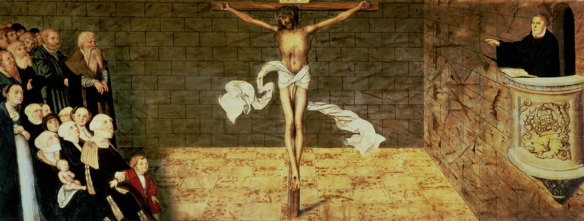
Lucas Cranach was a Renaissance painter and printmaker in woodcut and engraving. He was a friend of Martin Luther and his wife Katharine von Bora. In one of his paintings (1547) focusing on the Cross of Christ, Cranach depicts Martin Luther preaching to the congregation. I remember this particular painting vividly as it hung above the bookshelf in my house growing up.

image.png

It shows Martin Luther standing in a pulpit perched high on the wall of the chancel at the front of the medieval church. One of Martin Luther’s hands rests on the bible. And he points with his other hand to a cross with Jesus hanging bloodied bruised planted in the floor space between Luther and the crowd gathered in the church. Jesus hanging on the cross forms the center of this work of art.

Today this painting comprises one of the plates surrounding the altar in the Wittenberg church where Luther preached. As such, we often recognize and associate this painting with the ‘Reformation altar’.

Its prominence in Lutheran history suggests how poignantly this painting describes Luther’s theological bias: The Cross stands at the center. And Christ crucified informs everything in the church and even our reading of the bible.

Before we can embrace deeper understanding of Martin Luther’s theological claim that we find salvation by God’s grace—which finds us— through faith, we must first encounter the centrality of the Cross in Luther’s thinking and prayer.

In the seminary that I attended[1], we used the term, “Theology of the Cross”. Martin Luther first coined the phrase in his Heidelberg Disputation written in 1518. A theology of the cross is a way of understanding and imagining God. Fundamentally, in addressing God, we need to ask the questions: What is my image of God? Where is God primarily revealed? How is God best known?

Luther provided an answer: God was, and is, being revealed to us in all truth most clearly and unequivocally in suffering. In the vulnerability and pain of death on the cross, Jesus revealed—and continues to—the God who suffers alongside us wherever there is pain and suffering in the world. It is no wonder, then, that the longest sections in each of the four Gospels in the New Testament are dedicated to the various passion narratives[2]of Jesus.

Therefore, the Cross is theologically vital not just to Luther but to the Apostle Paul (the central figure of the Acts of the Apostles and some of the earliest Christian writings and Epistles) who central theme is: “God’s power is shown in human weakness.”[3]

The Theology of the Cross is contrasted to a Theology of Glory. Especially today among spiritually materialistic cultures in the West, what has been coined ‘a prosperity gospel’ has grown in popularity. This theology of glory presumes God validates faith, and is only validated by, success, measures of progress and triumphal conquering over any weakness or adversary.

A prosperity gospel fueled by unbridled optimism avoids places of defeat, failure, vulnerability and weakness as having anything to do with divine identity or purpose. A theology of glory undermines real people and a God who is known in the darkest times and places of life. It compromises and even derides a common humanity and the losses we all endure.

Prayer, as I have said, is the act of letting go. If prayer begins with God, and our address of God, we must presume before all else who this God is, and how this God is revealed—in scripture, in tradition and in our own experience.

One of the first creeds that circulated among the earliest Christians is from a hymn imbedded in Paul’s letter to the Philippians 2:5-11. The poetry first describes the descent of God. This is the primary movement of God, and of faith: downward. The Almighty chose to enter the lower and lowest regions of human birth, life and death. Only after this primary downward movement can the rising out of the depths happen.

Theologians over the centuries have used the term kenosis, from this text in Philippians, to capture the primary movement of faith. It starts with Christ’s self-emptying and letting go of God’s pure, divine nature. In God’s humility, Jesus compromised a perfect divinity in order to take on the fullness of a human existence.

Our God is a God who lets go, releases, self-empties what has become part of the God-self. This calls for a descent of the soul which in the words of St John of the Cross entails, indeed, a ‘dark night’ of the soul. Prayer is not easy, in so much as it may very well be simple.

Prayer, in the words of Laurence Freeman, “… always involves us in the paradoxes of growth, the cycle of losing so that we can find and then of having to let go of what we have found.”[4]

Prayer is a continual process of detaching and dislodging from places of comfort, stability and strength. Prayer is a deconstructive process. It is disruptive. In prayer we begin first to detach our self from all that we are attached to, all that has defined our identity and lives, all our constructs—mental and material—that constitute the construction and containment of our ego. All of this, in prayer, is placed on the precipice of loss.

All is not lost, however. Because in action and contemplation prayer’s aim and understanding is the prayer of God and for the sake of the God of the Cross. “Prayer calls the active person to a life of interiority and soul discovery … by detaching from all the fruits of action and doing everything purely for the love of God.”[5]In letting go, we discover our true self in God which includes and transcends all that we have been and are becoming.

By kenosis we resolve the Lutheran paradox. Some complain that the grace of God is cheap, such as Dietrich Bonhoeffer last century who sacrificed his life for a greater cause of justice in the Nazi regime. He wrote a book entitled, “The Cost of Discipleship”. Bonhoeffer argued that the theology of the cross ought not lead the Christian to rest on their laurels and not do anything. Just because we are saved by grace and since Christ lost everything for everyone once and for all doesn’t mean there isn’t a point doing anything. There is a cost of discipleship.

In prayer, we move into response because prayer is not for our sake. When we pray, it is not my prayer or our prayer. Praying is like walking along a path on the banks of a fast-flowing river and frequently stepping into the water. The current is strong. It is moving in one direction. We immerse ourselves into presence, the presence of Christ. We fall into the river of prayer that continues, the prayer of the living, resurrected Jesus, whose destination is union with God.

It is in Christ’s name we pray, and for the sake of our God who chose to be revealed in the humility and defeat of the Cross, in the most desperate human condition possible: death. We step maybe timidly yet faithfully into the water, fast flowing towards the great hope of new love and life in God. 

Questions for reflection and discussion:

  1. When you pray, after considering your image of God, what is God doing? What is God’s purpose—a purpose that is consistent with that image of God? Construct your prayer by strengthening the connection between image and function. If God is revealed in human suffering, where does that suffering lead? If God is compassionate, why? If God is patient, for what purpose? If God forgives and heals, to what end? Practice making this relationship between image and function as clear as possible before you make any petition to God. And write down some examples of the connection you make between image and function of God, to share with others next time (See copies of “Prayers of the Day” in Evangelical Lutheran Worship for good examples of how short prayers can be constructed).
  2. What is one non-negotiable spiritual practice and/or belief you would hold onto, if everything else had to be take away? (Ask yourself this, after visiting a place of worship other than your own)
  3. If time was short, what is most important to you in the end? Have you had this crucial conversation with those closest to you? If not, why not?

[1]Martin Luther University College (formerly, Waterloo Lutheran Seminary)

[2]The last several chapters of Matthew, Mark, Luke and John describe in detail the last days of Jesus leading to his arrest, torture and death on the cross. These passion narratives form nearly half the total lengths of the Gospels.

[3]1 Corinthians 1-2

[4]Laurence Freeman, Christian Meditation Newsletter, June 2005.

[5]Richard Rohr, Daily Meditation, 17 August 2018

Doers of positive change

If you’ve followed the Ottawa Senators’ Hockey Club over the last year you will have endured a roller coaster ride. From the high, you will have tasted the sweet drippings of a near-berth in the Stanley Cup Championship Series sixteenth months ago …

To the low, feeling the despairing collapse of the team, not just to being out of the playoffs but crashing all the way to second last place in the NHL standings by the end of this past season.

What happened?

In the last several months, the nightmare season was enflamed by revelations of all the off-ice drama that was happening:

  • Allegations of sexual abuse by then assistant manager Randy Lee;
  • The politicking of owner Eugene Melnick to shame/scare the fan base that he was either going to move the team away from Ottawa, and/or that the downtown arena project may not happen motivating concerned fans to initiate an #MelnykOut ad campaign across the city;
  • Star player Erik Karlsson’s wife applying for a peace bond (restraining order) against the girlfriend of another star player, Mike Hoffman, who allegedly used social media and other means to send discriminatory, abusive messages to the Karlssons even during the loss of their unborn son in March;
  • And the continuing speculation around and probable trade of Erik Karlsson in the final season of his current contract.

General Manager Pierre Dorion was right when he told the media last Spring that his locker room was “broken.” Inter-personal relationships, team chemistry – the essential ingredients in a winning team – were damaged maybe even beyond repair.

While ‘on paper’ the team had skilled players and was comprised of the same core from the year previous when they had that successful run to the Conference Final, something significant had changed for the worse. And this subtle yet very real aspect of failed team-work was at the root cause of the team’s on-ice collapse last season. It wasn’t that they weren’t good players; it was their unhealthy, damaging ways of relating with each other that was the problem.

Funny we are talking here in the church about a hockey team that many of us follow in Ottawa. And yet, we can, I think, attend in a similar way to most areas of our social, political, religious, family and personal lives. Are their areas in your work, your volunteer efforts in the church and in the community, in your personal health, in any aspect of your quality of life let’s say, that are lagging, that yearn for renewal, new life, positive change?

For some time, Ottawa Senator players have been saying that there needs to be a culture change in the locker room and among team relationships. Goaltender Craig Anderson said this week he is looking forward to the changed culture in the coming season but he is “too old for all the drama.”

Teammate and hometown defenseman Mark Borowiecki who is considered a leader in the group called out his goalie and others on the team by suggesting they need to do more than just say they need a culture change. Each player and the players themselves as a team, has to do the work of changing the culture. It wasn’t going to happen by itself. No divine intervention. No single-player trade, no matter how newsworthy, was going to change their culture. They, the players, had to take on the responsibility to work at it.

Be doers of the word. A theme in the scriptures assigned for this day. In the Book of James we get the message that while words are important, actions reveal the truth, authentic self and purpose of what we’re about (1:22) more than anything else. What we do with ourselves, with each other – our actions – are the best teacher and communicator of what is most important to our common life, our team, you could say – whether that team is the church, the family, a marriage, a community group, a political movement, or a sports team.

And this action is not only about our performance on the ice, so to speak. This work of doing is not merely about the mission, out there. It is not about whether we succeed or fail on the mission field in getting the job done – the work of ministry in the world. Perhaps our failure at getting that job done out there may at least in part relate to our failure to do anything on the inside of our personal and corporate lives. And lacking the awareness and the belief of positive change within.

It is no wonder Bishop Susan Johnson and the leadership of the Evangelical Lutheran Church in Canada (ELCIC) has identified being a “healthy church” as one of the four vision priorities, moving forward in community. Being a healthy church means, to “develop and promote a culture of mutual trust and accountability.”[1]

That is, we relate with one another and the world around us in ways that reflect genuine listening, respect, humility and patience. In short, we offer safe spaces for personal interaction and growth. We can’t achieve the other vision priorities of the church, such as compassionate justice, spirited discipleship or effective partnerships, unless we are first a healthy group of people relating to one another.

And no one will make this culture change in our relational lives unless we are doers of the word, unless we take action that promotes growth, faith and positive change in our common lives.

In the mid-point of Mark’s short Gospel, Jesus spends a lot of time around the Sea of Galilee. When I visited Israel during my seminary years, our bus ride was only a couple of hours from Jerusalem to the Sea of Galilee. In Jesus’ day, it meant walking at least six days. Word of Jesus had certainly spread, and his actions of healing and eating with sinners and picking grain on the Sabbath made the Pharisees – the keepers of the Law – extremely nervous. So much so, that the powers that be from Jerusalem invested the better part of a month checking up on Jesus’ ministry (7:1).

It is sometimes amazing the lengths people will go in order to keep things the way they have always been. A radio sports commentator mentioned after the Anderson and Borowiecki interviews that Mark Borowiecki was right: talk of culture change has been swirling around the same group of players for most of last season with little, actual change in their performance. It seems we haven’t really been taught how to work at bringing positive change, starting with us.

Change is frightening, to be sure. Institutions often seek to preserve the status quo. That was true in Jesus’ day. And it is true in congregations as much as in team locker rooms these days. Yet change, as we must surely know living in this time and place in history, is the norm, not an exception.

I was pleased to hear Pastor Mei Sum Lai, leading her last worship service at Resurrection Lutheran Church in Orleans[2]last Sunday, thank the congregation for allowing change to happen during her tenure there. I then reflected on all the changes that have happened here at Faith[3]in the last six years or so:

  • The bold decision to bring significant upgrades and modernization to the building and sanctuary;
  • The gutsy decision to worshipping for four months with our local Anglican parish while the sanctuary was off-limits in its renovation;
  • The move to weekly Communion;
  • The involvement of lay readers and worship assistants;
  • The completion of the work of the Evangelical Lutheran Women as a formal entity
  • The introduction of Christian Meditation as a weekly prayer group;
  • The evolution of bible study to a prayerful encounter with the Word;
  • The ongoing evolution of meals at the church in all its fits and starts – to name a few changes.

These changes, good or bad in your view, are nevertheless good practice for us. Making these changes are good exercise for us, for the positive changes that God is bringing about in our world and church. Because we won’t do it perfectly. We will make mistakes. We will even fail at times. But avoiding failure is not the point of Christian identity and mission. The point is, we are following Christ – or trying to – on a rocky and uncertain road in the post-modern world. Trying amidst the noise and chaos to discern and listen to Jesus’ voice.

What is at stake, is what we believe. What do we believe about change? I think this makes a huge difference in how that rocky road will go for us.

Despite the negative scrutiny and criticism heaped upon Jesus by the Pharisees, what does Jesus do in response? Does he cave into the pressure to play by the religious rules of the day? Does he try to please the authorities and adhere to the tradition for tradition’s sake? Does he shift into self-preservation mode and quietly step into the shadows as not to garner any more attention? What does he do?

Jesus keeps on healing. If you read on in chapter 7, he goes on from Lake Galilee southward on the road into the non-religious Gentile region first to heal the daughter of the Syrophoenician woman[4], and then he opens the ears of the deaf man in the Decapolis.[5]

In fact, I don’t know of anyone in the New Testament who doesn’t change after encountering Jesus, whether by a healing or in a shift of attitude and approach to life. The most dramatic example, probably, is Saul of Tarsus who on the road to Damascus encounters the living Lord and experiences a profound conversion.[6]

When you meet Jesus, your life changes for the better not because you don’t do anything about it. But because you’ve placed yourself, for better or worse, in a position to receive the grace, healing and change of God. Historian Diana Butler Bass writes, “For all the complexity of primitive Christianity, a startling idea runs through early records of faith: Christianity seems to have succeeded because it transformed the lives of people in a chaotic world.”[7]During this time, Christianity was primarily about how to live a better, more faithful life, here and now within the kingdom of God.

Team play is as much an inner game as it is an outer game. And the inner game takes work, not just words. This inner work is not easy to do.

Perhaps you might have a hard time believing positive change is possible in your own life. If so, is it because we refuse to see the positive changes happening in those around us – in the life of the church, in our own families and friendship groups? Because when we refuse to accept that others have changed, we strike the death knoll and close the doors of our own hearts to see the change there.

So perhaps a first step would be to regard others, especially those closest to us, as on a journey that is changing and growing them in ways beyond our control. And then wait for Jesus’ call on your own life to follow him, to encounter him, to meet him on the road of life. In most of the people who meet Jesus, they present their own need. They approach Jesus in their vulnerability. Where they are hurting.

Because whatever the case may be with your own heart, whether or not you believe change in your own life and in the life of others around you is possible, God waits for you. God is patient, ready and willing to heal. God believes in you.


[1]http://www.elcic.ca

[2]http://www.rlchurch.ca

[3]http://www.faithottawa.ca

[4]Mark 7:24-30

[5]Mark 7:31-37

[6]Acts 9:1-31

[7]Diana Butler Bass, “A People’s History of Christianity: The Other Side of the Story” (HarperOne, 2009), p.26.

A spirituality of fierce landscapes

The Lord is king! Let the earth rejoice; let the many coastlands be glad! Clouds and thick darkness are all around him; righteousness and justice are the foundation of his throne. (Psalm 97:1-2)

Which is mountain? And which is cloud?

Sometimes it’s difficult to distinguish one from the other. When cooler air temperatures carried by strong wind collide with a warm land mass in wide open, exposed landscapes, what we see is not always clear. The lines between the two are not certain.

I am reminded of Moses meeting God in a could atop Mount Sinai in the wilderness. I imagine the dove dropping from the heavens and God’s voice booming at Jesus’ baptism. I sympathize with the disciples seeing Jesus change before their very eyes atop the Mount of Transfiguration. Biblical stories of God colliding and communicating with creation and humanity in a volatile mix of potent energies, some clashing and some joining in a mysterious dance of meaning and purpose.

And we’re not always sure what to make of it. Can we trust what we see? Is our perspective clouded? What is real?

Mountains convey a sense of certitude and stability, a rock and fortress we can count on and lean on. What are the rocks in our lives? Those things, beliefs and people that anchor us in the construct of our lives?

Clouds are ethereal. We cannot grasp the cloud. It is there and yet it isn’t. It is not solid. It is a vapour that we can see, yes, but that which we cannot contain. A cloud is free to form and reform, free to move, free to be and not to be. After all, it belongs in the sky. What are the clouds in our lives? Events, circumstances and situations that have arisen quite outside the realm of our control, good and bad?

Then, as we reflect on the journey of our lives, with all the twists, turns and unexpected happenings, which has more sway in the course of our lives? The mountain? Or, the cloud?

While the mountains of our lives give us a sense of security and well-being, comfort and confidence — all important in life — what role do the clouds play? The bible shows that God speaks through the cloud, even when our main characters find themselves on top of the mountains! Despite all the securities we afford in our lives, those things we strive for to make us feel in control, God clouds those places.

Not that God is against those things, per se. But that the only way God can get into our hearts and bring meaningful change is from the cloud. An anonymous fourteenth century spiritual writer called her work, “The Cloud of Unknowing”, to talk about a way of prayer in which God encounters us in the depths of our hearts.

It may feel, at times, like we don’t know much. It may feel, in these out-of-our-control experiences of life, that we don’t know anything. And we ask, “Why me?”, and “Why this?”

It is in the cloud of our unknowing, nevertheless, where our re-birth and renewal begins. It is here, in the cloud, where all we need to do is not turn around and go home. In the cloud of unknowing, we must not give up. It is called faith.

Faith, to know, that in the fiercest landscapes of our lives where everything seems uncertain, there is hope. We are held in a greater, larger purpose of which we cannot see the whole, big picture right now. We are held in a loving Mystery. And that’s ok.

Because the very reason we can ask the questions, struggle in the uncertainties and take the next, tentative, step on the path is because the sun gives the light for all this to be possible in the first place.