Re-purpose the building: a sermon for Transfiguration

In the Gospel stories of the Transfiguration of Jesus, it is the disciples’ response to Jesus’ glory that captures my attention and imagination.

In response to seeing the incredible transformation of their friend and master before them, Peter says he wants to build three “dwelling places”, or “tents” from the Greek. The Gospel of Mark suggests that Peter wants to build these shelters because they are “terrified”.[1]

It is a natural reaction when we are afraid for us to go to that which gives us security. For Peter, that means building a house. Or two. Or three. He must have been really scared. Not just a tent for Jesus, but also for Moses and Elijah who have mystically and supernaturally appeared alongside Jesus.

This is a glorious moment. Jesus’ divinity bursts upon their vision. And, we humans naturally want to contain this mountaintop experience. Put God, literally, in the proverbial box. Saint Augustine said in the fourth century, “If you can comprehend it, it is not God.”

The Gospel of Matthew goes further when he writes that it was “while Peter was speaking”[2] this, that a voice from heaven spoke: “This [Jesus] is my beloved Son.” The narrative feels like God interrupted Peter, cut him off.

It’s as if God is saying: “Don’t.” Don’t try to own such divine moments of God’s self-revelation. Don’t try to manage your spirituality. Don’t try to control the experience of gift, of unconditional love. We may want to build something and thus put God in a box. But we can’t. Because, really, there is no box.

In our religiosity, we may instinctively try to capture any glorious, God moments we experience in life. By repeating the experience, invoking certain feelings and the mood. We build buildings and keep them the same.

As with the disciples of old, we would rather escape the humdrum, ordinary realities of living in the valley of our daily, imperfect lives, and just stay on the mountaintop, containing God while we are at it. We don’t want it to change. We don’t want to change. We, like the disciples of old, just want to remain in this state of euphoric ‘mountaintop’ feelings and stay put, there.

Today marks the one-year anniversary that we have worshipped in this transfigured space. A year ago, on Transfiguration Sunday, we returned from an extended absence during which we worshipped every Sunday for eighteen straight weeks with our neighbours at Julian of Norwich Anglican Church. Coming back to this renewed space was a joy and a blessing. We were back in our own tent, so to speak.

IMG_6546

I say, ‘tent’, intentionally. Because the contractors who modernized this building emphasized the strap-over accenting on the exterior – to make it look like when you put a large fly over your tent. In fact, those of us on the ‘liturgical arts’ committee who consulted with the contract designer heard him say on occasion early on in the project, that the idea behind the contrasting colour choices was to make it look like a tent.

Which was by design. And very appropriate for the church, as a symbol. Not only was the natural element emphasized in the tent-like strappings on the outside, the blue colour on our ceiling inside was meant to image the night sky – looking up, in faith.

Indeed, the structure of our church, and its recent ‘transformation’, is not new. It is to emphasize an original idea when it was first built over fifty years ago: as a temporary house worship space. The tent image for our structure underscores an enduring truth about the church: The church is a movement. It is always on the move. It doesn’t stay put in one place for long.

A church ever changing, a church adapting its form yet reflecting its original mission.

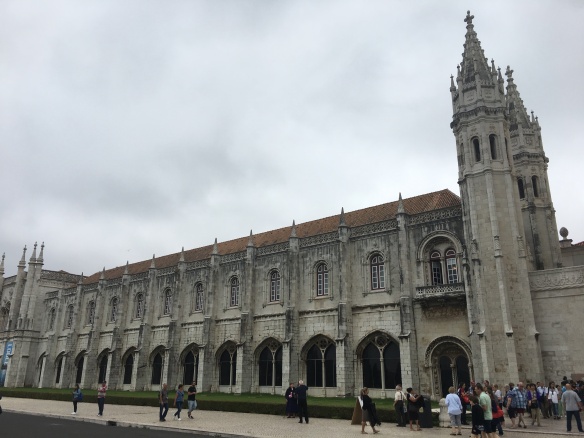
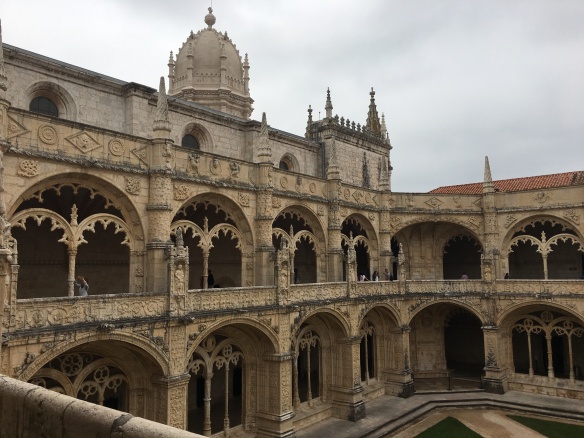
The Jeróminos Monastery in Lisbon, Portugal, is a UNESCO world heritage site. When my wife and I toured the massive complex last summer, including the impressive cloister and the ‘chapel’ – which views more like a colossal cathedral in typical European grandeur, I understood why. These photos don’t do it justice.

IMG_5608

In 1833, over three hundred years after the site and property was inaugurated as a religious Order of Saint Jerome, a state edict transferred the property and all its assets to Real Casa Pia de Lisboa, a philanthropic institution that took in, raised and educated orphan children.
IMG_5573

It was hard for me to imagine that a three-hundred-year-old religious institution of this magnitude would relinquish its assets. And doing this, located on prime waterfront in Portugal’s growing commercial city during the sea-faring Age of Discovery.

IMG_5588

IMG_5595

IMG_5605

IMG_5581

Without delving into the complex history and context of the Secularization Act of 1833, the fact remains: During a robust period of historical expansion, the church made a big change. I would argue, however, the church did not lose. Sure, it no longer could boast financial ownership of the property. But, by handing over its assets and combining them with the resources of the state, it bolstered its core purpose in mission – the care of vulnerable children. The space and property, as of 1833 moving forward, would now serve the needs of needy children.

Jesus says: “Unless you change and become like children …”[3] Without doubt, the religious of 1833 Lisbon were being true to the mission of Jesus.

In our lifetimes, we are witnessing here in North America – indeed in Ottawa – many growing examples of a church re-purposing its properties to build senior’s complexes and other social enterprise. We may believe this is a sign of the times – a negative, unfortunate, disappointing, mournful reality of the church. But, in truth, in many cases, such a re-purposing of a building is consistent with the Christian mission – to care for the weak, the vulnerable and needy in our society.

I can remember driving through rural country in south-western Ontario, and more in Saskatchewan, where you would see, stuck in the middle of a wheat field, a run-down, dilapidated old church building no longer in use, just left abandoned. It is sad to see this. It’s easy to jump to the negative conclusion that the church is dying by simply looking at its physical assets. When it’s not tied to a living purpose, the building will surely die.

But two hundred years after the so-called secularization of the Jeróminos Monastery’s assets, hundreds of thousands of visitors to the site every year continue to pour in and be inspired by the legacy of that bold, courageous move of those 19th century Christians in Lisbon. Good for them.

Re-purposing church property is not just a recent, contemporary phenomenon borne out of the institution’s modern demise. Re-purposing assets is not a sign of Christian defeat in a secular society. First of all, it has evidently been done throughout history when the need and opportunity arose.

Moreover, changing a physical structure doesn’t mean Christians are being decimated by an oppressively secular, contemporary, multi-cultural, diverse society in Canada. The physical transfiguration of Christian property may in truth be a positive sign of healthy, missional spirit, consistent with our Christian identity. A sign that the church and its original purpose in their properties will endure for centuries longer.

The disciples of Jesus accompany him to and from the mountaintop. Moses and Elijah appear with the transfigured Jesus, linking the present moment with the great tradition spanning all times and places. The community, the people, the saints on earth and the saints of heaven, accompany us on this journey.

The journey is a movement, not to remain stuck – even in moments of glory and victory. Rather, we are called to embrace the hardship as well, the challenges, the disappointments and opportunities of the daily grind of living, down in the valley of our lives. Ours is not a denial religion. Ours is not an escapist religion, one that ignores the plight of those who suffer, avoiding the normal difficulties of life, pretending that somehow we can with God only experience the highs without the lows. That is false religion.

Jesus interrupts our striving and tells us, “Don’t”. Don’t build those false expectations of a prosperity gospel. Don’t pretend you can stay on the mountaintop with Jesus forever while you live on earth. Because, Jesus, the divine Son of God, also embraced his humanity, and leads us down into the very human valley of life on earth.

Positive change and transfiguration in this light don’t come by way of escaping the world. The cathedrals of our hearts are meant to house people – all people, in their needs and for the sake of the other.

We are not alone, in this enterprise. As Jesus accompanied the first disciples up and down the mountain, God goes with us, up and down. Jesus leads the way. And, we walk shoulder to shoulder with our co-pilgrims who go with us.

[1] Mark 9:6, NRSV

[2] Matthew 17:5, NRSV

[3] Matthew 18:1-5

funeral sermon – Epiphany

Something of eternal consequence had already started the day before Derry died.

As is customary in the weekly bible study at Faith, we take turns reading the scripture for the day. And we read that same scripture over three times, in the tradition of lectio divina – a meditative, prayerful approach to the bible.

I think I speak for everyone in that group to say that we all wanted Derry to read. He read well. Derry articulated the words with nuance and meaning. His deep, rich voice brought the scripture to life.

The day before Derry died, he attended our last session before the Christmas break. We were reading, as you can imagine, the story of Jesus’ birth from Luke chapter two. At the beginning of our time together, I asked Derry if he would read that scripture. But he needed more time to get settled, and he would read it later. “We’ll get back to you,” I announced.

But, for whatever reason, we never did. Whether it was the turn of the conversation, the character of the group that day, or innocent forgetting, Derry didn’t get his turn to read that day.

A couple of us reflected briefly on this over Christmas. And we felt badly that we missed an opportunity to honor his gift one last time.

In retrospect, it feels like unfinished business, something left hanging, incomplete. On this side of death, we can’t yet fully realize and appreciate what Derry’s gift of faith means beyond death’s door.

Last summer in my travels I found this quote printed on the window of a restaurant: “Life is not measured by how many breaths you take, but by the experiences that take your breath away.”[1]

What are these experiences that ‘take our breath away’? When we behold something beautiful. When something outside of ourselves ignites and inspires something from within us, we taste glory. We are moved. Deep speaks to deep[2]. Emotions, memories, feelings stir within us.

This is the purpose of art. The creative impulse is to fashion something material outside of us to reflect the beauty and glory within. Our outer world and its inner significance – those moments that take our breath away – come together with resulting joy and a sense of coherent beauty.[3]

Art is not something that can be used. Its primary purpose is not functional. A sculpture cannot be part of a mechanism to make something work. Art does not bring water into a community, heat our homes, transport goods and services across the continent. Art isn’t meant to be a cog in the wheel of our economy. It’s not easy to make a good living in our culture doing only art. From this perspective, art is unproductive — even useless.

So, why do we bother to spend so much of our time in our flower gardens? Why do we exercise extraordinary patience in painting something that is called from within us? Why do we write poetry? Why do we travel across this globe to visit cathedrals and art galleries and artifacts that bespeak of unspeakable beauty?

Like a verdant garden bursting with variety and the fullness of life, Derry’s artwork was rich in diversity – sculpting, painting, ceramic and wood-carving and gardening. Derry’s gift of art not only reflect his astounding creativity but also the witness of one who reflected the light and glory of Christ to the world in his own, unique way. The ‘likeness of Christ’, we say.

Today is the church’s annual observance of the Epiphany. Every year on January 6th, Christians further contemplate the mystery of the incarnation, of word made flesh.[4] During the season of Epiphany that follows, we discover again how God is made flesh in Christ, in the world today.

Whether we want to believe it or not, we reflect the light of Christ, the light even the darkness of death cannot consume.[5] Today we stand in the shadow of death. We grope in the darkness of grief, trying to find our way forward but not sure because it is an unknown path. We mourn at this occasion of profound loss.

Yet, the light continues to shine. And what is more, that light shines within us. If Derry leaves a legacy, it is to witness to this light – the light of glory, the light of Christ risen, the light of life that is now, because of Christmas, in the world and in us. Second century bishop of Lyons, Irenaeus, said that “the glory of God is the human person fully alive.”

Derry, in his artistic expression, was surely ‘fully alive’. We can trust this. We may not feel it all the time, especially in grief. But not feeling God’s light within us doesn’t make it untrue.

Derry was also a teacher. He taught many student teachers at the university. Derry teaches us something important about life and death. Derry’s teaching to us now is to witness to the glory of God, reflected in each one of us.

The darkness does not overcome the light. The light endures forever. In God’s reign, there is no unfinished business. Derry continues to bask in the light and glory of God’s eternal reign. Today, Derry deepens his connection with the Word, reading and living the stories of God made flesh in Jesus Christ. In this time, God brings to completion the good work begun in Derry’s life with us.

Thanks be to God.

[1] T. Paul’s Restaurant in Astoria, Oregon

[2] Psalm 42:7

[3] Richard Rohr, Daily Meditation, January 1, 2018

[4] John 1:14

[5] John 1:5

Christmas – God goes home

Were you home for Christmas?

It is customary to be at home, or go home, for Christmas. For some, Christmas wouldn’t be Christmas without being home. And, in this meaning, ‘home’ refers to a specific, geographic location, a space usually defined by a building: the homestead back on the farm, the house you grew up in and is still in the family, the house you lived in for many years, etc.

Bing Crosby’s “I’ll be home for Christmas” echoes in the back of our mind, providing a mantra for constructing our idea of what Christmas must be like. Being home brings comfort and a feeling of stability. To do or say otherwise might threaten our very notion of what Christmas means. In discussing whether it is time to celebrate Christmas somewhere new and somewhere different, someone will always say: How could we do Christmas anywhere else than here — at home?

I heard over the holiday the story of a childhood memory of Christmas. When this person was a young child, her parents took her and her siblings to travel from Ottawa to the Eastern Townships to be with an aging and infirm family member. Friends criticized them: “How could you spend Christmas in a motel room and nursing home far away,” they judged. “You’re spoiling Christmas. Especially for the children.”

Contrary to our nostalgic sentiments, the first Christmas story points another way: Mary and Joseph make a home where there is no home – a stable behind a packed inn in a town far away from hometown Nazareth. The recluse shepherds have to leave the familiar abodes of the fields surrounding Bethlehem and go with haste to visit strangers in town. And the magi travel great distances, following a star, from the East and arrive to visit the Christ child after some time has passed since that Holy Night.

The Christmas story is more about traveling away from home, away from the familiar and towards the unknown, the new, the unfamiliar. If we assume that being away from home at Christmas would be unsettling, then we might be surprised that the dislocation of the main characters in the Christmas story does not appear to destabilize them.[1]

Brian McLaren argues that what matters most in religion “is not our status but our trajectory, not where we are but where we’re going, not where we stand but where we’re headed. Religion is at its best when it leads us forward, when it guides us on our spiritual growth.”[2] This is the meaning of the magi’s journey:

Religion is at its best when we, with the wise men, follow the star shining upon the place of Jesus’ presence in the world today. Like Jesus’ disciples who were to “go into all the world”[3], we are called from time to time to leave places of comfort and familiarity, in order to discover the new things God is revealing to us and participate in the mission of God.

Our comfort and stability come when, no matter where we find ourselves at Christmas time, we find our home in Christ. There is something true about a nostalgic portrayal of the nativity: the happy family and visitors huddle around the manger made of straw, a soft light shedding its warmth on the pastoral scene; what is right about this is that there is a home – a home whose hearth is Jesus Christ himself.[4]

As I pondered the idea of being home at Christmas, I found this wonderful definition of home: “Home is the abiding place of the affections.”[5] Home speaks of a shared intimacy, vulnerability, truth-telling and love. The abiding place of the affections is not limited to any one physical space, but is more a function of healthy relationships. Jesus said, “Wherever two or three are gathered in my name, there I am among them.”[6] Whenever deep speaks to deep,[7] heart speaks to heart, that is home. And that is where God is.

In this coming season of Epiphany, we indeed discover God anew. We discover the revelation of Jesus in the world today. We discover with joy that God is at home in us and in this world.

“See, the home of God is among mortals; He will dwell with them; they will be his peoples and God himself will be with them.”[8]

Christmas means that the game for us has changed. For, no longer do we need to wait until the end of our life to go to heaven and be with God. For that matter, we don’t need to go anywhere at all.

Rather, Christmas means that God came home; that God and heaven have come to us. To where we are. And no matter where we are. For now, and forevermore. Amen.


[1] Cynthia L. Rigby in David L. Bartlett & Barbara Brown Taylor, eds. “Feasting on the Word: Preaching the Revised Common Lectionary Year B, Volume 1 (Kentucky: WJK Press, 2008) p.118.

[2] Brian McLaren, “The Great Spiritual Migration: How the World’s Largest Religion is Seeking a Better Way to Be Christian” (Convergent, 2006), p.xi-xii, 12-13.

[3] Mark 16:15

[4] Cynthia L. Rigby, ibid.

[5] David Marine, cited in Diana Butler Bass, “Grounded: Finding God in the World, A Spiritual Revolution (New York: HarperCollins Publishers, 2015) p.172.

[6] Matthew 18:20

[7] Psalm 42:7

[8] Revelation 21:3

Dialogue sermon – Epiphany 3A

The people who sat in darkness have seen a great light, and for those who sat in the region and shadow of death light has dawned (Matthew 4:16)

The people who walked in darkness have seen a great light; those who lived in a land of deep darkness — on them light has shined (Isaiah 9:2b)

Voice 1: We confess that we sit in darkness (Matthew 4).
Voice 2: We confess that we even have the gall to walk around in the darkness (Isaiah 9).

Voice 1: Whether we are moving, or staying put, the darkness of sin clouds our vision, purpose and value in the world. We stumble and fall —
When we exclude, and draw lines of division between the haves and have-nots;
When we ignore, avoid and despise those different from us who press into our private places, disturbing the darkness and isolation.

Voice 2: We confess our longing to sit and walk in the light.
A place to be, free from our stuck-in-the-rut-ness,
free from what holds us back — our prejudices and fears.
A place to affirm and re-affirm our call.

Voice 3 (from balcony):
Bethlehem.
Egypt.
Nazareth.
Jordan River.
Wilderness.
Capernaum by the Sea of Galilee.

Voice 4 (from balcony):
The places where Jesus had his beginnings —
moving,
interrupting,
disturbing,
challenging,
calling.

Voice 1: Where are we now? What place inhabits our vision?
We long to return soon to our home, at 43 Meadowlands (Faith Lutheran Church).

Voice 2: We long to identify our place in the mission of God to the inadequately-housed (Julian of Norwich Anglican Church).

PLACE IS IMPORTANT.

Voice 5:
Our place in this world.
Our purpose.
Where we pray, sing, do mission together.
Where we affirm week after week who we are in Christ,
the light of the world.

In relationships, where we act boldly, and immediately, as did Christ’s disciples of old.

Jesus comes into the places of our lives to change us, challenge us.
No longer complacent,
but urgent following.
No longer passive,
but active response —

Voice 1: to the God who has, does and will continue to shine
God’s light and love in Jesus Christ
upon all who sit and walk in the darkness of the world.

Today

In Andy Weir’s book and movie entitled, “The Martian”, the character played by actor Matt Damon – Mark Watney – is stranded on Mars. And he decides to survive using whatever scientific means possible and using whatever resources are at his disposal until a rescue mission is mounted. 

The book and movie differ in some ways — although the deviations in the movie aren’t as pronounced as in other script to screen adaptations. The most significant difference is, perhaps, the last scene. In the movie, the rescued and now teacher, Mark Watney, gives advice to a classroom full of students in astronaut school.

He counsels that in the face of almost certain death, the way forward is to focus all your energy on solving the next problem, and then the next, and then the next. After all, he survived almost two years alone on the red planet on account of his determination, and despite the odds to remain focused on the immediate task at hand. And not get lost in imagining future outcomes, or wallow in past mistakes.

His advice points to the importance of being present to the current moment of existence, paying attention to what is (not what might be or what was), and acting in confidence for all his efforts.

In the Gospel story, Jesus uses the words of the prophet Isaiah to announce his mission, his purpose (Luke 4:14-21). Jesus will bind up the brokenhearted, proclaim liberty to the captives, release to the prisoners and good news to the oppressed. In summary, he declares his mission to bring compassion and healing to people. And significantly, he closes his public reading in the Nazarene synagogue in 28 C.E. by announcing that “today” this scripture has been fulfilled.

For all who wonder about who this Jesus is, this season after Epiphany ought to give us some clues. Epiphany means ‘revelation’, as Jesus is revealed to us. And, in this text his purpose is made clear. In fact, the writer Luke throughout his book de-emphasizes moral correctness, and rather underscores acts of compassion (1). The underlying question in Luke is not so much: “What does God demand?”; Rather, “Who needs attention and compassion?” This line of questioning can re-focus the purpose of any follower of Jesus.

If someone asked you today, “What is your purpose in life?”, what would you say? Could you describe your mission, specifically and in concrete terms? And, how does your life today reflect the values of your mission statement?

These questions cannot be directed solely at individuals, but the church as well. In the reading today from 1 Corinthians 12, our ministry and purpose finds purchase in the context of the collective. Saint Paul describes the church as a body with many members. The church is the Body of Christ, today. Do you know what your faith community’s mission is, to which you belong?

In coming to terms with his own ministry, Jesus had to make some decisions. He omits a phrase from the Isaiah scroll handed to him. While Jesus cites Isaiah 61:1-3 word for word, he excludes the second part of verse 2 — “… and the day of vengeance of our God.” In order to be true to his purpose, Jesus also needs to be clear about what he will not do. He needs to leave something out of his life altogether in order to remain on the path of healing and compassion. How can he reconcile divisions and heal the brokenhearted by bringing punishment and vengeance upon the people? Impossible.

In pursuing your mission, what do you need to omit? What do you need to stop doing? What are things you need to let go of, in order to make room for the new life which is calling you to grow in the Body?

And we can’t put it off or rationalize it away. There is a sense of urgency in the life of faith. Almost a dozen times in his Gospel, we find the word “today.” The writer Luke emphasizes the importance of the present time. Jesus says, “Today” the scriptures have been fulfilled (Luke 4:21). To Zacchaeus, Jesus announces that “today” salvation has come to his household (Luke 19:9). Hanging on the cross moments before he dies, Jesus turns to the criminal hanging beside him and says, “Today, you will be with me in paradise” (Luke 23:43).

Today, not yesterday. Not when I was young. Not in the heyday of church planting and growth. Not in some glorious vision of the past to which we hang on, pretending it was perfect, wishing to turn the clock back.

Today, not tomorrow. Not at some future date when things will be better. When we will have enough money. When I will have more time. When the kids are old enough. When I retire. When I die. When the church will be full again. When I/we find healing or deliverance from whatever hinders me/us from pursing my/our mission.

God gives us no other day than today to do what we must, what we need to do.

What in my life is it too soon for, too late for, just the right time for? (2)

The Holy Spirit gives us something to do for God. And God doesn’t leave us bereft of resources. The solution may very well be under our eyes, very near to us. Everyone seems to want to know these days: “How are we doing as a church?” and “How are you doing as an individual?” Perhaps the questions need to change. The real questions may be: “As a church, what are we doing for God?” and “What are you doing for God, today?”
This is the day that the Lord has made! Let us rejoice and be glad in it! – Psalm 118:24


(1) Carol Lakey Hess in Barbara Brown Taylor & David L Bartlett, eds. “Feasting on the Word” Year C Vol 1, WJK Press Kentucky, 2009, p.286

(2) Dawna Markova, “I Will Not Die an Unlived Life” in Joyce Rupp, “Open Door: Journey to the True Self”, Kindle version, 2008, p.18 of 36 in Week 1

I am loved, therefore I am

During this season of Epiphany – which means ‘revelation’ – we will again uncover the identity of God made flesh in Jesus.

How will we do that? While Epiphany is a positive celebration of the meaning of the “Word made flesh” (John 1:14), this season also introduces an identity crisis swirling around Jesus throughout the centuries. It also confers that same identity crisis upon his followers. Who is this Jesus? And who are we?

Who is Jesus? It may comfort, or disturb, us to realize that even while Jesus walked the earth over two thousand years ago, those around him didn’t always ‘see’ him for who he was. Even at spectacular events such as the transfiguration or after Jesus performed miracles of healing, some confused him for the prophet Elijah who in the tradition was promised to return (Mark 9:9-13; Matthew 11:2-15). Some mistook Jesus for a political Messiah who was expected to liberate the oppressed Jews from Roman occupation of the Holy Lands (Matthew 21:1-11). And, even when Jesus appeared to his disciples after his death and resurrection, “some doubted” (Matthew 28:17). The scriptures do not hide this confusion about Jesus’ identity.

So Christians today need not be perplexed nor overly hard on themselves if they, too, struggle to understand this Jesus whom God announces at his baptism: “You are my Son, the Beloved, with you I am well pleased” (Luke 3:22). Paradoxical doctrines claiming that Jesus is fully divine and fully human, are not easy for the human mind to grasp.

Which suggests to me that to understand Jesus’ identity is not so much to get vexed and lost in doctrines about Jesus. It is rather to see what he does and listen to what he says. Brother David Vryhof of the Society of the Saint John the Evangelist writes, “If you would know what God is like, discover what Jesus is like. Listen to his words, observe his actions, notice his values and priorities, see how he lives his life. And follow him.” (1)

French philosopher and mathematician Rene Descartes’ famous claim, “I think, therefore I am”, is not helpful here. More appropriate for the Christian today is, “I do, therefore I am”. Or, better yet, “I am loved, therefore I am.” This latter statement especially reflects the values demonstrated in Jesus’ life. I am loved, therefore I am.

Vryhof goes on to tell a story by Soren Kierkegaard: “Once upon a time, there was a powerful and wise king who fell in love with a beautiful maiden who lived in his kingdom. The king’s problem was this: how to tell her of his love?

“He called for the best and brightest of his consultants and asked their advice. He wanted to do this in the best and most proper way – and, of course, he hoped his love would be cherished by the maiden and returned. But when all of his advisors had had their say, the king was left disappointed. For every one of them had counselled him in the same way:

“‘Show up at the maiden’s house,’ they said, ‘dressed in all your royal finery. Dazzle her with the power of your presence and with your riches. Overwhelm her with expensive gifts. What girl could resist? Who would reject such an opportunity, or turn away from such an honor? Who would possibly refuse a king? And if need be,’ they added, ‘you can always command her to become your wife.’

“But the king, being wise, was unhappy with this advice. He wanted the maiden to love him for himself and not for his position and power. Love freely given must be freely returned or it isn’t really love. Certainly, the girl could be impressed, even overwhelmed. And of course she could be coerced and might even ‘learn’ to love the king eventually. But the king saw that if he followed this counsel he would never know if she really loved him for himself or simply for the comforts and privileges that queenship offered.

“So the king decided against the advice of his counsellors. He chose instead to strip himself of his glory and power. He put on the clothes of a poor peasant and walked to the maiden’s cottage to declare his love for her.” (2)

This story by Kierkegaard parallels closely the meaning of Christmas — of why Jesus came, and what kind of person Jesus is — “who, though he was in the form of God, did not regard equality with God as something to be exploited, but emptied himself, taking the form of a slave, being born in human likeness” (Philippians 2:6-7). 

Who is Jesus? Jesus is God in love with us, and in us. And how do we know Jesus lives with and in our lives today? These questions lead to: Who are we?

We are who we are because of Jesus’ love for us. We are beloved, because of what God did in Jesus. Therefore, we are given the gift of God’s presence in Christ through the Holy Spirit. We have it in us. Yes, we do! And we exercise that gift in relationship with others. Who we are with, with whom we spend most of our time, where we commune with others — these are vital questions of spiritual, personal growth.

Who we are in Christ also begs the question of our nature — our growth, our changing, our transforming: Do we change? Can we change, for the better? Does being a Christian change our lives? Do you believe that?

I have over the years heard some argue that we do not change, really. We are locked in for life, the way we are, regardless of circumstance, regardless of where we are and with whom we live our lives. Nature. 

Others are more optimistic. On my good days I believe in the capacity of humans to change for the better. But this depends, I believe, on the quality of our relationships. Whether or not we change for the better depends largely with whom we spend most of our time. Nurture.

I believe most of us contain all the parts necessary for a healthy existence. Even a faithful one. At my baptism as an infant I believe God gave me the gift – the seed – of the Holy Spirit. At which times, or to which degree, that seed would mature and be expressed has depended largely on with whom I spend my time. 

Our families, our friends, our communities have a great influence over our lives. Because just by being with them, they will bring out of us the good and/or the bad. Their presence in relation to us hooks into some aspect of our life and pulls that aspect out. It is the quality of the ‘links’ between us that will determine what emerges from our souls. The old adage is true: “Show me your friends, and I’ll know who you are.”

Which also signifies the importance of hanging out with Jesus, in prayer. Jesus is integral to our relational world. Being intentional is critical here. The more you spend time with Jesus in the Body of Christ – the church, the more you spend time with Jesus in prayer and contemplation, the more you connect with Jesus in his mission to care for the poor — all of these things will over time bring out the good that is already in you.

The bottom line message of Christianity is that all creation matters because of God’s creative love in Jesus. We are created each of us from the spilling out of God’s love to the world. Therefore we are. Therefore we do.

(1) Br. David Vryhof, posted on the front page of the website of The Society of Saint John the Evangelist (www.ssje.org) on Tuesday, January 5, 2016

(2) cited by Br. David Vryhof, “God Has Spoken to Us By a Son”, posted on December 25, 2009 on the website of The Society of Saint John the Evangelist (www.ssje.org)

An Epiphany reflection

Two kings stand amid the sand dunes under the star speckled desert sky dressed in their regal attire. Their camels peer over their shoulders at the third ‘wise man’ holding the hand of Frankenstein. Yes, Frankenstein. 

The two confront the third, pointing accusatory fingers at what they do not understand: “Right, we’ve picked up the gold and the myrrh … What on earth is THAT?!”

We know the story (Matthew 2) of the magi who visited the infant Jesus bearing gifts of gold, frankincense and myrrh. Yes, frankincense. 

We might have an idea of what gold is. But frankincense and myrrh? Basically, these are fragrant spices. But they are not the kind of gifts we would normally give anyone today, let alone a king or queen, president or prime minister. Because we are not familiar with these kinds of gifts, we get tripped up over the words and confuse them with other things. Today we know more about Frankenstein than we do about frankincense. Yet, in Jesus’ day, these were very special gifts.

Let me show you a gift I received this Christmas season. It is three bars of hand-made soap. One of the bars of soap actually has gold flecks in it, as well as frankincense and myrrh essential oils. It is called the “Gift of the Magi Soap”. I suppose there are other things about this gift that can remind me of God, the Christmas story, and the reason Jesus came to the world. 

For example, three bars of soap stand for the Trinity: God is the Father who created everything and everyone; Jesus is the Son who came to wash us clean from our sin; and the Holy Spirit gives us the strength to be the people God has called us to be — to love and care for all people. Of course, the three bars also remind me of the three wise men bearing their special gifts for the baby Jesus.

These days, we will not bring frankincense or myrrh to give to Jesus. Some may bring gold. But the point is not what kind of gift it is. It is that we are willing to bring something special from our own lives to give back to God. It is our offering, whatever it is — our love, our passions, our money, our time, our talents. Maybe even myrrh and frankincense, who knows? 

In this new year, let’s spend some time first thinking about what we can give to God. And then do it. We don’t need to be kings, queens, presidents or prime ministers to give anything of value to Jesus. Because in our baptism we are all princes and princesses in God’s kingdom. And, because our various gifts are important to Jesus and his mission on earth today.

It’s ok to fall (1): Jesus lets us

There’s a bouncy feel to the rhythm of Mark’s story-telling. I can track the Gospel of Mark on a chart in terms of highs and lows:

The highs are the remarkable, miraculous, inexplicable even sensational events witnessed by story-tellers. Beginning with the baptism of Jesus in the first chapter (v.9-11) — voices from heaven, clouds parting, dove descending.

Then, mid-way through the Gospel Jesus goes atop a mountain and turns into this divine, ethereal being before the disciples’ eyes (Mark 9:2-9). Giants from Hebrew history — Moses and Elijah — appear out of thin air, clouds roil and again a voice from heaven. And, in the last chapter (16:9-20), of course, the brief but significant mention of Jesus’ glorious resurrection from the dead. These are definitely ‘highs’.

The lows are a bit more tricky. They represent the down-side of Jesus’ ministry — the temptation after forty impoverished days in the desert, the scrutiny of the Pharisees, all culminating in the Passion of Christ: his betrayal, arrest, torture, crucifixion, death and burial. Some original manuscripts of the Gospel of Mark end on a ‘low’: “So [the disciples] went out and fled from the tomb, for terror and amazement had seized them; and they said nothing to anyone, for they were afraid” (v.8).

Talk about bouncy, like what often happens with the outdoor temperature when seasons change!

These lows are tricky, because, as we shall see, they are not really ‘lows’. At least, they are not the final word in the story of faith. There is always an upside past the low. The troubling truth is that the high will not happen without the necessary, preceding low. In other words, before we rise we must know to fall.

I told this story already once before but it bears repeating. It illustrates the point rather well. And it is a summer-time, water-play story — and my imagination goes there frequently at this frozen time of year.

I was learning to water-ski. In fact, it was the first time I ever tried it, at age thirty. Jessica and I visited with some friends who had a cottage on a small lake nestled in the Bruce Peninsula north of Owen Sound.

It was a good lake to learn on. Few cottagers, even fewer boaters. A quiet, round lake. And my friend, John who drove the boat, assured me that we would just circle the lake a few times and when I wanted to stop, just to wave my arm and he would bring me close to shore.

John’s family, gathered with Jessica at shore to watch me. They assured me that it was normal to fall the first time on skis. In fact, they said they didn’t remember anyone ever being able to lift up and out of the water the first time without falling, when the boat accelerated. I think my friends were getting ready for a long afternoon of fits, stops and starts.

Well, were they in for a surprise. Including myself. Well, not really. Because, darn it all, I would employ all my strength and stamina NOT TO FALL!!!!

I was sitting with my skis submerged in the water, when John hit the gas and I felt the first tug. I gripped the tow rope handle with all my power and pulled myself out of the water, and voila! I was skiing! I briefly heard the cheering of my friends on the shore behind me before we were out on the open water and the waves were peeling off the sides of my skis. I enjoyed it for a few minutes.

But then, my back started cramping up, and my thighs began to seize up. We were around the lake a dozen times before I fully realized I was in some incredible pain. But I never wiped out once! It wasn’t until afterward that I came to the conclusion — after impressing everyone, I think — that I never relaxed into the experience. I was so tight because I didn’t want to fall.

And yet, I needed to fall. I needed to just let go into the water to know how it felt. My enjoyment of the experience was dampened because of an unrealistic, and inhuman (I might add) expectation of myself. Even though I never fell waterskiing that first time, even though I was ‘perfect’ at it — have I ever wanted to go again? No.

When I recall, as a child, those times that I truly enjoyed playing in the water — it was those times whenever a huge wave caught me off balance and threw me head over heels onto the beach. Those were the times I jumped up and ran back in with glee. It’s the same thing with water slides, and why we will run back up the steps all afternoon long. There is something important about sliding under the surface of the water, losing control, falling into grace, letting go into the sometimes tumultuous waters of our baptism.

This is the first movement of anyone’s true, journey of faith. The pull of the current is downward. Austrian poet, Rainer Maria Rilke, writes: “How surely gravity’s law, strong as an ocean current, takes hold of even the smallest thing and pulls it toward the heart of the world … This is what the things can teach us: to fall, patiently to trust our heaviness” (cited in Richard Rohr, “Falling Upward”, Jossey Bass, San Francisco, 2011, p.153).

What I am learning over time is that we are the cause of our sinning more than anything or anyone else. Because it is natural to fall, from time to time. But we don’t allow ourselves, give ourselves permission, to do just that. We resist, deny, suppress this movement downward. Part of the Lenten journey, I believe, is to reflect on why it is we don’t allow ourselves to just let go into the arms of God, and simply trust.

Admittedly our human nature is such, that we would rather avoid the low and shoot straight for the high. I get that. It is also true, we are up against a giant. We build our lives up against the fear of falling. We are a success-oriented culture. We construct our fortress of security, we incessantly compare ourselves to others and measure our self-worth against some notion of success plastered on the front covers of magazines and echoed through the voices of our sports’ heroes and business tycoons. We are an upwardly mobile culture, valuing even yearning for this trending in our own lives. ‘Up’ is the only way to go! What else is there to do?

So, beware of this prejudice against falling before we start! I ask you to consider all these real and important concerns we have in our culture against falling — whether they are physical, emotional, spiritual — and hold them before you, carefully, during the coming “down” season.

The glorious, divine vision of Jesus is hard to explain. It is a miracle way beyond human understanding. We may say that this event was meant to encourage and empower Jesus for his coming journey to the cross. We may say that we need to be reminded again of the divine nature of Jesus. We may say that what this text tells us is to be obedient, and “listen” to, Jesus, the Holy One of God.

But I like how the story ends. Mark, in his brevity nonetheless, does take intentional note of the movement of the disciples with Jesus “down the mountain” (v.9). This is the sounding bell for Lent. We are now ready to begin the journey downward, into the valley. We are now on a downward trajectory.

And the real question is: What will we do with that? Will we distract ourselves even more? Will we intensify our addictive behaviour and buy more toys to keep the pain at bay? Will we pretend that ‘all is well’ when it is not?

Or, will we face our fears, confront our internal poverty and our crisis, with courage? And I say, with courage, because there is reason to hope when we stand on the edge of the abyss. There is reason to persevere through the fall.

In Matthew’s version of the story of Jesus’ Transfiguration (17:1-8), describing with even more detail than Mark all that happened in this incredible mountain-top scene, the disciples who go with Jesus to see this heavenly vision and hear the voice of God from the bright, overshadowing cloud — what do they do? “When the disciples heard this, they fell to the ground and were overcome by fear” (v.6). They fall to the ground. And not only that …

Jesus’ lets them. He doesn’t scold them for falling down by saying something like, “Hey, buck up; you are standing on holy ground before Elijah, Moses and my divine being! Don’t fall down and grovel in the dirt! Pull yourself together! You’re my disciples, after all! Show some respect!” No, he doesn’t.

Instead, Jesus let’s them be humbled before his divine presence. If but for a short moment, Jesus allows them their humanity. And then he says with encouraging, inviting words, “You don’t have to be afraid, get up” (v.7).

I hope you can join me in the coming Lenten journey, taking great comfort in the Good News of Jesus. I can almost hear Jesus’ loving voice whisper in my ear, next time I risk getting on water skis again, “It’s okay to fall, you know. You don’t have to be afraid.”

Of fig trees and lottery tickets

Some time towards the end of the nineteenth century, a man named Huxley who was intelligent, quick of mind, and never lost an argument, attended a house party at a grand, country estate on a Saturday night. When Sunday morning rolled around, many of the guests who stayed the night prepared to go to church.

As one who was naturally skeptical, Huxley did not propose to go. In fact, he was somewhat irate at his fellow party-goers at their sudden righteous intent. Given what all had happened the night before, Huxley could not believe they still wanted to go to church.

“Suppose you don’t go to church today,” he challenged his friend who he knew to have a simple yet radiant Christian faith. “Suppose you stay at here with me and tell me what your Christian faith means to you this morning, and why you are a Christian.”

“But,” said the man, “you could demolish my arguments in an instant. I’m not clever enough to argue with you.”

“I don’t want to argue with you,” Huxley said, gently. “I just want you to tell me simply what this Christ means to you.” So, his friend stayed with Huxley at home Sunday morning and told him most simply of his faith. When he had finished there were tears in Huxley’s eyes. “If only I could believe that,” he said. (adapted from William Barclay, “The Gospel of John” Volume 1 – The Daily Study Bible Series – Westminster Press, Philadelphia, 1975, p.92)

Huxley’s response speaks to an aspect of our faith that sometimes gets crowded out because of our compulsion to be rational, persuasive and argumentative. And yet, this more heart-felt dimension is what, I believe, ultimately defines, motivates and describes our faith at its core. Because it’s more about a personal experience of Jesus rather than clever argument, persuasive logic and rational explanation.

Prior to Nathanael’s life-changing encounter with Jesus — as described in the Gospel for today (John 1:32-51), Nathanael was skeptical about his friend Philip’s proposition that they had found the Messiah: “Can anything good come out of Nazareth?” (v.46) — Jesus’ hometown. A Roman garrison was stationed there, so people living in this small, insignificant hovel of a town were associated with the hated Roman occupation of Palestine. The notion that the one who would save them from the Romans would come from Nazareth — which, moreover, was nowhere mentioned in any biblical prophecy — was unbelievable, un-credible.

Then, when Nathanael goes with Philip to see Jesus, and Jesus says that in Nathanael there is no deceit nor guile (v.47), Nathanael questions Jesus’ integrity: “Where did you get to know me?” Nathanael was skeptical that anyone could give a verdict like that on so short an acquaintance. I think we can relate: How can you say anything about me when you even don’t know me! Who do you think you are?!

In short, this encounter with Jesus starts off on rocky ground. It doesn’t look good from the standpoint of trying to start a good relationship with someone. How often do we know of friends or family — even ourselves — who have given up on faith, the church, God, all because we felt put off, even offended, initially by something that is said or done. Or, how often have we given up on a spiritual practice after just trying it once? I think we can sympathize with Nathanael’s initial objections.

But then, something changes. How does he move from cynicism to belief, from questioning and doubt, to praise and confession? What happens?

It’s the fig tree. The turning point happens when Jesus speaks to Nathanael’s heart, not so much his mind: “I saw you under the fig tree before Philip called you” (v.48), says Jesus. These simple words turned Nathanael’s heart from suspicious questioning to confessing Jesus as the Son of God.

The fig tree in the bible stood for peace (1 Kings 4:25; Micah 4:4). In ancient Israel, this was a place on one’s property where one could go to be undisturbed, to find quiet. Because the fig tree was leafy and shady, it was the custom in the arid, Mediterranean heat of the day to sit and meditate under the roof of its branches. Perhaps this is what Nathanael had been doing on a regular basis — sitting under his fig tree, praying for the day when God’s Chosen One should come, and meditating on the promises of God.

When Jesus speaks those words, “I saw you under the fig tree…” Nathanael must have felt that Jesus had seen into the very depths of his heart, and read the thoughts of his inmost being. Nathanael must have said to himself, “Here is the man who understands my dreams! Here is the man who knows my prayers! Here is the man who has seen into my most intimate and secret longings, longings which I have never even dared put into words! Here is the man who can translate the inarticulate sigh of my soul!” (ibid., p.93)

It’s the fig tree. What can we say about finding our own fig tree? What are the qualities that describe this place where we meet with God? And where God convicts our hearts?

First, you will notice, Nathanael’s fig tree is not “Sunday morning”, so to speak, where the formal liturgies are practised. It is not to say temple worship was unimportant, even vital, as a place of communal gathering where faith was nurtured, sustained and grown.

But what we are talking about here is where personal, daily faith is nurtured, sustained and grown. Jesus said, “Pick up your cross daily and follow me” (Luke 9:23). We are not talking here about going to church every Sunday. We are talking about our intentional, discipline of prayer and meditation from Monday through Saturday. This Gospel suggests that a daily practice is critical in preparing the heart to recognize God’s love for you.

Preparation and practice is important in our faith. Philip and Nathanael had studied the scriptures and anticipated in their regular prayer the coming of God’s Chosen One. They were, in a sense, ready to receive Jesus. Those of us brave souls who went to a Yoga for Christians class the other night must have walked away with the strong impression, as I did, that regular practice is so important. Because those of us who don’t, still feel it today!

As with any exercise, spiritual or otherwise, you can’t simply snap your fingers to be an expert. With Christian meditation, for example, you can’t just go once and decide whether it’s for you or not; it’s about a long-term vision of practice and intention and discipline. It’s like tending a garden.

Where is the place you go daily to be under your fig tree? Is it a special chair in your living room? Is it a spot on your front or back deck? Is it in the forest on your back-50? Is it a rock on the river-side? Is it connecting with the expansive outdoors? Is it doing a certain physical exercise? Is it some object that you hold or look at to remind you of something or someone precious? Where is your fig tree?

And if you will look for one — It is a place where hopes and dreams are nurtured in your heart. It is a place where the good promises of God are given shape and sustenance. It is a place where faith then begins to affect your decisions in daily life, with joyful anticipation of God’s presence everywhere.

Canadian radio broadcaster Stuart McLean wonderfully tells the story of the “Lottery Ticket” (a necessarily paraphrased and adapted version follows here). Tommy gets a phone call telling him that his grandfather, Lewis, suddenly died. Shortly after the news of the death circulates among the family, the question of his un-scratched lottery ticket comes up. For over ten-years — longer than that, in some people’s minds — Grandpa Lewis kept his faded, un-dated lottery ticket in a box on the mantle, un-scratched. The prize, one million dollars.

“It’s a winner, it’s a winner!” he had often and regularly announced with deep conviction and belief. “It’d be more than that if you’d just scratch it!” rebutted his brother Lawrence. “Just think of the interest it would have made in all this time!”

“Or, I would have none!” argued Grandpa Lewis. “Know what happened to that lottery winner in Toronto, or that family from New Brunswick who won it big? Besides, I don’t need the money. It’s not about the money!

“But, tell me, what would you do with a million dollars?” he would always ask anyone who mentioned his un-scratched lottery ticket. “What is your heart’s desire?” Then he would listen very carefully, and ask, always: “Is that really what you would do?”

When the family gathered to plan the funeral, they argued about what to do with the lottery ticket since it wasn’t mentioned in the will. There were seven in the family, divided between the ‘scratchers’ and the ‘non-scratchers’, the believers and those who didn’t believe. Tommy counted himself as one who wanted to leave the ticket alone. But the ‘scratchers’ had the edge. “Just be done with it. Then we would know one way or another.”

They decided that after the funeral service, they would gather around the mantle upon which sat the box containing the lottery ticket. Silence shrouded the meeting. What would they do if in fact it was a winning ticket? What would they say, if it wasn’t?

When uncle Tony was delegated to open the box, he lifted it off the mantle, opened it, then slowly looked at everyone in the room. When he tipped open the box for all to see, they were surprised to find Grandpa’s Lewis’ lottery ticket missing. And in its place, seven newly purchased lottery tickets.

A week later, Tommy and his girl-friend, Stephanie, sat around their kitchen table. Stephanie asked, “I wonder what happened to the lottery ticket?”. Tommy confessed, “I buried it with Grandpa Lewis. I put it in his pocket before we closed the casket.”

“Why would you do that?” Stephanie asked, reflectively.

“That’s where it belonged. I wanted to trust him. Because I realized that throughout his life, Grandpa needed hope more than he needed money. To him, dreams were more important than a pile of money. Whenever he took out that lottery ticket and waved it in our faces, he could hang on to hope. And challenge us to think very deeply about our true heart’s desire.”

Both were surprised to learn, later, that everyone still had their lottery ticket, unscratched.

Back to the Future: Borderland spirituality

2015 is the year of “Back to the Future”, did you know? When Marty McFly, played by Michael J. Fox, travelled ‘Back to the Future’ in the 1980’s pop culture film, the year they went to, in the future, was 2015.

As a kid I enjoyed the movie, partly because the year 2015, at the time, seemed some unrealistic, arbitrary and irrelevant point in the future; the number only represented some distant benchmark unconnected to my present reality.

Today, 2015 no longer means some far-off, futuristic fantasy. It is reality, now. And if I watch ‘Back to the Future’ today, the movie represents more of an historical curiosity — I’m only looking ‘back’.

In faith, it’s like we simultaneously look back, forward, and both from the grounding of the present moment. Balancing all three is good theology. For its sesquicentennial anniversary, the Eastern Synod (ELCIC) employed the motto: “Remembering for the Future”. Celebrating an important event in the present day by integrating past with the future is important. And a good way to interpret the Bible.

But it an also cause dismay if we only insist on a certain, chronological ordering of events in an absolute kind of way. For example, at Jesus’ baptism in the Gospel for today (Mark 1:4-11) there is the matter of the Holy Spirit, which descends in the form of a dove upon Jesus (v. 8, 10). John the Baptist preaches that Jesus will baptize with the Holy Spirit.

But Jesus never performs one baptism in his ministry that we know of. And, according to the time-line of the Gospels, the Holy Spirit doesn’t descend on the church until after Jesus’ resurrection (John 20:19-23) and at the Day of Pentecost (Acts 2) — these Holy Spirit events do not occur during Jesus’ ministry of healing, teaching and praying on earth. Curious, since many understand Jesus’ baptism as his ordination or commissioning to his call as the beloved Son of God. How do we make sense of this?

To understand many of the stories we read, like the Gospel for today, we would do well, I believe, to employ a ‘Back to the Future’ hermeneutic. This way of interpreting does not deny the truth of all of the events outlined above. For one, it reveals something about how the bible was put together:

The actual writing of the New Testament was done decades after these events took place. Therefore, we say, that we, today, are ‘post-resurrection’ Christians. We can best understand what happens at Jesus baptism from the perspective of the future. Because when these stories were written down for the first time, and from today’s perspective — the Holy Spirit has already come. Jesus is alive. Even as we recall, as a matter of history, what happened in the moments of Jesus’ life on earth some two thousand years ago.

And it’s not just a pointing forward that we need to keep in mind. It is a reverence and respect for the past.

If you look at the geography of the Baptism of our Lord, we can conclude at least a couple of things: First, it takes place in the wilderness, the desert. That is through which the river Jordan runs, basically north to south separating lands that are for the most part destitute, rugged, dangerous even.

Second, that river forms a boundary between two worlds — on the east and south, the world of the ancient Israelites tracking through the desert for decades on their way to the Promised Land flowing with milk and honey, which is on the other side.

John the Baptist comes to this border land, which is significant in the history of the prophets. In fact, John the Baptist stands in line with the prophets of old. His speeches are associated with Isaiah (Mark 1:1-8); he is also mistaken for Elijah because of what he wears (2 Kings 1:8) and because he foretells of the coming Messiah (John 1:21). John’s presence and ministry at the Jordan River in the wilderness brings the past (an identification with history and the prophets) together with the future (Jesus Christ, and the coming Holy Spirit) together into the present moment.

How can we keep ourselves from getting lost and totally confused in the plot line of “Back to the Future?” We remain grounded in the present moment. We look to our immediate surroundings. Like the beasts of the field, we scuff the earth with our heal, and snort and spit, before we look up.

And this is the beauty and wisdom of these Scriptures: their insistent if not peculiar emphasis on details. Yes, God acts in creation. Yes, God redeems sinners. Yes, God has a plan for salvation.

But this ‘spiritual’ talk is always, in the Gospel, tied to material — real water, real bread, real time, inexpensive wine, locusts, honey, sand, camel’s hair, wind, birds and the clouds being rent asunder. This is the nitty-gritty of life, and it can never be separated from matters of the Spirit.

Keeping grounded in the present awareness of life, ‘as is’, helps us track the sometimes confusing plot-line of ‘Back to the Future’. Because it is there that Jesus stands — on the borderland, at the edge of the Kingdom of God. Jesus stands there, and invites us to live into the now-and-not-yet reality of it (Ted Smith, “Feasting on the Word” WJK Press, Kentucky, 2008, p.239).

The Gospel of John identifies Jesus as a ‘lamb’. T.S. Elliot describes Jesus as a ‘tiger’. In C.S. Lewis’ ‘Narnia’ books, Jesus is personified in Aslan, the ‘lion’. Nancy Rockwell, in her post, “Tracks” (blog: The Bite in the Apple) suggests the ‘camel’, for Jesus who identified with lepers and prostitutes, difficult people, estranged members of right society, people who are spat upon. All these images for Jesus throughout history reveal unique elements about his truth.

But, standing in the desert beside John the Baptist, Jesus identifies with the lowly who are on a journey of transformation. Jesus invites the lowly in us to go on a journey that does not reject the past, and tradition, and history but doesn’t allow us to remain stuck there. Because this journey through borderland brings us eventually into a land flowing with milk and honey — a land of healing, restoration and justice for all who seek these gifts of the Holy Spirit.

This means that we cannot use our tainted and troubled past as an excuse for not doing the right thing, now. At the same time, we cannot wait until an ideal future when circumstances are perfect to do the right thing, now.

Back to the Future brings the present moment into sharp focus. A good theology will always ask, “What is going on right now in my life and world?” “Who do I meet today?” And act, now, accordingly. A spirituality of the borderland will always draw my attention to the divine importance of the present moment which is supported by history, and hope-filled for the future.