Stick-to-it-ness of love

Terrorist bombs going off in Brussels during Holy Week should get our attention. Not only and primarily because of the sudden horror and tragic, senseless loss of life.

But also because Christians this week, the world over, are reflecting and imagining the path Jesus took to his own senseless, horrific death hanging on a cross.

Death is on the mind and heart of many these days. How can we approach this reality common to us all? How can we accept the truth of our own mortality, which will be realized some day in some unique way?

In a popular book about near-death experiences, people reported on how they saw a review of their life — the cliched ‘life flashing before your eyes’.

The people who had momentarily died detailed every single encounter they had had with another human being throughout their life. They not only re-lived it, they were able to feel what the other person had felt. In that life-review they knew what others felt because of the near-dead person’s words or actions in that particular encounter. (1)

You may be able to imagine how surprised some felt to know how their behaviour and words actually affected other people. To know what impact our lives have on others. We may not think that a simple action like a smile, or a scowling face, a gracious word, or an angry outburst, could affect someone else’s day — let alone their life.

A friend recently suggested that this is what they thought Judgement Day would be for us — to understand and feel fully what influence our lives had on people around us. And how much our lives mean, in relationship.

I attended my brother-in-law’s retirement reception last week. He was retiring from the military after about twenty-five years. In his speech to the gathered friends, family and colleagues he concluded by saying something that stuck with me: “There’s lots that I’ve done over the years that I’m not proud of — as I stand here today. But, I’ve always and will always be proud of who I did it with.”

On Maundy Thursday, the main theme behind the actions of Jesus with his disciples is love. The commandment to love one another infuses the ritual of washing his disciples feet, of eating with them and instituting the Holy Supper, of instructing them and praying for them that ‘they may be one’.

The motif of loving one another is strangely underneath the surface of the high-tension, escalating conflict surrounding Jesus as he nears the cross — the ultimate place of his suffering and death. You wouldn’t think this is a love story, at first glance.

Yet, Jesus does not seek retribution for the injustice he endures. As Simon Peter did by taking a sword and cutting off the ear of one of the high priest’s servants who came to arrest Jesus (John 18:10). Instead, Jesus is about a restorative type of judgement — one that through love seeks to make right what has been divided or tarnished by sin. Judgement is ultimately always about restoring us, not avenging us for all our mis-deeds. To whom are we restored?

Our religion is not one of individual moral performance and accomplishment for our glory alone. The judgement we individually meet at the end is not considered in a vacuum. Our religion is constituted in a community. Our religion, more to the point, is practised and validated in the context of human relationship. Christianity is a social religion. You can’t do Christianity apart from others.

On Maundy Thursday, the focus is on the disciples meeting together for the last time with Jesus. And they do so around a Meal. This is the context, the meal and the companionship, however flawed and fragile. Sharing food, here, is not an individual indulgence as it is a communal sharing.

For many, in our culture today, to simply sit and eat and talk and to remain together until the end of the meal seems a quaint custom, perhaps incomprehensible, even an empty game: There’s always something else to do in my room — download something, fix something, watch something, communicate in some other media. The community of the table seems far less interesting once you have eaten your fill.

Yet eating with others is what prayer is all about. It is the time — like meditating with others or celebrating a ritual as we do this evening at the Sacrament of the Table — when we are fed and nourished by the One who is the food itself. We need to stay and wait and allow ourselves to be waited upon. (2)

And so, we need to practice doing things together. Practice. Not perfectly. Not always the right way. And not just when all is smiles and joy. Sometimes, in practising our faith together we end up hurting others, and being hurt ourselves. This is nevertheless the nature of practice. 

Like in any endeavour, physical exercise, any discipline, anything that is of value to us. It sometimes hurts. We need to challenge ourselves. We need what coach Dave Cameron of the Ottawa Senators said once in an interview explaining what his team needs in order to be successful in the NHL: ‘stick-to-it-ness’. 

‘Stick-to-it-ness’ is the quality of staying with the game plan, playing with the team; not, individual heroics as they and we are want to do. Stick-to-it-ness, even in the face of adversity or failure, or disappointment. Not running out the back door when things get tough or uneasy or uncomfortable. Not giving up on others or on yourself, even when they disappoint you. Staying with the game plan. Being persistent. Even when things are less-than-perfect or ideal in your life, and life with others.

‘Stick-to-it-ness’ is a quality sadly lacking in Christian culture today. We are so individually-minded that we delude ourselves into thinking we can go it alone. That we don’t need others. That we can live our Christian lives without being faithful to the community — the hassle or complication of others who will only disappoint and annoy — 

That we can leave a group of people and join another church. That religion is like a smorgasbord; and “I” am the centre of the universe, determining my destiny, choosing what I want and leaving behind what I don’t want. And being in total control.

In the acclaimed film, “The Way”, starring Martin Sheen and his son Emilio Estevez, father and son together experience a walking pilgrimage on the Camino de Santiago. They begin their journey in conflict, estranged from one another. The son tells the father a truth that he learns by the end of the movie: “You don’t choose a life, you live a life.”

Practising our faith is not something we do by ourselves. Practising our faith is not motivated by trying to earn favour from God by all our good deeds. Practising our faith is not creating for ourselves the life we want. 

Practising our faith is first and foremost something we do together, for the sake of the other, and for love of the other. Even in the face of death.

We follow Jesus, who walked the way of life and death as we know it. We worship Jesus, these holy days, who showed us the motivation and stick-to-it-ness of love, of grace, of leading with a heart of mercy. For the sake of the other.

I will offer to you a thanksgiving sacrifice and call upon the name of the Lord.

I will pay my vows to the Lord in the presence of all his people, in the courts of the house of the Lord,

in your midst, O Jerusalem. Praise the Lord!

(Psalm 116:17-19)
(1) Raymond A. Moody, “Life After Life”, HarperCollins, New York, 2000, p.55-65

(2) Laurence Freeman, “Sensing God”, Novalis Press, Toronto, 2015, p.110

The apple of the eye

Guard me as the apple of the eye; Hide me in the shadow of your wings. (Psalm 17:8)

Last week’s children’s chat got me thinking even more. I told the story of ‘that mom’ who carried with her everywhere the biggest purse you could imagine. Everywhere she went her two young children trundled behind. And everywhere her kids went, so did she.

Mom was prepared for every contingency. When one of the kids fell in the school yard and scraped his knee, out came the bandaids. When the other ripped her shirt sleeve on the sharp edge of the door at school, out came the needle, thread and scissor set. And even though they left in the morning without a cloud in the sky, if by the end of the day rain showers dumped a deluge, out came the rain poncho. She carried everything you ever needed in that purse.

Or so we thought. I asked the kids what else she should have in her purse. “Some snacks, in case they became hungry.” “A flashlight in case the lights went out wherever they were.” etc. etc. So, she didn’t have everything you could imagine they would need. As prepared as she was, Mom wasn’t prepared for everything. She would also have to go by faith.

“Faith in what?” In Advent, the church has traditionally prepared for Jesus’ coming — in the four weeks leading to Christmas. Our faith, it would seem, leaned heavily on our ability, or lack thereof, to be prepared. Have we done everything we could to be purged of our sin? To be purified? Have we repented enough? Done enough penance? Confessed all our sins? And changed our ways? 

Have we done everything we can to be prepared for Christmas? Bought all the presents? Sent out all the cards? Cleaned and decorated the house? Finalized the invitations, menus and schedules?

Are we ever prepared enough? I’ve talked to more and more people over the years saying they are simply not doing everything any more. It’s too much. And they’re not going to worry about if things aren’t just perfect, anymore. I think they’re onto something. Because the truth is, faith-in-us is only (a small) part of the equation.

Would Jesus still come at Christmas even if we were not totally prepared? Of course. Therefore, a significant part of the Advent message is to emphasize that not only do we do what we can ‘to prepare’, we must also receive everything that we experience in life — the good and the bad — as God’s way of preparing us for the coming of the Lord. In the end, the Lord’s coming is not dependent on how well we prepare. Because Jesus is coming anyway, ready or not!

When we appreciate that everything that happens in our lives is God’s way of preparing us, could we not approach life’s circumstances with a heart of faith and trust rather than resentment and despair? When we appreciate the trials and tribulations of life as the way God is, in the words of the prophet Malachi, “refining” and “purifying” (3:1-4) our lives, would we not then have peace?

How can we ‘see’ the Lord’s hand in all the circumstances of life? I think ‘seeing’ is the key. And I’m not speaking merely of the physical ability of seeing. It’s more of a deepened awareness and perception of reality.

The origin of the phrase “apple of the eye” refers to the reflection of oneself that can be seen in another’s pupil. To hold someone as the ‘apple of the eye’, means that they are close enough to the beholder that they could see their own reflection in the beholder’s pupil. As a metaphor for God’s love, this phrase builds on the idea of humankind having been built in God’s image. We are close enough to God that we can see our own reflection in Him, and He in us. (1)

So, the purpose of ‘preparation’ and ‘purification’ goes beyond merely removing the impurities. Apparently, a silversmith knows that the refining process is complete only when you can observe your own image reflected in the mirror-like surface of the metal. (2)

If that is the case, the prophet Malachi implies that God’s image in us is restored precisely through the challenges and difficulties of life. Not apart from them. This is the peace we find. The prophet’s message is that we are deemed good and righteous when once again God’s image is reflected in our lives. 

The end point is not the pain or discomfort. We often get stuck there, and give up. The point is God being made manifest in who we are and what we do with our lives. And this takes time. And lots of work. And the gift of faith, to see God always close by. And trust, that whenever I take one step toward God, God takes ten steps toward me.

Questions of purpose, therefore, are important to ask in this season. For many good reasons. Especially when what occupies us in the ‘shopping season’ often distracts us from what is most important in our lives. The prophet is annoyed by the peoples’ wayward practices. How can God’s image be reflected in a selfish, me-first, immediate-gratification motivated people?

Who are we? And who are we called to be? John the Baptist’s cries in the wilderness echo the ancient prophets’ messaging (Luke 3). Stop distracting yourself to death! Return to the source and the ground of your being! Reclaim your true self, your original reflection of God’s goodness in creation.

In a year-end letter from the treasurer of the Eastern Synod to all congregational pastors and treasurers, Keith Myra offers some helpful, universal suggestions around financial issues facing churches today. One of his reminders states: Remember, “The church is not a club — membership does NOT have its privileges.” 

Here, he suggests that especially during this time of year our redemption does not lie in: “What can I get out of life, the church, my family, the economy.” Our redemption does not lie in: “What is in it for me?” And, “It’s up to me!” Rather, the church has always proclaimed the message of Jesus Christ, which is about: “What can I first give to others?” “How does my life reflect God’s image to the world?” “What does the life of Jesus call forth from me?”

We are chosen and loved, yes. Even so, in the end God choosing us is not for privilege, but for a purpose. Belonging to God introduces a great purpose and an important mission.
There is a reason for which we are being purified! And it points beyond the warm fuzzies of this holiday season. It points to actions in the world by Christians that communicate God’s love for all — especially to those without hope, without home, without peace. Then, every valley shall be filled, every mountain and hill be made low … the rough ways made smotth and all flesh shall see the salvation of God. (Luke 3:5-6)

Poet Christina Rossetti writes this prayer:
Lord, purge our eyes to see /Within the seed a tree, /Within the glowing egg a bird, /Within the shroud a butterfly, /Till, taught by such we see /Beyond all creatures, Thee /And hearken to Thy tender word /And hear its “Fear not: it is I” (3)

Amen.

(1) Lutherans Connect, “The Trees of Jesse: Day 3” lcadventdevotional2015blogspot.ca
(2) in David L. Bartlett, Barabara Brown Taylor & Kimberly Bracken Long eds. “Feasting on the Word: Advent Companion” WJK Press, Kentucky, 2014, p.32

(3) Christina Rossetti, from “Judge not according to the appearance”  

Lift, and open the gates!

I reacted with sadness and sympathy looking at the photo of my friend’s dog whose entire face, chest and front legs were pierced with dozens — maybe even hundreds — of the sharp quills of a porcupine.
The photo was taken of the dog in the back of the car on the way to the vet, and she seemed stable enough — like the look of someone who knows they’ve been stung and know they just need to hold it together for a bit longer.

I felt sorry for that dog because it was simply being true to its nature — maybe motivated by a natural impulse to be friendly and play with another creature. Unfortunately, good intentions don’t always yield the desired results in relationships. Often, expressions of love and care are misunderstood. And the response can sting — just like this poor dog! I wonder if this dog will ever approach another porcupine again with such exuberance. 

On All Saints Sunday, Christians remember not only those who have gone before us who now taste and see the glory of God in eternity. We also reflect on the “communion of saints” on earth. And, like we did last Sunday during the celebration of the Reformation, we ask the good question: Who are we? Who are the saints? What qualifies a Christian for sainthood, beginning in this life?

Psalm 24 may suggest that no one living can belong to this glorious, virtuous group of people. Only those with clean hands and pure hearts who do not swear deceitfully (v.4) can qualify. A sharp tone of exclusivity rings throughout our tradition. Since I am not good enough, and will never be good enough, I have nothing good to offer. And so I will grovel in the dirt, turned in on myself and my sins.

Such negativity dominates our way of life. We don’t see abundance, we see scarcity. We don’t see forgiveness of sins as much as we love to talk about and dwell on our sinfulness. We don’t see the good, we see the bad. It’s a dangerous world out there, after all, and so we need to build closed, protective fortresses around us. And therefore, we get stuck in a self-centred, self-inhibiting style of life. Who am I to be able to offer anything of value? Let alone be counted among the saints?!

The bible’s poetry, today from the Psalms, offers insight into this problem. The Scriptures reveal a way of emphasizing what is important. Really important. We see this method most in the Hebrew scriptures — the Old Testament Psalms and prophets: Repetition.

Repetition of words and phrases underscores a sense of urgency or jubilation. In the Psalm for today — 24 — certain phrases are repeated. The context is a massive procession coming up the road to Jerusalem; God is returning to the temple being restored in the city of God. 

And as the people ascend to the walls, the cry goes out not once (v.7-10), but several times: “Lift up your heads, O gates! and be lifted up, O ancient doors! that the King of glory may come in.” (x2) The general image of ‘lifting up’, in fact appears almost half a dozen times in this short Psalm. What emphasis is being sought by the Psalmist, here?

The insistence of lifting up the gates mounts beyond the request to raise the gate just high enough, or the doors just wide enough, for the King of glory to enter and then to be slammed shut in the face of the others in the procession. Rather, the intent is for the gates to be raised so high above the walls that they will never need to be shut again. The intent is for the doors to be flung off their hinges, in order that the seekers and followers of the Lamb may follow him, redeemed and welcomed, into the courts of God. (1)

“The barriers to paradise, like the stone rolled away from the empty tomb in the garden, have been pushed aside to give us unfettered access to behold the smiling face of a gracious and accepting God, whose mercy, rather than our own merits, enables us to pass through the open door.”

We need to remember and appreciate who our King of glory is: A man, named Jesus, who encountered in his short life on earth all that we must endure and suffer. Our God is a God who became one of us in order to fully appreciate our own station in life. God understands our human weaknesses, suffers and endures with us on the road up to Jerusalem, and longs to welcome us into the divine presence. 

Ours is a God who bears the scars and wounds of crucifixion, even in his resurrected form. God is one who identifies with us seekers and wanderers who bear the scars of life, the woundedness of sin — and yet who long for something more: a deeper communion with God and the saintly procession going to Jerusalem together.

If we want to know God, we must know and accept ourselves; if we want to accept ourselves, we must know and accept God. Who are we? Well, perhaps we first need to ask: Who is God? Clean hands, a pure heart, a humble spirit, integrity and honesty — these are infinitely more difficult and subtle a list of characteristics suggested by this Psalm than the mandates against theft and adultery and the taking of another life (as in the Ten Commandments).

The qualifiers for sainthood are not a cut and dry check list easily accomplished like completing a shopping list. Rather, the qualifiers for sainthood are worked out in a life-long journey and sometimes seesaw struggle with the One who despite bearing the scars of suffering is the only One with clean hands and a pure heart.

Who are we? Well, then, Who is God? In Jesus, God is the One who welcomes us all into the holy city, whose cry goes out to lift up those gates — I mean, really lift up those gates — forever — in order to let in that whole procession of rag-tag, diverse, wounded, broken followers!

Knowing who we are, appreciating fully the grace and acceptance of us by a God who knows us, what do we have to lose? We can offer what little and what much we have to help others. We can use the gifts we have been given for the sake of the other, and with others, on this journey. We don’t have to be afraid. We can take the risk to reach out — not worried about the results but only convinced of the value of what we do.

Whether we have been stung by the quills of disappointment; whether we have been hurt by the failures of our lives; whether we have been weighted down by the pressures of performance in work and play; whether we endure the pain of physical, mental, emotional illness; whether we grieve through the losses of life — we are still on the way! And will always be!

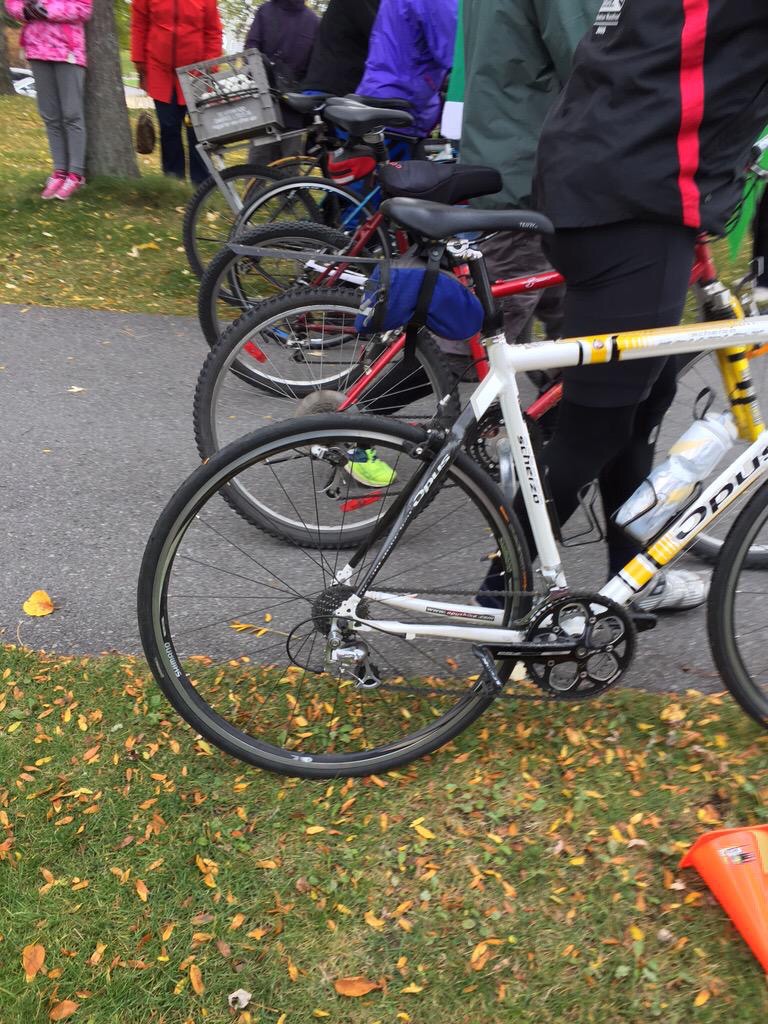
The highlight for me during the clerics cycling challenge (clericchallenge.com) was the finish line, when we all crossed together. This experience symbolized for me what the culture of Christian community ought to feel like and be like.

   
 We are part of a holy procession led by the King of Glory whose destination is sure. We have nothing to lose. If God’s grace is extended even to the generation of seekers (v.6), then we have nothing to lose. If what we are about is not a competition, then we have nothing to lose. If we don’t need to find fault in the other to prove our own self-worth, then we have nothing to lose. If it’s not about one-up-man-ship, then we can go for broke and not worry about it. If we don’t need to question who our Saviour is — who already accomplished for us our salvation — we don’t need to doubt our final destination. Then, why not share now what we have with others on this road?

All the saints on earth, despite the scars of life we bear, have gifts to share with other seekers on that journey. What gifts and blessings of God reflect in your life? In discerning this, remember: It’s not up to you alone! We don’t need to be perfect. We gain the gates not by our own merit or even hard work. Ours is the victory only because of the One for whose reason the gates are lifted in the first place.

Thanks be to God!
(1) — Michael Morgan in David L. Bartlett & Barbara Brown Taylor, eds. of “Feasting on the Word Year B, Volume 4” Fortress Press, 2009, p.228

Community of the broken and blessed

This Sunday I will use the words of David Lose, in his fine reflection on the Gospel assigned for this 19th Sunday after Pentecost in the Revised Common Lectionary (Mark 10:2-16).

He suggests that Jesus’ difficult words here are not so much addressed to individuals as they are to a community that is broken and blessed. These words are not about divorce per se but about the law and under what circumstances it was applied.

Finally, these Gospel words are not so much about matters of the law, but about relationships of mutual dependence and health. He welcomes children, thereby painting a vivid picture of this kindgom community. This is a community comprising of relationships whose purpose is to be honest about our vulnerability, and whose mission is to protect the vulnerable.

Please visit his blog for the full text: In the Meantime

Wise speech is a prayer

My parents, now retired pastors, have been ordained many years in the Evangelical Lutheran Church in Canada and the Polish Lutheran Church. My mother told me that not once in her long years of work did she choose to preach on the second lesson for this Sunday in Ordinary Time — the 18th Sunday after Pentecost — James 5:13-20. 

So, curious, I went back in my online archive of sermons to see if had. And to my surprise, I discovered that I now have preached two sermons in a row based on this text. The last time in the lectionary these texts appeared was three years ago in September 2012; and here we are three years later focusing on it again!

Why so? I asked myself. Many possible reasons likely. Not to mention the lectionary group here at Faith chose to reflect on James — yet again! Could it be, underlying this desire to look at James is the church’s need today for some practical advice about how to live the Christian life? Could it be, that the church today needs basic guidance about how to live as a Christian would in today’s world?

When we think of all that we say, all the airtime we populate with our words, how much of it would we consider ‘wise’? It is important to ask this, since one of the major concerns in the Book of James is our speech (Mark Douglas, Feasting on the Word Year B Vol 4, eds. Barbara Brown Taylor & David L Bartlett, WJK Press, 2009, p.112). And, it’s not so much what we say but how we say it — in the context of the relationships involved. This, indeed, requires great wisdom. So, I ask again, how much of what we say would we consider wise?

My guess is, not much. When we think of all that we say that is hypocrisy — that doesn’t really coincide with the choices we make, the lifestyles we lead. When we think of all that we say that only ends up hurting others …

When wise speech happens, it is truly a holy event. This is speech that communicates truth and honesty. This is speech that reveals vulnerability, expresses compassion, tenderness and authenticity. This is speech that is wise. And wise speech is then a prayer in God, with God, to God.

And, it is not only spoken to the ceiling. Because prayer is fundamentally a public act, not a private affair. One of the unfortunate victims of the Reformation period  — which launched the Enlightenment and Industrial and Scientific Revolutions of the modern era — was that Confession was relegated to a lower place in the value systems of religion. As a result of these modernizing developments which heightened the importance of the individual in religion, prayer was reduced and confined to words spoken to the air in our private lives.

In contrast, Confession is about speaking honestly the truth of our lives to another and with another. Confession is wise speech which brings healing and wholeness, when another ‘in the flesh’ can hear the truth and respond with guidance and in love, mercy and forgiveness.

And what we do every time we gather to worship, is pray. We pray in all the parts of the liturgy. Whether we are celebrating the sacrament of the table, whether we are listening to the sermon, whether we are singing a hymn or ‘saying’ a prayer — we are praying! Including the Confession of sins, and the pronouncement of forgiveness.

It is true — the church needs basic guidance about how to live as a Christian would in today’s world. I emphasize in today’s world because sometimes I don’t think we realize how decidedly unChristian this culture of ours is. And I don’t just mean the fact that we live in a multicultural, ethnically and religiously diverse society. But also, even in the institutional church, in our own lives, our lifestyles, our common sense assumptions about how to live our lives and the values we espouse: our attitudes towards competition, financial security, self-defence, self-righteousness, financial-material selfish gain, etc.

Perhaps it is time for the Reformation church (including Lutherans) to let go of the split we have created between grace and ‘works righteousness’. It is not all ‘cheap’ grace on the one hand; nor is it all work, on the other. In truth, it is a lot of work and practice to remain fully open to underserved and unmerited grace (Philippians 2:12-13). Because we will rush, if unawares, to make it all about our hard work. Just work harder!

At the same time, as Cynthia Bourgeault writes (in The Wisdom Way of Knowing: Reclaiming an Ancient Tradition to Awaken the Heart, Jossey Bass Publishing, 2003, p.10), “those willing to bear the wounds of intimacy, the knowledge of that underlying coherence – in which all things hold together – is possible.” To let go of the compulsions that keep us captive and stuck in patterns of life that are ungracious, untrue, unhealthy. To commit to the work and sacrifice of being true to self, true to neighbour and true to God. To practice confession and honesty with another. To accept the forgiveness, mercy and love of God and to receive it fully and know peace.

Could it be deep down we know it but are afraid to address and embrace it: the values of God in Christ Jesus are meaningful — they make for great, wordy and pious statements in church groups — yet clash with what we do and what we actually say to one another?

The Furious 7 movie which was Paul Walker’s last before he died shortly after filming the movie, ironically, in a car crash, highlighted for me this hypocrisy. In the extended version which I assume was edited after his death, there is a beautiful scene on the beach where Paul Walker’s character and family are gathered. His friends watch on as he plays with his young child and pregnant wife at the water’s edge. One of them remarks how what is truly important in life is not the thrill-seeking, high-octane, ego-satisfying selfish pursuits, but his relational world of love and family which endures forever. In contrast to the explosive, sensational content of the film up to that point, this affirmation of family living in love is rich in meaning and truth.

I commented in my slightly cynical mood after the movie that I didn’t think the Fast & the Furious franchise would have grossed the hundreds of millions it did if it made movies solely about family and love. It seems we want to acknowledge what is true and right, but only after we first can serve our own fixations and compulsions ‘for the thrill’.

Another TV example: Did you notice how the Amazing Race Canada presented the final words of the father and daughter from Africa — newly arrived immigrants, when they were eliminated before the final round? They were the victims of unfair play in that second-to-last leg of the race; other teams cheated on them by stealing their taxi not once but twice, if I remember correctly. 

And then, as the host John invited them for some closing remarks on the elimination mat, all of them spoke beautiful tear-wrenching words about the fair, generous nature of Canadians. It seems only the losers have something meaningful to say. Only when we suffer loss do we discover the truth of our lives. Now, we are getting uncomfortably closer to the whole point of our Christian faith and what it means to follow Jesus.

As I wrote three years ago, in James’ concluding chapter we encounter vivid images of prayer involving the laying on of hands and the anointing with oil. Prayer is a public act that invades the space of individuals and pulls us to be in the space of one another. Prayer is inherently relational. It gets down and dirty in the bodily reality of our lives, one with another. It is about touch and sensation as much as about the mere words we speak. Prayer is not my time, it is our time for the sake of the other.

Maybe I chose to preach on James 5 two times in a row because the Gospel associated with this text is about Jesus instructing us to cut out our eyes or chop off our hands if they caused us to sin (Mark 9:38-50). And I just didn’t want to go there! These are difficult words to ponder. Jesus concludes by using the image of salt to define the Christian life: something with an edge, that adds flavour. God forbid you lose your edge, your flavour! Jesus counsels us to have saltiness in our lives as a way to “be at peace with one another” (v.50).

Perhaps the way of Jesus will be tough and difficult building bridges of reconciliation. And yet, his last word to us today is a blessing of peace. The Book of James began with an address to those who are “dispersed” (1:1). James continues his letter to address the divisive consequences of an “unbridled tongue” (3:6ff) and considers the reasons for the “conflicts and disputes” among the people of God (3:4). James’ letter acknowledges the inherent splintering of our lives.

His letter in chapter 5, however, ends rather abruptly. Perhaps to indicate that there is no easy answer to the disconnections of our lives. Perhaps also to remind us that though wise speech is indeed a gift from God in the world so full of sin and death, we will still pray. And through prayer that is public, we will continue to engage the world in hope for a time when what has splintered can be reunited.

The outing begins within us

“If a kingdom is divided against itself, that kingdom cannot stand … No one can enter a strong man’s house and plunder his property without first tying up the strong man; then indeed the house can be plundered … Whoever does the will of God is [my family]” – Mark 3:24,27,35 

I wonder, in an action-oriented culture, whether we have considered the curious notion of where the kingdom of God – the reign of God – resides. In the the Gospel of Luke (17:21), Jesus says that “The kingdom of God is within you.” The great reformer, Martin Luther, preferred this rendering to the sometimes translated, “among” you. In his famous German translation he writes: “Das Reich Gottes ist inwendig in euch.”

Our house-dividedness and our divisions are not only externally out there in the big, bad world; they embody an internal reality, among and within us, that we often fail to acknowledge.

I think it was Canadian mystery writer, Louise Penny, in one of her recent novels described the internal conflict between two wolves: On the one hand, there is the wolf that lives on fear, anxiety and negativity; the other wolf warring for supremacy inside of us lives on joy, optimism and hope. The main characters in the newly-released home video entitled “Tomorrowland” starring George Clooney use this image of two parts of ourselves in conflict: the wolf of fear versus the wolf of hope. Which one wins? Which one will be victorious?

The answer: The one you feed.

We don’t often recognize the darkness within each one of us. We are all divided – in our nation, in our city, our communities, our churches and in our own lives. Whether we are ‘saved’ or not. Whether we are believers or not. Whether we belong to the right church, or not. Whether we have the right interpretation and doctrine, or not. Whether we speak the right language, or not.

It is curious how Jesus rebuffs the religious leaders’ serious accusation that Jesus had the devil inside him. In denouncing their claim by a logical argument – how can the devil purge the devil? – he acknowledges Satan’s existence and influence. Jesus doesn’t deny the power of evil.

We are all divided. The power of sin extends into the ways we have organized our lives, our prejudices, our racism, our bigotry, our ‘common sense’ ways of looking at the world and people, our economy. We are divided. Our identity is fractured. We will say one thing about God’s love, and behave the opposite way when it comes down to it.

It can be very easy to detect which wolf we end up feeding, most of the time.

Thankfully, there is this levelling affect that Jesus has in his words from the Gospel today. This is not an exclusive venture we are on, as followers of Jesus. In verse 28 a more accurate translation of the word “people” evokes a universal meaning, such as “all children of humanity” – everyone will be forgiven their sins! This is good news! This is the hope. Because, even though we live in imperfect, flawed and divided communities – there is still the good, therein.

But how can the two wolves get along inside of us? How can the warring internal battles, in the end, be resolved?

“Das Reich Gottes ist inwendig in EUCH”. That last word, “you”, is not singular. In German, it is the plural form. Of course, in the original Greek, Jesus addressed his disciples. But in English we don’t have this distinction in the second-person between individual or plural; so we easily and naturally assume, I think, the individual. But this is a mistake.

In this Gospel text, the one verse that I think get’s us distracted more than any other is the ‘one sin against the Holy Spirit that is unforgivable’ (v.29). And immediately we, individually, start getting upset and fearful and very nervous: What if I have sinned against the Holy Spirit? Will I go to hell? People on their death beds will often become anxious about their faith, whether they, individually, have done enough to ‘earn’ salvation on their own, by themselves. This fear goes deep.

But the weight of glory and the burden of sin is carried by the whole, mystical body of Christ. I don’t have to be privately perfect in order to go to heaven, because the perfection is in the whole body of Christ. We are merely members of it: some of you are a foot, some of you are an eye, some of you are an ear – today, I am the mouth! “I” am not the whole body; you (singular) are not the whole body.

You, individually, don’t have to take the burden of universal sin upon yourself, in which you are complicit, I agree. And so am I. But neither can you, individually, take on the weight of glory upon yourself. If you are good – and obviously you are by coming to church today and sticking with us the whole hour long – your goodness is not your own: It’s your Mom in you; it’s your Dad in you; it’s your grandfather and your grandmother in you; it’s your neighbour in you; it’s your pastor that pastored you years ago in you; it’s your friends in you. They are your goodness.

This rampant individualism that is the unfortunate consequence of the Reformation has probably undone Christianity more than anything else, to keep us – ‘tie us up’ – from understanding the communal aspect of God’s kingdom and the church. This is the level from which Jesus, Paul and Martin Luther for that matter proclaimed it. (Richard Rohr, Center for Action and Contemplation, The Rohr Institute, Disc 4, New Mexico, 2012).

So, despite the tug of war inside of inside of us, obey the good. Whatever is strong and good in us together, let that lead. Whatever good nudges us at the core of our being – forgiveness, compassion, grace, good intention – let’s not ‘tie that strength up within us.’ Let’s not hesitate. Let’s not rationalize it to death. Let’s not succumb to the temptation of paralysis-by-analysis. Let it out. Let that goodness lead us. Because each of us has this shared, good strength within – even people against whom we hold prejudice and discriminate.

Decorated Canadian Olympian and mental health advocate, Clara Hughes, said at the Closing Ceremonies of the Truth and Reconciliation Commission in Ottawa this past week that “The only way you can be good and strong and fast is if you want it for everyone.”

Jesus said, “Only those who do the will of God is my brother and sister and mother” (v.35). We say the words every week in our prayers – praying for peace among waring religious groups in far away places. We pray for peace in Syria and Iraq where ISIL continues its reign of terror against religious minorities. We pray for reconciliation between Aboriginal and Settler peoples – that is, immigrants like us.

Why don’t we also consider living that prayer out, in our own backyard? Why don’t we also consider actually doing something in the name of Jesus to the purpose of peace and reconciliation between different religious and ethnic groups in our own city? To be a faithful witness of what peace can look like, to the world?

To feed the wolf of hope.

Finding Love

When the Beatles sang, “All you need is love” back in the 1960s, this soft sentiment echoed the enthusiastic embrace by some people who wanted everyone simply to get along and overlook their differences. It was also during this turbulent time in history when others expressed a rejection of this dreamy emotion. The hard-liners suggested that we can’t solve the problems of the world without first acknowledging the base motives and evil intent of others expressing competing differences; the solution: a forceful, uncompromising response.

Depending on our personality and life experience, each one of us likely leans in one way or another. But neither vision of ‘love’ is what Jesus expresses in the Gospel for today (John 15:9-17), a text laden with talk of love.
Love, it goes without saying, is one of those words that is not easily defined. At least the biblical Greek distinguishes a few nuanced understandings of love ranging from a desiring love (eros) to a friendship love (philia) to a self-giving, outward-focused love for all people (agape). Consistently, in this Gospel text, it is the agape love that is prevalent. But Jesus weaves agape with friendship. And so Biblical scholars are correct to insist that these biblical definitions of love are not mutually-exclusive when they are used (David Cunningham, “Feasting on the Word” Year B Volume 2, WJK Press Kentucky 2008, p.498); there is overlap in meaning. So, we are back at the beginning, confronted with a powerful word which can mean so many things.
How do we understand what Jesus was getting at? How can we grasp, and better yet, experience, for our own lives the love of which Jesus demonstrates with his words and life?
Maybe we do need to look at more than just the word. We need to look at the setting, or context, in which those words are spoken. Because the words that we hear in one time and place can have an entirely different impact on us if we hear them in another time and place:
For example, ‘I hope you are well’ may seem like nothing more than a polite greeting in a casual conversation over the phone. But the phrase has a much more focused meaning if it is spoken by a friend visiting you in the hospital. They are the exact same words, but they carry a different resonance, a different intensity and inflection.
So, meaning shifts with the setting. That is an important principle to remember in the Gospel of John, for its words are always sounding in at least two different historical contexts: First, there is the immediate story line, the unfolding narrative of Jesus Christ and his ministry as recorded on the pages of the Bible. And second, there is the community that gave birth to – that wrote down the words of – the Gospel of John and the circumstances in which that community lived some three generations after Jesus’ earthly ministry.
Consider how the exact same words of Jesus would sound in these two different contexts. If, in the face of Jesus’ impending death we read, ‘No one has greater love than this, to lay down one’s life for one’s friends’ (15:13), then the verse leaps out to us as an interpretation of the sacrificial action Christ is about to suffer on the Cross.
But what happens if we read it in the context of the community of John at the end of the first century – when these words were first written down? During this time the community of Christians faced growing oppression from the Roman Empire and was experiencing serious conflict with the Jewish synagogue (9:22; 12:42; 16:2). The words seem no longer to refer only to Christ and his death, but to the sacrifice of members of the community.
I don’t believe we have to choose between one reading and the other. Instead, by identifying both readings we understand how the life of faith keeps expanding and deepening the meaning of Jesus’ words. It is a process that has kept the church vital generation after generation. And it continues in our own lives today. The Word is a living word whose meanings grow clearer as we hold the complexities of life in its light. (For this meaning-finding in context, I used Thomas Troeger’s wonderful formulation in “Feasting on the Word” ibid, p.497-501)
Love is not only a mushy, self-gratifying emotion that finds energy and drive in our dreamy states and compulsions. Love is also not merely a ‘tough’ love that is forceful, cleansing and ‘real’. Love is not only self-sacrifice. But neither is it self-denial and self-hatred. The meaning of love for each of us is more likely born in our own lives where we have to struggle and suffer through some external or internal conflict.
Another phrase from Jesus in this Gospel plants notions of love and joy firmly in the context of suffering. He says, “I have said these things to you so that my joy may be in you, and that your joy may be complete” (v.11). How can Christ speak of joy when he is about to be arrested and tortured to death? But also imagine how these words would have sounded to a community of believers at the end of the first century who themselves were grappling with rejection and persecution. Finally, what about us, the heirs of Jesus Christ and his disciples: How do these words redefine the meaning of joy as we move through strenuous times?
In the reality TV-show, “The Amazing Race” whose 26th season finale is soon approaching, a dozen teams are racing around the world. Couples challenge each other through each leg of the race, ultimately seeking the $1 million prize at the end. 
One couple in this season – Blair and Hayley — is particularly fascinating to watch. Because they have such friction. She is a nurse, and he is a doctor. You would think they have a lot in common and therefore could get along. But they are at each other’s throats all the time. Hayley nags and complains and is downright nasty to Blair. And Blair isn’t a pushover but for the most part is patient, non-anxious and keeps it together. You would also think, because they can’t communicate very well and have such acrimony between them, they would have long ago self-imploded and have been eliminated.
But, contrary to my expectations, they have found a way to make it work. They are still in the final four teams racing for the million. And, what is more, they won a recent leg of the race!
When Phil, the host of “Amazing Race”, greeted them on the ‘mat’ he shook his head in disbelief and inquired as to how they are finding success. Both of them admitted the challenges they face and how each of them drives the other crazy. But both of them said they respect each other and this tension is somehow motivating them forward. Phil responded: “You sound like true BFFs!” – Best Friends Forever.
To be honest, I have a hard time calling this ‘love’. But there is an aspect of ‘love’ here we often forget: A community needs to learn how to love one another despite the fact we will drive ourselves crazy from time to time. The early Christians, facing oppression and persecution from outside, needed to learn how to strengthen their bonds in-house, so to speak. But that doesn’t mean they couldn’t disagree. That doesn’t mean, they needed to force each other to repress their differences. That doesn’t mean they all had to be like-minded and ‘the same’. That doesn’t mean it has to be roses and champagne all the time.
Similarly for us. We can express our differences, fight (fairly!), respect each other. And still love one another. Especially when we focus on the reason we are together, the prize, the goal, what in truth unites us in Christ, we will find traction on our journey. There can be a beautiful loving that can happen in a diverse, sometimes chaotic, existence called the church. We won’t be all holding hands and singing ‘Kumbaya’ around the campfire all the time. Sometimes, our love will mean we have to make some tough choices, confront our differences and work through conflict. That’s love, too.
How do we find God’s love? Well, it’s a little bit of both/and. And sorry to say for those who want to have control – there is a little bit of letting go necessary. And, conversely, for those who tend to be passive, there is some work involved!
Photographer Ansel Adams would wait days and hours for the perfect circumstances and ideal light to take his iconic photos. He said, “Chance favours the prepared mind.” There is a method to the faithful walk. And it must go far beyond merely enforcing the will and doing it as if it all depended on our own sheer determination and timelines to make it happen. We have to remember, God is free and is not dependent on our actions. The reason Jesus says he no longer calls us slaves but friends (15:15) is this: A master was bound by convention and law to care for his slaves; but a friend’s love is freely given, and mutual. A friend will love and receive love, freely and without condition.
Could we learn to wait for and fully expect God’s grace and love to come freely as God will – in the flow of “living water”, “blowing wind”, “descending flames”, and “alighting doves” – all biblical descriptions of how God comes to us in love and truth? (see Richard Rohr, “Breathing Underwater”, Franciscan Media, Ohio 2011, chapter 6)
So, the waiting and the preparing the mind for God finding us in love, the softening of the heart, the deepening of expectation and desire, the ‘readiness’ to really let go of control, and the recognition that “I really do not want to let go” – these are all characteristics of the mature Christian. Because the actual willingness to change is the work of weeks, months, and years of “fear and trembling” (as Paul expresses in Philippians 2:12). 

Love is a process. Love is revealed in the transforming, changing person. It is found in the grit on the road of life with others. It is revealed in the commitment to stay the course, however difficult that course may be.

Grace and love will always favour the prepared mind, the heart willing to risk it all and nurturing the anticipation that there is a hopeful outcome. And, if you ask me, I believe the reason that Blair and Hayley in “The Amazing Race” are finding success? It’s because at least one of the partners at any given moment is showing a whole lot of undeserved grace and forgiveness to the other. No matter how that team finishes in the end, they will, I am sure, remember the love that in different ways each of them experienced in the other over the course of the race. Perhaps a little bit, at least, like true, best-friends-forever.

Who’s counting?

I think it was Albert Einstein who said that we can’t solve a problem by using the same kind of thinking that caused the problem in the first place. In other words, we can’t move forward with solutions into the new thing God is doing using a frame of mind that also contributed to creating the fix we find ourselves in today.

The Gospel story today (Matthew 25:14-30) is a good example of a parable that challenges a materialistic way of thinking, a mentality that has contributed to a problem we face today. It also introduces — if we pay attention to it — the Gospel way of thinking. And I believe, the Gospel way of thinking not only judges the ways of old, it paves the way for entering God’s future.

A man and his wife were having some problems at home and were giving each other the silent treatment. Suddenly, the man realized that the next day, he would need his wife to wake him at 5:00 AM for an early morning business flight.

Not wanting to be the first to break the silence (and LOSE), he wrote on a piece of paper, “Please wake me at 5:00 AM.” He left it where he knew she would find it.

The next morning, the man woke up, only to discover it was 9:00 AM and he had missed his flight. Furious, he was about to go and see why his wife hadn’t wakened him, when he noticed a piece of paper by the bed.

The paper said, “It is 5:00 AM. Wake up.”

On several levels this story exposes the kind of way we operate when facing difficulties: It’s a tit-for-tat world we live in. There have to be winners and losers. It’s really the only game we know well. When someone, or some group, or some other religion or denomination poses a threat, we respond in kind. Because someone must win and someone must lose. During the Cold War Era, we called it ‘mutually-assured-destruction’; or, as the acronym accurately suggests, when we give ourselves into this compulsive way of behaving, we are indeed MAD.

On the surface this parable looks like it contains a good stewardship message. And, admittedly, there is this theme of valuing personal industry and action as part of what it means to follow Jesus. By comparing what the three servants do — one turns five talents into ten and the other turns two into four by bold, risky investment; but the third doesn’t do anything with his talent — we may be left merely with the notion that the solution is by just upping the ante of all our spiritual work. Just do more. Work harder, and spin those wheels faster.

All of this to get more of what we think we want; that is, more of the same thing we’ve always known. I like to joke that when someone in the church suggests we do something today the same way the church did it 50 years ago — whether it is about a strategy for getting more people in the pews, some outreach program all intended to bring people in — it’s like advising someone who has car trouble they should really trade it in for horse and buggy. It just won’t work today! The church today really needs to do something altogether different from the ways of thinking fifty years ago.

I wonder what would have happened if the first two slaves had put the money in a high-risk venture and lost it all. Jesus didn’t tell the story this way, but I cannot imagine the master would have been harsh towards them; he might even have applauded their efforts. The point here is not really about doubling your money and accumulating wealth. (John M. Buchanan, “Feasting on the Word” Year A Volume 4, WJKP 2011, p.310). The point is not about achieving a desired result, and being congratulated for your success, materially. This is not management by objective. This is not ‘the ends justify the means.’

This is about living — living in a way that demonstrates a willingness to take risks not knowing how it will all turn out. The Gospel way is not win-lose, it is both-and. Because in being faithful, we may try things, and sometimes fail in the world’s eyes. But emphasizing risk-management may sometimes impede our action to do the right thing when we have to do it, despite the sordid circumstances of life. We can’t wait until everything is hunky-dory before we take action; otherwise we never will. The reason the third slave received judgement was because he wanted to play it safe, be cautious and prudent; he wanted to make sure he wouldn’t lose anything; low risk, no risk.

Dietrich Bonhoeffer said that the sin of respectable people is running from responsibility. Bonhoeffer, who was a pacifist, took his own responsibility seriously, so much so that he joined the Resistance and helped plan an assassination attempt on Hitler’s life. His sense of responsibility cost him his life. (ibid., p.311-312)

We, as Christians, are not called to be ‘counters and measurers’. God knows, if we do anything well in times of institutional crisis and constriction, we count and we measure — we do this very well. But in all our counting and measuring and bottom line conversations, are we not being judged? We just need to look around and count the heads in our churches today, for that answer.

When we arranged for this pulpit swap, the purpose around doing so was to provide an opportunity to share about how we reach out. In the congregation I serve, in the last couple of years, we have done “Back to Church Sunday”. Practically, this event boils down to each member of the worshipping community being challenged to ask a friend, “Would you like to come to church with me?” And it’s not as easy as it may seem on the surface.

Success in the program is not based on how many first-time visitors walk through the door on B2CS. Success is not measured by the number of people who agree to come. No-one may show up on that Sunday. But the event could still be considered a success IF … If at least one member — one of you — actually asked someone, actually invited someone, to come. Because the result is not something we have control over. How a person responds is not in our control — it is the job of the Holy Spirit to move in the heart of the person.

Yes, we have some work to do in the process — developing a friendship with that person, praying for that person — these are things we can do to prepare ourselves for asking that question to them. And had we done all those things, culminating in actually asking that question — then we are successful.

This calls, admittedly, for a radical shift in our mentality and in our approach. It necessitates, I believe, some uncomfortable letting go of the way we have seen ourselves. But in the unravelling, discomfort and vulnerable places we put ourselves in living the Gospel way, we can be encouraged.

For one thing, in reading this Gospel text, have you ever noticed how trusting the master is with his resources. God, like the master, has faith in us. God gives according to our abilities — not more, not less. God puts no condition on what we do with this bounty. Even the one talent was worth — in those days — 15 years of wages. Converted to today’s average salaries, that would be around a million dollar value! But who’s counting?

The point is, God entrusts us with an abundance of wealth, gifts and resources. God is so generous to us. Do you see the good in your life? I hope you do, because this ‘seeing’ calls us to respond in kind. God believes in us, and will ever be faithful by God’s gift of abundant grace. Just maybe, then, we can trust God when we live boldly using those gifts in the world for good, and as we step out into the unknown, as we move out of our comfort zones to do great things that God can accomplish in us.

No partiality

At the beginning of every congregational council meeting, members take turns sharing a personal experience of God — whether in their day, or in the past, or in childhood.

Last week a young adult member told us about participating in the ice bucket challenge that went viral on Youtube in the summer. At first he wondered whether this was not just another gimmick he should ignore.

But then he inquired why people were doing this — to raise funds and awareness about ALS, or Lou Gehrig’s Disease. He watched another video of how this challenge began and learned what this meant personally to its promoters.

Citing the Golden Rule (Matthew 7:12; 22: 39) and the Good Samaritan story (Luke 10:25-37) from the Bible, the council member concluded his devotions with the Gospel message: that Jesus shows no partiality. God’s love extends to Jews and Samaritans — even though in first century Palestine they were in conflict.

As a result, followers of Jesus are also called to love our neighbour as ourselves. Just because only 3,000 in Canada have Lou Gehrig’s Disease (a small number compared to the entire population) doesn’t mean we can ignore those who have this degenerative muscular, and fatal, disease. Minorities — however we define them — deserve our caring attention, especially if they are suffering in any way.

In another confrontation with the religious leaders of the day, Jesus confounds them by his response (Matthew 22:15-22). What we sometimes overlook in this tense exchange is the heated political context of the time:

The Emperor was putting more pressure on the local leadership in Palestine to firm its grip in the occupied territories. Rome was exercising greater power over the population by imposing currency imprinted with the Emperor’s face, and rescinding the privilege of the Sanhedrin to execute sentences of death. The pressure on Herod and Pilate in the region was mounting; their lives were at risk should there erupt any uprising or public defiance against Rome (read Shusaku Endo translated from the Japanese by Richard Shuchert, “A Life of Jesus” Paulist Press, Toronto, 1973, p.52-53)

At this point in the narrative, many remembered the recent beheading of John the Baptist (Matthew 14:1-12). Those who opposed Rome recalled his charisma and powerful leadership. And now that he was gone, they looked to Jesus to carry the mantle of spearheading precisely such an uprising. All the various religious groups had stake in the politics of opposing Roman occupation of their lands — the Essenes, the Zealots, the Sanhedrin, the Pharisees and Sadducees. Would Jesus be the one to rally the troops? Many were thinking it. And that is why they ask Jesus another trick question, significantly focusing on the new coinage.

It is also significant, I think, that there is truth in the Pharisees’ opening question: They say the truth about Jesus, even though they are plotting against Jesus who is aware of their ‘malice’. “We know,” they say, “that you show deference to no one; for you do not regard people with partiality.”

They knew, despite their devious motives to trap Jesus, what Jesus was all about. The truth of the Gospel of Jesus is surprisingly expressed by sinful people. They, of all people, get it! Jesus stands with all people — even the minorities, those who live under oppression in occupied lands, even to those who we would rather ignore, or not see, or even hate.

Aboriginal people in Canada make up only 4% of the entire population. And we know their plight. As indigenous people on this land we call Canada, they are particularly disadvantaged in the dominant culture and economy. Things have started to get better for some of them. But certain systemic problems exist and persist — like endemic poverty, education inequality for children, lack of safety for women, and lack of access to safe drinking water.

Do we as followers of Jesus, like the religious leaders in Jesus day, know what Jesus is all about? That’s a good start. But it’s the follow-through that’s just as, if not more, important. What will we do to be more than just a Jesus-fan-club? What will we do when we encounter opportunities to live out the Gospel of Jesus?

Are you an honest sinner?

A Christian leader (Laurence Freeman) commented on the 25th anniversary edition of “Rolling Stones” magazine. It contained interviews with pop music icons over that time period, starting with John Lenin all the way to Madonna.

He was wondering why young people especially were drawn to these, their idols. Of course, many pop stars are not exemplary people. They are not saints.

But they are, what he calls, ‘honest sinners’. Which reminds me of what Martin Luther said about us: That we are at the same time: Saints AND Sinners.

In the church, I think we get the ‘Saint’ part. But how do we validate the ‘Sinner’ part of ourselves?

In the Gospel text for Ordinary Time on this last Sunday in September 2014, we continue to work through the parables given by Jesus, in the latter part of the Gospel of Matthew.

In the assigned pericope, the authority of Jesus is questioned by the Pharisees (Matthew 21:23-32). In response, Jesus tells a story of a Father who asks both his sons to work in his vineyard. The first son says he wont do it, but does. The second son says he will do it but doesn’t.

What do we make of the first son who does his Father’s bidding? He does not want to obey. And he is honest about it.

The verb in the original Greek in this text (v.29) for “changed”, as in, “he changed his mind” (or as many English translations have it — “he repented”), is not the common one usually associated with the idea of a total transformation of character (as is implied in, for example, Matthew 3:2 “Repent, for the kingdom of God is at hand”).

In fact, the only other place in the Gospel of Matthew where the exact same form appears is in Matthew 27:3, when Judas experiences a regretful change of purpose that ends in despair, remorse and his demise (see Ellicott’s Commentary for English Readers).

Perhaps a better translation would have it as “a caring change of heart”; or, “a change of heart burdened with care.”

This form suggests that a heart nurtured in the love of God leads to action that not only obeys the call of God, but does it willingly. Even though the first son’s mind and his words at first are contrary to the will of the Father, his follow-through redeems him in the end. An imperfect confession it is, to be sure. But, ultimately, words are not enough.

Although in the case of both sons words do not match the deeds, “the repentance of the former is preferable to the hypocrisy of the latter;” Kathryn Blanchard says it best: “True righteousness is in the doing, rather than in the confessing” (in “Feasting on the Word” Year A Volume 4, WJK 2011, p.118).

I see a possible link here with the alternate first testament text assigned for this Sunday, from Exodus 17:1-7 (We also encounter this text on the Third Sunday in Lent, Year A). The Israelites are on the journey to the promised land, and yet again (for the fourth time in the sequence of these texts from Exodus) they complain to Moses about their lack of food; and in this, case, water.

They are thirsty. They are without a basic need for human survival. We are not talking here about typical ‘first-world problems’ — complaining about the weather, or unable to sync online calendars among family members with different smart phones, or dealing with a dilemma of how to invest money in competing markets, or having to cancel a credit card that was stolen, etc. These are things we complain about, and may even pray about.

But the Israelites’ complaints to Moses are about a basic, human need that they lack. I cannot blame them for being upset! They will die without water. They are being ‘honest sinners’, aren’t they?

Scientists, medical professionals, and child care workers will agree today that love is such a basic human need. If a person, especially at a young age, lacks love in their life, this absence of love will even stunt their physical development. They will be underdeveloped, physically, because of love being absent. The giving and receiving of love is a fundamental, human need.

Jesus tells the Pharisees that the prostitutes and tax collectors will enter heaven before they will. Maybe because these ‘lowest rung’ folk in the religious hierarchy of the day certainly don’t present themselves in a religiously acceptable way. There is no pretence, performance, pious evasion. There is no making appearances, no self-denial nor self-repression. There is no saying-the-right-things, no artifice, no self-consciousness to their being and behaving. They are truly ‘honest sinners’.

Both of Moses and of Jesus, the people demanded ‘signs’ of God’s presence. The Exodus text ends with those ominous and faithless words: “Is God with us, or not?” Even after the visible and tangible sign of water was given to quench their thirst, the Israelites still doubted. Even though Jesus performed miracles; even though the resurrected, bodily form of Jesus appeared to the disciples in Galilee following Easter morning, they did not ‘believe’ (Matthew 28:17).

The ‘signs’ are not the point of the Gospel — God’s love IS. Acts of love demonstrate our Christianity more than dogmas and creeds.

And when we participate in loving, caring action …

We are truly free. Free to be ourselves. And free to do the right thing. Perhaps whatever good things honest sinners do, they do it then from the heart. Their giving of love, however unnoticeable and seemingly irrelevant acts of love, is authentic and real — something the Pharisees so stuck in their heads and dogmas could not grasp.

You might notice that the Father — who in this parable may represent the attitude of God — does not condemn the first son for saying the wrong thing. The Father does not ‘correct’ the son’s imperfect words. The Father accepts him just as he is. And in the freedom of God’s love, the son then experiences a change of heart.

God accepts you as you are. God has faith in you. Because of God’s steadfast love and unwavering faithfulness in you, what will you do?