Advent 4 – children’s sermon

We’re almost there! Less than a week until Christmas! Are you excited?

I brought in this candle to show you, because it is special. At Christmas in worship we light lots of candles to show that Jesus is the light of the world. And comes to shine God’s light in our dark world.

Can someone light the candle? What does it smell like?

That’s right! A tree! Actually, a balsam fir, it says on the jar.

For some people, they wait until Christmas Eve to cut down a tree and bring it into their home. Then they put real candles on it, light it the first time late Christmas Eve and sing “Silent Night, Holy Night” while standing around the tree.

Smelling this candle reminds us of all sorts of things …. Memories of last Christmas …. Smelling this candle reminds us of so much more than we can see right now. This candle’s smell is bigger than the odour itself; it reminds us of something much larger than the candle itself.

Every thing we do in worship — light candles, say prayers, eat the holy meal, sing and listen together — reminds us and points to something bigger, something larger than ourselves.

Smelling this candle reminds me that very soon a real Christmas tree will be soon giving that wonderful scent of balsam needles in this very space. We can look forward to that! And being joyful about Jesus being born at Christmas! And coming again!

Bethlehem: house of bread

There’s only one problem with the nativity set. Do you notice? All the characters are in place and accounted-for. 

But no stable. No barn. No shelter for the Christ-child, Mary, Joseph, the shepherds and Magi. Not to mention all the animals.

I think in the nativity set around the altar we accounted for this obvious ‘missing piece’ by placing all the matching pieces right beside a figure of a church building. There’s something that feels right about doing that, despite the historical disconnect between modern church building and the first century birth we celebrate this holy season of Christmas.

Because Jesus needs a house. Significant, isn’t it, that Bethlehem in Hebrew means, “house of bread”? Bethlehem, the town of David (Luke 2:4), was foretold by the prophets of old: “But you, Bethlehem, too small to be among the clans of Judah, From you shall come forth for me one who is to be ruler in Israel; Whose origin is from of old, from ancient times” –Micah 5:1. Bethlehem was the ‘house’ into which Jesus was born. And Jesus, then became the house wherein all who sought God would find comfort and rest.

Is this not what we celebrate at Christmas? Our homes, places of comfort, places where we find our roots, our grounding, places where we meet and live with those beloved to us. These nativity scenes adorning the altar normally form part of our Christmas decorations in our homes. They, in a sense, bring Jesus — the house of all people — into our houses, our homes. Into our lives.

At Christmas we sing for Jesus to come into our lives. But do we think of what it would mean for us to make room for the Christ? And welcoming the stranger?

In a verse from the hymn, “Christ Be our Light” we sing —

Longing for shelter, many are homeless. Longing for warmth, many are cold. Make us your building, sheltering others, walls made of living stone. 

Christ, be our light! Shine in our hearts. Shine through the darkness. Christ, be our light! Shine in your church gathered today. (1)

Many times in the Gospels, Jesus describes the “kingdom of God”. One of my favourite images is from Mark (4:32), where Jesus compares God’s reign to a small seed that ” … becomes the greatest of all shrubs, and puts forth large branches, so that the birds of the air can make nests in its shade.”
This image gives an all-encompassing, expansive vision of what God intends: a home for all creatures great and small.

Of course, the problem is, that so many people don’t have this shelter, this safety, this home. And it’s not just a spiritual reality. It’s also a material, earth-bound reality.

After all, Jesus himself, was a refugee. After his birth, Jesus’ parents Joseph and Mary had to flee the threat of persecution in their home country. In Matthew (2:13) we read: “… an angel of the Lord appeared to Joseph in a dream and said, ‘Get up, take the child and his mother, and flee to Egypt, and remain there until I tell you; for Herod is about to search for the child, to destroy him.” Jesus, Christians believe, is the Son of God. And this God we worship experienced, on earth, what it means to be a refugee and to be homeless.

Jesus, the comforting house and home for all — like the giant tree housing all the creatures of the earth — knew what it was to be without home, without shelter.

Elsewhere in Matthew (8:20) as Jesus exercises his ministry of compassion, healing and grace to the downtrodden, he reminds those who listen: “Foxes have holes and birds of air have nests, but the Son of Man has nowhere to lay his head.”

We are called, therefore, to care precisely for those who are homeless, who are refugees today as if we are loving God. Sri Lanken theologian D.T. Niles stated: “Christianity is one beggar telling another beggar where to find bread.” (2).

Where do we find this ‘bread’ today? Because we will not travel to Bethlehem to find Jesus, like the Shepherds and the Magi did over two thousand y ears ago. Today we may ask God as the righteous did of old: “Lord, when was it that we saw you hungry and gave you food, or thirsty and gave you something to drink? And when was it that we saw you a stranger and welcomed you, or naked and gave you clothing? And when was it that we saw you sick or in prison and visited you?” And Jesus answers, “Truly I tell you, just as you did it to least of these … you did it to me.” (Matthew 25:37-40)

And, in so doing, we reveal the truth that the author of the last book of the Bible expressed: “See, the home of God is among mortals!”(Revelation 21:3). God’s home in Christ Jesus is here on earth, among those who need the “bread of life” (John 6:35). 

Our job this Christmas as all year round is to feed the hungry and house the homeless. Because Jesus has come into this world. He is out there. And he calls to us. Waiting for us to respond. To be and make home for us all.

(1) “Christ Be Our Light” Evangelical Lutheran Worship, Augsburg Fortress, 2006 #715

(2) Joseph R. Jeter in David L. Bartlett, Barbara Brown Taylor & Kimberley Bracken Long, eds., “Feasting on the Word: Advent Companion” WJK Press, Kentucky, 2014, p.65

You shall see the light

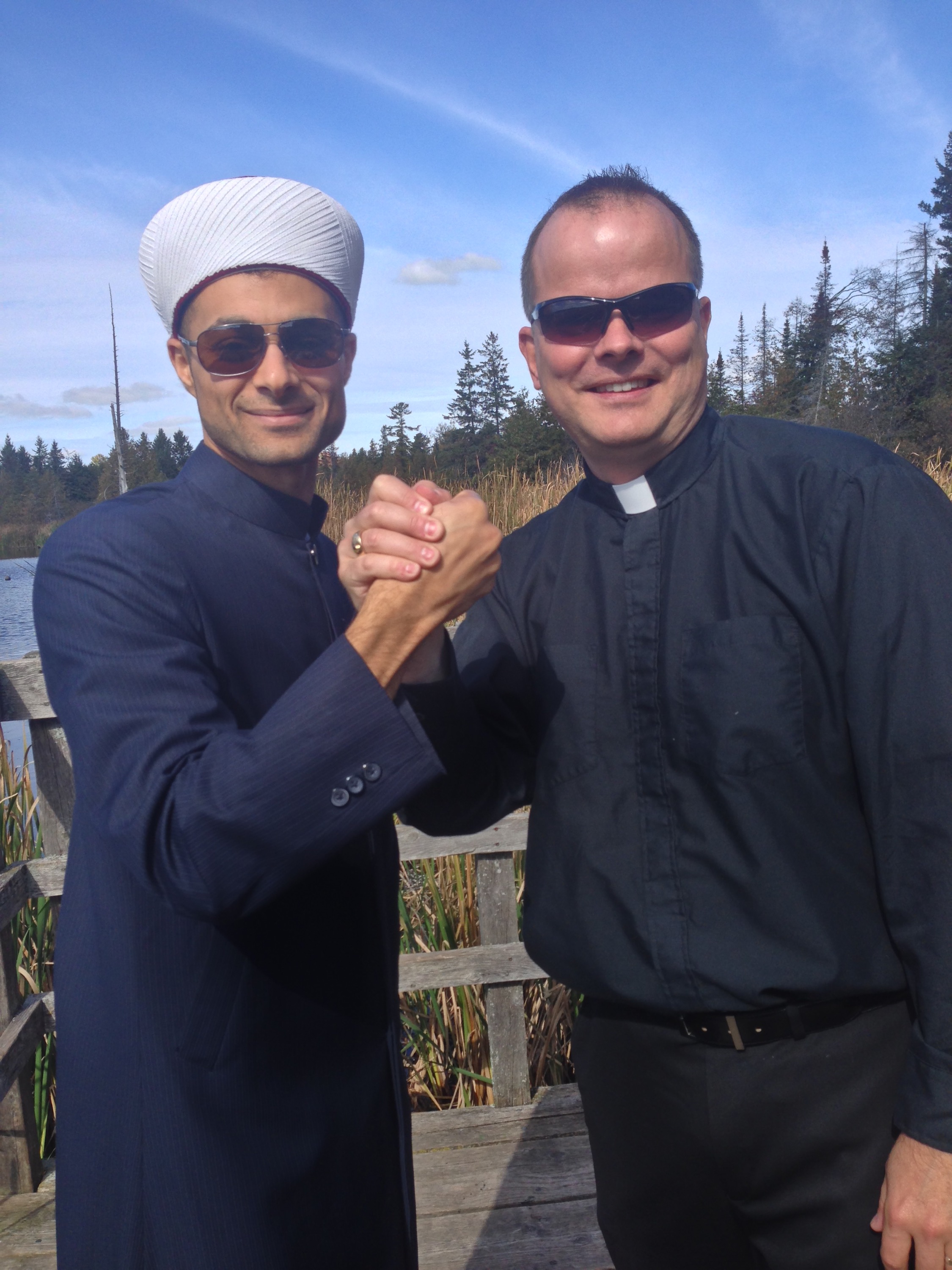
Jesus commanded that we shall love our neighbour as ourselves (Matthew 22:36-40). This commandment motivates me to participate this afternoon in the clerics’ cycling challenge (www.clericchallenge.com), initiated by Imam Mohamad Jebara.

  
Practically, then, what Jesus’ commandment means is that if you love someone, you want to know something about her or him. You want to know who she is, what he values, and how they orient their life. If you love someone, you take the time to talk to him, get to know her, and in so doing, you share yourself as well. 

  
Love shows itself in attention to another, in accepting another on their own terms — yes, and in a willingness to learn something new, to think about things in a new way, and to grow together in friendship and harmony. 

  
When I say Christians are called to love their Jewish or Muslim neighbours, for example, I mean we are called to develop relationships of mutual affection, understanding, and appreciation (Kristin Johnston Largen, “Interreligious Learning and Teaching” Fortress Press, 2014, p.59). Then, we love our neighbour as ourselves, thus fulfilling Jesus’ commandment.

  
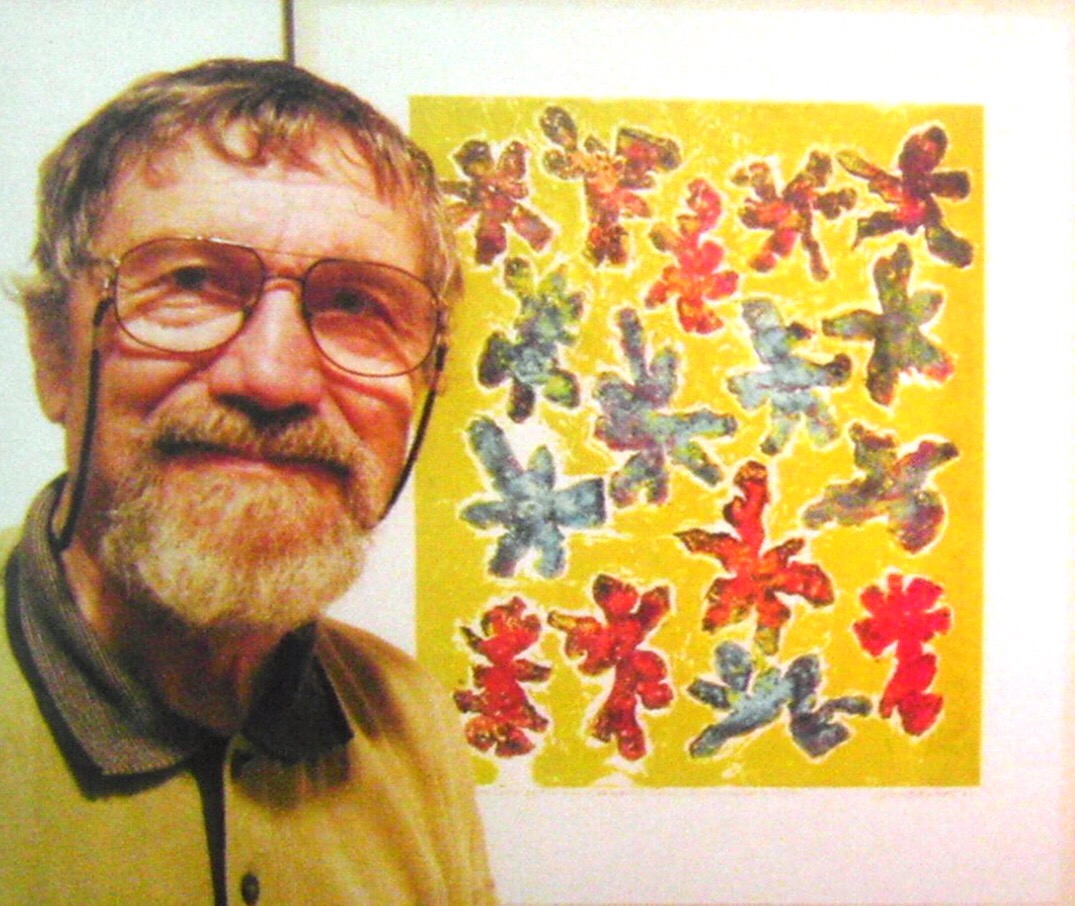
I had the pleasure of viewing some artwork this past week at the Rothwell Gallery on Montreal Road in Ottawa. The Gallery is presenting until October 24th the work of the late Leonard Gerbrandt (1942-2010) who travelled the world and created beautiful impressionistic watercolours and prints especially about the structures of various land and waterscapes. I was given a personal tour by Ute, his spouse, of the hundred pieces or so displayed in the gallery.

  
When we began the tour, she asked me to guess what colour appears and is prevalent in the vast majority of his art. With a twinkle in her eye, she confessed that this particular colour also happened to be his favourite. And so I went to work. At first, I suggested it was the earth tone greens, even maybe the rust, terracotta and orange/reds. No. No. And no.

As we reflected on one specific piece of art I marvelled how Leonard mixed the blues to distinguish sky and sea. Ute smiled, then said, it was blue indeed. I quickly travelled through the gallery looking anew at the paintings. And you know what? It was true! Now, I could see it — blue indeed found its way into almost all his paintings. Why didn’t I see that at first?

Blue, after all, is my favourite colour too (No political association, though!). And then I pondered further why I couldn’t see what had always been my favourite colour. Had I been distracted by the flashiness of other ‘colours’? Did I take ‘my colour’ for granted? What were ‘the blocks’ inside of me preventing me from seeing what was most important to me? Pride? Anger? Fear? Shame? Greed? Why couldn’t I appreciate fully the beauty that was staring me in the face, for me?

Of course, colours would not exist without the presence of light. In fact, it is how the light is represented in a work of art that brings out the textures and hues created by the paint brush. I also believe that art, like music, serves to reflect back to us an inner state — and that is why art and music can be so powerful conveyors of meaning and truth about ourselves and the world at any given moment in time.

The living Jesus is with us, and in our hearts through the Holy Spirit. The love of God propels the Spirit to move us in the the way of Jesus. And yet, we block our sight. We can’t see the light. What are those blocks that keep us from living out of our nature that is being renewed day by day? What keeps us from loving our neighbour? Is it fear of the unknown? Is it a shame that is deeply imbedded? Is it the fire of anger, the pain of regret, the poison of hatred, the paralysis of mistrust?

“Out of his anguish he shall see light” (Isaiah 53:11)

This phrase comes from a larger so-called suffering servant poem from the prophet Isaiah. Christians have read Jesus Christ into the role of the servant even though the text was originally heard among the people of Israel hundreds of years before Christ. The ‘servant’ could refer to the people as a whole suffering in Babylonian exile, or to a specific individual (i.e. Persian King Cyrus /Isaiah 45) who liberated the Israelites and led them home to Jerusalem.

This exegesis is important and we need to tread carefully in working with sacred texts that we share with our Jewish neighbours. We Christians know the sacrifice of Jesus on the Cross for our liberation, indeed for the whole world. Jesus fits the suffering servant-narrative from Isaiah. Let’s work with this.

The anguish Jesus experiences in his suffering and death reflects a God who is fundamentally relational. And God the Father, the Son and the Holy Spirit relates to us in our very own humanity. Thanks to Jesus who showed us the way not just in his divinity but especially in his very own humanity. ‘Anguish’ after all, is a human emotion grounded in love. That is, “to anguish over the loss of a loved one” (online dictionary definition).

Not only does Jesus know our suffering in a shared humanity, he feels for us because of God’s intense love for us. The author of Hebrews is therefore able to describe Jesus as the ultimate high priest, who “is able to deal gently with the ignorant and wayward, since he himself is subject to [this] weakness” (5:2). In short, Jesus helps us “see the light” because of God’s deep anguish-filled love for us. God grieves losing us to our sin, and will not stop short in going the distance — even sacrificing his own life — so that we too will see things as they truly are, in the brilliance of God.

In prayer, 14th century Christian mystic Julian of Norwich reflected the divine stance: “I am light and grace which is all blessed love.” May our words and deeds reflect the light of Christ to our neighbours, in all grace and love.


Changing your mind on faith

This past week I was finishing up on my monthly calls to shut-ins and those who are not easily able to attend worship services here. And it was in a couple of conversations where I felt particularly moved. Of course, I am not mentioning any names or specific circumstances.
“Sometimes I wonder if I have enough faith,” said one.
“When is it that you feel that you might not have enough faith?” I asked, prompting further: “What kinds of things are happening when you think you might not have enough faith?””Whenever things are not going well for me. When I’m suffering, or in pain. When it hurts. When I’m afraid that the worst will happen.”
Speaking Lutheran to Lutheran, I mentioned that the 16th century reformer was an anxious person. Martin Luther was terrified, for example, of dying. “I think that’s probably very normal,” I said. “Even people we consider giants of the faith, were afraid and scared especially when they thought they were going to die.”
Our conversation continued until we concluded that to have faith was not apart from all that scares us or causes us suffering and pain. Faith happens inspite of the difficulties of life. The challenging circumstances of life don’t define and determine our faith or lack thereof; Our faith or lack thereof is expressed amidst the realities of living.
“Faith is real only when we face and embrace the suffering of our lives.”
And it is here that we encounter what Jesus is getting at in the Gospel text today: We are not harmed by what comes from outside of us — including difficult circumstances — but by what is going on inside of us: what we think and say (Mark 7, James 1).
I like the more positive way the Deuteronomist expresses the same lesson — this to the Israelites entering the Promised Land: “Take care and watch yourselves closely, so as neither to forget the things that your eyes have seen [that is, the great acts of God to free the people from slavery in Egypt and sustain them through the desert wanderings] … nor to let them slip from your mind all the days of your life…” (Deuteronomy 4:9). Don’t forget! Don’t forget who and whose you are! Because what we do comes straight from what and how we think.
If we are honest, this life can take a toe-hold on our imagination — with values, goals, material aspirations and selfish projects that affect our way of thinking. I would add, cultural values that lead us to conclude that only if everything is perfect in my life — no pain, no tears, no suffering and lots and lots of money — then and only then can I have faith, believe in God and be active in my faith.
The Gospel message of Jesus Christ enduring throughout human history is all about a renewing of the mind — embracing a whole new way of thinking. Paul expresses this in one of his letters to the early church: “Be renewed in the way you think …” he counselled the Ephesians (2:23). Because often the way we think — our attitudes and opinions — are downright unhelpful and evil. “All these evil things come from within,” Jesus warns (Mark 7:23).
Sometimes we hold on to our opinions as if they were sacrosanct even though they may be unhelpful. But have we ever really examined our opinions? We often look down upon others (and ourselves), and dare I say politicians, who ‘change their mind’ about something or other. Waffling, we believe, or changing our mind about controversial subjects especially, is bad and suggests a weak personality. And yet God, even, changed his mind about bringing disaster upon the people when Moses and other prophets engaged God in passionate debate (eg. Exodus 32:14). If God is able to change directions, could we not too?
To change our way of thinking to be less self-centred and more other-centred.To change our way of thinking to find meaning more in serving others than serving self.To change our way of thinking about doing something good not out of fear or shame but more out of a heart filled with compassion.
“Once upon a time a king was strolling through the forest and he saw an old man, a poor man, bent over a furrow. He walked up to him and saw that he was planting seeds for chestnut trees. He asked the old man why he was doing it and the old man replied, ‘I love the taste of chestnuts.’
“The king responded, ‘Old man, stop punishing your back bent over a hole in the ground. Do you really not know that by the time even one of these trees has grown tall enough to bear nuts, you may not be around to gather them?’
“And the old man answered, “Your Majesty, if my ancestors had thought the way you do, I would never have tasted chestnuts.'” (Juan Gomez-Jurado, God’s Spy, Orion Books, Great Britain, 2007, p.164-165)
I had another inspiring conversation this week with someone who is caring for a loved one suffering with illness. She decided to invite some friends struggling with similar challenges over for a meal. These friends, especially, were down and depressed about their mutually-shared, tough circumstances.
And yet, over the tasty meal and dancing to music and laughter, something shifted in the climate of the meeting. The next day, the host received an email from one of the friends who visited: “Thank you for your generosity and love. I was so encouraged by the visit, that when I returned home, I changed into my gardening clothes, went outside to the front yard and trimmed the bush that had gotten way out of hand.” It was like the fearful, anxious, angst-ridden Martin Luther who said that if he knew the end of the world was going to happen tomorrow, he would still go out and plant an apple tree today. Now, that’s faith.
Here’s my confession today: Often I wonder whether it’s even possible. Whether we can change our minds towards God and God’s ways in Jesus Christ, no matter what circumstance of life in which we find ourselves. Sometimes I doubt that our minds can be renewed into the likeness of Jesus when we are sick, when we feel destitute and deprived, when things don’t go our way. When times are tough, we often knee-jerk into old, often destructive patterns of thinking. Will we, indeed, have enough faith, to see things differently and not despair?
It is here when, despite how I feel, I affirm a faith that says: No matter what you think, Martin, no matter what anyone else thinks, God will not forget you. Even if I have a lapse of memory and forget who I am and whose I am, even though our minds may go completely, this is the promise of the One who created us: “I will not forget you; I have inscribed you on the palms on my hands” (Isaiah 49:15-16). Because of who God is, I can therefore act boldly on a way of thinking that is based in trust. Trust this loving God who will not let go of us. Ever. And no matter what.
Thanks be to God!

‘One little word’

“Long ago your ancestors — Terah and his sons Abraham and Nahor — lived beyond the Euphrates and served other gods …. Now … choose this day whom you will serve, whether the gods your ancestors served in the region beyond the River or the gods of the Amorites in whose land you are living; but as for me and my household, we will serve the Lord.” (Joshua 24:2,15)

“Finally, be strong in the Lord and in the strength of his power. Put on the whole armour of God, so that you may be able to stand against the wiles of the devil. For our struggle is not against enemies of blood and flesh, but against the rulers, against the authorities, against the cosmic powers of this present darkness, against the spiritual forces of evil in the heavenly places … ” (Ephesians 6:10-12)

My mother told me the story of a dramatic stand made by Christians against Hitler on Easter Sunday 1942 in Norway: The Nazis had insisted that every Lutheran congregation praise God for Hitler’s rule over the Norwegians. The Lutheran Church considered this blasphemy, and refused. Every Norwegian Church closed that Easter Sunday morning. And instead they agreed to worship in the afternoon.

Later that day in one of the villages the people assembled in the market place. And because they were scared, they began singing what Lutherans have sung for over 400 years when they were afraid: “A Mighty Fortress is our God, a bulwark never failing …”

And they slowly began to walk to the steps of the village church — only to find the doors locked and guarded by a company of SS soldiers with submachine guns trained at them. When the Christians arrived at the front steps, having finished the first verse of Martin Luther’s famous hymn, an SS officer grabbed a woman holding a baby in her arms and said: “One more verse and she gets it first”, pointing the weapon at her head.

In the tense silence, the people, not knowing what to do, looked down at their feet.

And then, a single, soft, quivering voice began … 

“Though hordes of devils fill the land, all threatening to devour us, we tremble not, unmoved we stand, they cannot overpower us. Let this world’s tyrant rage … his might is doomed to fail. God’s judgement must prevail. One little word subdues him.”

It was the voice of the woman holding the baby. “One little word subdues him.” The soldiers were the ones in a moment of indecision who looked down at their boots. And then quietly they shuffled out of sight to let the worshippers enter the church.

One little word subdues him. Not a loud trumpet call. Not an explosion of spectacular proportions. Not an air strike obliterating the enemy. Not a bravado that denies human frailty and vulnerability. Not eloquent oration. Not a motivational speech rallying the crowd into a frenzy. One little word subdues him.

The themes of ‘standing up against evil’ and ‘taking a stand’ pervade the scriptures assigned for this Sunday. We must choose our god. We must stand up. Especially in the context of a multi-faith community. But how do we do this when all we want to do is stare down at our feet, immobilized with fear?

Because we are surrounded by diverse peoples. And that isn’t going to change. At least we can relate to the Ephesians. The Christians in Ephesus were probably taken to worship the emperor at the newly constructed temple of Domitian; Ephesus in the first century was also a thriving commercial city and the cultic centre of goddess Artemis. (Haruko Nawata  Ward, Feasting on the Word Year B Vol 3 Fortress Press, 2009, p.376). Christians were challenged to be confident in their faith amidst challenging times. Change some of the names, and it feels a bit like Canada in the 21st century!

And as simple as we sometimes may want to reduce the question of evil, the scriptures present a more subtle and systemic view of evil. In other words, evil is not just a little red man with a pitch fork sitting on your shoulder tempting you to do something bad. Evil is also, and more significantly, about forces beyond the immediately ‘individual’, into the realms of politics, world history, economics. 

More than against “flesh and blood” evil is also about certain patterns of thinking. Our attitudes and underlying beliefs and assumptions about people of other faiths and values.

Standing up against evil and taking a stand is just is as much to do with changing the way we think about ‘them’. Standing up against evil is about repudiating ways of thinking and unspoken assumptions that have only served to hurt and damage other people. Sometimes the way we think — the common sense assumptions of our culture — are downright evil and wrong. Let me give you an example:

This past summer at the national convention of the Evangelical Lutheran Church in Canada (ELCIC), the church voted to repudiate the “doctrine of discovery”. This doctrine is different from our normal understanding of a statement of faith. But it was a belief that resulted in untold damage to the aboriginal populations of North America. It was the reason aboriginal children were taken from their homes, families and communities to suffer — many of them — in the so-called Indian Residential Schools in the last century.

The doctrine of discovery was the underpinning belief that resulted in the first explorers labelling Aboriginal people as “beasts of the field and forest”, and prompted governments to justify “killing the Indian in the child.” The doctrine of discovery made the residential schools places where native children were not permitted to speak their own language, practice their own religion, nor attend with their own siblings or have any contact with their parents while they were at school. How evil is that!?

So what is this doctrine of discovery that the ELCIC repudiated? Basically, it was a system of belief based in the discovery of North America, as if nothing of inherent value existed here before ‘we’ arrived. When the explorers landed on the shores of Iceland and then Turtle Island (i.e. North America), the land appeared to be unoccupied in the ways of western Europe. The explorers therefore believed it was theirs to acquire and own. When the explorers encountered native bands, there was this immediate disconnected with their values and culture and relationship with the land, understandably. Still, the settlers felt superior in their relationship to the native culture, believing — “What we have is better for you.” And moving from that doctrine into practices and policies of assimilation and subjugation like the residential schools.

I can anticipate your objection: But what to make of the Great Commission in Matthew 28:19 — when Jesus instructs his disciples to “Go therefore and make disciples of all nations”? Isn’t this what we have been supposed to do? – make others, force others to be like us? Aren’t we supposed to impose our values on the world, using any means at our disposal? Another English translation of the word, disciples, changes the tone significantly. When we read, “Go therefore and make learners of all nations”, we can see our task as learning. Disciples are essentially ‘learners’. Learning involves challenging current patterns of thinking, and going out into the world to share our faith. (Kristin Johnston Largen, Interreligious Learning &  Teaching, Fortress Press, Minneapolis 2014, p.109)

When I visited Jerusalem years ago, I was surrounded by at least three different world religions day in and day out. Muslim minarets blared out regular calls to prayer; orthodox Jews bowed at the wailing wall. And I, with a small group of Christians found a little apartment in the old city to gather around bible, cup and bread, to pray  and sing together. Few other times in my life have I ever felt as confident and grateful for my Christian faith than in a context  where other faiths and cultures came and tried to live together, even clashed.

Sharing our faith is not about one-up-man-ship. Sharing our faith is not a competition. It is simply being confident to talk to others when appropriate about what is most important to you. And, giving the other the freedom to do likewise. I think we still need to work on that in the church because I think we still believe it’s about a competition. That we have to fight, even, if necessary, to defend God — or our ideas of God. Be the winner, not the loser, in a winner-takes-all kind of world. It was in Jerusalem when I first realized that if there was any evil in the world, it started in me and my selfish, materialistic, self-acquiring vision for life.

Paul’s armour-of-God metaphor, like all metaphors, has limits and can even be problematic. Such a text has been interpreted throughout two thousand years of church and world history often as justification for violence against others. It is challenging maybe even impossible for us today to engage this text without the lens of history and the development of society and human culture through the ages — particularly with respect to warfare.

And that is why, as Lutherans especially are taught to do, I would not want to interpret this text without placing it beside another text from Paul’s letters, in this case, to ‘let scripture interpret scripture’. Listen now to another clothing analogy, where Paul speaks of what we ‘put on’ in Christ:

“As God’s chosen ones, holy and beloved, clothe yourselves with compassion, kindness, humility, meekness, and patience. Bear with one another and, if anyone has a complaint against another, forgive each other; just as the Lord has forgiven you, so you also must forgive. Above all, clothe yourselves with love, which binds everything together in perfect harmony. And let the peace of Christ rule in your hearts to which indeed you were called in one body. And be thankful …. And whatever you do, in word and deed, do everything in the name of the Lord Jesus, giving thanks to God the Father through him.” (Colossians 3:12-15,17)

Indeed, in this light, the belt of truth is the Gospel. The helmut of salvation is God’s eternal promise of love for us. The breast-plate of righteousness is a heart of compassion. The boots are actions that bring peace and goodwill to the world. The shield of faith is trusting in God’s grace. The sword of the Spirit is proclaiming the word of forgiveness, mercy and love.

One little word subdues him. An act of humility, not military aggression nor forceful imposition.

One little word subdues him. A word of forgiveness rather than condemnation, racism and judgement.

One little word subdues him. Something unexpected, surprising and even looked down upon by the world’s winners — that changes history. One little word — not born of competition, comparison and control, but born of surrender, release and trust. One little word, “I love you”, changes everything.

One little word is Jesus. God becomes human. A baby. A prophet. A teacher. A lamb taken to slaughter. One little word is greater than anything the world lives by. One little word whispered in a storm. One little word sung softly into the barrel of a machine gun. One little word nudging gently our hearts, saying to you: I love you. I forgive you. You are free. You will forever more be a child of God.

Now, tell the nations of the world the same. And act like you believe it. Because it’s true. Thanks be to God.

Marriage: valuing difference

I am an identical twin. Whenever people see my brother and me together, usually the first reaction is to express how similar we look and act. People, it seems, naturally start with what appears to unite us and make us ‘the same’.

When two people celebrate a marriage, again what seems to be the focus is on what they must share in common, what makes them ‘one’. In various marriage traditions the unity of the couple is, obviously, presumed. In Christianity we read the scriptures about ‘two becoming one’; leave in order to cleave (Matthew 19:5; Ephesians 5:31).

We may therefore read into such a coming together a complete blending of the individuals, almost as if the two people in marriage must dissolve their separateness into one kind of amorphous blob. Somehow, it feels like individuality needs to be ‘erased’, we feel, in a proper marriage.

As a twin, I am continually intrigued by what challenges not only my twin relationship but other kinds of relationships as well: It is more difficult to consider our differences, what is dissimilar, between people as something to celebrate and lift up.

I am impressed by your differences that stand in sharp relief this weekend as you exchange wedding vows. Because, the very foundation of the way you are getting married is based on your differences. Not on something you share as the same.

Each of you come into the marriage union with a different and distinct set of religious beliefs. One is baptized Christian and the other is Hindu. In order to celebrate the marriage, you participated in a Hindu ceremony on Saturday, and then a Christian worship service on Sunday.

Using this experience as an important marker on your journey of life, I want to encourage you to continue celebrating the differences between you. Stand on your own two feet, albeit side by side. A healthy marriage will reflect two, distinct points of view. Don’t deny the individual journeys and identities of each person that brought you together in the first place, lest not those identities be diminished, ignored, suppressed or repressed in the course of your marriage. A healthy marriage will reflect an activity and character that results in two sets of feet moving in tension as in a dance, albeit in the same direction.

Kahlil Gibran, born in northern Lebanon, was an early twentieth century philosophical essayist, novelist, poet and artist whose 1923 book, “The Prophet”, is considered a classic in Arab literature. It is in this book that his poetry on marriage highlights the paradoxical nature of a true coming together, and a true unity of separate souls:

You were born together, and together you shall be forevermore.

You shall be together when the white wings of death scatter your days.

Ay, you shall be together even in the silent memory of God.

But let there be spaces in your togetherness,

And let the winds of the heavens dance between you.

Love one another, but make not a …[smothering] of love;

Let it rather be a moving sea between the shores of your souls.

Fill each other’s cup but drink not from one cup.

Give one another of your bread but eat not from the same loaf

Sing and dance together and be joyous, but let each one of you be alone,

Even as the strings of a lute are alone though they quiver with the same music.

Give your hearts, but not into each other’s keeping.

For only the hand of Life [God] can contain your hearts.

And stand together yet not too near together:

For the pillars of the temple stand apart, 

And the oak tree and the cypress grow not in each other’s shadow.[emphasis mine]

“Let their be spaces in our togetherness.”

What you are showing us is that we need not be afraid of what is different in the world today. We need not be afraid of what we don’t understand, just because it is a ‘mystery’. A mystery is not something we can’t understand; a mystery is infinitely understandable. Always unfolding. Always yielding and revealing new insights. Always inviting us to learn more, appreciate more, and love more. This is the true adventure and ongoing discovery of marriage and love.

You see, there is really only one reason, one motivation, one activity that gives charge, energy and purpose to your differentiated union. It is love. It is the passion and pure first love, born in the human heart, despite all the differences of our lives. Not denying them. Simply placing those differences in the perspective of love. The movement of love in your heart brings you into conversation and dialogue in the first place. And then, this love leads you both into deeper expressions of joy and intimacy.

Without needing to control the other, or force the other to change into our likeness. Love does not demand subservience. Love does not force another into submission. Love is not controlling of the other. Instead, love respects another who is different, seeks to understand the other. Love forgives the other and listens to them.

God is love. And that is why we are here today. As Lutheran pastor and teacher, Dr. Kristen Johnston Largen, writes, there is “inherent value in difference – even religious difference” (Interreligious Learning & Teaching, Fortress Press Minneapolis, 2014, p.79). Religious difference, in truth, is “part of God’s plan, rather than an obstacle to it.”

Love calls us out of our comfort zones, into the sometimes challenging and messy realities of being with another and participating in another’s field of life. On the one hand respecting one’s own integrity in doing so; at the same time, boldly entering another’s life. Marriage, in this way, is one of the best schools of love.

Raimon Panikkar, who was one of the most creative voices working in the area of interreligious dialogue encouraged people of different faiths to remember that “We belong together, even if our notions and codes are incompatible” (quoted in Largen, ibid., p.81). We belong together, in relationships of love. The scriptures you chose for your Christian wedding reflect this central tenet of Christianity (1 John 4:9-12, 1 Corinthians 13:4-13).

In the Christian faith, God is understood in a relationship. We call it, “The Holy Trinity” – three persons as one God. The truth of our lives is demonstrated most clearly in relation to one another. Because each of us has gifts and strengths to offer the other. In marriage, you individually have something the other needs, and the other can teach you a thing or two – I am sure! Each can learn from another, each from our own areas of strength.

For God bringing us together today.

For God bringing you both together in love.

Amidst the diversity, difference and distinctions of our common lives.
We give thanks. And praise be to God.

Amen.

Seeing Jesus

Jesus says, “the person who sees me and believes will be raised up” (John 6:40).

If I polled the assembly gathered here this morning and asked you to raise your hand if you ‘believed in Jesus (or God)’, my guess is I would get a decent showing.

But if I asked you to put up your hand if you recently saw Jesus, I’m not sure I’d get the same kind of response. If you did raise your hand to that question I might look at you with some degree of skepticism. I might not take your statement at face value. I would want to ask you more questions.

Seeing Jesus sounds like a conversation for the mystics and contemplatives. If our faith is limited merely to a conversation about the historical, biblical Jesus, we will be challenged at this point of acknowledging the living, immanent Jesus who is also always more — an unfolding Presence in the course of all history.

Where do we see Jesus? This is an important question. How can we see the living, resurrected Lord in the world and in our lives today? How can we account for the presence of Jesus?

There is the problem of sight. Here, Jesus obviously is not talking about physical vision. Otherwise why would he even say, “the person who sees me …”? Of course the people to whom he originally spoke these words standing on the sandy, rocky ground in first-century Palestine saw him. Jesus is talking more about a perception of the heart, mind and soul — an internal dynamic.

If you follow any of my social media sites online, you might have noticed there recently some sunset photos over Lake Huron where my family vacationed over the past couple of weeks. Aside from the inspiring sunsets, this is not what I remember the water to look like:


Normally, as I recall from my childhood summers spent on these shores, Lake Huron is fairly active. More days than not you would see a lot of wave action, and white caps carving up the horizon and rolling in over the surf. You would feel the constant high winds buffeting the tree-lined shore.

For the fourteen days we lived by the shore last month, however, the Lake was mostly calm. The water was placid, where there would be no more than a ripple on the surface and a splash on the shore line. In fact I would be hard pressed to say there was more than two days of wave action that came close to my childhood recollections. Needless to say, the quiet, peaceful waters made for much stress-free sea-kayaking and swimming along the coast.


At sunset most evenings we sat around the fire pit a stone’s throw from the shore, enjoying the very soft breezes and the relatively flat surface of the water.

And, if you watched the water, once in awhile you would see a large white fish breach the surface and flap it’s broad tail. The slapping sound often caught my attention if I wasn’t looking at the exact spot on the water.

This sudden sound, amidst the relative quiet of the expansive scene of resting water, air and land before us, also caught the attention of the other members of my family (I would add, they were preoccupied by their hand held devices, swatting the bugs, and chatting incessantly with one another!).

“What was that?” they looked up.

“Oh, a fish, jumping out of the water,” I responded.

“Cool! Where? Where? I wanna see!”

“Well, you need to be watching the water. Keep scanning the water up and down the shore line close to the edge.”

“I don’t see anything!”, one says, scratching another mosquito bite.

“You need to keep watching the water. There,” I point over the water toward the island, “there was another one!”

“Where?”

“Were you watching the water?”

“Uh, no.”

And on and on it went. I had a restful holiday. No, I did. Really!

The problem is not so much an incapacity to see. It is first to confess how distracted we are as a people in a culture that is impatient, anxious, that does not want to slow down, that keeps us from seeing what is already there. Perhaps Jesus is there for us to see. And we, like the Pharisees with whom Jesus often sparred, are “blind” to this truth. Jesus gives us precisely what we need to live, fully (Matthew 23; John 10:10). Do we not see it?

Before the cross became the central symbol of Christianity, the sign of the fish identified the early Christian movement. In fact, the cross was for centuries rejected by Christian who naturally recoiled at the thought of having an instrument of torture and capital punishment the central symbol of the faith.

The fish was a symbol for Jesus Christ. Food. Like bread, fish gave faithful people ongoing strength, sustenance and nourishment for life. No wonder the miracle of multiplication of bread and fish became a popular Gospel story about Jesus feeding the multitude on a hillside in Galilee (Matthew 14, Mark 6, Luke 9, John 6).

The new logo of the Eastern Synod reflects this original, early Christian identification with fish:


In the sixth chapter of the Gospel of John especially, Jesus compares himself to bread — bread that sustains us and feeds us everything we need. Everything. Not more. Not less. In the Old Testament, it was manna that God provided to the people in their desert wanderings.

The desert was the place where the people had to learn to give up control, which is mostly what ‘making plans’ is all about. “Like us, the Hebrews weren’t initially too excited about all this vague mystery. The people didn’t just complain that they were out of food, they also began to romanticize about the good old days back in Egypt where they ate their fill of bread …

“God responded to the people’s anxiety about food in a very tangible way. He provided the daily blessing of bread from heaven called manna. It was a fine, flaky substance which appeared every morning. And it came with some instructions (Exodus 16:1-8). Every family had to gather their own. You couldn’t store it up or hoard it, or the worms would eat it. So you had to gather it every day, except on the sixth day of the week when you could gather an extra portion for the Sabbath. It wasn’t much — just enough to keep you going on the journey.

“All of these descriptions [like bread and fish] are wonderful metaphors for how God cares for us along the way in the desert journey: daily, tangibly, personally, and sufficiently, although never enough to remove our anxiety about tomorrow. We have to trust there will be more manna when we need it [emphasis mine].

“This is what Jesus had in mind in teaching us to pray, ‘Give us this day our daily bread’. To pray those words is as if to say, ‘No matter how hard I try to secure my life with money, exercise, relationships, or work, I know that only you can give it to me. And you will do it one day at a time.

“The best reason for seeing the manna as a blessing [of Jesus’ presence, I might add] comes from its name. The literal translation of manna is ‘What is it?’ This means that every morning the people would go out and gather the ‘What is it?’ The mothers would prepare it as creatively as they could, which was tough because there was no ‘What is it?’ -helper. The family would sit at the table to eat. The kids would ask, ‘What is it?’ The mother would sigh and say, ‘Yes.’ They’d bow their heads and pray, ‘Thank you God for What is it?'” (Craig Barnes, Insights from the Desert, “Nurtured in Mystery” Shadyside Presbyterian Church, 2010)

What if we lived out of gratitude for what God has already given us? What if we made decisions — even small ones, each and every day — based on trust in Jesus being there for us, just beneath the surface of our lives? They’re for the watching. They’re for the catching and gathering. Grace and Gift, available to us. Before we even lift a finger to eat.

Christmas: Jesus all grown-up in us

In the Monastery of the Holy Spirit in Conyers, Georgia, Mary — the God-bearer — is depicted in a magnificent rose window above the altar. What strikes me is the size of Mary’s womb. Mary sits in this glorious stained-glass circle with outstretched arms and a womb so large it contains Jesus standing as a grown man, with his arms open wide. (Trisha Lyons Senterfitt, “Feasting on the Word; Advent Companion”, WJK Press, Kentucky, 2014, p. 90)

Why the adult form of Jesus? After all, isn’t the Christmas story of Mary giving birth to the Son of Man about a baby Jesus? Was the artist of this stained glass window confusing metaphors?

Or, is there something more going on here worthy of our reflection?

After all, the historical Jesus was a man. But Christ was not his last name. “The Christ” includes the whole sweep of creation, and history joined with him, including you and me. We are members, each and every one of us, of the Body of Christ — this ‘mystical union’ we call it in our liturgy; Lutherans have sometimes called it the ‘invisible union’ of the church. Though we cannot claim to be the historical Jesus, obviously, we are, as Martin Luther described it, “little Christs”. We rightly believe in Jesus Christ — and both names — ‘Jesus’ and ‘Christ’ — are important. We, like Mary, are Christ-bearers.

The celebration of Christmas is not merely a reverie about a baby born in Bethlehem. We do the Gospel of Jesus no favour when we make Jesus, the eternal Christ, into a perpetual baby, a baby able to ask little or no adult response from us. That may have been the role of Advent — the season of preparing the way of the Lord, when we consider how to make room for the birth of Jesus in our lives. A baby image can be helpful, to start with: A sign of grace that results in a sweet feeling of love.

But, eventually, we have to grow up. A mature Christianity, today, receives the risen Christ in his fullness. In relationship with Jesus the Christ, there come expectations. God wants to relate to us in our adulthood — expecting a full, free, responsible, participatory (Philippians 3:10), cooperative (Romans 8:28) and mature (Ephesians 4:13) adult response from us. When we pray, “Come, Christ Jesus”, we are asking for our own full birth and transformation. God, in our growth, wants ultimately to have an adult relationship with us.

When we read in the Gospel today that we have the power to become “children of God” (John 1:12) we are not relinquishing any responsibility and mature engagement with our faith; being a ‘child of God’, a wonderful expression, simply indicates that God is God and I am not; being a ‘child of God’ describes a quality of trust towards God, a trust that despite any delusion on my part that I can somehow earn God’s favour. Because God still has faith in me. God will never give up on me.

But Christ has come! And it is the risen Christ in 2014, not the historical baby, of two thousand years ago! (Richard Rohr, “Preparing for Christmas” Franciscan Media, Cincinnati, 2008, p.8-9)

In our lives we have the capability already born within us to have room for our transformation. We are all ‘pregnant’ with the possibility of new life, becoming more than we are, growing up into the fullness promised to us in Christ. For God is with us and in us.

So, what does that path to our transformation look like?

In a modern painting of the manger scene by German artist Beate Heinen, Mary and Joseph hover over their newborn baby boy Jesus. There are no angels in the painting, neither ox and donkey nor any of the people, who in our imagination usually gather around the crib – shepherds and kings; just the three of them: Mary, Joseph and the child lying in a manger, which looks conspicuously like a coffin. The scene is set in a cold cavern like stable from which a winding path leads to a distant hill with three crosses. (Thank you to Rev. Thomas Mertz for this illustration)

In all the glory and celebration of the Advent and Christmas season this image sticks out like a sore thumb. As we celebrate the renewed life and hope for our world in Christ, the reminder to suffering and death creates a stumbling block. And it always has.

“How then is it written about the Son of Man, that he is to go through many sufferings and be treated with contempt?”(Mark 9:12) The words though spoken by Jesus reflect a nagging question on the minds and in the hearts of the disciples: “How can it be that our salvation comes through the suffering of God?” A few years later Paul wrote to the Corinthians that the message about the cross is foolishness (1 Corinthians 1).

You will notice that halfway between the manger and the hill in Beate Heinen’s painting there are three wanderers – a reminiscence of Jesus meeting two of his disciples on their way to Emmaus; still struggling and pondering the same questions, facing the foolishness of the cross.

As all believers they travel the road between the Good News of Christmas, the pain of Good Friday and the Glory of Easter. And it is not until they gather around a table, worshipping and united in the breaking of bread, that in the presence of God all starts to fall into place and their questions come to rest (Luke 24:13-35).

“The word made flesh” is the proclamation of the festive celebration of the Nativity of our Lord. The word made flesh! Meaning, that the Word — Jesus Christ — comes into our very ordinary humanity. But not the glory of humanity in all its splendour and might.

Rather, as the Christmas story reveals, Christ comes into the darkest night of our souls — in the outcast, rejected places. Christ comes into the impoverished places of our lives, and of humanity. As at least one theologian has put it (i.e. Gustavo Gutierrez), the Word made flesh should read: The Word made poor. That’s where Jesus is born and is at work. As Saint Paul put it, “For you know the generous act of our Lord Jesus Christ, that though he was rich, yet for your sakes he became poor, so that by his poverty you might become rich” (2 Corinthians 8:9).

As bread is broken around the Holy Communion, Christ comes into the broken places in us and into the world where healing is needed. The circle in the Georgia Monastery stained glass reminds me of the trajectory of my life — the promise of completion, wholeness, fulfillment is there, in Christ Jesus. I am continually being re-made, transformed; I am growing, in Christ Jesus. And so are you.

The rest of the world wants to finish Christmas this morning. But the true Christmas message that begins today does not allow us to keep stuck in our baby Christianity. But invites us to grow up — no matter how young we are — in a maturing faith, deepening commitment, and active Christian witness to the newborn King!

May we grow into a fuller, deeper celebration of Christmas in the days to come, as we ponder the mystery of God’s incarnation, God entering our humanity.

Dream-state

“Who are you?” the scrutinizing Levites ask John the Baptist (John 1:19-28). “Who is this man?” Because if John the Baptist is indeed preparing the way for the Messiah, he must be — according to tradition — the prophet Elijah.

There seems to be confusion in the ranks about his identity. If he is who he claims to be, then either their beliefs need to be changed, or else John the Baptist is a liar. ‘Who he is’, is a question of great importance.

I admire John the Baptist’s self-confidence. He does not seem to care who they think he is, much less their confusion. Note his rather curt responses to their questions: “I am not the Messiah”, “I am not”, “No” — He is not inclined to make kind, polite conversation. Neither does he care to make things better for them by clarifying.

And when he does say anything positive about his identity — he uses esoteric images from the ancient scripts: He is “a voice crying out in the wilderness”, meant to “make straight the way of the Lord” (Isaiah 40). This is not a clear, rational response to their very pointed questions that demand a ‘straight’ answer. What is apparent and important to John the Baptist, is that he knows who he is.

Who are you? Who are we? A glaring symptom of our confusion today, our disconnection from who we are, and our supreme fear and lack of confidence in our own identity — as people of God, as individuals and members of the Body of Christ — is the heaping layers of distraction with which we surround ourselves. Especially at this time of year!

It’s like we are walking around in a dream-state. Our dreaming disconnects us from who we truly are, and what is really important. On the first Sunday in Advent, we heard Jesus’ instruction to “Keep awake!” (Mark 13:37). On this third Sunday in Advent we sing the hymn: “Awake! Awake, and Greet the new Morn” (EvLW 242). It seems a prevalent theme in our Advent liturgy is to “wake up!”

Listen to the way Richard Rohr describes our way of life:

“It’s safe to say that there is confusion about what is needed for life and what is really important for life …. We have created a pseudo-happiness, largely based in having instead of being. We are so overstimulated that the ordinary no longer delights in us. [In our culture] … middle-class people have more comforts and securities than did kings and queens in the times when royalty flourished. We have become human doings more than human beings. And the word ‘rest’ as Jesus uses it [‘Come to me … to find rest for your souls’ (Matthew 11:28)] is largely foreign to us.”

What the Gospel says, is that simplicity “is the only place that happiness is ever to be found … Such a message is about as traditional, old-fashioned and conservative a gospel as we can possible preach, and it will always be true” (Richard Rohr, “Preparing for Christmas; Daily Meditations for Advent”, Franciscan Media, Cincinnati Ohio, 2008, p.27-28).

How do we wake up from this false, dream-state of distraction and over-stimulation? How do we wake up to our true selves? And how can we embrace a more simpler life of ‘being’?

These are the real questions I believe we need to be asking during Advent, and as we approach the Christmas season.

It’s not easy. It might take some discipline. Because we may be “Like people who have lived by the train tracks for years, we no longer hear the sound of the train. After years in church, we get used to the noise of Advent, to the message of the coming Christ, so much so that we no longer notice it. Or if we do, it has ceased to jolt us awake and has become instead a low, dull rumble …

Like the house hunter who noticed the train tracks on moving day, but later sleeps through the whistles and the engines that rush by, we can miss the thing in the season of Advent that might have been the most obvious and important at one time …” — the presence and love of Jesus coming into our lives again. (Lillian Daniel, “Feasting on the Word; Advent Companion”, WJK Press, Kentucky, 2014, p.66).

And this is God’s dream, coming to us. As Christians, we carry the mantle of God’s dreamers. This is our heritage — the dreams of the prophets and those who spoke God’s restorative vision to a people in exile, a people depressed, discouraged, downcast. And, who were given a vision — a dream — of a straight path through the wilderness of their lives.

To this day and age. If God could inspire Jacob in the desert with a dream of a ladder reaching down from heaven (Genesis 28:10-17), God can dream in us. If God could give guidance to Joseph wondering what to do with Mary (Matthew 1:18-25), then God can dream in us.

Twenty-five centuries after the psalmist expressed the words: “We were like those who dream…” (Psalm 126:1), Martin Luther King said, “I have a dream”. And with those words ignited a vision in the 20th century for justice towards an uncertain future. A generation later, (the first African-American) President Barak Obama, tantalized a nation, and the world, with his eloquent words of hope. Today, Malala Yousafzai inspires us to support education for women, in a dark and conflict-ridden world.

God’s dreams of a just and peaceful kingdom are born in the visions of the people of God, and in the heart of each child of God. In the end, it is not ‘my’ dream, maybe not even ‘our’ dream alone; it starts with God’s dream — when the wolf shall live with the lamb (Isaiah 11:6;65:25), and swords will be beaten into ploughshares (Isaiah 2:4).

The problem with dreaming is not the dream itself, necessarily, but whose dream it is. The problem with walking in a dream-state at this time of year, distracted by all the ueber- stimulation of our culture, is when it is our dream — my dream, alone, when I got caught up in my stuff so much that I don’t see the other; when I don’t see the other as God would.

Who are we? We are who we are meant to be when we bear witness in our very lives to the vision and dream of God. We are who we are created to be, when we let the light of God’s love that burns in our hearts, radiate out to a world shrouded in cold darkness.

And then, paraphrasing the famous words of Elliot Wolfson, God’s dream “dreams the dreamer as much as the dreamer dreams the dream.”

May God’s dream, dream in us.

Forgiveness is absurd and excessive

Forgiveness is not what our world preaches nor practises. The problem in religious circles is that we may preach forgiveness but don’t often practise it.

When I listened to the speakers at the rally on Parliament Hill last week, I was impressed by the diversity of Christians represented in the crowd. There were placard-waving enthusiasts as well as mild-mannered conservatives. There were the politically right-wing as well as social justice progressives.

The diverse crowd of around one thousand responded with cheers, claps and arm-waving every time a speaker called on Canadians to stand up against the atrocities done in the name of religion against minorities in northern Iraq and Syria. Our sympathies were rallied for the cause of justice and human dignity for all.

Some speakers reminded us of the deplorable, evil acts of violence meted out by extremists, and the overwhelming social consequences: beheading, raping, exploitation of children, displacement of entire communities, refugee camps, even genocide.

Members of Parliament reviewed government actions in response to the crisis. Pastors, priests, bishops, Imams, and lay leaders called for the silent majority of Christians and Muslims to rise up against this evil.

And to all of this — loud cheering and fist pumping and whistling.

Then towards the end of the rally, a Syrian priest, I believe it was, stood up to give his speech. After commenting on the problem of evil as did many speakers before him, he said the most remarkable thing I heard all afternoon: “ISIS, we forgive you. We love you because God created you too, and loves you.”

I shook my head in stunned awareness. The crowd was silent. Not a popular things to say, I thought. True, yet hard to comprehend. So what does the theology of the Cross, the foundation of Christianity, say to this reality?

“Love your enemies,” Jesus commanded his disciples (Matthew 5:43-44). “For if you forgive others their trespasses, your Heavenly Father will also forgive you; but if you do not forgive others, neither will your Father forgive your trespasses” (Matthew 6:14-15).

Suddenly, and only for one, uncomfortable moment, the focus of the rally shifted away from northern Iraq to us — shouting, jeering, clapping crowds on a sunny day in Ottawa.

As I left the Hill, I could only reflect on how absurd forgiveness is, in Jesus’ name. Perhaps it is in the humble and honest struggle to practise this essential part of the Way that is redeeming. After all, it took Joseph from chapter 37 all the way to 50 in order to finally forgive his brothers the evil done to him (Genesis 50:15-21).

Lord, have mercy on us. Lord, have mercy.