Rooted in the earth, rising to the sun

Recently I have been reading about people’s experiences on the Camino de Santiago — the eight hundred kilometre walking pilgrimage through northern Spain. This walk has become more and more popular among Christians of all stripes over the past couple of decades. It seems Christians around the globe are finding the pilgrimage a good place to work through personal issues, find focus in life again and seek re-connection with God, the world and themselves.

This past week I met with one such pilgrim from Ottawa who goes at least once a year to walk some part of the Camino; in fact he is leaving today for Barcelona. I sought his experienced advice for some practical considerations for the trek. His first rule of thumb: Pack only ten percent of your body weight. For me, that would mean no more that 20 pounds in my back pack — of all that I would need for the thirty to forty day hike. Twenty pounds is not a lot!

His second rule of thumb: What you wear on your back, put only one in your pack. That’s all. For example, if you are wearing a t-shirt, pack only one other t-shirt in your back-pack. If you are wearing a pair of shorts, pack only one other pair of shorts. And so on.

He laughed when he told me that about four days in — some one hundred kilometres into the journey — you find bins and bins full of personal items people left behind. These pilgrims had realized, thankfully sooner than later, that they were simply carrying too much — stuff they didn’t really need (extra shirts, pants, sweaters, books, jackets, bed mats, blankets, etc.). A final rule of thumb from my friend: If you do take something extra, then you need to have a good reason for it besides, “I might need it.”

This discipline reflects the quality of being able to let go. It can be described as a total self-surrendering, a giving up. The term “Kenosis” has been used among Christians throughout the ages to connote this sense of releasing that which we normally feel we need to hold onto tightly.

Fourteenth century German theologian Meister Eckhart said, “God is not found in the soul by adding anything, but by a process of subtraction.” (1) In our consumer culture, religion and spirituality have very often become a matter of addition: earning points with God, attaining enlightenment, producing moral behaviour. In the ‘prosperity gospel’ so popular in North America, we often hear the message that Jesus approves of you when your material and financial wealth increases; the more you have, the more in favour you are in God’s eyes.

Yet authentic, Christian faith is not about getting, attaining, achieving, performing or succeeding. The solution is not just “work harder” or “get more” of something. Our culture and economy, indeed, is based on more and more. Whereas true faith suggests: less is more. Martin Luther’s theology of Justification by Grace through Faith suggests the very same: We cannot by our own efforts achieve anything worthy of God.

So, stop trying. In fact, start doing the opposite: Let go of your pretence to manage your life according to the creed: Bigger and More is Better. Let go of a paralyzing negative body image. Let go of the inner talk that is putting yourself down, that tells you you are no good. Let go of attitudes of hatred against people who are different from you. Let go of those material aspirations that tease you into a false sense of security. Let go of being paralyzed by fear.

Instead, focus on what is essential. Appreciate that you already have enough, all that you need. When Jesus gives instruction in the Gospel text for today (Luke 14:25-33) he is travelling out on a public road, on his pilgrimage to the Cross. Remember, ever since Luke 9:51, he is already on the way to Jerusalem, his final destination. When Jesus is walking towards his death and resurrection in Jerusalem, he offers what sounds rather harsh to our ears. What is called-for here is a ‘single-mindedness’ that is needed when you travel with Jesus.

Discipleship is about being single-minded about the purpose, the goal and the mission of Jesus in the world. It is about prioritizing what is important to life in the public realm where culture, consumerism and a whole host of other distractions can keep us from this focus.

This single-mindedness demands that we think ahead, and anticipate the cost of our journey. Setting out on the road to follow Jesus requires at least a little forethought and reflection. This journey is not a light matter. Sit down and think about it a bit. Reflect.

There is not only the blessing of the assets promised, but there are the liabilities, too. Discipleship is not just one more hobby or extra-curricular activity to add to a well-rounded, prosperous life. It is not merely “a matter of pure passion and abandon” (2).

Followers of Jesus should count the cost, but also realize this is not just about counting the cost of a church building renovation or a church fund-raising project. The cost of discipleship, as Dietrich Bonhoeffer first coined the term, is about prioritizing our whole lives, not just our “church” or “Sunday morning” lives.

If someone told me a year ago that I would spend four days cut off from civilization, in the bush without cell-phone service, hauling all my food and everything I need to survive in a canoe that I would have to navigate through rapids and rocky, snake-infested portage routes — I would say they were dreaming … or talking about someone else.

Well, that’s precisely what I did last week, along the French River Provincial Park between North Bay and Sudbury. Fortunately I was not alone; I journeyed with a more experienced wilderness survivalist. 

We ended up taking more than we needed. We could have packed less food, and less clothing. The exercise, nevertheless, was confident-building for me in realizing I really don’t need that much stuff.

Jesus says, “None of you can become my disciple if you do not give up all your possessions.”

To live life well, and faithfully, is to recognize one’s place in the world, and not to over-reach, over-extend, to be someone you are not — all on the basis of wanting more and more, bigger and better. To live faithfully, we are called to examine our dependencies, count the cost of it all, focus on what is important, and then make room in our lives for what is important by letting go.

A sojourn into the wilderness may indeed by the antidote to visions of self-aggrandizement embedded in the prosperity gospel message. Try doing without, for some time, what you may have taken for granted for too long. Try doing without what you always have believed you needed in order to live. Try Letting go. Releasing. Forgiving. 

This is not about doing away with personal boundaries. Letting go is not about condoning injustice or cruelty. Kenosis/letting go is not about being blind optimists, repressing or denying or not caring, or ‘giving up’ in frustration.

Forgiveness is a good example of letting go of the misery caused by holding on to the pain of resentment or holding a grudge. This kind of letting go brings a positivity that is based in honest struggle and prayer born out of compassion and love for self, the other, and God. The end result is a freedom and peace that cannot ever be realized through a program of simply working harder or getting more.

The German poet, Rainer Maria Rilke, wrote about the contrast between the law of gravity and the rising of the trees. He writes about the gift of letting go into a place of trust: Trusting that the gift in you is enough. So that you can rise up, rooted like trees: 

How surely gravity’s law,

strong as an ocean current,

takes hold of even the smallest thing

and pulls it toward the heart of the world.


Each thing —

each stone, blossom, child —

is held in place.

Only we, in our arrogance,

push out beyond what we each belong to

for some empty freedom.

If we surrendered

to earth’s intelligence

we could rise up rooted, like trees


Instead we entangle ourselves

in knots of our own making

and struggle, lonely and confused.

So, like children, we begin again

to learn from the things,

because they are in God’s heart;

they have never left God.

This is what the things can teach us:

to fall,

patiently to trust our heaviness.

Even a bird has to do that

before he can fly. (3)

In the poetry of scripture, the Psalmist describes beautifully the blessing we are, created in the image of God — so “wonderfully made” (Psalm 139:14). God would know intimately each part of our lives only if we were valuable to God and to the rest of creation. Otherwise, why would God care?

In other words, we are and have everything we need to enjoy and live to our fullest potential. We are beautiful. We don’t have to strive and strive to become someone we are not. We don’t have to ‘add’ anything to our lives to be well. In fact, when we have the courage to risk letting go, and “fall”, as Rilke poetically expresses, trusting in our “heaviness”, we will find a freedom and peace that will be the joy of all creation, and the glory of God.

We will live our lives at the same time rooted in the earth, and rising to the sun.

(1) Translated by J. Clark & J. Skinner, “Meister Eckhart: Selected Treatises & Sermons Translated from Latin and German with an Introduction and Notes”, Faber & Faber: 1958, p.194

(2) David Schnasa Jacobsen, Commentary on Luke 14:25-33 in “WorkingPreacher.org”, 2016

(3) Rainer Maria Rilke, “Rilke’s Book of Hours: Love Poems to God” translated by Anita Barrows and Joanna Macy, Riverhead Books: 1996, p.116-117; cited with permission in Richard Rohr’s Daily Meditation for August 28, 2016

Exposing the agenda of hate

A recent song by American singer-songwriter Soufjan Stevens is entitled: “There’s no shade in the shadow of the cross.” Today, on Good Friday, we all stand in the shadow of the Cross of Jesus. But there’s no shade in this shadow.

If you want a comfortable religion that just makes you feel good, then you dare not approach the Cross of Christ, and you dare not pray.

Encountering Jesus on the Cross is not pablum for the soul nor is it expressing mere platitude for an easy life. The cross is not an exercise of remembering something that happened long ago (and therefore doesn’t really mean anything for me today). We are not merely going through the motions, on Good Friday.

The cross, in all its bloody, bear and stark reality, exposes the darkness within each one of us, today. The cross exposes the human problem of hatred. You will not find relief here today. No shade. No comfort. Only sin. Only hate. In the world. And, within you.

The longer we live in this world, we are forced to asked the question: What makes many people so mean? What creates mean-spirited people? “I want to hurt you!” What is behind hate?

Hate – I just called it ‘mean-spiritedness’. Maybe that is what we see more often than overt hatred. Mean-spiritedness is, unfortunately, here to stay.

Hate is, for some reason, helpful. Hate works. In a lot of immediate and seemingly good ways. It unites a group very quickly. Far quicker than love, you must know that. Hate immediately and easily resolves the inner struggle between the little devil on one shoulder persuading you to do something other than what the little angel on the other shoulder is saying. 

Mean-spiritedness is formed by contraction, ‘against-ness’. Love, on the other hand, is formed by expansion. Love doesn’t come easily, because you have to let down your boundaries. And no one wants to do that.

Contraction — whereby you can eliminate another person, write them off, exclude them, torture them, expel them, ‘vote them off the island’, immediately gives one a sense of boundaried definition, boundaried superiority, even.

Hatred — mean-spiritedness — gives a person identity even if it is a negative one (“I am not that, I am not like them, I am against so-and-so, etc.”). And we’d sooner have a negative identity than feel vulnerable, like nothing, empty. Just who we are, in God.

Hatred takes away all doubt, and free-floating anxiety. Even if in a false way. It feels superior. And feels in control. Hate settles the dust, and the ambiguity that none of us likes. Hate is much more common and — I’m sad to have to say this as a pastor — it is much more immediately effective than love. Immediately.

Hate makes the world go round. Just read the front pages of morning paper this week, scroll through the news feeds on your tablet or flip the channels at 6 o’clock every day. It’s largely about who is hating whom.

You could say that Jesus came to resolve the central problem of hate — this problem that has defined humanity since the beginning of history. There’s really no other way: To save us from ourselves. To save us from one another. And to, therefore, save us.

Until and unless we are saved from our need to hate. 

That’s why people even made religion into a cover for their need to be hateful. I’m hating for Allah, and so it’s ok. And yes, I’m hating for Jesus. Christian history, too, is not free from violence (the Crusades, the witch-hunts, Protestant-Catholic European wars, the residential schools — the list goes on). “I’m hating for Christianity — so my hatred is good hatred.” It happens every day. It’s almost the name of the game.

The ultimate disguise, whereby you can remain a hateful, mean-spirited person is to do it to protect the church, or to protect the country. All those good excuses. So, you are relieved of all anxiety: “I am still a holy person.” Even though, underneath, in the deeper stream, you are a hateful person. But you don’t have to see that. That’s what Scott Peck called, years ago, “People of the Lie”.

We have done so much utopian talk about Jesus and love. But Jesus had a very hard time getting to the issue of love. First, he had to expose and destroy the phenomenon of hate. Which I think is the meaning of the Cross.

Once he exposed the lie and the illusion of hatred, love could show itself clearly. But until then, you can’t. The pattern is still the same. As Jesus shockingly put it, “Satan is the real prince of this world” (John 12:31, 14:30, 16:11).

Hate, it seems, is the daily, ordinary agenda. Love is the totally enlightened, entirely non-sensical way out of the ordinary agenda. The Gospel presents the dilemma in a personal and cathartic Passion narrative that grounds the whole issue in history, and in one man’s enlightened response to that history. 

One man, Jesus — fully divine and fully human, accepts the religious and social judgement of hate. We have both church and state, both Caiaphas and Pilate. Both power systems declaring Jesus unworthy, declaring him a sinner, wrong, the problem. The very one that you and I call the most perfect man who ever lived is judged by power at the highest levels to in fact be the problem. 

Jesus bears the consequences of hatred, publicly. But in an utterly new way that transforms the pattern. And therefore for us, transforms the possibilities. For two thousand years, Jesus has remained the most striking icon of a possible new agenda. His death exposed the lie and the problem like never before.

His risen life told people that life could have a different story line. Jesus did not just give us textbook answers from a distance. But he personally walked through the process of being rejected and then said, ‘follow me’. And there’s something you only know having been in that position.

What is behind hate? I believe fear is almost always behind hate. It’s not easy to get to that deeper river of fear. It’s not easy to recognize the subtle fears: Afraid of not looking good. Afraid of not being in control. Afraid of not having the right word. All those are fears. But they are subtle.

And the only way to see them is to go right into your own poverty of spirit — blessed are they who do so, Jesus said (Matthew 5:3).

Sometimes it looks like it’s control that’s behind hatred. But even control freaks like myself are usually afraid of losing something. Just go deeper, and you’ll see. It is almost always fear that justifies our knee-jerk hateful response. 

Fear is hardly ever recognized as such. As Paul says in Second Corinthians — ‘the angel of darkness must always be disguised as an angel of light’ (2 Corinthians 11:14). The best and most convincing disguise, of course, is virtue itself, or godliness. Then, it never looks like fear. 

For fear to survive, it has to look like reason, or reasonableness, prudence, common sense, intelligence, the need for social order, responsible stewardship, morality, religion, obedience, or even justice and spirituality. It always works. Just give it the nice cover, and you don’t have to face underneath it, what is craven fear.

What better way to veil vengeance, and a vengeful spirit than to call it justice. You hear it on the news every night, “I just want justice.” One wonders whether the inner need to punish the other, to hurt the other, has ever been recognized. Let’s be honest: It’s in everyone of us in this room. When someone has made you afraid, you want to hurt them back. To be trapped in our need for vengeance, is to always be afraid. It’s necessarily to be afraid. No wonder fear is the name of the game in almost all of the world. 

And that demon is not exorcised easily. Until you name the demon and admit the demon is there, you have no power of exorcising the demon. It’s clear, in Jesus’ exorcisms. You must name the demon correctly. When you pretend the demon isn’t there, you’ll never do any good exorcism. That’s largely what we do. It’s called, denial.

Only people who are honest and vulnerable about their own fear, and confess their need to control all outcomes, only those practiced in letting go, can go beyond the agenda of hate. Jesus himself prayed hanging on the cross: “Father, into your hands I commend my spirit” (Psalm 31:5). This is about letting go of our opinions, our need for getting back, our need to exclude, circle the wagons, and point the finger.  

Jesus prayed, too, from the cross: “Father, forgive them — they don’t know what they are doing!” (Luke 23:34). Only people practised in letting go will be taking the first step in the new agenda of love and forgiveness. This agenda of love, Jesus made possible for us. “Perfect love casts out fear,” scripture promises us (1 John 4:18).

The Cross, today on Good Friday, calls us to trust Jesus. To not have anyone that you can trust is necessarily to be afraid, to be vengeful. Christianity at its best aims to free individuals from their small, fragile, sinful selves, and points to a larger identity in Christ Jesus — the only true self — “hidden in Christ with God” (Colossians 3:3) .

Jesus is the only trustworthy lover, the only trustworthy self. Healthy Christianity, like Jesus himself, tells you that there IS someone you can trust. You do not have to create all the good. You do not have to fix all of the bad. You do not have to explain all the failures. You know you are simply in the stream we call the mystery of death and resurrection, the paschal mystery. 

What else would be the beginnings of peace? As long as you think you have to fix everything, control everything, explain everything, and understanding everything, I can promise you, you will never be a peaceful, loving person.

In the shadow of the cross, there is no shade. Indeed. But let’s stay awhile, and open our hearts to Jesus whose love makes us worthy and who is with us, even in the darkness.

Adapted and transcribed from Richard Rohr, “The Central Problem of Hate” track 8 on CD ‘Action & Contemplation’, Meditatio Talk Series 2015

Stick-to-it-ness of love

Terrorist bombs going off in Brussels during Holy Week should get our attention. Not only and primarily because of the sudden horror and tragic, senseless loss of life.

But also because Christians this week, the world over, are reflecting and imagining the path Jesus took to his own senseless, horrific death hanging on a cross.

Death is on the mind and heart of many these days. How can we approach this reality common to us all? How can we accept the truth of our own mortality, which will be realized some day in some unique way?

In a popular book about near-death experiences, people reported on how they saw a review of their life — the cliched ‘life flashing before your eyes’.

The people who had momentarily died detailed every single encounter they had had with another human being throughout their life. They not only re-lived it, they were able to feel what the other person had felt. In that life-review they knew what others felt because of the near-dead person’s words or actions in that particular encounter. (1)

You may be able to imagine how surprised some felt to know how their behaviour and words actually affected other people. To know what impact our lives have on others. We may not think that a simple action like a smile, or a scowling face, a gracious word, or an angry outburst, could affect someone else’s day — let alone their life.

A friend recently suggested that this is what they thought Judgement Day would be for us — to understand and feel fully what influence our lives had on people around us. And how much our lives mean, in relationship.

I attended my brother-in-law’s retirement reception last week. He was retiring from the military after about twenty-five years. In his speech to the gathered friends, family and colleagues he concluded by saying something that stuck with me: “There’s lots that I’ve done over the years that I’m not proud of — as I stand here today. But, I’ve always and will always be proud of who I did it with.”

On Maundy Thursday, the main theme behind the actions of Jesus with his disciples is love. The commandment to love one another infuses the ritual of washing his disciples feet, of eating with them and instituting the Holy Supper, of instructing them and praying for them that ‘they may be one’.

The motif of loving one another is strangely underneath the surface of the high-tension, escalating conflict surrounding Jesus as he nears the cross — the ultimate place of his suffering and death. You wouldn’t think this is a love story, at first glance.

Yet, Jesus does not seek retribution for the injustice he endures. As Simon Peter did by taking a sword and cutting off the ear of one of the high priest’s servants who came to arrest Jesus (John 18:10). Instead, Jesus is about a restorative type of judgement — one that through love seeks to make right what has been divided or tarnished by sin. Judgement is ultimately always about restoring us, not avenging us for all our mis-deeds. To whom are we restored?

Our religion is not one of individual moral performance and accomplishment for our glory alone. The judgement we individually meet at the end is not considered in a vacuum. Our religion is constituted in a community. Our religion, more to the point, is practised and validated in the context of human relationship. Christianity is a social religion. You can’t do Christianity apart from others.

On Maundy Thursday, the focus is on the disciples meeting together for the last time with Jesus. And they do so around a Meal. This is the context, the meal and the companionship, however flawed and fragile. Sharing food, here, is not an individual indulgence as it is a communal sharing.

For many, in our culture today, to simply sit and eat and talk and to remain together until the end of the meal seems a quaint custom, perhaps incomprehensible, even an empty game: There’s always something else to do in my room — download something, fix something, watch something, communicate in some other media. The community of the table seems far less interesting once you have eaten your fill.

Yet eating with others is what prayer is all about. It is the time — like meditating with others or celebrating a ritual as we do this evening at the Sacrament of the Table — when we are fed and nourished by the One who is the food itself. We need to stay and wait and allow ourselves to be waited upon. (2)

And so, we need to practice doing things together. Practice. Not perfectly. Not always the right way. And not just when all is smiles and joy. Sometimes, in practising our faith together we end up hurting others, and being hurt ourselves. This is nevertheless the nature of practice. 

Like in any endeavour, physical exercise, any discipline, anything that is of value to us. It sometimes hurts. We need to challenge ourselves. We need what coach Dave Cameron of the Ottawa Senators said once in an interview explaining what his team needs in order to be successful in the NHL: ‘stick-to-it-ness’. 

‘Stick-to-it-ness’ is the quality of staying with the game plan, playing with the team; not, individual heroics as they and we are want to do. Stick-to-it-ness, even in the face of adversity or failure, or disappointment. Not running out the back door when things get tough or uneasy or uncomfortable. Not giving up on others or on yourself, even when they disappoint you. Staying with the game plan. Being persistent. Even when things are less-than-perfect or ideal in your life, and life with others.

‘Stick-to-it-ness’ is a quality sadly lacking in Christian culture today. We are so individually-minded that we delude ourselves into thinking we can go it alone. That we don’t need others. That we can live our Christian lives without being faithful to the community — the hassle or complication of others who will only disappoint and annoy — 

That we can leave a group of people and join another church. That religion is like a smorgasbord; and “I” am the centre of the universe, determining my destiny, choosing what I want and leaving behind what I don’t want. And being in total control.

In the acclaimed film, “The Way”, starring Martin Sheen and his son Emilio Estevez, father and son together experience a walking pilgrimage on the Camino de Santiago. They begin their journey in conflict, estranged from one another. The son tells the father a truth that he learns by the end of the movie: “You don’t choose a life, you live a life.”

Practising our faith is not something we do by ourselves. Practising our faith is not motivated by trying to earn favour from God by all our good deeds. Practising our faith is not creating for ourselves the life we want. 

Practising our faith is first and foremost something we do together, for the sake of the other, and for love of the other. Even in the face of death.

We follow Jesus, who walked the way of life and death as we know it. We worship Jesus, these holy days, who showed us the motivation and stick-to-it-ness of love, of grace, of leading with a heart of mercy. For the sake of the other.

I will offer to you a thanksgiving sacrifice and call upon the name of the Lord.

I will pay my vows to the Lord in the presence of all his people, in the courts of the house of the Lord,

in your midst, O Jerusalem. Praise the Lord!

(Psalm 116:17-19)
(1) Raymond A. Moody, “Life After Life”, HarperCollins, New York, 2000, p.55-65

(2) Laurence Freeman, “Sensing God”, Novalis Press, Toronto, 2015, p.110

I am loved, therefore I am

During this season of Epiphany – which means ‘revelation’ – we will again uncover the identity of God made flesh in Jesus.

How will we do that? While Epiphany is a positive celebration of the meaning of the “Word made flesh” (John 1:14), this season also introduces an identity crisis swirling around Jesus throughout the centuries. It also confers that same identity crisis upon his followers. Who is this Jesus? And who are we?

Who is Jesus? It may comfort, or disturb, us to realize that even while Jesus walked the earth over two thousand years ago, those around him didn’t always ‘see’ him for who he was. Even at spectacular events such as the transfiguration or after Jesus performed miracles of healing, some confused him for the prophet Elijah who in the tradition was promised to return (Mark 9:9-13; Matthew 11:2-15). Some mistook Jesus for a political Messiah who was expected to liberate the oppressed Jews from Roman occupation of the Holy Lands (Matthew 21:1-11). And, even when Jesus appeared to his disciples after his death and resurrection, “some doubted” (Matthew 28:17). The scriptures do not hide this confusion about Jesus’ identity.

So Christians today need not be perplexed nor overly hard on themselves if they, too, struggle to understand this Jesus whom God announces at his baptism: “You are my Son, the Beloved, with you I am well pleased” (Luke 3:22). Paradoxical doctrines claiming that Jesus is fully divine and fully human, are not easy for the human mind to grasp.

Which suggests to me that to understand Jesus’ identity is not so much to get vexed and lost in doctrines about Jesus. It is rather to see what he does and listen to what he says. Brother David Vryhof of the Society of the Saint John the Evangelist writes, “If you would know what God is like, discover what Jesus is like. Listen to his words, observe his actions, notice his values and priorities, see how he lives his life. And follow him.” (1)

French philosopher and mathematician Rene Descartes’ famous claim, “I think, therefore I am”, is not helpful here. More appropriate for the Christian today is, “I do, therefore I am”. Or, better yet, “I am loved, therefore I am.” This latter statement especially reflects the values demonstrated in Jesus’ life. I am loved, therefore I am.

Vryhof goes on to tell a story by Soren Kierkegaard: “Once upon a time, there was a powerful and wise king who fell in love with a beautiful maiden who lived in his kingdom. The king’s problem was this: how to tell her of his love?

“He called for the best and brightest of his consultants and asked their advice. He wanted to do this in the best and most proper way – and, of course, he hoped his love would be cherished by the maiden and returned. But when all of his advisors had had their say, the king was left disappointed. For every one of them had counselled him in the same way:

“‘Show up at the maiden’s house,’ they said, ‘dressed in all your royal finery. Dazzle her with the power of your presence and with your riches. Overwhelm her with expensive gifts. What girl could resist? Who would reject such an opportunity, or turn away from such an honor? Who would possibly refuse a king? And if need be,’ they added, ‘you can always command her to become your wife.’

“But the king, being wise, was unhappy with this advice. He wanted the maiden to love him for himself and not for his position and power. Love freely given must be freely returned or it isn’t really love. Certainly, the girl could be impressed, even overwhelmed. And of course she could be coerced and might even ‘learn’ to love the king eventually. But the king saw that if he followed this counsel he would never know if she really loved him for himself or simply for the comforts and privileges that queenship offered.

“So the king decided against the advice of his counsellors. He chose instead to strip himself of his glory and power. He put on the clothes of a poor peasant and walked to the maiden’s cottage to declare his love for her.” (2)

This story by Kierkegaard parallels closely the meaning of Christmas — of why Jesus came, and what kind of person Jesus is — “who, though he was in the form of God, did not regard equality with God as something to be exploited, but emptied himself, taking the form of a slave, being born in human likeness” (Philippians 2:6-7). 

Who is Jesus? Jesus is God in love with us, and in us. And how do we know Jesus lives with and in our lives today? These questions lead to: Who are we?

We are who we are because of Jesus’ love for us. We are beloved, because of what God did in Jesus. Therefore, we are given the gift of God’s presence in Christ through the Holy Spirit. We have it in us. Yes, we do! And we exercise that gift in relationship with others. Who we are with, with whom we spend most of our time, where we commune with others — these are vital questions of spiritual, personal growth.

Who we are in Christ also begs the question of our nature — our growth, our changing, our transforming: Do we change? Can we change, for the better? Does being a Christian change our lives? Do you believe that?

I have over the years heard some argue that we do not change, really. We are locked in for life, the way we are, regardless of circumstance, regardless of where we are and with whom we live our lives. Nature. 

Others are more optimistic. On my good days I believe in the capacity of humans to change for the better. But this depends, I believe, on the quality of our relationships. Whether or not we change for the better depends largely with whom we spend most of our time. Nurture.

I believe most of us contain all the parts necessary for a healthy existence. Even a faithful one. At my baptism as an infant I believe God gave me the gift – the seed – of the Holy Spirit. At which times, or to which degree, that seed would mature and be expressed has depended largely on with whom I spend my time. 

Our families, our friends, our communities have a great influence over our lives. Because just by being with them, they will bring out of us the good and/or the bad. Their presence in relation to us hooks into some aspect of our life and pulls that aspect out. It is the quality of the ‘links’ between us that will determine what emerges from our souls. The old adage is true: “Show me your friends, and I’ll know who you are.”

Which also signifies the importance of hanging out with Jesus, in prayer. Jesus is integral to our relational world. Being intentional is critical here. The more you spend time with Jesus in the Body of Christ – the church, the more you spend time with Jesus in prayer and contemplation, the more you connect with Jesus in his mission to care for the poor — all of these things will over time bring out the good that is already in you.

The bottom line message of Christianity is that all creation matters because of God’s creative love in Jesus. We are created each of us from the spilling out of God’s love to the world. Therefore we are. Therefore we do.

(1) Br. David Vryhof, posted on the front page of the website of The Society of Saint John the Evangelist (www.ssje.org) on Tuesday, January 5, 2016

(2) cited by Br. David Vryhof, “God Has Spoken to Us By a Son”, posted on December 25, 2009 on the website of The Society of Saint John the Evangelist (www.ssje.org)

Grant us peace

This evening we find ourselves at the threshold of all that Christmas anticipates. Our sight is therefore narrowly focused on the immediate. After all the waiting and the long journey, Mary and Joseph have finally arrived at the place of nativity, in Bethlehem.

And, like any expectant father and mother, they find themselves embroiled in the hustle and bustle that immediately precedes birth. Christmas Eve is therefore all about a sense of ‘place’.

Everything happens here, on this holy night. We are drawn to this place in this time to remember and re-enact what happened on that very first, special holy night. At one moment in history, God entered the world on that first Christmas. In a specific time, at a specific place — the town of Bethlehem.

The children re-created the version of the Christmas story according to Luke. And they made sure we got into the roles and felt that sense of place — the innkeeper’s door, the manger scene in that town surrounded by shepherd’s fields under a starry night.

It was that small, dusty, ordinary, rather plain and dull place that was to receive the greatest gift of all time — the gift of God incarnate. Bethlehem was the scene of the glorious host of heaven entering into the world. But, “How could anything good come out of Nazareth?” was the condescending yet prevalent attitude expressed by an early disciple of Jesus (John 1:46). How could it be that Bethlehem and its ragtag cast of characters would receive this gift?

Indeed, receiving gifts is just as important as giving gifts at Christmas. I think, in our achievement, accomplishment and success -oriented culture, it is more difficult to truly open our hearts and unconditionally receive a gift of great joy. When we don’t feel like we have to somehow return the favour, or earn it by our hard work. I think for many of us busy-bodies, to stop and just be — before any active response — is tough to do.
We are so used to ‘providing for’, doing it, giving it, expending our energy, performing, succeeding; or, God-forbid failing at succeeding, accomplishing by our acts of heroism — to care for another, to make it happen for others. We are compulsive in our drive to be a champion of something or another.

You’d think we were the Messiah coming to save the world by observing some of our actions.

I heard from several of you this Advent how you haven’t this time around either decorated or baked or ‘checked off the list’ all the things you’ve normally done in years past. And this was cause for moments of anxiety: “Would Christmas be the same?” And what a gift it was to hear from you confess that, indeed, Christmas has come to you at a more meaningful level as ever before.

Could it be, because we are slowly learning, simply, to receive the gift that comes, despite us?

One of the oldest prayers and carols in the Christian tradition, originally expressed in Latin: Dona Nobis Pacem — give us peace. “Peace on earth” is the purpose of Christ-coming. The peace we seek in our lives. And for that to happen, we need first to relinquish our Messianic compulsions. We need to recognize and accept our human limitations. And that is good. Because when we can release our grip — or at least loosen it for a moment — could we, then, have peace.

O Little Town of Bethlehem signifies this gift of peace. Why? Precisely because it is un-spectacular. It is not an exceptional town in the region of Nazareth. You would not find Bethlehem listed prominently in the Frommer’s tour guide books from the 1st century. Maybe that’s why it took the Magi some time to get there. It’s like one of the ‘if you blink you’ll miss it’ crossroad hamlets that dot the rural landscape of our land.

If you drive down highway 41 south from Pembroke through Eganville towards Denbigh, you pass by one of those blue-coloured town signs with the word “Khartoum” written on it. Khartoum, Ontario — do you know it? It is actually a town — but you might count three houses driving by amidst the pine, spruce and rock-lined, winding roadway. Khartoum is like the Bethlehem of Ontario.
Perhaps because expectations are low. Why so many don’t have peace at Christmas is because expectations are so crazy and unreasonable at this time of year. Again, assuming ‘we make Christmas happen’. But this is not the message of the Gospel of Jesus Christ. We do not make Christmas happen.

The Gospel — the good news — of Christmas is that the baby Jesus had to rely on this ragtag cast of characters to survive. The holy child, the divine made flesh, the almighty God — became vulnerable. God had to wait. God had to receive the gift of these imperfect characters, these unimpressive, un-extraordinary people. Jesus the baby had to receive their gifts of protection, love, care, and support. In order to be the greatest gift for us, God had to receive our imperfect gifts. God waits to receive our imperfect gifts, our offerings, our giving.

I’m learning something as I begin the second half of my life: The art of letting God come to me. It’s not dissimilar from the the concept espoused by those who coach sports, who advise: “Let the game come to you.” They make reference, of course, to players and teams on a winning streak who play loosely, who are not trying too hard, who don’t hold their sticks or bats too tightly; And, who nevertheless concentrate, who are in the flow, in the zone. Yes.

But they are not making it happen. They are not driving it too hard. Doing too much. Nor are they over-stating their presence, pushing it. Let it come to you, rather than trying to make it happen — this is the practical yet difficult challenge at Christmas.

Christian writer and teacher, Henri Nouwen, wrote: “Christmas is the renewed invitation not to be afraid, and let God …be our companion”. Allow God — whose love is greater than our own hearts and minds can comprehend — come to us. (Henri Nouwen, “Gracias!” in “Advent and Christmas Wisdom from Henri J.M Nouwen”)

A birthing experience will force all closely involved into a receptive state of being — as uncomfortable as that might be for some of us control freaks. We do need to just let it happen when it will. Let the gift come to us.

The unconditional love, unconditional positive regard, the faithfulness of God in us, the trust of the baby Jesus — these truths bring us all to a level playing field. There is no them-and-us. There is no outsider in God’s realm. There is no hierarchy of social standing. There is no moral-achievement program here. There is no ladder to climb.

Rather, God climbs down the ladder to us, just as we are. Because God’s love for us is so great. That is the message of Christmas. That is the peace that we seek.

Let there be peace on earth and goodwill among all people! Merry Christmas!

Advent 4 – children’s sermon

We’re almost there! Less than a week until Christmas! Are you excited?

I brought in this candle to show you, because it is special. At Christmas in worship we light lots of candles to show that Jesus is the light of the world. And comes to shine God’s light in our dark world.

Can someone light the candle? What does it smell like?

That’s right! A tree! Actually, a balsam fir, it says on the jar.

For some people, they wait until Christmas Eve to cut down a tree and bring it into their home. Then they put real candles on it, light it the first time late Christmas Eve and sing “Silent Night, Holy Night” while standing around the tree.

Smelling this candle reminds us of all sorts of things …. Memories of last Christmas …. Smelling this candle reminds us of so much more than we can see right now. This candle’s smell is bigger than the odour itself; it reminds us of something much larger than the candle itself.

Every thing we do in worship — light candles, say prayers, eat the holy meal, sing and listen together — reminds us and points to something bigger, something larger than ourselves.

Smelling this candle reminds me that very soon a real Christmas tree will be soon giving that wonderful scent of balsam needles in this very space. We can look forward to that! And being joyful about Jesus being born at Christmas! And coming again!

Bethlehem: house of bread

There’s only one problem with the nativity set. Do you notice? All the characters are in place and accounted-for. 

But no stable. No barn. No shelter for the Christ-child, Mary, Joseph, the shepherds and Magi. Not to mention all the animals.

I think in the nativity set around the altar we accounted for this obvious ‘missing piece’ by placing all the matching pieces right beside a figure of a church building. There’s something that feels right about doing that, despite the historical disconnect between modern church building and the first century birth we celebrate this holy season of Christmas.

Because Jesus needs a house. Significant, isn’t it, that Bethlehem in Hebrew means, “house of bread”? Bethlehem, the town of David (Luke 2:4), was foretold by the prophets of old: “But you, Bethlehem, too small to be among the clans of Judah, From you shall come forth for me one who is to be ruler in Israel; Whose origin is from of old, from ancient times” –Micah 5:1. Bethlehem was the ‘house’ into which Jesus was born. And Jesus, then became the house wherein all who sought God would find comfort and rest.

Is this not what we celebrate at Christmas? Our homes, places of comfort, places where we find our roots, our grounding, places where we meet and live with those beloved to us. These nativity scenes adorning the altar normally form part of our Christmas decorations in our homes. They, in a sense, bring Jesus — the house of all people — into our houses, our homes. Into our lives.

At Christmas we sing for Jesus to come into our lives. But do we think of what it would mean for us to make room for the Christ? And welcoming the stranger?

In a verse from the hymn, “Christ Be our Light” we sing —

Longing for shelter, many are homeless. Longing for warmth, many are cold. Make us your building, sheltering others, walls made of living stone. 

Christ, be our light! Shine in our hearts. Shine through the darkness. Christ, be our light! Shine in your church gathered today. (1)

Many times in the Gospels, Jesus describes the “kingdom of God”. One of my favourite images is from Mark (4:32), where Jesus compares God’s reign to a small seed that ” … becomes the greatest of all shrubs, and puts forth large branches, so that the birds of the air can make nests in its shade.”
This image gives an all-encompassing, expansive vision of what God intends: a home for all creatures great and small.

Of course, the problem is, that so many people don’t have this shelter, this safety, this home. And it’s not just a spiritual reality. It’s also a material, earth-bound reality.

After all, Jesus himself, was a refugee. After his birth, Jesus’ parents Joseph and Mary had to flee the threat of persecution in their home country. In Matthew (2:13) we read: “… an angel of the Lord appeared to Joseph in a dream and said, ‘Get up, take the child and his mother, and flee to Egypt, and remain there until I tell you; for Herod is about to search for the child, to destroy him.” Jesus, Christians believe, is the Son of God. And this God we worship experienced, on earth, what it means to be a refugee and to be homeless.

Jesus, the comforting house and home for all — like the giant tree housing all the creatures of the earth — knew what it was to be without home, without shelter.

Elsewhere in Matthew (8:20) as Jesus exercises his ministry of compassion, healing and grace to the downtrodden, he reminds those who listen: “Foxes have holes and birds of air have nests, but the Son of Man has nowhere to lay his head.”

We are called, therefore, to care precisely for those who are homeless, who are refugees today as if we are loving God. Sri Lanken theologian D.T. Niles stated: “Christianity is one beggar telling another beggar where to find bread.” (2).

Where do we find this ‘bread’ today? Because we will not travel to Bethlehem to find Jesus, like the Shepherds and the Magi did over two thousand y ears ago. Today we may ask God as the righteous did of old: “Lord, when was it that we saw you hungry and gave you food, or thirsty and gave you something to drink? And when was it that we saw you a stranger and welcomed you, or naked and gave you clothing? And when was it that we saw you sick or in prison and visited you?” And Jesus answers, “Truly I tell you, just as you did it to least of these … you did it to me.” (Matthew 25:37-40)

And, in so doing, we reveal the truth that the author of the last book of the Bible expressed: “See, the home of God is among mortals!”(Revelation 21:3). God’s home in Christ Jesus is here on earth, among those who need the “bread of life” (John 6:35). 

Our job this Christmas as all year round is to feed the hungry and house the homeless. Because Jesus has come into this world. He is out there. And he calls to us. Waiting for us to respond. To be and make home for us all.

(1) “Christ Be Our Light” Evangelical Lutheran Worship, Augsburg Fortress, 2006 #715

(2) Joseph R. Jeter in David L. Bartlett, Barbara Brown Taylor & Kimberley Bracken Long, eds., “Feasting on the Word: Advent Companion” WJK Press, Kentucky, 2014, p.65

You shall see the light

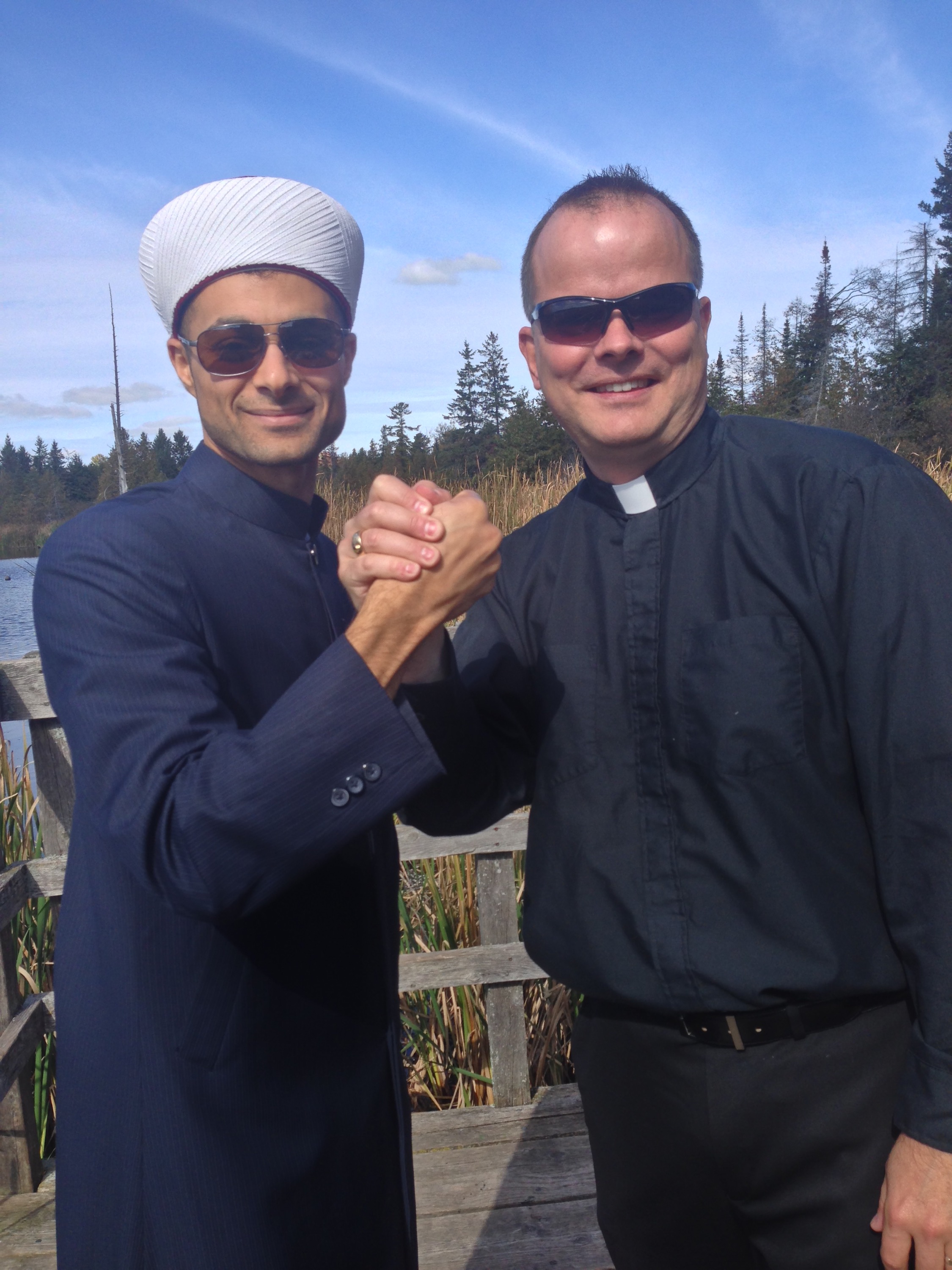
Jesus commanded that we shall love our neighbour as ourselves (Matthew 22:36-40). This commandment motivates me to participate this afternoon in the clerics’ cycling challenge (www.clericchallenge.com), initiated by Imam Mohamad Jebara.

  
Practically, then, what Jesus’ commandment means is that if you love someone, you want to know something about her or him. You want to know who she is, what he values, and how they orient their life. If you love someone, you take the time to talk to him, get to know her, and in so doing, you share yourself as well. 

  
Love shows itself in attention to another, in accepting another on their own terms — yes, and in a willingness to learn something new, to think about things in a new way, and to grow together in friendship and harmony. 

  
When I say Christians are called to love their Jewish or Muslim neighbours, for example, I mean we are called to develop relationships of mutual affection, understanding, and appreciation (Kristin Johnston Largen, “Interreligious Learning and Teaching” Fortress Press, 2014, p.59). Then, we love our neighbour as ourselves, thus fulfilling Jesus’ commandment.

  
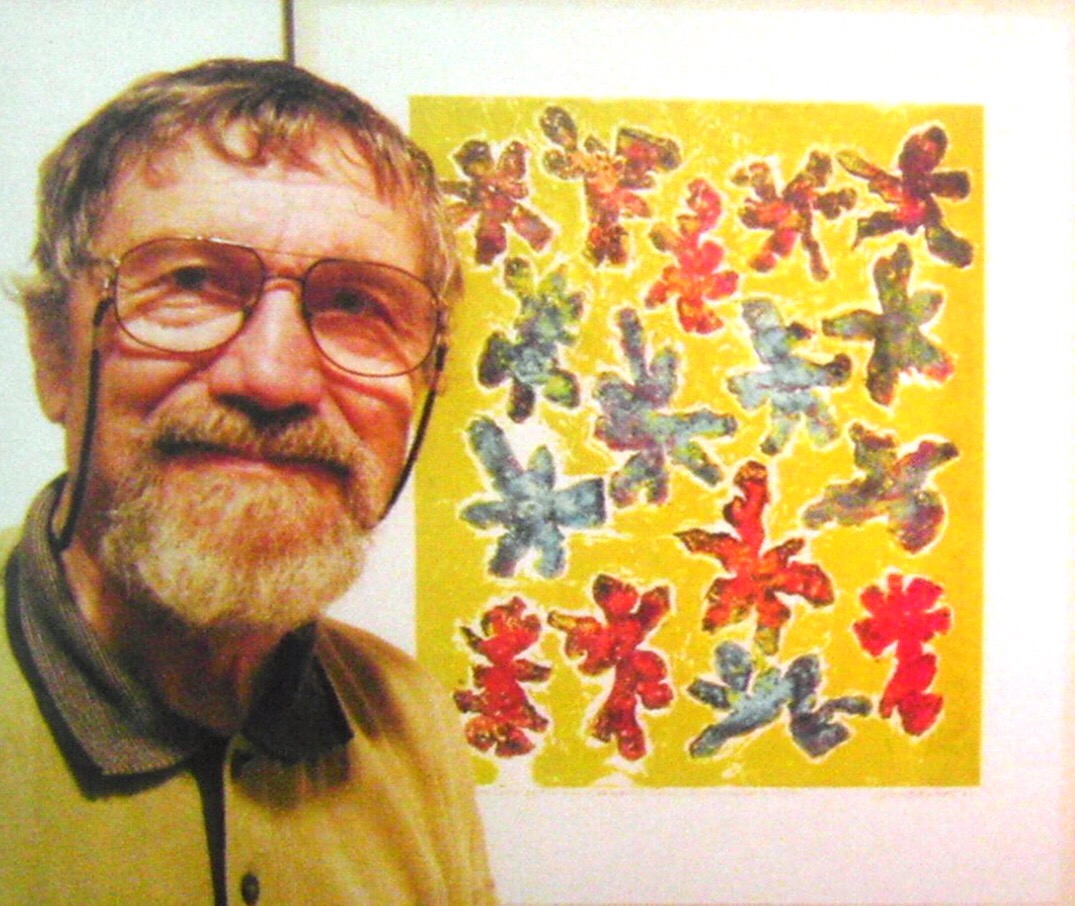
I had the pleasure of viewing some artwork this past week at the Rothwell Gallery on Montreal Road in Ottawa. The Gallery is presenting until October 24th the work of the late Leonard Gerbrandt (1942-2010) who travelled the world and created beautiful impressionistic watercolours and prints especially about the structures of various land and waterscapes. I was given a personal tour by Ute, his spouse, of the hundred pieces or so displayed in the gallery.

  
When we began the tour, she asked me to guess what colour appears and is prevalent in the vast majority of his art. With a twinkle in her eye, she confessed that this particular colour also happened to be his favourite. And so I went to work. At first, I suggested it was the earth tone greens, even maybe the rust, terracotta and orange/reds. No. No. And no.

As we reflected on one specific piece of art I marvelled how Leonard mixed the blues to distinguish sky and sea. Ute smiled, then said, it was blue indeed. I quickly travelled through the gallery looking anew at the paintings. And you know what? It was true! Now, I could see it — blue indeed found its way into almost all his paintings. Why didn’t I see that at first?

Blue, after all, is my favourite colour too (No political association, though!). And then I pondered further why I couldn’t see what had always been my favourite colour. Had I been distracted by the flashiness of other ‘colours’? Did I take ‘my colour’ for granted? What were ‘the blocks’ inside of me preventing me from seeing what was most important to me? Pride? Anger? Fear? Shame? Greed? Why couldn’t I appreciate fully the beauty that was staring me in the face, for me?

Of course, colours would not exist without the presence of light. In fact, it is how the light is represented in a work of art that brings out the textures and hues created by the paint brush. I also believe that art, like music, serves to reflect back to us an inner state — and that is why art and music can be so powerful conveyors of meaning and truth about ourselves and the world at any given moment in time.

The living Jesus is with us, and in our hearts through the Holy Spirit. The love of God propels the Spirit to move us in the the way of Jesus. And yet, we block our sight. We can’t see the light. What are those blocks that keep us from living out of our nature that is being renewed day by day? What keeps us from loving our neighbour? Is it fear of the unknown? Is it a shame that is deeply imbedded? Is it the fire of anger, the pain of regret, the poison of hatred, the paralysis of mistrust?

“Out of his anguish he shall see light” (Isaiah 53:11)

This phrase comes from a larger so-called suffering servant poem from the prophet Isaiah. Christians have read Jesus Christ into the role of the servant even though the text was originally heard among the people of Israel hundreds of years before Christ. The ‘servant’ could refer to the people as a whole suffering in Babylonian exile, or to a specific individual (i.e. Persian King Cyrus /Isaiah 45) who liberated the Israelites and led them home to Jerusalem.

This exegesis is important and we need to tread carefully in working with sacred texts that we share with our Jewish neighbours. We Christians know the sacrifice of Jesus on the Cross for our liberation, indeed for the whole world. Jesus fits the suffering servant-narrative from Isaiah. Let’s work with this.

The anguish Jesus experiences in his suffering and death reflects a God who is fundamentally relational. And God the Father, the Son and the Holy Spirit relates to us in our very own humanity. Thanks to Jesus who showed us the way not just in his divinity but especially in his very own humanity. ‘Anguish’ after all, is a human emotion grounded in love. That is, “to anguish over the loss of a loved one” (online dictionary definition).

Not only does Jesus know our suffering in a shared humanity, he feels for us because of God’s intense love for us. The author of Hebrews is therefore able to describe Jesus as the ultimate high priest, who “is able to deal gently with the ignorant and wayward, since he himself is subject to [this] weakness” (5:2). In short, Jesus helps us “see the light” because of God’s deep anguish-filled love for us. God grieves losing us to our sin, and will not stop short in going the distance — even sacrificing his own life — so that we too will see things as they truly are, in the brilliance of God.

In prayer, 14th century Christian mystic Julian of Norwich reflected the divine stance: “I am light and grace which is all blessed love.” May our words and deeds reflect the light of Christ to our neighbours, in all grace and love.


Changing your mind on faith

This past week I was finishing up on my monthly calls to shut-ins and those who are not easily able to attend worship services here. And it was in a couple of conversations where I felt particularly moved. Of course, I am not mentioning any names or specific circumstances.
“Sometimes I wonder if I have enough faith,” said one.
“When is it that you feel that you might not have enough faith?” I asked, prompting further: “What kinds of things are happening when you think you might not have enough faith?””Whenever things are not going well for me. When I’m suffering, or in pain. When it hurts. When I’m afraid that the worst will happen.”
Speaking Lutheran to Lutheran, I mentioned that the 16th century reformer was an anxious person. Martin Luther was terrified, for example, of dying. “I think that’s probably very normal,” I said. “Even people we consider giants of the faith, were afraid and scared especially when they thought they were going to die.”
Our conversation continued until we concluded that to have faith was not apart from all that scares us or causes us suffering and pain. Faith happens inspite of the difficulties of life. The challenging circumstances of life don’t define and determine our faith or lack thereof; Our faith or lack thereof is expressed amidst the realities of living.
“Faith is real only when we face and embrace the suffering of our lives.”
And it is here that we encounter what Jesus is getting at in the Gospel text today: We are not harmed by what comes from outside of us — including difficult circumstances — but by what is going on inside of us: what we think and say (Mark 7, James 1).
I like the more positive way the Deuteronomist expresses the same lesson — this to the Israelites entering the Promised Land: “Take care and watch yourselves closely, so as neither to forget the things that your eyes have seen [that is, the great acts of God to free the people from slavery in Egypt and sustain them through the desert wanderings] … nor to let them slip from your mind all the days of your life…” (Deuteronomy 4:9). Don’t forget! Don’t forget who and whose you are! Because what we do comes straight from what and how we think.
If we are honest, this life can take a toe-hold on our imagination — with values, goals, material aspirations and selfish projects that affect our way of thinking. I would add, cultural values that lead us to conclude that only if everything is perfect in my life — no pain, no tears, no suffering and lots and lots of money — then and only then can I have faith, believe in God and be active in my faith.
The Gospel message of Jesus Christ enduring throughout human history is all about a renewing of the mind — embracing a whole new way of thinking. Paul expresses this in one of his letters to the early church: “Be renewed in the way you think …” he counselled the Ephesians (2:23). Because often the way we think — our attitudes and opinions — are downright unhelpful and evil. “All these evil things come from within,” Jesus warns (Mark 7:23).
Sometimes we hold on to our opinions as if they were sacrosanct even though they may be unhelpful. But have we ever really examined our opinions? We often look down upon others (and ourselves), and dare I say politicians, who ‘change their mind’ about something or other. Waffling, we believe, or changing our mind about controversial subjects especially, is bad and suggests a weak personality. And yet God, even, changed his mind about bringing disaster upon the people when Moses and other prophets engaged God in passionate debate (eg. Exodus 32:14). If God is able to change directions, could we not too?
To change our way of thinking to be less self-centred and more other-centred.To change our way of thinking to find meaning more in serving others than serving self.To change our way of thinking about doing something good not out of fear or shame but more out of a heart filled with compassion.
“Once upon a time a king was strolling through the forest and he saw an old man, a poor man, bent over a furrow. He walked up to him and saw that he was planting seeds for chestnut trees. He asked the old man why he was doing it and the old man replied, ‘I love the taste of chestnuts.’
“The king responded, ‘Old man, stop punishing your back bent over a hole in the ground. Do you really not know that by the time even one of these trees has grown tall enough to bear nuts, you may not be around to gather them?’
“And the old man answered, “Your Majesty, if my ancestors had thought the way you do, I would never have tasted chestnuts.'” (Juan Gomez-Jurado, God’s Spy, Orion Books, Great Britain, 2007, p.164-165)
I had another inspiring conversation this week with someone who is caring for a loved one suffering with illness. She decided to invite some friends struggling with similar challenges over for a meal. These friends, especially, were down and depressed about their mutually-shared, tough circumstances.
And yet, over the tasty meal and dancing to music and laughter, something shifted in the climate of the meeting. The next day, the host received an email from one of the friends who visited: “Thank you for your generosity and love. I was so encouraged by the visit, that when I returned home, I changed into my gardening clothes, went outside to the front yard and trimmed the bush that had gotten way out of hand.” It was like the fearful, anxious, angst-ridden Martin Luther who said that if he knew the end of the world was going to happen tomorrow, he would still go out and plant an apple tree today. Now, that’s faith.
Here’s my confession today: Often I wonder whether it’s even possible. Whether we can change our minds towards God and God’s ways in Jesus Christ, no matter what circumstance of life in which we find ourselves. Sometimes I doubt that our minds can be renewed into the likeness of Jesus when we are sick, when we feel destitute and deprived, when things don’t go our way. When times are tough, we often knee-jerk into old, often destructive patterns of thinking. Will we, indeed, have enough faith, to see things differently and not despair?
It is here when, despite how I feel, I affirm a faith that says: No matter what you think, Martin, no matter what anyone else thinks, God will not forget you. Even if I have a lapse of memory and forget who I am and whose I am, even though our minds may go completely, this is the promise of the One who created us: “I will not forget you; I have inscribed you on the palms on my hands” (Isaiah 49:15-16). Because of who God is, I can therefore act boldly on a way of thinking that is based in trust. Trust this loving God who will not let go of us. Ever. And no matter what.
Thanks be to God!

‘One little word’

“Long ago your ancestors — Terah and his sons Abraham and Nahor — lived beyond the Euphrates and served other gods …. Now … choose this day whom you will serve, whether the gods your ancestors served in the region beyond the River or the gods of the Amorites in whose land you are living; but as for me and my household, we will serve the Lord.” (Joshua 24:2,15)

“Finally, be strong in the Lord and in the strength of his power. Put on the whole armour of God, so that you may be able to stand against the wiles of the devil. For our struggle is not against enemies of blood and flesh, but against the rulers, against the authorities, against the cosmic powers of this present darkness, against the spiritual forces of evil in the heavenly places … ” (Ephesians 6:10-12)

My mother told me the story of a dramatic stand made by Christians against Hitler on Easter Sunday 1942 in Norway: The Nazis had insisted that every Lutheran congregation praise God for Hitler’s rule over the Norwegians. The Lutheran Church considered this blasphemy, and refused. Every Norwegian Church closed that Easter Sunday morning. And instead they agreed to worship in the afternoon.

Later that day in one of the villages the people assembled in the market place. And because they were scared, they began singing what Lutherans have sung for over 400 years when they were afraid: “A Mighty Fortress is our God, a bulwark never failing …”

And they slowly began to walk to the steps of the village church — only to find the doors locked and guarded by a company of SS soldiers with submachine guns trained at them. When the Christians arrived at the front steps, having finished the first verse of Martin Luther’s famous hymn, an SS officer grabbed a woman holding a baby in her arms and said: “One more verse and she gets it first”, pointing the weapon at her head.

In the tense silence, the people, not knowing what to do, looked down at their feet.

And then, a single, soft, quivering voice began … 

“Though hordes of devils fill the land, all threatening to devour us, we tremble not, unmoved we stand, they cannot overpower us. Let this world’s tyrant rage … his might is doomed to fail. God’s judgement must prevail. One little word subdues him.”

It was the voice of the woman holding the baby. “One little word subdues him.” The soldiers were the ones in a moment of indecision who looked down at their boots. And then quietly they shuffled out of sight to let the worshippers enter the church.

One little word subdues him. Not a loud trumpet call. Not an explosion of spectacular proportions. Not an air strike obliterating the enemy. Not a bravado that denies human frailty and vulnerability. Not eloquent oration. Not a motivational speech rallying the crowd into a frenzy. One little word subdues him.

The themes of ‘standing up against evil’ and ‘taking a stand’ pervade the scriptures assigned for this Sunday. We must choose our god. We must stand up. Especially in the context of a multi-faith community. But how do we do this when all we want to do is stare down at our feet, immobilized with fear?

Because we are surrounded by diverse peoples. And that isn’t going to change. At least we can relate to the Ephesians. The Christians in Ephesus were probably taken to worship the emperor at the newly constructed temple of Domitian; Ephesus in the first century was also a thriving commercial city and the cultic centre of goddess Artemis. (Haruko Nawata  Ward, Feasting on the Word Year B Vol 3 Fortress Press, 2009, p.376). Christians were challenged to be confident in their faith amidst challenging times. Change some of the names, and it feels a bit like Canada in the 21st century!

And as simple as we sometimes may want to reduce the question of evil, the scriptures present a more subtle and systemic view of evil. In other words, evil is not just a little red man with a pitch fork sitting on your shoulder tempting you to do something bad. Evil is also, and more significantly, about forces beyond the immediately ‘individual’, into the realms of politics, world history, economics. 

More than against “flesh and blood” evil is also about certain patterns of thinking. Our attitudes and underlying beliefs and assumptions about people of other faiths and values.

Standing up against evil and taking a stand is just is as much to do with changing the way we think about ‘them’. Standing up against evil is about repudiating ways of thinking and unspoken assumptions that have only served to hurt and damage other people. Sometimes the way we think — the common sense assumptions of our culture — are downright evil and wrong. Let me give you an example:

This past summer at the national convention of the Evangelical Lutheran Church in Canada (ELCIC), the church voted to repudiate the “doctrine of discovery”. This doctrine is different from our normal understanding of a statement of faith. But it was a belief that resulted in untold damage to the aboriginal populations of North America. It was the reason aboriginal children were taken from their homes, families and communities to suffer — many of them — in the so-called Indian Residential Schools in the last century.

The doctrine of discovery was the underpinning belief that resulted in the first explorers labelling Aboriginal people as “beasts of the field and forest”, and prompted governments to justify “killing the Indian in the child.” The doctrine of discovery made the residential schools places where native children were not permitted to speak their own language, practice their own religion, nor attend with their own siblings or have any contact with their parents while they were at school. How evil is that!?

So what is this doctrine of discovery that the ELCIC repudiated? Basically, it was a system of belief based in the discovery of North America, as if nothing of inherent value existed here before ‘we’ arrived. When the explorers landed on the shores of Iceland and then Turtle Island (i.e. North America), the land appeared to be unoccupied in the ways of western Europe. The explorers therefore believed it was theirs to acquire and own. When the explorers encountered native bands, there was this immediate disconnected with their values and culture and relationship with the land, understandably. Still, the settlers felt superior in their relationship to the native culture, believing — “What we have is better for you.” And moving from that doctrine into practices and policies of assimilation and subjugation like the residential schools.

I can anticipate your objection: But what to make of the Great Commission in Matthew 28:19 — when Jesus instructs his disciples to “Go therefore and make disciples of all nations”? Isn’t this what we have been supposed to do? – make others, force others to be like us? Aren’t we supposed to impose our values on the world, using any means at our disposal? Another English translation of the word, disciples, changes the tone significantly. When we read, “Go therefore and make learners of all nations”, we can see our task as learning. Disciples are essentially ‘learners’. Learning involves challenging current patterns of thinking, and going out into the world to share our faith. (Kristin Johnston Largen, Interreligious Learning &  Teaching, Fortress Press, Minneapolis 2014, p.109)

When I visited Jerusalem years ago, I was surrounded by at least three different world religions day in and day out. Muslim minarets blared out regular calls to prayer; orthodox Jews bowed at the wailing wall. And I, with a small group of Christians found a little apartment in the old city to gather around bible, cup and bread, to pray  and sing together. Few other times in my life have I ever felt as confident and grateful for my Christian faith than in a context  where other faiths and cultures came and tried to live together, even clashed.

Sharing our faith is not about one-up-man-ship. Sharing our faith is not a competition. It is simply being confident to talk to others when appropriate about what is most important to you. And, giving the other the freedom to do likewise. I think we still need to work on that in the church because I think we still believe it’s about a competition. That we have to fight, even, if necessary, to defend God — or our ideas of God. Be the winner, not the loser, in a winner-takes-all kind of world. It was in Jerusalem when I first realized that if there was any evil in the world, it started in me and my selfish, materialistic, self-acquiring vision for life.

Paul’s armour-of-God metaphor, like all metaphors, has limits and can even be problematic. Such a text has been interpreted throughout two thousand years of church and world history often as justification for violence against others. It is challenging maybe even impossible for us today to engage this text without the lens of history and the development of society and human culture through the ages — particularly with respect to warfare.

And that is why, as Lutherans especially are taught to do, I would not want to interpret this text without placing it beside another text from Paul’s letters, in this case, to ‘let scripture interpret scripture’. Listen now to another clothing analogy, where Paul speaks of what we ‘put on’ in Christ:

“As God’s chosen ones, holy and beloved, clothe yourselves with compassion, kindness, humility, meekness, and patience. Bear with one another and, if anyone has a complaint against another, forgive each other; just as the Lord has forgiven you, so you also must forgive. Above all, clothe yourselves with love, which binds everything together in perfect harmony. And let the peace of Christ rule in your hearts to which indeed you were called in one body. And be thankful …. And whatever you do, in word and deed, do everything in the name of the Lord Jesus, giving thanks to God the Father through him.” (Colossians 3:12-15,17)

Indeed, in this light, the belt of truth is the Gospel. The helmut of salvation is God’s eternal promise of love for us. The breast-plate of righteousness is a heart of compassion. The boots are actions that bring peace and goodwill to the world. The shield of faith is trusting in God’s grace. The sword of the Spirit is proclaiming the word of forgiveness, mercy and love.

One little word subdues him. An act of humility, not military aggression nor forceful imposition.

One little word subdues him. A word of forgiveness rather than condemnation, racism and judgement.

One little word subdues him. Something unexpected, surprising and even looked down upon by the world’s winners — that changes history. One little word — not born of competition, comparison and control, but born of surrender, release and trust. One little word, “I love you”, changes everything.

One little word is Jesus. God becomes human. A baby. A prophet. A teacher. A lamb taken to slaughter. One little word is greater than anything the world lives by. One little word whispered in a storm. One little word sung softly into the barrel of a machine gun. One little word nudging gently our hearts, saying to you: I love you. I forgive you. You are free. You will forever more be a child of God.

Now, tell the nations of the world the same. And act like you believe it. Because it’s true. Thanks be to God.