Leaning in

The man with the unclean spirit is ordered by Jesus to “Be silent!”[1] After Jesus speaks to him, the unclean spirit obeys, and leaves the man. The man is thus transformed, healed, made whole in this dramatic Gospel encounter with Jesus.

We need to note, before going on, that Jesus speaks in the synagogue in Capernaum. He is at the beginning of his ministry. And what better place to start his preaching than on home turf, on familiar ground, in the rural community with people he likely knows, and who know him?

If you’ve ever lived in the country, or farther up the Ottawa Valley, you know that in small towns, people know each other. And when it comes to annual fairs, big events or musical shows, everyone attends. So, when in the lake side village, a home-boy comes to preach in the local synagogue, well, who wouldn’t show up? The synagogue is crammed full. Standing room only.

The point here is that the evil spirit resides and comes out within this rather homogenous community. The evil is not out there, somewhere – in Jerusalem the big city, or out there across the lake among the heathen Gentiles, or expressed within other groups with different belief systems and faiths. The evil is right there in the middle of the common, familiar, comforts of home.

The man with the evil spirit is a person like us. We know him. He is our neighbour. He, or she, is our friend, co-worker. She is the person who comes to church and sits beside us, Sunday after Sunday. The person with the evil spirit is not a stranger to us. That person is us. Each of us.

The Gospel of Mark – indeed the entire New Testament – is a primarily message to and for the church. Not to Islam. Not to Wicca. Not to some Voodoo occult. Not to the so-called Axis of Evil. The finger of judgement is pointed directly at us, at our sin, our evil, the brokenness within us.

When we deny. When we exclude. When we overstep our bounds. When we self-justify. And if you think you don’t have any of these and other problems – to quote what my Dad used to say and preach – you do have a problem!

It’s to this community, in awareness of the sin in our hearts, individually and collectively, that Jesus’ first words, spoken with authority, are: “Be silent!”

How do we change by being silent? I thought we were supposed to do something about our sin! Being silent sounds too much like being passive, lazy, self-indulgent and unproductive. How is it that we are changed when we are quiet?

The silence of which I speak, is first not the silence of denial. It is not a silence that happens when we remain quiet in the face of a great injustice. When a problem is not named, silence enables the problem to continue unattested. When there is something wrong, but no one dares to name the elephant in the room. This is not the silence of which I speak.

Neither is it the silence of combative conflict between people. When someone gives the other ‘the silent treatment’, silence serves as a weapon between people who need help to speak to one another about things that need saying in a safe way. This, too, is not the silence of which I speak.

Jesus is not scolding the man with the unclean spirit when he says, “Be silent!” He is not like the frustrated parent who has reached the boiling point with a disobedient child and just wants them to just shut up and go to their room.

When Jesus says, “Be silent!” he is inviting the disturbed and ill man to open his heart to being changed. Jesus first words are an invitation to be healed. And the first step in that direction is to put to rest, for the moment, the rampant flailing of a seemingly unstoppable ego.

This is a scary thing to do. How can we let go of our reactions, compulsions, need to be right? How can we be so vulnerable and leave ourselves wide open? How can we take this risk, let alone be healed by doing so?

One of my greatest fears as a child was to play on the round-a-bout. At the centre of the playground at kindergarten, stood the scary carousel-like structure. The round-a-bout used rotary motion, spinning around in a circle either clockwise or counter-clockwise. It was painted red.

A bunch of us kids would start by grabbing the four railings which fanned out from the centre like spokes on a wheel. We then started running, really fast, around and around pushing the carousel to dizzying speeds. And then at the moment when we couldn’t run any faster, we threw ourselves onto the spinning platform.

My instinct, at first, was to hang on for dear life at the edge of the round-a-bout as it spun ridiculously fast. It seemed to me the closer I could be to the edge, the more control I had over when I wanted to get off. Doing this, however, I didn’t step off when I wanted. I flew off when I couldn’t hold on any more. So much for control. When all I wanted when I played on the round-a-bout was an evacuation plan.

In order to best stay on the round-a-bout, and not fall off, I had to lean in towards the centre. I had to do the counter-intuitive thing. I had to grab hold of the centre wheel – the hub, the heart of this fearful reality. This way, not only did I last longer, I actually had some fun.

We overcome the evil within not by denying it. Not by turning away from it. Because denying and turning away already exposes another negative disposition. Actual repentance is served best by turning toward that which frightens us. Transformation is realized by moving to our fear not away from it.

And surprise, we are not alone there. We find our strength and our victory in turning toward and leaning into … a very loving, very much present Christ. Jesus is even there, yes.

Like a pine tree on the Canadian Shield rocky coast of Georgian Bay leans into the gale force winds to survive and thrive in that environment, so, too, we turn towards that which assails us in life. As you know, I love the White Pine – native to this part of the world. And one of my favourite Group of Seven pieces of art is A.J. Casson’s “White Pine”.

This painting, in particular, depicts the rugged, often inhospitable places where the white pine flourishes. Spreading its roots just beneath the surface of the ground, the white pine can find foothold in rocky, sandy earth. What is more, along waterlines, the pine will grow sometimes leaning, like the Tower of Pisa, into the gale force winds, not away from them. By doing so, even with its shallow root system, it will not fall. At least, not for a long time.

Naturally, we resist this counter-intuition. Many say that when they meditate, the first half of the period of meditation is hell. When the flood gates are opened. That is when all the thoughts, distractions, and emotions scream to the surface. That is when we fight our greatest battle in prayer. Not against the thoughts and feelings themselves, but against the experience of being still and silent. Because all that has been hidden and suppressed in the dark recesses of our lives finally can come to the surface and is exposed even burned in the Son-light.

It is too easy to give into the ego at this point, which wants to have control, which drives compulsively towards having more, making more, producing more, taking more, defending more. Un-relentless is the ego, driving impulses we struggle with in those first minutes of quiet, still, sitting and praying. It is too easy to give up on the experience and declare, “This is not for me.” And return to the hurly-burly of life in the fast lane.

Should we, however, lean into the internal fray – not suppressing the maelstrom of thoughts, not doing violence against our ego – when we just let the thoughts and feelings come at us and go through us, we will find the rock of our salvation who will hold us up even if we are leaning a bit.

Our lives thus become a prayer of healing when, before all else, we heed Jesus’ call: “Be silent!”, when we seek to quiet our busy thoughts. Saint Isaak of Syria wrote of a way of becoming silent and experiencing our hearts as the temple of the Holy Spirit[2], the holy still centre, and the hub of our lives:

“Enter eagerly into the treasure house that is within you,” he wrote, “and you will see the things that are in heaven – for there is but one single entry to them both. The ladder that leads to the kingdom is hidden within your soul.  Dive into yourself, into your soul, and there you will find the ladder by which to ascend”, and by which God descends into our lives.[3]

Just the turning, the leaning in, is everything on the journey to transformation. “Be still before the Lord,” the Psalmist sings.[4] “In quietness and in trust shall be your strength,” the Prophet advises.[5] “Be silent!” Jesus invites.

[1] Mark 1:21-28, NRSV

[2] 1 Corinthians 6:19

[3] cited in Greg Pennoyer & Gregory Wolfe, eds. “God For Us: Rediscovering the Meaning of Lent and Easter” (Massachusetts: Paraclete Press, 2015), p.91.

[4] Psalm 37:7; 46

[5] Isaiah 30:15

Repeat performances

Once again during the Christmas season, I experienced this strange cultural phenomenon:

How many decades has it been that every December, movies like “It’s a Wonderful Life”, “Elf”, “How the Grinch Stole Christmas”, “A Charlie Brown Christmas”, “National Lampoon’s Christmas Vacation” and “The Bishop’s Wife” get replayed and replayed over and over again, year after year? And only at this time of year? You can probably add several more of your favourites to this list.

That is why I was a tad apprehensive last month when we received tickets to attend the National Art Centre (NAC) Theatre production of Charles Dickens “A Christmas Carol.” I know the story. I’ve read it several times. I’ve watched television renditions of the story over the years. What could the NAC Theatre do to bring it to life, once again, for me? Same old, same old, right?

On the other hand, I believe there is a good reason why we turn to these stories every year. There’s a reason for our culture’s yearning for their repeat-performances. A higher reason, I might add. Perhaps there’s something in those stories that we need to take to heart, and make positive changes to our lives. Perhaps, we need to see the story-telling as more than a mere syrupy, sentimental “Isn’t that nice” tradition.

So, I was surprised and intrigued by what the NAC Theatre troop did with the story. It was introduced by two actors who came on stage — one was blind and one was deaf. In the introduction they invited the audience to participate in a simple activity with our hands, both to show that the two actors needed each other in accomplishing their jobs; and, what is more, near the end of the story everyone in the audience was needed to give the sign with their hands in order to encourage Scrooge finally to embrace a more compassionate approach to life.

Without taking anything away from the traditional story-line plot, the meaning of Dickens’ famous “A Christmas Carol” was conveyed to me in a fresh way.

We encounter in young Samuel and the elder Eli one such repeat performance story in today’s text from the Hebrew scripture.(1) It is a story many of us know — of the boy Samuel in the temple who is called upon by God. It gets told many times in the life of the church over and over again — every three years at least. It is true: it is a nice, little story, isn’t it?

At first, Samuel doesn’t recognize God’s voice, believing instead that it is his old mentor, the priest Eli, who is calling him. Finally, with Eli’s help, Samuel responds to God’s call by saying, “Here I am. Speak, Lord, for your servant is listening.”(2)

Well, as I said, many of us are familiar with these very words. We even like to sing a popular hymn (3) reflecting the words of one responding positively to God’s call — a call that changes the life of the recipient. How does this familiar story speak to our lives today? How is it more than just ‘a nice, little story’ from the Bible? How can this story change our lives?

In this story, an old man and a young man collaborated to hear God’s vision for a new Israel. For God was about to do a new thing: Soon to emerge in the life of God’s people was a new lineage of kings, beginning with the inauguration of King Saul.(4) What was passing, was the rule of Judges along with the sinful house of Eli. What was emerging was the likes of King Saul, King David, King Solomon, and so forth.

In God’s message to Samuel, God condemns Eli’s lack of restraining his sons’ immorality. Eli’s sin was his aversion to do something even though he recognized what was happening. Even though Eli knew the ongoing problems in his household, Eli turned a blind eye and ignored it all.

He did not act. And no matter what Eli would do now to try to redeem himself by making various sacrifices to the Lord, God was intent to establish a new order of leadership over God’s people starting with the demise of Eli’s household.

Doing nothing was the problem. For us, today, doing nothing about a problem we know exists is the problem. How do we begin to move out of the prison of this self-inflicted inertia?

We need to recognize that growth and healing is a process. The birth of the new thing God was doing began as a cooperative affair. It took the attentiveness of the young Samuel’s ears and the wisdom of the old priest’s heart and mind to bring about God’s purpose. It took both the authority of the failing, feeble priest and the obedience of his youthful protégé to bring about God’s purpose. In other words, it takes a community to bear such a task.(5)

Responding to God’s actions and call in the world and in our lives today is not a solo effort. Religion is not a solitary practice. Indeed, it takes a village. It takes the various gifts of people in our lives. What one has and the other does not, what the other is good at that the first is not — it takes everyone’s attentiveness and participation.

How do we live into this collaborative way, especially challenged by our society’s emphasis on individualism, privacy and self-reliance? We are, indeed, up against a culture that is at odds with the Christian vision. How do we live the way of God’s reign? Where we value mutuality, diversity, common purpose in the mission of God for the good of all people?

In contrast to the way in which God spoke to the likes of Isaiah, Jeremiah and the later prophets of Israel, God does something unique with Samuel. You will notice that God does not enjoin Samuel to deliver God’s message to Eli. God does not charge Samuel to tell Eli what God is telling Samuel with words like: “Thus says the Lord, tell the people Israel”, etc., etc. No.

Rather, God wants simply to confide in Samuel. Basically, God expects Samuel, first, to listen. Just listen. It seems, Samuel first needs to learn how to do this. And it will take some time and some practice, evidently.

Can we have the courage, and the patience, to learn how first to listen to God and the other — without jumping in too soon with the energy of our own bravado, our own opinion, our own self-justifications, our own visions of what must be? The simple act of listening, can change our lives. Because listening first means we believe that the other has something of value to offer that we don’t have.

God works at a slower pace, it seems, compared to the hypersonic rhythms of life in 2018. Not only does God give Samuel and Eli one chance to figure it out, but two and even three opportunities to get on the same wavelength as God.

The story-telling is both appealing and intentionally slow early on. Dialogue is repeated. The action of Samuel getting up from sleep and going to Eli are repeated. We have to slow down with the narration and feel the build-up to the great reveal of God’s message.

Even though both Samuel and Eli are slow in finally getting it, even though they are encumbered by sleep, drowsiness, denial and avoidance, even though their response to God is compromised by vision and hearing impairment, by youthful pretence and the attrition of old age …. God still finds them. God still speaks. God still acts in the way God will act.

Despite human arrogance and self-delusion, despite all our toiling and pride, despite all our ego compulsions, God keeps at it to tell us, guide us, and instruct us.

We may not like the answer. We may not like what God has to say. We may be challenged to the core of our being by what God is telling us. Regardless of our hesitation, denial or self-delusion, God finds a way. God doesn’t give up on us. God gives us people, and stories, and experiences — even the same ones, over and over again — to help us finally get it.

God doesn’t give us just one chance. God is not just a God of second chances, as we often say. God gives us many chances, as many we need. May we, like Eli, finally come to accept what God has to say to us, with his words: “It is the Lord; let him do what seems good to him.”(6)


(1) 1 Samuel 3:1-20, the first reading for the Second Sunday after the Epiphany, Ordinary time, Year B in the Revised Common Lectionary.

(2) 1 Samuel 3:4-10.

(3) “Here I am, Lord”, Hymn #574, Evangelical Lutheran Worship (Augsburg Fortress, 2006); also, for the Christmas cycle, this hymn is also appropriate in singing Mary’s response to the angel Gabriel’s visit to her, announcing Mary’s role in the birth of Jesus (Luke 1:38).

(4) 1 Samuel 8-10.

(5) Richard Boyce in David L. Bartlett & Barbara Brown Taylor, eds., “Feasting on the Word: Preaching the Revised Common Lectionary, Year B, Volume 1 (Kentucky: WJK Press, 2008), p.245-247.

(6) 1 Samuel 3:18

A wintery spirit

IMG_6730

The winter of 2018 has been record-setting, so far. And we are barely one week into the new year! Did you know it was Ottawa’s coldest New Year’s Day since records began in 1873? At 8am on January 1st, the mercury dipped to a frigid minus 30.2 degrees Celsius (-22 Fahrenheit); New Year’s Day also marked Ottawa’s sixth consecutive day with temperatures below -17 degrees Celsius (1 Fahrenheit), which made it the longest run in exactly one hundred years.[1]

IMG_0223

A full onslaught of winter can help us appreciate the meaning of Christianity. Though much of the bible’s stories and lessons were wrought out of the harsh desert climate surrounding the Mediterranean and Arabian seas, the winter realities we face in Canada are not that much different. I suggest, then, let’s take desert and winter as synonymous – meaning, essentially, the same things.

IMG_3529

American Lutheran theologian, Martin Marty, describes the importance of what he calls a “wintery spirituality”, defined by the shrill cry of absence, frost, and death. In contrast to a summer spirituality, winter is more given to being emptied than being filled. Winter is harsh and lean in imagery, beggarly in its gifts of grace and love.[2]

IMG_3524

Of course, Jesus goes into the Judean wilderness to be baptized in the Jordan River. And right after his baptism, he spends forty days and nights in the desert.[3] The desert is not a comfortable place to be. For one thing, it makes scarce and even denies the basic need for our survival – water. A desert is an arid region where annual rainfall remains miniscule. Some deserts average only one centimetre a year, with parts of the Sahara not receiving a drop of rain for more than twenty years.[4]

The word and image of water appears in each of the Hebrew readings assigned for this festival day in the church calendar, and is tied to baptism in the readings from the New Testament.[5] More to the point, water is given out of the chaotic void in the creation story, and in the arid wilderness as a gift and a grace. Water is thus a sign of God’s love amid the harsh winter or desert realities of our lives.

The prophets of old affirm that it is precisely in the desert where God expresses God’s love to the people. The grace of God cannot be received outside of winter. “Thus says the Lord: The people who found grace in the wilderness … I have loved you with an everlasting love …. I remember your love, how you followed me in the wilderness.”[6]

How, then, can we appreciate and even thrive, living out of this truth? How can we follow Jesus in his way? After all, the Baptism of our Lord is about Jesus beginning the journey to fulfill his God-given purpose in life. How he does it is of particular importance to us, if we are interested in following Jesus in our life-style.

Listen to a story first told by a nineteenth-century teacher, Awad Afifi the Tunisian, who drew his wisdom from the wide expanse of the North African desert:

A gentle rain fell on a high mountain in a distant land. The rain was at first hushed and quiet, trickling down granite slopes. Gradually it increased in strength, as rivulets of water rolled over rocks and down gnarled, twisted trees that grew there. The rain fell, as water must, without calculation. After all, water never has time to practice falling.

Soon, it was pouring, as swift currents of dark water flowed together into the beginnings of a stream. The brook made its way down the mountainside, through small stands of cypress trees and fields of lavender, and down cascading falls. It moved without effort, splashing over stones – learning that the stream interrupted by rocks is the one that sings most nobly. Finally, having left its heights in the distant mountain, the stream made its way to the edge of a great desert. Sand and rock stretched beyond seeing.

Having crossed every other barrier in its way, the stream fully expected to cross this as well. But as fast as its waves splashed into the desert, that fast did they disappear into the sand. Before long, the stream heard a voice whispering, as if coming from the desert itself, saying, “The wind crosses the desert, so can the stream.”

“Yes, but the wind can fly!” cried out the stream, still dashing itself into the desert sand.

“You’ll never get across that way,” the desert whispered. “You have to let the wind carry you.”

“But, how?” shouted the stream.

“You have to let the wind absorb you.”

The stream could not accept this, however. It didn’t want to lose its identity or abandon its own individuality. After all, if it gave itself to the winds, could it ever be sure of becoming a stream again?

The desert replied that the stream could continue its flowing, perhaps one day even producing a swamp there at the desert’s edge. But it would never cross the desert so long as it remained a stream.

The stream was silent for a long time, listening to distant echoes of memory, knowing parts of itself having been held before in the arms of the wind. From that long-forgotten place, it gradually recalled how water conquers only by yielding, by turning to steam in a natural cycle. From the depths of that silence, slowly the stream raised its vapours to the welcoming arms of the wind and was borne upward, carried easily on great white clouds over the wide desert waste.

Approaching distant mountains on the desert’s far side, the stream then began once again to fall as a light rain. At first it was hushed and quiet, trickling down granite slopes. Gradually it increased in strength, as rivulets rolled over the rocks and down the gnarled, twisted trees that grew there. The rain fell, as water must, without calculation. And soon it was pouring, as swift currents of dark water flowed together – yet again – into the headwaters of a new stream. [7]

Jesus instructs his followers to become the people they are called to be.[8] God is aware that our lives are like a journey through the desert. Or, as Canadians, we can say that our faith journey is not dissimilar from living through an Ottawa record-setting winter.

To thrive in this life is to see that this journey of becoming is not static. We are not called by Jesus to become mere swamp lands at the edge of the desert. Rather, the journey calls us to be vulnerable, to recognize what we may initially want to resist in us – like the stream that first struggled against yielding to the wind.

Our journey through life are journeys of vulnerability. Of taking little. Of trusting God. Of appreciating the value of small things. Of letting go into the Spirit wind of God. Then, we can, with the Psalmist see that, even in the wilderness, the Lord fulfills God’s promises and does indeed give strength to us and bless us with peace.[9]

IMG_3628

[1] Ottawa weather records, Twitter @YOW_Weather

[2] cited in Belden C. Lane, “The Solace of Fierce Landscapes: Exploring Desert and Mountain Spirituality” (New York: Oxford University Press, 1998), p.37

[3] Mark 1:12-13

[4] Belden C. Lane, ibid., p.38

[5] The Baptism of our Lord, Revised Common Lectionary Year B: Genesis 1:1-5, Psalm 29, Acts 19:1-7, Mark 1:4-11

[6] Jeremiah 31:3; 2:2

[7] as written by Belden C. Lane, ibid., p.20-21

[8] read the entire section from Matthew 10:5-42

[9] Psalm 29:11, NRSV

Pizza, sushi, pigs-in-a-blanket: It all matters

It’s an odd beginning.[1] You’d wonder why, if Matthew and Luke – and to some extent even John – begin with stories of Jesus’ birth, Mark starts his Gospel rather abruptly. And by reference to the Hebrew prophets of old.

During this Advent season as we prepare for and wait for God’s coming at Christmas, the Gospel text for today feels out of place. It shakes us out of our sentimental leanings and Hallmark expectations of pleasant Christmassy stories.

One of my favourite children’s exercises is finding the pattern in a row of numbers, words, pictures – and identifying which part doesn’t fit. Preparing a way in the dusty heat of the Judean desert by referring to Isaiah is a no-brainer for finding what doesn’t fit if we would line up and compare the first chapters of each of the four Gospels.

Compared to wordy John, for example, Mark is the master of brevity. The earliest of all four Gospels in the New Testament, Mark tells the story of Jesus by getting to the point. He appeals to our contemporary need to summarize concisely. Mark is short – only 16 chapters compared to Matthew’s 28, Luke’s 24 and John’s 21. In our digital video age where sound and video bytes must capture our attention in less than 15 second ads, Mark is the go-to Gospel. If you’ve got the time.

He opens by simply getting to the point: Jesus is the Son of God. And it’s good news. Amen. We’d go hear his sermons.

Unlike Matthew, Mark leaves out the juicy, vitriolic speech John the Baptist gives slicing up the Pharisees calling them a brood of vipers.[2] Instead, in a few short verses, Mark simply tells his audience that John the Baptist comes to herald Jesus’ coming. That’s John the Baptist’s only role: To announce and prepare the way of the Lord. Period. Next question.

Our three confirmands this year and their families have decided to meet in each other’s home once a month. Taking turns to host, each decides then what we will eat for supper. The first month it was pizza, perhaps no surprise there. The second month was sushi. And the third month we met this Fall, it was crescent pigs in a blanket. Pizza, sushi and pigs in a blanket.

Same group of kids and parents. Different culinary expressions. And I wondered how well this group found unity despite our differences. The detailed differences mark important aspects of our identity and perspectives on life. And yet, there we were, eating together and talking about God.

Which is why we must stop, pause and ponder Mark’s inclusion of certain details. If Mark wants to be brief and just tell the basic point, then why does he include what John the Baptist is wearing and what his diet is? There must be something very important about locusts, wild honey and camel’s hair.

I find a few good reasons for including only those details. First, Mark makes the connection between John the Baptist and prophets of old. We see, through these details that John the Baptist stands in line with Isaiah by citing his work.[3] John the Baptist is also mistaken for Elijah because of their similar attire,[4] and because he, like it is recorded in the other Gospels, foretells of the coming Messiah.[5]

Mark wants to be brief, but he also wants to add just enough detail to make those connections. Not only is this good writing, he conveys that it all matters. Not just the principles, the higher meanings, the abstract thoughts, the arguments, the beliefs. Material matters too. The locusts and wild honey that he eats, the camel hair that he wears – these all mediate God’s intent and message.

We can learn from Mark that “spiritual talk is always, in the Gospel, tied to material — real water, real bread, real time, inexpensive wine, locusts, honey, sand, camel’s hair, wind, birds and the clouds being rent asunder. This is the nitty-gritty of life, and it can never be separated from matters of the Spirit.”[6]

Because there is “nothing in all of creation that can separate us from the love of God in Christ Jesus”[7], then everything can mediate that love. There is nothing in all of creation that cannot communicate God’s goodness. All perspectives, all things, everyone – it all matters!

Those that created this library that we call “the Bible” in the fourth century could have tried to summarize the four Gospels – Matthew, Mark, Luke and John – into one definitive, authoritative account. No variations. No differences. No discrepancies.

No need to ask questions like: Was it the feeding of the 5000 or 4000? Were there two or was there just one angel in the empty tomb to speak to the disciples? Why does the Gospel of John contain stories not recorded in Matthew and Luke? One compilation would be enough, one that gets right the chronology of all the events, teaching and parables of Jesus. It would have made life easier!

But the wisdom of our forebears in the faith would keep the variations intact. Four similar yet different accounts were included in the New Testament. The diverse expressions and witnesses of Jesus Christ and his birth, life, teaching, healing, death, resurrection and ascension emerge as a critical element of faith.

In reflecting on the unitive diversity of Christian faith in the Bible, Richard Rohr wrote earlier this week in his daily meditation: “Scripture gathers together cumulative visions of the divine.”[8] Diversity is essential to who we are. It all matters.

It all matters because there is something good in everything. Everything in creation is just that: Created by God. And if everything was and is created by God, then despite the consequences of human misdeeds and the stain of sin in creation, despite all the religious and political differences in the world, there is still something redeemable and inherently good in this brokenness of creation. Including in us. This is the hope of Christian faith.

The Christmas season is a time when traditional gatherings occur in families, communities, friendship groups, and workplace teams. It would be too easy, and lazy on our part, to be dismissive and rush to make judgements of family members and co-workers with whom we differ. Some hesitate and complain about attending these gatherings because we can’t stand “grumpy uncle Stan” or “flakey aunty Molly”.

But even “grumpy uncle Stan” and “flakey aunty Molly” are beloved of God. There is something good about them. Will we take the time and effort to help make a safe place for them to express their true selves created in the image of God?

Richard Rohr has made many enemies in the Christian church for his provocative and progressive views. He has been a voice crying out in the wilderness for several decades now. And over all this time, he maintains that in conversation with those who differ from him, he follows a simple rule:

There is always at least ten percent of what he hears in their point of view that he can agree with. And it’s from that common ten percent that he begins his response to them.[9]

That calls for some work. And persistence. Because building relationships with those from whom we differ is not accomplished in one meeting, overnight, or after one phone conversation. It’s not easy work. It can take a life time.

It’s easier to give up and walk away. It’s easier to justify some narrative that paints them as evil or not worth spending any time with. The sad consequence of following this easy way we see in the world today.

We pray for peace on earth this Christmas season, as with the angels of old. The way of peace is to have hope. To have hope is to live into that which God calls us into being. And that hope requires us to take the narrow path.[10] To have hope is to work hard at practicing good listening skills. Hope requires us to work hard at not speaking first, but first asking questions and hearing the other. That hope requires us to work hard at listening with the aim of seeking understanding, to try to see things from the perspective of the other.

This doesn’t mean we will agree with the other. This doesn’t mean we will lose our integrity or that which defines us as Christians and as individuals. But it does lead us to a way of being with the other that honours them and respects them as beloved creatures of God.

We will continue eating together as a confirmation class into the new year. I look forward to the different culinary tastes that await. And what is better, I know the young women in the confirmation class are looking forward to this as well.

Hope.

[1] The Gospel for Advent 2B – Mark 1:1-8

[2] Matthew 3:7

[3] Isaiah 40:3

[4] 2 Kings 1:8

[5] John 1:21-23

[6] I wrote in my post from January 2015, “Borderland Spirituality”

[7] Romans 8:38-39

[8] December 4, 2017

[9] Richard Rohr, “The Art of Letting Go: Living the Wisdom of Saint Francis” (Boulder Colorado: Sounds True Audio CD Learning Course, 2010).

[10] Matthew 7:13-14; Luke 13:24

Surprise ending

The Arnprior Rapids were destined to lose. If you asked me, midseason, to write the history of the 2017 Fall season of the Lanark-Renfrew Highschool Football League, it would sound completely different than it actually turned out in the end.

After playing five games, the Rapid’s opponent, the Almonte Thunderbolts, was undefeated. What is more, in all their games they did not have one single point scored against them. They were that good. By all counts, they were destined to be the League’s champion.

When a couple of weeks ago Almonte faced its arch rival and 2nd place Arnprior Rapids in the final championship game, many – even the players themselves deep down – felt this was a pointless exercise. Why bother even playing the game? Because the last time these two teams clashed Almonte thrashed Arnprior 40-0. And the time before that, 24-0.

So, you tell me. What will the history books have said about the outcome?

IMG_6618

These kids are learning an important life skill. Because as is often the case throughout life when things happen, it is easy to focus on what is wrong, what seems impossible, what appears a waste of time and energy. And give up.

Over the past several weeks, we have been reading some parables of Jesus recorded in the latter chapters of the Gospel of Matthew.[1]

These apocalyptic[2] parables sound somewhat harsh towards the human project: It seems human beings cannot help but eventually get it all wrong, whether it be the wicked tenants, the foolish bridesmaids or, as in today’s parable, the fearful investor.[3]

What is more, you get the feeling that the line between doing the right thing and the wrong thing is awfully thin. Even those that do get it right in Jesus’ telling are not that much different from those who get it all wrong – those who are doomed to the hell fires “where there will be weeping and gnashing of teeth.”[4] In short, there is a heavy, dark pall of negativity hanging over these stories.

It’s hard to remain enthusiastic about a life of faith when presented with these doom-and-gloom scenarios. It’s easier to become more fearful than hopeful.

When reading from this section in Matthew, I think we need to be mindful of the context of Jesus’ storytelling. We need to remember that Jesus told these stories while he was heading right into the middle of his own personal, high-risk venture, which led to arrest, torture, suffering and horrible death.

That is, he had decided to leave the relative safety of rural Galilee and head to Jerusalem, the capital city, where the authorities would regard Jesus as “a threat to the status quo and their own power.” The Romans would regard him as a “disturber of the peace” and condemn him to capital punishment on the Cross.[5]

We have the benefit of hindsight to help us better interpret these challenging parables. That is, because of the new life given to Jesus on Easter morning, we can now believe in resurrection, which is the end game of all of history. The benefit of Christ-faith is the hope and promise we discover on the other side of risk-taking, of losing, of failing and of taking responsibility. All the things that make us human.

Despite what may look impossible, a sure failure, a likely defeat and a waste of time and energy, this parable today encourages us to take heart and simply put our gifts, our talents on the line.

The sin described here is the sin of not risking anything, of not caring, not investing, of playing it safe and being overly cautious with what we have been given.

Whatever we have, “each according to their ability”[6], even if it’s only one, measly, tiny “talent” – when we risk giving it away to the world, allowing it to engage the world with positive intent, only then can good things happen. There are no guarantees good things will happen. But then again, we wouldn’t know unless we try. And take the risk.

But it’s well worth it! Because one talent is neither measly, neither is it tiny. One talent, according to some interpreters, was worth fifteen years wages or $1.25 million in today’s valuation. Just imagine the wealth of the entire property of the master who was placing it all in the care of his stewards.

Let’s take that to be God and us. When we can first appreciate all that wealth and riches that God has given us, and can begin to acknowledge the great faithfulness of God to entrust all that is God’s to us … now that’s something special about the God we worship. What a great joy! What a great responsibility!

In the end, this parable is not about money, essentially. Because even if the first two stewards who invested the little that was given them lost all that they invested on the market, Jesus would still have applauded them for trying. The attitude of risk-taking and putting it all on the line is the important thing, not the results of their monetary investment.

And then, when you try despite the odds stacked against you, you never know. How resurrection happens, and when, in the context of our own lives, will be a surprise.

When the Arnprior Rapids faced off against their arch rivals, the Almonte Thunderbolts in the Lanark-Renfrew Highschool Football League championship game, it was truly a David and Goliath show-down. The end looked bleak for Arnprior.

By all counts, Almonte should have won that game.

But, life is full of surprises. God is full of surprises. We can never know for sure what unexpected things await us when we put ourselves out there and invest our gifts on the playing field of life.

Not only did Arnprior score two touchdowns in the game – thus breaking Almonte’s bid for a clean sheet season – Arnprior did not allow a single point scored against them.

History is being written anew.

[1] Matthew 25:1-13, Matthew 22:1-14, Matthew 21:33-46; a parable is simply a fictional story Jesus tells to reflect some truth

[2] when the ‘end time’ promises of God are fulfilled

[3] Matthew 25:14-30

[4] Matthew 25:30

[5] John M. Buchanan in David L. Bartlett and Barbara Brown Taylor, eds., “Feasting on the Word: Preaching the Revised Common Lectionary Year A Volume 4” (Kentucky: WJK Press, 2011), p.308

[6] Matthew 25:15

Reforming Remembrance

In the last couple weeks, we have worn our poppies and have been challenged to remember.

There is little to question about what actually happened in the First, Great War, the Korean War, The Second World War and all the military conflicts in the last century including Afghanistan. We have the numbers, the maps, the results, the casualties. We honour the soldiers and veterans who made sacrifices in service to their country. We recall the horrors of war and pledge to be agents for peace in the world.

Remembering is important to do. How we remember and what we remember is another question worth pondering.

In recent years whenever my twin brother and I have gotten together we are intentional to remember times especially with my Father, growing up, travelling, spending ordinary days doing ordinary things. As with any life, there are lots of stories to remember.

And what is almost always the case, is that David remembers one aspect of the same event that I don’t; and, I remember a completely different part of that event – which David doesn’t. For example, David remembers the imaginative story Dad told us when we were about ten years old about Mr. Black fighting Mr. White. While he remembers more the content of the story, I remember that when Dad told us that story we were sitting on the back porch after having gone for a bike ride together.

We spend these times reminiscing by ‘filling in’ each other’s gaps in memory. Same event. Just different things remembered. And different things forgotten or overlooked.

In this 500th anniversary year of the Reformation, the Lutheran and Roman Catholic churches have attempted a different tact from the way we have ‘celebrated’ Reformation anniversaries in the past. Listen to what the Lutheran World Federation scholars and Roman Catholic leadership wrote together recently about the task of how we remember the Reformation events of the sixteenth century:

“What happened in the past cannot be changed, but what is remembered of the past and how it is remembered can, with the passage of time, indeed change. Remembrance makes the past present. While the past itself is unalterable, the presence of the past in the present is alterable. In view of 2017 [the 500th anniversary of the start of the Reformation] the point is not to tell a different history, but to tell that history differently.”[1]

That same history, you will know, was used for centuries to incite conflict and division between our churches. Reformation was traditionally a time to celebrate how good we are and how bad they are. Today, in a changed context reflecting globalization, ecumenism and a pile of new research and study about Martin Luther, his times and his theology — these have yielded fresh approaches that emphasize unity rather than division.

Perspectives have changed. And continue to change.

This year in Canada we are also celebrating our 150 years of history with more of a critical eye. We acknowledge publicly, perhaps in a new way, the fact that Canada was already occupied by people long before the first Europeans settled here. This understanding may be challenging for us settlers because for so long we have reaped the vast material benefits of settling and working here.

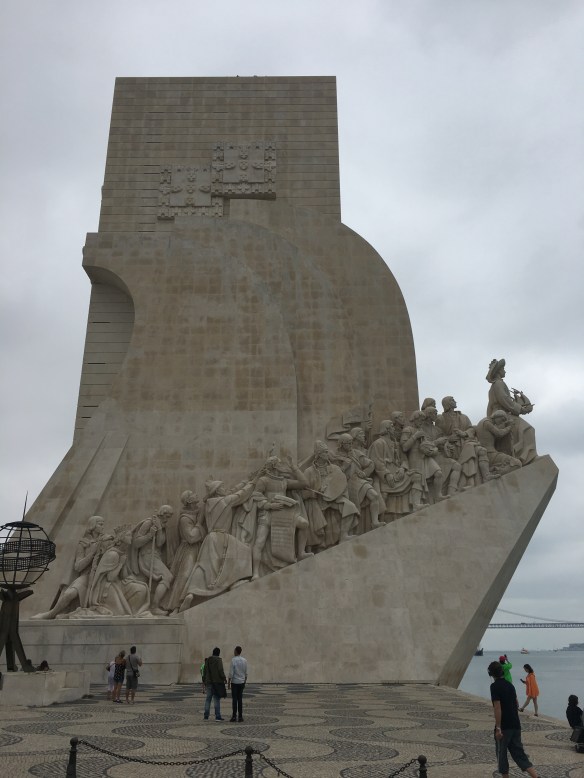
Part of my sabbatical journey took me to Lisbon, Portugal. On the far westernmost coast of continental Europe, Lisbon was a natural launching point for the various expeditions and voyages made by Europeans during the “Age of Discovery”.

IMG_6630

On Lisbon’s extensive waterfront at least a couple of impressive monuments stand in celebration of the achievements of European explorers and aviators. There is the looming Monument of Discovery which depicts the personalities of various explorers making their way across the ocean.

IMG_6632

IMG_6633

IMG_6631

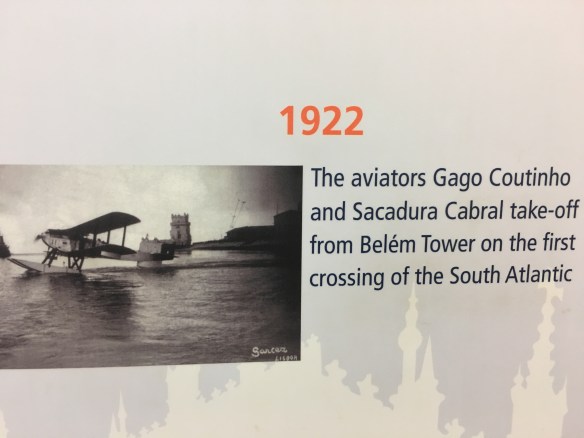
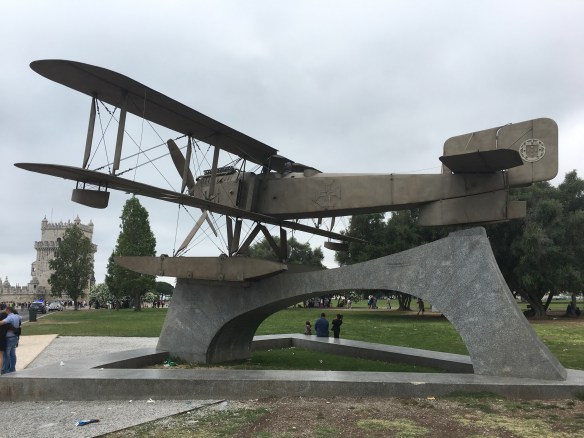
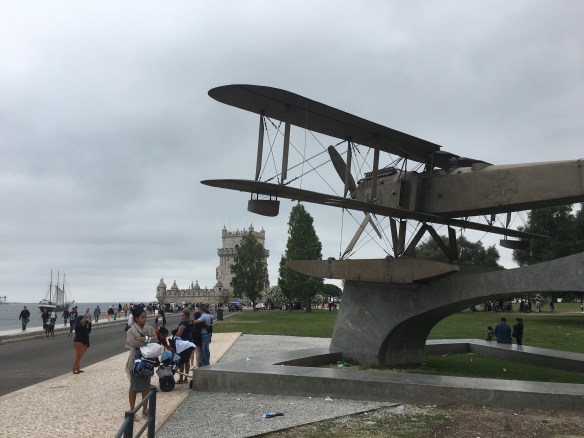
And there is an airplane monument commemorating the historic first south Atlantic crossing in 1922 flown by Gago Coutinho and Sacadura Cabral.

IMG_6628

IMG_6629

IMG_6634

In the decade following Coutinho’s and Cabral’s inaugural south Atlantic flight, another adventuring aviator, Antoine de Saint-Exupéry who is perhaps most well-known for writing the children’s book “The Little Prince”, reflected on what flying did to our understanding of the land upon which we live:

The airplane, he writes, “has revealed to us the true face of the earth. Through all the centuries, in truth, the roads have deceived us … They avoid barren lands, great rocks and sands, they are wedded to the needs of men and go from spring to spring …But our perspective has sharpened, and we have taken a cruel step forward. Flight has brought us knowledge of the straight line. The moment we are airborne we leave behind those [winding] roads …  It is only then, from high on our rectilinear course, that we discover the essential bedrock, the stratum of stone and sand and salt…

“Thus do we now assess man on a cosmic scale, observing him through our cabin windows as if through scientific instruments. Thus we are reading our history anew.”[2]

As we retell our history, as we seek understanding of what and how it happened, do we take the winding road, or do we take to the skies?

Amos the reformer was a prophet in ancient Israel. He challenged especially the northern kingdom in the eighth century B.C.E. to accept a new way of worshipping God. No longer where they to worship at the old shrines established by earlier prophets Samuel, Elijah, and Elisha at Beer-sheba, Bethel and Gilgal. Now, they would have to learn to worship God in a central location, at the temple in Jerusalem.[3]

In order to persuade them, he railed against the rituals and heartless pomp often associated with worship in that day.[4] The Israelites’ understanding of their own history needed changing. Without denying or changing the history itself, Amos helped them grow into an appreciation of the centralized worship which was not inconsistent with the Hebrew faith, a faith that had always emphasized care for the poor, the widow, the destitute. As such, Amos was “an agent of reformation”[5].

Whether we speak of ancient Israel, or the Reformation, or the Age of Discovery, or World War Two, or present day Canada, our remembrance is being reformed.

This first week of November is Treaties Recognition Week in Ontario. Listen to what perspective is offered in the writing of our history. Again, this perspective is not untrue. It simply offers a fuller understanding of what happened when Europeans ‘discovered’ this land:

“This native land was the home of many peoples, who have lived here for centuries and millennia. There is extensive archaeological evidence to confirm this statement. North America was occupied long before European strangers from across the ocean ‘got lost’ on their way to India and ignorantly named the inhabitants ‘Indians’.

“The residents of this new land had a deep regard for the practice of hospitality. So they welcomed the strangers to come ashore and opened their lives to these ‘lost’ explorers. This invitation to step out onto the land conveyed a message that did not make sense to the newly-arrived who had their own primary interests; wealth and resources.

“These alien visitors were nominally Christian. They were supported by ‘Christian’ interests intermingled with commercial and imperial motives. The biblical foundations and the practice of hospitality had been lost or buried under the exercise of abusive power that appears to be the inevitable companion of empires seeking to expand their influence and control. Equally forgotten or ignored was the fundamental biblical concept of covenant whose goal is establishing and nurturing respectful relationships that honour the Creator.

“These European strangers had been told by their highest authorities that any people unlike themselves actually were nobodies. The Doctrine of Discovery … reminded the newly-arriving aliens that they were superior to the ‘nobodies’ greeting them in hospitality. The rest is history and now we are trying to ‘get it right’ so that we can discover what it means to live in peace and mutual respect. It is time to set aside suspicion and abuse so that we can again become hospitable to one another as well as to contemporary visitors.”[6]

This anniversary year we sing “O Canada” and this Remembrance Day we’ve worn our poppies. It is important that we remember. It is important that we commemorate our history, good and bad.

How we remember is important, too. What aspects of our remembrance we emphasize speak loudly about the kind of people we are and aspire to be.

Amos presented a pretty bleak picture of Israel’s plight in the eighth century B.C.E.  The tone of his message is harsh, doom-and-gloom. It seems the Israelites can do nothing to avoid the inevitable calamity that awaits. It’s easy to lose hope and despair in the present circumstances. It doesn’t look good, what with all that’s going on in the world today.

From the perspective of history, though, we know how the story ends for them. We know the people of God are headed to the trials of Babylonian exile a couple of centuries later. We also know that one day, they do return to Jerusalem to restore the temple worship and re-build their lives at home.

Antoine Saint-Exupéry tells the story of when he and his friends from northern Europe invited some north Africans from the Sahara to visit with them in France.[7] These Bedouin, up until this point in their lives, never left the desert; they only knew the scarcity of water that defined so much of their lives and perspective.

When they climbed in the foothills of the French Alps they came across a thunderous waterfall. The French explained to their astounded friends that this water was enhanced by the Spring run-off of melting snows high above them. After minutes of silence during which the Africans stood transfixed before the bounteous and gorged scene before them, the Europeans turned to continue on their mountain path.

But the Africans didn’t move.

“What are you waiting for?” Saint- Exupéry called back.

“The end. We are waiting for the water to stop running. A stream of water always runs out. We are just curious to see how long it takes.”

They would be waiting there a long time. The prophet Amos concludes his diatribe by doing what so many other prophets of Israel do: They call on the people to have faith in God’s action in the world, God’s righteousness and justice. “Let justice roll down like waters, and righteousness like an ever-flowing stream.”[8]

God’s justice never runs out. The waters of God’s grace, mercy and truth never cease flowing. Our perspectives, our experience, our opinions are limited and sometimes scarce, if we rely on these alone.

But God’s work continues to gush forth in and all around us. Let us trust and have faith in the never-ending flow of God’s love and presence in the world today. So we may grow into the fullness of God’s vision for us all.


[1]  “From Conflict to Communion: Lutheran-Catholic Common Commemoration of the Reformation in 2017” (Leipzig: Evangelische Verlagsanstalt/Paderborn: Bonifatius, 2013), p.16

[2] Antoine Saint-Exupéry, “Wind, Sand and Stars” trans. by William Rees (New York: Penguin Classics, 2000), p.33-34.

[3] Wil Gafney in David L. Bartlett & Barbara Brown Taylor, eds., “Feasting on the Word: Preaching the Revised Common Lectionary Year A Volume 4” (Kentucky: WJK Press, 2011), p.266-270

[4] Amos 5:18-24

[5] Wil Gafney, ibid., p.268

[6] Reconciling Circle: reconcilingcircle@execulink.com, Daily Readings for Treaties Recognition Week: 5-11 November 2017, Day 1 “Have You Ever”

[7] I summarize and paraphrase his telling from “Wind, Sand and Stars”, ibid., p.54-55

[8] Amos 5:24

God-talk

Last week in the Canadian Football League (CFL), Ottawa RedBlacks receiver Diontae Spencer set a CFL record in a game against the Hamilton Ticats for most overall yardage gained — just under 500 — in one game. His incredible feat was truly remarkable in a game where his team didn’t score any points in the first quarter.

When asked afterwards about his record-setting accomplishment, Spencer mentioned God several times. He emphasized that the praise was ultimately for God. He couldn’t have succeeded along with his team in that game without God. God was the reason and source of his victory.

Such a witness gets a lot of mileage, especially on national TV covering a professional sports league in Canada. It is true: the public, general impression of Christians is their often-exuberant witness to an all-powerful, almighty God who authors and reflects anything and everything that is glorious, successful, impressive and spectacular. This is the dominant belief and main flavour of the kind of God-talk in the public arena when it comes to Christian witness.

Years ago, a parishioner in a former parish declined my invitation to her to give a testimony of faith during a mid-week Lenten program. I knew she was struggling with some personal challenges at the time. When I asked her why she said no, especially as I recognized in her the strong gift of faith, she said she wanted to wait until things were going better in her life before sharing her faith.

While I understood her reasoning, and was mindful of the delicate situation in her life, I wondered to myself if her attitude didn’t reflect a more general disposition among Christians today. As if you could only give public testimony of faith when you could talk about how good your life was. As if you could only give public testimony of faith when you could point to external circumstances that were favourable, impressive, even enviable.

After all, how could you get up in front of people and talk about God when all was not well in your life? How could you talk about God if you had nothing impressive to show for it? More to the point, would you be giving faithful testimony to God if everything in your life was broken, damaged, failed?

Is God only mentioned when humans achieve something great? Is God only a God who wins contests on the football field and battlefield of life? Can God be talked about only among folks who have succeeded and are healthy and rich? Only when things are going super well?

Or, could God also be present and real to us when we fail, when we are down, when we lose our earthly battles? It seems to me Christians call themselves Christian because we follow the way of Christ. And so, don’t we believe in the God of the Cross? God, by all human standards, failed — being branded public enemy number one and condemned to death. Jesus’ broken body is the iconic symbol for Christians. It is precisely in the suffering of life where God finds us.

On this All Saints Sunday, we understandably focus on what human beings have accomplished: the saints on earth and the saints in heaven. Blessed are those who demonstrate the qualities we read in the Beatitudes[1] — the Gospel text for this festival in the church calendar.

“Blessed” is not the word we might associate with being poor, persecuted peacemakers especially if we use the often-translated English word, “Happy”. I prefer the translation of the first word in the Psalms[2] also often translated to “Happy are they …”:

The Hebrew word here is ‘ashar, which means, literally, “to find the right road.” So, in providing the first beatitude, Jesus is saying: “You are on the right road when you are poor in spirit.”[3] I prefer this translation because it implies a direction rather than a moral state.

Should we take these beatitudes as moral rules for living, as with the Law, we can never fulfill it perfectly. And therefore, we can easily despair and give up. Being on the way, however, gives the long view and big picture. It implies the need for trusting that we are headed in the right direction even if the present circumstances in our lives suggest otherwise.

What is more, as much as we want to make the Beatitudes into the Ten (or rather, Nine) Commandments of the New Testament, this speech from Jesus — given at the beginning of his Sermon on the Mount in Matthew’s Gospel — is not primarily about ‘rules for moral behaviour’ as it is facts about God. These Beatitudes really and fundamentally describe God.

Matthew’s narrative builds towards this awareness, if you can appreciate the classic reversal that Matthew sets up in the first five chapters of his Gospel:

In the first chapter, Matthew’ genealogy firmly plants Jesus “the Messiah” in the lineage of the great Israelite King David. In the second chapter, exotic magi from the East come to pay homage to the newborn king. In the third chapter, King Herod takes seriously this threat to his power and tries to eliminate a contestant to his throne by killing innocent, Hebrew two-year-old boys in Bethlehem. Then, John the Baptist comes on the scene, announcing that he was making way for one who was greater than he. Finally, Matthew has Jesus ascend a mountain where he, like his predecessor Moses, would dispense the Word of God and give his inaugural address.[4]

You can see the build-up, I hope, of an expectation that Jesus would come to bring justice to the wicked and set things right. He, the Messiah, would turn back Roman oppression and occupation of Palestine. But, these words from Jesus’ mouth announcing who is “blessed” pull the rug from under our expectations of who God is. “The one who was supposed to lead revolutionary armies or bring down heavenly fire shows up in Galilee building hospitals and telling people not to hit back.”[5]

Can you imagine the surprise and shock among his disciples! Even the imprisoned John the Baptist does a double-take on his faith and later questions Jesus: “Are you the one who is to come, or shall we keep looking?”[6] It is no wonder, then, that Peter later rebukes Jesus when he talks of his impending death: “God forbid it, Lord! This must never happen to you!”[7]

These beatitudes must have seriously disappointed his listeners and most ardent followers who had such ‘high’ expectations of their would-be Messiah King. How could they now continue following this man?

Is the reason why we may have trouble conforming our lives to the way described in the beatitudes is that we really don’t believe in these words as giving an accurate and trustworthy understanding of God? This is, after all, Jesus, who we know was persecuted and reviled as the prophets were before him.[8]

Do we believe in a God who chooses to be revealed in human flesh, born a vulnerable baby to a teenage couple? Do we believe in a God who chooses to be revealed dying a grotesque and brutal death on a cross showing the world a bruised, beaten, broken and bloody body?

If we did, perhaps we would hear more from the losers in our society. Perhaps TSN would hear the faithful witness of locker room players talking of a God who knows how it is to lose a big game and still keep faith. Perhaps we would hear more from street people, addicts and the impoverished, vulnerable people talk of their simple yet honest faith in a God who walks with them. Perhaps we would hear more from children declare their love of a playful God who carries our burdens for us, freeing us to be who and how we are without judgement and punishment.

Perhaps we would listen more to the murmurs of our own hearts whisper the love of God for us especially when we suffer the turmoil of life. Then, I gather, the world will open its eyes to the God of grace and love.

Because they will see people who live in hope. They will see people who know they have found the right road where they find God most present in helping people who suffer loss and pain, a road on which Jesus has walked himself, a road upon which God will always first find us.


[1] Matthew 5:1-12, NRSV

[2] Psalm 1:1, NRSV

[3] Earl F. Palmer in David L. Bartlett and Barbara Brown Taylor, eds., “Feasting on the Word: Preaching the Revised Common Lectionary Year A, Volume 4 (Kentucky: WJK Press, 2011), p.238

[4] Allen Hilton in ibid., p.239

[5] ibid., p.239

[6] Matthew 11:3

[7] Matthew 16:22

[8] Matthew 5:11-12

Sabbatical reading list

I enjoyed reading during my sabbatical. Here is a list and brief commentary on seven of the books that I particularly liked:

1. Saroo Brierly, “Lion” (previously published as “A Long Way Home: A Memoir”), Toronto: Penquin Books, 2013.

This memoir was also made into a motion picture under the title, “Lion”. The author documents his traumatic story of becoming separated from his family and lost as a child in India. Miraculously he finds help at the right time and the resources he needs to escape an impoverished and dangerous life on the street in Calcutta, and start his life over in Australia. Under the care of loving foster parents, he responds to an inner longing. His journey home is about finding the roots of his life in India. The story is about death and resurrection, relationships, and journeys of longing, searching, and finding.

2. Charles Foster, “Wired for God? The Biology of Spiritual Experience”, London: Hodder & Stoughton, 2010.

I find Charles Foster to be both delightful and humorous, as well as serious and respectful of the Christian faith. This is not an easy balancing act to perform in one book. He nevertheless provides a thorough academic and scholarly background to his arguments. He suggests that both belief and experience are essential to the journey of faith. But he does not give glib and easy answers to complicated questions and paradoxes of life and truth. Particularly, I enjoyed learning more about the biology of our brains and how the mechanisms of neurotransmitters and other functions of the cortex relate to near-death, out-of-body, mystic and intensive care experiences. Pointing to historical and current examples, Foster weaves a rich and (shall I say) entertaining read. I first encountered Richard Foster reading his “Sacred Journeys” published around the same time.

3. Adam Shoalts, “Alone Against the North: An Expedition into the Unknown“, Toronto: Penquin, 2015.

A Fellow of the Royal Canadian Geographic Society, Adam Shoalts writes about his recent wilderness expeditions to the Hudson Bay Lowlands. In his gripping true tale of adventure, he tells the story of persistence, human resolve, success and failure. Relating his personal experience Shoalts comments on the nature and passion of exploration. He exemplifies the survivalist par excellence who depends on the land, water and air and with simple means survives life-threatening dangers in unsuspecting waterfalls and killer polar bears. Despite all the obstacles, he is pulled forward by an unrelenting motivation to complete the journey.

4. Phil Cousineau, “The Art of Pilgrimage: The Seeker’s Guide to Making Travel Sacred”, San Francisco: Conari Press, 1998.

A classic tome on pilgrimage, Cousineau’s book gives a comprehensive summary of what pilgrimage means. He suggests the idea of pilgrimage is more than just going to a traditional site. Pilgrimage could land someone anywhere on the planet — not just Jerusalem, Rome and Santiago (for Christians). Cousineau supplies in two hundred pages all the well-known quotes and citations about pilgrimage. So, I regard this book as a go-to resource for finding anything ever written on the theme of going somewhere to find meaning. I particularly liked how he helped the reader define for themselves what kind of pilgrimage to make, based on the reader’s own passion, longing and need to go somewhere. He makes the reflection both personal and historically sound, and suggests practical ways of making travel something more than just being a tourist.

5. Eca de Queiroz, “The Relic”, London: Dedalus, 2003.

Originally published in Portugese in 1887, this fiction is a European classic. It tells the story of a young university student who pretends at being pious and devoted to his Christian practice, motivated only by impressing his rich aunt so he would inherit the family fortune upon her death. Set in Lisbon, “The Relic” is about the journey of a man who crosses boundaries of moral behaviour in his secret/true life but shows off in order to please and meet the expectations of others. After a fantastical trip to Jerusalem to find a relic to bring home to his aunt, our hero experiences the folly of his hypocrisy. And, through the pain of defeat and untold embarrassment, he learns in the end to hold both the good and bad in his life.

6. Richard Rohr, “Adam’s Return: The Five Promises of Male Initiation”, New York: The Crossroad Publishing Co., 2016.

My favourite author/mentor, Richard Rohr continues in this book to make the case for authentic, real, and healing experiences for men in Western society. Drawing from cross-cultural and historical examples, Rohr describes what happens in male initiation rites, and what is hoped for through these transformational rites. It should be no secret that men suffer emotionally in our culture that give little space for men to be real, vulnerable and honest. Rohr reflects on Scripture and describes what is, in my reading, a summary of the Gospel: Only by accepting what is real, painful and honest about one’s life, only by entering the Paschal Mystery of Christ crucified and risen in one’s own life, can men rise into the resurrection of new life and hope.

7. Beldon C. Lane, “The Solace of Fierce Landscapes: Exploring Desert and Mountain Spirituality”, New York: Oxford University Press, 1998.

This was my favourite book on my sabbatical. A dense read (I had to re-read sections), Lane offers a historical overview of mystic/contemplative tradition, citing the likes of Gregory of Nyssa, Evagrius, Cassion, Julian of Norwich and other desert mothers and fathers. He also emphasizes the importance of geography in expressing one’s journey of faith, comparing for example the experiences of hiking up Mount Sinai compared to Mount Tabor. He makes the case for a healthy spirituality that includes both apophatic (no words, letting go, release, loss, mystery, disorder, contemplation, silence, solitude, stillness) and kataphatic (language, community, structure, order, images, action) modes of relating with God. You can’t have one without the other. Observing regular contemplative forms of prayer leads to a renewed engagement with community. Essentially, nevertheless, this is a book describing the process of grief. Lane writes about this stage in his midlife dealing with the loss and deaths of his parents, and how the experience of the nursing home and caring for his dying mother contributed to his inner and outer journeys. And his healing.

You may follow me on Goodreads.com for a listing of all the books I have read.

The good crowd

I was ten years old when my parents shuffled me and my brother into one of the front rows of the main, outdoor theatre in the small, Bavarian town. The crowd pushed and shoved for privileged seating to watch the story of Jesus’s last days acted out daily by the town’s folk every ten years.

In fact, the crowd on the large stage did not appear any different than the tourists who got up very early in the morning for tickets to the Oberammergau Passion play.  

This coming Holy Week is rich with story. And when we read the stories about the last days of Jesus — full of drama, plot, and character — we will naturally identify with elements of the story-telling. Our worship is designed to help us identify, for example, with the crowds.

This morning, we sing “Hosanna” and wave our palm branches identifying with the enthusiastic crowd that first day when Jesus entered the city. “A very large crowd spread their cloaks on the road, and others cut branches from the trees …” (Matthew 21:8). Some years in Holy Week we dramatized and therefore simplify the trial scenes. We have individuals and groups speaking the various parts of the story. So, for example, ‘the crowd’ is played by the whole congregation who chants those lines together, such as “Crucify Him! Crucify Him!” (Matthew 27:23) and “He deserves death!” (Matthew 26:66).

Undergoing some mysterious metamorphosis sometime between Palm Sunday and Maundy Thursday, the crowd turns to the dark side. In a tradition that goes back centuries, Christians have most often portrayed the Jewish crowd around Jesus during his last days as rabidly and violently against him. We see it in Passion plays, the most famous of which is at Oberammergau in Bavaria. The evil crowd is also central to Mel Gibson’s film, “The Passion of the Christ.”

This over-interpretation has unfortunately led to harmful, anti-semitic justification against the Jewish people throughout the dark side of Christian history.

It may be easy to identify with these ‘bad’ crowds more than anyone else in the stories. Through the journey of Lent, we have struggled with the shadow self of our own lives, carrying our own cross so to speak, alongside Jesus. We have confessed our sin. Indeed, at the climax of Christ’s Passion, we pound nails into the cross on Good Friday. We so readily identify with the crowds, even saying that ‘we’ have crucified Jesus by our sin. It is little wonder why we come to these rather negative views, from Scripture.

What these portrayals fail to address, however, is this: Why, if the Jewish crowd was so against Jesus, was it necessary to arrest him in the darkness of night with the help of a traitor from among Jesus’s followers? Why not arrest him in broad daylight? And why do they need Judas?

What we discover is a positive, more balanced approach to the identity of the crowd. First we need to understand why the high-priestly authorities wanted to do away with Jesus.

“[The chief priests and Pharisees] wanted to arrest him …” (Matthew 21:46).

If the chief priests and Pharisees let him go on like this, everyone would believe in him, and the Romans would then intervene and execute them (John 11:48). Moreover, the authorities were not just afraid of the Roman Emperor, who was the recipient of Judean tax money and demanded political allegiance from those put in a position of power by the Emperor to keep the Pax Romana in the region. Insurrection in Judea would not be tolerated by Rome.

“… but they feared the crowds …”

Pilate and the high-priests also felt threatened by the whole crowd of people who, if they didn’t do something about Jesus, would eventually turn on them, which in 70AD (around the time most of the Gospels were written), did in fact happen. (1)

The Gospels reveal a clear disconnect between the high-priestly authorities who wish to execute Jesus, and the “whole crowd” who are “spellbound by his teachings” (Mark 11:18) and who “regarded him as a prophet” (Matthew 21:46).

This favourable support of Jesus by the predominantly Jewish crowd does not stop after the “Hosannas” of Palm Sunday. It continues throughout the days leading to the Passover Festival in Jerusalem.

The crowds aren’t perfect, to be sure. Their motivations for supporting Jesus may very well have missed the mark, especially those who still sought in Jesus a violent solution to the end of Roman rule in Judea.

Yet, they are captivated by his teachings. There is some good, therein. The ‘whole crowd’ can be personified by each of us. Which part of ourselves identifies with the crowd that is for the most part good and supportive of Jesus, even during his last days on earth?

I ask this question, especially in the midst of the most penitential season of the church year. I ask this question, and make this point as a spiritual antidote to what can easily, and so often does, slide into self-hatred on account of all our sinfulness.

We must remember we live in Christ Jesus, and the living Christ lives in us through the Holy Spirit. There is some good therein. We don’t need to be so hard on ourselves.

“The secret of life,” say the American Indigenous people, “is in the shadows and not in the open sun; to see anything at all, you must look deeply into the shadow of a living thing.” (2)

We may begin Lent and Holy Week — indeed our Christian pilgrimage on earth — by confronting our shadow self. It’s important to do so. But by the end of Holy Week we cannot avoid the open sun and see the empty tomb. The ending is always as it was in the beginning when God created everything and everyone, and said that it was good. “It was very good” (Genesis 1:31).

 
1 — Marcus J. Borg & John Dominic Crossan, “The Last Week: What the Gospels Really Teach About Jesus’s Final Days in Jerusalem” (New York: HarperCollins, 2006), esp. p.87-91

2 — cited in Joyce Rupp, “Walk In A Relaxed Manner: Life Lessons from the Camino” (New York: Orbis Books, 2005), p.161

Place for all – a funeral sermon

“Lord, when the shadows lengthen and night has come, I know that you will strengthen my steps toward home, then nothing can impede me, O blessed Friend! So, take my hand and lead me unto the end.” (1)

I wonder if in her last days in the hospital, May if she weren’t singing the words she certainly meant them when she declared a few times to those attending to her, “I’m soon going home.”

In saying this, did she mean her home in Osgoode — the homestead and first family home? Or in Bel Air Heights on Cannon Drive, where she and her family lived for 52 years? Or, was a more nuanced meaning of ‘home’ coming to mind? For example, when home wasn’t so much a specific place, as it was being with family in any place — such as the campground at Silver Lake, which I hear you frequented quite often and created so many cherished memories together.

“I’m soon going home.” Or, as I suspect, didn’t she already know that she soon was going home to be with all her loved ones gone before her — in her heavenly home?

A prayer on her lips and a well-known hymn’s words: So, take my hand and lead me, Lord, strengthen me in my steps toward home.

Indeed, home life was so important to May. You have told me, dear family, how your home — however imagined — was always a place of welcome to all your friends. It was a place of unconditional acceptance of each of you and your friends. Your home became a destination place for the community. A basement brimming with energy and sounding of laughter was a common occurrence. A tone of inclusiveness and openness surrounded home life.

Today as we gather to celebrate May’s life, we can affirm that God’s house is now home for May (John 14:1-3). This is a dwelling place which has a room for her, and all her loved ones in the heavenly host. 

May feels at home, I am sure, because her homes on earth seemed very much like what Jesus described in the kingdom of God: A place of inclusion, where all feel welcome. Food for everyone! An acre of vegetables that had to be tended, comes to mind, as you shared precious memories of treasured places like the large garden in the back yard.

In the Gospel reading, when Jesus says: In my Father’s house there are many rooms, read “a room for you” as “a place for you.” It goes beyond a mere belonging. It means “you can be yourself fully, here”. It means “you can come just as you are and be as you are.” “You can participate fully in everything this family is about.”

This participation is not isolated individualism. Because a house has shared space. A house has many rooms, yes. But a house means you are in a community of a certain kind. There are spaces in a house that must be shared — a living room, family room, dining room, kitchen, hallways, bathrooms.

Your parents were leaders in this shared space. They valued certain things in the family. They taught you what you know about being in relationship with one another: respecting the other, being responsible for your actions, being accountable to one another. Each of you had ‘room’ in this family to participate fully in your own unique way, and still be mindful of the other. 

The journey which continues today for May in her heavenly home begins on earth. However we find our way from this day onward — different for each of us — the same God who walked with May on earth walks with us. The God who blessed May with the joy of family relationships leads us toward bright horizons — the dawn of a new day.

Lord, take my hand and lead me upon life’s way; Direct, protect, and feed me from day to day. Without your grace and favour I go astray; So take my hand, O Saviour, and lead the way. (2)

Amen.

(1) – Julie von Hausmann, “Lord Take My Hand and Lead Me” in #767 Evangelical Lutheran Worship, Augsburg Fortress, MN, 2006

(2) – Ibid.