Lift, and open the gates!

I reacted with sadness and sympathy looking at the photo of my friend’s dog whose entire face, chest and front legs were pierced with dozens — maybe even hundreds — of the sharp quills of a porcupine.
The photo was taken of the dog in the back of the car on the way to the vet, and she seemed stable enough — like the look of someone who knows they’ve been stung and know they just need to hold it together for a bit longer.

I felt sorry for that dog because it was simply being true to its nature — maybe motivated by a natural impulse to be friendly and play with another creature. Unfortunately, good intentions don’t always yield the desired results in relationships. Often, expressions of love and care are misunderstood. And the response can sting — just like this poor dog! I wonder if this dog will ever approach another porcupine again with such exuberance. 

On All Saints Sunday, Christians remember not only those who have gone before us who now taste and see the glory of God in eternity. We also reflect on the “communion of saints” on earth. And, like we did last Sunday during the celebration of the Reformation, we ask the good question: Who are we? Who are the saints? What qualifies a Christian for sainthood, beginning in this life?

Psalm 24 may suggest that no one living can belong to this glorious, virtuous group of people. Only those with clean hands and pure hearts who do not swear deceitfully (v.4) can qualify. A sharp tone of exclusivity rings throughout our tradition. Since I am not good enough, and will never be good enough, I have nothing good to offer. And so I will grovel in the dirt, turned in on myself and my sins.

Such negativity dominates our way of life. We don’t see abundance, we see scarcity. We don’t see forgiveness of sins as much as we love to talk about and dwell on our sinfulness. We don’t see the good, we see the bad. It’s a dangerous world out there, after all, and so we need to build closed, protective fortresses around us. And therefore, we get stuck in a self-centred, self-inhibiting style of life. Who am I to be able to offer anything of value? Let alone be counted among the saints?!

The bible’s poetry, today from the Psalms, offers insight into this problem. The Scriptures reveal a way of emphasizing what is important. Really important. We see this method most in the Hebrew scriptures — the Old Testament Psalms and prophets: Repetition.

Repetition of words and phrases underscores a sense of urgency or jubilation. In the Psalm for today — 24 — certain phrases are repeated. The context is a massive procession coming up the road to Jerusalem; God is returning to the temple being restored in the city of God. 

And as the people ascend to the walls, the cry goes out not once (v.7-10), but several times: “Lift up your heads, O gates! and be lifted up, O ancient doors! that the King of glory may come in.” (x2) The general image of ‘lifting up’, in fact appears almost half a dozen times in this short Psalm. What emphasis is being sought by the Psalmist, here?

The insistence of lifting up the gates mounts beyond the request to raise the gate just high enough, or the doors just wide enough, for the King of glory to enter and then to be slammed shut in the face of the others in the procession. Rather, the intent is for the gates to be raised so high above the walls that they will never need to be shut again. The intent is for the doors to be flung off their hinges, in order that the seekers and followers of the Lamb may follow him, redeemed and welcomed, into the courts of God. (1)

“The barriers to paradise, like the stone rolled away from the empty tomb in the garden, have been pushed aside to give us unfettered access to behold the smiling face of a gracious and accepting God, whose mercy, rather than our own merits, enables us to pass through the open door.”

We need to remember and appreciate who our King of glory is: A man, named Jesus, who encountered in his short life on earth all that we must endure and suffer. Our God is a God who became one of us in order to fully appreciate our own station in life. God understands our human weaknesses, suffers and endures with us on the road up to Jerusalem, and longs to welcome us into the divine presence. 

Ours is a God who bears the scars and wounds of crucifixion, even in his resurrected form. God is one who identifies with us seekers and wanderers who bear the scars of life, the woundedness of sin — and yet who long for something more: a deeper communion with God and the saintly procession going to Jerusalem together.

If we want to know God, we must know and accept ourselves; if we want to accept ourselves, we must know and accept God. Who are we? Well, perhaps we first need to ask: Who is God? Clean hands, a pure heart, a humble spirit, integrity and honesty — these are infinitely more difficult and subtle a list of characteristics suggested by this Psalm than the mandates against theft and adultery and the taking of another life (as in the Ten Commandments).

The qualifiers for sainthood are not a cut and dry check list easily accomplished like completing a shopping list. Rather, the qualifiers for sainthood are worked out in a life-long journey and sometimes seesaw struggle with the One who despite bearing the scars of suffering is the only One with clean hands and a pure heart.

Who are we? Well, then, Who is God? In Jesus, God is the One who welcomes us all into the holy city, whose cry goes out to lift up those gates — I mean, really lift up those gates — forever — in order to let in that whole procession of rag-tag, diverse, wounded, broken followers!

Knowing who we are, appreciating fully the grace and acceptance of us by a God who knows us, what do we have to lose? We can offer what little and what much we have to help others. We can use the gifts we have been given for the sake of the other, and with others, on this journey. We don’t have to be afraid. We can take the risk to reach out — not worried about the results but only convinced of the value of what we do.

Whether we have been stung by the quills of disappointment; whether we have been hurt by the failures of our lives; whether we have been weighted down by the pressures of performance in work and play; whether we endure the pain of physical, mental, emotional illness; whether we grieve through the losses of life — we are still on the way! And will always be!

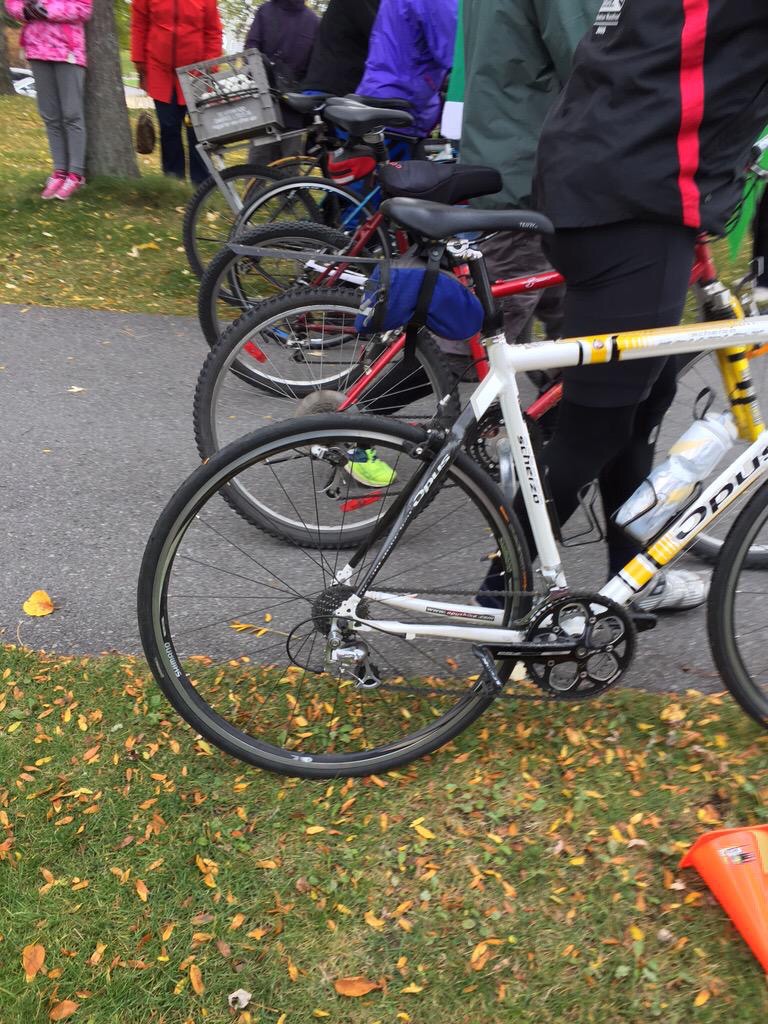
The highlight for me during the clerics cycling challenge (clericchallenge.com) was the finish line, when we all crossed together. This experience symbolized for me what the culture of Christian community ought to feel like and be like.

   
 We are part of a holy procession led by the King of Glory whose destination is sure. We have nothing to lose. If God’s grace is extended even to the generation of seekers (v.6), then we have nothing to lose. If what we are about is not a competition, then we have nothing to lose. If we don’t need to find fault in the other to prove our own self-worth, then we have nothing to lose. If it’s not about one-up-man-ship, then we can go for broke and not worry about it. If we don’t need to question who our Saviour is — who already accomplished for us our salvation — we don’t need to doubt our final destination. Then, why not share now what we have with others on this road?

All the saints on earth, despite the scars of life we bear, have gifts to share with other seekers on that journey. What gifts and blessings of God reflect in your life? In discerning this, remember: It’s not up to you alone! We don’t need to be perfect. We gain the gates not by our own merit or even hard work. Ours is the victory only because of the One for whose reason the gates are lifted in the first place.

Thanks be to God!
(1) — Michael Morgan in David L. Bartlett & Barbara Brown Taylor, eds. of “Feasting on the Word Year B, Volume 4” Fortress Press, 2009, p.228

How to love a porcupine

The following story was shared at a Faith Lutheran Women’s meeting recently, and I am relating it to the themes generated by the Lutheran World Federation (LWF) and adopted in convention by the Evangelical Lutheran Church in Canada (ELCIC) this past summer, to celebrate the 500th anniversary of the Reformation in 2017: “Liberated by God’s Grace: Salvation-not for sale; Humans-not for sale; Creation-not for sale!”

I was walking through the woods one day, happy to be outside in the wild. I was thinking about Jesus’ command to love our neighbour (Matthew 22:39; Mark 12:31; Luke 10:27). How is this possible? How could I love people who are not like me, who are different than me, whose beliefs are ‘a stranger’ to me.

When I rounded a bend in the path through the forest, I suddenly came across a porcupine trundling across the way in front of me. Its prickling spine and shell were covered with a dense coat of sharp quills pointing outward towards me. I stopped short and wondered what to do.
I think the porcupine, startled by my sudden appearance in its world, did as well.

In the silence that separated me and the porcupine on that path, I grinned at the thought that God must also love the porcupine. As ugly and as funny a creature it is, the porcupine too is created and therefore beloved by God. But how could I love that porcupine?

The porcupine is a rodent that can be hunted in Ontario, open year round and no limit by the law. Moreover, the porcupine’s meat is apparently safe to eat — a low risk, uncontaminated option in the protein department. Help yourself!

Perhaps to love a porcupine could mean different things. Sometimes if I assume loving a porcupine could only mean one course of action, I may be pricked by the needles!

If you were in that forest, confronted by that porcupine, what would you do? Or not do? 
In whatever you do, are you aware of why the porcupine might be afraid of you? The porcupine, like many creatures in the wild, is not for sale; that is, you aren’t there to buy or sell the things you see in the forest. So, why are you in that forest in the first place? What are you doing there? What are some words you could use to describe your relationship with everything else that makes the forest their home — including the trees, the water, the birds, and creatures that inhabit the place? (For example, are you their ‘owner’, or do you ‘share’ the gifts of creation with other creatures? What do you make of the fact that you are stronger and smarter — probably, and hopefully! — than most other creatures? What do you make of this gift you have?)

How is the forest, the path, and the porcupine analogous to human community and how we relate in our society to one another? How can we love the stranger who is also our neighbour? And just because we may not understand fully other creatures — including other people who are different — how can we show love to them (For example, by listening to them? By being curious to learn more about them? By helping them with something they need in our shared humanity? etc.)

Wise speech is a prayer

My parents, now retired pastors, have been ordained many years in the Evangelical Lutheran Church in Canada and the Polish Lutheran Church. My mother told me that not once in her long years of work did she choose to preach on the second lesson for this Sunday in Ordinary Time — the 18th Sunday after Pentecost — James 5:13-20. 

So, curious, I went back in my online archive of sermons to see if had. And to my surprise, I discovered that I now have preached two sermons in a row based on this text. The last time in the lectionary these texts appeared was three years ago in September 2012; and here we are three years later focusing on it again!

Why so? I asked myself. Many possible reasons likely. Not to mention the lectionary group here at Faith chose to reflect on James — yet again! Could it be, underlying this desire to look at James is the church’s need today for some practical advice about how to live the Christian life? Could it be, that the church today needs basic guidance about how to live as a Christian would in today’s world?

When we think of all that we say, all the airtime we populate with our words, how much of it would we consider ‘wise’? It is important to ask this, since one of the major concerns in the Book of James is our speech (Mark Douglas, Feasting on the Word Year B Vol 4, eds. Barbara Brown Taylor & David L Bartlett, WJK Press, 2009, p.112). And, it’s not so much what we say but how we say it — in the context of the relationships involved. This, indeed, requires great wisdom. So, I ask again, how much of what we say would we consider wise?

My guess is, not much. When we think of all that we say that is hypocrisy — that doesn’t really coincide with the choices we make, the lifestyles we lead. When we think of all that we say that only ends up hurting others …

When wise speech happens, it is truly a holy event. This is speech that communicates truth and honesty. This is speech that reveals vulnerability, expresses compassion, tenderness and authenticity. This is speech that is wise. And wise speech is then a prayer in God, with God, to God.

And, it is not only spoken to the ceiling. Because prayer is fundamentally a public act, not a private affair. One of the unfortunate victims of the Reformation period  — which launched the Enlightenment and Industrial and Scientific Revolutions of the modern era — was that Confession was relegated to a lower place in the value systems of religion. As a result of these modernizing developments which heightened the importance of the individual in religion, prayer was reduced and confined to words spoken to the air in our private lives.

In contrast, Confession is about speaking honestly the truth of our lives to another and with another. Confession is wise speech which brings healing and wholeness, when another ‘in the flesh’ can hear the truth and respond with guidance and in love, mercy and forgiveness.

And what we do every time we gather to worship, is pray. We pray in all the parts of the liturgy. Whether we are celebrating the sacrament of the table, whether we are listening to the sermon, whether we are singing a hymn or ‘saying’ a prayer — we are praying! Including the Confession of sins, and the pronouncement of forgiveness.

It is true — the church needs basic guidance about how to live as a Christian would in today’s world. I emphasize in today’s world because sometimes I don’t think we realize how decidedly unChristian this culture of ours is. And I don’t just mean the fact that we live in a multicultural, ethnically and religiously diverse society. But also, even in the institutional church, in our own lives, our lifestyles, our common sense assumptions about how to live our lives and the values we espouse: our attitudes towards competition, financial security, self-defence, self-righteousness, financial-material selfish gain, etc.

Perhaps it is time for the Reformation church (including Lutherans) to let go of the split we have created between grace and ‘works righteousness’. It is not all ‘cheap’ grace on the one hand; nor is it all work, on the other. In truth, it is a lot of work and practice to remain fully open to underserved and unmerited grace (Philippians 2:12-13). Because we will rush, if unawares, to make it all about our hard work. Just work harder!

At the same time, as Cynthia Bourgeault writes (in The Wisdom Way of Knowing: Reclaiming an Ancient Tradition to Awaken the Heart, Jossey Bass Publishing, 2003, p.10), “those willing to bear the wounds of intimacy, the knowledge of that underlying coherence – in which all things hold together – is possible.” To let go of the compulsions that keep us captive and stuck in patterns of life that are ungracious, untrue, unhealthy. To commit to the work and sacrifice of being true to self, true to neighbour and true to God. To practice confession and honesty with another. To accept the forgiveness, mercy and love of God and to receive it fully and know peace.

Could it be deep down we know it but are afraid to address and embrace it: the values of God in Christ Jesus are meaningful — they make for great, wordy and pious statements in church groups — yet clash with what we do and what we actually say to one another?

The Furious 7 movie which was Paul Walker’s last before he died shortly after filming the movie, ironically, in a car crash, highlighted for me this hypocrisy. In the extended version which I assume was edited after his death, there is a beautiful scene on the beach where Paul Walker’s character and family are gathered. His friends watch on as he plays with his young child and pregnant wife at the water’s edge. One of them remarks how what is truly important in life is not the thrill-seeking, high-octane, ego-satisfying selfish pursuits, but his relational world of love and family which endures forever. In contrast to the explosive, sensational content of the film up to that point, this affirmation of family living in love is rich in meaning and truth.

I commented in my slightly cynical mood after the movie that I didn’t think the Fast & the Furious franchise would have grossed the hundreds of millions it did if it made movies solely about family and love. It seems we want to acknowledge what is true and right, but only after we first can serve our own fixations and compulsions ‘for the thrill’.

Another TV example: Did you notice how the Amazing Race Canada presented the final words of the father and daughter from Africa — newly arrived immigrants, when they were eliminated before the final round? They were the victims of unfair play in that second-to-last leg of the race; other teams cheated on them by stealing their taxi not once but twice, if I remember correctly. 

And then, as the host John invited them for some closing remarks on the elimination mat, all of them spoke beautiful tear-wrenching words about the fair, generous nature of Canadians. It seems only the losers have something meaningful to say. Only when we suffer loss do we discover the truth of our lives. Now, we are getting uncomfortably closer to the whole point of our Christian faith and what it means to follow Jesus.

As I wrote three years ago, in James’ concluding chapter we encounter vivid images of prayer involving the laying on of hands and the anointing with oil. Prayer is a public act that invades the space of individuals and pulls us to be in the space of one another. Prayer is inherently relational. It gets down and dirty in the bodily reality of our lives, one with another. It is about touch and sensation as much as about the mere words we speak. Prayer is not my time, it is our time for the sake of the other.

Maybe I chose to preach on James 5 two times in a row because the Gospel associated with this text is about Jesus instructing us to cut out our eyes or chop off our hands if they caused us to sin (Mark 9:38-50). And I just didn’t want to go there! These are difficult words to ponder. Jesus concludes by using the image of salt to define the Christian life: something with an edge, that adds flavour. God forbid you lose your edge, your flavour! Jesus counsels us to have saltiness in our lives as a way to “be at peace with one another” (v.50).

Perhaps the way of Jesus will be tough and difficult building bridges of reconciliation. And yet, his last word to us today is a blessing of peace. The Book of James began with an address to those who are “dispersed” (1:1). James continues his letter to address the divisive consequences of an “unbridled tongue” (3:6ff) and considers the reasons for the “conflicts and disputes” among the people of God (3:4). James’ letter acknowledges the inherent splintering of our lives.

His letter in chapter 5, however, ends rather abruptly. Perhaps to indicate that there is no easy answer to the disconnections of our lives. Perhaps also to remind us that though wise speech is indeed a gift from God in the world so full of sin and death, we will still pray. And through prayer that is public, we will continue to engage the world in hope for a time when what has splintered can be reunited.

Slave to none, servant to all

Especially at the beginning of a new school year, the gospel story of little children sitting on the lap of Jesus warms my heart. This saccharine image speaks to Jesus’ welcoming the children as we would welcome them to church and the start of a new year of Sunday School programming. 
We tell ourselves, “So should we be towards the children, like Jesus was.” Or, “We should be like the children.” Here perhaps lies the genesis of any motivation and focus of children’s ministry in the church. This act of Jesus witnessed by the bible’s words becomes our authority for action.
Indeed, the Gospel text for this Sunday (Mark 9:30-37) is about God’s view on power and authority. How does authority work, in the kingdom of God? What does it look like?
And it is here, admittedly, we Lutherans get into trouble. We say that authority for a congregation in the Roman Catholic Church is the Pope. We also say that authority for a congregation in the Protestant tradition is the Bible. For Lutherans, it is a former pastor! 🙂
This Gospel story is more about Jesus’ stance vis-a-vis the powers-that-be in society. This is revolutionary and counter-cultural. He makes irrelevant the political-economic-cultural pecking order, as far as the kingdom of God is concerned. The root of the Greek words “servant” and “child”, spoken in the same breath, is virtually the same (pais/paidon); on the basis of vocabulary alone, those who first received this story were principally hearers and not readers. Mark’s Greek-speaking audience would have made the close connection between servant and child. Neither had any real social value.
Therefore, this story describes more a stance towards people in general, an attitude and approach for relating to those who do not have power, who are of particularly low social status. Contrary to what the economic and political powers espouse, Jesus assigns worth and importance to every person (Sharon Ringe in Feasting on the Word Year B Vol 4 eds. David Bartlett & Barbara Brown Taylor, WJK Press 2009, p.97).
This is no longer a sweet, warm-fuzzy message as much as it is a direct stab at our social hierarchy of values. And the disciples know it, deep down in their hearts. But they are afraid. In their silence, they betray their weakness and fault in not ‘getting’ Jesus nor willing to ‘go there’.
Jesus didn’t come to pander to power. He didn’t come to play the game. He didn’t come to compete in the smorgasbord of religions in the first century Palestine. He didn’t come to prove that he is right and everyone who doesn’t agree with him is wrong. 
He came to show that God loves everyone, including the lowly servants and children.
Jesus came to turn on its head the regular way of thinking about power. He lifted up children and servants as those who receive the grace and love of God, not just those deserving it because they happen to be higher up on the social pecking order. 
We know how Jesus’ earthly story goes. Jesus was a victim of his ministry of unconditional love, compassion and healing. And how did that go, for Jesus? The Cross. To say he was misunderstood is an understatement. Even his closest friends didn’t understand, or were too afraid, to face the truth of their hearts.
Perhaps we may take from this some measure of comfort, in tough times. For example, if you are ‘thrown under the bus’ by your closest friends, when you are misunderstood, when you are derided and put down for trying to do right, maybe you are indeed on the right track?
On the other hand, when you become puffed up in your righteous defence of the status quo of your life, when you engage in defensive, combative and competitive stances against those who differ — then, well, how is this the way of Jesus? It is not. It is a way, to be sure, heralded by the prevailing culture of human achievement, reputation-defending self-righteousness, one-up-man-ship and glory, yes. But far be it from being the Christian way.
We are asked by the Gospel message to examine our relationships with those in society with little economic or social value. How is our relationship with the physically disabled, the mentally ill, the refugees and newcomers to Canada, young people without direction, those who live on the streets, the poor, the Indigenous people of this land? 
I listened recently to how a graduating university student was deciding which job to take. Upon graduation he was offered a high-paying job from two different well-respected companies at the same time, one in Chicago and one in New York. The student sought advice from his pastor.
“Which job should I take?” he asked. “Both offer similar compensation. But I’m torn as to where I should go — Chicago or New York. Both have pros and cons. What do you think, pastor?”
The pastor hesitated, for a moment. Then he said, “It’s wonderful you have been given the privilege of a job offer. Many young people today don’t have one, let alone two. You are very fortunate.”
“Yeah, right,” the student responded. And quickly added: “But where should I go?”
“I really don’t know,” the pastor mused. “Does it matter?” It’s usually at this point in the session that people realize why pastoral counselling is free. 🙂
I think we tend to lose energy, even waste it, on these kinds of first-world problems. After all, the truth is there is no place we can go, no decision we can make that is out of the reach of God’s grace, love and healing (read Psalm 139). Where there is a fork in the road … take it! 
In most, if not all, of our dilemmas do we acknowledge that no matter what we decide, even for less-than-stellar motivations or for high and righteous ones, God will not abandon us? Because God’s grace will not come up short, ever.
In the end, the Gospel story of Jesus welcoming little children comes to us not a word about how we should act. It’s not primarily about us serving others. Rather, the Gospel is about Jesus serving us.
Jesus asks each of us: How can I serve you? Jesus reflects God’s favour towards us, and all people. Jesus will not do what we so regretfully and naturally fall into — a tit for tat food fight with whatever first-world problems we wrestle, about which we complain, and over which we fight for ‘the advantage’. That’s not what Jesus is about. 
At the same time, Jesus will not stop at our human divisions. If you are at the bottom of the ladder, Jesus will come to you. If you are at the top of the world, Jesus will come to you. Jesus will make the ladders of our lives irrelevant. These ladders of success, upward-mobility and power are nonsense in the kingdom of God. Jesus comes to us all, and asks us — “I will welcome you and serve you. What do you need today, in order to follow me?”

The life-giving gap

Does a spring pour forth from the same opening both fresh and brackish water?” (James 3:11)

The writer, James, makes a case for integrity and authenticity in the Christian life. For us moderns, living in a day and age where how we look, our reputations, our social standings and our bank accounts seem to speak louder than anything else about who we truly are and what we truly want. Is our joy at living based on these ‘worldly’ values, when we are honest about it? 

It becomes particularly challenging for us Christians, whose value system is acutely counter-cultural. It becomes a real war, actually, to embrace the true source of our lives in a world of celebrity politicians and glory-seeking suburbanites. And I think, for the most part, we live a bifurcated existence. We say one thing — I believe in the God who asks us to bear our cross and follow him (Mark 8:34) — but so easily slip into a lifestyle that is really narcissistic, self-centred and selfish. The easy way.

It’s a rhetorical question. “Does a spring pour forth both fresh and brackish water?” In James’ mind, of course not. A spring will either bring forth, on balance, mostly fresh or mostly dirty water. The meter will lean one way or the other. 

Which way do you lean? In your work? In the way you invest? In how you spend your money? In how you spend your free time? With whom? In what and how you communicate?

In the Gospel for today (Mark 8:27-38), Jesus says some difficult, counter-cultural things about what kind of way Jesus — the Lord of Lords, the King of Kings, God incarnate, Almighty and Everlasting God — will travel the journey of life. And it is this God who beckons us to follow: in order “to undergo great suffering” (Mark 8:31). Really? That doesn’t sound right for a person claiming godly power!

In an upwardly mobile culture we are suddenly and shockingly presented with a downwardly mobile God. Naturally and understandably, through the lens of worldly value, we shudder. Peter rebukes Jesus. And it is in response to Peter’s communication that Jesus accuses Peter of being Satan.

The first lesson from Isaiah, the third chapter in the Epistle James and the Gospel reading for today are a call to discipline our speech — how we talk, and for what purpose. I would broaden this to say: How we communicate. The words we use. The body language we employ. They say that 70% of communication is non-verbal. I believe this truth is what prompted Francis of Assisi to say: “Preach the Gospel; Use words only when necessary!” It’s a cliche, but it’s true: Our actions speak louder than words.

We are called to pay attention not only to the words we use — important though they are, but our actions, our tone, our presence with another. We are called to pay attention to these details in assessing the quality of our relationships. Not to do so, to ignore and dismiss our attention to these aspects of relating, is evil. Not to hold ourselves accountable to what we say and how we say it to another is a satanic time-bomb waiting to happen.

The eighth commandment reads: Do not bear false witness against your neighbour (Exodus 20, Deuteronomy 5). This means, what we say about them. Of course, first we have to look around and ask: Who is our neighbour? On Meadowlands Drive West, in Nepean, Ottawa, and in Canada. Who are our neighbours today? Do we know their names? Who are they? And then, what do we say about them, to them?

In his explanation of all the Ten Commandments, Martin Luther makes clear these are not simply about ‘not-doing’ — not gossiping, not slandering — but even more important what positive behaviour we do for the sake of the neighbour. He writes that it is imperative that Christians should do all they can to protect the good name and social standing of their neighbours — and he lifts up particularly the “sins of the tongue” in this context. (Martin Luther, “The Large Catechism,” in the Book of Concord, ed. Robert Kolb & Timothy Wengert, Minneapolis: Fortress Press, 2000, p.420)

I can’t help here to think of the millions of refugees fleeing the violence in Syria. I can’t help here but think of the many ways Muslims are disparaged in the media in the West not only in the press, but also in those malicious forwarded emails that circulate “like a hydra with multiple heads: so pernicious and so difficult to stop” (Kristin Johnston Largen, “Inter-religious Learning and Teaching” Fortress Press, 2014, p.57).

James concedes to our human predicament. In the end, no matter how hard we try to do right by this, “no one can tame the tongue” (3:8). It’s as if the narrative of Scripture accepts the impossible capability of us, on our own, to get it all right all of the time. Even though Peter is in one moment ‘Satanic’ he is, in the next, the rock upon which the church will be built against whom “the gates of Hades will not prevail” (Matthew 16:18). Martin Luther’s well-known paradox can help us frame this apparent contradiction: We are simultaneously saints AND sinners (simul justus et pecator). 

This ‘word’ today may make us feel uncomfortable. It does, me. And, probably for good reason. Yet, there is good news. God speaks into this confused darkness of our lives. God speaks the Word of creation into this murky existence (Genesis 1). A Word of forgiveness, mercy and compassion. 

And the Word that God speaks sets up the endless harmonic of sounds in the world. And as we speak, and try to speak truthfully, perhaps what we are doing is far less hanging labels around the necks of the things of the world. And instead we try to find those divine harmonics and speak and act ‘in tune’ with that Word first spoken into silence and darkness.

The image I like of creation is that God first makes a great cave. And then breathes into it. Speaks into it. A Word. And from the cave the echoes come back. Differently pitched. Differently aimed. A world of Word. And we find our place in that world listening to those harmonics, trying to speak and act in tune with them. Not to speak and act from our will or our passion for control. But to speak because we want to join in what an earlier generation would have called the ‘music of the spheres’. (Rowan Williams, “The Spirit in the Desert” Meditatio Talk Series 2015 B Apr-June CD).

Those of us preachers and public speakers, especially need to think more about this. Paul says that the Body of Christ is made up of all parts, each important in their own right (1 Corinthians 12:12-27) — you are a hand, you a leg, you the eyes, you the foot. This morning, I am the mouth! And, like James, Paul also says that greater scrutiny and possible judgement will be brought upon those who speak (2 Peter 2:3;Colossians 2:20;1 Timothy 1:2-4). A timely word, perhaps, in a season of political campaign, mindless rhetoric and questionable election promises.

How do we speak in such a way that is authentic and true? Only by looking for the harmonics that that Word of God sets up. By refusing the mass pressures of culture. By becoming in our speaking as in our living a kind of invitation into the gracious harmonics of God’s world, into the resonances and echoes that are set up by that primordial utterance of God into the cave of creation.

Simone Weil used the concept of ‘hesitation’ to describe how to communicate in a healthy way For her, part of the essence of spiritual maturity was leaving the ‘life-giving gap’ between you, the act, and the other person (quoted in Rowan Williams, ibid.). Learning not so much to project straight away our ego compulsions into the other person; learning not so much to move right away into solving a problem on our own terms. But drawing away momentarily to listen for the sake of the other. And for the sake of the truth.

At the end of the day, we are called to check the compulsion to speak. And move back into a momentary stillness into which God’s draws us, and out of which God calls us to speak and to act with integrity and authenticity.

We would make James proud.

(Hoping for) A happy ending: Why not?

“God will come and save you.” (Isaiah 35:4)

When the prophet Isaiah promises salvation to the people, people who are “weak, feeble and fearful” (Is 35:3-4) what does he mean? What does he mean when he says: “God will save you”? Does he mean, the promise of heaven? Does he mean, remission of sins?

In the news this week we have seen images of desperate people risking their lives to escape the dire situation in Syria. Refugees are literally dying for the sake of finding a better life for themselves and their loved ones.

The prophet Isaiah spoke to a people dispersed from their homes. He spoke to a people who were displaced for political reasons. Emerging empires, such as Assyria, Babylon and then the Greeks, swept through the region in the centuries before Christ leaving those without power or privilege to fend for themselves in foreign lands. Sound familiar?

The Bible gives us Christians a broader perspective on ‘Salvation’. Because when we look carefully at texts such as Isaiah 35, salvation is not about heaven and remission of sins. The people who are exiled, lost and experiencing the worst circumstances of life, will be saved from those circumstances. In real time, earth-bound, flesh and blood realities.

From the perspective of Jesus Christ, of course, we can express, in all truth, the promise of heaven and remission of sins. For sure. And yet we cannot, if we engage the bible honestly, limit the concept of salvation to these albeit abstract notions of faith. Salvation in Christ has just as much to do with our lives on earth, and the lives of others, “in the flesh”.

We may despair, watching the news. What can anyone do to make the situation right for the millions of refugees now flooding Europe? How can there be a happy ending, in this mess? We can be paralyzed in our fear, and look away, despondent.

And yet we have this fantastic story of restoration. We know how the story ends for the remnant of Judah in Babylonian exile. We know that their earthly suffering ends happily. On earth. They eventually return to Jerusalem and restore their fortunes. We can get giddy with faith at this happy ending. Surely, this is the promised outcome for all who suffer in any way!

Listen to how Professor of Old Testament, Patricia Tull, writing in workingpreacher.org, expresses the puzzling truth of this story:

“Events as deeply woven into our history as Jerusalem’s restoration take on for us an air of inevitability. Yet they cannot be taken for granted. Other nations destroyed by great empires — including Aram, Moab, and the Northern Kingdom of Israel — failed to reestablish when their crises passed. We have Judah’s story only because it transcended destruction. Every time our scriptural reading brings us to Jerusalem’s phoenix-like restoration 2500 years ago is a moment to stop for gratitude and wonder. As Isaiah 34 and 35 vividly show, reversal of fortune isn’t guaranteed. But it is possible. Judah’s success story sets a precedent for hope, showing that happy endings have occurred and can occur.”

The first prime-minister of the modern state of Israel, David Ben-Gurion, said, “Anyone who does not believe in miracles is not a realist.” To be hopeless, however grave the circumstance, is unrealistic. It works both ways: To believe that there is a happily-ever-after for each and every person in every situation imaginable is unrealistic; we know that’s not the way life works. At the same time, to dismiss altogether the possibility of happy endings and miraculous turn of events is unrealistic as well. For God, all things are possible.

Franklin D. Roosevelt once said, “Some people see things as they are and ask, ‘Why?’ Others see things as they could be and ask, ‘Why not?’

As Christians, as people of faith, aren’t we a people of a ‘Why not?’ -capability?

Why not be grateful at the start and end of each day — grateful for all things that have gone well in life?

Why not focus on the blessings and abundance rather than the scarcity?

Why not celebrate the victories of God that you see in the world in the lives of others even if those victories don’t benefit you personally?

Why not rejoice with those who rejoice and weep with those who weep?

Why not sing a song of gladness when the underdog takes it all?

Why not see the face of Jesus in the stranger, the immigrant, the Muslim neighbour, the un-churched youth and mid-lifers?

Why not envision a future for your life and the life of the church that is better than what it is now? Why not? Why not? And then, see where that leads …

We are not in the business of faith for what we make of it or get out of it. We are in the business of faith for what God has done, and continues to do all around us, and even despite us.

We can be strong and do not need to fear because God keeps promises. God keeps God’s word. As Isaiah foretold, “the eyes of the blind shall be opened, and the ears of the deaf unstopped … the lame shall leap like a deer, and the tongue of the speechless sing for joy.” (Isaiah 35:5-6). 

In the Gospel today we read about Jesus doing precisely this: Jesus brings miraculous healing to the lives of those distraught and torn apart by illness and disease (Mark 7:24-37). Jesus is the glory of God shining through the brokenness of our lives. Jesus is the majesty of God embracing the sweat and tears of our lives. Jesus is the active presence of God working in us and through our poverty and pain, amidst the blood and grit and earthy, daily activity of our lives.

The story of the Quilt Holes inspired me recently at a funeral I attended. The preacher told the story of one who faced God at the last judgement, as spoken through the first person: “I knelt before God, as did everyone else. Our lives lay before us like the squares of a quilt in many piles. An angel sat in front of each of us sewing our quilt squares together into a tapestry that is our life.

“But as my angel took each piece of cloth off the pile, I noticed how ragged and empty each of my squares was: They were filled with giant holes. Each square was labeled with a part of my life that had been difficult, the challenges and temptations I had faced in every day life. I saw hardships that I endured, which were the largest holes of all.

“I glanced around me. Nobody else had such squares. They just had a tiny hole here and there. Their tapestries were filled with rich colour and the bright hues of worldly fortune. I gazed upon my own life and was disheartened.

“Finally the time came when each life was to be displayed, held up to the light, the scrutiny of truth. My gaze dropped to the ground in shame. There had been many trials of illness. I had to start over many times. I often struggled with the temptation to give up. I spent many nights in tears and on my knees in desperate prayer, asking for help and guidance that took a long time coming.

And now, I had to face the truth: My life was what it was, and I had to accept it for what it was. I rose and slowly lifted the combined squares of my life to the light.

An awe-filled gasp filled the air. I gazed around at the others who stared at me with wide eyes. Then, I looked upon the tapestry before me: Light flooded the many holes, creating an image, the face of Christ. Then Jesus stood before me, with warmth and love in his eyes. He said, “Each point of my light shone through the holes, the rips and ragged, empty squares of your life. When you were down and out, and honest and still trusting, my light continued shining through you.”

At the end of it all, we may be threadbare and worn. It may look like a failure, a sad ending. And yet, Christ in us is the end of the story, not us.

Why not, then, just be the Body of Christ in the world today? Why not be, together, the hands and feet of Jesus? Holes and all? What do we have to lose? Why not be the answer we are waiting and hoping for — for others who have no hope, for the refugees of the world? 

I recently read the story of a woman who had walked seven hundred miles as a refugee to escape a violent war. She was finally able to cross a national boundary out of the war zone. She walked all that way and brought with her an eight-year-old girl, who walked beside her. For seven hundred miles, the child held her hand tightly. When they reached safety, the girl loosened her grip, and the woman looked at her hand: It was raw and bloody with an open wound, because the little girl had held tightly in her fearfulness. This is no casual hand-holding. This is a life-or-death grip that does not let go. (Walter Brueggemann, “Sabbath as Resistance: Saying No to the Culture of Now”, WJK Kentucky, 2014, p.88-89)

God’s hands do not let go of us, even though we may fear, even though we may be scared to take the risk and do the right things. This is the promise that God will never break.

The Evangelical Lutheran Church in Canada (ELCIC) was onto something when in convention this past summer we adopted the Reformation challenges — one of which is to sponsor, by 2017 (the 500th anniversary of Martin Luther posting the 95 theses, or arguments, on the doors of the Wittenberg Church in Germany thereby launching the Reformation), 500 refugees coming to Canada.

We are the people we are waiting and hoping for. We have a responsibility, in faith, to be grace, forgiveness, mercy and compassion to those who are unloveable, undesirable, the outcasts, the downtrodden, the refugee, the marginalized. Can you imagine what a show of grace might do in the lives of those to whom the unexpected is given?

Why not?

Changing your mind on faith

This past week I was finishing up on my monthly calls to shut-ins and those who are not easily able to attend worship services here. And it was in a couple of conversations where I felt particularly moved. Of course, I am not mentioning any names or specific circumstances.
“Sometimes I wonder if I have enough faith,” said one.
“When is it that you feel that you might not have enough faith?” I asked, prompting further: “What kinds of things are happening when you think you might not have enough faith?””Whenever things are not going well for me. When I’m suffering, or in pain. When it hurts. When I’m afraid that the worst will happen.”
Speaking Lutheran to Lutheran, I mentioned that the 16th century reformer was an anxious person. Martin Luther was terrified, for example, of dying. “I think that’s probably very normal,” I said. “Even people we consider giants of the faith, were afraid and scared especially when they thought they were going to die.”
Our conversation continued until we concluded that to have faith was not apart from all that scares us or causes us suffering and pain. Faith happens inspite of the difficulties of life. The challenging circumstances of life don’t define and determine our faith or lack thereof; Our faith or lack thereof is expressed amidst the realities of living.
“Faith is real only when we face and embrace the suffering of our lives.”
And it is here that we encounter what Jesus is getting at in the Gospel text today: We are not harmed by what comes from outside of us — including difficult circumstances — but by what is going on inside of us: what we think and say (Mark 7, James 1).
I like the more positive way the Deuteronomist expresses the same lesson — this to the Israelites entering the Promised Land: “Take care and watch yourselves closely, so as neither to forget the things that your eyes have seen [that is, the great acts of God to free the people from slavery in Egypt and sustain them through the desert wanderings] … nor to let them slip from your mind all the days of your life…” (Deuteronomy 4:9). Don’t forget! Don’t forget who and whose you are! Because what we do comes straight from what and how we think.
If we are honest, this life can take a toe-hold on our imagination — with values, goals, material aspirations and selfish projects that affect our way of thinking. I would add, cultural values that lead us to conclude that only if everything is perfect in my life — no pain, no tears, no suffering and lots and lots of money — then and only then can I have faith, believe in God and be active in my faith.
The Gospel message of Jesus Christ enduring throughout human history is all about a renewing of the mind — embracing a whole new way of thinking. Paul expresses this in one of his letters to the early church: “Be renewed in the way you think …” he counselled the Ephesians (2:23). Because often the way we think — our attitudes and opinions — are downright unhelpful and evil. “All these evil things come from within,” Jesus warns (Mark 7:23).
Sometimes we hold on to our opinions as if they were sacrosanct even though they may be unhelpful. But have we ever really examined our opinions? We often look down upon others (and ourselves), and dare I say politicians, who ‘change their mind’ about something or other. Waffling, we believe, or changing our mind about controversial subjects especially, is bad and suggests a weak personality. And yet God, even, changed his mind about bringing disaster upon the people when Moses and other prophets engaged God in passionate debate (eg. Exodus 32:14). If God is able to change directions, could we not too?
To change our way of thinking to be less self-centred and more other-centred.To change our way of thinking to find meaning more in serving others than serving self.To change our way of thinking about doing something good not out of fear or shame but more out of a heart filled with compassion.
“Once upon a time a king was strolling through the forest and he saw an old man, a poor man, bent over a furrow. He walked up to him and saw that he was planting seeds for chestnut trees. He asked the old man why he was doing it and the old man replied, ‘I love the taste of chestnuts.’
“The king responded, ‘Old man, stop punishing your back bent over a hole in the ground. Do you really not know that by the time even one of these trees has grown tall enough to bear nuts, you may not be around to gather them?’
“And the old man answered, “Your Majesty, if my ancestors had thought the way you do, I would never have tasted chestnuts.'” (Juan Gomez-Jurado, God’s Spy, Orion Books, Great Britain, 2007, p.164-165)
I had another inspiring conversation this week with someone who is caring for a loved one suffering with illness. She decided to invite some friends struggling with similar challenges over for a meal. These friends, especially, were down and depressed about their mutually-shared, tough circumstances.
And yet, over the tasty meal and dancing to music and laughter, something shifted in the climate of the meeting. The next day, the host received an email from one of the friends who visited: “Thank you for your generosity and love. I was so encouraged by the visit, that when I returned home, I changed into my gardening clothes, went outside to the front yard and trimmed the bush that had gotten way out of hand.” It was like the fearful, anxious, angst-ridden Martin Luther who said that if he knew the end of the world was going to happen tomorrow, he would still go out and plant an apple tree today. Now, that’s faith.
Here’s my confession today: Often I wonder whether it’s even possible. Whether we can change our minds towards God and God’s ways in Jesus Christ, no matter what circumstance of life in which we find ourselves. Sometimes I doubt that our minds can be renewed into the likeness of Jesus when we are sick, when we feel destitute and deprived, when things don’t go our way. When times are tough, we often knee-jerk into old, often destructive patterns of thinking. Will we, indeed, have enough faith, to see things differently and not despair?
It is here when, despite how I feel, I affirm a faith that says: No matter what you think, Martin, no matter what anyone else thinks, God will not forget you. Even if I have a lapse of memory and forget who I am and whose I am, even though our minds may go completely, this is the promise of the One who created us: “I will not forget you; I have inscribed you on the palms on my hands” (Isaiah 49:15-16). Because of who God is, I can therefore act boldly on a way of thinking that is based in trust. Trust this loving God who will not let go of us. Ever. And no matter what.
Thanks be to God!

‘One little word’

“Long ago your ancestors — Terah and his sons Abraham and Nahor — lived beyond the Euphrates and served other gods …. Now … choose this day whom you will serve, whether the gods your ancestors served in the region beyond the River or the gods of the Amorites in whose land you are living; but as for me and my household, we will serve the Lord.” (Joshua 24:2,15)

“Finally, be strong in the Lord and in the strength of his power. Put on the whole armour of God, so that you may be able to stand against the wiles of the devil. For our struggle is not against enemies of blood and flesh, but against the rulers, against the authorities, against the cosmic powers of this present darkness, against the spiritual forces of evil in the heavenly places … ” (Ephesians 6:10-12)

My mother told me the story of a dramatic stand made by Christians against Hitler on Easter Sunday 1942 in Norway: The Nazis had insisted that every Lutheran congregation praise God for Hitler’s rule over the Norwegians. The Lutheran Church considered this blasphemy, and refused. Every Norwegian Church closed that Easter Sunday morning. And instead they agreed to worship in the afternoon.

Later that day in one of the villages the people assembled in the market place. And because they were scared, they began singing what Lutherans have sung for over 400 years when they were afraid: “A Mighty Fortress is our God, a bulwark never failing …”

And they slowly began to walk to the steps of the village church — only to find the doors locked and guarded by a company of SS soldiers with submachine guns trained at them. When the Christians arrived at the front steps, having finished the first verse of Martin Luther’s famous hymn, an SS officer grabbed a woman holding a baby in her arms and said: “One more verse and she gets it first”, pointing the weapon at her head.

In the tense silence, the people, not knowing what to do, looked down at their feet.

And then, a single, soft, quivering voice began … 

“Though hordes of devils fill the land, all threatening to devour us, we tremble not, unmoved we stand, they cannot overpower us. Let this world’s tyrant rage … his might is doomed to fail. God’s judgement must prevail. One little word subdues him.”

It was the voice of the woman holding the baby. “One little word subdues him.” The soldiers were the ones in a moment of indecision who looked down at their boots. And then quietly they shuffled out of sight to let the worshippers enter the church.

One little word subdues him. Not a loud trumpet call. Not an explosion of spectacular proportions. Not an air strike obliterating the enemy. Not a bravado that denies human frailty and vulnerability. Not eloquent oration. Not a motivational speech rallying the crowd into a frenzy. One little word subdues him.

The themes of ‘standing up against evil’ and ‘taking a stand’ pervade the scriptures assigned for this Sunday. We must choose our god. We must stand up. Especially in the context of a multi-faith community. But how do we do this when all we want to do is stare down at our feet, immobilized with fear?

Because we are surrounded by diverse peoples. And that isn’t going to change. At least we can relate to the Ephesians. The Christians in Ephesus were probably taken to worship the emperor at the newly constructed temple of Domitian; Ephesus in the first century was also a thriving commercial city and the cultic centre of goddess Artemis. (Haruko Nawata  Ward, Feasting on the Word Year B Vol 3 Fortress Press, 2009, p.376). Christians were challenged to be confident in their faith amidst challenging times. Change some of the names, and it feels a bit like Canada in the 21st century!

And as simple as we sometimes may want to reduce the question of evil, the scriptures present a more subtle and systemic view of evil. In other words, evil is not just a little red man with a pitch fork sitting on your shoulder tempting you to do something bad. Evil is also, and more significantly, about forces beyond the immediately ‘individual’, into the realms of politics, world history, economics. 

More than against “flesh and blood” evil is also about certain patterns of thinking. Our attitudes and underlying beliefs and assumptions about people of other faiths and values.

Standing up against evil and taking a stand is just is as much to do with changing the way we think about ‘them’. Standing up against evil is about repudiating ways of thinking and unspoken assumptions that have only served to hurt and damage other people. Sometimes the way we think — the common sense assumptions of our culture — are downright evil and wrong. Let me give you an example:

This past summer at the national convention of the Evangelical Lutheran Church in Canada (ELCIC), the church voted to repudiate the “doctrine of discovery”. This doctrine is different from our normal understanding of a statement of faith. But it was a belief that resulted in untold damage to the aboriginal populations of North America. It was the reason aboriginal children were taken from their homes, families and communities to suffer — many of them — in the so-called Indian Residential Schools in the last century.

The doctrine of discovery was the underpinning belief that resulted in the first explorers labelling Aboriginal people as “beasts of the field and forest”, and prompted governments to justify “killing the Indian in the child.” The doctrine of discovery made the residential schools places where native children were not permitted to speak their own language, practice their own religion, nor attend with their own siblings or have any contact with their parents while they were at school. How evil is that!?

So what is this doctrine of discovery that the ELCIC repudiated? Basically, it was a system of belief based in the discovery of North America, as if nothing of inherent value existed here before ‘we’ arrived. When the explorers landed on the shores of Iceland and then Turtle Island (i.e. North America), the land appeared to be unoccupied in the ways of western Europe. The explorers therefore believed it was theirs to acquire and own. When the explorers encountered native bands, there was this immediate disconnected with their values and culture and relationship with the land, understandably. Still, the settlers felt superior in their relationship to the native culture, believing — “What we have is better for you.” And moving from that doctrine into practices and policies of assimilation and subjugation like the residential schools.

I can anticipate your objection: But what to make of the Great Commission in Matthew 28:19 — when Jesus instructs his disciples to “Go therefore and make disciples of all nations”? Isn’t this what we have been supposed to do? – make others, force others to be like us? Aren’t we supposed to impose our values on the world, using any means at our disposal? Another English translation of the word, disciples, changes the tone significantly. When we read, “Go therefore and make learners of all nations”, we can see our task as learning. Disciples are essentially ‘learners’. Learning involves challenging current patterns of thinking, and going out into the world to share our faith. (Kristin Johnston Largen, Interreligious Learning &  Teaching, Fortress Press, Minneapolis 2014, p.109)

When I visited Jerusalem years ago, I was surrounded by at least three different world religions day in and day out. Muslim minarets blared out regular calls to prayer; orthodox Jews bowed at the wailing wall. And I, with a small group of Christians found a little apartment in the old city to gather around bible, cup and bread, to pray  and sing together. Few other times in my life have I ever felt as confident and grateful for my Christian faith than in a context  where other faiths and cultures came and tried to live together, even clashed.

Sharing our faith is not about one-up-man-ship. Sharing our faith is not a competition. It is simply being confident to talk to others when appropriate about what is most important to you. And, giving the other the freedom to do likewise. I think we still need to work on that in the church because I think we still believe it’s about a competition. That we have to fight, even, if necessary, to defend God — or our ideas of God. Be the winner, not the loser, in a winner-takes-all kind of world. It was in Jerusalem when I first realized that if there was any evil in the world, it started in me and my selfish, materialistic, self-acquiring vision for life.

Paul’s armour-of-God metaphor, like all metaphors, has limits and can even be problematic. Such a text has been interpreted throughout two thousand years of church and world history often as justification for violence against others. It is challenging maybe even impossible for us today to engage this text without the lens of history and the development of society and human culture through the ages — particularly with respect to warfare.

And that is why, as Lutherans especially are taught to do, I would not want to interpret this text without placing it beside another text from Paul’s letters, in this case, to ‘let scripture interpret scripture’. Listen now to another clothing analogy, where Paul speaks of what we ‘put on’ in Christ:

“As God’s chosen ones, holy and beloved, clothe yourselves with compassion, kindness, humility, meekness, and patience. Bear with one another and, if anyone has a complaint against another, forgive each other; just as the Lord has forgiven you, so you also must forgive. Above all, clothe yourselves with love, which binds everything together in perfect harmony. And let the peace of Christ rule in your hearts to which indeed you were called in one body. And be thankful …. And whatever you do, in word and deed, do everything in the name of the Lord Jesus, giving thanks to God the Father through him.” (Colossians 3:12-15,17)

Indeed, in this light, the belt of truth is the Gospel. The helmut of salvation is God’s eternal promise of love for us. The breast-plate of righteousness is a heart of compassion. The boots are actions that bring peace and goodwill to the world. The shield of faith is trusting in God’s grace. The sword of the Spirit is proclaiming the word of forgiveness, mercy and love.

One little word subdues him. An act of humility, not military aggression nor forceful imposition.

One little word subdues him. A word of forgiveness rather than condemnation, racism and judgement.

One little word subdues him. Something unexpected, surprising and even looked down upon by the world’s winners — that changes history. One little word — not born of competition, comparison and control, but born of surrender, release and trust. One little word, “I love you”, changes everything.

One little word is Jesus. God becomes human. A baby. A prophet. A teacher. A lamb taken to slaughter. One little word is greater than anything the world lives by. One little word whispered in a storm. One little word sung softly into the barrel of a machine gun. One little word nudging gently our hearts, saying to you: I love you. I forgive you. You are free. You will forever more be a child of God.

Now, tell the nations of the world the same. And act like you believe it. Because it’s true. Thanks be to God.

Marriage: Read the fine print!


Standing outdoors in this beautiful location to celebrate your marriage naturally brings me to the first story of creation in the Bible (Genesis 1). God created Adam and Eve to love one another. Their home was truly an outdoor Paradise.
And when we imagine a Paradise, it is perfect, isn’t it? True, God intended creation to be good. Just read the number of times each act of creation is punctuated by: “It is good…. It is good” ….. It is good!”
It is true, God gives what we need in marriage, too. God gave Adam and Eve each other and the Garden of Paradise, where so many good things surrounded them. There was a bounty of fruit and trees all around them. They could have their fill!
But not of all the fruit! There was that one tree at the centre of the Garden whose fruit they were forbidden to eat. Well, we know how the story goes from there. “Adam and Eve were the first people to not read the Apple terms and conditions.” — those of you have these iPhones might appreciate the metaphor about first-world issues of responsible reading of all the fine print before clicking on ‘update’. Who has time for that?!
I think sometimes when we celebrate marriage we might forget that damn tree right at the centre of our Garden of Paradise which is supposed to be perfect, right? We may therefore be disappointed because we get caught up in the idealism and feelings of love at the expense of the reality and sometimes pain of human interaction. They say that marriage is made in heaven, but so is thunder and lightning!
I say this to you today not to discourage you both. Quite the opposite. Getting married is an act of great courage, especially these days. We need more people to do courageous things. And when we can accept the truth of our limitations as individuals and couples, we can navigate the adventure of married life with enduring commitment, forgiveness and mutual understanding much better.
And God certainly understands the challenge for us, I believe. Having that forbidden tree — whatever limitation, personal issue or suffering it may represent for you — having that forbidden tree in Paradise was, after all, God’s idea of ‘perfection’. Even before Adam and Eve sinned, God’s creation included imperfection, if you will. Or as Saint Paul, the author of that familiar passage of love we heard today described elsewhere in his letter to the Corinthians “the thorn in his flesh” (2 Corinthians 12:6-9) — something imperfect, incomplete and unsatisfied with which he had to live.

Don’t forget to read the fine print in life and love! Because it isn’t always peaches and cream. At the same time, as we stand in this beautiful outdoor setting today, I want to remind you both that God does give you all that you need — and more! In the gift of each other and this assembly of loved ones gathered with you today, in the gift of being able to work as you do in the great outdoors caring for the environment, in the gift of health, in the gift of the material blessings of your life — may you be, day by day, encouraged in your gratitude for all the good things you are and have.

The Lord spoke to Saint Paul, “My grace is sufficient for you, for my power is made perfect in weakness” (2 Cor 12:9)

Seeing Jesus

Jesus says, “the person who sees me and believes will be raised up” (John 6:40).

If I polled the assembly gathered here this morning and asked you to raise your hand if you ‘believed in Jesus (or God)’, my guess is I would get a decent showing.

But if I asked you to put up your hand if you recently saw Jesus, I’m not sure I’d get the same kind of response. If you did raise your hand to that question I might look at you with some degree of skepticism. I might not take your statement at face value. I would want to ask you more questions.

Seeing Jesus sounds like a conversation for the mystics and contemplatives. If our faith is limited merely to a conversation about the historical, biblical Jesus, we will be challenged at this point of acknowledging the living, immanent Jesus who is also always more — an unfolding Presence in the course of all history.

Where do we see Jesus? This is an important question. How can we see the living, resurrected Lord in the world and in our lives today? How can we account for the presence of Jesus?

There is the problem of sight. Here, Jesus obviously is not talking about physical vision. Otherwise why would he even say, “the person who sees me …”? Of course the people to whom he originally spoke these words standing on the sandy, rocky ground in first-century Palestine saw him. Jesus is talking more about a perception of the heart, mind and soul — an internal dynamic.

If you follow any of my social media sites online, you might have noticed there recently some sunset photos over Lake Huron where my family vacationed over the past couple of weeks. Aside from the inspiring sunsets, this is not what I remember the water to look like:


Normally, as I recall from my childhood summers spent on these shores, Lake Huron is fairly active. More days than not you would see a lot of wave action, and white caps carving up the horizon and rolling in over the surf. You would feel the constant high winds buffeting the tree-lined shore.

For the fourteen days we lived by the shore last month, however, the Lake was mostly calm. The water was placid, where there would be no more than a ripple on the surface and a splash on the shore line. In fact I would be hard pressed to say there was more than two days of wave action that came close to my childhood recollections. Needless to say, the quiet, peaceful waters made for much stress-free sea-kayaking and swimming along the coast.


At sunset most evenings we sat around the fire pit a stone’s throw from the shore, enjoying the very soft breezes and the relatively flat surface of the water.

And, if you watched the water, once in awhile you would see a large white fish breach the surface and flap it’s broad tail. The slapping sound often caught my attention if I wasn’t looking at the exact spot on the water.

This sudden sound, amidst the relative quiet of the expansive scene of resting water, air and land before us, also caught the attention of the other members of my family (I would add, they were preoccupied by their hand held devices, swatting the bugs, and chatting incessantly with one another!).

“What was that?” they looked up.

“Oh, a fish, jumping out of the water,” I responded.

“Cool! Where? Where? I wanna see!”

“Well, you need to be watching the water. Keep scanning the water up and down the shore line close to the edge.”

“I don’t see anything!”, one says, scratching another mosquito bite.

“You need to keep watching the water. There,” I point over the water toward the island, “there was another one!”

“Where?”

“Were you watching the water?”

“Uh, no.”

And on and on it went. I had a restful holiday. No, I did. Really!

The problem is not so much an incapacity to see. It is first to confess how distracted we are as a people in a culture that is impatient, anxious, that does not want to slow down, that keeps us from seeing what is already there. Perhaps Jesus is there for us to see. And we, like the Pharisees with whom Jesus often sparred, are “blind” to this truth. Jesus gives us precisely what we need to live, fully (Matthew 23; John 10:10). Do we not see it?

Before the cross became the central symbol of Christianity, the sign of the fish identified the early Christian movement. In fact, the cross was for centuries rejected by Christian who naturally recoiled at the thought of having an instrument of torture and capital punishment the central symbol of the faith.

The fish was a symbol for Jesus Christ. Food. Like bread, fish gave faithful people ongoing strength, sustenance and nourishment for life. No wonder the miracle of multiplication of bread and fish became a popular Gospel story about Jesus feeding the multitude on a hillside in Galilee (Matthew 14, Mark 6, Luke 9, John 6).

The new logo of the Eastern Synod reflects this original, early Christian identification with fish:


In the sixth chapter of the Gospel of John especially, Jesus compares himself to bread — bread that sustains us and feeds us everything we need. Everything. Not more. Not less. In the Old Testament, it was manna that God provided to the people in their desert wanderings.

The desert was the place where the people had to learn to give up control, which is mostly what ‘making plans’ is all about. “Like us, the Hebrews weren’t initially too excited about all this vague mystery. The people didn’t just complain that they were out of food, they also began to romanticize about the good old days back in Egypt where they ate their fill of bread …

“God responded to the people’s anxiety about food in a very tangible way. He provided the daily blessing of bread from heaven called manna. It was a fine, flaky substance which appeared every morning. And it came with some instructions (Exodus 16:1-8). Every family had to gather their own. You couldn’t store it up or hoard it, or the worms would eat it. So you had to gather it every day, except on the sixth day of the week when you could gather an extra portion for the Sabbath. It wasn’t much — just enough to keep you going on the journey.

“All of these descriptions [like bread and fish] are wonderful metaphors for how God cares for us along the way in the desert journey: daily, tangibly, personally, and sufficiently, although never enough to remove our anxiety about tomorrow. We have to trust there will be more manna when we need it [emphasis mine].

“This is what Jesus had in mind in teaching us to pray, ‘Give us this day our daily bread’. To pray those words is as if to say, ‘No matter how hard I try to secure my life with money, exercise, relationships, or work, I know that only you can give it to me. And you will do it one day at a time.

“The best reason for seeing the manna as a blessing [of Jesus’ presence, I might add] comes from its name. The literal translation of manna is ‘What is it?’ This means that every morning the people would go out and gather the ‘What is it?’ The mothers would prepare it as creatively as they could, which was tough because there was no ‘What is it?’ -helper. The family would sit at the table to eat. The kids would ask, ‘What is it?’ The mother would sigh and say, ‘Yes.’ They’d bow their heads and pray, ‘Thank you God for What is it?'” (Craig Barnes, Insights from the Desert, “Nurtured in Mystery” Shadyside Presbyterian Church, 2010)

What if we lived out of gratitude for what God has already given us? What if we made decisions — even small ones, each and every day — based on trust in Jesus being there for us, just beneath the surface of our lives? They’re for the watching. They’re for the catching and gathering. Grace and Gift, available to us. Before we even lift a finger to eat.