Ordinary faithfulness

“Those who love their life lose it, and those who hate their life in this world will keep it for eternal life. Whoever serves me must follow me, and where I am, there will my servant be also.” (John 12:25-26, NRSV)

One reason the Stars Wars saga in the movies and on television has endured successfully over the years is because the themes in the story-telling resonate with ordinary life.

For example, the epic struggle between the dark side and the good side of the Force gets played out in entertaining fashion between the Sith lords and the Jedi masters. This war of fiction nevertheless resembles so much of how we perceive the struggles in our own lives, how we do battle with bad in our hearts and the evil in the world around us. It just goes on and on, already for some forty years, and never seems to end!

In the spin off TV series, “Star Wars: The Clone Wars”, a story is told of how Jedi younglings are trained in the Force in a ritual called “The Gathering”. In order to become full Jedi, they must build their own light sabres. Their light sabres are unique to the individual. Each one is built around a crystal which they have to retrieve on an inhospitable, cold planet.

A group of younglings is dispatched into an ice cave to harvest their crystal. In order to succeed, they must meet and overcome their deepest individual fear and greatest weakness. Fear of heights. Fear of monsters. Impatience. Being left behind. Their crystal becomes available to them once they endure this personal challenge, each to their own.

What is more, they must find their crystal and exit the cave in a few short hours before the entrance to it freezes over. Otherwise, they would have to wait a couple of weeks trapped inside without help until the next rotation of the sun would allow the ice entrance to melt open again. The clock is ticking.

Individual challenges. But a group effort. Before sending the younglings into the cave, Jedi master Yoda gives them their final instructions: “Trust yourself and trust each other you must.”

For some, this is the biggest problem. Most of the younglings run into the cave and work together in smaller groups, at least in pairs. One helps the other, and vice versa.

But for Petro, the young upstart, know-it-all youngling boy, he rushes in at breakneck speed and abandons the group immediately. He forges ahead giving the others the impression, again, that he doesn’t need anyone’s help.

Before you know it, he finds his crystal, or so he thinks. And, so he is the first one back outside the cave. But when Yoda inspects the crystal, it melts in his hand. It wasn’t a crystal he found on the tip of the cave’s stalactite, just some frozen water.

Petro needs to go back in and do it all over again. But now, time is against him. While he runs back through the main entrance of the cave, others are already returning from their search. He is worried and anxious now that he won’t have enough time.

Feverishly sprinting down tunnels and turning corners Petro doesn’t know what to do. Until he comes across one of his class mates, Ketuni, trapped behind a glass wall. Ketuni had been rushing herself to get to the entrance after finding her crystal. She had followed what she thought was a short cut from one of the larger caverns where her return passage was blocked. Just as she had recognized the main tunnel near the exit, she realized she was trapped. There was no way she had enough physical strength herself to break the glass wall. Neither did she have enough time to find another way around.

Ketuni is just about to give up, getting used to the idea of spending days alone in the cave when she notices Petro rush by. Ketuni calls, “Help! Get me out! Help!”. Petro faces her through the glass wall. “But I haven’t yet found my crystal. I can’t help you. I have to get going.” And so, preoccupied with his own agenda and needs, he darts off.

But seconds later, perhaps with a change of heart remembering Yoda’s initial instructions to work together, Petro comes back to the trapped Ketuni. Still without a crystal himself, Petro takes a sharp rock and breaks a hole through the glass wall big enough to let her out. “Thank you! I’ll help you find yours, now quick!” Ketuni says.

“No, No, you go. There isn’t enough time. Please, get yourself out!” Petro cries. Reluctantly, yet realizing the truth of what he says, Ketuni runs to the exit. At that moment Petro notices a crystal glimmering in the ice of the wall he just broke down to help his friend. In his willing sacrifice for her sake, he finds what he is looking for himself. By the end of the story, of course, Petro makes it out just in the nick of time.

One of the lessons learned from the story is the mutual blessing that comes from serving first the needs of the other as the way of finding your own true needs met. Our little friend needed to learn the value of trust in working together.

Star Wars, like many popular stories, are grandiose in order to get our attention and entertain us. Yet, the spiritual life, our pilgrimage of faith on earth, is anything but grandiose. Neither, by the way, is it entertainment. Because of the influence of our hyper-stimulated culture, we may be tempted to believe our faith, if it has any value, has to show itself in spectacular fashion.

We may be tempted to believe that if we have any faith at all, it has to be mass media worthy, go viral on the internet and make millions: a grand spectacle of sacrifice, of laying down one’s life, of doing what no one else could do. These extraordinary spectacles, unfortunately, can serve to keep us stuck in the rut of unbelief. “Well, we can’t do that,” we convince ourselves. And we give up. And don’t do anything for the sake of the common good.

But true faithfulness begins with the first, small, ordinary step. It begins with something we can do.

Twentieth-century Jesuit theologian Walter Burghardt defined prayer, simply yet profoundly, as: “a long, loving look at the real.”[1] Long, because it is unhurried and quiet. Loving, because our connection with God, however we do it, is done in the context of love. Prayer is a look, because we do it being aware; we pay attention, simply. We don’t analyze, define or describe; we simply observe and acknowledge. Finally, prayer is real because it focuses on our daily life and what is ordinary.

So, what do we do to follow Jesus? How do we ‘lose’ our life? How can we find what we are looking for by looking to the needs of others? How can we move beyond being solely interested in our own individualistic well-being to those outside our families, friends, and immediate community?[2]

Reflecting on Burghardt’s definition of prayer, we can ‘look’ at what we already have. This requires us to slow down and pay attention, and quieting our compulsive, driven nature. Breathe. Because God is out there. God is present, even here. Even there.

One of our members asked recently a neighbor to describe what happens on and around our property on an average day. This, by the way, is prayer that is ‘real’ by focusing on what is ordinary. And the neighbor reported that between 2:30 and 3:30 every week day, about 30 kids on average, children of all ages, walk across our property from the bus stops along Meadowlands to their homes in the City View neighborhood. Thirty.

With presence of mind, our member asked the neighbor: What do they do when they walk across? Is there anything in particular that stands out in their behavior?

The neighbor said many of them like our benches outside the front doors. They like to sit and visit. They like to rest for a few minutes before continuing on their walk home.

When the member and I reflected on this, we realized there aren’t many, if any at all, public places in the neighborhood where people can sit awhile. Not only do we fill a need providing a place to sit, we encourage community-building, relationship-building right outside the doors to the church. How appropriate!

And for so many young people who are turned off the church, or at least afraid to enter into a church building these days, providing benches for young people to sit and visit sends a positive if subtle message about our identity and purpose as a church. It also sends a subtle yet real message of welcome.

This example is simple, ordinary, unspectacular. Yet, it is a first step in the right direction. As a community. Not as individuals doing our own thing. But, together, as a church.

And isn’t that what the walk of faith is all about? We can only do what we are able to do, together. And then, when we take the first step, we watch as the Spirit of God can surprise us and meet our own needs. All because we began by simply responding to the needs of others. Giving from ourselves, for the sake of others. That is, following Jesus.

We become “children of the light”[3], the Light who shines through us.

[1] Cited in James Martin, SJ, “The Jesuit Guide to Almost Everything: A Spirituality for Real Life” (New York: HarperCollins Publishers, 2012), p.114.

[2] James Martin, SJ, ibid., p.183-184

[3] John 12:36

Lutherlyn skit: Listen to God’s voice

Narrator (N)

Camp Counselor (CC) – Serena

Camper 1 (C1) – Jordan

Camper 2 (C2) – Mikayla

N – It is a stormy night at Camp Lutherlyn. The sleep-out is cancelled due to the storm. Hurricane-force winds pound the old-growth pine forest surrounding the cabins, rubbing the tree branches against the windows and outside walls. The wind howls through the grove. The rain pelts the windows and forms pools of water in the walkways joining the cabins. Inside cabin “Faith”, the girls huddle in the semi-darkness. The only light comes from the glow of Mikayla’s iPhone. The Bluetooth speakers vibrate to the beat of K-Pop.

C1 – Really???!!! (She rolls over in her bunk, facing the wall. She tucks a pillow around her head)

C2 – At least the music is drowning out the storm outside. (She stands in the middle of the cabin, dancing to the music)

CC – It’s ok to be afraid of the storm.

C2 – I’d rather listen to music than the wind howling outside.

N – At that moment, a lightning bolt flashes. Thunder cracks.

C1 – I’d rather listen to the storm.

C2 – We all love the music, don’t we, girlfriends!

CC – We are kinda like the people in the bible.

C2 – Huh?

C1 – Turn the music down!

CC – When the young prophet Samuel was sleeping in the temple. (read 1 Samuel 3:1-20)

C1 – Well, we’re not sleeping. And I’m pretty sure he wasn’t listening to K-Pop.

C2 – What did they listen to back then?

CC – I’m not sure. The bible does mention harps and lutes and stringed instruments.

C2 – Bo-ring! Probably like the music my parents like.

C1 – What were prophets?

CC – Prophets were people who listened to God’s voice. They told the people what God had to say to them.

C1 – I can’t hear myself think in all this racket! Can’t we listen to some Daya?

C2 – You’re kidding, right? (She rolls her eyes. Music is still blasting. She still dances)

 CC – While Samuel was trying to sleep, God was trying to get his attention. But Samuel thought the interruption was the old priest, Eli, sleeping in the room next door. And this went on for half the night.

C1 – Did Samuel finally get that God was trying to talk to him?

CC – Samuel didn’t know it was God at first. He needed help.

N – A large branch crashes against the building.

ALL – Aaahhhh! (screaming)

C2 – Do you think God is trying to tell us something? Ha-Ha! (laughing)

CC – The old priest, Eli, told Samuel the next time he heard the voice of God …

C1 – What did God sound like?

CC – I don’t know.

C1 – Can we change the music, PLEASE!

C2 – Next song.

C1 – Wait! Do you hear that?

ALL – What? (C2 turns off the music)

C1 – Ssshhhh! The rain stopped!

C2 – It’s not windy anymore!

C1 – I think the storm is over!

C2 – Why is it so bright outside? (looking out the window)

 C1 – Let’s go see! (jumps out of her bunk)

 CC – Put on your rubber boots and raincoats, girls. And don’t forget your flashlights! Remember the buddy system!

N – Mikayla opens the door and the girls walk outside into the open.

C2 – Look! The moon!

C1 – It’s a full moon, tonight.

C2 – The stars are so bright!

CC – It’s beautiful to be in God’s creation. God is good. God has protected us through the storm. And we are not alone. We have each other.

C1 – Do you hear that?

C2 – What?

C1 – Listen!

Lent

IMG_6780

All we need to do during this season of Lent, is just slow down a bit.

Displaying a delightful play on words, this photo of Dorchester Ave in Ottawa suggests in the French language what drivers must do in the bilingual city of Ottawa when navigating narrow streets: “Slow down!”

A meaning of the word Lent, is slow. It is a season when we slow down to aerate the lawn of our lives, so to speak. In so doing, we create bigger and longer spaces amidst the hurly-burly of living. We take stock of our lives, reflect on the purpose of our living and contemplate our lives as part of a bigger picture.

During Lent, we (re) connect and correct. We connect with others in an organized fashion to focus on others in meeting their needs And, we connect with the Other that is the destination and goal of life — the living Christ.

In community and in relation to the other, we also experience a correction. We say the market makes occasional corrections to re-establish a sustainable pattern for growth in the value of stocks over the long term. So, our lives must experience regularly a season of correction, for the long term.

We make this Lenten pilgrimage both for connection and correction, in the hope that by the time Easter arrives we can experience renewed balance and a pattern for sustainable growth and joy in living.

But, it starts by slowing down the pace. Evening stopping, pausing, for a moment or two. Take a deep breath.

Lentement, s’il vous plait.

Langsam, bitte.

Slowly, please.

Annual Pastor’s Report 2017

Anniversary Year

2017 marked a significant year in the life of the Lutheran church, from the global expression of the church all the way to the local.

Some 74 million Lutherans associated with the Lutheran World Federation (LWF) commemorated the 500th anniversary of Reformation with the theme, and theological claim: “Liberated by God’s Grace: salvation, human beings, creation – not for sale!”

The Evangelical Lutheran Church in Canada (ELCIC) presented several Reformation goals based on the number 500. Congregations in the ELCIC were challenged to commit to 500 refugee sponsorships, fund 500 scholarships for students in the Evangelical Lutheran Church in the Jordan and the Holy Land, plant 500,000 trees, and raise $500,000 for the LWF endowment fund.

In the Ottawa Ministry Area, a five-week study in the Fall included lay and ordained members from both Lutheran and Roman Catholic congregations to reflect together on the theme and resource, “From Conflict to Communion”. The documents were developed by the ELCIC and the Canadian Conference of Catholic Bishops (CCCB) for local groups across the country to acknowledge the significant strides to greater visible unity between Lutherans and Catholics over the last fifty years.

Thus, the Reformation was not merely ‘celebrated’ as a competitive – even combative – victory over the other but rather ‘commemorated’ as a movement whose trajectory invites greater understanding of a complex history. In this mutual sharing and conversation, deeper ties and unity is realized.

In this spirit of growing ecumenism as an appropriate expression of Reformation, two significant worship experiences happened in the Fall of 2017. The first was held at St Peter’s Lutheran Church and Christ Church Cathedral in downtown Ottawa.

This service, on Reformation Sunday, October 29, welcomed over 600 Lutherans and visitors from Ottawa congregations who by closing their individual congregation’s doors that Sunday morning opened doors of greater unity and relationship-building. It was a festive worship led by Eastern Synod Bishop Michael Pryse and National ELCIC Bishop Susan Johnson. The service was organized by lay and ordained leaders of the Ottawa Lutherans organization, and by many of our members from Faith.

The second service occurred on the last liturgical weekend of the church calendar in 2017 – at Notre Dame Cathedral. Ottawa Roman Catholic Archbishop Terrence Prendergast and Lutheran Bishop Michael Pryse led a Service of the Word to an assembly of Lutherans, Catholics and visitors – again to enact a Reformation 500 principle of first focusing on all that unites us rather than emphasizing our differences.

At Faith, this Lutheran Anniversary year also capped an extensive modernization of our worship space and narthex. At the beginning of 2017 we were still worshipping at Julian of Norwich Anglican Church while renovations were being completed at 43 Meadowlands Drive.

During our absence from Faith building, we were able to continue worshipping at the same time on Sunday morning with our neighbouring Anglican sisters and brothers, seamlessly, because of the Full Communion relationship the ELCIC shares with the Anglican Church of Canada (ACC).

Finally, on a personal note, 2017 marked the 20th anniversary of my ordination to the Ministry of Word and Sacrament (June 6, 1997). And therefore, it was significant that in my 20th year of ordination, I took a three-month sabbatical leave for renewal and rest. My wife, Jessica, and I celebrated in 2017 our 20th wedding anniversary as well.

In conclusion, anniversaries are opportunities to not only look back, but look to the future with hope. In all the planning and events surrounding the 500th anniversary of Reformation, I heard often the sentiment that we do this for the sake of the next 500 years. I’ve quoted before the Eastern Synod motto for its 150th celebration in 2011: “Remembering for the future.” Indeed, life must be lived forward even as we look to the past.

“Hope does not disappoint us, because God’s love has been poured into our hearts through the Holy Spirit that has been given to us.” (Saint Paul, Romans 5:5)

There’s a wild-ness to God’s mercy

“Show me your ways, O Lord, and teach me your paths …

All your paths, O Lord, are steadfast, love and faithfulness

To those who hold on to your promise …”

(Psalm 25:4,10)

When I walked fifty kilometers on the sand last summer on Long Beach Peninsula on the coast of the Pacific Ocean in Washington State, I was obviously forging my own path.

IMG_5894

Even though the beach was not busy any time I walked it, it was also obvious to me that many had travelled this route – by foot and vehicle, since cars are allowed to drive portions on this way.

IMG_6237IMG_5889

I couldn’t trust these other paths, however, since I was by myself I had no idea how long the footprints or car tracks had been there. And with the dramatic shift of tides on the beach every twelve-or-so-hours, I could easily lose a path someone else made.

And, you might presume that my 130-kilometer hike on the Camino in Spain  a month earlier would have been harder on my feet. While I did not get one blister in Spain – no problems there whatsoever with my feet – walking on Long Beach Peninsula was brutal by comparison.

52238986157__0BB32B7D-A218-49B0-A0AB-CE5783F87119

Often, we make assumptions about our faith journeys. We presume things about following the way of Jesus that are, simply, untrue. And only experience can verify. The first myth is that this path is easy – a walk along the Rideau Canal among the tulips on a sunny, quiet Sunday in May.

I’m watching  Mark Burnett’s TV production of “The Bible” this Lent. And I was impressed by the actor playing Moses, who when he parts the Red Sea with water spraying all around in the tumult, mayhem and stress of the moment – when the Egyptian army is bearing down on the Israelites – he calls to them, “Follow Me!”

It’s like an invitation to a roller coaster ride. Or worse! A part of me wants to say, “Thank you. But, no thank you. I’ll take that walk by the canal.”

These short verses from Mark’s Gospel focus on Jesus’ personal experience of change, leading to a simple message to his listeners to follow in his way. And his way leads through disruptive changes in one’s life. True growth is a wild journey, to say the least, to follow the path of Jesus by making our own through the desert of our lives.

Jesus’ baptism by John is something which Jesus experiences by himself. Mark gives no indication whatsoever that Jesus’ baptism is some public event witnessed by many. It is intended for Jesus alone. Jesus is set apart to experience a deeply personal, largely private, and divine event in his life.

“And just as he was coming up out of the water, he saw the heavens torn apart and the Spirit descending like a dove on him.”[1]

This personally divine experience is not a pleasant, comforting event for Jesus. The word “torn apart” in Greek is used only at one other time in Mark’s short Gospel – at the moment of Jesus’ death on the cross, when the curtain in the temple was “torn apart.”[2] When Jesus experiences the blessing and call of his life, it’s not about gentle doves cooing from heaven. God does the ripping apart in both cases.

There’s a wild-ness and a danger in God’s grace. This is a disrupting affair. This is life and death stuff. You can only wonder whether Jesus didn’t see in a moment of churning clouds his own death – the end of the journey he was about to begin.

After Jesus’ baptism, the text takes a rapid shift, as Jesus is “immediately” driven into the desert. Mark does not go into the details of Jesus’ forty days in the wilderness. He does not reveal what it meant for Jesus to be with the “wild beasts”. His temptations are not described in detail, only that he was tempted by Satan. And, by the end of the time in the desert, the angels waited on him.

IMG_6315

Mark preserves these truths about anyone’s wilderness journeys: It is wild, for sure; and, no one else can make that human journey for us.

As Jesus was privy to his own struggle with the wild beasts, so is it with our journeys in the wilderness. Whenever we go through challenging times and transitions in our lives, whenever we experience the severity of life’s choices and consequences of our misdeeds, whenever we receive the blunt end of life’s punches in the death of loved ones, in the loss of any security, the pain of ill health – these are intensely personal demons we struggle with.

IMG_6236

No one else, really, can fully presume to understand this journey of ours. They are unique to us alone. Our temptations are unique to us as spiritual individuals on a human journey. We need, as individuals, to take ownership of our own wilderness journey.

IMG_6244

Some of you may have been surprised in the Ash Wednesday liturgy this year when I asked you to impose the ashes on your own forehead as I said the words: “Remember that you are dust, and to dust you shall return. Repent, and believe in the Gospel.”

For those of you who were here last Wednesday, I hope you reflected on the subtle change’s significance. If you are entering this forty-day journey, embracing the path of Jesus in some way, through the desert of your life – however you define your wilderness journey – then you need to own it yourself. No one else can do for you. At the start of this interior and life-changing journey, you will own your own ‘ash’, you will enter the desert of your own heart.

This journey is a journey of repentance. Repentance means, “a change of mind.” This is the original, basic meaning of the word – more than a renewing of the mind as Paul puts it,[3] repentance entails a radical turn around in thinking. This is largely an interior journey, in your mind and heart. “Rend not your garments,” the prophet Joel preached, “Rend your hearts.”[4] Will you go there, this Lent?

Martin Luther defined repentance as a returning to your baptismal waters. Returning to God’s grace, God’s love, God’s unconditional forgiveness and mercy upon your heart.

The Lenten journey can be taken by holding on to the promise of your baptism.  The path we make is only possible by the waters of faith. In the end, the waters of grace, of eternal presence of God, will wash away our delusions and give us sustenance for the journey. If we must forge our own path, we are not alone nonetheless. For, another has gone before us. One who loves us.

In his description of the journey of the Lenten season, American theologian Frederick Buechner wrote, “After being baptized by John in the river Jordan, Jesus went off alone into the wilderness where he spent forty days asking himself the question what it meant to be Jesus. During Lent, Christians are supposed to ask one way or another what it means to be themselves.”

He, then, outlines several questions for Christians to ponder during Lent. Among them:

  1. When you look at your face in the mirror, what do you see in it that you most like and what do you see in it that you most deplore?
  2. If you had only one last message to leave to the handful of people who are most important to you, what would it be – in twenty-five words or less?
  3. Of all the things you have done in your life, which is the one you would most like to undo?
  4. Which is the one that makes you happiest to remember?
  5. If you had to bet everything you have on whether there is a God or whether there isn’t, which side would get your money and why?
  6. Is there any person in the world, or any cause, that, if circumstances called for it, you would be willing to die for?
  7. If this were the last day of your life, what would you do with it?

“To hear yourself try to answer questions like these,” Buechner goes on, “is to begin to hear something not only of who you are but of both what you are becoming and what you are failing to become. It can be a pretty depressing business all in all. But if sackcloth and ashes are at the start of it, something like Easter may be at the end.”[5]

[1] Mark 1:10

[2] Mark 15:38; Stanley P. Saunders in David L. Bartlett and Barbara Brown Taylor, eds., “Feasting on the Word: Preaching the Revised Common Lectionary Year B Volume 2 (Kentucky: WJK Press, 2008), p.47.

[3] Romans 12:2

[4] Joel 2:13

[5] Frederick Buechner, “Wishful Thinking” (New York: HarperCollins, 1993).

Love got down and dirty

I am not a pet person. In the sense that we don’t own a pet and we don’t have any animals currently living in our home.

However, we do enjoy visiting with the pets of others. And, if we did have a dog at home, I would probably consider a terrier. The word, terrier, is derived from the Latin word terra, meaning, earth.

And, I’ve heard, a terrier will eat dirt. And dig holes in the dirt. It is a solid dog with short legs. It is scruffy and tough. A terrier is, indeed, an ‘earth dog’, living very close to the ground.

Today, Ash Wednesday, marks the beginning of Lent. This long season of the church year, some forty days’ pilgrimage, leads us somewhere. It is not an aimless wandering. Though it may sometimes feel like it.

The forty days is largely symbolic, let’s be honest. Though the Lenten season is an ancient Christian tradition going back in its variations to at least the fourth century after Christ, our observance of it today is slight, for the most part.

How can we re-discover its meaning?

At the beginning of any journey – I prefer to see the progress of life and faith as a journey – I want to see in my mind’s eye at least, the destination – the finish line so to speak.

Before I set out on the Camino pilgrimage in Spain last Spring – some 800 kilometres long – I needed to know my destination, which was the city of Santiago. Not only did knowing the destination help me navigate the trail, it motivated me on the way.

What is the finish line of the Lenten journey? Easter, of course.

I said the observance of the faith journey is marked by symbol or ritual. These rituals in the church take the form of sacraments, such as baptism and Holy Communion. At Easter – the celebration of Jesus’ resurrection – we not only receive the promise of our ongoing transformation and new life in Christ, we have arrived at the destination of the Lenten journey of our healing, our forgiveness, our change.

Because of Easter, we can do Lent. The disciplines of Lent would be groundless without the Easter promise guiding our way. The joy of Easter is the destination – the very point – of the long Lenten discipline.

That is why baptisms and confirmations happen during Easter. This so-called first sacrament of the church, baptism, involves using water to make the sign of the cross on baptized forehead.  In some churches, the congregation gathers literally by the river to participate in a baptismal celebration.

Diana Butler Bass grew up as an evangelical Christian. She remembers that more often than not, “The water would be murky, seemingly impure rather than sanctified … The pastor would dunk the newcomer anyway, a drenching testimony of sin washed away and new birth in Christ.” But she wondered “how one could be washed of sin when the water itself was not safe to drink.”[1]

It seems, we cannot avoid getting dirty on the road to Easter and new life. In truth, is there not something good about dirt?

Some years ago, Diana Butler Bass spent the forty days of Lent focusing her discipline on priming her vegetable and flower garden in Spring. Obviously, she lived farther south than where we are. During Lent, she readied the garden, worked the soil, coaxed dirt to life. And, she concluded,

“Dirt was not dirty – it was beautiful. God made it. I was tending it. Caring for soil is hard work. The last thing I wanted to imagine was it being washed away. I was fighting for the dirt. I wanted more dirt, better dirt, richer dirt. I was adding stuff to it to make it mealier. I wanted dirtier dirt.”[2]

Yet, I would agree with Butler Bass, the symbols of the church have become sterile over the centuries. We have become germ-a-phobic, averse to dirt. And this, to our spiritual peril.

“In many dictionaries, the definition of ‘soil’ as a noun is typically scientific” – a particular kind of earth, a portion of the earth’s surface, the ground, etc.”

But the second definition, as a verb, turns sinister: ‘to soil: to make unclean, dirty or filthy; to smirch, smudge, or stain; to sully or tarnish, as with disgrace; defile morally. Its synonyms are ‘blacken, taint, debase, pollute.’ The term ‘dirt’ is perhaps even worse than ‘soil’. ‘Dirt’ comes from Middle English … meaning ‘mud, dung, or excrement’; or related ‘smutty or morally unclean.”

It’s easy to understand the theological leap from dirt and soil to sin and evil.[3] This is why we need Ash Wednesday in our faith journey. We need to feel the dirt on our foreheads in the sign of the cross as much as we make the sign of the cross with baptismal water, impure as it sometimes is.

This may seem like “a tempest in a linguistic teapot”[4] except for the fact that the bible points in another direction:

“Biblical creation stories abound with praise for the soil: God creates the ground and calls it good. Then the land brings forth life, and God calls it good. Humankind is made from the dust; God breathes life into the soil and Adam is born, this ‘soil creature’, and God sees that as very good.[5]

Humans beings are, literally, made from the humus, the ground. We are, simply, animated dirt.

In the famous Gospel story of the sower and the seed – where some seed falls on rocky ground, other seed on fertile, deep soil, other seed on the path, and other seed on shallow soil – Jesus explains that the seed is God’s love and the soil is us. The moral of the story?

“We are not soil-y enough! Spiritually, we would be better off more soiled rather than less. Being soiled is actually the point. You could say: ‘God loves dirt more than plants, soil more than what it yields. God is a dirt farmer, not a vegetable gardener.’ Soil is not sin. Soil is sacred, holy, and good. When we care for it, we are doing God’s work. Soil is life. And it is time for us — Ash Wednesday is a good time, symbolically at least — to reclaim the dirt.”[6] Why?

God became humus. God’s love got down and dirty. In the person of Jesus, God’s love was shown – in a human being. God is, according to Paul Tillich, not apart from us “but who is the very core and ground of all that is.”[7]

God is part of us, because of Christ Jesus and the incarnation. I read that every day more than sixty tons of cosmic dust fall to the earth. These are microscopic elements we can’t see, travelling in space from the farthest reaches of the universe. This cosmic dust enters our atmosphere where it mixes with existing soil on earth and enters the food chain.

Imagine, this cosmic dust is a source of ongoing creation. We eat and breathe it. Quite literally, human beings are made and being made of ‘stardust’. As the biblical story reflects: the divine and the soil, the Creator and created, are part of the same, theological ecosystem.

The Easter baptismal celebration is the end goal. We see it now, from the perspective of the starting line: Ash Wednesday. Tonight, we also make the sign of the cross on our foreheads, not with water – pure or murky. But with ash. We start by embracing the soil in and of our own lives.

Earth to Earth, Ashes to Ashes, Dust to Dust. The traditional words spoken at the start of Lent, and significantly, when our bodies return to the ground. A reminder, viscerally by the imposition of ash on our foreheads, that we are not only mortal, but that we belong to the earth. A reminder of our own need for repentance and new life.

At very least, we have to say it starts with dirt. We are dirt. Really. We therefore have to care for the dirt that is us, and in the earth, on this journey.

“We are not tourists here,” writes philosopher Mary Midgly, “We are at home in the world, because we were made for it,”[8] a world God so loved.

[1] Diana Butler Bass, “Grounded: Finding God in the World; A Spiritual Revolution” (New York: HarperCollins Publishers, 2015), p.53.

[2] Ibid., p.53-54.

[3] Ibid., p.54.

[4] Ibid., p.54.

[5] Ibid., p.57.

[6] Ibid., p.58.

[7] Cited in ibid., p.31

[8] Cited in ibid., p.64

Lifting up

Imagine the path slick with rainfall and mud. I took this photo at the end of a beautiful, clear day, on the Camino de Santiago (del Norte). But just as often as there were dry, sunny days on the way, I encountered trails that were treacherous in rain.

IMG_5303

It was at the end of my longest hiking day in northern Spain that I met with such a descent – almost a full kilometre straight down on uneven cobblestone into the coastal town of Deba. The rain had started moments before. And I had just walked thirty-three kilometres in the hilly Basque country, all the way from Orio, near Zarautz.

I was exhausted. My mind was obsessed with getting to the pilgrims’ hostel as soon as possible. I was ready to collapse in a heap on my bed. Negotiating a tricky, slippery path was the last thing on my mind.

I had read and heard from fellow pilgrims these horror stories of unsuspecting pilgrims breaking their ankles on these kinds of descents. It was all too easy to cut short a pilgrimage after such an unfortunate accident. The practiced and seasoned hikers would know that one had to be very mindful of each step made. Even when they were tired. Even when being mindful of placing one foot in front of the other was the last thing they wanted to do.

On the last couple of Sundays we’ve encountered stories from the Gospel of Mark about Jesus’ healing ministry.[1] Indeed, during Ordinary (“green”) time in the church – both during the relatively shorter season after Epiphany in January and early February, and during the longer summer months in the season after Pentecost – the Gospel focus is the ministry of Jesus which includes healing.

In Lutheran circles we tend to look only at his proclamation; that is, we focus on what he said and taught the disciples about the kingdom of God. From this, we emphasize that Christian ministry is primarily about the proclamation of the good news. Mission, then, becomes more about ‘telling’ others about God, thus spreading the Word.

We miss an essential aspect of work-in-the-name-of-Christ with this limited vision of mission. Because, as elsewhere in the Gospels, we find that healing has equal prominence in Jesus’ ministry. Not only do we read about the miracles of Jesus curing disease, but more an inner healing for people battling their demons, so to speak. Healing has just as much to do about a renewed mind, a refreshed heart, a changed spirit. A reconstituted identity.

Healing is emphasized in the Gospel story today. Not just through words. But changed lives. Jesus came not only so that we might ‘believe’ with our minds in the good news, but that we might be healed in our earthen bodies and spirits.

How does this happen? What does Jesus do? From the text given to us today, Jesus’ took the hand of Simon’s mother-in-law, and “lifted her up.”[2] Jesus touches the person, physically. Taking someone by their hand is a sign of accompaniment. God is not remote from our human struggles. God is with us, Emanuel, in the person of Jesus. God takes our hand, and then lifts us up.

Faith can be described as movement. Last week we looked at the movement of ‘leaning into’ what we are afraid of, as a step in the direction of our healing – and finding Jesus is there. This week, the focus on the movement of ‘lifting up’, being ‘lifted up’, by God. As Jesus took the woman by the hand and lifted her up to be healed.

The Psalmist knew intimately this uplifting aspect of faith. “I lift my eyes to the hills, from where will my help come? My help comes from the Lord, who made heaven and earth.”[3] Many of the Psalm writer’s verses are called “psalms of ascent” because they were sung on the way ‘up’ to Jerusalem. The ancient pilgrim faithful needed to ‘look up’ as they made their way up the mount to the gates of the holy city. You know the hymn: “My Faith Looks Up to Thee.”

Faith is a ‘look beyond and upwards’ movement. In other words, the life of faith is not characterized by remaining stuck in the valley of our own suffering and misery. A faithful life, of course, does not deny our suffering nor is it pretending or distracting ourselves away from accepting its harsh reality.

Despite life’s imperfections, and struggles, however, to be faithful is to remain focused on others, on the promise of God, and on the hope we have. God takes our hand and is with us, and God sees it all. As Paul wrote, “we only see dimly now”.[4] Because we cannot understand all of life’s complexities, we need to trust in life, trust in good, trust in God’s time, in God’s way, that “all things work together for good for those who love and trust in God.”[5]

We are not just lifted up for our sake alone. We are called to lift others up, especially the downtrodden. Ours is the calling to lift others up – physically, emotionally, spiritually and materially.

We all know people who are ‘the lifters’. In their presence you feel lighter, lifted up. Whether it be their life story, their non-judgemental presence, their desire to show mercy and compassion, their interest in listening to you – they are an inspiration to us. They inspire us by their discipline, their focus in life.

The Gospel message is: We don’t need to be continually burdened by our suffering and narrow focus. We can be lifted up and transformed to be a reflection of God’s light to the world. In being truly ourselves, we can be ‘lifters’ too.

Remember: Resurrection is the end game of our faith. I mean not only of Jesus’ resurrection over two thousand years ago. I mean not only of our resurrection after we die our physical, earthly death. Because of Jesus’ healing ministry, we know that God also wants us to experience ‘resurrections’ in our own lives – on our earthly pilgrimage of living.

We can change, yes. It won’t be easy. It will take work. It will challenge us. We will need to move outside of our comfort zones. We will need to endure our momentary afflictions. On this journey of transformation, it will get harder before it gets easier. The truth will set us free, but it will first make us miserable. This is Christian truth. There is a cost. It is first the Cross of Christ; it is then the empty tomb of Easter.

There’s a woman from Tennessee whose name is Margaret Stevenson. She was in her nineties when I first read about her passion for hiking. You see, Margaret Stevenson used to hike ten or fifteen miles every day. She was a legend in the Smoky Mountains. She knew every trail and every plant and tree by its Latin and colloquial name.

Bill was much younger than Margaret when he hiked with her one day up Mt. LeConte. Now, Mt. LeConte is the third highest mountain in the Great Smoky Mountains National Park peaking at just over 6500 feet.

pexels-photo-414171.jpeg

Bill’s first trip up Mt. LeConte was Margaret’s seventy-fifth. When she finally stopped hiking she had climbed Mt. LeConte more than 700 times. Her husband rarely went, even before he got cancer.

When Bill and Margaret set out, they came upon what Margaret described as the most unrelenting two-mile ridge in the whole area – two miles up with no break. And this after a hard six miles on a very hot day.

Bill liked to hike in spurts, so he said, “See you later, Margaret,” and took off in his usual fashion and got way ahead of her. At some point, he found himself lying flat on his back in half delirium. A blurred Margaret passed him by at her steady pace. Bill can still hear the click-click of her cane and with no pity at all in her voice, she said, “One more mile to go, Bill. I’ll see you at the top!” And so, she did, arriving well ahead of Bill without stopping once.

Not long after that, Margaret’s husband finally died of cancer. But because of her daily walk with God, their last few hours were spent not in sadness or remorse, but in joy and celebration. For when Margaret says, “I’ll see you at the top!” she means it. For her face is fixed on Christ. Her step is steady and sure. And she knows the meaning of Isaiah’s words:

Even youth’s will faint and be weary,

And the young will fall exhausted;

But those who wait for the Lord shall renew their strength,

They shall mount up with wings as eagles,

They shall run and not be weary,

They shall walk and not faint.[6]

[1] Mark 1:21-28, Mark 1:29-39

[2] Mark 1:31

[3] Psalm 121:1-2, NRSV

[4] 1 Corinthians 13:12

[5] Romans 8:28

[6] William J. Carl III in David L. Bartlett & Barbara Brown Taylor, eds. “Feasting on the Word: Preaching the Revised Common Lectionary” Year B, Volume 1 (Kentucky: WJK Press, 2008), p.318-319.

Leaning in

The man with the unclean spirit is ordered by Jesus to “Be silent!”[1] After Jesus speaks to him, the unclean spirit obeys, and leaves the man. The man is thus transformed, healed, made whole in this dramatic Gospel encounter with Jesus.

We need to note, before going on, that Jesus speaks in the synagogue in Capernaum. He is at the beginning of his ministry. And what better place to start his preaching than on home turf, on familiar ground, in the rural community with people he likely knows, and who know him?

If you’ve ever lived in the country, or farther up the Ottawa Valley, you know that in small towns, people know each other. And when it comes to annual fairs, big events or musical shows, everyone attends. So, when in the lake side village, a home-boy comes to preach in the local synagogue, well, who wouldn’t show up? The synagogue is crammed full. Standing room only.

The point here is that the evil spirit resides and comes out within this rather homogenous community. The evil is not out there, somewhere – in Jerusalem the big city, or out there across the lake among the heathen Gentiles, or expressed within other groups with different belief systems and faiths. The evil is right there in the middle of the common, familiar, comforts of home.

The man with the evil spirit is a person like us. We know him. He is our neighbour. He, or she, is our friend, co-worker. She is the person who comes to church and sits beside us, Sunday after Sunday. The person with the evil spirit is not a stranger to us. That person is us. Each of us.

The Gospel of Mark – indeed the entire New Testament – is a primarily message to and for the church. Not to Islam. Not to Wicca. Not to some Voodoo occult. Not to the so-called Axis of Evil. The finger of judgement is pointed directly at us, at our sin, our evil, the brokenness within us.

When we deny. When we exclude. When we overstep our bounds. When we self-justify. And if you think you don’t have any of these and other problems – to quote what my Dad used to say and preach – you do have a problem!

It’s to this community, in awareness of the sin in our hearts, individually and collectively, that Jesus’ first words, spoken with authority, are: “Be silent!”

How do we change by being silent? I thought we were supposed to do something about our sin! Being silent sounds too much like being passive, lazy, self-indulgent and unproductive. How is it that we are changed when we are quiet?

The silence of which I speak, is first not the silence of denial. It is not a silence that happens when we remain quiet in the face of a great injustice. When a problem is not named, silence enables the problem to continue unattested. When there is something wrong, but no one dares to name the elephant in the room. This is not the silence of which I speak.

Neither is it the silence of combative conflict between people. When someone gives the other ‘the silent treatment’, silence serves as a weapon between people who need help to speak to one another about things that need saying in a safe way. This, too, is not the silence of which I speak.

Jesus is not scolding the man with the unclean spirit when he says, “Be silent!” He is not like the frustrated parent who has reached the boiling point with a disobedient child and just wants them to just shut up and go to their room.

When Jesus says, “Be silent!” he is inviting the disturbed and ill man to open his heart to being changed. Jesus first words are an invitation to be healed. And the first step in that direction is to put to rest, for the moment, the rampant flailing of a seemingly unstoppable ego.

This is a scary thing to do. How can we let go of our reactions, compulsions, need to be right? How can we be so vulnerable and leave ourselves wide open? How can we take this risk, let alone be healed by doing so?

One of my greatest fears as a child was to play on the round-a-bout. At the centre of the playground at kindergarten, stood the scary carousel-like structure. The round-a-bout used rotary motion, spinning around in a circle either clockwise or counter-clockwise. It was painted red.

A bunch of us kids would start by grabbing the four railings which fanned out from the centre like spokes on a wheel. We then started running, really fast, around and around pushing the carousel to dizzying speeds. And then at the moment when we couldn’t run any faster, we threw ourselves onto the spinning platform.

My instinct, at first, was to hang on for dear life at the edge of the round-a-bout as it spun ridiculously fast. It seemed to me the closer I could be to the edge, the more control I had over when I wanted to get off. Doing this, however, I didn’t step off when I wanted. I flew off when I couldn’t hold on any more. So much for control. When all I wanted when I played on the round-a-bout was an evacuation plan.

In order to best stay on the round-a-bout, and not fall off, I had to lean in towards the centre. I had to do the counter-intuitive thing. I had to grab hold of the centre wheel – the hub, the heart of this fearful reality. This way, not only did I last longer, I actually had some fun.

We overcome the evil within not by denying it. Not by turning away from it. Because denying and turning away already exposes another negative disposition. Actual repentance is served best by turning toward that which frightens us. Transformation is realized by moving to our fear not away from it.

And surprise, we are not alone there. We find our strength and our victory in turning toward and leaning into … a very loving, very much present Christ. Jesus is even there, yes.

Like a pine tree on the Canadian Shield rocky coast of Georgian Bay leans into the gale force winds to survive and thrive in that environment, so, too, we turn towards that which assails us in life. As you know, I love the White Pine – native to this part of the world. And one of my favourite Group of Seven pieces of art is A.J. Casson’s “White Pine”.

This painting, in particular, depicts the rugged, often inhospitable places where the white pine flourishes. Spreading its roots just beneath the surface of the ground, the white pine can find foothold in rocky, sandy earth. What is more, along waterlines, the pine will grow sometimes leaning, like the Tower of Pisa, into the gale force winds, not away from them. By doing so, even with its shallow root system, it will not fall. At least, not for a long time.

Naturally, we resist this counter-intuition. Many say that when they meditate, the first half of the period of meditation is hell. When the flood gates are opened. That is when all the thoughts, distractions, and emotions scream to the surface. That is when we fight our greatest battle in prayer. Not against the thoughts and feelings themselves, but against the experience of being still and silent. Because all that has been hidden and suppressed in the dark recesses of our lives finally can come to the surface and is exposed even burned in the Son-light.

It is too easy to give into the ego at this point, which wants to have control, which drives compulsively towards having more, making more, producing more, taking more, defending more. Un-relentless is the ego, driving impulses we struggle with in those first minutes of quiet, still, sitting and praying. It is too easy to give up on the experience and declare, “This is not for me.” And return to the hurly-burly of life in the fast lane.

Should we, however, lean into the internal fray – not suppressing the maelstrom of thoughts, not doing violence against our ego – when we just let the thoughts and feelings come at us and go through us, we will find the rock of our salvation who will hold us up even if we are leaning a bit.

Our lives thus become a prayer of healing when, before all else, we heed Jesus’ call: “Be silent!”, when we seek to quiet our busy thoughts. Saint Isaak of Syria wrote of a way of becoming silent and experiencing our hearts as the temple of the Holy Spirit[2], the holy still centre, and the hub of our lives:

“Enter eagerly into the treasure house that is within you,” he wrote, “and you will see the things that are in heaven – for there is but one single entry to them both. The ladder that leads to the kingdom is hidden within your soul.  Dive into yourself, into your soul, and there you will find the ladder by which to ascend”, and by which God descends into our lives.[3]

Just the turning, the leaning in, is everything on the journey to transformation. “Be still before the Lord,” the Psalmist sings.[4] “In quietness and in trust shall be your strength,” the Prophet advises.[5] “Be silent!” Jesus invites.

[1] Mark 1:21-28, NRSV

[2] 1 Corinthians 6:19

[3] cited in Greg Pennoyer & Gregory Wolfe, eds. “God For Us: Rediscovering the Meaning of Lent and Easter” (Massachusetts: Paraclete Press, 2015), p.91.

[4] Psalm 37:7; 46

[5] Isaiah 30:15

Traveling stones: a pilgrimage lesson in letting go

In the sixth century Saint Benedict said, “A monk should have death always before his eyes.”[1] ‘Death’ doesn’t need to refer only to our physical demise at the end of life but to any loss experienced in life. There are many deaths we experience in life: the death of a cherished pet, the loss of friendship, the loss of a job, divorce, death of a loved one, moving into another home. Any significant change, even positive ones, involve something lost.

In the second reading for today written in the first century, Saint Paul admonishes the Corinthians to live in this world “as though not.”[2] He is advocating a certain disengagement from the attachments and claims of our lives, including some of our most cherished relationships. The likes of Paul and Benedict reflect, as well, the wisdom of the prophets and poets of ancient Israel: “The grass withers, the flower fades, but the word of God stands forever.”[3]

Our earth-bound attachments come under scrutiny here, no doubt. The question remains for each of us on our own journeys of faith and life – what are those things of which we need to let go in order to move on? After all, in the Lord’s Prayer the words, “Thy Kingdom come”, mean little unless we can also say: “My kingdom go.”[4]

Following Jesus means leaving things behind — as the first disciples did, in our Gospel reading for today (Mark 1:14:20).

You heard about the man who was hiking in the mountains when he slipped, and started to slide over the edge. Just as he was about to fall into the abyss, he grabbed a tree branch growing out of the rock ledge. He hung on perilously dangling in the air.

He didn’t know what to do. It was impossible to pull himself up since the branch stem was slippery and wet. He swung in the silence of the breeze contemplating his fate with growing terror. Finally he looked up to the sky and prayed: “If there is a God anywhere up there, I could do with some help, please.”

To his surprise and shock, he heard God’s voice respond instantly: “I will help you. But you first have to let go.”

The man was silent for a minute. He dared not look down. It was a long way to the jagged rocks of the canyon below. Again he looked up to the sky, and said: “Is there anyone else up there?”

A long-standing tradition in doing a pilgrimage is to bring a stone from home and lay it somewhere along the path. This home-stone represents a part of myself that I lose, and leave behind, where I have walked.

Last Spring when I walked a part of the Camino de Santiago, I wanted to leave my stone in the waters off the western coast of Spain, either in Fisterra or Muxia – both coastal towns are some one hundred kilometres west of Santiago.

I imagined this place a fitting resting place for my stone since I love walking by water and coastlines. Once, long ago, people believed the coastal town of Fisterra (French, for ‘the end of the earth’) was the physical limit of land – the farthest one could go. In my imagination, I saw myself facing the setting sun, having completed the 800-kilometer, two-month trek, looking west to the horizon line beyond which lies the land of my home in North America.

I imagined feeling satisfied at the end of a long journey, having reached my goal, grateful for the challenge and all the things the Camino taught me. In that moment of gratitude and joy, I would toss my stone as far as I could into the spume and depths of the Atlantic Ocean. That was the vision, anyway.

I found the perfect sized stone while wandering around my house one afternoon a week before leaving for Spain. Because I was running about making the last-minute preparations for the journey, I placed it temporarily on the landing railing in the garage, certain I would soon tuck it away in my backpack.

Two weeks later I was scrambling up a steep incline outside the town of Irun on the first day of my pilgrimage. As I expected that first day was incredibly tough going. The temperatures soared to above 25 degrees C and the sun shone brightly. Sweat pouring down my neck and back I struggled up that cliff wondering why on earth I chose to do this on my sabbatical. I dug my walking poles into the hard-caked sandy ground to make the next ledge and wondered sarcastically if I should have rather taken rappelling lessons in preparation for coming to Spain.

In that moment of physical and growing mental exhaustion, I realized I had forgotten to pack my stone. It was still sitting on the railing in the garage back home! I stopped in my tracks and exhaled deeply.

“What’s the matter?” my Dutch pilgrim friend asked me, huffing and puffing as I was.

“I forgot to bring my stone,” I confessed my failure.

“Don’t despair,” my co-pilgrim wanted to advise. “The Camino will give you an answer.”

IMG_5248

Several days later two significant things happened. The first was while I was walking down a slope towards the northern Basque town of Guernica, I thought I should take with me a couple stones from this path, as a keepsake from walking the Camino. So, I selected two small pebbles from under my feet where I stood beholding the town and valley below.

IMG_5299

That same day, my knee seized up, and I walked the remainder of my Camino in pain. Three days later, coughing and feeling very sick, I was on a plane homebound. Diagnosed with pneumonia back in Ottawa, I had to come to terms with my failure of not having reached my goal.

Not only had I not reached Santiago and Fisterra, I had done nothing with my stone which I had forgotten anyway. By forgetting the stone, had I already destined myself not to finish the pilgrimage? These dark thoughts swirled in my mind.

After having recovered a few weeks later, my wife and I flew to Lisbon for a week of vacation to celebrate our wedding anniversary. Originally, the plan had been for her to join me at the end of my pilgrimage, where I would meet her in Lisbon. Nevertheless, this time, I did bring my stone from home, renamed my ‘glory’ stone.

My glory stone represented all my aspirations, desires, longings which I knew deep down the Camino had taught me to let go of. I had to surrender even my human yearning and goals to God.

IMG_5853

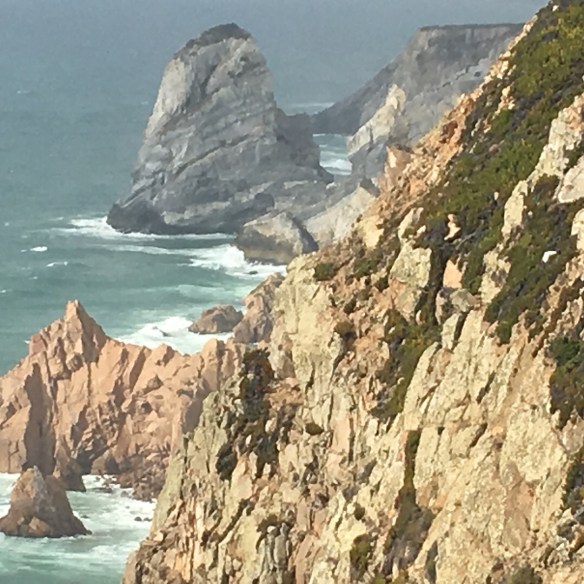
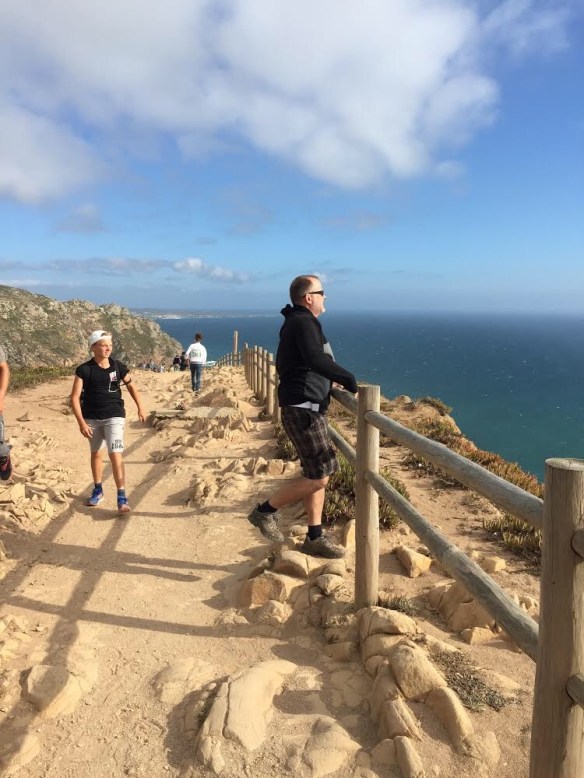
And so, at Cabo Da Roca near Lisbon, Portugal – the farthest most western point of land on continental Europe – I threw my glory stone into the Atlantic Ocean facing the setting sun. I had to practice letting glory go.

IMG_5812

It seems I was still bound to finish some kind of pilgrimage during my sabbatical. I didn’t have enough time to go back to Spain and finish the Camino de Santiago. But I did have enough time to walk the entire length of the longest contiguous sand beach in North America – fifty kilometres on Long Beach Peninsula in Washington State. There, my journey of letting go continued.

IMG_6200

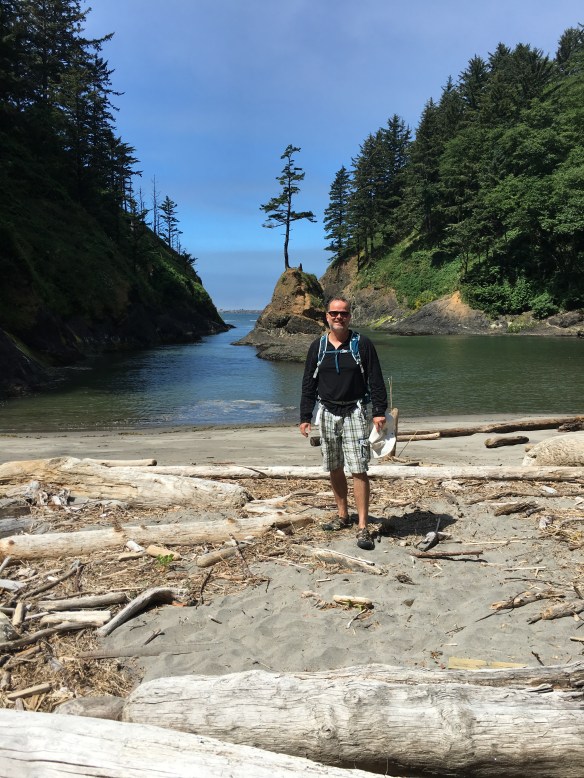
There, on “Cape Disappointment” – fittingly named – I brought the two pebbles that I picked up in Spain on the last day I walked on the Camino. One glorious afternoon, I scrambled down into Dead Man’s Cove – also fittingly named – on Cape Disappointment. After reflecting on my disappointments of late, I realized on my journey of life not only did I need to yield all my dreams but also all my regrets and suffering. And so, I threw those stones of disappointment into the Pacific Ocean. I let these go.


I realized life is not lived well when we obsessively hold on to all those things that cause us grief. I had to offer these to God as well. Later, while I sat on a park bench near the lighthouse on Cape Disappointment looking over the Pacific, I met a couple of Americans visiting from Portland. In our conversation, we were able to affirm that “all great spirituality is about learning to let go.”[5]

IMG_6217

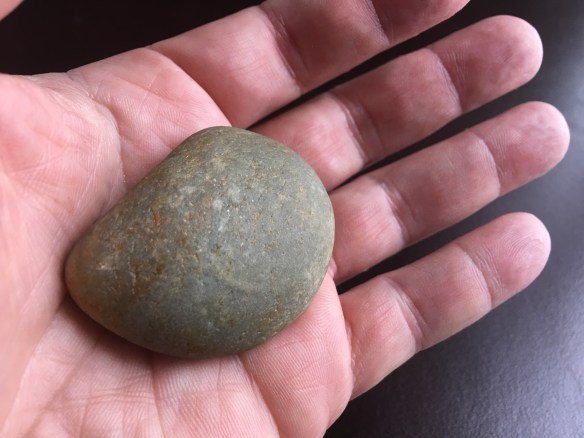
But I didn’t leave my pilgrimage empty handed. When I climbed out of Dead Man’s Cove that day, I picked up from the sand a smooth, round stone. Now, any rocks on the Peninsula are rare. Most of the fifty-kilometre stretch is sand, land created from the outflow of the mighty Columbia River as it spills into the Pacific Ocean. Most rocks you see on the Peninsula have been trucked in. So, I was delighted to take with me back home, a rare thing.

And hope is a rare commodity in this world of pessimism, denial, and despair. This is my “stone of hope”, that I hold forever, amidst all the human aspirations swirling in my life and all the disappointments and failures which I regularly need to practice letting go of.

IMG_6752

We hold not only that which we need to let go of, but we also hold hope throughout our lives. “We do not simply resign ourselves to the give-ness of the world, for we have planted within us a great hope that God’s kingdom will come on earth, as in heaven. This means we are a people who look to the future with trust and hope, confident that God is working God’s purposes out and that God’s realm is even now breaking into our world.”[6]

At this point in your journey of life, which stones are you holding — of dreams, of disappointments, of hope? Which ones do you need to let go of? Which do you need to hold on to? I suspect it is true when the likes of Saint Paul, and all the wise teachers over the ages, writes: “Hope does not disappoint us.” [7]

[1] cited in Ruthanna B. Hooke in David L. Bartlett & Barbara Brown Taylor, eds., “Feasting on the Word: Preaching the Revised Common Lectionary Year B Volume 1” (Kentucky: WJK Press, 2008), p.280

[2] 1 Corinthians 7:29-31

[3] Isaiah 40:8

[4] Richard Rohr, Daily Meditation, Thursday, January 18, 2018.

[5] Richard Rohr, Center for Action and Contemplation, cac.org

[6] Ruthanna B. Hooke, ibid.

7 – Romans 5:5

Repeat performances

Once again during the Christmas season, I experienced this strange cultural phenomenon:

How many decades has it been that every December, movies like “It’s a Wonderful Life”, “Elf”, “How the Grinch Stole Christmas”, “A Charlie Brown Christmas”, “National Lampoon’s Christmas Vacation” and “The Bishop’s Wife” get replayed and replayed over and over again, year after year? And only at this time of year? You can probably add several more of your favourites to this list.

That is why I was a tad apprehensive last month when we received tickets to attend the National Art Centre (NAC) Theatre production of Charles Dickens “A Christmas Carol.” I know the story. I’ve read it several times. I’ve watched television renditions of the story over the years. What could the NAC Theatre do to bring it to life, once again, for me? Same old, same old, right?

On the other hand, I believe there is a good reason why we turn to these stories every year. There’s a reason for our culture’s yearning for their repeat-performances. A higher reason, I might add. Perhaps there’s something in those stories that we need to take to heart, and make positive changes to our lives. Perhaps, we need to see the story-telling as more than a mere syrupy, sentimental “Isn’t that nice” tradition.

So, I was surprised and intrigued by what the NAC Theatre troop did with the story. It was introduced by two actors who came on stage — one was blind and one was deaf. In the introduction they invited the audience to participate in a simple activity with our hands, both to show that the two actors needed each other in accomplishing their jobs; and, what is more, near the end of the story everyone in the audience was needed to give the sign with their hands in order to encourage Scrooge finally to embrace a more compassionate approach to life.

Without taking anything away from the traditional story-line plot, the meaning of Dickens’ famous “A Christmas Carol” was conveyed to me in a fresh way.

We encounter in young Samuel and the elder Eli one such repeat performance story in today’s text from the Hebrew scripture.(1) It is a story many of us know — of the boy Samuel in the temple who is called upon by God. It gets told many times in the life of the church over and over again — every three years at least. It is true: it is a nice, little story, isn’t it?

At first, Samuel doesn’t recognize God’s voice, believing instead that it is his old mentor, the priest Eli, who is calling him. Finally, with Eli’s help, Samuel responds to God’s call by saying, “Here I am. Speak, Lord, for your servant is listening.”(2)

Well, as I said, many of us are familiar with these very words. We even like to sing a popular hymn (3) reflecting the words of one responding positively to God’s call — a call that changes the life of the recipient. How does this familiar story speak to our lives today? How is it more than just ‘a nice, little story’ from the Bible? How can this story change our lives?

In this story, an old man and a young man collaborated to hear God’s vision for a new Israel. For God was about to do a new thing: Soon to emerge in the life of God’s people was a new lineage of kings, beginning with the inauguration of King Saul.(4) What was passing, was the rule of Judges along with the sinful house of Eli. What was emerging was the likes of King Saul, King David, King Solomon, and so forth.

In God’s message to Samuel, God condemns Eli’s lack of restraining his sons’ immorality. Eli’s sin was his aversion to do something even though he recognized what was happening. Even though Eli knew the ongoing problems in his household, Eli turned a blind eye and ignored it all.

He did not act. And no matter what Eli would do now to try to redeem himself by making various sacrifices to the Lord, God was intent to establish a new order of leadership over God’s people starting with the demise of Eli’s household.

Doing nothing was the problem. For us, today, doing nothing about a problem we know exists is the problem. How do we begin to move out of the prison of this self-inflicted inertia?

We need to recognize that growth and healing is a process. The birth of the new thing God was doing began as a cooperative affair. It took the attentiveness of the young Samuel’s ears and the wisdom of the old priest’s heart and mind to bring about God’s purpose. It took both the authority of the failing, feeble priest and the obedience of his youthful protégé to bring about God’s purpose. In other words, it takes a community to bear such a task.(5)

Responding to God’s actions and call in the world and in our lives today is not a solo effort. Religion is not a solitary practice. Indeed, it takes a village. It takes the various gifts of people in our lives. What one has and the other does not, what the other is good at that the first is not — it takes everyone’s attentiveness and participation.

How do we live into this collaborative way, especially challenged by our society’s emphasis on individualism, privacy and self-reliance? We are, indeed, up against a culture that is at odds with the Christian vision. How do we live the way of God’s reign? Where we value mutuality, diversity, common purpose in the mission of God for the good of all people?

In contrast to the way in which God spoke to the likes of Isaiah, Jeremiah and the later prophets of Israel, God does something unique with Samuel. You will notice that God does not enjoin Samuel to deliver God’s message to Eli. God does not charge Samuel to tell Eli what God is telling Samuel with words like: “Thus says the Lord, tell the people Israel”, etc., etc. No.

Rather, God wants simply to confide in Samuel. Basically, God expects Samuel, first, to listen. Just listen. It seems, Samuel first needs to learn how to do this. And it will take some time and some practice, evidently.

Can we have the courage, and the patience, to learn how first to listen to God and the other — without jumping in too soon with the energy of our own bravado, our own opinion, our own self-justifications, our own visions of what must be? The simple act of listening, can change our lives. Because listening first means we believe that the other has something of value to offer that we don’t have.

God works at a slower pace, it seems, compared to the hypersonic rhythms of life in 2018. Not only does God give Samuel and Eli one chance to figure it out, but two and even three opportunities to get on the same wavelength as God.

The story-telling is both appealing and intentionally slow early on. Dialogue is repeated. The action of Samuel getting up from sleep and going to Eli are repeated. We have to slow down with the narration and feel the build-up to the great reveal of God’s message.

Even though both Samuel and Eli are slow in finally getting it, even though they are encumbered by sleep, drowsiness, denial and avoidance, even though their response to God is compromised by vision and hearing impairment, by youthful pretence and the attrition of old age …. God still finds them. God still speaks. God still acts in the way God will act.

Despite human arrogance and self-delusion, despite all our toiling and pride, despite all our ego compulsions, God keeps at it to tell us, guide us, and instruct us.

We may not like the answer. We may not like what God has to say. We may be challenged to the core of our being by what God is telling us. Regardless of our hesitation, denial or self-delusion, God finds a way. God doesn’t give up on us. God gives us people, and stories, and experiences — even the same ones, over and over again — to help us finally get it.

God doesn’t give us just one chance. God is not just a God of second chances, as we often say. God gives us many chances, as many we need. May we, like Eli, finally come to accept what God has to say to us, with his words: “It is the Lord; let him do what seems good to him.”(6)


(1) 1 Samuel 3:1-20, the first reading for the Second Sunday after the Epiphany, Ordinary time, Year B in the Revised Common Lectionary.

(2) 1 Samuel 3:4-10.

(3) “Here I am, Lord”, Hymn #574, Evangelical Lutheran Worship (Augsburg Fortress, 2006); also, for the Christmas cycle, this hymn is also appropriate in singing Mary’s response to the angel Gabriel’s visit to her, announcing Mary’s role in the birth of Jesus (Luke 1:38).

(4) 1 Samuel 8-10.

(5) Richard Boyce in David L. Bartlett & Barbara Brown Taylor, eds., “Feasting on the Word: Preaching the Revised Common Lectionary, Year B, Volume 1 (Kentucky: WJK Press, 2008), p.245-247.

(6) 1 Samuel 3:18