The Shepherd, and Creation

In the midst of this season of Easter, the extreme winter weather that has plagued this part of the world recently has been the topic of conversation. Perhaps, then, it is appropriate that April 22 is Earth Day. The public, as well as Christians, are invited to pause and reflect on our relationship with all of creation.

Earth Day coincides with the Fourth Sunday of Easter, which is traditionally called “Good Shepherd Sunday”. Familiar readings from the bible populate the liturgies of this day.

The imagery from the Psalms, particularly Psalm 23, calls forth in me a context of creation that is stable, healthy. The Psalmist walks beside still waters, green pastures, verdant valleys. And if we expand the Psalmist’s repertoire we can include the hills and mountains (Psalm 121), the moon and the stars (Psalm 8), breaking waves (Psalm 42,89), expansive seas (Psalm 139) and sky-reaching trees (Psalms 1,148).

In scripture, grace is mediated through creation, not apart from it. The message of the Gospel cannot be communicated in spite of creation but in and with it. All of creation, like the Sacrament, is a beloved conveyor of God’s grace and purpose.

When in the Gospel Jesus says to his disciples that he is the “good shepherd” (John 10:11), we are invited to consider what it means to care for creation. The Greek word for ‘good’ in this text, kalos, means ‘model’. In other words, Jesus is the model shepherd. Jesus models for us, in his life-giving love, how it looks to be a follower of Jesus.

Jesus will stop at no cost to care for us and for the world that God created and so loved. What does it mean for us? What are we called to do, as followers of Jesus?

This weekend, as the weather finally warms up and feels more like Spring, please reflect and act on what it means to follows Jesus in today’s world. Start by reading the Earth Day statement prepared together by the ELCIC Bishop, the Rev. Susan Johnson, Anglican National Indigenous Bishop, the Rt. Rev. Mark MacDonald, and the Anglican Church of Canada Bishop, the Most Rev. Fred Hiltz:

Earth Day statement by church leaders

A wintery spirit

IMG_6730

The winter of 2018 has been record-setting, so far. And we are barely one week into the new year! Did you know it was Ottawa’s coldest New Year’s Day since records began in 1873? At 8am on January 1st, the mercury dipped to a frigid minus 30.2 degrees Celsius (-22 Fahrenheit); New Year’s Day also marked Ottawa’s sixth consecutive day with temperatures below -17 degrees Celsius (1 Fahrenheit), which made it the longest run in exactly one hundred years.[1]

IMG_0223

A full onslaught of winter can help us appreciate the meaning of Christianity. Though much of the bible’s stories and lessons were wrought out of the harsh desert climate surrounding the Mediterranean and Arabian seas, the winter realities we face in Canada are not that much different. I suggest, then, let’s take desert and winter as synonymous – meaning, essentially, the same things.

IMG_3529

American Lutheran theologian, Martin Marty, describes the importance of what he calls a “wintery spirituality”, defined by the shrill cry of absence, frost, and death. In contrast to a summer spirituality, winter is more given to being emptied than being filled. Winter is harsh and lean in imagery, beggarly in its gifts of grace and love.[2]

IMG_3524

Of course, Jesus goes into the Judean wilderness to be baptized in the Jordan River. And right after his baptism, he spends forty days and nights in the desert.[3] The desert is not a comfortable place to be. For one thing, it makes scarce and even denies the basic need for our survival – water. A desert is an arid region where annual rainfall remains miniscule. Some deserts average only one centimetre a year, with parts of the Sahara not receiving a drop of rain for more than twenty years.[4]

The word and image of water appears in each of the Hebrew readings assigned for this festival day in the church calendar, and is tied to baptism in the readings from the New Testament.[5] More to the point, water is given out of the chaotic void in the creation story, and in the arid wilderness as a gift and a grace. Water is thus a sign of God’s love amid the harsh winter or desert realities of our lives.

The prophets of old affirm that it is precisely in the desert where God expresses God’s love to the people. The grace of God cannot be received outside of winter. “Thus says the Lord: The people who found grace in the wilderness … I have loved you with an everlasting love …. I remember your love, how you followed me in the wilderness.”[6]

How, then, can we appreciate and even thrive, living out of this truth? How can we follow Jesus in his way? After all, the Baptism of our Lord is about Jesus beginning the journey to fulfill his God-given purpose in life. How he does it is of particular importance to us, if we are interested in following Jesus in our life-style.

Listen to a story first told by a nineteenth-century teacher, Awad Afifi the Tunisian, who drew his wisdom from the wide expanse of the North African desert:

A gentle rain fell on a high mountain in a distant land. The rain was at first hushed and quiet, trickling down granite slopes. Gradually it increased in strength, as rivulets of water rolled over rocks and down gnarled, twisted trees that grew there. The rain fell, as water must, without calculation. After all, water never has time to practice falling.

Soon, it was pouring, as swift currents of dark water flowed together into the beginnings of a stream. The brook made its way down the mountainside, through small stands of cypress trees and fields of lavender, and down cascading falls. It moved without effort, splashing over stones – learning that the stream interrupted by rocks is the one that sings most nobly. Finally, having left its heights in the distant mountain, the stream made its way to the edge of a great desert. Sand and rock stretched beyond seeing.

Having crossed every other barrier in its way, the stream fully expected to cross this as well. But as fast as its waves splashed into the desert, that fast did they disappear into the sand. Before long, the stream heard a voice whispering, as if coming from the desert itself, saying, “The wind crosses the desert, so can the stream.”

“Yes, but the wind can fly!” cried out the stream, still dashing itself into the desert sand.

“You’ll never get across that way,” the desert whispered. “You have to let the wind carry you.”

“But, how?” shouted the stream.

“You have to let the wind absorb you.”

The stream could not accept this, however. It didn’t want to lose its identity or abandon its own individuality. After all, if it gave itself to the winds, could it ever be sure of becoming a stream again?

The desert replied that the stream could continue its flowing, perhaps one day even producing a swamp there at the desert’s edge. But it would never cross the desert so long as it remained a stream.

The stream was silent for a long time, listening to distant echoes of memory, knowing parts of itself having been held before in the arms of the wind. From that long-forgotten place, it gradually recalled how water conquers only by yielding, by turning to steam in a natural cycle. From the depths of that silence, slowly the stream raised its vapours to the welcoming arms of the wind and was borne upward, carried easily on great white clouds over the wide desert waste.

Approaching distant mountains on the desert’s far side, the stream then began once again to fall as a light rain. At first it was hushed and quiet, trickling down granite slopes. Gradually it increased in strength, as rivulets rolled over the rocks and down the gnarled, twisted trees that grew there. The rain fell, as water must, without calculation. And soon it was pouring, as swift currents of dark water flowed together – yet again – into the headwaters of a new stream. [7]

Jesus instructs his followers to become the people they are called to be.[8] God is aware that our lives are like a journey through the desert. Or, as Canadians, we can say that our faith journey is not dissimilar from living through an Ottawa record-setting winter.

To thrive in this life is to see that this journey of becoming is not static. We are not called by Jesus to become mere swamp lands at the edge of the desert. Rather, the journey calls us to be vulnerable, to recognize what we may initially want to resist in us – like the stream that first struggled against yielding to the wind.

Our journey through life are journeys of vulnerability. Of taking little. Of trusting God. Of appreciating the value of small things. Of letting go into the Spirit wind of God. Then, we can, with the Psalmist see that, even in the wilderness, the Lord fulfills God’s promises and does indeed give strength to us and bless us with peace.[9]

IMG_3628

[1] Ottawa weather records, Twitter @YOW_Weather

[2] cited in Belden C. Lane, “The Solace of Fierce Landscapes: Exploring Desert and Mountain Spirituality” (New York: Oxford University Press, 1998), p.37

[3] Mark 1:12-13

[4] Belden C. Lane, ibid., p.38

[5] The Baptism of our Lord, Revised Common Lectionary Year B: Genesis 1:1-5, Psalm 29, Acts 19:1-7, Mark 1:4-11

[6] Jeremiah 31:3; 2:2

[7] as written by Belden C. Lane, ibid., p.20-21

[8] read the entire section from Matthew 10:5-42

[9] Psalm 29:11, NRSV

Why? To melt hearts of stone

In a typical Canadian winter at this time of year, salt and light (Matthew 5:13-20), of course, serve a particular purpose.

It doesn’t matter how cold it can still get in February, if the sun is shining then the snow and ice will melt under the strengthening, radiant beams of warm light. And, with the occasional freezing rain still in the offing, that bag of salt sitting on the porch or in the garage can come in handy, to sprinkle on the walkways and driveways — to melt the ice.

Salt and light, in any given context, serves a specific purpose. I can remember when the kids were younger, one of ours had the habit of picking anything and everything up off the ground and putting it in her mouth.

I can remember needing to intervene when she was in her exploratory mode, walking down the sidewalk in the middle of winter. “Don’t eat it! That is road salt, dear. Not table salt.”

We are called to be like salt and light in the world. But that gift will serve a specific purpose, according to the context and circumstance of our lives.

How can we know what that gift is, and for what purpose it serves? It can be challenging to claim that gift for our lives, and then have the courage to use it. This can be difficult because the world and the dominant powers of culture may not support it. The gift and purpose may seem small in comparison to the dominant climate of coldness, hatred and violence so prevalent in the culture today.

Julian of Norwich in her first of Divine Revelations writes about the small hazelnut. She writes, that God “showed me a little thing, the quantity of a hazel nut, lying in the palm of my hand …. I marvelled how it might last, for I thought it might suddenly have fallen to nothing for littleness. And I was answered in my understanding: It lasts and ever shall, for God loves it. And so have all things their beginning by the love of God.”

It may seem pallid at first, even pointless. But there is power in small. Ezekiel writes, “A new heart I will give you, and a new spirit I will put within you; and I will remove from your body the heart of stone and give you a heart of flesh. I will put my spirit within you …” (Ezekiel 11:19;36:26-27).

In words that may make better sense in our Canadian winter, God is promising us that God will melt our hearts of stone-cold bitterness, resentment, fear and hatred. And put the warmth of God’s light in Christ and the loving power of the Spirit to change our lives, and the world around us.

Salt and light are gifts that are subtle and small, yes, similar to the smallness of the hazelnut. And yet, these are gifts you cannot easily hide. Nor will they go away. They are public gifts, not private, in scope. They affect the whole experience of living.

You cannot add salt to soup, and not notice a difference. You cannot throw ice-melter on the driveway, and not notice some change on the ground. You cannot stop the sun from shining, and not stop the smile that comes on a sunny day after weeks of dark, grey, cloudy existence.

Faith Lutheran has a renovated gift, the gift of a safe and modernized building — a gift, yes. But why will it be used? How will our (Faith Lutheran’s) soon return to that site on 43 Meadowlands Drive restore something that was missing in the neighbourhood while we were here (at Julian)? Or, does it? What difference does that gift make to the world around us?

Our gift has a purpose. And that purpose is meant to catch the attention of a world that is shrouded in cloudy days and numbed to the slippery vices of distraction, delusion and fear.

Why is this important? How is it worthwhile? In an age when the church in North America is facing challenge and change, perhaps it is time again to focus on the WHY. It has been argued that people don’t buy-in to the WHAT we do but the WHY we do it. (1)

We need to be clear about that. The only way we can know WHAT do do with our faith, the church and our buildings is first to claim, embrace and communicate clearly the WHY of our faith. The WHY.

In the aftermath of the tragic violence in Quebec last weekend, the premier challenged his province, indeed our whole society, to reflect and consider again how we treat one another in a culturally diverse community. How we treat one another through the changes and stresses of life that can be disruptive. How we treat one another who are different and come from different walks of life, religious experience and ethnic diversity.

Observing how we do what we do may also give us a clue to the WHY. I believe the church has a lot to offer this world of ours, as salt and light. St. Paul encourages the fledgling, conflict-ridden Corinthian church to claim their identity they already have, in Jesus: “We have the mind of Christ,” he concludes (1 Corinthians 2:16). And Jesus, in short, came to show the love and grace of God to a world so hung up on achieving, earning, competing, judging, proving themselves, excluding others and fighting.

I believe the church has a lot to offer this world. To reflect Christ, the light of the world: to receive the love of God, to accept the love of God, and then demonstrate that compassion and love to the world. It is behind everything we do in the church. Everything. Let’s not forget that.

To melt hearts of stone.
(1) Simon Sinek, “Start With Why” (New York: Penguin, 2009), p.58

One light in the dark world


The bible doesn’t always help alleviate a low grade angst growing at this time of year. Abduction-type images are splashed on the canvas of our imaginations: “one will be taken, one will be left” (Matthew 24:40-41). The notion of the Second Coming of Jesus can often arouse anxious feelings of impending doom and destruction. Certain Christian groups devise popular theologies that articulate with great detail and certainty how it’s all going to come crashing down on us some day.

And what is more, some will say the Bible contains implicit warnings (as in the Gospel for today, Matthew 24:36-44) that we can prevent it all from happening by our good works, by being ready, if only we can break the secret code, figure out the hidden message and solve the riddle — a la Dan Brown.

The way of Christ is never that easy. And the Gospel text will throw a wrench into any neat and tidy philosophy. In this image-rich text Jesus confronts our pretence. “You don’t know and you cannot know.” Neither did Noah when the flood came “unexpectedly.” “But about that day and hour no one knows … and they knew nothing …”

What is this ‘knowing’? If we cannot predict how it’s all going to shake down in the end – whether we are talking about world politics, climate change or our challenging personal relationships – what can we know? 

We do know certain things are best not known: How we are going to die. How the meat we are eating at the dinner table was actually produced. Many probably are better not to watch a YouTube video of the surgery they are preparing to undergo. In some facets of life, it’s simply best not to know.

And life will continue to remind us that it is futile to pretend we can: None of the pundits and polls — even early on election night in the U.S. a few weeks ago — could predict the actual result of the presidential race. 

And, in my generation it must have been the falling of the Berlin Wall which had divided Germany for over thirty years. Who could have predicted it, given the enduring and seemingly entrenched geo-political tensions of the Cold War, let alone begin in evening candlelight vigils held in German churches? A small, warm light started to melt the cold, dark and divided world.

The season of Advent fits like a glove; it gives warmth in the cold atmosphere of our lives. “Keep awake for you do not know on what day your Lord is coming … be ready, keep awake.” So we hear instruction from Jesus. Being ready and keeping awake are fundamentally about being aware. Awareness in the present moment.

What DO we know? Saint Paul, in an accompanying text for today writes: “you know now is the moment for you to wake from sleep; for salvation is nearer to us now that when we became believers … Put on the armour of light.” (Romans 13:11-14)

Putting on the armour of light is not a call to violent, combative behaviour, action which narrows the vision and snuffs out awareness. Putting on the armour of light does not constrict the soul into locked patterns of thought, but expands the scope to embrace the truth and vision of God right now.

You may have heard of the story: All along the Western Front in 1914, a few short months into a war that would eventually claim 17 million lives, a kind of miracle happened on Christmas Day – a rare moment of peace:

Trooper Graham Williams of the Fifth London Rifle Brigade, recalls that special night: “First the Germans would sing one of their carols and then we would sing one of ours, until when we started up ‘O Come, All Ye Faithful’ the Germans immediately joined in singing the same hymn to the Latin words Adeste Fideles. And I thought, well, this is really a most extraordinary thing ­– two nations both singing the same carol in the middle of a war.”
The next morning, in some places, German soldiers emerged from their trenches, calling out “Merry Christmas” in English. Allied soldiers came out warily to greet them. In others, Germans held up signs reading “You no shoot, we no shoot.” Over the course of the day, troops exchanged gifts of cigarettes, food, buttons and hats. The Christmas truce also allowed both sides to finally bury their dead comrades, whose bodies had lain for weeks on ‘no man’s land’.

It is estimated that over 100,000 troops from both sides honoured the Christmas Truce of 1914 that lasted some days.

Hearing the text today from the prophet Isaiah, you may have noticed some very familiar words and phrases. Because a few weeks ago, on All Saint’s Sunday, the words of Micah we heard: “they shall beat their swords into ploughshares and their spears into pruning hooks; nation shall not lift up sword against nation, neither shall they learn war anymore” (4:3). Sound familiar?

Isaiah 2:1-5 and Micah share precisely the same words. And, in Psalm 46 — the great “Lutheran” Psalm we heard on Reformation Sunday last month, and also on Christ the King Sunday last week — the Psalmist echoes the sentiments of the major and minor prophets: “God makes wars cease to the end of the earth, he breaks the bow, and shatters the spear; he burns the shields with fire” (v.9).

A major message throughout the Hebrew scriptures and reinforced by Jesus’ teaching in the New Testament envision wars to cease and violent divisions among people to end. “Blessed are the peacemakers,” Jesus preaches. (Mathew 5:9; Luke 6:27-31)

Knowing is not knowledge of facts and manipulation of data to suit one’s ideology. Knowing is not formulating intellectual and persuasive strategies that demonstrate airtight logic and rational impunity. Knowing is not about getting more information. This kind of knowing keeps one distracted, in the past or fretting about the future.

Knowing is more about living relationships of love, grace and peace in the present moment; this is the biblical understanding of ‘knowing’ – more a function of the heart than of thought.

Advent heralds the start of a new church year. This season calls us to watch, to wait and wake up to the reality of Christ in our lives, and Christ coming again. Like All Saints’ Sunday, in Advent the future and the past converge on the present moment. Now.

We can enter this season full of hope. Today, contrary to what the headlines imply, the earth is less violent than it was in the past. We are not living in dangerous times any more than what always has been. In fact, according to statistical trending over the past few decades, the world over is safer and more peaceful. (see Steven Pinker and Andrew Mack’s article “The World Is Not Falling Apart” (Slate: 2014), http://www.slate.com/articles/news_and_politics/foreigners/2014/12 )

“Now”, Paul writes, “we are closer to salvation than before.” And, now, we are called to love others, to strive for peace and an end to all divisions — in the world, and in our lives. Even when it might appear hopeless. We are called, like the Germans and English during the Christmas Truce of 1914, to cross the dividing lines of our lives and sing together of a holy night, a silent night, a night still and always shall be bathed in the light of Christ.

Pray for peace. Commit to one small, act of kindness and generosity, especially to one with whom, for whatever reason, you have been estranged. Without any strings attached, no expectations of any kind about how the other ‘should’ respond, commit to an act of unconditional love. Because God is bringing all of history into the vision of peace and harmony reflected in the prophets’ writings. This is our hope. This is the present reality.

Throwing snowballs to get the message across!

We threw snowballs in worship last Sunday. 

Well, they weren’t exactly real snowballs. It’s Ottawa, after all, in December — and there’s still no snow on the ground! Just paper crumpled up into a ball. We’re warming up for the winter still-to-come. 

At the beginning of worship the children threw about a dozen of these ‘snowballs’ into the congregation. And those who caught them were instructed, during the time leading up to the children’s chat later in the service, to get pen to paper.

The Gospel texts these Sundays in Advent focus on John the Baptist (Luke 3). John’s job was to get the message across that the Messiah was coming. In truth, that is generally the job of the prophet: to tell the people what they need to hear in order to prepare for what God is about to do.

In our day and age people everywhere are preoccupied with their smart-phones and social media — to ‘message’ their friends. Messaging is now cornerstone of our culture. What we message — for better or for worse —  is vital to maintaining our relationships. 

So, we were going to practice what we ‘message’ to one another in the church, and to the world. Those who caught the paper snowballs wrote a short message that the children would later hear read out loud. What message would children hear, this Advent as we prepare for the coming of the Lord?

Here is what members of the church wrote on their snowballs:

1. Wishing you peace, hope and love at Christmas

2. Remember Christmas is not about presents but about spending time with those who love us

3. God loves us so much that he sent us Jesus

4. Show your friends love like you show your family because they love you too

5. Stop! Look! Listen! Feel the love!

6. Share with your friends

7. Every day say thank you for something that you are really thankful for. Especially for the little things that made you smile

8. Jesus is coming and is in your heart

9. God gave his only Son for you!

10. Rejoice, for Jesus is coming 🙂

Of course, at the end of children’s chat, those who wrote these messages delighted in throwing the snowballs back at the children. “If you’re going to give it, you also have to take it,” we said.
True prophets in this crowd!

Changing seasons

20140317-150852.jpg

Apparently this has been the coldest winter in Ontario in some twenty years. Three days before Spring officially arrives, it is one of the coldest St Patrick’s Day EVER in Ottawa.

On the other side of the province, I stand today on the westernmost point of Lake Ontario looking east. The long grass and wet, packed sand whispers promises of summer, beach fun. The boulder size blocks of ice at the shoreline recall the harsh reality of the winter that is slowly passing. The shadows of light reflecting against a thinly veiled high-cloud announce the warmth that will soon embrace us, once again.

Not all wanderers are lost and alone

The pathways through the forest are tricky, these days. With winter and spring battling it out for seasonal supremacy, the snow-melt leaves walking paths uneven and icy. It’s a challenge simply to keep on the path.

I make my way through the Grove with a destination in mind. But the forested parkland is marked with a web-like array of criss-crossing trails of dog-walkers, ski-enthusiasts, snow-shoers and joggers. So I leave it up to the inspiration of the moment to choose which path I take, keeping in mind where I eventually hope to end up.

But there are options. I’m reminded of the Psalmist who doesn’t just talk of one path describing the Lord’s way, but of many: “All the paths of the Lord are steadfast love and faithfulness” (Psalm 25:9-10). And so I have some fun deciding which path to take; that is, which one is suited more to my abilities and interest on that day.

In describing the kingdom of God to Nicodemus, Jesus talks of salvation, and being born again (John 3:1-17). In case Nicodemus is tempted to believe life events such as birth and re-birth are something he can direct and control, Jesus talks about the nature of God’s work in the matter: “The wind blows where it chooses, and you hear the sound of it, but you do not know where it comes from or where it goes” (v.8). There’s a wild, free, untethered quality integral to the journey of life and faith.

To be sure, some pathways are easier — wide, flat and well-trodden. Others require me to focus more my attention on where I place my feet, lest I trip over an exposed tree root or sink into foot-deep snow. One thing is for sure: It’s very satisfying to discover a new path I never knew was there, a path that gives me a new perspective on the forest, regardless how uneven or narrow it is.

To the casual observer I may appear directionless, lost, wending my way around and through the Grove. Some may wonder what I’m doing in there. Is there not something more productive I should be up to rather than wandering in the forest? Sometimes going to worship, participating in activities of the church, engaging the ministry and mission of God in the community may seem rudderless, unproductive.

This faith journey can appear to some rather cavalier and pointless — a glorified hobby of self-indulgence and of no real consequence: Because Christians like everyone else suffer and experience the difficulties that everyone does. What sets us apart? Why bother?

When the hardships come as they do to us all, the journey of the faithful starts to nudge at something deeper inside us. Deep down, though on the surface it may look otherwise, we know we are not lost in our wandering. We look up, from time to time. When the journey gets difficult, it’s natural and rather tempting to look down all the time, to be constantly turned in on oneself, to see only one’s own problems and disregard altogether the world ‘out there’.

When the journey of life gets difficult, our hearts are nevertheless open and free to accept the gift of faith. This gift of faith declares in our hearts the conviction that: I am not alone, in this dark, dangerous forest of my life. I am not alone.

There is a broad consensus that Psalm 121 was not expressed in the faith life of ancient Israel by individuals, on their own, by themselves. In other words, these words weren’t spoken originally between one person and God. It’s not about ‘me and sweet Jesus’.

It was a song sung responsively as a congregation, an assembly, a caravan, on the road together from Jericho — some 1500 feet below sea level — up to Jerusalem where God’s presence awaited in the temple of the Lord. The structure of the poem suggests a question-answer kind of liturgy between various voices — voices assuring one another of the hope they had on this dangerous road. A hope they would find by lifting their gaze towards their destination.

In this stance to life, individuals would be guarded against falling into the trap of feeling isolated in their suffering. At the same time, the different voices would challenge any potential “misery-finds-company” quality in relationship. Ample differentiation in the community encouraged the paradox of ‘hopeful realism’ on the journey of life; that is, on the one hand not denying the pain of the journey; but, doing so in the conviction that ‘death has not the last word’.

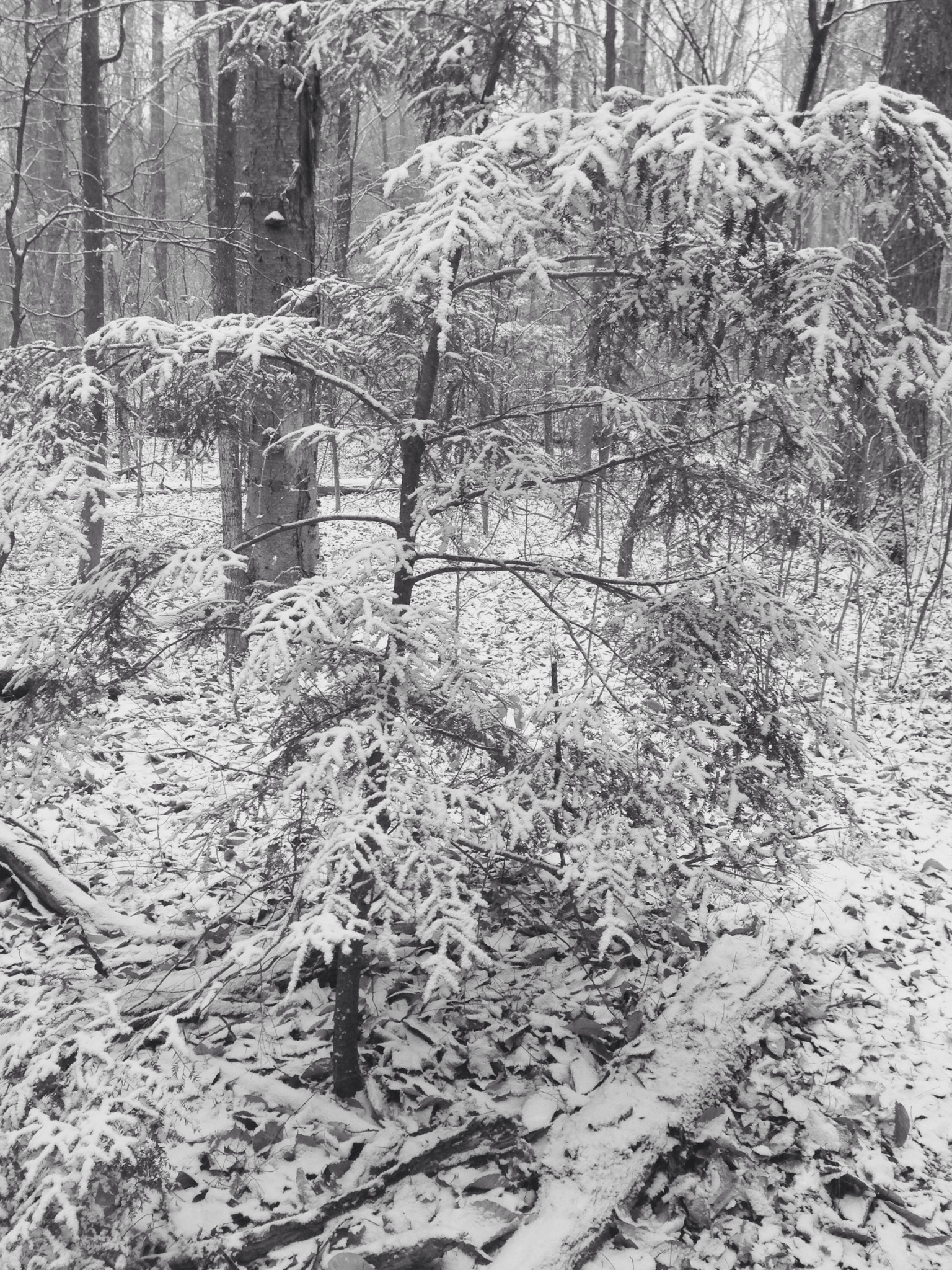
The predominantly old-growth stand of Hemlock trees in the Grove through which I wander contrasts with the white of snow on the ground. Even during the brightest part of the day, this is a relatively dark spot in the forest. And I can’t see where the path leads through the thick, coniferous growth. Nevertheless, I can’t help but occasionally look up, with a smile on my face. The trees reach to the sky, reminding me of the direction of our faith.

When we step out on our journey — whatever that journey is — we can do so with confidence and trust in the One who calls us and sends us out on the path. You may be embarking on a new journey in your life — a journey to change jobs, move to a new home, a journey of exploring a new relationship, or renewing old ones; your journey may be a challenge to live with the reality of increased physical limits, or, dealing with a newly diagnosed illness. You may find yourself at a cross-road in your life. So, what do you do?

At those moments of decision and sometimes despair, think again when you are tempted to feel that you are lost, and that you are alone on this journey. Because you belong to the church — the Body of Christ — to share in prayer and song on this road we travel together. And you know, in faith, the end of the story, the end of the road — which is good.

Some helpful thoughts on the journey of faith come from Charles Foster’s “The Sacred Journey” and  Alan Roxburgh / M.Scott Borden in “Introducing the Missional Church”

20140311-110821.jpg

Revealing glory: a funeral sermon

Your keeping vigil with your mother over the past month occurred, primarily, during the season of Epiphany. The season of Epiphany in the church calendar is all about the revelation of Jesus. And the stories that we hear during this season — the baptism of Jesus, the miracle of water to wine, and the magi bringing priceless gifts to the baby Jesus — emphasize the glory of God in the coming of Jesus into the world.

Christians have responded to the revelation of God’s glory by affirming Jesus as the divine Son of God. The season finds its climax in the transfiguration of Jesus on the mountaintop alongside other biblical greats in Moses and Elijah. Here we witness as a foretaste of the coming glory of Easter the epitome of God’s shining glory in the blazing light of Jesus’ holy presence.

It may at first seem incongruous to talk about God’s glory on a day when we grieve the death of one beloved among us. It may at first even appear nonsense to focus on the brilliance, beauty, and blazing light of God’s presence in and around us during the darkest, coldest part of the year. As does wintertime, death may come to us as an example of God’s defeat, not God’s victory.

And yet, I do not hesitate in beginning this funeral sermon by mentioning God’s glory in Jesus. And not only because we still find ourselves in the season after Epiphany. It’s more because of whom we remember this day.

Because, for me, her life with us — even to the end — truly reflected God’s glory. In the sense that her presence conveyed dignity, respect, elegance. You told me how often she upheld values of proper etiquette and dress — especially in church! She wanted to look beautiful. God forbid you wore jeans to church!

Around New Year’s when she was very low I remember coming to the hospital to visit her. I had to wait outside in the hallway for a few minutes as a nurse attended to her. When I was finally called in to her room, I came in just as she was getting help from one of you putting her lipstick on! Even in her severely weakened, vulnerable, state, she still wanted to do what she could, to look beautiful. Glorious!

Epiphany is faith’s response to the dark, cold days of winter. Epiphany is faith’s response to the dark, difficult, painful times of our lives. Not that we deny, brush over, or try to hide that reality.

Only that we affirm, despite the loss and amidst the grief, the small nugget of hope — of beauty — within us all, as she did for herself. Your loved one was especially gifted at pointing out, recognizing and affirming that nugget in us — even when we couldn’t see it ourselves!

She truly had the gift of encouragement. And she used it! Several of you have recalled for me times when after leading a bible study or presenting music or words in worship, she would take the time to make a phone call or write a card to you afterwards. In those simple acts, she thanked you and pointed out the positive — even though you may have felt the opposite about the experience!

Earlier in her life, she exercised her gift of hospitality and invitation to newcomers to the community — inviting them over for supper or tea. Such grace goes a long way to affirm that gift of hope and faith in us so often and easily shrouded by life’s difficulties.

In doing so, your loved one was herself being transformed. Through the course of her life, in exercising her gifts of encouragement, hospitality, generosity and care, she was being transformed into the likeness of Christ’s glory. Indeed, I believe she once described to me her own life as a journey towards God.

There’s an old story (as told by Barbara Schmitz, p.35, “Changed From Glory Into Glory” in The Life of Christ and the Death of a Loved One, CSS Publishing, 1995) about a fellow who fell in love with a young woman. But he was sure that she would not be interested in him because he didn’t think he looked handsome. So with the help of a surgeon he had a special mask designed, a handsome mask that was then placed over his face. With this handsome new look, he easily won over the woman he loved and they were married.

But many years later, she discovered the trick and asked him to remove it. When he peeled off the mask, what was underneath, but a handsome face! For, after all those years, his natural face had slowly taken on the handsome contours of the mask. His face had been transformed into the likeness of the mask.

The Christian life, from baptism to death, is indeed a journey of being changed, transformed, into the likeness of Jesus Christ. And periodically, on this journey, in good times and even through difficult times, we pause to give thanks and celebrate the good, the blessing, the gift, that is there whether we always see it or not.

At this funeral service, we give thanks for the life of our loved one who now celebrates at the banquet feast of heaven. At this funeral service, we also share in a holy meal often called the Eucharist. Eucharist means “thanksgiving”. And in our thanksgiving to God for Jesus, we take one more step on that journey of being healed, being changed, being transformed, for the good.

May our lives, as did the one whom we remember today, reflect the glory of God.

In Christ Jesus, our Lord and Savior.

Out of the depths

Image

20121221-112447.jpg

The longest night. The fiercest storm. The threat to comfort. And down with the flu.

I am pulled out out of the routine distractions and busy-ness of living and left silent, still, listening to the howling wind outside and creaking timbers in the house….

And then emerges a new kind of vision, a clarifying purpose for what is truly important in life — community, mutual support, friendship, family, faith. The corner is turned.

Out of the depths comes new found hope. Joy. A way forward. Renewed.