Believe in God’s possibilities

Somewhat striking to me in Gospel text is the sense of urgency surrounding these miraculous, healing stories from Jesus’ ministry (Mark 5:21-43). At least three times in this text, we hear the word ‘immediately’. A frenetic pace describes Jesus’ work here. It’s important, and it happens right away. There’s no time to lose. No sitting back. It’s time for action. It’s finally time to do something.
I suspect the reason this jumped out at me, is that summer can be a tempting, dangerous time for people like me who depend on routines and regular disciplines to keep our lives balanced. Because the temptation may be to skip the healthy practice — whether it be prayer, physical exercise, healthy eating, or attending to friends and family.
This text comes to us at the beginning of the traditionally long summer slow-down in our country. It may be wise to guard against what the Christian desert fathers and mothers called the sin of acedia, sloth, laziness, or my favourite word to describe the problem — inertia. The challenge during seasons of comfort and repose is to keep the important disciplines of exercising mind, body and spirit — to hold the sense of urgency around those important things in life.
Because to have faith is to hold fast, to trust in God’s possibilities. And the time to do that is now. Not some ideal day in the future, and not some day in the golden years of our past. But now. To have faith. To believe in God’s possibilities in your life. In our life, together.
While both Jairus’ dying 12-year-old daughter and the woman haemorrhaging for 12 long suffering years come from very different socio-economic and social circles, what they have in common is that their faith had made them well. (In the case of Jairus’ daughter, it wasn’t her faith, but that of her father). 
It doesn’t matter how old you are. It doesn’t matter whether you can even express your faith in words. It doesn’t matter whether you are poor and marginalized in society — like the woman in the text. It doesn’t matter if you are wealthy, comfortable and have status in society — like Jairus, the leader of the Jewish synagogue.
What is the healing in your life that you seek? Where can God touch the deepest need in your life? What is the discontent rocking your life now? Have you named it? Have you asked God for healing? God, we know, doesn’t cure every disease just because we ask for it. And yet, do you believe that God can do anything God wants, even bring healing? 
Last week after our two-day intensive training in Toronto, the Lutheran Ottawa Ministry Area Leadership Team was rushing to the airport to catch our flight back to Ottawa. We knew this usually half-full flight across the Province — a short 50 minute plane ride — is, these days, packed. The Women’s FIFA knock-out stage had games in Ottawa; and, the Pan-Am Games are soon beginning in Toronto. Our flight to Toronto the day before was also sold-out. 
And, with airlines normally over-booking, we heard of folks being delayed because they waited to get to the airport before getting their boarding passes. So, we were a little anxious, especially since someone on our Team had to get to work on returning to Ottawa.
I was fortunately able to get a seat, along with everyone else on the Team. As was the case with the flight to Toronto, I was assigned the middle of a three-seat row. Okay. I can put up with that for an hour. What I didn’t know was that the row I was in was the first one behind Business/First Class, which on each side of the centre isle has only two, larger seats across.
One thing on a short flight that I will enjoy doing is watching the real-time map on the screen in front of me — showing the variables of outside temperature, miles travelled, distance to destination, altitude and speed. On the screen you can watch the little icon of the plane travel slowly towards your destination. I enjoy watching that. Call me a nerd.
Because I don’t fly very often, I forgot that I probably had one of those video screens folded up and tucked away in my arm rest. But I didn’t think of that. I only reacted by feeling I got the short end of the stick. Ba-humbug! 
Both my row partners had screens on the back of the seats directly in front of thhem, but not me. 

Both of them fell asleep immediately upon take off. I concluded quickly they probably were not interested in using their screens. So I watched out of the corner of my eye until the guy on my right had his jaw hanging open and breathing heavily before I snuck my arm across to his screen to turn it on. But just as I was about to tap on “Map”, he twitched in his sleep and came half awake. I quickly withdrew, and waited until he again fell asleep before finally getting it turned on.

It dawned on me why I didn’t just ask him whether I could use his screen. I’m fairly confident he would probably have been okay with that, or at least reminded me of the screen I had in my arm rest. But I didn’t. I was bent on trying to sneak in my intention, or put off the actual engagement.
One aspect of the faith of Jairus and the woman, is that both in words and actions, they took the risk, made themselves vulnerable and even interrupted Jesus. They came out. They asked. Granted, they were desperate and at the end of their rope. Are you? Are we?
There are seasons in our lives when it may be difficult to believe in God’s possibilities for us. We get trapped in our heads. I know I do. We get stuck in our pain, and circle back over and over again trying to rationalize and self-justify not doing anything differently. We think too much about the hard realities facing us that we end up either rejecting our faith outright; or, we sit back in the lounge chair of summertime-like complacency. 
We may give up too quickly. We get discouraged so easily. We may even delude ourselves into thinking that “time will heal”. 
I suspect the biggest reason we hold back when opportunity for healing comes our way is because, as I did in the plane afraid to ask, I knew deep down in stepping out in faith to ask for something, my nicely constructed world however imperfect would have to change: Who knows? Maybe the fellow next to me would have wanted to talk with me, inquire what I did for a living and we would end up talking about God and faith and all his problems. It would require some work, then, right?
Asking for help and healing in prayer to God means things might get a bit messy, disruptive. Energy-draining. It’s a risk. Our asking for healing may very well shake us out of our comfortable way of doing things. God may very well be calling us into a sense of urgency as we go about ‘being Christian’. Do we even want that?
Do we believe in God’s possibilities? Do we hold the vision of God to heal, to restore and give new life, new beginnings to us, despite our present circumstances? Because opportunities will come our way. Will we seize the moment, as the woman did to interrupt Jesus? Carpe Diem! Will we want to acknowledge our dire, desperate circumstances giving rise to the courage to ask?
In the next year, our church will face an opportunity to begin a 5-, 10- or 15- year-long journey. An opportunity, I believe, will come across our bow to begin this journey in the next year. I mention this today, because it is the last time I’m preaching before my summer break. And I want to leave you with something to contemplate. I have a feeling we will, I hope over the next year, want to talk about this more.
When you go home today, I invite you to drive to the intersection of Woodroffe and Baseline. There is an open field there now, a strip of land between the transitway and Woodroffe, across the street from College Square. And as I speak, imagine the opportunity for Christian mission and ministry in this prime piece of land, the gateway to Nepean and very close to significant institutions of business, education, health care and culture at Centrepointe.
Then, imagine, what maintaining the status quo here will result in, some ten to fifteen years from now. If we just carry on business-as-usual and try to continue doing it on our own. We just need to tally the percentage of people in this room today over a certain age to answer that question rather decidedly. The trajectory is clear if we just ‘maintain’.
Then, again, imagine the possibility of healing that can come to the local Christian community overburdened and exhausted by a complacency and resignation to reality-as-is. Imagine the restoration, the new life, new beginning, and vigour of church ministry and mission in Jesus’ name that can happen when we share this work, as Lutherans, with other willing and effective partners in faith — other congregations — who are primed to do the same. Imagine what exciting work can be done together when we can combine our assets and resources — not ‘do it alone’ — and be a powerful, significant Christian voice and presence in West Ottawa. Imagine God’s possibilities! We’re not down and out; there’s a bright future! Together.
Jesus doesn’t ask Jairus, a Jewish synagogue leader, for proof of right belief. Faith is not saying the right doctrine or articulating a ‘correct’ denominational theology. Jesus doesn’t question the woman’s rather superstitious character of her faith before healing her. In fact the healing is virtually done before Jesus talks to her! Jesus doesn’t demand any rationally expressed pre-condition for granting his grace and healing power. To us, too.
In all truth, it’s his heart, his compassion, his unconditional love first and foremost that drives him to heal those who just have the courage to express an urgent, desperate desire for a new beginning, for health and wholeness. And take that first, small step in Jesus’ direction.

Imagine God’s possibilities!

An Advent-Christmas funeral sermon

In some churches, the manger scenes during the Advent season are left intentionally incomplete: For example, as in our creche, the manger is empty; during the four weeks leading up to Christmas, the figurine of baby Jesus is not there. Until December 25th.

In one congregation that worships in a large, cathedral-type building, the magi start their journey at the beginning of Advent somewhere in the narthex (the entrance). Each successive Sunday in Advent, the magi move closer to the manger scene which is set up at the front near the altar.

And, each Sunday, the children of the congregation are charged with a treasure-hunt search for where the figurines of the magi have been placed that week — whether on a decorated window sill, or beside a poinsettia plant, or on the steps to the chancel, etc.

Not only do these traditions emphasize the important Advent themes of waiting and watching with expectation for the coming Christmas joy, we are reminded at this time of year that we are, all of us, indeed, on a journey towards the manger, towards a new encounter with Jesus.

I believe Grant’s love of hiking revealed his ability to see the Big Picture. You see, when you go on a hike, following a trail that spans hundreds of kilometres as Grant has done on occasion, you are not just meandering aimlessly. Oh, yes, the trail can take many twists, turns, ups and downs.

But part of the joy of long-distance hiking is understanding in your imagination where you are headed, where you began, and the relationship between the two. No matter where you are along that journey, you can see the Big Picture.

One of my favourite visual effects of modern cinema does this well: From the perspective of the TV/movie camera, a scene of someone or something that happens on the ground in one moment of time is suddenly zoomed out; we move backwards up into the sky — still focused on the ground, but quickly disappears through the clouds and then into outer space. And we can see the planet earth and the solar system. And we can understand how that particular event or person on earth relates to the cosmos!

To have this Big Picture vision is to see our present reality, on the ground, from the perspective of not only history (where you’ve been) but also from the perspective of the future (where you’re going). Grant was a Big Picture kind of guy. He enjoyed the long-distance hike.

The ancient caravan routes through the Holy Land, Judean desert I think informed the prophetic writings, many of which we read in the Bible. These caravan routes were the life-line of the economy, and framed the boundaries of social order.

When you followed a caravan route you were walking a path trodden by generations of people who came before you, and a path that was followed by many once you were gone. This is the experience of people who journey, in every time and place.

I like our Bishop’s repeated advice to pastors whenever we gather for clergy and leadership retreats: “Remember, we are one and all merely ‘interim’ pastors”. Even pastors who are tenured and may remain years, even decades, in one parish are still, only, ‘interim’. They are interim because there were pastors who preceded them in the congregations’s history, and hopefully there will be more pastors coming once they are gone.

The point is not a focus on the pastor so much as seeing that pastor in the context of the larger history and journey of a congregation. It’s to regard an individual from the perspective of the Big Picture.

I can see why Richard Rohr uses the term, Big Picture, to understand the Kingdom of God. Because even though we are in constant transition on the caravan route, both the memory of the past and the promise of the future impinge on the present moment. In the Big Picture, the twin pulls of historical and future vision reveal a “vibrant now” in which God’s kingdom is complete and dwelling among us (Gail Ricciuti, “Feasting on the Word; Advent Companion”, WJK Press, Kentucky, 2014, p.94).

Being in the present moment, while informed by the past and motivated by the future promise, requires that you keep both feet on the ground. Hiking is an activity that requires the hiker not merely to keep moving, but to keep focused on the ground, one step at a time. It’s a cliche, but it’s a good one: a journey of a thousand miles begins with the first step.

As such, the journey of faith is grounded in the moment. It is earthy, real. Your boots, feet and legs get dirty, scratched, bitten, sunburned. The Big Picture ultimately, for it to be effective, is anchored in the present, gritty, sometimes ugly circumstance of life.

Even when we experience death, loss, suffering and pain; this is part of the route when we have to go through the wilderness, the desert, and navigate the ‘dark night of the soul’ (St John of the Cross).

When I hiked part of the Bruce Trail near Tobermory on the Bruce Peninsula years ago, I remember first following the trail from the parking lot to a cliff- edge standing over a hundred feet above the crashing surf of Georgian Bay. It was a beautiful vista overlooking the bay, the sky, the water birds. The memory is vibrant: breathing in the marine smells, feeling the warm, morning sun. I relished the moment, standing still, taking it all in.

I didn’t want to turn my back on it, and continue on the hike. I wanted the moment to last forever. I felt that should I continue on the trail, I would never experience such a blissful moment again. It wasn’t easy to rip myself away. However, in the course of the day, there were many more such views I enjoyed along the trail.

The poet T.S. Elliott wrote: “The end is where we start from … or say that the end precedes the beginning” (ibid.). Grant met his ‘end’, we say, in dying. But that ending was just the start of something new. Our faith in God, the promise of salvation, Jesus’ resurrection, and by the guidance of the Holy Spirit — we are, each and everyone of us, including Grant — well equipped for the journey of life and death.

Because even though we might need to keep putting one foot forward and turn our back on the old, there is in each turn only something new waiting for us — a new perspective, something beautiful, something beyond our wildest dreams.

When we finish our walk on earth, the journey to Jesus merely takes on a whole new dimension. This Christmas, like the Magi who finally arrive at their destination to encounter the Christ child, Grant arrives home — his home with the Creator God and his Saviour Jesus. Now, he can experience life and union with God in a whole new, and deeper way.

One thing remains. The caravan is a journey undertaken with others, together. No one would even consider travelling the caravan routes through the desert alone. Jesus travelled with Grant throughout his life on earth, just as Jesus embraces Grant this day, with all the hosts of heaven.

Psalm 139:7-10
Where can I go from your spirit?
Or where can I flee from your presence?
If I ascend to heaven, you are there;
if I make my bed in Sheol, you are there.
If I take the wings of the morning
and settle at the farthest limits of the sea,
even there your hand shall lead me,
and your right hand shall hold me fast.

God dreams in us

This piece will be published shortly in an Advent devotion booklet written by leaders of the Eastern Synod of the Evangelical Lutheran Church in Canada. At the end of November, visit http://www.easternsynod.org to download your copy

” … we were like those who dream” (Psalm 126:1)

Especially at this time of year, it’s like we journey in a dreamworld. Coloured lights and candles burning speckle the long and dark nights. Symbols of the season evoke in us latent memory and soft sentiment. Are we dreaming, or what?

As Christians, we carry the mantle of God’s dreamers. This is our heritage — the dreams of the prophets and those who spoke God’s restorative vision to a people in exile, a people depressed, discouraged, downcast.

To this day and age. If God could inspire Jacob in the desert with a dream of a ladder reaching down from heaven (Genesis 28:10-17), God can dream in us. If God could give guidance to Joseph wondering what to do with Mary (Matthew 1:18-25), then God can dream in us.

In the 20th century Martin Luther King said, “I have a dream”, and ignited a vision for justice towards an uncertain future. A generation later, (the first African-American) President Barak Obama, tantalized a nation, and the world, with his eloquent words of hope. Today, Malala Yousafzai inspires us to support education for women, in a dark and conflict-ridden world.

God’s dreams of a just and peaceful kingdom are born in the visions of the people of God, and in the heart of each child of God. In the end, it is not ‘my’ dream, maybe not even ‘our’ dream alone; it starts with God’s dream — when the wolf shall live with the lamb (Isaiah 11:6;65:25), and swords will be beaten into plowshares (Isaiah 2:4).

Open our hearts, God of justice and truth, to dream your dreams. And give us courage, to live them out. Amen.

In the Other

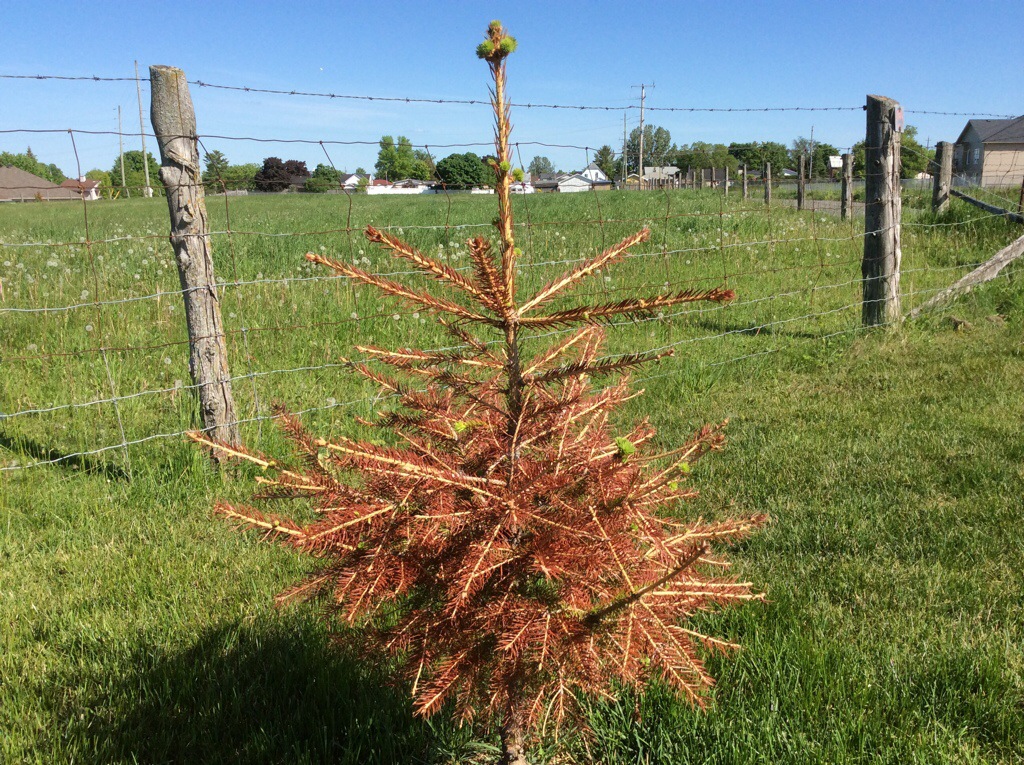
When we moved into our new house last Spring, there were no trees in our backyard. And so I went to a local nursery and bought a beautiful looking Norway Spruce tree, about four feet high, which I planted at the fence line. And I remember choosing this particular tree because it looked healthy; its deep and thick, verdant green branches were bursting with fresh, full buds, all over.

I watered it all summer long and fed it with fertilizer. In the winter I covered it with a folding board to protect it from the harsh winds and biting temperatures — which we had! I was going to make sure this tree would prosper!

So, tell me what you would do if you saw what I saw this Spring once all the snow melted: What would you do? (scroll down to see photo).

I must confess that my first instinct was to rip it out and start over. Find another tree. I thought, at first, that this tree was surely dead. There was no life in it anymore. Hopeless cause. Forget it.

But, for some reason or other I just let it be. I left it alone for awhile. And about a month ago, I noticed something remarkable. Do you see it? There are indeed signs of life showing: the green buds atop, and amidst the what looks otherwise like dead wood.

And I thought of my tree when reading the Gospel text for today (Matthew 10:24-39). Jesus seems intent on reminding his disciples of their worth, their value (“You are of more value than many sparrows” v.31) — despite everything that seems to the contrary. Remember, these disciples are not getting it; they misunderstand Jesus left, right and centre! They are imperfect, some would say — hopeless causes! Why would God even bother with those stupid disciples from Galilee? Riff-raff. Blue collar. Uneducated … the list goes on!

There is the story of a certain monastery — a monastic community which had fallen upon hard times. Only five monks remained in the motherhouse and all of them over the age of 70. Clearly, it was a dying order.

In the woods surrounding the monastery was a little hut, where a wise bishop lived. One day, the abbot thought it would be a good idea to visit this bishop, and ask him for any advice he might be able to offer, in order to save the monastery.

And so the abbot went and explained the problem to the bishop. The bishop commiserated with him: “I know how it is,” he said. “The spirit has gone out of the people. No one knows the joy and love of God anymore.” And so the old bishop and the abbot wept together. They read parts of the Bible, and quietly spoke of deep things together.

The time came for the abbot to leave. They embraced each other, and as they parted the abbot said, “It’s been wonderful that we should meet after all these years. But I must ask: Is there nothing you can tell me, no piece of advice you can give me that would help me to save my dying order?”

The bishop looked straight into the eyes of the abbot and said, “The only thing I can tell you is this: One of you at the monastery is the Messiah.”

When the abbot returned to the monastery, he told his monks: “The bishop couldn’t really help me. We only read some Scripture and wept together. But he said some cryptic thing as I was leaving — he said that one of us is the Messiah. I really don’t know what he meant by that.”

In the weeks and months that followed, the old monks pondered the bishop’s statement, and wondered among themselves if there could possibly be anything of significance to the bishop’s words. The Messiah? One of us? But which one? The conversations went something like this:

“Do you suppose he means the abbot? Surely if he means anyone, it is Father Abbot. He has been our leader for more than a generation.

“On the other hand, he might have meant Brother Thomas. Without a doubt, Brother Thomas is a holy man.

“But certainly he could not have meant Brother Eldred! Eldred can get really crotchety at times. But you know, come to think of it, even though he can be a thorn in people’s sides … when you look back on it, Eldred is virtually always right about anything. Often very right. Maybe the bishop means Brother Eldred.

“But surely not Brother Philip. Philip is so passive, a real nobody. But then, he has got a real gift of somehow always being there when you really need him. He just, like magic, appears by your side. Maybe Philip is the one ……”

And so, as they contemplated this matter together, the old monks began to pay greater attention to one another. They regarded each other with fresh eyes. They began to treat one another with respect, love and extra care. They related to one another keeping in the back of their minds always, that just maybe one of them might be the Messiah. Or, perhaps that each monk himself might be the one.

A beautiful forest surrounded the monastery, and people still occasionally came to visit the monastery — to picnic on its lawn, to wander along some of its paths, and even now and then to go into its dilapidated yet charming chapel, to pray.

And as they did so, without even being conscious of it, they sensed this aura of respect and grace that now began to surround the five old monks …

And radiate out from them.

There was something strangely attractive and compelling about the atmosphere about the community. Hardly knowing why, these visitors began to return to the monastery to picnic, to play, and to pray. They began to bring their friends to show them this special place. And their friends brought their friends.

Then it happened that some of these visitors started to talk more and more with the old monks, and ask them questions: “Why are you here?” “What are you all about?” “Who are you?” etc. etc.

After awhile, one asked if he could join them. Then another. And yet another. And within a few years, the monastery had once again become a thriving order focused not on its own self nor plight — but in others with whom they came into contact in their daily routines about the community.

This story touches on the practice of being church. Community in Christ is not about navel-gazing and conformity. It’s not about seeking a gathering of the “like-minded”. Belonging in the family of God is not about being the same, or tying to be the same, with everyone else in the community.

Being in a church is about meeting others who are not like me. Being part of the church is about discovering God in difference, in others who are different from me and my ilk. Often that comes about by first noticing what you might not choose to be like, yet seeking to understand from where the other is coming, and appreciating their gifts.

And perhaps this story might give us a clue as how to appreciate the disruptive words of Jesus in our Gospel text — about loving God before loving our family. The Gospel of Jesus Christ is not about forming exclusive communities or clubs of like-minded people.

Rather, the Gospel is continually calling us to go out into the world in order to discover what God is already up to in other people who are not ‘part of our family’. Our worth and our value has a purpose — “to proclaim [the Gospel of Jesus] from the housetops” (v.27). As we have heard from many church leaders in recent years — “the church exists primarily — it’s primary focus — for those who are not members of it.”

This challenges each one of us, first to see the Christ in one another, and also see Christ in the stranger. And remembering that if God doesn’t give up on us who are far from perfect — if God sees the value and worth in us even when we might only see the blemishes — so God asks us to value an outsider as potentially being visited upon by Jesus himself.

20140620-110751-40071026.jpg

Cathedral Thinking

Some time has passed, and the people prosper in Jerusalem. There is, in a manner of speaking, a housing boom. Thinking of the fine new buildings that are beginning to go up in his fortress city, King David realizes how different they are from the simple tent in which the Ark — the Holy of Holies — is still enshrined.

Surely the time is nigh to build a house fitting for the glory of the God of Israel. And so David makes plans to build a beautiful, large temple. The prophet, Nathan, even encourages David to do what he has ‘in mind’ (2 Samuel 7:3). Nathan affirms David in having a vision. It’s a good and important thing to do. After all, a people without a vision, perish. Right?

Well, for reasons not clear nor explained in black-and-white, Nathan suddenly changes his advice. David is told that he will not live to see the temple built. But rather David’s son will. The glorious vision will not be his to see through. Something is missing?

At the Synod Assembly of our church a couple of weeks ago, the Principal Dean of Waterloo Lutheran Seminary, David Pfrimmer, shared with all delegates the vision of the seminary. He began his report by saying that when he was interviewed for the job some years ago, the committee had asked him: “Why would you want to be Dean of WLS?” And he responded that he didn’t want to be Dean of the Seminary; what he wanted was to help position the seminary so that it would be a viable, growing, institution of learning for the 21st century.

I’ve taken his statement as instructive for leadership in the church today; that is, to take the long view and ask the questions that will get at what it is we are really about as a congregation, to develop a vision that hopes and reaches toward future realities that we face.

Let me illustrate. David Pfrimmer put on the screen some architectural depictions of two new buildings that will soon comprise the seminary campus, and which will cost some $50 million to build. But he framed the vision not around the buildings themselves, but about why they were building them. This is critical.

For example, one of those buildings will be a large, multi-purpose chapel; why? The seminary expects to be the only post-secondary learning institution in Canada that will provide a program in Sacred Music; therefore, a building to meet that vision. Also, a special dormitory/residential building will house graduate students; but their design and features will meet particular needs of a growing characteristic among graduate students on university campuses today — older, single students from abroad who need facilities that provide more than just a bed, a desk, and a shared washroom/kitchen. They need a design that creates and fosters community; therefore, a building to meet that vision.

You see, it’s not building a structure based on assumptions from the past; it is building structures that meets future needs and emerging realities. 

Maybe the Lord had more work to do with David before the temple was ready to be built. Maybe the people still had something to learn about God’s purposes.

The 12th century began a wave of cathedral building throughout Europe. Magnificent large cathedrals were built. These mammoth building projects, without the benefit of modern construction equipment, were a tremendous feat. Cathedral vaults reached heights of 80 to 160 feet. The spires and towers could be twice that height.

Not only did it require vast amounts of material resources; it was a task that would take many years to complete. The average cathedral took 80 years to complete and some took over 200 years of continuous labor. The current St. Peter’s Basilica in Rome required 150 years of work to complete by 1656. More so – the cathedral in Cologne, Germany, with its two great bell towers, each bursting more than 500 feet skyward, required 350 years of work spanning six centuries.

It involved a generational effort. The generation that began the cathedral would not live to see it through to completion. The first generation passed on their building skills and in many instances their tools, to the next generation, which did the same to the third generation, so that there was an unbroken continuity in the construction. The first generation hired the architect, who not only designed the building, but also supervised its initial stages of construction.

How did they do it? How could they generate such enthusiasm and commitment and sacrifice, all for the sake of others who would come after them?

After all, the vision of that first generation would only come into reality long after they were gone. They labored in faith, believing that the “seed” they were sowing would ultimately grow to maturity. They passed on the responsibility of the vision to the next generation. They built into their children a reverence for the task, and a sense of meaning and purpose. They imparted to the younger generation a vision that would govern their lives.

Cathedral thinking is about us getting excited about something now that goes beyond our own personal opinions, desires, and preferences. Cathedral thinking is about setting the stage now for what others besides ourselves may enjoy and benefit from. For the sake of something larger than each of us.

Buildings are only shells. What constitutes the inside neds be established and strong before any shell becomes worthwhile. What’s the pointof having a shell if there’s nothing vital on the inside — a purpose, a vision that drives us?

As a church, as a congregation, we do not exist simply to die; rather we exist to live for a very long time. This is the attitude of hope, not defeat; of vision, not tunnel-vision; of embracing fundamentals not debating secondary issues.

Jesus described his own body as the temple (John 2:19-24)). In our liturgies we pray for the “mystical union” we share with all believers in the Body of Christ. We celebrate that truth in the Holy Communion where we affirm our belonging to the Body of Christ, the church. We also pray that in the eating of the bread in this Holy Meal that, as we go from this place today, we may become “bread for the hungry” in the world. As such, our bodies — our very lives — become “temples of the Holy Spirit” (1 Corinthians 3:16-17; 6:19).

The church is first and foremost people, in relationships characterized by the compassion of Christ. Jesus sets the tone for our ministry and vision-making; he is the perfecter of our faith. The Gospel stories suggest that Jesus’ initial motivation, attitude and stance toward others he meets was often, and simply, compassion. From the reading today: “As he went ashore, he saw a great crowd; and he had compassion for them, because they were like sheep without a shepherd …” (Mark 6:34)

How does the church practice compassion?

As we worked side-by-side in the lunch club three days this past week in downtown Ottawa (St. Luke’s Anglican Church, Somerset St. West), we met and got to know a few regulars who depend on this vital ministry for their daily nutrition: a young, pregnant, 19-year old woman about whom the staff worry whenever she doesn’t show because of her ocassional plight into addiction; the well-dressed middle-aged man who arrives for the first time at the door to the soup kitchen, and who tells the staff with tears in his eyes that he doesn’t want to be there but that he just lost his job; the volunteer staff person, 85 years old, who celebrates while we’re there, her 21st anniversary of daily coming to help out in that soup kitchen.

These are but a small sampling of people with whom we related and what the confirmation youth from Good Shepherd Barrhaven and Faith Lutheran experienced as the church in mission. I knew what it meant to belong to a church without walls, without borders, in the people-ministry in which we were engaged. The church is people in compassionate mission for others.

We can be assured that the Lord Jesus meets us first with compassion. Not punishment. Not judgment. Not criticism. You’ll notice Jesus is seldom upset with sinners; if anything he is more often upset with those who don’t think they are sinners. Jesus primary stance towards those who are honest with others, is grace and compassion.

And then, Jesus invites us to follow in his way. Our relationship with the Lord then defines our relationship with others. The way God is with us, is the way we are called to be with others.

The big question is: Will we?  Should we have the courage to be, then cathedrals of all kinds will be built the world over for centuries to come. Solo Deo Gloria. Amen.

Herbert O’Driscoll “The Word Among Us” Year B Volume 3, p.56-57