The way the story is told

Look at the man whose community has judged as possessing a legion of demons. He has been pigeon-holed. Ostracized. Bullied. Looked down upon. Pitied. The man whom they looked upon, and said to themselves, ‘Thank God it’s not so bad with me.’ This is the kind of person who, it has been argued, we need. If only to make the rest of us feel better about ourselves.

Schadenfreude is the term we use to depict and distinguish those ‘less fortunate’ than us to justify our complaints and our more privileged status. So, we need ‘them’. And we need ‘us’. We need the distinction. To envision the opposite, to imagine some kind of union, to unearth the unholy distinctions between ‘them’ and ‘us’—well, that may be far too threatening to our fragile egos.

The way the story is told is not to focus on the man’s illness. Though, that’s what we like to talk about: the frothing at the mouth, the rattling of the chains which bound him, the pigs rushing dramatically to their watery deaths. The way the story is told, however, is not to fixate on whatever ails him, his sin, his problem. We say this is a healing story. But who else besides the man is invited to be healed?

Important though it is not to overlook the man’s problem, the way this story is told leads us to the climax of the telling—the last few sentences that describe the reaction of the man’s community, there across the Lake in Gentile territory.

When, at first, he is healed, and is shown to the people, how do they respond? You would think they would rejoice. You would think they would praise God. You would think they would marvel at the goodness, the promise, the hope, the delight of God in bringing transformation and healing to this man who once was lost in sickness and despair but now is saved. In Greek, the word for salvation is the same word for healing. This man we look upon, alongside the Gerasene community, is now restored, healed and given a new beginning in life. A second chance.

You would think those who witness this would rejoice in the promise and anticipation that this healing and transformation be offered to each of them also. Amen?!

The way the story is told, however, emphasizes the point not once at the end of the story, but twice: They were afraid, seized with a great fear.[1]They didn’t like what Jesus was doing. They had become too comfortable in their opinions, their prejudices, their categories, their pigeon-holing this man. And they didn’t like what Jesus was doing to upturn and completely reverse their world-view. They even had the gall to tell Jesus to leave. No more of this. Do you blame the healed man for wanting to get out of there, too, with Jesus?

This story shines an uncomfortable light not on the Gerasene Demoniac. The title of this story should rather be the community’s demoniac. The community’s sin. Their prejudice. And their incapacity to repent—to change their minds about the people they have normally pigeon-holed into convenient places of malice and schadenfreude, them and us.

The Gospel story opens with Jesus taking his disciples to the ‘opposite side’ of Galilee. To be faithful to Jesus, to follow Jesus, they have to leave their zones of comfort and familiarity to go to the Gerasene territory across the lake.  Every city, every community, every country, every culture, every church, has an ‘opposite side.’ And it’s to that ‘opposite side’ that we—Lutheran Christians in Canada today—are called to go.

The way the story is told, is that Jesus’ presence and power disrupts the social order of the way things are. Because, for one thing, to the people whose living depends on the pigs, their loss is catastrophic. The swineherds are understandably afraid.

From this standpoint, the way the story is told, the coming of the gospel of Jesus brings upheaval and sets in motion forces that will disrupt even economic and social arrangements. In other words, the good news will not seem good to everyone at first. Maybe, to us.

Especially to those who are comfortable, privileged and set in our ways. Indeed, for the community in Gerasene and for us, we might prefer the devil we know to the freedom we do not. We might take a false sense of security from the dysfunction, the prejudice, the self-righteousness we have learned to tolerate in ourselves, cope and live with, ignore and sluff off. And we might therefore fear what change—even change for health—may bring.

We fear freedom from what binds us:

Locked and bound in some prison of our doing—telling ourselves we are not good enough, that we can’t do it, that we don’t deserve the immeasurable love which God has for us.

Locked and bound in some prison of our doing—telling ourselves and each other that the poor, the newcomer to Canada, the Indigenous people of this land, our home on native land—deserve their plight as if we don’t have any responsibility to care for them. To tell ourselves we need not seek understanding from another’s point of view.

Locked and bound in some prison of our doing—maintaining beliefs, even religious ones, that serve only to belittle others from a different social, religious background than ours, others whose gender orientation is not ours, others who are impoverished financially. Maybe Paul’s words must ring true again today to our hearts that are divided and distressed over these issues: “There is no longer Jew or Greek, there is no longer slave or free, there is no longer male and female; for all of you are one in Christ Jesus.”[2]

What is the ‘opposite side’ of the lake, for you? Is it a troubled personal relationship? Is it a long-held assumption or belief? Is it something you’ve wondered about doing but had up until now been too afraid to try? Perhaps in this season after Pentecost, the Spirit of God is calling us to consider going there.

To discover anew that whether we succeed or fail, whether we accomplish our goals or not, whether we live or die, we are the Lord’s forever.[3]Healing and salvation will come to us, regardless of our pedigree. For, again in the words of Paul, “it is no longer I who live, but it is Christ who lives in me.”[4]The gospel doesn’t begin with us. It’s always about what God is doing in us.

As Richard Rohr writes, “It’s not what you do that makes you holy, it’s what you allow to be done to you that makes you holy.” (in today’s ‘daily meditation’, http://www.cac.org)

Grace does that. One doesn’t first become Christian, then go to church; One goes to church to become a Christian—and it will take a life time, and beyond. It’s not the destination, it’s the journey. As fourteenth-century Saint Catherine of Siena once said: “It’s heaven all the way to heaven, for Jesus is the way.”

Jesus invites us to join him on his journey to the opposite side. To grow and change. To reach further, deeper, into health and wholeness. To open ourselves to the unity we share with all people in Christ Jesus our Lord.

And that story will have a good ending.


[1]Luke 8:35,37, NRSV

[2]Galatians 3:28

[3]Romans 14:8

[4]Galatians 2:19-20
What brings you delight?

The story is told of three-year-old Morgan and her mother Sarah driving in the car one day. Morgan is a little butterfly of a girl. She loves to talk—she chatters constantly—especially when she’s in her car seat. She’s always telling her mom, Sarah, to look at things. And Sarah will often respond rather absent-mindedly, “Yes, honey, I see!” or “Wow, Morgan, that’s great!”

One morning while Sarah was driving Morgan to pre-school, Morgan said, “Look, Mommy! Look what I have in my lap!” Without turning around Sarah replied, “Yes, honey, I see! That’s great!” Little Morgan didn’t miss a beat. “Mommy,” she said sternly, “we do not look with our mouths! Turn around and see me with your eyes!”[1]

Often we struggle to ‘see’ God in our lives. Especially during the dark moments when things aren’t going well, when we confront some significant challenge, or suffer pain and loss. In those experiences, we might simply give God ‘lip service’—we say we believe, but deep down, if we’re honest, we really doubt God’s interest or involvement in our lives.

Or, we might downright reject the notion that God is present. And we’re not afraid to say it. In fact, I suspect most people will not see God, will not hear God, and therefore will not believe in God. ‘I’ll believe it when I see it’ is a very powerful mantra in our society—even among those who may say, “I believe!”

In this text assigned from Proverbs for Holy Trinity Sunday, a main character who speaks here is Wisdom. And she is described in Christian tradition as the third member of the Trinity—the Holy Spirit. “Before the mountains had been shaped, before the hills, I was brought forth … then I was beside the Lord, like a master worker; and I was daily the Lord’s delight, rejoicing before the Lord always, rejoicing in his inhabited world and delighting in the human race.”[2]

When you hear the word ‘wisdom’, what first comes to your mind? Like me, you might first imagine a stern, tight-lipped person, a killjoy, or a solemn judge in black robe. But that is not the picture of the Holy Spirit described here in the scripture. God is not dour drudgery. God is not about excessive seriousness. We do not worship a stingy God who grudgingly gives gifts and who grants forgiveness as a divine grump.

God, in the Holy Spirit, is joyous laughter, dance, and play. “When there were no depths I was brought forth …” The Hebrew word for ‘brought forth’ may also be translated as ‘whirl’ or ‘dance’. That’s why the Eastern Orthodox tradition emphasizes the Trinity in the word, ‘perichoresis’, which literally means “dancing around”.[4]The triune God is a joyous, dancing God who pours out overflowing gifts to humanity with gladness.

God’s invitation to walk, laugh, play and dance comes to us all in the light of each new day. To see is to pay attention to what brings delight to your heart. To see this is to pay attention to what rejoices in your spirit. Not all the answers to the deepest, important questions of our lives, not all the solutions to our biggest problems and challenges, are found in the act of furrowed brows, stern language and intense conversations.

When Jesus says to look at the children as a witness to following in the way of Christ,[3]I believe he does so because it is the delightful, freeing, playfulness that opens the heart to seeing God. The blocking—the unseeing—resides in our grown-up expectations, our stifled adult imagination, our narrowing vision.

God is right behind us, telling us to ‘Look what I have here!’ And we have to do more than say, ‘Yeah, I see’ and carry on in our serious, self-consumed busyness. We actually have to give that playful word validation and significance. And, we have to turn around to see it, and engage that playfulness.

Here’s a personalized version of Proverbs 8, a story of seeing and meeting God in everyday life:

“I was out shopping yesterday, and whom did I run into? Wisdom. Yeah, there she was. She called me over and we began talking. Wisdom and I. Then, I went down to the courthouse, and there she was again, making a plea for justice in some dingy courtroom where somebody had been unjustly accused. After that, I dropped by the school, and she had gotten there before me, calling for students and teachers alike always to seek truth. Then, I went for a walk in the woods, moving along the trail in quiet meditation. Wisdom snuck up on me and said …

“’Now that we are alone, I have something I want to share with you, a present I want you to enjoy. You know, I have been around a long time, really before the beginning of time. I have been whirling and dancing with God all along. I am God’s delight, laughing and playing. I want you to know the lightness of spirit and gladness that come when you welcome me. Will you set aside those thoughts, words, and deeds that make life heavy and sad for you and others? Will you come and laugh and play with me? Will you come and dance with me? Will you?’”[5]

The Spirit of the living God is everywhere. The goodness of God is right before our eyes if we are willing to see it. In Roland Bainton’s classic biography of Martin Luther, Bainton relays the story of a large bough of cherries which hung above the table in Luther’s busy and active household. The reason given was to remind everyone of the beauty and delight of the Lord.

Martin Luther responds, “All you need to do is to look down and around the table at all the children running about – and you will learn from them more than from a cherry bough about the delight of the Lord.”

May we learn to set our sights on what is right there before us, to see God.


[1]Sharon Garlough Brown, Sensible Shoes: A Story about the Spiritual Journey (Illinois: IVP Books, 2013), p.51

[2]Proverbs 8:25, 30-31

[3]Mark 10:13-16

[4]Jeff Paschal in David Bartlett & Barbara Brown Taylor, eds. Feasting on the Word: Preaching the Revised Common Lectionary Year C Volume 3 (Kentucky: WJK Press, 2010), p.27-31

[5]Paschal, ibid.

Super-hero busted

With Marvel and DC the biggest box office attractions in recent years, the popular culture exposes our desires and fantasies. These super-heroes are really just projections of our own wants and longings. We put ourselves in these roles, vicariously living out the super-hero life.

What from the super-hero culture inform and influence our real lives, you ask? What does it mean to be a hero, living day-to-day?

Last week, we concluded our Lent book study about our medical culture. When the stakes are high and decisions have to be made about treatment of serious illness, what do we want? How do we respond? In the book aptly entitled, “Being Mortal”, author Atul Gawande writes:

“The pressure remains all in one direction, toward doing more, because the only mistake clinicians seem to fear is doing too little. Most have no appreciation that equally terrible mistakes are possible in the other direction—that doing too much could be no less devastating to a person’s life.”[1]

Being heroic means doing more, not less. More power. More strength. Super-human capacity. Fighting evil means counter punch for punch—just harder, faster. Solving problems means finding more resources, generating more capacity to meet the demands. Doing things better. This is the culture of heroism in our day. We want to be heroes.

Peter, one of Jesus’ disciples, is our biblical hero. We like him. We get him. He always wanted to be Jesus’ hero, protecting him from the suffering of which he spoke, jumping into the water not once but twice to be the first of the disciples to get to Jesus.[2]Jesus, at one point, even had to say to Peter: “Get behind me Satan” when Peter said he would not allow the suffering and death of Jesus.[3]

Even in the Passion narrative Peter is still delusional, believing he will follow Jesus, heroically, to the end. “Lord, I am ready to go with you to prison and to death!”[4]Peter is the consummate hero.

The part from the Passion narrative where he then ‘denies the Lord three times when the rooster crows’ is a turning point for him.[5]And for us.

In the Passion of our Lord, the Cross is the central image and destination. And against the Cross our truth is exposed, and we are caught in the headlights. Our true motivations are squared against the values of the kingdom of God to which Jesus bore witness in his last days and trial.

Normally, I have understood Peter’s denial of Jesus merely as self-preservation. He doesn’t want to expose his vulnerability in that situation. He doesn’t want to be considered a threat, and be arrested himself. He wants to conserve and protect himself. And so he is caught off-guard, and quickly denies his involvement with Jesus.

But what if we saw Peter’s words of denial more as a confession rather than self-seeking, self-preservation? Peter confesses, at the end of the road, that he does not ‘know’ the kingdom of which Jesus speaks. Peter confesses that he is not a true disciple of Jesus.

Even at this end, nevertheless, Jesus knows Peter better than he knows himself. “Today, you will deny me”. Hours later, Peter stares into the flames of the firepit in the courtyard of the high priest’s house, and warms his hands by the fire. Finally, Peter comes to himself in all honesty and vulnerability. “No, I don’t know him. No, I don’t know this Jesus. No, I don’t know what you’re talking about.”

He is finally telling the truth, in his ‘denial’. Facing this truth is hard, and that is why he goes out and weeps bitterly at the end. Peter’s ideal image of himself—a heroic disciple of the Lord, a super-hero Jesus freak—has come crashing down. He is not the hero he thought he was. He does not have the courage to follow in the way of Jesus to the cross.

When, in the solitude of our confession, we confront ourselves in all honesty—we find ourselves at ground zero, that turning point, that event-horizon towards transformation and healing. Because further down that path of hero worship we cannot go. And, we wonder, seriously question whether we have what it takes to let go, and follow Jesus to the cross of our lives.

It is unknown territory, on the bottom. We do not know it well, if at all. We shy away from it, understandably. We are uncomfortable, here. “In solitude, we encounter our own poverty, incompleteness and brokenness. We see how petty we can be; how possessive and judgmental; how angry, resentful, and mean-spirited; how self-centered in our thoughts and actions. No wonder we are tempted to flee solitude and to lose ourselves in busyness and distractions. It takes courage to plumb the depths of our soul.”[6]

Peter in the high priest’s courtyard finds his bottom in honest confession, not unlike the Prodigal Son wallowing in the mud of the pig pen when he has his moment of reckoning.

It takes courage to come close to Jesus near the Cross. It takes courage to let go of our heroism and our compulsion to do more, to do better. It takes courage to let go being incessantly active and working harder as a way of avoiding ‘plumbing the depths of our soul’.

Are you willing to give up being a hero for Jesus? Are you still a disciple when Jesus leads you this close to the cross?[7]

Perhaps another story from the Passion narratives of the Gospels usually assigned for Holy Week can be helpful. It’s the Gospel text from last week, actually, when Mary lavishly anoints Jesus’ feet.

How does Mary respond to the reality of human limitation and vulnerability? How does she respond to the ‘ground zero’ reality surrounding her and Jesus? Remember, Mary knows what is going on with Jesus. Anointing was reserved for coronations and burials. Jesus qualifies for both. And his end was nigh. How does she deal with that?

In Luke’s version of the anointing story, Jesus tells Mary: “Your sins are forgiven.”[8]Why were her sins forgiven after anointing Jesus’ feet with costly perfume?

Not only because of her great sorrow, nor because she remembered all her sins, nor even because of any contrition she might have felt for her human weakness. Why then?

Because she loved, and loved much.[9]So, instead of sorrowing over her sinfulness, she gave abundantly and without reservation of her affection and love for Jesus.

Confronting our truth, as scary as that is, is not license to wallow in passive, self-preoccupation. Rather, this degree of self-honesty and confession leads to extravagant acts of mercy and love towards another. At ground zero, we realize that our lives are not ours, but God’s. At ground zero, we realize that we live for something and someone much greater than our individual problems and shortcomings.

The description of what God does, relating to the suffering servant in Isaiah 50:4-9 is important:

The Lord God has given me the tongue of a teacher, that I may know how to sustain the weary with a word …

The Lord God has opened my ear …

The Lord God helps me …

The Lord God helps me.[10]

When truth-telling can lead to acts of profound love for the sake of ‘the weary’, the Lord God helps us.

When our actions, tarnished even by our humanity, focus on love for the vulnerable and weak, the Lord God helps us.

When our limitations are offered to God in acts of love for others, the Lord God helps us.

And we are still the Lord’s disciples. Even Peter, beyond his moment not of denial, but acceptance. Jesus pronounced him ‘the rock’ upon which God builds the church.

And, we know what lies beyond this momentary tribulation. We have Jesus to thank for that. This is the promise of our journeys, rough though they may be.

And, through it all, we are still the Lord’s disciples.


[1]Atul Gawande, Being Mortal: Medicine and What Matters at the End(Toronto: Penguin, 2017), p.220

[2]Matthew 14:28-31; John 21:7-19

[3]Matthew 16:23; Mark 8:33

[4]Luke 22:33

[5]Luke 22:24-34,54-62; John 18:15-27

[6]Br. David Vryhof
Society of Saint John the Evangelist, “Brother, Give us a Word” 8 April 2019


[7]M. Craig Barnes, The Pastor As Minor Poet: Texts and Subtexts in the Ministerial Life  (Michigan: Eerdmans, 2009),  p.79.

[8]Luke 7:44-48

[9]The Cloud of Unknowing, ed. Ira Progoff (Delta Books: 1957), 100-102.

[10]Isaiah 50:4-9 NRSV, reading assigned by the Revised Common Lectionary (RCL) for Passion Sunday.

You can tell a pilgrim …

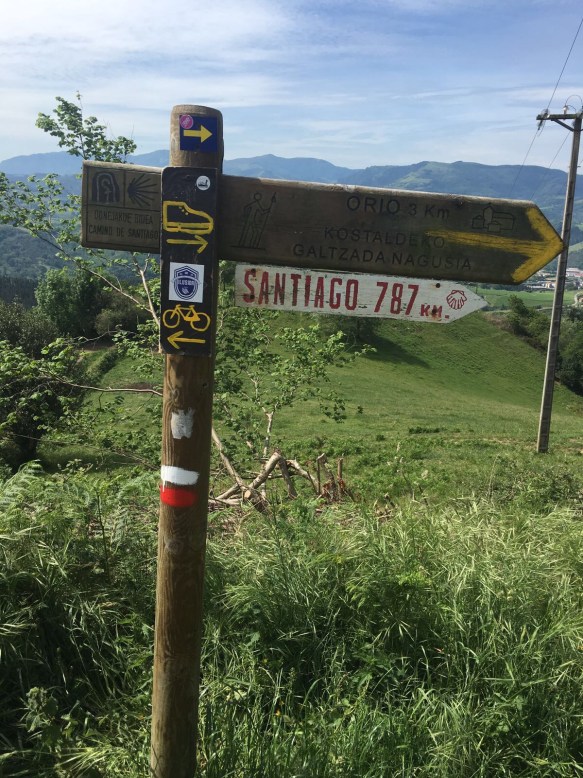
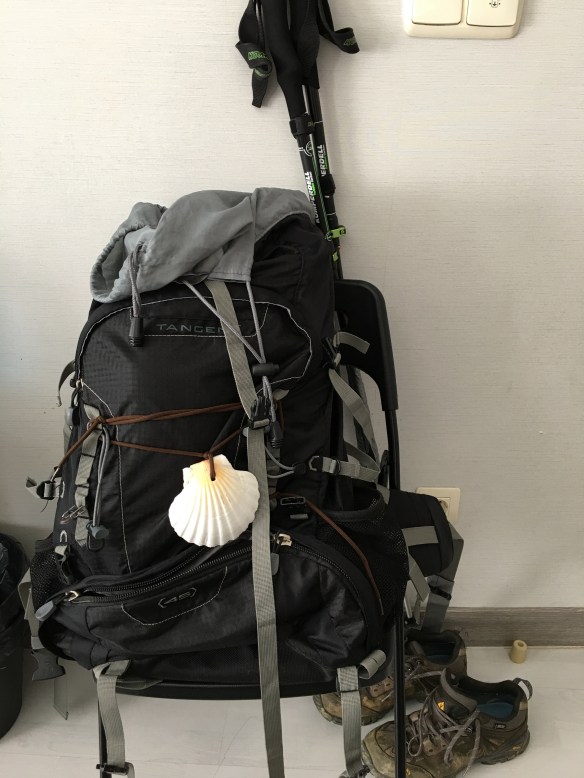
Before I took my first steps on the Camino de Santiago pilgrimage a couple of years ago, I first had to choose my shell—the symbol for St James the Apostle. Along the roadways and paths of the 800-kilometre trek across the Iberian Peninsula in northern Spain you can tell a pilgrim by the shell they have attached to their backpacks.

IMG_5341

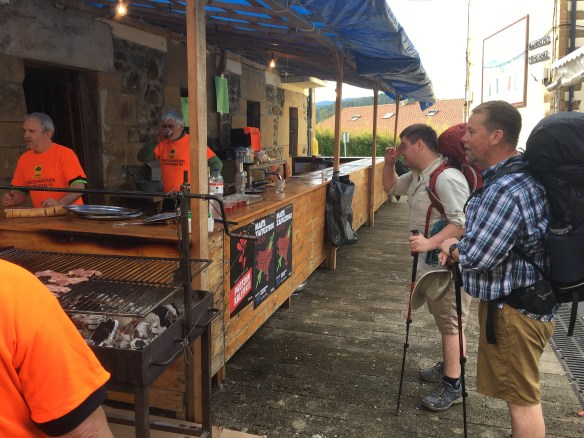
Wearing the shell attracted attention, often very positive. The group with whom I was walking came through a small suburb of the city of Guernica one Sunday morning. When we walked into the town square, we soon realized we were at the finish line of a marathon fundraiser for a local, special needs school.

There, some of the locals had set up large barbecues where they were grilling all sorts of meats for the marathon runners to enjoy after their race. We entered the square moments before the first runners crossed the finish line. But those preparing the barbecue called us over and without even asking our names or who we were offered us some of the delectable meats.

IMG_5308

When we expressed our gratitude, they asked us to say a prayer for them at the destination of our pilgrimage: the shrine in the city of Santiago, Spain—still some 700 kilometres away. I promised them I would.

IMG_5385

As you know, I didn’t make it to Santiago, falling ill to pneumonia and coming home early after only a couple of weeks on the trail. I remember struggling with my ‘failure’ to achieve my spiritual and physical goals. For one thing, I wasn’t able to offer a prayer in Santiago for those good people from Guernica who asked me to.

Was it worth it? Did my truncated pilgrimage do any good? Or, was the love and generosity those locals showed us and our receiving their gifts graciously, enough?

On Ash Wednesday, we begin a journey. And at the beginning of this journey, we are given a mark—not a shell, but the sign of the cross on our foreheads. It is a public act, a public ‘coming out’ if you will. By this mark the world will know we are Christians.

I hope you will wear your mark home tonight, wherever you go and whatever you still have to do—keep it visible. And see what happens. You might be invited into some meaningful, enriching conversations along the way. Some might even ask you to pray for them.

Go into the closet where no one can see you, instructs Jesus.[1]And pray to your Father in heaven who hears you, and will reward you for your faithful act. But even when we think our faith fails us? Or only for its visible success? Or only if we achieve our goals?

Arnold Lobel, author of his children’s book called The Frog and Toad Treasury describes the relationship of two friends and how they pass time together, explore the world together and support one another.

In one chapter, the action takes place in October. The leaves are falling. Frog decides to go to Toad’s house, secretly, and rake his leaves for him. “I will rake all the leaves that have fallen on his lawn. Toad will be surprised,” Frog says.

Now, his friend Toad has the same idea. Both manage to arrive at the home of the other unseen, ascertain that no one is home, rake the leaves, and return to their own houses unnoticed. On their respective ways home, however, a wind comes.

The wind blows and blows. The piles of leaves do too, so that the leaves are scattered everywhere. At the end of the day, neither Frog nor Toad realizes what the other has done, because both return home to leaves strewn across their yards. Both pledge to rake their own leaves the next day. Nevertheless, that night Frog and Toad are both happy when they each turned out the light and went to bed.[2]

What is more important: Our good intentions and motivation? Or, the outcome of our actions. Being authentic matters more than the results of our actions. The Gospel is not about the consequences, good or bad, of our good or bad intentions. The Gospel is not about achieving results and being rewarded for our good work, even with righteous motivation. In the end, the Gospel does not leave us stuck (and perplexed!) in self-centred piety, it points to what God is all about.

Normally when we hear the words of Jesus: “the kingdom of heaven is like …”[3]when someone does so and so, we think of the job we must do to enter that kingdom. And so, we imagine and want to be like that religious person, attending to ritual and prayer and acts of charity and justice our whole life long; the more we can do, the better.

Not that we don’t do anything or don’t keep trying. But we cannot ignore from these words of Jesus what Godis all about. I consider those scriptures about the kingdom of heaven as describing the character of God: A God who treasures each of us. And will stop at nothing to find us. And give up God’s very life on the cross—give up everything—in order to be with us and love us.

God is the one who sells all in order buy the field with the treasure buried in it. God is the merchant who sells everything in order to obtain the pearl of great value. Where God’s treasure is (God’s life, God’s mercy, God’s presence—in us), there God’s heart is also.

This is a fundamental message of Christianity. A message of One who comes into our life even in the messiness and despair of being human. Born a vulnerable baby to poor, teenage parents in a backwater town of Bethlehem. Living the life of a simple man from Nazareth, hanging out with fishers, tax collectors and prostitutes. Dying, even, the very humiliating death of a criminal, for all to see.

The message of Christianity is about a God who ‘sells it all’ in order to be with us, live in us and work in us, for the good.

God does all of this in order to know us, really know us. To love us. To grieve with us. To enjoy with us. To walk with us this often difficult journey that we undertake again this day.

And despite the difficult journey for which Lent is a metaphor, may the world in each step we take on the pilgrimage know we are Christians by our love.

And that’s enough.


[1]Matthew 6:1-6,16-21

[2]Cited in Lori Brandt Hale, David L. Bartlett & Barbara Brown Taylor, eds. Feasting on the Word: Preaching the Revised Common Lectionary Year C Vol 2 (Kentucky: WJK Press, 2009), p.23-24.

[3]from his later parables (or stories) describing the reign of God, specifically Matthew 13:44-45.

The change within

When seventeen-year-old Hannah said she was drug free, her parents were skeptical. Having participated in a rehab program and given all the support she could expect from friends and family, Hannah was able to declare that she was finding success in weaning herself off a destructive opioid dependence.

But her father was not convinced. When pressed, he simply confessed, “I don’t believe people can change. Once a drug addict, always a drug addict.”

Though fictional, Hannah and her parents’ situation poses a common predicament for many today. Not just of the real struggle with addiction. But also the struggle with belief: Do we change? And if so, how? And maybe more to the point: Do we recognize the change that happens in our lives? Do we want to?

There’s the story of the Zen Monk who was visiting Time’s Square in New York. And he wanted to buy a hotdog. The vendor asked him, “What would you like on your hotdog?”

The monk replied with a smile, “Make me one with everything.” So the vendor made the hotdog with ketchup, onions and lettuce and mustard and all these other nice things. And he gave it to the monk, and the monk gave the vendor a twenty-dollar bill.

And the vendor didn’t give him anything back. So the monk said, “What about my change?” And the vendor said, “The change is all within.”[1]

An underlying belief in Christianity is that people do change. The resurrection of Christ presents the ultimate pattern for life. We die. We live. We grow. We evolve. We are given new beginnings, to live again. Death. Resurrection. Life is dynamic, not static.

On this Transfiguration of our Lord Sunday, we encounter people who change. First and foremost, Jesus. He is bathed in uncreated light and to the onlookers his face radiates a changed appearance. His countenance is transformed before their very eyes. Here the gospel writers want to emphasize Jesus’ divine nature, his unique revelation as God’s own. The witnesses to this holy and amazing encounter receive the most wonderful gift of experiencing God’s greatness in Christ.[2]

At the same time, the transfigured Lord encounters us. In the scriptures for this Sunday we witness change in the characters of the bible, specifically Moses, Elijah and Paul.[3]They, and others in the bible, are not static beings, one-dimensional characters. We witness in them, rather, incredible change over the course of their lives and throughout history.

In other words, Jesus is not the only one who shows a divine-like appearance. Throughout scripture, there are others who experience within themselves a transfiguration.

Jesus is the first and foremost. But God’s divinity, though fully expressed in Jesus, is not confined to Jesus. God’s true presence is not limited to Jesus for Jesus’ sake alone. God’s fullness in all of creation is not locked in one specific time of history, two thousand years ago.

Martin Luther called it, the great, wonderful, holy “exchange”[4]. On the cross God experienced the fullness of our human sin in all its humiliating nakedness and vulnerability in order that all for whom Christ loved and died may eventually experience and grow into the fullness of divine life and union with God. This divine-human holy exchange is exemplified and mediated through Jesus.

We may balk at the notion that in our very lives, in each one of us, God is present in the living consciousness of Jesus. How can we be that good, eh? We are so used to imagining a separation there—that God is ‘out there’ reserved exclusively to doctrinal debate alone or in some other person upon whom we project all our hopes and dreams. But within me? In my heart? So that I can live differently, better, a changed person?

St. Paul, elsewhere in his first century writings expresses this truth from the start: In his letter to the Galatians, he says, “God revealed his Son in me”[5]. On the road to Damascus the living, post-resurrected Christ encountered Paul. Over one hundred times in all of his New Testament writings he writes this phrase: en Christo meaning ‘in Christ’. And to the Colossians, he confesses: “There is only Christ. He is everything and he is in everything.”[6]

The vendor’s response to the monk carries metaphoric weight. The change is within. A holy encounter with Jesus first changes us within. The change for the better can happen because God is in us. God works on our hearts. God is relentless. Sometimes it hurts. God is the refiner’s fire, creating and re-creating us from the inside-out.

So that, eventually, the light of Christ’s love may shine forth from our lives, and our union with God will be complete, in this world and the next.

Thanks be to God!

[1]Laurence Freeman, “Change is part of the Journey, like it or not”; talk 1 in Mount Oliveto Retreat, Maggiore Siena, Italy, June 18-25, 2016: Change (wccm.org, audio resources, album)

[2]Luke 9:28-43

[3]Exodus 34:29-35; 2 Corinthians 3:12—4:2

[4]“That is the mystery which is rich in divine grace to sinners: wherein by a wonderful exchange our sins are no longer ours but Christ’s and the righteousness of Christ not Christ’s but ours. He has emptied Himself of His righteousness that He might clothe us with it, and fill us with it.

And He has taken our evils upon Himself that He might deliver us from them… in the same manner as He grieved and suffered in our sins, and was confounded, in the same manner we rejoice and glory in His righteousness.”

–Martin Luther, Werke (Weimar, 1883), 5: 608.

[5]Chapter one, verse sixteen, as translated by the NIV and JB.

[6]Chapter three, verse 11. In the NRSV, the Greek is translated, “He is all and in all.”

You are blessed

(We can better understand the beatitudes of Jesus[1] alongside the texts from the Hebrew scriptures assigned for today[2]. Read together in light of the imagery we find there, we begin to make sense of Jesus’ challenging words. Both the Psalmist and the Prophet paint the picture of a tree or shrub in a state of dryness, and in a state of blessedness, shall we say?)

6They shall be like a shrub in the desert, and shall not see when relief comes. They shall live in the parched places.[3]

Being in a “parched place” suggests the unfortunate state of our lives when misfortune and adversity come our way: when we fail at something, when we lose someone or something, or through circumstances beyond our control life hands us lemons.

But the problem is not so much that we are in the desert. It’s not the condition nor circumstance in which we find ourselves. When we are in a bad way, it’s not where we are.

When we are ‘dried out’, the problem is we don’t see the relief that comes our way. We have a vision problem:

We don’t perceive the grace, the gift, and the solutions that present themselves. We, for whatever reason, do not appreciate what we already have. We are blind to this grace.

The sight of which Jeremiah speaks is not merely physical, but of the heart—an attitude, an inner stance—that leans towards what is good within us and in the world around us. It is the intention of our minds and hearts to search for what is good, what is life-giving. And, we nurture this disposition despite what may appear to the contrary on the surface.

Of course, to search and yearn for something means there is something missing in our lives. It is to admit something is amiss. It is to be honest and open about our needs. The longing of the heart exposes our vulnerabilities. But also our hope.

7Blessed are those who trust in the Lord,
whose trust is the Lord.
8They shall be like a tree planted by water,
sending out its roots by the stream
.[4]

Our searching for what feels lost in our lives are like the roots of a tree that naturally expand, grow and spread out towards the source of life—in water, in light. It’s the search itself, the persistent, dedicated and committed journey towards the water that keeps the tree alive, even against the odds.

On the Washington State coast along the Pacific Ocean, you will find the famous Kalaloch Tree, otherwise known as the Tree of Life, or the Runaway Tree.Underneath the webbed roots of the Kalaloch Tree is the Tree Root Cave. Inside, a stream falls into the cave and flows out into the ocean.

69c053a6a3c63493189b8bdda3d7943d

(photo from pinterest.ca)

Many question how the tree continues to grow and the leaves continue to stay green. These questions have been asked so many times with no one really knowing how it keeps on going. So it became known to some as the Tree of Life. Because it continues to live by the stream and the ocean, even though where it finds itself is hardly the ideal spot for stability and longevity.

The Sitka Spruce tree, common along the lush, verdant Pacific coast under the constant influence of moist-laden trade winds, has lived a long time balanced precariously over these rocks. Even though it’s immediate circumstance is fragile, its roots are never far from the source of its very life.

There’s the story about a man searching for his keys under a street light. A friend comes by and asks, “What are you doing?” The response: “Looking for my keys.” The friend says, “Where did you drop them?” The man replies, “Around the corner but I’m looking here because the light is better.”[5]

It’s interesting that in order for the man to actually find his keys, he would eventually have to go around the corner into the dark to find them. But he starts under the light. He starts his search where the light is. Where his confidence rests. Where he can see. And he will go from there, on his journey.

Today, it is common for people to say, “I am blessed” when talking about good fortune. When expressing joy and thanksgiving about all the good in life, we say that “we are blessed.” And, on one level, it is true.

But when Jesus gives a list of characteristics describing those who are ‘blessed’, that’s hardly the case. We find it hard to attribute blessedness to the poor, to the downtrodden, to those who experience misfortune, bad luck, who are given life’s worst circumstances imaginable. We can’t easily make that connection when we associate blessedness with material prosperity, or excellent health, or good fortune.

In Jesus’ teaching, ‘blessedness’ is not absence of trouble. Blessedness, here, is not a reflection of good luck and prosperity. Blessedness, in Jesus’ sense, is not a result of peachy circumstances, fortune and material wealth in the way the word is used in common parlance today.

Rather, to be blessed is “to live through such opposition aware that the struggle is temporary”[6]and that in the end, God will stand by the faithful.

In Luke’s version of Jesus’ great sermon, Jesus stands not on the mountain (as is the case in Matthew 5-7), but on “a level place.” In the bible the word “level” often refers to places of disgrace, suffering, misery, hunger and mourning.[7]

Jesus does not ascend to some high place to give his teaching. Instead, he descends not only to where we stand, but he goes deeper. Jesus descends into the dark recesses of the most difficult, challenging corners of our hearts in order to teach, guide and lead us through. He comes down to that ‘level’.

To be blessed is to be that Kalaloch Tree on the precipice of destruction, and still yearn, search and reach for the water. To be blessed is to pursue the good despite all the bad that is evident all around you. To be blessed is to start that search wherever there is light, and go from there. To be blessed is to trust God to be there in the dark with you. To be blessed is to grow into God’s holy purposes despite adversity, setback and misfortune.

In short, to be blessed is to bear the scars of life proudly. It’s not the absence of difficulty, grief, pain, poverty and suffering that mark a Christian. It is following Christ in his way, despite the suffering that path brings. It is depending on God alone for life, because there is nothing else to rely on.

We thus journey on with hope, joy and trust, bearing witness to the goodness of God to sustain, to nourish and to grow us in the light of Christ.


[1]Luke 6:17-26

[2]Psalm 1; Jeremiah 17:5-10, according to the Revised Common Lectionary (RCL) for the Sixth Sunday after Epiphany, Year C

[3]Jeremiah 17:6 NRSV

[4]Jeremiah 17:7-8 NRSV

[5]Dr. Earl A. Grollman, “In Search of a Lost Faith”, Frontline (Winter 2019), p.4

[6]Ronald J. Allen, “Commentary on Luke 6:17-26” in http://www.workingpreacher.org

[7]Allen, ibid.

Even among the lost

I hear Simon’s despair, tainted with frustration and even anger, when he reacts to Jesus’ instruction to put the nets in deep water to catch the fish in Lake Galilee.[1]

“Master, we have worked all night long but have caught nothing.” He’s trying to make a point that there is no use to doing what Jesus asks of them. After all, they did all they could do. They employed all their resources, knowledge and effort into catching fish that night. But to no avail. Understandably frustrated, Simon scoffs at the futility of doing what Jesus asks. As if he knows better. There is not point to it all.

This is not the first time we hear Jesus say or do something that mystifies us. Earlier in this season after Epiphany, we witnessed Jesus being baptized. Jesus being baptized in the Jordan River often confounds our sensibility. Why does Jesus need to be baptized? Aren’t we the ones that need to be baptized? Not God!

So often we find salvation in what we do, and the meaning we attribute to what we do. In the church, we often do exactly what the crowds at the Jordan did: We come to worship, pray the printed confessions of sin, receive Communion and hope that these liturgical acts will wash away our sins. And make life right.

Then, we also have other programs for self-improvement, such as trying a new diet, cutting down on drinking and smoking, or finding someone who will love us just right. But these things are all futile for making real change in our lives, for making our lives right.

But Jesus walks into our lives just as he waded into the Jordan to be baptized by John. If Jesus was to walk into our lives today, he could just as well arrive at our job interviews, wedding receptions, or retirement parties. He could just as well stand in the long lines with us at the Tim Horton’s or sports venues. Jesus could just as well join us in all our driving around town to this and that – and the next futile thing we are trying to do in order to make life right.

Yes, I could feel the futility behind Simon’s statement—but we fished all night and caught nothing. Would Jesus step even into that despair?

When work seems futile. When other people frustrate us. When life seems pointless. When what we do appears to have little purpose, meaning or utility. When we fail. When despair sinks in.

Or, not far removed in the face of uncertainty, we clamber and clamor for the next shiny, new thing. We distract ourselves. We fall into mindless routine or stimulating addiction, to occupy our minds or numb them. And escape reality. Even just below the surface of seeming industry, there broils a fearsome anxiety.

Yes, I hear Simon’s despair. But I also see Jesus, right there.

What is Jesus up to here? Getting baptized. Going fishing with his friends. Going to weddings. Hanging out in the streets. What is Jesus up to here, living the life we all live?

For some reason, Jesus is taking on our lost condition. Jesus participates in our lives, doing what we do, engaging our routines, our work, our lifestyles. And, as we become more aware of Jesus closeness to us in our successes and our failures, we discover the Gospel truth: that salvation comes not because of our activity, our brains, our efforts. Salvation comes through a loving Savior who finds us and takes on our lost condition.

So maybe our job is not to explain the mystery, but simply to obey the seemingly pointless, futile instruction from Jesus. And act on it, as Simon did. “Yet, if you say so, I will let down the nets.”[2]

Visit the sick. Befriend the poor, the outcast, the refugee. Accompany the vulnerable, the weak, the dying.

After selling their large house where they called home for decades, Jack and Betty moved to a smaller two-bedroom apartment in town. Once settled in, they invited Craig, a church friend, to dinner in their new home. Craig was happy to oblige.

After all, on Sunday mornings they would sit together in worship. They didn’t say a lot. Betty might say something odd, but her countenance was so bright. Jack seemed always bothered by something, like he was scowling. But the couple was always together. And they liked each other.

Craig tells the story of his experience visiting Jack and Betty. He writes,

“Once I arrived at their apartment on the appointed evening, it didn’t take me long to realize that Betty had Alzheimer’s disease. It now seemed so obvious that I felt foolish for missing it earlier. Jack never let her out of his sight. It was then that I realized that he hadn’t been scowling for the last couple of years. He was just worried.

“Before I even had my coat off, Betty took me by the hand and led me to the painting above the sofa that depicted their stately old home. She became a bit more lucid as the stories of the old place tumbled out of her soul. I felt her squeeze my hand as she talked … [as if she were trying to say], ‘There is more to me than you see now.’ … Jack stood behind us and allowed his worry to ease a bit with a tender smile.

“Dinner was interesting. Betty couldn’t be allowed near the stove, and Jack wasn’t about to learn to cook. So he had asked their housekeeper to make them an extra-large omelet before she left that afternoon. When we were ready to eat, Jack put the egg dish in the microwave, then cut it into thirds and served it on Betty’s best china. For desert he brought out Klondike bars that we ate using the good silverware, which wasn’t easy. Several times during the meal, Betty got up and wandered around the apartment a bit. I was impressed by Jack’s ability to maintain our conversation, which was always of secondary importance to him, while always watching his wife.

“Throughout the evening I kept thinking that I needed to say something useful. After all … [isn’t that what we’re supposed to do with others?] But how profound could I be with Betty, whose mind was too clouded for conversation? What would I even say to Jack…? I could try, ‘Keep up the good work’ or ‘This must be really hard,’ but that would be so inane.

“After dinner, we left the old dining-room table and made our way back to the living room sofa, where I sat next to Betty. Jack took the chair across from us. I began to talk, trying to speak of …[relevant] things, but I wasn’t doing well. [As a Christian friend, from church] I knew that I was called there to be a blessing to them and … to witness to Christ’s presence among them. But how? I felt like a pilot circling above the clouds, looking for an opening to land. Soon Betty got up and wandered off again.

“When she returned, she stood behind the chair where Jack was seated and put her trembling hand on his shoulder. And as only old lovers know how to do, he reached up to take her hand as if it were the first and millionth time he had done it. I stopped talking as they both smiled at me.

“Well, there it was – the blessed presence of Christ. Then I knew that I wasn’t there to say a thing. My calling was to behold and be amazed. It was as if their mutual smile said, ‘Don’t you dare pity us. We are blessed.’ Beneath the gentle act of holding a trembling hand lies the mystery of … [love].

“In the end, this is as good as the calling to love can be. …There is just the holding of hands …”[3]

There is neither brow-wrinkled explanation nor fear-induced despair.

There is just the smile of God in the face of another.


[1]Luke 5:4-5

[2]Luke 5:5

[3]M. Craig Barnes, The Pastor As Minor Poet: Texts and Subtexts in the Ministerial Life (Grand Rapids: Eerdmans, 2009) p.97,103-105

funeral sermon – living with a Gospel bias

The last church activity in which Tony participated was the weekly bible study group. At that time I was asking the group to choose next week’s text for study. And the selection was one from either the Old Testament or the Psalms or from Paul’s letters in the New Testament or from a Gospel reading in Matthew, Mark, Luke or John—the first four books of the New Testament.

Tony always, always, always voted for the Gospel reading. The Gospel describes the story of Jesus—his life, death and resurrection. You could say Tony had a bias towards the Gospel. And especially the Gospel of John, for some reason.

The word, Gospel, means: Good News. Good news. Not bad news. Not about how we always fall short. Not about human folly. Not readings about our sinfulness, about what we should do to make it better. But about the grace of God. God’s forgiveness, mercy, love.

The example in today’s Gospel is typical: Jesus washes his disciples’ feet.[1]The Gospel, to recognize it, is always about what God does, as a gift to us. So, here’s the thing about the good news of God:

It’s about receiving more than it is about achieving. The grace of God must be received, not achieved. Normally at a funeral service we talk about what our loved one has achieved in life, as if somehow the more one has achieved the better.

And without second glance, Tony, on that measure, has achieved so much: publishing books in his retirement, building half a dozen houses, acquiring degrees in mathematics and engineering, qualifying himself in brick-laying and construction, even playing soccer into his 80thyear. He achieved a lot, if that’s how you want to look at it.

And certainly in our culture, it seems that’s what it’s all about.

But what a tribute to one who has learned to see, that in all that life has given him—good and bad—all that he received in life, there is grace. A gift of God’s love. To appreciate life as gift. This is right brain stuff. This is entering into the mystery that is God and life.

When he was young, he contracted Diphtheria which kept him isolated for some time, sequestered with the nuns in their abbey. Late in his life, Tony was able to confess that even having a disease was a gift, since it kept him from entering the war, a war that claimed the lives of his two brothers.

These traumatic events of life could have left him bitter. But, despite it all, he remained his true self—kind, loving and gracious.

The author bio on the back cover of both books he published in his retirement says the following about Tony: “Tony was always very interested in literature, history, religion, and cosmology.”

At the end of Act One in his book entitled About God, the World and People, the scene is set at an evening dinner party. Around the table sit different characters – a priest and a scientist among others. After covering such cerebral topics as ‘what is dark matter’, the origin of the universe and various forms of energy, the priest, Father Stengel, concludes with what I suspect is the author’s personal belief:

Father Stengel says, “I personally have no problem with what our diligent scientists discover. I clearly see in the development of our universe the guiding and loving spirit of our Father in heaven.”[2]

While working with numbers all his life and valuing their clarity and succinctness, Tony was also able to say, “They’re just numbers”, in light of God’s truth.

From the perspective of faith, analytics and left-brain thinking can obviously help with some things in life. But when it comes to the great mysteries of life, when we encounter great suffering or great love, when we experience death, or yearn for God, we need to access another ‘operating system’.

You can’t explain these realities adequately using the scientific method alone. It’s remarkable, for the mathematician and engineer that Tony was—that he was able to appreciate, discern and plumb those more intuitive and subtler depths of knowing as well.

It doesn’t make sense how grief works, really. I’ve told this to many grieving families over the years after a loved one died: That in a grieving process, it’s not just the pain of loss of that particular person that comes to the surface at that time. The death of a loved one triggers all the emotional baggage—if you will—of all previous losses you have experienced as well, all those unresolved issues in a family, everything. It can be quite overwhelming. I’ve recently experienced this truth myself. It’s not rational. But it’s very real.

And in those moments that can’t be explained, in the end, the only course of action is love. It’s the only way that does make sense in the turmoil of loss and pain. I think Tony knew that. Gospel bias towards love.

Tony’s teammates on the soccer team were well represented at the funeral home last evening. One of his teammates told me that Tony was the reason they kept playing together. He said that during a game teammates and the competition sometimes came to blows, emotionally if not physically. But Tony was always there trying to mend ways, trying to keep the group together, inspiring them to play on. Tony knew that. Gospel bias towards love.

Death changes some things. Death is final, in a way. And it hurts. Yes. But human death doesn’t mean the relationship is ended. Death merely changed the nature of our relationship with Tony.

Now, Tony is no longer physically present with us. But he lives on—in our hearts, in our minds, in our spirit, in our conscience, in our actions. He is still with us, albeit in a different way. Tony’s death leaves us a gift, an invitation to make what was important to him, important to us. Life as gift, a grace to do unto others as you would have done unto yourself. Gospel bias towards love.

“What we do for ourselves dies with us. What we do for others and the world remains and is immortal.”[3]Let what we do for others, be love.


[1]John 13:12-15,34-35

[2]Tony Bickle, About God, the World and People (Xlibris Corporation, 2008) p.48

[3]Most likely from Albert Pike, 19thcentury American attorney, soldier, writer, and Freemason. Sometimes this quote is attributed to 20thcentury American writer and biographer, Albert Paine.


Christmas, now

Just a couple of years before he died, Martin Luther preached one of his last Christmas sermons. In it, he challenged his 16thcentury German congregation to bring the nativity into the present moment – the present reality.

Martin Luther described the squalor and desperation swirling around Mary and Joseph arriving late in Bethlehem and not finding room in the inn, leaving them to give birth to Jesus in a small barn out back. Then, he said:

 There are many of you in this congregation who think to yourselves: “If only I had been there! How quick I would have been to help the baby! I would have washed his linen!” … [Well] Why don’t you do it now? You have Christ in your neighbour. You ought to serve them, for what you do to your neighbour in need you do to the Lord Christ himself.[1] That was preached in 1543.

At Christmas 2018, we are not just called to hear the story again, but to be in it, part of it.[2]

Essentially, Martin Luther was getting at the meaning of Christmas for his contemporaries. And for us, today. How can we be inspired by the children, the music, the gifts we bring at Christmas to step out of the nativity ‘play’, and into the real story unfolding around us today?

We share in the communion tonight. In the chaos, noise and crowd, celebrating the sacrament might not fit our idea of a neat-and-tidy, perfect Christmas service. It’s hard to sentimentalize the Eucharist.

But it’s important to offer it tonight. Because the sacrament brings us to the present moment. The meal tells the story of Jesus being in our hearts—not decades ago when things were golden and sweet in our memories, not two thousand years ago, not in the Martin Luther’s day, not lost in words of scripture alone—but right here, right now, in the present day, in our own experience of life in this world.

Receiving the bread and cup doesn’t mean your life is perfect, doesn’t mean you are now ready for Christmas, doesn’t mean y our life is in order and worthy of God.

When you receive the Communion, you are affirming that God is somewhere in the mess and chaos of your life. Our life. Emmanuel–God with us.

Celebrating Christ’s birth does not bring us outof history, it involves us with it—in the present time.[3]The Christmas story gets lived out by our attention and care for the dark shadows in our own hearts, as well as reaching out to vulnerable people in our world.

I heard with dismay on the local radio station last week that the City of Ottawa is putting up 230 families in cheap hotels this Christmas, where they have to live for over a year before social housing spots open up. Talk about conditions of squalor entire families, all of them poor, need to live in at Christmas. And we’re not talking about a handful. Two Hundred and Thirty families, in Ottawa alone.

Have we considered that when we pray for and help in whatever way we can these people, we are serving Christ himself? After all, our Lord was a refugee himself right after his birth, fleeing to Egypt with his parents to get away from Herod’s violent and murderous intent.[4]

Popular TSN Hockey Insider Bob McKenzie just came out with a book this Fall entitled: “Everyday Hockey Heroes: Inspiring Stories on and off the Ice”[5]

In one chapter about an inspiring Ottawa story, Bob McKenzie relays the words of Karina Potvin, a minor hockey coach. She writes: “So much about Canada is welcoming. Well, except maybe our winters, but they’re a small price to pay in order to play hockey …”

As Karina watched on the news refugees being greeted at the airport, she writes: “I knew I wanted to help these new Canadians feel at home. I just wasn’t sure how.

“A few months later I was at practice when I saw one of my fellow coaches … coming towards the bench … [he had a] new idea for Reach Out. Reach Out is a program in our hockey association that helps low income families pay for equipment and registration fees so that their kids can join our league …

“‘You know how my wife and I have been working with some of the Syrian families who have settled here in Ottawa?’ He went on, ‘We took a family to …[a] game last week, and their sons absolutely loved it. They had never heard of hockey before, but they want to play.’

Karina ended up coaching three boys—Mohammed, Ahmad and Ismael—who quickly got the hang of skating. “They’re all over the ice!”

“The three boys breathed hockey all day, every day. As did their parents. By midseason, the parents were typical Canadian hockey moms and dads.

“One Arabic word I learned was hebbak which means “I love you.” Sometimes when we were on the bench, I would turn to Mohammed and say it. He always gave me a strange look.

“’Yeah, I just told you that I love you. Because you’re playing really well tonight and listening to us coaches.’

“He shook his head, ‘Coach Karina, you’re weird.’

“’If you ever make the NHL and they ask you who was your first and favourite coach, you have to say Coach Karina.’

“’Yes, of course.’ He laughed.

“’And if you ever play for the Senators, you have to get me tickets.’ Every time I said this, he would smile and reply, ‘Yes. Yes. Yes.’”

Just imagine: The year before, these kids had been in a refugee camp in Lebanon. Now, they were playing hockey just like so many other kids in Canada.[6]

May the first Christmas story become alive and real for you, as the Christ child is born anew in your hearts thisday.

Here are the words of American writer Madeleine L’Engle in a poem entitled “First Coming”:

He did not wait till the world was ready,
till men and nations were at peace.
He came when the Heavens were unsteady,
and prisoners cried out for release.

He did not wait for the perfect time.
He came when the need was deep and great.
He dined with sinners in all their grime,
turned water into wine.

He did not wait till hearts were pure.
In joy he came to a tarnished world of sin and doubt.
To a world like ours, of anguished shame
he came, and his Light would not go out.

He came to a world which did not mesh,
to heal its tangles, shield its scorn.
In the mystery of the Word made Flesh
the Maker of the stars was born.

We cannot wait till the world is sane
to raise our songs with joyful voice,
for to share our grief, to touch our pain,
He came with Love: Rejoice! Rejoice!

Merry Christmas!

[1]Martin Luther, Christmas Sermon, 1543; Matthew 25:45

[2]Lcfaithinthenight.blogspot.com, 19 Dec 2018, (Lutherans Connect, @LuTConnect).

[3]Gustavo Gutierrez, cited in LutheransConnect, ibid.

[4]Matthew 2:13-15

[5]With Jim Lang (Toronto: Simon & Schuster, 2018)

[6]The full story in ibid., p.45-56

Behold, I prepare the way!

“Behold, I am sending my messenger to prepare the way before me … “ (Malachi 3:1).

It was the day after my birthday at the end of October, that the tree arrived. Much earlier than I expected all the way from Idaho. But I wanted to make sure this artificial tree, which was billed as the most realistic Balsam Fir on the market, would get all the way to Canada during a postal strike in time to decorate. The end of October was much too early for me, but at least you might say I was preparing well. Or, so I thought.

Meaning, I was getting things done early. I was on top of all the planning and busy preparations. In so doing, I was convincing myself that I was doing the preparation that Advent calls for.

Well, it’s the 2nd Sunday in Advent and the tree is still not decorated. In fact half of it does not light up. For all of November and almost half of December, I have sat in my chair in our living room, looking at an empty tree waiting for the replacement part to arrive. According to tracking, it’s supposed to arrive tomorrow. Pray for me.

It hasn’t been easy sitting there throughout this time looking at a tree that was supposed to be perfect but wasn’t. It was broken. It hasn’t been easy looking every day at that tree that was supposed to be decorated and functioning perfectly already but wasn’t. It hasn’t been easy talking on the phone umpteen times with the company about what was wrong with the wiring. It hasn’t been easy waiting for things to happen that should already have. It hasn’t been easy looking at what has become a symbol not of my good intentions, my industrious, conscientious hard work paid off; but, instead, a symbol of imperfection, failure and frustration.

One of the messages of Advent is that we must prepare the way of the Lord in our hearts and in this world. How, then, are we to prepare for the Lord’s coming? How are we to prepare, if not just upping our efforts at getting stuff done—the more efficient the better, the faster the better?

In several scriptures assigned for Advent, we encounter a unique word: “Behold!” Today, the command is to behold, my messenger comes to prepare the way. I prefer this old English translation in the King James Version which preserves an important nuance of this biblical command to behold. This is very similar to the behold from last week, from the prophet Jeremiah, commanding us to behold that the days are coming when God will fulfill God’s promises. (1) In other words, God is about to do something.

At least in today’s reading from the Hebrew scripture, the New Revised Standard Version (NRSV) opens with the more common, “See!” But we can work with that! In fact, that is not bad. When Philip asks Jesus, “Show us the Father”, Jesus responds, “If you have seen me, you have seen the Father.” (2) Throughout the Gospels, the message is that in Jesus, we see God.

But, really see. That’s why ‘behold’ is better. Not just ‘look at.’ Not just a sidelong glance. Not just looking at someone askance, in passing. Not just the surface of how he looks. But to perceive Jesus, to look into the heart of the Lord. To ‘behold’ God. To be in and contemplate the presence of the One who comes to us. The One we cannot fully understand.

God is about to do something. When? Where? How? So, behold God—the One we cannot fully understand who comes nevertheless. Behold the mystery.

The story shared with me was of a lonely widower who was told by his friends that he ought to get a dog. So he goes to a pet shop to see what’s available.

“Have you ever owned a dog before?” the saleswoman asks.

“No.”

“Are you prepared to take it out for a walk two or three times a day?”

“I hadn’t really thought of that. I just wanted a little companionship.”

“That companionship requires something from you, no?” the saleswoman mused out loud.

“Listen,” she broke the awkward silence between them, “if you really want companionship, I’ll show you a talking centipede for about the same price.”

“You must be joking.”

“No, I’m serious, and what’s more, this little guy can even sing.” She leads the customer to a miniature house, and in front of it, in a barely visible lawn chair, is the centipede. Turning to the tiny creature, she says, “Would you say something for this man so he’ll know you can talk?”

“Okay,” says the centipede in a very soft voice. “What would you like me to say?”

“That’s fine,” says the saleswoman. “And can you show him your singing voice?”

“Of course,” says the centipede, who breaks into a barely audible rendition of “Sweet Caroline.”

The man can’t believe it. He buys the centipede and the tiny house and brings them home.

Later that day, he calls out, “I’m going for a coffee and I’d love to introduce you to my friends at Tim Hortons. Would you like to come along?”

The centipede does not answer. He repeats the questions, and again there’s no answer.

He decides to ask one more time. He goes right up to the little house and says in a loud voice, “For the last time, I’m going out for a coffee. Would you like to come along?”

“I heard you the first time,” quietly says the centipede. “I’m just putting on my boots.”

Beholding God requires something of us. It calls us to get in sync with where God likely is and how God tends to work. We are called to interface with the presence of God. Admittedly, this is challenging for us because, as one Japanese theologian remarked, God, like the centipede, is going three miles an hour. (3)  How fast are we going?

The refining fire of growth and change is not waiting for us to feel good about it. This Advent, we are simply called to behold the mystery of God’s ways and respond from the heart to the truth of how God is revealed to us. And trust, that in God’s time and ways, all that’s good will come to pass in our lives and in this world.

It might be counterintuitive but a better way to prepare during this season might very well be to slow down and be silent more. To listen for what God is already whispering into your own soul. And to see what God is already doing all around you.

I’m not saying that preparing is not a good thing to do. But, inevitably, times come in life when no amount of preparation can prepare you for what you must endure. So, you wait.

And, in the waiting, you may find some time to acknowledge what is missing in your soul—“your longing desires, your deepest needs, the questions where you don’t, yet, have answers.” (4)

And, then, pray in the awareness that God knows. And, in the end, it is not my or your preparation that is the most important during this time of Advent, but God’s. God is already preparing your soul for its healing and wholeness once again.

“Behold! I am about to do a new thing,” God says. “Do you not see it?” (5)

  1. Jeremiah 33:14-16
  2. John 14:8-9
  3. Kosuke Koyama, “Three Mile An Hour God” (SCM Press, 2015)
  4. Society of Saint John the Evangelist (SSJE) “Longing – Brother, Give Us A Word” (3 December 2018), http://www.ssje.org
  5. Isaiah 43:19

Postscript: On December 13, the part finally arrived! And, it seems to work. Well worth the wait!