Annual Pastor’s Report

Effective Partnerships

The most significant event in the life of Faith Lutheran Church in 2016, was the decision to complete an extensive renovation of our worship space and narthex hallway. To complete this major modernization project, we partnered with the capable and esteemed contracting company from Stittsville, “Amsted”.

This decision precipitated what may in the long run prove to be just as significant, if not more so: The decision to join with the local Anglican parish on Sunday mornings during the time of the renovation (which lasted into 2017).

Even should nothing enduring come of the relationship between Faith Lutheran Church and Julian of Norwich Anglican Church, the mere exercise of gathering as a hybrid congregation for the last ten consecutive Sundays in 2016 plus two Christmas Eve services caught the attention of the Christian community in Ottawa and across our Eastern Synod.

Meeting to worship with local Anglicans affirmed both the existing Full Communion relationship between the Evangelical Lutheran Church in Canada (ELCIC) and the Anglican Church of Canada (ACC), an agreement existing since 2001. As such, given the other options during our vacancy from 43 Meadowlands Drive West, meeting with an Anglican congregation was attractive, since doing so facilitated many logistics of worship between our similar liturgies, as well as kept a certain momentum alive for meeting at all, during the renovation/vacancy period.

On Lutheran liturgy Sundays (every other Sunday) at Julian of Norwich, we expressed our unique identity within the union of two distinct congregations. For example, each congregation has different histories, as well as contrasting governance structures (i.e. Anglicans are governed episcopally, while Lutherans are governed in a congregational structure).

While comparing congregations is fruitful, challenging and enjoyable, the fact that we began this relationship knowing we were returning home at some point allows us to pose critical questions of review of our ‘way of doing things’ freely, both around sacramental practice and mission.

During the Eastern Synod Assembly in June, your lay delegate (Julia Wirth) and the pastor heard again the four main, missional themes of the Eastern Synod (Effective Partnerships, Healthy Church, Spirited Discipleship, Compassionate Justice). No doubt, our congregation participated in a way no other Eastern Synod congregation has, in affirming the value of seeking “Effective Partnerships” in fulfilling God’s mission, especially during times of need and change.

Loss and Transition

A basic assumption of committing to the renovation project was that we had to take leave of our current building, and specifically our place of prayer. Doing so was an act of courage. Leaving a place that has symbolized a constant certainty in the lives of Faith members for over fifty years was not easy. Our sense of stability in faith was disrupted, as we were challenged to distinguish between the form (‘our’ building) and function (the purpose) of faith.

This leave-taking coincided with other endings. June 2016 marked the last time the Faith Lutheran Women (FLW), structured the way they had been for the last few decades, met in typical fashion (see report). For some time prior to this they had been talking about closing their account and ceasing to meet ‘as is’. In the latter part of 2016, that talk became reality.

Also, the Confirmation program that for several years had been a successful experience for leaders and participants alike, did not in the Fall of 2016 achieve the critical mass of students to warrant a class structured in the same way. As a result, no program started up at the start of the school year.

These events, I believe, constitute ground for growth and maturity of our community as we practice the spiritual gifts of detachment and trust. The prophet Isaiah spoke the word of God to the exiled people in Babylon in the 6th century B.C.:

“Do not remember the former things, or consider the things of old. I am about to do a new thing; now it springs forth, do you not perceive it? I will make a way in the wilderness and rivers in the desert.” (Isaiah 43:18-19)

Before the new thing arrives, we need to stop the old thing. These endings are not failures as such; rather, they provide the space for the new thing God will have for us. What we are called to in disruptive times of loss and transition, I believe, is to be patient, have presence of mind and openness of heart, and be willing to take a risk together when something presents itself in our hearts as possibility and passion.

Poised for renewal

Moving into the new year, Faith Lutheran Church is poised to embrace a season of discernment, reflection and new beginnings.

Not only will we return to enjoy the gift of a refreshed, safe and healthy environment for meeting in our newly renovated building, we will be encouraged to reflect on what this space, created for at least another decade of ministry, worship, and mission, will be used for.

Late in 2016, the congregational council unanimously endorsed a proposal for a 3-month sabbatical for the pastor in 2017. The sabbatical covenant, based on the Eastern Synod Guidelines for Sabbatical, addresses the need for leaders to take periodic and extensive ‘pauses’ in vocational life, for renewal, reflection and discernment.

The benefits for the congregation mirror those for the pastor. From the perspective of providing some distance, a sabbatical gives freedom for everyone to step back, assess the structure of ministry and mission in the congregation, and contemplate new ways of supporting one another in our lives of faith.

For example, healthy congregations in general have several highly functioning lay leaders who engage proactively not only in managing a church, but in leading the mission of the church. The health benefits to the congregation, as for the pastor, following the sabbatical give opportunity for renewal of the mutuality of the relationship between pastor and congregation in God’s mission. The ‘reset button’ is pressed, and energy flows again.

Adaptive Change: Put away the mallets and start asking “Why?”

“There is a wonderful story of a group of American car executives who went to Japan to see a Japanese assembly line. At the end of the line, the doors were put on the hinges, the same as in America. But something was missing.

“In the United States, a line worker would take a rubber mallet and tap the edges of the door to ensure that it fit perfectly. In Japan, that job didn’t seem to exist.

“Confused, the American auto executives asked at what point they made sure the door fit perfectly. Their Japanese guide looked at them and smiled sheepishly. ‘We make sure it fits when we design it.’

“In the Japanese auto plant, they didn’t examine the problem and accumulate data to figure out the best solution — they engineered the outcome they wanted from the beginning. If they didn’t achieve their desired outcome, they understood it was because of a decision they made at the start of the process.

“At the end of the day, the doors on the American-made and Japanese-made cars appeared to fit when each rolled off the assembly line. Except the Japanese didn’t need to employ someone to hammer doors, nor did they need to buy any mallets. More importantly, the Japanese doors are likely to last longer and maybe even more structurally sound in an accident. All this for no other reason than they ensured the pieces fit from the start.

“What the American automakers did with their rubber mallets is a metaphor for how so many people and organizations lead … a series of perfectly effective short-term tactics are used until the desired outcome is achieved. But how structurally sound are those solutions?

“ … Long-term success [is] more predictable for only one. The one that understands why the doors need to fit by design and not by default.

“Going back to the original purpose, cause of belief will help … [churches] adapt. Instead of asking, “WHAT should we do …? the questions must be asked, “WHY did we start doing WHAT we’re doing in the first place, and WHAT can we do to bring our cause to life considering all the technologies and …[other] opportunities available today?” (1)

Being poised for renewal means we need to understand the nature of change in institutions such as the church. Some definitions, outlined in a report generated by the Eastern Synod Mission Committee late in 2016, draw the distinction between Technical Change and Adaptive Change:

Technical Change is about fixing problems while essentially keeping the system the same. In other words, where’s the mallet?
Adaptive Change, on the other hand, is about addressing fundamental changes in values that demand innovation, learning and changes to the system itself. Start with ‘Why?’ And then lead from there, by design not default.

During this coming year, which will give all of us permission to pause and reflect, please resist the temptation to rush into doing something either because ‘we’ve always done it that way’ or because we are too anxious not to remain awhile in the uneasy ‘in-between’ time of loss and transition. Be patient, take deep breath, pray, and reflect on the following questions:

Our adaptive challenge questions for 2017:
1. How do we communicate? To whom is each of us accountable?
2. How well do we listen and seek to understand the other? Give concrete examples.
3. Will we create a list of those who are not in church (technical strategy); or, will we identify the needs in the community surrounding 43 Meadowlands Dr West, in Ottawa (adaptive strategy)?
4. How will prayer be our starting point?
5. What are other ways besides worship that serve as entry points for the public to engage the church? This is important.
6. How do we see worship as a launching pad, not a destination, for following Jesus? This is very important.
7. What are the gifts we have as a church? (personnel, space, talents, passions, etc.)
8. How well do you know your fellow congregants’ jobs, professions, contacts, interests, hobbies, talents, passions?
9. Why do we initiate a ministry or mission outreach activity in the first place? Who is the target group? What is the purpose of doing it? Does everyone know the purpose? Why or why not? Is there general agreement about the purpose? Why or why not?

Thank you again for the privilege of another year doing this work with you. Blessings and Grace, on our journeys moving forward,
Pastor Martin

(1) Simon Sinek, “Start With Why”, Penguin Books, New York, 2009, p.14-15, p.51

Christmas in July


This past summer my family visited friends in Italy. We spent three weeks touring around mostly the southern half of mainland Italy — Naples and the Amalfi Coast especially. In this region in summer, the weather is tropical. Palm trees, humid air, full sun and temperatures soaring. We wore shorts and sandals, t-shirts and hats the entire time.

One of our highlights was visiting the Green, or Emerald, grotto near Positano on the Amalfi Coast. We had to take an elevator down from the snaking roadway to the water line. Then, we entered small boats for a tour around the cave.


The grotto was named “Emerald” for the incredible colours that filter from an underground opening and fill the cave with intense nuances of green. The inside of the cavern is filled with stalagmites, stalactites and beautiful works of art created by time and nature.

Near the end of the tour when the boat was paddled close to a wall of the cave, our tour guide asked us to look down into the sparkling, luminescent water on the one side of the boat. “What do you see?” he prompted us. For the longest time, I could see nothing, just the rippling waters.

Then, as the light continued to play on the currents swirling some ten feet underneath us, I saw it:

The grotto is home to an underwater nativity scene, made by a ceramics artisan from nearby Vietri in 1956. Since that time, divers from all over Italy come to pay a visit to the Holy Family at Christmas. But it wasn’t Christmas.

For me, the traditional nativity set felt out of place – a kitsch decoration in a natural, marine setting in a tropical paradise. From my Canadian perspective, it felt all wrong. This didn’t belong here.

It was the least-expected time and place to be reminded of Christmas. Christmas in July, where temperatures were well into the 30 degree celsius range, far away from home on the Amalfi Coast in Italy. On vacation. Christmas was the farthest thing from my mind!

In the Christmas children’s book by Eve Bunting, entitled, “We Were There: A Nativity Story”, she illustrates how the least expected animals very likely also attended the birth of Jesus: a snake, a frog, a scorpion, a cockroach, a bat, a spider and a rat.

It is written from the perspective of these least likely characters who are thankful for the more popular donkeys, sheep and cows who are “so generous to share their place” by the side of the manger. She concludes:

No one will look beyond the light to darkness
and the corner where we watch, unwatched.
They will not know or care.
But we were there. (1)

This children’s book makes a deep, theological point! The problem: We don’t see that God is there. We only expect to see God in certain places, at certain times:
Only at Christmas once a year in a crowded, decorated church;
Only in warm, comfortable stables where clean sheets and cutesy animals surround a quiet baby lying in the arms of a domicile Mary;
Only when good times roll with egg nog at the hearth of a roaring fire sitting in your favourite chair;
Only when choristers sing your favourite carols;
Or, only when everything is perfect.

We’ve locked God into the proverbial box.

The good news: God blows all our contrived and constricted expectations. God comes to us in all times and places, especially when we least expect it, even when we are not thinking about it, or planning for it.

While the dominant Christmas culture depends on our planning and organizing and ‘setting it up’, God comes to us despite all our fussing and fretting.

In truth, God is already there, just beneath the surface, out of the reach of the light, in the shadows where no one is looking or even caring.

Our job is not to make God happen by all our toiling and efforts to create the best Christmas ever. We don’t achieve God’s presence. Our job is simply to recognize where God is already present. Our job, simple though not easy, is to surrender to God who is already there. And this takes practice and intention.

So, this Christmas holiday, take a walk downtown where street people continue to ask for money. This Christmas holiday, search out an old friend with whom you haven’t spoken for a long time. This Christmas holiday, do something that you normally would not do, for the common good. This Christmas holiday, recognize the gifts you already have, not just in those presents packed under the tree.

Give thanks for the gifts you enjoy every day of the year — friends, family, love, community — the blessings that come from learning to want what you have instead of having what you want. Exercise the skill of seeing where and what many will not.

The joy of Christmas be with you. The gift of life and love in Jesus is born anew in our very lives. Today. And no matter where you are and whatever the circumstance of your life. God is already with you, waiting to be seen.

(1) – Eve Bunting, “We Were There: A Nativity Story” (Clarion Books, New York, 2001)

Rooted in the earth, rising to the sun

Recently I have been reading about people’s experiences on the Camino de Santiago — the eight hundred kilometre walking pilgrimage through northern Spain. This walk has become more and more popular among Christians of all stripes over the past couple of decades. It seems Christians around the globe are finding the pilgrimage a good place to work through personal issues, find focus in life again and seek re-connection with God, the world and themselves.

This past week I met with one such pilgrim from Ottawa who goes at least once a year to walk some part of the Camino; in fact he is leaving today for Barcelona. I sought his experienced advice for some practical considerations for the trek. His first rule of thumb: Pack only ten percent of your body weight. For me, that would mean no more that 20 pounds in my back pack — of all that I would need for the thirty to forty day hike. Twenty pounds is not a lot!

His second rule of thumb: What you wear on your back, put only one in your pack. That’s all. For example, if you are wearing a t-shirt, pack only one other t-shirt in your back-pack. If you are wearing a pair of shorts, pack only one other pair of shorts. And so on.

He laughed when he told me that about four days in — some one hundred kilometres into the journey — you find bins and bins full of personal items people left behind. These pilgrims had realized, thankfully sooner than later, that they were simply carrying too much — stuff they didn’t really need (extra shirts, pants, sweaters, books, jackets, bed mats, blankets, etc.). A final rule of thumb from my friend: If you do take something extra, then you need to have a good reason for it besides, “I might need it.”

This discipline reflects the quality of being able to let go. It can be described as a total self-surrendering, a giving up. The term “Kenosis” has been used among Christians throughout the ages to connote this sense of releasing that which we normally feel we need to hold onto tightly.

Fourteenth century German theologian Meister Eckhart said, “God is not found in the soul by adding anything, but by a process of subtraction.” (1) In our consumer culture, religion and spirituality have very often become a matter of addition: earning points with God, attaining enlightenment, producing moral behaviour. In the ‘prosperity gospel’ so popular in North America, we often hear the message that Jesus approves of you when your material and financial wealth increases; the more you have, the more in favour you are in God’s eyes.

Yet authentic, Christian faith is not about getting, attaining, achieving, performing or succeeding. The solution is not just “work harder” or “get more” of something. Our culture and economy, indeed, is based on more and more. Whereas true faith suggests: less is more. Martin Luther’s theology of Justification by Grace through Faith suggests the very same: We cannot by our own efforts achieve anything worthy of God.

So, stop trying. In fact, start doing the opposite: Let go of your pretence to manage your life according to the creed: Bigger and More is Better. Let go of a paralyzing negative body image. Let go of the inner talk that is putting yourself down, that tells you you are no good. Let go of attitudes of hatred against people who are different from you. Let go of those material aspirations that tease you into a false sense of security. Let go of being paralyzed by fear.

Instead, focus on what is essential. Appreciate that you already have enough, all that you need. When Jesus gives instruction in the Gospel text for today (Luke 14:25-33) he is travelling out on a public road, on his pilgrimage to the Cross. Remember, ever since Luke 9:51, he is already on the way to Jerusalem, his final destination. When Jesus is walking towards his death and resurrection in Jerusalem, he offers what sounds rather harsh to our ears. What is called-for here is a ‘single-mindedness’ that is needed when you travel with Jesus.

Discipleship is about being single-minded about the purpose, the goal and the mission of Jesus in the world. It is about prioritizing what is important to life in the public realm where culture, consumerism and a whole host of other distractions can keep us from this focus.

This single-mindedness demands that we think ahead, and anticipate the cost of our journey. Setting out on the road to follow Jesus requires at least a little forethought and reflection. This journey is not a light matter. Sit down and think about it a bit. Reflect.

There is not only the blessing of the assets promised, but there are the liabilities, too. Discipleship is not just one more hobby or extra-curricular activity to add to a well-rounded, prosperous life. It is not merely “a matter of pure passion and abandon” (2).

Followers of Jesus should count the cost, but also realize this is not just about counting the cost of a church building renovation or a church fund-raising project. The cost of discipleship, as Dietrich Bonhoeffer first coined the term, is about prioritizing our whole lives, not just our “church” or “Sunday morning” lives.

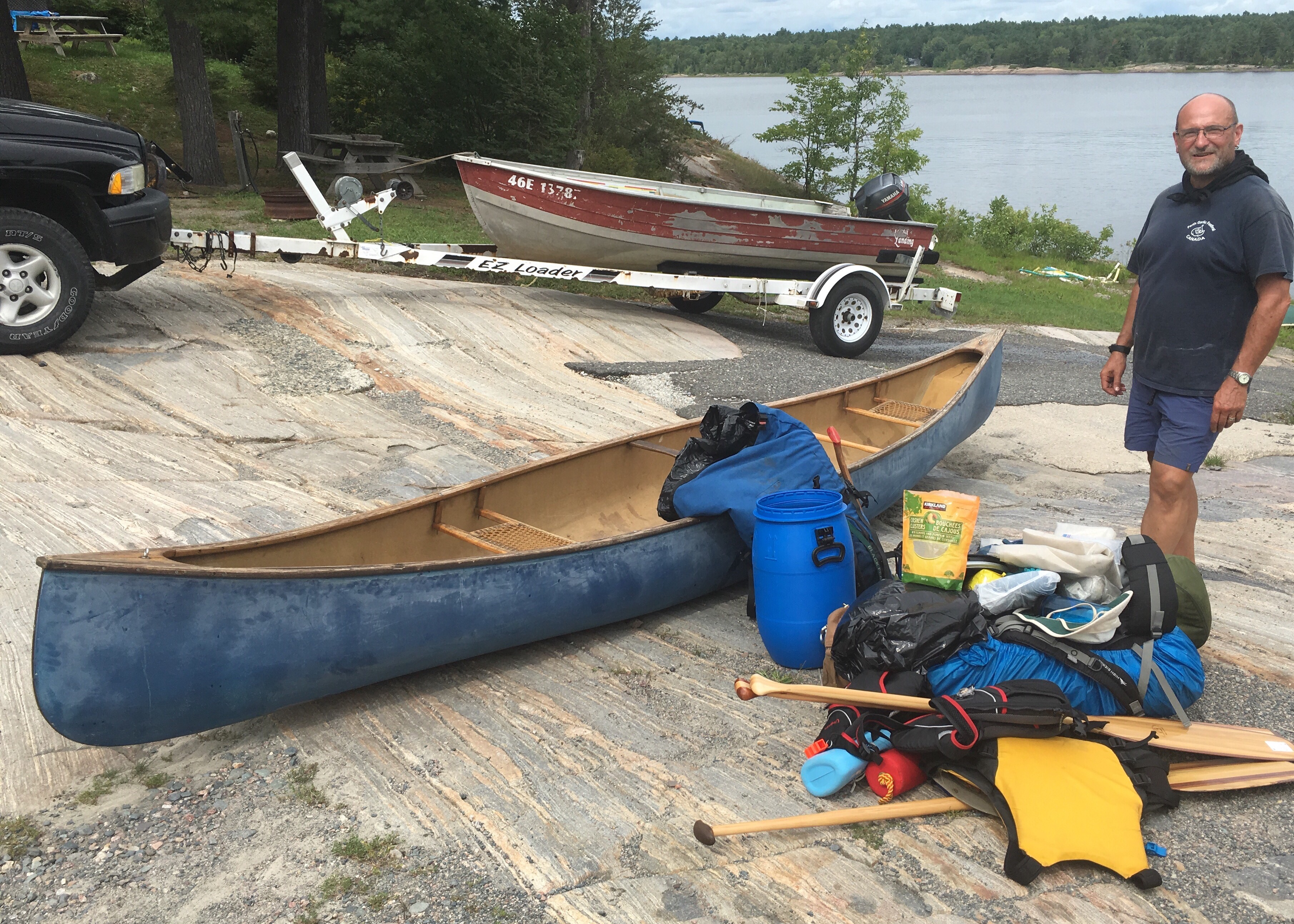
If someone told me a year ago that I would spend four days cut off from civilization, in the bush without cell-phone service, hauling all my food and everything I need to survive in a canoe that I would have to navigate through rapids and rocky, snake-infested portage routes — I would say they were dreaming … or talking about someone else.

Well, that’s precisely what I did last week, along the French River Provincial Park between North Bay and Sudbury. Fortunately I was not alone; I journeyed with a more experienced wilderness survivalist. 

We ended up taking more than we needed. We could have packed less food, and less clothing. The exercise, nevertheless, was confident-building for me in realizing I really don’t need that much stuff.

Jesus says, “None of you can become my disciple if you do not give up all your possessions.”

To live life well, and faithfully, is to recognize one’s place in the world, and not to over-reach, over-extend, to be someone you are not — all on the basis of wanting more and more, bigger and better. To live faithfully, we are called to examine our dependencies, count the cost of it all, focus on what is important, and then make room in our lives for what is important by letting go.

A sojourn into the wilderness may indeed by the antidote to visions of self-aggrandizement embedded in the prosperity gospel message. Try doing without, for some time, what you may have taken for granted for too long. Try doing without what you always have believed you needed in order to live. Try Letting go. Releasing. Forgiving. 

This is not about doing away with personal boundaries. Letting go is not about condoning injustice or cruelty. Kenosis/letting go is not about being blind optimists, repressing or denying or not caring, or ‘giving up’ in frustration.

Forgiveness is a good example of letting go of the misery caused by holding on to the pain of resentment or holding a grudge. This kind of letting go brings a positivity that is based in honest struggle and prayer born out of compassion and love for self, the other, and God. The end result is a freedom and peace that cannot ever be realized through a program of simply working harder or getting more.

The German poet, Rainer Maria Rilke, wrote about the contrast between the law of gravity and the rising of the trees. He writes about the gift of letting go into a place of trust: Trusting that the gift in you is enough. So that you can rise up, rooted like trees: 

How surely gravity’s law,

strong as an ocean current,

takes hold of even the smallest thing

and pulls it toward the heart of the world.


Each thing —

each stone, blossom, child —

is held in place.

Only we, in our arrogance,

push out beyond what we each belong to

for some empty freedom.

If we surrendered

to earth’s intelligence

we could rise up rooted, like trees


Instead we entangle ourselves

in knots of our own making

and struggle, lonely and confused.

So, like children, we begin again

to learn from the things,

because they are in God’s heart;

they have never left God.

This is what the things can teach us:

to fall,

patiently to trust our heaviness.

Even a bird has to do that

before he can fly. (3)

In the poetry of scripture, the Psalmist describes beautifully the blessing we are, created in the image of God — so “wonderfully made” (Psalm 139:14). God would know intimately each part of our lives only if we were valuable to God and to the rest of creation. Otherwise, why would God care?

In other words, we are and have everything we need to enjoy and live to our fullest potential. We are beautiful. We don’t have to strive and strive to become someone we are not. We don’t have to ‘add’ anything to our lives to be well. In fact, when we have the courage to risk letting go, and “fall”, as Rilke poetically expresses, trusting in our “heaviness”, we will find a freedom and peace that will be the joy of all creation, and the glory of God.

We will live our lives at the same time rooted in the earth, and rising to the sun.

(1) Translated by J. Clark & J. Skinner, “Meister Eckhart: Selected Treatises & Sermons Translated from Latin and German with an Introduction and Notes”, Faber & Faber: 1958, p.194

(2) David Schnasa Jacobsen, Commentary on Luke 14:25-33 in “WorkingPreacher.org”, 2016

(3) Rainer Maria Rilke, “Rilke’s Book of Hours: Love Poems to God” translated by Anita Barrows and Joanna Macy, Riverhead Books: 1996, p.116-117; cited with permission in Richard Rohr’s Daily Meditation for August 28, 2016

Back to the Future: Borderland spirituality

2015 is the year of “Back to the Future”, did you know? When Marty McFly, played by Michael J. Fox, travelled ‘Back to the Future’ in the 1980’s pop culture film, the year they went to, in the future, was 2015.

As a kid I enjoyed the movie, partly because the year 2015, at the time, seemed some unrealistic, arbitrary and irrelevant point in the future; the number only represented some distant benchmark unconnected to my present reality.

Today, 2015 no longer means some far-off, futuristic fantasy. It is reality, now. And if I watch ‘Back to the Future’ today, the movie represents more of an historical curiosity — I’m only looking ‘back’.

In faith, it’s like we simultaneously look back, forward, and both from the grounding of the present moment. Balancing all three is good theology. For its sesquicentennial anniversary, the Eastern Synod (ELCIC) employed the motto: “Remembering for the Future”. Celebrating an important event in the present day by integrating past with the future is important. And a good way to interpret the Bible.

But it an also cause dismay if we only insist on a certain, chronological ordering of events in an absolute kind of way. For example, at Jesus’ baptism in the Gospel for today (Mark 1:4-11) there is the matter of the Holy Spirit, which descends in the form of a dove upon Jesus (v. 8, 10). John the Baptist preaches that Jesus will baptize with the Holy Spirit.

But Jesus never performs one baptism in his ministry that we know of. And, according to the time-line of the Gospels, the Holy Spirit doesn’t descend on the church until after Jesus’ resurrection (John 20:19-23) and at the Day of Pentecost (Acts 2) — these Holy Spirit events do not occur during Jesus’ ministry of healing, teaching and praying on earth. Curious, since many understand Jesus’ baptism as his ordination or commissioning to his call as the beloved Son of God. How do we make sense of this?

To understand many of the stories we read, like the Gospel for today, we would do well, I believe, to employ a ‘Back to the Future’ hermeneutic. This way of interpreting does not deny the truth of all of the events outlined above. For one, it reveals something about how the bible was put together:

The actual writing of the New Testament was done decades after these events took place. Therefore, we say, that we, today, are ‘post-resurrection’ Christians. We can best understand what happens at Jesus baptism from the perspective of the future. Because when these stories were written down for the first time, and from today’s perspective — the Holy Spirit has already come. Jesus is alive. Even as we recall, as a matter of history, what happened in the moments of Jesus’ life on earth some two thousand years ago.

And it’s not just a pointing forward that we need to keep in mind. It is a reverence and respect for the past.

If you look at the geography of the Baptism of our Lord, we can conclude at least a couple of things: First, it takes place in the wilderness, the desert. That is through which the river Jordan runs, basically north to south separating lands that are for the most part destitute, rugged, dangerous even.

Second, that river forms a boundary between two worlds — on the east and south, the world of the ancient Israelites tracking through the desert for decades on their way to the Promised Land flowing with milk and honey, which is on the other side.

John the Baptist comes to this border land, which is significant in the history of the prophets. In fact, John the Baptist stands in line with the prophets of old. His speeches are associated with Isaiah (Mark 1:1-8); he is also mistaken for Elijah because of what he wears (2 Kings 1:8) and because he foretells of the coming Messiah (John 1:21). John’s presence and ministry at the Jordan River in the wilderness brings the past (an identification with history and the prophets) together with the future (Jesus Christ, and the coming Holy Spirit) together into the present moment.

How can we keep ourselves from getting lost and totally confused in the plot line of “Back to the Future?” We remain grounded in the present moment. We look to our immediate surroundings. Like the beasts of the field, we scuff the earth with our heal, and snort and spit, before we look up.

And this is the beauty and wisdom of these Scriptures: their insistent if not peculiar emphasis on details. Yes, God acts in creation. Yes, God redeems sinners. Yes, God has a plan for salvation.

But this ‘spiritual’ talk is always, in the Gospel, tied to material — real water, real bread, real time, inexpensive wine, locusts, honey, sand, camel’s hair, wind, birds and the clouds being rent asunder. This is the nitty-gritty of life, and it can never be separated from matters of the Spirit.

Keeping grounded in the present awareness of life, ‘as is’, helps us track the sometimes confusing plot-line of ‘Back to the Future’. Because it is there that Jesus stands — on the borderland, at the edge of the Kingdom of God. Jesus stands there, and invites us to live into the now-and-not-yet reality of it (Ted Smith, “Feasting on the Word” WJK Press, Kentucky, 2008, p.239).

The Gospel of John identifies Jesus as a ‘lamb’. T.S. Elliot describes Jesus as a ‘tiger’. In C.S. Lewis’ ‘Narnia’ books, Jesus is personified in Aslan, the ‘lion’. Nancy Rockwell, in her post, “Tracks” (blog: The Bite in the Apple) suggests the ‘camel’, for Jesus who identified with lepers and prostitutes, difficult people, estranged members of right society, people who are spat upon. All these images for Jesus throughout history reveal unique elements about his truth.

But, standing in the desert beside John the Baptist, Jesus identifies with the lowly who are on a journey of transformation. Jesus invites the lowly in us to go on a journey that does not reject the past, and tradition, and history but doesn’t allow us to remain stuck there. Because this journey through borderland brings us eventually into a land flowing with milk and honey — a land of healing, restoration and justice for all who seek these gifts of the Holy Spirit.

This means that we cannot use our tainted and troubled past as an excuse for not doing the right thing, now. At the same time, we cannot wait until an ideal future when circumstances are perfect to do the right thing, now.

Back to the Future brings the present moment into sharp focus. A good theology will always ask, “What is going on right now in my life and world?” “Who do I meet today?” And act, now, accordingly. A spirituality of the borderland will always draw my attention to the divine importance of the present moment which is supported by history, and hope-filled for the future.

Resonance in marriage: a wedding day sermon

The afternoon we first arrived at the Bed and Breakfast on the shores of western Newfoundland, I headed straight for the beach. I didn’t know it was high tide when I saw several meters off shore a couple of large rocks breaking the swells like solitary giants guarding the beachfront.

Our nine-year-old daughter wanted to wade out to those rocks. But I hesitated. I was worried about what danger lurked at the base of those rocks never-mind the strong riptides that usually surge around these things. I just couldn’t see what lay underneath the swells.

Early the next morning as I looked out over the waters of the Gulf of St Lawrence I was taken aback by the ocean floor that was exposed by the low tide.

Those two rocks were now joined at their base by a flat, sandy smooth, debris-free floor. Without the swirling, roiling waters and white caps breaking all around the rocks, I was able to see that these otherwise solitary giants were profoundly and essentially connected at their root, standing united on the same, pristine ground.

Separate and distinct on the surface, yet fundamentally joined and united. Both — being separate AND being connected — are important, when it comes to healthy relationships, especially in marriage.

One thing that has connected you to one another is music. And so a music metaphor may prove useful to placing your marriage in a healthy context. For example, in my appreciation of music I enjoy listening to how dissonant sounds resolve into resonant sounds.

Dissonance happens — at least on the keyboard — when two notes directly beside each other are played at the same time; at first, it doesn’t sound right. The sound those two notes make when played together is not pleasing; it sounds ‘off’. And if a whole musical piece was played like that, I’m not sure I’d be satisfied at all.

Resonance, on the other hand, happens when there is at least a one-note space in between the two notes being played at the same time. Resonance is harmonic and therefore pleasing to the ear.

Two notes, when sounded at the same time, produce something that is greater than the sum of their separate parts. It is a beauty that is greater than us, individually.

If the musical piece, however, was only made up of resonant harmonies, the music would sound cheap, flaky, unreal and superficial. It’s always more pleasing to have those minor, dissonant chords eventually resolve, unfold and fall into the resonant harmonies.

But I can’t fully enjoy the resolutions unless there was the dissonance to begin with. You need both: The sounds that upset the equilibrium, even challenge the sweet desires of the ear, as well as those pleasant harmonies.

If the climax of a piece of music seeks resonance out of dissonance, for me, then, it is not so much who is playing the piece but how the music is played. This we can apply to relationships of love.

Recently a good friend of mine suggested that, in the end, is not so much who we love, but how we love that other person. Do we love the other with grace and forgiveness? Or, do we expect our partner to change, to be more like us, to reflect our opinions and orientations to life?

You see, when we have the courage to love without expectations of the other, when we love with the grace of God that is given to us all, we acknowledge the other as a distinct, separate being. Like those two rocks which on the surface stood apart from one another amidst the swirling waters of the ocean.

In this self-giving love, we allow the other person to be fully who they are. By acknowledging this separateness there will be experiences of dissonance, of conflict and competing desires, to be sure. This is normal, even healthy.

Famous poet, Kahlil Gibran, in his writings about marriage and love entitled, “The Prophet”, sounds this note over and over again — that in honouring our separateness and the ‘space in between us’, we discover what true love is all about.

How we love makes all the difference. Because you know, despite the differences that mark your unique individualities, what is underneath the surface. You know that both of you, though very different in your personalities, stand on a common ground. You are both linked by the ground upon which you stand.

I’ve already hinted at what connects you both — indeed, us all. This ground upon which you stand united is the very grace and love of God that created each of you in the first place. Despite those necessary differences, the other stands with you on the same side of the fence — a fence that doesn’t really exist. By appealing to the ground of your being, especially in times of dissonance, you will, by the grace of God, experience harmony, true joy and resonance.

And, in the end, perhaps give you the courage to seek even a deeper connection with the other, a path you may likely not have undertaken had you not recognized what keeps you united.

When the tide came in and the pounding surf splashed around those two rocks once again, my daughter and I playfully waded out to those rocks and created some precious memories of being together. I was able to relax and take a risk because I knew what was underneath the surface; I knew the ground upon which we stood.

May your marriage make good music! Including some dissonance, but finding those resonant harmonies as well.

I pray that, according to the riches of God’s glory, you may be strengthened in your inner being with power through the Spirit, and that Christ may dwell in your hearts through faith, as you are being rooted and grounded in love — Ephesians 3:16-17