
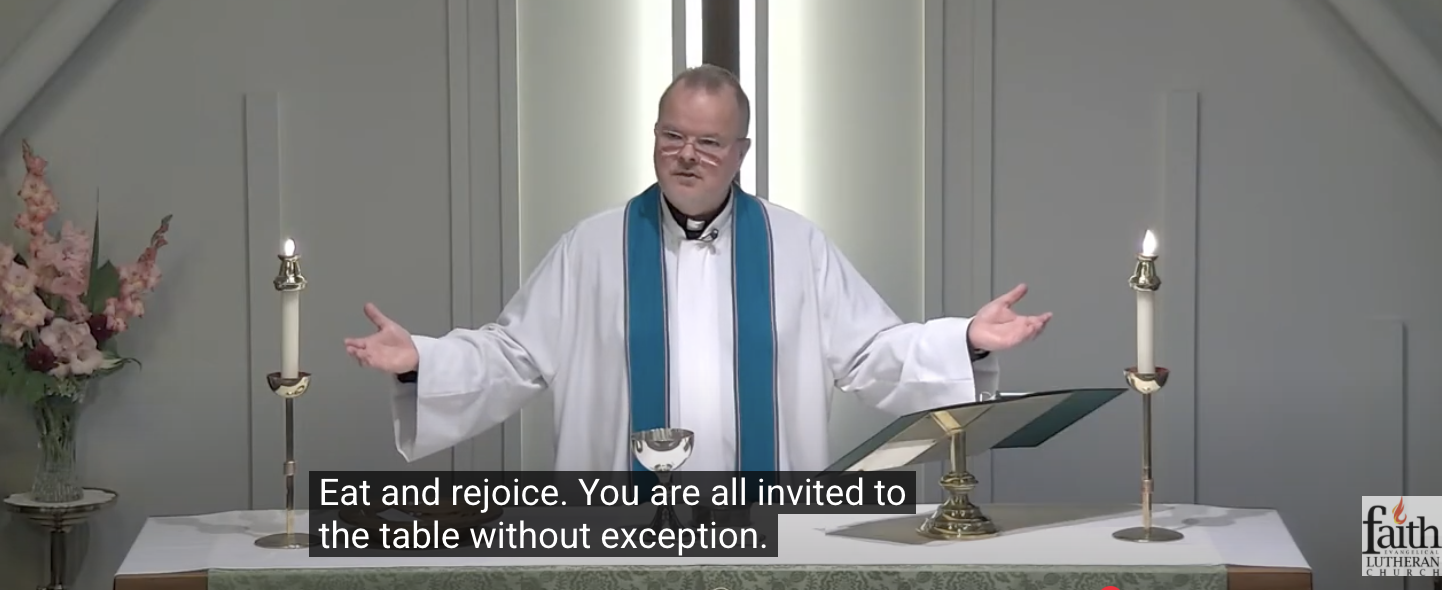
In my last sermon before the start of my practicum, I want to focus on and underscore the central action of the church to be welcoming and affirming of all people, without exception. I want to thank the congregational council for giving their blessing and support for the adventure on which we now embark over the next 8 months, which will see me take a significant step back from working in the church as I complete the practical part of my Master of Arts in Counselling Psychology program. I also want to thank the congregation, in advance, for giving Pastor Rosalie an ideal and excellent opportunity to practise her skills and development as a Lutheran pastor in the Canadian context. You are giving her this opportunity to exercise leadership as you pursue together God’s mission in this world, to invite all people to partake of God’s grace and love, without exception. Thanks be to God. ~ Pastor Martin
Do you have a place at the table? Do you feel there’s room for you around the table of the Lord? Is there a place for you, here, in the church?
On the last day of school at the end of June, every year like clockwork, we look forward to receiving an invitation to attend the annual Ida Street BBQ in Arnprior.
For years, neighbours at the end of our street host a gathering around food and drink. The street is barricaded off to vehicle traffic. And we are given the opportunity to meet each other, mix and mingle at the start of the summer holidays.
A diverse group of people from all walks of life, identities, backgrounds and life experiences gather around food.
In the Gospel of Luke, Jesus is especially preoccupied by eating (Saddler Jr., 2010). There are, in Luke, more references to eating, banquets, tables, and reclining at tables than in any of the other Gospels (Karris, 1985).
It is sitting or reclining around the table where Jesus teaches (22:24-30; 11:37-41) and encounters those who are marginalized (7:39). The table is the focal point in some of his parables (16:21; 14:15-24), as in today’s banquet feast parable (14:7-14).
That the table is the centre piece in Jesus’ teaching and fellowship should not escape our notice. There’s something important about eating together that sets the stage for healing and for restoring broken relationships. Jesus will not only meet us when we come together over food and fellowship but has something to teach us at the table of the Lord.
One of my earliest memories about church was Communion Sundays. I remember picking up on the holiness of the moment happening at the front.
But it wasn’t holy because of the kind of bread, or wafer offered or the wine. It was something about just the simple experience of going to the front with others. I would kneel or stand shoulder to shoulder on the same level as everyone else around the altar.
We were, all of us around the communion rail, in this holy action together in all our diversity. Part of God’s family.
And it wasn’t just an individual thing. There was no table of honour, for some. It wasn’t the privileged people who got to go first to receive communion, or anything like that. It was table after table of the mix of people who ever happened to be in line at the time our table was called.
That was the good memory. What I also remember that slightly annoyed me, quite frankly, were all the words. My Dad, the pastor, would read the longest Eucharistic prayer in the book! And while I appreciated the beautiful language and theological import of the words spoken before Communion, I grew astonishingly restless. “Just get on with it! Let’s go to the front!” was what my heart cried out.
Church is about doing, as much as it is about thinking and feeling.
My recent studies about what brings psychological healing made me appreciate what we do in faith, week after week, coming to the table of the Lord. What we do brings spiritual and psychological healing.
‘Talk therapy’ is popular these days. Many of the cognitive treatments rely on a whole of verbiage, to the extent that we’ve come to believe resolution only comes by coherently and accurately telling yourself and another what you think and what you feel. Religion isn’t the only place we encounter a whole lot of words. But words alone don’t save us.
We may be saved ‘by the Word’ – meaning the “Word became flesh” (John 1:14) in Jesus. But we are not saved by words alone – arguments, disputations, constitutions, belief statements. When Jesus says, “we are not saved by bread alone” (Matthew 4:4) he means we are not saved by material possessions or even spiritual materialism.
Dietrich Bonhoeffer was convinced himself, and wrote, that “the church is constituted not by religious formulae, by dogma, but by the practical doing of what is commanded [by Jesus]” (Barnhill, 2005, p. 253).
What brings healing is more than just books, talk therapy or words alone. Because, to Jesus, socially constructed, mentally devised distinctions that divide people do not define a person’s value, a person’s worth.
What defines a person’s value, dignity and worth is God’s invitation. God’s invitation, in Christ Jesus, to sit at the same table as everyone else. Gone are the ‘places of honour’. Gone is a ranking system, a pecking order, based on meritocracy and those who ‘deserve it’, reserved only and exclusively for those who have achieved ‘great things’. God’s invitation is not only for those who have it all, those who are perfect.
You don’t have to prove yourself worthy. Communion isn’t only for those whose lives are just right. You don’t receive Communion only when you are somehow rid of all your impurities and can show the best of yourself.
Because the truth of the Gospel, the good news in Christ Jesus, is that even if you lose everything (or I should say when you lose everything because eventually, we all will) – financial security, wealth, prestige, physical strength, your reputation, your social standing, those you love – when you lose it all, you still have a place at the table.
That’s why Holy Communion is offered to those in hospital beds and care homes, to the dying, to the poor, the marginalized, the suffering.
No matter what station of life, whether you are climbing the ladder and amassing your portfolio and finding the better jobs with higher income scales, you have a place at the table. In the prime of life in great health and are living the dream, you have a place at the table.
And, when things are failing, when you are descending the ladder, you have a place at the table. Even if you are staring into the abyss, unknowing and uncertain about a scary future. Even if your health is failing, resources are dwindling, and you are alone in your struggles. You have a place at the table.
There is always a place at the Lord’s table for you. God invites you, more than once a year. How about every time the church gathers to worship? You are all welcome, without exception!
References:
Barnhill, C. (Ed.). (2005). A year with Dietrich Bonhoeffer: Daily meditations from his letters, writings, and sermons. Harper One.
Karris, R. J. (1985). Luke: Artist and theologian: Luke’s passion account as literature. Paulist Press.
Saddler Jr., R. S. (2010). Luke 14:1, 7-14: Exegetical perspective. In D. L. Bartlett & B. B. Taylor (Eds.), Feasting on the word: Preaching the revised common lectionary, year c volume 4 (pp. 21-25). Westminster John Knox Press.





 Raspberryman