
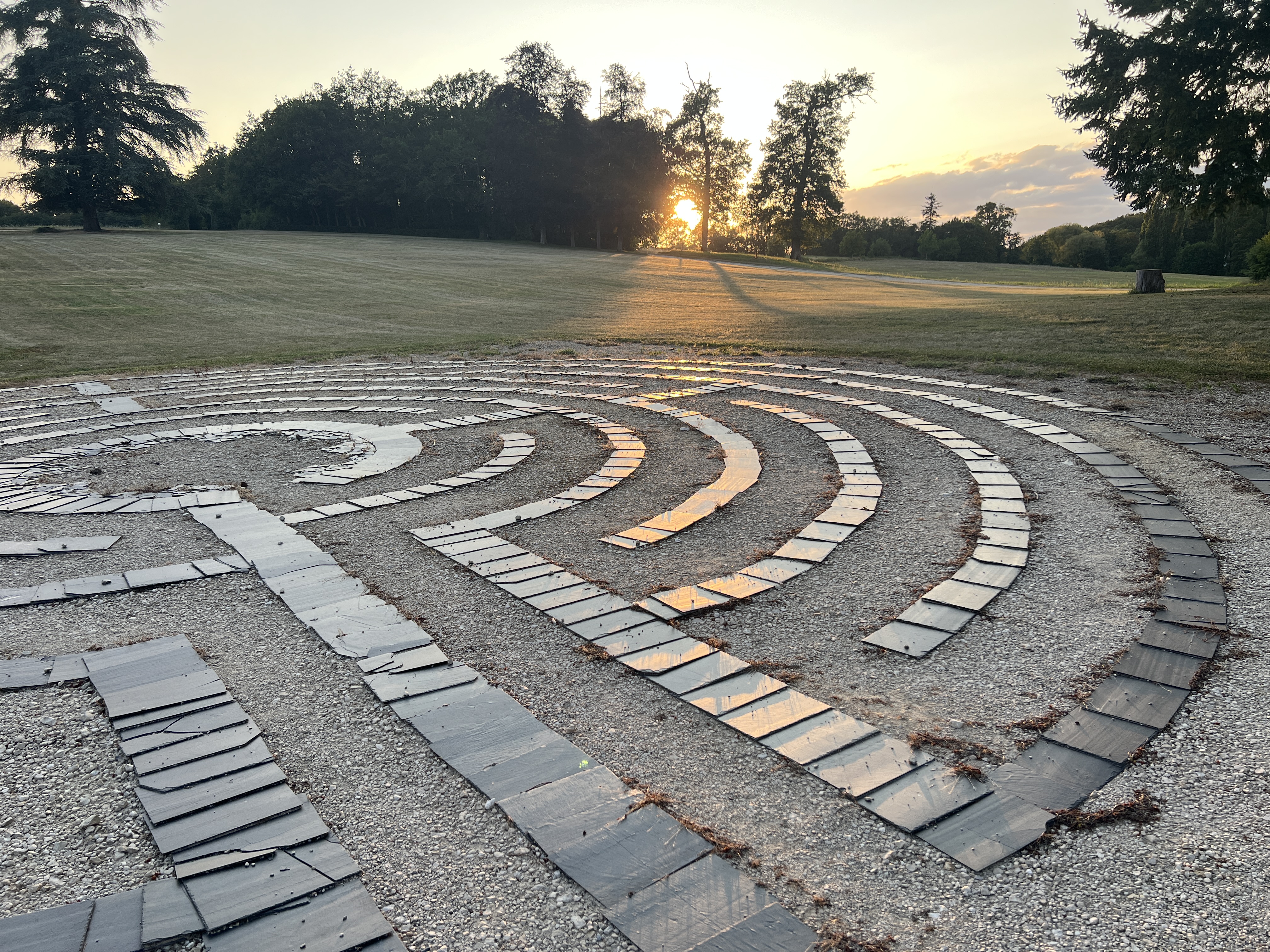
Wildfires and the journey of faith

Labyrinth at Bonnevaux Centre for Peace (photo by Martin Malina, 21 July 2023, Marçay, France)

How could such a beginning
Ringed in water
Come to such an end
Fixed in fire?

(King, 2019)

When I recently read this poetic lament written by Canadian Indigenous historian and poet, Thomas King, I couldn’t help but immediately think about all the wildfires this summer.

Others are calling on us Canadians to get used to the “new reality” (Reed, 2025, August 11) regarding summertime wildfires. 2025 has been the second worst year for wildfires after the record-setting year in 2023.

The average number of hectares that burn over a 5-year period in Canada is around 4 million. This year alone, seven-and-a-half million hectares of land have burned due to wildfires, about 78% more than the 5-year average.

The warmer it gets the more fires we see. It is a stark manifestation of the climate crisis, with temperatures this past spring already two-and-a-half degrees Celsius above average. The hotter the climate the more the atmosphere sucks moisture out of the dead vegetation and the forest floor, creating ideal conditions for fires to start. The warmer temperatures increase the frequency of lightning that sparks the fires. Lightning is a leading cause of wildfires in remote regions of Canada’s north.

Indeed,

How could such a beginning
Ringed in water
Come to such an end
Fixed in fire?

(King, 2019)

How do you interpret this poem? Likely, we can go in many different directions with it. We could, like I initially did, take his poem literally and refer it to creation and the climate crisis.

We could also read it as a metaphor for faith, describing the journey of faith beginning in the waters of baptism and ending in the fiery passion of living in the Spirit?

Whichever way you go, poetic words are meant to call out from each of us – our own hearts and minds – a unique response. Scripture is meant that way, to elicit and evoke something from us.

Like last week’s Gospel, Jesus’ words in the opening verse of today’s reading from Luke leans into this approach: “I came to cast fire to the earth and how I wish it were already ablaze!” (Luke 12:49). Poetic. But is Jesus angry? Is he vengeful?

Recall, Jesus recently rebuked James and John for wanting retribution, wanting to bring down fire from heaven on unwelcoming Samaritans (Luke 9:54-55). Jesus means a different kind of fire. This is not the fire that incinerates. It’s not the fire of judgement raining down from heaven upon the heads of God’s (read, ‘our’) enemies. Let’s be careful about taking these poetic words literally.

Some bible scholars suggest Jesus is talking about the fire he takes upon himself. This is the “baptism by fire” (Lull, 2010, p. 361) that entails his own suffering, his own passion. God’s work on earth is Jesus’ own self-giving, his own sacrifice on the cross. “How I wish it were already ablaze,” Jesus says. How he wishes his purpose on earth was already accomplished. He was passionate.

So, where does that leave us? Jesus does not let his disciples, nor we, off the hook. In this season after Pentecost we continue to be reminded of the Holy Spirit’s work in our lives, in the church on earth. The fire the Spirit of God brings burns in the hearts and minds of followers of Jesus. “Were not our hearts burning within us?” confessed the disciples after seeing the resurrected Jesus (Luke 24:32). A spiritual awakening, a growth, a movement enflamed by the Spirit’s power continues to burn in the hearts of Jesus’ followers ever since.

So, if the fire in this Gospel refers to the passion of Jesus leading through the suffering of the cross and the empty tomb, the death and resurrection of Jesus introduce us to the paradox of faith. In other words, we cannot bypass the pain on the path to new life. Death before resurrection. Whatever good for which we pray, strive and seek only comes by way of hard, personal work. The good results from the struggle.

At the orientation meeting when I started the Master of Arts in Counselling Psychology over a year and a half ago, the Dean of the program told all of us newbies that, “to learn is to churn.” To churn, like hurricane Erin now does in the eastern Caribbean.

To learn is to churn. I didn’t want to believe him at first. But I can honestly now say that this learning journey, while rewarding and affirming in many ways, has also been a churning, so to speak.

Learning is something we say we are always doing. But the growth and positive change don’t come without the pain of loss. The ‘little deaths’, as Martin Luther liked to put it. This challenge can apply to everything from family relations to politics to community engagement and church work, from caring for ourselves and others to meeting our daily challenges. Solutions don’t come without some churning along the way.

To learn is to churn. On the one hand, churning is about movement. When we confront the ambiguity and nuance and complexity of life, we don’t just give up and stay stuck in this challenging awareness. Churning is about movement. We do something. Our behaviour changes.

At the same time, churning is about a movement that is not rushed nor hastily reactive. Churning turns things over, mixing it all, going deep. We don’t rush the turns of life. We spend time in, embrace, the change as hard as it is. Teilhard de Chardin said, “Above all, trust in the slow work of God” (DotMagis, 2025). Churning.

One highlight of the summer for me happened on the first day of summer, when members of three congregations in this community went for a walk from garden to garden to garden. We ended by walking the labyrinth on the floor in the parish hall at Julian of Norwich Anglican Church.

The labyrinth has a history in the Christian tradition. During the Middle Ages, when Christian pilgrimages to Jerusalem were disrupted by conflict, particularly during the Crusades, Christians developed labyrinths as a substitute for the physical journey to the Holy Land. 

These labyrinths, often called “Chemins de Jerusalem” (Paths of Jerusalem), provided a way for Christians to symbolically journey to Jerusalem through prayer and meditation, particularly on the Passion of Christ. The most famous of these labyrinths is in the Chartres Cathedral near Paris, France.

When I walked on the labyrinth at Julian of Norwich, praying and reflecting on the journey of life and faith, these words pierced my heart with renewed appreciation: “There is no wrong turn”. On the labyrinth, there is no wrong turn.

The labyrinth, after all, is not a maze. In a maze you may be tricked or mistaken in taking a wrong turn which leads to a dead end, right? But not so in a labyrinth. There is only the one path, leading to the centre. You just need to follow it.

And be mindful of the turns. Those turns take you around 360 degrees. If you are sprinting, you might overshoot and miss the turn. But by remaining faithful to the slow work, by staying on the path, that is all. You just need to take your time at each turn. On the labyrinth, there is no wrong turn. In a life of faith, there is no wrong turn.

These turns, changes of direction, in life, are not easy. But these turns provide the best learning opportunities in your life. And yes, to learn is to churn.

As I focus on my practicum over the next eight months, I will have an excellent opportunity to learn. It will also be an excellent opportunity for you, the congregation, to learn. To learn together in a new way.

Trust the path. On the way, there is no wrong turn. No decision you make is outside the purview of God’s grace, mercy and love. Because the path you are on, even with all the turns, takes you to the center of Jesus’ heart, into the fullness of Christ’s presence and love. This is the eternal journey that begins now, and in eternity never ends.

The promised glory at the end of the road requires us to take that road, and fully embrace ourselves on the path ahead, one step at a time.

Trust in the slow work of God. And be amazed.

References:

DotMagis (Ed.). (2025). Prayer of Teilhard de Chardin: Patient trust [Website]. Loyola Press. https://www.ignatianspirituality.com/prayer-of-theilhard-de-chardin/

King, T. (2019). 77 fragments of a familiar ruin: Poems. Harper Collins.

Lull, P. J. (2010). Luke 12:49-56: Pastoral perspective. In D. L. Bartlett & B. B. Taylor (Eds.), Feasting on the word: Preaching the revised common lectionary, year c volume 3 (pp. 359-362). Westminster John Knox Press.

Reed, B. (2025, August 11). Canada wildfire season already second worst on record as experts warn of ‘new reality’ [website]. The Guardian. https://www.theguardian.com/world/2025/aug/11/canada-wildfire-season

Can you catch it?

When I was younger I enjoyed playing catch using a softball or baseball. My catch partner and I would stand at a distance from each other, and we would toss, whip, lob, sidearm, underhand, windmill or basically throw the ball in various combinations of the above.

That simple, and for me rather therapeutic, repetitive motion – back-and-forth—impressed upon me the truth that whether the ball is successfully caught doesn’t just depend on the catcher. Whether the ball is successfully caught depends to a large degree how accurately the ball is thrown. Assuming you want your ball partner to catch the ball!

You need to throw the ball in such a way to match the catcher’s ability, attention in the moment, stance and glove position. The one throwing the ball needs to pay attention to and know the catcher. Throwing and catching the ball is a relationship in which both parties have to do their part for the exercise to work.

Which then reminds me of a popular saying in the church I have heard over the years: That faith is not taught as much as it is caught. The ball of faith, if it is to be successfully passed on, needs to be thrown in a way that the catcher can catch it. Because every individual is unique and has different abilities, personality, and capacity, the gift of faith—if it is to stick and not be dropped—needs to come at them in a way they can handle it.

No one size fits all. The ball of faith has wings to fly in a manner in which each of us can perceive it, appreciate it, and let it enter into our life. On our part, to throw the ball of faith, we need to reach people through their point of view, not our own. In other words, we need a relationship with them to seek to understand their tendency, their perspective, and then speak their language (Rubin, 2017).

One of the most significant scientific facts in existence is something we cannot directly see, touch, taste, or even smell. But we can feel it on our skin. Planet Earth is wrapped in 5,600 million million tons of air, and most of the time most of the air is moving (Mahany, 2023, p. 93). While wind is elusive, hard to define, one thing it is for sure: Wind is impossible to ignore.

photo by Martin Malina (Long Beach WA, July 21, 2017)

The winds have been particularly noticeable of late. They have been strong enough to send us the smoke caused by wildfires in Western Canada. Over the past few years, we have witnessed the effects of powerful windstorms here in Ottawa – toppling ancient trees, downing lines, throwing damaging debris.

A couple of weeks ago, a Chinese paraglider was caught in a powerful updraft sending him some nine kilometres straight upward until he was piercing the edge of the atmosphere with air temperatures near -40 degrees Celsius. Most para-gliders caught in this unfortunate circumstance don’t survive. Miraculously, he did (TWN, 2025).

Indeed, wind is elusive, dangerous. We cannot contain it, control it, nor even predict its behaviour. No wonder for people of faith the world over and since the beginning of time have made the wind, air, breath synonymous with the divine (Mahany, 2023).

There is movement in the scriptures assigned for this season after the resurrection of Jesus leading into this Pentecost Sunday. There is movement with the Spirit. The Spirit descends on the disciples gathering in Jerusalem with “the sound like the rush of a violent wind” (Acts 2:1-21). Elsewhere in the bible, Jesus breathes the Spirit into the disciples (John 20:22). God’s breath moves over creation (Genesis 1:2). “Even the winds and waves obey” the the disciples notice after Jesus stills the storm on Lake Galilee (Matthew 8:27).

The question of faith confronting the disciples after Easter was, what happens now when Jesus, the founder of the community, is no longer around? Is the community left on its own, with no access to Jesus’ presence or transformative power (Bay, 2010)? Has the wind, the breath of God, stopped blowing?

Has Jesus dropped the ball? Have the disciples? The disciples, essentially, are anticipating their grief at losing access – physical access – to their loved one in Jesus. And they don’t know what to do without him.

The question of faith is how to live amidst the perceived absence. Pentecost answers the question of grief. Because one important aspect of healing is that we are no longer defined by our losses. While the pain of grief stays with us our whole life long, who we are now is not defined by what happened then. Not because we’ve forgotten. Healing is not forgetting.

But we are now defined by what the connection to our lost loved one means to us today, now. They live in us. They live in some way in the world today. Who we are and who they are, are no longer defined by what caused our painful grieving in the first place. Instead, we are defined today by those around us who hold us, accept us, and give us encouragement on the way.

“Show us the Father,” demands Philip (John 14:8). Jesus rebukes Philip. Philip wants to see, touch, taste, control, contain, put a lock on his apprehension of faith. No, no, Jesus says to Philip and to you and to me. You know God already. You don’t need to put God in a box in order to believe. God is already with you, in you. “You know [God],” Jesus responds, “because God abides with you, and God will be in you” (John 14:17).

God is already with you, in you. The life of Jesus, through the coming Spirit of God, lives in you, through you, around you! So, act like it!

We take a breath some 20-30 thousand times a day. Yet, are we aware when we even just take one? If you do anything on this Pentecost Sunday that is spiritual and life giving, just breathe with awareness that you do. Breathe in God’s love, God’s presence. Breathe out – return the gift of God’s life and love into the world by your loving actions for your neighbour.

Jesus throws the ball of faith towards us. And it’s not that we have to catch it one way. We don’t need to be afraid of dropping it. When we are aware of the presence of Jesus, when we face him and lift our hands to catch the ball, Jesus throws it at us in a way we can receive it. Because Jesus knows us. Jesus is in a relationship of love with us. God created us. And the Spirit lifts the ball and carries it into our hearts so that we can catch it.

Thanks be to God.

References:

Bay, E. C. (2010). Pastoral perspective: John 14:8-27. In D. L. Bartlett & B. B. Taylor (Eds.). Feasting on the Word: Preaching the Revised Common Lectionary Year C, Volume 3 (pp. 20-24). Westminster John Knox Press.

Mahany, B. (2023). The book of nature: The astonishing beauty of God’s first sacred text. Broadleaf Books.

Rubin, G. (2017). The four tendencies: The indispensable personality profiles that reveal how to make your life better (and other people’s lives better, too). Harmony Books.

The Weather Network (2025). Paraglider sucked nearly 9 km up into the frigid atmosphere [Video]. Newsflare/Reuters. https://www.theweathernetwork.com/en/video/Ke6uK9sn?playlist=JRE9lq9q

The way the story is told

Look at the man whose community has judged as possessing a legion of demons. He has been pigeon-holed. Ostracized. Bullied. Looked down upon. Pitied. The man whom they looked upon, and said to themselves, ‘Thank God it’s not so bad with me.’ This is the kind of person who, it has been argued, we need. If only to make the rest of us feel better about ourselves.

Schadenfreude is the term we use to depict and distinguish those ‘less fortunate’ than us to justify our complaints and our more privileged status. So, we need ‘them’. And we need ‘us’. We need the distinction. To envision the opposite, to imagine some kind of union, to unearth the unholy distinctions between ‘them’ and ‘us’—well, that may be far too threatening to our fragile egos.

The way the story is told is not to focus on the man’s illness. Though, that’s what we like to talk about: the frothing at the mouth, the rattling of the chains which bound him, the pigs rushing dramatically to their watery deaths. The way the story is told, however, is not to fixate on whatever ails him, his sin, his problem. We say this is a healing story. But who else besides the man is invited to be healed?

Important though it is not to overlook the man’s problem, the way this story is told leads us to the climax of the telling—the last few sentences that describe the reaction of the man’s community, there across the Lake in Gentile territory.

When, at first, he is healed, and is shown to the people, how do they respond? You would think they would rejoice. You would think they would praise God. You would think they would marvel at the goodness, the promise, the hope, the delight of God in bringing transformation and healing to this man who once was lost in sickness and despair but now is saved. In Greek, the word for salvation is the same word for healing. This man we look upon, alongside the Gerasene community, is now restored, healed and given a new beginning in life. A second chance.

You would think those who witness this would rejoice in the promise and anticipation that this healing and transformation be offered to each of them also. Amen?!

The way the story is told, however, emphasizes the point not once at the end of the story, but twice: They were afraid, seized with a great fear.[1]They didn’t like what Jesus was doing. They had become too comfortable in their opinions, their prejudices, their categories, their pigeon-holing this man. And they didn’t like what Jesus was doing to upturn and completely reverse their world-view. They even had the gall to tell Jesus to leave. No more of this. Do you blame the healed man for wanting to get out of there, too, with Jesus?

This story shines an uncomfortable light not on the Gerasene Demoniac. The title of this story should rather be the community’s demoniac. The community’s sin. Their prejudice. And their incapacity to repent—to change their minds about the people they have normally pigeon-holed into convenient places of malice and schadenfreude, them and us.

The Gospel story opens with Jesus taking his disciples to the ‘opposite side’ of Galilee. To be faithful to Jesus, to follow Jesus, they have to leave their zones of comfort and familiarity to go to the Gerasene territory across the lake.  Every city, every community, every country, every culture, every church, has an ‘opposite side.’ And it’s to that ‘opposite side’ that we—Lutheran Christians in Canada today—are called to go.

The way the story is told, is that Jesus’ presence and power disrupts the social order of the way things are. Because, for one thing, to the people whose living depends on the pigs, their loss is catastrophic. The swineherds are understandably afraid.

From this standpoint, the way the story is told, the coming of the gospel of Jesus brings upheaval and sets in motion forces that will disrupt even economic and social arrangements. In other words, the good news will not seem good to everyone at first. Maybe, to us.

Especially to those who are comfortable, privileged and set in our ways. Indeed, for the community in Gerasene and for us, we might prefer the devil we know to the freedom we do not. We might take a false sense of security from the dysfunction, the prejudice, the self-righteousness we have learned to tolerate in ourselves, cope and live with, ignore and sluff off. And we might therefore fear what change—even change for health—may bring.

We fear freedom from what binds us:

Locked and bound in some prison of our doing—telling ourselves we are not good enough, that we can’t do it, that we don’t deserve the immeasurable love which God has for us.

Locked and bound in some prison of our doing—telling ourselves and each other that the poor, the newcomer to Canada, the Indigenous people of this land, our home on native land—deserve their plight as if we don’t have any responsibility to care for them. To tell ourselves we need not seek understanding from another’s point of view.

Locked and bound in some prison of our doing—maintaining beliefs, even religious ones, that serve only to belittle others from a different social, religious background than ours, others whose gender orientation is not ours, others who are impoverished financially. Maybe Paul’s words must ring true again today to our hearts that are divided and distressed over these issues: “There is no longer Jew or Greek, there is no longer slave or free, there is no longer male and female; for all of you are one in Christ Jesus.”[2]

What is the ‘opposite side’ of the lake, for you? Is it a troubled personal relationship? Is it a long-held assumption or belief? Is it something you’ve wondered about doing but had up until now been too afraid to try? Perhaps in this season after Pentecost, the Spirit of God is calling us to consider going there.

To discover anew that whether we succeed or fail, whether we accomplish our goals or not, whether we live or die, we are the Lord’s forever.[3]Healing and salvation will come to us, regardless of our pedigree. For, again in the words of Paul, “it is no longer I who live, but it is Christ who lives in me.”[4]The gospel doesn’t begin with us. It’s always about what God is doing in us.

As Richard Rohr writes, “It’s not what you do that makes you holy, it’s what you allow to be done to you that makes you holy.” (in today’s ‘daily meditation’, http://www.cac.org)

Grace does that. One doesn’t first become Christian, then go to church; One goes to church to become a Christian—and it will take a life time, and beyond. It’s not the destination, it’s the journey. As fourteenth-century Saint Catherine of Siena once said: “It’s heaven all the way to heaven, for Jesus is the way.”

Jesus invites us to join him on his journey to the opposite side. To grow and change. To reach further, deeper, into health and wholeness. To open ourselves to the unity we share with all people in Christ Jesus our Lord.

And that story will have a good ending.


[1]Luke 8:35,37, NRSV

[2]Galatians 3:28

[3]Romans 14:8

[4]Galatians 2:19-20

From spiritual childhood to adulthood

It was in the 1980s and 1990s when the phrase “kids of all ages” came into vogue. When its usage skyrocketed. People attending circuses, entertainment and other public events would often hear the invitation and address to “kids of all ages!”

It was also during the 1980s and 90s when baby boomers became adults. And when these adults—like no adults before them but all who followed—started acting like children:

Half the buyers of comic books and tickets to superhero movies were adults. The majority of video game consoles, cartridges and discs at the end of the last century were bought by people in their 30s. Video games, originally sold to boys to pretend they were grown up action heroes were soon bought mainly by grown men who wanted to play like kids.[1]

This was the time when it became acceptable for adults to play video games and fantasy sports. This was the time when it became ok for the likes of me to dress like teens, to groom themselves and even get surgery to look thirty years younger. The “kids of all ages” phenomenon has had negative repercussions on men and women alike, especially around issues of self-esteem and body image.

Emotional immaturity, narcissism, co-dependency and not taking responsibility for one’s actions tend to be the psychological effects of the kids-of-all-ages era. And we live with these effects to this day.

You can understand, then, why some contemporary theologians have expressed concern over an uncritical and indiscriminate use of the term, “children of God”[2], which appears prominently in the short text from Romans today.[3]

It is popular in the church to identify with being “a child of God.” We gravitate to images of Jesus rocking children on his knee, telling his disciples that they are to become like children to enter the kingdom of God. At baptisms and confirmations, we remind the candidate and ourselves that each of us is a child of God.

We are held in the arms of God, close to the bosom of Jesus. Yes. Such comforting images can be helpful during times of trial and suffering, for sure. Yes. Our following Jesus and our endurance and resilience in the spiritual does not depend alone on cognitive, intellectual knowledge—usually the purview of adults—but on a simple childlike trust. Yes.

I also agree with Stuart Brown who, in his book, promoted the value of play. That, what might seem like a frivolous or even childish pursuit can be beneficial to our mental health. That, paradoxically, purpose-less, unproductive activity from time to time can make one enormously more productive and invigorated in other aspects of life.[4]These pursuits normally belong to children but are of benefit our whole life long. Yes.

At the same time, when Paul uses the term ‘children of God’ he associates our identity in Christ with anything but childish states of being. He talks about not being enslaved in fear. He talks about living with suffering. These are realities, not fantasies, born of a life lived and experienced and embraced with the good and the bad.

Being a child of God doesn’t give us license to behave childishly. Being a child of God doesn’t give us license to behave irresponsibly, shifting authority and blame for one’s actions to someone else.

Two aspects of being an adult in Christ I want to underscore. First, it is to pay attention to our own desires, not denying them. Paul writes that the Spirit of God speaks to our own spirit. “It is that very Spirit bearing witness with our spirit that we are children of God.” We have a human spirit. And God speaks through the deep desires and longings of our hearts. Unfortunately, whether we realize it or not, we use the identity of ‘child of God’ to deny our very human needs and desires. When we do so, are we not blocking God’s way of speaking to our hearts?

Saint Irenaeus, second century bishop of Lyons,  France, said that the ‘glory of God is a human being fully alive.’ God speaks through our very humanity. What gives us joy. What causes us pain. What is good and right. Our small ‘s’ spirit within us is the very thing God’s big ‘S’ Spirit connects with. The Psalmist paints an image of how God communicates with creation: “Deep calls to deep”.[5]We are part of, and participate in, the divine equation.

This divine relationship, from deep to deep, needs containment nonetheless. This is the second aspect of being an adult in Christ. Here, we turn to the words of Rev. Michael Curry, presiding bishop of the Episcopalian Church in America. You might remember his famous sermon he preached at the royal wedding just over a year ago. In it, he talks about fire—the primary symbol of Pentecost—harnessing the incredible power of love.

He said that the harnessing of fire was one of the great scientific and technological discoveries in all of human history.

‘Fire to a great extent made human civilization possible. Fire made it possible to cook food and to provide sanitary ways of eating which reduced the spread of disease in its time.

‘Fire made it possible to heat environments and thereby made human migration around the world a possibility, even into colder climates.Fire made it possible—there was no Bronze Age without fire, no Iron Age without fire, no Industrial Revolution without fire.

‘The advances of fire and technology are greatly dependent on the human ability and capacity to take fire and use it for human good.

‘Anybody get here in a car today? Fire—the controlled, harnessed fire—made that possible.Controlled fire in a plane gets us across this world. Fire makes it possible for us to text and tweet and email and Instagram and Facebook, and socially be dysfunctional with each other’ and act like children!

Fire makes all of that possible. Indeed, fire was one of the greatest discoveries in all of human history. And then Bishop Curry concluded that if humanity ever harnesses the energy of fire again, if humanity ever captures the energy of love—it will be the second time in history that we have discovered fire.

The passion, the spirit, the fire of love coming from within us needs to be contained. For it to have effect it must work within limits. The damage of forest fires and bombs we have witnessed both literally and figuratively throughout history and in our own lives. The passion, the spirit, and the fire of love needs containment. Then when its boundaries are respected, we can discover its true and divine power.

Poet and spiritual writer Anne Lamott says it best in describing the maturing Christian, as we grow from child to adult: “Grace meets us where we are but does not leave us where it found us.” In the implication there to ‘Grow up!’, we are challenged to continue to learn how to harness the energy, joy and passion of the Spirit within us, to use for the good of all.

The message of God’s love, the sending of the Spirit of God upon the church ever since that day long ago in Jerusalem, grows us into the adults that we are created and loved to be.


[1]Kurt Andersen, “Forever Young: Why Are Adults Acting Like Children?” The Saturday Evening Post (June 12, 2018).

[2]“As someone concerned with Christian moral practice, I lament the infantilizing of Christians as children, without the responsibilities of adult members of the household of God,” Jane Lancaster Patterson, Commentary on Romans 8:14-17 in www.workingpreacher.org

[3]Romans 8:14-17; a reading assigned for the Day of Pentecost, Year C, Revised Common Lectionary; in four short verses, Paul uses the term ‘children’ three times.

[4]Stuart M. Brown Jr. & Christopher Vaughan, Play: How It Shapes the Brain, Opens the Imagination, and Invigorates the Soul (New York: Avery Press, 2009), p.11

[5]Psalm 42:7

Dare we imagine

For my friend’s wedding over twenty years ago, I was asked to play Pachelbel’s Canon in D on my violin for the processional. We were to rehearse on the Friday evening. As I was running late, I drove over 120 km/hour on the Queensway from the west end all the way to Orleans. When I ran into the church, violin case in toe, the bride was waiting. I had made it just in time to set up and start the procession.

The notes lifted off the strings and the bridal party started down the aisle. But I was getting strange looks from them when all of a sudden the bride waved her hands and said: “Could we start over? Martin, did you tune your instrument?”

At that moment I actually heard the music I was playing – completely off key, sharp by at least three tones. “Ah, no,” I mumbled, even though the problem wasn’t that I hadn’t tuned my instrument. The problem was in my head.

You see, when I sat down to play, my mind was still travelling 120 km/h on the Queensway. My body may have been resting at that moment when I played the first note. But everything inside of me was still going. And going fast. No wonder I was playing sharp.

I learned from that experience, that before I play my guitar or violin, or sing any song, I must pause. I stop. And in my mind, before playing the first note, I hear what I want to play and how I want to play it. I need to imagine it first, before doing anything.

The truth is, you cannot even do something until you first have an image of it inside you. Albert Einstein, early 20th century inventor and scientist, once said, “I am enough of an artist to draw freely upon my imagination. Imagination is more important than knowledge …”[1]

Late 20thcentury author, surgeon, and inventor — Leonard Shlain – made the case that images come before our capacity to verbalize or name what we see.[2]We have to see it in our mind’s eye, first. Our imagination dictates our reality to a large extent.

Attending the Festival of Homiletics in Washington D.C. this week is a real treat, as I have had a little time in the busy schedule hopefully to visit the National Gallery of Art.

There, until mid-summer is an exhibition of paintings about Francis of Assisi. Francis of Assisi from the 13thcentury is an important figure in Christian history. He is, of course, known for his spirituality about nature and all of creation. Francis is also credited for putting Christmas on the annual Christian calendar. Christmas is the celebration of God’s incarnation into humanity.

I was impressed to learn that “Francis of Assisi has the longest, single entry in the bibliography in the Library of Congress, also in Washington D.C. He is the most written-about human being in history. Every day there is another biography, monograph, that they enter into their files, from another language, another culture, even other religions.

When the Pope some years ago wanted to gather leaders of all the world religions to have a respectful, inter-faith dialogue, the only city in the world that they could agree to meet in was Assisi, Italy. Because the memory of this man doesn’t carry much negative baggage at all. “[3]He was one of those rare human beings whose humility and stance towards others garnered respect and love. Truly, a saint.

In one popular painting of him, he is standing with arms open and the birds flocking around him. But instead of looking up – which you might expect – he is looking down at the earth.

In the season of Pentecost we are entering now, we read from Book of Acts that the Spirit of God “came from heaven” upon those gathered in Jerusalem.[4]The Spirit of God came down upon the earth. The Spirit of God descended to the place where humans were gathered.

Often we assume that to be spiritual, or to be holy, we have to gaze upwards towards heaven – somewhere away from the here and the now. We may therefore over emphasize our destination in the heavenly realms while paying little heed to the earthly journey.

In the optioned first reading for today[5], we encounter a dramatic vision of what happens in the valley of dry bones.[6]The prophet Ezekiel conveys to us a message using fantastic imagery, not unlike later apocalyptic visions from Daniel and the Book of Revelation in the Bible. I hope our imaginations are stirred by this reading, where skeletal human remains join together and begin to walk again.

Christians have traditionally understood this vision primarily to point to the resurrection of the dead, in light of Christ’s resurrection. This rising, then, would happen at the end of time, after our physical death.

Such an interpretation does not do full justice to the text, whose context is the community of exiles in Babylon, some six centuries before Christ. These exiles – the people of God – felt dead, like the dry bones. They had lost everything when Babylon conquered Jerusalem – their temple, their homes, their land.

The prophet Ezekiel with the exiles, conveys the word of God to the hopeless. The vision of new life in the dry bones is a promise of new life for the exiles. They are given hope, in a hopeless world.

Holy people in art are often depicted looking up to God. While this is certainly an appropriate stance to have in life, let us not miss the point of the Pentecost message, which is not fundamentally heavenward. The primary movement and message of Pentecost is downward. To the ground. God’s Holy Spirit blows upon the earth, in the earth, and in humanity.

God’s Spirit comes to us, wherever we are in life on earth. To whatever circumstance of our lives. Whether we are imprisoned in the exile of our own making or constrained by forces beyond our control. It is into the ordinary, the mundane even sordid realities of life to which God now comes.

Our lives on earth matter to God. How we live and what we do with what we have matters to God. How we live and what we don’t have matters to God. How we live with others matters to God.

While in the passing season of Easter our gaze may have looked upward to the glory of Jesus, our gaze and focus during Pentecost levels out upon the earth. We now watch for the presence of God among us. We go where the Spirit blows to do God’s will and mission.

We pause to imagine, like African American slaves did centuries ago on this continent, that ‘dem bones’ will rise again out of captivity. Dem bones will sing a new song. Dem bones will embrace freedom in the loving grace of God.

Dare we imagine.

[1]Cited in Leonard Shlain, “Art and Physics: Parallel Visions in Space, Time, and Light” (New York: HarperCollins, 2007)

[2]Richard Rohr, “Daily Meditation” 14 May 2018 (Center for Action and Contemplation), http://www.cac.org

[3]Richard Rohr, “The Art of Letting Go: Living the Wisdom of Saint Francis”, Session One/CD1 (Boulder Colorado: Sounds True, 2010)

[4]Acts 2:2 NRSV

[5]Day of Pentecost, Year B, Revised Common Lectionary

[6]Ezekiel 37:1-14

No life insurance

It’s like the spirited game parents play with their young children.

I remember years ago when the kids were still in diapers tossing our little ones up into the air, and then catching them on their way down. What makes this game so delightful is to watch the expression on the face of the child. If you slow-motioned the activity and zoomed in on the facial reactions of the child at each stage of the ‘throw and catch’ game, you would see a contrast of emotions:

From the catch to the upward toss, a smile and squeal of joy; from the falling motion to moment of catch, a growing sense of alarm as the eyes widen in concern and fear begins to creep into the picture. But, then, again the catch. And the grin returns. And the game resumes.

Can you imagine being the widow in the Gospel story (Luke 7:11-17) who has just lost her only son? Having lost her husband is one thing. You think it cannot get any worse. Yet, as is often the case in life, it does. Now her son. She feels the sharp edge of grief once again. Perhaps more deeply for the child she gave birth to, and raised with all her mother’s love.

Not only a personal grief, but the prospect of living in extreme need. Being a widow in 1st century Palestine was usually a ticket to poverty and low social status. A woman’s economic worth was almost always tied up in the men of her household — her husband or eldest son. This was much more than personal, emotional grief. This was a complete life-style change, from top to bottom, in a heart beat.

After meeting Jesus, however, things change so rapidly. From a season of mourning and grief, to the astonishment and wonder of joy: Her son is no longer dead, but alive! No longer is she alone, vulnerable, a burden on society, worthless in the economy and social structures of the day. Now, she has her son back. She has family. And that means the world to her!

Although something has changed. This new thing is also scary. All who witnessed the miracle were filled with fear (v.16). What does this second chance at life mean? Things will be different now. No longer like the good old days.

The rapid and extreme change of emotions could make her feel like a yo-yo. Maybe life sometimes feels like that for you. From moments of exquisite satisfaction, pleasure and joy, to the dark caverns of grief, depression, loss, suffering, fear and pain. Life. Death. Life. Death. Life. Death. Life. 

In my first parish, which was in rural southern Ontario, burials were conducted (except during winter months) immediately following the funeral service in the cemetery right beside the church building. The recessional with casket proceeded to the grave side where the words of committal, prayers and scripture readings were offered. 

But then, the family stood by as the grave-diggers and funeral attendants lowered the casket, suspended up until that point on winches and ropes, down into the hole. In some cases, I had to assist by moving the casket into place as it slowly lowered. Once resting on the ground inside the hole, a family member used a spade to throw the first shovel-full of earth onto the casket — a symbol of the family participating in burying their loved one.

Today, especially in urban centres where funeral services are highly managed by market-driven professionals, most often the family leaves the grave-side before the casket is lowered and actually buried. I wonder about how the smallest of acts reflects our attitudes towards death and loss. 

Perhaps we can’t ‘go there’ emotionally so soon after losing a loved one and have to insulate ourselves in order to cope. The funeral rite therefore serves more as an anesthetic against the harsh reality of death and loss. I wonder: Does the experience and ritual of funerals only end up buffering the hard, emotional impact of loss?

Perhaps we are not used to ‘losing’, letting go, failing, surrendering, being powerless, vulnerable, at ground zero. We have little in life to practice this letting go before the final experience of losing a loved one. And perhaps healthy religion, as Richard Rohr claims, is about showing us what to do with our pain.

Is this too difficult an expectation of our faith? Because in making religion only about ‘feel good’ ‘warm fuzzies’ we might maintain our denial of life’s realities and only distract ourselves from truth. And that’s not what Christian faith is about — distracting us and keeping us from the rhythms of life, death, life, death, life.

Because in avoiding death, we also ironically, avoid life. And Jesus is about life. When we say this Gospel story is first and foremost about a miracle, we may be missing the point. It’s understandable that we do, because it is sensational. It captivates our imagination.

Focusing only on the miracle may just play into our fear and avoidance of death. As if to say Jesus performing this miracle was done for the boy’s sake. The enemy, death, was conquered! Therefore we can go on denying death. As if the boy will never eventually die an earthly death. As if to say Jesus performed this miracle solely to convince us to ‘believe’ in him — because no one else could do so (even though there were magicians/soothsayers and other miracle workers who performed incredible acts in Jesus’ day).

But the miracle, per se, is not the point of the story. Jesus raised the son from death not merely to show his divine power but to express his love and concern for the widow. He had compassion on her (v.13). And he couldn’t stand the thought that she would have to go it alone in a culture that marginalized the widow. Jesus brought the son back to restore a relationship, for living in the world.

God tosses us into the air. God throws us into the thick of life with all its challenges, disappointments, failures, weaknesses, joys, hurts, loves, pleasures and pain, satisfactions and accomplishments. God throws us into the air to experience fully this life we have been given. Life, death, life, death, life, death …

Then, to our happy amazement, God catches us again at just the right moment. God cares about what happens to us in our lives. God is interested in every minute detail and event in our lives — even those things we would rather cover up and hide in the darkest recesses of our hearts. God’s light exposes those secrets, even. We may feel vulnerable, challenged, unsettled for a time. And we may even wonder if we won’t just crash and burn on our way down.

Have faith in the One who’s tossing you. Because it’s part of life, for one thing. But most importantly, because God loves you and will quite unexpectedly be the One to catch you, at just the right moment.

Better together

The story is told of a wide-eyed enthusiast who visited Mother Theresa in Calcutta. Over the last century, Mother Theresa has been admired by Christians worldwide for her dedicated, self-giving work for the poorest of the poor in India.

The young man approached Mother Theresa and said, “You couldn’t pay me a million dollars to do what you do.”

Mother Theresa, not missing a beat, replied, “You couldn’t pay me a million dollars to do what I do either. I do this because I was made to do it.”

When we speak about the Holy Spirit in this season after Pentecost, we speak about the breath of God breathing in us. The Greek word for “spirit” is pneuma, which means “breath.” 

Breathing is one of those automatic, biological responses that we don’t even have to think about. It is natural and does not really take any effort at all. We are seldom aware of our breathing. And yet, it is vital to our health. Breathing is critical to our very life and purpose.

You could say, we are made to breath.

And yet, though breathing is integral to our life we may forget the gift that is in us: The gift of the Holy Spirit. We forget that living in the Spirit is as natural as breathing.

The Spirit of God is like our breath. “God’s spirit is more intimate to us that we are to ourselves,” writes Henri Nouwen. “We might not often be aware of it, but without it we cannot live a spiritual life. It is the Holy Spirit of God who prays in us, who offers us the gifts of love, forgiveness, kindness, goodness, gentleness, peace, and joy.” (1) 

Breathing is so essential for life that we only think about it when something is wrong with it. When disease, shock or accident leaves us without breath. When breathing becomes laboured. When oxygen levels are critically low in our bodies. When something we have taken for granted for so long no longer works, then what?

The way to arrive and remain in the Holy Spirit of God is both very simple and very hard: We have to remain in love. Breathing the Spirit of God’s love nips negativity, hatred and violence in the bud. It begins by retraining our initial thoughts.

We can’t risk walking around with a negative, or resentful, or gossipy, or critical mind. Because if we let the mind operate in a paranoid, angry, and resentful way, we aren’t going to breathe the Spirit of God. We won’t be breathing. We can’t be God’s usable instrument. 

That’s why Jesus commanded us to to love. It’s that crucial for life. Like breathing. That love can begin in the mind. As Eleanor Roosevelt apparently said: “Watch your thoughts; they become words. Watch your words; they become actions. Watch your habits; they become character. Watch your character; it becomes your destiny.” (2)     

In Jewish tradition only the consonants for Yahweh were printed in the Hebrew text – YHWH. As such, this most holy name for God was unspeakable. Interestingly, even the Hebrew consonants used in YHWH do not allow you to close your lips when you try to speak them.

We cannot confine God in one place as much as we cannot contain breath. We cannot point to one specific place and say, “God is there!”, turn around, point in the opposite direction and say, “And God isn’t there!” We can’t dare try to close our lips over breathing and pretend we have God all figured out! Identifying with God since ancient times was simply the intake and exhalation of breath. The great “I AM” was the breath itself.

It is the great mystery we enter into when we follow Jesus. Someone said, “life is a mystery to embrace, not a problem to be solved.” God is always beyond us but totally around us, within us and outside of us. And we all share in that same air and that same breath. It is the first thing we did coming out of our mother’s womb, and there will come that moment when we will do it for the last time.

But in between, we continue to take in the breath of God and exhale the breath of God – the totally accessible One, the totally given One, who like breath just waits to be received. Waits to be engaged. In bold acts fuelled by love for the other.

The late Swedish Lutheran bishop, New Testament scholar, and pioneer in Lutheran-Jewish relations, Krister Stendahl, gave helpful advice in this regard. How is it we can love others who are so different from us, so unlike us? Because it is easy to ignore, write off, dismiss and be critical of them.

To Christians living in a diverse and multi-religious environment, Stendahl encourages us to cultivate an attitude of ‘holy envy’ (3) towards the other. That is, we first recognize the gifts, the positives, that the other offers by their life. Rather than thinking first we need to persuade them that ‘they are wrong’, we first seek understanding based on admiring a gift they have. What does the other offer that I/We do not have? Because others have gifts I/We do not have. So, what is it the other has, that is good?

In such a way we begin to see the image of God reflected in creation — in others who are different. We begin to practice seeing Christ in the other. We begin to see the unity we share in the purpose of God, the mission of God. It takes us working together, each with their gifts, to make it happen.

This mysterious God we worship chooses to self-reveal as the Trinity — three persons in one. In other words, this one God we worship is a holy relationship. God the Father, God the Son, and God the Holy Spirit must function together by nature.

So, too, we must learn, practice, be intentional, about being in relationship with one another: working together, breathing in together and breathing out together the love and purpose of God on earth.

Once there was a Washer-man (a man who washes others’ clothes for hire) who was raising two donkeys. One he called Donkey-A and the other Donkey-B.

Donkey-A felt he was more energetic and could do better than the other donkey. He always tried to get the Washer-man’s attention by taking more of the load and walking as fast as he could in front of him.

Donkey-B was just a normal donkey. He tried as hard as he could, but he couldn’t carry as much as Donkey-A or impress the Washer-man by walking in front of him.

One day Donkey-B was crying and asking Donkey-A to help. He said, “Dear friend, it is only the two of us. Why do we compete against each other? If we worked together we could carry an equal load at a normal speed.”

Donkey-A became even more competitive after that. The next day he boasted to the Washer-man that he could carry more and run faster than Donkey-B, and he did.

Under the pressure Donkey-B collapsed in great fatigue and quietly passed away. As a result of the collapse, Donkey-A felt like he was on top of the world, having proved his superior skills and abilities. 

But now he also had to carry Donkey-B’s load.

For a short time Donkey-A was able to carry both loads, but he eventually became fatigued and weak. Finally the day came when the Washer-man was tired of this fatigued and no good donkey. He put him to pasture, and went searching for some other pack donkeys to get his work done.

The moral of this story is, you can’t do it alone. If we are made to breathe the Spirit of the triune God, we are by nature ‘relational’. It is important to learn how to work well together.

Worrying more about individual performance, taking all the credit and trying to do more than you are capable of doing eventually comes back and bites us one way or another. Christians, at their best, are team players.

Donkey B may not have been the strongest nor the fastest, but he was consistent. Everyone brings something valuable to the table. And so do you. Just because you may be different from others, doesn’t qualify you or them to be in competition nor be shunned.

Stronger together. Better together. This is what we were made for.


(1) Henri Nouwen, “Bread for the Journey; A Daybook of Wisdom and Faith”, HarperSanFrancisco, 1997, May 18

(2) cited in “Richard Rohr’s Daily Meditation” Centre for Action and Contemplation, May 19

(3) cited in Kristin Johnston Largen, “Interreligious Learning and Teaching: A Christian Rationale for a Transformative Praxis” Fortress Press, 2014,page 4

Bread for all

After the old doctor died, his sons emptied the house in order to sell it. In the living room on the shelf above the fireplace they found a box with a slice of bread in it.

It was dried up hard and obviously had sat in the box a long time.

“He really kept every thing!” said one of the sons amazed. The doctor’s assistant who worked for the doctor for many years stood beside the sons silently. And then said: “Let me tell you the story of the slice of bread:

“You know that after the war your dad became very ill. He was weak, and near death. A friend, who had visited him told him, ‘If you don’t eat enough to regain your strength, it looks very bad for you.’ But where was one to get enough to eat? Everyone was starving. Many simply cooked potato peels and considered it a rich soup.

“The friend returned after some hours and brought some bread. Where he found it, he didn’t say. Surely he must have paid a fortune for it.

“But your dad did not eat it,” continued the assistant. “Your dad told me to take it to the neighbour; their daughter had been ill for a long time too. ‘I am an old man already who does not need the bread as much!’ your Dad said. ‘Take it to the neighbours!’

“As it later turned out, the neighbours did not eat it either, but passed it on to a family of refugees with three little children that lived in a small shack in the backyard of the neighbours’ house. They were overjoyed for they had not seen bread for more than three months. 

“But as they were about to eat, they remembered that the doctor, who had helped their children at no charge when they had been struck by a dangerous fever, was ill and weak and really needed something that would make him stronger.

“So when the bread came back after a day,” said the assistant, “we recognized it at once. Your dad was in tears, as they found out about the wandering piece of bread and where it had been.

Your Dad had said, “as long as there is love between us – I am not afraid about anything, not even dying”. So he divided it evenly and sent me out again. His share he kept; he put it in this box to always remember what had happened.”

The three children took the old bread, broke in in three pieces and decided to keep it in order to remember the story, to tell it to the next generation, and to teach them about the power of love and the wonder of sharing.

Something like this can only happen when there is a communal consciousness — more than one person that participates in a community of love and trust. That all will have enough. That all will benefit. That the needs of the whole outweigh the needs of the one.

This is the Gospel call. The kingdom call. Not for individual enlightenment or edification. Not for our sake alone. Dear Confirmands, your baptism as a baby was not valid on account of your own individual strength or decision. It was the community — your parents, sponsors and everyone in the church long ago — whose faith surrounded you at your baptism. Even your confirmation is not done for your own sake — but for the sake of others around you.

And that’s why you participate in leading and assisting in your own confirmation service: To practice this truth, that affirming your baptism is a call to deeper commitment in the life of the church. You may doubt the strength of your faith. That’s ok. In fact, I would be worried if you didn’t. God can work with just a tiny bit.

I must admit when we planted that tiny four-inch tall spruce on church grounds last Fall, I didn’t have a lot of hope that it would survive the winter. This was our first tree planted in response to the Reformation challenge for our national church to plant 500,000 trees by the end of 2017 — the 500th anniversary of the Reformation. It was a small tree. A humble start. Could it live, and even bear fruit? I had my doubts.

For one thing it was exposed, and not easily visible, to the many pedestrians that use this property to cross through and the many children who play in this space. For another thing, since receiving the sapling, I had not seen signs of new life on it. So I wasn’t sure it there was anything new to come out of it.

I was in for a pleasant surprise. Throughout the coming months, our neighbours put a tall chicken-wire type fence around it and staked it. We watered it. People walked around it. God took care of it over the cold winter. And voila, look at the new shoots of life sprouting now! There is hope.


It does take a community committed to sharing, committed to kingdom values, and the Gospel of Jesus Christ. Today is just as much about celebrating the church of all times and places as it is about our part in the kingdom of God on earth. We are not loners on this path. We don’t walk by ourselves. It’s not all up to us, individually. 

It’s amazing to see the fans of “We the North” cheer on the Toronto Raptors as they advance through the NBA playoffs this post-season. They are true fans who gather in “Jurassic Park” outside the ACC in downtown Toronto, even during away-games in the pouring rain. You might say, they are ‘fan-atics’ of their team. 

Yes, fans can be fanatics — exuberant, dedicated, passionate, sometimes even over-the-top. Imagine the fans in heaven — the faithful gathered as the grand host of heaven, cheering you on this day. These may be your loved ones, long gone now, or recently died. These may be the saints throughout the ages. These may be other Christians not here today yet praying for you nonetheless. These are your fans of faith. Fans. Fanatics. Fantastic!

You are not alone, making this decision today. Pentecost, and Confirmation Sunday, is also about trusting in God’s initiative, God’s work, God’s love and mercy. Through the Holy Spirit God comes to us in so many ways we sometimes don’t even recognize. 

In a few minutes, God comes to us in bread. This bread, the body of Jesus, is broken bread. It is broken from the One, so that all may eat. There is always enough for all, for the sake of our broken lives in this broken world that God so loves.

Better is not what you think

What happens when doors close and we don’t see other doors open? Life is full of closed doors: unemployment, failure to graduate, illness, tragedy, lost friendships, divorce — the list goes on. What happens when you are stuck in the middle of that transition and can’t see a way through? For whatever reason, doors close. The fact we sometimes don’t know why may make it harder to take.

Paul wanted and “attempted” to go to Asia. The lectionary doesn’t include the verses (6-9) immediately prior to the first text today (Acts 16:9-15). For some inexplicable reason, the Holy Spirit “did not allow” Paul and his cohort to travel there. A door is closed. 

But you’ve heard the cliche: When God closes a door, another one opens. Which is, presumably, a better deal.

After the door to Asia, and Paul’s ‘wants’, closes, he then goes to Macedonia after a convincing vision and on to Philippi where he meets Lydia. The result of their encounter is that “she and her household were baptized”. Good things happen. This open door was a successful mission. Even though, originally, this mission-field was not for-seen, planned, even desired.

The church finds itself in an uncomfortable situation these days. The glory days of ethnically-defined church planting and building are long gone. We still yearn for those good-old-days, the hey day of the kind of church we still try to maintain when Lutherans from Germany were streaming off the boats, church budgets were growing and pews were filled. For the institutional reality, it feels like a door is closing. And we don’t see a clear picture of what it is changing into.

It’s not a comfortable place to be, when doors close. Where’s the open door?

Earlier this year a couple members of a Lutheran church in Southern Ontario, decided to partner with a neighbouring church to organize a refugee sponsorship initiative. They complied with all the regulations, began a fundraising appeal, and the word got out.

Before long they had attracted fourteen people from the community to work alongside them. They found unprecedented success at mobilizing resources and motivating people to help. Tens of thousands of dollars was raised in no time. An apartment was secured and furnished without problem. A Syrian family was on the way.

The Lutherans on the committee made sure their own congregation was brought up to speed with regular reports, appeals for help and updates. To their surprise, and dismay, all but a couple on that growing committee were members of their church.

The gentleman who had initiated this refugee work lamented to one of the Synod staff who was close to the community, “What’s the point of doing all this work, when the people working on the committee don’t come to church on Sundays and put offerings in the plate?”

“Are others aware you are a Christian from a local congregation?”

“Are people being helped?”

“Is good coming out of all your efforts?”

“Are you doing this from your conscience as a Christian?”

“Do you feel God is calling you to do this work?”

All these questions were answered in the affirmative. So, what’s the problem? Maybe a door is closing, and maybe another has opened? It just isn’t what we may expect or think we want. The Holy Spirit is active in the world and among people. The question is, are we willing to walk through that open door? Congratulations to that Lutheran who took the initiative to do something when there was a need.

When a door closes, it can feel like you are unprepared for whatever may be. In life transitions, especially, the in-between ‘close door / open door’ time can be unnerving. When a baby is born, for example, no manual comes out with the baby. Being a parent is feeling your way to make decisions with each passing moment. Preparation — you can throw that out the door!

Of the top three major festivals of the church year, the Day of Pentecost comes up almost unexpectedly. Did you know it’s two weeks from today? Unlike Christmas and Easter which have long weeks of preparation (Advent and Lent, respectively) leading up to these high, holy days, Pentecost does not.

We only have Jesus’ words in the Gospel of John (14:23-29) to his disciples, these days, preparing them for his departure. And giving the promise of the Holy Spirit.

Occasions like this should be sad, unnerving, disquieting, too sudden. And, on some level, it is. It cannot be denied. After all, the disciples will no longer have Jesus physically present with them any more. In a way, they are losing something precious and dear to them: their leader, their confidant, their friend. The common reaction to a loved one’s leaving is sorrow and despair. We can understand. Sympathize.

And yet, Jesus tells them to “rejoice” that Jesus is going back to the Father. Be glad, that Jesus is leaving them? It doesn’t make sense. Be glad, that you are going? – You can probably hear the disciples murmur under their breath, trying to figure it out.

In coping with his absence, Jesus nevertheless gives them something even better. The door of his physical presence is closing. But another, better door, is opening. This is unexpected, never-before-seen, and unplanned (from the disciples’ point of view):

After he leaves, Jesus’ presence will be within them: Earlier in this chapter (v.20), Jesus says: “I am in my Father, and you in me, and I in you.” Through the gift of the Holy Spirit, they will have the power and the grace to do great things in the name of Jesus. “Very truly, I tell you, the one who believes in me will also do the works that I do and, in fact, will do greater works than these, because I am going to the Father” (14:12).

In order for the new door to open, the old door must close. The only way the disciples of Jesus can receive the Holy Spirit and do and be all that they are meant to be and do, is only after Jesus leaves them and returns to his Father in heaven.

The promises of God are rich. We may not see the outcome or how it will all turn out, in the end. Yet, it is true: Once a door closes, another will open. And it will not be what we think. It will be better!