
There’s no place on earth

People of faith, since the beginning, have been on the move. Even when they settled down for a while, they created ways of practising the journey — of moving from Point A to Point B.

Rome, central to the story and expansion of early Christianity, is full of famous steps. The most famous of these are the 135 Spanish steps which visitors traverse daily en masse.

Millions of Christians have walked the Camino el Santiago which spans almost 800 kms from the foothills of the Pyrenees in France all the way to Galicia on the northwest coast of Spain.

The trails to the castle at Lindisfarne in the United Kingdom attract Christians worldwide every Holy Week to walk nearly 200 kilometres.

People of faith have valued movement as integral to their spiritual growth. Because we are not the same at the end of a journey than we were when we started. This innate desire to be better, to change, to grow and mature — is part and parcel of the life of faith.

The culture of Journeying, so important to the Lenten season we now begin, has its roots in the original pilgrimages to Holy Lands. For centuries, Christians sought a deeper connection with Jesus who walked and lived and died in and around Jerusalem and the Judean wilderness. 

When the Crusades prevented pilgrims from traveling to the Holy Lands, Christians ‘back home’ developed prayer walks in Labyrinths — the most famous and oldest in the Chartres Cathedral in France — which symbolized the long journey to meet Jesus.

Indeed, settlers to this country moved here, many of them to exercise and practice their faith in freedom. Mobility, migration, pilgrimage — this is our story, as people of faith.

How we journey is the question. The journey is not only physical, it also describes our understanding of the way things work.

Over the last month, the Ottawa Senators (NHL hockey team) were looking to score more goals. They had lost more games than won. Their star players were not producing. 

One of their younger players, Curtis Lazar, decided to give $50 to a homeless person after dining out one evening. The next night, he scored two goals in a routing of the Toronto Maple Leafs — the Senators won that game 6-1. The following game, the Senators won again, 5-1, against the Tampa Bay Lightning.

In an interview afterwards, Lazar confessed that perhaps there was “karma” working here. Meaning, because he had done a good deed, there was a ‘return’ on his righteous investment and he was rewarded with those goals and wins.

I like Lazar and I appreciate his hockey skills and character. At the same time, he reflects a dominant way of thinking. It is really what some have a called a mechanical type of spirituality, with inputs (from us) and outputs (from God). The sequence goes something like:

1. We sin

2. We are punished

3. We confess our sins

4. We change our lives, and do something good

5. Then, we receive forgiveness and grace

Such is the description of a journey towards goodness that hinges entirely on us, and our doing, our initiative. This spiritual journey then cycles back to the beginning and round and round it goes. Essentially, we force God’s hand. Karma is not a belief alien even to Christians, it seems!

The problem with karma is that because it ultimately relies on our good works, we will never achieve the goal. After winning two lop-sided games, the Senators have now lost three in a row. Where does that leave Lazar? Does he have to give $100 next time to poor people he meets?

In recalling the great acts of God in bringing the Israelites to the Promised Land, Moses confesses it is God’s mighty arm that started the ball rolling towards freedom; verses 8-9 of Deuteronomy 26:

8The Lord brought us out of Egypt with a mighty hand and an outstretched arm, with a terrifying display of power, and with signs and wonders; 9and he brought us into this place and gave us this land, a land flowing with milk and honey.

Like the Israelites wandering in the desert for 40 years, Jesus walks with us in a completely opposite direction from karma. His is not the spirituality of addition, but of subtraction. He goes into the desert.

Try to imagine Jesus’ first moments, entering into the wilderness he would occupy for forty days: The sound of any footsteps is absorbed by sand and rock, lost in the wind or in silence. It is in this barren place that Jesus chooses to retreat, far from what he knows.

Christ chose to retrace the path of his ancestors — in the desert: Abraham. Moses. Ruth. Some of them were responding to God’s call. Some were fleeing persecution. Some were simply looking for a place to call home.

There may very well be value, to our growth as Christians, in embarking on spiritual journeys and earth-bound pilgrimages with some expectations at the destination in mind.

At the same time, we can be assured that Jesus not only waits for us at the ‘end of the line’. Jesus is right there with us, each step of the way. His journey into the desert of testing and suffering shows that there is no place of suffering, pain and loss on earth, to which Jesus is unaccustomed. No place of want that Jesus doesn’t know, intimately. This is more the point.

I like one of the sayings, attributed to Albert Camus, on a Valentine’s Day card I saw: It’s a message of love from one to another: “Don’t walk in front of me, I may not follow; don’t walk behind me, I may not lead. Just walk beside me, and be my friend.”

The message of Christianity is that God is not out there, or back there. God is ‘in our skin’, with us. And goes where we go in our journeys of faith and life, through the good and the bad. Jesus is not only the God of our eternal salvation, Jesus is our friend for life, and no matter what.

Jesus resides in the deepest places of our heart and activates our truest most authentic selves no matter where we are at.

Long before Jesus came, the Psalmist knew this gracious truth in his heart: There is no place on earth where God’s presence of grace, love and mercy cannot reach. In Psalm 139 —

7 Where can I go from your spirit? Or where can I flee from your presence? 
8 If I ascend to heaven, you are there; if I make my bed in Sheol, you are there. 
9 If I take the wings of the morning and settle at the farthest limits of the sea, 10 even there your hand shall lead me, and your right hand shall hold me fast. 

Contrary to karma, this journey of faith begins with God’s grace and forgiveness, as it always does. It is in the desert of our lives where we experience this grace because life happens regardless of how hard we try. And because we are already forgiven, already blessed, we can live confident, transformed lives, even in the desert of our lives. As we live out of our freedom in Christ, we can then confess, “Jesus is Lord!”

As God is with us in our deepest darkness and light, we look to those on the move today. Refugees. Migrants. More than the places of the journey, it is the people we must engage. 

While the desert wilderness was a time of solitary retreat for Jesus, migrants and refugees live in communities: their solace is in the comfort of companionship and common history and identity with those whom they live alongside. In the Lenten days to come, in our own solitary places, let us pray for those for whom solitude is a luxury. And welcome them into our hearts and minds. (1)

(1) Lutherans Connect, “Welcoming the Stranger” blogpost Lenten devotions, Day 1 (lc2016lentdevotional.blogspot.ca)

Lift, and open the gates!

I reacted with sadness and sympathy looking at the photo of my friend’s dog whose entire face, chest and front legs were pierced with dozens — maybe even hundreds — of the sharp quills of a porcupine.
The photo was taken of the dog in the back of the car on the way to the vet, and she seemed stable enough — like the look of someone who knows they’ve been stung and know they just need to hold it together for a bit longer.

I felt sorry for that dog because it was simply being true to its nature — maybe motivated by a natural impulse to be friendly and play with another creature. Unfortunately, good intentions don’t always yield the desired results in relationships. Often, expressions of love and care are misunderstood. And the response can sting — just like this poor dog! I wonder if this dog will ever approach another porcupine again with such exuberance. 

On All Saints Sunday, Christians remember not only those who have gone before us who now taste and see the glory of God in eternity. We also reflect on the “communion of saints” on earth. And, like we did last Sunday during the celebration of the Reformation, we ask the good question: Who are we? Who are the saints? What qualifies a Christian for sainthood, beginning in this life?

Psalm 24 may suggest that no one living can belong to this glorious, virtuous group of people. Only those with clean hands and pure hearts who do not swear deceitfully (v.4) can qualify. A sharp tone of exclusivity rings throughout our tradition. Since I am not good enough, and will never be good enough, I have nothing good to offer. And so I will grovel in the dirt, turned in on myself and my sins.

Such negativity dominates our way of life. We don’t see abundance, we see scarcity. We don’t see forgiveness of sins as much as we love to talk about and dwell on our sinfulness. We don’t see the good, we see the bad. It’s a dangerous world out there, after all, and so we need to build closed, protective fortresses around us. And therefore, we get stuck in a self-centred, self-inhibiting style of life. Who am I to be able to offer anything of value? Let alone be counted among the saints?!

The bible’s poetry, today from the Psalms, offers insight into this problem. The Scriptures reveal a way of emphasizing what is important. Really important. We see this method most in the Hebrew scriptures — the Old Testament Psalms and prophets: Repetition.

Repetition of words and phrases underscores a sense of urgency or jubilation. In the Psalm for today — 24 — certain phrases are repeated. The context is a massive procession coming up the road to Jerusalem; God is returning to the temple being restored in the city of God. 

And as the people ascend to the walls, the cry goes out not once (v.7-10), but several times: “Lift up your heads, O gates! and be lifted up, O ancient doors! that the King of glory may come in.” (x2) The general image of ‘lifting up’, in fact appears almost half a dozen times in this short Psalm. What emphasis is being sought by the Psalmist, here?

The insistence of lifting up the gates mounts beyond the request to raise the gate just high enough, or the doors just wide enough, for the King of glory to enter and then to be slammed shut in the face of the others in the procession. Rather, the intent is for the gates to be raised so high above the walls that they will never need to be shut again. The intent is for the doors to be flung off their hinges, in order that the seekers and followers of the Lamb may follow him, redeemed and welcomed, into the courts of God. (1)

“The barriers to paradise, like the stone rolled away from the empty tomb in the garden, have been pushed aside to give us unfettered access to behold the smiling face of a gracious and accepting God, whose mercy, rather than our own merits, enables us to pass through the open door.”

We need to remember and appreciate who our King of glory is: A man, named Jesus, who encountered in his short life on earth all that we must endure and suffer. Our God is a God who became one of us in order to fully appreciate our own station in life. God understands our human weaknesses, suffers and endures with us on the road up to Jerusalem, and longs to welcome us into the divine presence. 

Ours is a God who bears the scars and wounds of crucifixion, even in his resurrected form. God is one who identifies with us seekers and wanderers who bear the scars of life, the woundedness of sin — and yet who long for something more: a deeper communion with God and the saintly procession going to Jerusalem together.

If we want to know God, we must know and accept ourselves; if we want to accept ourselves, we must know and accept God. Who are we? Well, perhaps we first need to ask: Who is God? Clean hands, a pure heart, a humble spirit, integrity and honesty — these are infinitely more difficult and subtle a list of characteristics suggested by this Psalm than the mandates against theft and adultery and the taking of another life (as in the Ten Commandments).

The qualifiers for sainthood are not a cut and dry check list easily accomplished like completing a shopping list. Rather, the qualifiers for sainthood are worked out in a life-long journey and sometimes seesaw struggle with the One who despite bearing the scars of suffering is the only One with clean hands and a pure heart.

Who are we? Well, then, Who is God? In Jesus, God is the One who welcomes us all into the holy city, whose cry goes out to lift up those gates — I mean, really lift up those gates — forever — in order to let in that whole procession of rag-tag, diverse, wounded, broken followers!

Knowing who we are, appreciating fully the grace and acceptance of us by a God who knows us, what do we have to lose? We can offer what little and what much we have to help others. We can use the gifts we have been given for the sake of the other, and with others, on this journey. We don’t have to be afraid. We can take the risk to reach out — not worried about the results but only convinced of the value of what we do.

Whether we have been stung by the quills of disappointment; whether we have been hurt by the failures of our lives; whether we have been weighted down by the pressures of performance in work and play; whether we endure the pain of physical, mental, emotional illness; whether we grieve through the losses of life — we are still on the way! And will always be!

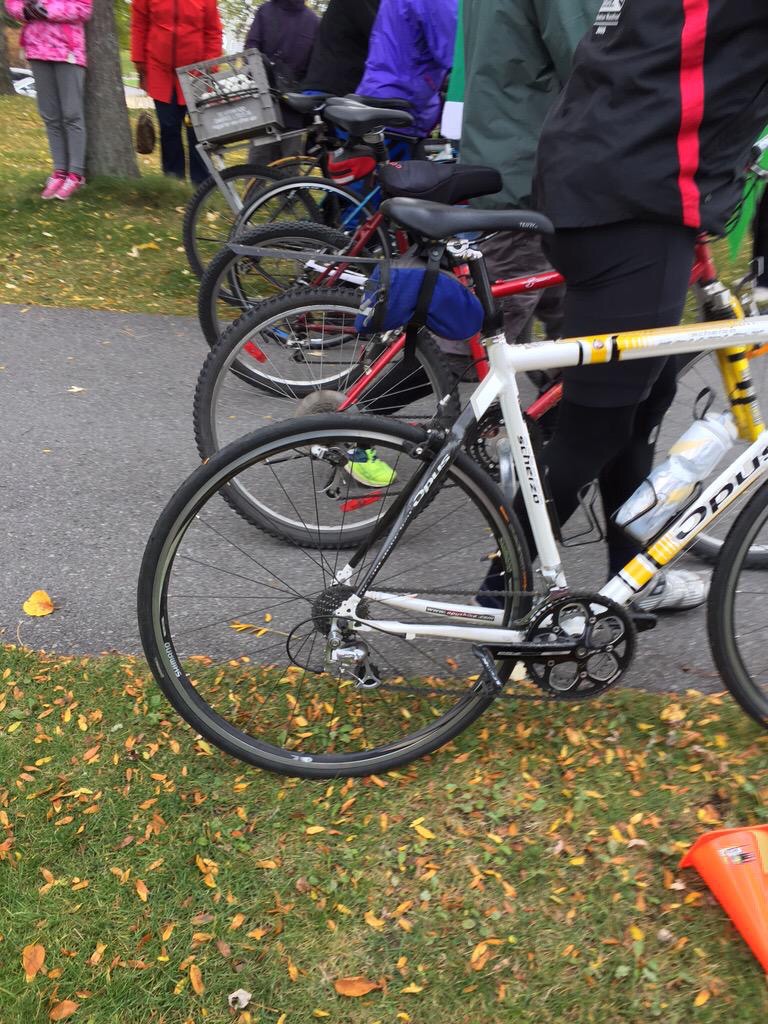
The highlight for me during the clerics cycling challenge (clericchallenge.com) was the finish line, when we all crossed together. This experience symbolized for me what the culture of Christian community ought to feel like and be like.

   
 We are part of a holy procession led by the King of Glory whose destination is sure. We have nothing to lose. If God’s grace is extended even to the generation of seekers (v.6), then we have nothing to lose. If what we are about is not a competition, then we have nothing to lose. If we don’t need to find fault in the other to prove our own self-worth, then we have nothing to lose. If it’s not about one-up-man-ship, then we can go for broke and not worry about it. If we don’t need to question who our Saviour is — who already accomplished for us our salvation — we don’t need to doubt our final destination. Then, why not share now what we have with others on this road?

All the saints on earth, despite the scars of life we bear, have gifts to share with other seekers on that journey. What gifts and blessings of God reflect in your life? In discerning this, remember: It’s not up to you alone! We don’t need to be perfect. We gain the gates not by our own merit or even hard work. Ours is the victory only because of the One for whose reason the gates are lifted in the first place.

Thanks be to God!
(1) — Michael Morgan in David L. Bartlett & Barbara Brown Taylor, eds. of “Feasting on the Word Year B, Volume 4” Fortress Press, 2009, p.228

Marriage: for the heavy-haul

“For if they fall, one will lift up the other” (Ecclesiastes 4:10)
On the journey of life, how well we do depends on with whom we travel. And how well we travel together. I like the name of your business — the brand of your trucking company: “JNB Heavy Haul”. You are not hauling the light stuff. You’re challenging yourself to haul the heaviest stuff that can be pulled by a tractor-trailer on the highways and byways of this continent.
On the road of life, how well we travel together depends, furthermore, on the degree of touch in the relationship. Yes, touch. In our touch-averse culture, the institution of marriage offers couples the benefit and freedom to exercise that public and private right with the fullness, health and joy with which touching another was meant to be.
The popular reading, “The Blessing of the Hands”, brings to our minds this image of holding the hand of your beloved. What is powerful about this poem is that it not only describes those delightful and joyous occasions when hands are held in the sweetness of love. It also brings to mind the larger picture of youth AND ageing, happy AND sad — and even hints at the prospect of death. This perspective includes the heavy-haul of life.
In the blissful exchange of wedding vows you make in the prime of the first half of your life, it is important to sound this deeper note. Because even in the most challenging moments of marriage, life and love, those hands that hold one another can mean everything. The sense of touch with the beloved can get us through times when disappointment, failure, loss, grief, fear and the need for forgiveness press close — as will happen in everyone’s life.
The image of holding hands in those times are equally important to bring to light. Such a bond, forged in the anvil of struggle and conflict, is nearly indestructible. When two people join their hearts, minds and bodies, a third element is brought into the relationship — you can call it ‘the relationship’. And when this happens, you feel it — and everyone else knows it and must respect it: “A threefold cord is not quickly broken” (Ecclesiastes 4:12). If you ever take ballroom dancing and learn the standard, international steps of, let’s say, a waltz, you soon recognize this ‘third partner’ that is the energy linking two individuals. Both partners step in time with one another and respond in kind to this field of energy between and surrounding them. Call it God.
God, who created you both, makes an eternal promise that will never be broken: “I am continually with you; you hold my right hand” (Psalm 73:23). Originally this promise was made to a people desperate in life’s challenging circumstances and struggles, travelling through the wilderness of life. This promise is made for the long-haul and the heavy-haul of life.
I recently read the story of a woman who had walked seven hundred miles as a refugee to escape a violent war. She was finally able to cross a national boundary out of the war zone. She walked all that way and brought with her an eight-year-old girl, who walked beside her. For seven hundred miles, the child held her hand tightly. When they reached safety, the girl loosened her grip, and the woman looked at her hand: It was raw and bloody with an open wound, because the little girl had held tightly in her fearfulness. This is no casual hand-holding. This is a life-or-death grip that does not let go. (Walter Brueggemann, “Sabbath as Resistance: Saying No to the Culture of Now”, WJK Kentucky, 2014, p.88-89)
Upon arriving at their destination, can you imagine the joy, relief and gratitude expressed by both the woman and her eight-year-old travel companion? Their relationship is sealed for life, no matter what!
Earlier this year, a colleague of mine from Toronto was celebrating her 25th silver anniversary. In fact it was Valentine’s Day when she and her husband were driving by one of the biggest cemeteries in Toronto. At that moment they were discussing what they should do, to celebrate this joyous occasion. They wondered if they ought spend some money on themselves, treat themselves, to mark such an auspicious point in their lives.
At that moment they passed by the entrance-way to the sprawling cemetery grounds. And hanging over the ornate gate was a great canvass banner with the words printed in Valentine’s Day red: “One-day sale only: 10% off burial plots!”. The couple looked at each other with wide eyes. A few hours later, they drove out of the cemetery chuckling about how they had just dropped $8000 for themselves on their silver anniversary …. to buy two burial plots side by side!
This puts a different slant on those traditional wedding vows, “till death do us part!” And yet, they do so in life with confidence and faith that marital love can stand the test of time, thanks be to God, for the long-haul and the heavy-haul!

It’s ok to fall (4): It’s the only way

It’s only the second Sunday in Lent. Time seems to drag during this long, hard season. At least Advent — a similar season of preparation, repentance, and waiting — is only four weeks long; things seem to go faster in December.

The pace for Lent is perfect for Sarai and Abram. They are old — in their nineties, now in the twilight of their lives (Genesis 17). They are, likely, slower in moving about and more reflective than the young. They are, likely, more contemplative and more aware of the mistakes they have made and the wounds they have caused — all of which is appropriate for the Lenten journey (Craig Kocher, “Feasting on the Word” Year B Vol 2, Westminster/John Knox Press, Kentucky, 2008, p.50). I agree — although it’s hard to admit — sometimes we need a slower pace, and a place to listen and pray carefully, to confess our sin, as we turn toward God.

I tried something for the first time this past week which goes against the grain of my personality. When I go for my 45 minute walks, my route takes me along streets, roadways and eventually into a beautiful multi-acred forest called ‘the Grove’ whose trails lead to the Ottawa River. 

But I always carry my smart-phone with me. I have justified doing so for safety reasons. My hyper-vigilant personality loves this — no matter where I am on this planet I am only a text or phone call away! If there is a crisis or emergency, I can respond with efficiency and lightning speed to get help.

As I pondered leaving my phone at home, before going for my walk, I reflected on how dependent I have become on this device. Addicted, perhaps? I wondered what I would have done before the smart-phone era — not long ago, but long enough! If there was an emergency, I would have sought a neighbour’s help by knocking on their door; I would have paid more attention to my surroundings and where I might find help. I would have prepared better for my walk. I would have rested more in the moment, trusting more in the interrelated fabric of life around me.

So, here’s the good news. (But the structure of this sermon goes like this: There’s good news, then bad news, then really good news. Stay with me!) First good news, from this experience: I felt liberated. Leaving my phone behind wasn’t really that hard to do — and yet, it was a small step in a healthy direction, a simple sacrifice for evaluating my life-style and making concrete changes for the good. I will now practice more often ‘leaving my phone behind’, for its obvious benefits.

These are the ‘small’ steps we can make during Lent. Others give up chocolate, sweets, meat. Others still will ‘add’ something to their lifestyle — exercise, working out, volunteering more, coming to church more often, giving more money for some overseas mission, spending more time in prayer — all these good disciplines that are popular for Christians in Lent. And these are good!

During Lent, however, we are called also to contemplate the journey of Jesus to the cross — and the implications of that kind of sacrifice on our own lives. And so — and here’s the rub, the ‘bad’ news: Giving up chocolate or the cell phone is not ultimately what the Lenten journey is about. Jesus’ death on the cross was not making a ‘convenient’ sacrifice. Jesus’ death on the cross was not a little discipline that pinched but really didn’t change anything significant when Easter morning came around.

Jesus’ sacrifice goes to the jugular of our lives; it demands a costly cost; it means a radical change and giving up of something that is near and dear to us.

God calls Abram and Sarai to change their names. And it was a big deal in their day. In our times, names are often considered nothing more than labels. In our world, names are often chosen based on nostalgia, diction or popularity.

In the ancient world, however, names reflected the character and destiny of that person. To be called by your name, was a big deal. To change that identification was radical! Names were wrapped up in the core of one’s identity and purpose.

The name of God, above all, was untouchable — literally. The Jewish people withheld from spelling God’s name in scripture, from saying God’s name out-loud in worship. To call ‘on the name of the Lord’ was an act of profound devotion. To call ‘on the name of the Lord’ was a radical act of identifying with an un-nameable God.

And yet, in this text, even God is given a new name. For the first time, God is given the name “God Almighty” (Genesis 17:1). It is transliterated from the Hebrew, “El Shaddai” which might be translated, “God of the Mountains” (ibid., p.52).

So, here is my invitation to you today: Consider what profound and deep aspect of your life God is calling you to change. You may object, on the grounds of scriptural interpretation alone: “This text is not about us needing to change! God called Abram and Sarai to change their names. That was them. But not us!” 

Yes, we may think on occasions — even religious in nature — where we do still change our names — at weddings, some women will change their last names; and in Christian baptisms practised in some churches, babies take on their “Christian” name for the first time.

And yet, when we read this Old Testament text, and while we would do well to acknowledge its original context and meaning to the first people who received it, we are still asked today: What does it mean to us? How can this text become alive for us today?

And when we relate this text to the Gospel for today (Mark 8:31-38), where Jesus calls us to take up our cross and follow him, where Jesus challenges us to ‘lose’ our lives in order to ‘gain’ life — what does that mean? It’s not just about throwing a little more cash in the offering plate, or not indulging in sweets.

What may God be calling us to change, in our own lives? What may God be calling us, whispering into our hearts, to ‘lose’? Are we prepared to fall? Big time?

Jesus shows us that it’s okay to fall, because it’s the only way to go: The Cross. If anything, don’t skip opportunities in Lent to worship — during mid-week studies, Maundy Thursday, Good Friday, and the Easter Vigil. Why? Going to the Cross, through the Cross, is the only way for us to know and experience the joy and truth of resurrection. Being uncomfortable by facing our fear, anger and shame is the only way for us to know and experience the joy of life. If you yearn for true joy, satisfaction and rebirth in your life, being uncomfortable is the only way for you to be healed, to be redeemed and forgiven, to find your way in this world.

You can’t have Easter without Good Friday. We need to be prepared to ‘lose’ ourselves — to fall — in order to ‘find’ ourselves — to get up, again. In Christ. “El Shaddai”, God of the Mountains. Mountains define valleys. You can’t have mountains without valleys. Mountains encircle valleys — valleys of despair, valleys of impatience and sorrow, valleys of Lenten confession and discipline. Wherever you have a range of mountains, you will have valleys. But whenever you find yourself in a valley, don’t give up. Don’t get stuck in the valley. Don’t get comfortable there, either. Get up and keep on, because there’s a mountain just up ahead pointing our vision to the skies. 

And here comes the really good news (after the bad news, after the first good news): Abram is ninety-nine years old when ‘the big change’ happens. Ninety-nine! It’s never too late. Never too late for God to call us to change. Never too late for God to call us into ‘losing’ something that we have for a life-time believed to be important. Never too late for God to give us the strength we need to endure and follow-through on that change. Never too late for God to bless us with a wonderful gift of the new thing God is doing for us — whatever that may be.

God will never give up on us. God will wait a life-time, and then some! God is the God of Mountains. And mountains are steadfast and true. Mountains point upwards to the vastness and infinite beauty and glory of the sky and the stars. God pointed Moses’ vision upwards to see the Big Picture of God’s promises and God’s future.

Mountains will remind us, I pray, that God’s promises are sure. God’s covenant to us cannot be broken, even as we follow Jesus down this long, slow road. But, “whose destiny is our destiny: the cross, the grave, the skies” (ibid, p.54).

The Falling and the Rising

It is the first Sunday after Christmas. How do you navigate this ‘hangover’ time? Are you wandering now into the proverbial ‘deep valley’ after having experienced the ‘mountaintop’ of festive frivolity?

For some, the reality of the cost of gift giving has begun to sink in. Perhaps for you, your expectations were high coming into the season, only now to discover it was not what you thought it would be. For others still, the toys unwrapped on Christmas morn are already a tiresome bore, left on the shelf somewhere.

There is good reason to suggest that choristers ought to visit the nursing home with joyous carols, not before Christmas Day, but in the dog-days of late December and early January. It is this time that many of us may need a pick-me-up, more than ever. I am grateful some of you thought to organize a congregation meal together for Epiphany rather than when things are crazy in mid-December, when we are at the height of all expectation and activity.

We read in the Gospel text today, “Then Simeon blessed them and said to his mother Mary: “This child is destined for the falling and rising of many …” (Luke 2:34)

Notice the backward order of the words in the scripture — “falling and rising”. In the world, as it may be how we feel at this time of year, it’s ‘rise and fall’: The rise and fall of the Roman Empire, the rise and fall of the Third Reich, the rise and fall of a business tycoon, the rise and fall of a celebrity.

In Macleans magazine, they evaluate 2014 newsmakers in terms of “winners and losers” — and include the likes of famous Canadian radio host, Jian Ghomeshi, who “fell from grace”, we say, whose stardom rapidly disintegrated this Fall (Dec 8/15, Vol.127, Nos.48/49). This is the way we see the rhythm of history and what the world notices. First, one rises; then, once on top, the only way is the way down.

But with Jesus it’s the other way around. With Jesus, it’s fall and rise. “Unless a grain of wheat falls into the earth and dies, it remains just a single grain; but if it dies, it bears much fruit” (John 12:24). Anna fasts “night and day”, not ‘day and night’. Jesus did not fly directly up into heaven once danger flared. He suffered and died, and then was raised to glory. The movement is down, then up (Philippians 2:5-11). We fall, and from that lowest point, we rise.

You may just fall. But if you rise, it is because you have first fallen. Rising doesn’t come without falling.

If you have arisen, you would have done so rising from the ashes of defeat, failure, having come through some of the worst time of your life. If you have arisen, you would know what it means to be at ground zero. There is spiritual power and great wisdom in embracing your own vulnerability, your own limitation, your own shame, anger and fear.

There is inherent value in being open and honest about your pain — not denying it, not pretending it away, not hiding it, nor distracting ourselves from it. Because it is in facing our own ‘stuff’, even our own mortality, that we will experience the turn.

Simeon, the elder, can now be hospitable to his impending death after encountering the vulnerable, infant Jesus (Luke 2:22-40). There is no rising without first falling. Ironically, this is also the message of Easter. And this is how Christmas and Easter are indivisible: We can see it from the perspective of Mary …

Mary must have shuddered at Simeon’s words. Mysteriously he speaks of a “sword piercing her soul” (v.35). It is moving to think of Mary, feeling Jesus kick in her womb, hearing his first cry, nursing him, watching his first steps. After all, she will witness thirty years, which is telescoped into a single verse: “The child grew and became strong” (v.40). Jesus leaves home and marshals a following.

But wicked men turn against her son — who is pure, good, all love. Mary has to watch as Simeon’s prophecy is fulfilled. Her heart breaks as she sees the lifeblood she had given him drain out of his beautiful body on the Cross. The fall.

But then the rise, on Easter morn. Who, among all who witnessed Jesus risen from the dead, was more joyful to see him alive than his own mother? (thanks to James C. Howell, “Feasting on the Word” WJK Press, Kentucky, 2008, p.168, for his words and thoughts on ‘falling and rising’).

So, when we are at the bottom, how do we cope when “in the Fall”, and when we still await “the Rise”?

As I reflect about looking back over unhappy times in my own life, as I reflect on dashed expectations, disappointments and unfulfilled ‘wants’ — I wonder. I wonder if crying out for the Lord is a cry of despair, or a cry of hope? (thanks, Rev. Doug Reble, for this insight). For me, I have to confess: I would not give up on hope.

Because of Jesus. Mary and Joseph, in this part of the Christmas story, take Jesus to the temple in order to fulfill the letter of the Jewish law (Luke 2:22-24). Their diligence may raise questions for Christians who feel no obligation to the Old Testament’s laws. What is the purpose of the ‘sacrifice’ for their purification?

From a Christian faith perspective, we would say this child was in no need of any such purification. Jesus did not need to be purified. Karl Barth wonderfully wrote about Jesus’ baptism — which we shall read in a couple of weeks — that Jesus needed to be washed of sin; but not his sin, but our sin: “No one who came to the Jordan was as laden and afflicted as He” (cited in ibid., p.164).

No one ever came to the temple for purification as laden with sin — not his, but our sin. Jesus took it all on him. Jesus was purified, for our sake. Jesus takes it all on him — whatever burden we carry — so that we can have a new start, a fresh beginning. Therefore, we can hope.

In this coming new year, 2015, may you be blessed with hope. A hope which carries you through the weeks, months, or even years of “lonely exile” and into the peace, love, and joy promised in Jesus Christ. May your falling turn into a glorious rising, “soon and very soon”.