
How to know peace

How can we know peace? Not only are we anxious and stressed to get everything done this holiday season, our hearts may also be heavy with grief with loss, and aware of the tragic violence facing so many people in other parts of the world today … Then what of ‘peace?’

Cardinal Thomas Collins was the guest speaker at an event I attended on behalf of Bishop Michael Pryse (Eastern Synod, ELCIC) earlier this week on Parliament Hill. He spoke to a room full of parliamentarians and multi-faith religious leaders on the theme of “Faith in a Time of Crisis”.

In his opening remarks he admitted this theme could be interpreted in a few ways: He said, the most obvious, was to look at the places of violence and conflict in the world, images that are splashed all over the media almost on a daily basis.

Then, “Faith in a Time of Crisis” might also be applied to our Canadian context, where changing economic realities and public violence hit close to home, as it did in downtown Ottawa a few weeks ago in the shootings and deaths on Parliament Hill.

But, Cardinal Collins settled on the crises we face ourselves, personally, in our own lives: crises of losses, frail health, broken relationships and despair. He looked straight into the eyes of our Members of Parliament and government leaders, and with a twinkle in his eye spoke about the virtue of humility.

I couldn’t help but think about the examples of humility in the Scriptures, especially in the New Testament. Unlike the self-righteous Pharisee praying in the temple, the tax collector beats his breast and prays, “Lord, have mercy on me, a sinner”; apparently, the person who exercises humility is the person of God (Luke 18:9-14).

In the Gospel text for today, John the Baptist confesses, “I am not worthy even to untie the thong of Jesus’ sandals” (Mark 1:1-8). John the Baptist points to the coming Saviour, Jesus Christ. He knew that he would ‘decrease’ so that Christ would ‘increase’ (John 3:30). We might not think of John the Baptist as particularly humble, what with his rough-and-tumble persona.

But he was merely the messenger, preparing the way of Jesus. Jesus would be ‘the way, the truth, the light’, not John the Baptist. He understood, as we all are well to do, that God is God, and we are not. Even though we are valuable members, each and every one of us, of the Body of Christ, we are still just a part of the larger, “Big Picture”, as Richard Rohr calls the kingdom of God.

It’s easy to slip into that frame of mind that believes we are God, and that it’s up to us. It’s easy to identify with the unholy trinity of “me, myself and I.” We might sooner go to confession and, instead of saying, “Father I have sinned …”, say, “Father, my neighbour has sinned; and, let me tell you all about that!” The words, ‘pride’ and ‘sin’ both share the same middle letter … ‘I’!

Unbounded self-assuredness is not the way of the Gospel. The Gospel of Mark opens with John the Baptist preaching repentance. Indeed, “scripture proclaims hope for troubled souls and judgement for the self-assured. Against our human tendency to read the Bible in self-justifying ways, confirming our prejudices and excusing our resentments, we must learn to read self-critically, allowing Scripture to correct us. As the Swiss theologian, Karl Barth says, ‘only when the Bible grasps at us’ does it become for us the Word of God” (David Bartlett & Barbara Brown Taylor, eds. “Feasting on the Word – Advent Companion”, WJK Press, Kentucky, 2014, p.160).

It’s much harder, to see yourself as the problem. Cardinal Collins used the image of going in for an oil change, to describe his own need, regularly, to confess his own sins, to be grounded again in the truthful reality of his life. Some of us, he feared, unfortunately take better care of our cars with regular maintenance than we do with our own souls.

Humility means to be grounded, to be in touch with your humanity (‘humus’ — Latin for the earth, ground). Humility is to recognize your own complicity in a problem or challenge we face, AND taking responsibility for your own behaviours. Humility also reflects the desire to be changed, and to change yourself. The famous poet, Rumi, once wrote: “Yesterday I was clever, so I wanted to change the world. Today I am wise, so I am changing myself.” Do you want to change yourself?

Now, you also probably know this: whenever you embark on a journey of transformation, you will encounter resistance to this change — both from external sources and from within yourself. Listen to how a congregation undergoing intentional change identified very honestly in their reporting what they anticipated to be different states of resistance; they wrote:

“If we are going to try to make some changes – guaranteed – there will be resistance! (If there is no resistance, that shows that nothing is changing.) We will encounter (at least) four waves of resistance: 1. against the very need to consider change 2. against no matter what changes or types of changes 3. against specific changes 4. against personal changes and transitions, without which there is no way changes in the congregation, as a whole, can happen.” This shows great insight, and wisdom! Even in a climate where a collective change must occur, they recognize that the body can’t change unless its individual parts do.

Now, you may be starting to wonder what the desire for peace has to do with change. In fact, you may see change as the grounds for anything but peace. Well, the two are related, in the act of confession.

In the Lutheran Church, Confession has not been practiced as a formal sacrament; traditionally, the only two sacraments that have been practised as such are Baptism and Holy Communion – although to varying degrees among different Lutheran expressions, confession, too, has been practiced sacramentally.

Whatever the case may be, there is agreement that Martin Luther did place immense importance on the practice of confession. In our current worship books, there are orders for individual and corporate confession. I encourage you to look into these prayers, especially at this time of year. The point is, when you practice humility in the act of confession, the heart is naturally opened up to change for the better, and find peace.

Admittedly this path to peace, is a way through the desert. We enter one of the greatest paradoxes of the Christian faith: that it is through the suffering that comes to us all in various ways that we can experience the grace, the mercy, and the profound love of God that changes us, transforms us, into a new creation. John the Baptist preached “in the wilderness”; Isaiah (40) proclaimed words of comfort to a people moving “in the wilderness”.

But, if you want to see the stars, you have to go out into the wilderness — where it is ‘dark’, where it is quiet, where silence and stillness of the night characterizes reality much more than the usual distractions, stimulations and the incessant rushing-about that describes our lives more today, and in this season.

If the Christian faith has anything of enduring value to offer our retail-crazed, commercialized, high-octane holiday season — it is the gift of “Silent Night, Holy Night”. Because the light of the world is coming. As John the Baptist pointed to the brightest star that was coming into the world, we can do well to pay attention the ways in which Christ comes to us.

In our humility, in our acknowledgement for the need for forgiveness and grace, we learn to depend on God and one another for signs of God’s coming to us, again, and again.

Peace be with you.
The desert journey begins

One of the first things we do even before setting out on the journey is to contemplate: “What should I bring along?” And so we need to imagine what it is we will be getting ourselves into, on this journey. Where will I go? What will I do? What will the weather be like? As such, we must initially deal with our expectations.

And as the weather goes, so the reality of what actually happens once we get on the road might not coincide at all with what we had anticipated. We all know those people who travel without high expectations or a highly controlled agenda; they just experience things and deal with situations when they arise. And if that’s how we are to travel on this spiritual journey, some of us may not want to go; we may get stuck even before we head out the door.

And yet, we know, no amount of planning can determine precisely how we experience the journey.

Jesus wandered the hillside, countryside and byways around Palestine. It seems every time we encounter Jesus in the Gospels he is on the move. He is either coming or going. And so it is consistent with the nature of the pilgrim God we worship: Immediately after Jesus’ baptism and before he even begins his ministry, the Spirit of God sends him into the wilderness for forty days and forty nights where he fasts and contemplates the journey ahead (Matthew 4:1).

“Do not worry,” Jesus later preached, “about your life, what you will eat or what you will drink … what you will wear” (Matthew 6:25,31). In the desert, admittedly, those luxuries become somewhat irrelevant, don’t they?

Jesus goes into the desert. We may not literally need to go into the desert – although you can understand why ancient Christian pilgrims made it a point to spend time in the desert as our Lord did because you cannot find a more austere location for a true ‘letting go’. An actual desert pilgrimage brought spiritual benefit for many followers of Christ. But the harsh climate in that setting – with the sand dunes, scorpions, snakes and burning hot air – can also stand as a metaphor for us.

Michael Pacher’s masterful, artistic depiction of the temptation of Jesus on an altar piece in the Sankt Wolfgang church in Austria shows Jesus and the devil not in the middle of a desert as we would imagine. But on a narrow street in a medieval town in front of a cathedral, of all places. And what is more, the devil is not holding a pitch fork and coloured red. He is wearing a monk’s habit and bent over like an elderly, wizened man.

Pacher’s interpretation is worthy of reflection, as he translates the desert into his own daily reality. Living in the 15th century, Pacher implies in his art that the journey of faith is not tied down, literally, to any particular geography but is lived out especially in one’s own place, wherever one is. What is more, our greatest temptations are more subtle. What can destroy us will more often than not come disguised in familiar, even culturally acceptable ways and people.

We often discover, do we not, that the greatest challenges and difficulties on the road arise from the least expected sources — you packed the wrong pair of shoes, or you can’t decide whether to grab a quick burger here or there or skip lunch altogether. The biggest temptations, or tests, come from the most familiar, most common and from those nearest to us — even from within ourselves!

And yet, we do not overcome the devil by avoiding this pilgrim journey. In truth, the only way we experience redemption, healing and restoration is by committing to the journey through the desert of our lives.

Go, we must, should we seek the Lord. Jesus went into the desert. And so, we will follow there. “Follow me” Jesus called to his disciples (e.g. Matthew 9:9). But how shall we be? What shall we do?

If we follow Jesus into the desert, we must also consider about what Jesus was tempted. And we know that Jesus, King of Kings and Lord of all, right up to the end when he hung on the cross “despised and rejected” was taunted again by the voice of the devil in the passersby: “If you are the Son of God, come down from the cross” (Matthew 27:39-40).

We know that, as from the beginning, Satan tempts his victims to go for power: To Eve he promised: “You can be like God” (Genesis 3:5). Perhaps this is why the first of the Ten Commandments establishes who is the God we are to worship and place undying trust in: “I am the Lord your God … you shall have no other gods before me” (Deuteronomy 5:6-7). The three temptations of Christ are really three variations on this same basic theme: the turning of the bread – about the miraculous; the falling from the temple – about the spectacle; and while the first two show semblance of persuasion, the third goes directly for sheer control (p.46, Douglas John Hall, Feasting on the Word Year A Volume 2, JN Press Kentucky, 2010): “I will give you all the kingdoms of the world” (Matthew 4:8-9).

The pilgrim ‘desert’ journey is the sure fire antidote to the danger of pretending we have ultimate power and control over life. It is the path of humility, letting go, and ultimate trust in God – that God will take care of us as He did Jesus.

But we have to move. On a journey, we move, physically. We put one foot forward at a time. What tangible, intentional discipline will you do during these forty days before us now? Whatever it is you decide to take up in Lent, envision each time you do it like taking one step forward on that journey.

In worship, we symbolize an intentional discipline by refraining from singing “Alleluia”, the Hymn of Praise after the Kyrie, and, generally, simplifying and toning down the style of worship. We also give opportunity for more prayer and worship on Wednesday evenings, during which we practice the ancient Christian rite of laying on of hands and anointing with oil. With tangible, earthy, disciplines that we do together, we keep our feet on the ground and moving forward. Our soup suppers before worship on Wednesdays are intentionally simple, to remind us that we have all that we need in trusting Jesus for our very lives.

And despite the temptations and set-backs we may occasionally experience on the road, Jesus goes with us. What Jesus shows us, above all, in his wilderness experience was an unyielding trust in God, the Father. After all, it was the Spirit of God that led Jesus into the wilderness in the first place. Jesus needed to trust God that God knew what He was doing in sending Jesus on this unappealing journey. Jesus had to trust God’s words in Scripture over-against the devil’s wiles. Jesus had to trust God that in the end, his needs would be met. And indeed, they were, as angels came to attend to his hunger and physical need (Matthew 4:11).

Whatever temptations come our way, they are essentially an invitation not to trust God. Temptations are those ways of thinking and behavior that place more and more power and control in our hands – as if we were God. Instead, we are invited each Lenten season, specifically, to welcome opportunities to be vulnerable, to open our hearts, to not be afraid to go on that journey into the desert and experience for some time what is feels like to let go, and trust God even more.

Starting a weekly Christian Meditation Group

20140125-094318.jpg

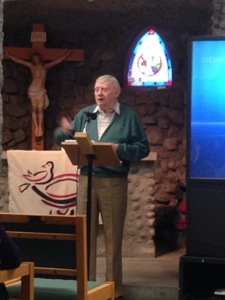
Paul Harris is a long-time leader of the Ottawa Christian Meditation Community and author. Today he leads a workshop to encourage and equip small group leaders of weekly meetings of meditators. There are over 44 groups in the Ottawa area, spanning many church denominations and meeting in all manner of locations. A useful resource, written by Order of Canada recipient, Laurence Freeman, is: “A Pearl of Great Price; Sharing the Gift of Meditation”