Reception and release

“Increase our faith!” the disciples ask Jesus (Luke 17:5). Perhaps they in so doing expose their underlying belief that they are not good enough at practising their faith. “Increase our faith!” is their prayer.

And perhaps yours, too.

What does it mean, to have more faith? What does that look like?

When my beef tomato plant yielded hundreds of blooms early in the summer my hopes soared. But as the blooms turned into tiny green golf-balls, then turned yellow and grew finally into the large, red ripened tomatoes, the vast majority of them had a problem.

Even in the premature, un-ripened stage all of them with very few exceptions showed signs of rot, starting from the bottom up. Many of these rotten tomatoes didn’t even have a bottom. It looked like someone had sliced off the bottom half which was flat and blackened.

At a critical stage early in the plant’s development, the tomato plant did not get what it needed. When I looked up this problem, the experts suggested this plant did not receive the requisite amount of calcium. The soil, in other words, did not provide this plant with the needed nutrients mediated by regular watering.

But it was not just about what was missing, but when. As soon as I noticed the first tiny green tomato with the rot back in July, and did my research, I started watering the plant, even soaking the ground, every evening. But it was too late. I’d missed that critical stage in its development. Early on in its growth, that is when the watering and soil treatment should have happened.

“Increase our faith!” The disciples asked Jesus to strengthen what they probably perceived to be their weak faith. They had just heard Jesus’ difficult teaching on the need to forgive others who have hurt them (Luke 17:1-4). They likely felt unable to do this and concluded that they didn’t have enough faith. They may even have gotten down on themselves. Not having enough faith translated into being a bad person.

Jesus responds with a parable to temper their expectations. To sum it up, I can hear Jesus ask them a rhetorical question: “Who do you think you are, God?”

As far as gardening goes, I felt like a failure.

A couple of things I need to remember regarding my disappointing tomato plant experience: First, we did get a few, really good, juicy-sweet tomatoes from it. It wasn’t a total loss.

Second, I might do well to recall my part in its growth. And this ties in with the act of blessing, which we have engaged in this morning. Because when we give a blessing, how are the blessing’s gifts realized? After all, the blessing’s benefits must be received in order for the blessing to be fulfilled. It’s not just the giving but the receiving as well.

The action of blessing our pets is a good exercise of faith for us today, because, of course, we have little way of verifying scientifically that our blessing confers anything of value on our pet. They can’t even say, “Thank you, I feel better already.” But we still do it, faithfully if imperfectly. And that is the important piece.

Is it not the same relating with human beings? In our stuffed-up pride, we may like to believe that our caring and our words and our blessing actions must have a positive effect on those whom we bless when we can see and verify it by their changed behaviour, or whatever. The value of our prayers, our service, our words become contingent on a verifiable result. And when we don’t have that result immediately, we may lose faith in ourselves and in God.

My gardening failure, taken as a metaphor to failing at all my righteous attempts to do good, doesn’t mean I’m weak in my faith or not praying hard enough. When you experience failure, it doesn’t mean your faith is deficient.

The paradox is that for anything great to happen, for any wondrous change to occur for the better, we first must accept ourselves as we are, with all our limits and weaknesses. Whenever we avoid, mask, pretend and think more and expect more from us than what is, we often run into trouble and bring about the opposite of what we seek.

After the first week of training and orientation at my practicum site last month, I felt I had a tentative and yet untested grip on all the policies, procedures and digital charting protocols. I was just beginning to understand how things operated in the office, receiving referrals from the doctors and using the proper charting process, never mind the actual practice of counselling clients.

There are, including me, four psychotherapists in our department. On one day in the second week, it so happened that the other three were not in the office. For the whole day, I was it, the only therapist on site.

I wondered, at first, why I had been left all by myself. There were still things I wasn’t sure about. But I managed through all the hiccups and logistics that challenged me that day. I figured out solutions, if only temporary. As the day wore on, I found more confidence in myself and found an unexpected pride in occupying that space and role for the day.

Later I reflected how important that experience was for me not to lean on the crutch of more experienced professionals at my beck and call to help me. I appreciated the faith my colleagues had in me to leave me alone in their office and on their computers. It was, in truth, an important part of my learning.

They had faith in me! God has faith in me, and God has faith in you!

The prayer to God, “Increase our faith” is learning to trust the faith that God already has in us especially when things are stressful, tense and not going our way – when we’re not on our game, when we are suffering, grieving, losing.

Let me repeat: Increasing our faith looks more like the practice of receiving and trusting in the faith of God in us, when we are not at our best.

This Gospel is about God validating the faith already in us, never mind how strong or weak it is. The real question is – Do we trust the incredible faithfulness God has in us? Do we trust God’s faithfulness in us,

enough faith to let us make our own mistakes,

enough faith to let us make our own decisions with the resources we already have,

enough faith to let us meet those tough days without giving up,

enough faith to let us use what we already have for good,

enough faith to meet our seemingly insurmountable challenges with courage,

enough faith to trust we are never out of the reach of God’s love, mercy, grace and forgiveness.

Our new national bishop of the Evangelical Lutheran Church in Canada (ELCIC), the Rev. Bishop Larry Kochendorfer, said recently: “We do not fully know the future, but we have what we need. We have bread and wine, we have the scriptures, we have each other … Jesus comes alongside. Love is at our side.”

The blessing we receive from God is God’s faith in us. The blessing is the gift of accepting that God believes in us because God loves us. And this is the blessing we give to others.

When we bless others, we have faith in them, in their abilities to meet their own challenges with the resources, and the God-given capacities they have, to grow and flourish.

“Increase our faith, Lord. Help us lean on the faith you have in your creation. Help us trust you have given us enough of what we need to live by your grace and love.”

Amen.
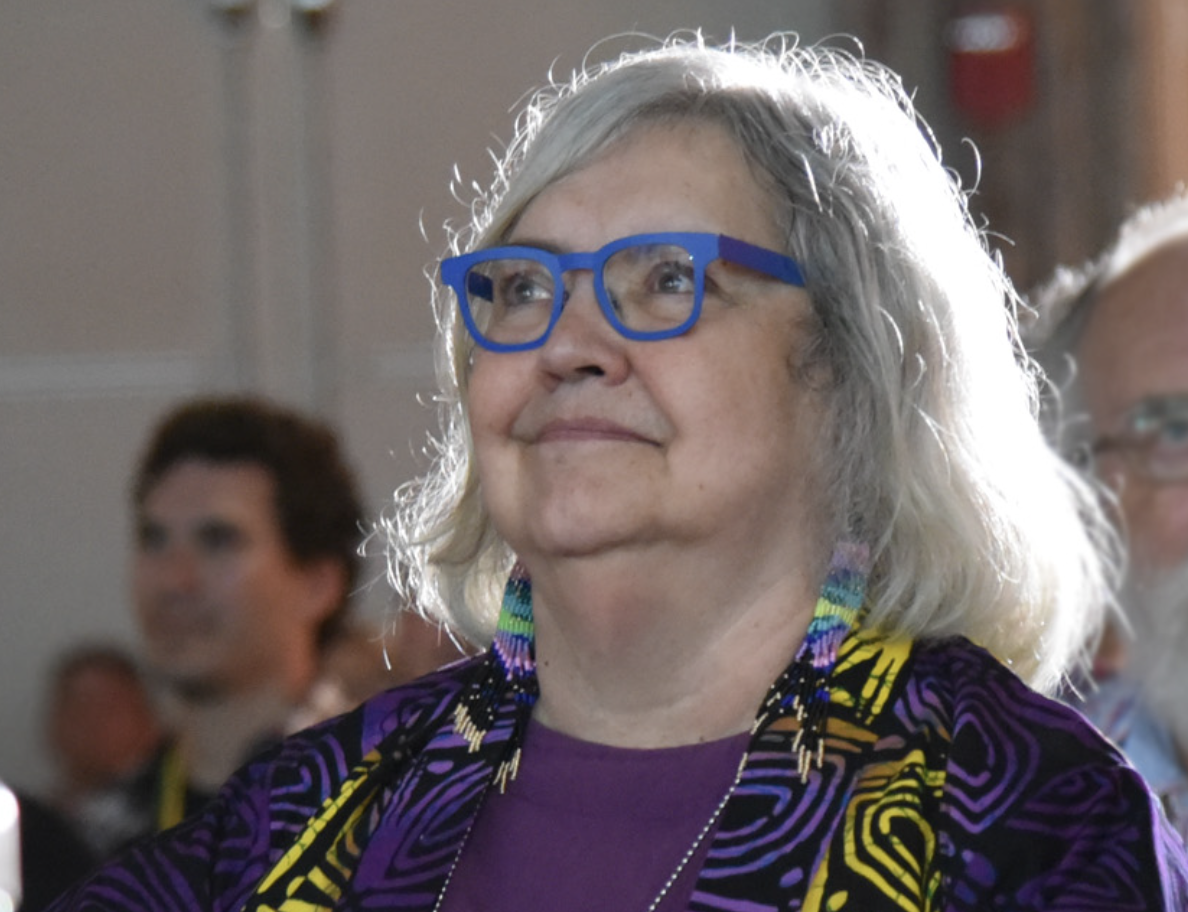
Telling our story

National Bishop Susan Johnson (ELCIC) listens to words of gratitude for her 18 years of service as national bishop (July 12, 2025, Winnipeg, http://www.elcic.ca)

The Mary-and-Martha Gospel story (Luke 10:38-42) reminds me of what sometimes happens when family and/or friends gather around a table on a holiday or to celebrate some special occasion. Over the meal, each person has a different take on the subject matter at hand. Everyone has their own opinion.

After years of regularly encountering this Gospel in the lectionary, and preaching countless sermons on it, I have concluded that there are at least three characters sitting around our table today. These three characters represent my own evolution of understanding this Gospel story. They are the Literalist, the Rebel, and the Peacemaker.

The Literalist is the first to speak. The Literalist reads this Gospel and concludes that Mary is the person that we all should model: the one who is quiet and listens to Jesus and doesn’t worry at all about the practical aspects of hosting Jesus and his entourage. While the mundane activities need to be done, we are called instead to aspire to the true, higher, spiritual gifts.

The Rebel, as you might guess, jumps right in. The Rebel resists the Literalist’s interpretation and declares their objection. They see it in the opposite way. Martha is the true hero, and Jesus is unfair in admonishing her. After all, the practical aspects of hosting a party are vital in healthy relationships and community building, not to mention how dominant cultures have tended to diminish and marginalize women who traditionally did these more active, practical things.

Finally, the Peacemaker quietly interjects. The Peacemaker will argue that both roles, or postures, are important to balance in any community or within any individual. Jesus isn’t taking sides in this debate. Rather, he directs his comments to the way Martha goes about her task, “worried and distracted by many things” (Luke 10:41). Whether we are active all the time and busy in our service to God, or praying in silence and resting in stillness and holy presence, distraction is the real culprit.

If you were invited to this table, and you came, where would you sit? And with whom? The Literalist? The Rebel? The Peacemaker? Or … is there yet another voice that needs to be heard?

In the farewell tribute and celebration of outgoing national bishop Susan Johnson at the national convention of the ELCIC last week, a speaker and close friend of Susan’s, Willard Metzger from the Mennonite Church and current director of the Citizens for Public Justice (CPJ) talked about the strengths in Bishop Johnson’s ministry (www.elcic.ca).

He spoke about how Bishop Susan knows who she is. She is strong in her personal identity. In other words, she has an abiding love of self despite all the challenges she had faced, both personally and professionally, in her 18 years as bishop.

Willard went on to say that our love for God is affirmed when we love ourselves. Why? Because God created each of us. Each individual is created out of the love of God. It is fundamentally crucial as Christians to continually work at loving ourselves because God created you, made you, fashioned you in God’s image. We would then compassionately correct any messages we might tell ourselves, or the world might tell us, to the contrary.

Here’s another voice, another way of interpreting the Gospel. What shall we call this character? The Lover? It’s not about whether it’s better to be active and serving, attending to others and being hospitable in practical ways. Neither is it better to be contemplative, and reflective and sitting at Jesus’ feet. It’s not either/or.

It was that Mary knew who she was, was strong in her own identity, and loved herself enough to know that she just needed to do the one thing she was about and be who she was, at that point in time. The “better part” that she had chosen was that she chose to be herself without trying to be someone and do something she was not. She didn’t need to please someone else or fulfill their expectation of her. Jesus said it: Who she was and what she was about could not, “will not be taken away from her” (Luke 10:42).

This year, the national church has embarked on a restructuring process. During the convention the facilitators of the restructuring process engaged convention delegates, visitors and staff in an activity which I would like to practice here today, with you.

To begin with, the activity had us pair off. So before doing anything, turn to one person sitting beside or close to you and introduce yourself to them. It’s best to break the ice before diving in to do this exercise. If you are watching online with another person, you can do this with them at home.

The aim is to tell a story, together. I’ll start you off by saying, “Once upon a time ….” Then one of you will start telling your story by saying just one word. Then the other person will respond, but with just one word. And back and forth you go, taking turns but with just one word at a time.

Before you begin we need a general theme that will govern all our stories. So, what country or place in the world would you like to visit? …. What activity would you like to do there? ….

Ok, the story you will create together with your partner will be in this place and revolve around this activity. But remember, you say just one word when it’s your turn. I’ll give you a couple of minutes to do this, ok? Ready? “Once upon a time …” Go!

Time’s up! What was one challenge you may have encountered in the exercise? You may have had an idea about where the story should go. But then your partner would say a word that totally threw you off. They, obviously, can’t read your mind. And they might very well rather take the story in a different direction.

For the exercise to be productive, both partners need to get past themselves, listen carefully, and join together in telling a story that emerges from both, without preconception. You are co-creating in the moment. And hopefully having some fun along the way.

The exercise taught me that there is a difference between my story, and a story. There’s a difference between my story, and our story. And it’s not that my story is bad, or lacking, or not good enough. Refer to my earlier point about loving ourselves.

Each of us is beloved and has value and worth and beauty. You and I need to know who we are as individuals. We need to rejoice and celebrate in our particular, unique gifts that each person brings.

At the same time, we need to share and engage each other in relationship, and work together, respecting each other’s gifts. We co-create a new story, an emerging story. This can be exciting, and scary at the same time.

However your close relationships are organized, however community happens for you, despite and maybe because of our differences, the family still gathers around the table, as we will at the Holy Meal shortly. We reach out to make meaningful connections.

And perhaps this is the grace. Even though the people sitting around the proverbial table may be very different in their outlooks and interpretations and politics, we still gather and hear each other out. We practice being in community. And God continues to love each one of us, and the church.

Let us rejoice and give thanks in the story that God tells through us.

Thanks be to God!

Seeking kin-doms: a funeral sermon

Byron was born at the beginning of the Easter season in 1974, on Easter weekend in fact. Byron died on the last weekend of the Easter season in 2025. His life, from beginning to end was held and embraced in the life of the resurrected Jesus. 

At the beginning of the Easter season, the beginning of Byron’s life, it is about the promise fulfilled. After months of waiting and expecting, your baby is born. New life has arrived, upturning regular routines, upsetting comfortable sleep patterns and shocking the family into a new, delightful part of life.

But at the end of the Easter season, at this unbidden moment, when the one we’ve grown to love and know and see in the flesh, leaves us. This is the difficult time for the disciples of Jesus, who now that Jesus is resurrected will leave them. They will no longer see him in the flesh. What will they do without him? This crisis of faith hits them like a gut punch.

Byron’s sudden and unexpected loss hits us like a gut punch. And we may very well still be trying to get our breath back from the shock of it.

The Easter season frames Byron’s life both in the promise of life and in the loss of it. Every funeral service, arising from the pain of death, is an Easter service no matter what time of year.

Loss is part of life. In his lifetime, Byron’s favourite team, the Indianapolis Colts only one the Super Bowl once, in 2007 under Payten Manning’s quarterbacking. For all the years that Byron was faithful to his beloved team, he endured all those losses, year after year – except for that one.

Losses and death can dominate even in the season of Easter, except for that one Win. Hope and faith stay alive despite the losses. The hope of life still to come, against all the odds. The colour of Easter is white, the colour signifying life ongoing, life eternal.

Hockey and football, two of Byron’s passions, are seasonal sports. For the most part, they happen during a defined season of every year. But I think there is something deeper going on here.

Notice in both cases we are talking about team play, with others. Football, like hockey, is a team sport. In few other sports do the players need to connect intuitively with everyone else. The better a team connects that way, the greater chance they have to win. Football players will often talk about their team-mates as family.

Byron, at heart, valued kinship. He was dedicated to family and to the network of people that made up his life. He never missed a family gathering, at Christmas and at Easter. In fact, this past Easter weekend was the last time some of you saw Byron face-to-face.

When Jesus counselled his disciples, prepared them, for his departure, he promised them he would always be with them, in them, through the Holy Spirit. He promised them that they would not be alone, and that they would always have access to him in their hearts, and in the world (John 14).

How so?

“It is God’s pleasure,” Jesus says, “to give you the kingdom” (Luke 12:32). The phrase, “kingdom of God” is mentioned some eighty times in the New Testament. It is what Jesus says is the goal, purpose and aim of the Gospel – the good news. “Seek ye first the kingdom of God” (Matthew 6:33).

But kingdom doesn’t mean empire-building, evoking images of might-makes-right, power-seeking kings that we have witnessed throughout human history. To help us get the true gist of the word, biblical scholars are now suggesting the word kingdom should drop the ‘g’. In other words, wherever we see the word ‘kingdom’ in the New Testament what we should be reading is ‘kin-dom’ (Butler Bass, 2022).

The reign of Christ is really about our kinship with God, with creation, with one another and with ourselves. The reign of Christ is really about valuing relationships over things. For wherever your treasure is, there your heart is also. Whatever you value, your treasure, what is most important to you, your heart will follow suit.

Put another way, whatever you value, you pay more attention to. Whatever you pay attention to, you love.

Jesus says, “Seek ye first the kingdom of God” (Matthew 6:33). Which means, pay attention, draw your attention, to what is already in front of your eyes, to what you have in your relationships. There you will find love. And there, you will find Jesus.

Because it’s not that we don’t already have access to the kin(g)dom. It’s not that we don’t have it and we have to somehow acquire it, possess it. It’s God’s good pleasure to give us the kingdom. We already have it. It is God’s good pleasure to raise up before us the value of our relationships.

For Byron, despite the challenges he met, or maybe better yet through the challenges he faced he remained true to his values of supporting his children and valuing those relationships more than material things. He didn’t live to amass wealth and prestige. He didn’t live to accumulate material resources and build investment portfolios.

He lived for his family. It wasn’t a perfect kinship all round. Like for all of us, relationships aren’t easy. And sometimes we fail. Yet, in all his humility, simplicity, and yes even in his passion where he found his juice and motivation, underlying all of that was his commitment and dedication to his kin.

God will not stop expressing pleasure in giving us the kingdom, despite and perhaps more because of our tendency to slip up and fail. God takes pleasure in giving us the kin-dom, offering us relationships where love and grace abound.

Connecting to the life of Christ, we all live in relationship. May the kinship of God, as it did and does for Byron, surround us with grace and fill our lives with love, forever.

Reference:

Butler Bass, D. (2022). Freeing Jesus: Rediscovering Jesus as friend, teacher, savior, lord, way, and presence.Harper One.

Closer to the light

Card crafting by Jasmine Hawley; Image from ‘Creative Stamping Magazine’ (Issue 147, p. 16, 2025)

As the days lengthen and the sun shines higher in the sky, so much more is exposed to the light, and for longer. The journey of the seasons can reflect our own personal, spiritual journeys with God. And one truth becomes clearer at this glorious time of year:

The closer we get to the sun, to the light source, the more of our shadow we see. We get closer to God, or God gets closer to us. And one of the first experiences of this nearing, is exposure to what we’ve wanted to hide, what has embarrassed us, what we’ve kept hidden from view. Nearer my God to Thee, and more of myself I and others see.

It’s like two opposite movements in tension. On the one hand, towards the bright glorious presence of God. And, on the other, towards the revelation of our own truth good and bad.

This can discourage us, and we might rather turn away from getting closer to the light.

Another natural reaction is to blame others. At every level of human interaction – from geo-political affairs to national debates, to community groups, families and inter-personally – it’s easier to locate the source of the problem outside us. It’s much, much harder, to admit the problem at home, in us.

Russian writer Aleksandr Solzhenitsyn put it beautifully: “If only there were evil people somewhere insidiously committing evil deeds, and it were necessary only to separate them from the rest of us and destroy them.

“But the line dividing good and evil cuts through the heart of every human being. And who is willing to destroy a piece of [their] own heart?” (Solzhenitsyn, 1974, p. 168). Jesus himself says that good and evil come from within us, from the heart (Mark 7:20-23; Matthew 12:34; Luke 6:43-45).

So, what does this mean? First, as Solzhenitsyn implies, it is impossible to purge that evil side of us. Jesus in the parable of the weeds, implies the same. “Don’t pull up the weeds because you might uproot the good wheat as well. Let the weeds and the wheat grow together …” (Matthew 13:24-30).

And, in truth, there is more to this than mere tolerating it, or putting up with the less-than-perfect ideal. Because, in truth, therein lies a key, working with both sides in your life, a key to growing and becoming stronger.

Holy is this tension between good and bad within us, not to be spurned. So, spiritual wisdom from the ages has taught: “Pray in the moments light and darkness touch” (Mahany, 2023, p. 125). Pray in the moments when the nearness of God’s light exposes the tender vulnerabilities in you.

The problem, really, are the untruths we believe – the ideals fuelled by perfectionist, purist expectations. When we set up those expectations, it is our vision we seek, rather than God’s. The problem starts when we dream up a vision of the church, for example, as an ideal we have to realize, rather than a reality created by God.

Because when it doesn’t go our way, when reality bursts our bubble, we think we are a failure. When our idealized image is shattered, we see the church falling to pieces. And then we blame others in the church, then we blame God, we blame culture, and finally we blame ourselves (Barnhill, 2005).

But Jesus doesn’t ask us to conform to some perfect ideal. When Jesus says, “Be perfect as your Father in heaven is perfect” (Matthew 5:48) he is not talking about someone who has magically become faultless by their own efforts. Our belonging in Christ is not a race we have to run or some competition to see who conforms to Christ faster or better. Our unity in Christ is not about uniformity based on some ideal to be striven after.

As Bonhoeffer claims, “the church doesn’t need brilliant personalities but faithful servants of Jesus and of one another. It does not lack the former, but the latter” (Barnhill, 2005, p. 140).

Instead, the Gospel is about Jesus who seeks to be formed in us (Galatians 4:19). What we have trouble believing is, what may appear weak and insignificant to us – the long shadow appearing the closer we get to the light – what may appear weak and vulnerable and shameful to us, may be useful to God. May even be great and glorious to God.

How so?

Every year towards the end of the season of Easter, we receive this prayer of Christ from John 17. This morning, we heard again the words of Jesus praying that his followers for all time “may be one” (John 17:20-26). The passage concludes with Jesus’ statement about how the world will know God. They will know God by the love in them and for each other.

When Jesus says, “Be perfect as your Father in heaven is perfect” he is talking about the Father’s love. Love others as your God loves you. What binds us together in unity, how we become one in Christ in the end, is the forgiveness of sins we all receive from God. Why what appears weak in us may be great to God, is that our perceived failures open the door to being aware we are loved despite our failure. We are forgiven.

And not just me. But everyone else I want to blame for the ills of church and society and the world we live in. Our forgiveness for what appears to be a long and scary shadow behind us as we near the light of Christ’s presence is what unites us in Christian community. And that reality, that truth, is great!

We don’t need to strive for perfection, or some ideal vision of what it ought to be like. We only need to receive one another, our leaders, our volunteers, our families in the way Christ also receives us – bathed in the light of God’s loving forgiveness, always and forever.

This forgiveness releases us to be who we are, including all our limitations and failures. God’s forgiveness releases us to take the next step, and follow where Christ leads.

Indeed, they will know we are Christians by our love.

References:

Barnhill, C. (Ed.). (2005). A year with Dietrich Bonhoeffer: Daily meditations from his letters, writings, and sermons. Harper One.

Mahany, B. (2023). The book of nature: The astonishing beauty of God’s first sacred text. Broadleaf Books.

Solzhenitsyn, A. I. (1974). The gulag archipelago, 1918–1956: An experiment in literary investigation (Vols. 1-2). Harper and Row.

True power, true love

photo by Martin Malina, 2019

“Love your enemies” (Luke 6:27) is a teaching from Jesus that hits especially hard in today’s economic and political climate. Because loving your opposition is not how you win. Loving your enemies goes against the grain of our conditioning. 

Using a hockey analogy, we naturally want to go on the offensive when facing adversity. We want to fight back, tit-for-tat. Seeking revenge is a strong motivator, isn’t it? 

But good hockey minds know that focusing only on offense usually means losing the game. Avoiding sound defensive play is not a winning strategy. As they say, defence wins championships. 

Winning, in the end, is about nurturing love and care for the battle that goes on in your end of the ice. Loving your enemies is first loving and taking care of your neck of the woods, in your backyard, whenever challenges or personal adversity appear.

So, on the one hand, loving your enemy is NOT about being a doormat and taking abuse. On the other hand, if the aim of any relationship is to always and unquestionably have the upper hand, that is no relationship.

Indeed, the problem with a bulldog approach to the challenges we face is that it more often than not keeps you stuck, by avoiding the things in your own life which you are scared to confront. These are issues that lurk in the places you don’t want to go. Occasions of adversity are invitations and opportunities to first take stock and look in your own life for whatever needs attention there.

Imagine these issues as “gnawing rats” (Loomans cited in Burkeman, 2024). How do you deal with these rats in your life? Impulsively we may want to eradicate and stomp the bad parts out of us, eliminate them completely. With force of willpower we will confront those rats and attack them with brute force and hatred even, eh?

The problem is that this approach simply replaces one kind of hatred (“Stay away from me!”) with another (“I’m going to destroy you!”). And that’s only a recipe for more avoidance over the long term, “because who wants to spend their life fighting rats?” (Burkeman, 2024, p. 62).

“Love your enemies,” says Jesus. What about befriending the rats instead? What about turning towards them and allowing them to exist alongside? There are benefits to this approach. Following Jesus’ command isn’t merely about being mindlessly obedient and doing whatever Jesus says never mind us. Jesus truly had our wellbeing, our healing in mind when he gave us this command. Jesus wants the best for us, wants us to be healthy.

First, to befriend a rat is to defuse the anxiety we feel, because we change the kind of relationship we have with it. We turn that gnawing rat into an acceptable part of our reality. By doing this, we can begin to accept that the situation is real, no matter how fervently we might wish that it weren’t. 

But we need to do something that initially feels uncomfortable. What would it take to befriend the gnawing rats in your life? “Loving your enemy” becomes an act requiring real courage – more courage, perhaps, than the standard confrontational approach. “Loving your enemy” becomes like reconciling yourself to reality rather than getting into a bar fight with it.

This is not passivity nor, as I said, is it being a doormat. It’s a pragmatic way, Jesus teaches, to increase our capacity to do something positive while becoming ever more willing to acknowledge that things are as they are, whether we like it or not (Burkeman, 2024).

Last week walking through the thick snow in the uncharacteristically quiet Arnprior Grove, I caught sight of a quick movement at the base of a tree. But it was too quick for me to recognize what it was. Seeing the tiny creature reminded me of an Indigenous tale taught by the late Canadian writer Richard Wagamese, whose story about true power I paraphrase here:

A young man dreamed of being a great warrior. In his mind’s eye he envisioned himself displaying tremendous bravery and earning the love and admiration of his people. The young man knew that the greatest warriors were those who possessed the strongest spirit and wisdom. He longed to become the greatest defender of his people.

And so he approached the Elder of his village. He told the Old One of his dream, of the great love and respect he felt within himself for his people and of his desire to protect them.

He asked the Old One to grant him the power of the most respected animal in all of the animal kingdom. With this power, the young man would be able to become as widely respected as this animal.

The Old One smiled. Although he appreciated the young man’s earnest desire he recognized that this was the time for a great teaching. So he told the young man that he would gladly grant him this power if the youngster could accurately identify the animal who commanded the most respect from his animal brothers and sisters.

The young warrior smiled. It was obvious to him that the grizzly bear commanded the most respect in the animal world. He stated this to the Elder and sat back awaiting the granting of the bear’s power. 

The Old One smiled. He told the young man to guess again, for despite the immense courage and ferocity of the grizzly, there was one who commanded greater respect.

One by one, the young man named the animals he felt possessed the adequate amount of fierceness, courage, boldness, and fighting power to earn the awe of his four-legged brothers and sisters. He named the wolverine, the eagle, the cougar, the wolf and the bison, but each time the Old One simply smiled and told him to guess again.

Finally, in confusion the young man surrendered. The Elder told the young man he had guessed as wisely as he could. However, not many knew the most respected of animals because the most respected one is seldom seen and even more seldom mentioned. It is the tiny mole, the Old One said.

The tiny, sightless mole who lives within the earth. Because the mole is constantly in touch with Mother Earth, the mole is able to learn from her every day. Whenever some creature walked across the ground above, the mole could feel the vibration in the earth. In order for the mole to know whether or not it was in danger, the mole would always go to the surface to learn more about what created the vibration.

It is said by the Old People that the mole knows when the cougar is prowling above, just as it knows the approach of a human and the scurry of a rabbit. And that is why the tiny mole is the animal among all animals who commands the greatest amount of respect. Because though the mole might put himself at great danger, the mole always takes the time to investigate what it feels (Wagamese, 2021, pp. 47-49).

“Love your enemies,” Jesus says.

Adversity challenges us to activate the better part of ourselves. Because however you define your enemy within and without, the enemy is an opportunity to reset a relationship, to re-balance things, with ourselves, with others, with creation, and with God.

“Love your enemies,” Jesus teaches us, because in the end, it’s about relationships. We were God’s enemy because humanity killed Jesus. Because sin kept us separated from God. What God did was to break down that barrier of enmity by forgiving us, loving us. Jesus gives us a way to deepen and in the end strengthen relationships of love despite the reality, the imperfection of it all, and the adversity we will always face in this life.

“I used to pray for everything I thought I wanted,” prays Richard Wagamese, “big cars, big money, big … everything. Mostly, so I could feel [big]. That was always a struggle. These days I’ve learned to pray in gratitude for what’s already here: prosperity, health, well-being, moments of joy and to pray for the same things for others …. I’m learning to want nothing but to desire everything and to choose what appears. Life is easier that way, more graceful and I AM [big] – but from the inside out” (Wagamese, 2021).

References:

Burkeman, O. (2024). Meditations for mortals: Four weeks to embrace your limitations and make time for what counts. Penguin Random House.

Wagamese, R. (2021). Richard Wagamese selected: What comes from spirit. Douglas & McIntyre.

Washed in the waters of love

The Jordan River
(photo by Jean Housen, CC BY-SA 3.0 https://creativecommons.org/licenses/by-sa/3.0, via Wikimedia Commons)

There is this sense of judgement in today’s Gospel (Luke 3:15-17, 21-22). Taken alongside the imagery of gathering the wheat and burning the chaff, the announcement of a baptism with Holy Spirit and fire leaves an impression of division, exclusion and judgement (Honig, 2025).

Last weekend my brother and his wife noticed that their outdoor Christmas lights, particularly the spotlight on their nativity scene set up in the flowerbed by the front of their house was mysteriously disconnected during the night.

Examining the scene the following morning they found the bulb lying on the snow a couple feet from the extension cord. Human footprints leading from the sidewalk were evident in the snow. They also noticed what looked like a dog’s footprints in the front yard.

Who did this? Why did they do this? My brother and I came up with a list of several reasons and scenarios that might lead someone to this act of aggression. And they weren’t positive reasons. Our imaginations swirled, as I’m sure you can understand, around worst-case motivations.

If it weren’t for a chance encounter in the local grocery store the next day, I wonder how long and how deep those judgements would burrow into and affect our hearts and minds.

Thankfully, in the grocery store my brother bumped into their next-door neighbour. And immediately the neighbour apologized for their dog’s erratic behaviour the previous night.

Out for their daily late evening walk, the dog had bolted and escaped its leash, and then leapt onto my brother’s yard. The dog began digging up the cords embedded in the snow and pulled apart the outdoor lights, resulting in the displacement of the nativity spotlight. The neighbour promised to replace any damaged cords or lights.

Truth be told.

The New Testament, taken as a whole, proclaims ours is not to judge (Romans 114). In this Gospel text, there is debate about who is the Messiah – John or Jesus (Luke 3: 15-17). The people wondered if it should be John. But even John makes an error in judgement when he expresses by his false humility – “I am unworthy to untie the thong of his sandals.”

Because recall that at the Last Supper, Jesus gets down on his hands and knees to untie the shoes and wash the feet of his disciples (John 13). In his confession, John’s idea of Messiahship was mixed up because being the Messiah was not about fright, might and right – the assumption of many at the time (and today).

Rather, to be the Messiah was to be servant of all, as Jesus modelled. It was God’s choice to make, not the crowds. It was God to judge who was to be the Messiah and who wasn’t. And at Jesus’ baptism (Luke 3:21-22) what was important was the voice of God making it clear on whom God’s mission would fall.

The beloved.

Baptism is a sign and promise of God to confer the blessing of love — to gather together, to end division, to bridge difference and to welcome all into a life that is beloved (Quivik, 2025).

The reason people make great mistakes in judgement and in their behaviour, I suspect, is because they never heard what Jesus heard on the day of his baptism (Rohr, 2021). They have never heard another human voice, much less a voice from heaven bless them by saying, “You are a beloved son. You are a beloved daughter. And in you I am well pleased.”

If we’ve never had anyone believe in us, take delight in us, affirm us, call us beloved, we don’t have anywhere to begin. There’s nothing exciting and wonderful to start with, so we spend our whole lives trying to say those words to ourselves: “I’m okay, I’m wonderful, I’m great.” Which can be helpful, to a point.

But we may not really believe it until that word also comes to us from someone else, someone we adore or at least respect — a partner, a friend, a parent. And when we do hear those words directed at us, we are changed. We are empowered.

Henri Nouwen wrote, “We are the Beloved. We are intimately loved long before our parents, teachers, spouses, children and friends loved or wounded us. That’s the truth of our lives. That’s the truth I want you to claim for yourself. That’s the truth spoken by the voice that says, ‘You are my Beloved’” (Nouwen, 1992, p. 30). This is our greatest need, to hear those words spoken to us. It is the greatest need of everyone.

The banner hanging right behind me is one of my favourites in our church: Christ’s light shines in us. In us. It’s not just that Christ’s light shines. But that it shines in us. And, therefore, like Jesus, because we shine in the light, we, too, are beloved.

That new year’s fright of finding the spotlight on Jesus torn from its extension cord in the front yard of my brother’s house and then finding out the truth of what actually happened, taught me something about how quick I am to judge others.

So, I invite you to consider with me a new year’s resolution that on paper may seem rather soft. But it is more difficult, I imagine, than any new year’s resolution you can make:

Rather than judging others or evaluating them for where they fit on our scales or standards, can we, near the start of the new year and in the way of Jesus, commit to compassionately understand every person we encounter, approaching everyone with humility, with empathy, no exceptions? Can we resolve to begin every encounter with everyone we meet, in our hearts and in our words, with grace and love?

Let us be renewed in the waters, in the river, of God’s never-ending love.

References:

Honig, C. (2025, January 12). Crafting the sermon; Baptism of our Lord /lectionary 1, year C. https://members.sundaysandseasons.com

Nouwen, H. J. M. (1992). Life of the beloved: Spiritual living in a secular world. Crossroad Publishing.

Rohr, R. (2021, October 28). Beginning as beloved; Original goodness. Daily Meditations. https://cac.org/daily-meditations/beginning-as-beloved-2021-10-28/

Quivik, M. A. (2025, January 12). Crafting the sermon; Baptism of our Lord /lectionary 1, year C. https://members.sundaysandseasons.com

Love, in the book of life – a funeral sermon for losing someone you loved dearly

God’s love can’t be washed away (photo by Martin Malina, July 2018, Long Beach WS)

The ‘book of life’ is mentioned not only once in Revelation – this last book of the bible – but several times (3:5, 20:12, 20:15, 21:27), as well as in Philippians (4:3) and Exodus (32:32-33). The book of life is mentioned throughout the bible.

The book of life is an image that came to my mind after something you said to me recently that made me think about the length of the books we read.

Normally I don’t like reading big books with hundreds if not thousands of pages in it. I feel I don’t have time nor energy to plumb the depths and breadth of long books. I prefer short books, under a couple-hundred pages.

While a short book I can easily get a handle on, understand and keep track of all the characters, plot lines, and themes, there is one problem with short books. If it’s a good book, I don’t want it to end. When I reach the last page, I want more. So, it’s tough putting down a quick read that I really enjoyed.

Your beloved’s last words to you were, “I love you.” Indeed, you had a love story that ended too soon. In other words, the book was too short. And reading this love story, we all wanted more.

The thing about the book of life in the bible is that it is ongoing. People’s names are written in it. But it’s not closed, reserved only for the names of those who lived thousands of years ago. It is open, and names are continually added including, today, your loved one’s.

In the life of spirit, of faith, nothing ever ends. And while our flesh withers away on earth, our relations continue forever. While your relationship with your loved one changed at their death, it is not over. And therefore, your relationship with them is not lost. It has just changed. Their name, after all, is written in the book life, forever.

Your love story is not over. Another book in the series is being published. Part two. Because it is the book of life. Life and love never end.

Jesus said, “The hour has come for the Son of Man to be glorified. Very truly, I tell you, unless a grain of wheat falls into the earth and dies, the seed remains just a single grain; but if it dies, it bears much fruit.” (John 12:23-24)

Ordinary Time

We understandably seek an extraordinary experience of the divine. The stories we like to tell each other over coffee, for example, are those strange, inexplicable even miraculous moments of life. It’s as if we can know God only through these extreme, irregular events: How by some fluke we avoided an accident waiting to happen, or how we were so fortunate to win a prize, or how we happened to be in the right place at the right time to witness something incredible. 

These expectations of experiencing something spectacular of the divine translate into our religious observance. We will come to church at Christmas and Easter – when all the stops are pulled to put on a good show – in order to fulfill our longing for God, for something better than the norm, something more entertaining and stimulating. Aren’t epiphanies supposed to catch our attention after all?

It is so tempting to set religion apart from the ordinary, making of it a sort of “fairyland amusement park.” This leads to an ancient heresy of the church – the split between God and human, the ordinary and the holy, the sacred and profane.[1]And when this split entrenches in our minds, how is it, we wonder, that we would deserve such a God? A God who is made known only to an elite few who will have these extraordinary, divine epiphanies more than we ever can.

But today we find ourselves in ‘ordinary’ time of the church year. According to the church calendar, these times are marked by the colour green. The largest chunk of ordinary time follows the numerous Sundays after Pentecost, running through the whole summer and into late Fall.

But, ordinary time also has a place early in the year, a shorter chunk of time between Christmas and Easter. Combined with the season after Pentecost, ‘ordinary’ time makes up mostof our time – thirty-three or thirty-four weeks of every year.[2]It is not, therefore, the time during which the church is engaged in preparations for, or celebrations of, the birth, death and resurrection of Jesus.

It is the time during which we are called, like Simon and Andrew in the Gospel for today, to follow Jesus. Not because of the star that announced his birth. Neither because of the excitement conjured by the promise of a trip to Jerusalem. But simply because Jesus said, “Follow me.”[3]

It’s ironic that in church history and doctrine we have minimized Jesus’ life and ministry in comparison to his birth and death. Some of the ancient creeds jump directly from Jesus’ birth to his death. But the reason for which Jesus lived on earth cannot be minimized. “Though it is not untrue to say that Jesus came to earth to die, it is more true to the Gospels to say that he came first to live.”[4]

In fact, Jesus’ death is truly significant only in connection with that which he lived for and proclaimed – God’s kingdom. We pray every week, “Thy kingdom come, thy will be done on earth as it is in heaven.” On earth. While we go about living, here.

In these weeks between Christmas and Easter we are reminded that, for all their wonders, neither of these great celebrations is sufficient to sustain us in the hard work of following Jesus in our ordinary lives. How can we do that?

In addressing this question let’s be aware again not to be always so taken by the WOW factor —the exceptional even unbelievable nature of the disciples’ response:

“Immediately they left their nets and followed him.”[5]

Again, we may tend to focus only on the extraordinary act of obedience on the part of the disciples. All we see and read here is this immediate response by Simon and Andrew to follow Jesus. They don’t think about it, they don’t talk to anyone before agreeing. They just drop everything and go. Wow!

But what has been going on leading up to this moment, this encounter between Jesus and the disciples he calls? You get the feeling that there has been something brewing beneath the surface, even of their consciousness, which then presents in this radical behaviour. What has been going on in their lives preceding this moment? And, over the long haul of their ordinary living?

Saint Augustine from the fourth century opens the first book of his Confessionswith the prayer and statement that “our hearts are restless until they rest in thee.”[6]It might very well be that even those four fishers had restless hearts – so restless that when they heard Jesus’ call to them, they could do nothing else but leave everything behind and follow. 

Perhaps they were simply responding to what had already been imprinted on their souls from birth—the knowledge of the voice of God—so that when they heard the voice, all they could do was obey. Their hearts were already prepared over time, to respond to that moment of invitation.

Our hearts have been prepared through every experience of our lives, prepared to hear God’s voice when it happens. Our lives, every ordinary moment, is holy ground in which God is working in us to be prepared for when that moment of realization comes.

We may be our greatest enemy in recognizing the work of God in our ordinary routines, as we go about our lives—washing dishes, or walking to the office, or talking on the phone. We can give up the search for extraordinary experiences to validate our relationship with God and service in Jesus’ name. It is obvious. It is right here. In our ordinary lives. Salvation happens in everyday, ordinary experience.[7]

An old man was making rope. Someone came to him and asked him, “What is it necessary to be saved?” Without looking up from his work, he replied, “You are looking at it.”[8]

An episode on one of the nature documentary channels was about the elephant seals of Argentina. The show focused on a mother and her seal pup, who had just been born. Soon after birthing her baby, the mother, now famished, abandoned the pup on the shore so she could go feed in the rich waters off the coast. 

After feeding, she returned to a different part of the beach and began to call for her baby. Other mothers had done the same, and all had returned at a similar time. It was hard to believe they would find each other. 

The camera then followed the mother as she called to her pup and listened for the response. Following each other’s voices and scents, soon the mother and her pup were reunited. The host of the show explained that, from the moment of birth, the sound and scent of the pup are imprinted in the mother’s memory; and, the sound and scent of the mother are imprinted in the pup’s memory.[9]

That’s how it is between God and each of us. We are imprinted with a memory, a longing for God. And God is imprinted with a memory, a longing for us. And even if it takes a lifetime, we will find each other.

No bright stars. No earthquakes. Just a voice that strikes our ear amid the ordinariness of our lives and announces that God has found us and God is among us.


[1]Gregory Mayers, Listen to the Desert; Secrets of Spiritual Maturity from the Desert Fathers and Mothers (Chicago: ACTA Publications, 1996), p.105

[2]David Toole in David L. Bartlett and Barbara Brown Taylor, eds. Feasting on the Word; Preaching the Revised Common Lectionary Year A Volume 1 (Kentucky: WJK Press, 2010) p.284-286

[3]Matthew 4:19

[4]Troy A. Miller in David L. Bartlett and Barbara Brown Taylor, eds., ibid., p.287

[5]Matthew 4:20

[6]Cited in Rodger Y. Nishioka, Feasting on the Word, ibid., p.286

[7]Gregory Mayers, ibid., p.105

[8]Ibid., p.97

[9]Rodger Y. Nishioka, Feasting on the Word, ibid., p.284-286

Of trees and radical love – a wedding sermon

From 1 Corinthians 13:4-8, 13 by Saint Paul:

Love is patient; love is kind; love is not envious or boastful or arrogantor rude. It does not insist on its own way; it is not irritable or resentful;it does not rejoice in wrongdoing, but rejoices in the truth. It bears all things, believes all things, hopes all things, endures all things.

Love never ends. But as for prophecies, they will come to an end; as for tongues, they will cease; as for knowledge, it will come to an end.

And now faith, hope, and love abide, these three; and the greatest of these is love.

From “Captain Corelli’s Mandolin”by Louis de Bernières:

Love is a temporary madness, it erupts like volcanoes and then subsides. And when it subsides you have to make a decision. You have to work out whether your roots have so entwined together that it is inconceivable that you should ever part. Because this is what love is.

Love is not breathlessness, it is not excitement, it is not the promulgation of eternal passion. That is just being “in love” which any fool can do.

Love itself is what is left over when being in love has burned away, and this is both an art and a fortunate accident. Those that truly love, have roots that grow towards each other underground, and when all the pretty blossom have fallen from their branches, they find that they are one tree and not two.

We are here today because you, Ryan and Kristina, have invited us to be with you in this very special moment in your lives. I count myself among those who feel very much honoured to witness the celebration of your love for each other, and the blessing of God upon your marriage.

Indeed, I suspect we are doing this because you want your relationship — which began years ago — to endure long after this day. You want your relationship of marriage to be strong and long-lasting. You want your marriage to be rooted, and grounded, in the love you share, and the love given to you.

We want to mark this beautiful moment in time because we know the challenges that will come to your marriage. The storms of life will come: Disappointments. Failures. Illness. Circumstances of life often beyond our control cause us anxiety, fear and suffering. And, deep down, we know that only love – truelove – will help you persevere through those storms.  

But what is true love? Can we describe it?

True love is radical. The word radical actually means the “root” of something, the “source” of it. How is this radical love shown in our lives? The reading from “Captain Corelli’s Mandolin” captures this sense of rooted love by comparing love to trees. What is it about trees that have survived countless wind storms through the years?

For one thing, healthy trees will stay connected even as they bend, yield, in adversity and in the storm. Some of the oldest trees, the Redwoods in California, I am told, intertwine their roots together; and elsewhere, even the tops of the trees offer mutual support through their branches being inter-connected. Reaching out to help, and receiving help.

True strength of character, in a relationship, comes not in remaining rigid and unmoving and stuck-in-a-rut. Otherwise, you’ll break. True strength of being is not about flexing power and muscle and bull-dozing through your point-of-view in an unyielding fashion. True love does not, in Saint Paul’s words, “insist on its own way” (1 Corinthians 13:5). 

The trees that survive the storms and endure over time are trees that are practiced in the art of give-and-take, flexibility and mutuality. They are used to bending, from time to time. And they realize they need each other. They need to meet the challenges of life together, not alone. Roots intertwined, interconnected.

Yet another characteristic of trees can teach us about love: Trees already have everything they need in the tiny seed that starts it all. The largest, tallest and oldest trees on earth started out as small seeds. And these seeds contain everything they are and will ever need. 

Often in marriage it’s easier to focus on the negative, especially when stress-levels rise, and those storms come. But that is a choice. Let’s not forget the positives. And they are many: you already have everything you need at the start of your married life in order to make this work. You already have everything you need, not only to survive, but thrive! Nurture those positive qualities you see in each other – you know what they are. Acknowledge the good in each other. Why? Because we already have “the technology” in us. As much as we are limited, broken people, we are also wired for goodness. Right from the start.

Finally, to love, is to be still. On occasion I have walked early in the morning through a forest. At dawn, a forest is normally quiet, and still. We behold the true beauty of the tree and forest in the stillness of the moment. In truth, we can admire the wonder and beauty of the trees only when they are still. 

In a storm of activity and distraction we aren’t normally admiring something or someone. Sometimes in our hectic, high-octane, busy lives, we distract ourselves to oblivion. We are moving constantly, rushing here and there, getting this and that, that we can forget to breath. We forget to be with ourselves and each other. To be still before the Lord (Psalm 46:10). 

In my marriage many of the precious, loving moments I spend with Jessica are those times in the canoe, paddling silently. Or, sitting quietly beside each other watching a sunset, or reading quietly together. To love, is to be still. Nurture the quiet and the still in each other. 

Trees that grow out of their roots, ultimately reach to the sky. People committed to each other in marriage grow out of this radical love, the love God, the glue in your marriage. Married couples ultimately reflect the love of God to the world. Like the tops of the trees reaching to the sky for light and life, our lives reflect and receive and yearn for God. As you grow in love and light, may your marriage reach for the sky.

To the coastlands

In the second of four, so-called ‘servant poems’ in this section of Isaiah,[1]we encounter a person who is called from before his birth for God’s purposes. But the servant is “deeply despised” and “abhorred by the nations” for something he had done that caused the people to heap judgement and even violence against him.

Whatever this servant had been doing was frustrating even for the servant. He complains that his work had been a complete waste of time, that he had “labored in vain.” Can you relate?

Have you “labored in vain”? Do you feel as if all the work you’ve put into something was in vain, wasn’t worth it, or it felt like it was all for naught and didn’t make any difference? Have you once felt the shame of futility, frustration and failure?

Mahatma Gandhi, during his student life, suffered from frequent panic attacks. He had a particularly agonizing experience during a speech he was asked to give to a vegetarian community in London. After reading one line from the message he had prepared, he could no longer speak and asked someone else to read the rest of the speech for him.

“My vision became blurred and I trembled, though the speech hardly covered a sheet of foolscap,” he recalled.[2]How can someone who is barely able to utter two sentences together in public lead an independence movement? You’d think he must have grieved his shortcomings and fear. Even doubted his ability to lead. 

What will God say to us? How will God answer our prayer born out of our frustration, feelings of futility and anxiety about the changing and scary world within and outside of us?

God’s answer surprises and is often counter-intuitive. We think, perhaps, the solution lies in scaling back, lowering expectations, isolating ourselves in cocoons of introspection and introversion. We think, perhaps, the solution lies in moving away from what causes our fears and anxieties in this changing and scary world out there.

But God’s way isn’t what we think! You thought the solution to your problems was to circle the wagons of your world, make it narrow and easily controlled. You thought the solution to your problems was to constrict your vision to stay within the walls you have constructed in your life between you, your loved ones and the changing and scary world around. To retreat into the safety of a like-minded ghetto behind fortress walls.

God’s answer is cued right at the beginning of this servant poem, in verse one: “Listen to me, O coastlands, pay attention, you peoples from far away!” The servant is not speaking to his own folk, nearby. The servant is not addressing his words to his like-minded cohort. The servant is not preaching to the choir. 

The servant may not realize it at the beginning, but buried in his first words is the seed for his own transformation, his own healing, the answer to his own problem. God only puts a punctuation mark at the end of the sentence: “I will give you as a light to the nations, that my salvation may reach to the end of the earth” (v.6). Not only are his sights set on raising up the tribes of Jacob and restore Israel; his destiny lies with people from far away, at the far reaches of his vision.

After God hears the servant’s lament, “God not only renews the servant’s original calling but enlarges the scope of it, so that it encompasses not only the restoration of Israel but the salvation of every nation on earth. Rather than looking upon the servant’s failures and adjusting the call downwards to meet diminished expectations,”[3]God offers an antidote to the servant’s inner struggles.

If the servant is to be healed from his inner turmoil and outer struggles, here is the antidote: reach out to others to meet them, serve them, learn from them and live together with them. Get out of yourself and the self-preoccupation born from too much navel-gazing, and meet God out there in that changing and scary world.

Gandhi found a cause that inflamed a passion in him so great that it overrode his anxieties and fears. His desire to see a free India moved him to stand up for what he believed in. Ghandi’s life echoed the expansive vision of God to care not just for those closest to him – in his family, village, township or province. But to care for the entire country!

Maybe when we’re anxious, we would do well to set our sights on the coastlands. Maybe, when are afraid, we would do well to consider a strategy that goes in another direction than ‘the way it used to be’. Maybe, when we feel all our work has been in vain, we would do well to try to reach out rather than just reach in. Maybe, when we are frustrated, we would do well to resist the temptation to retreat into the comfort zones too quickly.

Because maybe our healing lies in this expansive vision of God. Maybe our growth lies in setting our sights on the coastlands, to meet with people from far away, to make meaningful connections with peoples from all nations.

I think what we need to remember is that what has brought us here today—in the first place—is love. What brings us to this point of confession—confessing our sins, confessing our fear, feeling all those wants and unmet needs and grievances … we can only do that because love lives in our hearts. The small, spark of love – the love of God in us – opens our hearts to be who we are, warts and all.

But God doesn’t stop there. The love that brings us to honesty also sends us out to share God’s love in the world. The love of God will not stop in us but will radiate outwards, a centrifugal force that cannot be stopped, a force that will shine to the farthest corners. God won’t lower the bar with us, but raise it.

When we find the balance, when our outward reaching stems from the depths of our hearts in Christ, when the centrifugal force of the Spirit of God’s mission in the world emerges from the deep wells of God’s love within, then …

Our work will not be in vain. God will bring to completion the good work already begun in us.


[1]Isaiah 49:1-7

[2]https://visme.co/blog/amazing-leaders-who-once-had-crippling-stage-fright-and-how-they-overcame-it/

[3]Stephanie A. Paulsell, Feasting on the Word; Preaching the Revised Common Lectionary Year A Volume 1 (Kentucky: WJK Press, 2010), p.244-246