
Hope in the scars

For people who are approaching retirement, or anyone else who benefits from higher interest rates, these last seven years or so has been brutal. Even in the slow recovery since 2008, the Governor of the Bank of Canada has maintained the prime lending rate at historically low levels. In a recent interview with a small business owner who has been trying to retire for several years now, cynicism was beginning to creep into his voice.

Because he told a CBC reporter that while for the last couple of years those in power have been hinting at interest rates going up, they have remained level — and could even still go down further. When asked if he believed the promise of an interest rate hike, which would better his investments for retirement, he said: “I’ll believe it when I see it.”

Indeed, we use this popular cliche often, especially about someone who does not have a good track record: A neighbour who constantly behaves in ways contrary to his stated good intentions — “I’ll believe it when I see it”; a teenage son or daughter who says they will complete their chores at home before going out — “I’ll believe it when I see it”; a politician who promises local infrastructure investment — “I’ll believe it when I see it”.

It seems apparent that cynicism fits like a comfortable old slipper or jacket. We go there naturally. Even though expressing it really doesn’t help the situation, and keeps us stuck in negativity and despair. Hope appears a distant relative when cynicism lives next door.

The cynic depends entirely on proof. If anyone or anything does not prove the point in question, I will not believe it to be so — especially if the proposition is positive.

So, I think we can very easily relate to the disciples of Jesus. Thomas the twin, the ‘doubting’ Thomas (John 20:19-31), is likely for us folk living in the first decades of the 21st century the most relatable character in the New Testament.

Perhaps we can relate to the men who came to the tomb after Mary’s announcement that the tomb was empty (John 20:1-18). It seems they didn’t hear the message of the angel that the risen Christ was to meet them in Galilee, and NOT at the tomb (Matthew 28:1-10). Maybe they didn’t listen because they were fixated on finding ‘proof’ of Mary’s claim: Her words “seemed to them an idle tale, and they did not believe them” (Luke 24:11).

Of course, they were disappointed. The ones who come to the tomb for answers don’t see Jesus there; they don’t get any proof in the empty tomb. They just find more fuel for the flames of cynicism and despair.

It is into the darkness of this mood that Jesus appears to his disciples. And when Jesus comes to them, what he does first is show them his scars. Thomas doesn’t need need to believe in propositions of glory based on proof; he needs to hear Jesus say, “Touch my wounds — see here the evidence of the lowest point of my human life, the time in my life when I was defeated and overcome and when I had been beaten down and I was myself questioning, ‘why would God forsake me’.” (Rev. Pam Driesell, http://www.day1.org “Beyond Bunnies and Jelly Beans)

This is what his wounds point to — not his triumph but his tragedy, not his victory but a time when he was vilified, a time of pain and struggle.

And this perspective turns the tables on ‘proof’. Seeking proof in the religious life is a hand-tool of ‘religion’, not of faith in a God who decided to die on a cross in order to release God’s greatest power of love for all people.

Imagine for a moment how else this story could have gone. Jesus could have said, “Look, friends, it is I — completely healed. Nothing the Romans and religious leaders did to me has any lasting effect. I am perfect again.”

Instead, Jesus said, “Hey, I am scarred and wounded. But these wounds will not keep the power and life of God from flowing through me to you! And guess what! Just as God has sent me into the world, so I send you, not to cover up your scars, not to deny your wounds, but to show people that the same power that raised me from the dead is alive in you.”

Easter is not a promise that your retirement fund and your investments will be like “it used to be” in the ’80s and ’90s when 20% was expected. Easter is not a promise that the church will be like “it used to be” in the ’60s and ’70s when everyone went to church. Easter is not a promise that your family will be like “it used to be” when the children were young and the world was so sweet and innocent. Easter is not a promise that you will be cured from all your disease and that your pulse will continue beating on this earth forever.

Easter IS a promise that the power that gave you that pulse will never abandon you. Easter IS a promise that the power that raised Jesus from the dead can raise you from despair and cynicism. Easter IS a promise that the power that raised Jesus from the dead is still at work in the world doing a new thing in you, and in the church, and in the world. Easter IS the promise that nothing in your past, present or future has the ultimate power to define you.

Because you are defined by the light, the life and the love of God that flows through you and that flows through all creation, making all things new!

We don’t find Jesus in the ‘tomb’ of proof, because proof won’t satisfy our longing for life anyway. You don’t prove love, you embrace it. You don’t prove power, you experience it. You don’t prove life, you live it. You don’t prove new life, you receive it — and share it with the world.

The divinity of our risen Lord is linked, as it was during his life and ministry on earth, with his willingness to empty himself with his radical humility (Philippians 2:5-11), and with his ready willingness to identify with “the least of these” (Matt 25:40,45). When he reveals – not hides – his scars as the risen Lord, God continues to confound the wisdom of the world by the ‘foolishness’ of the Cross (1 Cor 1:25-28). To this day.

In her short story entitled, “Revelation”, Flannery O’Conner describes a vision of souls climbing upward into the starry field, and shouting “hallelujah!” Wonder turns to shock as she discovers that all the people she had considered inferior to herself — those wounded, scarred and beaten up by life — are leading the procession. And that reputable people like her are pulling up the rear.

Perhaps Thomas’ confession of tears is a coming-to-terms with that Christ-like identity and mission. Perhaps when Thomas finally believes and on his knees worships the risen Lord, he understands that he is now called by name to join the triumphant procession to honour the crucified and risen Christ. Thomas is, as we are all, invited to join Jesus on a heaven-bound journey that requires the humility to join the back of the line, to be vulnerable with our wounds, and to give up our conceited, self-centred, and cynical ways.

Let us pray: Life-giving God, may the power that raised Jesus from the dead fill us anew this Easter season, that we might boldly embody your love in all the world that you so love. Amen.
The Pilate problem and the gift of God’s perfect action

In Pilate’s actions (Matthew 27:11ff) we witness how we can be so divided, inside ourselves, between what we believe/what we say — and what we end up doing.

Pilate is convinced Jesus is innocent. He tries all manner of techniques — appealing to tradition to free one prisoner, even having Jesus flogged — all in order to keep him from being crucified. Even Pilate’s wife intervenes to try convincing Pilate to release Jesus.

And for this we can sympathize with Pilate. We can appreciate the political struggle. He is caught between a rock and a hard place: He can use his authority to do the ‘right’ thing but incur the wrath of the crowds and incite rebellion; or, he can do the ‘wrong’ thing but keep political stability in the occupied territories, not to mention his job.

Self-preservation seems to be a guiding motivation for Pilate. But, in the end, when all has been said and done, we hang our heads low in confession that Pilate failed. In contrast to the bloodied and tortured man that stood across from him, he was no man of integrity.

When Pilate washes his hands, he does so symbolically making himself innocent from the crucifixion of Jesus. But Pilate deludes himself from taking responsibility as the governor of the region; because, in truth, the authority to condemn someone to death rested on his shoulders. Even though he washes his hands to try to rid his conscience of the truth, he is culpable. Ironic, isn’t it, that in John’s gospel, Pilate asks Jesus, “What is truth?” (John 18:38)

We have heard the saying that not doing anything is doing something. There is no such thing as ‘abstaining from life’. Whether this problem is manifested in pretending not to see something happen on the road or in the mall that would require us to take a risk to help someone in need; whether self-preservation motivates us to hide or run away when what is called upon is our help; when we ignore a text or email from someone because what they say exposes us or asks us to deal with an uncomfortable truth.

These are some examples of the Pilate problem showing up in our lives — when we delude ourselves into believing there can be no significant consequence from our inaction; when we deceive ourselves into not doing anything, as a strategy for dealing with a difficult situation that requires our attention and action; when we fool ourselves to think that by ignoring someone or something we are doing some good.

Not doing anything is doing something. The question then, is: What is ‘doing nothing’ actually doing? Is not doing anything making the problem worse? Is not doing anything keeping people stuck in unhealthy habits and relationships? Is not doing anything enabling evil to accomplish its diabolic purposes?

We compulsively lay judgement on our’s and others’ actions that result in bad things; these are traditionally known as the sins of commission. But how much have we considered bad things that have resulted in not doing anything at all? The sins of omission are failure to do what one can.

This Good Friday is a good time to reflect personally on what our action, and our inaction, actually accomplishes in our families, marriages, our workplaces and church. More than what our words say, what does our behaviour communicate? Because when it’s all been said and done, our lives are a testimony to our actions.

As Dumbledore advised Harry Potter — in J.K. Rowling’s popular children’s books: “It is our choices, Harry, that show what we truly are, far more than our abilities.”

Who God truly is, was shown no more clearly and profoundly than in the Passion of Christ. But ‘Passion’ is not passive. God is doing something in the Passion of Christ. And there’s no way Pilate knew what was afoot — what his waffling was actually leading to, in God’s great work. So, in the end, the Passion story is not about the failure of Pilate, Peter, Judas and the deserting disciples. In the end, this is a story whose principle character is God, in Jesus Christ.

What does Jesus do, before Pilate? You will note that Jesus remained predominantly silent throughout his trial (Matthew 27:11-14). It’s not about what he says. Though he admits he could have called upon his disciples to fight to save him (John 18:36), though he confesses he is “the king of the Jews”, he knows what he must do.

When it’s all been said and done, Jesus against certain torture, mutilation and humiliation, had aligned his inner compass on true north. He was “a man despised and dejected” (Isaiah 53:3). But because he never wavered in his actions at the end, God “allotted him a portion with the great” (Isaiah 53:12).

God, in Jesus, showed us that our God is trustworthy, faithful and true to us, no matter how dire the consequence or even how divided in our lives we are. Nothing will stop God from trying to reach out to us in love. God, if anything, is persistent. God in Christ Jesus is, in the famous words of 19th century English poet Francis Thompson, the “hound of heaven”, who wont stop at anything to accomplish what is good, and what is right.

After all, when it’s all been said and done, nothing we can say nor do can even come close to what God accomplished on the Cross.

In this Good Friday liturgy, we have been focusing on the symbols of the Passion of Christ, culminating in the Cross, which is of greatest value in Christianity.

In the German, Lutheran tradition of worship on Good Friday, special effort is made to emphasize and cover as much as possible with the colour black.

In late medieval times, the colour black became the popular fashion choice for royalty in Europe. The more common, least expensive methods of pigmentation resulted in a brighter array of colours. But ‘vine black’ — obtained from burning the twigs of grape vines — was according to the 15th century painter, Cennino Cennini, “the perfect colour.”

Hard, laborious work was employed to extract even a little bit of this perfect colour. In order to yield the perfect result on a canvas or in clothing, a sacrifice of comparable worth was made.

Black was gold. Black signified a valuable and, above all, worthwhile expression of faith on “Good” Friday. While the colour black can signal temperance, penitence, sorrow and a mournful mood, it also points to a greatness beyond any human effort. This colour, as a symbol of faith on Good Friday, points to the greatest, most perfect, sacrifice of love by God that yields the greatest power, even over death itself.

God is not passive. God doesn’t sit around. God is active. That is why we adore the Cross — to symbolize the ultimate triumph of God.

Let us give thanks this day, that Christ’s action made all the difference in, and changed, the world forever.

Easter: Reset on Life

Much of this reflection is adapted from the Rev. Pam Driesell’s excellent sermon, “Beyond Bunnies and Jelly Beans” (Easter A, April 24, 2011) found at day1.org. Thank you!

Easter is fun. And like Christmas, we say that these holidays are for the children.

Anticipation brightens our mood. Lilies and new clothes and family visits and Easter dinner preparations consume our attention.

But there’s a reason for the fun. So, I sympathize with the Mother who tried with very little success to convey to her four-year old daughter the meaning of Easter. It went something like this:

“Mommy, will the Easter bunny bring me purple jelly beans?”

“I am sure he will bring you jelly beans, love. But, remember, Easter isn’t about the bunny. It’s about Jesus.”

“But will they be purple?”

“Yes, honey, I am sure there will be some purple ones in there. Honey, the important thing about Easter isn’t the bunny. Easter is about how much Jesus loves you and me and the whole world.”

“Mommy, HOW MANY purple jelly beans will the Easter Bunny bring me?”

“Sweat heart, I think he will probably bring plenty of purple jellybeans. Do you know how much Jesus loves you?”

“Mommy ….”

“Yes, dear?”

“Will he bring me tootsie rolls, too?”

For a four-year old, Easter bunnies and purple jelly beans and tootsie rolls are just way more interesting than JESUS, and they are enough to make Easter fun. And fun is, for a four-year old, enough!

But my guess is that, unless you are four, you are also looking for something beyond candy-coated cliches added to the assortment of jellybeans we consume, purple or otherwise. We want to know something of what poor Mommy was trying to convey to her daughter.

Because Mom knows that her daughter won’t always be four, and sooner-AND-later all of us will encounter those changes in life that challenge us and often bring us to our knees. Life happens: In addition to all the joys and satisfaction and blessings of life, we encounter the dark night of heart-wrenching grief, devastating disappointment or smothering guilt. And when we do, we will need MORE than bunnies and jelly beans.

The story from the bible we read every year during Easter is the single most important reason we ever get together. It is the heartbeat of the Christian community. It is the hope to which we cling and the promise upon which we stand. It is the very essence of the Christian faith. It is much more than cliche.

Easter is about life. And what is more, Easter is about putting meaning in our lives once again. The message of the resurrection of Jesus is about new life, and starting over. Easter is about being given the permission to press the reset button on life. And this is a great and valuable gift.

How valuable?

Scientists have studied the mineral and chemical composition of the human body. The chemical and mineral composition of the human body breaks down as follows: 65% oxygen, 18% carbon, 10% hydrogen, 3% nitrogen, 1.5% calcium, 1% phosphorous, and less than 1% of potassium, sulphur, sodium, chlorine, magnesium, iron and iodine; oh, and there are trace quantities of fluorine, silicon, manganese, zinc, copper, aluminum and arsenic.

If we took all those parts and sold them on the common market, it would be worth about a dollar (Canadian). Now, our skin, I read, is our most valuable physical asset; it’s worth about $4. So, added all up, we’re worth just over $5!

But take a moment now to place your hand on your wrist or on your lower neck on either side of your windpipe; go ahead. Let’s all be quiet and still together for a moment.

What do you feel? You feel your pulse. You feel the mystery of biological life beating through your $5 worth of chemicals and minerals. And that mystery is worth much, much more.

Easter is about the power and meaning of life — the power and meaning and purpose that makes $5 worth of elements, priceless. The gift of life, and its meaning for each of us, individually, is priceless.

The Brazilian writer, Paulo Coelho, used the image of a sword to describe the gift given to him as a mark of graduation. After all, he was graduating from a magical order and the sword would befit such an accomplishment.

At the last moment, alas!, it was snatched from him, and he was ordered to go on the road. “Somewhere on this journey,” he conceded, “I will find my sword.” Because he felt strongly that he deserved such as prize, he was determined. However, all along the sometimes tiresome, sometimes dangerous and ever-adventurous journey, the sword proved elusive. He couldn’t find it.

He arrived at his destination disappointed and dejected. He thought himself a failure. And then, in a moment of inspiration, the doors were flung open and the purpose of his pilgrimage came to light: The very reason he was called upon this journey was to make him ask the question: “What am I going to us my sword for?” He realized in this moment of epiphany that a sword is pointless unless you have asked, and answered, that question.

That point of destination was no ending, but only a new beginning. He knew he had to return home to discover the meaning and purpose of his prize — to know how he would use this very special gift. (Charles Foster, The Sacred Journey, p.188)

As followers of Christ, we have been given the gift of resurrection. Jesus is alive, today. That is what we celebrate: Not only the joy of that first Easter morning over two thousand years ago. But to reflect and get ready for a re-start in our lives today, wherever we are.

Easter addresses that human longing to start over, but this time with renewed vigour for life. Saint Augustine called the restart a longing for God, the restlessness that only finds rest in God. Paul Tillich called it the ground or the power of being itself. Kierkegaard called it the leap of faith that quells anxiety. Easter is the Christian answer to the desire to live life ever abundantly, as Jesus willed for us (John 10:10).

This is not an easy accomplishment.

Mary came to the tomb thinking that death was the end for Jesus. She goes in the dark, presumably to prepare Jesus’ $5 worth of minerals and chemicals for burial. She is resigned to the finality of the journey — death. She is grieving. At first she does not even recognize new life when it is in front of her. But when the Risen Christ speaks her name (John 20:16) she knows.

The Lenten journey is symbolic of our journey of life: It isn’t always easy to trod the path that Jesus made to the Cross — the Cross of personal self-reflection, the Cross of confessing our sins and our ultimate dependence on God, the Cross which symbolizes a profound letting go of all that inhibits life in us and in the world. It isn’t always easy to look at the suffering and dying Jesus in our midst.

Maybe you can relate to Mary? (Or the disciples who when they first hear the news from Mary, “they don’t believe” — Luke 24:11). Maybe on this Easter 2014 you are resigned to the futility of life and the awful pain of death, the finality of death: perhaps the death of a beloved friend or family member, perhaps the death that pervades our culture, tragic deaths that come as a result of war, terrorism, violence, natural disasters the world over; perhaps the death of a business, friendship, even the church.

Maybe even one or more of these things has convinced you that not much makes sense in this life and although you are breathing, your heart is beating, but it is also breaking. There’s been so much sorrow and loss in your life that you showed up here today not looking for life but expecting to find more of the same … Easter bunnies and jelly beans … some candy-coated cliches that do not touch the real questions of your life or bring comfort to your deep grief.

As Jesus called Mary’s name, so the Risen Christ calls each one of us by our name. We are called by name to stand up and receive the gift of his new life. We are called by name to stand up, and press the reset button on our lives. We are called, each of us by name, to stand up and embrace the deep meaning of what this gift of new life means to us: to live abundantly in Christ whose life breathes and lives in us, now. And, then, we are called to share that new life in the world.

The living Jesus is always one step ahead of us, beckoning us to the future. The angel in the tomb instructs Mary to go ahead to Galilee where they will see Jesus (Matthew 28:7). And when Jesus suddenly appears to his disciples behind locked doors, he instructs them to share the news that Jesus will meet with all the disciples in Galilee (Matthew 28:10). New life in Christ is forward-looking; Jesus awaits us in God’s good future. There is hope in the possibilities of God’s future for us.

And that, my friends, is better news than bunnies and jellybeans. It is the reason for all our alleluias!

So, let us in this Eastertide, press the re-set button on life. The life of Jesus is our precious gift. A journey may come to an end, in a sense. The journey of Lent is behind us; it is done, for now. The darkness has cleared.

But it is the dawn of the day. A new journey begins.

It is time to begin, again.

Hallelujah! Christ is risen! Christ is risen indeed!

Cross directions

In response to the changing realities of the church, the Eastern Synod this year is making a significant change to the way it organizes itself for ministry and mission

No longer will there be Conferences — like the Ottawa / St Lawrence Conference to which we belong. This Spring the Conference structure gives way to smaller units called ‘Ministry Areas’. This transition will likely be the focus of church-wide meetings over the next couple of months. We will be a part of about 8 or so congregations forming the ‘Ottawa Ministry Area’ whose local leadership will be appointed by the Bishop.

How will this new structure operate? Certain technical aspects of how elections to Synod and national conventions will work, for example, are part of these constitutional changes that will be considered. But how will it work in the sense of achieving the mission of the church?

Lately, again, I sat around a table of pastors and lay leaders of Montreal Ministry Area congregations who, literally, are up against a wall — for their shrinking resources and inability to afford ministry the way they used to. They know they have to work closer together, and share resources such as church buildings and pastors. And they have come up with some small, concrete plans for the near future: They are planning some combined worship events and more focused leadership meetings. But how will this new cooperation function and look like? That’s still up in the air.

And it’s not too long into our future in Ottawa when more and more of our congregations here will be pressed into a greater need to look at different models for ministry. How will that work? What will be the end result?

In reviewing the results of the pastoral care survey that was circulated over the last month here, one of your top choices for workshops was to get more information and help around making a housing change — downsizing — when physical limitations increase with age. You instinctively know that this is the direction, eventually, that many of us eventually take. But, for you who haven’t yet made that big change, how will that look? Where will you go? You may not know precisely how that will pan out, especially when spouses and their health are in the equation as well. You just know that a change will need to be made at some point.

Palm Sunday is just that day in the church calendar where the need to know the end result is tempered by the realization of what it will take to get there. On Palm Sunday, we focus on the direction more than the goal itself.

And this may be why Palm Sunday and especially Holy Week worship is not a very popular draw for Christians in our day. Because we are saving all our church energy for Easter, right?

Our culture, and the dominant belief system of the secular world today, is mesmerized by goals, and goal-setting. I was sitting around a table with Lutherans from the Missouri Synod, ELCIC and CALC. We are planning together a musical event to celebrate the Reformation, later this year. It was at our last meeting when someone said: “What is our goal? I need to know what the goal is for this cooperative effort.”

Management by results seems to be these days the methodology of choice, evidenced by how our politicians govern to how churches run their activities. While I believe time is never wasted in clarifying purpose, we may need to practice exercising a bit of humility when it comes to anticipating certain results.

A man and a woman were married for many years. Whenever there was a confrontation, yelling could be heard deep into the night. The old man would shout, “When I die, I will dig my way up and out of the grave and come back and haunt you for the rest of your life!”

Neighbours feared him. The old man liked the fact that he was feared. Then, one evening, he died when he was 98. After the burial, her neighbours, concerned for her safety, asked: “Aren’t you afraid that he may indeed be able to dig his way out of the grave and haunt you for the rest of your life?”

The wife said, “Let him dig. I had him buried upside down … and I know he won’t ask for directions.”

Perhaps it is time for Christians to ask more questions about the direction of our faith. We know the ultimate end, as Christians. We know that Jesus is the resurrection and the life. We know what our destination is. It is the direction that causes us trouble no matter how often we affirm in our creeds and sing from our hearts about heavenly glory.

Palm Sunday, as it ushers in Holy Week and the Passion of our Lord, may be a good time to reflect on the way, the direction, that Jesus calls us in our lives on earth. While Jesus may very well have know for certain the end result of his passion and suffering, Holy Week emphasizes the direction — the humility, the emptying, the letting go, and the loss — that the Cross of Christ stands for.

The children’s video we viewed this morning ended significantly: the path Jesus saw from his vantage point atop the donkey amid the Hosanna-cheering crowds was leading Jesus not to the glory of resurrection, but to the condemnation of the religious leaders and Roman authorities awaiting him.

It’s the direction we are asked to consider during Holy Week, not the goal.

What does this approach ask of us?

In a recent, popular, healthy-living book by Maria Brilaki called “Surprisingly Unstuck”, she makes the argument to focus on a lifestyle change as opposed to fixating on results. Rather than motivate or will yourself towards a goal — for example, lose five pounds in a week — instead practice making small choices: Eat an apple for a snack instead of a chocolate bar; walk up the flight of stairs instead of taking the elevator; refrain from that second helping at dinner, etc. Greater success comes to those who focus on small, healthy habits in the moments of daily living rather than forcing or willing some grandiose change based on a perceived goal.

Making small steps in the direction and according to the values of one’s faith, is better than expecting that by our strength alone we can engineer our salvation and the salvation of the world.

In the lectionary study this past week, we reflected upon the second reading for today from Philippians. One of the very good questions arising from our conversation was: How do we become humble, like our Lord? It’s hard to imagine what a humble life might look like in the manner of Jesus. Because, after all, none of us is Jesus. So, what does it mean to be Christ-like, or “little Christs”, as Martin Luther put it?

Saint Paul described the character of a humble lifestyle in the context of this reading from the second chapter of Philippians: “Do nothing from selfish ambition or conceit, but in humility regard others as better than yourselves. Let each of you look not to your own interests, but to the interests of others” (v.3-4); “…for it is God who is at work in you, enabling you both to will and to work for his good pleasure” (v.13).

The result of this life-style may look very different, person from person. Mother Theresa in the 20th century exercised genuine humility differently from the martyrs of the early church or from millionaires today who sell off their riches in order to serve the poor in developing countries, or from a teenager who volunteers tirelessly in a nursing home, or asking a neighbour her viewpoint on something you hold near and dear to your heart, even if that opinion is different than yours.

While the result of our work may not be clear, from our vantage point now, we have enough to go on in the direction of our faith. Call it instinct. Call it conviction. Call it the inspiration of the Holy Spirit. This is God’s work enabling us in the direction of our faith.

So, if down-sizing is inevitable, what to do? If we can’t see exactly how it’ll turn out in the end, perhaps we can practice now little habits of letting go — whether in the way we pray, or giving away treasured possessions little by little.

If we can’t see now how the church will be organized in twenty years, but instinctively know significant things will have to change, perhaps now we can do little things to share ministry with other congregations, build friendships with those from other congregations, organize events with other churches and share space.

That path set before us, as it most definitely was for Jesus over two thousand years ago, may be difficult, challenging and uncomfortable. But perhaps by focusing on the little ways we can share the love of Jesus with each other and the world around us — we will, in the end, experience God’s work and power in our lives.

Let it so be. In Jesus’ name.

The healing power of memory

In suffering the pain of grief, memory can be a healing salve. Not only remembering stories of loved ones lost and recalling them at family gatherings. But when it comes to observing traditions and special occasions, such as Christmas or Easter. How do you navigate through a holiday without that special person? What do you do?

The first step is to recall in your mind’s eye the past; linger with these memories until you can feel the quiet, reassuring love and pleasure of those moments. Stay with each memory long enough to understand what about it is meaningful for you.

Then, let your memories guide you in making plans — let’s say, for this coming Easter holiday. The point is not to make an exact re-creation of the past. This is not about making a simulation of past experiences.

I heard about a man who, in middle age, purchased a Harley-Davidson to try to live in the myth of the youthful, unfettered individual who is free to go anywhere at any time. He felt unsatisfied, however, after his solitary road-trips. Something was missing.

After more reflection, what he was remembering on a deeper level was the positive experience in his youth of the friends he made in a bike shop where he worked a job one summer. The meaning of memory was found in the relationships more so than the motor-cycles. He didn’t sell the Harley-Davidson. But he did inquire about local riding groups of folks his age. His interest shifted to making friends.

Memories of past Christmases or Easters can transform each new celebration. For example, a memory of a family bike ride on an Easter Monday decades ago can lead to a family train trek through the Rockies. What’s important is not to re-create the past, but to transform it so it’s meaningful for the present. Not simulation, but translation.

During Lent we reflect on the question of healing, on our faith journeys. What I am discovering is as we hear the various stories of healing from members of our community, a wonderful theology of healing is emerging. And one important aspect of healing, is to consider the power of memory. Because of one, small experience of God’s grace in our past — should we be able to recall such an experience — can emerge strength and encouragement and guidance for dealing with a current challenge, suffering or crossroad in our lives.

But even if we are not able to remember any good in our past, the faith that gives us power today is not about our glory, but about God’s. In the Gospel for today, Jesus heals a man, blind from birth (John 9:1-41). Those who witness this healing miracle want an explanation for his condition: Is it his fault that he was blind, or his parents’ sin that caused him this disability. A biblically sound question, since the Torah suggests that the “iniquity of the parents is visited upon the children and the children’s children to the third and fourth generation” (Exodus 34:6-8).

Jesus avoids this kind of biblicism that seeks only to make technical arguments that focus only on our righteousness or lack thereof. Jesus turns our sites away from ourselves and onto God: The purpose of our lives, including our suffering, is to point to God, and God’s work. If we are to remember anything, it is to remember God’s mighty acts in relation to the people of God, including you and me. When the Psalmist delights in the past, his memory focuses on what God has done: “I remember the days of old, I think about all your deeds, I meditate on the works of your hands” (Psalm 143:5).

God’s vision is expansive and eternal, abounding in steadfast love. I wonder why the disciples weren’t that interested in the first part of that text from Exodus. Before talking about the iniquity imparted to the third and fourth generations, when the Lord spoke to Moses, he said first: “The Lord is a God merciful and gracious, slow to anger and abounding in steadfast love and faithfulness, keeping steadfast love for the thousandth generation” — which is a lot longer than four!

And as we know, generations ago the world was a lot different than what it is now. I was watching on Netflix a show that I remember watching avidly in the 1990s. One detail caught my attention, when the characters were talking to each other holding the old, large, clunky ear pieces connected by a spiral, rubber cord to a hand-dial phone. In one generation, so much has changed and people are doing things in different ways.

And yet, one thing remains: The steadfast love of God. Whatever we do in God’s mission, and however we do it, we can be assured that God is faithful to us, that God has unbounding love for us. After all, God doesn’t look on outward appearances; God looks at our heart. When David was chosen to be king of Israel, God wasn’t looking for the one who appeared to have all the desirable qualities; God wasn’t looking for the tallest, the strongest, the best-looking one to be their leader. God was looking at the heart of David (1 Samuel 16).

We can be courageous, then, and bold to reach out and be the hands and feet of Jesus in the world today. After all, it’s not, in the end about us. We find healing and wholeness for our lives in order to do, and by doing, the will of God. It is for His sake that we throw ourselves fully into life. It is for His sake that we are healed and restored.

The man who bought the Harley-Davidson was initially motivated by an individualistic worldview, that so often seeps into the life of the church. How often does our experience of worship, even, trend into being merely a disembedded, fragmented, personal experience in a crowd of strangers. As if worship was meant only for what you (individually) can get out of it for your own personal self-help agenda. No wonder many of us sometimes get frustrated with worship experience.

That is why a regular, weekly celebration of the Eucharist — the Holy Communion — is so vital to our life together. In this sacrament, we are re-membered as the Body of Christ. We remember what Jesus did and what God has done throughout salvation history; we recall these mighty acts of God, but not solely as a piece of history, a memorial. But as it impacts our lives today, in mission for others.

We come to the table, a diverse group of people. But we come as equals on a level-playing field deserving as one punishment for our sin but forgiven and showered with God’s mercy and grace — as one, by the self-less act of Jesus. We are empowered, through the broken body of Jesus, to be his broken body for the world, today. How that memory shapes us today may be different from decades ago. But memory continues to form us, and reform us. In our lives, the Gospel is translated for the world today.

Be thou, our vision, O God.

Thank you to Alan J. Roxburgh and M. Scott Boren in “Introducing the Missional Church: What it is, why it mattes, how to become one”, chapters 2-3

The desert journey begins

One of the first things we do even before setting out on the journey is to contemplate: “What should I bring along?” And so we need to imagine what it is we will be getting ourselves into, on this journey. Where will I go? What will I do? What will the weather be like? As such, we must initially deal with our expectations.

And as the weather goes, so the reality of what actually happens once we get on the road might not coincide at all with what we had anticipated. We all know those people who travel without high expectations or a highly controlled agenda; they just experience things and deal with situations when they arise. And if that’s how we are to travel on this spiritual journey, some of us may not want to go; we may get stuck even before we head out the door.

And yet, we know, no amount of planning can determine precisely how we experience the journey.

Jesus wandered the hillside, countryside and byways around Palestine. It seems every time we encounter Jesus in the Gospels he is on the move. He is either coming or going. And so it is consistent with the nature of the pilgrim God we worship: Immediately after Jesus’ baptism and before he even begins his ministry, the Spirit of God sends him into the wilderness for forty days and forty nights where he fasts and contemplates the journey ahead (Matthew 4:1).

“Do not worry,” Jesus later preached, “about your life, what you will eat or what you will drink … what you will wear” (Matthew 6:25,31). In the desert, admittedly, those luxuries become somewhat irrelevant, don’t they?

Jesus goes into the desert. We may not literally need to go into the desert – although you can understand why ancient Christian pilgrims made it a point to spend time in the desert as our Lord did because you cannot find a more austere location for a true ‘letting go’. An actual desert pilgrimage brought spiritual benefit for many followers of Christ. But the harsh climate in that setting – with the sand dunes, scorpions, snakes and burning hot air – can also stand as a metaphor for us.

Michael Pacher’s masterful, artistic depiction of the temptation of Jesus on an altar piece in the Sankt Wolfgang church in Austria shows Jesus and the devil not in the middle of a desert as we would imagine. But on a narrow street in a medieval town in front of a cathedral, of all places. And what is more, the devil is not holding a pitch fork and coloured red. He is wearing a monk’s habit and bent over like an elderly, wizened man.

Pacher’s interpretation is worthy of reflection, as he translates the desert into his own daily reality. Living in the 15th century, Pacher implies in his art that the journey of faith is not tied down, literally, to any particular geography but is lived out especially in one’s own place, wherever one is. What is more, our greatest temptations are more subtle. What can destroy us will more often than not come disguised in familiar, even culturally acceptable ways and people.

We often discover, do we not, that the greatest challenges and difficulties on the road arise from the least expected sources — you packed the wrong pair of shoes, or you can’t decide whether to grab a quick burger here or there or skip lunch altogether. The biggest temptations, or tests, come from the most familiar, most common and from those nearest to us — even from within ourselves!

And yet, we do not overcome the devil by avoiding this pilgrim journey. In truth, the only way we experience redemption, healing and restoration is by committing to the journey through the desert of our lives.

Go, we must, should we seek the Lord. Jesus went into the desert. And so, we will follow there. “Follow me” Jesus called to his disciples (e.g. Matthew 9:9). But how shall we be? What shall we do?

If we follow Jesus into the desert, we must also consider about what Jesus was tempted. And we know that Jesus, King of Kings and Lord of all, right up to the end when he hung on the cross “despised and rejected” was taunted again by the voice of the devil in the passersby: “If you are the Son of God, come down from the cross” (Matthew 27:39-40).

We know that, as from the beginning, Satan tempts his victims to go for power: To Eve he promised: “You can be like God” (Genesis 3:5). Perhaps this is why the first of the Ten Commandments establishes who is the God we are to worship and place undying trust in: “I am the Lord your God … you shall have no other gods before me” (Deuteronomy 5:6-7). The three temptations of Christ are really three variations on this same basic theme: the turning of the bread – about the miraculous; the falling from the temple – about the spectacle; and while the first two show semblance of persuasion, the third goes directly for sheer control (p.46, Douglas John Hall, Feasting on the Word Year A Volume 2, JN Press Kentucky, 2010): “I will give you all the kingdoms of the world” (Matthew 4:8-9).

The pilgrim ‘desert’ journey is the sure fire antidote to the danger of pretending we have ultimate power and control over life. It is the path of humility, letting go, and ultimate trust in God – that God will take care of us as He did Jesus.

But we have to move. On a journey, we move, physically. We put one foot forward at a time. What tangible, intentional discipline will you do during these forty days before us now? Whatever it is you decide to take up in Lent, envision each time you do it like taking one step forward on that journey.

In worship, we symbolize an intentional discipline by refraining from singing “Alleluia”, the Hymn of Praise after the Kyrie, and, generally, simplifying and toning down the style of worship. We also give opportunity for more prayer and worship on Wednesday evenings, during which we practice the ancient Christian rite of laying on of hands and anointing with oil. With tangible, earthy, disciplines that we do together, we keep our feet on the ground and moving forward. Our soup suppers before worship on Wednesdays are intentionally simple, to remind us that we have all that we need in trusting Jesus for our very lives.

And despite the temptations and set-backs we may occasionally experience on the road, Jesus goes with us. What Jesus shows us, above all, in his wilderness experience was an unyielding trust in God, the Father. After all, it was the Spirit of God that led Jesus into the wilderness in the first place. Jesus needed to trust God that God knew what He was doing in sending Jesus on this unappealing journey. Jesus had to trust God’s words in Scripture over-against the devil’s wiles. Jesus had to trust God that in the end, his needs would be met. And indeed, they were, as angels came to attend to his hunger and physical need (Matthew 4:11).

Whatever temptations come our way, they are essentially an invitation not to trust God. Temptations are those ways of thinking and behavior that place more and more power and control in our hands – as if we were God. Instead, we are invited each Lenten season, specifically, to welcome opportunities to be vulnerable, to open our hearts, to not be afraid to go on that journey into the desert and experience for some time what is feels like to let go, and trust God even more.

Healing with others

In worship, we pray regularly for problems in the world. We do this partly because we are not disconnected from the consequence of conflict in far-off places. Neither are we, in large part, innocent from the causes of these conflicts.

The growing conflict in the Ukraine affects the whole world. This problem is not isolated in its implications for the well-being of people everywhere. For example, a couple of days ago, the markets in Europe and North America tumbled. Especially in Moscow – where the rubble sank to its lowest value in decades and their stock market lost 11%, or some 60 billion dollars, of value in one day. Russia holds the highest reserve of natural gas in the world.

We might very well feel the effects of this crisis in our global economy. The markets dipped because of the fear that shipping of natural resources from Russia through the Black Sea will be disrupted. Hence, the price of oil goes up.

I mention the economic problems not to neglect the more important issues surrounding violence, loss of life, and respect for nationhood that is being stripped from the people of Ukraine at this time. But, only to underscore the truth of our inter-connected, inter-related and interdependent reality – both for good, and for bad.

Both the texts from Isaiah (58:1-12) and Matthew (6:1-6,16-21) that we read this evening on Ash Wednesday call our attention and some criticism to practicing our faith apart from a social awareness. It’s not so much to condemn fasting per se, for example, but what is motivating that fast.

After all, Moses fasted for 40 days and nights on Mount Sinai when he received the Ten Commandments (Exodus 34:27-28); Elijah fasted for 40 days and nights on that same mountain in response to the call of God (1 Kings 19:7-12); And Jesus fasted for 40 days and nights in the wilderness before being tested by the devil (Matthew 4:1-11). During his earthly ministry, Jesus often went off to be by himself to pray (e.g. Luke 6:12).

But the difference is whether that fast or prayer is motivated ultimately by self-interest; or, an interest to help others. Isaiah (58:3-7) is quiet clear to focus the attention of the Israelites on acts of social care. Isaiah is among those prophets who say that the Lord does not want our ritual sacrifices (Micah 6:6-8), but the sacrifice of our hearts (Psalm 51:16-17) for the sake of others. Matthew reiterates the pious, self-centred worship when he records Jesus’ indictment: “Not everyone who says to me, ‘Lord, Lord’ will enter the kingdom of heaven, but only the one who does the will of my Father in heaven.” (Matthew 7:21)

Over these forty days and forty nights that we call Lent, our mid-week worship will focus on the healing ministry of our church, according to the liturgy in the Evangelical Lutheran Worship Book (Augsburg Fortress Press, 2006, p.276).

The discipline of healing is an important theme in the Christian life; and we will be fortunate to hear the testimonies of several people from the church who will share their experience of healing; we will also practice the laying on of hands and anointing with oil that grounds our practice in tangible ways. We come to this discipline freely, unforced, and open to the promise of God (e.g. Isaiah 58:8-12).

But lest we, too, fall in the trap of making healing something that is the sole purview of our individual, abstract, isolated, disconnected-from-the-real-world selves, I encourage us to reflect on the way we do this work for one another, and its effect on the world around us.

Yuriy Derkach is the chaplain at Algonquin College. He is a member of the Ukrainian Orthodox Community here in Ottawa. We met last week to get caught up, reflect on the situation in his homeland. And, pray together.

He told me of an Orthodox discipline that some practice every year on Maundy Thursday of Holy Week, around the giving and receiving of forgiveness. In addition to recognizing the personal aspect of forgiveness between people that know each other, they also ‘ritualize’ the inter-connected effect of forgiveness on the community.

So, a few of them go into the downtown core of Ottawa, walk the streets, and meet total strangers. There, on the street corner, and quite genuinely, they ask the homeless for forgiveness, recognizing their own complicity in creating the problem of poverty in the world today. After receiving a word of forgiveness, they also offer forgiveness.

Yuriy believes this practice has a domino or butterfly affect. We may not go into downtown Ottawa and meet total strangers with words of forgiveness. But reflect, for a moment, on the power of forgiveness: When you throw a pebble into a still pond of water and see the ripples expanding outward, so, too, when you give and receive forgiveness the stratosphere is affected. Similar to the proverb you may have heard that when a butterfly bats its wings in Japan, a tornado is spawned in the American mid-west. When we pronounce words of promise, forgiveness and affirmation – as we do intentionally to one another in the liturgy for healing – we affect the atmosphere and ‘climate’ of the community around us.

It goes both ways: When we carry around anger and express hatred to those we meet during the day, it may very well have a net negative, global consequence. But imagine, should words of affirmation, healing, and love come from our hearts to those we meet and relate to on the streets of our daily lives, and in the church – what affect that may have in the world? Not fear. But hope.

One of the passages from the bible that has also challenged me from the lips of Jesus, is when he said: “The first shall be last, and the last shall be first” (Matthew 19:30). Yuriy gave me a wonderful interpretation of that passage. Using the analogy of running the race, which St. Paul uses (1 Cor 9:24), he said if those at the front hold hands with those at the back; and those at the back hold hands with those at the front; then, everyone can cross the finish line together. Then, indeed, the first are the last, and the last are the first.

Healing is not done alone. Whatever that healing is, it doesn’t happen in an earthly vacuum, by ourselves and in our heads alone. Very likely, there are always people around, people who care, people who reach out to touch another with loving intent.

We are as much a part of what is happening across this world, for good and for bad. We are, each and every one of us, in need of forgiveness and healing for what we have done, known and unknown, to cause hurt in another. And we are, each and every one of us, capable of affecting the world positively in small acts of kindness with God’s love.

Let it be so, this Lent.

And though we may at times stumble and fail, we will not give up. Because God’s word is true: Our light shall break forth like the dawn, and our healing shall spring up quickly; the glory of the Lord shall be our rearguard; we will call, and the Lord will answer; God will satisfy the needs of the afflicted; our light shall rise in the darkness; the Lord will guide us continually, and satisfy our needs in parched places and make our bones strong; we shall be like a watered garden, like a spring of water whose waters never fail; our ancient ruins will be rebuilt; we shall be called the repairer of the breach, the restorer of streets to live in (Isaiah 58:8-12).

Let it be so, this Lent.

A public journey

In the opening scenes of J.R.R. Tolkien’s “The Hobbit: An Unexpected Journey” on the big screen, Bilbo Baggins is faced with a momentous choice: Will he respond to the wizard Gandalf’s invitation to join the company of dwarves on an adventure? Or, will he remain safe and sound in the Shire and the comforts of his burrow?

We meet Bilbo as someone who cherishes his home. And we sympathize. We see how much he values the simple and predictable routines that give him security and peace: his regular meal times, his books, and pleasant sits on his front patio smoking a pipe looking upon the passersby. This is when Gandalf first encounters Bilbo with the invitation to join him on an important mission. Nothing comes of it, and Gandalf leaves.

Leading a rather solitary life, Bilbo is disturbed out of his comfort zone one evening soon thereafter when a company of dwarves invades his home, his cupboards and his routines in a boisterous celebration. Initially unawares of the purpose of this offensive invasion of privacy, Bilbo resents the dwarves and all their carousing, indulgence, eating and singing.

Then Gandalf appears again to put to Bilbo their need for a ‘thief’ to join their troupe in an attempt to recover the treasures of the dwarves’ lost kingdom. To comply, Bilbo must sign a contract, promising no guarantee of success or safety on this journey.

Bilbo resists this offer, turning it down flatly.  Too much risk. No guarantees of success. Too much to lose. Early in the morning, Bilbo wakes from his ‘nightmare’ to an empty house. The party is over. The lively group has just left on their journey, without him. All has returned to peace and quiet.

We watch Bilbo as he pauses amidst his seeming peace. We can only guess at the churning of his mind over the experience and invitation of the previous evening. Then, without warning, he erupts with speed and diligence, gathering only a few belongings in a bag. And runs out the door.

What finally convinced Bilbo to join in on this unexpected journey? How did Bilbo embark on this journey that would transform him from a unassuming, small hobbit into the hero of the story? What tipped the scales?

Was it Gandalf’s gentle yet persistent invitations and promptings? Was it meeting people who were real, genuine, authentic, people who would be forming his community on this journey, friends that would stand by him through thick and thin? Did he realize that in all his comfort and isolation and privacy in the Shire, he was missing something essential in life?

The Gospel from Matthew (4:12-23) reads like a grand opening of the start of Jesus’ journey, his ministry. The reading makes a broad sweep across time and scriptures to land at the disciples feet with invitation, and locate Jesus’ ministry in the synagogue at Capernaum. And there, in the synagogue the crowds came to listen to Jesus’ announce the coming kingdom of God.

Last week, from the Gospel of John, Jesus’ first question to his disciples was: “What do you seek? What are you looking for?” (John 1:38) In the Psalm for today (27:4), we read that the Psalmist seeks the Lord in his temple. Indeed, the people come to a public place for worship, to encounter truth, find peace and hear the message of love from God.

If the image of the temple, or synagogue, or church means anything to us today, it is the public gathering place for worship. Our deepest desires are met, not in isolation, but in community. Our deepest longing are satisfied not in the privacy of our individual lives, but in the public realm. It’s a bit counter-intuitive for some personalities — like it was for Bilbo who thought that his life would be complete in the safety, security and solitude of his home and hearth.

But deep down, he must have realized that there was something missing in his self-serving program for life. That his true self, his true calling and his growth as a person lay not in being by himself, but with his friends, in community, together on the ‘unexpected’ adventure of life.

I think this is part of the reason how those first disciples of Jesus were able to drop their fishing nets and follow Jesus, immediately. They knew that following Jesus would enrich their lives in ways no other self-seeking, self-centred, individualistic approach to life could do. Growth in faith is not a private enterprise, but a public expression. Faith is done together, not apart. In this way, we are assured of the eternal support and love from God through all the difficulties of life. And we grow and mature.

In the Psalm, God’s protection and support also includes being placed high upon a rock (27:5) — a vulnerable place to be, where the whole world can see you. Being a Christian and following Jesus is not just about seeking comfort nor is it about keeping things the same. Following God assumes some personal risk, no guarantees, and losing things. But the growth and transformation come about by this journey with others may very well be what we need to get through the dark times.

I was moved reading the story of “a beloved, longtime church member who was wracked with worry about his son. Sunday after Sunday the man returned to the sanctuary. When the congregation sang its hymns, he stood without a hymnal. He listened to the familiar tunes, but he had lost his voice for singing. The congregation’s alleluias felt far off.

“One Sunday he rose during the time of congregational prayer. He offered a prayer of thanksgiving for the people in those pews. He thanked his fellow churchgoers for keeping the faith when he could not, for singing hymns when he could not, for seeing the goodness of God when his eyes were too cloudy to see it.

“To be sure, his concern for his son continued. But he had begun to recognize again the source of his strength. His words were his own, but they echoed an ancient faith: God is my light and my salvation. God is the stronghold of my life. I will sing to the Lord.” (Andrew Nagy-Benson, Feasting on the Word Year A Volume 1, p.277)

When the gift seems strange

Because of the nature of my work, I cannot travel, like many Canadians do, to warmer climes during the holidays. I confess having fantasized celebrating Christmas Day or Easter morning in the tropics.

I imagine watching a sunrise over the liquid horizon, feeling the warm ocean breezes on my sun-bronzed skin and hearing the crackle of palm leaves above me. I squish my toes into the still-cool pristine sands beneath me and breathe in the salty air. I turn to those sharing the scene beside me, and say: “Merry Christmas”. And we burst into singing together, over the thunder of the crashing surf nearby, “Silent Night, Holy Night”.

I have to confess, I would like to experience this one day. I’m putting it on my bucket list. But I wonder: Will I then miss the typical experience of us northerners who are familiar with a winter setting for the celebration of these holy events? Will I feel I have missed something integral to the experience of a Christmas celebration without the frigid temperatures and snow-laden environs?

Those of you who have experienced a Christmas in a setting that is totally foreign to our typical Canadian winter climate, I’m interested in hearing from you. How did you feel? What did you think? Would you do it again?

As I reflect on our time-worn traditions, I confess how often I put so much emphasis on the ‘window dressing’ of the event, as if what makes the experience enjoyable for me depends on decisions I make or on how much I can control the circumstances. However, in all truth, achieving that ‘picture perfect’ Christmas depends in large part on forces beyond my control; for example, the weather. So, I am caught in-between pretending I can manage an ideal experience whose outcome is ultimately beyond my control.

The real question, therefore, is: How can I receive the gift of Christmas despite the circumstances of my life?

After the worship, we are holding our now annual ‘Epiphany potluck lunch’. Considering the origin of this church tradition, we are practising the spiritual discipline of receiving a gift, unexpectedly. Some of the first potluck meals in North America were held in 1843 at St Paul’s Church in Chicago, which served a large wave of German immigrants swelling Chicago. They held regular potlucks — communal meals where guests brought their own food (from a paper written by Daniel Sack on the social meaning of church socials).

But the original practice was in the spirit of spontaneity. The food was provided for an unexpected guest, but according to the ‘luck of the pot’. There was little or no control over what kinds of food people brought. Yet, attendees rejoiced in whatever they received, however mismatched or unbalanced the contents of meal ended up being. It was, after all, a gift.

In the Christmas story called “The Fussy Angel” which I read in worship on Christmas Eve, the angel assigned by God to look over the Christ child on the night of his birth was frustrated with the imperfect, out of control, events surrounding the Holy Birth.

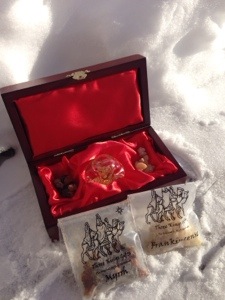
He chastised the Wise Men for their pricey and pretty yet wholly impractical and useless gifts. “If you were truly wise,” griped the angel, “you would have known that what we need is hot water and towels; goat’s milk and bread; twenty diapers and some soap to wash them with.” Not gold, frankincense and myrrh! (p.15-16, Mary Arnold, “The Fussy Angel”, Ignatius Press, 1995). Yet, the Christ child accepts these gifts, however impractical.

The gifts, of course, hold symbolic meaning: the gold – for a king; the spices – used in burial practices of the time.These gifts point to the identity and purpose of God made human in Jesus Christ, whose destination was the Cross and the empty tomb of Easter.

Admittedly, the whole story about astrologers bringing strange gifts to a child in a strange land sounds somewhat exotic, not real.  It is filled with strange incidents, strange gifts, and strangers encountering one another.

At the same time, there is meaning here. Should we but pause to consider the deeper, sometimes hidden, levels of our experience we may appreciate the gift anew, however strange.

The movie “The Best Exotic Marigold Hotel” (Fox Searchlight, 2012) tells of a group of seniors who head off to an inexpensive retirement home in exotic India. As unfamiliar and sometimes frustrating as the experience is, when one character asks why he likes it so much, he replies: “The lights, the colours, the vibrancy; the way people see life as a privilege, not as a right.”

Perhaps Epiphany can open our eyes as well to the holy revealed in what we may have previously thought of as strange, foreign, outside our experience.

Perhaps you have celebrated Christmas and New Year’s this year differently from ‘the norm’ — in a different setting, with different people, outside your comfort zone. Perhaps this Christmas was the first without a loved one. Or, perhaps your life circumstances are changing due to ill health. Admittedly, these are all situations to which, on the surface, we may react even reject outright if we had a choice.

But the Christ child teaches us something important: He didn’t reject those outlandish, impractical and useless gifts brought to him by, of all people, foreigners from the East. Instead, he welcomed them into their home with giggles, gurgles, and laughter.

And this grace, this gift of freedom, is infectious. It liberates us to receive and rejoice in the gifts of life, however small and strange they may at first appear.

20140103-110930.jpg

Spelling the Word

We are in the season of gift-giving. But during Christmas we must also be able to receive those gifts given to us. And receiving that gift, celebrating it, using it – can be just as challenging if not more so than giving.

The question throughout Advent – the four weeks of preparation before Christmas – challenged us to watch and wait, to let go and forgive, to shed those distractions of our lives, to give of ourselves for the sake of others. These were the disciplines of Advent.

But now the gift of Christ is given to us. The Gospel states that the light of the world has come; the light has shone in the darkness, a light no darkness can overcome. This is the gift of God, the life of Jesus, to the world (John 1:3-5)

How shall we receive this most precious gift? And how does this gift make a positive difference in our lives shrouded in darkness?

The answer may lie in how well you can spell. How’s your spelling? I learned how to spell by doing reps; I had to practice spelling a word. I also learned how to spell by getting beyond the disappointment of the mistakes, mistakes which were bound to happen no matter how good I was at spelling.

The famous artist, Rembrandt (1606-1669), painted the “Holy Family” in the 17th century. In the painting, he portrays the nativity as if it were an event taking place in 17th century Holland. The attire and furnishings are what one would find in a typical Dutch home from Rembrandt’s own day.

In addition to Joseph standing and an angel hovering in the background, Mary is seated at the centre of the painting with an opened, well-thumbed book, presumably the Bible, held open by her left hand. Her right hand, on the top of a rocking cradle, has pulled aside a covering to reveal a soundly sleeping Jesus. Mary’s head is turned from the book to gaze upon the infant.

Whether or not Rembrandt intended it, the painting represents different ways to encounter and understand the ‘word of God’:

On the one hand, there are the Scriptures, the book that Mary has been reading as Jesus sleeps and Joseph works in the background. The Word of God is to be found in the Bible. We read the words and find we are addressed by the Word of God. We read them again and again – like learning how to spell. That is why the book is well-thumbed. Rembrandt pictures Mary as one who knows well the word of God and who ponders it in her heart.

But she does not ponder the page alone. She also ponders the infant beside her, “the Word made flesh”, rather than the Word made paper and ink. The Word is a blood-warmed, breath-enlivened human sleeping beside his mother.

I have the impression looking at this painting that when Mary returns to her reading, she will understand what she reads at a greater depth because she has encountered the Word through the Word made flesh. At the same time, when she tends to the child, she will understand the child at a greater depth because she has encountered the Word through the words in the book. Back and forth between Word made flesh and Word through words is the pattern suggested by Rembrandt’s painting.

This is how we learn to ‘spell’ our baptism in Christ — learning not only the words in the Bible, but more importantly for us Christians living in the 21st century, learning to know the living Christ in our hearts and in others and in the world today. “The Word became flesh and lived among us” (John 1:14).

How do we live Christ in the world today? How do we tend to the Christ child in our midst?

Let the light be seen! Let the good gift of Christ within us shine forth anew, for the world to see! Those words are spoken at every baptism to the baptized: “Let your light so shine before others that they may see your good works and glorify your Father in heaven!” (Matthew 5:16). The light wasn’t meant to be hidden under a bushel, but put on a lampstand (Matthew 5:15)!

You hold the light of Christ in your heart. There is no justification to hide it. There is some good there that the world so desperately needs. And you have it!

A royal priesthood we are! A holy nation! God’s own people! In order that we might proclaim Christ (1Peter 2:9). Martin Luther argued for the ‘priesthood of believers’. In other words, we all receive the grace of God for ministry, not just the religious professionals. That is why the baptized receives a crown – we are all now princes and princesses in the kingdom of God.

How do we live out our priesthood?

Another artist, perhaps not as well known, lived during the same time as Rembrandt. George Herbert’s life (1593-1633) overlapped with Rembrandt’s. Although the poet and painter may never have met or even known of each other’s work, I find it interesting to consider Rembrandt’s “Holy Family” in light of some lines from Herbert’s poem that resonate with the first chapter of John’s Gospel: “We say amiss, this or that is; Thy word is all, if we could spell.”

How do we ‘spell’ the Word of God? Listen to a portion of a poem written by Thomas Troeger (in Feasting on the Word Year A Volume 1, WJK Press, Louisville, 2010, p.189-193):

“How do you spell the word? /Where do you search and look – /Amidst the chaos and cries you’ve heard /Or in a well-thumbed book? /Hold back the swift reply, /The pious, worn cliché … /Instead, let all you do /Embody truth and grace, /And you will spell the word anew /In every time and every place.”

I must admit I had to practice a few times spelling ‘Kirubakaran’ before getting it right. Every name has meaning – this is also something we learn from the Christmas story: starting with the name of the newborn Messiah, Jesus – Immanuel, God is with us – the salvation of the world (Matthew 1:18/Isaiah 7:14). I was pleased when you told me that the name Roselyn takes, in your native language, means literally – “Christ who gives mercy.”

Today, as Rose is baptized, she receives the great gift of Christ in her life. May she grow to know, and live out, this mercy, forgiveness and grace.

May we all spell the word anew in every time and every place.