The raising of Love

If I told you that during this past week I bumped into a bunch of little, green aliens that landed in my backyard in their saucer-shaped UFO, I doubt you would believe me.[1]  I also doubt anyone would believe it if you or I brought someone back from death to life.

Yet, that is what the story from Acts implies. Following the resurrection of Jesus, Peter raises from actual death the woman named Tabitha. It isn’t Jesus that is now raising dead people. It isn’t Jesus alone performing such miracles. These are common men and women, like you and me.

How can we accept the miracle of resurrection? How can we believe that ordinary human beings can experience such an incredible degree of change within themselves and others? Death to life is probably the most radical change we can imagine. And yet, this is the very proposition of the resurrection.

On the one hand, we know that nothing is the same forever. So says modern science: ninety-eight percent of our bodies’ atoms are replaced every year; Geologists can prove with good evidence that no landscape is permanent. And, apparently so do people of faith: In the introduction to a mainline liturgy for a funeral service it says: “Life is not ended but merely changed.”[2]

In the short term any change can look and feel like a death. Perhaps that is why we tend to be change-averse. What we really are is death-averse, even though dying must precede any kind of resurrection and new life. The challenge of the Easter message for us is to accept our part in the very natural yet incredible change that is happening in our lives.

Perhaps that is the miracle: to believe change to this degree is possible. And happening, already. So, we affirm the Easter proclamation: Christ is risen! Christ is risen indeed!

How do we live Christ’s resurrection in our lives?

First of all, I believe we must confess the limits of words alone to describe the meaning of resurrection. We need to go beyond words to describe the truth surrounding the mystery of Christ’s resurrection. Apparently, it was too great a mystery for artists in the first centuries as well.

Until the 6thcentury, the moment of Jesus’ resurrection was deemed unpaintable or uncarvable.[3] Trying to capture, as we would today with a camera, how Jesus appeared and what resurrection looked like is a task too difficult to pin down in a one-time, concrete way. Understanding ‘resurrection’ is not easy but easily can bewilder us as it did those early Christians.

Eventually, certain symbols emerged as telltale signs identifying the Christ-like way and understanding. We know, for example, that before the cross became the central symbol for empire Christians, the fish identified followers of the Way[4] especially during times of persecution. These symbols helped non-literate early century people identify with the profound and ineffable meaning of Christ’s resurrection.

Another symbol that circulated among early Christians was the gazelle. Yes, the gazelle. The symbol of the gazelle became the all-inclusive mark of Christ-like love.

Where the early Christians struggled, for example, with how, or whether, to welcome Jewish people into the Way, the gazelle incorporated and communicated the love of God to do so. Should they include the circumcised? Or not? Could you be ritually impure, and still belong? The image of the gazelle communicated the emphatic ‘yes’ to the questions that Paul would later put in words.

The image of the gazelle pre-dates Christianity. In Jewish art the gazelle was used as a symbol for YAHWEH/God. Even more specifically, the gazelle was used to illustrate the life-giving character of YAHWEH. Why is this important for our discussion of the text from Acts?

Well, the author of this raising-to-life scripture story from Acts introduces the woman named Tabitha in both the Aramaic and Greek languages. That, in and of itself, is significant, in casting the message of the life-giving God to include more than just one group in early-century Palestine. At the same time, the bilingual reference may very well be a writing technique to draw our attention into the meaning of this woman’s name.

In Greek and Jewish culture, everything is in the name. So, let’s go with it. Back to Tabitha. Dorcas, in Greek, literally means ‘gazelle’. Now, bear with me, ‘gazelle’ is a word that literally comes from an older Arabic word for LOVE. We sometimes call this splendid creature an antelope.

I know that we don’t often encounter gazelles in Canada. But they are very common in the Middle East especially the variety that has become known as the Dorcas antelope, which literally means the “love love”. This is why in a culture where the majority could not read, images of the gazelle were used to represent the details of the faith and life-giving character of YAHWEH who is LOVE.

The woman—Tabitha/Dorcas—symbolizes something far greater than we can even begin to imagine at first. For she bears the name of YAHWEH who is LOVE. This story carries us beyond the physical resuscitation of the body of a first century woman. This story carries us beyond the mechanics of a resurrection ‘miracle.’

Clearly, the author here has set his listeners up for a story that expresses more than words can tell. Should we pay attention to it. And go there.

This is the story of the raising of love in the lives of those who follow Christ. This, alone, is a miracle when it happens. The life and love of Christ being raised in us and in the world around us! Can we see it? Can we perceive it? Can we hear the voice of Christ whispering in our hearts to ‘love love’?

Last year at this time when I spent a week in Algonquin Park, I didn’t meet any aliens. But I do recall talking to you about the ice on the lake. In the span of the few days I was there, the lake went from being ice-covered, to completely ice-free. It was incredible to witness such a significant change in the life of the lake, in such a short time frame. In fact, it came as a surprise.

You might call it, the resurrection of the lake. A couple warmer days strung together and a day of rain and wind, and … voilà! When I hiked out of the bush on the last day I could not detect one chunk of ice. If it weren’t for the budding leaves on trees around the lake and the still-cool temperatures you would think we were in the middle of summer the way the lake looked.

How different it was on the first day of that week! A sheet of white ice had locked the waters in its icy grip. It looked like that that ice wasn’t going anywhere for a long time! To suggest the ice would be completely gone in a few days — I wouldn’t believe it. The radical change was imperceptible. Or, was it?

I sat on the banks of the lake shore on the second day, surveying the field of drifting snow and glimmering ice stretching across the entire surface of the lake. It was quiet, except for the occasional chirping of a bird and the sound of the wind through the pines above. But when everything was still, I heard it.

First, it was subtle, barely detectible. A cracking, a knocking, a whining and groaning. Things were shifting below the surface. The ice was beginning to break up!

Although I couldn’t notice it with my eyes, I could hear it. Just. The change was happening. But only by hearing it, being open to it, paying attention to it. And giving myself a chance, in the first place, to be present to it.

Jesus said, “My sheep hear my voice … and they follow me.”[5] It’s not easy nor always quick to recognize God’s call amid the cacophony of sounds and distractions in our world. It’s not easy to discern the will of God in a complex society with moral questions and conundrums that can leave us spinning with confusion and mental paralysis . The noise can be enough to burn us out and leave us despairing.

The noise of delusion, false aspiration, needless worry; the allure of addiction, distraction and material comfort. It’s hard to hear that “still, small voice” of God’s resurrection change in the world and in our life. To recognize it, we must practice and learn how to pay attention, again, to the melting of the ice in God’s love.

Maybe, now that Christ is alive, it’s about a power that permeates all things. Maybe that power is a love that includes Jesus as much as it includes Peter, Tabitha, you and me. Maybe resurrection is about experiencing God’s love in all my relationships.

What a wonder to behold! What a love to live into!

No wonder so many are seeking solace in the practice of meditation—a safe place being in silence and stillness to practice paying attention, and listening to the voice of Jesus. Christians have meditated together since the early church in the form of the “Jesus Prayer”, for example. I encourage you to try it if you haven’t already.[6]

We all need starting points. The melting ice on the lake needed to start melting and breaking apart. Prayer in this way is a good starting point from which to live into the resurrection we share with all people and all of creation in the risen Christ Jesus. This prayer involves me in the life of Christ in the world that God so loved. I don’t have to worry whether or not I have the power to do these things—it is the life of Christ who works these miracles in me and in the world!

Christ is risen! Christ is risen indeed! Alleluia! Thanks be to God!


[1]Please read the comprehensive and insightful sermon by the Rev. Dawn Hutchings, The Raising of LOVE: the ‘more-than-literal’ meaning of the Raising of Tabitha – a sermon on Acts 9:36-41 (www.pastordawn.wordpress.com). I gratefully draw on her alien illustration, her research on the meaning of Tabitha’s name, and the reference to the dorcas antelope/gazelle. Thank you, Dawn, for your words.

[2]Richard Rohr, Raised from the Dead; Jesus’ Resurrection(Daily Meditation, www.cac.org), April 24, 2019

[3]Richard Rohr, From Darkness to Light; Jesus’ Resurrection(Daily Meditation, www.cac.org), April 25, 2019

[4]Acts 18:26; 19:9; 24:14

[5]John 10:27

[6]Faith has a weekly Christian Meditation group, which meets at 5pm on Wednesdays. See www.faithottawa.ca/calendarfor details.

To see that we are seen

Because of the devastating flooding in the Ottawa region since Easter weekend, many conversations have turned toward the unprecedented levels of water in the Spring run-off. In 2017, we surpassed the 100-year levels. And just two short years later in 2019 we surpassed even 2017 levels. What’s going on?

When 16-year-old Greta Thunberg began demonstrating last year at the Swedish Parliament about climate change she rapidly gained worldwide attention. Among others, she inspired a whole generation of girls to be politically active.[1]

In Ottawa, the seat of the Canadian federal government, we are never short of political talk. We engage in daily debates over backyard fences, at the hockey rink and in coffee shops about the goings on in and around Parliament Hill.

We’ve heard the story before. This is not new, we say — the issues, the players, the opinions, the debates, the conflict. It’s par for the course.

Even as politics has taken a nasty turn in recent decades. It has become intensely personal. Conversations about politics now start with degrading remarks about the person and their character. Election campaigns have become platforms for disputing a candidate’s moral character. Scandals thrive on mudslinging and disparaging the ‘likeability’ factor of the major players. Never mind the views represented by these political players.

And you know we are sinking into a deeper moral hole when teenagers like Greta Thunberg are bullied by those who don’t share her political views—not with arguments about climate change but because she has autism. Neuro-typical people opposed to her politics have seized upon autistic traits Thunberg exhibits, “such as her ‘monotone voice’ and forthright manner, to liken her to a ‘cult member’ in an attempt to delegitimise her message.”[2]

Yet, we’ve heard the story before, we say. It gets replayed in different times and places by different characters and situations in history, no? Human beings will behave this way. In this day and age especially when information is shared immediately and globally.

It’s not a new story to us. We experience it on a daily basis. We can’t help ourselves. It’s either a joke. Or, we despair. And then we turn away.

For one thing, why can’t we distinguish the person from the issue? Maybe we don’t want to. Why do we so easily walk into the minefield of legitimizing the truth of something based on whether or not we like whomever represents the vision, the values, the policy, the idea? When the medium is the message?

We’ve heard this story before. It’s not new. People haven’t changed. We haven’t changed, we say.

When Jesus appears to his disciples after his resurrection, they don’t recognize him. Mary thinks she sees a gardener at the empty tomb.[3]The disciples at first don’t know it’s Jesus standing on the shoreline calling out to them.[4]Their vision is clouded, myopic.

We’ve heard this story before. I’m not the only one, I am sure, who has experienced not seeing someone while walking in a crowd. You know, you are in the mall going past so many people. Then I happen to be ‘looking’ at someone I know, but I don’t really see them. The only way I do is when they see me and call my name. And then I become aware that I am seen by them. That’s when it changes.

So, if that ever happens between you and me, you could always just say you thought I was my identical twin brother whom you don’t know!

The recognition happens when I see that I have been seen.[5]That’s when relationship starts. When you know you are seen by the other. When Mary, Peter, Thomas, John and all the other witnesses of the resurrection know that they are seen by the resurrected Jesus and recognized for who they are. Then they know and appreciate that they are part of the resurrection story, not distant from it but very much involved in the story we know.

The resurrection of Jesus means that not only have we heard this story before, not only armchair, arm-length critics of the story. But we are participants of it. Ourselves. We see that we have been seen.

We are Greta Thunberg. We are Doug Ford. We are Justin Trudeau. We are Jody Wilson-Raybould. We are Jane Philpott. We are all those people –whomever you first like to scrutinize, criticize, even demean and disparage. Because the person you first point a finger at is really about you, about your woundedness. When we judge another, we need to be aware that this judgement only exposes our own moral disparity. What we judge in the other reveals something in our shadow side, our weakness that we want to hide, suppress and deny for some reason. A part of ourselves that we have not been able to come to terms with and accept.

And yet, despite that dis-arming truth, the resurrected Jesus does not ignore us and walk by us in the crowd. Just as Jesus called out to Mary at the tomb and said her name, “Mary.” Just as Jesus called out to the disciples to let them know that they are seen and recognized by the loving, penetrating, all-knowing gaze of a gracious God – Jesus calls out to you and to me.

The resurrection story from the bible is not just a story we know, or think we know. The resurrection story is not really just a story about believing in the fact of the resurrection. It is believing that someone, starting with Jesus but not ending with Jesus, could be wounded and also resurrected at the same time.[6]

Resurrection is not merely about some perfected, other-worldly state that only few people achieve by their own strength or moral righteousness. That is the story the world believes. Resurrection is not some fanciful state of being, occupied only by Jesus, the Son of God. But because of Jesus’ resurrection, we all now can be seen for who we are. Like Christ we are all ‘little Christs’ (Martin Luther’s term) – wounded and resurrected at the same time. When we see that we are seen by loving eyes looking on us despite the woundedness therein. Despite the scars, the hurts, the ongoing struggles.

There is the hope.

“Put your finger here,” Jesus invites Thomas to touch the wound in his side on his resurrected body.[7]“Come and see,” Jesus invites the first disciples.[8]  “Come, and have breakfast,” Jesus invites his post-resurrected disciples for a meal he offers to them on the lakeshore. Jesus turns to us, in our ordinary, broken, common lives, and sees us. Whether or not we at first see him.

That’s the miracle of Easter — not just a resuscitated body, but that this resurrection body still bears the marks of woundedness at the same time and in the same place!

We are seen, and are invited to follow Jesus. As we are. We need not be intimidated nor held back by our imperfections. Those first disciples bore the woundedness of their own lives: tax collectors (not a good job), fishers (lowest class), even political agitators like Simon the Zealot.[9]These were people on the fringes of mainstream, privileged society. Not perfect by any stretch.

The miracle of the resurrection is not saying that life in Christ is perfect, or should be, or should be for some others. The miracle of the resurrection is saying that new life can be experienced right in the middle of all the dying, suffering, and pain of our own lives. Now, because of the resurrection, we don’t have to wait for ideal circumstances before we can really live. We, too, can discover the grace, the joy and the life of God in us, and in the world around us. Now. And no matter what.

In the coming week, try turning off your cell phone for an hour each day—you determine the time. If you don’t have a cell phone, unplug your landline or turn the ringer off each day for a certain amount of time. Practice not being available to the distractions and expectations of others. Practice this uncomfortable state of not being attached to the latest gossip, the latest market fluctuation, breaking news or a friend’s reaction. Practice not responding right away to a message or text or call.

And, in that discomfort, close your eyes and breath. And remember that God sees you. And that, in the silence and uncomfortable disconnection you are fundamentally and eternally connected.

Perhaps, in that moment, you can see that you are seen by the living Lord.


[1]‘The Greta effect? Meet the schoolgirl climate warriors’,  https://www.bbc.com/news/world-48114220

[2]https://www.theguardian.com/commentisfree/2019/apr/25/greta-thunberg-autism-spectrum-critics

[3]John 20:14-15

[4]John 21:4; forming part of the assigned Gospel text for the 3rdSunday of Easter, Year C, Revised Common Lectionary

[5]Laurence Freeman, “Discipleship” (Meditatio Talk Series 2019A, Jan-Mar), Track 1

[6]Richard Rohr, “Jesus’ Resurrection”, Daily Meditation 23 April 2019, http://www.cac.org

[7]John 20:27

[8]John 1:39

[9]Acts 1:13, Luke 6:15

Life and love? Not just here

Why do you look for the living among the dead?

He is not here, but has arisen!

Where is Jesus now?

Around 13 million visitors a year flock to Notre Dame Cathedral in Paris. And that number has been growing in recent years, and will likely continue to grow now. After the fire there this past week, so many worldwide grieved at the seeming passing of this iconic and historical site.

Over a billion people in the last century alone have made a physical contact with that one particular site on the banks of the Seine River in France. Think of it. A significant portion of the world’s human population in modern history.

We are a people attached to certain places. And, then, we associate our identity, our families, our faith, our memories with those places—becoming attached to them. Losing them is akin to losing the meaning associated with that place. Losing them is losing ourselves.

Where is Jesus now? Where do we look for Christ today? In one place, only?

In the ashes of a burned-out sanctuary? At the homestead farm long ago abandoned? At the graveside tomb of a loved one? Only at the seaside, or only in gardens of splendour and glory? In the pages of the bible alone?

Can we even pin it down to one place, now? Can we experience Jesus only under certain conditions, when and where the stars are aligned in perfect order, where we feel God? And only there and then?

It was hard to believe that I would ever get the manger scene—our front-yard Christmas tableau—freed from the frozen ice last January. I joked that Jesus was snowed in with us. It felt like forever. And that it would probably be Easter by the time I would be able to free baby Jesus from the bonds of his snowy tomb.

Well, finally this past week, it was done! Baby Jesus’ resting place for the past half year now shows signs of new life in the ground even as the snow recedes.

IMG_8094

Jesus is no longer bound to a certain place and time in history. Easter has unfurled Christ to the whole world. The power of God’s love has unbound Jesus from a particular point in history and place; and, released the power of that love for all people, in every time and every place.

And, for all of creation.

Christmas and Easter are thus connected through the incarnation, the indwelling, the integration of the divine and material. While Christmas injected the divine into the DNA of humanity, announcing: “God is with us!”; Easter proclaims the universal imprint of God’s purpose through the Spirit of the living Jesus everywhere and in all things! Now, “God is for us!” Easter drives home and expands Christmas’ initial point.

Jesus isn’t in one place: 1stcentury Bethlehem, Nazareth, Galilee, Jerusalem, Golgotha.  Jesus is in every place, in all times:  2019 Canada. 1789 France. 1519 Wittenberg. 1348 Spain. 1215 England. 476 Rome. And that’s just looking backward … The future, too!

When French president Macron addressed the nation following the burning of Notre Dame, he talked about how the cathedral survived two world wars, about how the cathedral was looted and badly damaged in the French Revolution. And how it always survives. And how it will survive again, and be reconstructed.

Even through suffering, loss and death, the Spirit of hope, love and generosity prevails—throughout history! And sometimes unexpectedly. The love and life will come as a surprise. That is the nature of life.

In the winters of our lives, life will lie hidden and buried under banks of snow and ice. But under and in and within, life is literally waiting to erupt at just the right time, at just the right moment. Now it does. Because that is God’s desire for creation. Life and love.

That is God’s desire for Jacqueline who is this day baptized. That is God’s desire for each one of us. That is God’s desire, now, for everyone. The Easter message encourages each of us to release the loving Christ living in our hearts. The Easter message challenges us to act in ways that show that we aren’t saved until the whole world is saved. Because the wind of Christ’s presence now blows across the whole earth and over every creature, rock, tree and wave without inhibition, without boundary, without limitation. For all.

Today, Jesus is freed from the chains of death. Jesus is alive! Alleluia!

Amen!

Invasion of abundant grace

The Toronto Maple Leafs are a playoff team. They have been for a while now. In fact, they’ve occupied the third seed in the Atlantic Division for months. And, lately, regardless of how many games they’d lose or win, it wouldn’t change their place in the standings for the playoffs, which begin this coming week.

The Leafs’ success has a lot to do with the stellar play of their number one goaltender, Frederik Andersen. At least how he played early in the season when he was sporting an impressive .923 goals against average (that’s very good). He was, some argue, the main reason the Leafs were able to climb in the standings and secure their playoff destiny. That is, until recently.

As some of you may know, he’s been kind of faltering a bit in the last month — letting in just a little too many goals, and losing just a bit too many games. As of last week, the Leafs had lost five of their last seven games—two of them here in Ottawa against the Sens. His lackluster performance has been enough to cause some to wonder whether Freddy will be able to hold up during the playoffs, especially against their arch rivals in the first round: the Boston Bruins.

An article in the Toronto Star recently caught my eye about this funk Andersen is in, and what he’s doing about it.[1]

Anderson speaks of dealing with all the downward-spiraling statistics — an embarrasing .890 goals against average (that’s bad) — all the anxiety-producing pressures to perform and succeed and chalk up more wins than losses — all the negative, worrisome scenarios that might play out for his whole team if he doesn’t stop more shots on net. Dashed playoff hopes. Disappointed fans. Negative publicity in the media. Downward career trajectories. Worry. Worry. Worry.

Indeed having success doesn’t mean being in a good head space. True, when the stakes are high, when it’s all on the line, when the vice grips of life’s important events tighten—it’s very difficult, maybe feels like it’s impossible, to keep calm, walk lightly, and breathe deeply through it all.

That’s the measure, that’s the key. Not when there’s nothing on the line. When you have little or no investment in the outcome. When it doesn’t matter and you don’t really care.

Rather, when what you are passionate about, what you care about, what you believe in, your most sacred values—when those things are on the line, when the stakes are high, how do you respond?

In the Lent book study, “Being Mortal” by Atul Gawande[2], we have been exploring many questions about the last chapter of one’s life. We’ve been talking about how to navigate the medical culture and what we want when time is short. You could say, the end of life conversations and thoughts are the ultimate ‘high stakes’ decisions:

How do you want the last ten years of your life to look like? What do you want for yourself? What trade-offs are you willing to make in order to achieve your final wishes? Whom do you need to include in conveying those decisions? Are those closest to you aware of your thoughts? Why or why not?

Most of us avoid having these conversations. We dread not only those situations but those conversations. We don’t want to think too far ahead. We don’t want to think about next year. ‘It’s too depressing’ we say. ‘I just want to think about next week, or just tomorrow, or just today.’

As Atul Gawande writes in his book, “It’s the route people the world over take, and that is understandable. But,” he continues, “it tends to backfire. Eventually, the crisis [you] dreaded arrives.”[3]And then what?

When the stakes are high, what does Mary do? Oh, and if you think the stakes aren’t high, let’s take another look: Why does Mary spill on Jesus’ feet a year’s worth of wages in perfume made from pure nard?[4]There are two uses in ancient Israel for pouring expensive oil on someone: First, in a coronation of a king; and, second, for the burial of that person.[5]

This was a costly oil with a sweet smell, imported from northern India. Scholars estimate that the “pound” referred to was nearly 12 ounces, or 324 grams. Many typical flasks of anointing oil would contain only a single ounce. So, Mary has a lot of this stuff, and pours it all out on Jesus’ feet!

“Money going down the drain!” eh?

Yet, Mary was anoints Jesus, the true King, and Jesus who will soon die. This extravagant act of love and adoration conveys Jesus’ purpose, publicly for all to see and read for all time to come. While everyone else around Jesus does not want to talk about it even though they might feel it, Mary does everything but avoid, deny and shove under the carpet what is obvious. What needed to be done.

It’s not a measly drop, offered in secret. It’s a whole flask, and the aroma fills the entire house!

Jesus and to an extent Mary know what is going to soon happen. The writing is on the wall, certainly since Jesus recently raised Mary’s brother Lazarus from the dead. From that point on, the religious leaders began plotting Jesus’ death.[6]The way to the cross is becoming clearer and clearer. There is no turning back. There is no avoiding this outcome if Jesus chooses to continue in his mission and divine purpose.

It is worth it, even though the stakes are high.

How do we find the courage to rise above our tendency to avoid and deny reality when the stakes are high? Can it have something to do with our purpose and mission? When you know what it is you are all about in life? Maybe, then, good things can happen.

In his book, Gawande mentions an experiment which compared two nursing homes. After the study, in one the number of prescriptions required per resident fell to half, psychotropic drugs for agitation decreased, total drug costs fells to just 38% of the comparison facility; and deaths fell by 15 %.[7]

What made the difference? In the test facility, residents began to “wake up and come to life” when animals and birds were brought into their environment. Not just one or two creatures. But a whole bunch of them. They experienced a “glorious chaos” at the beginning of the experiment.

Because no one knew what they were doing, everyone—staff and residents included—had to drop their guard and pitch in, to help. Residents forgot themselves and were immersed in an environment that gave them purpose and meaning. In the process they started having a little bit of fun. There was lots of laughter and frivolity reported in response to the invasion of all the animals and birds.[8]

This is just one small example of how connecting to a meaning and purpose in life, however trivial, and at whatever stage of life—can do miracles.

For goalie Frederik Andersen, it means no longer obsessing about the data and numbers, good and bad. He has to trust his teammates and play as part of a team rather than an individual obsessed with personal stats. He has to free himself from micro-managing his technique because he realizes his primary challenge is not his ability or capacity to do great things in the net, but the mental, emotional and yes, spiritual, part of his game.

In short, he simply needs to find joy in playing again. That’s spiritual!

As the playoffs begin, Fredrik Andersen is on a journey to reconnect with the purpose of what he was about on the ice. He is looking to discover ‘fun’ in his game, and enjoy every minute he has the privilege of playing it at that level.

We, too, are on a journey in Lent. Mary’s action in the Gospel reminds us that on this journey, there are times God calls us simply to be extravagant in our giving born of devotion and thanksgiving to God. Mary’s action reminds us that sometimes God calls us to breathe deeply and savor life’s good things.

As we ourselves work on the important question of the church’s mission and ministry, and how that again can take expression in the here and now, let’s remember in the midst of all that, to take the time, to give ourselves the permission, to lavish upon God our love, our attention, to rest in God’s presence.

And, in that holy act of devotion and love, be renewed for life and joy.


[1]
https://www.thestar.com/sports/leafs/opinion/2019/03/28/the-joy-of-hockey-could-save-andersen-and-the-leafs-season.html

[2]Atul Gawande, Being Mortal: Medicine and what matters in the End (Anchor Canada: Penguin Books, 2014/2017).

[3]Ibid., p.57

[4]John 12:1-8, Gospel text for the Fifth Sunday in Lent according to the Revised Common Lectionary, RCL, Year C

[5]Lindsey Trozzo comments on the Gospel reading (John 12:1-8) at http://www.workingpreacher.org

[6]John 11:45-53

[7]Gawande, ibid., p.123.

[8]Ibid., p.120-121.

With us, snowed-in

I wasn’t able to remove the Christmas manger scene from our front yard in time, before the snowstorms left everything buried. As we’ve approached Lent, the joke in our household is that Jesus, like us, is snowed-in.

IMG_8042

It likely won’t be until late April now when I will be able to remove the tableau from the frozen earth and its snowy cover. When will Jesus be set free from the tomblike confines of winter’s grip?

When exactly, no one knows. Meteorologists are calling for a cooler-than-normal late April /early May. It might be a while.

The Jesus story, for us, begins in winter around the winter solstice on Christmas Day. We begin again our Lenten pilgrimage in the throes of winter, when snow and ice cover everything. When will the sky brighten and warmer temperatures heat the ground again? When does the journey end?

The poet, Mary Oliver, who died in January of this year, wrote primarily about winter. In several pieces she twins snow with wisdom, the capacity to live with questions in silence, surrendering to its beauty. “I love this world,” she wrote, “but not for its answers.”[1]

I’ve considered Christianity to be a winter faith. We, as people of faith, live with many questions that are largely unanswerable. Why do we still live in a world beset by injustice, intolerance, hatred—despite all good effort in the name of Jesus to the contrary? Why death and disease? When will we find the answers to our deepest questions? Why? Why? Why? Winter is a time for questions.

And so, we continue to search, wander, and wonder with Jesus snowed-in, by our side.

But, is Jesus in over his head?

The temptation of Jesus—as this story is famously called—happens near the beginning of his divine calling and ministry.[2]He goes into the wilderness, the desert, for forty days. He goes into a place of harsh simplicity, stripped of all creaturely comforts, to serve a holy purpose.

We wonder, will he survive the challenge?

Given his life purpose on earth, he meets with what could be his greatest vulnerability—the seduction of power and its forceful implications. The man who is the Son of God, King of Kings, Lord of Lords, Almighty and Everlasting, the man whom people would look to for guidance and leadership, the man who many would lift onto a pedestal—would Jesus succumb to everyone’s expectation?

Would Jesus yield to the temptation that he, the Messiah, will now lead the revolt to free the suppressed and oppressed Judeans out from Roman occupation? Would he be the political rallying point around which the crowds would mobilize and generate an effective, political movement?

And, in fact, the evil one touches on this potential weakness. Notice in different ways each of the three temptations seduce Jesus to grab hold of power that would make him this kind of King: One who satisfies his every appetite and hunger using whatever means at his disposal; one who creates God in one’s own image by forcing God’s hands, one who offers blind obedience to those still ‘above’ them while climbing the ladder of ‘success’.

But that’s not what Jesus was going to be about. We know that. In order to embrace his true identity, what happens?

Jesus is first led by the Spirit into this vulnerable place, not away from it. He was to first meet this human, shadow side.

The point of Lenten discipline, whatever it may be for you, is to be led into that shadow place in our own lives that we, on our own, don’t want and even can’t go. The Spirit leads us to face that which we normally distract ourselves from, where we normally deny, avoid. What is that vulnerability for you?

What does the light and Spirit reveal in the dark corners of your life? Is it a fear? Is it a conversation you know needs to happen? Is it confronting a situation you have been trying to avoid? Is it coming to terms with what is really going on deep down in your heart?

How does Jesus respond to his temptation? How does he return to his identity in God?

The scriptural quotations he cites are signs of his true identity—his ‘touchstone’, if you will. The scriptures point to his true self. By citing the scripture, he reminds himself, he aligns himself, he allies himself, with what grounds him in who he is. By citing scripture he relies not on his own humanity and resources of his own making, but rather on God.

This text provides rich support for our own journeys of Lent. As we wander into the wilderness of our lives and continue to trudge through the snow wary of still slipping on the ice, as we wonder with our questions, we meet our own shadow sides. And are called to stay rooted in who and whose we are.

And what is your touchstone for remembering your identity in Christ? Is it scripture? Is it the bread and cup of the sacrament? Is it a song? Is it an act of repeated service for another? Is it a prayer?

In her poems about winter Madeleine L’Engle writes a word of hope for the journey:

“Snow does not obscure the shape of things. It outlines them, like an icy highlighter, revealing the deep structure of the world. We walk through the woods, seeing differently, and, when we glimpse the hidden structure, we ask questions even as we experience its stark beauty.”[3]

Writer-theologian, Diana Butler Bass takes it further: “Strangely I have found in my own life that it is only through a wintery spirituality that I am able to affirm summer and sunshine. A friend wrote me recently, ‘Winter reveals structure’. Only as the structure is firmly there are we able to dress it with the lovely trappings of spring, budding leaves, rosy blossoms. Winter is the quiet, fallow time when earth prepares for the rebirth of spring.”

The word, Lent, means ‘springtime’. While the Lenten journey begins in the frozen winter, we can say in faith that the purpose of the journey is to bring us to Spring. Because by the end of the Lenten season, the snow will be gone revealing the soft, verdant earth underneath where new life is just budding to sprout.

In the end, the disciplines of Lent, the questions we now pose and with which we struggle on the journey, these are gifts from God. They point us to God’s presence in our lives and in our world. In the end, that is what faithful observance of Lent is—“a grace-filled return to the Lord our God.”[4]

Who begins with us, snowed-in and under.


[1]Cited in Diana Butler Bass, The Cottage: A Winter Faith (January 18, 2019)

[2]Luke 4:1-13

[3]Madeleine L’Engle cited in Diana Butler Bass, ibid.

[4]Kimberly M. Van Driel, in David L. Bartlett & Barbara Brown Taylor, eds. Feasting on the Word: Preaching the Revised Common Lectionary Year C, Vol 2 (Kentucky: WJK Press, 2009), p.25.

Pluck up!

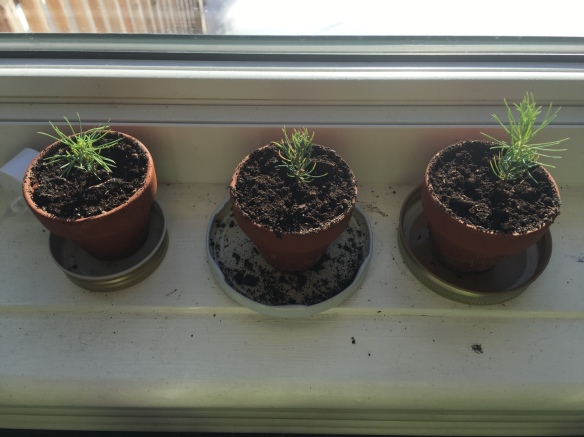
When our daughter received a pouch of seeds last Spring, we didn’t know initially what to do with them. They were Colorado Spruce Tree seeds. And we weren’t exactly planning on seeding a forest.

So we took a medium-sized flower pot and sprinkled the dozen-or-so seeds into the soil packed into the container which we left on the back deck outside. Let’s first see if the seeds in fact sprout, we thought. And go from there.

Three little buds popped through the top layer of soil a couple weeks later. One came up near the edge of the pot. But two of them came up in the centre, side-by-side. At first, I thought the two to be part of one sprig. But they weren’t.

At some point I would have to separate the two, distinct saplings. They were too close together. When to pull them up posed a bit of a challenge. If I waited too long, then the root systems would most certainly entwine and grow into one tree making it impossible to separate. If I plucked up the saplings too soon, I ran the risk of damaging the vulnerable shoots.

The task before me reminded me of the call of God to Jeremiah stated poetically: “to pluck up … and to plant.”[1]While Jeremiah’s plucking up and planting had to do with nations, social practice and religious faith, mine was more literal: As the tiny saplings were finding life and vitality to grow, I would first have to pluck them up from the soil before planting them into separate containers for the next stage of their growth.

And that plucking up would not be easy. It would hurt. It would put stress on the individual seedlings. I could very well be killing them in the transfer. Would they survive the ‘plucking up’?

Sometimes we don’t believe we can survive the ‘plucking up’ events of our lives. We don’t believe we have the strength to endure those difficult transitions in life, especially after experiencing loss, or when confronted with change or great disappointment and failure.

We object, like Jeremiah did—and Moses and Isaiah before him, to God’s call, finding all sorts of justifications: Can’t do that; I’m not qualified, I don’t have the skills, I don’t have the strength, I am too young or too old, I don’t have time. They make sense, common sense we might say. We find all sorts of excuses and even create a religion around all of that to keep us feeling good. Or at least not guilty. And stuck in a rut.

What is more, we make our faith into something that ought to make us comfortable. We ‘go to church’ expecting not the challenge to grow and change but instead to find the salve of warm fuzzies and emotional feel-goodies. We even believe Jesus was all about being ‘nice’. And if anyone is not nice, or challenges us, or doesn’t fit our mould—well, that’s not the way it’s supposed to be.

And yet, the biblical witness, if not our authentic lives of faith when we pay honest attention to them, suggest something entirely different:

  1. Jesus’ popularity suffers a severe blow after he says to his people in their synagogue that “today the scripture has been fulfilled in their hearing”.[2]What he means is that they—his people—would not be the vessels for the unfolding of God’s new narrative; outsiders would be. Stew on that. The audacity. They nearly succeed in throwing him off a cliff, they are so enraged.
  2. In the Jeremiah text, we read that God’s hand “touches” Jeremiah’s mouth. “I have put my words in your mouth,” God says.[3]Perhaps, at first, this sounds rather intimate, soft, gentle, nice.

But we need to be careful not to imagine it was a comforting touch. The same verb used here can also mean “strike” or “harm.” The one other biblical verse that uses this same verb to envision God’s hand touching is found in the prologue to the book of Job, where Satan challenges God to test Job’s faithfulness by taking away everything Job has.[4]There is nothing gentle about the wind that then “touches” the house where Job’s children are feasting, leaving every one of them dead beneath its roof.[5]

“When we picture the hand of God ‘touching’ Jeremiah’s mouth, we might do better to imagine a jolt or a shock. We would be justified in asking whether it hurt, whether it left a wound or scar, whether having God’s words in his mouth changed Jeremiah forever.”[6]

The message of Christ is the message of the cross. And then, resurrection. For our growth and life in Christ, we are called into places of disruption of our comfortable lives before anything new and life-giving happens. There’s no way around it, if we want to follow Jesus in this world.

It starts small, though. And that’s the grace and the hope. God does not call the qualified; God qualifies the called. The point of the Jeremiah story is that Jeremiah cannot depend on his own, developed capabilities and skill-set to justify his participation in God’s work. God called and equipped him even before he was born.

Every worldly role has purpose in Christ. No work is meaningless in God’s light. Martin Luther famously said about parenthood, when understood in Christian vocation: even changing dirty diapers is done for the glory of God! It is God’s invitation to us to invest God’s grace into whatever work God opens to us.[7]

All Jeremiah must do is trust God, and not make his decisions—yay or nay—based on fear. The most often repeated command in the bible—do you know it? “Fear not”. This does not mean we will never be afraid when we listen to and follow God. It means we do not lead our lives with fear in the driver’s seat. Instead, we find in the driver’s seat of our lives: Trust God. And hope in God. Fear can take a back seat, now.

I sat on the front porch with three separate, small pots for each of the seedlings. I did this in early November, believing they would do much better inside during their first winter.

My ‘plucking up’ was done swiftly, using the old adage of taking off a band-aid quickly is better than dragging it out. What surprised me the most in the process of ‘plucking up’ and then ‘planting’ again, was to see the roots.

Each of the tiny saplings had astoundingly long tap roots. One even had extended its main root all the way to the bottom of the original pot, and then some. More than tripling the length of the part of the sapling above ground, there was definitely more to the little sprout than what met the eye on the surface.

And so, there is much more to you and to me than what may first meet the eye—the eye of our self-regard. God calls us to break through the crust of the surface of our self-perception and to mine the depths of who we are, created uniquely each of us in God’s image. There’s so much good, there!

God is just waiting for you to uncover those depths, and then to bless and to empower who you are and what you do, into God’s holy purposes.

img_7991

[1]Jeremiah 1:10

[2]Luke 4:21-30

[3]Jeremiah 1:9

[4]Job 1:11, see Anathea Portier-Young in her commentary on Jeremiah 1:4-10 in workingpreacher.org

[5]Job 1:19

[6]Portier-Young, ibid.

[7]James Calvin Davis, in David L. Bartlett & Barbara Brown Taylor, eds., Feasting on the Word: Preaching the Revised Common Lectionary Year C Volume 1 (Kentucky: WJK Press, 2009) p.292

funeral sermon in Advent: Faith in the Night

From the Gospel of John, the first chapter (v.5.9):

“The light shines in the darkness, and the darkness did not overcome it … The true light, which enlightens everyone, is coming into the world.”

These days, we walk in darkness.

December 6thwas the first day the sun set the earliest it will all year long—at 4:19pm. And that will be the case for another week before the days start getting longer again. Your beloved died at, literally, the darkest time of year.

And, so it is with your grief at this sudden loss. It is a dark time, indeed, that you journey these last days of a significant year in the life of your family.

At the end of the year. At the end of a life shared together. It is dark. And it is in the darkness that we must remain, for some time.

We may feel like love is lost at times like this. In the intensity of grief, the finality of death hits like sprinting into a brick wall. The familiar bonds are severed completely. And the prospect of a radically changed life, now, chill the heart with fear and uncertainty.

Where, O Love, is Thy soothing presence? Where, O Love, is Thy warming touch? Where, O Love, is Thy reassuring voice?

For Christians, this loss is symbolized by the cross. And in the cross we see a cruciform shape to reality: Loss precedes renewal; emptiness makes way for every new infilling; every change in the universe requires the surrendering of a previous ‘form’.[1]

At your loved one’s bedside on December 6, you described to me the image of wings of protection and love that your beloved offered in prayer and in spirt for his children and grandchildren. The image of wings of love surrounding his family is a tender one.

In the bible wings describe the loving and protective stance of God towards us. “I gathered you as a hen gathers her chicks under her wings” (2 Esdras 1:30). The Psalmist prays: “How precious is your steadfast love, O God! All people may take refuge in the shadow of your wings” (Psalm 36:7).

May the image of holding a bird demonstrate the kind of love we need now to express in this time of loss. They say that to hold a bird, you can’t hold it too tightly. When the chickadees fly into the palm of my hand when I feed them nuts and sunflower seeds, I cannot, dare not, clasp my hand into a fist.

I must keep my hands open. They say that to show true love you must be willing to let the object of your love go. They say that to love, one must let go. One cannot control true love, hold on to it tightly. To be sure, there are times in life when love calls for a tighter grip, especially when giving direct care to one in need, or guiding and parenting children. In these situations, yes, a firmer hold in love may be necessary.

But at other times, especially when dark times of the year come around which they do for all of us, love demands a different approach. People wonder, understandably so, why if God is Almighty and Benevolent, why God allows those dark times to even happen at all.

If God truly loves us, God will offer love freely and not demand it be returned. If God truly loves us, God will give us freedom. God will let us go. Not abandon us, because God is everywhere. But give us the freedom to love and to let go.

And, you know also the saying: What you let go in love, like giving a tiny bird freedom to fly away from your hand, will return to you in love. Perhaps not in exactly the way you expected. Perhaps not according to your timing. Yet, this is the nature of God’s grace and love: In letting go, we discover and experience the surprise of love’s return in some form, some day.

What else can be said about December 6th, besides the day your beloved died? December 6th, of course, is Saint Nicolas Day. If anything can be said about Saint Nicolas is that he was generous. Generous to the poor, to those in need. Your beloved was generous to you with his love. The gift of generosity is given on the day your beloved died.

How can we continue in the love freely given and freely received in the union of marriage and family that was severely disrupted on the day your loved one died? The symbolism of the day cannot go unnoticed, unrecognized. We can continue in the legacy of your beloved is leaving to us: to pay attention to the needs of the vulnerable, the children. To be generous with the gifts God has given us to share with those in need. This is an honorable expression of our love for your loved one. This is a worthy focus of our energies as we wander in this dark time of loss and grief.

Yes, “grief and anxiety has gripped us, and we are frightened by the future. Yet, even in these times, God is there. The good news is that Jesus always comes again. Every year, despite how hard things have been, Jesus is born into our lives anew. Death is never the final word”[2]– divine love comes and gives us life. Again.

May love be our guide through these dark days, and into the bright hope of a New Year.


[1]Richard Rohr, Daily Meditations (Center for Action and Contemplation,  www.cac.org) 7 December 2018)

[2]Lutherans Connect “Faith in the Night” DAY 7 (Lutheran Campus Ministry Toronto, 8 December 2018), lcfaithinthenight.blogspot.com

A spirituality of fierce landscapes

The Lord is king! Let the earth rejoice; let the many coastlands be glad! Clouds and thick darkness are all around him; righteousness and justice are the foundation of his throne. (Psalm 97:1-2)

Which is mountain? And which is cloud?

Sometimes it’s difficult to distinguish one from the other. When cooler air temperatures carried by strong wind collide with a warm land mass in wide open, exposed landscapes, what we see is not always clear. The lines between the two are not certain.

I am reminded of Moses meeting God in a could atop Mount Sinai in the wilderness. I imagine the dove dropping from the heavens and God’s voice booming at Jesus’ baptism. I sympathize with the disciples seeing Jesus change before their very eyes atop the Mount of Transfiguration. Biblical stories of God colliding and communicating with creation and humanity in a volatile mix of potent energies, some clashing and some joining in a mysterious dance of meaning and purpose.

And we’re not always sure what to make of it. Can we trust what we see? Is our perspective clouded? What is real?

Mountains convey a sense of certitude and stability, a rock and fortress we can count on and lean on. What are the rocks in our lives? Those things, beliefs and people that anchor us in the construct of our lives?

Clouds are ethereal. We cannot grasp the cloud. It is there and yet it isn’t. It is not solid. It is a vapour that we can see, yes, but that which we cannot contain. A cloud is free to form and reform, free to move, free to be and not to be. After all, it belongs in the sky. What are the clouds in our lives? Events, circumstances and situations that have arisen quite outside the realm of our control, good and bad?

Then, as we reflect on the journey of our lives, with all the twists, turns and unexpected happenings, which has more sway in the course of our lives? The mountain? Or, the cloud?

While the mountains of our lives give us a sense of security and well-being, comfort and confidence — all important in life — what role do the clouds play? The bible shows that God speaks through the cloud, even when our main characters find themselves on top of the mountains! Despite all the securities we afford in our lives, those things we strive for to make us feel in control, God clouds those places.

Not that God is against those things, per se. But that the only way God can get into our hearts and bring meaningful change is from the cloud. An anonymous fourteenth century spiritual writer called her work, “The Cloud of Unknowing”, to talk about a way of prayer in which God encounters us in the depths of our hearts.

It may feel, at times, like we don’t know much. It may feel, in these out-of-our-control experiences of life, that we don’t know anything. And we ask, “Why me?”, and “Why this?”

It is in the cloud of our unknowing, nevertheless, where our re-birth and renewal begins. It is here, in the cloud, where all we need to do is not turn around and go home. In the cloud of unknowing, we must not give up. It is called faith.

Faith, to know, that in the fiercest landscapes of our lives where everything seems uncertain, there is hope. We are held in a greater, larger purpose of which we cannot see the whole, big picture right now. We are held in a loving Mystery. And that’s ok.

Because the very reason we can ask the questions, struggle in the uncertainties and take the next, tentative, step on the path is because the sun gives the light for all this to be possible in the first place.

A wedding sermon: To expand and include

In a moment, we will share candlelight in this circle of friends and family. Sharing the light is a symbol of the meaning of marriage. Just as one candle shines its light in the darkness and with other candles expands the field of vision, so the nature of the rose bud is to open and expand into the world. Each of you receives a rose from the bridal couple.

Like the rose bud, the human soul defines itself in the same way. The soul’s nature and purpose is to expand and include, by offering a courageous ‘yes’ to life.[1]The soul, in all human goodness, always says ‘yes’. Wherever and whenever ‘no’ must be said, it will follow the initial ‘yes’. ‘No’ never leads in a life of faith, and love. ‘No’ will find clarity and effectiveness only after the gracious lead of ‘yes’ – to any and all of life’s circumstances and situations, marriage included.

The primary words in a wedding service, traditionally and effectively, are spoken by the bride to the groom, and the groom to the bride: “I do.” In other words, “Yes! I will.” You cannot come to a wedding service without the energy of the “yes” defining this very moment. Thanks be to God!

In the time I have journeyed with the bridal couple in preparation for this day, I have witnessed in them a celebration of who they are as a couple. I have witnessed an emerging and resilient joy at their union. And the gift within them.

Each of us has a gift inherent and living within us. I invite you to participate now in a brief guided meditation to experience and touch that gift within your life. You may close your eyes or focus on the rose in front of you:

‘Imagine, for a moment, a rose bud. At first, the rosebud is closed and enveloped by its green sepals. Now, imagine that the sepals start to open, turn back, and reveal the petals inside – tender, delicate, still closed.

‘Now, the petals themselves slowly begin to open. [Such is the process of growth in us.] As you imagine the petals slowly begin to open, perhaps you can become aware of a blossoming also occurring in the depths of your being. You may feel that something in you is opening and coming to light.

‘As you keep visualizing the rose, you feel that its rhythm is your rhythm, its opening is your opening. You keep watching the rose as it opens up to the light and the air, as it reveals itself in all its beauty. You smell its perfume and absorb it into your being.

‘Now gaze into the very center of the rose, where its life is most intense. Let an image emerge from there. This image will represent what is most beautiful, most meaningful, most creative that wants to come to light in your life right now. It can be an image of absolutely anything. Just let it emerge spontaneously, without forcing or thinking.

‘Now stay with this image form some time and absorb its quality. The image may have a message for you – a verbal or a non-verbal message. Be receptive to it.’[2]This is the gift of the rose for you today, on this joyous occasion of the your union.

There is something beautiful emerging out of this expanding and inclusive circle. From the union of two, comes the growth of an emerging new family, including more and more people, an expansion born out of the ‘yes’ of love, life, and light.

In your opening notes about the service, dear couple, you quoted from the bible a verse from Proverbs (17:17). “A friend loves at all times.” The verse goes on to say that these relationships bear together not just the good times but the challenges of life, too. Despite the dissonance inherent in all relationships, someone stands by you. This, too, is an important image for the journey of marriage.

When I bought the same Sony receiver that you have in your home, I connected them to some old Sony tower speakers that I’ve used for years. You’d think that the same brand would create a perfect compatibility. But, I neglected to consider what connected these two parts. To connect the speakers to the receiver, I used the same, old speaker wires whose ends were frayed to put it mildly.

As a result, whenever the receiver is plugged into the electricity, I can hear this faint but persistent humming sound. For some reason, the wires inhibit a perfect compatibility between speaker and receiver. For a perfectionist such as myself, it drives me crazy. Needless to say, I’m on the hunt for some new wire that will, hopefully, more adequately convey and balance the connective energy between speaker and receiver.

In other words, the connection will not always be perfect. In truth, conflict is part of healthy life. “A life without conflicts is by necessity only half a life,” I read recently. “A certain degree of stress is good and necessary; and shows you inside of the true Mystery”[3]of all relationships, even good ones.

The healthiest of relationships will carry some subtle dissonances. But, when the marriage focuses intentionally on its fundamental purpose and nature to ‘make music’ – staying with the analogy – then the grace of God is experienced in all beauty and wonder and goodness. Because when I crank that receiver, the whole neighbourhood can hear what I’m playing! And it’s a sweet, clear sound.

When light does what it is meant to be – despite the darkness all around …

When the rose bud does what it is designed to do – expand and include …

When the human soul, before anything else, says, “Yes!” to love and life …

When, in the midst of the hard realities of life, the music of love and gentleness and compassion sound to all the world around …

Then, we know that we do and are, what we were meant for.  Then, your marriage communicates to yourselves and to those around all that is good in this life we are given.

[1]Richard Rohr, “Dancing Standing Still: Healing the World from a Place of Prayer” (New Jersey: Paulist Press, 2014), p.23-24.

[2]Jacqueline Syrup Bergan and Marie Schwan, CSJ, “Love, A Guide for Prayer” (Maryland: The Word Among Us Press, 2004), p.78-79.

[3]Richard Rohr, ibid., p.19.

Blessed, to trust

Jesus’ words to Thomas are meant for us. Yes, they were first said to Thomas over two thousand years ago in the upper room in Jerusalem days after Jesus’ resurrection. Yes, they were intended to increase his faith in light of his doubting and fear. Yes, the early church and disciples heard these words for them, too.

When Thomas confesses his faith in the risen Lord, Jesus says: “Blessed are those who have not seen yet have come to believe.”[1]They are for us.

Let’s slow down and savour these words. Let’s look at three sections of this short sentence.

First, “Blessed are those who have not seen yet have come to believe.”

When do we not see? What are the times in life when God is unrecognizable?

In the face of great suffering or great love,

in the presence of death and dying,

and facing the difficult questions of living such as: Why do children suffer disease, poverty, persecution? Why do people who don’t deserve it, suffer? When the usual, easy answers don’t fit.

When we stand in the presence of a great mystery.

When everything points to everything except what is good.

When all words and ideologies fail.

Then, “Blessed are those who have not seen yet have come to believe.”

What are the qualities of these people who have ‘not seen’? These are people …

Who sometimes doubt.

Who are not certain.

Who don’t have all the facts.

Who can’t provide an easy explanation.

Who don’t have proof.

Who have done without.

Who have to trust someone else, and ask for help.

Who have to trust …

“Blessed are those who have not seen yet have come to believe.”

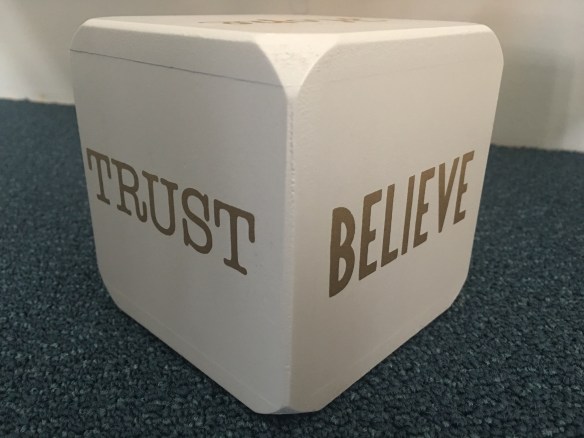
Finally, what does it mean to believe? To believe and to trust, are very similar. The two words appear on the faith cube. You might wonder why the authors of this toy decided to keep the two words separate even though they might, to our minds, mean essentially the same thing.

IMG_6887

And yet, it is worthy to ponder the subtle distinction between the two. Martin Luther understood faith as meaning the addition of the two concepts: Belief + Trust, not as opposing realities but complementing in distinct ways.

Belief is a function mainly of the mind. When we discuss doctrines, creeds. When we debate interpretations of scriptures and statements of faith. To believe is to access the cognitive capacity of our brains. It is, in the lingo of psycho-babble, the left brain analytical side that relishes in rational thought. To believe, in short, is to think through it.

Trust, on the other hand (or, on the other side of the brain), is more intuitive. Trust does not require a full explanation. Trust does not need all the facts and arguments in favor or against. Trust is a function mainly of the heart. Trust lowers the center of intelligence down from the brain to the heart.

Trust is relational. Trust understands our need for the other, to be open to the other, to take risks for and with the other. Trust calls us out of ourselves, to get out of the isolation of all our mental activity – to reach out to the other.

“Blessed are those who have not seen yet have come to believe.”

Jesus affirms for Thomas and the disciples that to follow in the Way of Christ, especially to generations and people like us thousands of years after the fact, that we need to trust others, and trust ourselves. To believe in Jesus, is to believe the witness of generations of Christians before us, to trust their witness, and to walk in the way precisely when easy explanations and scientific proof fall short.

We don’t ‘trust blindly’. That is often the criticism of trust, when it feels like we would be making an irrational decision not based in fact or evidence.

But we are trusting the most capable and the truest part of ourselves when we let go of our cognitive compulsions and let go into the love that sustains the heart.

The opposite of love is not hate. It is fear. “Perfect love casts out fear,” we read from the author of the second reading today[2]. We need to confess that it is fear that keeps us stuck in our heads, and keeps us stuck on the ground. Major decisions in our lives, decisions that changed the course of our lives, decisions that were important to us – were they born out of fear or love? Were they more a movement of the heart or head? Or some combination of both?

A music analogy …

I have been learning a new musical instrument these last couple of years. Classical guitar. Which is different, a little bit, from the acoustic guitar that you often see in churches today, and listen to in popular music.

In comparison, the classical guitar uses nylon strings, which tend to produce a softer, delicate, more harp-like sound. The fingerboard is wider on the classical guitar, and the body – the bell – of the instrument is smaller. When you hold the classical guitar, the curve of the body, which is more pronounced, sits on your left knee (if you are right-handed). And rather than strum chords, you pluck separate notes on the classical guitar. It’s a beautiful-sounding instrument.

But as with learning to play any instrument, and staying with it, there is a progression that needs to happen from the head to the heart. Listen to what Barry Green, renowned double bass player, writes about when teaching another musician how to play vibrato on their instrument. Vibrato is rolling your finger back and forth over your string when playing a note.

“On my Pacific tour,” he writes, “I coached Edith, a bass player from the New Zealand Symphony. She had tried to use her vibrato in a number of different places in a slow, expressive sonata by Vivaldi and couldn’t decide where it ‘worked’ best. None of her experiments quite had the right feel to them.

“I wanted Edith to discover the best places for vibrato by herself, so I asked her to play the piece without making any effort to put in a vibrato. I asked her to imagine that her fingers, not her brain, would tell her what to do, and suggested that she only use vibrato when her fingers ‘screamed at her’ to do so.  Since she would not have decided in advance which notes needed the vibrato, I was confident that her hands would be free to supply it unconsciously.

“Her performance improved immediately: Both her sound and her vibrato were smoother and richer.”[3]

Obviously to gain this level of playing, Edith had to practice and practice and practice. She had to become technically proficient in playing the bass. But to begin to enjoy playing and hearing the sounds you are creating on your instrument, to discover the resiliency of performing and the joy of making music, the usual questions provided by the mind must be eclipsed by the heart.

In other words, the mind will give instructions, constantly critique, and fan the flames of fear and self-consciousness – all of which undermine the making of a beautiful sound. We need the mind’s work, to an extent. But we also need to be able to let go of what the mental activity can get rather compulsive about. We need to grow up, as people of faith.

Albert Einstein, the most eminent scientist of the twentieth century, you would think would defend the prominence of the mind over the heart, the rational over the intuitive. So, this quote from him might surprise you; he said: “The intuitive mind is a sacred gift, and the rational mind is a faithful servant. We have created a society that honours the servant and has forgotten the gift.” Take his phrase, ‘intuitive mind’ to mean the ‘intelligence of the heart’.

Intuition relies on the capacity of trusting: Trusting the love, this capacity and capability within you, trusting the other who is willing to help, assuming the good intentions of others rather than immediately judging them – these are the attributes of one who has maturing faith. Especially, faith in God.

“Blessed are they who have not seen, yet have come to believe.”


[1]John 20:29

[2]1 John 4:18

[3]Barry Green with W. Timothy Gallwey, “The Inner Game of Music: The classical guide to reaching a new level of musical performance,” (New York: Doubleday & Company /Pan Books, 1986), p.113.