Transfiguration – a launching pad, not a destination

Last Fall, a member of council framed a few pieces of the original cork that lined our walls prior to the renovation. I now show you a piece of this cork as another reminder of what used to be a unique certainty every time worshippers gathered in this space, for over fifty years. Certainty no longer!

You notice, obviously, that this space is fundamentally the same. And yet what we see and what is invisible has changed. No longer cork, but drywall and insulation. No longer narrow windows placed as a trinity, but wider ones that let in more light! The reredos, the pulpit and the ceiling — all retain fundamental elements of the old, but are definitely and without a doubt new at the same time!

These are mysterious, hard to grasp perceptions that can help our understanding of the Transfiguration of Jesus — the same person, the same general shape and size, but different: not only fully human, but also fully divine!

The Transfiguration points to a truth in our lives we often, because of our sin, want to resist: Change happens; it is part and parcel of the process of life.

Before the transfiguration of this space that occurred over the last four months, did you know that this space experienced a previous transfiguration? Perhaps it was more a transfiguration of purpose, than actual bricks and mortar:

In 1965, the sanctuary was originally intended and designed to be the fellowship hall for the ‘new’ church to be built at some future date. The Annual Design Award for 1965 was given to the Schoeler Markham and Hector architectural firm by the Ontario Association of Architects, Ottawa Chapter, for the design of the “Faith Lutheran Fellowship Hall”, as it was originally named. (1)

Change in the church is the norm, not the exception. As we sit, stand and move in this space today, we know there is still work to be done. The narthex hallway is still under construction, and needs some time for its transfiguration to be completed.

Life is a process of change, of coming and going. The last four months were not a vacuum in our existence. Whether we are aware of it or not, we have changed in the time we were not here. Whether you worshipped with us at Julian, whether you worshipped elsewhere, whether you didn’t worship at all, we changed. And that is part of the reason that during midweek Lent gatherings, we will give ourselves time to process our learnings.

Much has been said and written about the extraordinary, supernatural experience of Jesus being transformed in the presence of a few of his disciples. Not only does Jesus’ countenance change, he appears with Moses and Elijah — a couple of Israel’s greats.

The relationship between these characters — Jesus, Moses, Elijah, Peter, James and John — is fascinating to ponder. What compels me in this reading is what happens shortly before they climb the Mount of Transfiguration, and what happens shortly after Jesus’ entourage heads back down the mountain. The movement up and down speaks of a rhythm not only evident in the bible, but in life: a rhythm of coming and going, of ups and downs, of death and resurrection.

Jesus took with him Peter, James and John up the mountain. Special treatment? After all, didn’t have twelve disciples? Were these Jesus’ favourites? I wonder. Well, Peter, in the verses prior to the text for today, gets a scolding from Jesus after Peter suggests Jesus ought not suffer and die; Jesus calls Peter “Satan” (Matthew 16:23) for expressing that opinion. So, Peter is not in Jesus’ good books. Or at least, that’s what James and John probably thought, hiking up that mountain.

And so, after the spectacular event atop the mountain, when they return with Jesus down into the valley of their regular lives, they want to keep and guard their special status among the other disciples. A few verses after the end of this text, they ask Jesus: “Who is the greatest in the kingdom of heaven?” (Matthew 18:1). The Gospeler Mark portrays James and John in a more aggressive manner, when he records James’ and John’s request more as an order, or demand of Jesus: “Teacher, we want you to do for us whatever we ask of you … Grant us to sit, one at your right hand and one at your left, in your glory” (Mark 10:35-37).

The disciples are fighting amongst themselves, and competing over who is the greatest. Of course, they use the world’s standards of greatness. Jesus brings to them children and the Cross, to show them who and what is truly great in God’s eyes.

“‘BANG!’ The gun fires and the race is on. The runners take off across the field. It rained the day before and the ground is still damp. The temperature is cool. It is a perfect day for running. The line of runners quickly forms a pack. Like a school of fish they come together as one. They move as one … As with any race, in a short period of time the stronger ones will start to pull ahead and the weaker ones will start to to fall behind.

“But not Ben Comen. Ben was left behind as soon as the starter gun sounded. Ben’s not the fastest runner on the team. In fact, he’s the slowest. He has never won a single race the entire time he’s been on the … High School cross-country track team. Ben, you see, has cerebral palsy.

“Cerebral palsy, a condition often caused by complications at birth, affects someone’s movement and balance. The physical problems endure a lifetime. Misshapen spines create a twisted posture. Muscles are often withered and motor reflexes slow. Tightness in the muscles and joints also affect balance. Those with cerebral palsy often have an unsteady gait, their knees knock and their feet drag. To an outsider, they may seem clumsy. Or even broken.

“The pack pulls farther and farther ahead while Ben falls farther and farther behind. He slips on the wet grass and falls forward into the soft earth. He slowly picks himself up and keeps going. Down he goes again. This time it hurts. He gets back up and keeps running. Ben won’t quit. The pack is now out of sight and Ben is running alone. It is quiet. He can hear his own laboured breathing. He feels lonely. He trips over his own feet again, and down he goes yet another time.

“No matter his mental strength, there is no hiding the pain and frustration on his face. He grimaces as he uses all his energy to pull himself back to his feet to continue running. For Ben, this is part of the routine. Everyone else finishes the race in about twenty-five minutes. It usually takes Ben more than forty-five minutes.

“When Ben Comen eventually crosses the finish line he is in pain and he is exhausted. It took every ounce of strength he had to make it. His body is bruised and bloodied. He is covered in mud. Ben inspires us, indeed.

“But this is not a story of ‘when the going gets tough, the tough get going.’ This is not a story of ‘when you fall down, pick yourself up.’ Those are great lessons to learn, without a doubt. But we don’t need Ben Comen to teach us those lessons. There are dozens of others we can look to for that … Ben’s lesson is deeper.

“…. What Ben teaches us is special … Ben starts every race with a very clear sense of why he’s running. [It’s not about how Ben relates to his ‘competitors’.] He’s not there to beat anyone but himself. Ben never loses sight of that. His sense of why he’s running gives him the strength to keep going. To keep pushing. To keep getting up. To keep going. And to do it again and again and again. And every day he runs, the only time Ben sets out to beat is his own.” (2)

Change is the norm, not the resisted exception. When we face changes in our lives, the only competitor we face is ourselves — individually, or as a group. When we face the changes of life, we misfire our energies if we find someone else to blame, some other entity out there that is the cause of all our problems. When we play that kind of game, we become part of the problem rather then part of the solution. The greatest and most significant competitor we face, is ourselves.

From the mountaintop experience, one must return to the valley, where the real work begins. We need to ponder, now that we have this beautiful space to gather, why indeed we gather here. We need to articulate for a new day in new language and different forms what is our purpose, our mission. What is the purpose of the building?

There is no recording of James, John and Peter ever running back to the place of worship atop the Mount of Transfiguration when things got tough. They didn’t go back there every Sunday, again and again. That’s because the purpose of worship is not a destination, but a launching pad to the world around.

The purpose of this space on Sunday morning is not a destination of our faith, but a launching pad, to go out there and live out our faith in our daily, Monday-Saturday lives. Ekklesia, the Greek word for ‘church’ means literally, ‘a people called out’. We keep going, moving forward, doing what we are called to be and do.

And we don’t give up. We keep in mind that when the stress of change seems overwhelming, there is no one or circumstance ‘out there’ to blame. We are our own greatest enemy, they say; it is true. We, also, are our greatest asset. We only have ourselves to challenge, to change, and to grow.

And Jesus goes with us, and before us, through all the ups and down. Thanks be to God. Ours is the task, now, to follow.

1 – from Church Anniversary 2011, Faith Evangelical Lutheran Church Ottawa, “Some Interesting Facts”.

2 – Simon Sinek, “Start With Why”, New York: Penguin, 2009, pages 222-224.

Checking our Image of God

Do you know “Good Old Uncle George”? (1)

Listen to this description of what happens when a family makes a visit to Uncle George who lives in, and never really leaves, his formidable mansion.

At the end of the brief visit in which the children describe Uncle George as bearded, gruff and threatening, he leans closely, and says in a severe tone of voice, “Now listen, dear. I want to see you here once a week. And if you fail to come, let me just show you what will happen to you.”

He then leads the family down to the mansion’s basement. It is dark, becomes hotter and hotter as they descend, and they begin to hear unearthly screams. In the basement there are steel doors. Uncle George opens one.

“Now look in there, dear,” he says. They see a nightmare vision, an array of blazing furnaces with little demons in attendance, who hurl into the blaze those men, women and children who failed to visit Uncle George or act in a way he approved. “And if you don’t visit me, dear, that is where you will most certainly go,” says Uncle George.

Do you know “Good Old Uncle George?” Sound familiar?

From the bible readings assigned for this season after Epiphany, we are asked to consider again who is this God we are called to follow. Of course, no one image of God is complete. Our perspective is limited, no matter how well we know the bible or how many degrees we may have behind our name. And God is greater and bigger than anything anyone can imagine or say.

Nevertheless, it is fruitful to examine what we think about God. Our image of God influences our own behaviour and what we do “in the name of God”, who is revealed in history, in our experience and in the Scriptures as God the Father, God the Son and God the Holy Spirit. Eventually, our actions mirror the God to whom we pray, to whom we relate, whom we imagine. (2)

I would like to highlight briefly three aspects of the character of God, in Jesus, that we can see in the story of Epiphany for today — the baptism of our Lord (Matthew 3:13-17).

First, Jesus moves. He does not sit still for too long. Jesus is baptized ‘on the side of the road’ so to speak. He is baptized nowhere special, not in some officially consecrated, designated holy place — but in the wilderness where John preaches ‘on the edge’ of civilization where crowds have to follow to be there.

In fact, the Jordan River is some 35 kilometres from Jerusalem. For people who walked, this would likely mean at least a two-day journey from the city. So, most of the people who witnessed this divine event and encounter between Jesus and John on the banks of the Jordan River had to travel to get there. Even the high priests and Pharisees, those in power and who held influence in the religious establishment of Jerusalem had to get there.

Who is God? God is more a verb than a noun; God is not static; God is always on the move; we can in this story of Jesus’ baptism appreciate the moving parts of faith. It is important to note to where God goes, and is revealed.

Mobility is a kingdom value. Going some place else away from what is familiar and comfortable is part of exercising a healthy faith. Conversely, staying in one place too long is not healthy for the soul.

Second, in this mobility God relates to us in vulnerability. In worship and praise of God we are accustomed to calling God Almighty. But, at the same time, if we are ‘getting’ Jesus, we ought to be calling God Al-vulnerable.

Jesus relates to us. The divine becomes one of us in moments of vulnerability, especially. The primary symbol of Christianity, the Cross, points to the ultimate, earthly destination of Jesus, and reveals our most vulnerable God. The Cross is a sign that says: God understands us even in death and dying.

What is unique about Matthew’s version of the baptism of our Lord is that it is meant for public witness. Unlike the other Gospel accounts who make this event more of an inward, spiritual experience of Jesus, Matthew portrays the baptism of Jesus as an external event, available to all present.

Also, Jesus submits to baptism not because he needs his sins washed away. Through this act, Jesus was indicating his willingness to yield his life, to surrender his life, in obedience to his Father. Jesus requests baptism by John so that he could completely identify with those he came to save.

Therefore, relationships described by mutual vulnerability is another kingdom value. Being with others in this way, in community, is vital for faith. Prolonged isolation and emotional detachment from others is not healthy for the soul.

Finally, not only is God in motion and in vulnerable relationship with us, God is reaching out to us, immanent and present to our common lives.

Jesus’ father in heaven calls to him, validates and affirms his path. Then, too, Jesus calls his disciples. Jesus does not do it alone. He includes his disciples in his travels, walks in their shoes, involves himself in the common, daily activities, gets his hands dirty — so to speak.

Jesus is the son of a carpenter from Nazareth, he fishes with his disciples, he goes to weddings and drinks wine, he hangs out with all people not just the ‘good ones’.

Jesus does not leave us alone, some distant, transcendent God who does not care about what happens on earth. Jesus will not stop reaching out to us, and will beckon us to follow where he goes. Jesus continues to engage our lives, touching our hearts, our hands and our minds, in the very course of our lives on earth. God will intervene, and pierce our perception, inviting us into a new way of being and doing.

Today, followers of Jesus can consider anew this God who is revealed to us in Jesus. Jesus is the divine-man, who walked everywhere and moved around a lot; Jesus is the God who seeks relationships and models vulnerability and self-surrender; Jesus is the God who will not leave us alone and continues to call out to us to follow in his way.

May God bless the path we journey. Amen.
(1) cited in Dennis Linn, Sheila Fabricant Linn & Matthew Linn, “Good Goats: Healing our Image of God” (Paulist Press, New York, 1994), p.3
(2) ibid., p. 7ff

No easy way up those stairs


Perhaps you know someone like Sue.

Sue had Multiple Sclerosis (MS). As the disease progressed in her relatively young life, she nevertheless wanted to stay at home as long as possible. Her house, unfortunately, was not outfitted appropriately for someone in her debilitating condition.

And yet, she battled. For example, it took her twenty minutes to crawl upstairs to her bedroom. Sue called the stairs “Mount Sinai”. Because it was by struggling on those stairs, moving limb for limb through each laboured breath through gritted teeth; it was through determination for each step gained, that she learned so much (1).

The prophet Isaiah does this to us again — gives us an ideal vision of a world where no one suffers any longer, a utopia where everyone is joyful. What is perhaps even more astounding is that this vision of hope and promise is proclaimed in the midst of everything that was not:

These verses speak to Babylonian exiles (2). They are the captives of war, and as such have been wounded maimed, even intentionally blinded as was King Zedekiah (2 Kings 25:7). It is to this failed community now subjugated and marginalized in an oppressive regime far away from Jerusalem that Isaiah paints this picture of a highway leading back home through the desert (Isaiah 35:1-10).

The cynic in us alights, as it must have in many of the exiles in the sixth century B.C.E. For, when do we see the eyes of the blind opened, the ears of the deaf unstopped, the disabled leaping like a deer, the tongues of the speechless sing for joy? (vs.5-6). Words that Jesus later repeats almost verbatim (Matthew 11:5; Luke 4:18) surprise because he seems to validate the promise of a vision, hundreds of years after Isaiah, that has yet to be fulfilled.

The vision, the promise, operates like a bouncing ball through history. Indeed, our world to this day — two thousand years later — is still rife with human brokenness, both visible and hidden from sight. Many have given up on God precisely because they can’t see how a God of love can be represented in a world of suffering, disease, violence and disability.

What if this promise is given, is meant, for us today? Can we believe it? Yet, perhaps human beings will always struggle with the God who came, and is coming again and again, in Jesus. We have to be careful with Isaiah’s vision, for it can pander to our perfectionism, which denies the reality of a life lived in the graces of God: That what is of God is exclusively the purview of the rich and famous, successful, beautiful and handsome — only for the perfect ones.

Perfectionism pretends that we have to achieve that vision of wholeness and restoration by our own herculean efforts and responsibilities. A denial of the suffering in life leads us to attempt a path around all that is difficult, challenging and transformative.

“A highway shall be there, and it shall be called the Holy Way, and the unclean shall not pass it by, but it shall be for them.” (Isaiah 35:8)

When John the Baptist shouts that the coming Jesus will make a way through the aridity and desolation of the desert (Matthew 3:3), it bears reason to pause and reflect on the place of John’s prophetic work. Not in the public square in downtown Jerusalem nor on the steps of the Temple.

He stands on the banks of the Jordan River — which separated two worlds. On the one side, the desert which represents the long journey, the pilgrimage, that the people of God made from slavery in Egypt. On the other side of the Jordan lies the Promised Land, the place of arrival, destination, highlighted by the holy city of Jerusalem.

John the Baptist stands preaching words of challenge and hope in the in-between place — the River Jordan. Baptismal in its imagery, this in-between space is the place where something happens. A change occurs in our lives. The space in-between is often a place of disruption as the mental furniture of long-held beliefs, assumptions and values are re-arranged. In this in-between place of discomfort and turbulence we experience, nevertheless, a transformation to be people ‘on the way’ to our destination with God.

We must be willing to go there. And not deny this path through the wilderness. A holy highway does not circumvent the desert places of our lives. What ails us, what disturbs us, what challenges us — these are often valuable clues, yes even invitations, to a deeper engagement with our lives and with God. The disruption is actually God calling us into a transformative experience of life.

Do we accept this? Advent is a time to be honest. Advent is a time of reckoning. Will we stay the same, stuck in our inhibitions and motivated by fear? Or, are we willing to take the risk and go through this in-between place that does not deny our suffering and discomfort, but which actually holds redemptive power?

It is no accident that God chose to be revealed in a broken body. A bloody and pierced body hanging on a Cross. God showed us the way, in Jesus’ death and resurrection. God opened to us the way of salvation.

We know God saves. The names of Isaiah, and Joshua — important in the Hebrew Scriptures — echo the same meaning of Jesus’ name: God saves. No dispute there. But what is the way, the how, of God’s saving? How does God save?

The path through the desert. Before there is a re-ordering of our lives, there must first be a dis-order or sorts. There is no direct-flight from ‘order to re-order’ as much as we might wish there were. In God’s realm, according to the way of Jesus, we must go from ‘order to dis-order before arriving at re-order’ (3).

Julian of Norwich wrote: “First the fall, and then the recovery from the fall. And both are the mercy of God” (4).

We can’t have Easter without Good Friday. Both are held in tandem. Even today in popular Christianity, people avoid worshiping on Good Friday; most experience the ‘hosananas’ of Palm Sunday only to return the following Easter Sunday to sing ‘halleluia’. No wonder we get seduced by culture’s ‘glory’ theology that pretends we can somehow deny suffering in order to validate our faith.

But without somehow acknowledging the Passion and suffering of Holy Week culminating in death on the Cross of Good Friday, we miss the point of Easter. We miss the point of Christianity:

The body of Christ is broken in love for us. God loves us not despite our brokenness as human beings but precisely because we are broken.

Lutherans talk a lot about grace, and unconditional love of God for us ‘while we were yet sinners’ (Romans 5:6-8). This is good talk. But — being a diehard, lifelong Lutheran myself and so I can say this — it is not easy living, behaving and inter-relating according to that unconditional-love-‘way’ with others. It may be a simple concept for the mind to turn over and accept, but it certainly is not easy for our egos to put into practice.

Climbing the steps of “Mount Sinai” as Sue was want to do was a feat of incredible endurance. Whether it took her twenty minutes or two hours is not the point, really. It’s the journey: Learning to love, forgive and accept our lives not because everything is ‘just right’ but precisely because God is there in the ‘not alright’ — is a discipline that may indeed take a lifetime to learn.

Enduring whatever suffering comes your way. Grieving whatever loss or mourning a loved one. Carrying on in the midst of the in-between places of our lives. Being present to all the feelings and thoughts and sensations of life — good and bad. Accepting our own imperfection and disability — and still enjoying moments of grace with one another on the way.

So as we learn on the way, may our journeys be inspired by moments when we do experience the presence of a God who understands and walks with us, when the vision appears no longer a mirage on the horizon of reality. But is truth incarnate. An inexplicable gift of joyous wonder.

When, “everlasting joy shall be upon their heads; they shall obtain joy and gladness, and sorrow and sighing shall flee away” (Isaiah 35:10).


(1) Charles Foster, “The Sacred Journey” (Thomas Nelson, Nashville, 2010), p. xxiii
(2) Bruce C. Birch in David L. Bartlett & Barbara Brown Taylor, eds. “Preaching the Revised Common Lectionary; Feasting on the Word, Year A, Volume 1” (WJK Press, Kentucky, 2010), p.51-55
(3) Richard Rohr, “Daily Meditation”, Tuesday, December 6, 2016 (Center for Action and Contemplation), http://www.cac.org
(4) Julian of Norwich, “Revelations of Divine Love”, 61, ed. Grace Warrack, R.Rohr paraphrase (London: Methuen & Company, 1901), p.153

The case of the missing pulpit

As we worship this morning, the sanctuary at Faith Lutheran Church building is gutted — empty, a shell. Not only is the cork on the walls now removed and the old carpet disposed. The light fixtures, most of the furniture, liturgical items and holy hardware is stowed away for the time being to be recovered, restored and positioned again in their proper place once the renovations are completed.

I know some of you who have been at the site in the last day or so helping to get it ready for the workers, have been asking the question: “Where is the pulpit?” I can see the title of the next best-selling mystery novel: “The Case of the Missing Pulpit.” Where is it?

What a mystery! Well, this is what happened …

Last Sunday afternoon as I was helping members of our altar care committee removing certain items, we ran into a little problem. Our pulpit is mobile; it sits on wheels. So, depending on the needs of the day, we move it around. 

Well, we moved it alright — all the way to the door of the sacristy where we were hoping to store it. Without doing serious alterations (and damage!) to the door frame, there was no way that pulpit would get through. And the cloakroom, where we normally store the pulpit at Christmas, was going to be filled with stacks of chairs. Where on an already compact floor space would we store a rather heavy and cumbersome piece of teak-wood furniture?

It was the spur of the moment when I offered to put the pulpit in my car. I had the back seats down anyway at the time, and the rear hatch opened just wide enough to allow the pulpit to slide in fairly easily. And I drove away with church’s pulpit in the back seat of my car! Truth be told!

During the 45 minute drive home to Arnprior, my mind raced: What would I say to someone who would behold this mystery! I was also wondering where on earth I would put it. I had no clue. There was room in our garage, but most of that space was already tagged for bikes, tires, canoes and garden implements for the winter season.

My wife and I sat in the living room that evening scratching our chins and trying to come up with solutions. But to no avail. I guess I would drive around with a pulpit in the back seat of my car for three months! A mobile preacher who comes with his own pulpit! What a deal!

Barbecuing on the back deck that evening, I looked above the tree line and my eyes rested on the steeple of a church, just around the corner from our place. After making a phone call, and depending on the good will of their pastor and the muscle of a couple of their men from that community — and our pulpit now has a resting place. 

So, if anyone asks: Our pulpit is in the safe-keeping in the building of the good people of St John Lutheran Church in Arnprior. Let it be heard! “The case of the missing pulpit” … mystery solved!

I’m usually the kind of person who wants to have a plan, to know how things ought to go and what the end result should be, before doing anything. This is also usually a good thing. Driving away with the pulpit without any clue as to where it should go, was a little unnerving for me. It was, nevertheless, a good exercise for letting go and trusting that a solution would present itself. And it did, in a most gracious, natural and expedient way.

Some of you know that I am planning to go on a sabbatical next year. The theme of my sabbatical is ‘pilgrimage’. And part of the experience is to walk an ancient path, some eight hundred kilometres long, on the north coast of Spain on the famous Camino de Santiago de Compostela. I’ve read that a majority of people who start the pilgrimage — hundreds of thousands every year — don’t finish it. Many pilgrims give up, some even just 25 kilometres into it. 

What many successful pilgrims learn is that all that is required is to remain committed to the journey itself. What is needed, is to unlearn deep-seeded attitudes about what justifies us, as human beings. To persevere in that un-learning process over six-weeks, even against all the challenges of the trail. To learn that all that is required is simply to put the next foot forward. To not give up, to not lose heart. And to pray always.

To dial it down to accepting that it’s all about taking the next step faithfully — nothing more, nothing less. Although simple, it is not easy for most of us to comprehend let alone do: Just walk. Eight hundred kilometres. Because it’s not about our ability and resourcefulness in the end. It’s not about rushing to the next distraction, checking off the next thing on our list in a busy, hectic lifestyle. It’s about something much bigger than us and our ‘stuff.’ A pilgrimage can teach us that.

That was the message from last week’s Gospel from Luke 18:1-8, to pray always. The most important thing is to remain focused on staying the course, to do the prayer. The solution — the answer, the benefit — will present itself as long as we remain committed to the journey, the adventure. 

Last week, we learned to persevere in prayer. This week in the story that follows we learn how to pray. And I want to reflect David Lose’s perspective here (1), to watch for the trap that Luke sets for us readers. Remember, the Gospel of Luke is full of reversals — the song of Mary, the beatitudes in the sermon on the mount, Jesus’ conversation with the thief hanging beside him on a cross, etc. Luke, it seems, delights in setting up his readers with presumed expectations, and then pulling the rug from under our feet.

It’s too easy merely to paint the bad guy as the Pharisee. Because don’t forget, the Pharisee is law abiding, has fulfilled all the demands of his religion, lives a pure and righteous life. Isn’t this what faithful living looks like? After all, we shall know others by their fruits, no? The Pharisee does a lot of things right. Except for one thing:

The Pharisee, while living the right life, has forgotten the source of his life and all the good in it. Otherwise, he would not despise another whom God loves. He falsely believes it’s all about him and his efforts alone. He falsely believes others who are not like him, need to be, in order for them to be good people.

And, it’s too easy to side with the ‘humble’ tax collector. Let’s not let him off the hook too easily. The tax collector only recognizes that all he is about is depending on the mercy and forgiveness of God. That’s in good contrast to the Pharisee, yes. And that’s the challenging starting place, to be sure.

But nowhere do we see a sign of his repenting. Does he desire to have his life turned around? He may very well be as self-engrossed as the Pharisee. Just the other side of the same coin. The tax collector strikes me as one who might remain stuck in cycles of self-pity, negative self-talk and depression. 

He might be one who goes back every Sunday to remind himself how bad he really is. A false humility, we may call it, where it feels good, actually, to put yourself down before others. “I’m not good enough.” “I don’t have a strong faith.” “I can’t do this or that.” 
Will he not hear that God’s forgiveness can lift him out of what may appear a chronic negativity? Will he not hear that he is not all of the time all worms and dirt and badness within? Will he not hear that God has given him a great gift within himself, in himself?

No matter with whom we relate, or cheer for, in this text — the Pharisee or the tax collector — we run into a wall with both of them. And I believe this wall is meant to test to what degree we focus too much on ourselves in the practice of our faith and in our prayer, and not on God.

The trap is to call us out whenever what we do or what we decide as communities of faith is more about our own stuff, than about the bigger picture, the holy and wonderful mystery that is God.

At least one item from our worship practice is not in storage, but stands in this place alongside yours — the Paschal Candle. It is called, ‘paschal’, because it describes the ‘mystery’ of Jesus life, death, resurrection and ascension. We call it, ‘the Paschal Mystery’. 

We are not talking here about a mystery like ‘the case of the missing pulpit’, where it is simply a question of information about something that is already known, just not to everyone. “Mystery isn’t something that you cannot understand”; A mystery, in the holy sense, is as Richard Rohr puts it: something you can “endlessly understand” (2). We never ‘arrive’ at a complete knowing, this side of eternity, of what God is all about. We never completely ‘get it’. We are always growing, changing, discovering, adventuring.

It is natural to seek signs. The Pharisees and disciples demanded Jesus: Give us a sign! And the only ‘sign’ that Jesus was willing to give them, was the “sign of Jonah” (Luke 11:29). Many of us know that story from the Old Testament, where Jonah fights against God’s will, refuses to follow where God calls, doesn’t want to do it! 

Only by spending time in the belly of a whale for a few days, where he can do nothing, does Jonah become aware and accept that it’s not about him, or his mission, but about God’s purpose, God’s call, God’s mission. Doing God’s mission will call us beyond our own agendas, preferences, and even personalities. Not that those things are bad. But this is about something a lot bigger than our resumes, list of accomplishments, or even our baggage and painful histories.

We are on a journey moving forward, a pilgrimage, to discover what God is about in this holy space and in the world around us, now. We already received signs of God grace — your authentic and heartfelt welcome and accommodating us, for starters. This beautiful space and hospitality we can share. This is God’s good work among us and through you. Thank you!

We might not know what this will look like at the end of the journey together as Faith Lutheran Church worships alongside Julian of Norwich Anglican Church over the next few months. “I’ve got this pulpit in the back seat of my car, and I have no idea where it’s going!”
We might not know where this adventure leads.

But we don’t go alone. We travel this uncertain road together, side by side. We may suffer through some moments together as we figure things out, as we feel our way into this journey, as we learn and perhaps go through some growing pains together on these first few steps.

But let us be encouraged by the Paschal Mystery, which points to the way of Christ, the self-emptying and giving that leads to a marvellous and wonderful resurrection from all that is passing away, transforming us into the new thing that God is doing. The light of Christ shines ever and ever, even in the darkness and through our most challenging journeys. 

Thanks be to God! Amen.


(1) David Lose, “The Pharisee, the Tax Collector, and the Reformation”; Monday, October 21, 2013; http://www.workingpreacher.org 

(2) Richard Rohr, “The Divine Dance: The Trinity and Your Transformation” (Whitaker House Publishing, Pennsylvania, 2016)

Rooted in the earth, rising to the sun

Recently I have been reading about people’s experiences on the Camino de Santiago — the eight hundred kilometre walking pilgrimage through northern Spain. This walk has become more and more popular among Christians of all stripes over the past couple of decades. It seems Christians around the globe are finding the pilgrimage a good place to work through personal issues, find focus in life again and seek re-connection with God, the world and themselves.

This past week I met with one such pilgrim from Ottawa who goes at least once a year to walk some part of the Camino; in fact he is leaving today for Barcelona. I sought his experienced advice for some practical considerations for the trek. His first rule of thumb: Pack only ten percent of your body weight. For me, that would mean no more that 20 pounds in my back pack — of all that I would need for the thirty to forty day hike. Twenty pounds is not a lot!

His second rule of thumb: What you wear on your back, put only one in your pack. That’s all. For example, if you are wearing a t-shirt, pack only one other t-shirt in your back-pack. If you are wearing a pair of shorts, pack only one other pair of shorts. And so on.

He laughed when he told me that about four days in — some one hundred kilometres into the journey — you find bins and bins full of personal items people left behind. These pilgrims had realized, thankfully sooner than later, that they were simply carrying too much — stuff they didn’t really need (extra shirts, pants, sweaters, books, jackets, bed mats, blankets, etc.). A final rule of thumb from my friend: If you do take something extra, then you need to have a good reason for it besides, “I might need it.”

This discipline reflects the quality of being able to let go. It can be described as a total self-surrendering, a giving up. The term “Kenosis” has been used among Christians throughout the ages to connote this sense of releasing that which we normally feel we need to hold onto tightly.

Fourteenth century German theologian Meister Eckhart said, “God is not found in the soul by adding anything, but by a process of subtraction.” (1) In our consumer culture, religion and spirituality have very often become a matter of addition: earning points with God, attaining enlightenment, producing moral behaviour. In the ‘prosperity gospel’ so popular in North America, we often hear the message that Jesus approves of you when your material and financial wealth increases; the more you have, the more in favour you are in God’s eyes.

Yet authentic, Christian faith is not about getting, attaining, achieving, performing or succeeding. The solution is not just “work harder” or “get more” of something. Our culture and economy, indeed, is based on more and more. Whereas true faith suggests: less is more. Martin Luther’s theology of Justification by Grace through Faith suggests the very same: We cannot by our own efforts achieve anything worthy of God.

So, stop trying. In fact, start doing the opposite: Let go of your pretence to manage your life according to the creed: Bigger and More is Better. Let go of a paralyzing negative body image. Let go of the inner talk that is putting yourself down, that tells you you are no good. Let go of attitudes of hatred against people who are different from you. Let go of those material aspirations that tease you into a false sense of security. Let go of being paralyzed by fear.

Instead, focus on what is essential. Appreciate that you already have enough, all that you need. When Jesus gives instruction in the Gospel text for today (Luke 14:25-33) he is travelling out on a public road, on his pilgrimage to the Cross. Remember, ever since Luke 9:51, he is already on the way to Jerusalem, his final destination. When Jesus is walking towards his death and resurrection in Jerusalem, he offers what sounds rather harsh to our ears. What is called-for here is a ‘single-mindedness’ that is needed when you travel with Jesus.

Discipleship is about being single-minded about the purpose, the goal and the mission of Jesus in the world. It is about prioritizing what is important to life in the public realm where culture, consumerism and a whole host of other distractions can keep us from this focus.

This single-mindedness demands that we think ahead, and anticipate the cost of our journey. Setting out on the road to follow Jesus requires at least a little forethought and reflection. This journey is not a light matter. Sit down and think about it a bit. Reflect.

There is not only the blessing of the assets promised, but there are the liabilities, too. Discipleship is not just one more hobby or extra-curricular activity to add to a well-rounded, prosperous life. It is not merely “a matter of pure passion and abandon” (2).

Followers of Jesus should count the cost, but also realize this is not just about counting the cost of a church building renovation or a church fund-raising project. The cost of discipleship, as Dietrich Bonhoeffer first coined the term, is about prioritizing our whole lives, not just our “church” or “Sunday morning” lives.

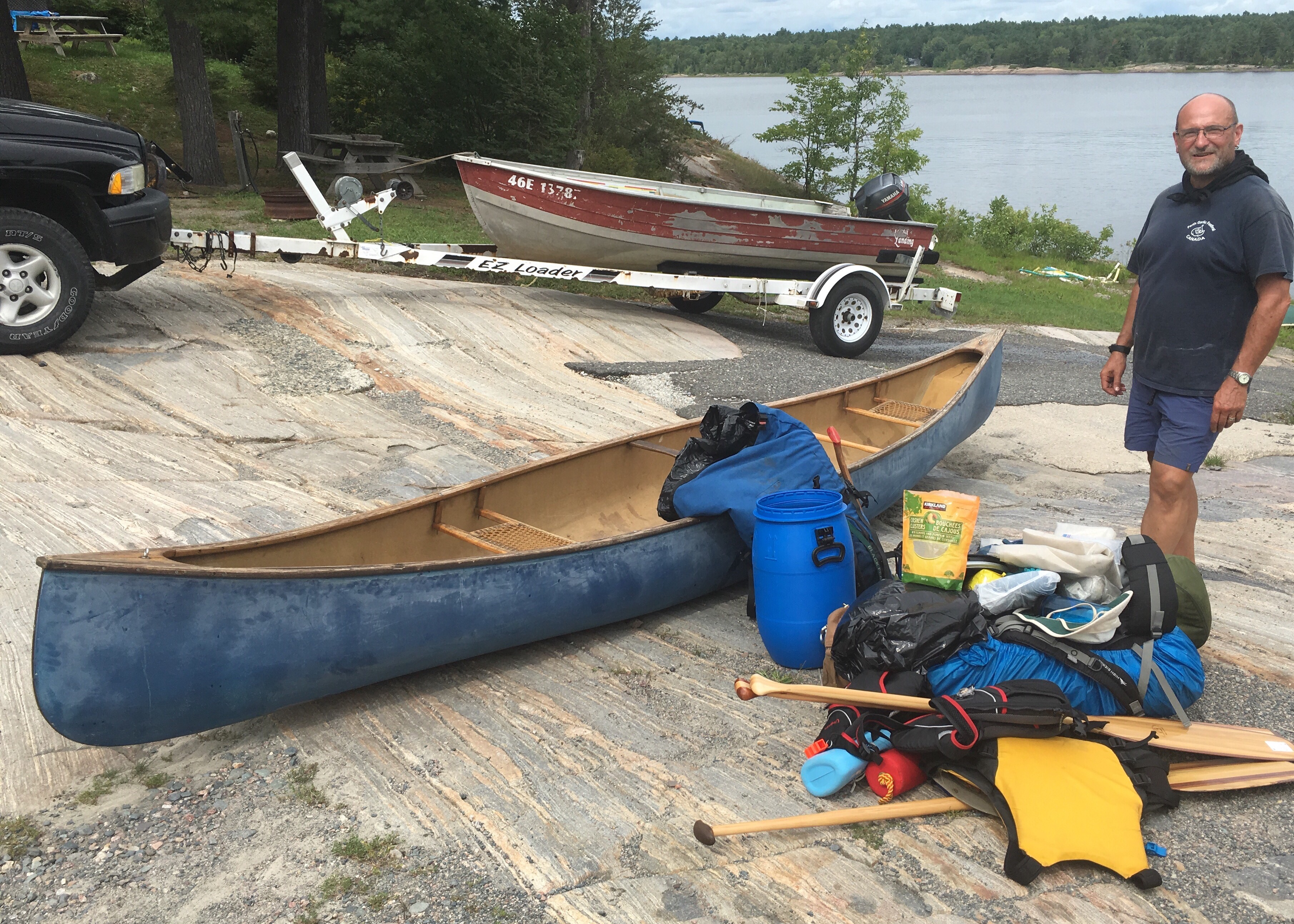
If someone told me a year ago that I would spend four days cut off from civilization, in the bush without cell-phone service, hauling all my food and everything I need to survive in a canoe that I would have to navigate through rapids and rocky, snake-infested portage routes — I would say they were dreaming … or talking about someone else.

Well, that’s precisely what I did last week, along the French River Provincial Park between North Bay and Sudbury. Fortunately I was not alone; I journeyed with a more experienced wilderness survivalist. 

We ended up taking more than we needed. We could have packed less food, and less clothing. The exercise, nevertheless, was confident-building for me in realizing I really don’t need that much stuff.

Jesus says, “None of you can become my disciple if you do not give up all your possessions.”

To live life well, and faithfully, is to recognize one’s place in the world, and not to over-reach, over-extend, to be someone you are not — all on the basis of wanting more and more, bigger and better. To live faithfully, we are called to examine our dependencies, count the cost of it all, focus on what is important, and then make room in our lives for what is important by letting go.

A sojourn into the wilderness may indeed by the antidote to visions of self-aggrandizement embedded in the prosperity gospel message. Try doing without, for some time, what you may have taken for granted for too long. Try doing without what you always have believed you needed in order to live. Try Letting go. Releasing. Forgiving. 

This is not about doing away with personal boundaries. Letting go is not about condoning injustice or cruelty. Kenosis/letting go is not about being blind optimists, repressing or denying or not caring, or ‘giving up’ in frustration.

Forgiveness is a good example of letting go of the misery caused by holding on to the pain of resentment or holding a grudge. This kind of letting go brings a positivity that is based in honest struggle and prayer born out of compassion and love for self, the other, and God. The end result is a freedom and peace that cannot ever be realized through a program of simply working harder or getting more.

The German poet, Rainer Maria Rilke, wrote about the contrast between the law of gravity and the rising of the trees. He writes about the gift of letting go into a place of trust: Trusting that the gift in you is enough. So that you can rise up, rooted like trees: 

How surely gravity’s law,

strong as an ocean current,

takes hold of even the smallest thing

and pulls it toward the heart of the world.


Each thing —

each stone, blossom, child —

is held in place.

Only we, in our arrogance,

push out beyond what we each belong to

for some empty freedom.

If we surrendered

to earth’s intelligence

we could rise up rooted, like trees


Instead we entangle ourselves

in knots of our own making

and struggle, lonely and confused.

So, like children, we begin again

to learn from the things,

because they are in God’s heart;

they have never left God.

This is what the things can teach us:

to fall,

patiently to trust our heaviness.

Even a bird has to do that

before he can fly. (3)

In the poetry of scripture, the Psalmist describes beautifully the blessing we are, created in the image of God — so “wonderfully made” (Psalm 139:14). God would know intimately each part of our lives only if we were valuable to God and to the rest of creation. Otherwise, why would God care?

In other words, we are and have everything we need to enjoy and live to our fullest potential. We are beautiful. We don’t have to strive and strive to become someone we are not. We don’t have to ‘add’ anything to our lives to be well. In fact, when we have the courage to risk letting go, and “fall”, as Rilke poetically expresses, trusting in our “heaviness”, we will find a freedom and peace that will be the joy of all creation, and the glory of God.

We will live our lives at the same time rooted in the earth, and rising to the sun.

(1) Translated by J. Clark & J. Skinner, “Meister Eckhart: Selected Treatises & Sermons Translated from Latin and German with an Introduction and Notes”, Faber & Faber: 1958, p.194

(2) David Schnasa Jacobsen, Commentary on Luke 14:25-33 in “WorkingPreacher.org”, 2016

(3) Rainer Maria Rilke, “Rilke’s Book of Hours: Love Poems to God” translated by Anita Barrows and Joanna Macy, Riverhead Books: 1996, p.116-117; cited with permission in Richard Rohr’s Daily Meditation for August 28, 2016

Laetere!

“This is the day that the Lord has made. Let us rejoice and be glad in it!” (Psalm 118:24)

Lent is a journey through the desert. It is dry. And there’s little for comfort. Let alone luxury. It is a time of self-reflection, of letting go, of pacing ourselves through disciplines that humble us and peel back the layers of our habits and beliefs.

The famine provides a turning point in the parable of The Prodigal Son (Luke 15:11-32). His wasteful, dissolute, squandering of money — his lifestyle — is brought to an end by a famine, probably caused by drought.

Up to this point the Prodigal continued down the course of his delusion, believing he could be happy by pursuing this lifestyle, even when he runs out of money. His mistaken and self-indulgent strategy for fulfillment is derailed and heightened by the onset of famine.

After the famine grips the land and its people, he has to work among the pigs. He might have had to do this anyway. But because of the famine, nobody can even spare change to throw at his feet when he begs. This famine-ridden reality leads him to a place of brutal honesty. And he falls on his knees in confession.

This is not the only time a famine in the land affects the course of the history of the relationship between God and God’s people. The famine illustrates a pervasive motif in the bible: The famine acts as a significant motivator for people to move in their lives, physically and in their hearts as well (1).

Famine is the reason that Abraham and Sarah leave Ur for Canaan. Once they are there, famine is also the reason they leave again for Egypt (Genesis 12). Famine appears twenty times just in Genesis (eg, Genesis 26). The story of Joseph and Jacob revolve around the reality of the famine.

Famines represent those times in life when forces beyond our control dictate the course of our lives. Famines remind us that we are not the masters of our own destiny. Famines expose the truth of our own poverty. Famines make us honest for our own need. Famines cause us to reach out for help, and let go of our pretence of self-sufficiency and self-reliance.

Famines will lead us to confession – honesty about what we need, what we lack, what limits us. Famines will move us to depend on something/someone beyond our capabilities and industry. Famines will bring us to our knees at the throne of God’s grace (Hebrews 4:16).

Maybe that’s why famines happened a lot in scripture.

The famine, otherwise not usually considered an important part of the parable of the Prodigal Son, serves to underscore the central message of Scripture: It’s not about us, it’s about God. We can act irresponsibly like the Prodigal, or we can follow all the rules of life and be good citizens and good people like the resentful elder son — this has no bearing on the freedom of God to dispense grace as God will.

It almost doesn’t feel fair, what happens. We can sympathize with the elder son, I suspect. Yet, whenever we feel the pangs of ‘It’s not fair’ — how much of that objection, when we are honest, is based on the presumption of our own righteousness, our own ability, our own deserving, our own industry to earn our rightful place?

There’s this delightful short book by Francois Lelord, which was translated into English and adapted for the big screen starring Simon Pegg, called “Hector and the Search for Happiness.” Simon Pegg’s character, Hector, goes on a journey around the world to observe what makes people happy. As he travels to distant places and meets different people, he writes down in his little notebook a short list of what makes people happy.

His very first observation — the first lesson he learns about what makes people happy — is: “Making comparisons can spoil your happiness” (2). Is that not what the elder son does — compare his righteousness to the wayward squandering of his younger brother? He is justifying himself, based on the less-than-stellar behaviour of another.

“Making comparisons can spoil your happiness.” This is Gospel truth, in fact. Remember the other parable Jesus tells of the workers in the vineyard? The ones who work the shortest amount of time earn the same wage as the ones who worked from early morning (Matthew 20:1-16). The ones who worked all day grumble that they made the same wage as those who only worked a short time, even though the early workers had already agreed on the rate they would receive.

Another characteristic of people who are not grateful for what they have, and who continually make comparisons: Resentful people do not feel like a party. People who are continually comparing themselves to others who have more, keep themselves from enjoying life and having fun from time to time. People who are judging others and pointing fingers, will not easily relax and accept the good in them and others.

The Father begs the resentful elder son to join the party he has thrown for the Prodigal. What the Father reminds the elder son are words from God to us and the church today: “Son, you are always with me, and all that is mine is yours.” In other words, rather than incessantly compare our lot with others, focus on the gifts, the resources, the passions, the energy, the interests we have already been given to you. And we have been given much, indeed!

We have musical gifts in this congregation, and talented singers and instrumentalists. We have people passionate about social justice, and caring for the poor nearby. We are well-read, educated and earnest in our pursuit of truth. We are warm-hearted and dedicated to one another.

Moreover, we have an abundance of material resources. Yes, we do! A building assessment was done last year. And the replacement cost of this small building alone was valued at $1 million. With the property around the building, the value is much higher.

We have been given so much in this community alone. Imagine the potential human and material resource we have here for the purpose of God’s mission in the world today!

Accept with thanksgiving what we have been given. And, when it comes to what others have received, rejoice in God’s generosity and grace towards them. After all, God is free to do what God will.

And we are free, to do what we must do. Whether we make mistakes, or do good. Whether we are led astray for a time in our lives, or we keep the faith through thick and thin — God says, “You count! You are beloved! I am with you always. I will go the distance for you. I will wait for you — no matter what you have done, good or bad. You count!” So much so, it’s worth throwing a party — an extravagant party.

There is cause to celebrate. And be happy! For God is good, and God’s love endures forever.


(1) Lutherans Connect, Lenten devotional, Day 6 — found at lc2016lentdevotional.blogspot.ca
(2)Francois Lelord, “Hector and the Search for Happiness”, Penguin Books, Toronto, 2010, p.19

There’s no place on earth

People of faith, since the beginning, have been on the move. Even when they settled down for a while, they created ways of practising the journey — of moving from Point A to Point B.

Rome, central to the story and expansion of early Christianity, is full of famous steps. The most famous of these are the 135 Spanish steps which visitors traverse daily en masse.

Millions of Christians have walked the Camino el Santiago which spans almost 800 kms from the foothills of the Pyrenees in France all the way to Galicia on the northwest coast of Spain.

The trails to the castle at Lindisfarne in the United Kingdom attract Christians worldwide every Holy Week to walk nearly 200 kilometres.

People of faith have valued movement as integral to their spiritual growth. Because we are not the same at the end of a journey than we were when we started. This innate desire to be better, to change, to grow and mature — is part and parcel of the life of faith.

The culture of Journeying, so important to the Lenten season we now begin, has its roots in the original pilgrimages to Holy Lands. For centuries, Christians sought a deeper connection with Jesus who walked and lived and died in and around Jerusalem and the Judean wilderness. 

When the Crusades prevented pilgrims from traveling to the Holy Lands, Christians ‘back home’ developed prayer walks in Labyrinths — the most famous and oldest in the Chartres Cathedral in France — which symbolized the long journey to meet Jesus.

Indeed, settlers to this country moved here, many of them to exercise and practice their faith in freedom. Mobility, migration, pilgrimage — this is our story, as people of faith.

How we journey is the question. The journey is not only physical, it also describes our understanding of the way things work.

Over the last month, the Ottawa Senators (NHL hockey team) were looking to score more goals. They had lost more games than won. Their star players were not producing. 

One of their younger players, Curtis Lazar, decided to give $50 to a homeless person after dining out one evening. The next night, he scored two goals in a routing of the Toronto Maple Leafs — the Senators won that game 6-1. The following game, the Senators won again, 5-1, against the Tampa Bay Lightning.

In an interview afterwards, Lazar confessed that perhaps there was “karma” working here. Meaning, because he had done a good deed, there was a ‘return’ on his righteous investment and he was rewarded with those goals and wins.

I like Lazar and I appreciate his hockey skills and character. At the same time, he reflects a dominant way of thinking. It is really what some have a called a mechanical type of spirituality, with inputs (from us) and outputs (from God). The sequence goes something like:

1. We sin

2. We are punished

3. We confess our sins

4. We change our lives, and do something good

5. Then, we receive forgiveness and grace

Such is the description of a journey towards goodness that hinges entirely on us, and our doing, our initiative. This spiritual journey then cycles back to the beginning and round and round it goes. Essentially, we force God’s hand. Karma is not a belief alien even to Christians, it seems!

The problem with karma is that because it ultimately relies on our good works, we will never achieve the goal. After winning two lop-sided games, the Senators have now lost three in a row. Where does that leave Lazar? Does he have to give $100 next time to poor people he meets?

In recalling the great acts of God in bringing the Israelites to the Promised Land, Moses confesses it is God’s mighty arm that started the ball rolling towards freedom; verses 8-9 of Deuteronomy 26:

8The Lord brought us out of Egypt with a mighty hand and an outstretched arm, with a terrifying display of power, and with signs and wonders; 9and he brought us into this place and gave us this land, a land flowing with milk and honey.

Like the Israelites wandering in the desert for 40 years, Jesus walks with us in a completely opposite direction from karma. His is not the spirituality of addition, but of subtraction. He goes into the desert.

Try to imagine Jesus’ first moments, entering into the wilderness he would occupy for forty days: The sound of any footsteps is absorbed by sand and rock, lost in the wind or in silence. It is in this barren place that Jesus chooses to retreat, far from what he knows.

Christ chose to retrace the path of his ancestors — in the desert: Abraham. Moses. Ruth. Some of them were responding to God’s call. Some were fleeing persecution. Some were simply looking for a place to call home.

There may very well be value, to our growth as Christians, in embarking on spiritual journeys and earth-bound pilgrimages with some expectations at the destination in mind.

At the same time, we can be assured that Jesus not only waits for us at the ‘end of the line’. Jesus is right there with us, each step of the way. His journey into the desert of testing and suffering shows that there is no place of suffering, pain and loss on earth, to which Jesus is unaccustomed. No place of want that Jesus doesn’t know, intimately. This is more the point.

I like one of the sayings, attributed to Albert Camus, on a Valentine’s Day card I saw: It’s a message of love from one to another: “Don’t walk in front of me, I may not follow; don’t walk behind me, I may not lead. Just walk beside me, and be my friend.”

The message of Christianity is that God is not out there, or back there. God is ‘in our skin’, with us. And goes where we go in our journeys of faith and life, through the good and the bad. Jesus is not only the God of our eternal salvation, Jesus is our friend for life, and no matter what.

Jesus resides in the deepest places of our heart and activates our truest most authentic selves no matter where we are at.

Long before Jesus came, the Psalmist knew this gracious truth in his heart: There is no place on earth where God’s presence of grace, love and mercy cannot reach. In Psalm 139 —

7 Where can I go from your spirit? Or where can I flee from your presence? 
8 If I ascend to heaven, you are there; if I make my bed in Sheol, you are there. 
9 If I take the wings of the morning and settle at the farthest limits of the sea, 10 even there your hand shall lead me, and your right hand shall hold me fast. 

Contrary to karma, this journey of faith begins with God’s grace and forgiveness, as it always does. It is in the desert of our lives where we experience this grace because life happens regardless of how hard we try. And because we are already forgiven, already blessed, we can live confident, transformed lives, even in the desert of our lives. As we live out of our freedom in Christ, we can then confess, “Jesus is Lord!”

As God is with us in our deepest darkness and light, we look to those on the move today. Refugees. Migrants. More than the places of the journey, it is the people we must engage. 

While the desert wilderness was a time of solitary retreat for Jesus, migrants and refugees live in communities: their solace is in the comfort of companionship and common history and identity with those whom they live alongside. In the Lenten days to come, in our own solitary places, let us pray for those for whom solitude is a luxury. And welcome them into our hearts and minds. (1)

(1) Lutherans Connect, “Welcoming the Stranger” blogpost Lenten devotions, Day 1 (lc2016lentdevotional.blogspot.ca)

The return journey of Transfiguration

When I first watched Danny Macaskill’s video, “The Ridge”, I assumed the incredible journey on his mountain bike would culminate at the pinnacle. When he lifts his bicycle over his head through the streaming rays of glorious sunshine on top of the Scottish highland, I anticipated the credits to role. His journey done. The glory achieved. Mission accomplished.

But we were only half done! After relishing the moment, he puts his wheels on the uneven, rocky, dangerous path and accelerates downward on the return journey — jumping across gaping crevices, twisting across boulder tops and flipping over barbed wire fences. The pilgrimage began at the water’s edge below. And there, it will end.

The journey of Transfiguration, described by Luke in the lectionary for today, does not end on the mountaintop (Luke 9:28-43). After the majesty, mystery and glory of the spectacular vision on the top of the mountain, Jesus and the disciples “come down from the mountain” (v.37) into an anxious scene where Jesus heals a man shrieking, convulsing and foaming at the mouth in the grips of demon possession. Not exactly a moment of pristine glory. 

Though the story ends well for all concerned, the Gospel writer reminds us that the journey of change and transformation and healing must include a descent, a going down, a letting go, a releasing. You may call it a reality check in life, or in the case of the video, literally — the rubber hitting the road.

These mountaintop experiences of our lives, according to the Gospel, find meaning and validity in the valleys of our lives. Jesus’ majesty is legitimized in his mission to the people living in the valley. These mountaintop experiences are mere stopping points on the journey, not the destination. While we live on earth, the journey must embrace both mountain and valley, must recognize the meaning and value in both. Our spiritual charade is exposed if we pretend faith is validated only in those ecstatic mountaintop moments.

In your life, which mountains have you ascended? These can be times when you experience joy, love, peace and hope; they can be times when you experience a deep sense of satisfaction and accomplishment.

And into which valleys did you descend? These can be times when you experience failure, setback, disappointment, loss; they can be times when you felt profound fear, shame, anger, guilt and anxiety. 

Joyce Rupp reflects on legends common to many lands “about a person who has an enticing dream of where treasure is located. Of course, the valuable cache in the dream hides far beyond where the person lives. If the dreamer does not leave home to seek the treasure, the dream is repeated until the person finally sets out for the extensive journey. In each legend, the seeker travels long, arduous years, filled with both dangerous and enthralling adventure, never being sure if that which is sought will be found.

“The story ends with the traveler coming to the place where the treasure is supposedly hidden. Instead of finding it there, the seeker meets a stranger at that site who tells about a dream he or she had in which the long-sought treasure is located back at the place where the dreamer originally started out. Of course, the person who has been seeking all those years now hurries as quickly as possible to get home. Arriving back at the place of the dream, sure enough, there is the treasure. What the person sought on the arduous journey had been there all along.

“This legend teaches that life’s journey, with its flow of ups and downs, has to be made. Although it leads full circle back to the home of one’s own heart, the journey itself contains the necessary teachings for growth and change.” (1)

When we return to the starting point of our own existence, we will find our true nature. Again, the story of Jesus’ Transfiguration is helpful. Because the message from the biblical record is that Jesus’ true essence was revealed on the mountaintop. He is the divine Son of God.

Yet, the Transfiguration of our Lord didn’t negate his humanity. From that point forward, he would still go down into the valley, heal the sick, preach good news to the poor and die a human man on the Cross of Calvary. The Transfiguration only uncovered his true nature in that moment of time.

In the same way, we are transformed and changed — yes. But our Christian growth does not dismiss, discard, and deny all that we are and have been — good and bad. As Martin Luther argued, we are simultaneously saints and sinners. Our transformation is not a movement from sinner to saint, as if we can only be Christian if we don’t sin anymore, as if no more sin infects our lives, as if we can somehow abolish altogether our sinful baggage on the journey. The greatest saints on earth still sinned to their dying day.

Rather, our transformation reveals to us and those around us who we truly are, in Christ Jesus: We are beloved children of God. In this life, we will always be saints and sinner. Yet, we will know and experience more and more the transforming power of God’s love for us, in us, and through us. This is our true nature. And our greatest treasure. Thanks be to God!

Where in your life do you see the love of Jesus, working in and through you despite the sin in your life?


(1) Joyce Rupp, “Open the Door – A Journey to the True Self” Sorin Books, Notre Dame Indiana, 2009, digital copy in Week 2, p.8

Marriage: for the heavy-haul

“For if they fall, one will lift up the other” (Ecclesiastes 4:10)
On the journey of life, how well we do depends on with whom we travel. And how well we travel together. I like the name of your business — the brand of your trucking company: “JNB Heavy Haul”. You are not hauling the light stuff. You’re challenging yourself to haul the heaviest stuff that can be pulled by a tractor-trailer on the highways and byways of this continent.
On the road of life, how well we travel together depends, furthermore, on the degree of touch in the relationship. Yes, touch. In our touch-averse culture, the institution of marriage offers couples the benefit and freedom to exercise that public and private right with the fullness, health and joy with which touching another was meant to be.
The popular reading, “The Blessing of the Hands”, brings to our minds this image of holding the hand of your beloved. What is powerful about this poem is that it not only describes those delightful and joyous occasions when hands are held in the sweetness of love. It also brings to mind the larger picture of youth AND ageing, happy AND sad — and even hints at the prospect of death. This perspective includes the heavy-haul of life.
In the blissful exchange of wedding vows you make in the prime of the first half of your life, it is important to sound this deeper note. Because even in the most challenging moments of marriage, life and love, those hands that hold one another can mean everything. The sense of touch with the beloved can get us through times when disappointment, failure, loss, grief, fear and the need for forgiveness press close — as will happen in everyone’s life.
The image of holding hands in those times are equally important to bring to light. Such a bond, forged in the anvil of struggle and conflict, is nearly indestructible. When two people join their hearts, minds and bodies, a third element is brought into the relationship — you can call it ‘the relationship’. And when this happens, you feel it — and everyone else knows it and must respect it: “A threefold cord is not quickly broken” (Ecclesiastes 4:12). If you ever take ballroom dancing and learn the standard, international steps of, let’s say, a waltz, you soon recognize this ‘third partner’ that is the energy linking two individuals. Both partners step in time with one another and respond in kind to this field of energy between and surrounding them. Call it God.
God, who created you both, makes an eternal promise that will never be broken: “I am continually with you; you hold my right hand” (Psalm 73:23). Originally this promise was made to a people desperate in life’s challenging circumstances and struggles, travelling through the wilderness of life. This promise is made for the long-haul and the heavy-haul of life.
I recently read the story of a woman who had walked seven hundred miles as a refugee to escape a violent war. She was finally able to cross a national boundary out of the war zone. She walked all that way and brought with her an eight-year-old girl, who walked beside her. For seven hundred miles, the child held her hand tightly. When they reached safety, the girl loosened her grip, and the woman looked at her hand: It was raw and bloody with an open wound, because the little girl had held tightly in her fearfulness. This is no casual hand-holding. This is a life-or-death grip that does not let go. (Walter Brueggemann, “Sabbath as Resistance: Saying No to the Culture of Now”, WJK Kentucky, 2014, p.88-89)
Upon arriving at their destination, can you imagine the joy, relief and gratitude expressed by both the woman and her eight-year-old travel companion? Their relationship is sealed for life, no matter what!
Earlier this year, a colleague of mine from Toronto was celebrating her 25th silver anniversary. In fact it was Valentine’s Day when she and her husband were driving by one of the biggest cemeteries in Toronto. At that moment they were discussing what they should do, to celebrate this joyous occasion. They wondered if they ought spend some money on themselves, treat themselves, to mark such an auspicious point in their lives.
At that moment they passed by the entrance-way to the sprawling cemetery grounds. And hanging over the ornate gate was a great canvass banner with the words printed in Valentine’s Day red: “One-day sale only: 10% off burial plots!”. The couple looked at each other with wide eyes. A few hours later, they drove out of the cemetery chuckling about how they had just dropped $8000 for themselves on their silver anniversary …. to buy two burial plots side by side!
This puts a different slant on those traditional wedding vows, “till death do us part!” And yet, they do so in life with confidence and faith that marital love can stand the test of time, thanks be to God, for the long-haul and the heavy-haul!

Becoming the new

I spend a lot of time in the car. With over 30 years of driving experience, I pride myself in being a good driver who is well-prepared and always thinking ahead. 
Especially when it comes to fuelling the car. In fact, I have rarely ever let the gas gauge go much less than half full. Whenever I’ve noticed others pushing their car to the gas pump, I would secretly harbour disdain for them: “Stupid! Why would you even let yourself run out of fuel when you know you are running out of gas?!!! Plan ahead, idiot!” 
Others have loved to road trip with me because I am the one always thinking ahead, anticipating and watching out for where we could stop for cheap gas along the journey — I am the responsible car operator! 
Until this past week.
There are at least two ways to tell how much fuel you have: First, there is the traditional gauge with the little red needle that fluctuates between F for full and E for empty. In the new cars you can also toggle a button on your dash displaying how many kilometres you can still travel on the amount of gas you have. And it was this latter feature — this guidance system — that I chose to depend on in planning my road trip to Waterloo.
I filled up at Costco Monday morning and flipped the switch to show that I could travel 570 kilometres before I needed to refuel. According to Google Maps, the distance between Ottawa and where I was going in Kitchener was 528 kilometres. So, I concluded, I could make that trip on one tank of gas, especially since the gas station I was aiming for in Kitchener had the cheapest gas in the region. Sounds like a good plan, right? I wouldn’t have to stop. I could make better time. I wouldn’t have to pay the exorbitant gas prices along the 401.
As I travelled throughout the day I noticed the red needle make its slow but steady plunge towards the E. By the time I arrived in Cambridge (between Toronto and Kitchener) the trip counter showed I could still go 30 kilometres before I would run out of gas. Okay. But I was embroiled in one of those famous car parks along the 401. Happy to say, it didn’t take too long, even though by now the red needle was sitting on E. As I was flying along Highway 8 in Kitchener a handful of kilometres from the cheap gas station, the indicator still had me for 19 kilometres. My other eye kept looking at the red needle, which hadn’t moved at all still resting on empty.
I stopped at a red light very close to that gas station. I was still good for 19 kilometres. I looked around me and the other cars in the intersection waiting for the light to turn, feeling smug that everything was going smoothly according to my plan. Then, I looked down at the trip-counter, and to my horror it read: “0” kilometres left. How did it go suddenly from 19 to 0? I figured, I still had a few hundred metres to go. I would be running on fumes. And I just made it, without having to push my car to the pump. It was close!

It is vital to know which way of thinking, which guidance system, is informing our behaviour and the decisions we make. My decision to trust the trip counter instead of the fuel gauge made a difference in the way I experienced my journey.
What beliefs, what values, which guidance systems are informing the decisions you are making now in your life — especially in the midst of stress, loss, and increased anxiety? It’s important to step back and uncover this stuff.
What we do is based on beliefs that go deep. Often, like an iceberg, those beliefs are hidden, unacknowledged, under-the-surface — even though they constitute the main part, the main reason, for what we do. For the most part, we deal with what’s above the water line. This is where we operate most of the time. Without going underneath the surface, we end up leading shallow lives, simply reacting to what happens and going in circles.
I’ve quoted Albert Einstein before: “you can’t solve a problem with the same way of thinking that caused the problem in the first place.” 
Admittedly, this is how we normally have done things: we react, we knee-jerk, into similar, surface kinds of responses based on assumptions closer to the surface. We respond to a stupid remark by giving an equally stupid remark. When there is a disagreement, we jump into a relational food-fight to see who can yell louder — as if this is supposed somehow solve the problem. 
When I took history in public school, it was still during the Cold War; my teachers described the problem that the super-powers were caught in by calling it: “Mutually-Assured-Destruction” — the slippery slope to an unsustainable reality. How would it stop, when both sides stockpiled more and more nuclear weapons to show their enemy who was stronger? The anacronym for mutually-assured-destruction is true: It is MAD! It doesn’t lead us anywhere constructive. In fact, it is the path towards the demise of all that is.
Are we aware of the ordinary patterns of our thinking? If so, to begin with, we can give thanks. To a degree, those ways of thinking may have served us well throughout our lives, to a point. Without ditching them altogether, are we at the same time aware of deeper currents and other ways of approaching life’s challenges? I would hope so, because when life happens and we run low on gas, we have decisions to make. The question is: According to which way of thinking?
Paul concludes in the passage we read from his second letter to the Corinthian church: “We regard no one from a human [read, ‘ordinary’] point of view … So, if anyone is in Christ, there is a new creation: everything old has passed away; see, everything has become new!” (2 Corinthians 5:16-17)
How do we get to the ‘new’? I don’t believe we have to wait until we die, to get to the new. Someone wise once said, “The truth will set you free. But first it will make you miserable.” Whatever good, whatever new life we receive is necessarily preceded by some pain and what some have called: “necessary suffering.”
We resist this, quite naturally, in our personal lives and in the life of the church. And yet, the truth stares us in the face: No pain, no gain. You cannot circumnavigate grief, for example. You cannot trick life by avoiding conflict, another example. You cannot grow and mature without first letting go of something that is holding you back. All this causes some pain, yes. And on the other side of that suffering is the new creation.
This takes courage, resolve and determination to behave according to a different mind-set. “Be transformed by the renewing of your mind,” Paul writes to the Roman church (12:2). Renewing the mind involves taking some risk, responding differently from your usual pattern, stepping out of our comfort zones into places of discomfort. It may even feel like a momentary affliction. I had to experience the unexpected anxiety of trying another way of planning my road trips in order to learn something new, so that I am better equipped to plan for fuel stops along the way, next time I drive to Waterloo.
Talking about the new thing, wanting it will not make it happen. We first need to face the harder truth. Neale Donald Walsch writes: “Yearning for a new way will not produce it. Only ending the old way can do that. You cannot hold onto the old while declaring that you want something new. The old will defy the new; the old will deny the new; the old will decry the new. There is only one way to bring in the new. You must make room for it.” (nealedonaldwalsch.com) 
Making room will not guarantee anything. Making room will not make it happen. An yet, making room creates the space in our lives for grace. I think in the parable today (Mark 4:26-34), we can place ourselves in the role of the ‘someone’ who scatters the seed — the seed being the work we do and the hopes and dreams of our lives. You can call it, our work to surrender ourselves. 
We scatter the seed — our prayer for letting go for the good to come. We have to give it away. The results, the sprouting and growing, are beyond our doing. And then, the miracle happens. Then, the smallest seeds of our hearts become, with God’s work, something wonderful and great where even “the birds of the air can make nests in its shade.”

That’s what we can look forward to.