
Getting drenched

Nine, good people praying and studying in the church were brutally murdered this past week in Charleston, South Carolina. What tragedy. What loss. What a deep wound inflicted on our society. What awful pain the Christian community has suffered for the loss of those individuals, and for the loss of feeling secure, in church and in public.
In reaction to such horror, our ‘fear-meter’ may very well continue to rise. The storm clouds are thickening. We fear for others lives’ in a culture still troubled by racism. We fear for our own. Why would anyone ever want to enter the public square anymore to study the bible, pray and engage in social interaction? In reaction to the increasing anxiety in us, we may bolt our gates shut, close our borders completely, and cower to any anticipated conflict with others on account of our identity as Christians, as white people, as black people. This, too, would be tragic.
What the gift of faith does not do, however, is dis-spell fear. Having faith does not get rid of the reasons for being afraid. Rather, faith helps us cope with the fear and insecurity we must live with. Notice in the Gospel text for today, Jesus does not say, “Have no fear”; instead he says, “Why do you fear?” (Mark 4:35-41). Jesus does not deny there very well may be good reason to be afraid in life; at the same time, he suggests that faith gives us reason to embrace our fear with hope. And then act boldly, despite that fear.
Faith gives us reason to see beyond the fearful circumstance. The purpose of faith is to live with the hope that the present circumstance, fraught with anxiety and fear, has not the last word on our lives. Only by going through it, risking vulnerability in that circumstance, is the way to that hope, on the way to that new day.
I can imagine when Jesus calmed the storm and the wind ceased, the clouds above them broke open and they saw the sun shine again. Faith is about painting the sun-shine picture in our hearts, minds and souls, while in the middle of the storm. Faith is singing with confidence while the rain is falling (modifying slightly the words of an old song): “Someday when our crying is done, we’re gonna walk with a smile in the sun.” (A-Ha, “Crying in the Rain”)
When we are tempted in our fear not to do anything.

When we are tempted in our anxiety to turn a blind eye to the racism that continues – evidently – to be a blight on our culture.

When we are tempted in our fear to build fortress walls around us instead of welcoming the stranger …
The disciples were afraid, not awed, by Jesus’ calming the tempest. A better English translation of the Greek (phobos megas) in verse 41 is “being filled with a great fear”. Why? Probably because they knew deep down in their hearts, that living in the presence of Jesus will change them, will challenge them and cause them to behave differently in the future: boldly — no longer according to their fears, but taking risks of reaching out based on the faith — the vision — of the kingdom of God where all people are welcome.
Don’t forget that the journey across the lake was more than simply a change in venue. When Jesus said, “Let’s go to the other side”, he had in mind the actual geography of the place. He wanted to go to Gentile territory, the “country of the Garasenes” (5:1) — this is the context of the story that follows the Gospel for today. And, this represents Jesus’ first visit to what would likely have been considered a dangerous, risky mission field. Coming from his Jewish background, this would even be considered an inappropriate destination.

All this is to say, following Christ means, reaching out to others despite our fears and amidst of the storms of life. And doing so, never letting go of the vision and promise of Christ-with-us.
On my way home from Kitchener-Waterloo last week I chose to go the longer route north through Algonquin Park — and yes, I stopped at Gravenhurst to fill up with gas! I was looking forward to ‘try before I buy’ a canoe I had researched. They had a demo for sale at a reduced price, and I wanted to take this canoe for a test-paddle. I wasn’t making a commitment either way. I wanted to be open to not buying, or even finding another boat there that may have been more suitable. So, I had packed all my gear and was ready for a morning paddle in Oxtongue Lake near Dwight.
It was raining. And it wasn’t just a passing shower. It was a steady downpour. When I mentioned to the sales person that I really would like to paddle this canoe, he looked at me and smiled — “That depends”, he said, “on whether you are ok getting drenched.”
Earlier that morning when I had got up and looked at the weather forecast, I was a bit discouraged. It was cool and wet and dreary outside. And the forecast had promised a day-long rain. I hummed and hawed for a while. “Is it worth it?” “I could wait until the end of summer for the end-of-season sales.” “I don’t have to buy now”. 
Then I brought an image — a vision — to my mind. I imagined paddling this canoe on a sunny, calm-water day in some of my favourite places. I imagined the joy this would bring me, the adventure and the peace of mind and heart. Holding this vision before me, I decided it would definitely be worth the test paddle in the pouring rain.
I realize how easily discouraged I could be if the present circumstances are less than ideal. I realize how so much of life is led from the perspective of the stormy seas — as if that is the only reality we know. I also realize that if I were not able to hold firmly the vision of hope and faith and goodness before me, how life can be a negative and rather sad existence. Imagine the joy I would be missing out on had I listened to the voice of fear rather than the voice of hope.   
Another lesson I learned from my new solo canoe, is the vital importance of relaxing, of trusting, into the insecurity and uncertainty. You see, for the first time I have a canoe with a tumblehome design with no keel underneath. In other words, it is a flat-bottom boat with sides that bubble out before coming in to the gunnels on the sides. 
What this does, is make the boat extremely tippy. Unless you are sitting with your weight centred in the exact middle of the craft, you will start rocking back and forth. Unless you ‘settle down’, you will get wet quickly!
This boat is like a horse. I am told horses can read, intuitively the anxiety level of the rider. If the rider is nervous and anxious, the horse will respond in kind. The result can be an unpleasant experience for all concerned. The key, is to relax into and trust the experience. And when I do, this canoe can track with speed and is very good to manoeuvre in tight.
The Gospel for today opens to us the possibility of living through the storms of life holding onto the vision of Jesus. The only ‘condition’ of faith, is the presence of Jesus, quietly and faithfully resting in the back of our minds, in the bottom of our hearts, at the core of our being — always there, always pointing to the sun shining even above the storm clouds.
Thank you, Jesus. Help us act out of hope and faith knowing you are always there for us, always bidding us to reach out, to take the risk, and from time to time, getting drenched in the process. Amen.
Becoming the new

I spend a lot of time in the car. With over 30 years of driving experience, I pride myself in being a good driver who is well-prepared and always thinking ahead. 
Especially when it comes to fuelling the car. In fact, I have rarely ever let the gas gauge go much less than half full. Whenever I’ve noticed others pushing their car to the gas pump, I would secretly harbour disdain for them: “Stupid! Why would you even let yourself run out of fuel when you know you are running out of gas?!!! Plan ahead, idiot!” 
Others have loved to road trip with me because I am the one always thinking ahead, anticipating and watching out for where we could stop for cheap gas along the journey — I am the responsible car operator! 
Until this past week.
There are at least two ways to tell how much fuel you have: First, there is the traditional gauge with the little red needle that fluctuates between F for full and E for empty. In the new cars you can also toggle a button on your dash displaying how many kilometres you can still travel on the amount of gas you have. And it was this latter feature — this guidance system — that I chose to depend on in planning my road trip to Waterloo.
I filled up at Costco Monday morning and flipped the switch to show that I could travel 570 kilometres before I needed to refuel. According to Google Maps, the distance between Ottawa and where I was going in Kitchener was 528 kilometres. So, I concluded, I could make that trip on one tank of gas, especially since the gas station I was aiming for in Kitchener had the cheapest gas in the region. Sounds like a good plan, right? I wouldn’t have to stop. I could make better time. I wouldn’t have to pay the exorbitant gas prices along the 401.
As I travelled throughout the day I noticed the red needle make its slow but steady plunge towards the E. By the time I arrived in Cambridge (between Toronto and Kitchener) the trip counter showed I could still go 30 kilometres before I would run out of gas. Okay. But I was embroiled in one of those famous car parks along the 401. Happy to say, it didn’t take too long, even though by now the red needle was sitting on E. As I was flying along Highway 8 in Kitchener a handful of kilometres from the cheap gas station, the indicator still had me for 19 kilometres. My other eye kept looking at the red needle, which hadn’t moved at all still resting on empty.
I stopped at a red light very close to that gas station. I was still good for 19 kilometres. I looked around me and the other cars in the intersection waiting for the light to turn, feeling smug that everything was going smoothly according to my plan. Then, I looked down at the trip-counter, and to my horror it read: “0” kilometres left. How did it go suddenly from 19 to 0? I figured, I still had a few hundred metres to go. I would be running on fumes. And I just made it, without having to push my car to the pump. It was close!

It is vital to know which way of thinking, which guidance system, is informing our behaviour and the decisions we make. My decision to trust the trip counter instead of the fuel gauge made a difference in the way I experienced my journey.
What beliefs, what values, which guidance systems are informing the decisions you are making now in your life — especially in the midst of stress, loss, and increased anxiety? It’s important to step back and uncover this stuff.
What we do is based on beliefs that go deep. Often, like an iceberg, those beliefs are hidden, unacknowledged, under-the-surface — even though they constitute the main part, the main reason, for what we do. For the most part, we deal with what’s above the water line. This is where we operate most of the time. Without going underneath the surface, we end up leading shallow lives, simply reacting to what happens and going in circles.
I’ve quoted Albert Einstein before: “you can’t solve a problem with the same way of thinking that caused the problem in the first place.” 
Admittedly, this is how we normally have done things: we react, we knee-jerk, into similar, surface kinds of responses based on assumptions closer to the surface. We respond to a stupid remark by giving an equally stupid remark. When there is a disagreement, we jump into a relational food-fight to see who can yell louder — as if this is supposed somehow solve the problem. 
When I took history in public school, it was still during the Cold War; my teachers described the problem that the super-powers were caught in by calling it: “Mutually-Assured-Destruction” — the slippery slope to an unsustainable reality. How would it stop, when both sides stockpiled more and more nuclear weapons to show their enemy who was stronger? The anacronym for mutually-assured-destruction is true: It is MAD! It doesn’t lead us anywhere constructive. In fact, it is the path towards the demise of all that is.
Are we aware of the ordinary patterns of our thinking? If so, to begin with, we can give thanks. To a degree, those ways of thinking may have served us well throughout our lives, to a point. Without ditching them altogether, are we at the same time aware of deeper currents and other ways of approaching life’s challenges? I would hope so, because when life happens and we run low on gas, we have decisions to make. The question is: According to which way of thinking?
Paul concludes in the passage we read from his second letter to the Corinthian church: “We regard no one from a human [read, ‘ordinary’] point of view … So, if anyone is in Christ, there is a new creation: everything old has passed away; see, everything has become new!” (2 Corinthians 5:16-17)
How do we get to the ‘new’? I don’t believe we have to wait until we die, to get to the new. Someone wise once said, “The truth will set you free. But first it will make you miserable.” Whatever good, whatever new life we receive is necessarily preceded by some pain and what some have called: “necessary suffering.”
We resist this, quite naturally, in our personal lives and in the life of the church. And yet, the truth stares us in the face: No pain, no gain. You cannot circumnavigate grief, for example. You cannot trick life by avoiding conflict, another example. You cannot grow and mature without first letting go of something that is holding you back. All this causes some pain, yes. And on the other side of that suffering is the new creation.
This takes courage, resolve and determination to behave according to a different mind-set. “Be transformed by the renewing of your mind,” Paul writes to the Roman church (12:2). Renewing the mind involves taking some risk, responding differently from your usual pattern, stepping out of our comfort zones into places of discomfort. It may even feel like a momentary affliction. I had to experience the unexpected anxiety of trying another way of planning my road trips in order to learn something new, so that I am better equipped to plan for fuel stops along the way, next time I drive to Waterloo.
Talking about the new thing, wanting it will not make it happen. We first need to face the harder truth. Neale Donald Walsch writes: “Yearning for a new way will not produce it. Only ending the old way can do that. You cannot hold onto the old while declaring that you want something new. The old will defy the new; the old will deny the new; the old will decry the new. There is only one way to bring in the new. You must make room for it.” (nealedonaldwalsch.com) 
Making room will not guarantee anything. Making room will not make it happen. An yet, making room creates the space in our lives for grace. I think in the parable today (Mark 4:26-34), we can place ourselves in the role of the ‘someone’ who scatters the seed — the seed being the work we do and the hopes and dreams of our lives. You can call it, our work to surrender ourselves. 
We scatter the seed — our prayer for letting go for the good to come. We have to give it away. The results, the sprouting and growing, are beyond our doing. And then, the miracle happens. Then, the smallest seeds of our hearts become, with God’s work, something wonderful and great where even “the birds of the air can make nests in its shade.”

That’s what we can look forward to.

Of fig trees and lottery tickets

Some time towards the end of the nineteenth century, a man named Huxley who was intelligent, quick of mind, and never lost an argument, attended a house party at a grand, country estate on a Saturday night. When Sunday morning rolled around, many of the guests who stayed the night prepared to go to church.

As one who was naturally skeptical, Huxley did not propose to go. In fact, he was somewhat irate at his fellow party-goers at their sudden righteous intent. Given what all had happened the night before, Huxley could not believe they still wanted to go to church.

“Suppose you don’t go to church today,” he challenged his friend who he knew to have a simple yet radiant Christian faith. “Suppose you stay at here with me and tell me what your Christian faith means to you this morning, and why you are a Christian.”

“But,” said the man, “you could demolish my arguments in an instant. I’m not clever enough to argue with you.”

“I don’t want to argue with you,” Huxley said, gently. “I just want you to tell me simply what this Christ means to you.” So, his friend stayed with Huxley at home Sunday morning and told him most simply of his faith. When he had finished there were tears in Huxley’s eyes. “If only I could believe that,” he said. (adapted from William Barclay, “The Gospel of John” Volume 1 – The Daily Study Bible Series – Westminster Press, Philadelphia, 1975, p.92)

Huxley’s response speaks to an aspect of our faith that sometimes gets crowded out because of our compulsion to be rational, persuasive and argumentative. And yet, this more heart-felt dimension is what, I believe, ultimately defines, motivates and describes our faith at its core. Because it’s more about a personal experience of Jesus rather than clever argument, persuasive logic and rational explanation.

Prior to Nathanael’s life-changing encounter with Jesus — as described in the Gospel for today (John 1:32-51), Nathanael was skeptical about his friend Philip’s proposition that they had found the Messiah: “Can anything good come out of Nazareth?” (v.46) — Jesus’ hometown. A Roman garrison was stationed there, so people living in this small, insignificant hovel of a town were associated with the hated Roman occupation of Palestine. The notion that the one who would save them from the Romans would come from Nazareth — which, moreover, was nowhere mentioned in any biblical prophecy — was unbelievable, un-credible.

Then, when Nathanael goes with Philip to see Jesus, and Jesus says that in Nathanael there is no deceit nor guile (v.47), Nathanael questions Jesus’ integrity: “Where did you get to know me?” Nathanael was skeptical that anyone could give a verdict like that on so short an acquaintance. I think we can relate: How can you say anything about me when you even don’t know me! Who do you think you are?!

In short, this encounter with Jesus starts off on rocky ground. It doesn’t look good from the standpoint of trying to start a good relationship with someone. How often do we know of friends or family — even ourselves — who have given up on faith, the church, God, all because we felt put off, even offended, initially by something that is said or done. Or, how often have we given up on a spiritual practice after just trying it once? I think we can sympathize with Nathanael’s initial objections.

But then, something changes. How does he move from cynicism to belief, from questioning and doubt, to praise and confession? What happens?

It’s the fig tree. The turning point happens when Jesus speaks to Nathanael’s heart, not so much his mind: “I saw you under the fig tree before Philip called you” (v.48), says Jesus. These simple words turned Nathanael’s heart from suspicious questioning to confessing Jesus as the Son of God.

The fig tree in the bible stood for peace (1 Kings 4:25; Micah 4:4). In ancient Israel, this was a place on one’s property where one could go to be undisturbed, to find quiet. Because the fig tree was leafy and shady, it was the custom in the arid, Mediterranean heat of the day to sit and meditate under the roof of its branches. Perhaps this is what Nathanael had been doing on a regular basis — sitting under his fig tree, praying for the day when God’s Chosen One should come, and meditating on the promises of God.

When Jesus speaks those words, “I saw you under the fig tree…” Nathanael must have felt that Jesus had seen into the very depths of his heart, and read the thoughts of his inmost being. Nathanael must have said to himself, “Here is the man who understands my dreams! Here is the man who knows my prayers! Here is the man who has seen into my most intimate and secret longings, longings which I have never even dared put into words! Here is the man who can translate the inarticulate sigh of my soul!” (ibid., p.93)

It’s the fig tree. What can we say about finding our own fig tree? What are the qualities that describe this place where we meet with God? And where God convicts our hearts?

First, you will notice, Nathanael’s fig tree is not “Sunday morning”, so to speak, where the formal liturgies are practised. It is not to say temple worship was unimportant, even vital, as a place of communal gathering where faith was nurtured, sustained and grown.

But what we are talking about here is where personal, daily faith is nurtured, sustained and grown. Jesus said, “Pick up your cross daily and follow me” (Luke 9:23). We are not talking here about going to church every Sunday. We are talking about our intentional, discipline of prayer and meditation from Monday through Saturday. This Gospel suggests that a daily practice is critical in preparing the heart to recognize God’s love for you.

Preparation and practice is important in our faith. Philip and Nathanael had studied the scriptures and anticipated in their regular prayer the coming of God’s Chosen One. They were, in a sense, ready to receive Jesus. Those of us brave souls who went to a Yoga for Christians class the other night must have walked away with the strong impression, as I did, that regular practice is so important. Because those of us who don’t, still feel it today!

As with any exercise, spiritual or otherwise, you can’t simply snap your fingers to be an expert. With Christian meditation, for example, you can’t just go once and decide whether it’s for you or not; it’s about a long-term vision of practice and intention and discipline. It’s like tending a garden.

Where is the place you go daily to be under your fig tree? Is it a special chair in your living room? Is it a spot on your front or back deck? Is it in the forest on your back-50? Is it a rock on the river-side? Is it connecting with the expansive outdoors? Is it doing a certain physical exercise? Is it some object that you hold or look at to remind you of something or someone precious? Where is your fig tree?

And if you will look for one — It is a place where hopes and dreams are nurtured in your heart. It is a place where the good promises of God are given shape and sustenance. It is a place where faith then begins to affect your decisions in daily life, with joyful anticipation of God’s presence everywhere.

Canadian radio broadcaster Stuart McLean wonderfully tells the story of the “Lottery Ticket” (a necessarily paraphrased and adapted version follows here). Tommy gets a phone call telling him that his grandfather, Lewis, suddenly died. Shortly after the news of the death circulates among the family, the question of his un-scratched lottery ticket comes up. For over ten-years — longer than that, in some people’s minds — Grandpa Lewis kept his faded, un-dated lottery ticket in a box on the mantle, un-scratched. The prize, one million dollars.

“It’s a winner, it’s a winner!” he had often and regularly announced with deep conviction and belief. “It’d be more than that if you’d just scratch it!” rebutted his brother Lawrence. “Just think of the interest it would have made in all this time!”

“Or, I would have none!” argued Grandpa Lewis. “Know what happened to that lottery winner in Toronto, or that family from New Brunswick who won it big? Besides, I don’t need the money. It’s not about the money!

“But, tell me, what would you do with a million dollars?” he would always ask anyone who mentioned his un-scratched lottery ticket. “What is your heart’s desire?” Then he would listen very carefully, and ask, always: “Is that really what you would do?”

When the family gathered to plan the funeral, they argued about what to do with the lottery ticket since it wasn’t mentioned in the will. There were seven in the family, divided between the ‘scratchers’ and the ‘non-scratchers’, the believers and those who didn’t believe. Tommy counted himself as one who wanted to leave the ticket alone. But the ‘scratchers’ had the edge. “Just be done with it. Then we would know one way or another.”

They decided that after the funeral service, they would gather around the mantle upon which sat the box containing the lottery ticket. Silence shrouded the meeting. What would they do if in fact it was a winning ticket? What would they say, if it wasn’t?

When uncle Tony was delegated to open the box, he lifted it off the mantle, opened it, then slowly looked at everyone in the room. When he tipped open the box for all to see, they were surprised to find Grandpa’s Lewis’ lottery ticket missing. And in its place, seven newly purchased lottery tickets.

A week later, Tommy and his girl-friend, Stephanie, sat around their kitchen table. Stephanie asked, “I wonder what happened to the lottery ticket?”. Tommy confessed, “I buried it with Grandpa Lewis. I put it in his pocket before we closed the casket.”

“Why would you do that?” Stephanie asked, reflectively.

“That’s where it belonged. I wanted to trust him. Because I realized that throughout his life, Grandpa needed hope more than he needed money. To him, dreams were more important than a pile of money. Whenever he took out that lottery ticket and waved it in our faces, he could hang on to hope. And challenge us to think very deeply about our true heart’s desire.”

Both were surprised to learn, later, that everyone still had their lottery ticket, unscratched.

The Falling and the Rising

It is the first Sunday after Christmas. How do you navigate this ‘hangover’ time? Are you wandering now into the proverbial ‘deep valley’ after having experienced the ‘mountaintop’ of festive frivolity?

For some, the reality of the cost of gift giving has begun to sink in. Perhaps for you, your expectations were high coming into the season, only now to discover it was not what you thought it would be. For others still, the toys unwrapped on Christmas morn are already a tiresome bore, left on the shelf somewhere.

There is good reason to suggest that choristers ought to visit the nursing home with joyous carols, not before Christmas Day, but in the dog-days of late December and early January. It is this time that many of us may need a pick-me-up, more than ever. I am grateful some of you thought to organize a congregation meal together for Epiphany rather than when things are crazy in mid-December, when we are at the height of all expectation and activity.

We read in the Gospel text today, “Then Simeon blessed them and said to his mother Mary: “This child is destined for the falling and rising of many …” (Luke 2:34)

Notice the backward order of the words in the scripture — “falling and rising”. In the world, as it may be how we feel at this time of year, it’s ‘rise and fall’: The rise and fall of the Roman Empire, the rise and fall of the Third Reich, the rise and fall of a business tycoon, the rise and fall of a celebrity.

In Macleans magazine, they evaluate 2014 newsmakers in terms of “winners and losers” — and include the likes of famous Canadian radio host, Jian Ghomeshi, who “fell from grace”, we say, whose stardom rapidly disintegrated this Fall (Dec 8/15, Vol.127, Nos.48/49). This is the way we see the rhythm of history and what the world notices. First, one rises; then, once on top, the only way is the way down.

But with Jesus it’s the other way around. With Jesus, it’s fall and rise. “Unless a grain of wheat falls into the earth and dies, it remains just a single grain; but if it dies, it bears much fruit” (John 12:24). Anna fasts “night and day”, not ‘day and night’. Jesus did not fly directly up into heaven once danger flared. He suffered and died, and then was raised to glory. The movement is down, then up (Philippians 2:5-11). We fall, and from that lowest point, we rise.

You may just fall. But if you rise, it is because you have first fallen. Rising doesn’t come without falling.

If you have arisen, you would have done so rising from the ashes of defeat, failure, having come through some of the worst time of your life. If you have arisen, you would know what it means to be at ground zero. There is spiritual power and great wisdom in embracing your own vulnerability, your own limitation, your own shame, anger and fear.

There is inherent value in being open and honest about your pain — not denying it, not pretending it away, not hiding it, nor distracting ourselves from it. Because it is in facing our own ‘stuff’, even our own mortality, that we will experience the turn.

Simeon, the elder, can now be hospitable to his impending death after encountering the vulnerable, infant Jesus (Luke 2:22-40). There is no rising without first falling. Ironically, this is also the message of Easter. And this is how Christmas and Easter are indivisible: We can see it from the perspective of Mary …

Mary must have shuddered at Simeon’s words. Mysteriously he speaks of a “sword piercing her soul” (v.35). It is moving to think of Mary, feeling Jesus kick in her womb, hearing his first cry, nursing him, watching his first steps. After all, she will witness thirty years, which is telescoped into a single verse: “The child grew and became strong” (v.40). Jesus leaves home and marshals a following.

But wicked men turn against her son — who is pure, good, all love. Mary has to watch as Simeon’s prophecy is fulfilled. Her heart breaks as she sees the lifeblood she had given him drain out of his beautiful body on the Cross. The fall.

But then the rise, on Easter morn. Who, among all who witnessed Jesus risen from the dead, was more joyful to see him alive than his own mother? (thanks to James C. Howell, “Feasting on the Word” WJK Press, Kentucky, 2008, p.168, for his words and thoughts on ‘falling and rising’).

So, when we are at the bottom, how do we cope when “in the Fall”, and when we still await “the Rise”?

As I reflect about looking back over unhappy times in my own life, as I reflect on dashed expectations, disappointments and unfulfilled ‘wants’ — I wonder. I wonder if crying out for the Lord is a cry of despair, or a cry of hope? (thanks, Rev. Doug Reble, for this insight). For me, I have to confess: I would not give up on hope.

Because of Jesus. Mary and Joseph, in this part of the Christmas story, take Jesus to the temple in order to fulfill the letter of the Jewish law (Luke 2:22-24). Their diligence may raise questions for Christians who feel no obligation to the Old Testament’s laws. What is the purpose of the ‘sacrifice’ for their purification?

From a Christian faith perspective, we would say this child was in no need of any such purification. Jesus did not need to be purified. Karl Barth wonderfully wrote about Jesus’ baptism — which we shall read in a couple of weeks — that Jesus needed to be washed of sin; but not his sin, but our sin: “No one who came to the Jordan was as laden and afflicted as He” (cited in ibid., p.164).

No one ever came to the temple for purification as laden with sin — not his, but our sin. Jesus took it all on him. Jesus was purified, for our sake. Jesus takes it all on him — whatever burden we carry — so that we can have a new start, a fresh beginning. Therefore, we can hope.

In this coming new year, 2015, may you be blessed with hope. A hope which carries you through the weeks, months, or even years of “lonely exile” and into the peace, love, and joy promised in Jesus Christ. May your falling turn into a glorious rising, “soon and very soon”.

What is hope?

I remember a friend — intelligent, thoughtful, deeply spiritual — who claimed that to hope was to be delusional. Hoping, to him, was a distraction, a pointless waste of time — like fantasizing. To hope was to be ‘faking it’, to be unreal, to be in denial of the harsh realities of life.

I begged to differ with him, especially as I would at this time of year — the Advent season — which is my favourite of all liturgical themes: waiting for the Lord, hoping, anticipating the ‘almost there but not yet’. During Advent, we commit to a kind of “imperfect fulfillment” (Richard Rohr) — this keeps us open to a future created by God, rather than ourselves.

My friend may nevertheless have a point to his objection about hope, if having hope means we demand satisfaction of one another — on our own terms. If having hope means we demand that our anxiety or troubles be taken away — on our own terms. If having hope means we demand a resolution and completion of history — on our own terms.

Our Christian faith has understood the ‘coming of the Lord Jesus’ in not just one, not even just two, but at least three ways: Not only is this time of year dedicated to waiting for the time at Christmas (December 25) when we celebrate that first coming of baby Jesus born into the historical world of 1st century Palestine over two thousand years ago; not only do we, at this time of year especially, and as many of the assigned scripture readings suggest — including the Gospel for today — the Second Coming of Jesus at the end of time. But we also affirm in Advent our faith in the living Jesus who comes to us NOW — today, every day, whenever we celebrate the Sacrament of the Table, whenever we greet another as if we were encountering Jesus in all our expressions of love, forgiveness and service.

Hoping, in this sense, is not just about yearning for a better future whose circumstances are easier, more comfortable and without the suffering of the present. The point of faith, hope and love is not to somehow realize an absence of the difficult challenges we may currently face; it is not daydreaming or fantasizing. But it is to recognize in the present moment, and in our very selves — ‘as is’ — the grace and divine Presence.

It is to live in patience and trust without closure, without resolution — and be content, even happy, because we know the one who makes all things right, in the end.

This experience of grace often comes as a gift, when we least expect it, when we aren’t ‘trying too hard’ and when we learn to accept in ourselves and in the world — today — all the paradoxes, inconsistencies and ambiguities of modern life.

Remember, what were some of Jesus’ last words spoken from the Cross? “It is finished” (John 19:30). It is completed. It is accomplished. In Jesus’ life, death and resurrection — all was accomplished that needed to be accomplished for all time — for our salvation, for our health and wholeness, for our eternal life.

It’s as if Jesus is saying, “Tag! Now, you’re it!” Our task, our vision, our dreams would be better served when we approach ‘moving forward’ from an attitude of abundance and “all-is-already-completed” rather than from an attitude of scarcity and “things-should-be-better-before-anything-good-can-happen”. After all, and the truth is: the problem has already been solved.

The lesson, I believe, from the Gospel today (Mark 13:24-27) comes from an image right in the centre of the text: Focus on the fig tree. As Jesus says, and whose question is implied: What will you focus on? Will you focus on the fear, uncertainty, the pain and the suffering which is so much a part of our lives? (which presumes that we are the masters of our own destiny) Or, will you focus on the tender branch of the fig tree, watching as it puts forth, in its own time, fresh, new leaves?

When we focus on the life around us — what is positive, what is good, what is growth and transformation and the NEW thing — then we will know, says Jesus, that summer is near, that God is near — right at the gates! God is already with us! Without needing to deny nor gloss over the “momentary affliction” (2 Corinthians 4:17). Because the problem has already been solved.

Vivid images and visions in the bible — such as what we receive in today’s Gospel — are applied to new situations in our world today. The point is not to use these texts to predict specific events in the future. Rather, we look to see God’s mighty acts in the past as a way of understanding how we can respond to our present circumstances, dark as they may be (Lillian Daniel, “Feasting on the Word – Advent Companion”, eds. Bartlett & Taylor, WJK Press, Kentucky, 2014, p.64).

This requires from us a different kind of waiting, rather than fantasizing or daydreaming about some utopia in the future. Some waiting is passive. But there is also active waiting. “A fisherman finds it burdensome to wait for spring to arrive because it is a passive waiting. Once he is fishing, however, he does not find it a burden to wait for the trout to rise to his fly because it is an active kind of waiting, full of expectation.

“At the pool of his favourite trout stream his waiting is filled with accomplishing all the many things he must do, all injected with an active sense of anticipation because he never knows when the trout may appear” (Martin Copenhaver, ibid., p.70-71). His focus is on each task he must do presently in the boat, in order to best position himself whenever the fish may bite.

Hope is for now. Right now. Not yesterday. Not tomorrow. The promise of God that undergirds this hope is not that all the problems will go away, down the line. Nor complaining about something that happened in the past, as if doing that would somehow distract us from taking responsibility for the present circumstances of our lives. This is the false hope of which, I believe, my friend spoke.

The promise of God to come again, and again, and again, is that we will grow to discover Jesus even though things may be going to hell all around us, even though we will suffer and die. The promise of God’s grace in Jesus coming into our hearts is that we will be able to recognize the Christ child in all of life’s troubling moments.

So, stop, and take a good look around you. Jesus is being born in your heart and in the world any time, soon.

This is true hope.

God dreams in us

This piece will be published shortly in an Advent devotion booklet written by leaders of the Eastern Synod of the Evangelical Lutheran Church in Canada. At the end of November, visit http://www.easternsynod.org to download your copy

” … we were like those who dream” (Psalm 126:1)

Especially at this time of year, it’s like we journey in a dreamworld. Coloured lights and candles burning speckle the long and dark nights. Symbols of the season evoke in us latent memory and soft sentiment. Are we dreaming, or what?

As Christians, we carry the mantle of God’s dreamers. This is our heritage — the dreams of the prophets and those who spoke God’s restorative vision to a people in exile, a people depressed, discouraged, downcast.

To this day and age. If God could inspire Jacob in the desert with a dream of a ladder reaching down from heaven (Genesis 28:10-17), God can dream in us. If God could give guidance to Joseph wondering what to do with Mary (Matthew 1:18-25), then God can dream in us.

In the 20th century Martin Luther King said, “I have a dream”, and ignited a vision for justice towards an uncertain future. A generation later, (the first African-American) President Barak Obama, tantalized a nation, and the world, with his eloquent words of hope. Today, Malala Yousafzai inspires us to support education for women, in a dark and conflict-ridden world.

God’s dreams of a just and peaceful kingdom are born in the visions of the people of God, and in the heart of each child of God. In the end, it is not ‘my’ dream, maybe not even ‘our’ dream alone; it starts with God’s dream — when the wolf shall live with the lamb (Isaiah 11:6;65:25), and swords will be beaten into plowshares (Isaiah 2:4).

Open our hearts, God of justice and truth, to dream your dreams. And give us courage, to live them out. Amen.

Making a way where there is no way

Year after year I ponder how “Remembrance Day” carries with it so much staying power — especially for older generations of people. While on the surface our observances acknowledge the sacrifice made by many young service men and women in the wars of the last century, a deeper vein is struck.

It is important ‘to remember’, because so many lives were lost in war. Death separates loved ones. Death means, for many, that relationships are severed and hopes are dashed. Similar to attending funerals of loved ones, Remembrance Day observances expose one of our deepest, human fears — being abandoned by our loved ones. Being abandoned by our loved ones is a horror too deep to even want to go there.

In Paul’s letter to the Thessalonian church, he addressed a pastoral need. The early Christians living in those immediate decades after Jesus ascended to heaven believed that Christ was coming back in their lifetime. They believed his second coming was immanent. They looked forward to it.

The problem was, when their friends and family members began to die, they wondered if their loved ones would share in the glory of the resurrected Jesus at his second coming. Paul assures the church that not only are the dead included in resurrection at the end time, but that they will be “first” (1 Thessalonians 4:16) to join Christ at his return.

This passage forms a reading for one of the last Sundays before Advent. The season of Advent is about the ‘coming of Jesus’. We normally attribute this season to anticipating the coming of baby Jesus to Bethlehem — the incarnation of God — and we recall this history with much joyous tradition and emphasis.

But the ‘coming of Jesus’ theme is more than just the Christmas story. The Advent of Christ is attributed as well to the “Second Coming” when Jesus will come in at the ‘eschaton’ — the end time. We read in the Nicene Creed: “And he will come again in glory to judge the living and the dead, and his kingdom will have no end.”

Finally, the ‘coming of Jesus’ is meant to pique our attention to the ways in which the Holy Spirit comes to us daily, in the ordinary people and happenings of life, as well as in Word and Sacrament; in other words, the coming of Jesus is not only an event of history nor of future expectation, but something that happens now — all the time, in every moment. Especially at times of grief and loss when we fear abandonment, the assurance of a coming divine presence — or anyone’s presence for that matter — can bring comfort and hope into the moment.

How, then, do we experience a re-connection with those we love, especially because for whatever reason, we have been divided from them? There are many reasons why loved ones may be separated from each other, besides death: the friction of personality, vast geographical distance, emotional wounds, hurtful memories of a ‘water-under-the-bridge’ variety. Many reasons exist for why that division remains. And even though we may desire a better relationship with a loved one, we time and time again come up against those blocks. So, how do we even begin to make things better — amidst the grief, when facing hard times, when you can really use a friend to lean on?

An answer from the tradition of our Christian faith is, I’m afraid, not an easy one. First, in the words of Jesus from the Gospel for today: “Keep awake therefore, for you know neither the day nor the hour” (Matthew 25:13), there is this element of not being in total control of the outcome. And this is disruptive, especially for those of us who feel they need to be in some semblance of control over not only our relationships, but our lives in general. We can try. But the trying ought not be motivated by the result we envision.

Moreover, there are these dramatic and vivid images in Paul’s description of Jesus’ coming (1 Thessalonians 4: 16-17) that are, frankly, unbelievable and unrealistic: being drawn into the sky, trumpets sounding, the archangel calling, clouds whipping across the panorama — seems more like some filmmaker’s fantasy than anything that is real. The coming of Jesus into our lives is thus underscored with disruption, incredibleness and an unravelling of what we believe is possible.

Then again, this is a prevalent theme in the Scriptures. Two things: First, in our hope to re-establish relationships marred by whatever divides those relationships, can we be open to going to where it feels uncomfortable, unravelling of us, vulnerable — and being lovingly honest about it? If Jesus will bring his healing power to the relationship, the “refiner’s fire” (Malachi 3:2-3) will sting and singe, momentarily. The new thing that Jesus comes to establish in your life, in our lives, does bring judgement of sorts to what has been. We really cannot move forward unless we can lovingly and honourably discharge the past, and confess our own failing.

And it’s not just about healing the other’s issues — like pointing the finger at what you perceive to be ‘their’ problem. More importantly it is addressing your own issues that have contributed to the problem. And this is never easy. To even bother going there. Some would say impossible: to go inside yourself and let go of past hurts, to forgive others, to live in grace not anger and resentment. Impossible, you say?

But, and this is the second point from the testimony of scripture: God does come to make a way where there didn’t seem to be a way through: After all, God turns a rock into a pool of water (Psalm 114:8) and makes a path through the wilderness where none exists (Isaiah 43:19). Christ comes to disrupt the current, messy, state of affairs, yes.

But, to work a total transformation of our lives for the better. This turbulent coming creates a way to reconciliation, resurrection, a new life. As one theologian wrote: The kingdom of God “breaks into, disturbs, disorders, and troubles the waters of our fallen reality” (Jennifer McBride, “Feasting on the Word” Year A Volume 4, Westminster John Knox Press, 2011, p.282).

God comes, in Christ, to make a way where there is no way. In the fallen reality of death, abandonment, and separation — God comes to reunite and reconcile in acts of forgiveness, generosity and mercy.

In the fallen reality of dying church institutions and perceived dwindling of resources — God comes, in Christ to stir things up and create new ways of being the church in today’s world.

In the fallen reality of clashing religions and cultures where extremism threatens to escalate violent acts — God comes, in Christ to disarm and disable ideologies of hatred and make swords into plowshares and spears into pruning hooks (Isaiah 2:4).

And so we can have hope in the new thing that God promises. This hope is not in what is possible, but precisely in what seems impossible to us. What we can never on our own merit or strength, God will. Get ready! God is on the move!

The Cross: Not only for us, but involves us

What Jesus did on the cross involves us.

One great temptation of being a Christian today is to delude ourselves into believing that the cross of Christ must be reserved exclusively to the annals of history. What Jesus did on the cross is a historical curiosity, we may think, which has little if nothing to do with our day-to-day lives. As a result, Christianity is basically a theoretical exchange of ideas, and whose energy and passion revolve around whose ideas are more persuasive.

One thing we need to continually challenge ourselves is in the practice of our faith, so that we are not only saying the right kinds of things but doing them as well. The Gospel text for today (Matthew 16:21-28) reminds us again that what Jesus did on the cross involves us today, in our experience of faith. When Jesus instructed his disciples to “take up their cross and follow me” he was displacing the cross for standing merely as an historical idea and fact, and placing the cross directly onto the lives, hearts, and experience of his followers at that time, and for all time to come — including us!

The theme of suffering percolates in the Gospel text. How do we Christians deal with suffering in our lives? In Martin Luther’s German translation of the Beatitudes of Jesus in the New Testament, he conveys the sense of: “Blessed are those who bear their suffering …” It is not a question of whether or not we suffer, or whether or not we can deny or avoid the challenging, difficult work that will come to us all in doing God’s work on earth. After all, Jesus himself said, “I am the resurrection and the life. Those who believe in me, even though they die, will live …” (John 11:25-26). All of us will die. All of us will suffer. Whether we are Christian or not. Life will bring that to each one of us in a unique way.

So, the question of faith is: HOW will we bear that suffering? How will we appreciate the experience of life’s failures, losses, pain, grief, death?
The second reading for today from Paul’s letter to the Romans (12:9-21) suggests a way forward through our suffering: “Let your love be genuine,” he writes. How we bear our suffering depends on the quality of love in our lives. How is love genuine?

It has something to do, I believe, with letting go of the need to control someone’s else experience of ourselves, our gifts, our hospitality; letting go of our need to impose on another what we think should be for them. This is most difficult to do. But it is true love when we love, unconditionally, with no strings attached.

In my travels over the summer, I’ve met people in Newfoundland on the east coast as well as in the urban jungle of California on the west coast. As I reflect on my encounters with various people on that journey, the most meaningful ones were almost always around a meal time in a B&B or coffee break at a conference. It was listening to our B&B hostess at breakfast near Gros Morne Park, talking with our servers at the Duke of Edinburgh pub in St John’s, chatting with American tourists at breakfast in L’Anse aux Meadows, or with students at the next table in a Thai restaurant in San Francisco — these are memories that come quickly to mind and leave a lasting impression. Around a meal, with others. And never an outcome that I could have planned, expected or managed if I were in control. My experience over a meal with others was totally a gift.

In this Meal we ritually share every week as a people of God, we become vulnerable to one another as equals before God. We bring all our “stuff” to the Communion railing — good and bad. It can be nerve-wracking to be pulled out of our comfortable pew, so to speak, and come forward and lay it bear before God and one another.

But it is here, in all our honesty and true humility, that we are made aware of Jesus’ faithfulness to us. Jesus is truly present around the table. Holy Communion is a regular reminder that Jesus is with us, especially in the disruptive events of our lives. And it is here that we receive the hope and promise that all will be well through the suffering of our lives.

What Jesus did on the cross, after all, does not only involve us, it was for us.

In all that we must bear, we are not alone. When the twin brothers from Quebec were eliminated last week from the Amazing Race Canada Reality TV show, I could relate to something said in the brief interview on the mat after hearing that they were “the last team to arrive.” The twin who had done poorly in one of the challenges and was the reason they had been eliminated said with tears in his eyes, “It’s amazing being a twin because even at the worst of times you are never alone.” Twins or no twins, as Christians we are never alone.

Because of what Jesus did on the cross, God now understands and relates to our suffering in an intimate way. God’s love is shown most powerfully in what Jesus did for us. Whenever we suffer and take up our own cross, Jesus suffers along side of us, bears with us, and endures with us — all for our sake.

Something Peter and the disciples seem to have missed in reacting to the way of the cross, is the promise of resurrection. They stumble at the “undergo great suffering” and being “killed” parts of Jesus’ speech. But did they hear: “…and on the third day be raised”? (Matthew 16:21)

The way with Jesus, that must go through the cross and suffering, leads to new life and fresh, new beginnings. The way with Jesus, that must go through the cross and endure suffering, is a way of great hope of a holy transformation of our lives that starts now and lasts through eternity.

In the Other

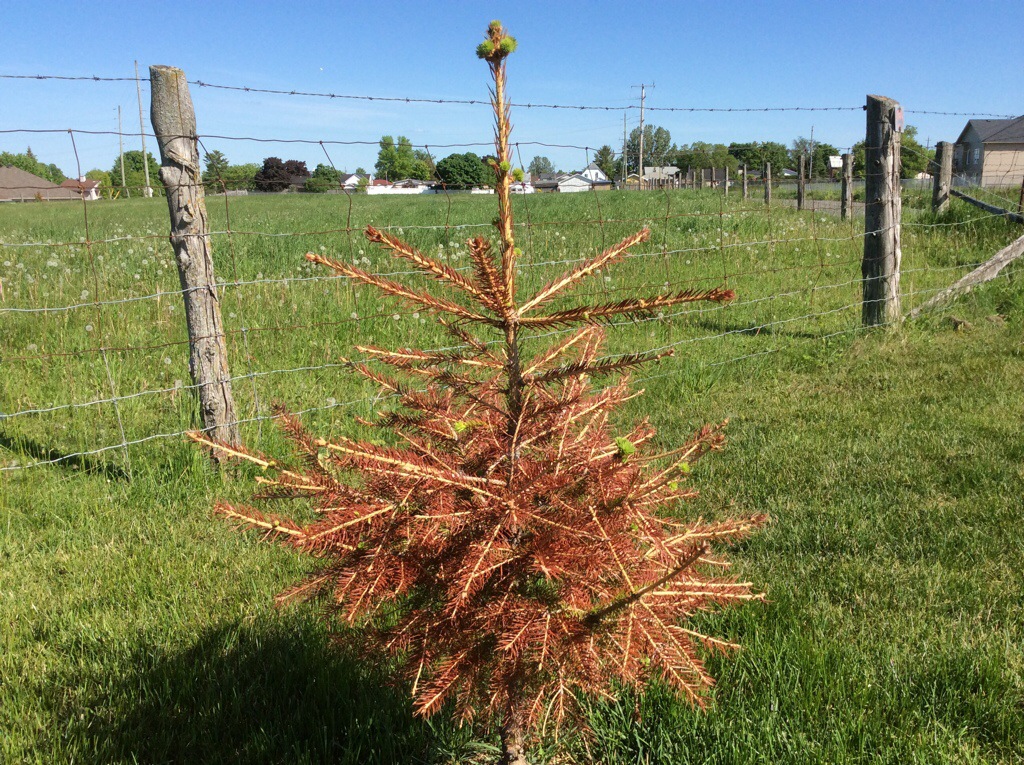
When we moved into our new house last Spring, there were no trees in our backyard. And so I went to a local nursery and bought a beautiful looking Norway Spruce tree, about four feet high, which I planted at the fence line. And I remember choosing this particular tree because it looked healthy; its deep and thick, verdant green branches were bursting with fresh, full buds, all over.

I watered it all summer long and fed it with fertilizer. In the winter I covered it with a folding board to protect it from the harsh winds and biting temperatures — which we had! I was going to make sure this tree would prosper!

So, tell me what you would do if you saw what I saw this Spring once all the snow melted: What would you do? (scroll down to see photo).

I must confess that my first instinct was to rip it out and start over. Find another tree. I thought, at first, that this tree was surely dead. There was no life in it anymore. Hopeless cause. Forget it.

But, for some reason or other I just let it be. I left it alone for awhile. And about a month ago, I noticed something remarkable. Do you see it? There are indeed signs of life showing: the green buds atop, and amidst the what looks otherwise like dead wood.

And I thought of my tree when reading the Gospel text for today (Matthew 10:24-39). Jesus seems intent on reminding his disciples of their worth, their value (“You are of more value than many sparrows” v.31) — despite everything that seems to the contrary. Remember, these disciples are not getting it; they misunderstand Jesus left, right and centre! They are imperfect, some would say — hopeless causes! Why would God even bother with those stupid disciples from Galilee? Riff-raff. Blue collar. Uneducated … the list goes on!

There is the story of a certain monastery — a monastic community which had fallen upon hard times. Only five monks remained in the motherhouse and all of them over the age of 70. Clearly, it was a dying order.

In the woods surrounding the monastery was a little hut, where a wise bishop lived. One day, the abbot thought it would be a good idea to visit this bishop, and ask him for any advice he might be able to offer, in order to save the monastery.

And so the abbot went and explained the problem to the bishop. The bishop commiserated with him: “I know how it is,” he said. “The spirit has gone out of the people. No one knows the joy and love of God anymore.” And so the old bishop and the abbot wept together. They read parts of the Bible, and quietly spoke of deep things together.

The time came for the abbot to leave. They embraced each other, and as they parted the abbot said, “It’s been wonderful that we should meet after all these years. But I must ask: Is there nothing you can tell me, no piece of advice you can give me that would help me to save my dying order?”

The bishop looked straight into the eyes of the abbot and said, “The only thing I can tell you is this: One of you at the monastery is the Messiah.”

When the abbot returned to the monastery, he told his monks: “The bishop couldn’t really help me. We only read some Scripture and wept together. But he said some cryptic thing as I was leaving — he said that one of us is the Messiah. I really don’t know what he meant by that.”

In the weeks and months that followed, the old monks pondered the bishop’s statement, and wondered among themselves if there could possibly be anything of significance to the bishop’s words. The Messiah? One of us? But which one? The conversations went something like this:

“Do you suppose he means the abbot? Surely if he means anyone, it is Father Abbot. He has been our leader for more than a generation.

“On the other hand, he might have meant Brother Thomas. Without a doubt, Brother Thomas is a holy man.

“But certainly he could not have meant Brother Eldred! Eldred can get really crotchety at times. But you know, come to think of it, even though he can be a thorn in people’s sides … when you look back on it, Eldred is virtually always right about anything. Often very right. Maybe the bishop means Brother Eldred.

“But surely not Brother Philip. Philip is so passive, a real nobody. But then, he has got a real gift of somehow always being there when you really need him. He just, like magic, appears by your side. Maybe Philip is the one ……”

And so, as they contemplated this matter together, the old monks began to pay greater attention to one another. They regarded each other with fresh eyes. They began to treat one another with respect, love and extra care. They related to one another keeping in the back of their minds always, that just maybe one of them might be the Messiah. Or, perhaps that each monk himself might be the one.

A beautiful forest surrounded the monastery, and people still occasionally came to visit the monastery — to picnic on its lawn, to wander along some of its paths, and even now and then to go into its dilapidated yet charming chapel, to pray.

And as they did so, without even being conscious of it, they sensed this aura of respect and grace that now began to surround the five old monks …

And radiate out from them.

There was something strangely attractive and compelling about the atmosphere about the community. Hardly knowing why, these visitors began to return to the monastery to picnic, to play, and to pray. They began to bring their friends to show them this special place. And their friends brought their friends.

Then it happened that some of these visitors started to talk more and more with the old monks, and ask them questions: “Why are you here?” “What are you all about?” “Who are you?” etc. etc.

After awhile, one asked if he could join them. Then another. And yet another. And within a few years, the monastery had once again become a thriving order focused not on its own self nor plight — but in others with whom they came into contact in their daily routines about the community.

This story touches on the practice of being church. Community in Christ is not about navel-gazing and conformity. It’s not about seeking a gathering of the “like-minded”. Belonging in the family of God is not about being the same, or tying to be the same, with everyone else in the community.

Being in a church is about meeting others who are not like me. Being part of the church is about discovering God in difference, in others who are different from me and my ilk. Often that comes about by first noticing what you might not choose to be like, yet seeking to understand from where the other is coming, and appreciating their gifts.

And perhaps this story might give us a clue as how to appreciate the disruptive words of Jesus in our Gospel text — about loving God before loving our family. The Gospel of Jesus Christ is not about forming exclusive communities or clubs of like-minded people.

Rather, the Gospel is continually calling us to go out into the world in order to discover what God is already up to in other people who are not ‘part of our family’. Our worth and our value has a purpose — “to proclaim [the Gospel of Jesus] from the housetops” (v.27). As we have heard from many church leaders in recent years — “the church exists primarily — it’s primary focus — for those who are not members of it.”

This challenges each one of us, first to see the Christ in one another, and also see Christ in the stranger. And remembering that if God doesn’t give up on us who are far from perfect — if God sees the value and worth in us even when we might only see the blemishes — so God asks us to value an outsider as potentially being visited upon by Jesus himself.

20140620-110751-40071026.jpg

Funeral sermon – A special grace given

Just this last week in the news you might have heard that a 74-year-old nun from Quebec was released from captivity after being abducted two months ago by armed rebels in northern Cameroon.

And just around that time we heard that an American soldier was released after nearly five years of captivity in Afghanistan at the hands of the Taliban.

When hearing this news, I wondered how those held hostage were able to hold it together. Not knowing for sure when and if they would be released, somehow the nun and the soldier endured their captivity. They persevered, with no guarantee that they would be saved. For all they knew, those prisons could have been the last thing they ever saw.

When I met recently with Brenda, I noticed this quality of perseverance in her. She never gave up hope. She didn’t waver in what she presented to others. She gave determined witness to the faith that she would not be defeated by her illness.

After meeting with her, I wondered in a similar way I did after hearing about the nun and the soldier held hostage for significant periods of time. How could she endure? How was this possible? How did she do this? Without knowing for sure how things would turn out?

Brenda’s from the Upper Ottawa Valley. I want to welcome members of Brenda’s family who made the trip at least a couple of times down to Ottawa. Perhaps some of you know a retired pastor who has for many years made the circuit among Lutheran churches in Valley. He once told me something I have not forgotten.

He said that God gives a special grace to people at two events in life: First, God gives a special grace to people in their dying; that is, when someone dies God gives them a special strength and ability to do so. And this is not something always and easily perceptible by those witnessing the death, and is known fully, only by the person who is dying — this special grace.

The other event in life when God gives a special grace is to birthing mothers; when the time comes, finally, to give birth, God gives a special grace to endure this trying yet hope-filled event. At these profound moments of life and death, God gives to those who must endure them, a special grace.

And that is the only explanation I can give for understanding the incredible gift of perseverance and final peace with which Brenda endured this last chapter of her life on earth.

The story of Job from the bible is a testimony as well to this incredible ability to proclaim a steadfast faith in the midst of suffering. He lost everything — his family, his property. He suffered disease and ridicule. You would think that his profession of faith would come only after all his fortunes were restored, which they were right at the end of the book of Job, chapter 42. But Job doesn’t wait until chapter 42; already at chapter 19 he can proclaim a great faith even in the middle of suffering greatly.

We are Christian not because somehow now we have the secret to cheating death. We are Christian not because we can avoid suffering in this life. We Christian not because we can prove miracles sometimes happen. We are Christian, because we discover and receive the gift of grace to embrace our faith whenever we do have to suffer in life.

There is a beautiful image in the Gospel of a giant tree where birds of the air find refuge and make nests in its branches. Jesus tells the story of the mustard seed — small, seemingly insignificant, hardly noticed. It’s the smallest of seeds, barely perceptible.

“It is the greatest of shrubs and becomes a tree, so that birds of the air come and make nests in its branches” (Matthew 13:31-32). We could interpret those words “so that” merely as a descriptive consequence of the mustard seed growing into the largest of trees — that, among other things, birds would find safety in its branches.

But we could also interpret “so that” as the reason why a mustard seed is great. Because it provides shelter, care and compassion for the creatures of this world. There is an important purpose and mandate for that ‘greatness’.

The faith that can move mountains is a faith not easily noticed, perceived or appreciated by the world. Because it is the gift of compassion and care. It is the gift of grace and love which embraces others and provides shelter to those in need.

That is the greatness of faith. It is a faith that recognizes the compassion of our Lord. It is a faith that recognizes God’s steadfast love no matter what happens. “Neither death nor life nor anything in all of creation can separate us from the love of God in Christ Jesus our Lord” (Romans 8).

Brenda showed that grace to others in her life. But she endured these last days because of the compassion and grace given to her. Those around Brenda, closest to Brenda, you showed abundant grace, care and compassion — to put Brenda’s needs before your own, at times of joy in life but also, and especially, in the most dire of circumstances. And that’s the greatness of faith.

The special grace of God is given to Brenda. The prize is hers today. She has endured. She is released from her captivity. And this special grace is ours, also, forever. No matter what may come.