Alone no more

Mary and Joseph mess up. Their only child, and they lose him. (read Luke 2:41-52) Aren’t parents supposed to know where their kids are, at all times?

Now, of course, this stuff happens all the time to the best of us—in large crowds, at amusement parks, sports stadiums, Disney World, the mall. Unintentionally we make mistakes. Each of us can likely relate to a time when we got lost and felt abandoned by our parents, and how that felt. Or, how as parents we lost track of our child. And how that felt. The fright. The embarrassment. The shame.

Maybe it’s a comfort to know that even Mary and Joseph parents of the Christ child didn’t get the parenting thing right, on occasion. Today, we would communicate that in social media as #parentingfail.

I’m reminded of the popular Christmas movie, Home Alone, when a family plans a European vacation for Christmas. The relatives all arrive for the big event. But in all the commotion the youngest son feels slighted. Expressing his frustration inappropriately, he is punished and sent to a room in the attic.

There, in a fit of anger, he wishes that his family would go away so he could be all alone. The next morning, in their rush to get ready and leave for the airport, the family overlooks the little boy in the attic. They get to the airport and board the plane, all the while believing he is with them. The boy gets his wish when the next morning he finds himself home alone.

The twelve-year-old boy Jesus experienced the feeling of abandonment by his parents. Perhaps this was a foretaste of the abandonment of the cross he would experience at the end of his life. It appears Jesus knew already from a young age what it felt like to be a human being. It appears he learned to accept the follies and misgivings of the human condition. For, he experienced it himself. At the end of the story, he felt the joy of being found and of not being alone anymore.

In the Judaeo-Christian tradition, the temple was a sign of God’s eternal presence. And so we have a clue as to why this story from Luke is read on the First Sunday of Christmas. Because, without the temple, how else would this story fit? After all, Christmas is about the birth of Jesus. And this story is about Jesus on the verge of adulthood, his ‘coming of age’ story from the bible.

Jesus was found in the temple, engaged with the learned in conversation about God. In his childhood experience of abandonment—in the midst of it—he was still in God’s presence. He was found in God’s presence.

Christmas is about the promise of God to be with us. It is about the grace and gift of God-with-Us, Immanuel. Immanuel is the name given to Jesus by the angel in the Christmas story. It is a name to give us hope.

God is with us, even in the darkness of grief. God is with us, even when we feel abandoned. God is with us, even when we are lost and forsaken. God is with us, even when we are confused and don’t know what to do. God is with us, in all our losses, pain and especially in our suffering. That is why this story, I believe, is included in the Christmas repertoire year after year: To remind us of this holy promise of hope at the darkest time of year: God is with us.

It feels like once we celebrate those first few days of Christmas, time seems to thrust forward in leaps and bounds. At one moment, we are cooing with the barn animals at the baby in the manger and singing hallelujahs with the angel chorus over the fields of Bethlehem.

And the next, we actually fast forward over a decade in the story of Jesus to this temple scene when he is almost a teenager. The Christmas message catapults us from the past, into the present and towards the future in a kaleidoscope of events that unite in the meaning of God-with-us.

A gift-giving tradition in our family is the exchange of books. I just finished reading a fiction which told its story by shifting forward and backward in time. In reading through the book from beginning to end, there were times when it felt a bit dis-jointed, where I asked myself especially early on: What does this detail or this person have anything to do with the story? Why is the author spending so much time and several pages describing this particular scene or detail? How does it all fit together?

This technique, of course, kept me hooked. I was committed to the journey. I had to trust that in the perplexing ‘set-up’ the author was providing, there would eventually be a satisfying ‘pay-off’. And I wanted to know, and feel, the resolution to the mystifying issues, sub-plot lines and character developments. I had to trust and hope that the longer I stayed with it, at some point, there would be some satisfaction to the bemusing chronology of the storytelling.

People will often say, there is a reason for everything. Even when bad things happen, they will say there was a divine purpose. I would sooner say, in everything that happens—good and bad—God is present, and there is reason to hope. Because we don’t know the mind of God.

As soon as we say ‘everything has a reason’ we presume our suffering is a consequence of our not knowing. But knowing ‘why’ is not our business. We cannot comprehend the fullness of the divine mystery and purpose. We can’t really pronounce on what God is up to in the evolution of reality and history. We can only make the next step. Our task is to become aware of God’s presence in all our circumstances.

In hope.

If we are not a people of hope, we are not human—just animals scavenging for survival and reacting to impulse. If we are not a people of hope, we are not the people of God who are called to see beyond the circumstances of the desert and darkness of this world with all its suffering.

In hope, time is really irrelevant. In hope, the past and future collapse into the present moment. That’s where we live, anyway. This time of year is not well-behaved, neat, and orderly. To be faithful in this time-tumbling season is to stick with it despite the disorderliness of our past, present and future, and not just give up.

We can appreciate the good in the past and can anticipate the good that is promised in the future. We can hope that no matter what lies before us or what happened behind us, there is good that still awaits. There is good that is here.

God is here. God is present. God is involved, now. That’s the meaning of Christmas—God is now with us, Immanuel. For now, and forevermore, God sheds tears and rejoices alongside us. God walks with us on this journey and will never abandon us in God’s love.

Hope is what keeps time. Hope is what connects the past and the future into the marvel of the moment. A moment in time infused with grace.

Where does hope reside in your life? In what activity? In which thoughts? What feelings are associated with hope, for you? How do your thoughts, your actions and your feelings reflect hope today?

May you be open to the blessing of God’s presence, in the New Year.
Christmas funeral sermon: God-with-us love

Please read 1 Corinthians 13 (v.1-8,13); Romans 8 (v.35,37-39); Matthew 28:20

In a popular Christmas movie, Home Alone, a family plans a European vacation for Christmas. The relatives all arrive for the big event. But in all the commotion the youngest son feels slighted. Expressing his frustration inappropriately, he is punished and sent to a room in the attic.

There, in a fit of anger, he wishes that his family would go away so he could be all alone. The next morning, in their rush to get ready and leave for the airport, the family overlooks the little boy in the attic. They get to the airport and board the plane, all the while believing he is with them.

When the little boy wakes, he discovers that there is no one in the house and believes his wish has been granted. He is home alone.

And he is delighted, even delirious with joy. For the next few days, while his family tries frantically to return to him, the little boy has full run of the house. He eats all the junk food he wants, watches whatever movie he wants, sleeps wherever he wants, and doesn’t have to answer to anyone.

But then burglars try to break into the house, and he discovers that his aloneness has made him vulnerable. After the burglars have been foiled with his inventive array of booby traps, the boy realizes how lonely he is. Being alone, without his parents and the rest of his family, isn’t as wonderful as he thought it would be.[1]

I think about this funny yet poignant movie in light of what we do today. We remember and celebrate the life and love of a beloved son, father, brother, uncle, friend and colleague.

Your loved one was a funny guy. He appreciated good, practical humor. Even in his final moments, he expressed his love to you in a gently humorous way. I suspect your loved one might have praised the little boy’s ways of foiling the burglars in Home Alone.

There are, of course, various ways people show love. Gary Chapman in his bestseller, “The Five Love Languages”[2], identifies different strategies for expressing love: through acts of service, words of affirmation, physical touch, giving gifts, spending quality time.

It’s true: there isn’t exclusively and only one, valid way of expressing love between people. It’s important to know how you do it yourself, and then equally important to know what your loved one’s preferred strategy is. To that list, I would add humor. Although it is often misunderstood.

God’s way of showing love is often misunderstood. People ask: If God is all-powerful and all-benevolent, why does God allow suffering to happen? How is God being loving when tragedy strikes, and when bad things happen to good people?

 Yet, God minds the gap, so to speak. God blesses the space between us. Irish poet John O’Donohue wrote a book of blessings entitled: “To Bless the Space Between Us”.[3]The title alone captures the essence of his poetry—blessings for people at the edge of an experience or relationship where there is a space, a darkness, a longing, a want, a suffering.

If God loves us truly, God will give us the freedom to choose, and not force nor demand our love in return. In the Home Alone scenario, the boy had to experience the freedom of his ways before realizing what he truly wanted—desiring to be with his family again.

Because God loves us, God gives us the freedom, the space. God does not smother us or make us into robots. God is not a control-freak. God honors the space. God lets us figure it out. Make mistakes. Find our way. God is patient. God is free.

To be sure, in the darkness of night, in the being home alone, we struggle. In the darkness of grief and pain, sight is compromised, vision is blurred, fear and desperate feelings can suffocate. And yet, it is in the darkness of the gap between this world and the next where God is, and comes to us as God did to your loved one, in his moment of greatest need.

One of the most common words we hear each and every Christmas is: Immanuel. The word adorns Christmas cards, is sung in hymns and carols, is painted or sewn on banners. Yet the impact of this word is often lost on us. Immanuel is one of the names of God, one of the most beautiful and enlightening names of God. And it explains one of the great reasons for Christmas in the first place.

The Christ child is called, “Immanuel”, which means “God is with us.” Not just in the ‘peachy’[4]times when all is well. But especially in the night. In times like this.

Christmas celebrates the coming of God into the dark night. The angel chorus announcing the birth of Jesus to the shepherds brightens the night sky. The back drop of this heavenly scene is a very dark time—on every level: politically, socially, historically.

Passing through the night, it is now ‘peachy’ with your loved one, our faith will say. The promise of the dawn is there for us all. The night will not last forever. How can we move towards that new day while we still walk in the dark as yet by faith?

Because Christmas celebrations are often lonely affairs for many, many people; because even those who have many friends feel alone—especially now, we can live the promise and truth of ‘God with us, Immanuel’. We can extend the love of God-with-us by sharing our presence, our love—in whatever language of love we use—to those who may need that extra special attention: a shoulder to lean on, a listening ear, an understanding smile, an act of kindness.

Humour can only be understood in relationship: a relationship of trust, of readiness to forgive, of unconditional love. Humor opens the soul, the heart and the mind to accept reality and look at things in a fresh way.

That’s healthy. To continue to build and strengthen those relationships among family and friends even now that he is gone from us. Your loved one’s gift to us can be this posture of openness, and encouragement to express God-with-us love to others.


[1]As described by Dan Schaeffer in his Introduction to God With Us: Christmas Reflections from Our Daily Bread (Windsor: Our Daily Bread Ministries Canada, 2018) www.ourdailybread.ca

[2]Gary Chapman, The Five Love Languages (Chicago: Northfield Publishing, 2015)

[3]John O’Donohue, To Bless the Space Between Us: A Book of Blessings (Toronto: Doubleday, 2008)

[4]A favourite word of the deceased

funeral sermon in Advent: Faith in the Night

From the Gospel of John, the first chapter (v.5.9):

“The light shines in the darkness, and the darkness did not overcome it … The true light, which enlightens everyone, is coming into the world.”

These days, we walk in darkness.

December 6thwas the first day the sun set the earliest it will all year long—at 4:19pm. And that will be the case for another week before the days start getting longer again. Your beloved died at, literally, the darkest time of year.

And, so it is with your grief at this sudden loss. It is a dark time, indeed, that you journey these last days of a significant year in the life of your family.

At the end of the year. At the end of a life shared together. It is dark. And it is in the darkness that we must remain, for some time.

We may feel like love is lost at times like this. In the intensity of grief, the finality of death hits like sprinting into a brick wall. The familiar bonds are severed completely. And the prospect of a radically changed life, now, chill the heart with fear and uncertainty.

Where, O Love, is Thy soothing presence? Where, O Love, is Thy warming touch? Where, O Love, is Thy reassuring voice?

For Christians, this loss is symbolized by the cross. And in the cross we see a cruciform shape to reality: Loss precedes renewal; emptiness makes way for every new infilling; every change in the universe requires the surrendering of a previous ‘form’.[1]

At your loved one’s bedside on December 6, you described to me the image of wings of protection and love that your beloved offered in prayer and in spirt for his children and grandchildren. The image of wings of love surrounding his family is a tender one.

In the bible wings describe the loving and protective stance of God towards us. “I gathered you as a hen gathers her chicks under her wings” (2 Esdras 1:30). The Psalmist prays: “How precious is your steadfast love, O God! All people may take refuge in the shadow of your wings” (Psalm 36:7).

May the image of holding a bird demonstrate the kind of love we need now to express in this time of loss. They say that to hold a bird, you can’t hold it too tightly. When the chickadees fly into the palm of my hand when I feed them nuts and sunflower seeds, I cannot, dare not, clasp my hand into a fist.

I must keep my hands open. They say that to show true love you must be willing to let the object of your love go. They say that to love, one must let go. One cannot control true love, hold on to it tightly. To be sure, there are times in life when love calls for a tighter grip, especially when giving direct care to one in need, or guiding and parenting children. In these situations, yes, a firmer hold in love may be necessary.

But at other times, especially when dark times of the year come around which they do for all of us, love demands a different approach. People wonder, understandably so, why if God is Almighty and Benevolent, why God allows those dark times to even happen at all.

If God truly loves us, God will offer love freely and not demand it be returned. If God truly loves us, God will give us freedom. God will let us go. Not abandon us, because God is everywhere. But give us the freedom to love and to let go.

And, you know also the saying: What you let go in love, like giving a tiny bird freedom to fly away from your hand, will return to you in love. Perhaps not in exactly the way you expected. Perhaps not according to your timing. Yet, this is the nature of God’s grace and love: In letting go, we discover and experience the surprise of love’s return in some form, some day.

What else can be said about December 6th, besides the day your beloved died? December 6th, of course, is Saint Nicolas Day. If anything can be said about Saint Nicolas is that he was generous. Generous to the poor, to those in need. Your beloved was generous to you with his love. The gift of generosity is given on the day your beloved died.

How can we continue in the love freely given and freely received in the union of marriage and family that was severely disrupted on the day your loved one died? The symbolism of the day cannot go unnoticed, unrecognized. We can continue in the legacy of your beloved is leaving to us: to pay attention to the needs of the vulnerable, the children. To be generous with the gifts God has given us to share with those in need. This is an honorable expression of our love for your loved one. This is a worthy focus of our energies as we wander in this dark time of loss and grief.

Yes, “grief and anxiety has gripped us, and we are frightened by the future. Yet, even in these times, God is there. The good news is that Jesus always comes again. Every year, despite how hard things have been, Jesus is born into our lives anew. Death is never the final word”[2]– divine love comes and gives us life. Again.

May love be our guide through these dark days, and into the bright hope of a New Year.


[1]Richard Rohr, Daily Meditations (Center for Action and Contemplation,  www.cac.org) 7 December 2018)

[2]Lutherans Connect “Faith in the Night” DAY 7 (Lutheran Campus Ministry Toronto, 8 December 2018), lcfaithinthenight.blogspot.com

Pilgrims rising

Don was a husband and father who one day was commuting home after work in a bad thunder storm, when the car he was driving was struck by lightning. Don was okay, and he managed to get home. Sitting down with his teenaged children, he relayed to them his harrowing experience.

Expecting at least a small degree of sympathy from them, Don was perplexed when his eldest interrupted: “Quick, let’s go buy a lottery ticket because they say the chances of being struck by lightning are like the chances of winning the lottery.”

The disconnect we feel in how Jesus’ disciples often responded to him is not dissimilar. He tells them he must die a horrible death. And they respond by demanding seats of power, authority and glory beside Jesus. His disciples continually seem out of sync with their leader’s meaning.

The Gospel for today[1]must be read in the larger context of Mark’s writing here. In Mark, we see that this is the third time Jesus announces his death, the third time the disciples respond in perplexing ways, and the third time Jesus responds to them by giving them a commentary on true discipleship.[2]

By looking at the what comes immediately before this text, we also discover that the disciples who followed Jesus were afraid.[3]It’s fair to presume, then, their desire and request to secure positions of glory once Jesus took his rightful throne on earth and/or in heaven was born out of fear.

The connection between fear and striving for security is common in all of us, to this day.

We are afraid. We fear the changing realities which make new demands on our time, energy and resources in the church. We fear the outcome of our health concerns. We fear the effects of an uncertain future, in our nation, our world and in our personal lives. In the fear of the unknown, it is a natural knee-jerk to secure anything down. Do something, anything, to give yourself the illusion of control. An insurance policy.

Let’s give the disciples the benefit of the doubt, to suggest perhaps they were aware that Jesus’ path was going to lead to his arrest, torture and death. And they knew that likely they, too, would be caught in the crossfire. They were probably aware that Jesus was causing an uncomfortable stir among the powers that be, religiously and politically, in Jerusalem. They saw the writing-on-the-wall.

And in the midst of this fear, the Sons of Zebedee tried to insure some benefit for all the sacrifices they were already making and would likely continue to make. Perhaps if they didn’t understand something, it was they couldn’t yet grasp the depths of the sacrifices they would make as a community of faith.

What Jesus stands for is a different way altogether from the way of the world. The disciples are caught up in the power plays of the world. They have in mind a hierarchy, a pecking order, of who’s on top. There is this Machiavellian feel to the debate amongst themselves, as if relationships of power must only be a win/lose scenario, a zero-sum game where in order to get ahead some people have to be left behind.

The way of Jesus, in contrast, is the way of the Cross. Jesus exposes the false way of the world by surrendering to it and dying by it. The way of the cross exposes our folly and calls us to a deeper more inclusive way.

Martin Luther first coined the phrase in his Heidelberg Disputation written in 1518. He called it, “A theology of the cross.” It is a way of understanding and imagining God. That is, God was, and is, being revealed to us in all truth most clearly and unequivocally in suffering. In the vulnerability and pain of death on the cross, Jesus revealed—and continues to reveal—the God who suffers alongside us wherever there is pain and suffering in the world.

Luther thus criticized a “theology of glory” which presumes God validates faith, and is only validated by, success, measures of progress and triumphal conquering over any weakness or adversary. This theology dominates not only in our society, but sadly also in the church.

A theology of glory reflects an unbridled, Pollyanna optimism that avoids and resists places of defeat, failure, vulnerability and weakness as having anything to do with divine identity or purpose. A theology of glory undermines real people and a God who is known in the darkest times and places of life. It despises our common humanity and the losses we all endure.

The way of Jesus is for all people, not just for those who make it to the top. The way of Jesus is for all people, because we all have our crosses to bear. We can share in our common suffering. And grow together. It is therefore in community, the Body of Christ, the body ‘broken for all’ we say in the Communion, where Christ is revealed and where our true purpose is born.

#OttawaRising is the hashtag used, announced and displayed on Ottawa Senators Hockey club promotional material. The vision is of the team rising out of the ashes of disappointment from last season. That was the season from hell, when they finished second-to-last place in the league standings, suffered through a broken, conflicted locker room and as a result had to trade away star players.

But it is only standing in the ashes that you can claim the vision of ‘rising’ again. The Stanley Cup champion Washington Capitals wouldn’t declare resurrection as their identity, this season. It only makes sense to proclaim the resurrection in the midst of the defeat of the cross.

The Gospel abounds with a promise. The disciples may not hear it as such. But Jesus has great compassion on them. He does not rebuke them for being out of sync with him. He affirms that they will indeed drink the cup that he must drink and be baptized with the baptism that he must endure.

Jesus will continue to offer this promise and hope to us, that we will not always need to act and respond out of our fear. That what we do as a community does not need to be knee-jerk platitudes that only keep us stuck in cycles of fear, self-preservation and defensiveness. Jesus will continue to call us into deeper expressions of serving others and of paying attention to the needs of others not just our own.

If there was anything the disciples should have known with any amount of certainty, is that Jesus’ promise is secure and very sure. Because by being in last place, and losing it all, those first disciples would one day rise.

And so will we.

[1]Mark 10:35-45

[2]C. Clifton Black in David L. Bartlett & Barbara Brown Taylor, eds., Feasting on the Word: Preaching the Revised Common LectionaryYear B Volume 4 (Louisville Kentucky: WJK Press, 2009), p.189.

[3]Mark 10:32

Funeral sermon for an African-Canadian: Room for all

‘Do not let your hearts be troubled. Believe in God, believe also in me. In my Father’s house there are many dwelling-places. If it were not so, would I have told you that I go to prepare a place for you? And if I go and prepare a place for you, I will come again and will take you to myself, so that where I am, there you may be also. Peace I leave with you; my peace I give to you. I do not give to you as the world gives. Do not let your hearts be troubled, and do not let them be afraid. (John 14:1-3,27 NRSV)

The more I reflect on the gospel text you chose for reading this day, I have to conclude that Jesus has always been preparing room for your beloved, throughout his life.

The first room was in Ghana, his birthplace. Shortly after he was baptized in a Presbyterian church, and later attended the Missouri Synod Lutheran church there. You were married in 1971. Over the next several years you had four children and started to build your family life. A room you called home.

A political coup in Ghana in the 1980s created conflict between the nation’s lawyers and the self-acclaimed government. Lawyers defended the rule of law which threatened the legitimacy of the coup d’état. God was preparing another room for him and the family.

Fearing for his safety he fled to Nigeria where he stayed for five years while the rest of the family stayed in Ghana. You came to Canada in 1988 for six months, as participant of an exchange program between Carleton University and Ghana Institute of Management and Public Administration where you were a lecturer. Your husband visited you in Ottawa and decided to put in an application as a refugee in order to unite the family. It took five years, but in 1993, after 10 years of separation the family was finally together in Canada.

You received help from this congregation as they settled into their new life in Canada. People in this congregation, and other friends, gave you furniture and other means for getting used to living through cold, Canadian winters. Here was yet another room, on earth, that the Lord had prepared.

I recall some of this family history to underscore, broadly put, the importance of community in a Christian’s life. The story of immigration and supporting refugees escaping untold threat and terrors in their homelands is not unique to Theo and his family.

Standing on the side of refugees and migrants and immigrants—this is a central part of our identity not only as Canadians but as Christians and Lutherans. Our values are thus defined because we are a nation of immigrants, to be sure. And in God’s love for all humanity, we continue to this day to do what we can to support those newly arriving in Canada.

God sets the bar and calls us to follow—there’s room for everyone!

Through the turmoil and disruption of those decades late last century, your beloved had to believe, and nurture his faith. He had to trust that good would eventually prevail. He had to lean on God to get him through those lonely days separated by a vast geography from his loved ones. He had to depend on others—his own resources, the gifts and good-will of friends, and upon the grace and presence of God in his heart.

In the last six years that I have personally known him, especially as his cognitive and physical abilities declined, there was one thing that did not change each time I visited him: His face brightened, and his eyes looked like they were going to pop when I opened the bible and prayer book. He was fully attentive as I read familiar prayers and scriptures.

And for all that cannot be known and cannot be said about the mystery of the sacrament, he craved the sharing of the bread and cup in the Holy Communion. With few words spoken, he grasped for and received a tangible sign of the true presence of the living Lord Jesus.

Enough cannot be said about his expression of faith, especially the last years of his life. As he declined, he had to stop attending all the activities in which he loved to participate.

Except bible study. To the end, he would faithfully attend the regular bible study at the nursing home. If when I dropped by he was not in his room and I would ask a PSW or nurse where he might be, the answer was unanimous and consistent every time: In the chapel. Everyone knew that about him. And, more often than not he was there with his bible and prayer books open on his tray.

Even in this latter time of his life, his faith was expressed in community. It was room shared by all. And it was and is in a faith community where God prepares the soul for our final home in union with God. Just like when others supported him get to and settle in Canada as a refugee, decades ago—his faith was again validated by the loving presence of care-workers, church volunteers and staff in the nursing home. In faith, we are not an island unto ourselves. His life and faith demonstrated this in so many ways.

Jesus has indeed prepared an eternal dwelling place for your loved one. Today, he rejoices in the full presence of God where he now sees face-to-face. I believe his death on Thanksgiving is significant. It is a heavenly signal to us about what we need to do during times of loss and grief. At a time in Canada when we pause to give thanks for all the good in our lives, we therefore give God thanks and celebrate the gift of your beloved—a dear husband, father, brother and friend.

Thank you, God, for giving him to us and to the world, to know and to love. Amen.

Thanksgiving not a 1-day event

Thanksgiving is not a one-day event.

Canadian Thanksgiving weekend is upon us. Even so, we know that for many of us in Ottawa feeling thankful is not easy at this time. Especially in the aftermath of the tornadoes, what about the folks in Dunrobin?

Indeed, difficult circumstances in life can challenge our attitudes and beliefs. Bad news can dampen any uplifting feelings. We may even react angrily to those who tell us to be happy and thankful.

Perhaps if we understand thanksgiving more as something we do over time rather than a one-shot deal, we can get through those tough times. Perhaps if we see thanksgiving as something that grows slowly in our hearts rather than an artificial nostalgia imposed during one Fall weekend in October, we can find a way through all the topsy-turvy feelings in our lives. True, thanksgiving is an attitude and corresponding action of ‘giving’ more than a self-serving emotional exercise.

The restoration efforts in Dunrobin, Gatineau and parts of Nepean continue. And they will, for some time to come. The needs of those rebuilding their lives didn’t stop in the week following the devastating tornadoes.

Below is a list compiled last weekend by a neighbor living in the Cityview community. Please consider the various opportunities to help those in need, locally. And, in so doing, giving thanks despite all that’s not perfect in the world.

May God grow the seed of thanksgiving in our hearts at this time of year.

What you can do:

1. Donate to the Red Cross, which is helping both Ottawa and Gatineau residents.

Ottawa: http://www.redcross.ca or by calling 1-800-418-1111.

Gatineau: http://www.gatineau.ca/croix-rouge

2. A financial donation to the Ottawa Senators’ fundraiser on GoFundMe.com. Ottawa-Gatineau supporters have donated $187,798 and the Ottawa Senators Foundation is going to match the total amount raised.

Visit their page at: https://www.gofundme.com/ottawa-senats-amp-fans-tornado-relief

3. Donate clothing, furniture or other household items to St. Vincent de Paul. To locations in Ottawa: Merivale Rd and Wellington

4. In Gatineau, donations of “clean clothing in good condition, personal hygiene products and non-perishable foods” can be dropped off at the former Sears location at the Galeries de Hull on Boul. Saint-Joseph.

5. The food banks are in need of donations. It is best to call them to find out what is needed most. Here are just a couple. There are others too in Gatineau.

The Kanata Food Cupboard – http://www.kanatafoodcupboard.ca/ – it is open for donations on Monday from 9 a.m. to 4:30 p.m., and will coordinate delivery to the locations “most in need.”

The Ottawa Food Bank – http://www.ottawafoodbank.ca/ – you can hold a food drive, volunteer, and/or make a donation through their website.

6. CBC has set-up The “Ottawa-Gatineau Tornado Community Connector” Facebook group is a place for anyone to share their ideas to help people without power or looking for shelter and supplies.

A New Way to Pray: Tracking the Trajectory of the Reformation

What follows are the lecture notes for Week Three in the course I am giving at the Ottawa School of Theology and Spirituality (www.osts.ca) this Fall. Reformation Sunday is on the last Sunday in October, October 28, 2018. It is a time for Lutherans and all Christians to reflect on the legacy of Reformation, commemorate its contributions, and to pray for unity among all who try to follow in the Way of Christ Jesus today.

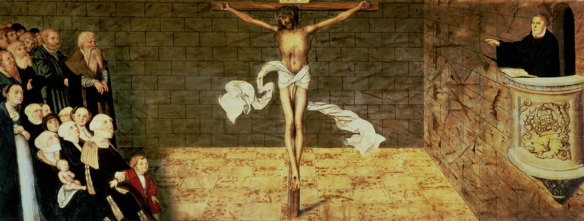
Lucas Cranach was a Renaissance painter and printmaker in woodcut and engraving. He was a friend of Martin Luther and his wife Katharine von Bora. In one of his paintings (1547) focusing on the Cross of Christ, Cranach depicts Martin Luther preaching to the congregation. I remember this particular painting vividly as it hung above the bookshelf in my house growing up.

image.png

It shows Martin Luther standing in a pulpit perched high on the wall of the chancel at the front of the medieval church. One of Martin Luther’s hands rests on the bible. And he points with his other hand to a cross with Jesus hanging bloodied bruised planted in the floor space between Luther and the crowd gathered in the church. Jesus hanging on the cross forms the center of this work of art.

Today this painting comprises one of the plates surrounding the altar in the Wittenberg church where Luther preached. As such, we often recognize and associate this painting with the ‘Reformation altar’.

Its prominence in Lutheran history suggests how poignantly this painting describes Luther’s theological bias: The Cross stands at the center. And Christ crucified informs everything in the church and even our reading of the bible.

Before we can embrace deeper understanding of Martin Luther’s theological claim that we find salvation by God’s grace—which finds us— through faith, we must first encounter the centrality of the Cross in Luther’s thinking and prayer.

In the seminary that I attended[1], we used the term, “Theology of the Cross”. Martin Luther first coined the phrase in his Heidelberg Disputation written in 1518. A theology of the cross is a way of understanding and imagining God. Fundamentally, in addressing God, we need to ask the questions: What is my image of God? Where is God primarily revealed? How is God best known?

Luther provided an answer: God was, and is, being revealed to us in all truth most clearly and unequivocally in suffering. In the vulnerability and pain of death on the cross, Jesus revealed—and continues to—the God who suffers alongside us wherever there is pain and suffering in the world. It is no wonder, then, that the longest sections in each of the four Gospels in the New Testament are dedicated to the various passion narratives[2]of Jesus.

Therefore, the Cross is theologically vital not just to Luther but to the Apostle Paul (the central figure of the Acts of the Apostles and some of the earliest Christian writings and Epistles) who central theme is: “God’s power is shown in human weakness.”[3]

The Theology of the Cross is contrasted to a Theology of Glory. Especially today among spiritually materialistic cultures in the West, what has been coined ‘a prosperity gospel’ has grown in popularity. This theology of glory presumes God validates faith, and is only validated by, success, measures of progress and triumphal conquering over any weakness or adversary.

A prosperity gospel fueled by unbridled optimism avoids places of defeat, failure, vulnerability and weakness as having anything to do with divine identity or purpose. A theology of glory undermines real people and a God who is known in the darkest times and places of life. It compromises and even derides a common humanity and the losses we all endure.

Prayer, as I have said, is the act of letting go. If prayer begins with God, and our address of God, we must presume before all else who this God is, and how this God is revealed—in scripture, in tradition and in our own experience.

One of the first creeds that circulated among the earliest Christians is from a hymn imbedded in Paul’s letter to the Philippians 2:5-11. The poetry first describes the descent of God. This is the primary movement of God, and of faith: downward. The Almighty chose to enter the lower and lowest regions of human birth, life and death. Only after this primary downward movement can the rising out of the depths happen.

Theologians over the centuries have used the term kenosis, from this text in Philippians, to capture the primary movement of faith. It starts with Christ’s self-emptying and letting go of God’s pure, divine nature. In God’s humility, Jesus compromised a perfect divinity in order to take on the fullness of a human existence.

Our God is a God who lets go, releases, self-empties what has become part of the God-self. This calls for a descent of the soul which in the words of St John of the Cross entails, indeed, a ‘dark night’ of the soul. Prayer is not easy, in so much as it may very well be simple.

Prayer, in the words of Laurence Freeman, “… always involves us in the paradoxes of growth, the cycle of losing so that we can find and then of having to let go of what we have found.”[4]

Prayer is a continual process of detaching and dislodging from places of comfort, stability and strength. Prayer is a deconstructive process. It is disruptive. In prayer we begin first to detach our self from all that we are attached to, all that has defined our identity and lives, all our constructs—mental and material—that constitute the construction and containment of our ego. All of this, in prayer, is placed on the precipice of loss.

All is not lost, however. Because in action and contemplation prayer’s aim and understanding is the prayer of God and for the sake of the God of the Cross. “Prayer calls the active person to a life of interiority and soul discovery … by detaching from all the fruits of action and doing everything purely for the love of God.”[5]In letting go, we discover our true self in God which includes and transcends all that we have been and are becoming.

By kenosis we resolve the Lutheran paradox. Some complain that the grace of God is cheap, such as Dietrich Bonhoeffer last century who sacrificed his life for a greater cause of justice in the Nazi regime. He wrote a book entitled, “The Cost of Discipleship”. Bonhoeffer argued that the theology of the cross ought not lead the Christian to rest on their laurels and not do anything. Just because we are saved by grace and since Christ lost everything for everyone once and for all doesn’t mean there isn’t a point doing anything. There is a cost of discipleship.

In prayer, we move into response because prayer is not for our sake. When we pray, it is not my prayer or our prayer. Praying is like walking along a path on the banks of a fast-flowing river and frequently stepping into the water. The current is strong. It is moving in one direction. We immerse ourselves into presence, the presence of Christ. We fall into the river of prayer that continues, the prayer of the living, resurrected Jesus, whose destination is union with God.

It is in Christ’s name we pray, and for the sake of our God who chose to be revealed in the humility and defeat of the Cross, in the most desperate human condition possible: death. We step maybe timidly yet faithfully into the water, fast flowing towards the great hope of new love and life in God. 

Questions for reflection and discussion:

  1. When you pray, after considering your image of God, what is God doing? What is God’s purpose—a purpose that is consistent with that image of God? Construct your prayer by strengthening the connection between image and function. If God is revealed in human suffering, where does that suffering lead? If God is compassionate, why? If God is patient, for what purpose? If God forgives and heals, to what end? Practice making this relationship between image and function as clear as possible before you make any petition to God. And write down some examples of the connection you make between image and function of God, to share with others next time (See copies of “Prayers of the Day” in Evangelical Lutheran Worship for good examples of how short prayers can be constructed).
  2. What is one non-negotiable spiritual practice and/or belief you would hold onto, if everything else had to be take away? (Ask yourself this, after visiting a place of worship other than your own)
  3. If time was short, what is most important to you in the end? Have you had this crucial conversation with those closest to you? If not, why not?

[1]Martin Luther University College (formerly, Waterloo Lutheran Seminary)

[2]The last several chapters of Matthew, Mark, Luke and John describe in detail the last days of Jesus leading to his arrest, torture and death on the cross. These passion narratives form nearly half the total lengths of the Gospels.

[3]1 Corinthians 1-2

[4]Laurence Freeman, Christian Meditation Newsletter, June 2005.

[5]Richard Rohr, Daily Meditation, 17 August 2018

Into the deep end

I’d like you to meet Harry Truman, at the end of his life.

This is not Harry Truman the 33rdpresident of the USA. This is Harry Truman, the eighty-three-year-old who, in March 1980, refused to budge from his home at the foot of Mount Saint Helens near Olympia, Washington State, where the volcano began to steam and rumble.

A former World War 1 pilot and Prohibition-era bootlegger, he’d owned his lodge on Spirit Lake for more than half a century. Five years earlier, he’d been widowed. So now it was just him and his sixteen cats on his fifty-four acres of property beneath the mountain.

Three years earlier, he’d fallen off the lodge roof shoveling snow and broken his leg. The doctor told him he was “a damn fool” to be working up there at his age.

“Damn it!” Truman shot back. “I’m eighty years old and at eighty, I have the right to make up my mind and do what I want to do.”

An eruption threatened, so the authorities told everyone living in the vicinity to clear out. But Truman wasn’t going anywhere. For more than two months, the volcano smoldered. Authorities extended the evacuation zone to ten miles around the mountain. Truman stubbornly remained.

He didn’t believe the scientists, with their uncertain and sometimes conflicting reports. He worried his lodge would be looted and vandalized, as another lodge on Spirit Lake was. And regardless, this home was his life.

“If this place is gonna go, I want to go with it,” he said. “’Cause if I lost it, it would kill me in a week anyway.” He attracted reporters with his straight-talking, curmudgeonly way, holding forth with a green John Deere cap on his head and a tall glass of bourbon and Coke in his hand. The local police thought about arresting him for his own good but decided not to, given his age and the bad publicity they’d have to endure. They offered to bring him out every chance they got.

He steadfastly refused. He told a friend, “If I die tomorrow, I’ve had a damn good life. I’ve done everything I could do, and I’ve done everything I ever wanted to do.”

The blast came at 8:40am on May 18, 1980, with the force of an atomic bomb. The entire lake disappeared under the massive lava flow, burying Truman and his cats and his home with it.

In the aftermath, he became an icon – the old man who had stayed in his house, taken his chances, and lived life on his own terms. The people of a nearby town constructed a memorial to him at the town’s entrance that still stands to this day, and there was a TV movie made based on the story.[1]

Opinions may be divided as to whether he did the right thing, by staying and dying so violently. Some herald his gritty resolve. Others shake their heads considering the effect of his decision on his loved ones, and the public resources expended on his behalf to inform and keep the community safe about the impending danger.

What would you have done?

4 Say to those who are of a fearful heart,
‘Be strong, do not fear!
Here is your God.
He will come with vengeance,
with terrible recompense.
He will come and save you.’

5 Then the eyes of the blind shall be opened,
and the ears of the deaf unstopped;
6 then the lame shall leap like a deer,
and the tongue of the speechless sing for joy.
For waters shall break forth in the wilderness,
and streams in the desert;
7 the burning sand shall become a pool,
and the thirsty ground springs of water;
the haunt of jackals shall become a swamp,
the grass shall become reeds and rushes.[2]

This poetry from the prophet reads, generally, in a comforting, encouraging and promising tone. However, the second half of verse 4 feels out of place. God “will come with vengeance, with terrible recompense” and then God “will come and save you.”

It sounds like salvation will come only after an horrible, terrifying experience. Perhaps, Harry Truman’s salvation came on the heels of being drowned in the burning lava flow.

This interpretation can lead, however, to dangerous conclusions. Such as the only way to something good is create and go through untold suffering: Such as the ends justify the means; That it is ok to do something hurtful, cruel, and violent if the result of that violence is pleasing; That salvation can only come through terrible suffering.

We know life happens. We don’t need to search out and fabricate all the pain that is a natural part of life. We don’t need to choose suffering. Great suffering comes in different forms quite apart from any conscious decision to bring it on.

The better question is not whether or not we must suffer, but how do we respond and live in the midst of our suffering. That is the question of faith.

No doubt, Harry Truman had experienced some significant losses in the years leading to the eruption of Mount Saint Helens. No doubt at age eighty-three, his physical capacities were failing. He had lost his spouse. He had broken his leg. He was coming up against his very sure limitations. And, likely, grieving in his own way the passing of his event-filled and active life.

One can only have compassion on him.

The words of Isaiah are spoken to “those who are of a fearful heart.”[3]Ultimately, the war of all that divides and challenges us is waged on the battlefield of our own hearts. Any external fight on our hands is really a fight happening in our own hearts. Do you fight against a circumstance beyond your control? Are you so terrified that you can’t even speak of it?

At the centre of that odd, out-of-place verse is a word I do not like much: “vengeance” (in Hebrew, naqam), because I struggle to link this promise with Gospel good-news.

And then I came across what Biblical scholar Hendrik Peels showed about this word, naqam, in the Bible. This word refers to a retribution by a legitimate authority. And especially in this text from Isaiah, the emphasis is a retribution that brings liberation to those who are oppressed, and freedom from a situation or need. Its meaning is closer to a restoration rather than to vengeance of any kind.[4]

We tend, naturally, first to react to our fears by targeting some outside source. We blame others, when all along we hold the source of our trouble in our own hearts by refusing to examine our attachments and address our own sense of loss and fear.

It’s not easy to learn how best to let go at the endings of our lives. Most of us, unfortunately, confront these deeper questions and challenges at the end of our lives when we face a critical crisis: our health fails and all that we have been attached to in life we lose, suddenly.

We can do ourselves a favour. But it takes exercise, and some pain during the course of our lives when we are not yet at this life-ending crisis time. Learning to die before we die is the point. When we meet with common challenges of life – a physical move, a changed relationship, a job loss, a surgery, a life-changing experience, daily challenges – we can practice how to die to what has been (in the past) and welcome the feeling of terror about the unknown future. We learn how to surrender to what cannot be controlled; or, find the courage to throw off the weight of internalized oppression. This is all serious heavy-lifting.[5]

Following Jesus provides a way through, so we don’t get stuck in despair or denial. The wisdom of the inspired Word of God has something to say about this journey of heavy-lifting:

It is to turn to our neighbor and help them on their journey. It is seeing with the mind’s eye and the heart’s passion that we share a common humanity with those who suffer, who are oppressed, who are vulnerable and needy. To look, and go, beyond ourselves. And not give up.

“Compassionate Justice” is therefore one of the four vision priorities of the Evangelical Lutheran Church in Canada (ELCIC).[6]Of course, making statements and standing up in the public sphere for the sake of the poor, the newcomer, the homeless, creation, the marginalized and weak can get us into trouble. Of course, we can spare ourselves a lot of trouble by shutting our eyes to the suffering.

But our closed eyes will also shut out God. The Word is spoken, indeed, to “those with fearful hearts”. To those who need to listen. And do something.

I’ve never met Harry Truman. I didn’t know him, personally. I didn’t know his family, his community, or his religious background.

But I wonder – what would have been in the last years of his life especially if someone he respected and trusted leant him an ear more than once-in-a-while.

What would it have been, if a friend offered to shovel the snow from the roof of his lodge.

What would it have been like, if family or friends showed him unconditional, loving attention despite his bravado and curmudgeonly behaviour.

I wonder if his ending could have somehow been less violent, less tragic.

Our hearts may be fearful. And yet hearts also race in expectation of something good. Something better. Hearts race in hope.

And hope never fails.

God of compassion and justice, bring justice to those who hunger for bread. And give a hunger for justice to those who have bread. Amen.


[1]Atul Gwande, “Being Mortal: Medicine and What Matters in the End” (Anchor Canada, 2017), p.66-67.

[2]Isaiah 35:4-7a, Revised Common Lectionary for Pentecost 16B

[3]Isaiah 35:4

[4]Hendrik G. L. Peels, The Meaning of the Root NQM and the Function of the NQM-Texts in the Context of Divine Revelation in the Old Testament (Leiden: Brill, 1995), 265-66.

[5]Brie Stoner, A Reflection: Into the Deep End in The Mendicant Volume 8 Number 3 (Center for Action and Contemplation, Summer 2018).

[6]http://www.elcic.ca

A meaningful religion

I like how Richard Rohr distinguishes between religion and spirituality. In his short, concise and excellent book “Dancing Standing Still” in which he relates prayer to justice, he writes that religion is for folks who fear hell, while spirituality is for those who have gone (or, are going) through hell.

Religion is for those who fear hell …. whether that be some notion of eternal damnation, financial ruin, making moral mistakes, earthly tragedy and accident … you name it. Basically, religion placates, and enables, fearful living. As if we can somehow avoid all of the above on the journey of life.

Spirituality, on the other hand, is for those who have gone, or are going through, hell. People who have experienced profound suffering — physically, mentally, socially and even religiously. Spirituality is for those who are aware of their own poverty, who have failed time and time again, who know their sin, who struggle honestly in the truth of their brokenness — materially and internally.

Just read the story from Luke 18:9-14 for a good biblical example showing the contrast between the two stances and their implications.

Where today do you find yourself are on the spectrum between religion on the one hand, and spirituality on the other? What do you like most about your religious, or spiritual, practice? What does it do for you?

How can religion (any religion) become more attentive to a growing number of people who are seeking a more meaningful spirituality despite their particular religious background?

A spirituality of fierce landscapes

The Lord is king! Let the earth rejoice; let the many coastlands be glad! Clouds and thick darkness are all around him; righteousness and justice are the foundation of his throne. (Psalm 97:1-2)

Which is mountain? And which is cloud?

Sometimes it’s difficult to distinguish one from the other. When cooler air temperatures carried by strong wind collide with a warm land mass in wide open, exposed landscapes, what we see is not always clear. The lines between the two are not certain.

I am reminded of Moses meeting God in a could atop Mount Sinai in the wilderness. I imagine the dove dropping from the heavens and God’s voice booming at Jesus’ baptism. I sympathize with the disciples seeing Jesus change before their very eyes atop the Mount of Transfiguration. Biblical stories of God colliding and communicating with creation and humanity in a volatile mix of potent energies, some clashing and some joining in a mysterious dance of meaning and purpose.

And we’re not always sure what to make of it. Can we trust what we see? Is our perspective clouded? What is real?

Mountains convey a sense of certitude and stability, a rock and fortress we can count on and lean on. What are the rocks in our lives? Those things, beliefs and people that anchor us in the construct of our lives?

Clouds are ethereal. We cannot grasp the cloud. It is there and yet it isn’t. It is not solid. It is a vapour that we can see, yes, but that which we cannot contain. A cloud is free to form and reform, free to move, free to be and not to be. After all, it belongs in the sky. What are the clouds in our lives? Events, circumstances and situations that have arisen quite outside the realm of our control, good and bad?

Then, as we reflect on the journey of our lives, with all the twists, turns and unexpected happenings, which has more sway in the course of our lives? The mountain? Or, the cloud?

While the mountains of our lives give us a sense of security and well-being, comfort and confidence — all important in life — what role do the clouds play? The bible shows that God speaks through the cloud, even when our main characters find themselves on top of the mountains! Despite all the securities we afford in our lives, those things we strive for to make us feel in control, God clouds those places.

Not that God is against those things, per se. But that the only way God can get into our hearts and bring meaningful change is from the cloud. An anonymous fourteenth century spiritual writer called her work, “The Cloud of Unknowing”, to talk about a way of prayer in which God encounters us in the depths of our hearts.

It may feel, at times, like we don’t know much. It may feel, in these out-of-our-control experiences of life, that we don’t know anything. And we ask, “Why me?”, and “Why this?”

It is in the cloud of our unknowing, nevertheless, where our re-birth and renewal begins. It is here, in the cloud, where all we need to do is not turn around and go home. In the cloud of unknowing, we must not give up. It is called faith.

Faith, to know, that in the fiercest landscapes of our lives where everything seems uncertain, there is hope. We are held in a greater, larger purpose of which we cannot see the whole, big picture right now. We are held in a loving Mystery. And that’s ok.

Because the very reason we can ask the questions, struggle in the uncertainties and take the next, tentative, step on the path is because the sun gives the light for all this to be possible in the first place.