From memory to presence

Whenever we suffer the stress of living, we naturally reach for ways of coping. Memory can be a healing salve. Not only remembering loved ones and friends from our past. But when it comes to observing traditions and special occasions — at Thanksgiving, Christmas and Easter for example — we bring the expectations of good times had long ago to bear on the moment.

Indeed, our memory of pleasant past experiences can even act as a narcotic for dealing with current challenges and stresses. We may make it a habit of escaping into our mind’s eye; we linger with a memory until we feel the peace.

While our memories are a key to understanding what is meaningful to us, we get stuck, however, in the rut of our problems if we try creating an exact imitation of the past. Escaping into the past isn’t always the best way for addressing present day problems. The path to healing and wholeness is not about making a simulation of past experiences.

I heard about a man who, in middle age, purchased a Harley-Davidson to try to live in the myth of the youthful, unfettered individual who is free to go anywhere at any time. He felt unsatisfied, however, after his solitary road-trips. Something was missing.

After more reflection, what he was remembering on a deeper level was the positive experience in his youth of the friends he made in a bike shop where he worked a job one summer. The meaning of memory was found in the relationships more so than the motor-cycles. He didn’t sell the Harley-Davidson. But he did inquire about local riding groups of folks his age. His interest shifted to making friends. (1)

Memories of past Christmases, Easters, friendships or treasured experiences can transform each new, present day moment. For example, a memory of a family bike ride on an Easter Monday decades ago can lead to a family train trek through the Rockies. A friendship born from intellectual and emotional stimulation long ago can lead to a rediscovery of a hobby or commitment to personal growth. What’s important is not to re-create the past, but to transform it so it’s meaningful for the present. Not simulation, but translation.

The point, is to recognize and accept the present moment as the most important time and place of our lives. Because even if we are not able to remember any good in our past, or remember anything at all for that matter, God is about the now.

In last week’s Gospel story about Jesus meeting the Samaritan woman at Jacob’s well (John 4:5-42), Jesus leaps beyond all boundaries of time to announce God’s intent for humanity is taking place in the present time. Three times in the passage, the words “already” and “now” highlight the importance of now. “Open your eyes and see!” Jesus says. “The fields are shining for the harvest, the reaper can collect his wages now, the reaper can already bring in the grain of eternal life” (v.35-36). Jesus is excited at the possibilities. Why? Partly because it is all happening now! (2)

In today’s Gospel, the Pharisees are interested in formulations of the mind which rest on the past. The blind man provides a focus for their cerebral machinations; they want an explanation for his condition: “Who sinned, this man or his parents, that he was born blind?” (John 9:2). A biblically sound question, since the Torah suggests that the “iniquity of the parents is visited upon the children and the children’s children to the third and fourth generation” (Exodus 34:6-8).

Jesus avoids this kind of biblicism that seeks only to make historical, technical arguments that focus only on our righteousness or lack thereof. Jesus turns our sight away from ourselves and onto God’s work in the present. “We must work the works of Him who sent me while it is day …” Jesus countered (v.4).

The purpose of our lives, including our suffering, is to point to God. If we are to remember anything from the past, it is to remember God’s mighty acts in relation to the people of God, including you and me. When the Psalmist delights in the past, his memory focuses on what God has done: “I remember the days of old, I think about all your deeds, I meditate on the works of your hands” (Psalm 143:5).

God’s vision is expansive and eternal, abounding in steadfast love. Before talking about the iniquity imparted to the third and fourth generations, when the Lord spoke to Moses, he said first: “The Lord is a God merciful and gracious, slow to anger and abounding in steadfast love and faithfulness, keeping steadfast love for the thousandth generation” (Exodus 34:6-7) — which is a lot longer than four!

And as we know, generations ago the world was a lot different than what it is now. Recently I was watching on Netflix a show that I remember watching avidly in the 1990s. One detail caught my attention, when the characters talked to each other holding the old, large, clunky ear pieces connected by a spiral, rubber cord to a hand-dial phone. In one generation, so much has changed and people are doing things in different ways.

And yet, one thing remains: The steadfast love of God. Whatever we do in God’s mission today, and however we do it, we can be assured that God is faithful to us, that God is abounding in love for us. After all, God doesn’t look on outward appearances, our resume, our list of past sins, etc. God looks at our heart. When David was chosen to be king of Israel, God wasn’t looking for the one who appeared to have all the desirable qualities; God wasn’t looking for the tallest, the strongest, the best-looking one to be their leader. God was looking at the heart of David (1 Samuel 16).

We can be courageous, then, and bold to reach out and be the hands and feet of Jesus in the world today. After all, it’s not, in the end about us or our past. We find healing and wholeness for our lives by doing the will of God. It is for God’s sake that we throw ourselves fully into life, in the present moment. It is for God’s sake that we are healed and restored.

We come to the Table of Communion each week, a diverse group of people. But we come as equals on a level-playing field feeling together the weight of our past sins, yet forgiven and showered with God’s mercy and grace, as one. We are empowered through the broken body of Jesus to be his broken body for the world, today.

How that memory shapes us today may be different from decades ago. But memory continues to form us, and reform us. In our lives, the Gospel is translated for the world today.


(1) Alan J. Roxburgh and M. Scott Boren in “Introducing the Missional Church: What it is, why it mattes, how to become one” (Baker Books, Michigan, 2009), chapters 2-3
(2) Richard Rohr, “Wondrous Encounters: Scripture for Lent” (Franciscan Media, Ohio, 2011), p.60-61

Transfiguration – a launching pad, not a destination

Last Fall, a member of council framed a few pieces of the original cork that lined our walls prior to the renovation. I now show you a piece of this cork as another reminder of what used to be a unique certainty every time worshippers gathered in this space, for over fifty years. Certainty no longer!

You notice, obviously, that this space is fundamentally the same. And yet what we see and what is invisible has changed. No longer cork, but drywall and insulation. No longer narrow windows placed as a trinity, but wider ones that let in more light! The reredos, the pulpit and the ceiling — all retain fundamental elements of the old, but are definitely and without a doubt new at the same time!

These are mysterious, hard to grasp perceptions that can help our understanding of the Transfiguration of Jesus — the same person, the same general shape and size, but different: not only fully human, but also fully divine!

The Transfiguration points to a truth in our lives we often, because of our sin, want to resist: Change happens; it is part and parcel of the process of life.

Before the transfiguration of this space that occurred over the last four months, did you know that this space experienced a previous transfiguration? Perhaps it was more a transfiguration of purpose, than actual bricks and mortar:

In 1965, the sanctuary was originally intended and designed to be the fellowship hall for the ‘new’ church to be built at some future date. The Annual Design Award for 1965 was given to the Schoeler Markham and Hector architectural firm by the Ontario Association of Architects, Ottawa Chapter, for the design of the “Faith Lutheran Fellowship Hall”, as it was originally named. (1)

Change in the church is the norm, not the exception. As we sit, stand and move in this space today, we know there is still work to be done. The narthex hallway is still under construction, and needs some time for its transfiguration to be completed.

Life is a process of change, of coming and going. The last four months were not a vacuum in our existence. Whether we are aware of it or not, we have changed in the time we were not here. Whether you worshipped with us at Julian, whether you worshipped elsewhere, whether you didn’t worship at all, we changed. And that is part of the reason that during midweek Lent gatherings, we will give ourselves time to process our learnings.

Much has been said and written about the extraordinary, supernatural experience of Jesus being transformed in the presence of a few of his disciples. Not only does Jesus’ countenance change, he appears with Moses and Elijah — a couple of Israel’s greats.

The relationship between these characters — Jesus, Moses, Elijah, Peter, James and John — is fascinating to ponder. What compels me in this reading is what happens shortly before they climb the Mount of Transfiguration, and what happens shortly after Jesus’ entourage heads back down the mountain. The movement up and down speaks of a rhythm not only evident in the bible, but in life: a rhythm of coming and going, of ups and downs, of death and resurrection.

Jesus took with him Peter, James and John up the mountain. Special treatment? After all, didn’t have twelve disciples? Were these Jesus’ favourites? I wonder. Well, Peter, in the verses prior to the text for today, gets a scolding from Jesus after Peter suggests Jesus ought not suffer and die; Jesus calls Peter “Satan” (Matthew 16:23) for expressing that opinion. So, Peter is not in Jesus’ good books. Or at least, that’s what James and John probably thought, hiking up that mountain.

And so, after the spectacular event atop the mountain, when they return with Jesus down into the valley of their regular lives, they want to keep and guard their special status among the other disciples. A few verses after the end of this text, they ask Jesus: “Who is the greatest in the kingdom of heaven?” (Matthew 18:1). The Gospeler Mark portrays James and John in a more aggressive manner, when he records James’ and John’s request more as an order, or demand of Jesus: “Teacher, we want you to do for us whatever we ask of you … Grant us to sit, one at your right hand and one at your left, in your glory” (Mark 10:35-37).

The disciples are fighting amongst themselves, and competing over who is the greatest. Of course, they use the world’s standards of greatness. Jesus brings to them children and the Cross, to show them who and what is truly great in God’s eyes.

“‘BANG!’ The gun fires and the race is on. The runners take off across the field. It rained the day before and the ground is still damp. The temperature is cool. It is a perfect day for running. The line of runners quickly forms a pack. Like a school of fish they come together as one. They move as one … As with any race, in a short period of time the stronger ones will start to pull ahead and the weaker ones will start to to fall behind.

“But not Ben Comen. Ben was left behind as soon as the starter gun sounded. Ben’s not the fastest runner on the team. In fact, he’s the slowest. He has never won a single race the entire time he’s been on the … High School cross-country track team. Ben, you see, has cerebral palsy.

“Cerebral palsy, a condition often caused by complications at birth, affects someone’s movement and balance. The physical problems endure a lifetime. Misshapen spines create a twisted posture. Muscles are often withered and motor reflexes slow. Tightness in the muscles and joints also affect balance. Those with cerebral palsy often have an unsteady gait, their knees knock and their feet drag. To an outsider, they may seem clumsy. Or even broken.

“The pack pulls farther and farther ahead while Ben falls farther and farther behind. He slips on the wet grass and falls forward into the soft earth. He slowly picks himself up and keeps going. Down he goes again. This time it hurts. He gets back up and keeps running. Ben won’t quit. The pack is now out of sight and Ben is running alone. It is quiet. He can hear his own laboured breathing. He feels lonely. He trips over his own feet again, and down he goes yet another time.

“No matter his mental strength, there is no hiding the pain and frustration on his face. He grimaces as he uses all his energy to pull himself back to his feet to continue running. For Ben, this is part of the routine. Everyone else finishes the race in about twenty-five minutes. It usually takes Ben more than forty-five minutes.

“When Ben Comen eventually crosses the finish line he is in pain and he is exhausted. It took every ounce of strength he had to make it. His body is bruised and bloodied. He is covered in mud. Ben inspires us, indeed.

“But this is not a story of ‘when the going gets tough, the tough get going.’ This is not a story of ‘when you fall down, pick yourself up.’ Those are great lessons to learn, without a doubt. But we don’t need Ben Comen to teach us those lessons. There are dozens of others we can look to for that … Ben’s lesson is deeper.

“…. What Ben teaches us is special … Ben starts every race with a very clear sense of why he’s running. [It’s not about how Ben relates to his ‘competitors’.] He’s not there to beat anyone but himself. Ben never loses sight of that. His sense of why he’s running gives him the strength to keep going. To keep pushing. To keep getting up. To keep going. And to do it again and again and again. And every day he runs, the only time Ben sets out to beat is his own.” (2)

Change is the norm, not the resisted exception. When we face changes in our lives, the only competitor we face is ourselves — individually, or as a group. When we face the changes of life, we misfire our energies if we find someone else to blame, some other entity out there that is the cause of all our problems. When we play that kind of game, we become part of the problem rather then part of the solution. The greatest and most significant competitor we face, is ourselves.

From the mountaintop experience, one must return to the valley, where the real work begins. We need to ponder, now that we have this beautiful space to gather, why indeed we gather here. We need to articulate for a new day in new language and different forms what is our purpose, our mission. What is the purpose of the building?

There is no recording of James, John and Peter ever running back to the place of worship atop the Mount of Transfiguration when things got tough. They didn’t go back there every Sunday, again and again. That’s because the purpose of worship is not a destination, but a launching pad to the world around.

The purpose of this space on Sunday morning is not a destination of our faith, but a launching pad, to go out there and live out our faith in our daily, Monday-Saturday lives. Ekklesia, the Greek word for ‘church’ means literally, ‘a people called out’. We keep going, moving forward, doing what we are called to be and do.

And we don’t give up. We keep in mind that when the stress of change seems overwhelming, there is no one or circumstance ‘out there’ to blame. We are our own greatest enemy, they say; it is true. We, also, are our greatest asset. We only have ourselves to challenge, to change, and to grow.

And Jesus goes with us, and before us, through all the ups and down. Thanks be to God. Ours is the task, now, to follow.

1 – from Church Anniversary 2011, Faith Evangelical Lutheran Church Ottawa, “Some Interesting Facts”.

2 – Simon Sinek, “Start With Why”, New York: Penguin, 2009, pages 222-224.

Martin Luther & Julian of Norwich

An imaginary meeting between Martin Luther (16th century reformer) and Julian of Norwich (14th century mystic) in celebration of the four-month time of worshipping together in the same space with Faith Lutheran Church Ottawa and Julian of Norwich Anglican Church Ottawa, a time which now comes to an end. Thank you to the Rev. Mary Ellen Berry, Anglican Diocese of Ottawa and incumbent of Julian of Norwich, for co-writing and presenting this dialogue with me, on our last Sunday together February 19, 2017


NARRATOR: I came early this morning to set up, and no one was here. I was tired so I sat down on the chancel steps, and fell asleep. And I had the strangest dream: Julian of Norwich had a conversation with Martin Luther …..

ANGEL: (singing, from the balcony) “I want Jesus to walk with me, I want Jesus to walk with me, all along my pilgrim journey, Lord I want Jesus to walk with me.” (ELW #325)

LUTHER: (appearing from behind the pulpit, holding a large Bible, opened, in one hand, his feather ink pen in the other) “Be perfect, therefore, as your heavenly Father is perfect!” (Matthew 5:48, Gospel for Epiphany 7A) What does this mean?

JULIAN: (appearing in her cell, sitting on a stool, leaning upon the reading desk) What does this mean to you?

LUTHER: Who are you?

JULIAN: Julian of Norwich.

LUTHER: Are you one of those uber-enthusiasts, I call Schwaermer in my native German tongue? Julian of Norwich, that’s hardly the way to relate to the Lord.

ANGEL: (singing) “I want Jesus to walk with me; I want Jesus to walk with me; all along my pilgrim journey, Lord, I want Jesus to walk with me.”

JULIAN: How did you learn that you couldn’t be perfect as God is perfect, by your efforts alone? What did you do?

LUTHER: At first, I rubbed the tips of my fingers raw washing the floors in the Augustinian monastery in Erfurt. That didn’t help my conscience. So, in 1510 I decided to go off to Rome. I crawled devoutly up the stairs of the Scala Santa, as millions of other pilgrims did.

JULIAN: Life, itself, Martin offers its own penance: disappointments, failures, sickness, betrayals. Life, if we but allow it, purges us of all the things for which our habits and affections grasp. Why on earth did you do all those things?

LUTHER: I laboured and sacrificed so much in order to purge myself of sin. It was up to me, I believed, to make myself right before God. It all depended on how hard I worked and the more penitential I became. I tried to impress God. I once believed my good works were the gateway to my salvation; only then, could I be perfect as my heavenly Father is perfect.

JULIAN: What happened to change your understanding?

LUTHER: It was on the Scala Santa in Rome as I made my wearisome, guilt-ridden way up those holy stairs, I heard God’s voice saying to me: ‘The just shall live by faith, not by doing penance.’ It was like scales fell from my eyes. I stood up, walked back down, and stalked out to ignite the Reformation!

JULIAN: You heard God’s voice speak to you! How do you know that it was God who spoke? Was it the only time you heard the voice of God speak to you? It seems quite an experience, no? Did you not criticize the ‘Schwaermer’ — as you call them — those ‘fanatics’ who relied on experience alone to express their Spirit-filled faith?

LUTHER: Well, yes .. and no, not just experience alone. I was suffering severe cramps in my room one evening, reading through Paul’s letter to the Romans, when I came across the verse from chapter 3: “Since all have sinned and fall short of the glory of God, we are now justified by God’s grace as a gift, through Jesus Christ” (v.23-24). This word of God is external, and comes to us quite apart from any experience we might have.

JULIAN: But you are not denying that God comes to us and speaks to us through our experiences?

LUTHER: Only when mediated through the Word.

JULIAN: I see, “Only when mediated by the Word.” And what, for you Martin, is the “Word’?

LUTHER: The spoken word, preached and proclaimed. The words in the bible. And, most importantly, the living Word made flesh, Jesus Christ.

ANGEL: (singing) “I want Jesus to walk with me; I want Jesus to walk with me; all along my pilgrim journey, Lord, I want Jesus to walk with me.”

JULIAN: But the spoken word and the living word touch our souls, not just the ears and mind, do they not? Is not the word something that needs to come into us, personally, experientially?

LUTHER: You are good at asking questions, fair Julian of Norwich. Perhaps you can tell me why it is you sit in your cell, asking questions of the faithful and listening to their stories?

JULIAN: It is in this way that I do my small part in the work of our Lord Jesus. I care for their souls, I tend to their hearts, so the real teacher, our Lord Jesus, can enter. My fondest hope, Martin, is “that when I am no longer in this world my dear ones will soon forget me so that I shall not hinder them, and they will behold Jesus who is teacher of all.”

LUTHER: In German, this pastoral care ministry is the work of the Seelsorger. But you also have written so much — the first book written by a woman in the English language. I wonder what greater impact your writing would have had, if you had Gutenberg’s printing press at your disposal, like I did.

JULIAN: You, too, my dear Martin, have written so much — more than me I should say! You translated the Latin bible into your beloved German.

LUTHER: Your Divine Revelations speak boldly of God’s love and trust.

JULIAN: You once wrote: “Sin boldly”. Do you regret anything you’ve written?

LUTHER: Well, yes. I did write unlovingly about the Jewish people. I have contributed, by my words, unfortunately, to the cause of anti-semitism. I am grateful that the Canadian Lutheran Church in the last century, among others worldwide, have rescinded this hateful language from my legacy. What advice do you have?

JULIAN: All wrath – all that is contrary to peace and love – is in us, not in God, Martin. So, yes you have sinned and fallen short of the glory of God. But you are forgiven, Martin. Grace alone. Is that not what you preached?

ANGEL: (singing) “I want Jesus to walk with me; I want Jesus to walk with me; all along my pilgrim journey, Lord, I want Jesus to walk with me.”

LUTHER: Your written work is impressive. Do you, Julian regret anything you’ve written?

JULIAN: Well, Martin, I don’t know that ‘regret’ is quite the proper word, but it will do until I can think of a better one. “All shall be well, and all shall be well, and all manner of things shall be well” are words that were given to me by our Lord, Jesus that I wrote in my Divine Revelations. They are beautiful words and they are most surely true, Martin. I do not regret hearing and writing these words; but I do regret – hmmm, still not the right word – how they are often taken.

LUTHER: What do you mean by “how they are often taken”?

JULIAN: What I mean, Martin, is that I fear these words have been misconstrued. When our Lord Jesus spoke them to me, I, too, was at first appalled and answered, “Good Lord, how can all be well when great harm has come to your creatures through sin.” – don’t forget, Martin, that I lived during times of war, plague, poverty, and famine. Through the grace of God, I came to understand our Lord Jesus’ words more fully.

LUTHER: Really, how so, Julian? Because being perfect, then, is not about a life free from all that ails us, and continues to do so all our lives long, no?

JULIAN: Yes. “All shall be well” is not a promise that God will relieve us of our sin and pain in this life. It is an invitation to trust God, to cultivate new habits of trust in God, and to at least be open to God’s healing love. “Just as by God’s courtesy he forgets our sin from the time we repent, just so does he wish us to forget our sins and all our depression and all our doubtful fears.”Does this speak to you, Martin? Or does it sound like the rantings of a 14th century mystic – a fourteenth century Schwaermer?

LUTHER: Well, you are two hundred years older than I am!

ANGEL: (singing) “I want Jesus to walk with me; I want Jesus to walk with me; all along my pilgrim journey, Lord, I want Jesus to walk with me.”

JULIAN: ‘Perfection’ then is experienced when we bask in the light of God’s love in, through, for and with us. Loving yourself, and loving others, loving all of creation, despite our suffering. This is the beginning and end of all prayer. How do you pray?

LUTHER: I spend nearly half the day in prayer, each and every day.

JULIAN: Being in the presence of God, whether you use words or not, unites us in Jesus.

LUTHER: I’ve always said: the fewer the words, the better the prayer!

JULIAN: The presence of Jesus, God’s love as a mother’s love, is all gift.

LUTHER: Despite our differences, then, prayer unites us all in this grace of God.

JULIAN & LUTHER: Thanks be to God! (Julian and Luther walk to the centre and embrace, then each walk separately out one of the side doors beside the altar)

ANGEL: (singing) “I want Jesus to walk with me; I want Jesus to walk with me; all along my pilgrim journey, Lord, I want Jesus to walk with me.”

NARRATOR: (wakes up, shakes his head, stands up and faces the congregation) The words of the Prayers of Intercession are posted on the screen. The Lutherans will with one voice say together their parts; and alternate with the Anglicans who will say their parts. Let us pray in the unity of Christ!

Martin Luther visit


Guten Tag. Allo. Ich heiss Martin. My name is Martin. Liebe Gott! I can speak English! Something incredible happened to me on my way to this time and place. And I cannot explain it! So, “Here I stand.” With you. In this place. Today.
You know, truth be told, I don’t know what to make of this “Lutheran Church”.

Yes, it’s been a long time — 500 years — since I hung the 95 Theses on the door of the Wittenberg Church. So much in the world has changed. Travel, electricity, automation, information systems. And yes, I did write a lot with my hand. I suppose I would do things differently today, as well. Who knows?

But I noticed that some of my words have taken on an iconic status in your discourse through the centuries. And so, I’ll start there and tell you what I observe about your “Lutheran” church today — I feel awkward even saying that word: “Lutheran”! Who the hell do you think I am? “It’s true, we are all beggars!” Even me!

So, let me set the record straight. First off, I never intended there to be a separate church, divided from the Catholic church. Oh yes, a toilet-flushing theology underpinned some religious practices at the time, beliefs that needed reformation. I was excommunicated. And that meant death. But the Lord had a purpose for me still to fulfill, and I was spared. Thanks to Frederick, who let me live in his Wartburg castle for a time being.

Obviously, I still have a purpose or else I wouldn’t be standing here today. I am amazed to see how many different churches exist — and some even taking on my name! In a letter I once sent to my colleague Philip Melanchthon, you know, I encouraged him to “sin boldly, but believe and rejoice in Christ even more boldly.” He must have taken my words seriously — the “sin boldly” part, anyway — since he pushed my reforms to brink of dividing the “one, holy, catholic church.” Dumbkopf!

Which, it seems, has happened here in Ottawa as well. I take it that Lutherans from my Heimat, Germany, arrived quite late in Ottawa — later than in other parts of Turtle Island — is that not what the first nations of this land call it, this Canada?

I have secret to tell you — the Germans have long since stopped getting off the boats and settling this land in large waves of immigration. You are all settlers! And, the first Lutheran Church was St Paul’s Lutheran Church near the University of Ottawa, established in 1874. For the most part of your history since then there have been some 15 Lutheran congregations, no?, divided basically into three different Synods — the Evangelical Lutheran Church in Canada, the Lutheran Church Canada-Missouri Synod, and the Wisconsin Evangelical Lutheran Synod.

“What does this mean?”. You who have endured Confirmation classes decades ago, yes I’m speaking to you now: When you memorized parts of my Small Catechism, you will remember I sectioned parts of the Creed, the Lord’s Prayer, and the Ten Commandments, for example, I offered my interpretation of those sections preceded by the question: “What does this mean?”

I did that on purpose. Don’t you know that asking the question itself reflects an important stance towards learning? “What does this mean” is a question that first seeks to understand. It doesn’t presume you already have the answer.

I certainly didn’t at first. I struggled mightily with my own stuff, and spent a whole lot of time on that blessed toilet seat! I had doubt and prayed: “Lord, I believe, help my unbelief!” (Mark 9:24).

The purpose of your Lutheran Council, for example, which functioned between 1968 and 1992 (I learned in your history books), was “to foster greater understanding between Lutherans in Ottawa” (1) — this amid conflicts over biblical interpretation, Communion practice and ordination of women to suggest a few enduring divisions. Good for the Lutheran Council! They were onto something, there, you know!

Learn from the first nations of this land. Among the diversity of Indigenous Peoples of Canada comes the wise advice: Seek first to understand, then to be understood. First, however, to understand the other. Not to persuade, to defend, to self-justify, to impose one’s opinion. Which appears to be the dominant characteristic of relationships in the church and the public today. You believe you first have to defend yourselves.

“What does this mean?” can be a call sign for you “Lutherans” today, indeed for all of mature faith, on how to learn, how to grow, how to move forward to embrace God’s future. You do so first by seeking to understand the other. Ask questions. Try to feel into from where the other is coming in their approach. Listen for smidgens of truth, of potential points of agreement, of overlap between what you hear and where your own heart resonates.

There’s another phrase some have said I wrote. But I didn’t. One of your modern theologians, Karl Barth, actually wrote it, based on something Saint Augustine of blessed memory wrote: “Semper Reformanda” — Always reforming. It’s still good and wise counsel! The Evangelical Lutheran Church in Germany (Evangelische Kirche Deutschland) has as the theme logo for the 500th Anniversary of the Reformation: “500 Years of Reformation”, suggesting that these past 500 years represent a continually reforming church. I like that. Sehr gut!

I know you like “A Mighty Fortress is our God”, ok? But I wrote that hymn in order to bring the popular music of my day into the church. I confess I spent much time in bars during my travels across Germany enjoying the local ales. And I sung along to the bar tunes, and wondered: “Wouldn’t this sound great in church!” And so, I took some of those tunes and transformed them into hymnody.

Why are you still singing “A Mighty Fortress” to celebrate the Reformation? The very idea of 21st century “Lutherans” celebrating the Reformation by clinging to the events of the 16th century doesn’t make sense, if you believe you are truly Semper Reformanda. I travelled all this way through space and time; I want to hear some of your new songs! 

We should be singing this century’s music rather than smugly resting on the laurels of the past, you would say. You should be plotting where the reformation goes from here. Perhaps in this the 21st century, when so many of your traditions have seen the institution fall into the malaise of irrelevancy, you need to echo the cry: “Semper Reformanda” — “Always Reforming”. Indeed, the church in every age stands in need of reformation (2).

In my Disputation in Heidelberg, a year before I hung those famous Theses on the doors of the Wittenberg Church, I stated that, “The Law says ‘do this’ and it’s never done; Grace says, ‘believe in this’ and everything is already done.”

The quality and practice of faith today is on trial. What do you believe about God, and your life with God, others and this world? Reformation starts with those questions.

I’m glad to see you still say, at least, that we are justified by grace through faith.

And when I read the Jeremiah (31:31-34) text for today, I must confess we are often our own worst enemy. When we try so hard and work so hard but underneath all that work is a niggling belief that it’s all up to us. We are most ready to hear those words of grace, forgiveness and mercy, I will confess, when our own efforts are exhausted. When we are weary of our inner turmoil we are ready to hear the Gospel of Jesus Christ. And believe. And trust.

Because by my own understanding or strength I cannot believe in Jesus Christ, in God, or anything good!

Do the work of God, yes. But allow God, in the end, to reap God’s own harvest. Believe in that which cannot be seen, towards that which can be seen (Hebrews 11:1). It won’t be our accomplishment when it finally happens. Because all is grace. All is love.

“This is most certainly true.”

I’ll tell you what else is true. There are some new words circulating among Lutherans in Ottawa these days. I’ve heard them. Who are you? You are “many communities and one church”. And you are “better together.” The fragmentation of the church which has been the unfortunate legacy of the Reformation needs reformation.

How can you see it? This is a matter of faith and belief? Do you believe that though you are many communities you are still one church? Do you believe you are better together?

This is not a figment of someone’s imagination that has mere mythic, allegorical status, invisible and irrelevant.

After all, when in the last year you gathered together at a Peace pole and prayer garden; when you gathered together to recall the history of the relationship between Indigenous and setter peoples in the blanket exercise; when you gathered together on Ash Wednesday and during Advent to worship; when you support a city-wide youth group by gathering together to have fun at summer fest; and when you serve together to do refugee sponsorship — it is real. It is tangible. It is visible.

And it is happening in a Lutheran community near you!

This is most certainly true!

(1) Barton Beglo & Jo Nordley Beglo, eds., “By Faith; Lutherans in Ottawa and the Valleys” (Ottawa: St Peter’s Press, 1995), p.66

(2) Dawn Hutchings, pastordawn.com “Enough with ‘A Might Fortress’ Already! Sing a New Song”

Gospel, Italian style

On the Sunday before I left for a family vacation to Italy, you encouraged me to — “know your history”. I think that message came to me mostly during the children’s chat when we talked about the Canadian flag on my backpack, and why Canadians had been so well appreciated and admired in western Europe, especially, over the past several decades.

The conversations then, as well as following the service over coffee, reinforced to me the value you place upon ‘history’ in general. 

Well, Italy is not exactly the hotbed of Reformation, Protestant Christian history as such. At the same time, the buildings there stand clearly as testimony to the dedication of Christians in certain times and places in history.

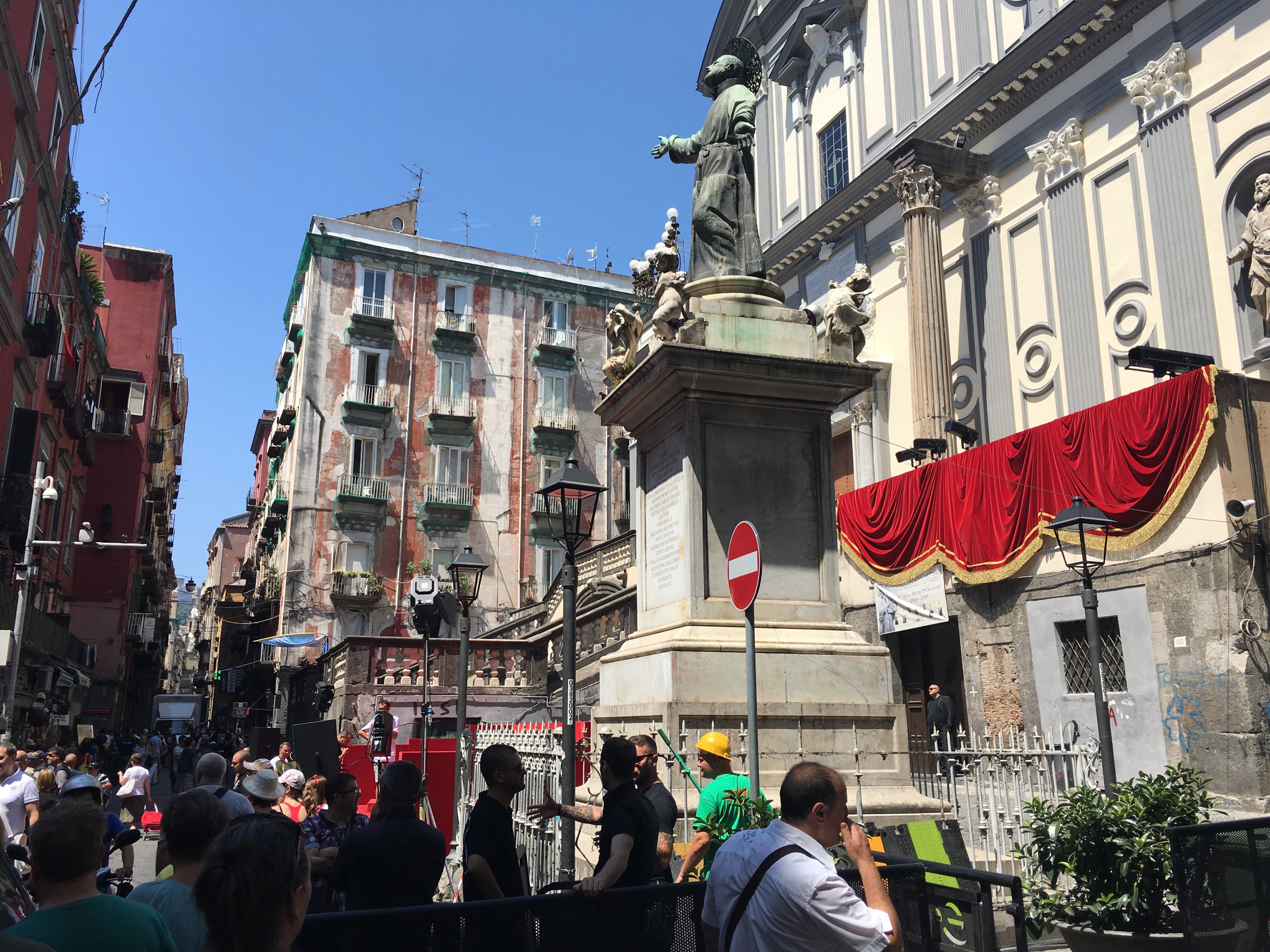
It was the first day we walked in the older section of Naples — a sprawling metropolis at the base of Mount Vesuvius on the Mediterranean coast — when I began to feel this history pressing in the air all around me.

I say sprawling because Naples is today the most densely populated urban centre in all of Europe; some 8,500 people inhabiting one square kilometre in a metropolis of nearly four million people — making it the third largest city in Italy, and the ninth most populous urban area in the entire European Union.


The noise was overwhelming: the hustle and bustle of pedestrians, car horns beeping, motorcycles and mopeds buzzing, shouting street vendors, impassioned conversations, two-toned emergency sirens, barking street dogs, screeching tires.

In conrast, the neo-Gothic styled ‘duomo’ in Naples offered a welcome break to this outside clamour. 

The expansive interior spaces of this main cathedral embraced silence and only hushed speech. You could occasionally hear the squeak of rubber-soled shoes and someone dropping a book on the stone and marbled flooring as people sat and wandered solemnly throughout the holy spaces.

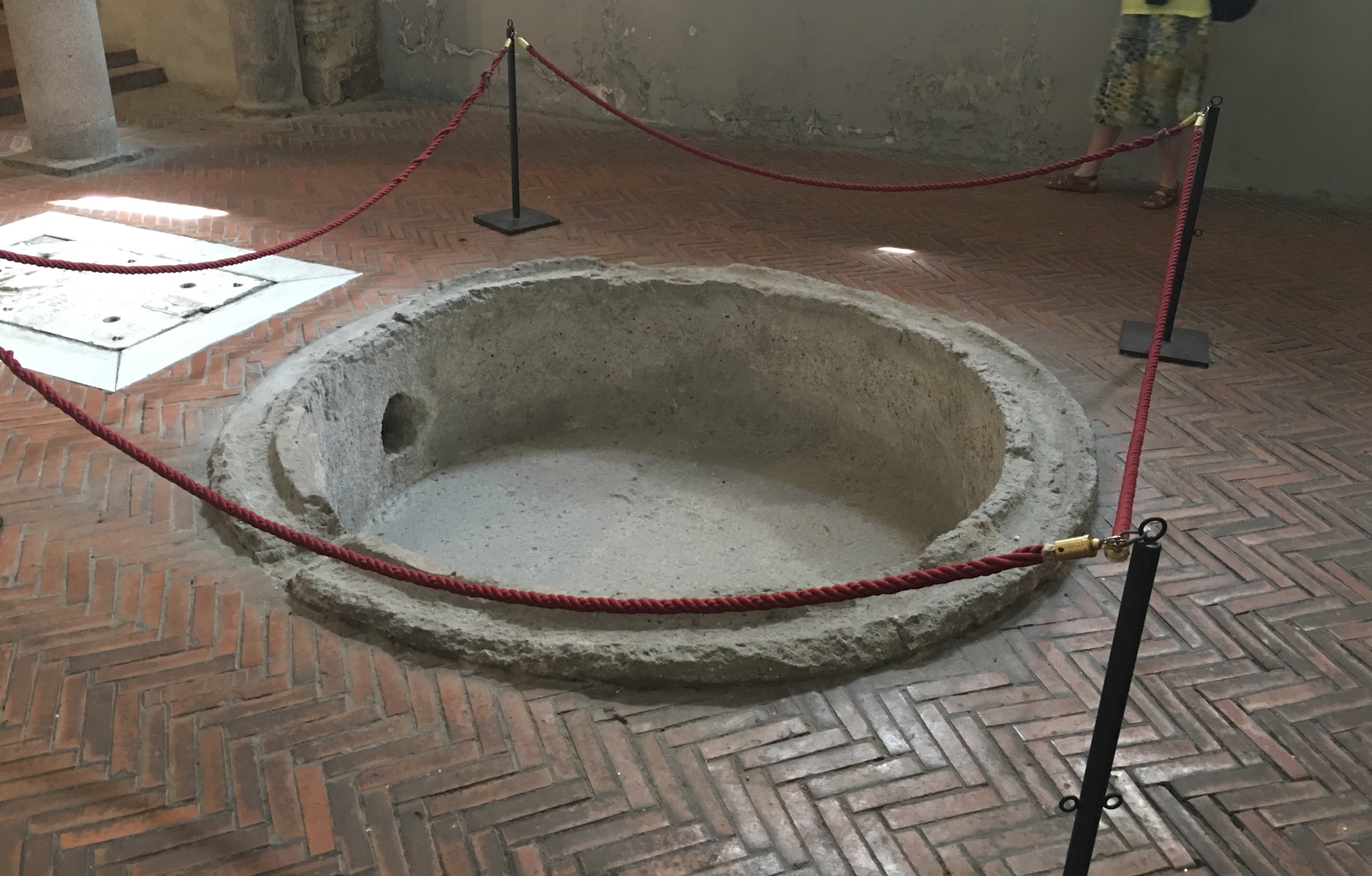
Perhaps the most significant feature of this cathedral is the baptistery, which is the oldest baptistery in the world, built in the fifth century, C.E. It is remarkable to connect with such an ancient symbol in a material form. 

When the baptized emerged from the water, looking upward at the ceiling, they would be encouraged in their faith; the first images they saw after being baptized were scenes from the Gospel expressed in Byzantine, mosaic art: Jesus saving Peter from drowning, the women at the empty tomb, the miracles of the multiplied fish, an image of Saint Paul, the Apostle, etc.

Seeing with my own eyes and touching with my own hands this font that was built by human hands only a few hundred years after Jesus, affirmed my conviction in the longevity and validity of the sacrament which has endured as profoundly meaningful for Christians throughout the millennia. 

I felt that faith is not just about the good old days when I was young, but the good old days when the Christian faith was younger. We are part of something much larger than our immediate reality. And, when we connect with that broader history, we realize it wasn’t always peaches ‘n cream and rose-coloured a history.

If you are movie watcher, you might recognize another cathedral we visited — the Duomo in the Umbrian, medieval town of Orvieto. 


This cathedral was featured in the opening scenes of Under the Tuscan Sun. This cathedral’s highlight is the Chapel of San Brizio, featuring Luca Signorelli’s brilliantly lit frescoes of the Day of Judgment and Life after Death. 

Although the frescoes refer to themes of resurrection and salvation, they do so through images not from the bible (that is, stories from the Gospels or Old Testament) but from the turbulent political and religious atmosphere of Italy in the late 1400s. Signorelli told the story of faith through his contemporary human events, rather than the traditional symbols (such as Jesus, God, the Trinity, the Apostles, disciples and other biblical characters) that we see in most other places.

Those frescos in the Orvieto cathedral chapel were snapshots of an historical era particular to a specific time and geo-political reality (i.e. 15th century Italy). And the impression of faith put ‘on it.’ Historical to us. Yet current to those who built that Cathedral in the Midlle Ages.

Faith is more than merely appealing to our past. Coming to worship today is not just about being reminded of something or someone from a long time ago. What we do here today is not just an exercise in recalling historical facts. As if decisions we make today are really not about faith. When we talk about our building renovations, worship practice and art, musical choices, communion, budgets, outreach initiatives  — these issues are very mcuh about the Christian faith ‘in the real world’, so to speak. All of these real things do reveal what we believe in, our values, what is important to us, who we are. How do these ‘mundane’ decisions reflect the Christian Gospel, faith, kindgom values in this time and place?

Lutherans make a similar mistake, I believe, when we define ‘Lutheranism’ as a belief/doctrinal system that is limited to the words and conceptual formulations of sixteenth century Germans. When we say that to be Lutheran is merely to ‘turn the clock back’ to 1537 when the Book of Concord was finally assembled including Luther’s Small and Large Catechisms, the Augsburg Confession, and the Apology to the Augsburg Confession.

I prefer a view that is reflected in the Evangelische Kirche Deutschland’s (EKD) logo for 2017, “Celebrating 500 years of Reformation”. Five hundred years of Reformation. In other words, Reformation started happening — in our tradition — with Martin Luther, yes. 

But, Reformation continued through the 500 years following, and continues to this day and beyond. We are always reforming the forms and means by which we express our evangelical, Gospel-centred faith. Always finding new and creative ways to tell the story of God.

What can we say, then, about Christian history? If we can apply a macro view over the ages, we can say that the history of the Christian faith is about a God who loves us. Christian history is about a God whose compassion never fails, who “will not come in wrath” (Hosea 11:9) — even though the people of God continue to keep “sacrificing to the Baals and offering incense to idols” (v.2).

The history of the Christian faith is about our lives being “hidden with Christ in God”, being “revealed with Christ in glory” (Colossians 3:3-4), dying daily to ways of sin and being renewed daily in Christ who “is all and in all!” — even though we are imperfect and sin as long as we hold breath. Christ is all and in all — despite us!

The history of the Christian faith is about how each moment of history — including this one right now — reflected Jesus’ love in the fifth century, the fourteenth century, the 21st century in Palestine, Egypt, Italy, Canada, etc. God for all times and places!

We validate the Christian faith by our lives today, now. This is where the rubber hits the road. This in-the-moment approach fuelled the generosity of medieval Catholicism represented in the magnificent building projects for worship as much as it did the passion and commitment of European Christians during the Reformation era.

We do not leave the practice of faith for some distant, utopic and dreamy future. Neither do we rest on the laurels of the tremendous sacrifices made by our forebears in Canada. 

Now is the time. Now is the time to live out of the conviction of God’s grace and love, despite the many and various ways Christians have messed up in history, and continue to do so today. Now is the time to live out of the faith that is full of hope, that despite our waywardness and unfaithfulness, God is faithful. Now is the time to claim God loves us, not because we are good, but because God is good. God is so good!

You know Jesus’ familiar exhortation, most often translated as “be perfect as your heavenly Father is perfect” (Matthew 5:48). Christians have often interpreted this word ‘perfection’ as being made whole. 

A much better translation might be: “be merciful.” Because this verse comes right at the end of a passage calling Christians to “love your enemies” (v. 43-48). Only God is perfect. But we can participate in God’s perfect mercy, God’s all-inclusive and impartial love.

Echoing Saint Paul’s words from the Epistle today (Colossians 3:11 — “Christ is all and in all”) St. Bonaventure later said, “Christ is the one whose centre is everywhere and whose circumference is nowhere.” [1] 

Christ’s mercy is everywhere evident in history. This is the Wholeness, the forgiveness, the grace, that holds you forever and everywhere. You can’t figure this Wholeness out rationally, nor can you control it. All you can do is fall into this Wholeness that holds you when you stop excluding, even the dark parts of yourself. [2] And that, my friends, is the Gospel — good news — for all times and places.

Thanks be to God!

1- Alan of Lille, ‘Regulae Theologicae’, Reg. 7 as quoted by Bonaventure, translated by Ewert Cousins, “The Soul’s Journey into God”, Classics of Western Spirituality (Paulist Press: 1978), p.100

2- Richard Rohr, “Daily Meditation on the Spirituality of Imperfection” Week 2 – Perfection of Wholeness, Thursday, July 28, 2016

Happy Birthday! (funeral sermon)

“Jesus said to her, ‘I am the resurrection and the life. Those who believe in me, even though they die, will live, and everyone who lives and believes in me will never die. Do you believe this?’” (John 11:25-26)

It may seem strange to say this, today: On a day we mourn at the death and loss of a loved one. A loved one, nonetheless who lived to a 103! A loved one whose 104th birthday is today! “Happy birthday Wilma!”

When we say a funeral service is a ‘celebration of life’ we affirm this with mixed feelings, to be sure.

Kind of like the other paradoxes in our lives: Because, for example, we know that we are better fulfilled in giving rather than receiving. Because, as people of faith, we know that it is in dying that we live — on many levels.

That is why a funeral service is like an Easter service when we celebrate the resurrection of Jesus. That is why, the day Jesus died on the cross is called “Good” Friday. Talk about paradox.

So, with confidence, we gather today to have a birthday party. Because Wilma, a person of deep faith in the living Lord, lives today in heavenly glory! 

Happy birthday Wilma!

At birthday parties we often tell stories about the person’s life, to date. There is one story from early on in Wilma’s life that I wish to highlight: When she was five years old, the windows of the Halifax house she and her family were living in blew inward, planting shards of glass deep in the layers of the skin on her head. She and her family survived the famous Halifax explosion.

Until Wilma was well into her 40s she was pulling little pieces of glass from her skin. For a large chunk of her life, especially in her formative years, she had to live with this reminder of her near death experience at such a young age. She was, in the first part of her life, regularly made aware of the fragility of her life and the reality of her mortality. That with each step we take in life, death walks along close by. Maybe that’s why she lived so long.

We try to avoid death. We deny it at every turn. We don’t want to see it. And yet, in avoiding death we also avoid living. Living to the upmost. The key to a rich life is to be aware that our death is only one breath away. 

It is common knowledge that the most effective, greatest and skilled soldiers in history were men and women who were willing to die in giving themselves to engage each combat situation. When you accept your own death at any given moment, then you can truly live.

An incredible paradox, isn’t it? How can we live in the ambiguity, uncertainty and mystery of this reality?

Wilma, as I said, was a woman of deep and enduring faith — through it all. It’s amazing when you think about the history she lived through: the rise of the automobile; the radical advance of technology from wires to the digital age; the many wars and two world wars of the last century, the Depression and economic ups and downs, the social revolutions. Through it all, she nurtured, and was nurtured in, a life of faith in the God who died in order to live.

Perhaps a deep knowing of this leads one to bless others. Indeed, this is how I got to know Wilma in these last four years of her life. Mostly through touch. In the tradition of the church, a blessing of healing and grace was given primarily by the ‘laying of hands’. It was a challenge to communicate with her, and yet, experts affirm that 70% of communication is non-verbal.

Wilma’s image of God was of a gracious, giving, loving God. She bristled at me early in our relating when I said the version of the Lord’s Prayer that has the line: “Lead us not to temptation …” She stopped me right in the tracks of that prayer, right there: “Stop,” she said. “God does not lead us to be tempted!” she objected. So, we changed the words. And that is why you read a slight variation in that sentence in the liturgy today.

God is a God of compassion and caring. God loves. Even when we can’t. Even when our love is imperfect and fraught with our own sin and misgivings. God comes to us first with a word of compassion, healing and mercy. This is the God Wilma believed in.

Her mission in life, in the last few years, was to bless others who cared for her. I learned this when she was at Fairfield Manor in Kanata, that she would routinely bless the nurses that attended to her. 

And after our many visits there, she would lean close to me and kiss me on my forehead. She said: “That’s the kiss of Jesus, saying that he loves you. And I do too.”

I responded: “I love you too, Wilma.”

Then, ever true to her belief, Wilma said: “That makes the Holy Trinity — three loves!”

Perhaps, then, Wilma leaves us with the legacy of faith that doesn’t pretend life is meant to be perfect. Because she wasn’t. But life is meant to be lived as long as we are given breath, in order to be a blessing of love to one another, as best we can.

Because God does.

Amen.

Easter: Jesus on the loose, now!

A mother was putting her young, eight-year-old girl to bed one night. The girl, accustomed to saying her prayers as part of her bedtime ritual, said to her Mom:

“I want to die so I can see Jesus.”

Taken aback, the mother realized in that moment that everything her daughter had heard to that point about Jesus was about eternal life — how Jesus came to earth to save us from our sins so that after we die we will go to heaven. 

No wonder the girl, who had faith, thought that the only way to see Jesus was to die first.

Quick thinking, the mother put her hand in her child’s, looked her in the eye and said, “Jesus is alive. Jesus lives in you and in me. If you want to see Jesus, look for him in the people you meet in the church, in your school and wherever we go. If you want to see Jesus, sweet child, just open your eyes. And live your life!”

Jesus is alive, today. Right now. That is the message of Easter. And the foundation of our faith as Christians.
A few weeks ago the Jewish Rabbi who met with our confirmation class answered a question about who he thought Jesus was. His answer made me think. He said, “Jesus was and is a very important and significant person for Christians.”

I wondered if someone asked me, “Who is Jesus?”, what would I say? I think my first response would be: “Jesus is alive.” Not dead. Not just a great teacher who walked the earth over two thousand years ago and died a criminal on a cross outside Jerusalem. Not just a healer of the sick and prophet who spoke God’s good news to the people of his time. All those things, yes. But more. So much more.

You notice the traditional Easter acclamation is NOT: “Alleluia! Christ was risen! He was risen indeed! Allelulia!” He IS risen!

When we come to worship God, we are not just praising a man from the past, studying an important historical figure, or reading a great story from history. We are not just about being a bunch of ‘talking heads’ who like to debate religion, theology and doctrine, but go on living as if nothing really needs to change in our lives in this world, today. 

We cannot turn this great story of Jesus’ death and resurrection into a platitude that just makes us feel good on a holiday long weekend in Spring. There’s too much at stake. The Easter proclamation means something for our lives today. Our job is no different from the first disciples who met the risen Jesus.

Jesus, outside the garden tomb, had to shift Mary’s focus away from the past to the future. After calling Mary’s name, Jesus rebuffs Mary’s attempt to ‘hold on’ to Jesus as if he were the same as before he died (John 20:17). In that encounter with Jesus, Mary learns from her Teacher that she is being caught up into a larger drama that includes not only Jesus’ death and resurrection, but also his ascension — and beyond!

In other words, Mary learns that this is not merely a story about the re-union of friends with tears and hugs all around, case solved. It is about ultimate destinies: (1) Jesus’ and Mary’s — and the disciples’ destinies too. The story has not concluded; it is still unfolding. She must relate that to the rest of the disciples. Her story, and Jesus’ story, his experience and hers, cannot be anchored in the past. The story of Jesus, then and now, must move on.

That’s where our sights are focused on Easter morning. Where are we going? Where are you going, in your faith? The promise of new life in Christ Jesus means something special for you, now. It means something very special for the church, today. To live out of the Easter message, we must look forward, to where the risen Jesus awaits our following.

It seems so many people these days are reading Rumi, the great 13th century Sufi poet. Sufi described an image of a mirror in the hands of God. It fell, and broke into billions of pieces of glass strewn all across the face of the earth. Everybody took a piece of it, and thought at first they had the Truth — the whole Truth, and nothing but the Truth.

Let’s imagine that each shard represents a unique reflection of God’s being, God’s will, God’s presence. Let’s imagine that each piece of glass represents one who has faith. Each piece of glass reflects the beauty and light of God’s creation, manifest in the individual person or congregation — however you want to look at it.

God is, over time, restoring all the pieces back into wholeness, into the original mirror. God also seeks our cooperation in mending what has been divided. 

We are like that little girl who wants to see the face of Jesus. And is learning that we don’t have to wait until we die, to experience a fullness of the Lord’s presence. Using the words of the Apostle Paul, We may see as in a mirror dimly while we live on earth (1 Cor 13:12), for sure. But slowly, surely, God is also already at work reflecting the love, the light and presence of the living Christ in each and everyone one of us. Who in gospels was not changed after encountering the Lord?

We are, as Paul also describes, the “Body of Christ” (1 Cor 12:27), on earth. The tradition of Christianity since the Resurrection of the Lord has claimed that the church together is the Body of the Living Jesus. We are the living representation of Jesus on earth. As Martin Luther stated, in our baptism we are “little Christs”. 

Jesus is on the loose! Jesus can show up as a cashier in the grocery store, the young man who changes the oil in our car, a coworker in the office, our doctor, a good friend or even our spouse, child or grandchild. You may even find him looking back at you in your bathroom mirror! (2)

Paul concludes, “All of us … are being transformed” (2 Cor 3:18). God is already at work, in the power of the resurrection, healing what has been broken, bringing together what has been divided, restoring to completion a glorious transformation of our very lives. This is our hope. This is our Easter joy.

Alleluia! Christ is risen! He is risen indeed! Alleluia!


(1) Gregory A. Robbins & Nancy Claire Pittman in David L. Bartlett & Barbara Brown Taylor, eds., “Preaching the Revised Common Lectionary: Feasting on the Word” WJK Press, Kentucky, 2009, p.377

(2) Sr Bernadette Gautreau, “Jesus is Loose!” in Holy Week Reflections 2016 published by On Eagle’s Wings, p.9

Exposing the agenda of hate

A recent song by American singer-songwriter Soufjan Stevens is entitled: “There’s no shade in the shadow of the cross.” Today, on Good Friday, we all stand in the shadow of the Cross of Jesus. But there’s no shade in this shadow.

If you want a comfortable religion that just makes you feel good, then you dare not approach the Cross of Christ, and you dare not pray.

Encountering Jesus on the Cross is not pablum for the soul nor is it expressing mere platitude for an easy life. The cross is not an exercise of remembering something that happened long ago (and therefore doesn’t really mean anything for me today). We are not merely going through the motions, on Good Friday.

The cross, in all its bloody, bear and stark reality, exposes the darkness within each one of us, today. The cross exposes the human problem of hatred. You will not find relief here today. No shade. No comfort. Only sin. Only hate. In the world. And, within you.

The longer we live in this world, we are forced to asked the question: What makes many people so mean? What creates mean-spirited people? “I want to hurt you!” What is behind hate?

Hate – I just called it ‘mean-spiritedness’. Maybe that is what we see more often than overt hatred. Mean-spiritedness is, unfortunately, here to stay.

Hate is, for some reason, helpful. Hate works. In a lot of immediate and seemingly good ways. It unites a group very quickly. Far quicker than love, you must know that. Hate immediately and easily resolves the inner struggle between the little devil on one shoulder persuading you to do something other than what the little angel on the other shoulder is saying. 

Mean-spiritedness is formed by contraction, ‘against-ness’. Love, on the other hand, is formed by expansion. Love doesn’t come easily, because you have to let down your boundaries. And no one wants to do that.

Contraction — whereby you can eliminate another person, write them off, exclude them, torture them, expel them, ‘vote them off the island’, immediately gives one a sense of boundaried definition, boundaried superiority, even.

Hatred — mean-spiritedness — gives a person identity even if it is a negative one (“I am not that, I am not like them, I am against so-and-so, etc.”). And we’d sooner have a negative identity than feel vulnerable, like nothing, empty. Just who we are, in God.

Hatred takes away all doubt, and free-floating anxiety. Even if in a false way. It feels superior. And feels in control. Hate settles the dust, and the ambiguity that none of us likes. Hate is much more common and — I’m sad to have to say this as a pastor — it is much more immediately effective than love. Immediately.

Hate makes the world go round. Just read the front pages of morning paper this week, scroll through the news feeds on your tablet or flip the channels at 6 o’clock every day. It’s largely about who is hating whom.

You could say that Jesus came to resolve the central problem of hate — this problem that has defined humanity since the beginning of history. There’s really no other way: To save us from ourselves. To save us from one another. And to, therefore, save us.

Until and unless we are saved from our need to hate. 

That’s why people even made religion into a cover for their need to be hateful. I’m hating for Allah, and so it’s ok. And yes, I’m hating for Jesus. Christian history, too, is not free from violence (the Crusades, the witch-hunts, Protestant-Catholic European wars, the residential schools — the list goes on). “I’m hating for Christianity — so my hatred is good hatred.” It happens every day. It’s almost the name of the game.

The ultimate disguise, whereby you can remain a hateful, mean-spirited person is to do it to protect the church, or to protect the country. All those good excuses. So, you are relieved of all anxiety: “I am still a holy person.” Even though, underneath, in the deeper stream, you are a hateful person. But you don’t have to see that. That’s what Scott Peck called, years ago, “People of the Lie”.

We have done so much utopian talk about Jesus and love. But Jesus had a very hard time getting to the issue of love. First, he had to expose and destroy the phenomenon of hate. Which I think is the meaning of the Cross.

Once he exposed the lie and the illusion of hatred, love could show itself clearly. But until then, you can’t. The pattern is still the same. As Jesus shockingly put it, “Satan is the real prince of this world” (John 12:31, 14:30, 16:11).

Hate, it seems, is the daily, ordinary agenda. Love is the totally enlightened, entirely non-sensical way out of the ordinary agenda. The Gospel presents the dilemma in a personal and cathartic Passion narrative that grounds the whole issue in history, and in one man’s enlightened response to that history. 

One man, Jesus — fully divine and fully human, accepts the religious and social judgement of hate. We have both church and state, both Caiaphas and Pilate. Both power systems declaring Jesus unworthy, declaring him a sinner, wrong, the problem. The very one that you and I call the most perfect man who ever lived is judged by power at the highest levels to in fact be the problem. 

Jesus bears the consequences of hatred, publicly. But in an utterly new way that transforms the pattern. And therefore for us, transforms the possibilities. For two thousand years, Jesus has remained the most striking icon of a possible new agenda. His death exposed the lie and the problem like never before.

His risen life told people that life could have a different story line. Jesus did not just give us textbook answers from a distance. But he personally walked through the process of being rejected and then said, ‘follow me’. And there’s something you only know having been in that position.

What is behind hate? I believe fear is almost always behind hate. It’s not easy to get to that deeper river of fear. It’s not easy to recognize the subtle fears: Afraid of not looking good. Afraid of not being in control. Afraid of not having the right word. All those are fears. But they are subtle.

And the only way to see them is to go right into your own poverty of spirit — blessed are they who do so, Jesus said (Matthew 5:3).

Sometimes it looks like it’s control that’s behind hatred. But even control freaks like myself are usually afraid of losing something. Just go deeper, and you’ll see. It is almost always fear that justifies our knee-jerk hateful response. 

Fear is hardly ever recognized as such. As Paul says in Second Corinthians — ‘the angel of darkness must always be disguised as an angel of light’ (2 Corinthians 11:14). The best and most convincing disguise, of course, is virtue itself, or godliness. Then, it never looks like fear. 

For fear to survive, it has to look like reason, or reasonableness, prudence, common sense, intelligence, the need for social order, responsible stewardship, morality, religion, obedience, or even justice and spirituality. It always works. Just give it the nice cover, and you don’t have to face underneath it, what is craven fear.

What better way to veil vengeance, and a vengeful spirit than to call it justice. You hear it on the news every night, “I just want justice.” One wonders whether the inner need to punish the other, to hurt the other, has ever been recognized. Let’s be honest: It’s in everyone of us in this room. When someone has made you afraid, you want to hurt them back. To be trapped in our need for vengeance, is to always be afraid. It’s necessarily to be afraid. No wonder fear is the name of the game in almost all of the world. 

And that demon is not exorcised easily. Until you name the demon and admit the demon is there, you have no power of exorcising the demon. It’s clear, in Jesus’ exorcisms. You must name the demon correctly. When you pretend the demon isn’t there, you’ll never do any good exorcism. That’s largely what we do. It’s called, denial.

Only people who are honest and vulnerable about their own fear, and confess their need to control all outcomes, only those practiced in letting go, can go beyond the agenda of hate. Jesus himself prayed hanging on the cross: “Father, into your hands I commend my spirit” (Psalm 31:5). This is about letting go of our opinions, our need for getting back, our need to exclude, circle the wagons, and point the finger.  

Jesus prayed, too, from the cross: “Father, forgive them — they don’t know what they are doing!” (Luke 23:34). Only people practised in letting go will be taking the first step in the new agenda of love and forgiveness. This agenda of love, Jesus made possible for us. “Perfect love casts out fear,” scripture promises us (1 John 4:18).

The Cross, today on Good Friday, calls us to trust Jesus. To not have anyone that you can trust is necessarily to be afraid, to be vengeful. Christianity at its best aims to free individuals from their small, fragile, sinful selves, and points to a larger identity in Christ Jesus — the only true self — “hidden in Christ with God” (Colossians 3:3) .

Jesus is the only trustworthy lover, the only trustworthy self. Healthy Christianity, like Jesus himself, tells you that there IS someone you can trust. You do not have to create all the good. You do not have to fix all of the bad. You do not have to explain all the failures. You know you are simply in the stream we call the mystery of death and resurrection, the paschal mystery. 

What else would be the beginnings of peace? As long as you think you have to fix everything, control everything, explain everything, and understanding everything, I can promise you, you will never be a peaceful, loving person.

In the shadow of the cross, there is no shade. Indeed. But let’s stay awhile, and open our hearts to Jesus whose love makes us worthy and who is with us, even in the darkness.

Adapted and transcribed from Richard Rohr, “The Central Problem of Hate” track 8 on CD ‘Action & Contemplation’, Meditatio Talk Series 2015

Laetere!

“This is the day that the Lord has made. Let us rejoice and be glad in it!” (Psalm 118:24)

Lent is a journey through the desert. It is dry. And there’s little for comfort. Let alone luxury. It is a time of self-reflection, of letting go, of pacing ourselves through disciplines that humble us and peel back the layers of our habits and beliefs.

The famine provides a turning point in the parable of The Prodigal Son (Luke 15:11-32). His wasteful, dissolute, squandering of money — his lifestyle — is brought to an end by a famine, probably caused by drought.

Up to this point the Prodigal continued down the course of his delusion, believing he could be happy by pursuing this lifestyle, even when he runs out of money. His mistaken and self-indulgent strategy for fulfillment is derailed and heightened by the onset of famine.

After the famine grips the land and its people, he has to work among the pigs. He might have had to do this anyway. But because of the famine, nobody can even spare change to throw at his feet when he begs. This famine-ridden reality leads him to a place of brutal honesty. And he falls on his knees in confession.

This is not the only time a famine in the land affects the course of the history of the relationship between God and God’s people. The famine illustrates a pervasive motif in the bible: The famine acts as a significant motivator for people to move in their lives, physically and in their hearts as well (1).

Famine is the reason that Abraham and Sarah leave Ur for Canaan. Once they are there, famine is also the reason they leave again for Egypt (Genesis 12). Famine appears twenty times just in Genesis (eg, Genesis 26). The story of Joseph and Jacob revolve around the reality of the famine.

Famines represent those times in life when forces beyond our control dictate the course of our lives. Famines remind us that we are not the masters of our own destiny. Famines expose the truth of our own poverty. Famines make us honest for our own need. Famines cause us to reach out for help, and let go of our pretence of self-sufficiency and self-reliance.

Famines will lead us to confession – honesty about what we need, what we lack, what limits us. Famines will move us to depend on something/someone beyond our capabilities and industry. Famines will bring us to our knees at the throne of God’s grace (Hebrews 4:16).

Maybe that’s why famines happened a lot in scripture.

The famine, otherwise not usually considered an important part of the parable of the Prodigal Son, serves to underscore the central message of Scripture: It’s not about us, it’s about God. We can act irresponsibly like the Prodigal, or we can follow all the rules of life and be good citizens and good people like the resentful elder son — this has no bearing on the freedom of God to dispense grace as God will.

It almost doesn’t feel fair, what happens. We can sympathize with the elder son, I suspect. Yet, whenever we feel the pangs of ‘It’s not fair’ — how much of that objection, when we are honest, is based on the presumption of our own righteousness, our own ability, our own deserving, our own industry to earn our rightful place?

There’s this delightful short book by Francois Lelord, which was translated into English and adapted for the big screen starring Simon Pegg, called “Hector and the Search for Happiness.” Simon Pegg’s character, Hector, goes on a journey around the world to observe what makes people happy. As he travels to distant places and meets different people, he writes down in his little notebook a short list of what makes people happy.

His very first observation — the first lesson he learns about what makes people happy — is: “Making comparisons can spoil your happiness” (2). Is that not what the elder son does — compare his righteousness to the wayward squandering of his younger brother? He is justifying himself, based on the less-than-stellar behaviour of another.

“Making comparisons can spoil your happiness.” This is Gospel truth, in fact. Remember the other parable Jesus tells of the workers in the vineyard? The ones who work the shortest amount of time earn the same wage as the ones who worked from early morning (Matthew 20:1-16). The ones who worked all day grumble that they made the same wage as those who only worked a short time, even though the early workers had already agreed on the rate they would receive.

Another characteristic of people who are not grateful for what they have, and who continually make comparisons: Resentful people do not feel like a party. People who are continually comparing themselves to others who have more, keep themselves from enjoying life and having fun from time to time. People who are judging others and pointing fingers, will not easily relax and accept the good in them and others.

The Father begs the resentful elder son to join the party he has thrown for the Prodigal. What the Father reminds the elder son are words from God to us and the church today: “Son, you are always with me, and all that is mine is yours.” In other words, rather than incessantly compare our lot with others, focus on the gifts, the resources, the passions, the energy, the interests we have already been given to you. And we have been given much, indeed!

We have musical gifts in this congregation, and talented singers and instrumentalists. We have people passionate about social justice, and caring for the poor nearby. We are well-read, educated and earnest in our pursuit of truth. We are warm-hearted and dedicated to one another.

Moreover, we have an abundance of material resources. Yes, we do! A building assessment was done last year. And the replacement cost of this small building alone was valued at $1 million. With the property around the building, the value is much higher.

We have been given so much in this community alone. Imagine the potential human and material resource we have here for the purpose of God’s mission in the world today!

Accept with thanksgiving what we have been given. And, when it comes to what others have received, rejoice in God’s generosity and grace towards them. After all, God is free to do what God will.

And we are free, to do what we must do. Whether we make mistakes, or do good. Whether we are led astray for a time in our lives, or we keep the faith through thick and thin — God says, “You count! You are beloved! I am with you always. I will go the distance for you. I will wait for you — no matter what you have done, good or bad. You count!” So much so, it’s worth throwing a party — an extravagant party.

There is cause to celebrate. And be happy! For God is good, and God’s love endures forever.


(1) Lutherans Connect, Lenten devotional, Day 6 — found at lc2016lentdevotional.blogspot.ca
(2)Francois Lelord, “Hector and the Search for Happiness”, Penguin Books, Toronto, 2010, p.19

Reformation Themes 2017

The Day of Reformation (October 31) for Protestants, and especially Lutherans, calls us back to basic questions about who we are, as people of faith. Celebrating this day gives us the opportunity to ask again, “Who are we in the variety of religious expression on a diverse, social landscape?” And what do we have to offer?

For Protestants, the word itself may give us a clue. Protestants have often identified themselves as protesting against something. Many of us know the history: In 1517 Martin Luther nailed those 95 arguments on the doors of the Wittenberg Church. “Theses”, we’ve called them, were statements against certain religious practices and beliefs in the 16 century church. “Here I stand” has become a popular Martin Luther quote as he stood his ground and accounted for his beliefs before the Pope and Emperor at the famous meeting in Worms, Germany, shortly thereafter.
Many of us remember the Lutheran legacy as substantially a theological assertion: that you cannot ‘buy’ your way into heaven (by purchasing indulgences); rather, we are justified by grace through faith. Faith and salvation are fundamentally gifts from God.
And this is why the Lutheran World Federation (LWF) — a worldwide communion of 144 national churches — has come up with the theme of “Liberated by God’s Grace” for the 500th anniversary in 2017, commemorating Luther’s first protestant act in Wittenberg. Its sub-themes resonate with the indulgence debate: “Salvation not for sale; Humans not for sale; Creation not for sale.” 
In the pronouncement of these themes Lutherans worldwide and in Canada are claiming that we are not only celebrating something that happened in history. We are also asserting that we are a continually reforming church; that century-old themes can be relevant even today.
“Salvation – not for sale; Humans – not for sale; Creation – not for sale”. When something is not for sale, it is not on the market. We can not procure it by our means — any material means for that matter. When something is not for sale, it is a gift. We cannot possess it, in the same way we can never really possess God, salvation, anyone else, nor can we possess the earth.
The world today wants us to think and believe we can. We therefore delude ourselves into thinking and believing that we can buy salvation, that by our own hands, efforts and hard work we can earn God’s favour, God’s forgiveness. Do we go to church because we feel we need to manage our spirituality more as an insurance policy against hell, even though we are not sure about living out the mission of Jesus today? But God’s love in Jesus is unconditional. It is free. We have nothing to lose in positively living out our faith. Really! “Salvation — not for sale!”
Second, humans: It’s incredible that in the 21st century, there is still slavery practiced in the world; according to a 2013 study, there are still some 30 million slaves in the world today. Even in Canada, young people are gone missing and forced into the sex trade. Many Aboriginal women have disappeared, some murdered and some no doubt exploited in some despicable way. But, we claim: “Humans — not for sale!” What are we doing about this?
Finally, creation: As I said, our culture wants us to believe we can buy it. In fact, a recent survey measuring happiness revealed that our happiness is often dependent on ‘owning’ property. While the exchange of goods is in many ways an important building block of our economy, how differently would we look on our lives if creation (the environment, the land, the water and the resources therein) was not only something we must buy, possess and exploit for profit — but simply given as a gift from God that we share with all people? “Creation — not for sale!” Is finding meaning and purpose in life not the real sources of happiness? (“Money Really Can Buy Happiness, Study Shows”, thecanadianencylopedia.ca, 2013)
The confirmation class last week planted a tree in our church yard. Not only did we do this to respond to one of the Reformation challenges of our church (Evangelical Lutheran Church in Canada) to plant 500,000 trees by 2017, we performed a loving and caring act towards God’s beautiful creation which we share with all living creatures.
  
When it comes down to it, and we are honest, we must confess that it is often very difficult to be loving. It is challenging, even though we say we believe in a God who loves us unconditionally, loves the world unconditionally, loves creation unconditionally. 

So, how can we learn to love better?