
Forgiveness: from transaction to wholeness

We ran all-out with back packs and walking poles to catch the bus. Yes, we were on a walking pilgrimage. But a few of us didn’t feel up to walking through one of northern Spain’s downtown city streets. After hiking a couple days already through the beautiful, peaceful hills along pristine trails with spectacular ocean views, the thought of breathing gas fumes and hitting the hard top sidewalks in an urban jungle just didn’t appeal. It was only three or four kilometres, and a city bus conveniently would take us to the other side where we could pick up the pilgrimage trail out in the open again.

As I clambered onto the bus behind my Dutch walking partners with all my gear, mindful of not clobbering someone with the swing of my bulky pack, I realized I did not have the correct change for the single fare ticket. Without any hesitation, my pilgrim friends dropped enough euros to cover my ticket. I expressed a deep-felt thanks to them, making a mental note to treat my friends later on. “I owe you coffee,” I said as the bus wove through San Sebastian’s downtown core.
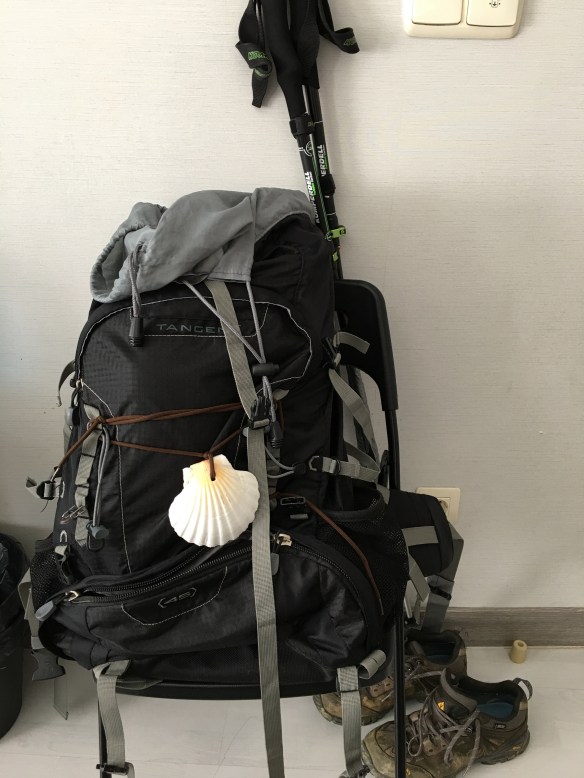
IMG_5341

There’s a culture on the trail among pilgrims that doesn’t operate according to the normal etiquette of life back home. You see, early the next morning, my friends wanted to get going right away. I, on the other hand, wanted to stay at the hostel of my name’s sake (San Martin) a little longer to enjoy the view and the home made breakfast offered by the hosts. Off they went, and I never saw them again. I didn’t have a chance to ‘repay’ their good deed done unto me.

At the same time, there were other pilgrims to whom I’d catch up a few nights later at another hostel. Everyone walks at a different pace. Paths would cross, un-cross, and cross again. Sometimes I’d meet someone on the trail and never see them again. Other times I’d bump into the same group every other day, or so, somewhere along the way. Because of the nature of the pilgrimage community, I looked for opportunities, therefore, to treat another fellow pilgrim at a roadside café whenever the opportunity arose.

The economy of quid pro quo – paying back another individual and keeping the economic scales even on an individual basis – just couldn’t operate neatly on the Camino. It didn’t matter to whom you were being gracious. Only that you were gracious – that you offered help when help was needed, to whomever, regardless of whether or not they had earned your favour in some way earlier on.

The challenge was to receive the gift when it was offered, and give a gift when it was needed. Period. It was as if, on pilgrimage, we were all in the same boat. Which, of course, we know before God we are. It’s just in our daily lives we are not often able to appreciate that reality clearly.

Forgiveness is the theme in the Gospel text for today[1]. I’ve wondered why the servant who was forgiven his debt didn’t do likewise when given a chance. A more general question, is:  Why do we find it so difficult to forgive one who ‘owes you’ an apology for some wrong committed against you. I think it’s important to understand first some elements of the Gospel story. Because this story first tells us something very important about God and God’s ways.

To begin with, the servant owes the master ten thousand talents. ‘Ten thousand’ here signifies an absurd amount of money.[2] In that day and age, even if the servant lived three life-spans working full-time, there was no way he could ever repay that amount. The master has pity on him because the servant pretends that he can somehow work hard enough, in his plea for mercy, to repay the debt. The absurdity of the extra-ordinary amount should tip us off to something vital in our understanding of God forgiving us:

There is nothing we can do to make our lives right before God. And what is more, God has already forgiven us, and reminds us over and over again that we are forgiven before we do anything. Yes, we can say we ‘owe’ God. But no matter how hard we try, no matter all the things we can do to make it right, this effort will never, ever be able to erase what is stacked up against us – all our moral failing, our mistakes, our brokenness.

We puff ourselves us up in embarrassing, false piety when we pretend we can. As if forgiveness was simply a matter of paying our dues. But it isn’t. Like true love, forgiveness is a function of grace. And, oh, the Lord has compassion on us, even in all our futile toiling and striving.

I suspect one reason why the forgiven servant does not ‘pay it forward’ to his own slave, is because what the slave owes the forgiven servant was not as large an amount. In other words, the slave could technically repay his debt.

It’s so easy not to apply God’s economy of extraordinary grace to our ordinary lives. It’s so easy to slip into the transactional ways of our world, and apply the values of the culture to our life of faith. Meaning, we don’t really forgive others when they have to ‘earn’ our attention, our love, and our friendship. We will not really forgive others when they don’t behave in a way that meets our approval.

We live in a transactional economy – even in our spirituality – where people have to pay for their sins. We are to a large extent products of our culture. Our view of justice, therefore, is naturally retributive. Whereas God’s economy is about transformative justice. To move from one to another calls for a monumental shift in our thinking.

God’s grace, indeed, “surpasses all our understanding” (Philippians 4:7). God’s economy of grace does not make sense in our quid pro quo culture of transaction and merit. God’s love crosses all these boundaries and systems of our making. The gift is simply given. Will we receive it, freely? Will we pass it forward, freely, without any expectations nor strings attached?

In God’s economy of grace, we move from transaction to wholeness. Love and forgiveness – these functions of grace – expand outward. There are no losers in this economy. Only winners.

A transactional economy goes something like this: If I have twelve, gold coins and you take six, I will only have six left. I’ve lost. You’ve won. And so it goes with everything we do with others in life. Someone described our culture this way, sadly: We love things and we use people.

In an economy of grace, in contrast, we love people and use things. It’s as if I had planted twelve lily bulbs. I can divide my bulbs and give you twelve and I will still have twelve left. Then you can plant your bulbs and eventually you can give away twelve more. Grace multiplies. Everyone gets more. Grace is infinite, in truth. The win-lose economy changes into a win-win economy.[3]

Moreover, forgiveness is not just about evening the score between just two individuals. It’s not entirely a private act. Forgiveness is communal.[4] When, in the Gospel text, the others saw how unjustly the servant treated his own slave who owed him money, they didn’t simply wipe their hands in denial and avoidance of the injustice before them. They went back to the master and told him. The proverbial whistle-blowers, they were involved in the process of forgiveness.

This is necessary, because sometimes individuals are guilted into forgiving someone who is left unchallenged, unaffected, and unaccounted for their misdeed. Sometimes victims are not able to easily forgive the one who has hurt them. It took Joseph all the way to the last chapter in Genesis to finally forgive his brothers for throwing him into a well and selling him to slave-traders.[5] As they say, it takes a village. And sometimes time. Lots of it.

Forgiveness is validated in community. Because sin is something we all participate in. If we are human and live on this earth, we will sin. No matter the colour of our skin, no matter our creed, our ethnic background, no matter where we were born or what our political stripe. We will make mistakes. We will all contribute to the problems we face. As Paul wrote, “since all have sinned and fall short of the glory of God”.[6] No one is immune to the complicity and consequence of sin. It is woven into the fabric of our common existence.

And so is forgiveness. When forgiveness is offered and received, it becomes part of a wider field of responsibility and accountability. We are not alone. We need the community of faith. We need to be real. Forgiveness does not mean enabling sinful behavior to continue by excusing it, or letting it happen over and over again. Forgiveness means people of faith seek the justice of the matter. Forgiveness can only happen when people see their own lives as part of the human condition, just like everyone else.

People will not be changed in their hearts for God unless they are loved unconditionally, freely. Martin Luther believed that we would be so overcome by God’s unearned, unconditional love that we would be so moved to spontaneously and unconditionally love others in the same way.[7]

May our hearts be moved to forgiveness and justice for all.

Our Father in heaven …. forgive us our sins, as we forgive those who sin against us.

Amen.


[1] Matthew 18:21-35

[2] David L. Bartlett and Barbara Brown Taylor, eds., “Feasting on the Word: Preaching the Revised Common Lectionary”, Year A Volume 4 (Louisville Kentucky: WJK Press, 2011), p.71

[3] Janet Hagberg uses the gold coin versus lily bulb analogy to describe transitions in power, in “Real Power: Stages of Personal Power in Organizations”, 3rd Edition, Salem Wisconsin: Sheffield Publishing, 2003, p.77

[4] Susan E. Hylen, “Forgiveness and Life in Community,” Interpretation, Volume 54, Number 2 (April 2000), p.146-57.

[5] Genesis 50:15-26

[6] Romans 3:23

[7] cited in Bartlett & Brown Taylor, eds., ibid., p. 70

From memory to presence

Whenever we suffer the stress of living, we naturally reach for ways of coping. Memory can be a healing salve. Not only remembering loved ones and friends from our past. But when it comes to observing traditions and special occasions — at Thanksgiving, Christmas and Easter for example — we bring the expectations of good times had long ago to bear on the moment.

Indeed, our memory of pleasant past experiences can even act as a narcotic for dealing with current challenges and stresses. We may make it a habit of escaping into our mind’s eye; we linger with a memory until we feel the peace.

While our memories are a key to understanding what is meaningful to us, we get stuck, however, in the rut of our problems if we try creating an exact imitation of the past. Escaping into the past isn’t always the best way for addressing present day problems. The path to healing and wholeness is not about making a simulation of past experiences.

I heard about a man who, in middle age, purchased a Harley-Davidson to try to live in the myth of the youthful, unfettered individual who is free to go anywhere at any time. He felt unsatisfied, however, after his solitary road-trips. Something was missing.

After more reflection, what he was remembering on a deeper level was the positive experience in his youth of the friends he made in a bike shop where he worked a job one summer. The meaning of memory was found in the relationships more so than the motor-cycles. He didn’t sell the Harley-Davidson. But he did inquire about local riding groups of folks his age. His interest shifted to making friends. (1)

Memories of past Christmases, Easters, friendships or treasured experiences can transform each new, present day moment. For example, a memory of a family bike ride on an Easter Monday decades ago can lead to a family train trek through the Rockies. A friendship born from intellectual and emotional stimulation long ago can lead to a rediscovery of a hobby or commitment to personal growth. What’s important is not to re-create the past, but to transform it so it’s meaningful for the present. Not simulation, but translation.

The point, is to recognize and accept the present moment as the most important time and place of our lives. Because even if we are not able to remember any good in our past, or remember anything at all for that matter, God is about the now.

In last week’s Gospel story about Jesus meeting the Samaritan woman at Jacob’s well (John 4:5-42), Jesus leaps beyond all boundaries of time to announce God’s intent for humanity is taking place in the present time. Three times in the passage, the words “already” and “now” highlight the importance of now. “Open your eyes and see!” Jesus says. “The fields are shining for the harvest, the reaper can collect his wages now, the reaper can already bring in the grain of eternal life” (v.35-36). Jesus is excited at the possibilities. Why? Partly because it is all happening now! (2)

In today’s Gospel, the Pharisees are interested in formulations of the mind which rest on the past. The blind man provides a focus for their cerebral machinations; they want an explanation for his condition: “Who sinned, this man or his parents, that he was born blind?” (John 9:2). A biblically sound question, since the Torah suggests that the “iniquity of the parents is visited upon the children and the children’s children to the third and fourth generation” (Exodus 34:6-8).

Jesus avoids this kind of biblicism that seeks only to make historical, technical arguments that focus only on our righteousness or lack thereof. Jesus turns our sight away from ourselves and onto God’s work in the present. “We must work the works of Him who sent me while it is day …” Jesus countered (v.4).

The purpose of our lives, including our suffering, is to point to God. If we are to remember anything from the past, it is to remember God’s mighty acts in relation to the people of God, including you and me. When the Psalmist delights in the past, his memory focuses on what God has done: “I remember the days of old, I think about all your deeds, I meditate on the works of your hands” (Psalm 143:5).

God’s vision is expansive and eternal, abounding in steadfast love. Before talking about the iniquity imparted to the third and fourth generations, when the Lord spoke to Moses, he said first: “The Lord is a God merciful and gracious, slow to anger and abounding in steadfast love and faithfulness, keeping steadfast love for the thousandth generation” (Exodus 34:6-7) — which is a lot longer than four!

And as we know, generations ago the world was a lot different than what it is now. Recently I was watching on Netflix a show that I remember watching avidly in the 1990s. One detail caught my attention, when the characters talked to each other holding the old, large, clunky ear pieces connected by a spiral, rubber cord to a hand-dial phone. In one generation, so much has changed and people are doing things in different ways.

And yet, one thing remains: The steadfast love of God. Whatever we do in God’s mission today, and however we do it, we can be assured that God is faithful to us, that God is abounding in love for us. After all, God doesn’t look on outward appearances, our resume, our list of past sins, etc. God looks at our heart. When David was chosen to be king of Israel, God wasn’t looking for the one who appeared to have all the desirable qualities; God wasn’t looking for the tallest, the strongest, the best-looking one to be their leader. God was looking at the heart of David (1 Samuel 16).

We can be courageous, then, and bold to reach out and be the hands and feet of Jesus in the world today. After all, it’s not, in the end about us or our past. We find healing and wholeness for our lives by doing the will of God. It is for God’s sake that we throw ourselves fully into life, in the present moment. It is for God’s sake that we are healed and restored.

We come to the Table of Communion each week, a diverse group of people. But we come as equals on a level-playing field feeling together the weight of our past sins, yet forgiven and showered with God’s mercy and grace, as one. We are empowered through the broken body of Jesus to be his broken body for the world, today.

How that memory shapes us today may be different from decades ago. But memory continues to form us, and reform us. In our lives, the Gospel is translated for the world today.


(1) Alan J. Roxburgh and M. Scott Boren in “Introducing the Missional Church: What it is, why it mattes, how to become one” (Baker Books, Michigan, 2009), chapters 2-3
(2) Richard Rohr, “Wondrous Encounters: Scripture for Lent” (Franciscan Media, Ohio, 2011), p.60-61

No easy way up those stairs


Perhaps you know someone like Sue.

Sue had Multiple Sclerosis (MS). As the disease progressed in her relatively young life, she nevertheless wanted to stay at home as long as possible. Her house, unfortunately, was not outfitted appropriately for someone in her debilitating condition.

And yet, she battled. For example, it took her twenty minutes to crawl upstairs to her bedroom. Sue called the stairs “Mount Sinai”. Because it was by struggling on those stairs, moving limb for limb through each laboured breath through gritted teeth; it was through determination for each step gained, that she learned so much (1).

The prophet Isaiah does this to us again — gives us an ideal vision of a world where no one suffers any longer, a utopia where everyone is joyful. What is perhaps even more astounding is that this vision of hope and promise is proclaimed in the midst of everything that was not:

These verses speak to Babylonian exiles (2). They are the captives of war, and as such have been wounded maimed, even intentionally blinded as was King Zedekiah (2 Kings 25:7). It is to this failed community now subjugated and marginalized in an oppressive regime far away from Jerusalem that Isaiah paints this picture of a highway leading back home through the desert (Isaiah 35:1-10).

The cynic in us alights, as it must have in many of the exiles in the sixth century B.C.E. For, when do we see the eyes of the blind opened, the ears of the deaf unstopped, the disabled leaping like a deer, the tongues of the speechless sing for joy? (vs.5-6). Words that Jesus later repeats almost verbatim (Matthew 11:5; Luke 4:18) surprise because he seems to validate the promise of a vision, hundreds of years after Isaiah, that has yet to be fulfilled.

The vision, the promise, operates like a bouncing ball through history. Indeed, our world to this day — two thousand years later — is still rife with human brokenness, both visible and hidden from sight. Many have given up on God precisely because they can’t see how a God of love can be represented in a world of suffering, disease, violence and disability.

What if this promise is given, is meant, for us today? Can we believe it? Yet, perhaps human beings will always struggle with the God who came, and is coming again and again, in Jesus. We have to be careful with Isaiah’s vision, for it can pander to our perfectionism, which denies the reality of a life lived in the graces of God: That what is of God is exclusively the purview of the rich and famous, successful, beautiful and handsome — only for the perfect ones.

Perfectionism pretends that we have to achieve that vision of wholeness and restoration by our own herculean efforts and responsibilities. A denial of the suffering in life leads us to attempt a path around all that is difficult, challenging and transformative.

“A highway shall be there, and it shall be called the Holy Way, and the unclean shall not pass it by, but it shall be for them.” (Isaiah 35:8)

When John the Baptist shouts that the coming Jesus will make a way through the aridity and desolation of the desert (Matthew 3:3), it bears reason to pause and reflect on the place of John’s prophetic work. Not in the public square in downtown Jerusalem nor on the steps of the Temple.

He stands on the banks of the Jordan River — which separated two worlds. On the one side, the desert which represents the long journey, the pilgrimage, that the people of God made from slavery in Egypt. On the other side of the Jordan lies the Promised Land, the place of arrival, destination, highlighted by the holy city of Jerusalem.

John the Baptist stands preaching words of challenge and hope in the in-between place — the River Jordan. Baptismal in its imagery, this in-between space is the place where something happens. A change occurs in our lives. The space in-between is often a place of disruption as the mental furniture of long-held beliefs, assumptions and values are re-arranged. In this in-between place of discomfort and turbulence we experience, nevertheless, a transformation to be people ‘on the way’ to our destination with God.

We must be willing to go there. And not deny this path through the wilderness. A holy highway does not circumvent the desert places of our lives. What ails us, what disturbs us, what challenges us — these are often valuable clues, yes even invitations, to a deeper engagement with our lives and with God. The disruption is actually God calling us into a transformative experience of life.

Do we accept this? Advent is a time to be honest. Advent is a time of reckoning. Will we stay the same, stuck in our inhibitions and motivated by fear? Or, are we willing to take the risk and go through this in-between place that does not deny our suffering and discomfort, but which actually holds redemptive power?

It is no accident that God chose to be revealed in a broken body. A bloody and pierced body hanging on a Cross. God showed us the way, in Jesus’ death and resurrection. God opened to us the way of salvation.

We know God saves. The names of Isaiah, and Joshua — important in the Hebrew Scriptures — echo the same meaning of Jesus’ name: God saves. No dispute there. But what is the way, the how, of God’s saving? How does God save?

The path through the desert. Before there is a re-ordering of our lives, there must first be a dis-order or sorts. There is no direct-flight from ‘order to re-order’ as much as we might wish there were. In God’s realm, according to the way of Jesus, we must go from ‘order to dis-order before arriving at re-order’ (3).

Julian of Norwich wrote: “First the fall, and then the recovery from the fall. And both are the mercy of God” (4).

We can’t have Easter without Good Friday. Both are held in tandem. Even today in popular Christianity, people avoid worshiping on Good Friday; most experience the ‘hosananas’ of Palm Sunday only to return the following Easter Sunday to sing ‘halleluia’. No wonder we get seduced by culture’s ‘glory’ theology that pretends we can somehow deny suffering in order to validate our faith.

But without somehow acknowledging the Passion and suffering of Holy Week culminating in death on the Cross of Good Friday, we miss the point of Easter. We miss the point of Christianity:

The body of Christ is broken in love for us. God loves us not despite our brokenness as human beings but precisely because we are broken.

Lutherans talk a lot about grace, and unconditional love of God for us ‘while we were yet sinners’ (Romans 5:6-8). This is good talk. But — being a diehard, lifelong Lutheran myself and so I can say this — it is not easy living, behaving and inter-relating according to that unconditional-love-‘way’ with others. It may be a simple concept for the mind to turn over and accept, but it certainly is not easy for our egos to put into practice.

Climbing the steps of “Mount Sinai” as Sue was want to do was a feat of incredible endurance. Whether it took her twenty minutes or two hours is not the point, really. It’s the journey: Learning to love, forgive and accept our lives not because everything is ‘just right’ but precisely because God is there in the ‘not alright’ — is a discipline that may indeed take a lifetime to learn.

Enduring whatever suffering comes your way. Grieving whatever loss or mourning a loved one. Carrying on in the midst of the in-between places of our lives. Being present to all the feelings and thoughts and sensations of life — good and bad. Accepting our own imperfection and disability — and still enjoying moments of grace with one another on the way.

So as we learn on the way, may our journeys be inspired by moments when we do experience the presence of a God who understands and walks with us, when the vision appears no longer a mirage on the horizon of reality. But is truth incarnate. An inexplicable gift of joyous wonder.

When, “everlasting joy shall be upon their heads; they shall obtain joy and gladness, and sorrow and sighing shall flee away” (Isaiah 35:10).


(1) Charles Foster, “The Sacred Journey” (Thomas Nelson, Nashville, 2010), p. xxiii
(2) Bruce C. Birch in David L. Bartlett & Barbara Brown Taylor, eds. “Preaching the Revised Common Lectionary; Feasting on the Word, Year A, Volume 1” (WJK Press, Kentucky, 2010), p.51-55
(3) Richard Rohr, “Daily Meditation”, Tuesday, December 6, 2016 (Center for Action and Contemplation), http://www.cac.org
(4) Julian of Norwich, “Revelations of Divine Love”, 61, ed. Grace Warrack, R.Rohr paraphrase (London: Methuen & Company, 1901), p.153

The other side

In a Brazilian folk tale called, “The Little Cow”, a master of Wisdom was walking through the countryside with his apprentice. They came to a small disheveled hovel on a meagre piece of farmland. “See this poor family,” said the Master. “Go see if they will share with us their food.”

“But we have plenty,” said the apprentice.

“Do as I say.”

The obedient apprentice went to the home. The good farmer and his wife, surrounded by their seven children, came to the door. Their clothes were dirty and in tatters.
“Fair greetings,” said the apprentice. “My Master and I are sojourners and want for food. I’ve come to see if you have any to share.”
The farmer said, “We have little, but what we have we will share.” He walked away, then returned with a small piece of cheese and a crust of bread. “I am sorry, but we don’t have much.”

The apprentice did not want to take their food but did as he had been instructed. “Thank you. Your sacrifice is great.”
“Life is difficult,” the farmer said, “but we get by. And in spite of our poverty, we do have one great blessing.”

“What blessing is that?” asked the apprentice.

“We have a little cow. She provides us milk and cheese, which we eat or sell in the marketplace. It is not much but she provides enough for us to live on.”

The apprentice went back to the Master with the meagre rations and reported what he had learned about the farmer’s plight. The Master of Wisdom said, “I am pleased to hear of their generosity, but I am greatly sorrowed by their circumstance. Before we leave this place, I have one more task for you.”
“Speak, Master.”

“Return to the hovel and bring back their cow.”

The apprentice did not know why, but he knew his Master to be merciful and wise and so he did as he was told. When he returned with the cow, he said to his Master, “I have done as you commanded. Now what is it that you would do with this cow?”
“See yonder cliffs? Take the cow to the highest crest and push her over.”
The apprentice was stunned. “But, Master …”

“Do as I say.”

The apprentice sorrowfully obeyed. When he had completed his task, the Master and his apprentice went on their way.

Over the next years, the apprentice grew in mercy and wisdom. But every time he thought back on the visit to the poor farmer’s family, he felt a pang of guilt. One day he decided to go back to the farmer and apologize for what he had done. But when he arrived at the farm, the small hovel was gone. Instead there was a large, fenced villa.

“Oh, no,” he cried. “The poor family who was here was driven out by my evil deed.” Determined to learn what had become of the family, he went to the villa and pounded on its great door. The door was answered by a servant. “I would like to speak to the master of the house,” he said.

“As you wish,” said the servant. A moment later the apprentice was greeted by a smiling, well-dressed man.
“How may I serve you?” the wealthy man asked.

“Pardon me, sir, but could you tell me what has become of the family who once lived on this land but is no more?”

“I do not know what you speak of,” the man replied. “My family has lived on this land for three generations.”

The apprentice looked at him quizzically. “Many years ago I walked through this valley, where I met a farmer and his seven children. But they were very poor and lived in a small hovel.”
“Oh,” the man said smiling, “that was my family. But my children have all grown now and have their own estates.”

The apprentice was astonished. “But you are no longer poor. What happened?”

“God works in mysterious ways,” the man said, smiling. “We had this little cow who provided us with the slimmest of necessities, enough to survive but little more. We suffered but expected no more from life. Then, one day, our little cow wandered off and fell over a cliff. We knew that we would be ruined without her, so we did everything we could to survive. Only then did we discover that we had greater power and abilities than we possibly imagined and never would have found as long as we relied on that cow. What a blessing from Heaven to have lost our little cow.” (1)

This story is not a prescription for how the church or society should treat economically disadvantaged, underprivileged people — by ignoring their plight and expecting them to pull themselves up by their own bootstraps. 

Instead, I offer this story as an allegory, a parable, of whatever it is in our lives that keeps us bound, that keeps us stuck. 

The cow, in the story, represents that which the farmer believed would help them survive in the big, bad world. And without it, they would be lost.

What is ‘the cow’ in your life? Whatever you believe you cannot live without. What keeps you bound, shackled in a sense? It may not appear or even be a bad thing. It can be the ‘best’ thing in your life, you will say! And that’s point of the fable.

The cow was the only thing, the best thing, the poor family had going. In our lives, it can be the relationship we have with our work. It can be a person. It can be some activity of our lives that we think we want and need. What is the ‘cow’ in your life — things to “let go ” of, either in church life or your personal lives, that would enable the freedom of God to operate?

Letting go of over-attachment to building? Property? Material riches? Some significant aspect of your financial portfolio?Clutching on to church programs and processes that have had their day, making room for something new?

It could even be your reputation, your status, or social position. Whatever it is …

If we should lose that, why would God want that for us? And when we do lose it, we may be angry at God for taking it away from us. We may shake our fists at God, walk away in disgust and anger, never to darken the door of a church again. We may be blind to the possibilities on the other side.

In the Gospel text today (Luke 8:26-39), Jesus travels to opposite side of Lake Galilee. He goes to what I will call ‘the other side’, where the people in the Gentile territory there respond to the miracle of exorcism with fear. The man they knew to be living on the outskirts of town, out of his mind, full of demons — now sat at the feet of Jesus “in his right mind” (v.35).             

Odd as it may sound, we often prefer the devil we know to the freedom we do not. We can take a false sense of security from the patterns of our lives we learned to cope with over the years. 

And we may fear what change — even change for health — may bring. Because that would mean losing that which we have grown accustomed, even cherished, for a long time. We keep ourselves from seeing the possibilities on the other side.

The truth of the Gospel of Jesus Christ reverses the fortunes of those in low estate. The “good news to the poor” which Jesus announces in his inaugural speech (4:18) becomes a reality in the healings and exorcisms that follow in Luke’s Gospel.

But this freedom and health does not come without major disruption in people’s lives. This is the part we like to dismiss in our “feel good”, “prosperity-gospel” driven culture of church in North America. 

Because to the people whose living depended on the pigs — those pigs who ran off the edge of a cliff to their deaths — their loss is catastrophic. The swineherds in the Gospel story are understandably afraid, too, even angry at Jesus. And despite the healing, they want Jesus to leave them (v.37).

The story demonstrates that the the Gospel brings upheaval and sets in motion powerful forces that will disrupt our lives. 

At first, the good news of Jesus will not seem good to everyone. At first, our economic and social lives are put on their heads. At first, we will experience pain and suffering. We will need to surrender that which has given us a sense of security in life. 

We cannot have Easter without “Good” Friday. The cross precedes the empty tomb. The way of salvation goes through suffering, not around it. We cannot avoid pain in our journey towards liberation, healing and salvation.

The good news is the promise that there is no darkness, no loss, no pit too deep that God will not go into, in order to carry us through to the other side.

(1) cited in Richard Paul Evans, “The Walk” Toronto: Simon & Schuster, 2010, p.285-288

Happy Birthday! (funeral sermon)

“Jesus said to her, ‘I am the resurrection and the life. Those who believe in me, even though they die, will live, and everyone who lives and believes in me will never die. Do you believe this?’” (John 11:25-26)

It may seem strange to say this, today: On a day we mourn at the death and loss of a loved one. A loved one, nonetheless who lived to a 103! A loved one whose 104th birthday is today! “Happy birthday Wilma!”

When we say a funeral service is a ‘celebration of life’ we affirm this with mixed feelings, to be sure.

Kind of like the other paradoxes in our lives: Because, for example, we know that we are better fulfilled in giving rather than receiving. Because, as people of faith, we know that it is in dying that we live — on many levels.

That is why a funeral service is like an Easter service when we celebrate the resurrection of Jesus. That is why, the day Jesus died on the cross is called “Good” Friday. Talk about paradox.

So, with confidence, we gather today to have a birthday party. Because Wilma, a person of deep faith in the living Lord, lives today in heavenly glory! 

Happy birthday Wilma!

At birthday parties we often tell stories about the person’s life, to date. There is one story from early on in Wilma’s life that I wish to highlight: When she was five years old, the windows of the Halifax house she and her family were living in blew inward, planting shards of glass deep in the layers of the skin on her head. She and her family survived the famous Halifax explosion.

Until Wilma was well into her 40s she was pulling little pieces of glass from her skin. For a large chunk of her life, especially in her formative years, she had to live with this reminder of her near death experience at such a young age. She was, in the first part of her life, regularly made aware of the fragility of her life and the reality of her mortality. That with each step we take in life, death walks along close by. Maybe that’s why she lived so long.

We try to avoid death. We deny it at every turn. We don’t want to see it. And yet, in avoiding death we also avoid living. Living to the upmost. The key to a rich life is to be aware that our death is only one breath away. 

It is common knowledge that the most effective, greatest and skilled soldiers in history were men and women who were willing to die in giving themselves to engage each combat situation. When you accept your own death at any given moment, then you can truly live.

An incredible paradox, isn’t it? How can we live in the ambiguity, uncertainty and mystery of this reality?

Wilma, as I said, was a woman of deep and enduring faith — through it all. It’s amazing when you think about the history she lived through: the rise of the automobile; the radical advance of technology from wires to the digital age; the many wars and two world wars of the last century, the Depression and economic ups and downs, the social revolutions. Through it all, she nurtured, and was nurtured in, a life of faith in the God who died in order to live.

Perhaps a deep knowing of this leads one to bless others. Indeed, this is how I got to know Wilma in these last four years of her life. Mostly through touch. In the tradition of the church, a blessing of healing and grace was given primarily by the ‘laying of hands’. It was a challenge to communicate with her, and yet, experts affirm that 70% of communication is non-verbal.

Wilma’s image of God was of a gracious, giving, loving God. She bristled at me early in our relating when I said the version of the Lord’s Prayer that has the line: “Lead us not to temptation …” She stopped me right in the tracks of that prayer, right there: “Stop,” she said. “God does not lead us to be tempted!” she objected. So, we changed the words. And that is why you read a slight variation in that sentence in the liturgy today.

God is a God of compassion and caring. God loves. Even when we can’t. Even when our love is imperfect and fraught with our own sin and misgivings. God comes to us first with a word of compassion, healing and mercy. This is the God Wilma believed in.

Her mission in life, in the last few years, was to bless others who cared for her. I learned this when she was at Fairfield Manor in Kanata, that she would routinely bless the nurses that attended to her. 

And after our many visits there, she would lean close to me and kiss me on my forehead. She said: “That’s the kiss of Jesus, saying that he loves you. And I do too.”

I responded: “I love you too, Wilma.”

Then, ever true to her belief, Wilma said: “That makes the Holy Trinity — three loves!”

Perhaps, then, Wilma leaves us with the legacy of faith that doesn’t pretend life is meant to be perfect. Because she wasn’t. But life is meant to be lived as long as we are given breath, in order to be a blessing of love to one another, as best we can.

Because God does.

Amen.

No life insurance

It’s like the spirited game parents play with their young children.

I remember years ago when the kids were still in diapers tossing our little ones up into the air, and then catching them on their way down. What makes this game so delightful is to watch the expression on the face of the child. If you slow-motioned the activity and zoomed in on the facial reactions of the child at each stage of the ‘throw and catch’ game, you would see a contrast of emotions:

From the catch to the upward toss, a smile and squeal of joy; from the falling motion to moment of catch, a growing sense of alarm as the eyes widen in concern and fear begins to creep into the picture. But, then, again the catch. And the grin returns. And the game resumes.

Can you imagine being the widow in the Gospel story (Luke 7:11-17) who has just lost her only son? Having lost her husband is one thing. You think it cannot get any worse. Yet, as is often the case in life, it does. Now her son. She feels the sharp edge of grief once again. Perhaps more deeply for the child she gave birth to, and raised with all her mother’s love.

Not only a personal grief, but the prospect of living in extreme need. Being a widow in 1st century Palestine was usually a ticket to poverty and low social status. A woman’s economic worth was almost always tied up in the men of her household — her husband or eldest son. This was much more than personal, emotional grief. This was a complete life-style change, from top to bottom, in a heart beat.

After meeting Jesus, however, things change so rapidly. From a season of mourning and grief, to the astonishment and wonder of joy: Her son is no longer dead, but alive! No longer is she alone, vulnerable, a burden on society, worthless in the economy and social structures of the day. Now, she has her son back. She has family. And that means the world to her!

Although something has changed. This new thing is also scary. All who witnessed the miracle were filled with fear (v.16). What does this second chance at life mean? Things will be different now. No longer like the good old days.

The rapid and extreme change of emotions could make her feel like a yo-yo. Maybe life sometimes feels like that for you. From moments of exquisite satisfaction, pleasure and joy, to the dark caverns of grief, depression, loss, suffering, fear and pain. Life. Death. Life. Death. Life. Death. Life. 

In my first parish, which was in rural southern Ontario, burials were conducted (except during winter months) immediately following the funeral service in the cemetery right beside the church building. The recessional with casket proceeded to the grave side where the words of committal, prayers and scripture readings were offered. 

But then, the family stood by as the grave-diggers and funeral attendants lowered the casket, suspended up until that point on winches and ropes, down into the hole. In some cases, I had to assist by moving the casket into place as it slowly lowered. Once resting on the ground inside the hole, a family member used a spade to throw the first shovel-full of earth onto the casket — a symbol of the family participating in burying their loved one.

Today, especially in urban centres where funeral services are highly managed by market-driven professionals, most often the family leaves the grave-side before the casket is lowered and actually buried. I wonder about how the smallest of acts reflects our attitudes towards death and loss. 

Perhaps we can’t ‘go there’ emotionally so soon after losing a loved one and have to insulate ourselves in order to cope. The funeral rite therefore serves more as an anesthetic against the harsh reality of death and loss. I wonder: Does the experience and ritual of funerals only end up buffering the hard, emotional impact of loss?

Perhaps we are not used to ‘losing’, letting go, failing, surrendering, being powerless, vulnerable, at ground zero. We have little in life to practice this letting go before the final experience of losing a loved one. And perhaps healthy religion, as Richard Rohr claims, is about showing us what to do with our pain.

Is this too difficult an expectation of our faith? Because in making religion only about ‘feel good’ ‘warm fuzzies’ we might maintain our denial of life’s realities and only distract ourselves from truth. And that’s not what Christian faith is about — distracting us and keeping us from the rhythms of life, death, life, death, life.

Because in avoiding death, we also ironically, avoid life. And Jesus is about life. When we say this Gospel story is first and foremost about a miracle, we may be missing the point. It’s understandable that we do, because it is sensational. It captivates our imagination.

Focusing only on the miracle may just play into our fear and avoidance of death. As if to say Jesus performing this miracle was done for the boy’s sake. The enemy, death, was conquered! Therefore we can go on denying death. As if the boy will never eventually die an earthly death. As if to say Jesus performed this miracle solely to convince us to ‘believe’ in him — because no one else could do so (even though there were magicians/soothsayers and other miracle workers who performed incredible acts in Jesus’ day).

But the miracle, per se, is not the point of the story. Jesus raised the son from death not merely to show his divine power but to express his love and concern for the widow. He had compassion on her (v.13). And he couldn’t stand the thought that she would have to go it alone in a culture that marginalized the widow. Jesus brought the son back to restore a relationship, for living in the world.

God tosses us into the air. God throws us into the thick of life with all its challenges, disappointments, failures, weaknesses, joys, hurts, loves, pleasures and pain, satisfactions and accomplishments. God throws us into the air to experience fully this life we have been given. Life, death, life, death, life, death …

Then, to our happy amazement, God catches us again at just the right moment. God cares about what happens to us in our lives. God is interested in every minute detail and event in our lives — even those things we would rather cover up and hide in the darkest recesses of our hearts. God’s light exposes those secrets, even. We may feel vulnerable, challenged, unsettled for a time. And we may even wonder if we won’t just crash and burn on our way down.

Have faith in the One who’s tossing you. Because it’s part of life, for one thing. But most importantly, because God loves you and will quite unexpectedly be the One to catch you, at just the right moment.

Prayer: “Help”

When I heard this prayer I thought it related well and in a humorous way to how well we follow the ‘rules’ of our faith:

“Dear Lord, I am happy to report, so far this day has gone well: I haven’t coveted anyone their belongings; I haven’t harboured ill-will to my neighbours; I haven’t spoken hateful words or done anything out of spite to harm anyone; I want to help out in the church food-bank this week; I’m even praying to you now! I am thankful that this day has been going so well, Lord. But I think I’m going to need some help, once I get out of bed. Amen.”

Indeed, how well do we follow the commandments of God? The very act of getting out of bed almost guarantees we will make mistakes no matter our good intentions. It is our common humanity.

One of the functions of the Law, from a Lutheran point of view, is to make us realize that we totally depend on the grace of God. Let’s be honest. We need help, and we can’t do it on our own. No matter how hard we try, we will always miss the mark and mess up in some way. If there is anything good that comes out of our work, it is a gift and a grace.

This morning’s Gospel (John 13:31-35) was also read at the Maundy Thursday liturgy last month. Maundy means the commandment to love. It is fair to say that these words of Jesus capture the essence of who we are called to be and what we are called to do: In all we are called to be and do, is to personify love.

In this love, we see the glory of God. Glory. A statement attributed to Saint Ireneus of the early church comes to mind: “The glory of God is a human fully realized”. 

I take that to mean that God’s glory is not something other-worldly so much as something discovered in the ordinary, real, weak, broken life of a person who is able to receive with open heart the gifts of another, the gifts of grace and love. That is the glory of God. So intertwined with Jesus’ suffering as a human on the night of his betrayal (v.31-32), when Jesus needed to depend on his Father.

Faith is not just about believing and thinking doctrines and dogma, it’s more than that; it’s not just about believing, it’s about behaving. We have to pay attention to the behaving part. We must remember something I have heard our bishops say for many years now: Those who claim the greatest truth must demonstrate the greatest love.

Peter Steinke, who has given much thought, books and workshops about healthy churches and leadership today, told the true story of mega-church pastor whose congregation in the southern U.S. was doing really well. By all counts, Pastor Chase was enjoying unprecedented success in his vocation. 

And yet, he had confessed to Steinke, he was suffering from a malaise of the spirit. You could call it, a crisis of faith. Chase was losing a sense of personal direction in his work. 

Hearing about his struggle, a brother-in-law who was a member of a Franciscan order invited Chase to visit him in Italy. And so, Chase took his leave and spent that time resting, reading and visiting his extended family. 

Nearing the end of his time away, the brother-in-law invited him to come for a day to the AIDS hospice which the Franciscans managed and served the several men who were terminally ill. After working in the kitchen a couple of hours, a care-giver invited Chase upstairs to help with one of the residents. The man he looked upon was emaciated. His skin looked like it would fall off the bone. He couldn’t have been more than 90 pounds.

The care-giver greeted the man with a kiss on the forehead, and then looked at Chase: “Could you please lift him into the bath for me?” Chase carried the man and laid him into the bath water. The care-giver then asked, “Would you please wash him?” At first hesitant, Chase understood that this man needed a thorough wash. And so he did.

When they were finished and walking down the stairs the care-giver thanked Chase for his help. She indicated they were short-staffed that day and Chase had provided a real service to the hospice. “I can tell you have a Christian background,” she said. Chase responded: “It is I who need to thank you, Sister, because today I became a Christian.” (1)

“They will know we are Christians by our love,” goes the song. We have a choice to make. We need to be intentional as Christians. We cannot afford not to be, in this day and age. We can choose whether or not to love. 

We can’t save ourselves, or do anything to garner points for heaven, for we will always fall short no matter how heroic, self-giving or impressive our good deeds of faith appear. This is not about doing these things in order to make ourselves right with God. It is not about not doing anything at all. It is, however, about choosing actions that demonstrate care, compassion and love for the sake of others, and so, for God. 

It won’t ever be perfect. But that’s not the point. It is about behaviour that flows genuinely from a heart of love. And understands that all is a gift: The gift of faith, the gift of each other, the gift of community, the gift of Jesus Christ who is alive and lives in the Body of Christ, the church, and in the world he so loves.

(1) – adpated from a video entitled, “To Make a Difference”, presented in an upcoming workshop called “Apple Tree” by the Eastern Synod-ELCIC. Apple Tree is a workshop to help stimulate conversations about purpose and mission

The return journey of Transfiguration

When I first watched Danny Macaskill’s video, “The Ridge”, I assumed the incredible journey on his mountain bike would culminate at the pinnacle. When he lifts his bicycle over his head through the streaming rays of glorious sunshine on top of the Scottish highland, I anticipated the credits to role. His journey done. The glory achieved. Mission accomplished.

But we were only half done! After relishing the moment, he puts his wheels on the uneven, rocky, dangerous path and accelerates downward on the return journey — jumping across gaping crevices, twisting across boulder tops and flipping over barbed wire fences. The pilgrimage began at the water’s edge below. And there, it will end.

The journey of Transfiguration, described by Luke in the lectionary for today, does not end on the mountaintop (Luke 9:28-43). After the majesty, mystery and glory of the spectacular vision on the top of the mountain, Jesus and the disciples “come down from the mountain” (v.37) into an anxious scene where Jesus heals a man shrieking, convulsing and foaming at the mouth in the grips of demon possession. Not exactly a moment of pristine glory. 

Though the story ends well for all concerned, the Gospel writer reminds us that the journey of change and transformation and healing must include a descent, a going down, a letting go, a releasing. You may call it a reality check in life, or in the case of the video, literally — the rubber hitting the road.

These mountaintop experiences of our lives, according to the Gospel, find meaning and validity in the valleys of our lives. Jesus’ majesty is legitimized in his mission to the people living in the valley. These mountaintop experiences are mere stopping points on the journey, not the destination. While we live on earth, the journey must embrace both mountain and valley, must recognize the meaning and value in both. Our spiritual charade is exposed if we pretend faith is validated only in those ecstatic mountaintop moments.

In your life, which mountains have you ascended? These can be times when you experience joy, love, peace and hope; they can be times when you experience a deep sense of satisfaction and accomplishment.

And into which valleys did you descend? These can be times when you experience failure, setback, disappointment, loss; they can be times when you felt profound fear, shame, anger, guilt and anxiety. 

Joyce Rupp reflects on legends common to many lands “about a person who has an enticing dream of where treasure is located. Of course, the valuable cache in the dream hides far beyond where the person lives. If the dreamer does not leave home to seek the treasure, the dream is repeated until the person finally sets out for the extensive journey. In each legend, the seeker travels long, arduous years, filled with both dangerous and enthralling adventure, never being sure if that which is sought will be found.

“The story ends with the traveler coming to the place where the treasure is supposedly hidden. Instead of finding it there, the seeker meets a stranger at that site who tells about a dream he or she had in which the long-sought treasure is located back at the place where the dreamer originally started out. Of course, the person who has been seeking all those years now hurries as quickly as possible to get home. Arriving back at the place of the dream, sure enough, there is the treasure. What the person sought on the arduous journey had been there all along.

“This legend teaches that life’s journey, with its flow of ups and downs, has to be made. Although it leads full circle back to the home of one’s own heart, the journey itself contains the necessary teachings for growth and change.” (1)

When we return to the starting point of our own existence, we will find our true nature. Again, the story of Jesus’ Transfiguration is helpful. Because the message from the biblical record is that Jesus’ true essence was revealed on the mountaintop. He is the divine Son of God.

Yet, the Transfiguration of our Lord didn’t negate his humanity. From that point forward, he would still go down into the valley, heal the sick, preach good news to the poor and die a human man on the Cross of Calvary. The Transfiguration only uncovered his true nature in that moment of time.

In the same way, we are transformed and changed — yes. But our Christian growth does not dismiss, discard, and deny all that we are and have been — good and bad. As Martin Luther argued, we are simultaneously saints and sinners. Our transformation is not a movement from sinner to saint, as if we can only be Christian if we don’t sin anymore, as if no more sin infects our lives, as if we can somehow abolish altogether our sinful baggage on the journey. The greatest saints on earth still sinned to their dying day.

Rather, our transformation reveals to us and those around us who we truly are, in Christ Jesus: We are beloved children of God. In this life, we will always be saints and sinner. Yet, we will know and experience more and more the transforming power of God’s love for us, in us, and through us. This is our true nature. And our greatest treasure. Thanks be to God!

Where in your life do you see the love of Jesus, working in and through you despite the sin in your life?


(1) Joyce Rupp, “Open the Door – A Journey to the True Self” Sorin Books, Notre Dame Indiana, 2009, digital copy in Week 2, p.8

Today

In Andy Weir’s book and movie entitled, “The Martian”, the character played by actor Matt Damon – Mark Watney – is stranded on Mars. And he decides to survive using whatever scientific means possible and using whatever resources are at his disposal until a rescue mission is mounted. 

The book and movie differ in some ways — although the deviations in the movie aren’t as pronounced as in other script to screen adaptations. The most significant difference is, perhaps, the last scene. In the movie, the rescued and now teacher, Mark Watney, gives advice to a classroom full of students in astronaut school.

He counsels that in the face of almost certain death, the way forward is to focus all your energy on solving the next problem, and then the next, and then the next. After all, he survived almost two years alone on the red planet on account of his determination, and despite the odds to remain focused on the immediate task at hand. And not get lost in imagining future outcomes, or wallow in past mistakes.

His advice points to the importance of being present to the current moment of existence, paying attention to what is (not what might be or what was), and acting in confidence for all his efforts.

In the Gospel story, Jesus uses the words of the prophet Isaiah to announce his mission, his purpose (Luke 4:14-21). Jesus will bind up the brokenhearted, proclaim liberty to the captives, release to the prisoners and good news to the oppressed. In summary, he declares his mission to bring compassion and healing to people. And significantly, he closes his public reading in the Nazarene synagogue in 28 C.E. by announcing that “today” this scripture has been fulfilled.

For all who wonder about who this Jesus is, this season after Epiphany ought to give us some clues. Epiphany means ‘revelation’, as Jesus is revealed to us. And, in this text his purpose is made clear. In fact, the writer Luke throughout his book de-emphasizes moral correctness, and rather underscores acts of compassion (1). The underlying question in Luke is not so much: “What does God demand?”; Rather, “Who needs attention and compassion?” This line of questioning can re-focus the purpose of any follower of Jesus.

If someone asked you today, “What is your purpose in life?”, what would you say? Could you describe your mission, specifically and in concrete terms? And, how does your life today reflect the values of your mission statement?

These questions cannot be directed solely at individuals, but the church as well. In the reading today from 1 Corinthians 12, our ministry and purpose finds purchase in the context of the collective. Saint Paul describes the church as a body with many members. The church is the Body of Christ, today. Do you know what your faith community’s mission is, to which you belong?

In coming to terms with his own ministry, Jesus had to make some decisions. He omits a phrase from the Isaiah scroll handed to him. While Jesus cites Isaiah 61:1-3 word for word, he excludes the second part of verse 2 — “… and the day of vengeance of our God.” In order to be true to his purpose, Jesus also needs to be clear about what he will not do. He needs to leave something out of his life altogether in order to remain on the path of healing and compassion. How can he reconcile divisions and heal the brokenhearted by bringing punishment and vengeance upon the people? Impossible.

In pursuing your mission, what do you need to omit? What do you need to stop doing? What are things you need to let go of, in order to make room for the new life which is calling you to grow in the Body?

And we can’t put it off or rationalize it away. There is a sense of urgency in the life of faith. Almost a dozen times in his Gospel, we find the word “today.” The writer Luke emphasizes the importance of the present time. Jesus says, “Today” the scriptures have been fulfilled (Luke 4:21). To Zacchaeus, Jesus announces that “today” salvation has come to his household (Luke 19:9). Hanging on the cross moments before he dies, Jesus turns to the criminal hanging beside him and says, “Today, you will be with me in paradise” (Luke 23:43).

Today, not yesterday. Not when I was young. Not in the heyday of church planting and growth. Not in some glorious vision of the past to which we hang on, pretending it was perfect, wishing to turn the clock back.

Today, not tomorrow. Not at some future date when things will be better. When we will have enough money. When I will have more time. When the kids are old enough. When I retire. When I die. When the church will be full again. When I/we find healing or deliverance from whatever hinders me/us from pursing my/our mission.

God gives us no other day than today to do what we must, what we need to do.

What in my life is it too soon for, too late for, just the right time for? (2)

The Holy Spirit gives us something to do for God. And God doesn’t leave us bereft of resources. The solution may very well be under our eyes, very near to us. Everyone seems to want to know these days: “How are we doing as a church?” and “How are you doing as an individual?” Perhaps the questions need to change. The real questions may be: “As a church, what are we doing for God?” and “What are you doing for God, today?”
This is the day that the Lord has made! Let us rejoice and be glad in it! – Psalm 118:24


(1) Carol Lakey Hess in Barbara Brown Taylor & David L Bartlett, eds. “Feasting on the Word” Year C Vol 1, WJK Press Kentucky, 2009, p.286

(2) Dawna Markova, “I Will Not Die an Unlived Life” in Joyce Rupp, “Open Door: Journey to the True Self”, Kindle version, 2008, p.18 of 36 in Week 1

Slave to none, servant to all

Especially at the beginning of a new school year, the gospel story of little children sitting on the lap of Jesus warms my heart. This saccharine image speaks to Jesus’ welcoming the children as we would welcome them to church and the start of a new year of Sunday School programming. 
We tell ourselves, “So should we be towards the children, like Jesus was.” Or, “We should be like the children.” Here perhaps lies the genesis of any motivation and focus of children’s ministry in the church. This act of Jesus witnessed by the bible’s words becomes our authority for action.
Indeed, the Gospel text for this Sunday (Mark 9:30-37) is about God’s view on power and authority. How does authority work, in the kingdom of God? What does it look like?
And it is here, admittedly, we Lutherans get into trouble. We say that authority for a congregation in the Roman Catholic Church is the Pope. We also say that authority for a congregation in the Protestant tradition is the Bible. For Lutherans, it is a former pastor! 🙂
This Gospel story is more about Jesus’ stance vis-a-vis the powers-that-be in society. This is revolutionary and counter-cultural. He makes irrelevant the political-economic-cultural pecking order, as far as the kingdom of God is concerned. The root of the Greek words “servant” and “child”, spoken in the same breath, is virtually the same (pais/paidon); on the basis of vocabulary alone, those who first received this story were principally hearers and not readers. Mark’s Greek-speaking audience would have made the close connection between servant and child. Neither had any real social value.
Therefore, this story describes more a stance towards people in general, an attitude and approach for relating to those who do not have power, who are of particularly low social status. Contrary to what the economic and political powers espouse, Jesus assigns worth and importance to every person (Sharon Ringe in Feasting on the Word Year B Vol 4 eds. David Bartlett & Barbara Brown Taylor, WJK Press 2009, p.97).
This is no longer a sweet, warm-fuzzy message as much as it is a direct stab at our social hierarchy of values. And the disciples know it, deep down in their hearts. But they are afraid. In their silence, they betray their weakness and fault in not ‘getting’ Jesus nor willing to ‘go there’.
Jesus didn’t come to pander to power. He didn’t come to play the game. He didn’t come to compete in the smorgasbord of religions in the first century Palestine. He didn’t come to prove that he is right and everyone who doesn’t agree with him is wrong. 
He came to show that God loves everyone, including the lowly servants and children.
Jesus came to turn on its head the regular way of thinking about power. He lifted up children and servants as those who receive the grace and love of God, not just those deserving it because they happen to be higher up on the social pecking order. 
We know how Jesus’ earthly story goes. Jesus was a victim of his ministry of unconditional love, compassion and healing. And how did that go, for Jesus? The Cross. To say he was misunderstood is an understatement. Even his closest friends didn’t understand, or were too afraid, to face the truth of their hearts.
Perhaps we may take from this some measure of comfort, in tough times. For example, if you are ‘thrown under the bus’ by your closest friends, when you are misunderstood, when you are derided and put down for trying to do right, maybe you are indeed on the right track?
On the other hand, when you become puffed up in your righteous defence of the status quo of your life, when you engage in defensive, combative and competitive stances against those who differ — then, well, how is this the way of Jesus? It is not. It is a way, to be sure, heralded by the prevailing culture of human achievement, reputation-defending self-righteousness, one-up-man-ship and glory, yes. But far be it from being the Christian way.
We are asked by the Gospel message to examine our relationships with those in society with little economic or social value. How is our relationship with the physically disabled, the mentally ill, the refugees and newcomers to Canada, young people without direction, those who live on the streets, the poor, the Indigenous people of this land? 
I listened recently to how a graduating university student was deciding which job to take. Upon graduation he was offered a high-paying job from two different well-respected companies at the same time, one in Chicago and one in New York. The student sought advice from his pastor.
“Which job should I take?” he asked. “Both offer similar compensation. But I’m torn as to where I should go — Chicago or New York. Both have pros and cons. What do you think, pastor?”
The pastor hesitated, for a moment. Then he said, “It’s wonderful you have been given the privilege of a job offer. Many young people today don’t have one, let alone two. You are very fortunate.”
“Yeah, right,” the student responded. And quickly added: “But where should I go?”
“I really don’t know,” the pastor mused. “Does it matter?” It’s usually at this point in the session that people realize why pastoral counselling is free. 🙂
I think we tend to lose energy, even waste it, on these kinds of first-world problems. After all, the truth is there is no place we can go, no decision we can make that is out of the reach of God’s grace, love and healing (read Psalm 139). Where there is a fork in the road … take it! 
In most, if not all, of our dilemmas do we acknowledge that no matter what we decide, even for less-than-stellar motivations or for high and righteous ones, God will not abandon us? Because God’s grace will not come up short, ever.
In the end, the Gospel story of Jesus welcoming little children comes to us not a word about how we should act. It’s not primarily about us serving others. Rather, the Gospel is about Jesus serving us.
Jesus asks each of us: How can I serve you? Jesus reflects God’s favour towards us, and all people. Jesus will not do what we so regretfully and naturally fall into — a tit for tat food fight with whatever first-world problems we wrestle, about which we complain, and over which we fight for ‘the advantage’. That’s not what Jesus is about. 
At the same time, Jesus will not stop at our human divisions. If you are at the bottom of the ladder, Jesus will come to you. If you are at the top of the world, Jesus will come to you. Jesus will make the ladders of our lives irrelevant. These ladders of success, upward-mobility and power are nonsense in the kingdom of God. Jesus comes to us all, and asks us — “I will welcome you and serve you. What do you need today, in order to follow me?”